Introduction
People in Gaza (Palestine) suffer acute, time-critical medical emergencies like other civilian populations: out-of-hospital cardiac arrest, acute myocardial infarction, stroke, septicemia, and breathing difficulties. In addition, thousands of trauma casualties from repetitious Israeli military operations on Gaza add to the everyday accidents and trauma patients; more than 17,000 were injured from different Israeli military incursions on the Gaza Strip from 2006 to 2014.Reference Heszlein-Lossius, Al-Borno, Shaqqoura, Skaik, Giil and Gilbert1 Reports from military incursions in 2012 and 2014 showed that approximately 1,500 and 11,000 were injured, respectively, during short periods: eight days in 2012 and 51 days in 2014.Reference Gilbert and Skaik2,Reference Gilbert and Skaik3
Emergency patients need an efficient “chain of survival” to improve their outcome.Reference Cummins, Ornato, Thies and Pepe4 The first link in the chain is lay bystanders who are able of recognizing emergencies, call for help, and who are capable of providing early Basic Life Support (BLS) and cardiopulmonary resuscitation (CPR), as needed. Trained laypeople give better first aid to emergency victims, and it ultimately leads to better survival among the victims.Reference Bakke, Steinvik, Eidissen, Gilbert and Wisborg5–Reference Hasselqvist-Ax, Riva and Herlitz7 A recent systematic review identified the lack of trained first responders and medical personnel as a key barrier to developing an out-of-hospital system in low- and middle-income countries (LMICs).Reference Kironji, Hodkinson and Ramirez8 The World Health Organization (WHO; Geneva, Switzerland) has long recommended that the first and most basic tier of a prehospital system in any country, especially in LMICs, is to teach laypeople in the community basic first aid techniques.Reference Sasser, Varghese, Kellermann and Lormand9
Gaza’s two million strong civilian population has had little, if any, access to systematic BLS and CPR training. Moreover, hospital staff report that many medical and trauma emergency patients reach hospitals without being supported by active BLS and CPR, often with blocked airways and on-going bleeding. The report from the 2012 military incursion, for example, highlighted the high number of patients arriving dead to the hospital and the need for an efficient prehospital system.Reference Gilbert and Skaik2
In this pilot study, it was explored if local medical students could be recruited as instructors to train laypeople in BLS and CPR in Gaza, and it also mapped their motives for becoming instructors for laypeople. This manuscript describes the training that the medical students received, and its organization and components, as well as the training sessions delivered to the laypeople by medical student instructors. The training program systematics is compared with other programs implemented in LMICs, and the peculiarity of the conditions in Gaza is further discussed.
Methods
One hundred and seventeen Palestinian medical student volunteers from The Faculty of Medicine at Al Azhar University in Gaza (Gaza City, Palestine) were selected to be trained as BLS and CPR instructors. An online form was completed by those students who wished to be part of this new training program. The selection process was based on: (1) volunteerism and activism in the students’ body activities as an indicator for willingness to take part in laypeople training sessions; (2) gender equality; and (3) geographical distribution. In each training, there were at least four or five student instructors, equally divided in terms of gender, from each of the five governorates of the Gaza Strip. This consideration was taken to ensure availability of instructors in all areas where laypeople training sessions may take place. The objectives of the training program were clearly stated in the form. Three training sessions were organized for the medical students: August 2017, January 2018, and finally in June 2018. Trainings took place at Al Azhar University lecture halls and premises in Gaza City to implement the training. For the first training, students from fifth and sixth year were allowed to apply, while the last two pieces of trainings included students from third and fourth year as well.
Background, Motives, and Expectations
The students answered a questionnaire exploring their demographics, prior training experience, motivations, and the expectations they had of the training on the laypeople. The questionnaire is shown in Appendix A (available online only). The questionnaire was created by the supervisors of the program and the study, and its content validity was achieved through discussion agreement among the supervisors and the four senior medical students. The questionnaire was filled in by students online using Google (Google LLC; Mountain View, California USA) forms. Not answering the questionnaire was considered as not giving consent to be part of the study. Results were extracted to Microsoft Excel (Microsoft Corp; Redmond, Washington USA) and analyzed. The four senior medical students read and analyzed the responses and categorized them as shown in the results below.
Instructors Training
The training included 12 hours of hands-on training in practical BLS and CPR skills and four hours of didactical skills to enable efficient communication skills for the two hours basic training sessions for laypeople. A lecture was given at the beginning on the basic physiology of resuscitation. Instructors were trained to understand, manage, and convey the following skills or items: securing the scene, calling for help (shout or call emergency number), airway management, CPR, bleeding control, hypothermia prevention, comfort and encouraging victims, and didactics to teach the laypeople. The practical part dominated in the training. Lectures were 15–20 minutes long, followed by 40–45 minutes of practical training in small groups. Instructors trained to manage one single patient either as one rescuer or as a team. Students practiced on each other almost all the time, and mannequins were used only for training on full-depth chest compressions for CPR.
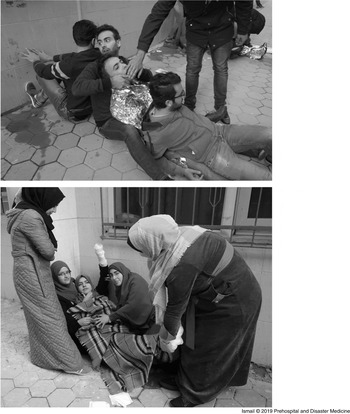
At the end of the training, a mass-casualty scene, similar to that in bombing and military attacks in Gaza, was also simulated. A scene was designed to include five to six casualties with realistic make-up and play to simulate various types of injuries. A lightly injured casualty would come screaming in the classroom asking the medical students to come and help. The students worked in groups and each group took responsibility for one patient in the scene (Figure 1 and Figure 2). This simulation served to train the students in groups on giving BLS and CPR, scene management, triage, and transporting patients.
All teaching material was developed based on the European Resuscitation Council (ERC; Niel, Belgium) 2015 guidelines and experience from similar training at UiT The Arctic University of Norway (Tromsø, Norway).Reference Monsieurs, Nolan and Bossaert10,Reference Olsen11 The conservative nature of the local society was not a hindrance for male and female medical students to be trained together. Lectures were held for both genders in the same auditorium, and groups in the practical training included male and female students. This aspect was emphasized to give a more natural feeling of how it would be to work in a real emergency in local communities.
Multiple-Casualty Scene is Simulated; Medical Students Train in Groups.

Photos and videos of the practical training were recorded and screened for the student instructors immediately following the training session. This procedure allowed the students to see how they performed and where improvements could be made. Microanalysis of the individual behavior and performance was conducted through watching the recorded videos. Also, students were asked to report what they thought was good and what was possible to improve in their team performance. A discussion of how to improve communication, teamwork, and leadership ensued with comments from the trainer and the fellow medical students. In the end, conclusions were drawn of what was done properly and what could be improved. The training and the study were approved by the board of the faculty of medicine and the study was approved by the Helsinki Committee in the Palestinian Health Research Council (Gaza, Palestine).
Laypeople Training
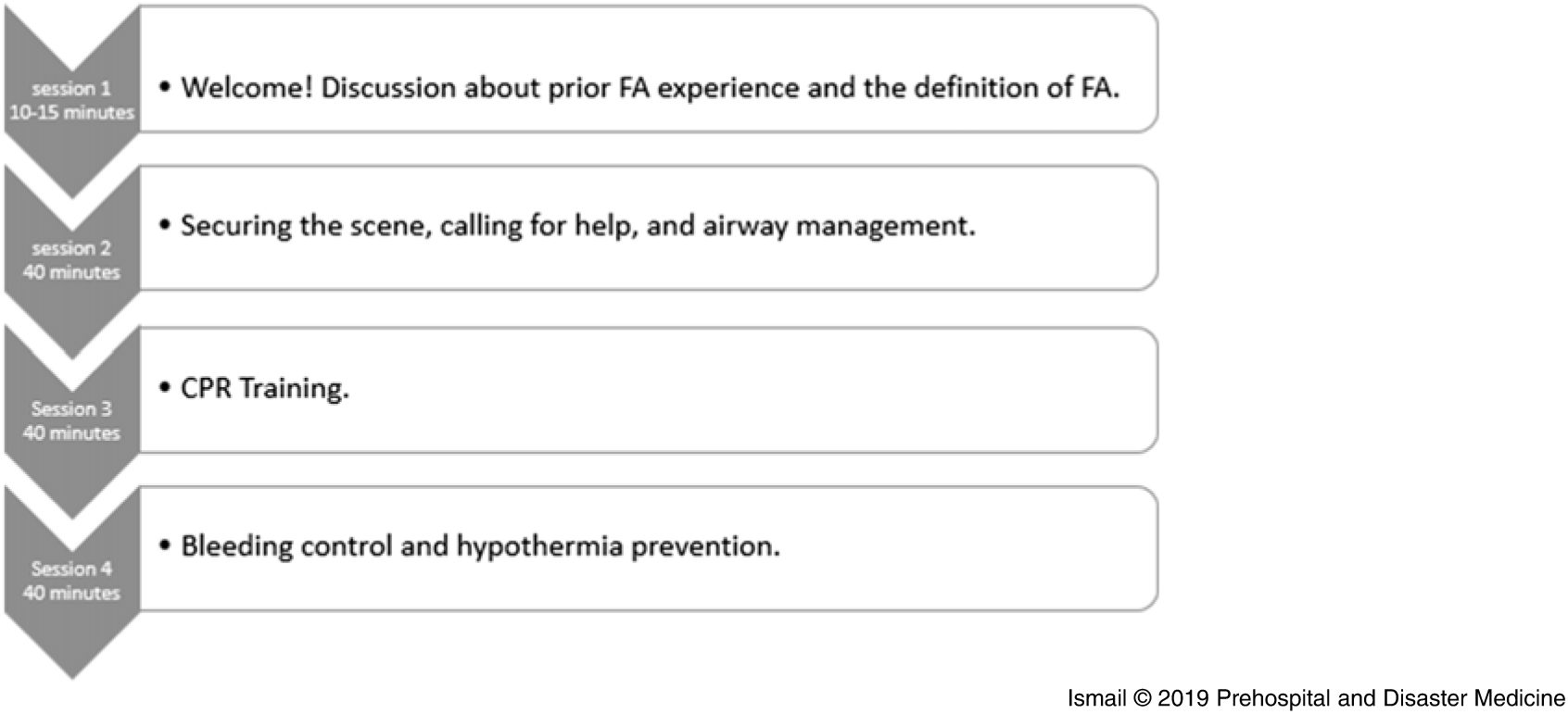
The student instructors started training groups of laypeople soon after completion of the instructor’s course. Training sessions for laypeople typically lasted approximately two hours. The participating lay audience was trained to secure the scene, call for help, open and control the victim’s airways, understand when to start CPR, perform basic CPR, start bleeding control, prevent hypothermia, and provide patients with encouragement and comfort. The organization of the training is shown in Figure 3. Some training sites received first aid kits containing essential equipment needed to act in emergency situations. The first aid kits contained gloves, adhesive bandages, gauze, and scissors for removing clothes, as well as roller and elastic bandages. These kits were purchased from local suppliers, at a cost of USD$25 per kit. In other sites, individual first aid packs were provided for the trainees. These packs included some gloves, two elastic bandages, and gauze, at a cost of USD$5 per kit.
The Organization of the Training Session for the Laypeople.

Results
The Instructors
Initially, a total of 316 students showed interest and signed up to take the training course and become a volunteer instructor. The total number for whom the course was offered was 420 (third, fourth, fifth, and sixth year students). This showed an interest in becoming a volunteer instructor with a rate of 75.2%. A little over one-third (n = 117; 37.0%) of the students who signed for the training were selected and trained to be volunteer instructors.
Ninety-five medical students completed the online questionnaire, 52.7% females and 47.3% males, all in their early twenties. The response rate to the questionnaire was 81.2% (95/117). Thirty-three medical students were in their third year at the time of receiving the training. Thirty-eight were in their fifth year and twenty-four were in their sixth year.
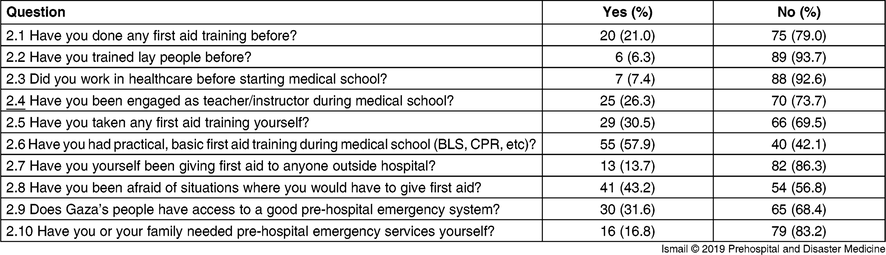
Five students reported having lost family members during Israeli attacks. More than one-fourth of the students (n = 27) had lost house or property during attacks. Table 1 describes students’ prior experience in first aid training and teaching. Nine out of ten students had no previous experience in training laypeople and 70.0% had never taken a first aid training course themselves.
Prior Experience of the 95 Medical Students who Participated in the Training to Become Life-Saving First Aid Instructors for the Laypeople

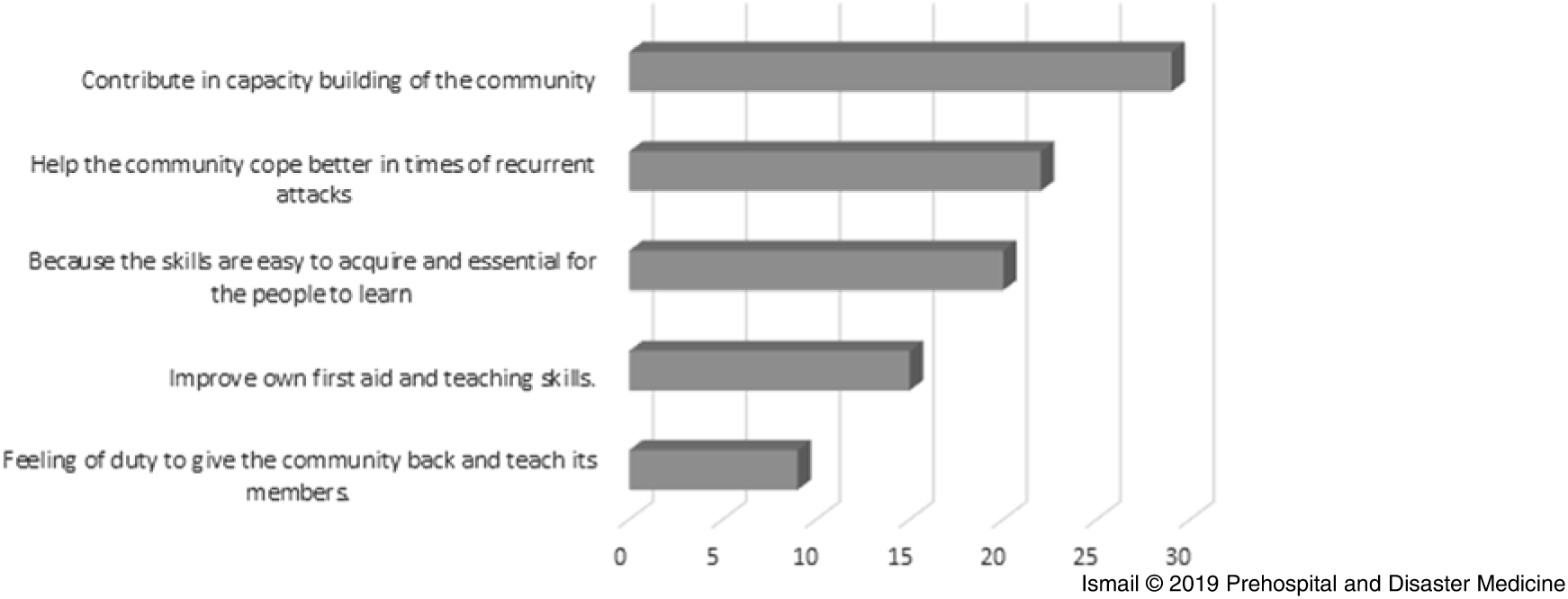
Students reported various motivations to apply for the training: building the capacity of the community (n = 29) and contributing to better coping with the tense situation and the recurrent incursions (n = 22) were the most common motives. Figure 4 shows the motivation to join the training program for all students. More than one-half (n = 51; 53.7%) wanted to improve personal clinical skills in BLS and CPR, whereas 40.0% (n = 38) of the students wished to contribute to achieving training 3,000 lay people. Nearly two-thirds described a sense of belonging and duty to the community as their most important inspiration (n = 61; 64.2%). The majority (n = 71; 74.7%) preferred to train teens and young adults (ie, school and university students).
The Motivations of the Medical Students (in Numbers) to Join the Program to Train Laypeople Life-Saving First Aid, in a Descending Order.

Seventy-six students (80.0%) hoped the training would contribute to increased capacity and skills in the community’s response to emergencies, especially during military attacks. More than one-half (n = 56; 58.9%) wished that the project would increase the number of emergency patients receiving help in the prehospital settings, improving survival for out-of-hospital victims. As coming doctors, the students believed that the project would also improve their own technical skills (n = 46; 48.4%), would improve their communications with the surrounding community (n = 25; 26.3%), and would build up their self-confidence (n = 21; 22.1%). Three people (3.2%) preferred not to answer this question.
The Training Sessions
Fifty-eight training sessions with 1,312 lay participants were completed (so far). The majority of lay trainees had been school students aged 13–20 years (n = 1,012; 77.1%). The male:female ratio of trainees was 1:1.2. An average of 4.1 medical student instructors were present in each training session, yielding a ratio of 5.52 lay trainees per student instructor.
Discussion
Three training courses were conducted for volunteering medical students in order to make them instructors in life-saving first aid and CPR for lay civilian Palestinians in the Gaza Strip. A total of 117 students were trained. Fifty-eight training sessions were conducted for laypeople, during which 1,312 laypeople were trained. The program is still active with the goal to train at least 3,000 laypeople, well within reach.
Almost all students had lived all their lives and study medicine in besieged Gaza; all had witnessed and survived at least three major military attacks. Students had experienced loss of family members as well as loss of their house or a property during attacks. The students and their families are constantly exposed to low-intensity warfare, political instability, and economic hardships. Strong motives for the medical students to join the program were the sense of belonging to the community and the desire to contribute to competent response in attacks. This picture reflects the austere conditions and severe stress in which the students live and their desire still to contribute to better the conditions for their fellow citizens of Gaza.
A recent review article identified six similar training programs in LMICs during the last five decades.Reference Callese, Richards and Shaw12 The programs were in North Iraq and Cambodia, Iran, Ghana, Nepal, South Africa, and Uganda.Reference Husum, Gilbert and Wisborg13–Reference Jayaraman, Mabweijano and Lipnick18 The programs mainly aimed at improving the prehospital system in their respective country or town. However, none of the programs used medical students as part of the training. The programs were of short duration and relatively similar to this program. An exception is the one in North Iraq and Cambodia, which established the concept of “The Village University,” where trainees received advanced training over three years and became instructors. The programs in North Iraq and Cambodia and in Iran were similar to this program regarding sustainability; local personnel with medical background were trained to become instructors to train the laypeople.
A major obstacle tackled by the programs in North Iraq and Cambodia, Nepal, Ghana, and Uganda was the transport of patients and providing basic life-saving first aid in the prehospital phase before reaching the hospital. This constraint is also relevant in Gaza, where a significant number of patients are transported by family members or friends with no prehospital life-saving first aid given. Moreover, the situation is aggravated during attacks when ambulances cannot reach the victims and family cannot evacuate from the danger zone, resulting in long time periods before any medical help is provided to the victims. Also, to overcome their feeling of helplessness, family and relatives may apply harmful measures during the transport.
The program in North Iraq was successfully sustainable at least for eight years following the initial implementation.Reference Wisborg, Murad, Edvardsen and Husum19 Almost 6,000 laypeople were trained, and the program caused a significant decrease in mortality among land mine victims with severe injuries and long prehospital evacuation times. This finding highlights an important aspect of this program and the other programs: anchoring the training program to the locals and making foreign help superfluous.
Limitations
There were no standard CPR mannequins available for the training due to the siege of Gaza and economic hardship. Instead, two old, ordinary upper-torso mannequins were used. In addition, there were no bleeding mannequins and artificial blood and make-up were used to mimic bleeding injuries realistically. The cultural barriers of the society did not allow for a more engaged training. The analysis only includes answers from those who joined and took training, but it doesn’t include and compare the answers of those wanted to join and couldn’t. No statistical validity was carried out for the questionnaire before being administered to the students. At the beginning of the laypeople training, only the number of trainees was collected and there was a lack of systematic data collection to gather demographics and prior first aid experience.
Conclusion
In this study, it is shown that local medical students are important, under-utilized resources for community medical work. Medical students in Gaza were willing and able to train as volunteer instructors for BLS and CPR courses targeting laypeople in communities under severe stress from siege and military attacks. This program, like similar programs, can continue to harness the under-utilized medical student and be sustainable, with promising results. The effects of such training on local resilience and patient mortality need further studies.
Acknowledgements
The authors thank the students and Dean at Faculty of Medicine, Al Azhar University-Gaza (Gaza City, Palestine) for their enthusiasm and support; Lærdal Medical Foundation (Stavanger, Norway) and the Palestine Children’s Relief Fund (PCRF; Ramallah, Palestine) for practical and logistical support; and finally the teachers and club leaders for generously allowing them to conduct the training in their classes.
Conflicts of interest/funding
Palestine Children’s Relief Fund (PCRF; Ramallah, Palestine) funded travel expenses of the trainers. Lærdal Medical (Stavanger, Norway) and PCRF provided logistical support during the instructors training sessions and provided medical students with first aid kits. Lærdal Medical funded first aid kits to the laypeople training sessions. The authors have no conflict of interest.
Author Contributions
AI contributed to data collection, data entry, data analysis, interpretation of the results, the primary draft of the manuscript writing, editing the manuscript, literature search, and final approval of the manuscript. MA contributed to data collection, data entry and analysis, revising the manuscript, and final approval of the manuscript. MS contributed to data collection, data entry and analysis, revising the manuscript, and final approval of the manuscript. RAH contributed to data collection, data entry and analysis, revising the manuscript, and final approval of the manuscript. HHL contributed to study design, training of the medical students, revising the manuscript, and final approval of the manuscript. GV contributed to the study design, revising and editing the manuscript, and final approval of the manuscript. MG contributed the original research idea, the study design, training of the medical students, revising and editing the manuscript, and final approval of the manuscript.
Supplementary Material
To view supplementary material for this article, please visit https://doi.org/10.1017/S1049023X19005004