From the earliest moments in American political history, women's place in the political and civic world has been connected to—and sometimes defined by—motherhood. Beginning with republican motherhood and presuffrage political activism that dealt with matters of social welfare, safety, morality, and children, women's connection to the state has historically centered on the mothering role (Beckwith Reference Beckwith2001; Kerber Reference Kerber1980, Reference Kerber, Kerber, Kessler-Harris and Sklar1995; Keyssar Reference Keyssar2000; Ritter Reference Ritter, Christina Wolbrecht and Baldez2008). It is no wonder, therefore, that this early linkage between maternal duties and female political agency shaped political elites' behavior toward women once the vote was won. Political parties and candidates often used maternal images and appeals to women's role as mother in their campaign efforts.
In the 1920s, the Democratic and Republican Parties created women's clubs that were intended to focus on issues regarding the well-being of the family and the home (Harvey Reference Harvey1998). In the 1920 and 1924 presidential elections, Democratic and Republican candidates alike sought to appeal to female voters on the particular issue of the League of Nations, with each candidate connecting “mothers' interests” to his own policy stance.Footnote 1 Indeed, these types of appeals to female voters that focused on motherhood and domestic responsibilities can be seen in presidential politics on both sides of the political aisle up until the present day.Footnote 2 And while the tone of these appeals changed with the birth of the modern women's movement in the 1960s, the discourse surrounding motherhood and presidential politics remains.
To be sure, the emergence of Governor Sarah Palin of Alaska onto the national political scene in the fall of 2008 marked a reintroduction and reframing of the long-held public connection between motherhood and politics. This linkage, however, was quite different from those made in previous presidential contests. As a “hockey mom” who attempted to reach out to other “moms,” Palin stressed her own role as mother and her interest in family, family values, and support for American military troops (including her own son, who was deployed to Iraq during the campaign). This presentation of her candidacy was arguably a strategic move to try to win “middle class” women over to the Republican presidential ticket, as well as disgruntled Hillary Clinton supporters. Although this strategy appears not to have been successful (Barack Obama won handily among women), it represents another iteration of the long-standing trend that connects motherhood to American politics.
While the Palin “hockey mom” rhetoric was distinctive, it was also a case of placing old wine in new bottles.Footnote 3 This hockey mom appeared to be a new, Alaska-inspired version of the “soccer mom” of the 1990s and the “security mom” of the 2004 election, appeals that did not appear to sway the electorate in any meaningful way (Carroll Reference Carroll1999, Reference Carroll, Lois and Whitaker2008). Why, then, did we see yet another “mom appeal” to women?
These labels appear to be the product of an underlying (and unspoken) belief among political elites that mothers are different from nonmothers. They suggest that women with children have different political priorities and concerns and, at times, take different positions on political issues. In short, the continued use of motherhood by political campaigns implies that “something changes” politically when a woman becomes a mother. Taking this proposition seriously, I ask the questions: Does becoming a mother have a transformative effect on women's political attitudes? Does becoming a mother or being a mother lead to a shift in an individual's political views and policy preferences? Might there be a real phenomenon that underlies the historical use of motherhood in political campaigns? Or do these monikers ring hollow?
MOTHERHOOD AS A QUESTION OF POLITICAL SOCIALIZATION
The idea that a life event or experience (such as becoming and being a mother) has implications for an individual's political views and behaviors is not a new proposition. Political socialization specialists have long been investigating the relationship between life experiences and political development. Although scholarship shows that the preponderance of political development takes place during childhood and adolescence, there is evidence that the political socialization process can continue in adulthood. The acquisition of new roles and life experiences can create new relationships, social environments, interests, concerns, and responsibilities that can lead to changed political outlooks and contribute to the ongoing formation of the political self (Sapiro Reference Sapiro1994; Sears and Levy Reference Sears, Levy, Sears, Huddy and Jervis2003; Steckenrider and Cutler Reference Steckenrider, Cutler and Sigel1989). Indeed, the events that typically take place in adulthood, such as marital transitions, entering college, beginning a job, serving in the military, or participating in social movements, have all been shown to have implications for an individual's political behavior (Jennings and Markus Reference Jennings and Markus1977; Jennings and Niemi Reference Jennings and Niemi1981; Newcomb et al Reference Newcomb, Kathryn Koenig and Warwick1967; Sigel Reference Sigel and Sigel1989; Stoker and Jennings Reference Stoker and Jennings1995, Reference Stoker, Jennings and Zuckerman2005).
Moreover, there is some evidence that political change can stretch past young adulthood into middle age, and that some events are more consequential for women than for men. For example, Laura Stoker and M. Kent Jennings (Reference Stoker, Jennings and Zuckerman2005) find that married men and women converge politically over time through a process of mutual socialization, with women showing greater accommodation than their husbands. In addition, more recent, innovative strains of political behavior research have tapped into themes that are important to the socialization literature. New waves of scholarship that connect personal experiences to political attitudes and political behavior offer mounting evidence that the personal events and environments of adulthood shape how individuals think about and act in the political world (Burns, Schlozman, and Verba Reference Burns, Schlozman and Verba2001; Cramer Walsh Reference Cramer Walsh2004; Harris-Lacewell Reference Harris-Lacewell2004; Stoker and Jennings Reference Stoker, Jennings and Zuckerman2005).
The study of life events offers a unique way to look at connections between individuals' life histories and their political attachments. David O. Sears and Sheri Levy (Reference Sears, Levy, Sears, Huddy and Jervis2003) assert that the life histories of individual's social and political orientations are significant because of the effect they have on individual development throughout adulthood: “[T]he constant tension between continuity and change is played out throughout an individual's life span,” and this motivates ongoing change, be it directional change in attitudes or the reinforcement of prior beliefs (Sears and Levy Reference Sears, Levy, Sears, Huddy and Jervis2003, 60). What fosters continuity and what promotes change is found, in part, in the events and experiences that fill out an individual's life history. Because life histories are varied, with numerous events taking place, it would be impossible to understand how every step along the life course affected (or did not affect) an individual's political orientations. But for those life events that are widespread and take place along a time line common to the life course, more focused investigations are necessary. Investigating issues regarding the impact of life events on political attitudes and behaviors addresses unanswered questions about how political development plays out in adulthood. It also contributes to the growing discourse on how the private lives of individuals contribute to their public lives as citizens. Here, I examine an event that is frequently lauded as one of the most significant of a woman's life: becoming a mother.
MOTHERHOOD MATTERS
Extensive research, primarily in the fields of psychology and sociology, document many of the changes that accompany parenthood and produces compelling evidence that becoming a parent and being a parent are indeed life-altering experiences. This is particularly true for women. For example, researchers have established that parenthood affects the psychological well-being of individuals in both positive and negative ways (Barnett and Baruch Reference Barnett and Baruch1985; Bird Reference Bird1997; Glenn and McLanahan Reference Glenn and McLanahan1982; McLanahan and Adams Reference McLanahan and Adams1987; Nomaguchi and Milkie Reference Nomaguchi and Milkie2003). Parenthood can serve as the basis for feelings of generativity or for commitment to helping future generations (Stewart and Gold-Steinberg Reference Stewart and Gold-Steinberg1990); parenthood alters levels of marital satisfaction (Belsky Reference Belsky1985; McLanahan and Adams Reference McLanahan and Adams1987; Nomaguchi and Milkie Reference Nomaguchi and Milkie2003); and parenthood marks a shift in identity and self-concept (Cowan and Cowan Reference Cowan and Cowan1992; Mercer Reference Mercer2004).
In addition, becoming a parent has implications that extend outside of the psychological realm. Parenthood also affects social resources: It alters social networks (Gallagher and Gerstel Reference Gallagher and Gerstel2001; Ishii-Kuntz and Seccombe Reference Ishii-Kuntz and Seccombe1989; Nomaguchi and Milkie Reference Nomaguchi and Milkie2003; Umberson and Gove Reference Umberson and Gove1989); offers a foray into community institutions (Nomaguchi and Milkie Reference Nomaguchi and Milkie2003); and facilitates deeper social integration that fosters closer ties to other adults (Nomaguchi and Milkie Reference Nomaguchi and Milkie2003; Umberson and Gove Reference Umberson and Gove1989). Having a child also meets one of the most common societal expectations. Parenthood is an expected adult role, “one that fits with American cultural ideas that place a premium on having children” (Nomaguchi and Milkie Reference Nomaguchi and Milkie2003, 357). This role brings with it a sense of legitimacy, as well as certain rights and privileges that are both cultural and political (Sieber Reference Sieber1974).
While they are widespread, the effects of parenthood are, of course, not universal. Scholars are careful to note that the impact of parenthood is often mediated through family structure, marital status, socioeconomic status, and employment status. Of particular importance are differences in parenthood that exist along gender lines. Although parenthood is consequential for men and women along a multitude of dimensions, there is evidence that its effects are more acute on women. Scholars acknowledge the transition into motherhood as a major development in the life of a woman in a way that is not equivalent to the adoption of fatherhood by men (Meleis et al. Reference Meleis, Sawyer, Im, Messias and Schumacher2000; Mercer Reference Mercer2004).
Political science also has something to say about parenthood. Scholarship that focuses primarily on political participation indicates that despite earlier conclusions that having children causes a drop-off in political activity, being a parent does not always lead to decreased levels of political participation (Bowers Reference Bowers2003; Burns, Schlozman and Verba Reference Burns, Schlozman and Verba2001; Verba, Schlozman, and Brady Reference Verba, Schlozman and Brady1995). According to Bowers (Reference Bowers2003), participation rates for men and women in a few types of political and civic activities actually rise at certain points in their parenting careers. Although the effects are different for younger parents and individuals who have multiple children, Bowers argues, having children overall does not depress political participation. In some cases, it may even promote it. Once again, gender differences emerge when looking at the effects of parenthood on participation, with men and women responding differently to the adoption of this role (Bowers Reference Bowers2003; Elder and Greene Reference Elder and Greene2005, Reference Elder and Greene2007).Footnote 4
Some scholars do address political attitudes specifically. Alice H. Eagly and her colleagues (Reference Eagly, Diekman, Johannesen-Schmidt and Koenig2004) find that although the effects are complex, motherhood may increase women's greater support (relative to men) for compassionate policies that offer public support to families and communities. Moreover, they also find that motherhood may contribute to more traditional positions on public policies that can be seen as “morality issues” (2004). Other scholars have come to similar conclusions (Elder and Greene Reference Elder, Greene and Whitaker2008; Howell and Day Reference Howell and Day2000).
MOTHERHOOD AS A DYNAMIC EXPERIENCE
Motherhood is not a stable, static state; it is a dynamic process. The arrival of a child and its growth and development mark a constant shifting in the daily activities, concerns, and social engagements of a mother. Undoubtedly, along with this constant evolution of the parenting experience is an evolution of self-perception as a mother—and perhaps—as a citizen. Previous examinations of the impact of motherhood use cross-sectional data to look at the effect of being a mother (versus not being a mother) on a set of political attitudes. This type of analysis, while helpful in understanding cross-sectional differences, does not offer any information as to whether becoming and being a mother drives attitude change. For this reason, I use over-time panel data to capture the dynamics of this life event in order to better estimate the power of motherhood.
I investigate attitudinal change as it relates to five political attitudes. These attitudes, which gauge views on drug legalization, military, police, partisan identification and ideological orientation, reflect several issue areas that are traditionally linked to the differing stances that characterize women's views (relative to those of men).Footnote 5 Indeed, a gender gap emerges on issues linked to traditional morality such that women are less supportive of “behavior that violates conventional moral norms in domains such as sexuality, drug use, suicide, and family life” than are men (Eagly et al. Reference Eagly, Diekman, Johannesen-Schmidt and Koenig2004, 802–3); this includes more conservative views on issues such as the use of marijuana (Shapiro and Mahajan Reference Shapiro and Mahajan1986). Women are also less likely to support use of force or military aggression, but more likely than men to support policies that involve the protection of the public and crime policy that is seen as preventative rather than punitive (Hurwitz and Smithey Reference Hurwitz and Smithey1998; Shapiro and Mahajan Reference Shapiro and Mahajan1986). Finally, women are more likely to favor the Democratic Party and hold more liberal ideological orientations than are men (Shapiro and Mahajan Reference Shapiro and Mahajan1986). These findings in the literature make the five attitudes examined here relevant to inquiries surrounding the role of gender in shaping attitudes. However, what makes them relevant to a study on motherhood?
Scholars often invoke theoretical discussions surrounding social roles and the socialization of gender norms in their understandings of gender differences. Eagly and her colleagues (Reference Eagly, Diekman, Johannesen-Schmidt and Koenig2004) make use of social role theory, which articulates a process whereby societal expectations based on gender shape attitudes and action. This perspective posits that the socialization of women as being other-regarding and nurturing contributes to their more liberal stances on social welfare issues than those of men, as well as their more conservative stances on traditional morality (which Eagly et al. also see as marked by women's role obligations surrounding the giving of care).Footnote 6 By extending the logic of this perspective, we might expect that mothers should emerge as distinctive from nonmothers with regard to some of these issue areas. If women are marked by distinct attitudes on a set of political issues in part because of the socialization of social roles, does engaging in these social roles create additional distinctions? Thus, to better understand if it is the role itself that contributes to attitudinal distinctions, rather than simply the socialization of characteristics that are attached to the role, I look to see if motherhood promotes attitudinal change among women.
This perspective is not a new one. Some scholars, most notably theorist Sara Ruddick (Reference Ruddick1989), have argued that the act of mothering leads to more pacifist views, and that this helps to explain gender differences on issues of militarization and war. Empirical investigations into whether being a mother promotes pacifist views, however, have not found support for this as an explanation (Conover and Sapiro Reference Conover and Sapiro1993). Thus, this “mothering” argument on its own does not provide a compelling rationale to expect change. However, when considering this argument alongside of the scholarship on self-interest, we might expect motherhood to produce attitudinal shifts. The literature on self-interest suggests that when self-interest is salient and clear, it can shape the political stances that individuals may take (Chong, Citrin, and Conley Reference Chong, Citrin and Conley2001; Citrin and Green Reference Citrin, Green and Long1990; Sears and Citrin Reference Sears and Citrin1985; Sears and Funk Reference Sears, Funk and Zanna1991; Stoker Reference Stoker1994). Thus, when women consider policy issues that may affect their own children (access to drugs and issues of safety), we may see that motherhood shapes women's political attitudes.
More concretely, I look to see if becoming a mother promotes a more conservative stance on the legalization of marijuana (mapping onto gender differences on moral traditionalism and assuming self-interest in keeping drugs less accessible to children). I examine attitudes toward the military and police, anticipating that motherhood would lead to increased support for these institutions (mapping onto gender differences with regard to policies that involve the protection of the public and assuming that self-interest in children's safety translates into support for these protective institutions).Footnote 7 Finally, I examine shifts in partisan identification and ideological orientation. Although the literature on the gender gap clearly states that women are more likely to be Democratic and liberal than men, scholarship on partisan identification and ideology suggests that these attitudes are less easily changed and at times muddled (Converse Reference Converse and Apter1964; Converse and Markus Reference Converse and Markus1979). Moreover, the self-interest argument does not extend naturally to issues of general political orientations. Thus, I expect that motherhood should not have a directional effect on these attitudes. It is possible, however, that if motherhood reinforces some policy preferences (some of which move women in a more liberal direction and others that move women in a more conservative direction), the intensity of political orientations could change. Thus, I look to see if women's partisan and ideological attachments become more polarized with motherhood.
DATA
I use the Political Socialization Panel Study to assess the dynamic effects of motherhood on women's political attitudes. This is a four-wave study of high school seniors and their parents that begins in 1965 and continues with additional waves of data collection in 1973, 1982, and 1997. The initial wave of data collection comes from 1,669 high school seniors and one of their parents chosen at random. The students were selected as part of a national probability sample of students located in 97 public and private high schools. The subsequent waves provide complete data on 935 individuals from the student cohort, representing an unadjusted retention rate of 56% (Jennings, Stoker and Bowers Reference Jennings, Stoker and Bowers1999).Footnote 8 In the 1965 wave, all respondents were interviewed in a face-to-face format, as were the majority of respondents in 1973 and 1982 (though some of the hard-to-reach respondents in 1982 completed a short mail-back questionnaire). In 1997, about one-half of the respondents were interviewed in a face-to-face format, while the other half was interviewed on the telephone. Questions involving parenthood naturally mean that only the youth cohort can be employed in this project.Footnote 9
In important ways, these data are representative of the larger public. The reproductive patterns of the Political Socialization Panel Study sample closely reflect the patterns in the general population, according to Census data from the Current Population Study (Bowers Reference Bowers2003). Among the youth cohort, 52% of all female respondents became parents by 1973, when they were approximately 26 years of age. Seventy-seven percent were mothers by 1982 at age 35. And 85% were mothers by 1997 when they were 50 years old.
METHODS
I use ordinary least squares and a conditional change model to estimate the effects of parenthood on the dependent variables. The dependent variables all capture attitudinal change from one wave of the panel to the next. In the conditional change model, a lagged dependent variable is included in the equation to control both for prior orientations or conditions of the dependent variable that may substantively affect its change in value, as well as for technical advantages, such as accounting for regression to the mean.Footnote 10 I also include lagged and contemporaneous values for “parental status,” as that is my primary variable of interest.Footnote 11 The parent variable indicates when the respondent first became a parent. This is done to account for any differences that might be correlated with age of entry into parenthood, as well as to identify if there are patterns with regard to whether motherhood has more immediate or lagged effects on attitudes.Footnote 12 I also include independent variables that represent change from Time 1 to Time 2. The model is represented by the following equation, where β1 represents parental status and β2, β3 and so on represent other important demographic characteristics:

For each dependent variable, I run several models in order to understand if and how parenthood affects these political attitudes, but present only a final model that includes controls for demographic changes, as well as shifts in political orientation controls.Footnote 13
To capture change in both the dependent and independent variables, I use difference scores. Difference scores simply capture the change in a variable between Time 1 and Time 2, and permit an investigation into shifts in political attitudes and behaviors at different points throughout the life course. This method holds constant the change in other aspects of the respondent's life (such as shifts in income or religiosity) when honing in on the impact of becoming a parent.Footnote 14 In addition, lagged dependent variables are included in all of the models.
The dependent variables that I examine in this article represent a range of political attitudes.Footnote 15 See the Appendix for question wording.) They are all measured in three of the waves: 1973, 1982, and 1997. For the change variables, 0 represents change in the liberal direction, while 1 presents change in the conservative direction; .5 indicates no change. All contemporaneous variables, dependent and independent, are coded 0 to 1, with 0 representing the Democratic/liberal position and 1 representing the Republican/conservative position.Footnote 16 Dependent variables that capture the polarization of partisan identification and ideology are intended to capture degrees of polarization rather than directional change. Polarization is defined as attitudinal change that moves more than one-fourth of the distance of the scale toward the poles of the scale. Thus, respondents whose attitudes shift more than one-fourth of the distance of the scale in either direction are scored as a 1; respondents who move less than one-fourth of the scale are scored .5; and respondents who report no shift are scored 0. In addition, all multivariate models include controls for changes in education, income, religious service attendance (which I call religiosity), and work status from Time 1 to Time 2. In addition, there are controls for static variables, such as race, in all models.Footnote 17
FINDINGS
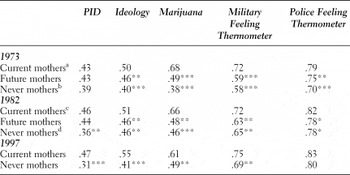
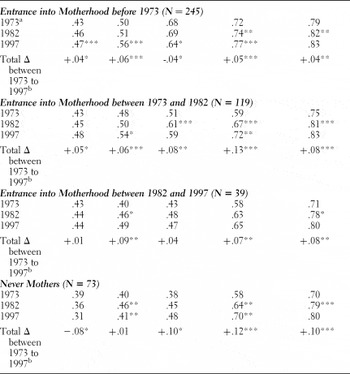
Although there certainly are important selection effects with regard to how motherhood ties into political attitudes, there is evidence that the mothering role itself also creates differences between mothers and nonmothers. Indeed, a quick look at mean differences reveals that across all three waves, mothers consistently have more conservative stances than nonmothers on all the attitudes examined. (See Table 1.) Moreover, women who are early mothers (entering motherhood prior to 1973) are almost always more conservative than other women, whereas women who never become mothers almost always hold the most liberal stances. (See Table 2.) This suggests that there may be selection effects at play, where women who are predisposed to more conservative attitudes become mothers at younger ages, while women who lean leftward may be more likely never to have children.Footnote 18
Mean differences among women by parental status, 1973, 1982, and 1997

aTo determine statistical significance, “current mothers” is the comparison group for each category of mother.
bMean differences between future mothers and never mothers are statistically significant at the .1 level for ideology, marijuana, and police.
cTo determine statistical significance, “current mothers” is the comparison group for each category of mother.
dNo mean differences between future mothers and never mothers are statistically significant.
Note: *** p < .001, ** p < .05, * p < .1.
Source: Political Socialization Panel Study, Youth Panel Data.
Mean differences among women by mother cohort

Note: Standard errors are in parentheses. *** p < .001, ** p < .05, * p < .1.
aStatistical significance is determined through a paired t-test between adjacent waves in the panel data, with asterisks for 1982 values representing mean differences between 1973 and 1982. Similarly, asterisks for 1997 values represent mean differences between 1982 and 1997.
bStatistical significance is determined through a paired t-test between mean scores in 1973 and 1992.
Source: Political Socialization Panel Study, Youth Panel Data.
These data also reveal a general trend toward more conservative positions among all women on attitudes toward marijuana, military, and police. (See Table 1.) This suggests that motherhood alone may not promote more conservative stances, but rather that with age or changing political environments, all women shift to the right. This is not the case for attitudes connected to political orientations, however. For partisan and ideological identification, women who never have children become more Democratic and liberal over time, while mothers, on average, become more Republican and conservative. Although the shifts do not always reach statistical significance, these diverging patterns are clear.
If selection effects and general trends are at work, is there anything to suggest that motherhood motivates attitude change? Indeed, these data hint that there is an independent effect of motherhood. That the mean scores are different between mothers and nonmothers across all three waves indicates that it is not purely an issue of self-selection that leads to these group differences. In each wave, additional women move from the nonmother group and enter the mother group. Rather than diluting the differences, these “new mothers” contribute to the differences across a whole host of variables. These descriptive results suggest that motherhood contributes in part to attitudinal change, though it is clear that other factors also contribute to mean differences across these cohorts and waves.
Moving from descriptive statistics to regression analysis enables me to answer the critical questions posed here: Does motherhood push women to more conservative positions on marijuana legalization, and greater support for the military and police? Does motherhood lead to more polarized ideological and partisan identities? The answer is a qualified yes; effects do emerge but they are rare. Motherhood appears to shape attitudes on some issues and for some cohorts of women. Indeed, I find that for three of the five attitudes examined here, motherhood does appear to produce an attitudinal shift in the conservative direction; however, the relationship does not appear across all waves, nor does it materialize in all cohorts of mothers. Thus, the effects that emerge are not large enough or consistent enough to make a sweeping claim that motherhood transforms the attitudes of women. Rather, the results reveal a nuanced picture of when and for whom motherhood is politically consequential.
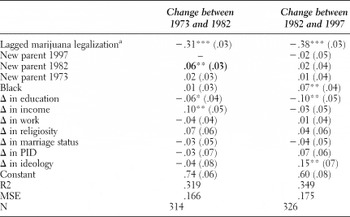
For attitudes on the legalization of marijuana, between 1973 and 1982, the model indicates that becoming a mother during this time period contributes to a shift to the right on this issue (b = .06, s.e. = .03). (See Table 3.) Having a first child during this period results in a slight movement toward opposition to legalizing the drug. Note that having a child prior to 1973 has no effect for this same time period. In addition, being or becoming a mother has no impact on shifting attitudes about marijuana between 1982 and 1997. This suggests that the effects of motherhood are quite limited in this case. Two dynamics may be at play here.
OLS regression coefficients for change in attitude on marijuana legalization among women

Note: Standard errors are in parentheses. *** p < .001, ** p < .05, * p < .1 – indicates an excluded variable.
a The lagged dependent variable represents the 1973 score for the 1973–82 period, and the 1982 score for the 1982–97 period.
Source: Political Socialization Panel Study, Youth Panel Data.
First, women who became mothers prior to 1973 had fairly stable conservative views on this issue across the first two waves. (See Table 2.) While on average these women took a slightly more conservative stance in 1982 (relative to 1973), the increase was slight and not statistically significant. This stands in contrast to the mean attitudes of the other mother cohorts, all of which become, on average, more conservative on this issue (though the difference is only statistically significant for women who become mothers between 1973 and 1982). Thus, the consistently conservative stance among young mothers across the first two waves likely explains the lack of an effect from this group of mothers in 1982.
Second, all groups of mothers became, on average, more liberal on this issue between 1982 and 1997. Though the change, again, was small, this pattern suggests that the issue of marijuana legalization became less salient and less divisive, moving from the 1980s to the 1990s. These two dynamics suggest that more moderate mothers had a greater propensity for attitudinal change, and that change was most likely to happen during a time period when the issue of drug legalization had more resonance with the public.
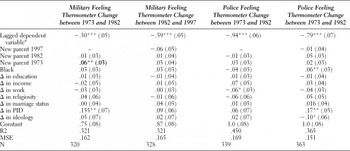
Two attitudes were intended to capture shifts toward greater support for protection of the public that may accompany motherhood: feelings toward the police and the military. Looking at Table 2, mean attitudes across the waves for each group of women reveal that all women have more positive attitudes toward the police over time, and that between 1973 and 1982, the increase is statistically significant for all groups. This suggests an attitudinal shift that is not limited to mothers, nor generated by motherhood. Indeed, the regression results bear this out. On attitudes toward the police, though the motherhood coefficient is in the right direction for attitude change between 1982 and 1997, it falls just short of statistical significance. Thus, there is no clear evidence that being and becoming a mother has an impact on attitudes toward the police for either time period captured in this analysis. (See Table 4.)
OLS regression coefficients for change in attitude toward the military and police among women

Note: Standard errors are in parentheses. *** p < .001, ** p < .05, * p < .1 – indicates an excluded variable.
aThe lagged dependent variable represents the 1973 score for the 1973–82 period, and the 1982 score for the 1982–97 period.
Source: Political Socialization Panel Study, Youth Panel Data.
The story is somewhat different for attitudes toward the military, however. Again, mean attitudes shown in Table 3 show warmer feelings toward the military among all groups, with statistically significant differences emerging between 1973 and 1982, as well as between 1982 and 1997 for all but one group. Regression results show, however, that one of these shifts is due to motherhood. Becoming a mother between 1965 and 1973 leads women to have a slightly more positive view of the military between 1973 and 1982 (b = .06, s.e. = .03). (See Table 4.) This means that women who became mothers prior to 1973 experienced a shift toward more positive feelings toward the military between 1973 and 1982, even when controlling for shifts in income, education, religiosity, political orientations, and other factors. In contrast, a similar effect was not seen among women who also became mothers between 1973 and 1982. For this group, entry into motherhood had no impact on their shifting attitudes toward the military. Similarly, no significant results emerge during the 1982 to 1997 time period for any of the motherhood variables. These results are interesting because although women who became mothers prior to 1973 held significantly more positive views of the military than the two other cohorts of mothers, all of the cohorts became, on average, more supportive of the military over time.
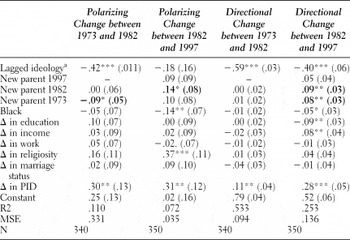
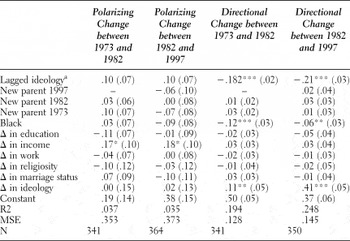
Finally, despite expectations that motherhood would have no impact on general political orientations, I find that motherhood has interesting effects on political ideology. Between 1973 and 1982, becoming a mother between 1965 and 1973 is associated with a stabilization of ideological identification (b = –.09, s.e. = .05). However, the effect flips during the second time period. Between 1982 and 1997, becoming a mother between 1973 and 1982 leads to a more polarized ideological attachment (b = .14, s.e. = .08). This indicates that motherhood contributed to movement toward the ends of the ideological spectrum. (See Table 5.) Is this polarization moving in one direction or another? To test this, I look at directional change of ideological stances and find that though there are no directional motherhood effects for the period between 1973 and 1982, during the second period—1982 to 1997—becoming a mother before 1973 and between 1973 and 1982 causes a shift toward a more conservative ideological identification (b = .09, s.e. = .03 and b = .08, s.e. = .03, respectively). Again, this relationship emerges even with important controls such as changes in religiosity and partisan identification. In other words, outside of the impact of those shifts, motherhood still has an effect. Partisan identification, on the other hand, is quite a different story. Motherhood has no effect on the polarization of party preferences in any of the waves, nor does it have an effect on directional change. (See Table 6.)
OLS regression coefficients for change in ideological orientation among women

Note: Standard errors are in parentheses. *** p < .001, ** p < .05, * p < 1. – indicates an excluded variable.
aThe lagged dependent variable represents the 1973 score for the 1973–82 period, and the 1982 score for the 1982–97 period.
Source: Political Socialization Panel Study, Youth Panel Data.
OLS regression coefficients for change in partisan orientation among women

Note: Standard errors are in parentheses. *** p < .001, ** p < .05, * p < .1 – indicates an excluded variable.
aThe lagged dependent variable represents the 1973 score for the 1973–82 period, and the 1982 score for the 1982–97 period.
Source: Political Socialization Panel Study, Youth Panel Data.
The observation that some attitudinal change among some women is rooted in motherhood naturally leads to the question of whether this same dynamic can be found among men. Although fatherhood is not subject to the same type of political sloganeering (the “NASCAR Dad” of the 2004 presidential election is one notable exception), the unique effects of motherhood are seen more clearly when juxtaposed to the effects of fatherhood. Running the same set of analyses for men, I find that for only one attitude—views about marijuana—are the effects of fatherhood similar to those of motherhood. Beyond that, motherhood and fatherhood shape the attitudes of women and men in distinct ways. Specifically, divergent effects arise when looking at attitudes related to safety. While fatherhood produces warmer feelings toward the police, there is no effect on attitudes toward the military; this is the opposite of what is seen among women.Footnote 19 Finally, in contrast to women, parenthood had no impact on general political orientations among men; this is true when looking at the polarization of attitudes as well as directional change.Footnote 20
CONCLUSION
Does becoming a mother have a transformative effect on women's political attitudes? Does becoming a mother and being a mother lead to a shift in political attitudes? Is there truth behind the historical and contemporary political appeals that imply that motherhood generates distinct attitudes among women? In this article I find that there is in fact a kernel of truth behind these appeals, though the effect that motherhood has on changing political attitudes is not uniform over time, nor is the effect uniform among women who enter into motherhood at different ages.Footnote 21 Nevertheless, some consistent and useful results do emerge.
First, when the effects of becoming and being a mother materialize, they reflect change that is conservative in orientation. Motherhood pushes some women to oppose legalizing marijuana, increase their support for the military, and stake out political orientations that are more conservative. This offers an important contribution to the existing literature on the effects of motherhood on women's political attitudes, which shows that motherhood primarily promotes more liberal views among women. While it is likely that motherhood does promote liberal attitudinal shifts for some women, particularly on issues linked to social welfare (the data employed here did not allow for an investigation into attitudes on social welfare), uncovering conservative change adds to our appreciation of the complexities of motherhood and its impact on women. Thus, these interesting moments of conservative change, while limited in scope and frequency, indicate that further investigation into the heterogeneous effects of motherhood is warranted.
A second broad finding from these results is that the impact of motherhood on shifting political attitudes is not restricted only to those women who enter motherhood at young ages—before the age of 25, when political attitudes are typically marked by some instability and thus more prone to change. Rather, attitudinal shifts are seen among women who become mothers at slightly older ages: between ages 26 to 35 (between 1973 and 1982). This suggests that even when women are past the “critical years” of attitudinal formation, they still may experience some attitudinal shifting as a result of their new mother role. Of course, this is not the case for the smaller number of women who first enter motherhood between ages 35 to 50 (between 1982 and 1997), suggesting that the impact of motherhood may be tempered by the increased political stability in preferences that accompanies middle age, and may be a result of a selection effect with regard to the timing of motherhood.
Third, it is likely that the results that emerge here reflect an interaction between motherhood and the political environment of the day. That motherhood has an effect on attitudes toward marijuana legalization between 1973 and 1982 may very well be due to a national conversation about marijuana that made the issue more salient. Similarly, this same time period marked the end of the Vietnam War and a progression in the Cold War that likely contributed to warmer feelings toward the military. Finally, the effects of motherhood on political ideology emerge between 1982 and 1997—the height of the “family values movement.” It is plausible that in each of these cases, the political environment helped to draw out the motherhood effects found here. Thus, it is crucial to take into account the political environment in which motherhood emerges as a meaningful force in attitudinal change. Motherhood alone may not produce attitudinal shifts, but political environments that highlight issues affecting children or the family may moderate the effects that this role has on women's political views.
Finally, much like the parenting role itself, gender appears to play a role in how parenthood shapes the political attitudes of men and women differently. The results here indicate that while the effects are not wholly divergent, motherhood is unique in its effect on ideological attachment. It is difficult to say whether or not the conservative shift in ideology shown here illustrates the effectiveness of the family values rhetoric of the 1980s and 1990s among mothers in particular; however, it is clear that gender is a critical dimension to consider when investigating the impact of parenthood on political attitudes.
Also important to note are two ways in which this investigation and these findings are constrained. First, these data, though offering the best over-time picture of adult political socialization available to researchers, are limited by their inability to be generalized to other points in political history. The women in these data came of age during the Civil Rights movement and Vietnam. They experienced the Cold War, glasnost, the Moral Majority, and the Republican Revolution. Undoubtedly, the political context in which they lived not only shaped the salience of political issues but also gave some of these issues their political meaning. This means that extrapolating from the findings of the article must be done with caution. The role of generation may be critical in understanding how motherhood shapes women's political attitudes; only with new longitudinal data, can this relationship be better understood.
A second limitation of these findings is the limited number of dependent variables examined here. Again, the great virtue of the data employed in this investigation is that they capture change across crucial years of adulthood. Unfortunately, many attitudes that would be important to examine are not measured. Issue attitudes that seem to be consistently linked to mothers and motherhood, such as support for school funding, child care, and health care, are not captured in these data. Similarly, issues that are more traditionally linked to women's liberal policy-attitude orientations are not available here. Thus, the conclusions of this article are limited by both what is captured by these data and by what is not.
Despite these limits, there is some evidence that motherhood matters. The patchwork of effects shown here illustrate that for some women, on some issues, the process of becoming a mother and being a mother does have an impact on how they view the political world. In these instances, motherhood promotes attitudinal shifts—though slight—that are consequential to women's political views. Moreover, these findings provide new insights into attitudinal change among women, offering evidence that stands in contrast to scholarship that emphasizes women's liberalism and, specifically, to research that highlights the role of motherhood in directing liberal stances. While motherhood may very well produce liberalizing change on attitudes not captured in these data, the results reported here show that motherhood can, for some, promote conservative shifts. This highlights the need to uncover heterogeneity among women in order to fully understand how gender shapes political views and actions. These results also show that while motherhood may matter to women's political beliefs, it does so in nuanced ways. Thus, the historical appeal to female voters through the lens of motherhood is not without empirical basis, but it requires further inquiry to be fully understood.
APPENDIX: QUESTION WORDING
Support for the Legalization of Marijuana:
Some people think that the use of marijuana should be made legal. Others think that the penalties for marijuana should be set higher than they are now. And other people have opinions somewhere in between.
Where would you place yourself on this scale, or haven't you thought much about this? 1, Make use of marijuana legal, to 7, Set penalties higher than they are now.
Military and Police Feeling Thermometer:
There are many groups in America and we would like to get your feelings toward some of them. Here's a card on which there is something that looks like a thermomenter. We call it a feeling thermometer because it measures your feelings toward these groups. Here's how it works. If you don't feel particuarly warm or cold toward a group, then you should place it in the middle at the 50-degree mark. If you have a warm feeling toward a group, or feel favorably toward it, you should place it somewhere between 50 degrees and 100 degrees, depending on how warm your feeling is toward the group. On the other hand, if you don't feel very favorably toward a group, that is, if you don't care for it too much, then you would place it somewhere between 0 degree and 50 degrees. Of course, if you don't know too much about the group, just tell me and we'll go to the next one. Where would you put the military/police (score on the thermometer)?
Partisan Identification (Standard 7-Point Scale):
Generally speaking, do you usually think of yourself as a Republican, a Democrat, an Independent, or what? Would you call yourself a strong Republican or a not very strong Republican? Would you call yourself a strong Democrat or a not very strong Democrat?
Political ideology (Standard 7-Point Scale):
We hear a lot of talk these days about liberals and conservatives. Here is a 7-point scale on which the political views that people might hold are arranged, from extremely liberal to extremely conservative.
Where would you place yourself on this scale, or haven't you thought much about this?