In August 1923, Harry Hamilton Laughlin of Cold Spring Harbor, Long Island, New York, submitted an entry to the American Peace Award Contest, which offered $100,000 “to the author of the best practicable plan by which the United States may cooperate with other nations to achieve and preserve the peace of the world.”Footnote 2 Laughlin's submission, entitled “The Common Government of the World,” did not win the prize.Footnote 3 That went instead to Charles Herbert Levermore. The result of the contest is hardly surprising. Levermore held an office in a prominent internationalist organization, the League of Nations Union, and was also a friend of the former U.S. president, Woodrow Wilson, whose Fourteen Points were the inspiration for an actual international body established after World War I, the League of Nations.Footnote 4 What is surprising, if current historical scholarship is to be believed, is that Laughlin, a prominent member of the American eugenics movement, actually entered the Peace Award competition at all.
In his book Changing the World: American Progressives in War and Revolution, Alan Dawley suggested that the popularity of eugenics in post-World War I America was part of a reaction against internationalism. Dawley argued that the upheaval and unrest experienced in the United States as a result of World War I alienated many erstwhile progressives from the cause of reform, whether in domestic or foreign policy. According to Dawley, while some progressives remained committed to the struggles for social justice and international peace, many others joined with the rising forces of conservatism. The “conservative impulse,” stated Dawley, was characterized by resistance to demands for workers' rights, racial justice, and social reform, as well as withdrawal from multilateral initiatives on the international scene. Dawley claimed that there was a direct link between the American elite's fear of spiraling social unrest and their decision to “turn away from participation in the League of Nations.”Footnote 5 Among the most visible manifestations of this rising conservatism were laws instituting “prohibition, eugenic sterilization, and immigration restriction,” all of which received support from various elements of the prewar progressive coalition.Footnote 6 It appears ironic that one of the nation's most influential champions of both eugenic sterilization and immigration restriction, Harry H. Laughlin, was fascinated by the idea of a transnational political body, such as the League of Nations, and devoted a great deal of time and energy over more than forty years to formulating and promoting his own template for world government.
Few individuals better exemplify than Laughlin the forces of conservatism identified by Dawley. During the early twentieth century, he achieved prominence as an influential exponent of three causes that were experiencing their heyday in the United States: the dissemination and institutionalization of eugenicist precepts;Footnote 7 the compulsory sterilization of the socially inadequate;Footnote 8 and the restriction of immigration, especially from southern and eastern Europe.Footnote 9 Laughlin directed the nation's leading eugenics laboratory and held executive positions in the main eugenics societies; he drafted a model sterilization law that was adopted by numerous American states, declared constitutional by the Supreme Court and later acclaimed by the Nazi regime in Germany; and he served as principal scientific advisor to the U.S. House of Representatives committee on immigration and naturalization that produced the most restrictive immigration law in the country's history. In using the triumph of eugenics as a symbol of both the rise of the conservative domestic agenda and the decline of American interest in internationalism, therefore, did Dawley choose a defective example to demonstrate his argument, or was Laughlin's interest in world government an aberration? If the latter, how did Laughlin balance his commitments to the seemingly contradictory causes of eugenics and internationalism? Did his support of one ultimately undermine his commitment to the other? Or did he manage to comfortably straddle the paradox created by his interest in these two ideals? Moreover, did Laughlin's close association with one movement compromise his ability to exert influence upon the other?
Due to his relentless self-promotion, it is relatively easy to discern what other internationalists thought of Laughlin and his theories on world government. He sent samples of his work to virtually anyone who he believed might prove of assistance in getting his ideas more widely disseminated. In the late 1910s and early 1920s, he circulated copies of an article he had written on the subject of apportioning representation in a world assembly to countless members of the peace and internationalist movements or at least persons whom he thought had such an association, including the politician William Jennings Bryan, the editors Edwin S. Slosson and Waldemar Kaempffert, and the philanthropists Andrew Carnegie, John D. Rockefeller Jr., and John Harvey Kellogg.Footnote 10 Laughlin also approached numerous international figures, such as the author H. G. Wells, to write a preface for various drafts of a world government constitution he had prepared. At one point, he even attempted to enlist the services of the French foreign affairs minister, Aristide Briand, the British prime minister, Ramsey MacDonald, the German chancellor, Heinrich Brüning, and the American president, Herbert Hoover.Footnote 11 In 1933, Laughlin tried to persuade Secretary of State Cordell Hull to grant a State Department seal of approval for his ideas on world government.Footnote 12
Needless to say, not all of the persons canvassed by Laughlin replied to him, and few agreed to endorse his plans for world government. Nonetheless, he did maintain a correspondence with a surprising number of prominent and influential internationalists, including, among others: Moorfield Storey, the veteran civil rights activist and president of the Anti-Imperialist League; Judge William H. Wadhams, a leading member of the League to Enforce Peace; Oscar Newfang, who became one of the leading American exponents of world federalism during the 1930s; and “Colonel” Edward M. House, President Wilson's chief foreign policy advisor, who played a key role in the peace negotiations at the end of World War I.
It is easy to imagine how members of the internationalist movement approached by Laughlin might have viewed him as an unlikely member of their coterie, because his credentials were not those of the typical internationalist. To most of his contemporaries, Laughlin's main claim to distinction would have been his appointment as the first superintendent of the Eugenics Record Office at Cold Spring Harbor, Long Island, a research center funded by the wealthy widow of the railroad magnate E. H. Harriman and affiliated with the genetics department at the Carnegie Institute of Washington, D.C. The eugenics movement is now accepted as one of the many manifestations of progressivism, and Laughlin comfortably fits the mold of an early twentieth-century “progressive,” particularly the kind of efficiency expert who welcomed government intervention in the name of advancing the social good.Footnote 13 Laughlin wholeheartedly supported other progressive reforms, like woman suffrage and the prohibition of alcohol.Footnote 14
However, contemporaries would have associated Laughlin more with the conservative strands of progressivism than the liberal ones, such as internationalism. It is no coincidence, for instance, that Laughlin was promoting the causes of eugenics, compulsory sterilization, and immigration restriction, as well as touting his plans for world government, at the same time as the influence of white supremacism reached its apogee in the American South and the nation as a whole. Laughlin saw no contradiction between Jim Crow and his own ideas on either eugenics or internationalism. During the 1920s, Laughlin became a close associate of Dr. Walter A. Plecker, registrar of vital statistics for the Commonwealth of Virginia, who played a leading role in securing passage of that state's Racial Integrity Law in 1924. The law was designed to prevent the racial amalgamation of blacks and whites by, among other devices, defining a black person as anyone with the minutest trace of African ancestry. Plecker warned that the white race would eventually become extinct in North America if other states did not follow the example of Virginia and enact similar legislation.Footnote 15 Beyond offering encouragement to Plecker, Laughlin actively promoted the latter's campaign for racial integrity laws in other states. Laughlin regularly used his annual written contribution to a popular reference work, the American Year Book, as a platform for publicizing Plecker's ideas and activities.Footnote 16 Although Laughlin was not prone to making virulent racist remarks, he produced or endorsed a substantial number of works that used an assumption of black inferiority as a starting point. Indeed, Laughlin justified his call for the restriction of immigration from Mexico on the grounds that most Mexicans were not white and that many had some African ancestry.Footnote 17
Laughlin's evident conservatism probably explains why, like his contemporaries, historians have also perceived him as an unlikely internationalist. For instance, despite extensive coverage of his other activities, historians have generally overlooked Laughlin's passion for internationalism. Indeed, Dawley appears to have been totally unaware of Laughlin's writings on world government or correspondence with prominent internationalists.Footnote 18 This oversight is understandable, because, as a rule, leading eugenicists in the United States focused almost entirely upon domestic issues or the domestic ramifications of international developments. Lothrop Stoddard's notorious The Rising Tide of Color was the sole major work written by an American that consciously viewed international relations through the prism of eugenics.Footnote 19 Although Stoddard urged the world's governments to dedicate themselves to preventing the outbreak of a global race war between white and nonwhite peoples, he did not explore the issue of multinational peacekeeping institutions. Laughlin's meditations on the theme of internationalism, therefore, provide rare insight into how a leading member of the American eugenics movement viewed the international order and the prospects of reforming it.
Historians have long pondered the composition and character of the internationalist movement in early twentieth-century America. These investigations have mostly focused on the links between domestic reform movements—especially those normally associated with progressivism—and the various peace and internationalist organizations that achieved prominence in the United States around the time of World War I.Footnote 20 The most important of these movements was the one campaigning for the establishment of a multinational peacekeeping body and American membership of such an organization.Footnote 21 The United States' rejection of the Versailles Treaty and refusal to join the League of Nations has frequently been interpreted as proof of the victory of isolationism over internationalism.Footnote 22 However, modern scholarship has revealed that internationalism persisted in the United States during the interwar period, albeit in a more subdued and circumscribed form, and then blossomed during World War II and in the short-lived World Federalist Movement.Footnote 23 Nonetheless, historians still disagree over the reasons behind the political ineffectualness of the internationalist movement. Sometimes the blame is put on the internal divisions that characterized the movement,Footnote 24 while other times attention is drawn to its ideological limitations,Footnote 25 particularly the racism,Footnote 26 sexism,Footnote 27 and imperialismFootnote 28 that informed its notion of multilateral cooperation. Progressives have also been accused of co-opting the causes of peace and internationalism in the furtherance of their own domestic reform goals, only to abandon the former campaigns when they no longer serve the needs of the latter ones.Footnote 29 This article explores these issues and debates by examining how Laughlin became involved in the internationalist movement, how his ideas on world government compared with those of other internationalists, and what position he occupied in the overall movement.
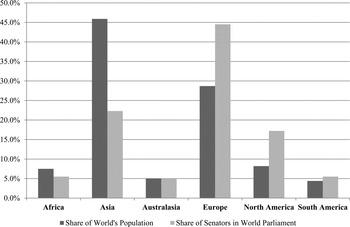
Unlike many Progressive Era champions of internationalism, Laughlin was not a fair-weather supporter of the cause. He composed a detailed paper on the subject of world government several months before President Wilson's earliest major speech on the idea of a multinational peacekeeping body and years before the League of Nations became a reality. In December 1916, Scientific Monthly published Laughlin's essay “Rating the Several Sovereign Nations on a Basis Equitable for the Allotment of Representation to a World Parliament.” In this article, he presented a system that used such factors as land area, population, literacy rate, and international commerce to determine the level of representation each nation should receive in any future multinational assembly.Footnote 30 Laughlin's formula for calculating the apportionment of representatives gave the greatest weightings to the value of international commerce (50 percent) and the size of the literate population in each country (25 percent). Laughlin recommended that the metropoles of empires should receive the full share of representation determined by this formula but that autonomous and non-autonomous colonies should receive only one-half and one-fourth shares, respectively. Moreover, he recommended that the share of representation generated by colonial possessions should be allocated to the metropoles and not the colonies themselves.Footnote 31 Unsurprisingly, this formula generated a representative assembly dominated by the Great Powers, particularly Britain, the United States, Germany, Russia, and France, which combined would have held 60 percent of the seats in any future multinational parliament.Footnote 32 In later versions of this model, Laughlin substituted “foreign commerce” with “intercontinental commerce,” because he viewed the latter as more representative of a nation's true contribution to global as opposed to merely regional affairs.Footnote 33 In these modified versions, the formulas used to allot representation retained a bias toward countries controlled by Europeans and their descendants. (See Chart 1.)
Harry H. Laughlin's plan for the apportionment of representation in the World Parliament, ca. 1932. Source: “Summary,” file B5-2B-5, Laughlin Papers.

Long before the Allied victory in World War I was in sight, Laughlin realized that the “forthcoming international readjustment” was to be one of the most pressing “after-war problems.”Footnote 34 However, the earliest surviving document in which Laughlin sketched out his ideas on the purpose and form of a world government dates to the summer of 1917. In “Repairing Our Ship of State,” Laughlin declared, “Unless this whole war is to be fought over again and again, the victorious democracies which come through its fire must federate, that is, they must forthwith and without cavil organize a super-nation, to which they [belong] severally and [as] constituent elements, and to which they shall grant such portions of their ‘inalienable sovereign rights’ as pertain to adjusting international relation[s] and to the interests of mankind as a unit.”Footnote 35 This paper, and a later one entitled “Our Faith in the Federal Idea and World Government,” called for an amendment to the U.S. Constitution that would allow the country to surrender some of its sovereign rights to a “world federation.”Footnote 36 In a 1918 work entitled “Continental Free Trade Regions and the World Government,” Laughlin produced a more detailed description of the shape he thought a world government should take.Footnote 37 By the early 1920s, these various works had evolved into the fifty-seven-page document that Laughlin submitted to the American Peace Award Contest.Footnote 38 The work had grown to seventy-fives pages by the early 1930s and had the new title of “The Fundamental Instrument for the Common Government of the World.”Footnote 39
It is possible that one of Laughlin's motives for producing such a work was that he imagined himself to be a modern-day James Madison, to whom reportedly he was related.Footnote 40 The prospect of one day being known as the “Father of the Constitution” for the whole world would most probably have slotted very comfortably into Laughlin's inflated self-image. This might be inferred from the fact that Laughlin went to the trouble of penning a preamble to his world government template that closely resembled the U.S. Constitution:
WE, the Sovereign People of the Earth, drawn into close contact by the growth of civilization, understand and declare that in order to live under the greatest independence, to develop our individual races and cultures, to enjoy the fruits of our own labors, to profit from cultural contact and trade with our fellow communities, and to insure inter-community justice and peace, our common duties must be faithfully performed, and our civil rights effectively defended. THEREFORE, in order to enjoy these ends, WE, the Sovereign People of the Earth, do hereby establish the fundamental structure for our Common World Government, and do hereby declare the basic principles upon which all just and effective human governments are conducted.Footnote 41
The similarities did not stop at the preamble. The 1923 version of Laughlin's world constitution contained thirteen articles. Articles I and II set out “human” and “community” rights and duties. Articles III to VI established procedures for determining the territorial boundaries of polities and for maintaining international peace, justice, and freedom of movement on the high seas and in the air. Articles VII, VIII, IX, and X explained the distribution of functions among the World Government's three branches: the “Parliament of the World,” the “World Executive,” and the “World Judiciary.” As might be expected from an author whose middle name was Hamilton—as opposed to Jefferson—Article XI established the supremacy of the World Constitution over those of member states. Articles XII and XIII outlined the procedures for amending and ratifying the constitution.
Despite the rapid shift in the national mood away from internationalism and toward isolationism that occurred soon after the Great War ended, Laughlin remained optimistic for much of the 1920s about the possibilities of the United States taking a more active role in world affairs. “In common with many, perhaps most Americans,” he wrote in December 1926, “I look forward to the time when the United States will participate in organized international efforts to maintain justice and peace among countries.”Footnote 42 However, by the early 1930s, he seemed to be more aware that his interest in world government ran counter to the national mood, as he revealed in a statement to Colonel House: “The present time seems to mark a low ebb in American appreciation of the high statesmanship of President Wilson and yourself in designing the structure for the League of Nations. Many of us have confidence that the tide will again turn toward belief in the necessity of better international government.”Footnote 43
Nonetheless, unlike many other progressives, Laughlin retained his interest in internationalism despite being disappointed with the results of the post-World War I peace settlement. He was not overly concerned by the apparent weaknesses and failings of the League of Nations, because in his view the organization was not the final embodiment of what he believed to be the irrepressible movement toward a world government. In April 1919, he wrote:
If the present Peace Conference can establish a League of some sort which can hold together for a few years, in the meantime there will be many organizations and scholars the world over who will work diligently upon the details of a more important plan of World Government. The work of scholars, as well as the consideration of statesmen, will serve the purpose of providing material for the ultimate formation of a World Government on a sound basis.Footnote 44
During the 1930s, Laughlin confessed that he had “spent many years of research trying to find an equitable formula for the distribution of parliamentary voice in any World Government which might be established.”Footnote 45 For Laughlin, therefore, internationalism was more than just a momentary diversion from his other interests.
As far as his professional status was concerned, Laughlin probably always stood to lose more than he would gain from this association with internationalism, because his fellow eugenicists were generally inclined to be either indifferent or vehemently opposed to the idea of a world government. David Starr Jordan, for instance, the only other prominent eugenicist to be involved in Progressive Era peace movements, was, unlike Laughlin, an outspoken opponent of U.S. involvement in World War I.Footnote 46 Moreover, Laughlin's close colleagues Madison Grant and Charles Davenport displayed no enthusiasm for his musings on internationalism. Nonetheless, Laughlin's contribution to the internationalist debate reflected and furthered his own professional interests and objectives, especially those rooted in the belief that ethnoracial groups could be ranked according to their moral and intellectual worth, and that the differences between groups were rooted in biology and heredity. The world constitution that he produced merely extended to the international sphere the eugenicist principles he had previously applied to domestic issues. Just as nativists implemented the literacy test in the United States to exclude immigrants from southern and eastern Europe, Laughlin recommended using the device for the purpose of limiting the level of representation enjoyed by groups he believed to be racially and culturally inferior. In defense of a formula for apportioning representation that gave a 35 percent weighting to “literate population” but only 15 percent to “total population,” Laughlin asserted:
A democratic World must not have too many classes, but in granting pilotship in operating so delicate a craft as the World's ship of state, if we would prevent a wreck, ability and experience must be taken into consideration. We must in the forthcoming World Government steer a course between the Scylla of absolutism and the Charybdis of Bolshevikism. Democracy believes in popular education and must therefore place a premium upon it. The existence of wide-spread literacy bespeaks a democracy functioning healthily in many activities.Footnote 47
Likewise, reflecting his adherence to the social Darwinist maxim of “survival of the fittest,” Laughlin declared that foreign commerce was “the best single measureable criterion for rating nations.”Footnote 48 His internationalism was driven by a desire to maintain order and stability in world affairs, with a particular emphasis on defending white global hegemony, rather than concern over social and economic inequalities. In a letter to his associate and fellow eugenicist Madison Grant, Laughlin stated that it “seems sound and fair” for “the representation value of one man in the United States [to be] equal to more than 25 times the representation value of one man in India,” an end that he boasted his system for allotting seats in a world assembly would achieve.Footnote 49
The internationalist movement that Laughlin sought to influence was, like the progressive movement, a very diverse collection of interests and groups. Not only were there divisions among and distinctions between the various strands of internationalism in the United States, but it was also a contested idea at the global level, especially following the Bolshevik Revolution. American internationalism was liberal, pro-capitalist, and anti-Bolshevik.Footnote 50 However, President Wilson's appropriation and promulgation of the concept of self-determination inadvertently gave hope and a powerful ideological weapon to colonized peoples beyond the confines of Europe, for which he had intended it.Footnote 51 The principal division within American internationalism was between “community internationalists,” who sought to remove competitive influences from human relations altogether, and “political internationalists” who wished to preserve the existing global system of competing nation states, while tempering its more destabilizing tendencies.Footnote 52 Laughlin appears to have belonged to the latter group. He dedicated several drafts of his world government document to the three combined causes of “individual liberty,” “national patriotism,” and “international harmony.”Footnote 53
Laughlin's internationalist pursuits, like those of community and political internationalists alike, very much resembled an exercise in American cultural imperialism. In 1918, he declared, “Because the nations of the earth must organize forthwith, or soon begin not a league-against-league fight, but a free-for-all and generally suicidal scramble for individual aggrandizement, we, as Americans have two duties: first, to adjust our own household to the exigencies of World Government; and second, to try to induce the World to federate on the democratic basis.”Footnote 54 Laughlin believed that it was incumbent upon American politicians to devise “a plan for extending the federal scheme upward” to the transnational level.Footnote 55 Modeling his proposed world government on the U.S. Constitution, Laughlin envisaged a body that would “constitute the supreme civil and military authority of the World.”Footnote 56 Despite the nationalist chauvinism that informed many of Laughlin's ideas, the version of internationalism that he sought to promote was a truly world federalist one. Soon after the publication of Wilson's Fourteen Points, Laughlin added his voice to the clamor for “a more effective World Government than now exists in the hazy mass of international law.”Footnote 57 As well as possessing collective security and tax-raising powers that could not be nullified by individual nations, he recommended that the world government should have exclusive authority over the regulation and taxing of trade between nations, the issuance of coinage, patents, and copyrights, and the determination of the calendar, alphabet, and system of weights and measures used throughout the world.Footnote 58
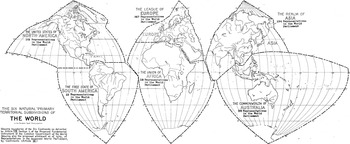
Laughlin's background in science and eugenics unmistakably influenced his perspective on the delineation of international boundaries and borders, making it different from that of most other internationalists. He transposed a discourse of national sovereignty onto the realm of biology and health. Unlike many other internationalists, who hoped the Paris Peace Conference would establish a global order that acknowledged the essential unity of humanity, Laughlin perceived it as an opportunity to compartmentalize and segregate the peoples of the world, with a view to imposing quarantine on what in his opinion were dysgenic nationalities and races. As the maps he devised reveal, Laughlin envisioned a world divided into a few huge political units, each dominated by the most dynamic element of its population (that is, those of north and west European stock), rather than the multitude of tiny states that would have resulted from a universal application of the principle of self-determination expounded in Wilson's Fourteen Points. (See Map 1.)
Laughlin's “Six Natural Primary Territorial Subdivisions of the World.” Source: undated map, file E2-6-22, Laughlin Papers.

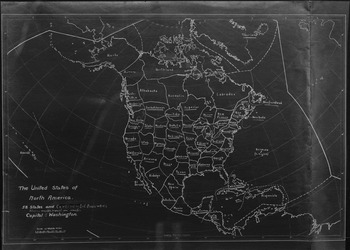
While African American progressives, like W. E. B. Du Bois, wanted the black populations of the Caribbean and Africa to be granted more autonomy or even independence in the new global order, Laughlin proposed a system of government and territorial divisions that would have further entrenched white domination in each of the world's main regions. In North America, for example, Afro-Caribbean people would find that their white British colonial rulers were replaced by white American ones under Laughlin's scheme; they would be ruled not from London but from a new city of Washington located in the heart of the continental United States. (See Map 2.) The boundaries delineated by Laughlin generally served the end of preventing conflict between the Great Powers, rather than delivering autonomy to colonial peoples. With the Caribbean incorporated into the United States of North America, there was no cause for contention between white North Americans and white Europeans over this strategically important area. The political borders proposed by Laughlin, therefore, defined spheres of influence within which Great Powers could operate, rather than the territorial boundaries of countries inhabited by persons of the same nationality. Thus, Laughlin's perspective on boundaries and borders could be described as one of self-determination for white people.
Laughlin's scheme for the United States of North America. Source: map drawn c. 1919, file B5-3B-7, Laughlin Papers.

In Changing the World, Dawley divided American interventionists into the “unilateralist and imperialist” ones, who supported involvement in the Great War but opposed entanglement in binding international agreements, and the “multilateralist and truly internationalist” progressives, who welcomed cooperation across borders and between peoples.Footnote 59 However, the example of Laughlin's world constitution seems to confirm Ian Tyrrell's contention that these “divisions … are far too stark,”Footnote 60 because Laughlin's world government plans were both multilateralist and imperialist. Along with the nationalist Senator Henry Cabot Lodge, who headed the Reservationist faction during the congressional debates over ratification of the Versailles Treaty, Laughlin shared the goal of exerting America's power on the world stage and extending its influence. Laughlin appeared to differ with the likes of Lodge on the matter of means not ends. Lodge, it is noteworthy, was a leading spokesperson for the Immigration Restriction League and an early advocate of restricting immigration from southern and eastern Europe. However, Laughlin had more in common with the so-called “mild reservationists,” such as William Howard Taft, Elihu Root, Herbert Hoover, and other members of the League to Enforce Peace, who genuinely favored United States' membership in the League of Nations. Whatever doubts this group might have had about the Versailles Treaty, they did not emanate from opposition to the Great Powers' refusal to extend the principle of self-determination to nonwhite colonized peoples across the globe.Footnote 61 Although many of this latter group might have doubted the feasibility of Laughlin's proposals, few would have found unpalatable his vision of a world order that was anti-Bolshevik, that rested upon Great Power multilateralism, and that limited self-determination mostly to whites.
In contrast, the more radical elements of the American progressive and internationalist movements would have found Laughlin's proposals reprehensible. Groups like the Women's International League for Peace and Freedom, for example, envisioned the creation of transnational coalitions dedicated to advancing social reform rather than the erection of more impenetrable territorial borders.Footnote 62 The opposing positions that Laughlin and social reformers like Jane Addams occupied on the nature-nurture debate were mirrored in their stances on international relations. Laughlin believed that genetics explained social problems like poverty and crime, whereas Addams thought that they were the products of environment. Laughlin planned to eliminate social ills by manipulating the human gene pool, whereas Addams proposed reforming society's institutions. Likewise, Laughlin thought that American interests were best served by a global system that delivered relatively fixed and closed territorial borders, whereas Addams envisioned the elimination of the barriers that separated different peoples from each other. To Laughlin, foreigners resembled harmful organisms that needed to be isolated and controlled; to Addams they were potential allies in the work of advancing peace and progress in the world.Footnote 63
Laughlin appears to have been aware of the contradictions between core American civic principles—especially those relating to legal equality and individual liberty—and the eugenicist quest for human biological perfection. This did not prevent him from devising a plan for world government that combined elements of both American constitutionalism and eugenicist exclusivism. In one of his first treatises on the subject of world government, Laughlin recommended that “due provision be made for the extension of law and order, education, liberty, opportunity, and self-government to colonial and other non-autonomous peoples, and for their due and ultimate admission into an equitable place in the federal plan of government.”Footnote 64 However, eugenicist elements became more pronounced in later versions of Laughlin's world government plans. Acting on his belief that “superior hereditary endowment of the people is, in the last analysis, always the basis for a successful democracy,” Laughlin included in one draft of the “Fundamental Instrument” a section that stated:
Granted that World Government to be effective as a democracy must, in turn, be governed by a well-integrated World opinion—alert, discerning, vigorous, honest and responsible—it must be further granted that World opinion possesses such qualities only to the extent to which the people are inherently intelligent and honest, and have enjoyed an honest and efficient education during their youth. This, in turn, means that from generation to generation the people of each country must improve their own hereditary equipment, and must educate their youth to the latter's full capacity of body, mind and spirit. Thus both heredity and environment must play major roles in good World Government, just as in local government.Footnote 65
For Laughlin, eugenics and American constitutionalism were not causes that could be championed independently of each other; they were the twin and only means by which the onward advance of progress in the world could be guaranteed. “The desire for a sound and honest World Government by all mankind and earnest effort for biological race-betterment by each of the several nations,” he asserted, “are two movements which would interact powerfully to strengthen each other.”Footnote 66
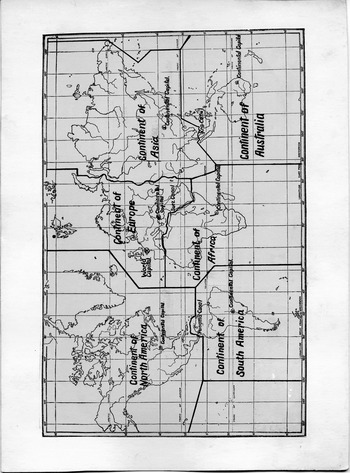
The American imperialism that permeated Laughlin's internationalist project was not just cultural; there was an expansionist territorial element as well. He proposed the amalgamation of the United States with its North American neighbors.Footnote 67 However, rather than a merging of the various nations on terms of equality, he expected the identities of Canada, Mexico, and other North American states to be subsumed within a “United States of North America.”Footnote 68 For Laughlin, the move toward a world government seemed to herald the consummation of the United States' manifest destiny to dominate North America. Despite his protestations of objectivity and impartiality, Laughlin was adept at assuring preferential treatment in his world government schemes for the peoples and places he held most dear. For example, in the maps which identified the capital cities of the six continent-sized states that he envisaged, the one for North America was located close to the point at which the Missouri and Mississippi rivers converge, which just happened to be close to the place where he had grown up, received his education, and met his beloved wife, and in which he would eventually spend his retirement and end his days. (See Map 3.)Footnote 69
Laughlin's reconfiguration of the continents with proposed continental capitals. Source: undated map, file B5-3B-1, Laughlin Papers.

A key feature of Laughlin's world government plan and one that clearly advanced his eugenicist agenda was the control that nations would retain over their borders and immigration policy. In 1932, he wrote: “International contacts are bound to increase in the future and if, as a consequence, nations and races are to be preserved it is necessary to establish firmly, by world wide acceptance, the principle of absolute migration control by each country. Each country must be assured security in its efforts to build up its own race and culture and to develop its own racial pride and patriotism.”Footnote 70 Laughlin was highly critical of the community internationalists' “tendency to abolish migration barriers on the theory that the whole earth belongs to all of its inhabitants in common and that all men are created equal.”Footnote 71
Like most other political internationalists, Laughlin was not an absolute pacifist. His attitude toward war was ambiguous. He believed that modern warfare was so destructive that even powerful nations would not be able to protect their vital interests without the establishment of an international system of collective security. Laughlin felt that the increased level of contact between nations generated by recent advances in communications and trade had “brought about an apparent conflict of extraordinary violence among national interests, which more than ever makes the safety of one nation dependent upon the behavior of its fellows.”Footnote 72 In one tract on the need for a world government, Laughlin stated:
The First World War has actually occurred. It ended in stalemate—both sides lost tremendously in both life and treasure.
All war has become mainly the self-destruction of all participant peoples and of their spiritual, their racial and their material treasures. War has lost its last excuse for existence as the instrument of national policy; it settles no issues; it makes certain losses for all and permanent gains for none. If the racial stocks of mankind are not destined to degenerate and if civilization is not to decay, then the abolition of war and armament, and of their accompanying dangers, becomes more certainly than ever a basic condition of successful and happy human life.Footnote 73
While Laughlin displayed a genuine abhorrence of the death and destruction caused by war, he also expressed admiration for the martial spirit. He was fascinated by historical tales of conquest, as is evident in a speech to the Daughters of the American Revolution in the mid-1930s, in which he stated: “If the conquerors are of superior physical, mental and moral quality, civilization in the long run profits. If they are of less fine hereditary stuff, the culture of the particular country fails.”Footnote 74 According to these criteria, Laughlin judged the Norman conquest of England to be “one of the finest definite conquests” in history.Footnote 75 Similarly, Laughlin enthusiastically embraced the militarization of American society during World War I, when he served as captain of the Cold Spring Harbor Home Defense Reserve.Footnote 76 Laughlin, like other interventionist internationalists, was dismayed by the nation's “notoriously lax and unprepared state at the beginning of the war,” which he blamed on the confusion caused by the Constitution's failure to vest the federal government with sole authority to raise militia.Footnote 77 “We must be armed to the maximum now,” he wrote in 1918, “and also must be prepared unhandicapped [sic], and with unflagging zeal to continue the social and economic progress, which the war is quickening in us.”Footnote 78
Laughlin did not believe his world government plan would be acceptable to all parties, but he hoped that its publication would prompt a wider public debate on the form of present or future multinational institutions, in much the same way as the Federalist Papers had done for the U.S. Constitution during the late 1780s. In 1931, he wrote to James R. Angell, president of Yale University, “I will agree that, if this new draft were submitted to professional international lawyers, they would promptly and quite unanimously condemn it, but the reception of the earlier paper, as reflected by the enclosed letters from eminent men in many walks of life, leads me to believe that the new and more critical work will prove useful also.”Footnote 79
Community internationalists unequivocally rejected the racist elements of Laughlin's ideas on world government. On the subject of Laughlin's proposed system for apportioning representation, the veteran champion of racial equality and foe of imperialism, Moorfield Storey, declared: “So long as we consider the Mexicans, South Americans, West Indians, Japanese, and other nations whose color is different from our own, as necessarily our inferiors we are not to be trusted with any more power over our neighbors.”Footnote 80 Storey's response was consistent with his view that one of the greatest flaws of the Versailles Treaty was that it did not recognize the principle of racial equality.Footnote 81 Despite his reservations about the peace agreement, Storey did not advocate a retreat to isolationism.Footnote 82 He was highly critical of those politicians who fought against U.S. membership of the League of Nations, a campaign that he attributed primarily to anti-British sentiment among Americans.Footnote 83 “I am certainly sure,” Storey informed Laughlin, “that no Senate of the United States would for a moment consider a world parliament in which the British Empire should have ninety-two representatives and America should have only sixty-nine.”Footnote 84 Storey fervently believed that collective security was the only means to secure global peace,Footnote 85 so it was with an air of disappointment that he confided to Laughlin: “I think a world parliament is out of the question at the moment.”Footnote 86
Considering the vast differences between his views on the world and those of Laughlin, Storey was exceptionally candid and courteous in his response to the latter. Another community internationalist, Oscar Newfang, also explicitly condemned the racist aspects of Laughlin's model of world government. Referring to a copy of Laughlin's Science Monthly article that he had received from the author, Newfang asserted, “I have read with much interest the article you sent me, but I can hardly see how it is consistent with the American idea that ‘All men are created free and equal.’ It is rather in accord with the Prussian idea [of] ‘Three votes for me and one vote for you.’”Footnote 87
Storey also appeared to take issue with Laughlin's cultural chauvinism and challenged the argument that the federal form of democratic government practiced by the English-speaking peoples of North America would, if extended to the whole world, dissolve ethnic divisions and protect ethnic and racial minorities from exploitation: “When you consider how the colored people in this country are dealt with, and when you reflect on the antagonism in Canada between the English and the French, [and] when you realize how the Germans and the Irish stand together, each race for itself in this country, I do not think your assumption can be sustained.”Footnote 88 This statement possibly reveals more about Storey's undisclosed animosity toward white immigrants in the United States, whom he accused of resisting assimilation, than it does about his position on America's right to interfere in the affairs of other nations. Unlike Laughlin, who opposed racial amalgamation, Storey believed in the idea of the United States as a melting pot in which all races could be blended. Moreover, he thought that the failure of some immigrants to become Americanized was partially attributable to the unfriendly welcome they received in the United States and not at all to the genetic factors favored by Laughlin.Footnote 89 However, on the issue of exporting American ideals, Storey appears to have shared the commonly held view that his nation had a missionary role to play in global affairs.Footnote 90 He believed that Americans were “helping other nations” when they made efforts to “to prevent evil or promote good in other countries.”Footnote 91
Newfang did not even challenge Laughlin's cultural assumptions. Indeed, he seemed to share the eugenicist's view that the U.S. Constitution could form the basis for a world system of government and later argued as much in his book The United States of the World: A Comparison between the League of Nations and the United States of America.Footnote 92 Admittedly, Laughlin's cultural assumptions may well have met with more robust dissent had he written to and received replies from other community internationalists, but based on the responses of Storey and Newfang, it still seems fair to conclude that it was his views on race that this group found most objectionable and not his belief in the superiority of American political institutions and practices.
Political internationalists seemed to have had less of a problem with Laughlin's racism and imperialism. In fact, some openly endorsed these traits in his work, as is revealed in a communication relating to his Science Monthly article that Laughlin received from Emerson McMillin of the League of Nations Union:
Personally, I feel a deep interest in your production. Am pleased [sic] to know that there are men who could see the necessity of the class of work. Had the “League to Enforce Peace” devoted a thousandth part of its energies and financial resources to working out the details of a PLAN for a Covenant, there would probably not have been born the crude product brought back by President Wilson from the Peace Conference six weeks ago.
The writer of this letter worked diligently for seven years, trying to find a basis of representation for the establishment of a World's Court.
One thing appears from the debates at the last Hague Conference—we must recognize the Equality of Sovereign States. This has been the practice from time immemorial. But we can give all countries the same vote as sovereign states, and then add votes to some for population, land, or commerce, or all three.
That Costa Rico [sic] should have as much to say about the management of the World['s] affairs as France would be a grave injustice and inequality.Footnote 93
Clearly, McMillin's position on the apportionment of representation in the League of Nations, as evidenced by his remarks concerning Costa Rica and France, was the exact opposite of that held by community internationalists such as Storey and Newfang. This suggests that McMillin and other political internationalists were more interested in satisfying the expectations of the Great Powers than in protecting the rights of smaller nations. Another political internationalist, James G. McDonald, was also impressed by Laughlin's work on apportionment of representation. McDonald chaired the executive committee of the League of Free Nations Association and tried to arrange for the organization to make a financial contribution toward the cost of publishing Laughlin's ideas in book form.Footnote 94 The fact that high-ranking officials of organizations like the League of Nations Union, the League of Free Nations Association, and others even bothered to respond to Laughlin's approaches reveals that despite the blatant promotion of eugenicism in his writings on world government, he was not routinely dismissed as a crank.
As is demonstrated by his reference to the League to Enforce Peace, an influential organization headed by former President William Howard Taft, McMillin's letter illustrates the internal divisions and petty rivalries that scholars have found to be characteristic of the American peace and internationalist movements. The fragmented nature of the internationalist movement should in theory have provided Laughlin with an opportunity to gain a foothold in it, but his opinions were too extreme to make this possible. Just as his views on race were unpalatable to community internationalists, Laughlin's attachment to world federalism alienated him from political internationalists.
Two examples illustrate the variety of negative responses that Laughlin's world federalist ideas received from political internationalists. The first example is the correspondence between Laughlin and Edward Cummings, general secretary of the World Peace Foundation. In March 1919, Cummings expressed concern at the prospect of Laughlin publishing his template for world government. Cummings was worried that isolationists would use such a document as a weapon in their campaign against internationalism, asserting that “one reason why the reactionaries are attacking the modest program of the proposed League of Nations is because they hear it is only the beginning of some … far-reaching adjustment.”Footnote 95 The second example is a letter to Laughlin from the editor of the Atlantic Monthly, which also lends weight to the view that his attachment to the concept of a strong world government proved to be the major stumbling block to the wider dissemination of his version of internationalism. “In our own opinion,” stated the editor, “the time is not ripe for anything like this degree of definiteness in present-day attempts to constitutionalize the world. Even vague efforts looking toward a conceivable internationalism meet with the stoutest kind of opposition, and we do not think it would help to clarify general public opinion to publish in The Atlantic a codification of the general rules upon which real world government should be founded.”Footnote 96 As was true of all other correspondence that Laughlin received from political internationalists, Cummings' letter, like that of the Atlantic Monthly editor, made no reference to the eugenicist's racism and imperialism; only the community internationalists expressed abhorrence at these traits in his work.
Although many political internationalists were aware of Laughlin's reputation as an influential advocate of eugenics, the experts in diplomacy and international law among them generally looked upon his excursion into internationalism as the dabbling of an amateur. This is evident in Laughlin's relations with Judge Wadhams from the League to Enforce Peace's executive board. In 1918, having heard that Laughlin had devised a method for apportioning representation in an international political assembly and that Colonel House had even shown interest in the plan, Wadhams made numerous attempts to arrange a meeting with the eugenicist for the purpose of ascertaining the latter's views on the proposed League of Nations. However, after meeting with Laughlin and then receiving updated and more explicitly racist versions of his recommendations on the apportionment of representatives, Wadhams appeared to distance himself from the eugenicist.Footnote 97 In the early 1920s, Wadhams demurred when Laughlin sought to secure a written endorsement of a publishing proposal.Footnote 98 Wadhams never openly censured Laughlin's racist plans for allocating representation at the international level, so it is not clear what role they played in creating the fissure between the two men. However, Wadhams, like other political internationalists, appeared to think that Laughlin's world government plans were too idealistic and impractical. After Laughlin criticized Wadhams for wanting to establish a multinational institution that was “too Jeffersonian and not Hamiltonian enough,”Footnote 99 the regularity and warmth of their correspondence decreased significantly.
Colonel House was another political internationalist who came to view Laughlin as a dilettante. Despite his earlier interest in Laughlin's plans for the apportionment of representation in the League of Nations, House eventually concluded that the eugenicist's ideas on world government were utopian. In 1932, House commented on a later version of Laughlin's world government model: “It seems to me that you have gone far ahead of the possibilities of this day and generation. We find it difficult to make the League of Nations a workable instrument for world peace, and we have been unable so far to get the United States to become a member. I do not see how we could hope to do in a generation or more what you propose.”Footnote 100 A white Southerner and close associate of President Wilson, whose administration witnessed the introduction of racial segregation within the federal departments in Washington, D.C., it is unlikely that House objected to the racist dimensions of Laughlin's world government model. Although he did not praise these aspects of Laughlin's ideas, he neither condemned them nor drew attention to the fact that they would attract strong objections from many nations.
Progressivism, like most other successful political movements in the United States, achieved results because it forged coalitions between groups and individuals from a variety of backgrounds and ideological viewpoints. To mobilize these disparate forces in support of a shared goal, such as internationalism, it was necessary for the various participants to indulge or at least not to censure each other's more unorthodox or unpalatable views on other issues. This might explain why many so prominent American internationalists failed to condemn the racism and imperialism inherent in Laughlin's plans for world government. Another explanation might be that individuals were reluctant to alienate somebody whose influence was clearly waxing and who counted many powerful people, particularly in Congress, among his friends. However, it seems more probable that the mixed reaction that Laughlin's ideas on world government received from American internationalists is attributable to the deep ideological divisions among them.
Internationalism was a contested concept both between and within different internationalist and peace organizations in the United States. At the first annual conference of the League to Enforce Peace, for example, some delegates envisioned a world in which a high degree of self-determination was possible, whereas others believed that only an international order dominated by great powers could secure global peace. Thomas Raeburn White, a member of the league's executive committee, felt that the kind of self-determination that had resulted in the birth of the United States was a right that could not be denied to even small nations. In a statement of league principles, White asserted, “Advancing civilization, while regardful of the rights of sovereignties, cannot be kept back by a system which would prevent changes in forms of government or the transfer of territory where necessary to the highest development of the world. The physical, moral, and spiritual welfare of human beings may have a higher claim than the national entity which for the moment asserts jurisdiction over them.”Footnote 101
White's version of internationalism clearly would not have fit comfortably with Laughlin's model of world government. However, at the same conference where White delivered his address, another speaker, Talcott Williams, expressed views more compatible with those of Laughlin. Williams, director of Columbia University's School of Journalism, viewed international relations very much in social Darwinian terms. He noted how over the course of the nineteenth century the hundreds of states that had existed during George Washington's day had been “consolidated” to form “a world of a few large states,”Footnote 102 in much the same way that small businesses had fallen prey to the consolidation process in the American economy during post-Civil War industrialization (although the speaker did not make this particular analogy); Williams described the process of consolidation as a “continuous evolution.”Footnote 103 He believed that the only way to “to carry the world from perpetual war to lasting peace” was to establish “a constructive league between great nations.”Footnote 104 This analysis of international relations viewed the Great Powers much the same way as Big Business was portrayed in Theodore Roosevelt's “New Nationalism”: the emergence of powerful consolidated entities was inevitable; their influence is mostly beneficent, but their activities need to be regulated by an enlarged and more powerful government. Williams's perspective clearly left less room for the exercise of self-determination than did that of White.
Possibly as a result of constant rejection from community and political internationalists alike, Laughlin became increasingly disinclined to tone down the chauvinistic elements present in his ideas on world government. By the early 1930s, he was describing his world constitution model as “an invasion of the territory of the internationalist.”Footnote 105 To Madison Grant, he wrote, “The reason most of us have for condemning the so-called internationalist is primarily because he strives to break down national barriers instead of coordinating sovereign nations.” Unlike community internationalists, Laughlin believed that world peace was best achieved “not by breaking down national and racial boundaries but by providing for the development of each race and culture independently.” “Perhaps the second most striking difference between our views and those of internationalists,” he informed Grant, “concern the basis of representation in the World Council. The internationalist puts forth two theories of such basis, one on the equality of all sovereign countries big or little and second, the allotment of voice on the basis of population. Both of these are, of course, impossible.”Footnote 106 Laughlin judged these two plans to be impossible because he believed the first ignored the lessons of American constitutionalism and the second those of eugenics.
Although some of his ideas on world government resonated with those of various leading internationalists, Laughlin never achieved the renown for his internationalist pursuits that he would do for advancing causes, such as immigration restriction, that typified the insular, isolationist, and uncharitable mood that took hold of the United States in the wake of the Great War. Despite the time and energy that he devoted to formulating and promoting his plans for a world government, he never succeeded in getting them published. The Scientific Monthly article constitutes the only occasion when Laughlin's internationalist ideas appeared in print. Nonetheless, Laughlin's writings on internationalism are significant because they provide a unique example of a leading American eugenicist contemplating how to mold the international order in a way that would complement what eugenicists were trying to achieve at the national level. Although other American eugenicists, like Lothrop Stoddard, occasionally made references to the idea of a world government, only Laughlin created a detailed plan of how the international order would look if it were organized according to eugenicist principles. The formula he devised for apportioning representation in his proposed world parliament proves beyond doubt that he envisioned a global order dominated by the white English-speaking peoples and their white European allies. Laughlin's meditations on internationalism were clearly an extension of his domestic interests. He envisioned the establishment of multinational political institutions that would make racist and imperialist ideas as firmly entrenched in custom and law throughout the world as they already were in the United States.
Laughlin's writings on world government and efforts to disseminate them are also of interest for the insights they provide into the composition and character of the early twentieth-century internationalist movement in America. Although Dawley was no doubt correct in suggesting that the simultaneous rise of conservative movements—such as those supporting eugenics, compulsory sterilization, and immigration restriction—and decline of internationalism after World War I were in some way connected to each other, the case of Laughlin demonstrates that these causes were not mutually exclusive. That said, Laughlin was clearly not a typical internationalist. Although he was not a fair-weather internationalist and his internationalist pursuits were unlikely to contribute to his advancement within the eugenics movement, the world government model he proposed did complement his broader eugenicist goals. It would have enabled a country to close its borders to unwanted immigrants, which Laughlin actively campaigned for in the United States.
Some internationalists and pacifists rejected Laughlin's world government model because they objected to its racist and imperialist features, especially the disproportionate political influence it gave to European and especially Anglo-Saxon peoples. Community internationalists, like Storey, took issue with Laughlin's contention that global peace and justice were more likely to be achieved by preserving national and racial group boundaries rather than by trying to break them down. The political internationalists who rejected Laughlin's model did so because it was too radical. They wanted a Jeffersonian-style world government, rather than the Hamiltonian-style one that he tried to promote. Political internationalists also worried that publication of Laughlin's ideas would play into the hands of isolationists and those opposed to joining the League of Nations, who might use his draft world constitution as evidence that any involvement in multinational bodies was likely to culminate in the erosion of American sovereignty. Significantly, the political internationalists who criticized Laughlin's world government model never did so on the grounds that it was imperialist or racist, which lends weight to the argument that a significant element of mainstream internationalism was itself both of these things.