

Economic historians often assume that financial revolutions pushed states towards modern financial systems, and that these were the motor behind some of the most important examples of economic growth in history. Recently Richard Sylla connected the economic success of the Dutch Republic and the industrialization of England with advances in public finances and debt management and the rise of banking and insurance institutions.Footnote 1 Financial revolutions are also believed to have been behind the rise of the American and Japanese economies.Footnote 2
It seems that the main idea behind these financial revolutions is that in order to grasp economic leadership, states had to gain a comparative advantage over competitors. Some states managed to do so by introducing new financial techniques, which often already existed elsewhere, but could be used more efficiently because ‘the process of transplantation eliminated the legal restrictions and encumbrances that had been imposed in the country of origin’.Footnote 3 This allowed states to experience an increase in government funding and radical changes in the process of state formation, and permitted them to create the foundations for economic leadership.
In the historiography on England, the concept of financial revolution has been challenged by authors such as Patrick O'Brien and Larry Epstein, who argued that developments went much more slowly than is often presumed.Footnote 4 Others have claimed that other factors were at least as important as the introduction of financial techniques. Douglass North and Barry Weingast singled out limits to monarchical power as a main cause for the increase in government creditworthiness.Footnote 5 David Stasavage explained that the ‘Whig Supremacy’ after 1715 helped to consolidate the financial revolution, because the Whigs were much more in favour of public debt than the Tories. Prolonged Whig rule assured potential creditors that the government was unlikely to default on public debt, and through ‘increased credibility of debt repayment’ caused costs of borrowing to drop.Footnote 6
Whereas the debate about the English financial revolution has yielded doubt on the importance of financial innovations, the debate about Holland's financial revolution is still very much centred on financial techniques. The first, and still most prominent, claim that a financial revolution paved the way for the Dutch Republic comes from James Tracy. In his innovative, thorough and above all highly influential study A Financial Revolution in the Habsburg Netherlands: ‘Renten’ and ‘Renteniers’ in the County of Holland (1515–1565), he argues that the county of Holland, in the west of the present-day Netherlands, experienced a financial revolution that allowed for a marked increase in government creditworthiness.Footnote 7 Several new financial techniques helped to increase the creditworthiness of the States of Holland, the representative body that coordinated and financed much of the war against Spain during the Dutch Revolt (1568–1648). Public debt of the States of Holland was also one of the most important financial institutions of the Dutch Republic.
This article discusses the medieval origins of countywide public debt and thus offers a refinement to Tracy's financial revolution. It demonstrates that collective responsibility for debt, as well as some other financial techniques of the financial revolution, was already used by the towns of Holland in the late Middle Ages. This technique was not fully employed until the beginning of the sixteenth century because of its political and economic costs. Therefore, collective responsibility for debt was predominantly created in emergency situations, and also to create ties between sovereign and public bodies by means of using the corporate personality of public bodies. This technique was only fully implemented after a financial crisis at the end of the fifteenth century, when traditional financial techniques – predominantly public debt contracted by individual towns – no longer sufficed to meet increasing demands for government funding and called for a reorganization of the system of public debt.
Collective responsibility for debt also emerged elsewhere in the Low Countries in the late Middle Ages, as well as in Spain and the kingdom of Naples.Footnote 8 However, only in Holland was it turned into a system of province-wide public debt. The question why this technique was not implemented on a large scale elsewhere, even though it was widely known, is beyond the scope of this article. Instead, we provide an analytical framework that uses the case of Holland to help explain why this financial technique may on some occasions have been slowly implemented, and that thus may also be of use to historians of the aforementioned regions.
The article starts with a survey of Holland's financial history (Section 1) and then goes on to explore the medieval roots of Holland's sixteenth-century financial revolution, demonstrating that the relevant financial techniques were already available since the thirteenth and fourteenth centuries. Section 3 offers some explanations as to why these financial techniques were not implemented on a large scale: sovereigns faced high political costs and public bodies high economic costs. Therefore, these techniques were only employed in emergency situations. Furthermore, we hypothesize that collective responsibility for debt was often used as a political instrument that increased ties between sovereigns and towns, as well as among the towns involved, and thus contributed to stability. Section 4 goes on to show how the sovereigns and public bodies were nevertheless forced to apply these instruments on a large scale after increasing demands for government funding had caused a profound financial crisis among the States of Holland and the towns at the end of the fifteenth century. The only way out was to centralize a large part of public debt in the hands of the States of Holland: collective public debt helped to regain the solvency of the States of Holland and individual towns, and brought about some important improvements in debt servicing, in part by solving a collective action problem.
1. Financial revolutions in the county of Holland
In the past decades the idea that the Dutch Republic was founded on sixteenth-century developments in government finance has quickly gained ground. It is believed that developments in taxation and public debt allowed the States of Holland to direct a revolt against King Philip II of Spain (1556–98), survive the Eighty Years War (1568–1648) and become a world power in the seventeenth century.Footnote 9
Most theories about sixteenth-century developments in government funding have been put forward by James Tracy. He sees a financial revolution between 1515 and 1565, when the States of Holland entered capital markets in the Low Countries and created an apparatus capable of contracting and servicing long-term public debt. According to Tracy, the States managed to borrow unprecedented sums after they had improved their creditworthiness by introducing three institutional innovations. The first was the introduction of collective responsibility for debt, which bundled the community responsibility systems that individual public bodies already used in the Late Middle Ages. Back then, creditors could hold any member of a public body responsible for arrears. During the financial revolution public bodies collectively began to guarantee debts in this way, and thus increased the number of members that pensioners could hold responsible.Footnote 10 The second innovation was the use of future tax revenues as a security for public debt, which became possible after the introduction of province-wide excise taxes in 1542, the so-called common means. The third innovation was the introduction of the principle of voluntary loans. Initially the States did not create public debt on free markets, but forced subjects to buy. After 1552 demand increased, so the practice of forced loans could be abandoned.
Between 1515 and 1565, the States created public debt by selling gemenelandsrenten, annual pensions more or less comparable to annuities. These were long-term debts that ran either until the pensioner passed away or until the public body redeemed the debt.Footnote 11 These life annuities and redeemable annuities were not new, but had been used to reallocate capital by a host of public bodies, religious and social institutions and individuals in northwestern Europe since the thirteenth century.Footnote 12
The States used the money they attracted on the capital market to provide Emperor Charles V (1515–56) with funds, and also to wage war against Holland's hostile neighbours in the east, the diocese of Utrecht and duchy of Guelders, and even Lübeck in the north of the German Empire, to defend the county's interests in the Baltic trade. The emperor's need for funds caused a ‘growth of provincial institutions and responsibilities, especially in the fiscal sphere’.Footnote 13 This allowed the States to increase their control over tax revenues, which they used to pay out gemenelandsrenten. With respect to provincial debt, Tracy concluded that ‘in the long run it effected a dramatic shift in the relative position of the central government and its provinces’.Footnote 14 In control of revenues and presiding over massive creditworthiness, the States could adopt a more autonomous stance towards the emperor and his successor, Philip II.
Tracy's view has recently been refined by Oscar Gelderblom and Joost Jonker. They singled out negotiability of financial instruments as a major element of the financial revolutions of the Dutch Republic and England.Footnote 15 Gelderblom and Jonker argue that the emergence of a secondary market for shares of the East India Company at the beginning of the seventeenth century also offered investors in public debt increased opportunities to alienate gemenelandsrenten. Therefore, they suggest that Holland's financial revolution was only concluded after 1600.Footnote 16
Of course, financial techniques were not the only elements that allowed for the creation of public debt: the taxation system determined to what degree prospective creditors could expect the government to honour its debts. Much like their colleagues elsewhere in western Europe, the counts of Holland had improved the taxation system in the course of the late Middle Ages, when they came to rely less on domain revenues and more on tax revenues. They took a major step at the beginning of the fifteenth century, when they turned irregular taxes, which the counts could only levy on special occasions, such as warfare, crusades and imprisonment for war, into regular subsidies that were levied every year. The counts and the States usually agreed on subsidies that were to be levied for a number of years, for instance as six-year subsidies. Alternatively, the sovereigns could request the States to consent to extraordinary subsidies to finance warfare. Such requests often met with great resistance and lengthy negotiations.Footnote 17
The burden of taxation increased markedly in the second half of the fifteenth century. The inhabitants of the Low Countries had to finance the efforts Charles the Bold took to create a large kingdom between France and the German Empire, as well as the political ambitions of Maximilian. The inhabitants of Holland not only faced high taxes, but also uprisings and declining commerce. Revenues from excises on products like beer and bread grains decreased, which prompted towns and villages to start to sell annuities to meet expenses. In the end, public bodies defaulted on this mounting public debt and after 1492 Maximilian and Philip the Handsome had to grant many large towns moratoriums that allowed them to postpone annuity payments.Footnote 18
In the sixteenth century Charles V attempted to replace the annual subsidies, which included time-consuming negotiations with representatives of subjects, with province-wide excise taxes.Footnote 19 Recently, Wantje Fritschy has suggested that the adoption of these taxes contributed to the success of the Dutch Revolt: although they initially met with great resistance among tax payers, the taxes started to yield increasing amounts of money once the Dutch rebelled. According to Fritschy, Holland therefore experienced a tax revolution rather than a financial revolution prior to and during the Revolt.Footnote 20
Even though Fritschy has downplayed the importance of borrowing for the finance of the Dutch Revolt, province-wide public debt was nevertheless an important element of government funding under the Dutch Republic. This article focuses on the financial revolution, as suggested by Tracy, and particularly the introduction of collective responsibility for debt that was behind the introduction of gemenelandsrenten. These annuities were sold by the States after 1515 and became an important type of government funding in the decades prior to the Revolt.
2. The medieval origins of collective responsibility for debt
Institutional innovation plays an important role in the debate about Holland's financial revolution. New financial techniques – collective public debt and the use of future tax revenues as securities – increased the creditworthiness of the States of Holland in the sixteenth century. Also, these innovations supposedly made gemenelandsrenten so attractive for investors that the States could abandon the practice of forced loans. However, a close look at the medieval history of public debt reveals that both financial techniques were already used to sell annuities on free markets at a much earlier stage, which raises the question as to why it took so long to implement them.
We encounter collective responsibility for debt for the first time in 1291, when the towns of Dordrecht, Haarlem, Delft, Leiden and Alkmaar together secured a loan worth 12,000 Holland pounds. They did this on behalf of their sovereign, Count Floris V (1266–96), and were joined by Middelburg and Zierikzee, towns in the county of Zeeland, to the south of Holland, which was also ruled by Floris. This arrangement offered some clear advantages for the creditors: Jan lord of Arkel, Lambert de Vries and Rikoud van Noordeloos. Medieval rulers were notorious for reneging on debts: although they usually tried to maintain their creditworthiness, John Veitsch demonstrated that they were often tempted to renege once they encountered alternative creditors.Footnote 21 Furthermore, Count Floris was the highest judge within his own territory, and anyone lodging a complaint against him stood little chance of success.Footnote 22 By involving his towns in credit transactions, Floris created a buffer zone between himself and his creditors, because the latter could hold townsmen responsible for comitial debts.
The need to involve towns in credit transactions increased when towns in Brabant and Flanders prospered: if Count Floris were able to borrow from its wealthy merchants, he would greatly improve his financial situation. This was particularly important because of the fierce competition among sovereigns in the Low Countries and also because of Floris’ military ambitions.Footnote 23 Usually the count borrowed money from fellow rulers and noblemen, and to this end an appeal to the debtor's sense of honour often sufficed. Loan contracts rarely mention ‘hard securities’ – that is, securities enforceable by law. Instead, when creditors sought compensation from sovereigns and noblemen, the only way to succeed seems to have been to discredit the debtor, for instance, by attacking his reputation.Footnote 24
Even though merchants and townsmen made use of such informal instruments as well, they predominantly demanded ‘hard securities’, and sovereigns like Count Floris had considerable trouble finding these. This is why they used public bodies as intermediaries on the capital market. Towns were particularly useful: townsmen were subjected to legal systems, and more importantly, they frequented the towns of Flanders and Brabant, home to some of the most important creditors of the Low Countries. A community responsibility system, known as the law of reprisal, made all townsmen responsible for debt. The corporate personality of public bodies allowed town governments to secure contracts with the unlimited liability of townsmen. This greatly increased the legal security of creditors from Flanders and Brabant, because they could be sure that they would not have any trouble running into a citizen of Dordrecht, for instance, when they were looking for compensation for arrears.Footnote 25
The law of reprisal was an indispensable institution underlying medieval public debt: in the absence of other means to secure transactions with foreigners, it facilitated exchange on international capital markets. On the other hand, the risks of reprisals hung over public bodies like a dark cloud, and in this respect Larry Epstein has already pointed out that the law of reprisal and collective responsibility for debt were ‘highly damaging to trade’.Footnote 26 Indeed, reprisals occasionally paralysed trade, and public bodies carefully had to weigh whether they would create public debt. Sovereigns usually tried to persuade public bodies by offering them securities, which they were allowed to seize for damages caused by defaults. Alternatively, sovereigns granted public bodies revenues which they could use to service public debt. Thus sovereigns secured public bodies, which in their turn secured creditors. In our example from 1291, Count Floris allowed the towns to seek compensation from all his domain revenues for any damages that might emerge from the loan.Footnote 27
In the remainder of the late Middle Ages the towns of Holland frequently contracted collective responsibility for debt, initially to secure short-term loans, but later also to secure long-term annuities. They also became more involved in the organization of public debt: initially they merely secured transactions, but later they also organized annuity sales, sent the yields to the counts and took care of debt servicing as well. Furthermore, cities even started to cooperate so they would be able to meet any problems caused by collective responsibility for debt. This is visible in 1345, when Count William IV badly needed money to finance his war against the bishop of Utrecht and the Frisians. He ordered representatives from Dordrecht, Haarlem, Delft and Leiden, all in Holland, and Zierikzee and Middelburg, in Zeeland, to visit his army camp before the besieged city of Utrecht, and persuaded them to sell 300 Tournay pounds worth of life annuities.Footnote 28 The towns signed a treaty stating they would help one another out:
. . . in rade in dade ende in vercrigen ende te innen dat voirs. goit ons mede te lossen ende te quijten vander voirnoemder borchtochte . . . Footnote 29
. . . with advice and deeds, and by collecting the securities they could use to redeem themselves from the aforementioned bail . . .
Another statement by the town of Haarlem, from 1345, is even more explicit about the collective character of the loan: the cities were supposed to
. . . mit hem te staen te dragen ende te liden ende te gelden allen last cost ende scade gelike hem tot enige tiden die hun of ons upcomen mach . . . Footnote 30
. . . carry the burden, and pay all costs and damages that may befall them [the other cities] or us [Haarlem]. . .
Thus a collective of the main cities of Holland and Zeeland secured the annuity payments. They were also joined by 24 nobles who agreed to underwrite the contract. This does not seem to differ all that much from the sixteenth-century practice, when the nobility and towns that made up the States of Holland took responsibility for gemenelandsrenten.
The counts used both domain revenues and tax revenues to secure the towns. In 1345 William IV appointed revenues from tolls, mills, ferries and tithes as securities, as well as all future tax revenues from the large bailiwick of Rijnland. If the towns did not receive the money they required to pay the annuities from the count's stewards, they were allowed to seize the securities.Footnote 31 A few years later, in 1351, the towns even gained full control over the count's revenues when they agreed to collective responsibility for debt. Together Dordrecht, Haarlem, Delft, Leiden, Amsterdam, Alkmaar, Medemblik, Geertruidenberg, Schiedam, Rotterdam and Oudewater secured the annual pension that Margareth, the widow of Count William IV, was entitled to, as well as 3,500 Tournay pounds that Count William V owed to the bishop of Utrecht, and 400 Tournay pounds that the count had agreed to pay for repairs to the castle of Woerden.Footnote 32 The count appointed all his ancient rents, including a considerable part of the northern Holland subsidy – an irregular tax,Footnote 33 as well as the confiscated goods of outcasts. The towns were also allowed to appoint one or two receivers in northern Holland to make sure they would get the money.Footnote 34
When we turn to voluntary loans, the third element of the sixteenth-century financial revolution that Tracy singled out, there is no evidence that towns forced inhabitants to invest in collective public debt in the late Middle Ages.Footnote 35 The towns usually sold annuities abroad, where they did not have any means of enforcement. For instance, in 1345 the towns of Holland and Zeeland sold most life annuities in Brussels, and much of the collective public debt that was contracted in 1405, 1407, 1416, 1417 and 1418 was contracted with people living in Brabant and Flanders.Footnote 36 Clearly, foreign creditors must have been convinced that the law of reprisal would offer them plenty of opportunities to seek compensation for defaults – and also that the threat reprisals posed to trade would induce the towns of Holland to do everything they could to make timely payments.
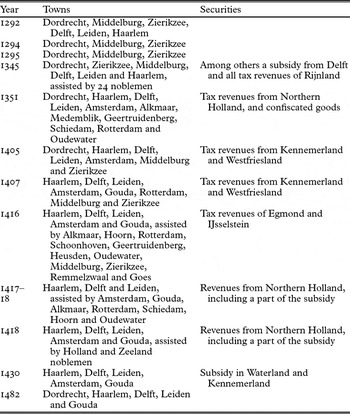
The towns of Holland frequently contracted collective responsibility for debt in the late Middle Ages. This was especially the case during the war-torn period after the death of William VI in 1417, when his daughter Jacqueline and brother John fought a bitter war of succession (Table 1). However, before the sixteenth century this type of funding did not yet acquire a very prominent position in government finances: the usual practice was that individual public bodies intermediated between sovereigns and capital markets.Footnote 37
Collective responsibility for debt of Holland and Zeeland cities (thirteenth–fifteenth centuries)

Sources: 1292 Dijkhof Reference Dijkhof2005, nr. 2724; 1294 Dijkhof Reference Dijkhof2005, nr. 2866, Van Dalen Reference Dalen1912, pp. 251–3; 1295 Van Dalen Reference Dalen1912, nr. 89; 1345 VerLoren van Themaat et al. Reference VerLoren van Themaat, Dokkum, Dijkhof, Roggen and Sanderson1985, pp. 93–4; 1351 Van Mieris Reference Mieris1754, pp. 796, 801; 1405 Bos-Rops Reference Bos-Rops1993, p. 128 notes 158 and 159; 1407 Bos-Rops Reference Bos-Rops1993, p. 129 note 168; 1416 Van Mieris Reference Mieris1756, pp. 379–80, 381–2, 389–90; 1417–18 Bos-Rops Reference Bos-Rops1993, pp. 169–70 note 128, Prevenier and Smit Reference Prevenier and Smit1988, nr. 852; 1418 Bos-Rops Reference Bos-Rops1993, p. 170 notes 135 and 136; 1430 Van Mieris Reference Mieris1756, pp. 988–90; 1482 NA, ASH inv. nr. 102, NA ASH, inv. nr. 618, f. 53v, Tracy Reference Tracy1985a, p. 58 note 99.
3. The price of progress: the slow evolution of collective responsibility for debt
Collective public debt was not implemented on a large scale because the political and economic costs were high, and therefore in the late Middle Ages this financial technique was predominantly used as an emergency measure. Collective responsibility for debt provided the counts of Holland with access to capital markets, but it also forced towns to cooperate and thus contributed to the emergence of a strong public sector that could pose a threat to sovereign power. At the same time, the towns had to cope with considerable economic costs when they decided to contract collective responsibility for debt, particularly because this made them dependent on the debt servicing of the collective: if one town defaulted, all risked reprisals and the obstruction of trade. In this respect, collective responsibility for debt only made sense from the perspective of the creditors, who demanded securities to be able to seek compensation for any defaults. They wanted to be able to hold as many people as possible accountable for timely payments. We have already seen that this is why they refused to deal directly with the counts and demanded that public bodies acted as intermediary. Provided that merchants from Holland frequented the pensioners’ residences, the law of reprisal offered them good securities against eventual defaults. Collective responsibility for debt even helped to further increase their security.
Considering the political and economic costs of collective responsibility for debt, it comes as no surprise to discover that sovereigns and public bodies scarcely made use of this financial technique. It even seems that they predominantly used it as a political instrument that allowed the counts to create unity among the towns of Holland. Collective responsibility for debt made public bodies dependent on the sovereigns, and the threat of reprisals also created incentives for inter-urban cooperation. Thus corporate personality was employed to pacify the towns of Holland, and it seems that sovereigns particularly used this technique at the beginning of reigns. In the late Middle Ages this political function of collective responsibility for debt prevailed; it took a financial crisis to convince sovereigns and public bodies to make full use of its financial potential. Before we turn to this issue, we first have to address the context of medieval collective responsibility for debt.
In the late Middle Ages sovereigns were almost constantly looking for funds, because political ambitions and international competition put government funding under constant pressure. This opened up possibilities for public bodies that could provide the rulers with tax revenues and access to capital markets. They could demand privileges in exchange for financial support. As Wim Blockmans explains, cities provided rulers with funding in order to achieve economic goals: ‘the security of roads, quick settlement of disputes, supervision of exchange values, freedom from tolls and arbitrary seizure’.Footnote 38 Bargaining thus strengthened both the position of the sovereign and that of the towns. This was predominantly at the expense of the nobility: government funding provided the rulers with possibilities to submit other feudal lords and provided cities with privileges that protected them from the same lords.Footnote 39
To make the most of this bargaining, public bodies had to develop representative institutions that could negotiate with sovereigns, levy taxes and sell annuities.Footnote 40 This paved the way for a strong public sector that was (occasionally) capable of resisting sovereign policy. Collective responsibility for debt contributed to this development for a number of reasons: it forced the towns of Holland (and Zeeland) to formulate common goals to bargain for during negotiations with the sovereign. It also required them to cooperate in finding creditors, organizing annuity sales and making timely payments, thus contributing to the emergence of a platform for interaction. Finally, when faced with reprisals, the towns had the common goal of protecting trade and therefore they usually chose to operate as a powerful collective.
These points can best be illustrated by turning to the early fifteenth century, when the towns of Holland created a large public debt during the war of succession after the death of count William VI in 1417. The competitors to power, William's daughter Jacqueline and his brother John, were both supported by towns that provided them access to capital markets, on either an individual or a collective basis. War activity caused public revenues to decline and as a result many towns failed to make timely annuity payments. Creditors in Brabant and Flanders reacted with seizures and arrests and thus the already war-torn county also faced severe obstructions to trade.
Robert Stein has suggested that a host of political-military and economic-financial problems induced the States of Holland to support the aspirations of Philip the Good to succeed Jacqueline.Footnote 41 In this respect he also mentions the problems related to public debt, which apparently induced the towns to press for a solution. In 1424 representatives of the government of Holland and the towns came to terms with pensioners from Brabant and Flanders. It is unclear how exactly these terms of payment were realized, but the course of events suggests that the government and towns of Holland may have asked Philip to arbitrate.Footnote 42
In search for money to fund war, Jacqueline and John of Bavaria had had public bodies create public debt, both individually and collectively. Faced with reprisals, the towns defended their commercial interests; public debt may well have been a major reason for them to support Philip the Good – and perhaps an even more urgent one than the reasons Stein mentions.Footnote 43 Without claiming that collective public debt was the sole reason for the towns to cooperate in finding a solution, this financial technique did align the towns of Holland. We see a similar development in James Tracy's account of sixteenth-century developments, when government funding contributed heavily to the emancipation of the States.Footnote 44 In general, collective responsibility for debt forced public bodies to cooperate; in the long run it altered the political constellation to the advantage of the public sector.
Even though the public sector could benefit from government funding by negotiating privileges, it was not too keen on selling annuities. When public debt was not properly serviced, it carried the risk of reprisals undertaken by angry pensioners. The law of reprisal posed a serious threat to trade, which happened to be the number one priority of towns. The public sector carefully had to weigh whether exchanging annuities for privileges would yield positive results. To complicate matters, refusing to cooperate usually meant that competing public bodies might be able to land a comparative advantage, by agreeing to cooperate with the sovereign and receiving privileges.
Public debt posed a serious threat to trade. The annuities that collectives of towns sold in 1417 and 1418 yielded nothing but trouble: in 1418 payments were already postponed and it did not take long before angered pensioners turned to the law of reprisal.Footnote 45 The moratorium that was brought about in 1423 and terms of payment with pensioners from Flanders and Brabant only brought temporary relief: at least until 1435 towns defaulted on annuity payments, which frequently forced them to renegotiate agreements with pensioners.Footnote 46
Collective public debt was particularly dangerous, because it created interdependence between public bodies. If one of them failed to pay out renten, they all risked reprisals. This was, for instance, a major problem at the end of the fifteenth century, when the towns of Holland had collectively created a large public debt. When Haarlem and Leiden could no longer pay their part of the annuities, creditors arrested merchants from all the towns involved.Footnote 47
Considering these risks, it comes as no surprise to see that towns sometimes hesitated over whether it would be wise to create (collective) public debt. For instance, in 1418 the government of Haarlem was divided on the issue of collective responsibility for debt for the sale of 2,000 nobelen worth of annuities in Brabant. The other towns also hesitated and demanded securities guarding them from reprisals before the sale could be materialized.Footnote 48 Sometimes towns even bluntly refused to intermediate on the capital market: in 1444 the towns of Holland told Philip the Good that they considered it too risky to increase their debts, and in 1516 Haarlem deemed it too risky to extend its public debt because of the threat of reprisals.Footnote 49
Under what circumstances did sovereigns and public bodies overcome their doubts about creating collective public debt? When we look at the timing of events, we encounter emergency situations like the war of succession after 1417. In such events sovereigns and public bodies may have shared incentives to attract funds for offensive or defensive purposes. But the timing of events also demonstrates that collective public debt was often contracted at the beginning of a reign. This seems to indicate that collective public debt may also have served political goals.
For instance, William V (1354–89) and the towns of Holland and Zeeland agreed to collective responsibility for debt after William had defeated his mother Margareth in 1351. To prevent further outbursts of partisan struggle, William had to align the towns. To this end he had the towns sign a treaty, but he also had them create collective public debt. This public debt was aimed at settling disputes with Margareth and the bishop of Utrecht (Table 1). But it also created interdependence between sovereign and towns, and among the towns. We see a similar timing of events at the advent of the government of William VI (1404–17), Jacqueline (1417–33), Maximilian (first regency, 1482–93) and Charles V (1515–55).
The beginning of reigns involved negotiations between the new sovereign and town governments during joyeuses entrées. The new count visited towns to be sworn in and to create the foundations for a peaceful reign. On these occasions the sovereign and town governments discussed privileges granted by his predecessors, which the former had to confirm. It is clear that these negotiations provided the sovereigns with the leverage they required to create collective responsibility for debt.Footnote 50
Collective public debt created ties between the sovereign and the main towns. It made the towns dependent on the sovereign, who could invoke reprisals by stopping annuity payments, or more indirectly, by cutting off the revenues towns used for annuity payments. Sovereigns did not eschew such measures: when Maximilian believed that Haarlem had participated in a revolt in 1491–2, he confiscated revenues that had been assigned to the town to pay annuities. This was a heavy blow for the already troubled town, which could no longer make annuity payments and quickly had to request a moratorium.Footnote 51
Collective public debt also created interdependence between the main towns. When they each took responsibility for a part of the annuity payments, the towns depended on the debt servicing of the other towns involved. Thus, when Haarlem and Leiden reneged on the annuities they had sold in the 1482 issue of collective public debt, the merchants of Delft and Gouda also ran the risk of reprisals. From a political point of view this interdependence may well have helped to create some unity; from an economic point of view it also carried the risk that the demise of one town would cause the others to collapse as well.
When we assume that this interdependence was an intentional outcome of some issues of collective public debt, it seems that this was not only a financial technique, but also a legal technique that aimed at using the corporate personality of public bodies to create political stability. This was particularly important in Holland, with its rather egalitarian social structure due to its weak nobility and many medium-sized towns. Alignments with powerful nobles and capital cities did not suffice to ensure stability for sovereigns, and as a result they faced an almost constant threat from outbursts of partisan strife.Footnote 52
Of course, it is likely that both political and financial incentives were among the incentives behind issues of collective public debt in the late Middle Ages. Still, if we are right to regard this technique in part as a political construction, we may have an explanation for its slow implementation: when we consider that annuities were long-term obligations, usually running for at least several decades, it becomes clear that sovereigns only occasionally felt the need to contract collective public debt for political purposes. Once in effect, the ties between sovereign and towns would probably last for the remainder of the former's government. In addition, sovereigns and towns were sometimes forced to use this technique to borrow during severe crises. However, considering the objections both sovereigns and towns had to this type of funding, they scarcely made use of this possibility.
This hypothesis also has some implications for our view of sixteenth-century developments. As we have explained earlier, James Tracy singled out the emancipation of the States of Holland as a major side effect of the financial revolution. Looking back to the medieval period, it seems that the improvement of ties between public bodies had always been an incentive of the creation of collective public debt. Therefore, it may be worthwhile to consider the possibility that the sale of gemenelandsrenten after 1515 also served this political purpose, and was also aimed at creating stability in one of the most important provinces of the Low Countries at the ascendance of the young Charles V.
4. The implementation of collective responsibility for debt
What caused collective responsibility for debt to change from a political instrument and financial technique used in emergency situations, to a structural element of government funding? In the late Middle Ages the system of public debt remained essentially decentralized: towns usually sold annuities individually. This system sufficed until the end of the fifteenth century, when demand for government funding increased markedly. Towns created an unprecedented public debt that ultimately caused them to default and to request moratoriums. The only way to prevent the repetition of these problems and to recover the creditworthiness of the public sector was to reorganize public debt.
Holland experienced a financial crisis at the end of the fifteenth century: public debt had mounted after the accession of Charles the Bold (1467–77).Footnote 53 The main towns had sold enormous sums worth of annuities to be able to support the sovereigns and, unable to pay, Dordrecht, Haarlem, Leiden, Amsterdam and Gouda requested moratoriums between 1492 and 1494. Of the main towns only Delft did not request permission to postpone payments.Footnote 54 However, public debt was not restricted to the main cities: a large number of smaller cities and villages had also created public debt on behalf of the central government, and some of them had serious problems paying annuities as well.Footnote 55
Collective public debt had reappeared in this period as well, in 1482, when Maximilian of Habsburg (regent, 1482–93) asked Dordrecht, Haarlem, Delft, Leiden and Gouda to sell annuities to pay for war with Utrecht.Footnote 56 These were referred to as gemenelandsrenten: annuities of the common land. The sale raised 202,046 guilders, far more than the preceding issues of collective public funded debt.Footnote 57 Even in the sixteenth century such amounts were rarely contracted: between 1515 and 1565 only one sale raised more, at 279,757 guilders.Footnote 58 It did not take long before the gemenelandsrenten caused problems: in 1486 the towns already discussed how to pay annuities in Flanders. That year they did manage to pay, but over the next ten years they defaulted and only paid when creditors seized merchants from Holland.Footnote 59 In 1497 the States complained to Philip the Fair (1493–1506) about their indebtedness and the damage caused by reprisals. After lengthy considerations with government officials the duke granted the States a number of measures aimed at the recovery of debts. The most important measure was a moratorium, which allowed for the postponement of payment: Philip guaranteed Holland subjects a safe journey through his realms, without the risk of seizure.Footnote 60
Another measure Philip took was to cancel collective public debt. Shared responsibility caused solvent towns to be hindered by reprisals as much as insolvent towns, and therefore Philip unilaterally ended collective responsibility for debt, and instead made seven regions responsible for parts of the annuity payments:
Item datmen die vanden eender steede off quartier van onsser voors. landen noch de inwonenden ende inghesetenen van dien niet en sal moghen aenspreken arresteren noch vervolghen voir die portie vanden anderen steden ende quartieren voors. Footnote 61
Inhabitants of one city or region of our country are not to be pursued for the debts of other cities and regions.
Thus Philip cancelled the law of reprisal and collective responsibility for debt. This operation clearly harmed creditworthiness and it must be regarded as one of the main reasons why Emperor Charles V (1515–55) and the States of Holland had to turn to improved securities when they wanted to sell annuities after 1515.
The moratorium of 1497 did not immediately help the towns to overcome their problems: in 1503 the towns once again defaulted on the gemenelandsrenten; in 1517 they were granted another moratorium for annuities that the common body and individual cities owed; and in 1518 pensioners from Brabant and Flanders were summoned to appear in The Hague to negotiate about arrears. Annuities of the ill-fated 1482 issue were only redeemed in 1526.Footnote 62
There can be little doubt that Holland's financial crisis called for a reorganization of the system of public debt. The introduction of gemenelandsrenten got rid of inefficiencies that had emerged due to the increased competition of public bodies on the capital market and gradually brought about the recovery of the creditworthiness of the public sector.
After 1515 collective public debt became a major type of government funding.Footnote 63 Apparently Charles V and Holland's public sector believed that collective public debt was to be preferred over individual public debt. Of course, the low creditworthiness of individual towns, most notably Haarlem and Leiden, forced them to offer prospective creditors the relatively ‘hard securities’ of collective public debt. Furthermore, the sovereign and public bodies probably realized that a recovery of public debt required improved coordination: a major advance after 1515 was the more centralized organization of annuity payments, which shifted to the States, and – to a lesser extent – clerks of the Council of Finance and the Receiver General, who engrossed the contracts and looked for foreign buyers.Footnote 64
The reorganization of public debt also included other elements. Collective public debt allowed the towns to bargain for better possibilities with the sovereigns to make sure that annuities were paid on time. In 1544 they started to levy their own taxes to fund a new issue of gemenelandsrenten; the Receiver for the Common Land, one of their officials, collected and spent the money.Footnote 65
The necessity for this reorganization had probably become apparent when the results of a large government survey, which was held in 1514, had come in. It showed that all towns and 60 per cent of the villages had created public debt. Government officials did not approve of this increase in public debt, presumably because they linked it to the financial crisis, and pressed for better monitoring of annuity sales.Footnote 66 This survey may also have convinced Charles V and the States of the necessity to economize on public debt: gemenelandsrenten no longer required numerous individual public bodies to hire people that were responsible for annuity sales, timely payments, and monitoring whether pensioners of life annuities were still alive.Footnote 67 More importantly, the gemenelandsrenten helped solve some collective action problems, particularly with regard to competition among public bodies. When towns outbid one another on the capital market, they drove up interest rates. Competition also induced towns to impose restrictions on free trade, for instance when they forbade inhabitants to buy annuities from other public bodies.Footnote 68 They also prohibited the resale of annuities they had issued themselves, out of fear of reprisals; these restrictions on trade made annuities less attractive for investors, and are therefore likely to have driven interest rates up as well.Footnote 69 Finally, competition also carried the risk of internal quarrelling: public bodies clashed over defaults and reprisals, and at the end of the fifteenth century they even used the law of reprisal against each other for political and economic purposes.
The organization of public debt shifted to the States, who offered superior possibilities for debt servicing. As a result most gemenelandsrenten were paid on time.Footnote 70 Douglass North and Barry Weingast singled this element out as crucial for any government to maintain solvency. They claim that the main challenge that public bodies faced was to uphold a ‘credible commitment’ with their creditors: to maintain a reputation to honour debts, to be able to continue to borrow in the future.Footnote 71 It is clear to see that this was difficult under the decentralized system of public debt that existed before 1515. The solution was to reduce individual sales and increase collective sales by the States. Thus the public sector could regain and slowly expand its solvency through timely payments, and maintain a ‘credible commitment’. This was a crucial element for the near-optimal access to capital markets the States of Holland were to enjoy in the centuries to come.
5. Conclusion
Several conclusions can be drawn from the evidence we have presented here. The article demonstrates the long medieval development towards sixteenth-century improvements in government finance. As early as the thirteenth century international competition forced sovereigns to maximize their income, or risk being defeated by their neighbours. This continuous pressure on government revenues forced sovereigns to introduce taxes to add to their domain revenues, and to look for ways to gain access to capital markets. For both purposes they needed public bodies to act as intermediaries, and more importantly, to develop ways to improve the organization of public debt.Footnote 72 In Holland this continuous pressure on public bodies to maximize revenues is reflected in the emergence of collective responsibility for debt.
This means that the success of Holland's gemenelandsrenten was not the result of sixteenth-century institutional innovation, but rather of the implementation of financial techniques that had already been used since the thirteenth century (collective responsibility for debt) and fourteenth century (the use of future tax revenues as securities and voluntary loans). Furthermore, the implementation of these techniques after 1515 must be regarded as a direct and most unwelcome consequence of the financial crisis Holland experienced at the end of the fifteenth century. Rising taxes and other demands for government funding had induced public bodies to create an unprecedented public debt, which they could not service properly. The inevitable defaults provoked reprisals, which caused commerce to suffer greatly. Faced with obstructions to trade and reduced creditworthiness, sovereigns and public bodies ceded their objections against collective responsibility for debt. The financial crisis forced both Charles V and public bodies to concede to gemenelandsrenten. This ended an ongoing prisoner's dilemma that had prevented the towns of Holland from reaching structural cooperation in annuity sales. The centralization of public debt reduced expenses, improved debt servicing and limited the risk of quarrelling among towns, and thus contributed to ‘credible commitment’ between creditors and debtors.
In the late Middle Ages sovereigns and public bodies had scarcely made use of collective responsibility for debt because of its political and economic costs. Supra-local collaboration among public bodies weakened the position of the sovereigns, while public bodies objected to the risk of defaults, which usually provoked reprisals that paralyse trade. As a result, during the late Middle Ages both the sovereigns and public bodies preferred a decentralized system of public debt, in which towns provided the sovereigns access to capital markets through individual annuities sales. They only created collective public debt on two occasions: in emergency situations, when creditors often demanded that the townsmen of several towns back the obligation, and also at the beginning of reigns, when sovereigns used collective responsibility for debt to create unity among the main towns of Holland. In the latter case the sovereigns made use of corporate personality to establish ties between central government and towns, and also among towns: collective responsibility for debt created incentives to cooperate on penalty of defaults and reprisals that paralysed trade.
As it turned out, the financial revolution allowed Charles V to have Holland's public sector intermediate in capital markets. However, it did little to resolve the objections of medieval sovereigns: during the financial revolution the States of Holland managed to use their intermediary position to increase their power. One of the things they did was to improve their debt servicing: gemenelandsrenten were usually paid on time and caused few problems, which means that the objections medieval towns had with respect to collective responsibility for debt were gradually resolved.
Finally, we have hypothesized that collective responsibility for debt was not only a financial instrument aimed at providing sovereigns with access to capital markets, but also a political instrument that was used to create ties between sovereign and public bodies. The combination of corporate personality, public debt and law of reprisal allowed the sovereigns to structure that part of society that was manifestly non-feudal. They did this by creating financial obligations involving themselves and public bodies. This means that one of the main consequences of the financial revolution that James Tracy has observed, the increased cooperation between the towns of Holland, may have been one of the purposes behind the sale of gemenelandsrenten right from the start.
Acknowledgements
The research was conducted in the programme ‘Power, markets and economic development: the rise, organization and institutional development of markets in Holland, 11th-16th centuries’ at Utrecht University and funded by the Netherlands Organization for Scientific Research (NWO). Earlier drafts of this article were presented at the seminar of the faculty of Social and Economic History of Utrecht University, at the European Social Science and History Conference in Amsterdam and at a workshop on government finance in Rotterdam. I thank the participants, as well as two anonymous referees, and James Tracy, John Munro, Larry Neal, Bas van Bavel, Joost Jonker and Oscar Gelderblom, who commented on earlier drafts.