Introduction
It is of great importance in systematics to identify diagnostic characters that make it possible to distinguish species. For a phenotypic trait to be useful as a diagnostic character it has to be constant within a taxon, undergoing only minor changes from environmental modifications (Davis & Heywood Reference Davis and Heywood1963; Winston Reference Winston1999), and preferably easy to recognize (that is, the different states are unambiguous and easily observable). Features of this kind, however, do not seem easy to find; many of the characters that had been used to circumscribe species in different groups of lichenized fungi are not diagnostic for different phylogenetic lineages (e.g. Lohtander et al. Reference Lohtander, Myllys, Sundin, Källersjo and Tehler1998; Ott et al. Reference Ott, Brinkmann, Wirtz and Lumbsch2004; Buschbom & Mueller Reference Buschbom and Mueller2006; Nelsen & Gargas Reference Nelsen and Gargas2009; Velmala et al. Reference Velmala, Myllys, Halonen, Goward and Ahti2009; Crespo & Lumbsch Reference Crespo and Lumbsch2010; Leavitt et al. Reference Leavitt, Johnson and St. Clair2011a , Reference Leavitt, Fankhauser, Leavitt, Porter, Johnson and St. Clair b ; Lumbsch & Leavitt Reference Lumbsch and Leavitt2011). One method of assessing whether the phenotypic characters are useful as diagnostic characters is to map them onto the phylogenetic tree of the group under study, and then verify whether the phylogenetically related specimens share the same character states (Scotland et al. Reference Scotland, Olmstead and Bennett2003).
Due to the fact that the genus Cladonia embraces a great number of species, many of which are morphologically extremely variable (Ahti Reference Ahti2000; Ahti & Stenroos Reference Ahti and Stenroos2013), the taxonomy of this genus can be considered one of the most intricate within macrolichens. Recent studies based on molecular characters have confirmed this complexity (Stenroos et al. Reference Stenroos, Hyvönen, Myllys, Thell and Ahti2002; Fontaine et al. Reference Fontaine, Ahti and Piercey-Normore2010; Pino-Bodas et al. Reference Pino-Bodas, Burgaz, Martín and Lumbsch2011; Steinová et al. Reference Steinová, Stenroos, Grube and Škaloud2013), indicating that many of the morphological characters used in the taxonomy of the genus are homoplasious and, consequently, that many species accepted on the basis of these characters are not monophyletic.
The present study focused on the Cladonia furcata complex, here including C. farinacea (Vain.) A. Evans, C. furcata (Huds.) Schrad., C. multiformis G. Merr., C. scabriuscula (Delise) Nyl., C. stereoclada Abbayes, and C. subrangiformis Sandst. The taxa within the Cladonia furcata complex were formerly placed in sect. Ascyphiferae Tornab. (type: C. furcata) of Cladonia (Ahti Reference Ahti2000). This section consisted of species characterized by an evanescent primary thallus, generally subulate podetia (with the exception of C. multiformis) with a dichotomous branching type, closed axils when young (later open and then often with lateral splits), with a corticate surface, a very strong central stereome and usually without soredia. Among these species, atranorin and fumarprotocetraric acid are the most frequent secondary metabolites (Huovinen et al. Reference Huovinen, Ahti and Stenroos1990; Ahti Reference Ahti2000). Using DNA sequences, Stenroos et al. (Reference Stenroos, Hyvönen, Myllys, Thell and Ahti2002) showed that the section Ascyphiferae is polyphyletic, but C. farinacea, C. furcata and C. scabriuscula formed a monophyletic group. However, C. farinacea and C. scabriuscula were not monophyletic, hence the specimens from Chile were different from the Northern Hemisphere material (Stenroos et al. Reference Stenroos, Hyvönen, Myllys, Thell and Ahti2002).
Lichenologists have shown great interest in this complex of species, as well as in the morphological variability of the taxa, indicated by the considerable amount of literature on the subject (Asahina Reference Asahina1942; Evans Reference Evans1954; Ullrich Reference Ullrich1956; Schade Reference Schade1964, Reference Schade1966; Hennipman Reference Hennipman1967; Pišút & Wagner Reference Pišút and Wagner1973; Paus Reference Paus1997; Günzl Reference Günzl2004). The species are very similar and their circumscription has occasionally been questioned, which led several authors to consider some of these taxa as having infraspecific rank within C. furcata (Hariot Reference Hariot1887; Vainio Reference Vainio1887; Fink Reference Fink1904; Abbayes Reference Abbayes1937; Schade Reference Schade1966; Hennipman Reference Hennipman1967; Hawksworth Reference Hawksworth1969; Verseghy Reference Verseghy1975; Hennipman & Sipman Reference Hennipman and Sipman1978; Clauzade & Roux Reference Clauzade and Roux1985; Wirth Reference Wirth1995). For example, many authors have recognized C. subrangiformis as having infraspecific rank within C. furcata (Abbayes Reference Abbayes1937; Schade Reference Schade1966; Hennipman Reference Hennipman1967; Hawksworth Reference Hawksworth1969; Verseghy Reference Verseghy1975; Clauzade & Roux Reference Clauzade and Roux1985; Wirth Reference Wirth1995; James Reference James2009), while others consider both as species (Nimis Reference Nimis1993; Burgaz & Ahti Reference Burgaz and Ahti2009; Ahti & Stenroos Reference Ahti and Stenroos2013). The phenotypic characters that have been used in combination to distinguish the species of this complex include the secondary metabolites, the branching type, the branching angle, the presence of white medullary outgrowth, the presence, abundance and morphology of squamules, the presence of soredia, soredioid granules or phyllidia, the production of scyphi, and the podetium type (solid or hollow) (Sandstede Reference Sandstede1922; Abbayes Reference Abbayes1937; Huovinen et al. Reference Huovinen, Ahti and Stenroos1990; Wirth Reference Wirth1995; Ahti Reference Ahti2000; James Reference James2009). However, intensively sampled molecular data have not been compiled to test these features in the circumscription of species in this complex.
In this study, the phylogeny of the Cladonia furcata complex is inferred using three molecular markers, and the phenotypic characters were mapped on the Bayesian tree, in order to address the following issues: 1) the monophyly of the currently accepted species, and 2) the degree of homoplasy of the phenotypic characters. We hypothesize that the phenotypic characters are highly homoplasious and most of the species polyphyletic.
Material and Methods
Taxon sampling
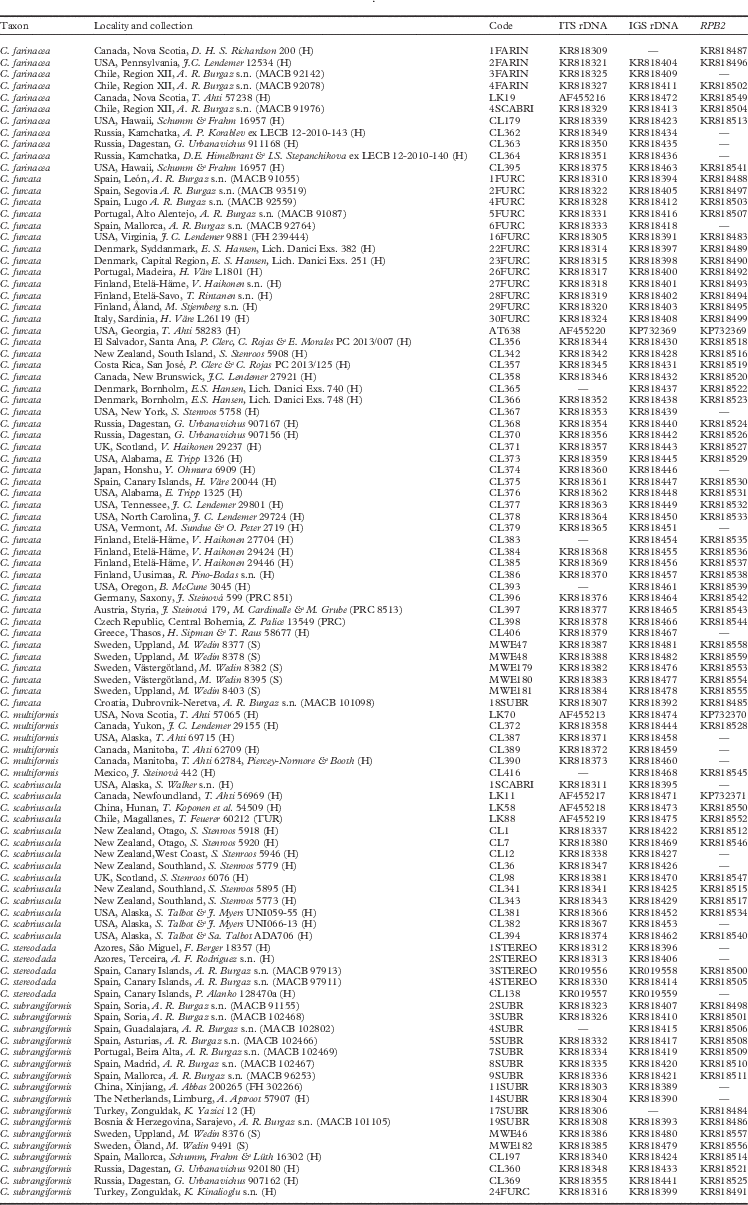
This study is based on 862 specimens (19 of C. farinacea, 583 of C. furcata, 18 of C. multiformis, 43 of C. scabriuscula, 19 of C. stereoclada, and 180 of C. subrangiformis) from the herbaria CANB, FH, H, MA, MACB, L, S and UPS. For molecular study, 114 specimens were selected. The criteria for the selection were: 1) the entire morphological and chemical variability of each species was included; 2) the material originated from different geographical regions in order to represent as complete a distribution of the species as possible; 3) the specimen had to be less than 10 years old to be suitable for DNA studies. Unfortunately, even the fresh specimens were not all successfully amplified for the three loci, but most of the phenotypic variation represented in the species was successfully amplified. In the phylogenetic analyses, only the specimens with sequences of at least two loci were included. These specimens are listed in Table 1. Cladonia pulvinella S. Hammer and C. corsicana (Rondon & Vězda) Pino-Bodas et al. were used as outgroup taxa, based on their placement in our more extensive phylogenetic analyses (Pino-Bodas et al. Reference Pino-Bodas, Burgaz and Martín2012a ; Ahti et al. Reference Ahti, Pino-Bodas and Stenroos2015; S. Stenroos, R. Pino-Bodas, H. T. Lumbsch, S. Parnmen, A. Thell, P. Clerc, A. R. Burgaz, M. P. Martín, F. Högnabba, T. Ahti, unpublished data).
Specimen information and GenBank accession numbers for the species of the Cladonia furcata complex used in this study

Phenotypic characters
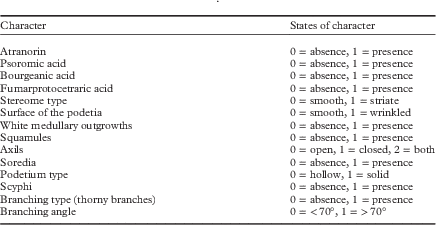
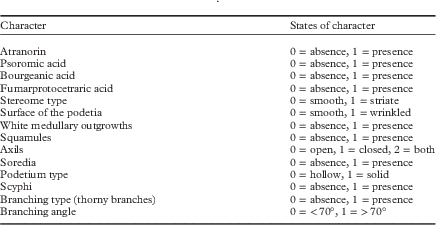
Fourteen phenotypic characters were selected based on the literature (Merrill Reference Merrill1909; Sandstede Reference Sandstede1922; Abbayes Reference Abbayes1937, Reference Abbayes1946; Evans Reference Evans1950; Ahti Reference Ahti2000). Table 2 lists the characters and their different states. The state of each phenotypic character was obtained by the morphological and chemical study of each specimen included in the phylogenetic study. The frequency of each character state per species, based on an extensive number of specimens, is provided in the supplementary material (Tables S1 & S2, supplementary material available online). The morphological characters were studied in three randomly selected podetia per specimen. The angles of all branches in the three podetia were measured, then the average of all these values per specimen was used for the analysis. Only a few specimens showed different states for some of the characters (frequently for the characters axil type or squamules). In these cases, the presence of squamules was taken as a character state for the specimen, since we considered that the podetia had the ability to develop squamules even though they did not show them. The axil type was coded as a third state (Table 2). The macroscopic characters were observed under an Olympus SZX9 stereomicroscope, while the anatomical character of stereome type was studied using an Olympus CX41 microscope at ×400. Secondary metabolites were studied by TLC according to standardized procedures (White & James Reference White and James1985), with solvent systems A and B.
List of phenotypic characters studied and their states in the Cladonia furcata complex
A cluster analysis was run in order to assess how the specimens gathered on the basis of the 14 phenotypic characters. Then, the morphological groups were compared with the clades obtained in the phylogenetic analyses. The analysis was implemented in R version 3.1.2 (R Core Team 2013), using the cluster package (Maechler et al. Reference Maechler, Rousseeuw, Struyf, Hubert and Hornik2014).
DNA extraction and sequencing
Prior to DNA isolation, secondary metabolites were extracted by soaking the samples in acetone for 2 h; then the liquid was used for TLC. The DNeasy Plant Mini Kit (Qiagen) or DNeasy Blood and Tissue Kit (Qiagen) was used to extract DNA, according to the manufacturer’s instructions. No differences between the kits were found with respect to the amount or quality of the genomic DNA obtained. The DNA was dissolved in 200 μl of buffer included in the kit. The following three nuclear loci were amplified: 1) ITS rDNA using the primers ITS1F (Gardes & Bruns Reference Gardes and Bruns1993) and ITS4 (White et al. Reference White, Bruns, Lee and Taylor1990); 2) RPB2 was amplified using nested PCR with two pairs of primers, RPB2-5F/RPB2-7R (Liu et al. Reference Liu, Whelen and Hall1999) in the first PCR and RPB2dRaq/RPB2rRaq (Pino-Bodas et al. Reference Pino-Bodas, Burgaz and Martín2010) in the second PCR; and 3) IGS rDNA using IGSf/IGSr (Wirtz et al. Reference Wirtz, Printzen and Lumbsch2008). PCRs were carried out with Ready-to-Go-PCR Beads (GE Healthcare Life Sciences, UK). The volume of reaction was 25 μl for each tube, with a 0·4 mM final concentration of primers and 5–30 ng of extracted DNA. The same amount of DNA was used to amplify the three loci. The amplification programs were: 1) 94°C for 5 min; 5 cycles of 94°C for 30 s, 54°C for 30 s, and 72°C for 1 min; and 33 cycles of 94°C for 30 s, 48°C for 30 s, and 72°C for 1 min; with a final extension of 72°C for 10 min for ITS rDNA; 2) initial denaturation at 94°C for 5 min; 40 cycles of 95°C for 1 min, 52°C for 30 s, and 72°C for 2 min; with a final extension at 72°C for 10 min for RPB2 and IGS rDNA. PCR products were purified using the QIAquick gel extraction Kit (QIAGEN, Hilden, Germany) or ExoSAP-IT (USB Corporation, Ohio, USA). The sequencing reactions were performed at Macrogen (South Korea) service (www.macrogen.com), with the same primers used for the PCR.
Sequence alignment and phylogenetic analyses
The sequences were aligned manually with SE-AL v2.0a11 (Rambaut Reference Rambaut2002) for each locus separately. The alignments did not have ambiguous regions and all the positions were included in the analyses. Each region was analyzed by maximum likelihood (ML). The ML analyses were implemented using RAxML (Stamatakis Reference Stamatakis2006) assuming the GTRGAMMA model. The bootstrap searches were conducted with 500 pseudoreplicates using the rapid bootstrap algorithm. Congruence among the different topologies inferred from the loci was tested following Lutzoni et al. (Reference Lutzoni, Kauff, Cox, McLaughlin, Celio, Dentinger, Padamsee, Hibbett, James and Baloch2004). We considered nodes to be in conflict if different topologies were each supported with at least 70% bootstrap. The topologies of the single locus ML trees were all poorly resolved. In the IGS rDNA tree, two main unsupported clades and a few small well-supported subclades were found. The topology of ITS rDNA yielded one large clade and other unsupported small clades. Inside the main clade, several supported subclades resulted. The topology of RPB2 yielded three main clades, one of them with the same specimens that the main clade found in the ITS rDNA analysis. Few small well-supported subclades were found in the IGS rDNA analysis. No incongruity was detected. MrModeltest 2.3 (Nylander Reference Nylander2004) was used for selecting the most appropriate nucleotide substitution model for each locus using the AIC criterion. Two combined datasets were constructed, one containing the specimens for which at least two loci were amplified and the other containing the specimens for which all three loci were amplified. The combined datasets were treated as five partitions: ITS rDNA, IGS rDNA and each of the three codon positions of RPB2, respectively, and analyzed by ML (on the same conditions for each locus separately) and a Bayesian approach. The Bayesian analysis was carried out using MrBayes 3.2 (Ronquist et al. Reference Ronquist, Teslenko, van der Mark, Ayres, Darling, Hohna, Larget, Liu, Suchard and Huelsenbeck2012). The model SYM+I+G was applied to each partition of RPB2, while the SYM+G model was used for ITS rDNA and GTR+G was applied to IGS rDNA. The posterior probabilities were approximated by sampling trees using Markov Chain Monte Carlo (MCMC). The posterior probabilities of each branch were calculated by counting the frequency of trees visited during MCMC analysis. Two simultaneous runs with 20 000 000 generations each, starting with a random tree and employing 4 simultaneous chains, were executed. Every 1000th tree was saved into a file. The convergence was assessed with the average standard deviation of split frequencies (<0·01) and in Tracer v. 1.5 (Rambaut & Drummond Reference Rambaut and Drummond2009) plotting the likelihood versus generation number. In addition, the split probabilities were checked in AWTY (Nylander et al. Reference Nylander, Wilgenbusch, Warren and Swofford2008). The first 1 000 000 generations (i.e. the first 1000 trees) were deleted as the ‘burn-in’ of the chain. A 50% majority-rule consensus tree was calculated using the ‘sumt’ command of MrBayes.
Mapping and homoplasy of phenotypic characters
The 14 phenotypic characters described previously (Table 2) were mapped on the 50% majority-rule consensus tree from the Bayesian analysis, based on the dataset containing the specimens for which all three loci were amplified.
The homoplasy for the 14 characters was estimated by the consistence index (CI) and retention index (RI), using Mesquite 2.75 (Maddison & Maddison Reference Maddison and Maddison2011). Both parameters were calculated for each character on the 50% majority-rule consensus tree from the Bayesian analysis of the three loci dataset.
Results
Phylogenetic analyses
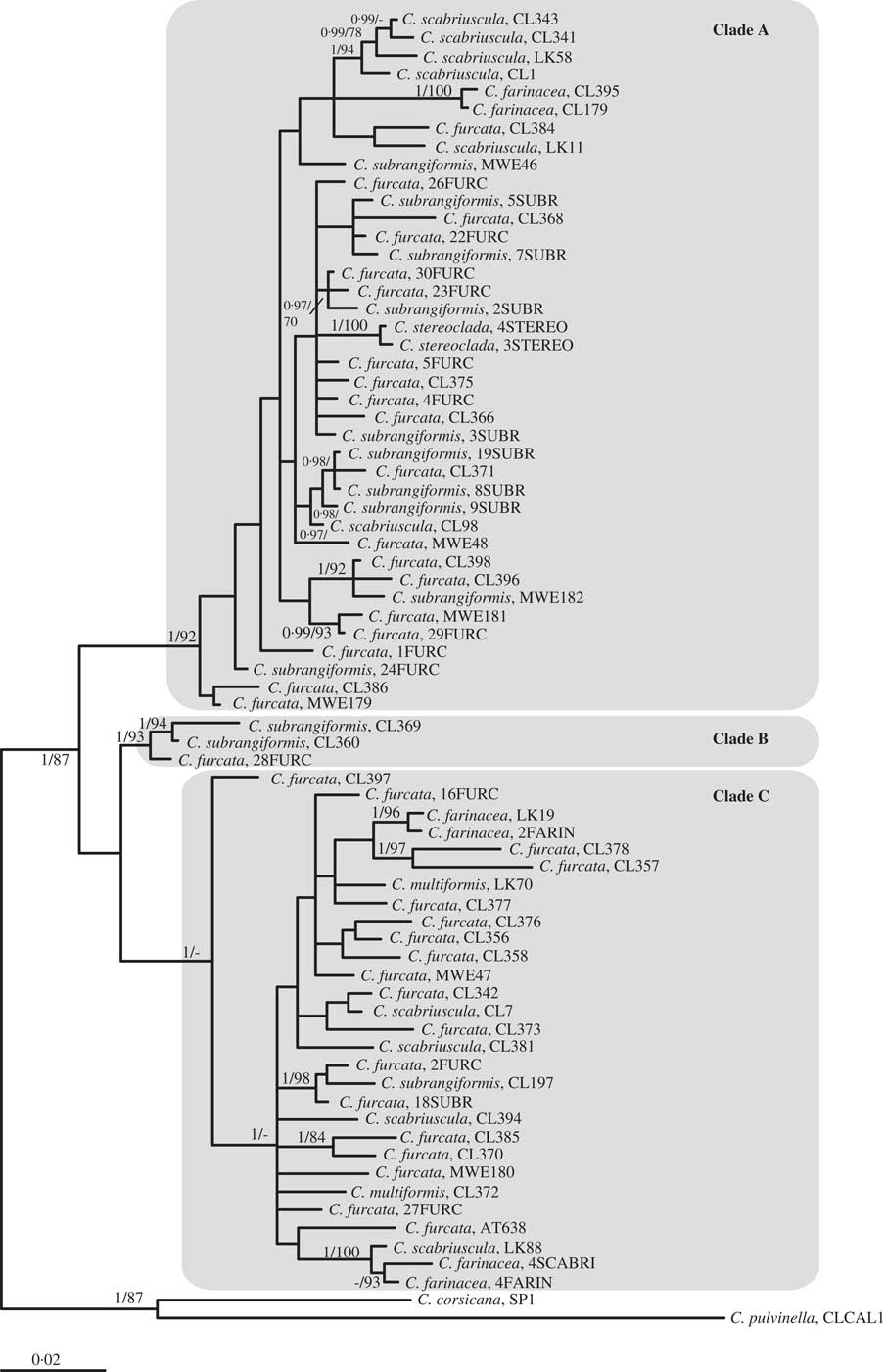
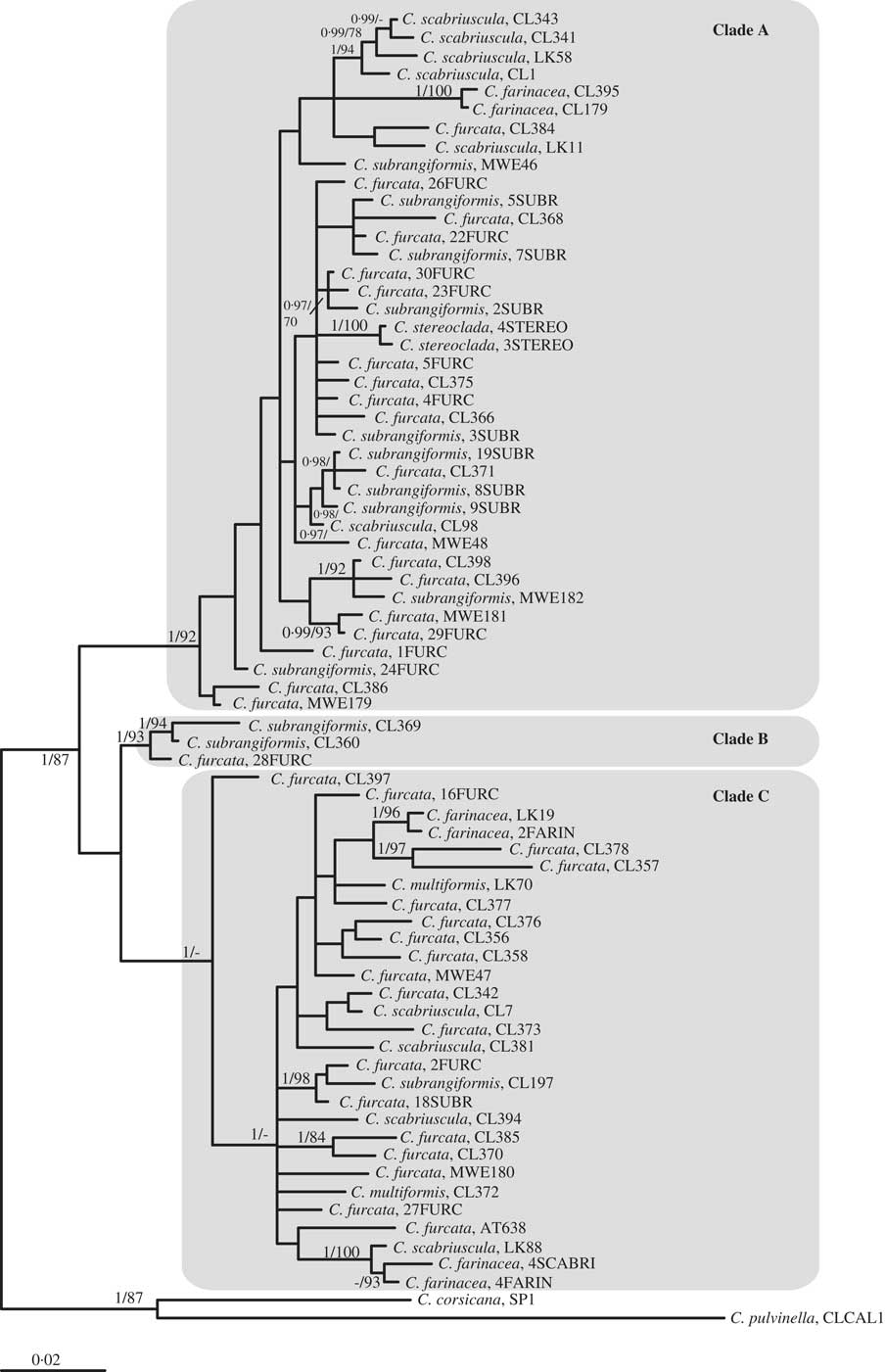
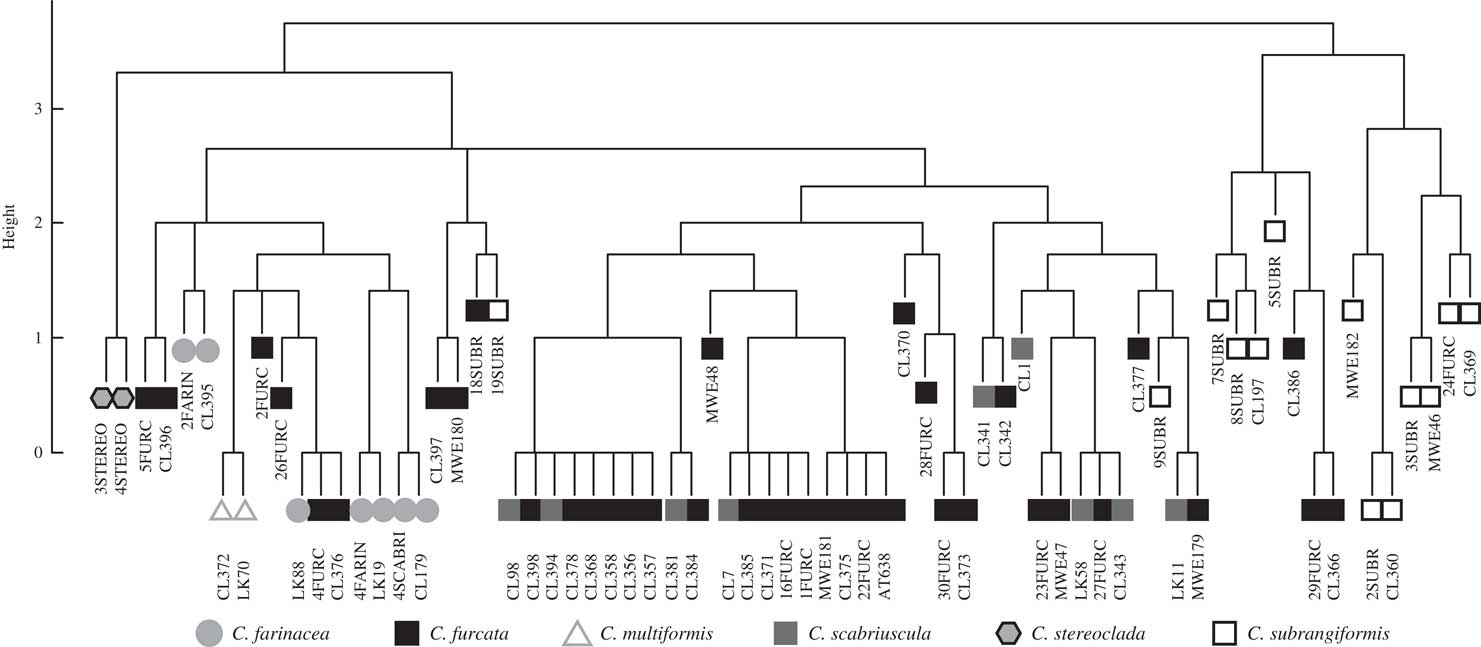
In this study, 261 new sequences were generated: 89 of ITS rDNA, 97 of IGS rDNA and 75 of RPB2 (Table 1). The concatenated dataset with sequences of all three loci contained 73 taxa and 1876 characters, 1586 of which were constant and 145 were parsimony-informative. The average number of different nucleotides among the sequences of the ingroup was 8·5 in ITS rDNA, 6·7 in IGS and 6·7 in RPB2. The number of different nucleotides including the outgroup was 9·5 in ITS rDNA, 7·2 in IGS rDNA and 7·0 in RPB2. The ML analysis yielded a tree with –lnL=5947·213, while the Bayesian analysis resulted in an arithmetic mean of –lnL=6164·412. The trees from ML and Bayesian analyses had the same topology, so only the Bayesian tree is shown (Fig. 1). The C. furcata complex resolved into three major clades. All the species except C. stereoclada turned out to be polyphyletic. Clade A was well supported and contained specimens of C. furcata, C. farinacea, C. scabriuscula, C. subrangiformis and C. stereoclada. Several well-supported subclades (six) were recovered (Fig. 1). One subclade included four specimens of C. scabriuscula; another subclade included all the specimens of C. stereoclada; another had two specimens of C. farinacea; another included two specimens of C. furcata; and the remaining two subclades comprised specimens of C. furcata and C. subrangiformis. Clade B included three specimens, one of C. furcata and two of C. subrangiformis. Clade C was supported only in the Bayesian analysis (57% bootstrap in the ML analysis). This clade included specimens of C. furcata, C. scabriuscula, C. farinacea, C. multiformis and C. subrangiformis (Fig. 1). Five well-supported subclades were recovered: one with two specimens of C. farinacea and one specimen of C. scabriuscula from Chile; another with two specimens of C. farinacea from North America; two subclades contained two specimens of C. furcata each; and another subclade had one specimen of C. subrangiformis and two specimens of C. furcata.
Molecular phylogeny of the Cladonia furcata complex. This is a 50% majority-rule consensus tree from a Bayesian analysis based on the concatenated dataset of ITS rDNA, IGS rDNA and RPB2. Posterior probability (first figure) ≥0·95 and bootstrap (second figure) ≥70% are indicated at the branches.
The analyses based on the concatenated dataset including specimens with sequences for 2 or 3 loci generated a ML tree with –lnL=6972·790, and –lnL=6817·049 in the Bayesian analysis. Both trees had the same topology. This topology was an unresolved phylogeny (see Supplementary Material,Figure S1 available on-line) for the C. furcata complex. As a result, the three loci were used to map the phenotypic characters.
Phenotypic groups and homplasy
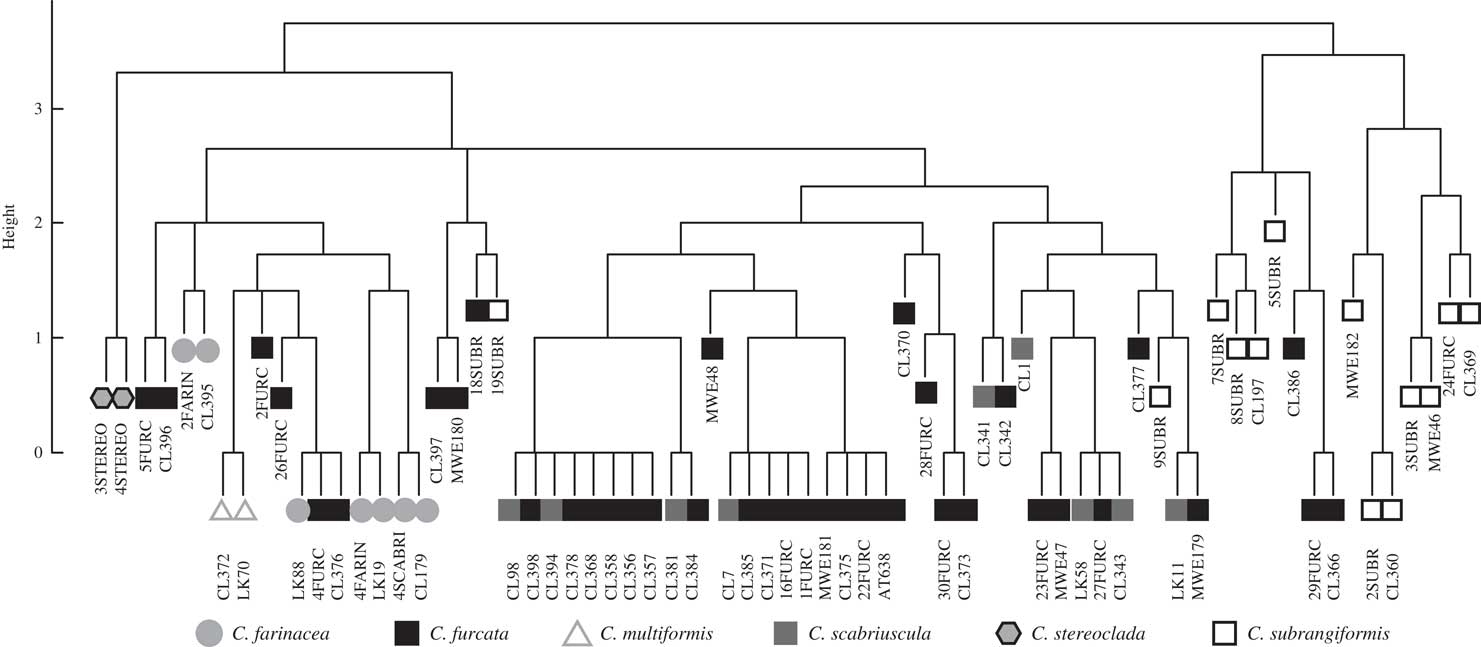
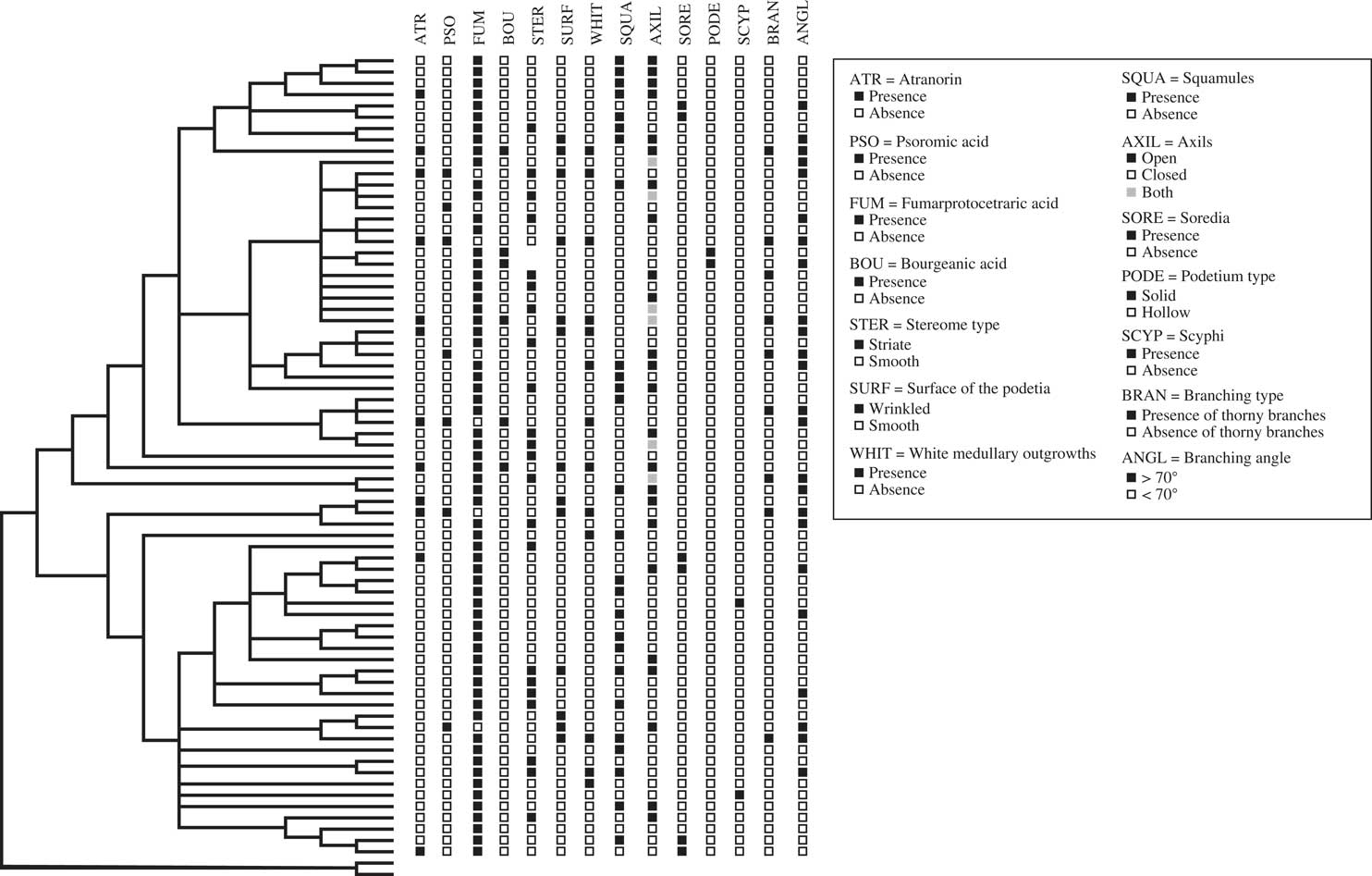
Figure 2 shows the dendrogram yielded in the cluster analysis based on the phenotypic characters studied. It shows three main groups, one with the two specimens of C. stereoclada; a second with most of the specimens of C. subrangiformis and three specimens of C. furcata; and a third one including the specimens of C. farinacea, C. multiformis, C. scabriuscula and most specimens of C. furcata. Inside the latter group, the specimens tended to gather in species. However, there was a low correlation between the phenotypic affinities and the phylogenetic results.
No phenotypic characters supported any of the main clades (A–C) obtained in the molecular phylogeny (Fig. 3). Solid podetia were characteristic for the subclade constituted by C. stereoclada. The other phenotypic characters did not show a clear phylogenetic structure. For example, the presence of psoromic acid, which is a descriptive trait for C. subrangiformis, occurred in five subclades; the presence of scyphi, which is diagnostic for C. multiformis, occurred in two positions in clade C.
Phenotypic character states of the Cladonia furcata complex mapped on the Bayesian tree based on the concatenated dataset including only the specimens with sequences for all three loci.
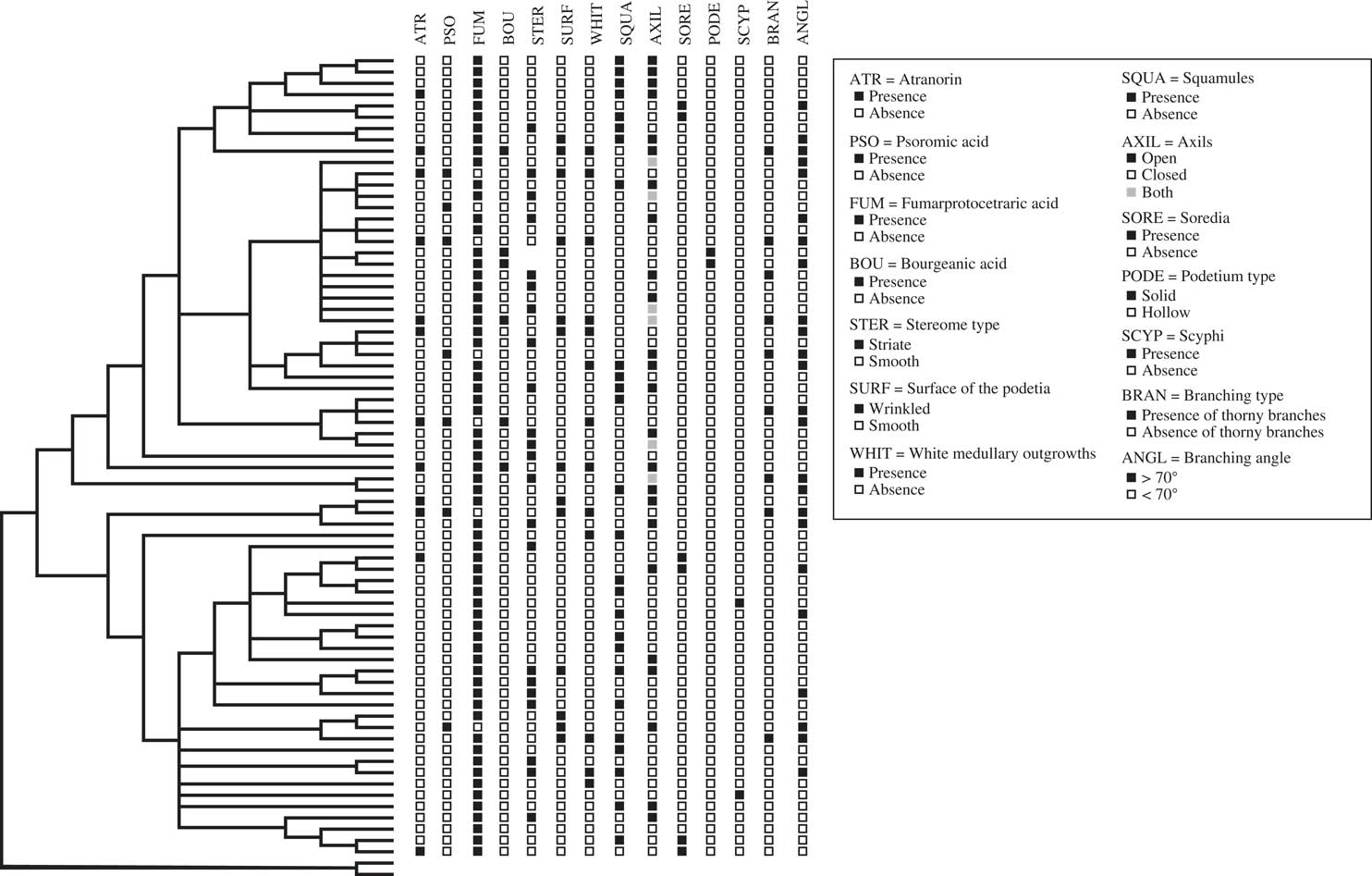
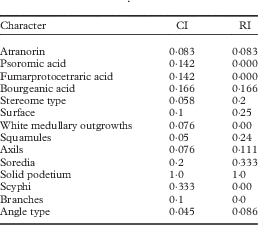
Table 3 summarizes the CI and RI values for the different traits examined. Most of the characters were highly homoplasious, with CI and RI values close to 0·0. Only the solid podetium was not homoplasious (CI=1·0, RI=1·0).
Homoplasy values for each character in the Cladonia furcata complex
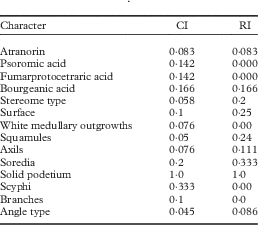
CI=consistence index, RI=retention index.
Discussion
The phylogeny of the C. furcata complex is inconsistent with the species based on phenotypic characters. All but one of the studied phenotypic characters that were previously used for species circumscription in the C. furcata complex have been shown here to be highly homoplasious (Table 2). This is consistent with previous studies that also found high homoplasy levels for phenotypic characters within Cladoniaceae (Pino-Bodas et al. Reference Pino-Bodas, Burgaz, Martín and Lumbsch2011; Parnmen et al. Reference Parnmen, Rangsiruji, Mongkolsuk, Boonpragob, Nutakki and Lumbsch2012). For example, the presence of scyphi (Pino-Bodas et al. Reference Pino-Bodas, Burgaz, Martín and Lumbsch2011), or the presence of soredia (Stenroos et al. Reference Stenroos, Hyvönen, Myllys, Thell and Ahti2002) were shown to be highly homoplasious in other groups of Cladoniaceae. The podetium type is the only non-homoplasious character and solid podetia represent an autapomorphy for C. stereoclada.
The lack of congruence between the phenotypic characters studied and the molecular phylogeny may be due to the influence of the environmental conditions on those characters (Osyczka et al. Reference Osyczka, Rola, Lenart-Boroń and Boroń2014). It is well known that a large number of Cladonia species are morphologically extremely variable (Abbayes Reference Abbayes1937; Clauzade & Roux Reference Clauzade and Roux1985; Ahti & Stenroos Reference Ahti and Stenroos2013). Cladonia furcata is especially variable in morphology, which has led several authors to distinguish numerous infraspecific taxa (Vainio Reference Vainio1887; Fink Reference Fink1904; Thomson Reference Thomson1968; Ozenda & Clauzade Reference Ozenda and Clauzade1970; Egan Reference Egan1972). Nevertheless, most authors currently consider much of the morphological variation of C. furcata to be an effect of phenotypic plasticity (Ahti Reference Ahti1977), or to represent developmental stages of this species (Jahns & Beltman Reference Jahns and Beltman1973; Jahns et al. Reference Jahns, Herold and Beltman1978). In addition, many intermediate forms have been described among C. furcata, C. subrangiformis, C. scabriuscula and C. farinacea (Abbayes Reference Abbayes1937; Brodo & Ahti Reference Brodo and Ahti1996; Stenroos et al. Reference Stenroos, Hyvönen, Myllys, Thell and Ahti2002).
Up to now, few ecological studies have addressed the influence of environmental factors on the morphology of Cladonia species (Schade Reference Schade1966; Vagts et al. Reference Vagts, Kinder and Müller1994; Paus Reference Paus1997; Günzl Reference Günzl2004; Osyczka & Rola Reference Osyczka and Rola2013). For example, in the C. pocillum/C. pyxidata complex, Kotelko & Piercey-Normore (Reference Kotelko and Piercey-Normore2010) showed that the morphology of the primary thallus (the main character used to separate C. pyxidata from C. pocillum) is an adaptation to differences in soil pH and that diverse phylogenetic lineages are tolerant to different soil pH values.
The presence of atranorin is one of the main characters used to distinguish C. subrangiformis from C. furcata (Sandstede Reference Sandstede1922; Evans Reference Evans1954). Atranorin is generally lacking in C. furcata, although in certain areas C. furcata specimens containing atranorin have been found (Huovinen et al. Reference Huovinen, Ahti and Stenroos1990; Etayo & Burgaz Reference Etayo and Burgaz1997; Ahti Reference Ahti2000; Huneck et al. Reference Huneck, Feige and Schmidt2004), especially in eastern North America, where Evans (Reference Evans1954) included them in C. subrangiformis (see Hale & Culberson Reference Hale and Culberson1960; Ahti Reference Ahti1962). Furthermore, this substance is not constantly present in C. subrangiformis as chemotypes lacking atranorin were found (Burgaz & Ahti Reference Burgaz and Ahti1992, Reference Burgaz and Ahti2009; Ahti & Stenroos Reference Ahti and Stenroos2013). In the other Cladonia species of this complex, atranorin is not constant either. For instance, material of C. farinacea from South America often contains atranorin, while samples from North America and Asia lack this substance (Huovinen et al. Reference Huovinen, Ahti and Stenroos1990; Stenroos et al. Reference Stenroos, Ferraro and Ahti1992). Also, C. scabriuscula rarely contains atranorin. The presence of psoromic acid is apparently restricted to some specimens of C. subrangiformis. The chemotypes with psoromic acid are particularly abundant in the Iberian Peninsula but are also known in Sweden (Burgaz & Ahti Reference Burgaz and Ahti2009; Ahti & Stenroos Reference Ahti and Stenroos2013). Psoromic acid is known to be variable and often rare in many Cladonia species, for example in C. arbuscula (Ruoss & Huovinen Reference Ruoss and Huovinen1989), C. rappii A. Evans (Ahti Reference Ahti2000), C. foliacea (Huds.) Willd. (Burgaz & Ahti Reference Burgaz and Ahti2009, under C. convoluta), C. symphycarpa (Osyczka & Skubala Reference Osyczka and Skubała2011), C. acuminata (Ahti & Stenroos Reference Ahti and Stenroos2013), and C. fruticulosa (Stenroos Reference Stenroos1988).
Most of the species in the C. furcata complex always contain fumarprotocetraric acid (Huovinen et al. Reference Huovinen, Ahti and Stenroos1990), which is absent only in some specimens of C. subrangiformis (Burgaz & Ahti Reference Burgaz and Ahti2009), hence being non-diagnostic.
Bourgeanic acid is present in some specimens of C. subrangiformis (four of them were included in the phylogenetic analyses). These specimens do not appear phylogenetically closely related to each other in our analyses, showing that this character has a weak phylogenetic signal. For other Cladonia species, it has been shown that the presence of fatty acids may have little taxonomic significance, as is the case for C. subturgida (Pino-Bodas et al. Reference Pino-Bodas, Burgaz and Martín2012a ), while the presence of bourgeanic acid is diagnostic in distinguishing C. humilis from C. conista (Pino-Bodas et al. Reference Pino-Bodas, Ahti, Stenroos, Martín and Burgaz2012b , Reference Pino-Bodas, Ahti, Stenroos, Martín and Burgaz2013). This is the first time that bourgeanic acid has been found in C. stereoclada.
Ahti (Reference Ahti2000) indicated that the internal stereome surface in C. furcata is striate in general. The stereome surface in Cladonia can be smooth, papillate, striate, reticulate or tomentose (Ahti Reference Ahti2000). In our study, only two types of stereomes were found: smooth and striate. The specimens which share the same stereome type are not closely related (Fig. 3B). Additional studies on the morphological variation and taxonomic value of stereome types are necessary to evaluate their taxonomic significance. However, our data suggest that their taxonomic significance is low in the C. furcata complex.
The podetial surface is one of the main characters used for separating species in the genus Cladonia (Ahti Reference Ahti2000). In the C. furcata complex, all species have corticate podetia with the exception of C. farinacea, which is partially sorediate. However, some authors found differences in the cortex surface between C. furcata and C. subrangiformis (Wirth Reference Wirth1995). In the latter, the surface is usually wrinkled and glossy, while it is smooth and less shiny in C. furcata. Our analyses show that specimens with different cortex types are not phylogenetically separated.
The presence of white medullary outgrowths (often tuberculous) was a diagnostic character used by Sandstede (Reference Sandstede1922; protologue) to distinguish C. subrangiformis from C. furcata, but later he considered that the presence of atranorin is more important since white medullary outgrowths could be a response to unfavourable conditions (Sandstede Reference Sandstede1931). Other authors have considered that these outgrowths appear in response to the accumulation of calcium oxalate in calcareous habitats (James Reference James2009). Several studies have shown that lichens in calcareous soils often produce calcium oxalate to remove the excess of calcium (Ascaso et al. Reference Ascaso, Galván and Rodríguez-Pascual1982; Wadsten & Moberg Reference Wadsten and Moberg1985; Edwards et al. Reference Edwards, Farwell, Seaward and Giacobini1991). Therefore, this character is probably influenced by the type of substratum. Other Cladonia species with these structures include C. macroceras, C. ecmocyna, and C. rangiformis (Schade Reference Schade1957; Ahti Reference Ahti1980; Burgaz & Ahti Reference Burgaz and Ahti1992).
Squamulose podetia can be present in most of the taxa studied. In Cladonia scabriuscula, squamules are always present and are more abundant than in the other species, and peltate. The name “var. pinnata (Flörke) Vain.” is often used to denote the squamulose specimens of C. furcata. Numerous species of Cladonia are able to produce squamules, but do not always develop them. Vainio (Reference Vainio1887) pointed out that populations living in humid areas tend to develop more squamules than those growing in drier habitats. This observation is supported by the fact that C. scabriuscula is a species common in oceanic areas (Krog Reference Krog1968; Brodo & Ahti Reference Brodo and Ahti1996; Ahti & Stenroos Reference Ahti and Stenroos2013). Günzl (Reference Günzl2004) found that specimens of C. furcata living in shady places had squamules more often than those growing in sunny habitats. Vagts et al. (Reference Vagts, Kinder and Müller1994) transplanted C. furcata thalli to soils with different chemical compositions, finding that eventually many thalli developed squamules. All these observations indicate that the presence and abundance of squamules, at least in the C. furcata complex, are dependent on environmental factors such as humidity and light.
Cladonia furcata, C. farinacea, C. scabriuscula, and C. multiformis usually have open axils, whereas in C. subrangiformis they are closed, although either state can be present in most taxa (Ahti & Stenroos Reference Ahti and Stenroos2013), as was observed in the specimens under study (Fig. 4C). Podetia with longitudinal fissures and perforated axils in Cladonia have been observed in habitats with high humidity and shade (Sembdner Reference Sembdner1958), but Günzl’s observations (Reference Günzl2004) did not corroborate these observations for C. furcata. However, he observed that older podetia, often bearing apothecia, have the perforated axils showing longitudinal fissures, as did other authors (Burgaz & Ahti Reference Burgaz and Ahti2009; Ahti & Stenroos Reference Ahti and Stenroos2013). This suggests that the different states represent different developmental stages, which would explain the lack of phylogenetic signal of the character.
In other Cladonia groups, it has been found that specimens with sorediate podetia can be present in several lineages, as in the case of Cladonia coccifera (Steinová et al. Reference Steinová, Stenroos, Grube and Škaloud2013). In general, it has been shown that the presence of soredia is a poor diagnostic character in some lichen genera (Tehler et al. Reference Tehler, Dahlkild, Eldenäs and Feige2004, Reference Tehler, Irestedt, Bungartz and Wedin2009; Ferencova et al. Reference Ferencova, Del Prado, Pérez-Vargas, Hernández-Padrón and Crespo2010; Lumbsch & Leavitt Reference Lumbsch and Leavitt2011).
The podetium type did not show homoplasy in the C. furcata complex, and solid podetia represent an autapomorphy of C. stereoclada. This is a rare character in Cladonia; only two species in the genus have solid podetia, namely C. solida Vainio and C. stereoclada (Ahti Reference Ahti2000). Cladonia solida has not been included in any phylogenetic study. Some other genera in Cladoniaceae also have species with solid podetia (Cetradonia and Gymnoderma), but in these genera the algae are lacking from the podetia (Wei & Ahti Reference Wei and Ahti2002).
The ability to produce perforated scyphi is used to distinguish C. multiformis from C. furcata. However, not all the podetia of C. multiformis have scyphi at every ontogenetic stage, and when scyphi are lacking the species can be very difficult to distinguish from C. furcata (Merrill Reference Merrill1909; Hammer Reference Hammer1995). Fontaine et al. (Reference Fontaine, Ahti and Piercey-Normore2010) found that the formation of scyphi is a character affected by convergent evolution, and hypothesized that scyphi fulfil the function of retaining water near the developing apothecia. This hypothesis could explain the lack of consistency in the production of scyphi in many species of Cladonia; their presence would be linked to the advanced developmental stages in which apothecia grow.
Thorny branches are characteristic of C. furcata “var. palamea” and C. subrangiformis, which are difficult to distinguish (Burgaz & Ahti Reference Burgaz and Ahti2009). In the present study, five specimens of C. furcata and four of C. subrangiformis with thorny branches were included but they are not phylogenetically closely related. Some authors’ field studies indicate that the specimens of C. furcata with thorny branches develop in sunny habitats (Hillmann & Grummann Reference Hillmann and Grummann1957; Vagts et al. Reference Vagts, Kinder and Müller1994), which would suggest that the presence of such a branching type is due to environmental factors.
The branching angle is one of the characters used to separate C. furcata from C. subrangiformis (Wirth Reference Wirth1995; Burgaz & Ahti Reference Burgaz and Ahti2009; Ahti & Stenroos Reference Ahti and Stenroos2013). In C. subrangiformis the angles tend to be wider than in C. furcata, often ranging from right to obtuse, sometimes beyond 120°.
The results of our phylogenetic analysis are congruent with the results of several previous studies and are inconsistent with the traditional species circumscriptions. Günzl’s phylogenetic analysis (2004) based on ITS rDNA could not separate German specimens of C. furcata and C. subrangiformis. Stenroos et al. (Reference Stenroos, Hyvönen, Myllys, Thell and Ahti2002) showed that C. farinacea and C. scabriuscula are not monophyletic. Fontaine et al. (Reference Fontaine, Ahti and Piercey-Normore2010) reported that C. multiformis was monophyletic, but in our analysis this taxon turned out to be polyphyletic (Fig. 1 and Supplementary Figure S1). We think that this disagreement is caused by the inclusion of C. multiformis in an analysis of the C. gracilis group, which is only distantly related to the C. furcata group (Stenroos et al. Reference Stenroos, Hyvönen, Myllys, Thell and Ahti2002). The sequences produced by Fontaine et al. (Reference Fontaine, Ahti and Piercey-Normore2010) were included in our analysis of ITS rDNA, and we found that these sequences do not form one monophyletic clade (data not shown). In fact, Fontaine et al. (Reference Fontaine, Ahti and Piercey-Normore2010) mention the large genetic variation of C. multiformis.
According to our results, a study focused on species delimitation should be carried out in order to clarify the taxonomy of the C. furcata complex. Additional loci, including more variable loci than the ones used here, should be studied in the future to clarify the delimitation of the species within this group. In addition, other phenotypic characters should be investigated. In the family Parmeliaceae, anatomical characters such as ultrastructure of the cortex and ascomata have supported clades found in phylogenetic analyses (Argüello et al. Reference Argüello, Del Prado, Cubas and Crespo2007; Divakar et al. Reference Divakar, Lumbsch, Ferencova, Del Prado and Crespo2010).
In conclusion, only one out of the six species included in our analyses, namely C. stereoclada, was monophyletic. This is also a species with the most restricted geographical range, limited to Macaronesia and some areas of Ireland and Scotland (James Reference James2009).
This study was supported by the Spanish Ministry of Economy & Competitiveness (CGL2013-41839-P). MW acknowledges support from the Swedish Research Council (VR 621-2009-5372, VR 621-2012-3990). RP-B was funded by the Marie Curie IEF-program (PIEF-GA-2013-625653).
Supplementary Material
For supplementary material accompanying this paper visit http://10.1017/S0024282915000225