Implications
This study showed that an earlier than recommended vaccination of male pigs with a gonadotropin-releasing hormone vaccine, Improvac, yielded results similar to surgical castration and the recommended vaccination schedule regarding production and behaviour. This implies that the vaccination can potentially be administered at a younger age, and the flexibility of vaccination increased for pig farmers who find the manufacturer's recommended vaccination schedule impractical. Although early vaccination is a potential alternative to the currently recommended vaccination schedule, it needs to be more extensively studied for different breeds under different practical conditions before general conclusions and recommendations can be made.
Introduction
In the European Union (EU), most male piglets intended for pork production are surgically castrated within the first week of life to prevent boar taint. However, today there is a growing scientific and public resistance against pig castration, which currently is typically performed without anaesthesia or analgesia. Castration is undoubtedly painful, causes stress and reduces early daily weight gain (Prunier et al., Reference Prunier, Bonneau, von Borell, Cinotti, Gunn, Fredriksen, Giersing, Morton, Tuyttens and Velarde2006; Zamaratskaia et al., Reference Zamaratskaia, Andersson, Chen, Andersson, Madej and Lundström2008a). Moya et al. (Reference Moya, Boyle, Lynch and Arkins2008) showed that after castration, pain and discomfort remained for at least 4 days. To relieve the pain, many alternatives are currently being studied (Fredriksen et al., Reference Fredriksen, Font i Furnols, Lundström, Migdal, Prunier, Tuyttens and Bonneau2009; von Borell et al., Reference von Borell, Baumgartner, Giersing, Jäggin, Prunier, Tuyttens and Edwards2009). For instance, immunological castration, which became available as an alternative castration method in EU in 2009, is considered a promising animal-friendly alternative. It consistently reduces the levels of the boar taint compounds androstenone and skatole, as well as the size of reproductive organs and sperm numbers (Jaros et al., Reference Jaros, Bürgi, Stärk, Claus, Hennesey and Thun2005; Zamaratskaia et al., Reference Zamaratskaia, Andersson, Chen, Andersson, Madej and Lundström2008a; Einarsson et al., Reference Einarsson, Andersson, Wallgren, Lundström and Rodriguez-Martinez2009). Immunological castration is achieved by administering two injections of vaccine (Improvac®; Pfizer Inc. Animal Health, Stockholm, Sweden), at least 4 weeks apart. The first injection primes the immune system and the second injection stimulates the release of antibodies against gonadotropin-releasing hormone (GnRH) that neutralise the pig's natural GnRH, thus inhibiting testicular function and the synthesis of testicular steroids, including androstenone. According to the manufacturer's recommendation, the second injection should be given no later than 4 weeks before slaughter, to enable boar taint substances already present to be metabolised and eliminated. The manufacturer's label advises that if pigs cannot be slaughtered within 4 to 6 weeks from the second injection, then they may still be sent for slaughter up to 10 weeks after the second injection with minimal risk of boar taint.
The reduced levels of anabolic hormones following vaccination might negatively affect performance and therefore lead to increased costs. Such negative effects have not been observed when the second vaccination with Improvac is given 4 weeks before slaughter in accordance with the recommended vaccination schedule (Dunshea et al., Reference Dunshea, Colantoni, Howard, McCauley, Jackson, Long, Lopaticki, Nugent, Simons, Walker and Hennessy2001; Cronin et al., Reference Cronin, Dunshea, Butler, McCauly, Barnett and Hensworth2003; Zamaratskaia et al., Reference Zamaratskaia, Andersson, Chen, Andersson, Madej and Lundström2008a). Administering the second vaccination earlier might lead to lower growth rate and fatter carcasses.
Several studies have shown that the behaviour of vaccinated male pigs is similar to that of surgically castrated pigs. Rydhmer et al. (Reference Rydhmer, Lundström and Andersson2010) compared the behaviour between surgically castrated, vaccinated and entire male pigs and found that vaccinated pigs showed less non-violent social, aggressive and sexual behaviours than entire male pigs after the second injection. Velarde et al. (Reference Velarde, Gispert, Oliver, Soler, Tibau and Fàbrega2007) and Cronin et al. (Reference Cronin, Dunshea, Butler, McCauly, Barnett and Hensworth2003) also reported that vaccinated pigs demonstrated less aggression than entire male pigs.
Vaccination according to manufacturer's recommendations involves group handling of heavy pigs. Some pig farmers would prefer an alternative schedule where pigs are given the second injection at a lighter weight (Einarsson, Reference Einarsson2006). In support of such an earlier vaccination schedule, Zamaratskaia et al. (Reference Zamaratskaia, Rydhmer, Andersson, Chen, Lowagie, Andersson and Lundström2008b) demonstrated an effect of recommended late vaccination with Improvac on the levels of androstenone and skatole at least 22 weeks after the second injection.
To the best of our knowledge, no study has yet investigated the effect of early (pre-pubertal or early pubertal) vaccination with Improvac. Therefore, the objective of this study was to investigate the effects of early vaccination of male pigs with Improvac at 10 and 14 weeks of age on performance and behaviour of growing/finishing pigs. The study aimed to demonstrate the possibility of a more flexible vaccination schedule.
This is part of a larger study, including the effects of early vaccination with Improvac on testicular histology and sperm morphology (Einarsson et al., Reference Einarsson, Brunius, Wallgren, Lundström, Andersson, Zamaratskaia and Rodriguez-Martinez2011), boar taint compounds, hormones and reproductive organs (manuscript in preparation) and regulation of hepatic enzymes involved in skatole metabolism (manuscript in preparation).
Material and methods
Experimental design
A total of 192 cross-bred male pigs (Swedish Yorkshire dams × Swedish Landrace sires or Swedish Yorkshire sires) from 40 litters were used in this study, comprising two trials each with 96 pigs. The study was performed at Funbo-Lövsta Research Station, Swedish University of Agricultural Sciences, Uppsala, in accordance with Swedish regulations for use of pigs. The sires used were randomly selected from sires available for artificial insemination.
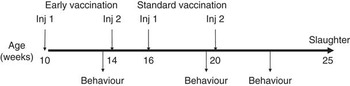
Piglets within litter were randomly allocated to four equally sized groups at birth. In one group, the pigs were surgically castrated without anaesthesia before the age of one week. Pigs in two treatment groups were each given two injections of Improvac® (Pfizer Ltd; 2 ml per injection). Pigs in the early vaccination group were given their first injection at 10 weeks of age (72.5 ± 7.2 days (mean ± s.d.); live weight (LW) 28.9 ± 7.1 kg) immediately after relocation into the growing/finishing unit and the second injection at an age of 14 weeks (100.0 ± 7.1 days; LW 47.3 ± 9.9 kg). Pigs in the standard vaccination group were vaccinated consistently with the manufacturer's recommendation: the first injection was given at the age of 16 weeks (114.0 ± 7.1 days; LW 58.9 ± 11.3 kg) and the second injection at the age of 20 weeks (142.0 ± 7.1 days; LW 86.2 ± 14.4 kg). The injections were given just behind and below the base of the ear. The vaccine, Improvac, contained a modified synthetic form of GnRH coupled to a carrier protein in an aqueous adjuvant (200 μg GnRH analogue-protein conjugate/ml). The two treatment groups were named early vaccinated group and standard vaccinated group, respectively, throughout the paper. In the fourth group, the pigs were kept intact throughout the study and no control substance was administered. A time schedule, including vaccination, is presented in Figure 1.
Time schedule.

The growing/finishing period started when the pigs were at an age of 72.3 ± 7.0 days and had an initial LW of 29.3 ± 7.4 kg. Each pen held eight pigs from only one treatment group in a pen. All pigs were fed restrictedly with the same commercial diet (12.4 MJ metabolisable energy (ME) per kg; digestible CP 13.5%) twice a day according to the standard feeding regimen for growing/finishing pigs in Sweden (Andersson et al., Reference Andersson, Schaub, Andersson, Lundström, Thomke and Hansson1997), that is, the daily feed allowances in MJ of ME were 16.5, 19.0, 24.1, 29.0 and 34.1 at 25, 30, 40, 50 and 60 kg LW and thereafter to slaughter, respectively. Pigs were weighed individually at the start of the study then fortnightly until their final weighing, one day before slaughter. Feed consumption was recorded on a daily basis and feed conversion ratio was calculated pen-wise.
Slaughter was performed on two occasions per pen at an average age of 178.0 ± 8.3 days and an average LW of 119.3 ± 10.2 kg with the four heaviest pigs slaughtered on the first occasion. All pigs were mixed with unfamiliar pigs during transport (350 km) and lairage, to simulate normal transport and slaughter conditions. Before cooling, carcass weight was recorded and lean meat content was evaluated with the Hennessy Grading Probe (Hennessy Grading Systems, Auckland, New Zealand). The amount of abdominal fat was recorded. In addition, skin lesions were visually recorded at slaughter by one observer using a 6-point scale (0: no visible skin damage; 5: very highly damaged skin). These records were used to classify the pigs into two groups: without skin lesions or with skin lesions. Pigs with only a few light skin lesions (score 0 or 1) were classified as ‘without’ skin lesions.
Daily lean meat growth from start of the experiment to slaughter was calculated using a formula of our own invention: % lean × (carcass weight − initial weight × 0.72)/days in experiment, with the value 0.72 representing a hypothetical dressing percentage at start. The income per carcass was calculated on the basis of carcass weight and estimated lean meat content, according to prices from the Swedish co-operative slaughterhouse, contract note November 2010. For entire male pigs, payment was reduced owing to boar taint analysis and tainted carcasses according to standard procedure. Prices were converted from SEK into EUR (1 SEK = 0.11 EUR).
The study was approved by the local Ethics Committee on Animal Research, Uppsala, Sweden and ensured compliance with EC Directive 86/609/EEC for animal experiments.
Behavioural studies
Activity behaviours and social interactions of pigs from all groups were studied by direct observations at three occasions per pen: at 13 to 14 weeks (the week before the second injection of the early vaccinated pigs), at 19 to 20 weeks (the week before the second injection of the standard vaccinated pigs) and at 22 to 23 weeks (2 weeks before slaughter; Figure 1). The observations were recorded by one observer, standing outside the pen and observations did not start until the pigs were accustomed and no longer seemed to pay attention to the observer. All observations were performed between 1000 and 1530 h, that is, outside feeding time.
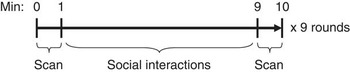
Nine observation rounds per pen were made in a consecutive order to distribute the observations of pens equally over time, and each pen was studied for a 10 min session per round. The observations consisted of two kinds of sampling and recording: instantaneous scan sampling of activity behaviours and continuous recording of frequencies of social interactions (Figure 2). Instantaneous scan samplings of activity behaviours were performed at the beginning and end of each observation round. Between these scan sampling observations, frequencies of social interactions were recorded for a total of 8 min. Thus, one observation day gave 18 instantaneous scan samples and a total of 72 min of social interactions per pen. The behavioural observations were performed over a total of 4 days per occasion.
Time schedule of a round.

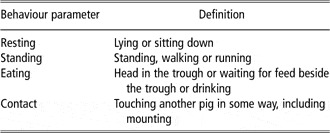
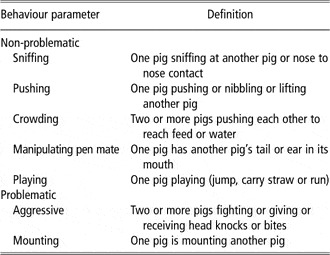
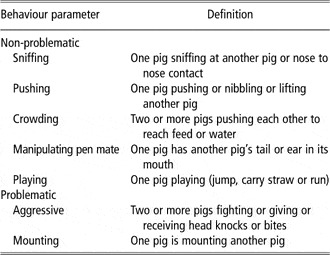
The definitions of the behaviour parameters are presented in Table 1 (activity) and Table 2 (social interactions). During the scan sampling, priorities sometimes had to be made. If a pig had any social contact with another pig, it was always recorded as contact and if a pig was eating while resting, eating was given priority and registered as the main activity. Contact during scan sampling included aggressive as well as non-aggressive behaviour. In the continuous frequency recording of social interactions, problematic (aggressive and mounting) and non-problematic (sniffing, pushing, crowding, manipulating pen mate and playing) interactions were recorded separately. Different social interactions were recorded as new events, regardless of whether they were performed by the same or several different pigs. A new event was recorded as soon as new pigs interacted or when the interaction stopped for 3 s or more, and then started again.
Definitions of behaviour parameters used at the scan sampling

Definitions of social interactions during continuous recording
Statistical analyses
Data were analysed with the Statistical Analysis System, version 9.2 (SAS Institute Inc., Cary, NC, USA). The effect of treatment on performance, carcass quality and severity of skin lesions recorded at slaughter was evaluated on combined data from the two trials with Proc Mixed. The model included the fixed factor of treatment (surgical castration, early vaccination and standard vaccination with Improvac, and entire males), and the random factors of trial, pen within trial and litter. Pig was the experimental unit for carcass and all performance traits, except for feed conversion ratio, where pen was the unit. Initial weight was included in the model as a covariate for daily weight gain and carcass weight for carcass traits. When analysing daily weight gain during suckling, surgically castrated pigs were compared with the entire pigs, that is, also pigs intended for vaccination. The model included the fixed factor of treatment (surgical castration v. entire pigs) and the random factor of trial and litter.
Activity behaviours were recorded as the percentage of pigs performing a particular behaviour at each observation occasion (9 rounds × 2 scan samplings) and were analysed as a percentage of time. The social behaviour was recorded as the total number of interactions performed per pen and hour at each observation occasion (9 rounds × 8 min). Pen was the experimental unit for all behaviour analyses. Behaviour parameters did not show normal distribution of the residuals. Thus, activity behaviour data were arcsine (square root)-transformed and social interaction data were square root-transformed before statistical analysis. These parameters were evaluated within each observation occasion with Proc Mixed. The model included treatment as fixed factor and trial as random factor. For comparisons over time, analogous evaluation was performed within treatment, with occasion as fixed factor and trial as random factor. The level of significance was set at P < 0.05.
The impact of treatment on the occurrence of skin lesions recorded at slaughter was tested as a logistic regression using a binomial distribution with a logit link function. These analyses were performed with Proc Genmod and the model included the effect of treatment and trial.
Results and discussion
Performance and carcass quality
During the suckling period, daily weight gain did not differ between surgically castrated and entire male piglets (258 v. 261 g; P = 0.702). This is in contrast with our previous study, in which surgically castrated piglets had lower growth rate from birth to weaning (Zamaratskaia et al., Reference Zamaratskaia, Andersson, Chen, Andersson, Madej and Lundström2008a). This was hypothesised to be due to pain associated with the castration procedure. This study, however, implies that the effect of castration pain on piglet growth rate may be small.
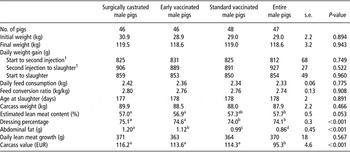
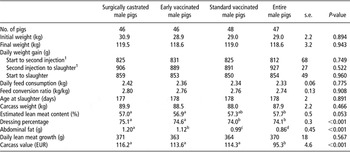
During the growing/finishing period, two surgically castrated, two early vaccinated and one entire male pig died or had to be euthanised, due to illness not related to the study. Daily weight gain in the interval from start to second injection of standard vaccinated pigs did not differ significantly between treatment groups (Table 3). Neither did daily weight gain differ in the interval from the second injection to slaughter. Accordingly, daily weight gain and feed conversion ratio for the entire raising period did not differ between the groups. In previous studies where pigs were vaccinated according to the manufacturer's recommendation, an increase in growth rate after the second injection was observed due to a higher feed consumption (Zamaratskaia et al., Reference Zamaratskaia, Andersson, Chen, Andersson, Madej and Lundström2008a; Pauly et al., Reference Pauly, Spring, O'Doherty, Ampuero Kragten and Bee2009; Fàbrega et al., Reference Fàbrega, Velarde, Cros, Gispert, Suárez, Tibau and Soler2010) and a better feed conversion efficiency (Pauly et al., Reference Pauly, Spring, O'Doherty, Ampuero Kragten and Bee2009; Fàbrega et al., Reference Fàbrega, Velarde, Cros, Gispert, Suárez, Tibau and Soler2010). This has partly been explained by a change in behaviour (decreased aggression and mounting) after vaccination due to lower levels of testosterone and oestrogens (Dunshea et al., Reference Dunshea, Colantoni, Howard, McCauley, Jackson, Long, Lopaticki, Nugent, Simons, Walker and Hennessy2001; Cronin et al., Reference Cronin, Dunshea, Butler, McCauly, Barnett and Hensworth2003; Mackinnon and Pearce, Reference Mackinnon and Pearce2007). It has also been shown that oestrogens have a direct negative effect on feed intake (Bonavera et al., Reference Bonavera, Dube, Kalra and Kalra1994). Effects of behaviour on growth rate have also been found by Rydhmer et al. (Reference Rydhmer, Zamaratskaia, Andersson, Algers, Guillemet and Lundström2006), who reported that male pigs performing many mountings had a lower growth rate than male pigs not mounting. The discrepancy between earlier findings and this study can probably be explained by a difference in feeding regime. In this study, the feed intake was restricted, whereas the pigs in the reported studies were fed (semi) ad libitum. Thus, even with an increased interest in eating of the vaccinated pigs, the restricted feed supply would not allow higher intake and associated increase in growth rate.
Performance and carcass quality for surgical castrated, early and standard vaccinated pigs and entire male pigs
Data are presented as least square means. s.e. = pooled standard error.
Means with different superscripts within the rows differ at P ⩽ 0.05.
1Second injection of standard vaccinated pigs.
There was a possible effect of treatment on estimated lean meat content (P = 0.053). Early vaccinated and surgically castrated pigs had lower values compared with entire male pigs (P = 0.014 and 0.021, respectively), whereas standard vaccinated pigs did not differ from entire males. This agrees with previous studies (Jaros et al., Reference Jaros, Bürgi, Stärk, Claus, Hennesey and Thun2005; Fàbrega et al., Reference Fàbrega, Velarde, Cros, Gispert, Suárez, Tibau and Soler2010), in which standard vaccinated pigs had lean meat content in between entire males and castrates. The lower value for early vaccinated compared with standard vaccinated pigs obtained in our study can be ascribed to a longer time between the second vaccination and slaughter. Thus, lean meat content of early vaccinated pigs is more similar to surgically castrated pigs than that of standard vaccinated pigs.
Dressing percentage was higher in early vaccinated and surgically castrated pigs than in standard vaccinated and entire male pigs (Table 3). These findings agree with results of Pauly et al. (Reference Pauly, Spring, O'Doherty, Ampuero Kragten and Bee2009). In contrast, Dunshea et al. (Reference Dunshea, Colantoni, Howard, McCauley, Jackson, Long, Lopaticki, Nugent, Simons, Walker and Hennessy2001) and Zamaratskaia et al. (Reference Zamaratskaia, Andersson, Chen, Andersson, Madej and Lundström2008a) found that standard vaccination leads to lower dressing percentage compared with entire male pigs, a finding that has been interpreted mainly as depending on a higher feed intake and gut fill in the vaccinated pigs. The discrepancy between the different studies is probably an effect of the applied feeding regime. The higher dressing percentage for early vaccinated pigs in our study can partly be explained by a lower size and weight of reproductive organs (Einarsson et al., Reference Einarsson, Brunius, Wallgren, Lundström, Andersson, Zamaratskaia and Rodriguez-Martinez2011), although this increase is somewhat counterbalanced by a higher amount of abdominal fat (Table 3).
Average daily lean meat growth from start of the study to slaughter did not differ between the groups (P = 0.567). Consequently, no differences in income per carcass were observed for surgically castrated or vaccinated pigs (Table 3). However, for entire male pigs the income was lower, as the payment system takes into consideration the additional cost for boar taint analyses and reduced payment for tainted carcasses. A more comprehensive economical analysis, including costs related to the different treatments during production is beyond the scope of this paper. Such costs would include, for example, labour costs for castration and vaccination and the cost of the vaccine. Neither do we consider underestimation of lean meat percentage for entire male pigs compared with castrated and female pigs (Andersson et al., Reference Andersson, Hansson, Lundström and Karlsson1995).
Activity behaviour
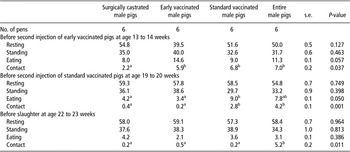
Treatment did not significantly affect the time that pigs spent resting and standing at any observation occasion (Table 4; Figure 1). Eating was affected by treatment, but the effect was not consistent over time. There was a tendency for a higher frequency of eating for entire male pigs at the first two observation occasions compared with castrates and vaccinated pigs. At the third observation occasion, the time spent eating by entire male pigs had decreased to the level of castrated and vaccinated pigs. This is probably due to an ageing effect and a similar pattern has also been observed by Rydhmer et al. (Reference Rydhmer, Lundström and Andersson2010). On the first observation occasion, surgically castrated pigs had less contact with each other than pigs in the other groups, who were all entire male pigs at that time (P < 0.05). This is in accordance with Baumgartner et al. (Reference Baumgartner, Laister, Koller, Pfützner, Grodzycki, Andrews and Schmoll2010) and Rydhmer et al. (Reference Rydhmer, Lundström and Andersson2010), who reported less activity for surgically castrated pigs already at the beginning of the growing period. The reasons for this behaviour are not clear, particularly given that Schwarzenberger et al. (Reference Schwarzenberger, Toole, Christie and Raeside1993) found that gonadal hormones between entire male and castrated pigs at this early, pre-pubertal stage do not differ. However, Berry and Signoret (Reference Berry and Signoret1984) reported that neonatal castration affected behaviour by elimination of sex play. On the next observation occasion, when early vaccinated pigs had received their second injection they spent less time on contact compared with the two groups with entire male pigs (P < 0.01), but similar to surgically castrated pigs (P = 0.587). On the third observation occasion, standard vaccinated pigs had also been injected twice and spent as little time on contact as surgically and early vaccinated pigs (P > 0.65), whereas entire male pigs continued to use approximately the same time on contact with each other as on the earlier observation occasions (P > 0.15). Thus, the second injection reduces the activity of the pigs, whether the vaccination is early or standard.
Percentage of day time used on scan sampling activity behaviours

See Table 1 for definitions of behaviour parameters used at the scan sampling.
Data are presented as least square means. s.e. = pooled standard error.
Means with different superscript within row differ significantly (P ⩽ 0.05).
Social interactions
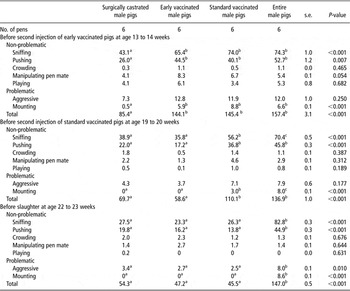
Non-problematic: On the first observation occasion, before the second injection of early vaccinated pigs (Figure 1), surgically castrated pigs performed less sniffing (P < 0.002) and pushing (P < 0.05) than the other pigs (Table 5). On the second occasion, when early vaccinated but not standard vaccinated pigs had received their second injection, the frequencies of sniffing (P < 0.002) and pushing (P < 0.001) were lower for early vaccinated pigs than for standard vaccinated and entire male pigs, but were similar to castrates. On the third observation occasion, these behaviours were at the same level for standard vaccinated pigs as for surgically castrated and early vaccinated pigs. For entire male pigs, these frequencies were unaffected over time (P > 0.51). In line with Baumgartner et al. (Reference Baumgartner, Laister, Koller, Pfützner, Grodzycki, Andrews and Schmoll2010), we could not find any difference between groups in the occurrences of crowding, manipulating pen mate and playing.
Frequency of observed social interactions per pen and hour

See Table 2 for definitions of social interactions.
Data are presented as least square means. s.e. = pooled standard error.
Means with different superscript within row differ significantly (P < 0.05).
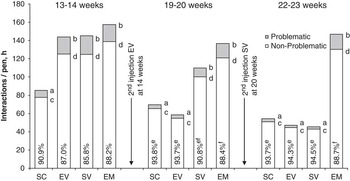
Total interactions were higher for entire male pigs than for surgically castrated pigs (Table 5), with a lower proportion of non-problematic behaviours already at 13 weeks of age (Figure 3). This pattern was unaffected over time. For the vaccinated pigs, both non-problematic and total interactions decreased after their second injection, from the levels of entire males to those of surgically castrated pigs. The proportion of non-problematic interactions increased to the higher level of surgically castrated pigs (Figure 3). Pigs are social animals. However, a too high level of activity can be stressful if it prevents pigs from resting. A high proportion of non-problematic social behaviours, as found after vaccination, is therefore conducive to a positive social environment.
Problematic (a and b different at P < 0.05) and non-problematic (c and d different at P < 0.05) behaviours of surgically castrated (SC), early vaccinated (EV), standard vaccinated (SV) and entire male pigs (EM). The proportion of non-problematic behaviours is shown at the bottom of each bar, expressed as percentage of total behaviours (e and f different at P < 0.05). Problematic interactions include aggression and mounting. Non-problematic interactions include sniffing, pushing, crowding, manipulating pen mate and playing.

Our results are in agreement with those published by other authors (Velarde et al., Reference Velarde, Gispert, Oliver, Soler, Tibau and Fàbrega2007; Fàbrega et al., Reference Fàbrega, Velarde, Cros, Gispert, Suárez, Tibau and Soler2010; Rydhmer et al., Reference Rydhmer, Lundström and Andersson2010) who showed that before the second injection, the activity of vaccinated pigs was as high as that of entire male pigs, whereas after the second injection, the activity decreased and was similar to surgically castrated pigs. Similar decreases in activity were observed for early and standard vaccinated pigs. Although the early vaccinated pigs had received their second injection already at 14 weeks of age, the effect on activity remained until the end of the trial.
Problematic: Problematic interactions were higher for entire male pigs than for surgically castrated pigs (Figure 3). For the vaccinated pigs, problematic interactions decreased after their second injection, from the levels of entire males to those of surgically castrated pigs. On the first observation occasion, mounting frequency was lower for surgically castrated pigs than for the other groups, which were all still entire male pigs (P < 0.001; Table 5). Rydhmer et al. (Reference Rydhmer, Lundström and Andersson2010) reported similar results. This difference can be explained by the elimination of most of sex play by neonatal castration (Berry and Signoret, Reference Berry and Signoret1984). At the next observation occasion, early vaccinated pigs ceased mounting behaviour completely. Although standard vaccinated pigs had not yet received their second injection, they had decreased their frequency of mounting to a lower level than entire male pigs (P = 0.008). This could be due to a rapid immunocastration effect in these pigs. In a study by Turkstra et al. (Reference Turkstra, Zeng, van Diepen, Jongbloed, Oonk, van de Wiel and Meloen2002), where a different anti-GnRH vaccine was used, 50% of the pigs had low levels of plasma testosterone and diminished testicular function already before the second vaccination. Before slaughter, mounting was also absent in standard vaccinated pigs, but was still present among the entire male pigs at the same level as previously. These results are in accordance with Cronin et al. (Reference Cronin, Dunshea, Butler, McCauly, Barnett and Hensworth2003) and Rydhmer et al. (Reference Rydhmer, Lundström and Andersson2010), who reported a higher frequency of mounting before the second vaccination compared with surgically castrated pigs. After the second injection, the frequency of problematic behaviour decreased to the level of castrates, and we found, in contrast to Fàbrega et al. (Reference Fàbrega, Velarde, Cros, Gispert, Suárez, Tibau and Soler2010) and Rydhmer et al. (Reference Rydhmer, Lundström and Andersson2010), no clear effect of vaccination on aggressive behaviour, probably due to an overall very low level. However, on the third observation occasion, surgically castrated and vaccinated pigs performed significantly less aggressive behaviour than entire male pigs. The increased risk for leg problems normally observed among entire male pigs, due to high frequency of problematic behaviours (Rydhmer et al., Reference Rydhmer, Zamaratskaia, Andersson, Algers, Guillemet and Lundström2006) was not observed in this study, probably owing to the overall low levels of aggression and mounting.
Overall, the behavioural studies indicate that vaccinated pigs after their second injection behave similarly to surgically castrated pigs. In addition, surgically castrated and vaccinated pigs had skatole and androstenone levels below threshold values, with no significant differences between these three groups. Entire male pigs, however, had significantly higher levels of both compounds (manuscript in preparation).
Skin lesions
Treatment affected skin lesions recorded at slaughter (P < 0.001), with more lesions observed on entire male pigs (65%) than in the other groups. The occurrence did not differ significantly between surgically castrated (14%), early (31%) and standard vaccinated pigs (25%). Fàbrega et al. (Reference Fàbrega, Velarde, Cros, Gispert, Suárez, Tibau and Soler2010) and Rydhmer et al. (Reference Rydhmer, Lundström and Andersson2010) both reported results along the same lines. We also found that the severity of skin lesions did not differ between early vaccinated (2.22 points) and standard vaccinated pigs (2.01 points; P = 0.353). However, the vaccinated pigs had more severe skin lesions than surgically castrated pigs (1.58 points; P < 0.049) but less severe than entire male pigs (3.01 points; P < 0.001). Vaccination thus resulted in a reduction of skin lesions, both in occurrence and severity, compared with entire male pigs. This implies that castration, regardless of method, suppresses problematic behaviours. However, it should be noted that, although behavioural studies at the end of the growing/finishing period indicated no difference in aggression and mounting between surgically castrated and vaccinated pigs, the occurrence of skin lesions at slaughter indicates a possible difference in behaviour at mixing with unfamiliar pigs.
Conclusion
This study showed that earlier than recommended vaccination of male pigs with a vaccine against GnRH, Improvac, yielded production results similar to surgical castration and vaccination as recommended by the manufacturer. Furthermore, early vaccination may be associated with animal welfare improvements over the recommended vaccination schedule as problematic aggressive and sexual behaviours are minimised earlier. Early vaccination provides the possibility of a more flexible vaccination schedule than the currently recommended schedule.
Acknowledgements
This study was supported by the Swedish Board of Agriculture. Pfizer is gratefully acknowledged for providing Improvac and additional financial support. We thank Mr. Michael Pearce for valuable comments on the manuscript. We also thank Eva Norling and the staff at Funbo-Lövsta Research Station for taking excellent care of the pigs and Ulla Schmidt for collecting data.