Introduction
The Big Five personality traits have received a lot of attention from political scientists in the past decade, which include five dimensions of personality: extraversion, agreeableness, conscientiousness, emotional stability (sometimes referred to by its inverse, neuroticism), and openness to experience (Digman, Reference Digman1990; Goldberg, Reference Goldberg1993). Specifically, extraversion is characterized by talkativeness, energy, boldness, and assertiveness; agreeableness is characterized by kindness, cooperativeness, trustfulness, and generosity; conscientiousness is characterized by organizability, orderliness, responsibility, and dependability; emotional stability is characterized by calm, stability, relaxedness, and contentedness; and openness to experience is characterized by originality, curiosity, reflectiveness, and ingenuity (Gosling et al., Reference Gosling, Rentfrow and Swann2003). Scholars have examined the relationship between the Big Five personality traits and political participation (Anderson, Reference Anderson2009; Gerber et al., Reference Gerber, Huber, Doherty, Dowling, Raso and Ha2011a; Mondak, Reference Mondak2010; Mondak et al., Reference Mondak, Hibbing, Canache, Seligson and Anderson2010; Mondak et al., Reference Mondak, Canache, Seligson and Hibbing2011; Vecchione and Caprara, Reference Vecchione and Caprara2009) and the general findings demonstrate that the Big Five personality traits exert significant influence on individual political participation. Most previous studies, however, simply focus on the United States and offer little insight into the relationships between personality traits and political behavior in other countries.
Therefore, this study aims to examine the effects of personality traits on voter turnout in South Korea. Ha et al. (Reference Ha, Kim and Jo2013) were the first to analyze the relationships between personality traits and various types of political participation in South Korea. In particular, their study indicates no significant relationship between personality traits and voter turnout, which is inconsistent with the findings from the United States and European countries. Nevertheless, does this mean we jump to a conclusion that personality traits are not associated with voter turnout in South Korea? Mondak et al. (Reference Mondak, Hibbing, Canache, Seligson and Anderson2010) suggest that personality traits might influence individual political participation through their effects on other mediatory factors and by interaction with individual and contextual factors. Therefore, several studies have formulated the mediation hypothesis to reexamine the relationships between personality traits and political behavior (Blais and Labbé St-Vincent, Reference Blais and St-Vincent2011; Gallego and Oberski, Reference Gallego and Oberski2012; Schoen and Steinbrecher, Reference Schoen and Steinbrecher2013; Wang, Reference Wang2016). Particularly, Gallego and Oberski (Reference Gallego and Oberski2012) find that while the effects of personality traits on voter turnout are sizeable, they are mediated by such attitudinal predictors as political interest, political efficacy, and civic duty. Therefore, we contend that although personality traits are not directly associated with voter turnout in South Korea, several attitudinal predictors of voting can mediate the effects of personality traits on voter turnout, including political interest, political efficacy, partisanship, and ideology.
On the whole, this study is expected to make two contributions: (1) propose a new theoretical perspective to explain the relationships between personality traits and voter turnout in South Korea and (2) provide empirical evidence that the effects of personality traits on voter turnout are mediated by some attitudinal factors in South Korea. The reminder of this study is structured as follows. In the second section, we outline the theoretical framework for the mediating relationships between personality traits and voter turnout, and proposes the hypotheses for each personality trait; in the third section, we describe the data, measurement of variables, and model specification; in the forth section, we report the empirical findings on the mediating effects of personality traits on voter turnout; and in the final section, we conclude by summarizing the key findings and discussing the implications of this study.
Personality traits, political attitudes, and voter turnout
In the field of political psychology, personality traits have been considered as the pivotal factors accounting for individual political attitudes and behaviors (Gerber et al., Reference Gerber, Huber, Doherty, Dowling, Raso and Ha2011a). In particular, many scholars have examined the relationships between personality traits and political participation (Mondak and Halperin, Reference Mondak and Halperin2008; Anderson, Reference Anderson2009; Steinbrecher and Scheon, Reference Steinbrecher and Schoen2010; Mattila et al., Reference Mattila, Wass, Söderlund, Fredriksson, Fadjukoff and Kokko2011; Gerber et al., Reference Gerber, Huber, Doherty and Dowling2011b; Mondak et al., Reference Mondak, Hibbing, Canache, Seligson and Anderson2010). Although past studies show inconsistent findings on the effects of personality traits on political participation, it is reasonable to believe that personality traits are theoretically and empirically associated with individual political participation. Generally, scholars expect that extraversion and openness to experience are associated with higher rates of political participation, whereas agreeableness and emotional stability are associated with lower rates of political participation. With regard to voter turnout, previous studies have provided evidence that extraversion and openness to experience are significantly correlated with voter turnout (Gerber et al., Reference Gerber, Huber, Doherty, Dowling, Raso and Ha2011a; Mattila et al., Reference Mattila, Wass, Söderlund, Fredriksson, Fadjukoff and Kokko2011; Mondak et al., Reference Mondak, Hibbing, Canache, Seligson and Anderson2010). By contrast, there are inconsistent results for agreeableness and emotional stability. Agreeableness is found to be negatively associated with voter turnout in the United States (Mondak and Halperin, Reference Mondak and Halperin2008; Gerber et al., Reference Gerber, Huber, Doherty, Dowling, Raso and Ha2011a), but be positively related to voter participation in Germany (Steinbrecher and Scheon, Reference Steinbrecher and Schoen2010). Furthermore, there are different results for the relationship between emotional stability and voter turnout even in the same country. Gerber et al. (Reference Gerber, Huber, Doherty, Dowling, Raso and Ha2011a) find a positive influence of emotional stability on voter turnout with two American samples. However, some studies demonstrate that emotional stability has a negative effect on voter participation (Anderson, Reference Anderson2009; Mondak et al., Reference Mondak, Hibbing, Canache, Seligson and Anderson2010).
While the majority of the studies have focused on the direct relationships between personality traits and voter turnout, Mondak et al. (Reference Mondak, Hibbing, Canache, Seligson and Anderson2010) suggest that personality traits might affect political participation through their impacts on other intermediary factors and call attention to multiple possible pathways linking personality traits and political participation. Consequently, several studies have attempted to examine the mediating relationships between personality traits and voter turnout. For instance, Blais and Labbé St-Vincent (Reference Blais and St-Vincent2011) examine the relationship between personality traits and the propensity to vote in Canada, finding that political interest and civic duty can mediate the impact of personality trait on the propensity to vote. Similarly, Gallego and Oberski (Reference Gallego and Oberski2012) investigate the relationships between personality traits and voter turnout in the European Parliament elections in Spain. They show that the effect of extraversion on voter turnout is mediated by political efficacy; the effect of conscientiousness on voter turnout is mediated by civic duty; and the effect of openness on participation is mediated by political interest and political efficacy. Furthermore, using data from a survey conducted after the 2009 German federal election, Schoen and Steinbrecher (Reference Schoen and Steinbrecher2013) demonstrate that such attitudinal factors as party identification, civic duty, political interest, and political efficacy play a role in mediating the effects of personality traits on voter turnout. To sum up, there is sufficient evidence that attitudinal predictors of turnout can serve as intervening variables to mediate the impact of personality traits on voter participation.
It is noted that existing studies on the relationships between personality traits and political participation mostly concentrate on the United State and European countries (Gerber et al., Reference Gerber, Huber, Doherty, Dowling, Raso and Ha2011a; Mondak and Halperin, Reference Mondak and Halperin2008; Mondak, Reference Mondak2010; Mondak et al., Reference Mondak, Hibbing, Canache, Seligson and Anderson2010; Mattila et al., Reference Mattila, Wass, Söderlund, Fredriksson, Fadjukoff and Kokko2011; Steinbrecher and Schoen, Reference Steinbrecher and Schoen2010; Vecchione and Caprara, Reference Vecchione and Caprara2009). By contrast, there are very few studies done in the other countries. As a result, this study attempts to fill this gap by studying the impact of personality traits on voter turnout in South Korea and expects to widen our understanding of the relationships between personality traits and political participation in Asia. As mentioned previously, Ha et al. (Reference Ha, Kim and Jo2013) are the first to assess the effects of personality traits on political participation in South Korea. They find that openness to experience has a positive impact on non-electoral political participation such as rally attendance, donation, and media contact, whereas agreeableness has a negative effect on non-institutional political participation such as signing petitions and joining protests. As for the topic of the present study, they show no relationship between personality traits and voter turnout. Although personality traits are not directly associated with voter turnout in South Korea, it does not necessarily mean that personality traits are completely unrelated to individual turnout decisions.
As demonstrated by previous studies (Blais and Labbé St-Vincent, Reference Blais and St-Vincent2011; Gallego and Oberski, Reference Gallego and Oberski2012; Schoen and Steinbrecher, Reference Schoen and Steinbrecher2013), personality traits might indirectly influence individual voter participation through their impact on attitudinal predictors of voter turnout. Therefore, this study argues that such attitudinal factors as political interest, political efficacy, partisanship, and ideology can mediate the effects of personality traits on voter turnout. While previous research has identified civic duty as an important variable that mediates the impact of personality on voter turnout, unfortunately this study cannot take civic duty into consideration, given the fact that the dataset used in this study does not include any variables related to civic duty. On the other hand, similar to studies conducted in other countries, political interest, political efficacy, partisanship, and ideology are found to be strong determinants of voter turnout in South Korea.
First of all, several studies have documented that political interest, including interest in elections, is associated with voter participation in South Korea (Kang, Reference Kang2003a; Kim, Reference Kim2014; Lee, Reference Lee2004; Lee Reference Lee2013). High levels of political interest mean that people are more concerned about various political issues and are more willing to take part in political activities. Accordingly, higher levels of political interest should increase the likelihood an individual will vote.
Second, numerous studies have also emphasized the role of political efficacy in voter turnout in South Korea (Hur, Reference Hur2013; Kang, Reference Kang2003a; Kim, Reference Kim and Lee1998, Reference Kim2013; Lee, Reference Lee2013). Political efficacy is defined as citizens’ belief that they do understand and can influence political affairs (Campbell et al., Reference Campbell, Gurin and Miller1954: 187). Therefore, it is expected that with the increase of political efficacy, people will become more likely to cast ballots.
Third, since the publication of The American Voter by Campbell et al. (Reference Campbell, Converse, Miller and Stokes1960), party identification has been viewed as a powerful predictor of voter turnout and there is no exception for South Korea. Due to a centralized power structure and regional party systems, South Korean politics is party-centered politics (Cho, Reference Cho1998; Lee and Brunn, Reference Lee and Brunn1996). Furthermore, a number of studies have confirmed the impact of party identification on voter turnout in South Korea (Lee, Reference Lee2004; Lee and Hwang, Reference Lee and Hwang2012).
Lastly, ideology has begun to play an important role in South Korean politics since the 1997 presidential election. The 1997 South Korean presidential election marked the first time in the history of South Korea that an incumbent government peacefully surrendered power to the opposition. The opposition presidential candidate Kim Dae-jung won the presidency, which terminated almost 36 years of conservative rule. Since that time, ideological voting has been seen as an effective approach to explaining individual voting behavior in South Korea (Kang, Reference Kang2003b; Choi and Cho, Reference Choi and Cho2005; Jhee, Reference Jhee2006; Lee and Jeong, Reference Lee and Jeong2007). In particular, ideological voting has been regarded as a new type of voting behavior that is different from regional voting or partisan voting in South Korea (Lee, Reference Lee2012). While past studies have focused on the impact of ideology on vote choice in South Korea (Lee, Reference Lee2009; Oh and Gil, Reference Oh, Gil, Park and Kang2013), it can be inferred that people with strong ideology ought to be more likely to vote in order to make sure the parties or candidates that are ideologically similar to them can receive more votes.
The above discussion has pointed out that political interest, political efficacy, partisanship, and ideology are associated with individual turnout decisions in South Korea. Nevertheless, in order to test the mediating relationships between personality traits and voter turnout, it is necessary to specify the theoretical pathways linking personality traits to the above-mentioned attitudinal factors. This study starts by discussing the effects of personality traits on political interest.
Some studies have documented the associations between personality traits and political interest. In general, people who score high on extraversion, conscientiousness, and openness to experience are more interested in politics (Gerber et al., Reference Gerber, Huber, Doherty and Dowling2011b; Mondak, Reference Mondak2010; Mondak and Halperin, Reference Mondak and Halperin2008). Besides, Mondak and Halperin (Reference Mondak and Halperin2008) find some evidence that individuals high in agreeableness tend to be less attentive to politics. By contrast, there is no empirical evidence supporting the relationship between emotional stability and voter turnout. Therefore, it is expected that extraversion, agreeableness, conscientiousness, and openness to experience influence individuals’ levels of political interest that in turn have an effect on voter participation.
On the other hand, past studies have demonstrated that personality has a significant influence on individual self-efficacy belief (Caprara et al., Reference Caprara, Vecchione, Alessandri, Gerbino and Barbaranelli2011; and Vecchione and Caprara, Reference Vecchione and Caprara2009). That is, personality traits have an effect on the strength of an individual's belief in her own ability to complete tasks and reach goals. Specifically, people with higher levels of extraversion, agreeableness, conscientiousness, emotional stability, and openness to experience are inclined to produce higher levels of political efficacy (Mondak, Reference Mondak2010; Mondak and Halperin, Reference Mondak and Halperin2008). Consequently, it is plausible to argue that the Big Five personality traits influence individuals’ levels of political efficacy, which in turn have an effect on turnout decisions.
Personality also plays a pivotal role in shaping an individual's party identification. Gerber et al. (Reference Gerber, Huber, Doherty and Dowling2012) provide a theoretical framework for understanding the relationships between personality traits and party identification. In particular, they argue that higher levels of extraversion, agreeableness, and conscientiousness are associated with strong identification with a major political party; by contrast, higher levels of emotional stability and openness to experience are associated with weak party identification. However, their empirical results only confirm that extraversion, agreeableness, and openness to experience can predict strength of partisan identification. Therefore, the Big Five personality traits are expected to influence individuals’ partisanship that in turn have an effect on voter turnout.
Finally, some studies have indicated that personality traits and ideology are associated with each other. In general, people who score high on agreeableness and openness to experience tend to be liberal, whereas those who score high on conscientiousness and emotional stability are prone to be conservative. However, there is no relationship between extraversion and ideology (Fatke, Reference Fatke2016). Accordingly, it can be inferred that people with higher levels of agreeableness, conscientiousness, emotional stability, and openness to experience are more likely to possess a strong ideology – either liberal or conservative. Therefore, it is expected that agreeableness, conscientiousness, emotional stability, and openness to experience influence ideology that in turn affects voter turnout.
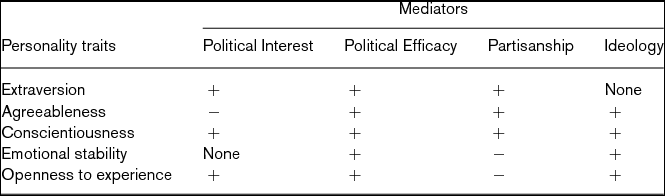
In light of above discussion, it is known that (1) higher levels of extraversion are associated with higher levels of political interest and political efficacy and strong partisanship; (2) higher levels of agreeableness are associated with higher levels of political efficacy and strong partisanship and ideology but are related to lower levels of political interest; (3) higher levels of conscientiousness are associated with higher levels of political interest and political efficacy and strong partisanship and ideology; (4) higher levels of emotional stability are associated with higher levels of political efficacy and strong ideology but are related to weak partisanship; and (5) higher levels of openness to experience are associated with higher levels of political interest and political efficacy and strong ideology but is related to weak partisanship. As a result, by taking into consideration the influence of political interest, political efficacy, partisanship, and ideology on voter turnout, this study hypothesizes that (1) extraversion exerts a positive mediation effect on voter turnout through political interest, political efficacy, and partisanship; (2) agreeableness has a positive mediation effect on voter turnout through political efficacy, partisanship, and ideology but a negative mediation effect via political interest; (3) conscientiousness exerts a positive mediation effect on voter turnout through political interest, political efficacy, partisanship, and ideology; (4) emotional stability exerts a positive mediation effect on voter turnout through political efficacy and ideology but a negative mediation effect via partisanship; and (5) openness to experience has a positive mediation effect on voter turnout through political interest, political efficacy, and ideology but a negative mediation effect via partisanship. The hypotheses are summarized in Table 1.
Summary of Hypotheses

Note: “+” indicates positive indirect influence; “ − “ indicates negative indirect influence; “none” indicates no indirect influence.
Data, measurement of variables, and model specification
The data for our analysis are obtained from the Korean General Social Survey (KGSS), 2012 (hereafter KGSS, Reference Kim2012). The KGSS is the South Korean version of the General Social Survey (GSS) and typically includes the topical module surveys of the International Social Survey Program (ISSP), and the East Asian Social Survey (EASS). Respondents were asked for their opinions on Korean society, including various political, social, and economic issues as well as demographic information such as age, sex, education level, household income, employment status, religious preference, and political philosophy. The KGSS is a nationally representative, face-to-face interview survey using full probability sampling procedures and has been conducted every year since 2003. The target population of the KGSS is all adults aged 18 years and over who live in households of Korea.Footnote 1 It is noted that the questions about the Big Five personality traits were first introduced in 2009 and then asked again in 2011 and 2012. Nevertheless, since the KGSS 2009 and KGSS 2011 do not include questions about such attitudinal variables as political interest and political efficacy, we simply focus on the KGSS 2012 for our empirical analysis.Footnote 2 The KGSS 2012 took place between June and August 2012 and had a response rate of approximately 60%. We describe how we operationalize the variables for empirical analysis as follows.
In the present study, we are interested in individual voter participation and thus our dependent variable is whether people voted in the election. Specifically, voter turnout is treated as a dichotomous variable coded as 1 for the respondents who voted in the 2012 legislative election and 0 for those abstaining from voting.
The key independent variables are the Big Five personality traits. The KGSS 2012 includes a carefully translated Korean version of the Ten-Item Personality Inventory (TIPI) developed by Gosling et al. (Reference Gosling, Rentfrow and Swann2003) and is widely used by political psychologists to examine the impact of personality traits on individual political attitudes and behavior (Gerber et al., Reference Gerber, Huber, Doherty, Dowling and Ha2010; Gerber et al., Reference Gerber, Huber, Doherty, Dowling, Raso and Ha2011a; Mondak et al., Reference Mondak, Hibbing, Canache, Seligson and Anderson2010; Mondak et al., Reference Mondak, Canache, Seligson and Hibbing2011; Wang, Reference Wang2014, Reference Wang2016). Each Big Five personality trait is captured by every two items, that is an overall score for each personality trait is obtained by adding, after appropriate recoding, the two items representing each personality trait. The higher score indicates the more prominent personality trait within an individual. In this study, the value of each personality trait ranged from 2 to 14. While some scholars prefer longer survey instruments to measure the Big Five personality traits (such as the 44-item Big Five Inventory [BFI] and the 240-item Revised NEO Personality Inventory [NEO-PI-R]), Gosling et al. (Reference Gosling, Rentfrow and Swann2003) demonstrate that the TIPI has high construct validity and test–retest reliability, and is highly correlated with the longer versions of personality measures, concluding that the TIPI stands as an adequate representation of the longer Big-Five measures.
Four attitudinal variables – political interest, political efficacy, partisanship, and ideology – play an important role in understanding the mediating relationships between personality traits and voter turnout. First of all, the respondents are asked to indicate how strongly they would agree or disagree with the statement that ‘I am personally interested in politics’. Accordingly, we treat political interest as an ordinal variable and code it to range from 1 to 7. The higher value means a higher level of political interest. Second, political efficacy is measured by how strongly the respondents would agree or disagree with the statement that ‘Politics and government are too complicated for me to understand what is going on.’ Similarly, we treat political efficacy as an ordinal variable and code it to range from 1 to 7. The higher value indicates a higher level of political efficacy. Third, given the limitations of the data, we are unable to assess individual strength of partisanship and can only identify whether the respondents are partisans or non-partisans. Thus, partisanship is treated as a dichotomous variable and coded as 1 for partisans and 0 for non-partisans. Finally, ideology is measured by a single question asking the respondents to place themselves on a five-point scale ranging from very liberal to very conservative. We recode this variable to indicate individual intensity of ideology ranging from 1 to 3, 1 being moderate and 3 being very ideological.
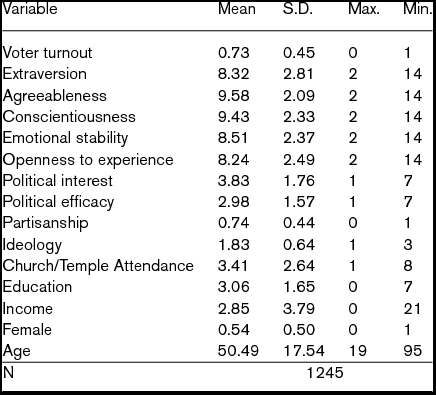
Although our main focus is to examine the mediating relationships between the Big Five personality traits and voter turnout, our final analytic model includes some variables related to voter participation in South Korea as controls, including religious attendance, education, income, gender, and age. First of all, religious attendance is treated as a continuous variable and the higher value denotes more frequent church or temple attendance. Second, we generate two continuous variable, to measure the respondents’ levels of education and income respectively. The higher values mean that the respondents have a higher level of educational attainment and higher income. Finally, we treat gender as a dichotomous variable coded as 1 if the respondents are female and 0 for males, and measure age using the number of years since birth. Table 2 reports the descriptive statistics of the variables used in our empirical analysis (please see the Appendix for detailed question wording).
Descriptive Statistics of Variables

To test the theoretical argument that the effects of personality traits on voter turnout are mediated by political interest, political efficacy, partisanship, and ideology, we employ the generalized structural equation model to perform mediation analysis.2 In particular, the following models are estimated to examine the mediating effects of personality traits on voter turnout in South Korea:
 $$\begin{equation}
\begin{array}{@{}l@{}} Ordinal\ logit\left( {Political\ interest} \right) = {\alpha _1}\left( {Extraversion} \right) + {\alpha _2}\left( {Agreeableness} \right)\\ \quad \quad \quad \quad \quad \quad +\, {\alpha _3}\left( {Conscientiousness} \right) + {\alpha _4}\left( {Emotional\ stability} \right)\\ \quad \quad \quad \quad \quad \quad +\, {\alpha _5}\left( {Openness\ to\ experience} \right) \end{array}
\end{equation}$$
 $$\begin{equation}
\begin{array}{@{}l@{}} Ordinal\ logit\left( {Political\ efficacy} \right) = {\beta _1}\left( {Extraversion} \right) + {\beta _2}\left( {Agreeableness} \right)\\ \quad \quad \quad \quad \quad \quad +\, {\beta _3}\left( {Conscientiousness} \right) + {\beta _4}\left( {Emotional\ stability} \right)\\ \quad \quad \quad \quad \quad \quad +\, {\beta _5}\left( {Openness\ to\ experience} \right) \end{array}
\end{equation}$$
 $$\begin{equation}
\begin{array}{@{}l@{}} Binary\ logit\left( {Partisanship} \right) = {\gamma _0} + {\gamma _1}\left( {Extraversion} \right) + {\gamma _2}\left( {Agreeableness} \right)\\ \quad \quad \quad \quad \quad +\, {\gamma _3}\left( {Conscientiousness} \right) + {\gamma _4}\left( {Emotional\ stability} \right)\\ \quad \quad \quad \quad \quad +\, {\gamma _5}\left( {Openness\ to\ experience} \right) \end{array}
\end{equation}$$
 $$\begin{equation}
\begin{array}{@{}l@{}} Ordinal\ logit\left( {Ideology} \right) = {\delta _1}\left( {Extraversion} \right) + {\delta _2}\left( {Agreeableness} \right)\\ \quad \quad \quad \quad \quad +\, {\delta _3}\left( {Conscientiousness} \right) + {\delta _4}\left( {Emotional\ stability} \right)\\ \quad \quad \quad \quad \quad +\, {\delta _5}\left( {Openness\ to\ experience} \right) \end{array}
\end{equation}$$
 $$\begin{equation}
\begin{array}{@{}l@{}} Binary\ logit\left( {Voter\ turnout} \right) = {\theta _0} + {\theta _1}\left( {Political\ interest} \right) + {\theta _2}\left( {Political\ efficacy} \right)\\ \quad \quad \quad \quad \quad +\, {\theta _3}\left( {Partisanship} \right) + {\theta _4}\left( {Ideology} \right)\\ \quad \quad \quad \quad \quad +\, {\theta _5}\left( {Religious\ attendance} \right) + {\theta _6}\left( {Education} \right) + {\theta _7}\left( {Income} \right)\\ \quad \quad \quad \quad \quad +\, {\theta _8}\left( {Female} \right) + {\theta _9}\left( {age} \right) \end{array}
\end{equation}$$
Empirical results
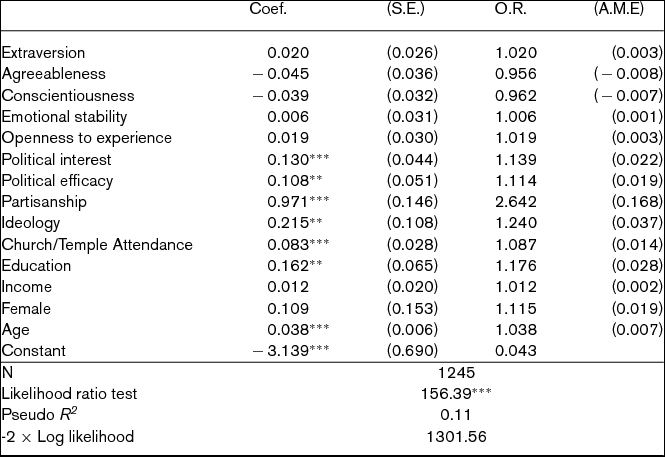
Before estimating the mediation model, we first examine the direct effects of the Big Five personality traits on voter turnout using the binary logit model. Our purpose is to see whether the Big Five personality traits have no direct impact on voter participation in South Korea as found by Ha et al. (Reference Ha, Kim and Jo2013). As shown in Table 3, there are no direct relationships between the Big Five personality traits and voter turnout in South Korea. The findings confirm the results of Ha et al. (Reference Ha, Kim and Jo2013) that personality traits are not directly associated with voter participation of South Korean people. Therefore, we conclude that the Big Five personality traits have no direct effects on voter turnout in South Korea, which contradicts the findings from past studies conducted in the United States and European countries and implies that the relationships between the Big Five personality traits and voting behavior might vary by country or culture.Footnote 3
Binary Logit Analysis of Personality Traits and Voter Turnout

Notes:
1 O.R. is odds ratio; A.M.E. is average marginal effect in terms of probability change.
2 ***: p < 0.01; **: p < 0.05; *: p < 0.10.
On the other hand, the results from Table 3 reveal that political interest, political efficacy, partisanship, and ideology play a pivotal role in predicting individual turnout decisions. As expected, voters with higher levels of political interest are more likely to vote. Specifically, for a one unit increase in political interest, the probability of voting is expected to increase by 2.2%. Furthermore, voters who exhibit stronger political efficacy are more likely to cast ballots. Particularly, increasing political efficacy by one unit increases the probability of voting on average by 1.9%. As found in previous studies on partisanship as a strong predictor of voter participation (Campbell et al., Reference Campbell, Converse, Miller and Stokes1960; Green et al., Reference Green, Palmquist and Schickler2002), the results show that partisans are more likely to vote than non-partisans, which is consistent with findings of past studies in South Korea (Lee, Reference Lee2004). On average, partisan have a higher probability of voting than non-partisans by 16.8%. Besides, people with strong ideology are more likely to go to the voting booth. On average, a one unit increase in ideology leads to a 3.7% increase in the probability of voting. Lastly, we also find that higher levels of education are associated with higher turnout as found in previous research (Tenn, Reference Tenn2007; Verba et al., Reference Verba, Schlozman and Brady1995), whereas people who regularly attend church or temple are more likely to vote than their counterparts mainly due to the acquisition of political resources through attendance, and direct political mobilization from the places of worship (Sobolewska et al., Reference Sobolewska, Fisher, Heath and Sanders2015). Moreover, the older the voters, the more likely they are to vote.
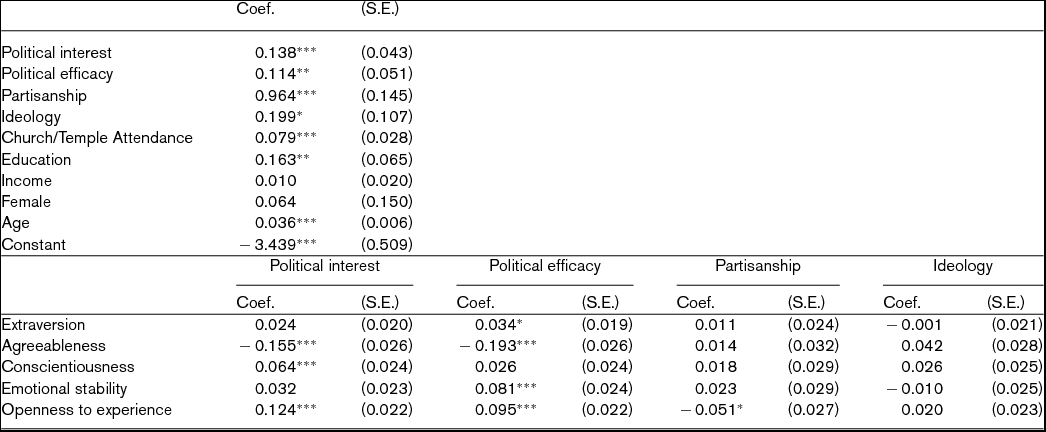
The above analysis shows that the Big Five personality traits play no role in individual turnout decisions in South Korea. Nevertheless, it would be too quick to jump to the conclusion that the Big Five personality traits are not associated with voter turnout in South Korea. The results for political interest, political efficacy, partisanship, and ideology imply the possibility that personality traits can indirectly influence voter turnout through these attitudinal factors. Therefore, to build the mediating relationships between personality traits and voter turnout in South Korea, the next step is to examine whether personality traits have significant effects on political interest, political efficacy, partisanship, and ideology. The results of mediation analysis using the generalized structural equation model provide some support to our argument. As shown at the bottom of Table 4, we find that voters with higher levels of extraversion and emotional stability tend to exhibit higher levels of political efficacy, whereas those with higher levels of conscientiousness are more likely to have higher levels of political interest. Besides, voters who score high on agreeableness are more likely to possess lower levels of political interest. Moreover, inconsistent with our expectation, they also tend to exhibit lower levels of political efficacy. By contrast, voters with higher levels of openness to experience are inclined to have higher levels of political interest and political efficacy, but they are less likely to become partisans. Contrary to our theoretical expectations and previous findings (Carney et al., Reference Carney, Jost, Gosling and Potter2008; Gerber et al., Reference Gerber, Huber, Doherty, Dowling and Ha2010; Gosling et al., Reference Gosling, Rentfrow and Swann2003; Mondak and Halperin, Reference Mondak and Halperin2008), we do not find significant relationships between personality traits and individual intensity of ideology, implying that personality traits fail to indirectly influence voter turnout through ideology. Overall, the results combined with the findings on the significant impacts of political interest, political efficacy, and partisanship on voter turnout indicate that personality traits have mediating effects on individual turnout decisions through political interest, political efficacy, and partisanship.
Mediation Analysis of Personality Traits and Voter Turnout

Note: *** is significant at p < 0.001; ** is significant at p < 0.01; * is significant at p < 0.05.
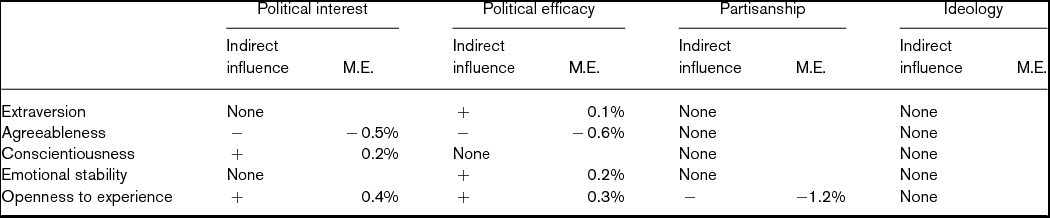
To demonstrate the mediating effects of personality traits on voter turnout, we calculate the predicted probability of voting by holding the other variables in the model constant, and present the results in Table 5. As expected, extraversion and emotional stability have positive mediating effects on voter turnout through political efficacy, whereas conscientiousness has a positive mediating effect on voter participation via political interest. By contrast, agreeableness exerts a negative mediating effect on voter turnout through political interest and political efficacy. Furthermore, openness to experience has not only a positive mediating effect through political interest and political efficacy but also a negative mediating effect through partisanship on voter turnout. With regard to the substantive effects of personality traits on voter turnout, the results in Table 5 demonstrate that openness to experience appears to have a more sizeable mediating effect. Specifically, on average, a one-point increase in openness to experience can indirectly increase the probability of voting by 0.4% through political interest and 0.3% through political efficacy, but indirectly decrease the probability of voting by 1.2% through partisanship. Agreeableness is another important personality trait that has a substantial mediating effect on voter turnout. In particular, a one-point increase in agreeableness can indirectly decrease the probability of voting by 0.5% through political interest and 0.6% through political efficacy. In addition, compared to partisanship and ideology, political interest and political efficacy seem to mediate a larger portion of the effects of personality traits on voter turnout.
Mediation Effects of Personality Traits on Voter Turnout

Notes:
1 “+” indicates positive indirect influence; “ − “ indicates negative indirect influence; “none” indicates no indirect influence.
2 “M.E.” indicates marginal effect in terms of probability change.
To sum up, our analysis confirms no direct relationship between personality traits and voter turnout in South Korea but this does not mean that personality traits do not matter for South Korean people's turnout decisions. We argue that political interest, political efficacy, partisanship, and ideology play a mediating role in the relationships between personality traits and voter turnout and the results of mediation analysis using a generalized structural equation model provide some support to this mediation argument. Particularly, extraverted and emotionally stable voters tend to have higher levels of political efficacy that in turn can drive them to vote. Moreover, conscientious voters are prone to display higher levels of political interest so that they are more likely to vote. However, agreeable voters are inclined to have lower levels of political interest and political efficacy that then make them abstain from voting. By contrast, voters who are open to new experience are more likely to possess higher levels of political interest and political efficacy that increase their chances of going to the voting booth, but they are also less likely to identify with some specific party, which then decreases their probability of voting. Some might argue that the substantial mediating effects of personality traits on voter turnout are trivial and we acknowledge that it makes no significant difference for an individual to increase her probability of turnout. Nevertheless, a one percentage point increase in the probability of voting among the population will make a difference to the election results.
Conclusion
While the study on the relationships between personality traits and political behavior has prevailed, little scholarly attention has been paid to understanding the mechanism of how personality traits influence individual political participation in Asia. Therefore, this study attempts to examine whether such attitudinal factors as political interest, political efficacy, partisanship, and ideology mediate the relationships between personality traits and voter turnout in South Korea. Although scholars of South Korean politics claim that personality traits simply have significant impacts on various non-electoral modes of participation, but not on voter turnout (Ha et al., Reference Ha, Kim and Jo2013), our findings indicate that in spite of no direct relationships between personality traits and voter turnout, the indirect effects of personality traits on individual turnout decisions indeed exist. The findings corroborate the proposed argument, in which political interest, political efficacy, and partisanship mediate the effect of personality traits on voter participation. In particular, our findings suggest that political interest and political efficacy are the two main attitudinal factors that mediate the effects of personality traits on voter turnout. To some extent our findings are consistent with the results of past studies (Blais and Labbé St-Vincent, Reference Blais and St-Vincent2011; Gallego and Oberski, Reference Gallego and Oberski2012; Schoen and Steinbrecher, Reference Schoen and Steinbrecher2013). Besides, it is surprising that party identification plays a trivial role in mediating the effects of personality traits on voter participation in South Korea. However, given that our measure cannot really reflect individual strength of partisanship, we would not jump into the conclusion that party identification does not matter for mediating the impact of personality on voter turnout. Lastly, although the intensity of ideology exerts a significant influence on voter turnout, there is no evidence that the intensity of ideology plays a mediating role in the relationship between personality traits and voter participation.
On the other hand, these results are in accordance with previous studies indicating that the effects of personality traits may vary by country and culture. By analyzing the relationship between personality traits and geographic variation in the context of the United States, Rentfrow, Gosling, and Potter (Reference Rentfrow, Gosling and Potter2008) have demonstrated fairly consistent patterns of state-level personality differences in the United States. They find that these differences correlate with many state-level social indicators. For instance, a high level of openness to experience is associated with the high levels of patent production per capita and the proportion of people working in artistic and investigative occupations. Also, Gerber and his colleagues (Reference Gerber, Huber, Doherty, Dowling and Ha2010) confirm the relationships between personality traits and ideology, in which their findings indicate that the personality–ideology relationship varies substantially by different cultural backgrounds. In this present work, our findings provide evidence that the effects of personality traits on political behavior vary by different countries by analyzing South Korean politics. The differences in the effects of personality traits on voting behavior among various countries may be rooted in fundamental cultural differences and thus all these personality traits may have different conceptual meanings. The empirical analysis in the case of South Korea again confirms the variation in the effects of personality traits on voting across geographical and cultural contexts.
In addition, the indirect relationships between personality traits and voter turnout make it particularly important to carefully formulate theoretically grounded expectations for the exact linkage between each personality trait, possible predictor of voting, and voter turnout. Using appropriate models to estimate the effects of personality traits on voter turnout, our results delineate how some attitudinal factors can mediate the influence of personality traits. In contrast to the findings of previous studies on the relationships between personality traits and political behavior in South Korea, by adding the mediation mechanism, the effects of personality traits on voter participation are now significant and thus missing the mediation mechanism can lead researchers to erroneously conclude that personality traits are unrelated to voting behavior in South Korea (Ha et al., Reference Ha, Kim and Jo2013).
Finally, there are several limitations to this study. First, this investigation was carried out in South Korea, where politics is highly influenced by the hierarchical Asian culture and the results may involve some Asian-specific elements. Thus, a generalization of our findings to other Asian samples and countries must be approached with caution, especially to those non-Asian samples. Second, the election targeted by this study, namely the legislative election, may not be able to completely represent South Korean voters’ voting behavior. At present, studies on personality traits and voting behavior in non-Western democracies still await further investigation.
About the authors
Ching-Hsing Wang is a postdoctoral fellow in the Hobby School of Public Affairs at the University of Houston. His research interests are research methods, political behavior, public opinion, and Asian politics. He has published articles in such scholarly journals as Electoral Studies, Party Politics, and International Political Science Review.
Dennis Lu-Chung Weng is an assistant professor of political science at State University of New York at Cortland. His research interests are comparative politics, political behavior, quantitative methods, and Asian politics. He has published articles in such scholarly journals as Electoral Studies, Journal of Chinese Political Science, and Asian Journal of Political Science.
Hyun-Jin Cha is a Ph.D. Candidate in the Department of Political Science & International Relations at Korea University. Her research interests are comparative politics, political behavior, and contentious politics. She has published articles in such scholarly journals as Journal of International and Area Studies.
Appendix. Question wording
Voter turnout
Did you vote in the South Korean Legislative Election on April 11 this year?
Big Five personality traits
Here are a number of personality traits that may or may not apply to you. Please mark a number next to each statement to indicate the extent to which you agree or disagree with it. You are supposed to consider both of the two traits at the same time for each statement below.
Extraversion: extraverted, enthusiastic; reserved, quiet.
Agreeableness: critical, quarrelsome; sympathetic, warm.
Conscientiousness: dependable, self-disciplined; disorganized, careless.
Emotional Stability: anxious, easily upset; calm, emotionally stable.
Openness to Experiences: open to new experiences, complex; conventional, uncreative.
Political interest
Do you agree or disagree on the following opinions concerning citizenship, government, and neighborhoods?
I am personally interested in politics.
Political efficacy
Do you agree or disagree on the following opinions concerning citizenship, government, and neighborhoods?
Politics and government are too complicated for me to understand what is going on.
Partisanship
Currently which political party do you support most?
Ideology
To what degree do you think yourself politically liberal or conservative?
Religious attendance
How often do you attend religious services?
Education
What is the highest level of school you have attended?
Income
Before taxes and other deductions, what is your total monthly average income from this job? This includes your base pay, bonuses, and other allowances.
Female
Respondent's gender
Age
Respondent's age