Invasive infections caused by gram-negative bacteria (GNB) are a frequent cause of morbidity and mortality in hospitalized patients. Globally, reports of resistance in GNB to critically important antibiotics, such as extended-spectrum cephalosporins, carbapenems, and colistin, are rising.Reference Gupta, Limbago, Patel and Kallen1–Reference Wang, van Dorp and Shaw4 Due to the severity of illness and limited treatment options, invasive infections caused by antimicrobial-resistant (AR) GNB often result in higher mortality and longer duration of hospitalization compared to infections caused by GNB without extensive antimicrobial resistance.Reference Schwaber and Carmeli5 In middle-income countries such as India, infections caused by AR GNB also pose a challenge to infection control staff with limited resources to prevent transmission of these pathogens in healthcare facilities.Reference Apisarnthanarak, Hsu, Khawcharoenporn and Mundy6
India has observed an increase in invasive infections caused by AR GNB. In particular, high proportions of carbapenem resistance in GNB isolates have been reported.Reference Gandra, Mojica and Klein7 The cause of increasing resistance among GNB in India is not fully clear, but it appears to be facilitated by widespread use of antibiotics in humans and animals, insufficient infection control in healthcare facilities, and limited availability of safe water and sanitation facilities.Reference Laxminarayan and Chaudhury8 Though initially described mainly as a problem in healthcare facilities, AR GNB have also been detected in community-onset infections, heralding a wider dissemination of these pathogens into nonhospitalized populations.Reference Pitout, Nordmann, Laupland and Poirel9
The high prevalence of carbapenem resistance in GNB in India has led to increasing use of a last resort antibiotic, colistin. Historically, colistin fell into disfavor for treatment of infections due to toxicity in humans at high doses, but it has recently emerged as an option to treat AR GNB infections.Reference Benattar, Zak-Doron and Paul10 Colistin has also been used as metaphylaxis or growth promotion in livestock, particularly poultry destined for human consumption.Reference Davies and Walsh11 Gram-negative bacteria without intrinsic colistin resistance, such as Klebsiella pneumoniae and Escherichia coli, may acquire resistance through chromosomal mutations or acquisition of mobile colistin resistance (mcr) genes.Reference Liu, Wang and Walsh12 First detected in specimens collected from human and animals in China, mcr-1 has since been reported globally.Reference Wang, van Dorp and Shaw4
Detection of colistin resistance is difficult. Manual broth microdilution (BMD) is the method recommended by the Clinical and Laboratory Standards Institute (CLSI) and the European Committee on Antimicrobial Susceptibility Testing (EUCAST) to detect colistin resistance.13 However, some laboratories in India continue to perform disk diffusion to measure colistin susceptibility despite studies demonstrating that this method underestimates minimum inhibitory concentrations (MICs) for colistin.Reference Tan and Ng14,Reference Moskowitz, Garber and Chen15
Several groups in India have reported infections caused by colistin-resistant K. pneumoniae (ColR-KP), raising the concern that this pathogen is spreading in India,Reference Kaur, Gandra, Gupta, Mehta, Laxminarayan and Sengupta16,Reference Pragasam, Shankar and Veeraraghavan17 and presenting a need to comprehensively describe the challenges in detection and containment of this emerging MDRO. Therefore, we undertook a study of ColR-KP in our hospital; our objectives were (1) to estimate the distribution of colistin resistance among K. pneumoniae clinical isolates, (2) to describe characteristics of patients with ColR-KP infections, (3) to estimate the extent of misclassification of ColR-KP isolates as colistin susceptible based on disk diffusion compared to recommended reference methods, and (4) to characterize transmission dynamics of ColR-KP using whole-genome sequencing.
Methods
Setting
The study was conducted at the Jay Prakash Narayan Apex Trauma Center of the All India Institute of Medical Sciences in New Delhi, India. Our center is a 178-bed, level 1 trauma center and teaching hospital; 18% of inpatient beds are in intensive care units (ICUs). As a regional referral center, ~20% of annual admissions are patients transferred from other hospitals. Admitted patients receive treatment free of charge. The microbiology department operates the hospital’s infection control program. The infection control program conducts prospective, facility-wide surveillance of healthcare-associated infections adapted from protocols published by the US Centers for Disease Control and Prevention National Healthcare Safety Network. The prevalence of carbapenem resistance among K. pneumoniae isolated from blood specimens is ~60%, comparable to recent national estimates.Reference Gandra, Mojica and Klein7 The infection control program also manages containment efforts for multidrug-resistant organisms (MDROs); these efforts involve implementation of contact precautions and isolation of case-patients, increased provision of alcohol-based hand rub dispensers and personal protective equipment in affected clinical areas, enhanced environmental cleaning of affected wards, and cohorting of healthcare workers.
Study population, definitions, and outcomes
All inpatients referred for microbiological testing during January 2016 to October 2017 were included. Case-patients were defined as individuals from whom K. pneumoniae resistant to colistin by BMD was isolated from at least 1 blood, urine, respiratory, or other body site culture. Isolates were classified as multidrug-resistant (MDR), extensively drug resistant (XDR), or pan-drug resistant (PDR) if they were nonsusceptible to 3 or more antibiotic classes, nonsusceptible to all but 1 or 2 antibiotic classes, or nonsusceptible to all antibiotic classes tested, respectively.Reference Magiorakos, Srinivasan and Carey18
For all case-patients, we reviewed medical charts to collect demographic information, antibiotic treatment history, admission history, date of collection of the first positive specimen, and outcome, including in-hospital mortality. The primary outcome was the prevalence of colistin resistance among clinical isolates of K. pneumoniae; secondary outcomes were case-patient mortality, relatedness of isolates based on whole-genome sequencing, and concordance of laboratory procedures for detecting ColR-KP.
Procedures
Attending physicians referred patients for microbiological testing. Clinical specimens were collected and incubated under routine conditions. Isolates were tested on Vitek 2 (bioMérieux, Marcy l’Etaile, France); identification was performed using the Vitek 2 GN card (bioMérieux); and antimicrobial susceptibility testing was performed using the Vitek 2 AST-N281 card (bioMérieux). All minimum inhibitory concentrations (MICs) were interpreted according to CLSI break points,19 except for colistin and tigecycline, which were interpreted according to EUCAST guidance.20 Isolates that were determined to be resistant to colistin by Vitek 2 were also tested by BMD for confirmation.
Susceptibility of isolates to colistin and polymyxin B was determined by BMD.21 Briefly, sulfate salts of colistin and polymyxin B (Sigma, St Louis, MO) were dissolved in cation-adjusted BBL Mueller Hinton II Broth (Becton Dickinson, Franklin Lakes, NJ). Minimum inhibitory concentration (MIC) dilutions ranging from 0.25 µg/mL to 1,024 µg/mL were performed in untreated 96-well glass coated microplates (Sigma, India). An MIC >2 µg/mL was considered resistant.20
Disk diffusion to determine colistin resistance was performed using the Kirby-Bauer inoculation method.22 Isolates were suspended in normal saline and adjusted to a turbidity of 0.5 McFarland standard using a calibrated densitometer. Suspensions were inoculated on Mueller-Hinton agar; 10-µg colistin disks (HiMedia, India) were used to measure colistin susceptibility. Plates were incubated at 35°C for 24 hours. A zone of inhibition ≥13 mm was interpreted as susceptible and ≤10 mm was interpreted as resistant.Reference Lo-Ten-Foe, de Smet, Diederen, Kluytmans and van Keulen23 For all colistin susceptibility testing, E. coli NCTC 13846 and E. coli ATCC 25922 were used as positive and negative controls, respectively.
Environmental samples were collected from high-touch surfaces, floors, ventilator tubing, and medication preparation areas using HiCulture swabs (HiMedia, India). Samples were enriched in thioglyocate broth and incubated at 37°C for 18 hours. The enriched broth was then inoculated on tryptic soy agar supplemented with 5% sheep blood and MacConkey agar. Water samples were collected in HiWater test kits (HiMedia, India), incubated at 37°C for 12 hours, and then subcultured on MacConkey agar. Identification and antimicrobial susceptibility testing (AST) of environmental isolates was performed on Vitek 2 (bioMérieux, France) as described above.
Whole-genome sequencing on ColR-KP isolates was performed using the Ion Torrent PGM platform with 400-bp chemistry with a depth of coverage of at least 40×. Sequence reads were assembled de novo using SPAdes version 3.9.0 software and the “--iontorrent” setting.Reference Bankevich, Nurk and Antipov24 Raw reads were mapped to the assembled contigs for minor error correction by BWA version 0.7.12 software.Reference Li and Durbin25 Contigs shorter than 500 bp were discarded from subsequent analysis. The remaining high-quality contigs were screened for acquired resistance genes, including mcr, by means of SSTAR version 1.1.01 software.Reference de Man and Limbago26 Chromosomal mutations conferring colistin resistance were identified by MEGA version 6.06 software.Reference Tamura, Stecher, Peterson, Filipski and Kumar27 Multilocus sequence typing was performed with MLST version 2.15 software (https://github.com/tseemann/mlst). Lastly, single-nucleotide polymorphisms (SNPs) were detected by CSI Phylogeny version 1.4 software.Reference Kaas, Leekitcharoenphon, Aarestrup and Lund28 Isolates with no more than 10 SNP differences were considered clonally related.
Raw sequencing data (accession no. PRJNA494951) have been deposited in the NCBI BioProject database (https://www.ncbi.nlm.nih.gov/bioproject/). Ethical approval for this study was provided by the Health Ministry’s Steering Committee, Ministry of Health and Family Welfare, Government of India.
Results
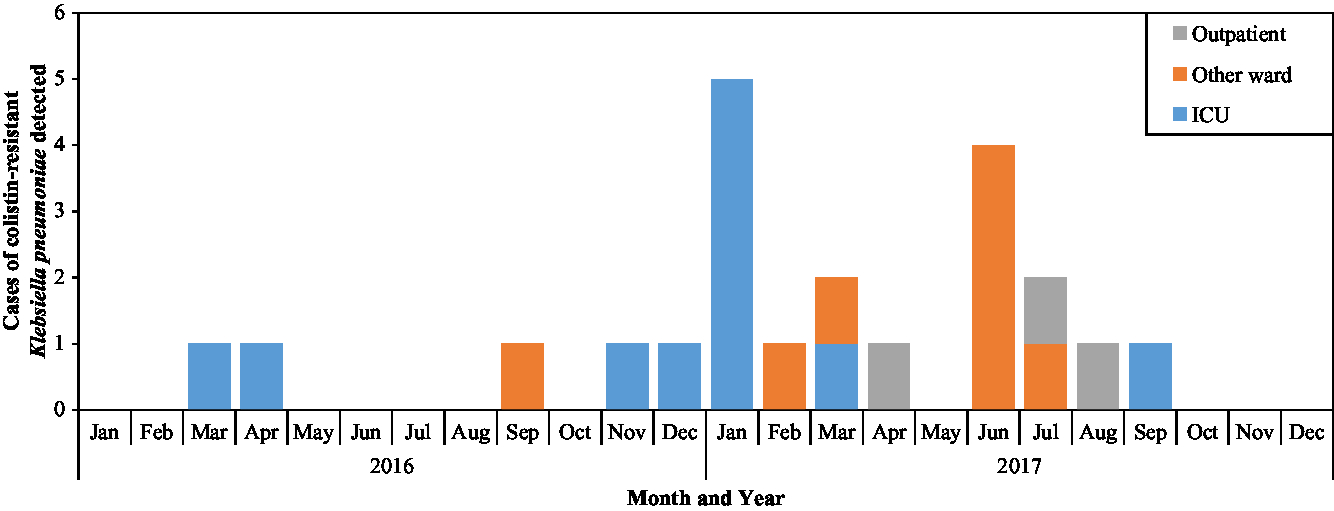
During the study period, 4,039 unique patients were referred for microbiological testing. From these, 22,175 clinical specimens were collected, and 4,147 GNB were isolated from 3,860 clinical specimens (17.4%). Among GNB isolates, 846 (20.4%) were Klebsiella pneumoniae, of which 34 (4.0%), from 22 unique patients, were resistant to colistin by BMD. A median of 1 case-patient (range, 0–5) was identified each month (Fig. 1).
Number of cases of colistin-resistant Klebsiella pneumoniae by location of case-patient on date of collection of the first positive specimen.

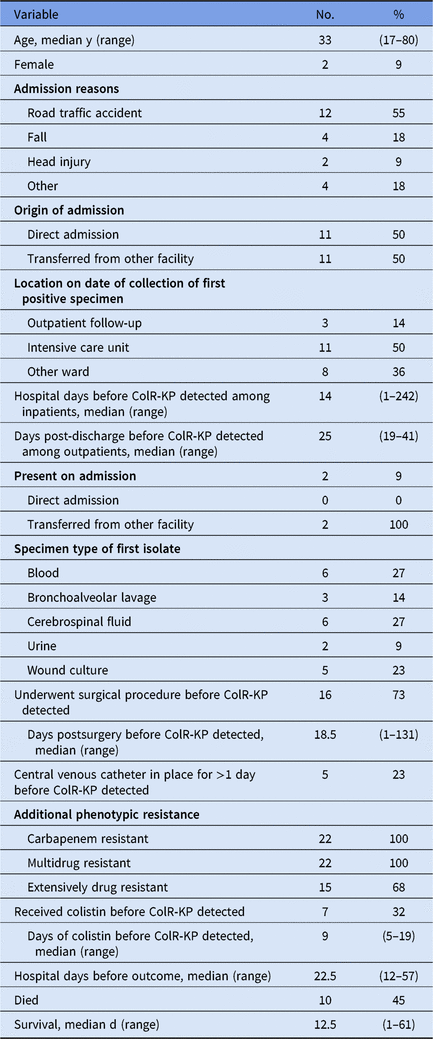
Table 1 summarizes information on case-patient clinical characteristics, specimen sources, documented exposure to colistin, and history of hospitalization. The median age was 33 years (range, 17–80); 2 (9%) were female; and 11 (50%) were transferred from a referring hospital. The location of case-patients on the date of collection of the first positive specimen with ColR-KP was an ICU (n = 11, 50%), another inpatient ward (n = 8, 36%), or an outpatient clinic during a follow-up visit (n =3, 14%). The first positive specimens were most commonly blood (n = 6, 27%), cerebrospinal fluid (n = 6, 27%), or wound culture (n = 5, 23%). Of the 2 case-patients (9%) with a positive specimen collected within the first 2 days of hospitalization, both were transferred from other healthcare facilities. Most case-patients (n = 16, 73%) underwent a documented surgical procedure before ColR-KP detection, and 7 case-patients (32%) had a history of exposure to colistin before ColR-KP detection.
Characteristics of Colistin-Resistant K. pneumoniae Case-Patients

Of the 22 case-patients, 10 (45%) died. Median survival time after collection of the first positive specimen with ColR-KP was 12.5 days (range, 1–61) among those who died. Among case-patients who survived, the median duration of hospitalization before discharge was 22.5 days (range, 12–57).
Among the first ColR-KP isolates from the 22 unique patients, all (100%) were MDR and 15 (68%) were XDR (Table 1); no PDR isolates were detected. All ColR-KP isolates were resistant to carbapenems, extended-spectrum cephalosporins, and penicillin/β-lactamase inhibitors. ColR-KP isolates were most commonly susceptible to tigecycline (100%), trimethoprim/sulfamethoxazole (45%), and minocycline (33%).
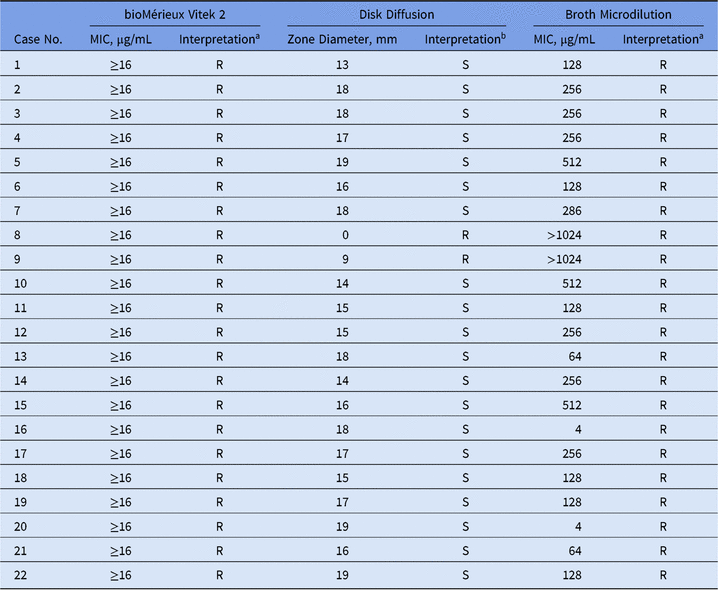
Table 2 summarizes the results of susceptibility of isolates to colistin determined by various methods. All isolates that were detected as colistin resistant by Vitek 2 were also resistant by BMD. However, only 2 K. pneumoniae isolates (9%) resistant by Vitek 2 and BMD were also resistant by disk diffusion using a ≤10 mm zone of inhibition.
Results of Various Methods of Colistin Susceptibility Testing Among ColR-KP Isolated From Case-Patients

Note. MIC, minimum inhibitory concentration.
a Based on Lo-Ten-Foe et al.Reference Lo-Ten-Foe, de Smet, Diederen, Kluytmans and van Keulen23
b Based on EUCAST. Break point tables for interpretation of MICs and zone diameters. Version 8.1, 2018. http://www.eucast.org.20
Genomes for isolates from 21 case-patients (95%) were successfully assembled de novo. Whole-genome sequencing revealed 8 unique multilocus sequence types among ColR-KP isolates; the most common were ST231 (n = 5, 24%), ST11 (n = 5, 24%), and ST14 (n = 4, 19%). None of the ColR-KP isolates harbored any mcr genes. Mechanisms of colistin resistance that were identified included mutations in the PhoP/Q system (n = 21, 100%), pmrB gene (n = 7, 33%), and mgrB gene (n = 1, 5%). The most common carbapenemase genes among ColR-KP were bla OXA-232 (n = 8, 38%), bla OXA-181 (n = 6, 29%), and bla NDM-1 (n = 4, 19%).
Phylogenetic analysis revealed 4 clonally related K. pneumoniae clusters comprising 8 case-patients. All clusters consisted of pairs of case-patients that overlapped in time, location, or both during their hospitalizations. Also, 2 case-patients from 2 different clusters were detected during postdischarge follow-up. Isolates from the remaining 13 case-patients appeared unique.
The GNB were isolated from 138 (2%) of 6,610 environmental samples. Of these environmental gram-negative isolates, 28 (20%) were identified as K. pneumoniae. However, none of these environmental K. pneumoniae isolates tested resistant to colistin.
Discussion
We found prevalence of colistin resistance to be 4% among K. pneumoniae isolates; more than half of these ColR-KP isolates were extensively drug resistant. Individuals with infections caused by ColR-KP experienced high mortality. Similar to other groups, we observed that disk diffusion almost universally identified ColR-KP isolates as colistin susceptible.Reference Lo-Ten-Foe, de Smet, Diederen, Kluytmans and van Keulen23,Reference Gales, Reis and Jones29 Hospital laboratories in India that use disk diffusion for colistin susceptibility testing are likely to miss detection of these isolates, which may adversely affect treatment outcomes through incorrect clinical guidance and facilitate silent transmission due to delay or absence of infection control response efforts. Timely detection and containment of colistin-resistant GNB is likely to be wider problem than in India, as surveillance efforts for antimicrobial resistance at the core level in low- and middle-income countries has focused on optimizing disk-diffusion methods for AST.Reference Seale, Gordon, Islam, Peacock and Scott30
Our study has several implications for the emergence and spread of this MDRO. Longitudinal MDRO outbreaks are often mediated by a small number of clonal strains that spreads in a healthcare facility due to gaps in infection control practices.Reference Kanamori, Parobek and Juliano31,Reference Snitkin, Zelazny and Thomas32 In contrast, the sequence diversity among ColR-KP strains in our investigation suggests that these occurred through multiple importations into the healthcare facility. The presence of multiple, highly resistant clones of ColR-KP underscores the importance of rapid detection and containment to prevent transmission in healthcare settings. Not all case-patients had documented exposure to colistin, suggesting that factors other than selective pressure from treatment with colistin may contribute to the development and spread of ColR-KP. Clinicians and infection control staff should be aware that persons at risk for ColR-KP infection are not only those who have been treated with colistin. Lastly, several case-patients were detected in an outpatient clinic after hospital discharge; it is unknown whether ColR-KP in these individuals was acquired during hospitalization. In addition to optimizing detection of ColR-KP and subsequent infection control efforts in healthcare facilities, there may be a need to characterize the extent and the drivers of ColR-KP in the community.
Half of the case-patients were individuals transferred from other facilities; 2 of these were patients with ColR-KP detected within 2 days of admission. This finding supports previous reports that this MDRO may be widely distributed across hospitals in India.Reference Kaur, Gandra, Gupta, Mehta, Laxminarayan and Sengupta16,Reference Pragasam, Shankar and Veeraraghavan17,Reference Aggarwal, Rastogi and Mathur33 Optimizing infection control practices in one facility may reduce the risk of MDRO in-hospital transmission, but not the risk of MDRO introduction from patients transferred from hospitals.Reference Smith, Dushoff, Perencevich, Harris and Levin34 Controlling the spread of this MDRO requires a coordinated approach to uniformly improve infection control practices across healthcare facilities across referral networks. A network-level approach to optimizing infection control practices has proven effective in controlling other MDROs such as vancomycin-resistant Enterococcus and carbapenem-resistant Enterobacteriaceae.Reference Ostrowsky, Trick and Sohn35,Reference Schwaber and Carmeli36
Patient safety is a burgeoning topic of discussion at the state and national levels in India. An important element of patient safety is the rapid detection and isolation of patients colonized or infected with MDROs. Containment of colistin-resistant GNB while the prevalence of colistin resistance is low may prove more feasible than containment of carbapenem-resistant GNB, which are highly prevalent in India.Reference Gandra, Mojica and Klein7 Conventional approaches to detecting colistin-resistant GNB have focused on rapid detection of mcr genes by polymerase chain reaction (PCR)-based analysis. However, in our setting, colistin resistance was conferred by chromosomal mutations rather than mcr genes. Therefore, detection of colistin-resistant GNB in our setting cannot be limited to assays designed to identify mcr genes. Screening approaches that employ selective agar for detection of colistin-resistant GNB should be considered to facilitate identification of patients colonized with this pathogen and to expedite necessary control measures, as has been demonstrated for control of facility-level transmission of other MDROs.Reference French, Coope and Conway37
Environmental sources can contribute to transmission of MDROs in hospitals.Reference Otter, Yezli, Salkeld and French38 However, all environmental samples were negative in our study. This observation may have been due to the specimen collection procedures employed in this study, which may not have been sufficiently sensitive to detect contamination. An additional possibility is that environmental contamination with this MDRO may be transient and therefore detection was missed.Reference Dancer39 We utilized Vitek 2 to detect colistin resistance in K. pneumoniae isolates. However, Vitek 2 can miss colistin-resistant bacteria with MICs ranging from 4 to 8 mg/LReference Chew, La, Lin and Teo40; therefore, the extent of colistin resistance in K. pneumoniae might be higher than demonstrated in our study. Whether plasmid-mediated spread of colistin resistance is of greater public health importance than the spread of Enterobacteriaceae strains with chromosomally mediated colistin resistance is unknown. However, a strategy of containing colistin resistance that relies solely on detection of mcr genes is likely to permit the spread of ColR-KP because the MDRO would escape detection and subsequent infection control response. We did not evaluate the uniformity of microbiological referral practices; it is possible that some ColR-KP infections occurred earlier than when they were detected or were missed. In this investigation, in-hospital transmission was determined by comparison of sequences of clinical isolates from case-patients; additional in-hospital transmission may have silently occurred among patients, visitors, or healthcare workers asymptomatically colonized with ColR-KP. Several characteristics were common among case-patients; however, we cannot conclude whether these characteristics are risk factors for ColR-KP infections in the absence of a comparison group. Although we observed a high fatality rate, case-patients had traumatic injuries that also likely contributed to overall mortality. Our study was not designed to measure the attributable mortality associated with ColR-KP infection. Lastly, as a trauma hospital, our facility provides care to a patient population with a likely healthier baseline than most other hospitals; the extent of colistin resistance in hospitals that serve a broader patient population may be higher.
In summary, we found high prevalence of colistin resistance in K. pneumoniae isolated from patients with infections in our center. Dissemination of this MDRO likely occurred through multiple importation and in-hospital transmission events. Disk diffusion for colistin susceptibility testing leads to misclassification and subsequently a more permissive infection control environment, which may allow transmission of this MDRO to remain undetected. Our investigation combined with other previous reports suggests that ColR-KP may be widely distributed in India.Reference Kaur, Gandra, Gupta, Mehta, Laxminarayan and Sengupta16,Reference Pragasam, Shankar and Veeraraghavan17 Action is needed from a broad range of stakeholders, including clinicians, microbiologists, and public health officials, to limit the spread of this critically important MDRO.
Acknowledgments
The findings and conclusions in this report are those of the authors and do not necessarily represent the official position of the US Centers for Disease Control and Prevention (CDC).
Financial support
Funding for this study was provided by US CDC Global Health Security Agenda (cooperative agreement no. 1U2GGH001869).
Conflicts of interest
Some authors in this study are employed by the US CDC. None of the authors has a commercial or other financial interest associated with the information presented in this manuscript.