INTRODUCTION
The hippolytid genus Leontocaris Stebbing, Reference Stebbing1905 is restricted to the deep sea (240–2182 m) (Taylor & Poore, Reference Taylor and Poore1998; Fransen, Reference Fransen2001; Poore, Reference Poore2009) and recognized by the striking structure of the major cheliped of pereopod 2. This limb forms a zigzag structure with interlocking plates and sockets that extends anteriorly (Poore, Reference Poore2009). The effective use of this tool is yet unknown; some authors suggest that it is predatory (Stebbing, Reference Stebbing1905; Bruce, Reference Bruce1990; Taylor & Poore, Reference Taylor and Poore1998) and according to Poore (Reference Poore2009) the twisted dentate dactyl suggests a specialized diet but there is no evidence about what that could be. Another striking feature in this genus is the tympanum at the grooved portion of the propod of the major second cheliped. It is an elongate or rounded slit with rows of soft, membranous, digitiform papillae (Fransen, Reference Fransen2001; Poore, Reference Poore2009). Its function is not clear. Poore (Reference Poore2009) suggests that a hydraulic expansion of the papillae may serve to unlock the proximal articles from the propod to allow extension of the folded claw.
Eight species are included in Leontocaris: L. paulsoni Stebbing, Reference Stebbing1905 from the south-eastern Atlantic; L. lar Kemp, 1906 from the north-western Atlantic; L. pacificus Zarenkov, 1976 from the Pacific; L. vanderlandi Fransen, Reference Fransen2001 from the Indian Ocean; plus three from Australia and New Zealand L. amplectipes Bruce, Reference Bruce1990; L. yarramundi Taylor & Poore, Reference Taylor and Poore1998; L. alexander Poore, Reference Poore2009; and one from Australia: L. bulga Taylor & Poore, Reference Taylor and Poore1998 (Poore, Reference Poore2009; Ahyong, Reference Ahyong2010; De Grave & Fransen, Reference De Grave and Fransen2011). The descriptions of species in this genus are based on few specimens so intra-specific variation is not well known (Fransen, Reference Fransen2001).
Associations with deep sea coelenterates (Antipatharia and Lophelia sp.) were reported by Kemp (Reference Kemp1910) for L. lar and by Fransen (Reference Fransen2001) for L. vanderlandi as they were caught together with scleractinian corals and zoantharians which could be their host. Bruce (Reference Bruce1990) also suggested a commensal life-style for L. amplectipes observing morphological features of the species. Taylor & Poore (Reference Taylor and Poore1998) reinforced this idea when finding two species (L. bulga and L. yarramundi) living on seamounts covered by corals.
Leontocaris smarensis sp. nov. was also caught together with live fragments of the deep sea coelenterates Enallopsammia rostrata (Pourtalès, 1878) (one of the main builders of deep sea coral reefs), Corallium cf. bayeri Simpson & Watling, 2011 (also a reef building species) and Narella alvinae Cairns & Bayer, 2003 (very common in and near coralline deep sea habitats) (D. Pires, personal communication). The occurrence of these species confirms that the new species is living in a deep sea coralline habitat.
Three Australian and New Zealand species were recorded predominantly from seamounts (Poore, Reference Poore2009; Ahyong, Reference Ahyong2010) as are the specimens herein identified as L. smarensis sp. nov. Seamounts are biologically distinctive habitats in the open ocean exhibiting a number of unique features (Rogers, Reference Rogers1994) such as the formation of eddies of water associated with upwelling of nutrient rich waters. Because food supplies are restricted in the open-ocean, seamounts and the water column above them serve as important habitats, feeding grounds and sites of reproduction for many open-ocean and deep-sea species (Rogers, Reference Rogers1994; Probert, Reference Probert1999).
The Mid-Atlantic Ridge (MAR) rises from 4000 m depth to reach peaks of 500 m of altitude; this mountain range is 100–200 km wide and has a length of 14,000 km. Given the very complicated nature of this region, it should be home to a diverse and interesting deep-sea fauna. This expectation has prompted recent biological investigations on the southern MAR, within the framework of the international project MAR-ECO (‘Patterns and Processes of the Ecosystems of the Northern Mid-Atlantic’). This project is an element of the Census of Marine Life and aims to enhance our understanding on the occurrence, distribution and ecology of animals and animal communities along the MAR.
MATERIALS AND METHODS
The first oceanographic cruise of South Mar Eco by the RV ‘Akademik Ioffe' occurred in 2009 (from 25 October to 29 November). Bottom trawls sampled the macrobenthos using a Sigsbee trawl. A total of 12 benthic sampling events were conducted, five in the South Equatorial MAR Sector (SEMS), two in the Tropical MAR Sector (TMS) and five in the Walvis Ridge Sector (WRS).
The specimens were fixed in ethanol 70%, identified, drawn, described and deposited at the Crustacea collection of the Museu Nacional/Universidade Federal do Rio de Janeiro (MNRJ). Measurements presented are postorbital carapace length (cl) in millimetres. The diagnosis and description presented herein follow those provided by Taylor & Poore (Reference Taylor and Poore1998), Fransen (Reference Fransen2001) and Poore (Reference Poore2009).
RESULTS
SYSTEMATICS
TYPE MATERIAL
Holotype: ovigerous female (7.8), Superstation 2, SEMS, 00°26, 18′N/17°03, 57′W, 902 m, MNRJ 22561; paratypes: 2 ovigerous females (5.3 and 5.5), 1 female (5.2), Superstation 2, SEMS, 00°26. 18′N/17°03. 57′W, 902 m, MNRJ 22560.
DIAGNOSIS
Carapace with 3–6 mid-dorsal epigastric spines. Rostrum 1.0–1.58 (N = 3) times as long as carapace length, curving upwards, with 9–12 (N = 3) dorsal teeth, 11–15 ventral teeth (N = 3). Abdominal somite 3 mid-posterodorsally rounded, without flat triangular projection. Abdominal somite 5 pleuron with 0–2 small acute posterolateral spines and rounded posteroventral margin. Cornea well developed, broader than eyestalk. Scaphocerite with produced distolateral tooth reaching blade distal margin and 18–24 (N = 4) lateral marginal teeth. Mandibular palp of 1 article. Major pereopod 2 (right or left) with fixed finger short, tridentate; dactyl sickle like with a prominent tooth on cutting edge. Pereopod 3 carpus slightly shorter than propod (pereopod 4 propod lost), pereopod 5 carpus slightly longer than propod; dactyls 0.23 (N = 2, pereopods 3 and 5 from holotype) times length of propod. Uropodal exopod lateral margin with 17–23 spines (N = 4). Telson with 5 pairs of dorsolateral spines (N = 3) and three pairs of distal spines (N = 3).
DESCRIPTION OF HOLOTYPE
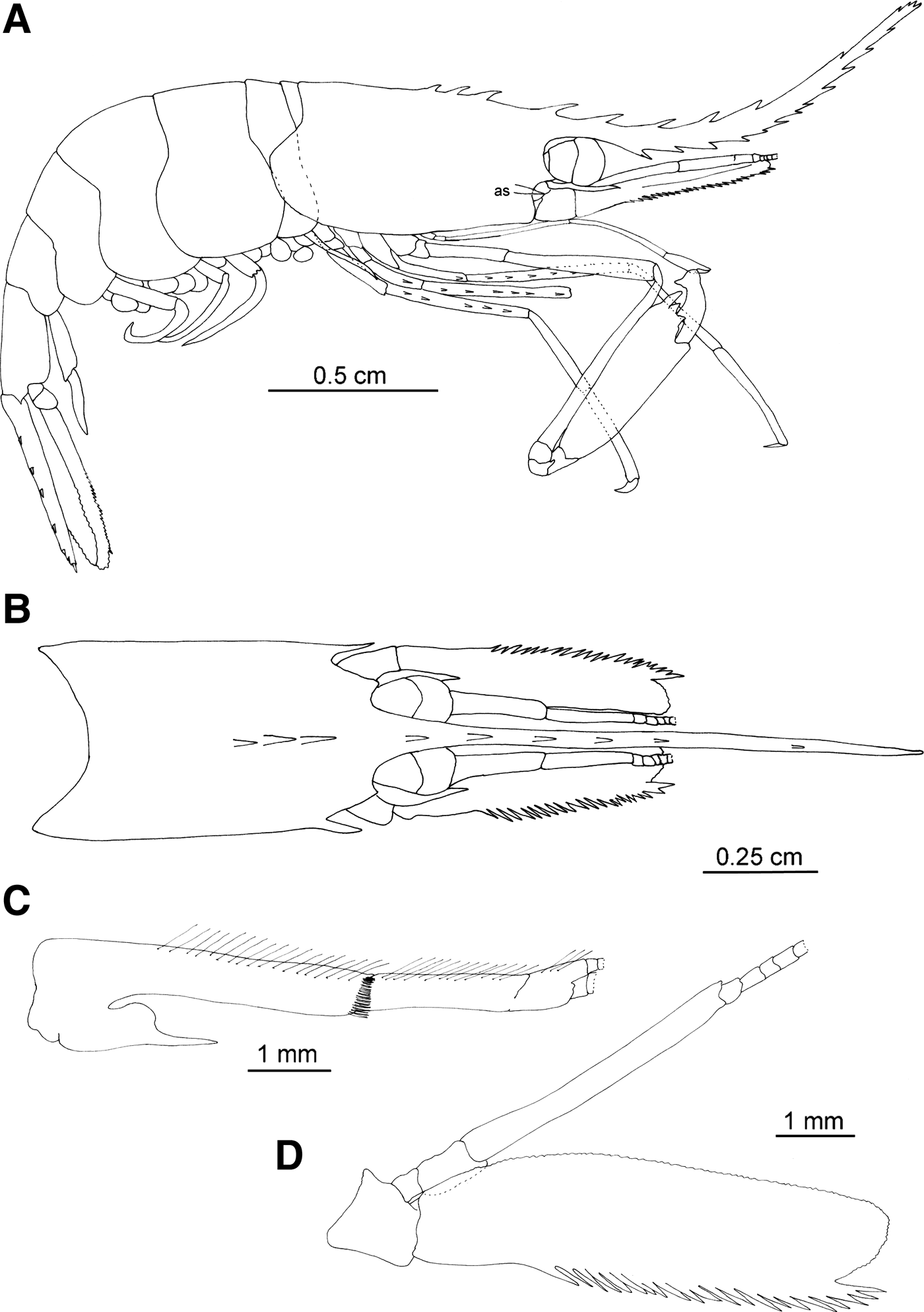
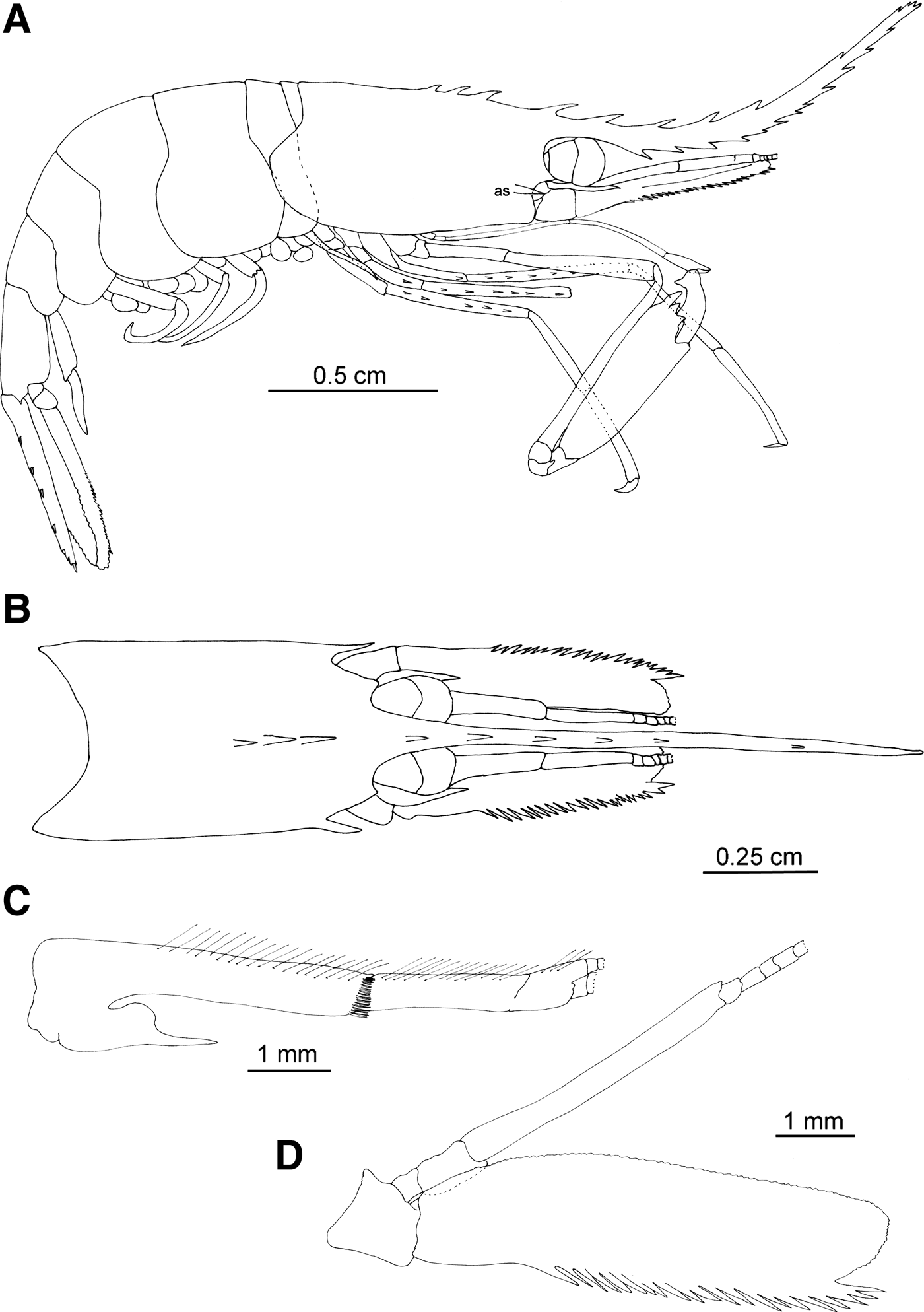
Carapace with 3 epigastric spines, centred around mid-length, similar in shape though one-third smaller in size (Figure 1A, B). Antennal spine well developed, sharp, straight. Pterygostomial corner rounded. Rostrum 1.58 times as long as carapace (Figure 1B), curving upwards, tapering; with 9 dorsal teeth, first 5 of same size, closely set, 2 small widely set and 2 small distal teeth near tip; 12 ventral teeth, decreasing in size distally, basal third widely set, median third closely set and distal third widely set (Figure 1A).
Leontocaris smarensis sp. nov., holotype, ovigerous female (7.8), MNRJ 22561: (A) whole animal, lateral view; (B) anterior region, dorsal view; (C) right antennular peduncle, dorsal view; (D) right antennal peduncle, dorsal view. as, antennal spine.
Abdominal somite 3 mid-posterodorsally unarmed, without flat triangular projection. Abdominal somites 1–4 pleura rounded. Abdominal somite 5 pleuron without acute posterolateral spine. Abdominal somite 6 pleuron like that of abdominal somite 5 but smaller. Abdominal somites 4–6 and telson dorsal lengths with ratio 1:0.94:1.55:2.72 (Figure 1A).
Eye globular, cornea fully pigmented, diameter 1.3 times stalk width.
Antennular peduncle 0.52 of rostrum length; article 1, 7.3 times as long as distal width; stylocerite with distolateral spine reaching 0.54 length of article 1 (Figure 1B). Antennal scale overreaching antennular peduncle, 4.17 times as long as greatest width, with produced distolateral tooth reaching blade margin, with 19 (left side) and 21 (right side) teeth closely set along distal 0.75 of length, distal margin rounded (Figure 1B, D).
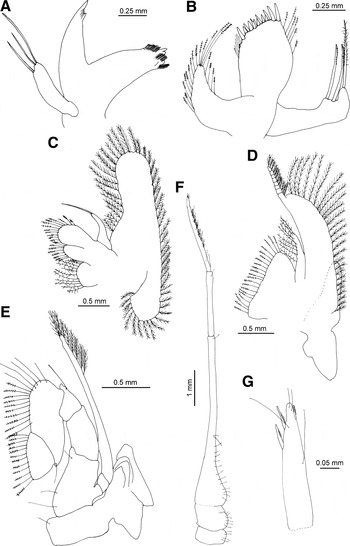
Mandibular palp of 1 article with 3 apical simple setae (Figure 2A). Mouthparts as figured (Figure 2A–E).
Leontocaris smarensis sp. nov., holotype, ovigerous female (7.8), MNRJ 22561: (A) left mandible, anterior view; (B) left maxillula, anterior view; (C) left maxilla, anterior view; (D) left maxilliped 1, anterior view; (E) left maxilliped 2, anterior view; (F) left maxilliped 3, anterior view; (G) left maxilliped 3, posterior region of propod-dactyl, anterior view.

Maxilliped 3 coxa and basis wider than long, medially setose; basis incompletely distinct from ischium–merus; ischium–merus 5 times as long as basal width; carpus unarmed; propod with clusters of simple setae; dactyl fused to propod, with 3 serrate setae. Ratios of lengths in ischium–merus: carpus: propod-dactyl = 1:0.37:0.48 (Figure 2F, G).
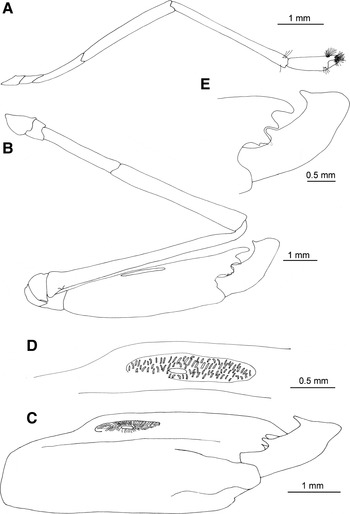
Pereopod 1 slender, smooth, without ornamentations; ratio of lengths of merus: carpus: propod = 1:1.21:0.47 (Figure 3A).
Leontocaris smarensis sp. nov., holotype, ovigerous female (7.8), MNRJ 22561: (A) right first pereopod, lateral view; (B) major, right second pereopod, lateral view; (C) major, right second pereopod, propod and dactyl, lateral view; (D) tympanum, lateral view; (E) major, right second pereopod, propod cutting edge and dactyl, lateral view.

Major pereopod 2 (right) ischium and merus unarmed; carpus with 4 articles, first article inner margin with 1 distal small tubercle, articles 2 and 3 with distolateral triangular projections (Figure 3B); propod greatest depth at median third of dorsal length (Figure 3B, C), tympanum formed by elongate cavity with a central pit and more than 20 digitiform papillae around it (Figure 3D), distomesial horizontal cylindrical projection directed anteriorly (Figure 3C), fixed finger with oblique cutting edge, with 3 teeth, median and outer tooth smooth with rounded apex, inner tooth with 3 denticles (Figure 3E); dactyl twisted, sickle like, cutting edge with 1 mesial tooth inserting between inner and median teeth of fixed finger, distal area tapering abruptly in a well developed tooth (Figure 3E).
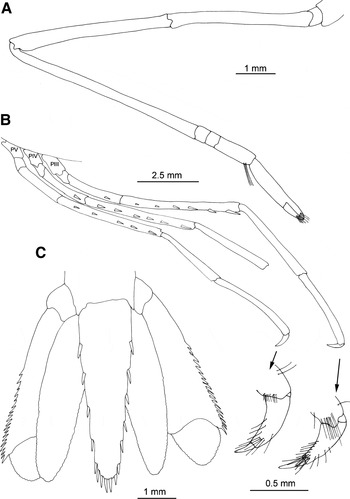
Minor pereopod 2 (left) slender, ratio of length of ischium: merus: carpus: propod = 1:1.10:1.90:0.56; carpus with 4 articles 0.76:0.048:0.048:0.14 times total length (Figure 4A).
Leontocaris smarensis sp. nov., holotype, ovigerous female (7.8), MNRJ 22561: (A) minor, left second pereopod, lateral view; (B) right pereopods 3–5, lateral view; (C) telson and uropods, dorsal view.

Pereopods 3–5 similar (Figure 4B), pereopod 4 propod and dactyl lacking. Pereopod 5 slightly shorter than pereopod 3. Pereopod 3 ischium with 1 subdistal spine, merus with 6 mesial spines, ratio of ischium: merus: carpus: propod = 1:2.10:1.56:1.41:0.33. Pereopod 4 ischium with 1 subdistal spine, merus with 6 mesial spines. Pereopod 5 ischium without spine, merus with 5 mesial spines.
Uropodal rami of equal length; endopod 4 times as long as wide; exopod 3.4 times as long as wide, lateral margins with 19 (left side) and 18 (right side) spines over distal two-thirds (Figure 4C).
Telson 1.75 times as long as abdominal somite 6, 3.47 times as long as basal width, evenly tapering, with 5 pairs of dorsolateral spines distributed over its entire length, apex with 3 pairs of distal spines (Figure 4C).
VARIATION
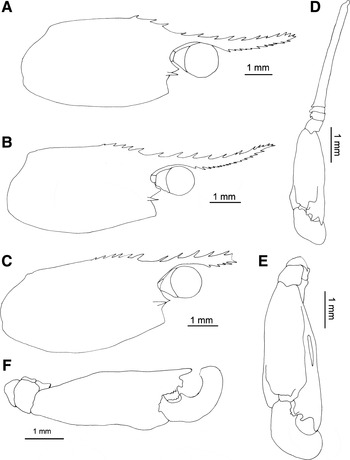
Males are not known. The carapace length in paratypes is shorter (5.2–5.5 mm) than in the holotype (7.8 mm). A variation in the number of rostrum teeth and length of the rostrum was observed and it is correlated with carapace length. The paratypes present shorter rostra with more teeth than the holotype (Figure 5A, B). The number of epigastric teeth varies from 3–6 and shows no correspondence with carapace size, one female with cl 5.2 mm presents 3 epigastric teeth (Figure 5A) as in the holotype (cl 7.8 mm), while an ovigerous female with 5.5 mm cl presents 6 teeth (Figure 5C). The major pereopod 2 is on the right side in the holotype and on the left in the paratypes, besides this only small variations in teeth shape were observed (Figure 5D–F). The number of spines on the merus of pereopods 3–4 varies between specimens, ranging from 5–6 on pereopod 3, from 6–7 on pereopod 4 and from 4–5 on pereopod 5.
Leontocaris smarensis sp. nov., paratypes, MNRJ 22560, female (5.2); (A) carapace, lateral view; (D) major, left second pereopod, lateral view. Ovigerous female (5.3): (B) carapace, lateral view; (E) major, left second pereopod, lateral view. Ovigerous female (5.5): (C) carapace, lateral view; (F) major, left second pereopod, lateral view.

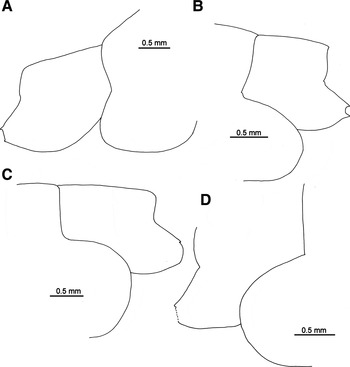
A striking variation occurs in the dentition of the pleuron of abdominal somite 5, which shows no acute spines in the holotype, and has 1 or 2 spines in the paratypes. In 2 paratypes, female (5.2 mm) and ovigerous female (5.3 mm), there are 2 acute spines (Figure 6A, B), while in the paratype ovigerous female (5.5 mm) there is 1 spine on the left side (Figure 6C) and at least 1 on the broken right side (Figure 6D).
Leontocaris smarensis sp. nov., paratypes, MNRJ 22560, female (5.2): (A) abdominal somites 4–5, right side, lateral view. Ovigerous female (5.3): (B) abdominal somites 4–5, left side, lateral view. Ovigerous female (5.5): (C) abdominal somites 4–5, left side, lateral view; (D) abdominal somites 4–5, right side, lateral view.

ETYMOLOGY
Derived from the type-locality, the South Mid Atlantic Ridge (SMAR).
DISTRIBUTION
South Equatorial MAR Sector at 00°26. 18′N/17°03, 57′W. At a depth of 902 m.
REMARKS
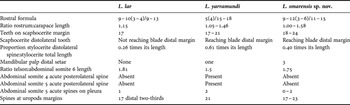
The specimens sampled herein are easily discernible from 6 of the 8 species in the genus by the mandibular palp being one-segmented; the absence of a postero-dorsal tooth on abdominal somite 3; and the exopods of uropods being disto-laterally serrate. The remaining two species L. lar, from the north-western Atlantic (Ireland) and L. yarramundi from the south-western Pacific (Tasmania and New Zealand) show closest affinity to L. smarensis sp. nov. A comparison table (Table 1) is presented to clarify the main differences between these species.
Comparison between Leontocaris smarensis sp. nov. and its closely related species Leontocaris lar and Leontocaris yarramundi. Rostral formula: dorsal teeth (epigastric teeth)/ventral teeth.

Leontocaris smarensis sp. nov. differs from L. lar in the scaphocerite distolateral tooth reaching the distal margin of the blade; in the higher proportion between the stylocerite distolateral spine and the stylocerite total length; and in the mandibular palp having three distal setae whereas it is devoid of setae in the latter species. The acute spines on the pleuron of abdominal somite 5 vary in L. smarensis sp. nov. from 0–2 (no spine in the holotype); only one paratype presents 1 acute spine, as in L. lar. In this case this single spine was observed with certainty only on the left side, because part of the right pleura was lost.
Leontocaris smarensis sp. nov. differs from L. yarramundi in the number (higher in L. smarensis sp. nov.) and disposition (not distributed to the distal third in L. yarramundi) of dorsal teeth on the rostrum and in the absence of an acute posterolateral spine on abdominal somites 4 and 5 (present in L. yarramundi sp. nov.). Regarding the acute spines on pleuron of abdominal somite 5, two paratypes present 2 posterolateral spines as L. yarramundi, while the holotype shows no spine and one paratype shows only one spine.
As not many specimens of the various species are known it remains difficult to interpret the observed variation in certain characters as being either inter- or intra-specific.
Comparing morphological data from L. smarensis sp. nov. with the most recent phylogeny of the genus (Poore, Reference Poore2009), we observed that the new species described herein is related to clade 2, as it presents one article at mandibular palp; a straight propodus, without setae on pereopod 3 and four or more dorsolateral spines on telson. Inside this clade this species is related with clade 3 (including L. amplectipes, L. lar and L. yarramundi) mainly due to the presence of more than three epigastric spines; but also due to the abdominal somite 3 being midposterodorsally unarmed; the tympanum groove being an elongate slit and the telson with a convex distal margin, with a row of distal spines and four to five dorsolateral spines.
Leontocaris amplectipes and L. yarramundi are recorded from Australia and New Zealand while L. lar is recorded from the north-western Atlantic and L. smarensis sp. nov. occurs in the South Atlantic. So, in this genus species morphologically similar occur in distinct oceans; as stated by Poore (Reference Poore2009) the phylogeny does not reflect geographical distribution. According Poore (Reference Poore2009) as all Leontocaris species (except L. lar) are found on or near the continental margins of the southern oceans this genus is probably an ancient southern group; the description of a South Atlantic species (L. smarensis sp. nov.) confirms this idea.
KEY TO THE SPECIES OF LEONTOCARIS STEBBING, 1905
1. Mandibular palp two articulate………2
Mandibular palp one articulate………3
2. Major pereopod 2 dactyl dorsal margin straight, ending in a triangular projection; scaphocerite with 26 marginal teeth………L. bulga Taylor & Poore, Reference Taylor and Poore1998
– Major pereopod 2 dactyl dorsal margin concave, ending in a rounded projection; scaphocerite with 13 marginal teeth………L. vanderlandi Fransen, 2004
3. Third abdominal somite with postero-dorsal tooth………4
– Third abdominal somite without postero-dorsal tooth………6
4. Seven dorsolateral spines on telson………5
– Five dorsolateral spines on telson………L. paulsoni Stebbing, Reference Stebbing1905
5. Rostrum 1.0 times as long as carapace; rostrum with four dorsal and 12 ventral teeth; telson 1.8 times as long as dorsal somite 6………L. pacificus Zarenkov, 1976
– Rostrum 1.7–1.9 times as long as carapace; rostrum with five dorsal and 8–9 ventral teeth; telson 2.2 times as long as dorsal somite 6………L. alexander Poore, Reference Poore2009
6. Exopods of uropods disto-laterally entire; dactyli of ambulatory pereopods more than 0.5 times propodus length………L. amplectipes Bruce, Reference Bruce1990
– Exopods of uropods disto-laterally serrate; dactyli of ambulatory pereopods less than 0.5 propodus length………7
7. Abdominal somite 4 with one acute posterolateral spine; abdominal somite 5 with one acute posterolateral spine and two acute spines on pleuron………L. yarramundi Taylor & Poore, Reference Taylor and Poore1998
– Abdominal somite 4 without acute posterolateral spine; abdominal somite 5 without acute posterolateral spine and with 0–2 acute spines on pleuron………8
8. Abdominal somite 5 with one acute spine on pleuron; scaphocerite distolateral tooth not reaching distal blade margin………L. lar Kemp, Reference Kemp1910
– Abdominal somite 5 with 0–2 acute spines on pleuron; scaphocerite distolateral tooth reaching distal blade margin………L. smarensis sp. nov.
ACKNOWLEDGEMENT
We thank the Mar Eco staff for planning the cruise and sampling the material.