




No CrossRef data available.
Article contents
- Abstract
- EDUCATIONAL CONCERNS OF SPANISH–ENGLISH BILINGUAL CHILDREN
- OVERVIEW OF PHONOLOGICAL AWARENESS: IMPORTANCE, ORIGINS, AND STABILITY
- BIDIRECTIONAL RELATIONSHIP OF PHONOLOGICAL AWARENESS AND LITERACY
- PHONOLOGICAL AWARENESS AND LINGUISTIC DIVERSITY
- PRIOR RESEARCH ON SPANISH–ENGLISH PHONOLOGICAL AWARENESS
- PRESENT PROJECT
- METHOD
- RESULTS
- DISCUSSION
- APPENDIX A: ASSESSMENT TASKS
- EPAP
- ELP
- ACKNOWLEDGMENTS
- References
Cross-language transfer of phonological awareness in low-income Spanish and English bilingual preschool children
Published online by Cambridge University Press: 23 June 2004
Article contents
- Abstract
- EDUCATIONAL CONCERNS OF SPANISH–ENGLISH BILINGUAL CHILDREN
- OVERVIEW OF PHONOLOGICAL AWARENESS: IMPORTANCE, ORIGINS, AND STABILITY
- BIDIRECTIONAL RELATIONSHIP OF PHONOLOGICAL AWARENESS AND LITERACY
- PHONOLOGICAL AWARENESS AND LINGUISTIC DIVERSITY
- PRIOR RESEARCH ON SPANISH–ENGLISH PHONOLOGICAL AWARENESS
- PRESENT PROJECT
- METHOD
- RESULTS
- DISCUSSION
- APPENDIX A: ASSESSMENT TASKS
- EPAP
- ELP
- ACKNOWLEDGMENTS
- References
Abstract
This study investigated the phonological awareness of low-income Spanish–English bilingual children, because phonological awareness has been found to be an important prerequisite for literacy acquisition and because such children have been identified as at risk for successful literacy acquisition. Our sample included 123 Spanish–English bilingual preschool children (M=49.1 months) attending Head Start programs. Children's receptive vocabulary was assessed using the Peabody Picture Vocabulary Test—3rd Edition and the Test de Vocabulario en Imagines Peabody. We assessed phonological awareness using English and Spanish versions of the Early Phonological Awareness Profile, which includes deletion detection and rhyming tasks. Emergent literacy was assessed in the child's stronger language using the Emergent Literacy Profile, which includes tests of environmental print knowledge, printed word awareness, alphabet knowledge, and early writing. Spring levels of phonological awareness in each language were most strongly related to development of phonological awareness in the other language. Final models accounted for 68% of the variance in spring English and Spanish phonological awareness. Educational implications are discussed.
Information
- Type
- Articles
- Information
- Copyright
- © 2004 Cambridge University Press
The early language and literacy development of children from Spanish-speaking backgrounds is an issue that is of growing concern in the United States. In recent decades the population of Americans who speak Spanish as a first language (L1) has grown dramatically. In 1998, approximately 15% of public school enrollment was Hispanic (Condition of Education 2000, 2000), and the numbers of Spanish-speaking families continue to increase by roughly 1 million per year (August & Hakuta, 1997). In fact, The Condition of Education 2000 (2000) argues that Hispanic students are the fastest growing student group in the nation's elementary and secondary schools. In 1999, the Head Start Fact Sheet (1999) stated that 26.4% of Head Start families are Hispanic.
Given the rapid increase in the population of Spanish-speaking children, we must understand the process by which such children move from conversing at home using their native language to learning to read and write English as they move through school. One of the first steps on this journey, children's acquisition of phonological awareness, is the focus of this paper. We examined the fall to spring growth of phonological sensitivity of 4-year-old children who were attending Head Start and spoke Spanish in their homes.
EDUCATIONAL CONCERNS OF SPANISH–ENGLISH BILINGUAL CHILDREN
The increase in linguistic diversity in the US population is linked to growing education challenges. The most recent National Assessment of Educational Progress in 1999 (Donahue, Voekl, Campbell, & Mazzeo, 1999) revealed that, at the end of high school, children from Spanish-speaking homes were performing at the same reading level as Caucasian students were at the end of eighth grade. Of equal concern is the fact that in some communities as many as half of all Latino children never make it to high school (US Bureau of the Census, 1993).
The roots of these later educational problems can be traced to the years before children enter school. A nationally representative survey of parents of 3- to 5-year-old children highlights the early origins of the gap between Hispanic and Caucasian, English-speaking children (Zill, Collins, West, & Hausken, 1995). According to parent reports, half as many Hispanic as White children could name “most or all of the letters,” which is sobering because letter name knowledge has long been associated with later literacy development (Adams, 1990). Given the growing evidence that children's levels of literacy development in kindergarten and first grade are highly predictive of later reading (Dickinson & Tabors, 2001; Snow, Burns, & Griffin, 1998), it is significant that differences between Spanish- and English-speaking children may emerge so early.
The sources of this early disadvantage are not well understood, although a teaching focus and exposure to reading materials in middle-class monolingual preschool children is associated in many ways with phoneme awareness (Foy & Mann, 2003). There is some evidence that parent–child book reading—an activity known to play an important role in supporting early language and literacy development (Bus, van Ijzendoorn, & Pellegrini, 1995; Dickinson & Tabors, 2001)—is less common in homes of Spanish-speaking children (New England Research Center on Head Start Quality, 1998). Anderson and Stokes (1984) conducted an observational study of children in the homes of different ethnic groups that included over 2000 hr of observation. These researchers found that children of all ethnicities examined received some kind of literacy exposure at home, but ethnicity was associated with the types of literacy experiences children had. Specifically, Anglo-American children received on average four times as much storybook reading as did Mexican American children.
Bus (2001) reviewed numerous studies that together make the point that the potential role of book reading as a stimulus for early literacy varies among culturally different groups. Parents from different cultures sustain their children's curiosity in different ways. Parents who were read to themselves provide the kind of interactive book reading talk that is both pleasurable and beneficial to children (Whitehurst et al., 1988). Unfortunately, parents who were not read to as children and were from cultures that valued discipline of children above all had less helpful and supportive book-reading sessions with their children. Often such conversations resulted in much effort to restrain the child or low-demand conversations that emphasized naming illustrations. Bus (2001) cautions that there was much variation among parents within any group, however, and has undertaken accounts to explain this variation. Among low-income Spanish-speaking families in America in particular, there is considerable disparity in family literacy practices, which is related to early Spanish literacy and oral English proficiency, both of which in turn significantly predict English reading achievement in Grade 7 (Reese, Garnier, Gallimore, & Goldenberg, 2000). Taken together, all these studies point to the need to better understand the path of literacy development during the preschool years among children from Spanish-speaking homes.
Certainly, being reared in a bilingual environment need not result in poor scholastic achievement. In a study of 5,567 students in 8th, 10th, and 12th grade, 56% of whom were from Spanish-speaking homes (from the National Education Longitudinal Study database), researchers (Yeung, Marsh, & Suliman, 2000) found that home language proficiency did not affect subsequent English test scores, school grades, or English proficiency in 12th grade. Home language proficiency did have a strong positive effect on maintenance of home language use and positive effects on standardized tests in English, math, and history. The few negative impacts of frequency of home language use on perceived English proficiency were found only in the early years of high school and did not persist. Certainly, many oral and written literacy skills in older children transfer from the L1 to second languages (L2s; e.g., see Cummins, 1991, for review); in particular, children may acquire orthography in their L2 for which they already have phonological representations in their L1 (Geva & Wade–Woolley, 1998). Few prior studies have focused on studying the relationship between bilingualism and phonological awareness, and the few that have found either evanescent advantages or advantages on specific tasks by specific kinds of bilingual children compared to monolingual peers (Bialystok, Majumder, & Martin, 2003). Cisero and Royer (1995) found that in kindergarten and first grade, students' ability to isolate initial sounds in their L1 was a significant predictor of their ability to isolate initial sounds in an L2.
The goal of the current research is to describe the pattern of development of phonological awareness of 3- and 4-year-old children from Spanish-speaking homes. We tracked their growth in phonological awareness in both English and Spanish and identified linguistic and print-related factors that contribute to the emergence of phonological awareness. We were interested in the extent to which phonological awareness development in one language is transferred to an L2 and in the contributions of oral language facility and early literacy knowledge to emerging phonological awareness in both languages.
OVERVIEW OF PHONOLOGICAL AWARENESS: IMPORTANCE, ORIGINS, AND STABILITY
Much past research has established that phonological awareness is a critical precursor, correlate, and predictor of reading achievement (Bryant, MacLean, & Bradley, 1990; Cronin & Carver, 1998; MacLean, Bryant, & Bradley, 1987; Speece, Roth, Cooper, & de la Paz, 1999; Stanovich, 1992; Vellutino & Scanlon, 2001; Wagner & Torgesen, 1987; Wagner, Torgesen, Laughon, Simmons, & Rashotte, 1993; Wagner et al., 1997). Experimental evidence of the importance of phonological awareness interventions comes from phonological awareness training studies of 5- to 6-year-old children that boosted later reading achievement (Ball & Blachman, 1991; Bradley, 1988; Bradley & Bryant, 1983; McGuinness, McGuinness, & Donohue, 1995). Training preschool children in phonological skills before beginning reading instruction has also proven effective (Lundberg, Frost, & Petersen, 1988). The importance of even small changes in the early years is heightened by the fact that early differences in phonological recoding skills translate into progressively larger differences in reading skills at later ages (Jorm, Share, MacLean, & Matthews, 1984; Juel, Griffith, & Gough, 1986; Lundberg, Frost, & Petersen, 1988; Share, Jorm, MacLean, & Matthews, 1984).
Despite the importance of phonological awareness to literacy development, we do not have a good understanding of all the factors that support its emergence. Some have argued that general linguistic abilities, rather than phonological awareness per se, are the critical basis of reading acquisition (Bowey & Patel, 1988; Chaney, 1992, 1994, 1998; Metsala, 1999; Whitehurst & Lonigan, 2001). For example, Metsala (1999) advances what has been termed the “lexical restructuring process” in which rapid expansion of vocabulary arguably forces the representation of increasingly small segments in words; children at the very outset of language acquisition need to discriminate relatively few unique words so that quite holistic representations of phonological forms will initially suffice. In other words, the kind of segmental representations involved in phonological awareness emerge after some threshold of vocabulary development has been achieved, although such representations are also held to be word specific. Words that are encountered many times or acquired early are more likely to become restructured than their rarer or later counterparts.
Others claim that phonological awareness or sensitivity is a cognitive process that is relatively distinct from general language or cognitive skill (e.g., Siegel, 1998); the fundamental phonological deficit in dyslexia is so severe that it is found in individuals with reading problems at all IQ levels. Furthermore, this phonological deficit is an arrest, not merely a delay, because it persists even when comparisons are made with reading-level matched individuals whereas linguistic and cognitive differences do not.
Vellutino and Scanlon (2001) argue that the relationship between general cognitive abilities and phonological awareness varies and is complicated to measure. Specifically, reading achievement and cognitive profiles of children who are easily remediated by one on one tutoring are more like those of normal readers and probably reflect limitations of the former in early reading experience and/or limitations in early reading instruction. However, the profiles (Woodcock Reading Mastery Test—Revised [WRMT-R]; Woodcock, 1987) of children who are found to be difficult to remediate were more likely to be associated with basic cognitive deficits. It is important to note, however, that IQ scores (Wechsler Intelligence Scale for Children—Revised [WISC-R]; Wechsler, 1974) of these groups did not differ from each other, from normal readers, or from the IQ norm, so cognitive deficits relevant to reading are not best indexed by traditional IQ measures. Regardless of the relationship between phonological awareness and the other various faculties required in order to read, there is abundant evidence from longitudinal–correlational and training studies that phonological processes are remarkably stable across the elementary school period (Torgesen & Burgess, 1998; Whitehurst & Lonigan, 2001).
BIDIRECTIONAL RELATIONSHIP OF PHONOLOGICAL AWARENESS AND LITERACY
Literacy instruction and children's growing grasp of the alphabetic principle play a major role in spurring individuals to begin attending to the sounds of words. Phonological awareness is partly an outgrowth of literacy experiences (Wagner, Torgesen, & Rashotte, 1994). Even in adults, phonological awareness does not emerge spontaneously but rather as a result of learning to read an alphabetic script (Kolinsky, Cary, & Morais, 1987; Read, Zhang, Nie, & Ding, 1986). Studies of children's emerging phonological awareness indicate the impact of letter knowledge and early reading on children's phonological sensitivity (Ehri, 1998). Reading books to children also has been related to children's phonological awareness (Dickinson, Bryant, Peisner–Feinberg, Lambert, & Wolf, 1999); regression analyses of a sample of over 800 Head Start children predicting phonological awareness found that parents' reported provision of specific literacy experiences (i.e., regular reading, availability of children's magazines, and use of the library) predicted phonological awareness over and above home background factors such as family size, socioeconomic status, and mother's education.
Phonological awareness is now established as important to children's ability to successfully focus on graphemes and link them to phonemes (Adams, 1990; Bryant, Bradley, MacLean, & Crossland, 1989; Byrne & Fielding–Barnsley, 1991; MacLean et al., 1987; Siegel, 1998; Tunmer, Herriman, & Nesdale, 1988). There is also considerable evidence that many children need instruction to lead them to the analytic approach to print and language such mappings require (Ehri & Robbins, 1992; Masonheimer, Drum, & Ehri, 1984).
Encouraging children to write is one effective means of instruction in phonological awareness. When children are encouraged to write freely they analyze their own speech without any direct phonological training (Vernon & Ferreiro, 1999). In another study (Dickinson & DiGisi, 1998), the amount of writing children did in class was correlated significantly with first grade reading achievement. Students with higher reading achievement scores were in classrooms where teachers asked students to engage in narrative and informational writing.
In any event, children must get off to a strong start with decoding, because longitudinal studies show considerable consistency from first grade to the later elementary grades in children's decoding skill (Dickinson, Tabors, & Roach, 1996; Juel, 1988; Stanovich, 1986), a finding that echoes the pattern seen for phonological awareness (Torgesen & Burgess, 1998).
PHONOLOGICAL AWARENESS AND LINGUISTIC DIVERSITY
Children's language background can influence the extent, nature, and development of their linguistic awareness, particularly their phonological awareness. Dialect can influence linguistic awareness in that children cannot be expected to reflect on structures they have not acquired (Chaney, 1994). Researchers will want to guard against the use of biased assessments of phonological awareness; when biased items are removed, there is no correlation between dialect and awareness (Chaney, 1994). Family literacy experiences also affect phonological awareness (Chaney, 1994); amount of family literacy experience is related to children's knowledge of alphabet concepts, a school-like literacy task. While children from all types of families receive some exposure to print, middle-class families routinely provide more exposure to a wide variety of literacy experiences than do poorer, less well educated families (Chaney, 1994). Thus, socioeconomic status affects phonological awareness, with children of wealthier and better educated families scoring higher than children of working-class families (Bryant et al., 1990; Dickinson & Snow, 1987; Wallach, Wallach, Dozier, & Kaplan, 1977; Warren–Leubecker & Carter, 1988). Chaney (1994), however, found that once language development was equalized, socioeconomic factors played an insignificant predictive role.
Bilingualism facilitates certain types of metalinguistic awareness (Bialystok, 1988; Galambos & Hakuta, 1988; Ianco–Worrall, 1972; see brief review in Malakoff & Hakuta, 1991), though these effects are often found mostly for middle-class and/or nonminority language bilingual children. Moreover, the languages in which a child is bilingual will determine the extent of the impact of their bilingualism in this regard; specifically, tonal phonological awareness is relatively independent of alphabetic phonological awareness, so that knowing Chinese in addition to English is less helpful, for example, than knowing a more closely related language (Liow & Poon, 1998). However, the phonological awareness of monolingual children benefits from being part of a multilingual classroom (Dickinson, 2000). Compared to monoglot instruction, bilingual schooling has also been shown to increase phonological awareness in bilingual students (Campbell & Sais, 1995).
PRIOR RESEARCH ON SPANISH–ENGLISH PHONOLOGICAL AWARENESS
Some studies have looked at the phonological awareness of Spanish–English bilingual children in particular (see Denton, Hasbrouck, Weaver, & Riccio, 2000, for review). Several investigators have found Spanish phonological awareness to be a strong predictor of reading (Bravo–Valdivieso, 1995; Carrillo, 1994; Durgunoglu, Nagy, & Hancin–Bhatt, 1993). Spanish–English bilingual children in kindergarten through Grade 2 were superior to monolingual children in the phonological translation of proper names, which moderately correlated with their reading ability (Oller, Cobo–Lewis, & Eilers, 1998). Among first graders enrolled in a transitional bilingual education program, phonological awareness in Spanish significantly correlated with phonological awareness in English, English spelling, and Spanish word recognition (Durgunoglu, 1998). Phonological awareness, independent of both native and L2 vocabulary, contributed to achievement in English reading comprehension among Spanish–speaking first, second, and third graders who were becoming bilingual (Carlisle, Beeman, Davis, & Spharim, 1999).
Despite such demonstrated relationships, Spanish phonological awareness may differ from the English variety. Specifically, Vernon and Ferreiro (1999) argue that the sensitivity shown by English-speaking subjects to onset and rime (the stuff of nursery rhymes) may not be as prevalent among speakers of other languages. Unlike English-speaking children, Spanish-speaking children normally initially attune to vowels before consonants (Denton et al., 2000).
PRESENT PROJECT
In reviewing studies of Spanish phonological awareness, Denton and colleagues (2000, pp. 349–350) note that “none of the Spanish tests of phonological or phonemic awareness have been subjected to psychometric study of validity and reliability,” and that “there is a need to identify those combinations of tasks that are reliable predictors of reading progress in Spanish-speaking children.” In this study, we attempted to address both of these concerns in the context of conducting a larger correlational study of language and literacy abilities of low-income children. We were interested in the extent to which phonological awareness development in one language is transferred to an L2 and in the contributions of oral language facility and early literacy knowledge to emerging phonological awareness in both languages. We hypothesized that growth in phonological awareness in Spanish would predict growth in phonological awareness in English and vice versa and both of these variables would relate to a lesser extent to vocabulary acquisition within a specific language.
The data we report come from a larger study that examined multiple dimensions of the language and literacy development of Head Start children from English- and Spanish-speaking homes and the home and classroom environments that support development. Spanish speakers were an important subset of our full sample and are the group that we examine in the current paper. Because of the breadth of our study and the fact that we assessed some children in two languages, it was possible to examine only selected dimensions of children's emerging phonological awareness.
METHOD
Sample
The sample consisted of 123 children enrolled in Head Start programs in the northeastern and southeastern United States. The average age of participants was 49.1 months (SD=5.5, range=33.7–60.3 months). In data not tabled here, an estimated 54% of the sample was male. On a 4-point scale (1=no high school diploma to 4=college degree), the average level of maternal education was 2.2 (SD=1.1). An estimated 66% of the sample was identified as Spanish dominant, and 33% as English dominant. Dominance was assessed using three independent approaches: teachers were asked to indicate the child's primary language; parents were asked what language the child should be tested in; and the native bilingual speaker who assessed the child made a determination based on informal conversation, an assessment that was then confirmed by administration of a test of receptive language in that language. Typically, these three approaches provided congruent information; when there was a lack of agreement the bilingual assessor's rating was used.
Measures
Each child was assessed over the course of 2 days. Each session lasted approximately 30 min. Assessment was done in the fall (i.e., between mid-October and late November) and in the spring (i.e., early April through late May). Children assessed earlier in the fall were also assessed earlier in the spring. The following measures were obtained:
Phonological awareness in English and Spanish
Phonological awareness in English and Spanish were measured by the Early Phonological Awareness Profile (EPAP1
These tasks were based on the early groundbreaking work of Carolyn Chaney (1994).
The second task is rhyme recognition. For this task children are asked to identify words that “have the same sound” or “rhyme.” They are shown pictures of three objects, two of which rhyme, and told the names of each object. They are asked to repeat the words to ensure that they have correctly labeled each picture and asked to point to or name the two words that “have the same sound” or “rhyme.” Children also receive two practice trials for this task. Those children who correctly identify at least five out of eight pairs of rhyming words then continue with the rhyme production task. For this task the child is given a word and asked to produce a word that rhymes with it. Responses are correct if they rhyme, regardless of whether the answer is a real word.
The EPAP has been employed by researchers in the New England area and in the southeastern region of the United States. The Cronbach's alpha for the total score on all subtasks in this large sample of English speaking children (n=984) was .93. For the bilingual sample used in the current project, the Cronbach's alpha was .94 for the Spanish version of the EPAP and .93 for the English version. Spring scores on the EPAP in English and Spanish are used as the outcome variable in these analyses. Fall scores are used as controls. Change scores (in the other language) are used as predictors. Analyses looking for floor and ceiling effects found some evidence of ceiling effects for the deletion task and floor effects for the rhyming tasks; but when scores for all tasks were combined into one composite score, floor and ceiling effects were not evident.
The Spanish version of the EPAP was created by a language expert who is a native speaker of Mexican Spanish under the direction of Carolyn Chaney. This version was not a direct translation, but it retained the same conceptual structure. We make no a priori claims that the two tools are of equivalent difficulty and use change scores in our analyses, reflecting our interest in developmental factors. Both versions assess children's ability to detect the deletion of phonemes and recognize and produce rhymes.
Emergent literacy
Children's emergent literacy was assessed by the Emergent Literacy Profile (ELP; Dickinson & Chaney, 1997b). The ELP consists of four component tasks: the ability to read environmental print, sensitivity to what is and is not printed language, letter identification and naming, and ability to write one's name (see Appendix A for details).
First, children's ability to read environmental print is assessed by showing cards that display familiar objects containing text (e.g., McDonald's logo, stop sign) and asking “What does this say?” Second, children's sense of printed language is assessed by asking them to distinguish between words and strings of letters or characters that do not make a word. For example, children are presented with a card that contains the text NNNT, W3#NJ, and MILK and are asked “Which one of these is a word?” Third, for the letter identification task, children are asked to name letters that are displayed on cards or to identify letters by the sounds that they make. If a child is unable to name the letter or its sound, then the assessor will provide the names of the letters and ask the child to identify the letter by pointing. Fourth, for the early writing task, the assessor presents the child with a blank piece of paper and a magic marker and asks the child to write his or her name. This process is scored based on directionality (did the child move from left to right?), intentionality (did the child intend to write his or her name or something else?) and conventionality (how many conventional letters did the child form?).
We created Spanish and English versions of this task, but because of the print-based nature of the assessment, the two versions were extremely similar. The first year of pilot work indicated that children's performance when assessed in English was very closely related to their performance when administered in Spanish; therefore, we did not continue assessing children in both languages. Instead, we assessed the children in their stronger language using the means described below. We had Spanish-speaking assessors administer this task, and they accepted as correct the responses that were given in either language. Thus, if a child was being assessed in English and labeled a letter using the Spanish letter name, the response was scored correct. The Cronbach's alpha for the full task for a large sample of English-speaking children (n=578) is .86 and in the current study is .82. This task did not have floor or ceiling effects.
Receptive vocabulary
Fall and spring receptive vocabulary in English was assessed with the Peabody Picture Vocabulary Test—3rd Edition (PPVT-III; Dunn, Dunn, & Dunn, 1997) and is reported in terms of standard scores. The Test de Vocabulario en Imagines Peabody (TVIP) was used to measure fall and spring receptive vocabulary in Spanish; standard scores were also used. This test is administered in Spanish and has been normed on Spanish populations.
Demographic factors
Child age was determined by the chronological age (months) of the child upon administration of the first assessment tool. Dichotomous variables were created for gender (1=male, 0=female) and language dominance (1=Spanish, 0=English). Mother's level of education was expressed as a continuous variable where 1=no high school diploma, 2=high school diploma, 3=some postsecondary education/training, and 4=college degree.
Assessment protocol
Once a child was assessed by the researcher to corroborate teacher and parent reports of his or her dominant language, testing on the first day proceeded in that dominant language and followed the following schedule. Children who were bilingual, Spanish dominant were given the TVIP and EPAP in Spanish and ELP in Spanish on Day 1 and the PPVT-III and EPAP in English on Day 2. Similarly, the PPVT-III and EPAP in English and the ELP in English were administered to children who were bilingual, English dominant on Day 1 and the TVIP and EPAP in Spanish on Day 2.
Analytic approach
Our analyses were designed to examine the relationships between phonological awareness in English and Spanish and identified linguistic and print-related factors. First, we explored the relationship between phonological awareness in Spanish (spring score) as a function of spring scores in phonological awareness in English, Spanish and English receptive vocabulary, and emergent literacy skills. Second, we examined the relationship between a child's phonological awareness in English (spring score) as a function of spring scores in phonological awareness in Spanish, English and Spanish receptive vocabulary, and emergent literacy skills. To examine our research questions, we fit a series of multiple regression models predicting phonological awareness on the basis of the aforementioned predictors, controlling for age and the child's entry level of phonological awareness in the fall. Gender, language dominance, and mother's level of education were considered as potential covariates, but the bivariate analysis revealed that they were not correlated with spring phonological awareness in either English or Spanish. Thus, they were not fit in the regression models. The final model for both English and Spanish outcomes, however, was fit with language dominance as an interaction term, in order to examine the appropriateness of a main-effects model. Missing data were imputed using regression analyses.
RESULTS
Descriptive statistics
Across the full sample, spring phonological awareness in Spanish averaged 12.7 points (SD=6.6, range=0–27 out of a possible 27 points). The estimated mean spring phonological awareness in English was 12.3 points (SD=6.8, range=0–26). The estimated mean of fall phonological awareness in Spanish was 8.2 (SD=6.9, range=0–24) and in English was 8.4 (SD=7.1, range=0–24). As mentioned above, the average age of the children was 4 years, 1.1 months. Average spring receptive vocabulary (standard scores) was estimated to be 86.1 (SD=14.4, range=55–114) in Spanish and 77.4 (SD=13.1, range=40–105) in English. Children's spring scores on print-related concepts averaged 19.5 (SD=8.1, range=4–42 out of a possible 44 points).
Bivariate correlations
Table 1 displays bivariate correlations among the outcomes, spring phonological awareness in Spanish and English, and predictors. First, note that children who begin the school year with a high level of phonological awareness in one language also tend to have a high level in the other language, whereas those who score poorly in the fall in one language also tend to score poorly in the other (r=.60, p[les ].001). It is not surprising that both spring outcomes are correlated with their fall controls (r=.42, p<.001 for Spanish and r=.35, p<.001 for English). Further inspection of the correlational analysis reveals that spring phonological awareness in Spanish is highly correlated with spring phonological awareness scores in English (r=.78, p<.001), as well as spring scores in Spanish and English receptive vocabulary (r=.40, p<.001 and r=.32, p<.001, respectively) and emergent literacy (r=.48, p<.001). Similarly, spring phonological awareness in English shows a strong positive correlation with its Spanish counterpart (statistic reported above) as well as Spanish and English receptive vocabulary (r=.35, p<.001 and r=.48, p<.001, respectively) and emergent literacy (r=.48, p<.001). In data not shown here, age is not significantly correlated with English phonological awareness (r=.14, p=.13) but is correlated with Spanish phonological awareness (r=.25, p<.01). Therefore, age will be used as a control in all regression analyses. Background factors such as gender, language dominance, and mother's level of education are not correlated with the outcomes. Therefore, these background factor variables will not be used in subsequent analyses, although because of the potential theoretical importance of language dominance in these analyses, the interaction effects of language dominance will be examined in the final model.

Multiple regression analysis
Phonological awareness in Spanish
To examine the relationship between spring phonological awareness in Spanish and linguistic and print-related predictors, a taxonomy of regression models was built (see Table 2). In approaching the model-building process, two control variables, age and fall phonological awareness in Spanish, were entered into the model. This control model predicts approximately 18% of the variation in spring phonological awareness in Spanish. After establishing the control model, linguistic and print-related variables significantly correlated with the outcome were added.

Because spring phonological awareness in English was strongly correlated with the outcome (r=.78), it was added in Model 2. With this addition, the predictive power of Model 2 increased to nearly 64%. On average, children demonstrating strong competency in phonological awareness in English also had higher scores in spring phonological awareness in Spanish. In Model 3, the two measures of receptive vocabulary were added to the model (r=.40 for Spanish, r=.32 for English). The addition of these variables increased the amount of variance explained in spring phonological awareness in Spanish to 67%. However, English receptive vocabulary was not significant and was consequently dropped from the model-building process. Model 4 incorporates the spring emergent literacy variable (ELP), which is not statistically significant in this model.
In order to determine the impact of students' language dominance on the model, the dummy variable for language dominance was added to investigate two-way interactions between language dominance and the two significant predictors: English phonological awareness (Model 5) and receptive vocabulary in Spanish (Model 6). Although the interaction between language dominance and phonological awareness in English was not significant, the interaction between language dominance and Spanish receptive vocabulary was statistically significant. Model 5 presents the results to the model with the addition of the interaction between language dominance and English receptive vocabulary. The amount of variation explained in Model 6, the final model, is now 68.10%. The effect of receptive vocabulary in Spanish varies according to language dominance, with the impact being greater for Spanish-dominant students.
Phonological awareness in English
In approaching the model-building process (Table 3), student age and fall phonological awareness in English were used as controls. Together, these control predictors explain 12% of the variation in phonological awareness in English. Spring phonological awareness in Spanish was added to the control model (Model 2), as it was the variable most highly correlated with spring phonological awareness in English (r=.78). In Model 2, phonological awareness in English was fit and the predictive power increased to 63%. On average, children demonstrating higher spring scores in phonological awareness in Spanish also had higher spring phonological awareness in English. In Model 3, receptive vocabulary in English and Spanish (r=.48 in English, r=.35 in Spanish) were added to the model and the R2 increased to 68%. Receptive vocabulary in English was a significant predictor, but its Spanish counterpart was not. Therefore, this latter variable was dropped from the model-building process.

In Model 4, emergent literacy was added to the model but it was not statistically significant. To explore the impact of student's language dominance on the model, the dummy variable for language dominance was added to Models 5 and 6 and two-way interactions with Spanish phonological awareness and language dominance (Model 5) and English receptive vocabulary and dominance (Model 6) were examined. Moreover, the interaction terms were found not to produce statistical significance. The main effects model, Model 4, was determined to be the final model, accounting for 69% of the variance in spring EPAP English scores.
DISCUSSION
In this article we examine various factors that contribute to 4-year-olds' phonological awareness in two languages. We are particularly interested in the transfer of phonological awareness from one language to another, both from Spanish to English and vice versa. In addition, we are interested in the extent to which a child's achievement in receptive vocabulary in both languages and emergent literacy play a role in the development of phonological awareness.
The most potent predictor of spring phonological awareness in both languages is phonological awareness in the other language. In each case, highly significant amounts of additional variance in phonological awareness scores in one language were accounted for by the performance in the child's L2, after controlling for age and fall phonological awareness in the same language. Thus, we found strong transfer of phonological awareness from Spanish to English and vice versa. In this most important result, our work corroborates and extends the work of Durgunoglu (1998), Cisero and Royer (1995), and Carlisle and colleagues (1999), who found similar transfer with children older than those in the present sample. These results strongly indicate that stimulation of phonological awareness of bilingual children in either of their languages is likely to transfer to the other language. In order to interpret our results, it is helpful to describe in broad terms the preschool experiences of these children, given that the quality of teacher–child conversations in classrooms is related to language growth (Dickinson, 2001a; NICHD, 2000, 2002; Peisner–Feinberg et al., 2001).
Classroom context
Our data were collected in Head Start classrooms before the drive to improve literacy support that began at the turn of this century. Previous studies of Head Start demonstrated that support for language is an area of special weakness in these classrooms. Layzer, Goodson, and Moss (1993) found that lead teachers engaged in one–one or small-group interactions with children 26% of the time, slightly less than the 28% of the time when they were coded as interacting with no children at all. In 20% of the classrooms half or more of the children had no individual interactions with an adult all day long. Similarly, in a longitudinal study carried out in the same region of the United States, Dickinson found that, on average, during free play 3-year-old children spent 21% of their time interacting with a teacher and 4-year-olds spent only 17% of their time interacting with a teacher (Dickinson, 2001b).
In parallel studies carried out in many of the same classrooms from which our sample was drawn, we found similar weakness in the focus on language and literacy. For example, using a tool that uses anchored ratings, we found that the quality of support for language and literacy was significantly weaker than ratings for creation of a positive climate that is well organized and supplied (Dickinson & Sprague, 2001). Intentional support for phonological awareness was rare, focused instruction on letter names or sound–symbol relationships was not seen in groups and rare in one–one interactions, and book reading was seldom seen in small groups and often was not found at all in large group settings (Dickinson & McCabe, 2003; Dickinson, McCabe, Anastasopoulos, Peisner–Feinberg, & Poe, 2003). Finally, teachers almost never talked explicitly about the meanings of words (Dickinson, McCabe, & Clark–Chiarelli, in press). This absence of talk about language came despite the large numbers of English language learning children in these classrooms.
Thus, the children in our study were in classrooms where English was the medium of instruction and the primary language for social interaction among children. Although the classrooms had displays of print and provided opportunities to write, explicit attention to language and literacy was not common.
Factors contributing to phonological awareness
Children's level of phonological awareness in a given language is relatively reliable. Fall scores on phonological awareness in both languages correlate with spring scores (r=.42 in Spanish, r=.35 in English). These findings are congruent with evidence from longitudinal–correlational and training studies that phonological processes are stable across the elementary school years (e.g., Torgesen & Burgess, 1998; Whitehurst & Lonigan, 2001). However, they reflect only modest levels of stability over this relatively short period of time. The fact that the correlation is lower for English than Spanish may result from the fact that the language of instruction in these classrooms was English. Although systematic support for language and phonological awareness was absent, the classrooms did support English acquisition of children from Spanish-speaking homes. No such support for Spanish acquisition was provided, which is probably why we found somewhat stronger evidence of consistency in Spanish phonological awareness than in English phonological awareness. Thus, there is evidence that this may be a developmental period when phonological awareness abilities are responsive to environmental inputs.
One factor that might also have an impact on phonological awareness is receptive vocabulary. After controlling for age and fall phonological awareness in Spanish and testing for EPAP in the other language, receptive vocabulary in Spanish (but not English) helps to predict phonological awareness in Spanish, though this accounts for less than 4% of predictive variance. After controlling for age and fall phonological awareness in English and testing for EPAP in the other language, receptive vocabulary in English (but not Spanish) helps to predict phonological awareness in English, although this accounts for less than 5% of the predictive variance. The finding that vocabulary contributes only a small amount of variance when predicting phonological awareness could be interpreted as indicating that language and phonological awareness are relatively distinct abilities at this age. Alternatively, it may be that the two systems are so closely interrelated that the phonological awareness assessment picks up considerable variance associated with broader language capabilities (Dickinson et al., in press). This perspective is supported by the fact that we, like others (e.g., Goswami, 2001; Metsala, 1999), found relationships between vocabulary and phonological awareness within language for both Spanish and English. Further work is needed to unravel the interdependencies among the linguistic and cognitive abilities that support the emergence of literacy.
Another factor that may contribute to phonological awareness is literacy. However, we found that literacy scores in the child's stronger language predicted neither English nor Spanish phonological awareness. This result is not consistent with prior work, discussed earlier, which documents that phonological awareness is, in part, an outgrowth of literacy experiences (Ehri, 1998; Kolinsky et al., 1987; Read et al., 1986; Wagner et al., 1994). It may be that we found no such a relationship because the classrooms provided little in the way of systematic instruction related to literacy. While children did vary in how much they knew about print and its uses, this learning likely was not the by-product of much direct instruction. Almost certainly the Head Start classrooms of these children were not providing instruction that explicitly linked the sounds of letters to the letters. It is likely that, because prior researchers were studying older children, those children were receiving more explicit instruction related to the connection between sounds and letters.
We conclude that bilingualism is no disadvantage to children at the cusp of literacy. Preschool phonological awareness skill transfers from L1 to L2s, just like many other oral and written literacy skills in older children (e.g., see Cummins, 1991, for review). Indeed, our findings clearly indicate that parents whose L1 is not English should be encouraged to use their stronger home language when they engage in activities that foster phonological awareness. Furthermore, our findings suggest that classroom instructional programs might consider using multiple languages as they help children acquire phonological awareness. Young children from Spanish-speaking homes transfer awareness across languages. Even in classrooms where English is the primary language of instruction, these children might benefit from having some phonological awareness experiences provided in Spanish.
Of course much remains to be learned about this complex area. Our sample was comprised strictly of children from low-income homes in the northeastern and southeastern parts of the United States, all of whom attended Head Start at a time when there was relatively little systematic attention to literacy and phonological awareness. Subsequently, literacy and phonemic awareness have been addressed more directly in many programs, but there is no reason to think that such changes would affect the general developmental processes we have described. Our results reflect changes over a relatively short period of time using a restricted battery of assessments of phonological awareness and included only vocabulary as an additional measure of language. Further observational research is needed that is more comprehensive and covers a longer time span. Intervention work, especially interventions that manipulate the language used, can also play an important role in unraveling the complex interdependencies among knowledge systems that support the acquisition of literacy.
APPENDIX A: ASSESSMENT TASKS
EPAP
Deletion detection task2 This task assesses sensitivity to the absence of initial and final phonemes and the ability to correct those errors. Because of its rudimentary nature, it is a task that reasonable numbers of 3-year-olds were able to do. Note that last syllables of ladder and shadow constitute single phonemes.
This task assesses sensitivity to the absence of initial and final phonemes and the ability to correct those errors. Because of its rudimentary nature, it is a task that reasonable numbers of 3-year-olds were able to do. Note that last syllables of ladder and shadow constitute single phonemes.
Total points=14 (8 points for judgments, 6 for corrections of all 6 incorrect items). The child is shown pictures and told the name of the object. Then the experimenter has the puppet say what the object is. The child is asked to judge whether the puppet has said the correct word. If the child says “no,” then he or she is asked to provide the correct pronunciation for the word.
Stimuli
PRACTICE ITEMS.
- foot: pronounced “oot”
- ladder: pronounced “lad”
- boat: pronounced “boat”
TEST ITEMS.
- ball: pronounced “ball”
- shadow: pronounced “shad”
- rock: pronounced “ock”
- soup: pronounced “sou”
- puppy: pronounced “uppy”
- house: pronounced “ouse”
- bear: pronounced “bear”
- fish: pronounced “ish”
Rhyming task
Rhyme recognition
Total points=8. The child is told that the puppet likes rhymes and that “rhymes are words that sound alike like this: my, by, hi, fly.” He is then told that he will help the puppet find some rhymes. The child is then shown cards with three pictures, told the name of each item, and encouraged to repeat the words. Then the child is told to point to the two words that rhyme.
PRACTICE ITEMS.
- light; bone; kite
- cup; pie; tie
- sock; lock; boot
TEST ITEMS.
- boat/moon/coat
- duck/pear/bear
- cat/rope/hat
- bed/fish/dish
- bowl/can/man
- soup/ball/wall
- plane/frog/train
- three/tree/spoon
Rhyme production
Total points=5. Children are told a word and asked if they can say a word that rhymes with that word. Nonwords are accepted as correct responses.
- hop
- bake
- red
- sand
- hill
Total EPAP score (out of 27 possible points)=———
ELP
I. Environmental print
Total points=10. The child is shown a laminated card with a logo or picture and accompanying words and is asked “Tell me what this says.” He or she is prompted when necessary with “Can you guess what you think it says? What might it say?” The child receives 2 points for a completely accurate response and 1 point for a semantically appropriate response.
Stimulus
The stimulus is a picture of each of the following items:
- milk carton
- stop sign
- popcorn
- bread
- McDonald's logo
II. Sense of printed language
Total points=4. The child is shown a laminated card with three stimulus items and is told “Now I am going to show you some more cards. I want you to show me things that are words. Look at these.” [card is presented] Then, for the first three items, the child is asked, “Which one is a word? Point to the word.” When necessary he is prompted with: “Make a guess. Which one do you think looks most like a word?” For the final, most challenging, item, the child is told, “Point to the word that says big.” The child receives 1 point for each correct response. The child is shown cards with three items on each card:
- BABY, picture of a baby, picture of a toy
- NNNT, W3#NJ, MILK
- Mommy (in cursive), qfby[, W!a$
- ALPHABETICAL, BIG, picture of a tall tree
III. Letter identification
Total points=24. The child is shown a laminated card that has four letters on it. First the child is asked, “What is the name of this letter?” If the child does not know its name, he or she is asked: “Do you know its sound?” When there are letters that the child cannot name or tell the sound for, the assessor names letters in a predetermined random sequence and asks the child to point to the letter being named. The child receives 2 points for naming the letter and 1 point for identifying it when the experimenter names it.
- A, D, T, C
- E, R, P, H
- a, d, t, f
IV. Early writing
Total points=6. The child is given a piece of paper and asked to write his or her name on it. The assessor observes how the child does this and when the child is done asks “Now I would like you to tell about your writing. Can you tell me what you wrote?” A follow-up prompt is asked (“Can you show me how you wrote that?”) to determine the child's intentions. The scoring is as follows:
- Directionality (left–right, top–bottom): 2 points
- Intentionality: 1 point
- Conventionality (developmental spelling): 3 points
Total ELP score (out of 44 possible points)=———
ACKNOWLEDGMENTS
This work was carried out as part of the effort of our Quality Research Center, which was supported by grants from the Agency for Children and Families (90YD0094 and 90-YD-0015). We thank the teachers and children in the Head Start Programs where we worked.
References
Adams M. J.
1990.
Beginning to read.
Cambridge, MA:
MIT Press.
Anderson A. B., &
Stokes S. J.
1984.
Social and institutional influences on the development and practice of literacy.
In H. Goelman,
A. A. Oberg, &
F. Smith (Eds.),
Awakening to literacy
(pp. 24–
37).
London:
Heinemann.
August D., &
Hakuta K.
1997.
Improving schooling for language-minority children: A research agenda.
Washington, DC:
National Research Council and Institute of Medicine, National Academy Press.
Ball E. W., &
Blachman B. A.
1991.
Does phoneme segmentation in kindergarten make a difference in early word recognition and developmental spelling?
Reading Research Quarterly,
26,
49–
66.Google Scholar
Bialystok E.
1988.
Levels of bilingualism and levels of linguistic awareness.
Developmental Psychology,
24,
560–
567.Google Scholar
Bialystok E.,
Majumder S., &
Martin M. M.
2003.
Developing phonological awareness: Is there a bilingual advantage?
Applied Psycholinguistics,
24,
27–
44.Google Scholar
Bowey J. A., &
Patel R. K.
1988.
Metalinguistic ability and early reading achievement.
Applied Psycholinguistics,
9,
367–
384.Google Scholar
Bradley L.
1988.
Making connections in learning to read and to spell.
Applied Cognitive Psychology,
2,
3–
18.Google Scholar
Bradley L., &
Bryant P. E.
1983.
Categorizing sounds and learning to read: A causal connection.
Nature,
301,
419–
421.Google Scholar
Bravo–Valdivieso L.
1995.
A four year follow-up study of low socioeconomic status, Latin American children with reading difficulties.
International Journal of Disability, Development, & Education,
42,
189–
202.Google Scholar
Bryant P.,
MacLean M., &
Bradley L.
1990.
Rhyme, language, and children's reading.
Applied Psycholinguistics,
11,
237–
252.Google Scholar
Bryant P. E.,
Bradley L. L.,
MacLean M., &
Crossland J.
1989.
Nursery rhymes, phonological skills, and reading. Journal of Child Language,
16,
407–
428.Google Scholar
Bryant P. E.,
MacLean M.,
Bradley L. L., &
Crossland J.
1990.
Rhyme and alliteration, phoneme detection, and learning to read.
Developmental Psychology,
26,
429–
438.Google Scholar
Bus A. G.
2001.
Early book reading experience in the family: A route to literacy development.
In S. Neuman &
D. Dickinson (Eds.),
Handbook for research on early literacy
(pp. 179–
191).
New York:
Guilford Press.
Bus A. G.,
van Ijzendoorn M. H., &
Pellegrini A. D.
1995.
Joint book reading makes for success in learning to read: A meta-analysis on intergenerational transmission of literacy.
Review of Educational Research,
65,
1–
21.Google Scholar
Byrne B., &
Fielding–Barnsley R.
1991.
Evaluation of a program to teach phonic awareness to young children.
Journal of Educational Psychology,
83,
451–
455.Google Scholar
Campbell R., &
Sais E.
1995.
Accelerated metalinguistic (phonological) awareness in bilingual children.
British Journal of Developmental Psychology,
13,
61–
68.Google Scholar
Carlisle J. F.,
Beeman M.,
Davis L. H., &
Spharim G.
1999.
Relationship of metalinguistic capabilities and reading achievement for children who are becoming bilingual.
Applied Psycholinguistics,
20,
459–
478.Google Scholar
Carrillo M.
1994.
Development of phonological awareness and reading acquisition: A study in Spanish language.
Reading and Writing,
6,
279–
298.Google Scholar
Chaney C.
1992.
Language development, metalinguistic skills, and print awareness in 3-year-old children.
Applied Psycholinguistics,
13,
485–
514.Google Scholar
Chaney C.
1994.
Language development, metalinguistic awareness, and emergent literacy skills of 3-year-old children in relation to social class.
Applied Psycholinguistics,
15,
371–
394.Google Scholar
Chaney C.
1998.
Preschool language and metalinguistic skills are links to reading success.
Applied Psycholinguistics,
19,
433–
446.Google Scholar
Cisero C. A., &
Royer J. M.
1995.
The development and cross-language transfer of phonological awareness.
Contemporary Educational Psychology,
20,
275–
303.Google Scholar
The Condition of Education 2000.
2000.
Retrieved from http://www.nces.ed.gov/pubs2000/coe2000/section1/indicator4.html
Cronin V., &
Carver P.
1998.
Phonological sensitivity, rapid naming, and beginning reading.
Applied Psycholinguistics,
19,
447–
462.Google Scholar
Cummins J.
1991.
Interdependence of first- and second-language proficiency in bilingual children.
In E. Bialystok (Ed.),
Language processing in bilingual children.
New York:
Cambridge University Press.
Denton C. A.,
Hasbrouck J. E.,
Weaver L. R., &
Riccio C. A.
2000.
What do we know about phonological awareness in Spanish?
Reading Psychology,
21,
335–
352.Google Scholar
Dickinson D. K.
2000.
Current research on bilingual program models and/or best practices.
NHSA Dialogue,
3,
345–
351.Google Scholar
Dickinson D. K.
2001a.
Large-group and free-play times: Conversational settings supporting language and literacy development.
In D. K. Dickinson &
P. O. Tabors (Eds.),
Beginning literacy with language: Young children learning at home and school
(pp. 223–
255).
Baltimore, MD:
Brookes.
Dickinson D. K.
2001b
Putting the pieces together: Impact of preschool on children's language and literacy development in kindergarten.
In D. K. Dickinson &
P. O. Tabors, (Eds.),
Beginning language with literacy: Young children learning at home and school
(pp. 257–
288).
Baltimore, MD:
Brookes.
Dickinson D. K.,
Bryant D.,
Peisnmer–Feinberg E.,
Lambert R., &
Wolf A.
(1999, April).
Phonemic awareness in Head Start children: Relationship to language and literacy and parenting variables.
Paper presented at the annual meeting of the Society for Research in Child Development, Albuquerque, NM.
Dickinson D. K., &
Chaney C.
1997a.
Early Phonological Awareness Profile.
Newton, MA:
Education Development Center.
Dickinson D. K., &
Chaney C.
1997b.
Emergent Literacy Profile.
Newton, MA:
Education Development Center.
Dickinson D. K., &
DiGisi L. L.
(1998, March).
The many rewards of a literacy-rich classroom.
Educational Leadership,
55,
23–
26.Google Scholar
Dickinson D. K., &
McCabe A.
2003.
A framework for examining book reading in early childhood classrooms.
In A. van Kleeck,
E. B. Bauer, &
S. Stahl (Eds.),
On reading books to children: Parents and teachers
(pp. 95–
113).
Hillsdale, NJ:
Erlbaum.
Dickinson D. K.,
McCabe A.,
Anastasopoulos L.,
Peisnmer–Feinberg E., &
Poe M. D.
2003.
The comprehensive language approach to early literacy: The interrelationships among vocabulary, phonological sensitivity, and print knowledge among preschool-aged children.Journal of Educational Psychology,
95,
465–
481.Google Scholar
Dickinson D. K.,
McCabe A., &
Clark–Chiarelli N.(in press).
Preschool-based prevention of reading disability: Realities vs. possibilities.
In A. Stone &
E. Silliman (Eds.),
Handbook of learning disabilities.
Hillsdale, NJ:
Erlbaum.
Dickinson D. K., &
Snow C. E.
1987.
Interrelationships among prereading and oral language skills in kindergartners from two social classes.
Early Childhood Research Quarterly,
2,
1–
25.Google Scholar
Dickinson D. K., &
Sprague K. E.
2001.
The nature and impact of early childhood care environments on the language and early literacy development of children from low-income families.
In S. Neuman &
D. Dickinson (Eds.),
Handbook for research on early literacy
(pp. 263–
280).
New York:
Guilford Press.
Dickinson D. K., &
Tabors P. O. (Eds.).
2001.
Beginning language with literacy: Young children learning at home and school.
Baltimore, MD:
Brookes Publishing.
Dickinson D. K.,
Tabors P. O., &
Roach K.
(August, 1996).
Contributions of early oral language skills to later reading comprehension.
In A. Spinollo &
J. Oakhill (Chairs),
Thinking about texts: Comprehension and metalinguistic awareness.
Symposium conducted at the Third National Head Start Research Conference,
Washington, DC.
Donahue P. L.,
Voekl K. E.,
Campbell J. R., &
Mazzeo J.
1999.
The NAEP 1998 Reading Report Card for the Nation and the States, NCES 1999–500.
Washington, DC:
US Department of Education, Office of Educational Research and Improvement, National Center for Education Statistics.
Dunn L. M.,
Dunn L. M., &
Dunn D. M.
1997.
Peabody Picture Vocabulary Test—3rd Edition.
Circle Pines, MN:
AGS.
Durgunoglu A. Y.
1998.
Acquiring literacy in English and Spanish in the United States.
In A. Y. Durgunoglu &
L. Verhooeven (Eds.),
Literacy development in a multilingual context: Cross-cultural perspectives
(pp. 135–
145).
Mahwah, NJ:
Erlbaum.
Durgunoglu A. Y.,
Nagy W. E., &
Hancin–Bhatt B. J.
1993.
Cross-language transfer of phonological awareness.Journal of Educational Psychology,
85,
453–
465.Google Scholar
Ehri L. C.
1998.
Grapheme–phoneme knowledge is essential for learning to read words in English.
In J. L. Metsala &
L. C. Ehri (Eds.),
Word recognition in beginning literacy
(pp. 3–
40).
Mahwah, NJ:
Erlbaum.
Ehri L. C., &
Robbins C.
1992.
Beginners need some decoding skill to read words by analogy.
Reading Research Quarterly,
27,
12–
26.Google Scholar
Foy J. G., &
Mann V.
2003.
Home literacy environment and phonological awareness in preschool children: Differential effects for rhyme and phoneme awareness.
Applied Psycholinguistics,
24,
59–
88.Google Scholar
Galambos S., &
Hakuta K.
1988.
Subject-specific and task-specific characteristics of metalinguistic awareness in bilingual children.
Applied Psycholinguistics,
9,
141–
162.Google Scholar
Geva E., &
Wade–Woolley L.
1998.
Component processes in becoming English–Hebrew biliterate.
In A. Y. Durgunoglu &
L. Verhoeven (Eds.),
Literacy development in a multilingual context
(pp. 85–
110).
Mahwah, NJ:
Erlbaum.
Goswami U.
2001.
Early phonological development and the acquisition of literacy.
In S. Neuman &
D. Dickinson (Eds.),
Handbook for research on early literacy
(pp. 111–
125).
New York:
Guilford Press.
Head Start fact sheet.
1999.
Retrieved from http://www2.acf.dhhs.gov/programs/hsb/research/99_hsfs.htm
Ianco–Worrall A.
1972.
Bilingualism and cognitive development.
Child Development,
43,
1390–
1400.Google Scholar
Jorm A. F.,
Share D. L.,
MacLean R., &
Matthews R.
1984.
Phonological recoding skills and learning to read: A longitudinal study.
Applied Psycholinguistics,
5,
201–
207.Google Scholar
Juel C.
1988.
Learning to read and write: A longitudinal study of fifty-four children from first through fourth grade.
Journal of Educational Psychology,
80,
437–
447.Google Scholar
Juel C.,
Griffith P., &
Gough P.
1986.
Acquisition of literacy: A longitudinal study of children in first and second grade.
Journal of Educational Psychology,
78,
243–
255.Google Scholar
Kolinsky R.,
Cary L., &
Morais J.
1987.
Awareness of words as phonological entities: The role of literacy.
Applied Psycholinguistics,
8,
223–
232.Google Scholar
Layzer J. I.,
Goodson B. D., &
Moss M.
1993.
Life in preschool: Vol. 1. Final Report to the U.S. Department of Education.
Washington, DC:
Abt Associates.
Liow S. J. R., &
Poon K. K. L.
1998.
Phonological awareness in multilingual Chinese children.
Applied Psycholinguistics,
19,
339–
362.Google Scholar
Lundberg I.,
Frost J., &
Petersen O.
1988.
Effects of an extensive program for stimulating phonological awareness in preschool children.
Reading Research Quarterly,
23,
263–
285.Google Scholar
MacLean M.,
Bryant P., &
Bradley L.
1987.
Rhymes, nursery rhymes, and reading in early childhood.
Merrill–Palmer Quarterly,
33,
255–
282.Google Scholar
Malakoff M., &
Hakuta K.
1991.
Translation skill and metalinguistic awareness in bilinguals.
In E. Bialystok (Ed.),
Language processing in bilingual children
(pp. 141–
166).
Cambridge:
Cambridge University Press.
Masonheimer P.,
Drum P., &
Ehri L.
1984.
Does environmental print identification lead children into word reading?
Journal of Reading Behavior,
16,
257–
272.Google Scholar
McGuinness D.,
McGuinness C., &
Donohue J.
1995.
Phonological training and the alphabet principle: Evidence for reciprocal causality.
Reading Research Quarterly,
30,
830–
852.Google Scholar
Metsala J. L.
1999.
Young children's phonological awareness and nonword repetition as a function of vocabulary development.
Journal of Educational Psychology,
91,
3–
19.Google Scholar
New England Research Center on Head Start Quality.
(1998, July).
Quarterly progress report.
Newton, MA:
Education Development Center.
NICHD.
2000.
The relation of child care to cognition and language development.
Child Development,
71,
958–
978.
NICHD.
2002.
Early child care and children's development prior to school entry: Results from the NICHD study of early child care.
American Educational Research Journal,
39,
133–
164.
Oller D. K.,
Cobo–Lewis A. B., &Eilers R. E.
1998.
Phonological translation in bilingual and monolingual children.
Applied Psycholinguistics,
19,
259–
278.Google Scholar
Peisnmer–Feinberg E. S.,
Burchinal M. R.,
Clifford R. M.,
Culkin M. L.,
Howes C.,
Kagan S. L., &
Yazejian N.
2001.
The relation of preschool quality to children's cognitive and social developmental trajectories through second grade.
Child Development,
72,
1534–
1553.Google Scholar
Read C.,
Zhang Y.,
Nie H., &
Ding B.
1986.
The ability to manipulate speech sounds depends on knowing alphabetic writing.
Cognition,
24,
31–
44.Google Scholar
Reese L.,
Garnier H.,
Gallimore R., &
Goldenberg C.
2000.
Longitudinal analysis of the antecedents of emergent Spanish literacy and middle-school English reading achievement of Spanish-speaking students.
American Educational Research Journal,
37,
633–
662.Google Scholar
Share D.,
Jorm A.,
MacLean R., &
Matthews R.
1984.
Sources of individual differences in reading achievement.
Journal of Educational Psychology,
76,
1309–
1324.Google Scholar
Siegel L. S.
1998.
Phonological processing deficits and reading disabilities.
In J. L. Metsala &
L. C. Ehri (Eds.),
Word recognition in beginning literacy
(pp. 141–
161).
Mahwah, NJ:
Erlbaum.
Snow C. E.,
Burns M. S., &
Griffin P. (Eds.).
1998.
Preventing reading difficulties in young children.
Washington, DC:
National Research Council, National Academy Press.
Speece D. L.,
Roth F. P.,
Cooper D. H., &
de la Paz S.
1999.
The relevance of oral language skills to early literacy: A multivariate analysis.
Applied Psycholinguistics,
20,
167–
190.Google Scholar
Stanovich K. E.
1986.
Matthew effects in reading: Some consequences of individual differences in the acquisition of literacy.
Reading Research Quarterly,
21,
360–
407.Google Scholar
Stanovich K. E.
1992.
Speculations on the causes and consequences of individual differences in early reading acquisition.
In P. B. Gough,
L. C. Ehri, &
R. Treiman (Eds.),
Reading acquisition
(pp. 307–
342).
Hillsdale, NJ:
Erlbaum.
Torgesen J. K., &
Burgess S. R.
1998.
In J. L. Metsala &
L. C. Ehri (Eds.),
Word recognition in beginning literacy
(pp. 161–
188).
Mahwah, NJ:
Erlbaum.
Tunmer W. E.,
Herriman M. L., &
Nesdale A. R.
1988.
Metalinguistic abilities and beginning reading.
Reading Research Quarterly,
23,
134–
158.Google Scholar
US Bureau of the Census.
1993.
The hispanic population in the United States: March 1993.
Washington, DC:
US Government Printing Office.
Vellutino F. R., &
Scanlon D. M.
2001.
Emergent literacy skills, early instruction, and individual differences as determinants of difficulties in learning to read: The case for early intervention.
In S. Neuman &
D. Dickinson (Eds.),
Handbook for research on early literacy
(pp. 295–
321).
New York:
Guilford Press.
Vernon S. A., &
Ferreiro E.
1999.
Writing development: A neglected variable in the consideration of phonological awareness.
Harvard Educational Review,
69,
395–
415.Google Scholar
Wagner R. K., &
Torgesen J. K.,
1987.
The nature of phonological processing and its causal role in the acquisition of reading skills.
Psychological Bulletin,
101,
192–
212.Google Scholar
Wagner R. K.,
Torgesen J. K.,
Laughon P.,
Simmons K., &
Rashotte C. A.
1993.
Development of young readers' phonological processing abilities.
Journal of Educational Psychology,
85,
83–
103.Google Scholar
Wagner R. K.,
Torgesen J. K., &
Rashotte C. A.
1994.
The development of reading-related phonological processing abilities: New evidence of bi-directional causality from a latent variable longitudinal study.
Developmental Psychology,
30,
73–
87.Google Scholar
Wagner R. K.,
Torgesen J. K.,
Rashotte C. A.,
Hecht S. A.,
Barker T. A.,
Burgess S. R.,
Donahue J., &
Garon T.,
1997.
Changing relations between phonological processing abilities and word-level reading as children develop from beginning to skilled readers: A 5-year longitudinal study.
Developmental Psychology,
33,
468–
479.Google Scholar
Wallach L.,
Wallach M. S.,
Dozier M. G., &
Kaplan N. W.
1977.
Poor children learning to read do not have trouble with auditory discrimination but do have trouble with phoneme recognition.
Journal of Educational Psychology,
69,
36–
39.Google Scholar
Warren–Leubecker A., &
Carter B. W.
1988.
Reading and growth in metalinguistic awareness: Relations to socio-economic status and reading readiness skills.
Child Development,
59,
728–
742.Google Scholar
Wechsler D.
1974.
Wechsler Intelligence Scale for Children—Revised.
New York:
Psychological Corporation.
Whitehurst G. J.,
Falco F.,
Lonigan C. J.,
Fischel J. E.,
DeBaryshe B. D.,
Valdez–Menchaca M. C., &
Caulfield M.
1988.
Accelerating language development through picture-book reading.
Developmenetal Psychology,
24,
552–
558.Google Scholar
Whitehurst G. J., &
Lonigan C. J.
2001.
Emergent literacy: Development from pre-readers to readers.
In S. Neuman &
D. Dickinson (Eds.),
Handbook for research on early literacy
(pp. 11–
29).
New York:
Guilford Press.
Woodcock R. W.
1987.
Woodcock Reading Mastery Tests—Revised.
Circle Pines, MN:
American Guidance Services.
Yeung A. S.,
Marsh H. W., &
Suliman R.
2000.
Can two tongues live in harmony: Analysis of the National Education Longitudinal Study of 1988 (NELS88) longitudinal data on the maintenance of home language.
American Educational Research Journal,
37,
1001–
1026.Google Scholar
Zill N.,
Collins M.,
West J., &
Hausken E. G.
1995.
Approaching kindergarten: A look at preschoolers in the United States.
Washington, DC:
Office of Educational Research and Improvement, NCES and NHES.
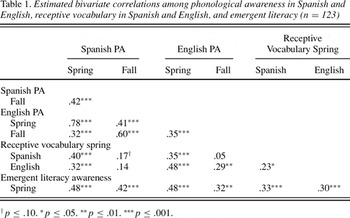
Estimated bivariate correlations among phonological awareness in Spanish and English, receptive vocabulary in Spanish and English, and emergent literacy (n=123)
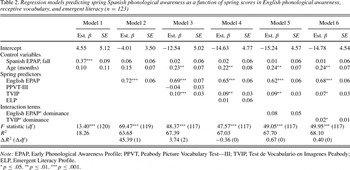
Regression models predicting spring Spanish phonological awareness as a function of spring scores in English phonological awareness, receptive vocabulary, and emergent literacy (n=123)
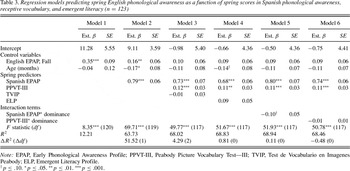
Regression models predicting spring English phonological awareness as a function of spring scores in Spanish phonological awareness, receptive vocabulary, and emergent literacy (n=123)
 You have
Access
- 175
- Cited by