Our departed friend, Mr. Dunup, who, as all the world, and especially his creditors, well know, departed by the boat for Boulogne about two months back, has been placed in a most awful position by the French Revolution. Bayonets were urging him from behind; but if he looked towards England, writs were threatening him in front.— “Awful Position of Mr. Dunup at Boulogne,” Punch 11 March 1848, 96
Punch's Mr. Dunup is indeed in an awful position. Having fled to France to escape his English creditors, he finds himself in the midst of the French Revolution of 1848. The question that he must answer – what is worse, revolution in France or bankruptcy in England? – is one that preoccupied Victorians at midcentury, when a wave of European revolutions coincided with the domestic financial crisis of 1845–48.Footnote 1 In classic accounts of nineteenth-century Europe, 1848 is remembered as the year when a crucial contest was waged between political revolution, identified with the Continent, and capitalism, identified with Britain. According to Eric Hobsbawm, the failure of the 1848 revolutions to effect lasting political change ushered in “[t]he sudden, vast and apparently boundless expansion of the world capitalist economy”: “Political revolution retreated, industrial revolution advanced” (2). For mid-nineteenth-century Britons, however, the triumph of capitalism was by no means assured. In what follows, I look closely at how Victorian journalists and novelists imagined the British financial crisis of the 1840s after this event was given new meaning by the 1848 French Revolution. Much of this writing envisions political revolution and the capitalist economy in the same way as the Punch satirist does – not as competing ideologies of social progress but as equivalent forms of social disruption. As we will see, at midcentury, the ongoing financial crisis was routinely represented as a quasi-revolutionary upheaval: it was a mass disturbance that struck terror into the middle classes precisely by suddenly and violently toppling the nation's leading men and social institutions.
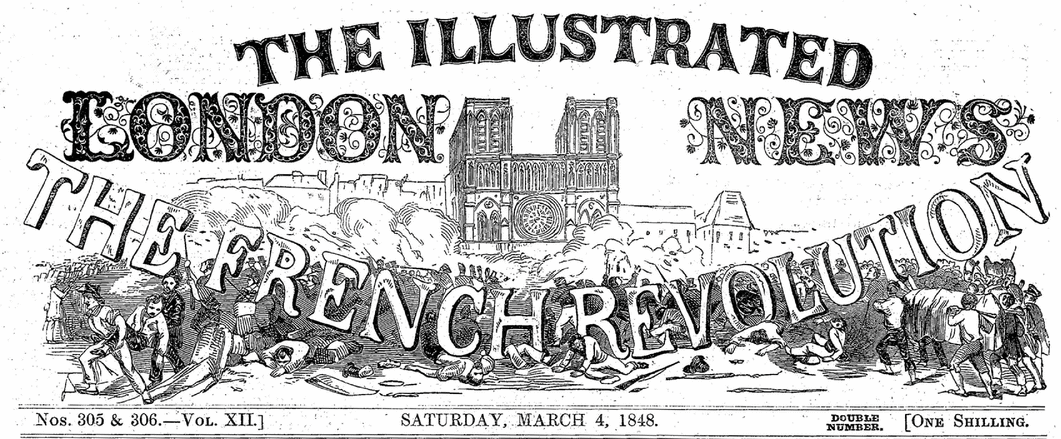
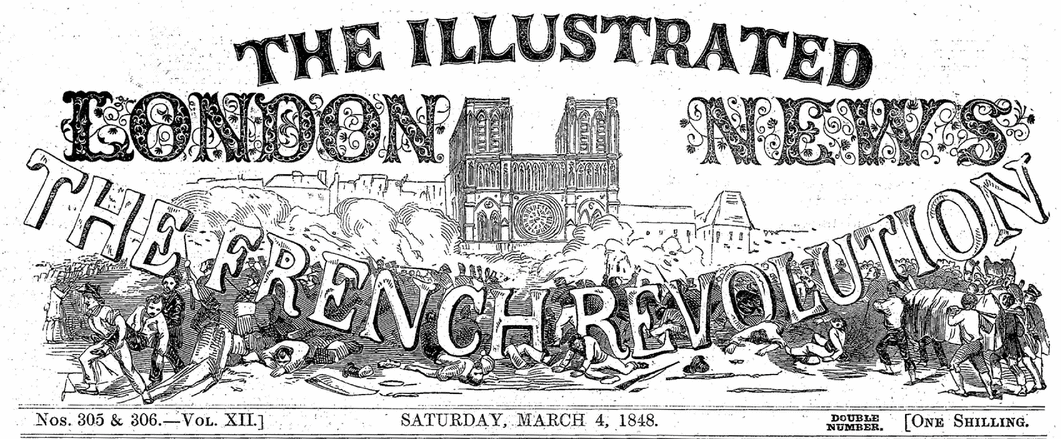
It is no accident that Mr. Dunup finds himself in France; the French Revolution of 1848 captured the imagination of the Victorian public. News of France's latest revolt dominated the pages of London's dailies, illustrated weeklies, and satire magazines from February, when King Louis Philippe was forced to abdicate after protests calling for political reform, through June, when the Parisian working classes fought to maintain socialist institutions established by the new republican government (Figure 4).Footnote 2 These months witnessed the publication of the first book-length British accounts of the February Revolt, and for the next two years, British writers penned a great many memoirs, pamphlets, histories, biographies, and novels explicitly concerned with France's past and present revolutions. Notable among these publications are J. S. Mill's “The French Revolution of 1848, and Its Assailants” (1849), George Henry Lewes's The Life of Maximilien Robespierre (1849), and Anthony Trollope's La Vendée (1850). Although Victorian investments in France's new revolution were various, many British observers believed that the new upheaval, like the Great Revolution of 1789, constituted a world-historical event. In the words of one metropolitan paper, “The events upon which Europe is now entering, will form a distinct, and hitherto, the most remarkable epoch in the history of the world” (Lead Article, Morning Advertiser 9 Mar. 1848, 2).
“The French Revolution.” Masthead for the special French Revolution number of the Illustrated London News, 4 March 1848.
It was the nature of this new epoch that became a matter of debate. As journalists were quick to point out, France's latest crisis was novel because it involved not only a political but a “social Revolution” (“The Great Revolution” 144). On the one hand, the new government established a constitutional republic whose legislators and president would be elected by universal suffrage. On the other, it attempted to realize a social utopia by implementing socialist “measures for the promotion of industry, and protection of the industrious classes” (“The Great Revolution” 144). Almost any British discussion of the French revolt noted that the socialist Louis Blanc was a member of the Provisional Government, and a number of journalists mistakenly concluded that the National Workshops, a state-sponsored assistance program, were modeled on his plan for workers’ cooperatives. Although the political achievement of the new revolution was celebrated by many Victorians, the social agenda inspired considerable trepidation, even amongst liberals. Alarmist articles with titles such as “Communism” depicted the socialist innovations of the Second Republic as a theoretical and practical challenge to the system of competitive enterprise that Britain pioneered and whose laws appeared to be irrevocable (Illustrated London News 25 Mar. 1848, 191).Footnote 3 Some journalists worried that the theories of the most radical French socialists would encourage a wholesale assault on the rich, inaugurating an economic Reign of Terror that would overrun all of Europe.Footnote 4 These writers, of necessity, offered passionate defenses of competition as the engine of personal and national progress. With some regularity, however, they felt compelled to admit that the drive to compete and acquire left a trail of destruction in its wake. Walter Kelly, author of the Narrative of the French Revolution of 1848, quoted a French economist's lament: “It is true, indeed, that competition has its abuses. The arena of competition is sown with ruins. . . . [H]ow often have the prospects of families there been annihilated!” (206).
Passages such as this one give voice to a fear that defined middle-class Victorian life throughout the century: fear of personal ruin and loss of property. As Jeff Nunokawa has argued, in Victorian novels, “to lose [property is] a taste of death, a scandal, a terror, a tragedy in which all others gather” (7). My goal, however, is not simply to demonstrate that the midcentury French Revolution provided an occasion for writers to express a generalized financial anxiety that had been intensified by the latest financial crisis. Instead, I build on recent scholarship that identifies the 1840s as the decade when the growth and volatility of speculative finance changed the way that financial writers, and the public at large, imagined the economy. More specifically, I argue that when we examine midcentury representations of British finance in the context of responses to the new revolution, we see that Victorians were beginning to understand the economy as a system that was coextensive with the nation and, so, to imagine that financial failure might – by itself – produce sudden and dramatic social transformation. To put it another way, we see Victorians beginning to imagine the possibility of financial revolution.
According to historians of Victorian finance, the 1840s were a “watershed in English financial history,” in large part because they mark the emergence of a widespread or national culture of speculative investment (Robb 21).Footnote 5 Because the rise of speculative investment increased the risk of crashes, the government passed the Bank Act of 1844, legislation that limited the amount of paper currency in circulation by requiring that it be backed by gold reserves (Poovey, Introduction 22–23). But the legislation did not work. A new mania for speculating in railway companies began in 1845. When the railway bubble burst, hundreds of banks, firms, and individuals failed; the strain on the supply of ready money led, ultimately, to the money panic of 1847–48, the third such crisis of the century.Footnote 6 As one scholar has observed, the money panic, in particular, “spread an . . . appalling brand of economic uncertainty,” “the uncomfortable perception that the wild fluctuation of share prices was caused . . . by the structure of the market itself” (Bigelow 81). It was in response to this profound uncertainty that Victorian financial writers tried to calm the anxieties of potential investors. One result, as Mary Poovey has explained, was the development of popular financial journalism, a new genre that “sought to depict the financial sector . . . as a law-governed, natural, and – preeminently – safe section of modern society” (“Writing” 22–23).Footnote 7 According to Poovey, the financial journalism pioneered in the 1840s “helped make the financial system imaginable as a system to Britons whose primary experience of finance was probably limited to transactions with local bankers” (“Writing” 25). It is the claim that financial journalism encouraged Britons to understand “the financial system . . . as a system” that interests me. Poovey's point is that financial journalists worked hard to convince lay readers that the British economy functioned in “regular and systematic” ways (“Writing” 25). However, she also suggests that these writers needed, as a first step in their project, to trace the connections among Britain's various financial institutions and markets – to show Britons that local banks, for instance, were part of an integrated system that crisscrossed and bound together the entirety of the nation.
The work of D. Morier Evans, an early financial journalist to whom I will return, exemplifies this effort to depict British finance as a national system.Footnote 8 In his early guide to London finance, The City; or a Physiology of London Business (1845), he acknowledges that, to “a stranger,” London's financial district seems to be isolated (“a world within itself”) and fragmented (the “bustling multitude” of businessmen “seem to have no direct association with each other”) (v). However, by describing for his readers the City's central institutions, occupations, and men, he aims to show that that this world is, in fact, “unit[ed] in one grand whole” (v). The City is no less than the center of the nation, the “pivot upon which the wealth of England turns” (1). When Evans discusses the current mania for speculation in railway companies, he speaks eloquently of the national reach of the speculative markets. He notes that just as the train has connected Britain's geography, so too has railway speculation forged financial links among Britain's commercial centers and, increasingly, among many of its citizens:
The work [of buying and selling railway shares] has not only been confined to London, but it has also extended itself to Manchester, Leeds, Liverpool, Glasgow, Dublin, Hull, Edinburgh, and Bristol. . . . The farmer is now as deep in railway shares as the merchant, the merchant as the banker; and the whole circle of society is so entangled in the mania, that when one link goes, the weight of responsibility will be found vastly embarrassing to those who have property that may be jeopardized by such a crisis. (61)
Earlier in the book, Evans takes pains to assure readers that City men are committed to “commerce and fair profit” (2), and in this section, he maintains that the “system” by which railway companies are promoted is “stabl[e]” (60). However, he also recognizes that the wealth generated by railway speculation has encouraged fraud – the creation of “sham companies,” for instance – and that the mania will end in a crash (60). When this crash comes, the marvelous financial interconnections among Britons will become “entangle[ments]” (61) that link people in a network of financial loss. What can prevent financial fraud and market volatility, according to Evans, is the work of men like him: the “vigilance of the [financial] press” (97).
Evans's The City illustrates how the idea that British financial institutions encompassed “the whole circle of society” could be consoling or frightening, depending on whether or not one believed that the financial system was unified, generally fair, and effectively policed. Indeed, I hope to show that, after the outbreak of the February Revolt, many Victorians found in the discourses of revolution a language for expressing their sense that, because the financial system was both unstable and extensive, panics could suddenly and dramatically alter the social structure.Footnote 9 At midcentury, Victorian observers routinely created analogies that equated British financial crisis and French revolution as forces that leveled the nation's most powerful institutions and men. Benjamin Disraeli, speaking of the recent financial failures before the House of Commons, observed that “[t]here were uprootings of commercial dynasties in England not less striking than the fall of [Europe’s] political houses” (Parliamentary Debates). At the same time, journalists reporting on the 1848 French Revolution compared it to an episode of financial panic when they joked that the ex-King Louis Philippe had, like many midcentury English gentlemen, gone bankrupt. According to the Illustrated London News, he was no better than a “beggared fugitive” (“The Great Revolution” 143).
To develop my argument that midcentury writing represents a formative moment in Victorian thinking about the financial system and its revolutionary potential, I provide two case studies. First, I examine press coverage of the bankruptcy of the Duke of Buckingham and Chandos, the most famous victim of the midcentury financial crisis; second, I analyze a recently rediscovered novel, William North's The City of the Jugglers; or Free-Trade in Souls. A Romance of the “Golden” Age (1850).Footnote 10 As we will see, the Buckingham bankruptcy culminated in a public sale held at the Duke's country estate, Stowe, in August of 1848. Before the midcentury French Revolution, fictional accounts of bankruptcy sales had already begun to represent these events as quasi-revolutionary social rituals in which the masses invade the gentleman's home and pillage his belongings. However, after the February Revolt, when the French people stormed and destroyed the King's palace, the Tuileries, equating “bankruptcy sales” with “revolutionary invasion” became commonplace. Journalists who covered the auction at Stowe routinely figured it as a traumatic revolutionary event. Further, they interpreted the Duke's failure as a sign that the traditional model of the nation – the nation as land – was giving way to a modern one, in which the nation was identified with its financial markets. Stowe, whose celebrated gardens made it an early destination in the domestic tourism industry, had long been viewed as a microcosm of England. The sale, however, showed that the value of this national symbol was shifting: its heirlooms were reduced to merchandise that circulated along financial, rather than hereditary, channels. North's The City of the Jugglers, a radical political fantasy, directly and outrageously develops this idea that the British nation has become a financial system. The novel's protagonists are republicans who have participated in the violent, mass uprisings of the 1848 revolutions in France and Hungary. However, their scheme to revolutionize Britain and establish universal suffrage does not involve staging a mass revolt; it involves orchestrating a panic in a speculative market.
Before turning to these two case studies, I will examine, in some detail, how midcentury financial journalism helped introduce into the popular imagination the idea that British financial panic was the domestic equivalent of political revolution.
The Terror of Financial Crisis
Early historians of the first French Revolution prepared later Victorian writers to associate political revolt with financial disruption. Generally speaking, accounts of 1789 emphasized the causal connections between the two forms of social crisis. Most typical were two commonsensical observations: first, that economic hardship produces social distress and, in turn, political revolution, and second, that political revolution disrupts trade and, thus, leads to widespread bankruptcy. In The French Revolution: A History (1837), Thomas Carlyle gives the first of these arguments a moral inflection.Footnote 11 Here he envisions pre-revolutionary France as a nation whose “Spiritual Bankruptcy” takes the form, initially, of a national financial crisis and, then, of a political revolt (1: 114; bk. 3, ch. 4). Midcentury writers did not reject these causal arguments. When, in the weeks after the February Revolt, enthusiasm for France's new revolutionary government was at its height, journalists followed Carlyle's line of argument and identified the near-bankruptcy of Louis Philippe's France as a crucial precondition of the recent upheaval.Footnote 12 Later, as enthusiasm waned, British journalists and memoirists focused instead on the commercial devastation caused by revolt and, purportedly, by the new government's socialist policies. According to one British eyewitness to the revolution, “Nearly one-third of the most enlightened population in Europe were, from their eager endeavour to work out an idea called the ‘Progress of Civilization,’ reduced from fair competency to actual beggary” (Chamier 2: 220).
This statement might well describe the condition of Britain in 1848. Many British firms and investors, eager to support the national railway system – an engine of progress as well as profits – had been ruined, if not reduced to beggary, by speculation in railway shares. Disraeli's claim, quoted above, that the commercial crisis was a quasi-revolutionary event suggests that this irony was not lost on Victorian observers. His speech also illustrates that many mid-nineteenth-century Victorians believed that the relationship of financial panic to political revolt was not causal but analogical – that the two were comparable forms of social disruption. Evans elaborates this analogy in his book The Commercial Crisis of 1847–1848: Facts and Figures Illustrative of the Events of that Important Period Considered in Relation to the Three Epochs of the Railway Mania, the Food and Money Panic, and the French Revolution (1849). Although this account, cobbled together out of previously published journalism and government reports, offers no overarching explanation of the crisis, Evans is particularly interested in the emotional structure of manias and panics. When he wants to capture the variety of terror that is elicited by financial distresss – the sickening suspense that overcomes investors as they watch markets fall or ready money dry up – he reaches repeatedly for revolutionary tropes. Writing of the week in October 1845, when the railway bubble began to burst, he paints a dramatic tableau of heroic investors facing a revolutionary onslaught of loss: “From one end of the kingdom to the other the tocsin of alarm resounded. The panic shout was scarcely universal, but terror nevertheless palled the hearts of the stoutest and boldest” (Commercial 19; emphasis added). Later, when he recounts the series of events that nearly led to a run on the banks in 1847, he reports that these City men brave a “week of terror” that will “long linger in the remembrance of those who witnessed its career” (Commercial 82). During manias and panics, Evans's businessmen are engaged not in the quotidian “battle of life” but in a traumatic and revolutionary struggle; the fate of their financial lives – and the life of the financial system – hangs in the balance. The idea that financial panic was a traumatic psychological experience equivalent to that of French revolution remained compelling to Evans. Over a decade later, he wrote an essay about a recent mini-bubble, titling it “The Reign of Terror of the Share Market.”
So far, I have focused on Evans's suggestion that the financial crisis of 1847–48 had revolutionary psychological effects. When we turn to his implicit explanation of how the railway mania developed, we can see even more clearly that he believes that financial crisis and political revolution share a social origin. In the wake of the 1789 Revolution, thinkers in France and Britain proposed that political revolt was linked to physiological and psychological disorder; in popular parlance, revolution was the result of mass illness or madness.Footnote 13 In The Commercial Crisis, Evans likewise proposes that the recent railway bubble is the product of a literal mania that afflicts all grades of society. Quoting from John Francis's History of the Bank of England (1847), Evans observes that “[t]he contagion passed to all, and from the clerk to the capitalist the fever reigned uncontrollable and uncontrolled” (Evans Commercial 2). The language of infection is pervasive in the opening pages of Evans's book, as is his insistence that the mania spreads to all classes. Railway riches “madde[n]” those who have made instant fortunes, and stories of their sudden wealth spread the infection even to “the poor” and to the “lowest of the low” among the speculators – a sinister group made up of “broken-down merchants’ clerks, decayed tradesmen who have lost money by speculation, and others, whose pretensions to honesty and character it would be difficult to describe” (Evans, Commercial 6). It is no wonder that, when Evans describes the crowds of investors who gather in the streets around the Stock Exchange, he cites another journalist who characterizes the gathering as a spectacle of “violence” (Evans, Commercial 5). The features that Evans ascribes to the manic crowd – irrationality, heterogeneity, and physical threat – match those ascribed to the French revolutionary mob not only in 1848 but throughout the nineteenth century.
To some extent, the French Revolution of 1848 made vivid, for Evans as well as the journalists he cites, assumptions about the revolutionary nature of manias that were embedded in the most influential early Victorian account of these episodes, Charles Mackay's Memoirs of Extraordinary Popular Delusions and the Madness of Crowds (1841). In lengthy discussions of two European manias – the South Sea Bubble and the French frenzy that inspired it, the Mississippi Scheme – Mackay characterizes bubbles as episodes of crowd madness that are analogous to revolt. His chapter on the Mississippi Scheme argues that the frenzy involved the entire nation (“People of every age and sex, and condition in life, speculated”) and that crowds of speculators erupted into “constant riots and disturbance” (1: 26, 27). Most interestingly, Mackay notes, as would later writers reflecting on the railway mania, that the episode was fueled by rumors “of [the] boundless wealth” that successful speculators could amass instantly: “many persons in the humbler walks of life, who had risen poor in the morning, went to bed in affluence” (1: 26, 33). This story evokes not just the “something-out-of-nothing” fantasy that is central modern economics.Footnote 14 It evokes the fantasy of social inversion that is central to post-Burkean understandings of political revolution (understandings that I will discuss at length below). At one point, Mackay feels that he must justify his long chapters on the manias, and he argues that it is precisely their quasi-revolutionary quality that makes them imaginatively engaging. He claims that bubbles are “capable of inspiring as much interest as even a novelist can desire. . . . [T]he wealthy of yesterday become the beggars of today. . . . [T]he powerful and influential [are] changed into exiles and outcasts” (1: 70–71). Panic thus accomplishes in the financial world what revolution accomplishes in the political world: the social hierarchy is suddenly turned on its head.
Readers of mid-nineteenth-century British fiction know that many writers agreed with Mackay's claim that panics were “capable of inspiring as much interest as even a novelist can desire.” Novels from this period frequently feature panics or, at least, the City men ruined by them. These works underscore the pathos of the bankrupt gentlemen by detailing a sordid ritual of financial collapse: the household sale, when frenzied bargain hunters invade the domestic sanctuary and pillage the most private of possessions. When we look closely at these scenes, we see that novelists such as Thackeray and Dickens represent the bankruptcy sale as a moment of quasi-revolutionary violence, modeling their descriptions on Edmund Burke's account, in Reflections on the Revolution in France (1790), of the invasion of Versailles. It is only after the February Revolt, however, when revolutionary crowds again entered a monarch's palace (the Tuileries, rather than Versailles), that this equation of the household sale and the revolutionary invasion became pervasive in the public imagination. Journalism about the sale at Stowe illustrates just how pervasive. Many articles simply announced that the public auction represented the British equivalent of a French revolution: a palatial estate had been invaded by the masses after a powerful man had been brought low. What is more, because the auction dispersed the holdings of an estate that, according to one journalist, gave “‘a local habitation’ to England's glory and greatness,” the sale at Stowe seemed to enact, on a symbolic level, the transition from a traditional, land-based understanding of the nation to a new one, which defined Britain as a network of financial markets (“Buckingham Bankruptcy” 328).
The Household Sale as Revolutionary Invasion
Burke understands the first French Revolution as a political act that inverted traditional social structures and values. His view of the revolt emerges with particular clarity in his famous account of the events of October 5 and 6, 1789, when a crowd of men and women who had marched to Versailles to demand an end to bread shortages invaded the Queen's bedchamber and, later, forced the royal family to march to Paris. Burke's account begins when the Queen is awoken, early in the morning of October 6, by the cries of her dying sentinel. Then “[a] band of cruel ruffians and assassins, reeking with his blood, rushed into the chamber of the queen and pierced with a hundred strokes of bayonets and poniards the bed, from whence this persecuted woman had but just time to fly” (62). For Burke, this act of violence, figured as rape, turns the social hierarchy upside down, reversing the positions of rulers and ruled. It also turns back the clock of social development. The invasion marks the end of “the age of chivalry,” a word that Burke uses as a synonym for civilization (66). In describing what the revolutionaries do next – they stage a mock-royal procession and march the King and Queen to Paris – Burke indeed imagines that a new age of barbarism has begun. He compares the revolutionaries to “a procession of American savages,” and he draws particular attention to the presence in the crowd of “ferocious” women (59). For Burke, the events of October 5 and 6 juxtapose tragedy (the assault on the Queen) and grotesque comedy (the procession of the revolutionaries). They thus emblematize another of his main claims about France's first revolution: it is “a monstrous tragicomedic scene,” an episode that evokes “alternate laughter and tears” (9).
Even before the outbreak of the 1848 revolts, midcentury writers figured the household sale as an act of revolutionary invasion. Consider, for instance, Thackeray's description, in an 1847 installment of Vanity Fair, of a representative sale, set at the home of the aptly named Mr. Dives. (This scene is intended to prepare readers for a real bankruptcy auction held at the home of Mr. Sedley, who is ruined when Napoleon escapes from Elba and the London markets crash.) Although the novel takes place during the Napoleonic Wars, Thackeray encourages readers to identify the episode with their own moment of financial turmoil. His narrator, speaking directly to the 1847 audience, notes that “[t]here are very few London people . . . who have not attended at these meetings [i.e., household sales]” (204; ch. 17). He further encourages readers to view the sale through a Burkean emotional lens. According to the narrator, household auctions are cultural events where “you light on the strangest contrasts, laughable and tearful” (204; ch. 17).
Indeed, when Thackeray describes the public viewing that takes place before the auction proper, he directly recalls and reworks Burke's accounts of the invasion and the mock-procession. Thackeray's narrator imagines that Dives's home is turned upside down by a “swarm[ing]” crowd that violently “invade[s]” the most private of the family's apartments, thinking nothing of poking and prodding the beds:
How changed the house is, though! . . . [T]he hall swarms with dingy guests of Oriental countenance, who thrust printed cards into your hand, and offer to bid. Old women and amateurs have invaded the upper apartments, pinching the bed-curtains, poking into the feathers, shampooing the mattresses, and clapping the wardrobe drawers to and fro. Enterprising young housekeepers are measuring the looking-glasses and hangings to see if they will suit the new ménage. (205–06; ch. 17)
The echoes of Burke are so loud that they speak for themselves. The crowd is composed not of “American savages” and their “ferocious” women but of domesticated Others – Jews, “old women,” and “young housekeepers.” These invaders do not commit murder or wield phallic knives, but they are responsible for acts of domestic violence: they “thrust” and “pinch” and, just like Burke's revolutionaries, “poke” the feather mattress. Most important, the scene dramatizes a moment in which the social order is inverted: as the gentleman falls down the social ladder, “enterprising” members of the lower middle classes move up by buying the objects that confer class status. Thackeray was not alone in depicting the bankruptcy auction as a quasi-revolutionary social ritual. When Dickens's Mr. Dombey suffers the indignity of a household sale, the novelist draws attention to the vulgar “herds” that “invade” the house, “touzling the feather-beds” and otherwise soiling the domestic sanctuary with dirty fingers (Dombey 696; ch. 59).
The revolutionary scenario implied in these scenes became historical reality once again during the first days of the Second French Republic, when the people of Paris demonstrated their new political authority by invading the Tuileries. This symbolically freighted event served as a set piece in many articles and memoirs devoted to the new revolt. The Illustrated London News included four large engravings in its special “French Revolution” edition of the paper, one of them tellingly titled “Orgies in the Palace Wine-Cellars” (138). Although the eye-witness report that accompanies these pictures expresses sympathy for the revolutionary movement, the spectacle of the people in the ex-King's palace still evokes Burkean horror. The writer describes the scene as a “saturnalia”: the people are engaged in a “frenz[ied]” destruction of royal property, their “hands . . . covered with smoke or dirt, sometimes smeared with blood” (“Additional Facts” 141). Conservative critics underscore the subtext of vulgar invasion and social inversion. One writer notes that a working-class boy dresses up as the ex-King and parades around atop the palace (Chamier 1: 79–80). Another, following Burke almost to the letter, insists that, even though the royal family has fled, the Queen's body is subject to symbolic attack: her rooms are invaded by “[b]ig-bearded men” smoking cigars, and “dirty smoke-smeared persons” roll around in her bed while making “obscene jokes and gestures” (Simpson 1: 70).
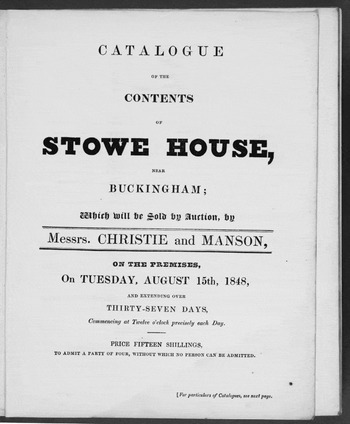
In this historical context, it is not surprising that the public auction at Stowe, the palatial residence of a bankrupt duke, was regarded as a national catastrophe. Hundreds, if not thousands, of sightseers traveled to Buckinghamshire during the preview days to tour the estate before it was dismantled (Figure 5).Footnote 15 Once the month-long auction began, on August 15, 1848, the metropolitan, provincial, and even colonial presses reported regularly on its progress. The Times was the first paper to claim, in a controversial editorial, that the Duke's bankruptcy was comparable to “the overthrow of a nation or a throne” (Lead Article, 14 Aug. 1848, 4). In the article, the writer proposes, on the one hand, that Buckingham's crash is revolutionary because the aristocrat has taken down an entire family, “a pillar of the state,” during a moment of widespread political unrest.Footnote 16 On the other, the writer emphasizes that the public sale, conducted within the walls of the mansion, is equivalent to a Burkean mass invasion. The sightseers and buyers who trek to Stowe for the auction are envisioned as a “tumultuous invasion” of “enem[ies]” who encamp on the lawn and, after entering the mansion, commit acts of “sacrilege”: “King Mob . . . r[ides] literally roughshod through the palace.” In this moment of high drama, Stowe itself emerges as virtuous woman (think Marie Antoinette) who is threatened with revolutionary defilement: “The bride was dressed for the altar, the victim for the sacrifice” (Lead Article, Times 14 Aug. 1848, 4). By the time The Annual Register for 1848 recalled the sale, the equation of auction and revolutionary invasion was not suggested but announced: “The mere inspection of the almost regal residence and domain attracted crowds of visitors, to whom its most sacred recesses were revealed by the misfortunes of the family – not even the Tuillieries [sic] or Versailles, assailed by a mob of insurgents, was more completely laid open to the vulgar gaze” (“Chronicle” 126).Footnote 17 Here the sale represents an act of exposure and desacralization that is somehow more destructive than a revolutionary assault. A handful of papers made the similarly hyperbolic claim that the sale struck a blow against the British peerage heavier “than any event, political or otherwise, that has occurred since the Conquest” and, so, “add[ed] overwhelming strength . . . [to] the ever restless spirit of revolution” (“Buckingham Bankruptcy” 328).
“Catalogue of the Contents of Stowe House.” Title page of the pre-sale catalogue for the auction at Stowe. Courtesy of The Huntington Library.

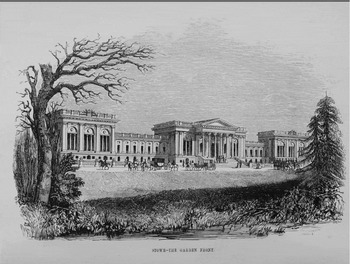
Although articles such as this one sound ominous warnings about Britain's future, they often seem most interested in expressing feelings of Schadenfreude, feelings evoked by the spectacle of a ruined aristocrat who (apparently) collapsed under the weight of his own excess. Even for critics of the Duke, however, the auction itself was troubling because it challenged the symbolic values associated with the country estate. The symbolic value of Stowe in the national imaginary was established in the early eighteenth century: the neoclassical mansion was visited by European royalty, and the extensive gardens were such a popular destination for early domestic tourists that publishers issued competing guidebooks (Figure 6).Footnote 18 According to Carol Fabricant, Stowe was at the center of a domestic tourist industry whose ideological objective was to create “a socially stabilizing consensus among different classes in society” (257). By the middle of the nineteenth century, various classes indeed identified Stowe as a site of national memory and meaning, as a repository of “the heirlooms of many great families, the records of many great events, and the memorials of many great persons” (Lead Article, Times 14 Aug. 1848, 4). These “heirlooms” included the state bed made for Queen Victoria's recent visit, a celebrated miniature portrait of Charles II, and a lock of hair belonging to the daughter of Henry VII. As one journalist explained, lamenting the sale of the estate's painting collection, such objects were rightly the “property of the nation” (“Stowe” 236).Footnote 19
“Stowe – The Garden Front.” Engraving, from Henry Rumsey Forster's The Stowe Catalogue Priced and Annotated (1848), xxxiii.

According to sociologist Charles Smith, auctions are social rituals through which objects are “reborn”: “They acquire new values, new owners, and often new definitions” (79). Victorians who witnessed the sale at Stowe insisted that the symbolic value of the Duke's estate was not being redefined but liquidated. As one journalist lamented, “objects hitherto supposed to be surrounded by an almost sacred halo of reverence are . . . in point of fact, mere merchandise. . . . [E]verything that Stowe contains is to be sold for anything that anybody will give for it” (“Buckingham Bankruptcy” 328).Footnote 20 This lament about the commercialization of household gods, whose intrinsic values are erased and replaced by the arbitrary valuation of “anyone” with ready money, should sound familiar to readers of Victorian fiction. In the case of the sale at Stowe, however, the sacred objects were Britain's patrimony, and the household was a country estate imaginatively identified with the nation. What the auction appeared to enact was a battle in which a new urban Britain, dominated by commerce and finance, triumphed over a traditional Britain, identified with the stability of the venerable country house. Although no one knew exactly why the Duke crashed, at least a few writers proposed that he had become implicated in midcentury London's volatile speculative markets.Footnote 21 The Economist emphasized this point when it argued that Buckingham was ruined because he “speculated” in land, gambling on the chance that rents would rise (“Ruin”15). A roman à clef featuring Buckingham and railway King George Hudson likewise proposed that the aristocrat “join[ed] in the [railway] speculation” (as many aristocrats, in reality, did), becoming the director of a company, shortly before he was ruined (The Golden Calf 1: 234). In this novel, the Duke's failure is only the most public in a chain of bankruptcies that are triggered by the railway panic, bankruptcies that span the nation's geography (from the metropolis to the provinces) and its social hierarchy (from aristocrats to capitalists to railways workers) (3: 224). To a great extent, the fictional Duke crashes because Britain has become a network of financial entanglements in which everyone is enmeshed.
The slang developed during the railway mania – Hudson, as we know, was dubbed the “railway king” – reflects Victorians’ sense that speculative capitalists, not Kings and Dukes, ruled the nation. It suggests as well an emergent sense that the nation has become a financial entity. William North runs with this idea in his The City of the Jugglers (1850). Beginning with the proposition that England is a “system of [financial] traffic,” he concludes, logically enough, that radicals can only revolutionize Britain's political institutions by triggering a panic in London (City of the Jugglers 93; bk. 1, ch. 8).
William North's The City of the Jugglers (1850): Financial Revolution
William North (1825–1854) was a British novelist and journalist whose life and work have recently begun to receive scholarly attention thanks to Patrick G. Scott, who published a digital edition of North's rare The City of the Jugglers in 2008.Footnote 22 Although North had achieved some success as a writer before penning City, his new book was a flop; apparently, not even one copy sold (Scott 7). Modern readers will have little difficulty understanding why no one bought North's novel. Judged by almost any aesthetic standard, City is a bad book, a mixture of stilted fictional narrative and self-indulgent philosophizing. North's novel is worth reading, however, because it exposes post-1848 fears about the national reach of the Victorian financial system and the quasi-revolutionary repercussions of panics. In this respect, City counts as an important example of “minor literature,” in Gilles Deleuze and Félix Guattari's understanding of the term: it gives full expression to a social nightmare (here, of financial revolution) that is often muffled in mainstream writing (Deleuze and Guattari 17).Footnote 23
North's novel opens in the City, in the aftermath of the British railway mania and the European revolutions of 1848. The promoter Ignatius Loyola Grey is finalizing plans to create a new speculative market or “juggle” that will “deal in human souls” (3,7; bk. 1, ch. 1). By evoking the story of Faust, North builds on a longstanding association of modern economics and black magic.Footnote 24 More important, the novelist emphasizes that, at midcentury, the financial markets have achieved total penetration, moving into the realm of the immaterial (the arena of intellectual speculation) and turning it into a source of profit (in the arena of financial speculation). The result is that all human relationships – and especially political alliances – have been commercialized. Readers soon learn that Grey's business is to “facilitate” the negotiation of bribes used to buy political influence (40; bk. 1, ch. 4). As Grey's business thrives, driving up the price of his company's shares, a soul mania erupts in the City. Rival soul agencies open their doors; ads describing “Souls” for sale fill the newspapers; and men and women of all classes are infected by the “cholera”-like speculation bug (103,104; bk. 1, ch. 8). When North announces that a magnificent Soul Market opens in advance of the new Houses of Parliament, his point is clear: the soul mania has revealed that Britain is less a political institution than a “system of traffic,” a “company” (93; bk. 1, ch. 8; 179; bk. 2, ch. 5).
Here we begin to recognize that North's The City of the Jugglers is a self-conscious satire of Evans's comforting financial guidebook, The City. Recall that Evans championed the City as the “pivot upon which the wealth of England turns” (City 1). North, by contrast, characterizes the City as the center of an elaborate structure of financial fraud that encompasses the entire social hierarchy, the nation, and, finally, Europe. A passage from the novel's opening is worth quoting at length:
It was four P.M. in the City. . . . Directors of companies were “cooking” the accounts of their shareholders. . . . Usurers were meeting gentlemen who wanted to borrow money at any rate of – nonpayment. Adventurers were keeping appointments with capitalists they hoped to drag into speculations. Capitalists were contriving monopolies by which to crush non-capitalist adventurers. Stockbrokers were playing monkey tricks on the Stock Exchange. Hebrew gold kings were manufacturing intelligence to astonish the stock-brokers. Couriers were dashing off with the commands of London financiers to foreign potentates. Messengers were arriving from the sham, entreating aid from the real sovereigns of Europe. And plenipotentiaries of the daily press were calmly overlooking the whole ant-hill with sublime indifference to the struggles of its busy insects, generalizing for millions the knowledge which, even to those in the midst of the bustle, was too often but semi-obscurity and chromatropic confusion. (2–3; bk. 1, ch. 1)
In this passage, Evans's “bustling multitude” of businessmen, all dedicated to “fair profit” (City v, 2), is exposed as an unsavory collection of unscrupulous directors, usurers, borrowers, capitalists, stockbrokers, and other financial functionaries who compete to out-cheat each other. North emphasizes that this group of men in no way forms what Evans had called “one grand whole” (City v): “Those in the midst of the bustle” see only “semi-obscurity and chromatropic confusion.” Whereas Evans had proposed that the press could serve as a check on financial malfeasance and financial volatility, North insists that journalists respond with “indifference.” (Later plot events reveal that newspaper editors sell their services to promoters, politicians, and even the Pope.) North's aim is to expose the hidden truth of London finance: it is “a system,” but one “which . . . might at any moment dissolve into nothingness” (1; bk. 1, ch. 1). The novelist wants to provoke, rather than calm, Victorian fears of the instability of their national financial markets. In this respect, his book is an anti-guide to the City – and the novel is at its satirical best when it explains, in step-by-step fashion, how almost anyone can create a new mania.Footnote 25
North's satire of Britain's financial system was shaped by the cultural trauma of the railway mania and, in all likelihood, by his imprisonment for debt, in 1847.Footnote 26 It was the outbreak of the midcentury revolutions, however, that made it possible for the young novelist to fantasize that the volatile forces at work in Britain's speculative markets could be harnessed to bring about revolutionary political change. As historians of nineteenth-century British radicalism have shown, the 1848 revolutions inspired not only committed Chartists (who organized the ill-fated Kennington Commons demonstration of April 10, 1848) but also middle-class liberals and radicals, many of them from “the bohemian precincts of London's literati” (Finn 71).Footnote 27 Many of the details of North's biography remain murky, but we know that he travelled in literary London's bohemian circles. Further, The City of the Jugglers shows that, in the wake of the revolts, North embraced a radical politics that he aligned with European republicanism.Footnote 28 The novel's protagonists – the poet Bernard Viridor and the Duke of St. George, Arthur Bolingbroke Darian – are idealized heroes who have developed their political ideologies by participating in the European revolutions of 1848. A long chapter recounts Darian's heroic exploits as a General in Hungary; other chapters offer snapshots of Viridor's days in revolutionary Paris, where he assisted France's poet-politician Alphonse Lamartine. Once these Englishmen return to London, Darian becomes a member and Viridor, the Grand Master, of the Illuminati, a pan-European republican organization that calls for universal suffrage and host of other democratic institutions (188–94; bk. 2, ch. 5). North's internationalism aligns him with other middle-class British radicals who championed the 1848 revolutions (see Finn 70–82). Like them, he also rejects socialism. As his heroes explain, socialist philosophy undermines progress and human liberty by checking competition (49; bk. 1, ch. 5). What distinguishes North's politics is his embrace of a simplified version of German idealist philosophy. According to Darian, democrats are, fundamentally, defenders of a “Spiritualism” that is synonymous with “Life” and “infinite progressive ambition”; they fight a selfish “Materialism,” epitomized by the Soul Market, that promotes “Death” and social inertia (39; bk. 1, ch. 4). It is this idealism that informs both the novelist's early claim that the financial system is founded on “nothing” and later philosophical excurses in which he attempts to prove that gold, property, and wealth are mere “chimeras” (95; bk. 1, ch. 8). Indeed, the novel as a whole follows a dialectical logic, proposing that the effort of Materialists to turn everything to profit leads them to begin exploring not just the soul-as-commodity but also, in the end, the soul-as-spirit. North reports that, in the midst of the mania, cheap editions of Kant and Hegel had “a prodigious sale” (226; bk. 3, ch. 1).
North's critique of Victorian finance is thus based on a general idealist suspicion of the material world rather than on arguments drawn from political economy. However, his idealist premises lead him to see with fantastic clarity the proposition that other Victorians only apprehend dimly or in part: because the nation is ruled by financial markets, panics represent the British version of revolution. It is this proposition that informs Viridor's scheme to effect political change in Britain. He and his brother Illuminati organize and promote a “Grand Exposition of the Souls of All Nations” with the intention of “awakening the . . . multitudes” from the delusive mania and producing a crash in the Soul Market (193; bk. 2, ch. 5). Rather than showcase souls that might be traded for profit, the exhibition features a variety of people who have already made their rounds on the market – and have been driven mad in consequence. North tells readers that, once the Exposition opens, a “tempest” will follow (220; bk. 2, ch. 7). And, indeed, in the novel's final seventeen pages, he offers a hasty account of the bloodless revolution that concludes when Viridor, now a Member of Parliament, succeeds in passing a bill that establishes universal manhood suffrage in Britain. How the panic in the Soul Market produces this revolutionary change is not entirely clear.Footnote 29 However, the novel's structure positions the panic as the agent of political transformation. Anticipating the novels of financial speculation written later in the century, North identifies each book of his triple decker with a phase in the life of the bubble: “The Opening of the Soul Exchange” (birth) is followed by “The Grand Exhibition of the Souls of All Nations” (growth) and “The Panic in the Soul Market” (death) (1, 107, 221).Footnote 30 In terms of the novel's overarching plot, the declaration of universal suffrage is thus an outcome of the panic. The title of the novel's final chapter, in which Viridor's bill is passed, encapsulates this point: “The Panic – the Beginning of the End” (244; bk. 3, ch. 4)
North's The City of the Jugglers is valuable because it articulates so vividly the midcentury sense that the nation is coextensive with its elaborate financial system and that, as a result, panics might have quasi-revolutionary repercussions. The novel, along with the other midcentury representations of panic that I have explored, brings into sharper focus the development and transformation of the mid-Victorian financial imagination. Most important, this midcentury writing reveals that fears of national financial collapse were shaped, in crucial ways, by the language, tropes, and narratives of political revolution. It was the outbreak of the 1848 French Revolution that gave writers a compelling imaginative framework for expressing their worries about Britain's emergent financial system and, so, for making sense of the lived experience of economic modernity. There can be little doubt that, as Hobsbawm argues, 1848 was the year when capitalism triumphed over revolution. But 1848 should also be remembered as the year when fears of financial revolution, fears that haunt the public imagination to this day, were born.