


Introduction
Social functioning deficits (e.g. social skill, community functioning) are a core feature of schizophrenia. They are a key diagnostic criterion for the disorder (DSM-IV; APA, 1994), precede illness onset (Davidson, Reichenberg, Rabinowitz, Weiser and Kaplan, Reference Davidson, Reichenberg, Rabinowitz, Weiser and Kaplan1999; Marenco and Weinberger, Reference Marenco and Weinberger2000), and are a strong predictor of outcome (Perlick, Stastny, Mattis and Teresi, Reference Perlick, Stastny, Mattis and Teresi1992; Sullivan, Marder, Liberman, Donahoe and Mintz, Reference Sullivan, Marder, Liberman, Donahoe and Mintz1990). These deficits are only minimally improved via medication (Bellack, Schooler and Marder, Reference Bellack, Schooler and Marder2004), the frontline treatment for schizophrenia. Additionally, many of the prominent psychosocial interventions for schizophrenia (i.e. social skills training and neurocognitive remediation) exhibit limited generalizability beyond their targeted domains to clinically significant social outcomes (Kurtz and Mueser, Reference Kurtz and Mueser2008; Twamley, Jeste and Bellack, Reference Twamley, Jeste and Bellack2003). Cognitive-behavioral interventions traditionally have not targeted social functioning (Roberts, Penn, Cather, Otto and Goff, Reference Roberts, Penn, Cather, Otto and Goff2004); however there is emerging evidence that, if appropriately focused, they may confer social functioning benefits (Granholm, Ben-Zeev and Link, in press; Wykes, Steel, Everitt and Tarrier, Reference Wykes, Steel, Everitt and Tarrier2008).
Recently, social cognition has been identified as a potentially promising treatment target for improving social functioning in schizophrenia (Green, Olivier, Crawley, Penn and Silverstein, Reference Green, Olivier, Crawley, Penn and Silverstein2005; Penn, Corrigan, Bentall, Racenstein and Newman, Reference Penn, Corrigan, Bentall, Racenstein and Newman1997; Penn, Sanna and Roberts, Reference Penn, Sanna and Roberts2008). Social cognition refers to a set of cognitive processes applied to the recognition, adaptive processing, and effective use of social cues in real-world situations (Brothers, Reference Brothers1990). Social cognition is a promising treatment target because it is related to social functioning outcomes (Couture, Penn and Roberts, Reference Couture, Penn and Roberts2006). Some evidence suggests that social cognition may be more strongly related to social functioning than is neurocognition (Pinkham and Penn, Reference Pinkham and Penn2006; Pollice et al., Reference Pollice, Roncone, Falloon, Mazza, DeRisio, Necozione, Morosini and Casacchia2002; Vauth, Rusch, Wirtz and Corrigan, Reference Vauth, Rusch, Wirtz and Corrigan2004), while other research suggests that social cognition and neurocognition exert an interactive effect on social functioning (Bell, Tsang, Greig and Bryson, Reference Bell, Tsang, Greig and Bryson2009; Brekke, Kay, Lee and Green, Reference Brekke, Kay, Lee and Green2005).
Key domains of social cognition that have been found to be abnormal in schizophrenia include emotion perception, Theory of Mind (ToM), and attributional bias (Penn et al., Reference Penn, Sanna and Roberts2008). Emotion perception is typically operationalized as one's ability to judge others’ emotional states based on their facial expression or vocal tone. ToM refers to the ability to infer others’ thoughts, beliefs or intentions indirectly, based on their utterances and behaviors, and in light of contextual clues; ToM is similar to “perspective taking”. Attributional bias refers to patterned tendencies in explaining the causes of events in one's life. Individuals with persecutory delusions may exhibit a hostile attributional bias whereby they attribute negative events to the hostile intentions of others.
Social Cognition and Interaction Training (SCIT) is a manual-based, psychosocial treatment that is designed to improve social functioning in schizophrenia by way of enhanced social cognition. SCIT has shown feasibility and preliminary evidence of efficacy among both inpatient (Penn et al., Reference Penn, Roberts, Munt, Silverstein, Jones and Sheitman2005; Combs et al., Reference Combs, Adams, Penn, Roberts, Tiegreen and Stem2007) and outpatient samples (Roberts and Penn, Reference Roberts and Penn2009).
The current paper reports on an open transportability trial of SCIT conducted within a network of community agencies unaffiliated with the developers of SCIT. In holding with stage models of treatment development (Onken, Blaine and Battjes, Reference Onken, Blaine, Battjes, Henggeler and Santos1997), transportability trials of novel interventions are typically conducted after an intervention has demonstrated evidence of efficacy in a controlled trial. However, bridging the gap between research findings and clinical practice has often proven difficult, and many interventions that demonstrate efficacy fail to receive appropriate transportability and effectiveness evaluation (Dobson and Hamilton, Reference Dobson and Hamilton2002; Westen, Reference Westen2002). There are multiple reasons for this gap, including limited incentives for community stakeholders to participate in treatment research (Addis and Krasnow, Reference Addis and Krasnow2000), the difficulty of modifying established treatment programming in community and hospital clinics, and the favoring of internal validity research over external validity research by funding agencies and academic publishing houses (Dobson and Hamilton, Reference Dobson and Hamilton2002). In sum, the traditional stage model of treatment development has encountered obstacles in producing treatment interventions that are internally as well as ecologically valid and transportable. In light of these obstacles, more recent models of treatment development have highlighted the benefits of integrating transportability and effectiveness studies earlier in the development process (e.g. Weisz, Chu and Polo, Reference Weisz, Chu and Polo2004).
The purpose of the current study was twofold: 1) To conduct a preliminary, open-trial evaluation of SCIT's transportability, feasibility, and acceptability in community settings prior to conducting a large-scale randomized, controlled trial; 2) To explore the utility of a model of research/clinical collaboration for facilitating the conduct of effectiveness research. Feasibility and acceptability assessment included feedback questionnaires completed by participating clients and group leaders, and attendance data. To assess the transportability of SCIT's active treatment components, and to provide treatment information useful to providers (Weisz et al., Reference Weisz, Chu and Polo2004), measures of emotion perception, Theory of Mind, and attributional bias were administered at pre- and post-treatment.
Method
Treatment setting
SCIT groups were conducted in New York City in collaboration with two healthcare service agencies, each of which operates a network of outpatient mental health services. Groups were conducted at three rehabilitation-oriented treatment centers for individuals with severe and persistent mental illnesses: (1) an intensive psychiatric rehabilitation program, which provides mental health, case-management, social, and vocational services in promotion of its clients’ independent living; (2) a rehabilitation program located within a supported living facility for adults; (3) an outpatient mental health day program, which provides a spectrum of rehabilitation-oriented outpatient services with the mission of promoting independent living and self-sufficiency for its clients.
Across sites, SCIT was offered as an adjunct to routine care, and followed the manual-specified schedule of 20 to 24 sessions over approximately 5 months. Each group was led by two clinicians (three with Bachelor's degrees and three with Master's degrees). The clinicians had an average of 8.1 years of experience (SD = 7.3) working with clients with severe mental illness.
Treatment intervention
SCIT is a 20-session manual-based intervention. All sessions begin with structured check-ins designed to increase emotional self-awareness, and the relationship between participants’ emotions and social judgments. Next, homework is reviewed to bridge content from the previous week to the current session. In the first several sessions, this is followed by psychoeducation and discussion of social cognitive principles. The bulk of most core sessions is spent learning specific social cognitive strategies, and then utilizing these strategies to analyze social cognitive stimuli (photographs, specialized videos, or incidents from group members’ lives). Strategy practice is structured in the form of games (including feedback about right and wrong answers) or as collaborative data-gathering, confidence-estimating, or problem-solving exercises. For example, participants learn that jumping to conclusions in social situations may lead to negative outcomes. They learn that one strategy to avoid jumping to conclusions is to separate social facts (e.g. she is looking this way) from guesses (e.g. she is thinking about me). Participants practice making this distinction in photographs and videos of social scenes. The final five sessions of SCIT are spent applying social cognitive strategies, such as separating facts from guesses, to interpersonal problems in participants’ day-to-day lives. All sessions end with assignment of homework.
Collaborative research approach
The study was conducted by two of the SCIT treatment developers (DR and DP), located in North Carolina, along with administrators (AS) and clinicians (DL and SM) from three mental health treatment agencies in New York City. Based on documented obstacles to effectiveness research, the following collaboration principles were established: 1) Increase clinical and administrative stakeholders’ incentives for participation; 2) Maximize research rigor within the resource limitations of participating clinical agencies; 3) Actively incorporate input from clinicians and administrators to enhance the feasibility and transportability of SCIT within community settings. These principles were addressed, respectively, as follows.
To increase clinicians’ and administrators’ incentives for participation, opportunities were provided for collaboration in the conduct, preparation, presentation, and write-up of research products related to the project. This was motivating for clinicians interested in developing as researchers. It was also motivating for administrators who had institutional commitments to increasing the empirical basis of their treatment offerings.
The primary resource limitations of participating agencies regarded group composition and outcome assessment. Regarding the former, it was deemed infeasible by clinical administrators to offer the SCIT intervention to only the subset of clients who met narrow research criteria (e.g. diagnostic homogeneity, exclusion based on current substance use). Therefore, inclusion criteria were relaxed. Regarding the latter, no research staff was available to provide participant assessments, nor did clinicians have time in their busy schedules to conduct individual research evaluations with participants. Therefore, standard social-cognitive outcome instruments were modified for use in group format, and were implemented by treating clinicians in the context of group sessions. Clinicians received coaching and supervision regarding test administration during weekly supervision calls.
Supervision calls were also used as a venue for clinicians to provide input regarding the feasibility of the intervention and the utility of the manual and bundled treatment materials. Clinicians’ input was recorded and, after completion of the trial, was utilized to enhance the subsequent version of the treatment manual. It was expected that this approach would maximize the transportability of the version of the intervention that would be evaluated in the subsequent randomized controlled trial (currently underway).
Participants
Participants were recruited by agency clinicians using the inclusion criteria from a previous efficacy trial (Roberts and Penn, Reference Roberts and Penn2009) as a guideline, in combination with the clinical goals of the program and the perceived treatment needs of individual clients. Specifically, clinicians prioritized recruitment of participants who met the following inclusion/exclusion criteria: (1) Diagnosis of schizophrenia or schizoaffective disorder; (2) Reading ability above third grade level; (3) Fluency in English; (4) No diagnosis of current substance abuse or dependence; (5) Difficulty with social cognition or paranoia, as indicated by clinician or staff consensus of difficulty with social interactions; (6) Aged between 18 and 65. All participants were receiving regular psychiatric treatment, consisting of case management, medication management, group treatment (i.e. psychoeducation and skill building) and, in some cases, vocational services.
Specific recruitment procedures differed across treatment sites, reflecting different institutional standards for group implementation. For example, one of the sites held an informational meeting at which the SCIT intervention was described. Clients had the opportunity to sign-up, and additional clients were approached based on clinicians’ judgment. Thus, across sites, no standard data are available on the percentage of clients receiving information about SCIT who elected to participate. Individuals who elected to participate in SCIT were offered the opportunity to complete pre- and post-treatment research assessments as part of the current study. A subset of 50 group attendees elected to do so, and comprise the sample for the present study.
Measures
Demographic and clinical information. Treating clinicians collected baseline data on age, gender, ethnicity, years of education, diagnosis, years with mental illness, and living status from participants’ medical charts.
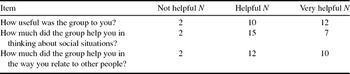
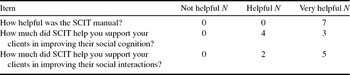
Transportability, acceptability, and feasibility. These domains were assessed using multiple methods. First, patients and clinicians were asked to complete evaluations of the SCIT intervention and materials. Using a 3-point scale (not helpful, helpful, very helpful), patients were asked to provide an overall rating of the group, as well as ratings of whether the group helped them in thinking about social situations and in interacting socially (see Table 2). Clinicians used a similar three-point scale to judge whether SCIT helped them to support their clients in improving their social cognition and in improving their social interactions (Table 3). Clinicians also rated the usefulness of the manual and materials on a similar three-point scale.
Second, pre- and post-treatment assessments of social cognition were conducted. As noted above, resources were not available to conduct extensive, one-on-one assessments with participants. Three widely-used social cognitive measures were modified for use in the current study. All three were produced in paper-and-pencil format, using enlarged font, and simplified printed instructions that were enhanced and clarified verbally as needed by group leaders. Measures were administered in group-format during the first three and final three meetings of the SCIT treatment groups. (Efforts were made to administer measures one-on-one for participants who missed any of the assessment meetings.) Because SCIT calls for groups to be co-facilitated by two clinicians, during assessment sessions one clinician presented assessment instructions and testing stimuli while the other clinician ensured that participants understood the directions and assisted those with special needs (e.g. language, reading, or writing limitations).
Emotion perception was measured with the Face Emotion Identification Task (FEIT; Kerr and Neale, Reference Kerr and Neale1993). The FEIT is comprised of 19 photographs of faces expressing one of six basic emotions (happy, sad, angry, afraid, surprised, and ashamed). The participant's task is to determine which of the six emotions is being expressed by each face. Performance is indexed as the number of correct responses. The FEIT was modified by projecting the facial images onto a screen using an LCD projector.
Theory of Mind was measured with the Hinting task (Corcoran, Mercer and Frith, Reference Corcoran, Mercer and Frith1995). The Hinting task consists of 10 brief, written vignettes describing a social interaction between two characters that ends with one uttering a hint (e.g. “Gosh, these suitcases are heavy!”). The participant must infer what the character really meant by the hint (e.g. “Will you help me carry them?”). A correct inference receives 2 points. In the standard format, if the respondent is incorrect, a second, more obvious hint is provided (e.g. “I don't know if I can carry all three!”) and, if correct at this point, the respondent receives 1 point. Incorrect answers receive 0 points. Scores on the Hinting task range from 0 to 20, with higher scores indicating better skills at inferring the desires of others. Because group administration made it impractical to provide the second hint to only a subset of respondents, all respondents were provided with the second hint and given the opportunity to change or add to their original answer based on this second hint.
Attributional style was measured with the Ambiguous Intentions Hostility Questionnaire-Ambiguous items (AIHQ-A; Combs et al., Reference Combs, Penn, Wicher and Waldheter2007). The AIHQ-A is comprised of five short, written, second-person vignettes describing negative interpersonal events with ambiguous causality. Each of the five vignettes is followed by a Hostility question (e.g. “Why did the other person do what s/he did?”), an Aggression question (e.g. “How would you respond?”), and a Blame question (e.g. “How much would you blame the person?”). Scores on each range from 0 to 5; higher scores indicate greater bias. Participants respond to Hostility and Aggression items with long-hand written answers. These responses were coded by a single, non-clinician rater, blind to pre/post status who had achieved adequate reliability (α > .75) with two other independent raters. Blame scores were derived from subject responses on Likert-type (0 to 5) scales.
SCIT's acceptability was further evaluated by examining group participants’ attrition and attendance data. Finally, naturalistic follow-up with the providing clinics after termination of the joint research project provided information as to the administrators’, clients’, and clinicians’ experience with the intervention.
Fidelity and supervision. Group facilitators read the SCIT treatment manual, attended a half-day workshop (conducted by DP and DR), and consulted with the treatment developers prior to initiating treatment. Facilitators participated in weekly supervision calls with DP and DR. No formal measure of treatment fidelity was administered.
Data analysis plan
Due to the small sample size and preliminary nature of this study, visual inspection of cell counts was used to assess responses on the post-treatment evaluation measures.
Social cognitive outcome data were evaluated by conducting a repeated measures MANOVA on the primary social cognitive variables (FEIT, Hinting task, and AIHQ hostility bias). Follow-up paired-samples t-tests were used to explore the statistical significance of pre-to-posttest change on these three variables individually, as well as on the other two AIHQ variables (aggression bias and blame score). Within-group effect sizes were calculated to estimate the magnitude of change from pre- to posttest. Cohen's d (Cohen, Reference Cohen1988) was calculated using Dunlap and colleagues’ conservative calculation, which corrects for effect size inflation due to within-variable correlation in paired samples (Dunlap, Cortina, Vaslow and Burke, Reference Dunlap, Cortina, Vaslow and Burke1996).
Results
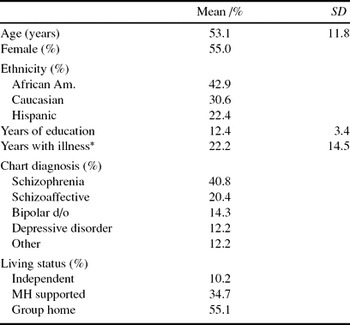
Demographic and clinical characteristics of the sample are summarized in Table 1.
Demographic information (N = 50)

MH supported = Apartment with functional supports from a mental health provider.
* Four participants identified as “10 +” are not included.
Attrition and attendance
Of the 50 participants who completed baseline assessments, 38 completed the SCIT training, yielding a 24% drop-out rate. Of the 12 drop-outs, 4 occurred after initial assessment but prior to SCIT treatment, 7 occurred during the first three sessions of treatment (one due to physical illness), and one occurred later in treatment.
Attendance data were collected from 31 of the 38 study completers.Footnote 1 These participants attended a mean of 15.5 sessions (SD = 2.8) out of a total of 20 to 23 sessions, yielding an average attendance rate of 69%. (The total number of sessions used to complete the manual differed slightly across cohorts.)
Post-treatment evaluations
Twenty-four participants completed post-treatment evaluations.Footnote 2 As shown in Table 2, the large majority rated SCIT as either “helpful” or “very helpful” in all three domains. Seven group leaders completed post-treatment evaluations. As shown in Table 3, the majority gave positive ratings for the usefulness of the SCIT manual and materials, and in supporting improvement of their clients’ social cognition and social interactions. No clinicians rated SCIT as “not helpful” on any of the three items.
Patient feedback regarding SCIT (N = 24)

Group leader feedback regarding SCIT (N = 7)

Integration of SCIT into regular programming
Follow-up with agency administrators after the termination of the research project revealed that two of the three participating clinics continued providing SCIT independent of collaboration with the treatment developers. The third clinic reported that they did not continue the group because of staffing shortages. However, the parent agency arranged for training of staff at affiliated clinics, and has now incorporated SCIT into routine programming at two additional sites.
Treatment outcome findings
Of the 38 participants who completed the SCIT training, 34 completed post-treatment assessments. Reasons for not completing post-treatment assessment were absence on the days of assessment (3) and refusal (1). Within the full sample of 50, comparison of baseline social-cognitive performance among the 34 post-test completers and the 16 non-completers revealed no significant differences on any social-cognitive variables.
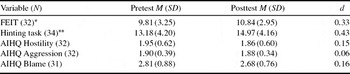
Table 4 summarizes pre- and post-test social cognitive performance. The omnibus repeated measures MANOVA conducted on the primary social cognitive variables was statistically significant (F(1,30) = 4.42; p = .011), indicating an overall change in social cognition from pre- to post-test. In follow-up paired-samples t-tests, participants showed a statistically significant improvement in FEIT (emotion perception) performance (t = 2.22; p = .034), and Hinting task (ToM) performance (t = 3.24; p = .003), which correspond to effect sizes in the small-medium range. No change was observed in AIHQ hostility bias, nor AIHQ Aggression bias or Blame score.
Social cognitive treatment outcomes

*p < .05; **p < .005.
M = Mean; SD = Standard Deviation; d = Effect size.
Note: N differences across measures are due to several participants’ failure to attend a portion of the testing sessions or failure to complete measures in session.
Discussion
This study evaluated the transportability, feasibility, and acceptability of SCIT, a social cognitive intervention for schizophrenia, in community mental health settings. Results indicate that participating clinicians and clients generally found SCIT to be acceptable and perceived it favorably. Treatment-outcome findings suggest that SCIT may have conferred social-cognitive benefits to participating clients. Findings are discussed in detail below.
Data concerning the transportability and feasibility of SCIT were collected from multiple sources, and were generally promising. Post-treatment evaluation data from participating clients was quite positive, indicating that they found it to be acceptable and useful. Positive client feedback is consistent with similar evaluations completed by participants in previous SCIT treatment groups (Penn, Roberts, Combs and Sterne, Reference Penn, Roberts, Combs and Sterne2007). This finding is also consistent with an emphasis on maximizing client engagement, which guided development of SCIT. Additionally, the attendance rate of approximately 69% is on par with the attendance rate achieved in our previous outpatient trial of SCIT (Roberts and Penn, Reference Roberts and Penn2009). The drop-out rate of 24% was higher than observed in this previous outpatient trial; however, it is on par with rates observed in previous outpatient trials of CBT for psychosis (Wykes et al., Reference Wykes, Steel, Everitt and Tarrier2008), as well as rates of disengagement from community treatment programs (Kreyenbuhl, Nossel and Dixon, Reference Kreyenbuhl, Nossel and Dixon2009).
Clinician evaluations also supported the feasibility of SCIT. Specifically, all seven clinicians gave the treatment materials the most favorable rating of “very helpful”. This finding is promising in light of previous evidence that practicing clinicians often perceive standardized treatment manuals negatively (Addis and Krasnow, Reference Addis and Krasnow2000). As noted above, clinicians’ input regarding the treatment was also solicited and recorded during weekly supervision calls throughout the study period. Most input consisted of two types: (1) Ideas for supplementary materials, such as additional homework options and increased incorporation of photographs and imagery; (2) Requests for suggestions on problem solving around unusual client presentations or difficult situations. (These suggestions were incorporated into the manual.) In light of previous research on the transportability of manualized interventions (Addis and Krasnow, Reference Addis and Krasnow2000), it is notable that clinicians did not indicate that implementing SCIT placed undo burden on them in the context of their busy clinical schedules, did not request streamlining of the manual, and did not indicate that the standardized treatment was inappropriate for their heterogeneous client population.
Perhaps the most meaningful feasibility data is the fact that clinic administrators have incorporated SCIT into routine programming at an expanded set of clinics. This promising finding may be due in part to the fact that SCIT was initially developed within a clinical treatment context (Penn et al., Reference Penn, Roberts, Combs and Sterne2007). Thus, consistent with the Deployment-Focused Model of treatment development (Weisz et al., Reference Weisz, Chu and Polo2004), SCIT was developed to employ generic elements that are common to typical inpatient and outpatient treatment settings, including group structure, weekly one-hour meetings, 5-month duration, psychoeducational and exercise based intervention, low demand for costly materials and technology, and minimal requirement for specialized staff training beyond general principles of cognitive, behavioral, and group intervention approaches.
Data collected regarding SCIT's effectiveness must be interpreted minimally and with caution because of the methodological limitations of this study. SCIT was associated with statistically significant improvement in emotion perception. The effect size was attenuated relative to previous studies of SCIT conducted by the developers of the treatment (Combs et al., Reference Combs, Adams, Penn, Roberts, Tiegreen and Stem2007; Roberts and Penn, Reference Roberts and Penn2009). Such attenuation is not uncommon when comparing the effectiveness of an intervention to its efficacy (e.g. Curtis, Ronin and Borduin, Reference Curtis, Ronan and Borduin2004), and may be influenced by a selection artifact driven by the increased heterogeneity and complexity of illness among community patients versus carefully-screened research participants (Westen and Morrison, Reference Westen and Morrison2001).
Participants improved significantly on Theory of Mind performance, replicating findings from previous inpatient studies of SCIT (Combs et al., Reference Combs, Adams, Penn, Roberts, Tiegreen and Stem2007; Penn et al., Reference Penn, Roberts, Munt, Silverstein, Jones and Sheitman2005), but contrasting with the two previous outpatient trials that used SCIT intervention techniques (Horan et al., Reference Horan, Kern, Shokat-Fadai, Sergi, Wynn and Green2009; Roberts and Penn, Reference Roberts and Penn2009). In the context of previous results, it is possible that the low functional level of the current participants prevented a ceiling effect on the Hinting task, enabling improvement that was not possible in previous, higher functioning samples.
As in both previous outpatient studies that used SCIT intervention techniques (Horan et al., Reference Horan, Kern, Shokat-Fadai, Sergi, Wynn and Green2009; Roberts and Penn, Reference Roberts and Penn2009), participants’ pre- and posttest scores on all three attributional bias scales (hostility, aggression, and blame) were in the low-normal range (cf. Combs et al., Reference Combs, Adams, Penn, Roberts, Tiegreen and Stem2007), rendering moot the possibility of meaningful decrease in this domain. As noted previously (Roberts and Penn, Reference Roberts and Penn2009), this suggests a floor effect such that SCIT participants actually endorsed less biased judgments than non-ill controls. Given the risk of self-presentation effects on measures of hostility bias, future research in this area may do well to follow the lead of social psychology in using implicit or non-obvious measures (cf. Greenwald and Banaji, Reference Greenwald and Banaji1995). We recently developed the Mental State Inference Questionnaire with this aim in mind (Roberts, Fiszdon, DeGeorge and Tek, Reference Roberts, Fiszdon, DeGeorge and Tek2009).
No standard measures of social functioning improvement were administered, although this domain was assessed informally in both client and clinician feedback questionnaires (Tables 2 and 3). Clinicians gave SCIT particularly strong endorsement in this domain, while client endorsement was also positive. Because social functioning improvement is the most important SCIT outcome domain, it will be crucial to formally assess this domain in future effectiveness research on SCIT.
This study has several notable limitations. It is a small, uncontrolled trial that used a convenience sample. Additionally, assessments were administered (1) by the treating clinicians, (2) in group format, and (3) using modified materials. All three of these factors threaten the internal validity of assessment results, and the first two could have inflated Type I error (Tarrier and Wykes, Reference Tarrier and Wykes2004). Additionally, the data used in this study are from the self-selected subset of patients who participated in both the pre- and post-test evaluations. It is possible that this subset found the curriculum more relevant and appealing than the subset of individuals who dropped out of the group or declined to participate in assessments. However, this possibility may be mitigated by the fact that all but one drop-out occurred prior to the fourth SCIT session. Thus, it could be argued that participants who gave SCIT a chance generally completed the intervention. Nonetheless, client feedback data may be an overestimation of the subjectively perceived helpfulness of the group to the broader population of outpatients, and it remains possible that this self-selection inflated treatment outcome findings.
These threats were known at the outset, and are largely an artifact of limited agency resources. The general convergence of the current outcome findings with previous research on SCIT strengthens our confidence in the validity of the data. Nonetheless, the current findings must be interpreted cautiously. As the emphasis on effectiveness research in mental health grows, there will be continued need for novel methods of maximizing assessment validity while minimizing agency cost and client burden. In this light, perhaps the most promising finding from the current study is the success of the research-clinical collaboration approach that was used and the dissemination of a promising treatment intervention that this collaboration generated.
Acknowledgements
We wish to thank Laurel Carpenter, Michael Cavallaro, Amy Dorin, Ellen Stoller and Marjorie Stuckle, as well as the employees of F.E.G.S. Health and Human Services System and The Bridge, Inc. for their contributions to this project.



Comments
No Comments have been published for this article.