INTRODUCTION
The signal of bomb radiocarbon in the deep subsoil (Baisden and Parfitt Reference Baisden and Parfitt2007) may imply that deep carbon (C) is not completely passive. Young and fresh organic matter, introduced from the top through the direct input of fresh plant remains (Bräuer et al. Reference Bräuer, Grootes and Nadeau2013a), stabilized-dissolved organic matter (Kalbitz et al. 2005; Hanke et al. 2014), and shoot roots and root exudates (Kuzyakov and Domanski 2000), may add fresh photosynthate to older subsoil organic matter and result in younger average 14C concentrations. This supports other findings indicating that fresh organic C inputs tend to reactivate, microbially stable organic C in the deep soil layers (Fontaine et al. Reference Fontaine, Bardoux, Abbadie and Mariotti2004, Reference Fontaine, Barot, Barré, Bdioui, Mary and Rumpel2007). Given the indication of active organic C in the subsoil, the storage of atmospheric CO2 as soil carbon, a key component of the fast reacting part of the global carbon cycle deserves attention. C inputs and storage in soils influence the global C dynamics and respond in different ways under different soil properties (i.e. mineralogy), climate, and crop management (Harrison et al. Reference Harrison, Broecker and Bonani1993; Trumbore et al. Reference Trumbore, Chadwick and Amundson1996; Torn et al. Reference Torn, Trumbore, Chadwick, Vitousek and Hendricks1997). The influence of these factors on subsoil carbon turnover needs to be quantified.
Tropical soils store substantial amounts of organic C (Chiti et al. Reference Chiti, Certini and Grieco2010), while worldwide in top soils an estimated 1500–2000 PgC (Pg: petagram=1015 g) are present as organic matter (Houghton Reference Houghton2007), which is 2–3 times the amount in the atmosphere. Various types of soils exist under different climatic regimes and soil-related factors that constrain C dynamics are, partly, connected to organic carbon (OC) stabilization by clay minerals (Mikutta et al. Reference Mikutta, Kleber and Jahn2005, Reference Mikutta, Kleber, Torn and Jahn2006; Eusterhues et al. Reference Eusterhues, Rumpel and Kögel-Knabner2007; Lorenz et al. Reference Lorenz, Lal and Jiménez2009) or the soil structure (Chevallier et al. Reference Chevallier, Woignier, Toucet and Blanchart2010). Among climate aspects, moisture and temperature are two keys factors to control soil properties (Birkeland Reference Birkeland1999). These factors, however, not only affect the decomposition rate of organic matter under a broad range of environmental conditions, i.e. temperate soils (Leirós et al. Reference Leirós, Trasar-Cepeda, Seoane and Gil-Sotres1999), temperate monsoon soils (Dan et al. Reference Dan, Nianpeng, Qing, Yuliang, Qiufeng, Zhiwei and Jianxing2016), tropical rainforest (Knorr et al. Reference Knorr, Prentice, House and Holland2005), Arctic soils (Moni et al. Reference Moni, Lerch, Knoth de Zarruk, Strand, Forte, Certini and Rasse2015), and permafrost region soils (Bracho et al. Reference Bracho, Natali, Pegoraro, Crummer, Schädel, Celis, Hale, Wu, Yin, Tiedje, Konstantinidis, Luo, Zhou and Schuur2016), but also vegetation types (Adams Reference Adams2010) and chemical composition of tissues (Cotrufo et al. Reference Cotrufo, Gado and Piermatteo2009). Biomass inputs as derived from plants/vegetation are the main source of soil OC (Lal Reference Lal1997), and their dynamics, in the top and subsoil layers, are influenced by crop rotations (Witt et al. Reference Witt, Cassman, Olk, Biker, Liboon, Samson and Ottow2000); environmental conditions, i.e. parent material and climate (Solly et al. Reference Solly, Schöning, Herold, Trumbore and Schrumpf2015); type of crops; and crop management methods (Nieder and Benbi Reference Nieder and Benbi2008).
The irrigated rice system is one of most important food production systems (Dobermann and Witt Reference Dobermann and Witt2000). The submerged condition during the rice season creates specific characteristics related to C dynamics, such as redox cycling, dynamics of dissolved organic C, and association with mobilized Fe and clay minerals (Kögel-Knabner et al. Reference Kögel-Knabner, Amelung, Cao, Fiedler, Frenzel, Jahn, Kalbitz, Kölbl and Schloter2010).
As part of Research Unit 995, “Biogeochemistry of Paddy Soil Evolution,” we research paddy soils in both subtropical (phase 1) and tropical environments (phase 2). In phase 1, work on a soil chronosequence, derived from marine sediments in a subtropical area, demonstrated slower refreshment of old OC with fresh, plant-derived C in rice paddies than in non-paddies (“upland soils”), and a fast increase of OC in the top soil, already after 50 yr of cultivation (Bräuer et al. Reference Bräuer, Grootes and Nadeau2013a). Now, in the second phase the studies focus on three different soil types in a tropical climate.
Following the simple approach of previous studies (Rethemeyer et al. Reference Rethemeyer, Grootes, Bruhn, Andersen, Nadeau, Kramer and Gleixner2004; Bräuer et al. Reference Bräuer, Grootes and Nadeau2013a,Reference Bräuer, Grootes, Nadeau and Andersenb) and radiocarbon dating, we selected the insoluble and thus supposedly stationary humin fraction and the alkali-soluble, mobile humic acid fraction to highlight the age heterogeneity of the soil total organic carbon (TOC), commonly analyzed in soil science. 14C analyses are still ongoing. The insolubility of the humin fraction is in part attributed to strong interaction with clay and Fe minerals and may thus be soil type dependent and of special interest. These bound humins are a complex mixture, characterized by labile compounds—i.e. carbohydrates, glucose, cellulose, peptides, peptidoglycan—and more stable compounds—i.e. aliphatic and lignin contents (Fabbri et al. Reference Fabbri, Chiavari and Galletti1996; Simpson et al. Reference Simpson, Song, Smith, Lam, Novotny and Hayes2007). We also observed plant remains as a source of C input to study subsoil C dynamics. We compare rice paddies with neighboring non-paddy fields to investigate the effect of paddy management on soil carbon dynamics. We use the 14C concentration of different soil carbon fractions to determine the influence of recently photosynthesized OC in these fractions.
MATERIAL AND METHODS
Study Sites and Sampling
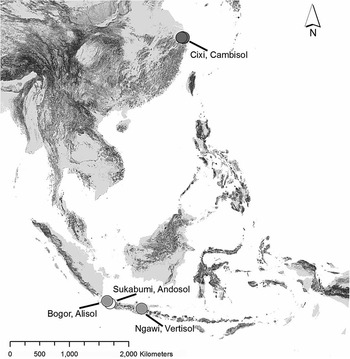
Research was carried out on three different types of tropical soils of Indonesia, i.e. Andosol, Alisol, and Vertisol (FAO 2006). Andosols at Sukabumi-Perbawati, West Java, were derived from a colluvial fan deposit (lahar) of Mount Gede-Pangrango at an altitude from 850 to 1000 m above sea leavel (asl) on terraced upper slopes (see Figure 1). The mean annual temperature in 2001–2010 ranged from 20.4 to 21.8°C, with annual rainfall in the range of 2200–6200 mm/yr. Alisols at Bogor-Jasinga, West Java, developed from andesitic volcanic materials at an altitude of 240 m asl on terraced midslopes with a mean annual temperature range of 25.5 to 26°C and annual precipitation of 1900 to 4700 mm/yr. Vertisols at Ngawi-Ploso Lor, East Java, formed from basaltic materials and marine sediments, with ~70 m asl elevation on a stagnant alluvial plain. In Ngawi, mean annual temperature during the period 1973–1992 is estimated at 26.6°C (Amien et al. Reference Amien, Rejekiningrum, Pramudia and Susanti1996), and the annual precipitation data from 2006–2014 show values from 980 to 4900 mm/yr. More details about soil characteristics have been discussed by Winkler et al. (Reference Winkler, Kaiser, Kölbl, Kühn, Schad, Urbanski, Fiedler, Lehndorff, Kalbitz, Utami, Cao, Zhang, Jahn and Kögel-Knabner2016).
Map of research area in Java, Indonesia (bottom) and Cixi, China (top) (source of data: DIVA-GIS)

Soils were investigated from two neighboring sites under paddy and non-paddy cultivation. The paddies have a rotation of rice (C3, Calvin cycle) with during the dry season mostly C3 plants [e.g. cassava, talas, chili, banana, Chinese cabbage (bok-choi), and tobacco] except in Bogor-Jasinga where maize (C4, Hatch-Slack cycle) was planted. The non-paddy crops in Ngawi-Ploso Lor and Sukabumi-Perbawati were sugarcane and maize (both C4 plants), while in Bogor-Jasinga cassava, chili, and talas were planted (C3). Photosynthesis favors CO2 molecules containing the light isotope 12C, which leads in C3 plants to a relative deviation of δ13C from the composition of the international standard PDB of –22 to –30‰. The more efficient CO2 uptake of the C4 cycle leads to reduced fractionation and δ13C values of about –9 to –19‰ (Balesdent et al. Reference Balesdent, Mariotti and Guillet1987). Different crops will lead to the input of plant material with different δ13C signatures into the soil and the TOC. Profiles were observed from all sites down to ~1 m depth, in paddies slightly below the groundwater level. Samples were taken from each layer of each profile over depth intervals of 1 to 5 cm as samples of ~5 kg to collect plant remains and as separate point samples over 1–2 cm depth, ~100–500 g, to analyze C and 14C concentration.
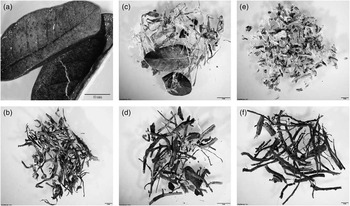
Plant remains (roots, seeds, leaves, stems) were collected on a 2-mm and a 0.37-mm sieve by wet-sieving. Root material was separated by color, light versus dark, to test whether color correlated with 14C content (“young versus old”). Some of the collected plant remains are depicted in Figure 4. A standard acid-alkali-acid treatment (Grootes et al. Reference Grootes, Nadeau and Rieck2004) was used to remove carbonates and potentially mobile, contaminating fulvic and humic acids from the acid/alkali-insoluble remains. Humic acids were precipitated and collected separately by acidifying the alkali extract. Visible plant remains were first picked by hand and removed from the point samples of soil, which were the passed through a ɸ<2-mm sieve and oven-dried at 60°C. The acid-alkali-acid extraction procedure was used to obtain a humic acid and a humin fraction of soil organic carbon. Prepared samples were combusted to CO2 at 900°C in quartz ampoules with CuO and silver wool, graphitized, and analyzed for 13C and 14C with accelerator mass spectrometry (AMS) in Trondheim (Nadeau et al. Reference Nadeau, Vaernes, Svarva, Larsen, Gulliksen, Klein and Mous2015). 14C concentrations are expressed in percent modern carbon (pMC) according to Stuiver and Polach (Reference Stuiver and Polach1977). The total organic carbon (TOC) was determined via elemental analyzer (EuroEA 3000). A pretreatment with concentrated HCl without washing was used to remove carbonates in particular for the Vertisol samples with inorganic carbon (IC) values ranging from 0.1 to 0.6%. IC was assumed to be negligible in the Andosols and Alisols as implied by the pH(H2O) values 4 to 6, so total carbon (TC) would be equal to OC content. The grain-size distribution of particles in the point samples from the different paddy and non-paddy soil profiles was quantified via a Mastersizer (Hydro 2000G), using a standard protocol with HCl and H2O2 extraction in a water bath at 60°C to remove carbonates and soil organic matter and soil dispersion by shaking with Na4P2O7 overnight.
RESULTS AND DISCUSSION
Here we present the distribution of grain sizes, organic carbon, and plant residues in the different paddy and non-paddy profiles and discuss the significance of the 14C concentrations measured in different OC fractions in Java in comparison with earlier results obtained in China.
Grain-Size Distribution
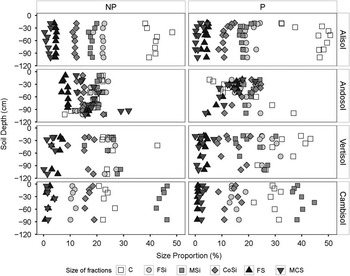
The grain-size distributions of the different paddy and non-paddy soil profiles are shown in Figure 2. Fine-sized particles dominate in the subsoil in all profiles and the sand fractions amount to only ~10%, except in the Andosol. In the Alisol and Vertisol, clay makes up 40 to 50% of the paddy and 25 to 40% of the non-paddy subsoil. In the Cambisol, clay contributes ~30% and 25%, respectively, while medium silt dominates with 40 to 45%. The grain-size distribution is relatively constant with depth for the Alisol, the Cambisol, and the non-paddy Andosol and Vertisol. The strong scatter of the paddy Vertisol data may be the result of the alternating wetting and drying of rice cultivation and the accompanying, smectiteFootnote 1 -dominated swelling and shrinking characteristics of the Vertisol, which result in vertical soil mixing through drying cracks.
Distribution of size fractions throughout the three profiles of paddy (P) and non-paddy (NP) soils from Java and the 50-yr Chinese Cambisols (C=clay, FSi=fine silt, MSi=medium silt, CoSi=coarse silt, FS=fine silt, MCS=total of medium and coarse fractions).

The grain-size distribution of the paddy Andosol top section, down to ~0.4 m depth, is relatively coarse with 25 to 30% sand like the non-paddy. It grades to finer material, more similar to the other paddy soils, below that depth, implying a possible disturbance of the layers above. The Sukabumi-Perbawati Andosol fields are on colluvial fan deposits on the upper slopes of Mount Gede-Pangrango with the paddy field downslope, ~1.5 km away and ~110 m lower. We suppose the soils may have generally been affected by frequent deposition and reworking of volcanic ashes, while the paddy fields have, additionally, been cut and shaped into flat surfaces. Grain-size distribution and 14C results (Figure 6), as well as the slight difference in Ti/Zr ratio (Winkler et al. Reference Winkler, Kaiser, Kölbl, Kühn, Schad, Urbanski, Fiedler, Lehndorff, Kalbitz, Utami, Cao, Zhang, Jahn and Kögel-Knabner2016), all indicate this disturbance.
Total Organic Carbon (TOC) of Soil and Organic Matter Fractions
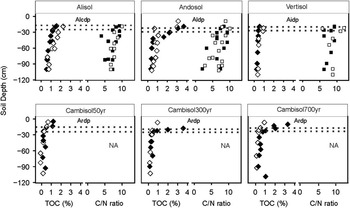
TOC values, representing a local time average of the soil carbon cycle that depends on past farming management and soil development-related processes, are in general relatively constant in the subsoil, around 0.5%. The values increase towards the topsoil and are a bit higher in non-paddy subsoil. C/N values appear to be decreasing with increasing depth (Figure 3).
Total organic C in percent of dry soil weight and C/N ratio of soil in paddy (P) and non-paddy (NP) in Alisol, Andosol, and Vertisol from Java, Indonesia, and Cambisol 50, 300, and 700 yr from Cixi, China (Bräuer et al. Reference Bräuer, Grootes, Nadeau and Andersen2013b). Filled and open symbols represent P and NP, respectively. Horizontal dotted lines show the compacted plough-pan. NA=data not available.

Layers immediately below the plough-pan in the paddy fields in Java, generally, contained less TOC than non-paddy fields at similar depth (Figure 3). Yet, in the top ~0.4 m of the Sukabumi-Perbawati Andosol, the reverse appears to be true. Field observations indicate that these anomalous TOC values may be influenced by recent human disturbance, taking different soil materials from elsewhere to the site, e.g. in field terracing, as we found a differently compacted layer below the plough-pan indicating a past-tillage effect. 14C results that are close to and above “recent” atmospheric values in the upper 0.4 m, and “old” below this depth (Figure 6) are consistent with this.
In the Cixi (China) area, in a chronosequence of polders with originally estuarine sedimentFootnote 2 under paddy management, the total organic C content in the top soil of the paddy was higher than in that of the non-paddy and increased by about a factor of 3 from 50 to 700 yr cultivation (Bräuer et al. Reference Bräuer, Grootes, Nadeau and Andersen2013b). This has been shown to be associated with the increase in silt and clay-sized particles (Wissing et al. Reference Wissing, Kölbl, Vogelsang, Fu, Cao and Kögel-Knabner2011).
The humin fraction accounts for most of the isolated soil OC (Table 1), presumably due to the high clay and fine silt mineral content of the soils (Figure 2). As OC is strongly bound by clay, the higher C-humin in the Alisol than in the Andosol soils is obviously due to the higher clay and fine particle content in the former (Figure 2).
Relative proportion of isolated SOC fractions to TOC from soils of Java under paddy (P) and non-paddy (NP) management.

Subsoil Macrofossils
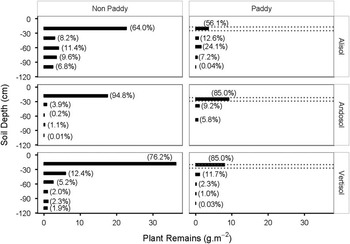
Collected plant remains were more abundant in the non-paddy than in the paddy topsoil for all three soil types, which is similar to TOC trends. This continued in the Alisol and Vertisol subsoils, while for the Andosol subsoil the non-paddy contained fewer plant remains than the paddy (Figure 4). Below 0.30 m depth, the size of plant remains decreased, except in the Ngawi-Ploso Lor Vertisol, where shrinking and swelling (a characteristic of smectites under dry and wet conditions) allow deep input of aboveground material through large cracks. The higher abundance of plant remains in the non-paddy soils may be described as a consequence of multiple, inseparable factors. Differences in annual crop rotations and in crop varieties affect the input of plant material, both aboveground and as (deep) roots. For paddy fields, with one seasonal dry-land non-rice crop, rotations applied regularly are rice-rice-bok choi (Chinese cabbage) in Andosol, rice-rice-maize in Alisol, and rice-rice-tobacco in Vertisol. In the non-paddy, we have maize (C4) in Sukabumi-Perbawati Andosol; cassava, chili, and talas (C3) in Bogor-Jasinga Alisol; and sugarcane (C4) in the Ngawi-Ploso Lor Vertisol (Dieterich Reference Dieterich2012). In addition, hydrological management and soil factors such as accessibility of plough-pan and soil/clay mineral properties influence the distribution size of subsoil plant remains.
Abundance of collected plant remains in the Alisol, Andosol, and Vertisol. The numbers in parentheses represent the proportional values. The dotted horizontal line in the paddy figures represents the plough-pan.

In the Alisol, an increase in small plant remains at around 0.63 m depth (Figure 4), for both paddy and non-paddy fields, coincides with a change in TOC from 0.8% below to ~1.3% above (Figure 3). This similarity in the pattern of distribution with depth of organic remains and TOC (Figure 3) suggests a close link between the two on a local scale (same soil type and climate).
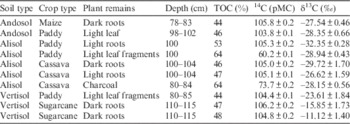
Plant remains found in the subsoil were generally dark in color. Yet, we also found some light-colored, fresh-looking leaves and roots at depth. We measured the 14C concentration of several dark and light leaf and root fragments from the bottom of the profiles to check for a correlation between color, depth, and 14C concentration. In the Alisol paddy at Bogor-Jasinga (Figures 5c, d; Table 2), we found light-colored roots with a 14C content of ~105 pMC at 1 m depth but also light-colored leaves, containing 60.2 pMC, at the same depth. In a neighboring non-paddy field, we observed both dark and light-colored roots having a 14C content of ~105 pMC at 1.00–1.04 m depth and charcoal of 73.7 pMC at 0.80–0.84 m depth. In the Sukabumi-Perbawati Andosol, we collected dark roots with ~105.80 pMC 14C at 0.78–0.83 m depth in the non-paddy, and a “fresh” leaf with ~103.80 pMC at 0.98–1.02 m depth of the paddy field. Furthermore, dark roots with 14C contents of ~104.8 and 106.2 pMC, observed at 1.10–1.15 m depth in the non-paddy field of the Ngawi-Ploso Lor Vertisol, are identified as sugarcane by their heavier C4 δ13C signal of ~–11.12‰ and –15.85‰, respectively. In the Ngawi-Ploso Lor paddy field, a light-colored leaf fragment, found at ~0.80–0.85 m depth, has a 14C content of ~104.4 pMC and, most likely, a C3 origin (δ13C content ~–23.61‰). These results indicate that not only young root material may be found in the deeper subsoil, but that also young plant litter may be transported into the subsoil by soil mixing processes.
Some collected subsoil plant remains for 14C dating: (a) and (b) dark roots and leaves from the Andosol profile; (c) and (d) leaves and dark-light roots from the Alisol profile; (e) and (f) light leaf fragments and dark roots from the Vertisol profile.

Organic carbon content and isotopic composition of collected macrofossils at different depths.

It is also clear that the color differences of organic remains (Figure 4) do not necessarily indicate 14C age differences. Plant remains with a 14C concentration close to that of atmospheric CO2 below 0.70 m depth (Table 2) are an indication of direct input of macrofossils from top layers. The present results confirm the previous findings of Bräuer et al. (Reference Bräuer, Grootes, Nadeau and Andersen2013b) who obtained plant material and roots with a 14C concentration higher than 105 pMC at ~1 m depth with one sample identified as rice roots by DNA analysis.
14C Distribution as a Function of Depth
The changes in the amount of organic carbon and its 14C concentration are determined by a complex interplay of several factors, such as crop type, crop management, and soil composition— including soil history, hydrology, and climate—that together determine input, remineralization, export, and stabilization of organic carbon in the soil. The three sites in Java provide data on three different volcanic soils in a tropical climate at different elevations to be compared with the earlier results from a fluviomarine soil at sea level in subtropical China (Bräuer et al. Reference Bräuer, Grootes and Nadeau2013a).
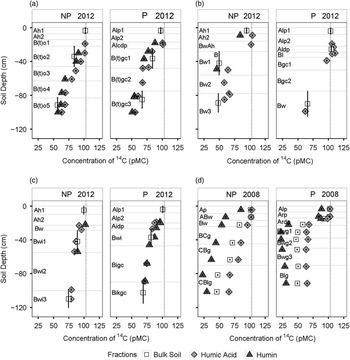
The 14C concentrations of the humic acid and the humin fractions show, as expected, a gradual decrease with increasing depth (Figure 6). The TOC 14C concentrations agree with these in general, but cannot be compared in detail, since they were obtained on samples averaged over a full soil layer (vertical bar) instead of on a 1–2 cm point sample. The humins, which make up ~20 to 50% of the TOC (Table 1), contain less 14C than the mobile humic acids in the Alisol and in the Chinese Cambisol, a pattern expected both from downward transport as DOM and from microbial recycling. Most of the humin OC is strongly associated with clay minerals, which form the largest of the particle size fractions (Figure 2; Morra et al. Reference Morra, Blank, Freeborn and Shafii1991; Amelung et al. Reference Amelung, Zech, Zhang, Follett, Tiessen, Knox and Flach1998; Schmidt et al. Reference Schmidt, Rumpel and Kögel-Knabner1999). It may thus also be suggested that the lower 14C concentration in the humin fraction is due to the dominance of older, mineral-stabilized OC. Lower 14C concentrations in the mineral-associated OC than in TOC (“bulk soil”) have also been observed by Eusterhues et al. (Reference Eusterhues, Rumpel and Kögel-Knabner2007). The deep Alisol samples show 14C concentrations around 60 pMC, similar to those of the deep Andosol.
14C distribution profiles (in pMC) in different types of soils (a) Alisol, (b) Andosol, (c) Vertisol, and (d) Cambisol in paddy (P) and non-paddy (NP). Short vertical bars represent the layer thickness sampled, while dotted vertical lines indicate 2008 and 2012 atmospheric 14CO2 concentrations, which were 105 and 103 pMC, respectively (Levin et al. Reference Levin, Naegler, Kromer, Diehl, Francey, Gomez-Pelaez, Steele, Wagenbach, Weller and Worthy2010, Reference Levin, Kromer and Hammer2013). Java belongs to the Southern Hemisphere atmospheric 14C zone 3 (SH-3), and Cixi, China, is in NH zone 3 (Hua et al. Reference Hua, Barbetti and Rakowski2013).

In the Sukabumi-Perbawati Andosol, the increase in clay- and silt-sized particles and Fe-mineral crystallinities below 0.4 m depth (Winkler et al. Reference Winkler, Kaiser, Kölbl, Kühn, Schad, Urbanski, Fiedler, Lehndorff, Kalbitz, Utami, Cao, Zhang, Jahn and Kögel-Knabner2016) coincides with a break in the TOC (Figure 3, Andosol) and 14C profile (Figure 6b). Above ~0.35 m depth, the 14C results obtained so far give 14C concentrations of humic acids above 100, up to ~111 pMC, corresponding to that of the atmosphere since ~1996 (Hua et al. Reference Hua, Barbetti and Rakowski2013), while below 0.4 m it is less than 70 pMC. The high 14C concentrations indicate carbon from the period with bomb 14C since 1954, most likely preserved by the stabilization of SOM in organomineral and Al/Fe complexes (Takahashi and Dahlgren Reference Takahashi and Dahlgren2016). This is supported by the abundance of short-range-ordered Fe oxides and allophane and imogoliteFootnote 3 -type phases in this soil (Winkler et al. Reference Winkler, Kaiser, Kölbl, Kühn, Schad, Urbanski, Fiedler, Lehndorff, Kalbitz, Utami, Cao, Zhang, Jahn and Kögel-Knabner2016). Additional analyses are in progress to confirm this. This large drop in 14C concentration probably reflects a change from a disturbed, terraced top soil with up to ~3% young TOC, to an old subsoil with less than 1% TOC (Figure 3). The 111 pMC 14C concentration found for humic acids in a differently compacted layer at 0.3 m depth below the plough-pan indicates a significant presence of organic material from the 1990s in this layer. This must have been the time at which the profile was disturbed.
In Ngawi-Ploso Lor (Figure 6, Vertisol), the 14C concentration of the humic acids is lower than that of the humins in the upper 0.46 m, but at greater depth they are similar. These results are in contrast with earlier findings (Rethemeyer et al. Reference Rethemeyer, Grootes, Bruhn, Andersen, Nadeau, Kramer and Gleixner2004; Bräuer et al. Reference Bräuer, Grootes, Nadeau and Andersen2013b) and with the results for the Java Alisols and Andosols. This could indicate a strong signal of the presence of young, acid-alkali-insoluble fine organic remains (e.g. cellulose) from aboveground litter or roots in the upper layers, for which the presence in the humin fraction has been reported (Fabbri et al. Reference Fabbri, Chiavari and Galletti1996; Simpson et al. Reference Simpson, Song, Smith, Lam, Novotny and Hayes2007). Smectite-dominated “swelling and shrinking” of the Vertisol generates cracks during the dry seasons through which material can fall down into the subsoil (Birkeland Reference Birkeland1999), and thus causes pedoturbation. Roots are dominantly placed in fine shrinkage cracks and between slickensidesFootnote 4 (Nicoullaud et al. Reference Nicoullaud, King and Tardieu1994), so they too may penetrate more easily to deeper layers. Together with the dense root system of the mature sugarcane at time of sampling and its decrease with increasing soil depth, this could explain the relatively large amount of young plant fragments found in the upper part of the sugarcane and rice field (Figure 4). The observed younger humin 14C signal may then result from the presence of fine root and plant material incompletely removed by sieving and acid-alkali-acid treatment. The higher 14C concentrations around 75 pMC, observed at depth (Figure 6c), are consistent with a larger input of young OC into the subsoil.
The TOC (Figure 3) and 14C-humic (Figure 6) values in the top layers of the non-paddy Vertisol are lower than in the Alisol despite the high abundance of collected plant remains (Figure 4). 14C concentrations deeper in the subsoil are, however, above those in the Alisol. This low 14C concentration-depth gradient may be explained by pedoturbational mixing due to the shrinking/swelling of the Vertisol under alternating dry/wet conditions. The inversion in humic acid 14C concentrations between 0.20 and 0.28 m depth and a relatively higher scatter of 14C concentrations in the Ngawi-Ploso Lor subsoil are consistent with this explanation.
In the Chinese Cambisol, the difference in 14C concentrations between the humin and the humic acid fractions is much larger due to much lower humin 14C values. This may be attributable to the origin of the Cambisol, which was deposited as estuarine sediment with a significant fraction of eroded old organic carbon, resulting in a TOC with an original 14C concentration of only about 50 pMC. Microbial recycling with DOM priming in the subsoil quickly lowered this already low initial humin 14C concentration from ~50 pMC to ~30 pMC (Bräuer et al. Reference Bräuer, Grootes and Nadeau2013a). The volcanic ash falls forming the parent material of the Java soils and thus lack such old OC. The Cambisol TOC shows 14C concentrations clearly intermediate between the humin and the humic acid fractions.
In the 50-yr Cambisol (Bräuer et al. Reference Bräuer, Grootes and Nadeau2013a), the effect of the plough-pan, decoupling the paddy topsoil from the subsoil C profile, can be clearly seen. The presence of the compacted layer at ~0.20 m depth reduced the root penetration as well as the infiltration of young organic remains and DOC with irrigation water and created a steep OC 14C gradient across this layer. In the 50-yr non-paddy field, the absence of the compacted layer made the subsoil more accessible for young organic carbon. Consequently, infiltrating young OC raised the original 14C concentration by increasing the proportion of young to old OC without significantly changing the OC concentration, and created a gentle 14C concentration gradient down to groundwater at ~0.80 m depth. The contribution of root material (cf. Table 2) and root exudates to the subsoil will be spatially heterogeneous. DOC may, in part, simply pass through the soil via preferential flow channels (Gandois et al. Reference Gandois, Teisserenc, Cobb, Chieng, Lim, Kamariah, Hoyt and Harvey2014), and partly be transformed and mineralized by microbial carbon cycling and stabilized on mineral surfaces (Hagedorn et al. Reference Hagedorn, Bruderhofer, Ferrari and Niklaus2015). After about 300 yr, the delaying effect of the plough-pan on profile development is no longer clear (Bräuer et al. Reference Bräuer, Grootes and Nadeau2013a). In Java, the paddy and non-paddy profiles are similar. This probably reflects the fact that the plough-pan in these profiles was much less distinct than in the Cixi Cambisols as well as the higher age of the profiles. The discontinuity in the Andosol paddy at ~0.4 m depth then would indicate a disequilibrium, like in the 50-yr Cambisol.
In the context of atmospheric variations of 14CO2 between the Northern and Southern Hemisphere, particularly during pre-bomb testing (Hua et al. Reference Hua, Barbetti and Rakowski2013), the difference of 14C concentration in topsoils of China and Indonesia is not significant, implying a wide distribution of bomb-derived 14C.
On Java, climate differences are mostly related to altitude. Thus, our three sites varied in mean annual temperature from ~21°C for the Andosol at 850 to 1000 m elevation to ~26.5°C for the Vertisol at 70 m asl with rainfall ranging from ~2 to 6 m/yr and 1 to 5 m/yr, respectively. In the Cixi area, at sea level the annual temperature is 16.3°C with a mean precipitation of 1325 mm per year (Cheng et al. Reference Cheng, Yang, Cao, Ci and Yin2009). A comparison of the TOC values in Figure 3 and the 14C profiles of Figure 6 gives no clear indication of a correlation with these climatic differences.
CONCLUSIONS
14C is a valuable tracer of the influence of recent photosynthate on organic carbon in the subsoil of three Java paddy/non-paddy sites of different soil types. The results suggest the following conclusions:
-
∙ Plant material with a 14C concentration close to that of the atmosphere, found down to ~1 m, the deepest level sampled, proves roots and/or bioturbation/pedoturbation can introduce organic carbon directly into the deeper subsoil.
-
∙ The influence of recent photosynthate in the humin and humic acid fractions of soil organic carbon decreases regularly with increasing depth in the subsoil. This decrease is not linked to soil horizons, but occurs continuously across soil layers.
-
∙ The 14C concentration in the mobile humic acid fraction is generally higher than in the humin, which is consistent with a downward transport of “young” organic carbon as DOM and with the 14C concentration gradients observed.
-
∙ A crop-dependent large input of litter and root material may overwhelm the effect of young DOM input and result in higher humin 14C concentrations in the upper layers of the subsoil.
-
∙ Pedoturbation, related to the shrinking and swelling properties of the Vertisol, opening and closing cracks in the soil, not only facilitates introduction of plant material into the subsoil, but also leads to mixing of OC in the subsoil and to a lower 14C-depth gradient.
-
∙ The origin of the sediment and its inherited organic carbon influence the 14C concentration of the humin fraction.
-
∙ The 14C concentration of TOC or any OC fraction thus does not primarily reflect 14C decay of a uniform carbon pool, but rather the mixing of carbon from different sources with different 14C concentrations.
ACKNOWLEDGEMENTS
We thank the German Research Foundation (DFG) for the funding of Research Unit FOR 995 “Biogeochemistry of Paddy Soil Evolution,” and our many colleagues of FOR 995 for their support, friendly collaboration, and scientific exchange. We thank the team of the National Dating Laboratory in Trondheim for high-quality isotopic measurements and Sophia and Manfred of the Institute for Ecosystem Research for grain-size and C/N analyses. The constructive and critical comments of two reviewers contributed to this paper.