INTRODUCTION
Seed predation by vertebrates and invertebrates is a major factor limiting the colonization, establishment and growth of plant populations (Forget et al. Reference FORGET, KITAJIMA and FOSTER1999, Howe & Smallwood Reference HOWE and SMALLWOOD1982, Janzen Reference JANZEN1971a, Reference JANZENb; Schupp Reference SCHUPP1988). Seed-eating animals may attack seeds during fruit development while seeds and fruits are still attached to parent plants; this is termed pre-dispersal seed predation. Plants can also suffer from post-dispersal seed predation when ripe seeds are consumed after their release from the parent plant. To prevent high seed losses and a consequent reduction in fitness, many plants have developed protective strategies against seed predators. These strategies include physical protection, such as spines or hard fruit endocarps that serve as barriers to predation, and chemical defences that render seeds toxic or inedible to seed-eating animals (Bell Reference BELL and Murray1984, Bodmer Reference BODMER1991, Dirzo & Dominguez Reference DIRZO, DOMINGUEZ, Estrada and Fleming1986, Janzen Reference JANZEN1971b, Kiltie Reference KILTIE1982).
In tropical rain forests, seeds of several genera in the Fabaceae are chemically defended (Janzen et al. Reference JANZEN, RYAN, LIENER and PEARCE1986, McKenna & McKenna Reference MCKENNA and MCKENNA2006). One classic example of a legume with chemically defended fruits is Mucuna, a pantropical genus of lianas comprised of approximately 100 species (Gentry Reference GENTRY1996). Mucuna seeds are highly toxic as they contain high concentrations of L-dopa (3,4-dihydroxyphenylalanine) within seed embryos and cotyledons (Daxenbichler et al. Reference DAXENBICHLER, VANETTEN, EARLE and TALLENT1972, Modi et al. Reference MODI, PATEL and GOYAL2008). This amino acid has pronounced deleterious effects on many insects (Rehr et al. Reference REHR, JANZEN and FEENY1973), mammals (Emenalom et al. Reference EMENALOM, OKOLI and UDEDIBIE2004) and birds (Harms et al. Reference HARMS, SIMPSON and WALDROUP1961) that consume these seeds. Although Mucuna seeds are highly toxic, they contain large amounts of protein (Daxenbichler et al. Reference DAXENBICHLER, VANETTEN, EARLE and TALLENT1972, Harms et al. Reference HARMS, SIMPSON and WALDROUP1961, Vadivel & Janardhanan Reference VADIVEL and JANARDHANAN2000). Therefore, the seeds of Mucuna may serve as a nutritious food resource to granivores that can overcome the seeds’ chemical anti-predation defences (Emenalom et al. Reference EMENALOM, OKOLI and UDEDIBIE2004, Udedibie & Carlini Reference UDEDIBIE and CARLINI1998a, Reference UDEDIBIE and CARLINIb).
The chemical properties of one species of Mucuna, M. holtonii (Kuntze) Moldenke, (syn. M. andreana Micheli) have been particularly well documented (Daxenbichler et al. Reference DAXENBICHLER, VANETTEN, EARLE and TALLENT1972, Rehr et al. Reference REHR, JANZEN and FEENY1973). The concentration of L-dopa within the embryos and cotyledons of M. holtonii seeds is one of the highest recorded for this genus (13.8% in immature seeds) (Daxenbichler et al. Reference DAXENBICHLER, VANETTEN, EARLE and TALLENT1972). Although M. holtonii seeds are highly toxic, we have observed terrestrial mammals investigating and manipulating these seeds at Estación Biológica La Selva, a tropical rain forest in Costa Rica.
Previous studies have focused only on the function of M. holtonii chemical defences against seed predators (Rehr et al. Reference REHR, JANZEN and FEENY1973). However, little is known about the potential role of seed structures, such as the seed coat, that may act as physical deterrents to seed predation (Janzen Reference JANZEN1977a). It is possible that the thin (0.6 mm thick), coriaceous seed coat that surrounds M. holtonii seeds prevents insect attack (e.g. by bruchid beetles, Janzen Reference JANZEN1977a). Therefore, in this research we also explored the role of the seed coat as a mechanical barrier against invertebrate seed predation.
The overarching hypotheses that we tested within this study pertained to how seed defences prevent seed predation. The high toxicity of M. holtonii seeds should prevent predation by vertebrate seed predators that cannot overcome the seeds’ L-dopa defences. Additionally, the physical protection proved by the coriaceous seed coat of M. holtonii seeds should act as an effective barrier to infestation by small invertebrate seed predators. To assess the effectiveness of chemical and mechanical defences in M. holtonii seeds against vertebrate and invertebrate seed predators respectively, the main objectives of our research were: (1) to assess levels of pre-dispersal insect infestation and fungal attack on ripe M. holtonii seeds, (2) to identify seed-removing mammals and the fates of the M. holtonii seeds they remove and (3) to determine if the seed coat affects insect infestation and subsequent endosperm removal. Finally, we explored the effects of endosperm removal on the germination and seedling growth of seeds partially consumed by invertebrate seed predators.
METHODS
Study site
This study was conducted from December 2007 to July 2008 at Estación Biológica La Selva (henceforth La Selva) located in Puerto Viejo Sarapiqui, Heredia, Costa Rica (10°26ʹN, 83°59ʹW). La Selva is a 1600-ha tropical lowland wet forest reserve comprised of old-growth forest, secondary growth, swamps and tree plantations. Rainfall at this aseasonal site averages approximately 4000 mm y−1 (McDade et al. Reference MCDADE, BAWA, HESPENHEIDE and HARTSHORN1994). Due to hunting and habitat fragmentation in the areas surrounding La Selva, some large-mammal species are locally extinct within this forest (e.g. white-lipped peccary, Tayassu pecari). We conducted the following study throughout the secondary forest of La Selva, corresponding to the habitat where M. holtonii is most abundant.
Study species
Mucuna holtonii is a tropical rain-forest liana that ranges from Chiapas, Mexico to Colombia and grows throughout secondary forest environments and disturbed areas (Woodson & Scherry Reference WOODSON and SCHERRY1980). The pendulous infructescences of M. holtonii are comprised of 1–9 flat, oblong legumes (length = 14–25 cm, width = 5 cm). Each M. holtonii fruit pod contains 1–6 black discoid seeds (diameter = 2–3 cm, thickness = 0.8 cm) (Woodson & Scherry Reference WOODSON and SCHERRY1980). Upon maturation, M. holtonii legumes dehisce and the mature seeds fall to the forest floor where they may be encountered by terrestrial vertebrates and invertebrates.
Pre-dispersal insect infestation of Mucuna holtonii seeds
To assess how invertebrate seed predators affect M. holtonii seeds prior to fruit dehiscence and seed fall, we collected seeds from mature fruits and inspected each seed for invertebrate damage (e.g. entrance holes, portions of eaten endosperm) and fungal infection. Mature, undehisced fruits were collected directly from randomly chosen lianas to ensure that we were measuring only pre-dispersal seed damage. We collected fruits from 10 locations throughout the secondary forest habitat of La Selva. Collecting locations were separated by a minimum distance of 200 m to ensure independence. We performed an arcsine transformation on the data and compared the proportions of undamaged seeds and seeds infested by invertebrates and fungi for each location using a one-way ANOVA.
Vertebrate seed removal and seed fates of Mucuna holtonii
To determine if terrestrial animals remove and potentially consume or disperse M. holtonii seeds, we used digital motion-detecting camera traps (Moultrie GameSpy 200) to monitor vertebrate removal of marked seeds. Fifteen seed depots separated by a minimum distance of 200 m were placed throughout the secondary forest of La Selva.
Each depot consisted of six fresh M. holtonii seeds that were individually marked with a 50-cm length of fluorescent pink nylon twine. Threads were tied through a single hole drilled in each seed. This drilled hole was subsequently filled with melted paraffin wax to prevent invertebrate access to the seed endosperm. The distal end of each thread was attached to a 1 × 2.5-cm numbered aluminium tag to identify each individual seed and 10 cm of pink flagging tape to facilitate subsequent seed and string relocation on the forest floor. All seeds used in experiments were of equivalent weights (mean ± 1 SD = 5.4 ± 0.7 g).
Cameras were positioned 1.5 m from each group of seeds at each seed depot. From this distance, our cameras could detect small mammals (e.g. Heteromys desmarestianus Gray, 1968; Proechimys semispinosus Tomes, 1860) and larger mammals (e.g. Dasyprocta punctata Gray, 1842; Nasua narica Linnaeus, 1766; Pecari tajacu Linnaeus, 1758) visiting the seeds offered (Garcia-Robledo & Kuprewicz Reference GARCIA-ROBLEDO and KUPREWICZ2009). We checked each depot daily and recorded the number of seeds removed, removal distances from each source and seed fates after removal (i.e. dispersed or consumed by vertebrates). Seeds remained in the field for 16 d (over 80% of all seeds were removed within this time period). We examined photographs taken by the motion-detecting camera traps to determine which vertebrate species removed each M. holtonii seed and we used relocated seeds and strings to determine the fates of the seeds each animal moved.
Seed coat as a structural defence against invertebrates in Mucuna holtonii
To ascertain if the seed coat plays a role in protecting M. holtonii seeds from invertebrate seed predators, we performed the following experiment. We randomly selected 10 locations spaced at least 200 m from each other throughout the secondary forest of La Selva where M. holtonii lianas were found. At each location, we placed seeds in two wire mesh boxes (L = 15 cm, W = 15 cm, H = 2 cm, mesh size = 2 × 2 cm) that allowed access to the seeds by invertebrates (and incidentally fungi and pathogens) but prevented vertebrate access.
We placed five M. holtonii seeds with intact seed coats (intact seeds) into each mesh box along with five seeds from which we removed two small (diameter = 4 mm) slices of the seed coat, one slice on the upper face and the other on the lower face of the seed (opened seeds). We recorded any invertebrate observed consuming M. holtonii seed endosperm after 24 h.
These seeds remained in the field for 16 d, whereupon they were brought to a laboratory to measure the amount of endosperm removed by invertebrates. To determine total seed volumes, we closed any hole in the seed coat with Parafilm® and placed seeds in a 50-ml beaker filled with water. We measured the volume of water displaced using pipettes with an accuracy of 0.01 ml. For each seed, we subsequently measured the volume of endosperm removed by invertebrates by filling the excavated hole(s) with water and recording the volume of water required to fill the seed. From these two values (intact seed volume and excavated endosperm volume), we calculated the per cent of endosperm removed by invertebrates from each seed. For each depot, we compared the mean per cent of endosperm removed by invertebrates for intact seeds and opened seeds using a match-paired t-test.
Effects of endosperm removal by invertebrates on Mucuna holtonii seed germination and growth
To determine how endosperm removal affects the germination success of M. holtonii seeds, we selected seeds with similar original masses (mean = 5.36 g, SD = 0.71 g, N = 50) but with different amounts of endosperm removed by invertebrates in the field (range of endosperm removed = 0–100%). The volume of endosperm removed was recorded for each seed. Seeds were placed in independent germination bags (volume = 1178 cm3) filled with soil from the secondary forest and monitored for 45 d under natural light and water conditions in a shade house. We used logistic regression to explore the effect of endosperm removal on seed germination.
To determine the effect of invertebrate endosperm removal on seedling growth of M. holtonii, we measured root and shoot biomass production in seeds with different amounts of endosperm removed by invertebrates. Seeds were harvested 15 d after radicle and plumule emergence, whereupon we removed the root and shoot from the remaining cotyledons. We subsequently dried the roots and shoots produced by each seed in a 60 °C drying oven for 48 h. We measured the dry weights of the roots and shoots using an analytical balance with an accuracy of ± 0.01 g. The effects of endosperm removal on root and shoot biomass production were explored with linear regressions. Data were transformed using the Box-Cox transformation in order to reduce heteroscedasticity.
RESULTS
Pre-dispersal insect infestation of Mucuna holtonii seeds
In total, we collected 1493 seeds from mature M. holtonii fruits. The majority of seeds collected prior to fruit pod dehiscence exhibited no signs of insect infestation or fungal damage (mean per cent ± 1 SD, undamaged: 95.7% ± 4.7%, infested by Nitidulidae: 1.5% ± 3.0%, infested by Rhizophagidae: 1.1% ± 1.4%, fungus damaged: 1.7% ± 2.9%). Less than 5% of the seeds were infested by nitidulid and rhizophagid beetles, or infected by fungi (F = 420, df = 3, P < 0.0001).
Vertebrate seed removal and seed fates of Mucuna holtonii
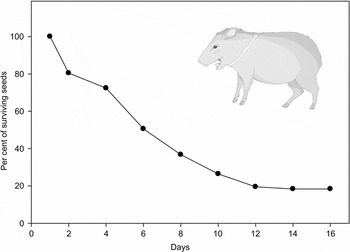
Seeds were removed by vertebrates in 14 out of 15 depots. Most of these seeds were removed after 6 d (Figure 1). We were able to record the vertebrate removing each seed, and the fates of 97% of the removed seeds (N = 90).
Per cent survival of Mucuna holtonii seeds exposed to mammal seed predators over 16 d. Total number of seeds = 90 (six seeds per independent depot).

After 16 d in the field, only 18.4% of the seeds escaped vertebrate predation (Figure 1). Seeds were moved 0–14.5 m from their initial locations (mean removal distance ± 1 SD = 1.5 ± 2.5 m). The majority (98.6%) of these removed seeds were taken by the collared peccary (Pecari tajacu, Artiodactyla). Most of the seeds removed by peccaries were eaten (98.6%, Figure 1). Only one of the M. holtonii seeds removed by a collared peccary escaped predation and was dispersed a distance of 6.95 m from the source. One seed was removed and consumed by a Central American agouti (Dasyprocta punctata, Rodentia) during our study. No seeds were removed or handled by other rodent species.
Seed coat as a structural defence against invertebrates in Mucuna holtonii
After 24 h, all seeds with a portion of the seed coat removed were visited by individuals of the neotropical leaf-cutting ant Sericomyrmex amabilis Wheeler, 1925 (subfamily Myrmicinae, tribe Attini). These ants collected small pieces of endosperm and transported them to nests for assumed use in fungal cultivation. In subsequent days, we observed S. amabilis recruitment and temporary trails used by worker ants to transport M. holtonii endosperm into ant nests. Sericomyrmex amabilis ants were not able to perforate the seed coats of intact M. holtonii seeds. After 16 d, no endosperm was removed from seeds with intact seed coats. All opened seeds were visited by S. amabilis, but had varying amounts of endosperm excavated. In seeds with opened seed coats, S. amabilis ants removed between 0.5–100% of endosperm (mean ± 1 SD per cent of endosperm removal per depot: Intact seeds = 0%, Opened seeds = 14.5% ± 17.4%, t = 2.63, df = 9, P = 0.027).
Effects of endosperm removal by invertebrates on Mucuna holtonii seed germination and growth
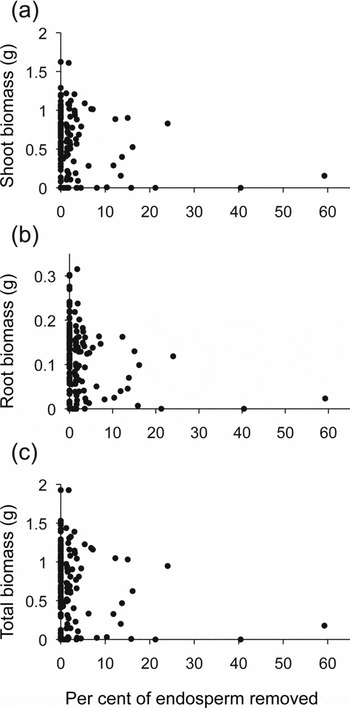
Endosperm removal reduced the germination success of M. holtonii seeds (Logistic regression, range of endosperm removed = 0–100%, Mean ± SD = 7.8% ± 21.4%, N = 182 seeds, χ2 = 32.6, df = 1, P < 0.0001). Seeds with more than 59.2% of their endosperm removed did not germinate. Endosperm removal also affected shoot and root biomass production in M. holtonii. Seeds with large amounts of endosperm removed by S. amabilis ants produced less shoot, root and total (shoot + root) biomass than seeds with small amounts or no endosperm removed (Figure 2).
Shoot (a), root (b), and total (c) biomass production (dry weights) of Mucuna holtonii seedlings from seeds with different amounts of endosperm removed by Sericomyrmex amabilis ants. Linear regressions performed on data after Box-Cox transformations, N = 143 plants. Shoot: λ = 0.82, F = 5.54, df = 1, r2 = 0.031, P = 0.02; root: λ = –1.22, F = 7.92, df = 1, r2 = 0.046, P = 0.0056; total: λ = 0.78, F = 6.05, df = 1, r2 = 0.034, P = 0.015.

DISCUSSION
Pre-dispersal seed predation by insects and fungal infection are leading causes of seed death among many plant species (Crawley Reference CRAWLEY and Fenner1992, Green & Palmblad Reference GREEN and PALMBLAD1975, Janzen Reference JANZEN1971c, Tewksbury et al. Reference TEWKSBURY, REAGAN, MACHNICKI, CARLO, HAAK, PEÑALOZA and LEVEY2008). However, pre-dispersal seed attack does not appear to be a major factor in M. holtonii seed mortality. For some plant species, physical protection provided by a fruit structure (e.g. thick exocarp) can effectively prevent pre-dispersal seed death from insect predation (Janzen Reference JANZEN1971c). During M. holtonii seed development, the fruit pod enclosing the seeds likely provides some physical protection against attack from seed predators (e.g. nitidulid and rhizophagid beetles or fungal spores). This protection, however, is ephemeral because M. holtonii seeds drop to the forest floor during the ripening process. After M. holtonii fruits dehisce and drop mature seeds to the ground, these seeds interact with terrestrial seed predators and face high levels of post-dispersal attack. In our study, we found that the majority of M. holtonii seed death occurs on the forest floor rather than on the liana.
At La Selva, collared peccary and Central American agouti are the most abundant terrestrial mammal species (TEAM Network, http://www.teamnetwork.org/en/). As generalist frugivores, peccaries and agoutis can either positively affect seeds of many plant species through seed dispersal, or negatively impact seeds via predation (Beck Reference BECK, Forget, Lambert, Hulme and Vander Wall2005, Bodmer Reference BODMER1991, Jansen et al. Reference JANSEN, BONGERS and HEMERIK2004). Within La Selva, terrestrial mammals have mostly negative effects upon M. holtonii seed survival since most of these seeds that fall on the forest floor are consumed and killed by peccaries. As a large seed with protein-rich endosperm (Harms et al. Reference HARMS, SIMPSON and WALDROUP1961), M. holtonii is a valuable food resource for peccaries and is thus eaten immediately when encountered by these animals.
Peccaries process food via foregut fermentation. This characteristic allows peccaries to effectively digest toxic seeds such as M. holtonii (Carl & Brown Reference CARL and BROWN1983, Elston et al. Reference ELSTON, KLINKSIEK and HEWITT2005, Nogueira Reference NOGUEIRA2005, Olmo Reference OLMO1993). Other terrestrial mammals at La Selva, such as rodents, lack complex stomachs capable of pregastric fermentation and cannot overcome the toxicity of these L-dopa-rich seeds (Bell & Janzen Reference BELL and JANZEN1971). Mucuna holtonii seed consumption by rodents during our study was rare, consisting of only a single predation event by one agouti. Therefore, M. holtonii seeds are not likely to be handled or dispersed by rodents in the La Selva forest.
Mucuna holtonii seeds face high predation pressure within La Selva because peccaries are locally abundant (E. K. Kuprewicz, unpubl. data). In contrast, agouti and peccary populations are reduced or locally extinct within forest fragments that surround La Selva. In hunted and fragmented forests, a reduction of large terrestrial mammals may increase the number of seeds available for small rodents (Dirzo et al. Reference DIRZO, MENDOZA and ORTÍZ2007). Additionally, small rodents are less affected by hunting and habitat fragmentation than large mammals, resulting in expected population increases of small rodents after habitat fragmentation (Dirzo et al. Reference DIRZO, MENDOZA and ORTÍZ2007). Because small rodents cannot feed on chemically defended M. holtonii seeds, it is possible that these seeds will be more likely to survive and germinate in defaunated forest fragments than within a protected forest like La Selva with high local densities of large mammals.
In many plant species, the seed coat serves as a defence against insect seed predation, preventing insects from boring through to the endosperm and killing the seed's embryo (Janzen Reference JANZEN1977a). In M. holtonii, the seed coat is very thin, yet it acts as an effective barrier to seed predation by Sericomyrmex ants. The great green macaw (Ara ambiguus Bechstein, 1811; Psittacidae) has been observed opening and chewing on fruit pods and eating seeds of M. holtonii (D. McClearn pers. comm.). While feeding, these macaws drop many partially eaten seeds to the forest floor. Seeds with opened seed coats, such as those partially eaten by A. ambiguus, allow S. amabilis ants to access and excavate the seeds’ endosperm. Another process that opens the coats of M. holtonii seeds is germination. Upon radicle emergence, the seed coat splits and S. amabilis ants can access the endosperm within the seed.
Previous work has reported that Sericomyrmex ants act as seed predators (Feldmann et al. Reference FELDMANN, VERHAAGH and HEYMANN2000). Sericomyrmex ants feed upon seeds of Parkia panurensis in the Peruvian Amazon (Feldmann et al. Reference FELDMANN, VERHAAGH and HEYMANN2000). Throughout the course of our study, S. amabilis was the only invertebrate seed predator to visit and excavate endosperm from M. holtonii seeds. Sericomyrmex amabilis ants, like other fungus-growing ant species, use collected plant material to cultivate fungus for use as a food resource. It is possible that the cultivated fungus grown by S. amabilis ants can digest the toxic chemical compounds found throughout M. holtonii seeds, thus rendering this L-dopa-rich endosperm non-toxic and converting it into a productive medium for fungus growth.
For many plant species, loss of seed endosperm results in reduced germination success and subsequent seedling biomass loss (Mack Reference MACK1998, Vallejo-Marin et al. Reference VALLEJO-MARIN, DOMINGUEZ and DIRZO2006). In our study, endosperm removal by S. amabilis ants detrimentally affected the growth of M. holtonii seedlings. If attacked seeds were able to germinate, higher amounts of endosperm excavated by S. amabilis resulted in less root, shoot and total (root + shoot) biomass produced by resultant seedlings. Breaching or scarification of M. holtonii seed coats allows opened seeds to more effectively imbibe water and germinate faster than seeds with intact seed coats (Janzen Reference JANZEN1977b). However, in the case of M. holtonii, scarification of the seed coat allows S. amabilis to enter and remove endosperm, thereby reducing the germination success and growth of M. holtonii.
In conclusion, the chemical defences of M. holtonii do not offer complete immunity against vertebrates as previous studies have reported (Bell & Janzen Reference BELL and JANZEN1971, Daxenbichler et al. Reference DAXENBICHLER, VANETTEN, EARLE and TALLENT1972, Harms et al. Reference HARMS, SIMPSON and WALDROUP1961, Janzen Reference JANZEN1977b, Janzen et al. Reference JANZEN, RYAN, LIENER and PEARCE1986, Rehr et al. Reference REHR, JANZEN and FEENY1973). In this study, we observed that seeds of M. holtonii are not only chemically defended, but that structural defences provided by the seed coat can also prevent post-dispersal seed predation by invertebrates. Both chemical and mechanical defences are fundamental to the survival and propagation of M. holtonii throughout tropical rain forests.
ACKNOWLEDGEMENTS
The authors thank the staff of Estación Biológica La Selva, especially J. Hurtado (TEAM Network, Conservation International) for use of camera traps, D. Brenes (Organization for Tropical Studies) and K. Mora (TEAM Network, Conservation International) for identification of arthropods. Funding for this project was provided by the Organization for Tropical Studies (Emily P. Foster Fund and Rowe Family Fellowship to E. K. Kuprewicz), University of Miami Center for Latin American Studies Grant to E. K. Kuprewicz, and University of Miami Curtis Plant Sciences Scholarships to E. K. Kuprewicz and C. García-Robledo.