1. Introduction
Afrikaans has evolved out of a group of 17th-century dialects of Dutch under the influence of long-lasting, extensive contact with endogenous African languages (including Cape Khoekhoe and Nàmá), imported languages (such as Malay), Creole Portuguese, and a Dutch-based pidgin spoken in and around the Cape colony. In the course of its historical development, Afrikaans has diverged from Dutch in many respects. Some of the historical changes have affected the phonological form of considerable parts of the sizeable, originally Dutch lexical stock.
One of the more salient differences involves the disappearance of /γ/, Afrikaans /g/, in intervocalic position (as in reën ‘rain’, Dutch regen; hoër ‘higher’, Dutch hoger). Furthermore, /v/ has been weakened to /w/, phonetically [ν] (as in briewe ‘letters’, Dutch brieven; sterwe ‘(to) die’, Dutch sterven), or entirely disappeared (as in aand ‘evening’, Dutch avond; oor ‘over’, Dutch over). Similarly, /d/ has been weakened to /j/ or /w/ (as in paaie ‘paths’, Dutch paden; goue ‘golden’, Dutch gouden), or even completely disappeared (as in zaal ‘saddle’, Dutch zadel; aar ‘vein’, Dutch ader). This d-lenition is not entirely “undutch,” but otherwise, these processes do not corroborate the superstrate view, according to which Afrikaans followed the structural tendencies already present in the dialects of the 17th-century Dutch colonists and settlers.
This contribution zooms in on the phonology of the various lenition and deletion processes, their rule-typological status, the question whether these developments are lexically diffuse and, if so, what factors have conditioned these developments. With respect to the latter question, the impact of lexical factors, such as token frequency, was studied, and thus claims made by proponents of Usage Based approaches to phonology. From the perspective of contact linguistics, I address the important role that may have been played by Khoekhoe speakers, as well as the distorting effects of early 20th-century standard Dutch on the codification of the relevant lexical sets in standard Afrikaans.
The structure of this paper is as follows. Section 2 presents the analysis of the distribution of the relevant lenition and deletion processes. Section 3 briefly sketches some of the morphological consequences of those processes. Section 4 outlines the results of a quantitative analysis of lexicographical data containing over 200 different items. Section 5 discusses the phonological properties of Nàmá and shows that, at least in Cape Dutch Pidgin, the obstruents that were subject to the lenition and deletion processes constituted a natural class. Some of the main venues for follow-up research are outlined in section 6.
2. The Lenition and Deletion Processes, and their Distribution
The variable lenition and deletion processes that affected three voiced obstruents in medial position have applied in trochaic forms. The forms can be monomorphemic, as in 1a, or morphologically complex, as in 1b.
(1)

The processes obviously applied to segments in the unstressed, second syllable of a trochee, hence in a prosodically weak position. Crosslinguistically, the intervocalic position and the syllable- or word-final position are the main contexts for lenition (Gurevich Reference Gurevich, van Oostendorp, Ewen, Hume and Rice2011:1564). According to Hualde Reference Hualde2013, intervocalic lenition typically stabilizes only word-internally. In the Afrikaans case at hand, the constellation is the one in 2.
(2)
Lenition creates a glide in onset position; deletion results in a hiatus or, through contraction, a superheavy monosyllabic form. As is evident from 1b, lenition and deletion have resulted in alternations between g-/v-/d-full monosyllabic simplex forms (that is, hoog, doof, and dood) and trochaic inflected forms lacking the obstruent. Consider also the examples in 3.
(3)
Deletion and lenition forms, such as aar ‘vein’ and dooie ‘dead’, respectively, occur in specific dialects and style levels of modern Dutch. The forms teder and teer ‘tender’ coexist in standard Dutch as style variants, the former one being more “elevated” and formal. These and similar facts may lead one to appeal to the superstrate view (see, for example, Kloeke Reference Kloeke1950 and Raidt n.y.), according to which Afrikaans follows the structural tendencies of the Dutch settlers’ dialects. This hypothesis competes with two other scenarios that have been proposed with respect to the linguistic development of Afrikaans. According to the creolization view (for example, Valkhoff Reference Valkhoff1966; Den Besten Reference Hans den, Pütz and Dirven1989, Reference Hans den2009a; Roberge Reference Roberge and Mesthrie2002, Reference Roberge2009), the grammatical and phonological developments of Afrikaans result from language contact between Dutch, other European languages, Cape Khoekhoe, and various slave languages. The other competing view is commonly referred to as the interlect scenario, whose two main supporters are Ponelis (Reference Ponelis1990) and Van Rensburg (Reference Van Rensburg, Hansden, Goossens, Ponelis and van Reenen1996). This view assigns a central determinant role to changes (mainly simplification and adaptation) induced by adult non-native speakers.Footnote 1
As becomes clear below, the conditioning of Afrikaans lenition and deletion is very different from the one in Dutch, and so is the specific set of obstruents undergoing these processes. As to the fricatives, /γ/ does not occur phonemically in Afrikaans. In Dutch underived words, /z/ only occurs intervocalically in loans such as puzzel ‘puzzle’ and mazzel ‘luck’. In Dutch, intervocalic /v/ has been sporadically (dialect- and item-specifically) weakened and deleted, as in the dialect variant heul ‘hill’, standard Dutch heuvel. According to Wissing Reference Wissing1971:53–54, Afrikaans /v/ is an “egte konsonant” ‘a real consonant’, that is, an obstruent, while others have labeled it an approximant. As to the plosives, in Afrikaans, /b/ is incidentally weakened to /v/ or /g/. An example is Dutch dubbel > Afrikaans dubbel ~ duwwel ‘double’, as in duwweltjie (Emex australis Steinh., or Emex centropodium; a species of weed, also known as Spiny Emex). As I show below, in Afrikaans, /g/ holds a relatively marginal phonemic position; it does not occur in modern Dutch, except in non-adapted loan words such as goal (sports terminology) and gar çon, a somewhat affected way to address a waiter. Forms that are not trochaic, such as agent ‘agent’ or regering ‘government’, never undergo lenition or deletion in Afrikaans.
The left-hand environment is a lax vowel followed by a liquid, as in berg-en ‘to store’; a tense vowel, as in1a;or a diphthong, as in eigen ‘own’, leid-en ‘to guide’, lijd-en ‘to suffer’. Lenition or deletion thus never apply in words such as vaandel ‘flag’ or handel ‘trade’.
In positions immediately following lax vowels, lenition and deletion are relatively scarce, but some items nevertheless show the effects of these processes. Some examples are given in 4.
(4)
Germanic languages disprefer lax vowels in open position. This follows from the fact that vowels in hê and sê are lax but long. In the relevant forms, the rareness of deletion after a lax vowel is probably also connected to the fact that the obstruent is ambisyllabic. If the obstruent is nevertheless deleted, a monosyllabic form results, as in hê and sê.
In Wissing's (Reference Wissing1971:105, 106) analysis, which is couched in early linear phonological theory and marked by external rule ordering, in items such as the following, the velar is a fricative /x/: vlag ‘flag’, eg ‘harrow’, brug ‘bridge’, wig ‘wedge’, trog ‘trough’ (all containing a lax vowel); maag ‘stomach’, steeg ‘alley’, oog ‘eye’ (all containing a tense vowel); twyg ‘twig’, tuig ‘harness; rig’ (all containing a diphthong); berg ‘mountain’, alg ‘alga’. Whenever a (suffix) schwa follows, /x/ first changes into the voiced plosive /g/, which is subsequently deleted, if in intervocalic position. Thereupon, an immediately preceding lax vowel is tensed. However, vowel tensing following medial /d/ weakening is unpredictable, according to Wissing Reference Wissing1971:107.
As shown in 5, no phonotactic problem arises if an obstruent disappears from a trochaic form with a tense vowel in the first syllable and a schwa (and maybe a consonant coda) in the second syllable.
(5)
Ponelis (Reference Ponelis1990:76) points out that after /g/-deletion, the vowel of the second syllable is invariably absorbed, except where the obstruent follows /ɛi/, as in eie ‘own’, Dutch eigen, and /oey/, as in duie ‘staves’, Dutch duigen, and it is sporadically absorbed where the vowel is a plural or flexion morpheme.
The right-hand environment is either a morpheme boundary or schwa. Wherever a morpheme boundary follows, morphological procedures can subsequently produce a trochaic form in which lenition or deletion can apply. Wherever the obstruent is lexically followed by a schwa, the schwa can be followed by a liquid or a nasal, and each of these latter can be followed by a coronal obstruent. Examples include the Afrikaans equivalents of Dutch tegel ‘tile’, orgel ‘organ’ (musical instrument), zwager ‘brother-in-law’, erger ‘worse; annoy, exasperate’, regen ‘rain’, ergens ‘somewhere’, navel ‘navel, belly button’, haver ‘oats’, lieverd ‘darling’, leven (d)‘(to) live; living’, sterven (d) ‘to die; dying’, edel ‘noble, high-bred’, teder ‘tender’, herder ‘shepherd’, adem ‘breath’.Footnote 5
For lenition or deletion to apply, the following segment has to be a vowel, as follows from the examples in 6.
(6)
The form arg(e)loos ‘innocent’ is usually pronounced with a schwa and the velar is retained as /x/. In contrast to what the latter form suggests, lenition and deletion can also apply if the velar is preceded by a liquid, as long as a vowel follows, as shown in 7a. Nevertheless, in 7b, /d/ is retained in skulde ‘debts’ but variably deleted in wilde ‘wild’.
(7)
In sum, phonologically, in some respects the lenition and deletion processes are not straightforward.
3. Morphological Complications
Until recently, Afrikaans used to have variable infinitives, such as the ones in 8a. The forms ending in -ə are not necessarily infinitives; they may also derive from Dutch plural agreement in finite verbs. These forms vary regardless of their syntactic function (see also Le Roux Reference Thomas and Thomas1954 and Ponelis Reference Ponelis1993:392). Until recently, Afrikaans also used to have variable verb stems, such as in 8b or, remarkably, 8c (for an in-depth study, see Le Roux Reference Jacobus1923).
(8)
According to Malherbe Reference Malherbe1920:55, in dialects of Afrikaans spoken in the northern provinces, verb forms ending in −g have many different conjugational forms. He mentions, among others, klaag ‘(to) complain’, with klae (kla) as a distinct present and infinitive form, and geklaag as past participle, whereas the southern dialect varieties would have the form klae in all cases (compare Stell Reference Stell2008).
As a result of the deletion of the medial obstruents /g/, /v/, and /d/, a number of verb stems have been restructured. The examples appear in 9a, 9b, and 9c, respectively.
(9)
The examples above all end in a long vowel or diphthong in open position. In this set of verbs, the restructuring has subsequently led to complications in certain derivational procedures. Consider the examples in 10.
(10)
In view of the alternations, it is not immediately obvious that the obstruent has indeed been deleted. The stem-final obstruent may just as well have a liaison-type status. Compare etymologically unanticipated yet relevant alternations in 11.
(11)
However, if deletion has gone all the way, the vowel in the suffix -ing (in items such as duiding ‘(the) spending’, besteding ‘expenditure’, vermyding ‘avoidance’, and bevryding ‘liberation’) may not be a schwa. Alternatively, derived forms of this type might contain a /d/-initial allomorph of the suffix -ing, an allomorph that does not exist in Dutch.
4. A Quantitative Study
In order to find out more about the determinants of the lenition or deletion of medial /g, v, d/, I carried out quantitative analyses of lexico-graphical data that contained 205 items from a scientific dictionary of late 20th-century Afrikaans, namely, Odendal & Gouws Reference François and Gouws2000. Etymologically, all items have Dutch roots, and except for vaartuig ‘vessel’, no compounds are involved.
The items were chosen based on their etymology, to meet the segmental and prosodic conditions discussed in section 2, and divided into three groups, according to the three obstruents. Each group was evenly divided according to a number of relevant phonological and grammatical parameters. Moreover, for each single item, the frequency of usage was included as a potential predictor of lenition or deletion. Frequency of usage for each item was based on counts in the 30-million-word Pharos corpus of the Nationale Uitgewers (NB). The items in this corpus come from newspapers, periodicals, and books published between 2000 and 2005. The frequency of usage of morphologically complex trochaic forms (such as the inflected adjectives in 1b above, or plurals) has been determined as the average of the complex (inflected, plural) and the simplex (uninflected, singular, monosyllabic) forms. The corpus frequency values have been 10 logarithmically transformed, so that small distances are weighed relatively more heavily than large ones. For example, for the /d/-items, the main descriptive statistics are as follows: mean 10log frequency 2.84, standard deviation 0.54, minimum 1.81, maximum 4.10. For the items with /g/ and /d/, the means were slightly lower and the standard deviations higher.
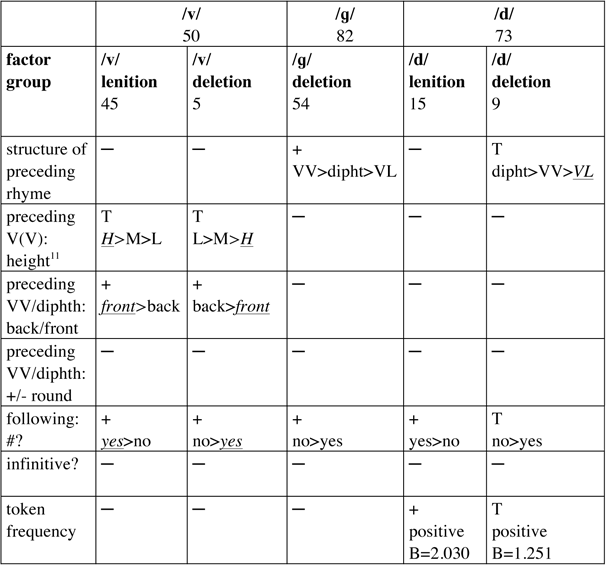
Frequency effects were established through logistic regression analysis (using the Wald method). All phonological and grammatical effects were analyzed using chis quare and contingency (measure of association). The main outcomes of the statistical analysis are summarized in table 1: + = p < .05, T = .05 < p < .10, − = not significant; underscored and italicized = the “knock-out” effect: 0% or 100% (that is, no variation in one single factor).
The effects of a number of phonological, morphological, and lexical parameters.

In section 4.1,Ifocus on the phonological (prosodic and segmental) and grammatical patterning. In section 4.2, I turn to lexical as well as external and extralinguistic aspects.
4.1. Structural Conditioning
There seem to be no clear signs of lenition of /g/ in the data (hence forms such as *hajel, *hahel < Dutch hagel ‘hail’ do not occur). Wherever /g/ is not preserved, it has merely undergone deletion. The finding that deletion is least frequent in positions following liquids may require further elaboration against the background of Ponelis’ (Reference Ponelis1993:157) claim that the process “was most restricted following [l].”
With respect to /v/, the following patterns were observed. Following both a high vowel and a front vowel, /v/ is always lenited and never deleted. Before a morpheme boundary (that is, when the following vowel is (part of) another morpheme), /v/ is always lenited and never deleted.
With respect to /d/, in this data set deletion never occurs if the rhyme consists of a vowel followed by a liquid, as, for example, in skuld(e) ‘debt(s), guilt’ or bord(e) ‘plate(s), board(s), traffic or road sign(s)’.Footnote 12 However, in correspondence with the author an Afrikaans writer, commenting on a development in the present-day Dutch political landscape, recently referred to Geert Wilders as <Willers>. This finding is also difficult to reconcile with Wissing's (Reference Wissing1971:107) observations regarding “assimilasie van /d/ aan voorafgaande sonorante konsonante”‘assimilation of /d/ to preceding sonorants’, in particular, total assimilation of underlying /d/ to preceding liquids or /n/.Footnote 13 One of the examples discussed by Wissing concerns/spɛld/ ‘needle’, plural /spɛl+ə/, a form that HAT does not mention and gives spelde instead. The solution may lie in an observation pointed out by Wissing, namely, that this “assimilation” occurs especially in the Westelike Provinsie.
Ponelis (Reference Ponelis1990:75, Reference Ponelis1993:157) claimed that what he referred to as g-syncope is much more general and “has a much wider lexical range than v-syncope”; he did not mention d-syncope in this connection. The above findings for /g/-deletion (54/82) and /v/-deletion (5/50) corroborate Ponelis’ claim. Does this indicate that /g/-deletion is indeed older, as Ponelis assumes?
With respect to the 4 phonological and 2 grammatical parameters studied, the lenition and deletion of /v/ appears to be more predictable than the lenition and deletion of /g/ and /d/. The following general observations can be made.
In terms of phonology, the structure of the preceding rhyme only appears to play a role in the case of deletion, /g/ and /d/. Furthermore, the quality (height and the front/back specification) of an immediately preceding (lax or tense) vowel only appears to play a role in the case of (the lenition and deletion of) /v/. Finally, the (un)roundedness of the preceding (lax or tense) vowel or diphthong does not appear to play a significant role anywhere.
In terms of grammar, whether an item is an infinitive plays no significant role anywhere. In contrast, morpheme or word boundary is important. The position immediately before a morpheme or word boundary hosts the most instances of lenition of /v/ and /d/ and the fewest instances of deletion of /g/, /v/, and /d/. Given that the morphological structure always plays a role, the lenition or deletion of these voiced obstruents in medial position cannot be phonetic or postlexical processes as these types of processes are blind to grammatical boundaries (Hargus & Kaisse Reference Kaisse, Hargus, Hargus and Kaisse1993). Therefore, in these environments lenition and deletion must beeither lexical phonological or lexicalized rules.
Apart from the knock out effects (that is, when there is no variation in one factor), most parameters (or factor groups) maintain probabilistic relations with lenition or deletion. The examples in 12 illustrate this.
(12)
The two items in 12a have essentially the same segmental and prosodic structure, but in one of them the voiced coronal stop has been weakened, while in the other one it has not. The examples in 12b present a very similar contrast.
These and similar facts, too, suggest that these lenition and deletion rules have exceptions, which is another indication that they cannot be considered an outcome of Neogrammarian sound change. There can hardly be a structural explanation for facts such as those in 12. Indeed, Ponelis (Reference Ponelis1990:74; compare Reference Ponelis1993:156) mentions what he refers to as “pre-17th-century d-cultivation” (translation is mine, FH), or reborrowing of the then prestigious Hollandic Dutch variants. Has reborrowing also occurred more recently? Did token frequency play a role in the lexically diffuse lenition or deletion of the relevant obstruents in items of the relevant formal type? In both scenarios, item-specific lexical effects would be involved.
4.2. Lexical and Contact-Induced Conditioning, and Prestige
To determine whether token frequency plays a role in the lexically diffuse lenition or deletion of the relevant obstruents, consider the findings summarized in the last row of table 1. Lexical frequency effects are evident in the case of /d/, and they are especially strong in the case of lenition—the higher the token frequency, the better the chances for lenition/deletion to apply. This is the effect Bybee (Reference Bybee2001) predicts for processes of phonetic reduction. Thus, it seems that the lenition and deletion of /d/ have spread or are still spreading in a lexically diffuse fashion, being driven by token frequency. In case the lenition of the other two obstruents is also lexically diffuse, token frequency does not play a determining role.
(European) Dutch has also influenced the situation. Only in 1925 did Afrikaans attain the status of an official language. An amendment to a law was passed saying that from then onwards the designation Hollands was to refer both to Dutch (which was being used in the parliament) and to Afrikaans. For decades, Afrikaans had coexisted with Dutch. In fact, there was a semidiglossic relationship between the two, in which Afrikaans served as the oral, colloquial code. In somewhat exaggerated terms, standard Dutch was the prescriptive norm, while Afrikaans was the language people actually used. There existed both integrationist and separatist positions regarding the relationship between Afrikaans and Dutch in the South Africa of those days. The separatists are often referred to as the “Eerste Afrikaanse (Taal-) Beweging” (end of the 19th century) and the “Tweede Afrikaanse (Taal-) Beweging”, the First and the Second Afrikaans (Language) Movement, respectively. Institutionally, the integrationist position, which was also supported by Dutch and Flemish groups (especially during and after the Anglo-Boer War, 1899–1902), was predominant until the second quarter of the 20th century.Footnote 15 The ideology was, of course, to diverge minimally from the (perceived) Dutch standard norm, which was and still is g-/v-/d-full in all relevant items.
According to Ponelis (Reference Ponelis1990:77, Reference Ponelis1993:158), forms from which /γ/, /g/ or /v/ was deleted have long been stigmatized and avoided by literary authors. For items with medial /v/, the reborrowing of Dutch forms (a process of “redutchification”) has made the picture especially diffuse. Again, according to Ponelis (Reference Ponelis1993:159), the deletion of medial /v/ “was reversed by cultivation, resulting in the creation of more stylish forms with medial [v]: belowe ‘promise’ for blo […] nawel ‘navel’ for nael” and the like. As can be expected, this sociolinguistically loaded situation also led to hypercorrection, for example, a paragogical /g/ in 13.
(13)
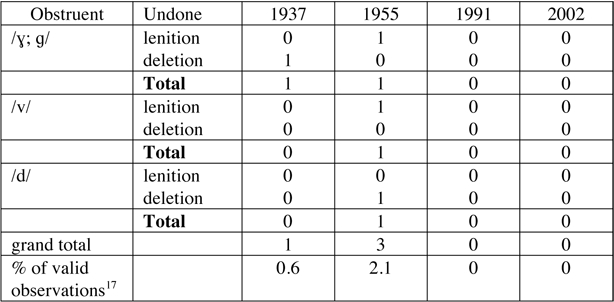
To determine the true magnitude of the reversal of the lenition/deletion processes in standard modern Afrikaans, I compared the spelling of the items in each set as it appears in the prescribed orthographyoffive editions of the official spelling guide for modern Afrikaans, Afrikaanse Woordelys en Spelre ëls (AWS; Afrikaans Wordlist and Spelling rules). More specifically, I compared the spelling in the very first 1917 edition with the spelling in four later editions published after 1925, the year of the amendment granting Afrikaans an official status (see above). The editions chosen for the study were published in the most regular intervals possible: 1917, 1937, 1955, 1991, and 2002. In between, in 1961, Dutch was removed from the South African constitution (compare Webb Reference Webb2002). The number of items per obstruent per edition was determined in which earlier lenition or deletion of any of these obstruents was undone. Not all items examined in this study were found in AWS. Table 2 specifies the numbers of items that were found (here refered to as “valid observations”) and in which earlier lenition or deletion of the relevant obstruents was undone.Footnote 16
Numbers of items in which the effects of lenition/deletion were undone in four editions of AWS, compared to the 1917 edition.
Insofar as conclusions can be drawn from the findings for this subset of the data, it seems that in the course of the standardization of Afrikaans, specifically with regard to codification, very few forms that resulted from earlier lenition or deletion have been changed.
In general, the Oosgrens-Afrikaans dialects (Eastern Border Afrikaans, spoken in, for example, Transvaal, Orange Free State, and the Rand region), which used to be fairly conservative and oriented toward standard Dutch, are considered to be the basis of modern standard Afrikaans (Pienaar Reference Pienaar1943; Raidt Reference Raidt1994; Steyn Reference Steyn1980, Reference Steyn1987; Van Rensburg Reference Van Rensburg, Ponelis, Combrink and Odendal1991).Footnote 18 However, with regard to medial /g/, /v/, and /d/ these dialects obviously did not set the (written) norm.
The view that standard Afrikaans is an artifact produced by the codifiers (Deumert Reference Deumert2004, Grebe Reference Grebe2004) or “language entrepreneurs” (Grebe Reference Grebe2009:21), for which there is ample evidence in other components of the language system, may not hold for the lenition and deletion of intervocalic/intersonorant /g, v, d/. Insofar as these and related findings are valid and reliable, the conclusion can be drawn that “the process of standardization that took place in the early 20th century […] confirmed the establishment of Afrikaans as a language truly separate from Dutch” (Stell Reference Stell2012). So insofar as Hollandic or Dutch g-/v-/d-full variants were not reborrowed in earlier historical stages of Afrikaans, it seems as though the lexically diffuse spread of the lenition and deletion processes underlies the synchronically unpredictable incidence of the processes throughout the Afrikaans lexicon.
This, finally, raises the question to which extent the lenition and deletion of /g/, /v/, and /d/ are still productive, insofar as lexicalized or lexically diffuse sound change can be considered productive at all. Ponelis (Reference Ponelis1990:76) observes that (what he refers to as) g-syncope is morphonologically productive wherever /g/ precedes a plural or inflectional schwa suffix; so /g/-deletion is a lexical phonological rule.
5. The Target Set. More Contact-Induced Change
The three obstruents that have been targeted by the various lenition and deletion processes obviously do not constitute a natural class in Afrikaans or Dutch phonology. If the processes had been internally motivated, one single segment or one clearly delineated natural class would have been targeted. In modern Afrikaans, this is clearly not the case. Is there a diachronic answer to the question regarding the coherence of the target set?
According to Den Besten Reference Hans den and Botha1999, in Afrikaans, the deletion of the fricatives /γ/ and /v/ was historically preceded by fortition; more specifically, the fricatives became (voiced) plosives. Thus, fortition also applied to /v/. If Den Besten's claim is tenable, there was in fact a natural class affected by lenition or deletion in medial position, namely, voiced plosives [-son, -cont, +vce].
In Den Besten's view, the Khoekhoen, through their contact with Dutch settlers and colonists, developed a pidgin. In the early Cape society (ca. 1660) this pidgin was adopted and subsequently altered by the slaves, many of whom had Asian roots. In this situation, a system emerged which is commonly referred to as Cape Dutch Pidgin, and which served as a medium for interethnic communication. After the Khoekhoen left the Western Cape, creolization set in, resulting in Creole Dutch, also known as Proto-Afrikaans I (ca. 1700).Footnote 19 The L1 of the Khoekhoen, Cape Khoekhoe or Nàmá, has the following oral, nonclick obstruent series (Beach Reference Beach1938, Hagman Reference Hagman1977):
(14)
Intervocalically, /p/ is realized as [β] and /t/ as [r]. Thus, it is obvious that Nàmá has no voiced plosives, but the voiceless ones have allophones which are both voiced and lenited, at least in the case of the labial and the coronal. It is therefore conceivable that the historical fortition of /v/ and /g/ occurred in Cape Dutch Pidgin in the speech of native speakers of Nàmá, who were trying to emulate the Dutch voiced obstruents.
A first, tentative reconstruction of the various historical, contact-induced changes may thus give the diachrony in 15 below. For Khoekhoe speakers of Nàmá, Dutch was a second language. Nàmá fortition changed the Dutch fricatives /g/ and v/ into the plosive counterparts /g/ and /b/, respectively.Footnote 20 In the sources of what he refers to as “the usual pidgin data” from about 1700, Den Besten (Reference Hans den, HugoCardoso and van den Berg2009b:233) mentions “de dieber instead of Du. de Duvel/Duivel ‘the Devil’ […] and— in spite of their German appearance: sterbem (< Du. sterven ‘die’) and storben.”
(15)
The results of Nàmá fortition, /g/ and b/ were possibly variably lenited (in this case, glided and spirantized, respectively) to become allophones [j] and [β], respectively. They may have reached Proto-Afrikaans I as /j/ and w/, which in turn were variably deleted—as were the allophones resulting from the lenition of /d/. This part of the hypothetical diachrony is consistent with the interlectal scenario (see section 2 above). As late as 1925, Von Wielligh observed that there was an imaginary line dividing South Africa, on the east of which medial /g/ was preserved, possibly because the Voortrekkers (pioneers), who colonized this area, had considerably fewer contacts with Colored people, descendants of the Khoekhoen and slaves (compare Marais Reference Johannes1965; Von Wielligh Reference Von Wielligh1925).
The variable lenition (here gliding) of /d/ is, at least intervocalically, a common characteristic of any variety of nonstandard Dutch, that is, dialects (including those spoken by the 17th and 18th century settlers; compare Ponelis Reference Ponelis1993:127, 156) as well as colloquial spoken standard Dutch. In other words, the weakened /d/-allophones appear to be consistent with the superstrate view (see section 2 above).
In this reconstruction, what Afrikaans ultimately adds to the historical phonology of the three obstruents is the deletion process.
6. Issues for Further Research
Future research will need to further explore several aspects of this study, including the following:
(i) Potential type frequency effects, that is, the effects of the number of “neighbors” (Luce & Pisoni 1998), or words with a similar phonological shape; do the numbers of different Dutch lexical items containing a long or tense vowel followed by /d/, /v/, or /g/, items containing a diphthong followed by /d/, /v/, or /g/, and items containing a short or lax vowel followed by a liquid and by /d/, /v/, or /g/ maintain statistically significant relations with the Afrikaans lenition or deletion of the obstruent? If so, is the nature of the effects compatible with Bybee's (Reference Bybee2001) and related models? The same question arises with respect to the structure of the rhyme, vowel height, and the back/front specification of the vowel (see the findings in table 1 above).
(ii) Insofar as Afrikaans lenition or deletion of the relevant obstruents are historical sound changes, finding indications for the mechanisms that have played a role may be as difficult as reconstructing cosmic phenomena which took place light years ago, on the basis of observed background radiation. Therefore, both type and token frequency counts ought to be based on corpora of contemporary (17th-, 18th-century) spoken Dutch and of slightly more recent spoken Afrikaans (insofar as they are available).
(iii) Variable lenition and deletion in representative systematic data for present-day spoken Afrikaans would doubtlessly shed more light on aspects of the historical phonology. In this connection, one of the reviewers mentions, for example,“skrywe/skrybe, blo (belowe), dro (droog). The pronounciation of bôre (borde) and skulle (skulde) and pêre (perde) is used by perhaps most speakers of Afrikaans, as well as keller and verwiller […] If the surname Kruher is pronounced as Kruger it is an exception to general usage.”
(iv) The findings from the present studyof Afrikaans strongly suggest that the lenition and deletion of these obstruents are not instances of regular, Neogrammarian sound change. At best, they are rules of lexical phonology, as in the case of /g/-deletion, and possibly lexically diffuse sound changes, as in the case of /d/-lenition and deletion. Are the lenition and deletion of /v/ lexical phonological rules or rather lexically diffuse or lexicalized (and hence historical) sound changes?
(v) Multivariate (rather than merely bivariate) statistical analyses ought to be carried out. The analyses should preferably be controlled for word effects (mixed model analyses with items as random effect).
(vi) Data with respect to recent loans could be collected in order to determine to what extent the lenition and deletion processes are still (marginally) productive and under what (prosodic, grammatical or lexical) conditions.
(vii) Are there any stylistic differences in the use of variants in which the relevant obstruents have been preserved/restored, weakened or syncopated?
(viii) Wissing (Reference Wissing1971, sketched in section 2 above) and Von Wielligh (Reference Von Wielligh1925, sketched in section 5 above) noted differences among groups of Afrikaans dialects with respect to the lenition or deletion of the relevant obstruents. What is the nature of these differences? Are there any other systematic differences among modern Afrikaans dialects corresponding to the ones concerning medial /g/, /v/, and /d/?
(ix) Is there any (positive or negative) evidence regarding the hypothetical diachrony in 15, insofar as it is also possible for Cape Dutch Pidgin (compare Den Besten Reference Hans den, HugoCardoso and van den Berg2009b:232, 238) and Proto Afrikaans I?