Introduction
Web 2.0 and social networking sites
In the first generation of the World Wide Web (Web 1.0), Websites were largely limited to passive viewing of material created for them by site operators. Today, with the second-generation World Wide Web (Web 2.0), the Internet has evolved from one-way communication to a communication platform that enables interactive user involvement (Chou et al., Reference Chou, Lai and Liu2010). There are many Websites with content entirely provided by users and where the operators simply deliver the framework and infrastructure that enables users to edit, modify, and link the content (e.g. Wikipedia and Yahoo! Answers). The Web 2.0 serves as a platform for information sharing, social interaction, and collaboration. A Web 2.0 site enables users to interact and collaborate with one another in a social dialogue as creators of user-generated content in a virtual community. Examples of Web 2.0 sites include social networking sites (SNS), blogs (discussion or information sites), wikis (that enable users to add, modify, or delete content), video sharing sites, and Web applications (i.e. applications that are accessed over the Internet).
This paper focuses on SNS (also known as “social media”), Web-based services that enable individuals to construct a public or semi-public profile within a bounded system, articulate a list of other users with whom they share a connection, and view and traverse their list of connections and those made by others within the system (Ellison, Reference Ellison2007). Examples of SNS include Facebook, MySpace, Google+, and Xing. Farkas (Reference Farkas2010) presents an exhaustive list of SNS sites.
Use of social networking sites
From 2005 to 2009, SNS participation more than quadrupled (Jones et al., Reference Jones, Fox, Internet and Project2009). Today, social networking accounts for about 22% of all time spent online (Wire, Reference Wire2010). Emblematic of this trend is the number of active Facebook users, which has reached 1 billion as of October 2012 (Facebook Inc.). Among these, 30% are younger than 25 years, 41% are 26–44 years old, 12% are 45–54 years old, and 7% are older than 55 years (Johnson, Reference Johnson2012). The fastest-growing group is people over 50 years and the number of older SNS users is expected to grow significantly in the next years (Lovett, Reference Lovett2011).
The most prominent functions of SNS sites are communication and picture sharing (Joinson, Reference Joinson2008). For that purpose, each SNS member has a virtual wall where one can post messages and photos that are visible to friends within the SNS. Accepted SNS friends can look at the messages and photos and add comments. Depending on computer skills and preferences, this can be done using a personal computer, a tablet computer, or a mobile phone. Moreover, it is also possible to display SNS pictures automatically via a wall-mounted electronic picture frame. This has the advantage that it does not require computer know-how (Cornejo et al., Reference Cornejo, Favela and Tentori2010). The SNS dialogue is not public and only visible to a limited number of selected friends. Several researchers believe that SNS dialogues can be a way to reduce social isolation, loneliness, and promote involvement of older people in their family life (Farkas, Reference Farkas2010). Particularly for senior citizens with limited mobility, SNS may help them to maintain and underpin existing contacts and connections (Erickson, Reference Erickson2011). Also, using SNS might be a good mean of communication to help keeping up with what is going on in the lives of family members who are active on SNS. According to Giles et al. (Reference Giles, Hajek, Stoitsova and Choi2010), a growing body of literature in the USA and other Anglophone settings has focused on the dynamics of communication in intergenerational relations (Williams and Nussbaum, Reference Williams and Nussbaum2001; Nussbaum and Coupland, Reference Nussbaum and Coupland2004; Harwood, Reference Harwood2007). Recently, several authors have speculated about the possible role of SNS to facilitate intergenerational communication for the benefit of both generations (Fees and Bradshaw, Reference Fees and Bradshaw2003; Williams et al., Reference Williams, Kemper and Hummert2005; Mesch, Reference Mesch2012). More generally, there are growing numbers of scientific publications presenting new ideas and new methodologies on how SNS use can improve quality of life for older adults. Since the main purpose of SNS is communication, there is good reason to expect that SNS use will have a positive impact, both in terms of its users’ social integration in a network of family, friends, and community and the benefits that flow from this integration (Shklovski et al., Reference Shklovski, Kraut and Rainie2004). The diversity and the dosage of different communication methods (i.e. face-to-face meetings, telephone, and SNS) seems important – and bearing this in mind, there is controversy in the research literature about whether the use of the Internet and SNS increases or decreases users’ social participation and the psychological and health benefits people generally receive from this participation (Shklovski et al., Reference Shklovski, Kraut and Rainie2004). Some optimistic reports claim that using the Internet leads to the emergence of a new social circle (Turkle, Reference Turkle1997; Kraut et al., Reference Kraut, Kiesler, Boneva, Cummings, Helgeson and Crawford2002) and the development of deep and long-lasting social relationships online (McKenna et al., Reference McKenna, Green and Gleason2002), and that it augments involvement in existing communities by providing new social spaces for communication (Katz and Aspden, Reference Katz and Aspden1997; Wellman et al., Reference Wellman, Haase, Witte and Hampton2001). In contrast, other analyses suggest that frequent Internet and SNS use was associated with increases in depression and social isolation (Kraut et al., Reference Kraut, Patterson, Lundmark, Kiesler, Mukophdyay and Scherlis1998; McKenna et al., Reference McKenna, Green and Gleason2002) and declines in spending time with family and friends and in attending social events (Nie et al., Reference Nie, Hillygus, Erbring, Wellman and Haythornthwaite2002). These findings are from investigations in younger cohorts and cannot be transferred one-to-one to older SNS users. Therefore, positive and negative impacts of SNS use on mental health in older people need to be considered and further investigated.
In this paper, we review, classify, and summarize existing scientific literature. We also discuss possible negative and positive impacts of SNS use on mental health and, finally, we present possible future research directions.
Methodology
We conducted a systematic review of studies on Web 2.0 and social media for older adults published or in press (e-pub) prior to July 2012. To identify relevant studies, we searched computerized databases (Pubmed, PsycInfo, PsycArticles, IEEE Explore, ISI Web of Knowledge, Wiley Online Library, www.icahdq.org, and Google Scholar) using combinations of the following keywords for the population: aging, aged, ageing, elderly, elderlies, old, older adults, oldest-to old, seniors (Kueider et al., Reference Kueider, Parisi, Gross and Rebok2012). For the content search, we used social media, social platform, social networking sites, and Web 2.0 as title keywords. Drawing on the PRISMA recommendation for systematic reviews (Moher et al., Reference Moher, Liberati, Tetzlaff and Altman2009), we identified studies from reference lists in retrieved articles, unpublished dissertations, and conference abstracts.
To be included in the present review, an article (original peer-reviewed article, review and current opinion, conference proceedings, conference abstract, dissertation, or technical report) needed to contain the selected keywords, and could not meet any of the seven exclusion criteria which are (A) not specifically dealing with social media and people aged ≥55 years; (B) focusing primarily on programming and technical aspects; (C) papers about children education; (D) marketing strategies for companies; (E) studies without interventions, interviews, or focus groups; (F) not about social media; and (G) no English translation available.
Defining “old” is difficult and age classification varies among countries and over time (Seeman et al., Reference Seeman, Lusignolo, Albert and Berkman2001). As a working definition for this review and for exclusion criterion A, the chronological age of ≥55 years was used. The authors feel that 65 years might be more appropriate, but several articles use ≥55 years to characterize old (Lehtinen et al., Reference Lehtinen, Näsänen and Sarvas2009; Karimi and Neustaedter, Reference Karimi and Neustaedter2010; Chou et al., Reference Chou, Lai and Liu2012), so we adopted this artificial definition. The screening of the articles with regard to the exclusion criteria was performed independently by two authors. Non-conformities were discussed among all authors and a common inclusion/exclusion decision was made. After inclusion, the articles were classified into articles reporting results from a field test and articles that report results from user groups, interviews, and online surveys.
Results
Articles included into the review
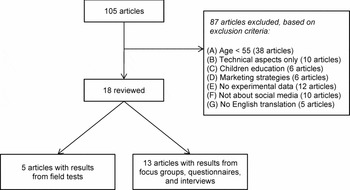
Our initial search returned a total of 111 articles (22 Pubmed, 28 ISI Web of Knowledge, 23 IEEE Explore, 6 Wiley Online Library, 6 www.icahdq.org, and 26 Google Scholar). Six publications appeared in two databases and the duplicates were deleted. Thus, 105 publications were screened for inclusion. Two authors screened the articles independently (TN and RG). Both authors excluded the same 79 articles, while 10 articles were excluded by one author only. After discussing each of the ten non-concurrent articles, all authors consensually agreed to exclude eight and to include two articles. Hence, 87 articles were excluded due to the following criteria: (A) not specifically dealing with social media and people aged ≥55 years (38 articles), (B) focusing primarily on programming and technical aspects (ten articles), (C) papers about children education (six articles), (D) marketing strategies for companies (six articles), (E) studies without interventions, interviews, or focus groups (12 articles), (F) not about social media (ten articles), and (G) no English translation available (five articles) (Figure 1).
Identification of studies in the systematic review.

Articles reporting field tests of social networking sites with senior citizens
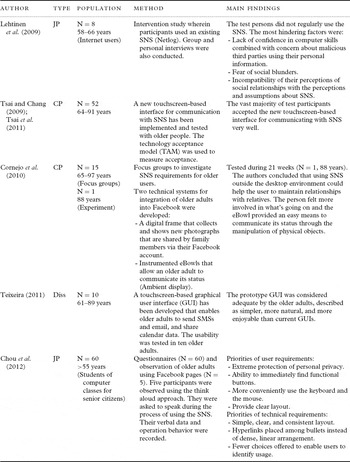
Five articles report results from field tests (Table 1): two journal publications (JP), two conference proceedings (CP), and one dissertation (Diss). One CP describes the user-centered development of a desktop-computer independent user-interface to Facebook (Cornejo et al., Reference Cornejo, Favela and Tentori2010). The new interface consists of a wall-mounted electronic picture frame where SNS dialogues with photos are displayed. The advantage of this setup is that it does not require any computer skills. It allows the user to stay in touch with family members via SNS and to watch novel photographs in his or her home. The new interface has been tested for 21 weeks within the family of an 88-year-old lady without cognitive impairment. The test participant felt more involved with what is going on among family members and the acceptance of the new system was very high.
Articles with results from field tests

CP = conference proceedings; Diss = dissertation; JP = journal publication; N = number of participants; SNS = social networking sites.
One publication (Chou et al., Reference Chou, Lai and Liu2012) reported results from questionnaires (N = 60) and observations (N = 5) of older people using Facebook. For the observations, a “think aloud” approach was used. Users were asked to speak during the process of using the SNS. Their verbal comments and operation behavior were recorded and analyzed. The authors transformed those findings into recommendations for simplifying SNS use for senior citizens, including protection of personal privacy, improving keyboard/mouse use (e.g. problems with double-clicks), and providing a clearer layout. Prior technical requirements include hyperlinks not linearly arranged, fewer choices, and less text. Less text seems to be important since the authors observed that older users, in contrast to younger users, read everything displayed on the screen.
Lehtinen and colleagues (Reference Lehtinen, Näsänen and Sarvas2009) observed eight Internet users (58–66 years old) who were about to start using an SNS. They found that test participants did not regularly use the SNS because of privacy concerns and because they did not see the benefit. The dissertation with the title “Improving elderly access to audiovisual and social media, using a multimodal human–computer interface,” describes the development and evaluation of a new touchscreen-based graphical user interface (GUI) for older adults (Teixeira, Reference Teixeira2011). While their proposed GUI resembles tablet-style interfaces, the interface proposed by Tsai and Chang (Reference Tsai and Chang2009) tries to attract user attention by providing an aesthetic, artistic image to emotionally attract the users and encourage participation with the SNS. Tests of 52 older users revealed high acceptance rates.
Articles assessing attitudes of senior citizens toward social networking sites
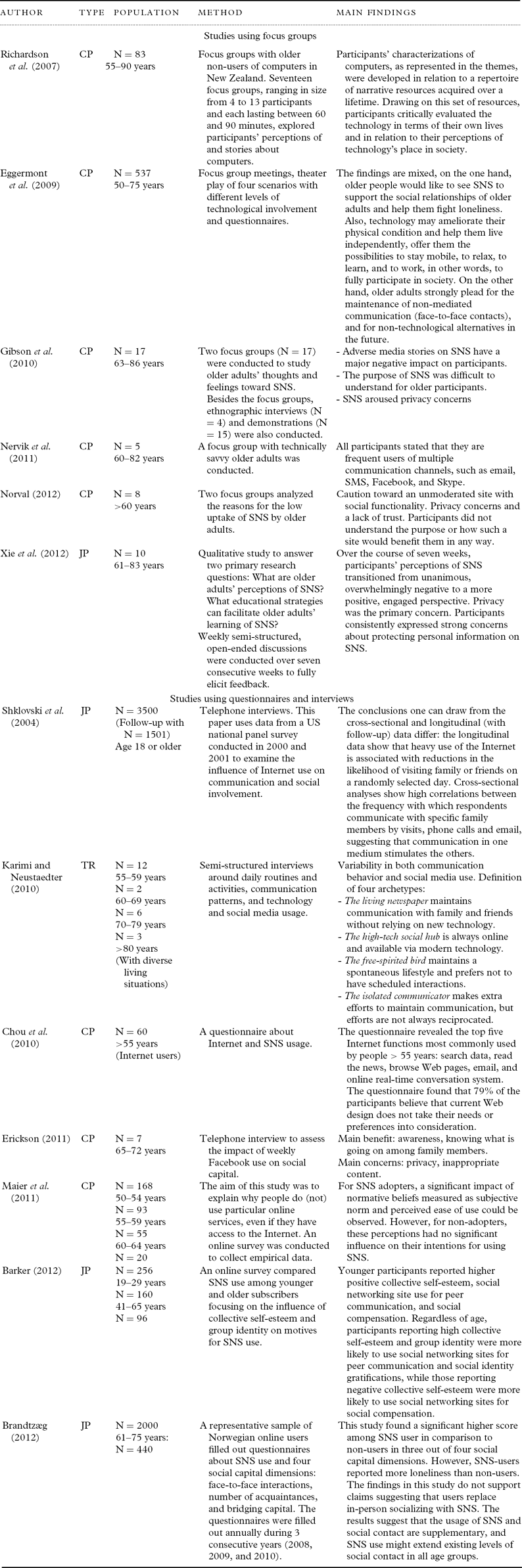
Four journal publications (JP), eight conference proceedings (CP), and one technical report (TR) were identified. Six articles reported results from focus groups with older people (Table 2). Gibson and colleagues (Reference Gibson2010) conducted two focus groups (N = 17), interviews, and demonstrations with 63–86-year-old people. The main finding was that the purpose of SNS was difficult for older participants to grasp. Also, the authors highlighted that SNS aroused privacy concerns. According to the authors, this might be the main inhibitor for SNS use by older citizens. Privacy concerns and lack of trust are also reported as a result of focus groups conducted by Norval (Reference Norval2012) in eight older persons. Also, this population did not see the purpose or how such a site would benefit them in any way. In weekly, semi-structured, open-ended discussions with ten older persons, Xie et al. (Reference Xie, Watkins, Golbeck and Huang2012) tried to answer the following questions: What are older adults’ perceptions of SNS? What educational strategies can facilitate their learning of SNS? The authors illustrated changing perceptions from the initial unanimous, strong negative to the more positive but cautious, and to the eventual willingness to actually contribute content. Also, in this paper, privacy concerns were identified as a major issue. Focus groups with technically savvy older adults conducted by Nervik et al. (Reference Nervik, Dahl and Kofod-Petersen2011) revealed that focus group participants combine multiple communication channels, such as email, SMS, SNS, and Skype. Eggermont and Vandebosch (Reference Eggermont and Vandebosch2009) used theater play to facilitate discussion in focus groups with 537 older persons. The findings are mixed; on the one hand, older people would like to see SNS to support social relationships and help them to overcome loneliness. On the other hand, participants strongly plead for the maintenance of face-to-face contacts. This differentiated view was also discovered in focus groups that were conducted in 83 older non-users of computers in New Zealand. Participants critically evaluated the new technology in terms of their own lives and in relation to their individual perceptions of technology's place in society (Richardson et al., Reference Richardson, Zorn and Weaver2007).
User groups, interviews, and online surveys
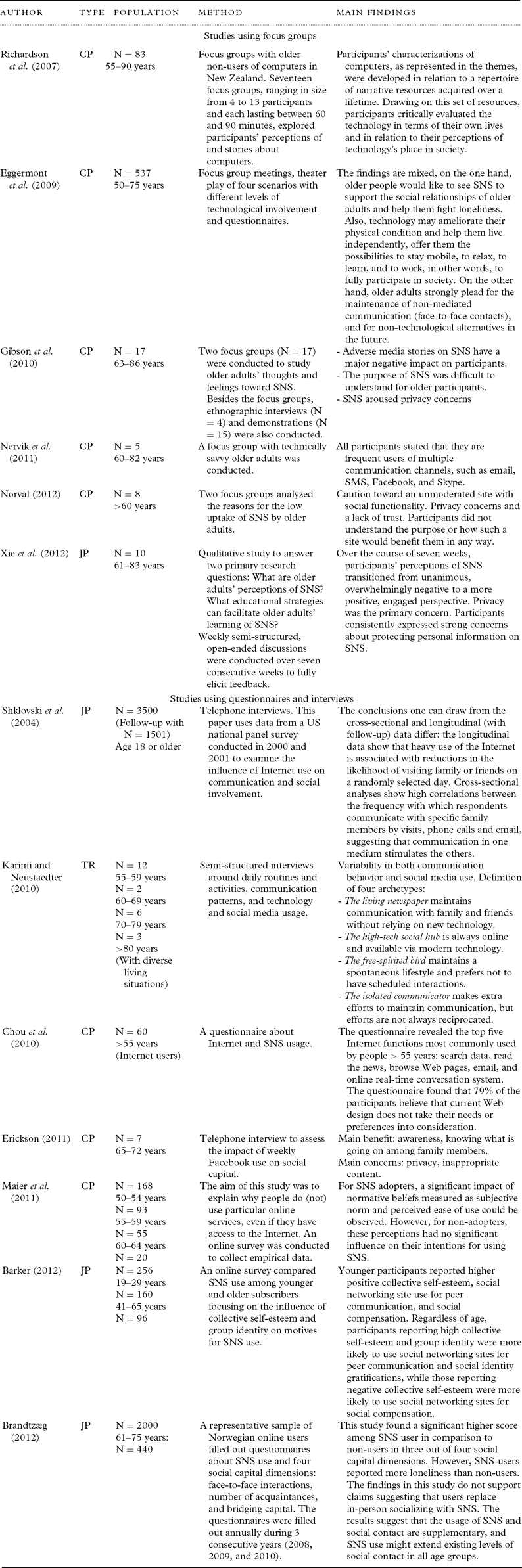
CP = conference proceedings; JP = journal publication; N = number of participants; SNS = social networking sites; TR = technical report.
Seven articles used questionnaires and interviews to learn why older people use or do not use SNS. In telephone interviews with individuals older than 65 who use Facebook at least weekly, Erickson (Reference Erickson2011) found that the main benefit of Facebook was about knowing what was going on among family members. Privacy issues and inappropriate content were the main concerns. In semi-structured interviews on technology and social media use, Karimi and Neustädter (Reference Karimi and Neustaedter2010) reported large variability in communication behavior and SNS use. To deal with this variability, the authors propose four archetypes: the living newspaper that maintains communication by relying on new technology; the high-tech social hub that is always online; the free-spirited bird that maintains spontaneous lifestyle and interaction; and the isolated communicator who takes a large amount of effort to maintain communication, but these efforts are not always reciprocated. In telephone interviews, a US-national panel survey interviewed 3,500 persons of all age groups (Shklovski et al., Reference Shklovski, Kraut and Rainie2004). The authors aimed to examine the influence of Internet and SNS use on communication and social involvement. The study analyzes cross-sectional and longitudinal (from follow-up interviews) data which led to different results. The longitudinal data indicate that heavy Internet use is associated with reductions in the likelihood of visiting family or friends on a randomly selected day. The cross-sectional data show that communication in one medium stimulates the others. In another online survey of 440 senior citizens, the authors also found that the usage of SNS and social contacts are supplementary, and SNS use might extend existing levels of social contact in all age groups (Brandtzæg, Reference Brandtzæg2012).
In an online survey with 168 older SNS adopters and non-adopters, Maier and colleagues (Reference Maier, Laumer and Eckhardt2011) found that adopters are influenced by normative beliefs and perceived ease of use. In a questionnaire with 60 Internet users older than 55 years, 79% of research participants said that current Web design does not take their needs into consideration (Chou et al., Reference Chou, Lai and Liu2010). The Internet functions primarily used by this population are “search data,” “read the news,” “browse Web pages,” “email,” and “online real-time conversation systems.” Another online survey compared SNS use among younger (N = 160) and older (N = 96) subscribers focusing on the influence of collective self-esteem (Barker, Reference Barker2012) and revealed that participants reporting high collective self-esteem were more likely to use SNS for peer communication, while those reporting negative collective self-esteem were more likely to use SNS for social compensation.
Discussion
Motivation of older adults to use social networking sites
Most of the reviewed articles aimed to better understand the needs of the older SNS users and derive requirements for SNS by using questionnaires (Chou et al., Reference Chou, Lai and Liu2010; Reference Chou, Lai and Liu2012), online surveys (Maier et al., Reference Maier, Laumer and Eckhardt2011; Barker, Reference Barker2012; Brandtzæg, Reference Brandtzæg2012), semi-structured interviews (Lehtinen et al., Reference Lehtinen, Näsänen and Sarvas2009; Karimi and Neustaedter, Reference Karimi and Neustaedter2010; Erickson, Reference Erickson2011; Xie et al., Reference Xie, Watkins, Golbeck and Huang2012), telephone interviews (Shklovski et al., Reference Shklovski, Kraut and Rainie2004; Erickson, Reference Erickson2011), and focus groups (Richardson et al., Reference Richardson, Zorn and Weaver2007; Eggermont et al., Reference Eggermont and Vandebosch2009; Cornejo et al., Reference Cornejo, Favela and Tentori2010; Gibson et al., Reference Gibson2010; Nervik et al., Reference Nervik, Dahl and Kofod-Petersen2011; Norval, Reference Norval2012; Xie et al., Reference Xie, Watkins, Golbeck and Huang2012). Researchers have described focus groups as a tool for obtaining information about people's thinking and feelings (Holtzman et al., Reference Holtzman2004) and focus groups are an appropriate and well-established technique for preliminary data gathering to obtain insights into a research topic and the needs of a specific group of people (Stoykova et al., Reference Stoykova, Matharan, Dartigues and Amieva2011). Throughout the reviewed articles, results from focus groups with a total of 35 persons (≥55 years) and from interviews with 37 persons (≥55 years) are surprisingly consistent: privacy issues and fear of inappropriate content were the major barriers to SNS adoption in older users. These findings were confirmed by articles reporting results of questionnaires and online surveys from a total of 288 participants (≥55 years). Also, it appeared that the purpose/benefits of SNS are not obvious for older participants (Gibson et al., Reference Gibson2010; Maier et al., Reference Maier, Laumer and Eckhardt2011; Nervik et al., Reference Nervik, Dahl and Kofod-Petersen2011; Norval, Reference Norval2012).
The lack of obvious purpose and benefit of SNS use might also explain why, in the intervention study of Lehtinen et al. (Reference Lehtinen, Näsänen and Sarvas2009), the older test participants did not adopt SNS. The authors reported that one clear finding of their study was the non-use of SNS by eight participants in the intervention study. The authors hypothesize that none of these participants’ acquaintances or friends were using the technology (apart from the other participants in the study). This aligns with the results from focus groups, where the main SNS benefit that older people saw was to “know what is going on among (younger) family members” (Cornejo et al., Reference Cornejo, Favela and Tentori2010; Erickson, Reference Erickson2011). Also, Gibson et al. (Reference Gibson2010) reported that staying connected with geographically remote grandchildren was a major motivation for older adults in using SNS technology. They concluded that an age-inclusive approach may be more appropriate than an age-exclusive one over the long term. This is supported by the case study of Cornejo and colleagues (Reference Cornejo, Favela and Tentori2010), who successfully motivated an 88-year-old test participant to adopt Facebook to stay in contact with family members. Success factors are the careful analysis of user needs in focus groups with 15 participants (65–97 years) and the consequent user-centered design of two technical systems to integrate the older person into the Facebook SNS: namely a wall-mounted electronic picture frame where images that were posted by family members via Facebook and an ambient interface (instrumented balls) that allowed the older person to interact with Facebook without using a desktop computer. The findings will obviously need replication in a larger case control study. Another important finding is that older people have, regardless of their computer experience, a differentiated view to SNS technology (Richardson et al., Reference Richardson, Zorn and Weaver2007). Hence, they would like to see SNS to support social relationship, but they also strongly plead for maintenance of face-to-face contacts (Eggermont and Vandebosch, Reference Eggermont and Vandebosch2009).
Old age-compatible user interfaces to social networking sites
It is clear that the design requirements for persons older than 85 years differ from those for persons of 56–65 years of age. This difference is not well reflected in the reviewed articles. However, the following general requirements are stated in several reviewed papers: extreme protection of personal information, clear layouts, reduced content, and elimination of extraneous or irrelevant information (Cornejo et al., Reference Cornejo, Favela and Tentori2010; Chou et al., Reference Chou, Lai and Liu2012). Two groups suggest touchscreens as an appropriate interface technology (Teixeira, Reference Teixeira2011; Tsai et al., Reference Tsai, Chang, Wong and Wu2011). This seems to be a good choice because it can simplify the interaction with a computer due to the use of direct eye–hand coordination and by having only one device that serves as input and output (Rowe and Kahn, Reference Rowe and Kahn1997; Bassuk et al., Reference Bassuk, Glass and Berkman1999). Also, ambient interfaces, as proposed by Cornejo et al. (Reference Cornejo, Favela and Tentori2010), seem to be a promising approach for enhancing interactions of senior citizens with SNS.
Relationship of SNS use to mental health
There are very few studies assessing the interaction of SNS and mental illness in older people. Several cross-sectional studies report positive impact of “real” social networks on cognitive performance (Bassuk et al., Reference Bassuk, Glass and Berkman1999; Seeman et al., Reference Seeman, Lusignolo, Albert and Berkman2001; Holtzman et al., Reference Holtzman2004; Béland et al., Reference Béland, Zunzunegui, Alvarado, Otero and Del Ser2005), mental illness (Steffens et al., Reference Steffens2005; Voils et al., Reference Voils2007; van Beek et al., Reference van Beek, Frijters, Wagner, Groenewegen and Ribbe2011; van der Post et al., Reference van der Post2012), and quality of life (McLaughlin et al., Reference McLaughlin, Vagenas, Pachana, Begum and Dobson2010; Sun et al., Reference Sun, Lucas, Meng and Zhang2011; Litwin, Reference Litwin2012). Depression has been directly linked to the subjective sense of loneliness and social isolation (Alpass and Neville, Reference Alpass and Neville2003; Ayalon and Shiovitz-Ezra, Reference Ayalon and Shiovitz-Ezra2011). In this context, we would expect that enhancing inter-familiar communication via SNS dialogues will have positive impacts on mental health and might help to prevent depression and anxiety. It is clear that the converse argument is not true, i.e. the non-use of SNS will not have per se negative effects on mental health. Under the premise that SNS use increases the size of the social network and intensifies social interaction with existing social contacts, one could expect similar positive effects of SNS use on the cognitive performance and the quality of life of older people. Anecdotic observations from Cornejo and colleagues (Reference Cornejo, Favela and Tentori2010) support this assumption. However, the relationship between SNS use and real-life communication is not yet clear and findings are reciprocal. Depending on the analysis methodology, Shklovski et al. (Reference Shklovski, Kraut and Rainie2004) found that the Internet and SNS have either positive or negative influence on real-life communication. In young SNS users, studies found a positive relationship between SNS use and the maintenance and creation of social capital (Ellison et al., Reference Ellison, Steinfield and Lampe2007). One reason for the contradictory findings could be that there are different ways to use SNS and the Internet. As Barker (Reference Barker2012) suggests, some people use the SNS for peer communication while others are more likely to use SNS for social compensation which would explain different implications on other communication forms.
Another study found positive impacts from Facebook use on student motivation, affective learning, and classroom climate (Mazer et al., Reference Mazer, Murphy and Simonds2007). Other reports, e.g. Pantic et al. (Reference Pantic2012), suggest that frequent Facebook use contributes to depression or reduces the time for outdoor physical activity and the time for real social relationships (Lucas et al., Reference Lucas2011). Several studies have mentioned that the use of SNS may contribute to the severity of symptoms associated with Internet addiction and overuse in adolescents and young adults (LaRose et al., Reference LaRose, Lin and Eastin2003; Wilson et al., Reference Wilson, Fornasier and White2010; Andreassen et al., Reference Andreassen, Torsheim, Brunborg and Pallesen2012; Kittinger et al., Reference Kittinger, Correia and Irons2012; Machold et al., Reference Machold2012). However, whether the findings for young cohorts can be transferred to older adults needs to be assessed in future studies, and the risks and potential benefits of SNS to prevent or treat mental illness in older people will clearly need more attention in the future.
Older users and SNS is an interdisciplinary topic and a strength of this review is that it summarizes and interprets literature from different fields, including medical, technical, psychological, gerontological, and communication sciences. An important limitation is that the number of studies that could be included in this review is rather small and that many studies are of qualitative nature with a small number of participants. Nevertheless, it reflects the state of research, the novelty of the topic, and emphasizes the need for more investigations in this field.
Conclusions and future research directions
SNS are an important way of communication for younger generations. They allow individuals to connect with others, regardless of location, creating more opportunities to share topics of interest, interact with others, and provide emotional and moral support, as well as stay in touch with family and friends (Erickson, Reference Erickson2011). As such, SNS add to the diversity of communication and may also represent new avenues for maintaining and strengthening key relationships for the growing population of aging adults (Béland et al., Reference Béland, Zunzunegui, Alvarado, Otero and Del Ser2005). Particularly for older people with limited mobility, SNS may help maintain connections that would otherwise be difficult or impossible to preserve (Erickson, Reference Erickson2011). There is evidence that SNS might enable them to stay in touch with younger generations and that this intergenerational interaction is very beneficial for and appreciated by both sides (Cornejo et al., Reference Cornejo, Favela and Tentori2010). These findings are also supported from studies investigating SNS use in people with traumatic brain injury (Tsaousides et al., Reference Tsaousides, Matsuzawa and Lebowitz2011) and stroke (Mittal et al., Reference Mittal, Sloan and Rabinstein2012). Under these premises, it is hard to understand why current popular SNS fail to take the needs of older people into consideration and why 79% of older SNS users realize that current Web design does not factor in their needs (Chou et al., Reference Chou, Lai and Liu2010). There are a number of SNS that are specifically developed for older people (Farkas, Reference Farkas2010). However, the age-exclusive approach with different SNS for different age groups will probably not be successful, because the interaction with younger family members is one of the major drivers for senior citizens to use SNS.
With respect to the importance of the topic, there are few articles reporting results of experiments with older people that are exposed to SNS. There is a clear need for more studies that observe older people when using SNS (Lehtinen et al., Reference Lehtinen, Näsänen and Sarvas2009; Chou et al., Reference Chou, Lai and Liu2012). As mentioned before, special attention should be directed to assess possible negative side effects (e.g. addiction and less physical activities). Also, experimental studies with ambient interfaces (Cornejo et al., Reference Cornejo, Favela and Tentori2010) that enable the very old (>85 years) to use SNS without requiring a desktop computer are promising and of great interest. Besides usage information, it would also be important to measure the influence of SNS usage on mental health and on the inter-family and intergenerational communication behavior. Also, gender differences and possible gender biases should be addressed in future studies.
Most SNS (e.g. Facebook) were developed for university students and thus they are likely to reflect the norms about public and private life held by young adults and adolescents. Studies reporting results from focus-group meetings with older users consistently reported that these norms (e.g. privacy and purpose) differ for younger and older cohort (Subrahmanyam et al., Reference Subrahmanyam, Reich, Waechter and Espinoza2008; Gibson et al., Reference Gibson2010; Chou et al., Reference Chou, Lai and Liu2012; Norval, Reference Norval2012). These differences are an excellent site for future research. Moreover, studies such as Chou et al. (Reference Chou, Lai and Liu2010) and Nervik et al. (Reference Nervik, Dahl and Kofod-Petersen2011) looking at what older adults are actually doing when using the Internet (i.e. e-mail, online real-time conversation, and SNS) are important to better understand the implications of the differences between older and younger users.
Conflict of interest
None.
Description of authors’ roles
All authors devised the review protocol and study inclusion criteria, and analyzed the study findings. Tobias Nef and Raluca Ganea conducted the literature searches, data extraction, and resolved any disagreements in the latter with René Müri and Urs Mosimann. All authors took part in writing and approving the paper.
Acknowledgments
This study has been financed in parts by the AAL Joint Program (FP7) through the proposal Safemove – Safe mobility of elderly in the vicinity of their home and on journeys.
Disclaimer
The authors have no direct or indirect financial interest in social networking sites.