Introduction
Cognitive impairments are common in multiple sclerosis (MS), with approximately 45–70% reporting cognitive difficulties (Bobholz & Rao, Reference Bobholz and Rao2003; Heaton, Reference Heaton1985; Jønsson et al., Reference Jønsson, Andresen, Storr, Tscherning, Soelberg Sørensen and Ravnborg2006; Rao et al., Reference Rao, Leo, Ellington, Nauertz, Bernardin and Unverzagt1991). Although the type of impairment varies with disease duration and subtype (e.g., relapsing-remitting; primary progressive, etc.), the most common deficits are in information processing speed and attention (Chiaravalloti & DeLuca Reference Chiaravalloti and DeLuca2008). Understanding the core cognitive deficits affecting individuals with MS is critical because problems with attention and information processing speed can contribute to impairments in higher-order cognitive functions such as memory (DeLuca, Chelune, Tulsky, Lengenfelder, & Chiaravalloti, Reference DeLuca, Chelune, Tulsky, Lengenfelder and Chiaravalloti2004). While there is a growing interest in assessing attention processes in MS, measuring attention is dependent on the way in which attention is defined. Posner's model proposes three attention networks, including: (i) an alerting network that is involved in achieving and maintaining vigilance, (ii) an orienting network that involves selecting and attending to specific spatial information, and (iii) an executive network that is involved in goal-directed control of attention and decision-making (Posner, Reference Posner1994; Posner & Peterson, Reference Posner and Peterson1990). The Attention Network Test (ANT; Fan, McCandliss, Sommer, Raz, & Posner, Reference Fan, McCandliss, Sommer, Raz and Posner2002) and its variant the Attention Network Test-Interactions (ANT-I; Callejas, Lupiáñez, & Tudela, Reference Callejas, Lupiáñez and Tudela2004; Callejas, Lupiáñez, Funes, & Tudela, Reference Callejas, Lupiáñez, Funes and Tudela2005) are designed to assess the efficiency of these three networks using a combined cued reaction time (Posner, Reference Posner1980) and flanker task (Ericksen & Ericksen, Reference Ericksen and Ericksen1974).
Both the ANT and ANT-I have been used to assess attention network efficiencies in MS. Deficits in the alerting network of individuals with MS have been found using the ANT (Crivelli et al., Reference Crivelli, Farez, González, Fiol, Amengual, Leiguarda and Correale2012; Urbanek et al., 2010). Interactions between the alerting and executive networks have also been found using the ANT and the ANT-I, suggesting that the presence of alerting cues alter executive control in patients with MS (Crivelli et al., Reference Crivelli, Farez, González, Fiol, Amengual, Leiguarda and Correale2012; Omisade et al., Reference Omisade, Fisk, Klein, Schmidt, Darvesh and Bhan2012). Furthermore, patients with MS with greater pathology on structural MRI scans have been found to have greater disturbances in the executive network while in an alerted state (Omisade et al., Reference Omisade, Fisk, Klein, Schmidt, Darvesh and Bhan2012). In addition to providing information regarding attention network performance, the ANT and ANT-I can also be used to examine speed and stability of information processing as both require participants to remain vigilant and perform a complex reaction time task for approximately 20 min.
Understanding performance characteristics of individuals with MS within a task is particularly important given that they not only demonstrate slowed processing speed (Archibald & Fisk, Reference Archibald and Fisk2000; DeLuca et al., Reference DeLuca, Chelune, Tulsky, Lengenfelder and Chiaravalloti2004) but also more performance variability (Bodling, Denney, & Lynch, Reference Bodling, Denney and Lynch2012; Bruce, Bruce, & Arnett, Reference Bruce, Bruce and Arnett2010; Wojtowicz, Berrigan, & Fisk, Reference Wojtowicz, Berrigan and Fisk2012). This intra-individual performance variability reflects fluctuations in reaction time across a series of trials and is considered to be a marker of overall central nervous system integrity (MacDonald, Nyberg, & Bäckman, Reference MacDonald, Nyberg and Bäckman2006). Low variability (i.e., high consistency) is thought to reflect better neurocognitive functioning (MacDonald et al., Reference MacDonald, Nyberg and Bäckman2006) whereas increased intra-individual variability has been associated with cognitive dysfunction of varying severity in clinical populations, including mild dementia (Hultsch, MacDonald, Hunter, Levy-Bencheton & Strauss, 2000), Parkinson's disease, Alzheimer's disease (Burton, Strauss, Hultsch, Moll, & Hunter, Reference Burton, Strauss, Hultsch, Moll and Hunter2006), and attention deficit and hyperactivity disorder (Westerberg, Hirvikoski, Forssberg, & Klingberg, Reference Westerberg, Hirvikoski, Forssberg and Klingberg2004).
There is increasing evidence that intra-individual variability may provide information about cognitive difficulties in MS. Patients with MS have been found to be more variable than healthy controls on reaction time tasks, even when controlling for potential sensorimotor confounds (Wojtowicz et al., Reference Wojtowicz, Berrigan and Fisk2012). This variability is increased in patients with MS on tasks with greater cognitive demands (Bodling et al., Reference Bodling, Denney and Lynch2012; Wojtowicz et al., Reference Wojtowicz, Berrigan and Fisk2012) and is associated with greater self-reported fatigue (Bruce et al., Reference Bruce, Bruce and Arnett2010). Together these findings suggest that intra-individual variability may be a sensitive indicator of changes in cognitive functioning for mildly affected patients with MS who otherwise may not demonstrate deficits on commonly used clinical tests.
The present study investigated intra-individual variability in information processing speed and attention network efficiency in a sample of patients with mildly affected, relapsing-remitting MS using the ANT-I. We examined the utility of intra-individual variability in distinguishing patients with MS from matched healthy controls. We also explored the associations between intra-individual variability and attention network scores on the ANT-I, as well as scores on another common clinical test of cognition, within our sample of patients with MS.
Methods
Participants
All participants provided informed consent following procedures approved by the Capital District Health Authority Research Ethics Board. Thirty-one females with MS and 30 healthy female control subjects participated. We recruited females with relapsing-remitting MS (RRMS) to maximize the homogeneity of our sample and because of their predominance among clinic-attending patients (Koch-Henriksen & Sørensen, Reference Koch-Henriksen and Sørensen2010). All participants with MS were recruited from the Dalhousie MS Research Unit (DMSRU), Halifax, Nova Scotia. Patients with MS were between 25 and 55 years of age, diagnosed with clinically definite RRMS according to the McDonald criteria (McDonald et al., Reference McDonald, Compston, Edan, Goodkin, Hartung, Lublin and Wolinsky2001), with Expanded Disability Status Scale (EDSS; Kurtzke, Reference Kurtzke1983) scores between 0 and 6. All were stable at the time of the study; none had experienced a symptom relapse or had been taking corticosteroids within 3 months before participation. Twenty-four were receiving first-line disease-modifying drug therapy, two were taking immunosuppressive medications, and the remaining participants were not using disease-modifying therapies (O'Connor, Devonshire, & Canadian Network of MS Clinics, Reference O'Connor and Devonshire2008). Based on their self-report and a review of their health records, none of the patients had co-morbid neurodegenerative or psychiatric disorders or a history of: substance abuse, learning disability, stroke, head trauma, or seizures. Those with a history of depression or anxiety disorders were included if clinical symptoms were not interfering with daily functioning at the time of the study as determined by self-report to DMSRU clinic staff. Healthy control participants, who met the same inclusion and exclusion criteria except those related to MS, were recruited through local advertisements. All participants reported normal or corrected-to-normal vision at the time of the study.
Clinical Measures
EDSS scores for all patients with MS were obtained from the medical record of their most recent DMSRU clinic visit, which was within 2 weeks of their participation. At the time of the study, participants completed the Beck Depression Inventory-Fast Screen (BDI-FS; Beck, Steer, & Brown, Reference Beck, Steer and Brown2000) to assess presence and severity of symptoms associated with depression. All participants also completed the 3-s and 2-s versions of the PASAT included in the Multiple Sclerosis Functional Composite battery (Fisher, Rudick, Cutter, & Reingold, Reference Fisher, Rudick, Cutter and Reingold1999) as clinical measures of information processing speed.
Attentional Networks Test-I (ANT-I)
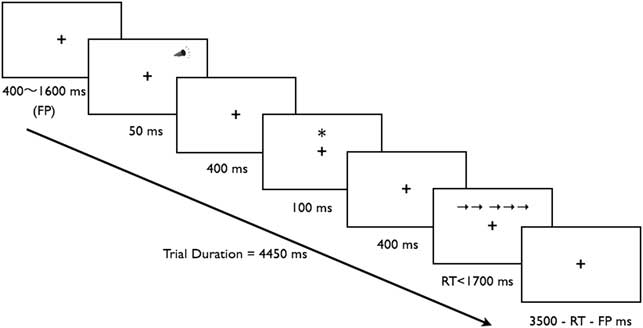
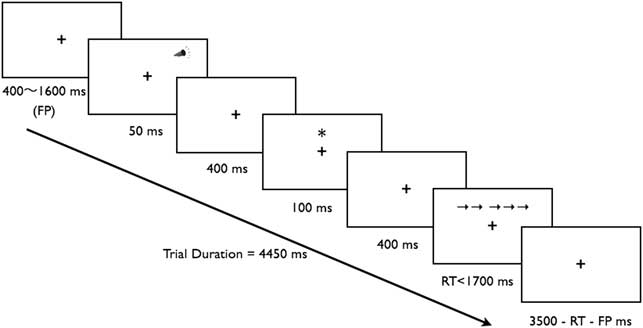
The ANT-I uses a 2 (alerting) × 3 (orienting) × 2 (executive) design (see Figure 1). Twenty-five practice trials (with visual feedback for correct and incorrect responses) are followed by 288 test trials (without feedback) in which stimuli are presented at intervals varying from 400 to 1600 ms. Participants are presented with a fixation cross in the middle of a computer screen on each trial. The alerting stimulus is a 50 ms, 2000 Hz tone that follows the inter-stimulus interval on half of the trials. The orienting cue is an asterisk that is presented on the screen for 50 ms, on 2/3 of the trials. This occurs 100 ms after the alerting tone or the period when the tone would have been presented. Ninety-six of the trials are preceded by a “valid” spatial cue in which the asterisk appears in the location where the target stimulus will subsequently appear. Another 96 trials are preceded by an “invalid” cue, in which the asterisk is presented at the same distance from the central fixation cross, but in the opposite direction as the eventual target location (e.g., above rather than below the fixation cross). No cue is presented on the remaining 96 “no cue” trials. The target stimulus on every trial is an arrow that appears either above or below the fixation cross. The participant's task is to identify its direction by pressing either the “/” key for a right-pointing arrow or the “z” key for a left-pointing arrow on the computer keyboard. The executive (or “congruency”) condition is manipulated by surrounding the target arrow with two arrows of equal size on each side. These “flanker” arrows point either in the same (congruent) or the opposite (incongruent) direction as the target. Half of the trials present congruent flankers while on the other half the flankers are incongruent with the target direction.
Attention Networks Test (ANT-I). Following a 400–1600 ms inter-trial period, the stimulus is preceded by an alerting tone (second panel from the top), and a valid orienting cue (fourth panel from the top). The target arrow is surrounded by congruent flankers (second panel from the bottom). RT = reaction time; FP = foreperiod.
Data Analysis
The efficiencies of the three attention networks were calculated from the ANT-I as follows: Alerting efficiency (Network Score) was evaluated by subtracting the subject's mean reaction time (RT) in conditions when the alerting tone was present from their mean RT when the alerting tone was absent. Orienting Network Score was evaluated by subtracting mean RT in the valid cue conditions from the mean RT in the invalid cue conditions. Executive control Network Score was measured by subtracting the mean RT for congruent flanker trials from the mean RT for incongruent flanker trials (Callejas et al., Reference Callejas, Lupiáñez, Funes and Tudela2005, Reference Callejas, Lupiáñez and Tudela2004; Fan et al., Reference Fan, McCandliss, Sommer, Raz and Posner2002). Only correct trials were included in these analyses. Interactions among network scores and group were determined using a group (2) × alerting (2) × orienting (3) × executive (2) mixed model analyses of variance (ANOVAs) for RT.
Intra-individual variability was measured by calculating individual standard deviations (ISDs) for all participants. This method of estimating intra-individual variability has been found to be more sensitive than alternative measures, like coefficient of variation (CoV; Wojtowicz et al., Reference Wojtowicz, Berrigan and Fisk2012). Only correct trials were used. Data were screened for outliers (i.e., > than 3 SD from the group means) with mean group RTs imputed for missing values, representing a conservative approach to estimating individual variability (Hultsch et al., Reference Hultsch, MacDonald, Hunter, Levy-Bencheton and Strauss2000). To avoid confounding with within-person variability, systematic differences in RT due to trial and block as well as mean level differences in RT associated with group membership were removed (Hultsch et al., Reference Hultsch, MacDonald, Hunter, Levy-Bencheton and Strauss2000). Residual scores were converted to t scores and an ISD score was calculated for each participant.
Results
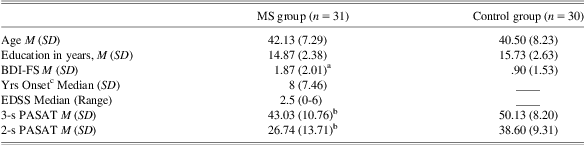
Demographic and clinical data for the participants can be found in Table 1. The groups were matched on age (t(59) = .819; p = .42; Cohen's d = 0.21) and education (t(59) = −1.34; p = .19; Cohen's d = 0.34). Patients with MS endorsed more depressive symptoms on the BDI-FS (t(56.05) = 2.11; p = .04; Cohen's d = 0.56); six scored within the clinical range (i.e., >4). Patients with MS made fewer correct responses on both the 3-s (t(59) = −2.89; p = .005; Cohen's d = 0.75) and 2-s PASAT (t(53.96) = −3.94; p < .001; Cohen's d = 1.07). Using normative values published by Boringa et al. (Reference Boringa, Lazeron, Reuling, Ader, Pfennings, Lindeboom and Polman2001), individual PASAT scores were converted into Z-scores and a 1.5 standard deviation cut-off was used to determine impairment on the PASAT-3 and PASAT-2. Two patients with MS met this criterion for impairment on the PASAT-3 while 8 were impaired on the PASAT-2. One control was impaired on the PASAT-3 and 2 controls were impaired on the PASAT-2. This represents the expected variation of performance found in a normally distributed healthy sample.
Demographic, disease and neuropsychological characteristics
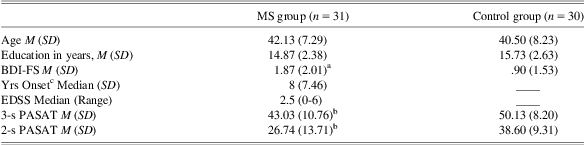
ap < .05.
bp < .01.
cYears since onset of reported MS symptoms.
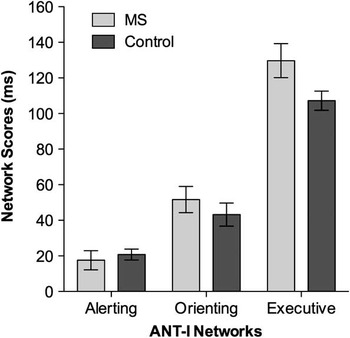
Patients with MS and controls did not differ in response accuracy on the ANT-I (t(59) = −.89; p = .38; Cohen's d = .23; Correct trials: M MS = 282.4; SD MS = 5.79, Accuracy % MS = 98.0%; Correct trials: M Control = 283.4; SD Control =4.06; Accuracy % MS = 98.4). A group (2) × alerting (2) × orienting (3) × executive (2) mixed model ANOVA of mean RT was used to examine interactions between networks and group (Callejas et al., Reference Callejas, Lupiáñez, Funes and Tudela2005, Reference Callejas, Lupiáñez and Tudela2004). This revealed a main effect of group, with patients with MS demonstrating slower overall performance (F(1,59) = 16.24; p < .001; M MS =743.40; SD MS = 117.87; M Control = 630.511; SD Control =100.52; Cohen's f = 0.52), as well as main effects of alerting (F(1,59) = 33.00; p < .001; Cohen's f = .748), orienting (F(1,59) = 74.42; p < .001; Cohen's f = 1.12), and executive control (F(1,59) = 449.98; p < .001; Cohen's f = 2.76). Both patients with MS and controls performed faster when presented with alerting tones and valid spatial cues, and when target flankers were congruent. A group × executive interaction (F(1,49) = 4.05; p < .05; Cohen's f = 0.26) was examined further using planned pairwise comparisons, which demonstrated that patients with MS had particularly slowed performance on trials with incongruent flankers (MMS =808.26; SDMS = 132.43; MControl = 684.12; SDControl =109.91). Figure 2 displays between-group differences for individual alerting, orienting, and executive network scores as determined by the subtraction of RTs described in the Methods section. A series of t tests revealed no difference between patients with MS and controls for the alerting (t(59) = −.479; p = .63) and orienting networks (t(59) = .869; p = .39), although a difference in the executive network was evident for the MS group (t(59) = 2.00; p = .05; Cohen's d = .52).
Alerting, orienting, and executive network scores for MS and control groups from the Attention Network Test (ANT-I). Error bars represent standard deviations.

A t test was used to compare ISD scores across groups. Patients with MS had greater variability across all trials of the ANT-I (t(59) = 5.92; p < .001; M MS = 9.37; SD MS = 1.71; M Control = 6.99; SD Control = 1.42; Cohen's d = 1.5). Pearson correlations were then calculated to examine potential relations between ISD, attention network scores, performance on the PASAT, and disease characteristics within the MS group. PASAT data from one patient were removed due to the participant's inability to follow the test instructions. ISD scores did not correlate significantly with ANT-I Network scores (Alerting Network, r = .10; p = .61; Orienting Network, r = .26; p = .15; Executive Network, r = .12; p = .53), or PASAT scores (PASAT-2, r = −.22; p = .23; PASAT-3, r = −.33; p = .08); or with disease characteristics (EDSS, r = .17; p = .37), years since symptom onset, r = .17; p = .46), or depressive symptoms (BDI-FS, r = .09; p = .65).
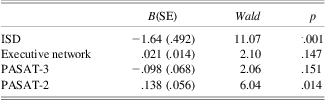
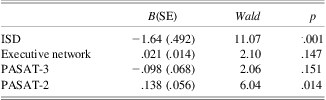
Next, we used logistic regression to examine the unique contributions of ISD, Executive Network scores, and PASAT scores to predicting group membership (MS vs. control). Alerting and Orienting Network scores were not entered into the analysis as they did not differ between groups. The combined information significantly predicted group membership (χ 2[4,N = 59] = 37.49; p < .001; Cox & Snell R square = .47; Nagelkerke R square = .63) and correctly classified 86.4% of all cases (24 of 29 MS patients; 27 of 30 controls). Table 2 presents the standardized weights of each predictor. Individual variability was the best predictor of group membership (i.e., ISD scores; p = .001) followed by PASAT 2 scores (p = .014).
Standardized coefficients of predictor variables of logistic regression predicting group membership
Discussion
Deficits in information processing speed and attention are two of the most commonly reported cognitive impairments in MS (Chiaravalloti & DeLuca Reference Chiaravalloti and DeLuca2008; Arnett & Strober, Reference Arnett and Strober2011). This study sought to investigate response speed, attention network efficiency and intra-individual variability in information processing speed in a sample of mildly affected patients with MS using the ANT-I. The ANT-I examines separate attention networks (i.e., alerting, orienting, and executive), provides information regarding general information processing efficiency, and can be used to examine the stability of a participant's performance over time through calculating intra-individual variability. We also examined the relative utility of intra-individual variability, attention network efficiency and performance on a standard cognitive test (i.e., PASAT-3; PASAT-2) in distinguishing patients with MS from matched healthy controls.
Inefficiency in PASAT performance is commonly found among patients with MS (Fisk & Archibald, Reference Fisk and Archibald2001; Tombaugh, Reference Tombaugh2006) and our sample of mildly affected patients with MS performed worse than controls on both the 3-s and 2-s PASATs. Despite these mean-level group differences, however, relatively few individuals with MS were cognitively impaired. While PASAT scores have been found to correlate with other cognitive tasks, disease severity, and neuroimaging indices of neurological impairment (Bellmann-Strobl et al. Reference Bellmann-Strobl, Wuerfel, Aktas, Dörr, Wernecke, Zipp and Paul2009; Hayton et al., Reference Hayton, Furby, Smith, Altmann, Brenner, Chataway and Kapoor2012; Rovaris et al., Reference Rovaris, Filippi, Falautano, Minicucci, Rocca, Martinelli and Comi1998; Synder & Cappelleri, Reference Synder and Cappelleri2001), it is unclear whether this is due to slowed processing speed, impaired sustained or divided attention, or poor working memory (Tombaugh, Reference Tombaugh2006). Thus, the ability of the PASAT to provide insight into specific cognitive and neurological functioning is limited. As a result, a current debate exists whether the PASAT should be replaced by the Symbol Digit Modalities Test (Smith, Reference Smith1982) for the assessment of information processing speed in MS (Brochet et al., Reference Brochet, Deloire, Bonnet, Salort-Campana, Ouallet, Petry and Dousset2008; Drake et al., Reference Drake, Weinstock-Guttman, Morrow, Hojnacki, Munschauer and Benedict2010). However, neither of these assessment methods provide a precise measure of reaction time nor do they allow for the assessment of information processing speed within specific cognitive domains. In contrast, the ANT-I allows for evaluation of information processing efficiency in individuals with MS across isolable attention networks (Ishigami & Klein, Reference Ishigami and Klein2009). Response accuracy did not differ between the groups and all subjects demonstrated the expected facilitatory effects of alerting tones, valid spatial cues and congruent flankers (Callejas et al., Reference Callejas, Lupiáñez, Funes and Tudela2005, Reference Callejas, Lupiáñez and Tudela2004). However, patients with MS demonstrated evidence of executive network impairment in their prolonged responses when required to ignore conflicting flanking stimuli. In the MS group, inefficiencies in performance became most evident under situations that requiring the resolution of conflicting input to determine response options.
Our findings that patients with MS have problems allocating attentional resources necessary for response inhibition differ somewhat from previous studies using the original version of the ANT in individuals with MS (Crivelli et al., Reference Crivelli, Farez, González, Fiol, Amengual, Leiguarda and Correale2012; Urbanek et al., Reference Urbanek, Weinges-Evers, Bellmann-Strobl, Bock, Dorr, Hahn and Paul2010). These investigators found deficiencies in the alerting network of patients with MS and differences in response inhibition only in the context of an alerting cue (i.e., Patients with MS were slower on incongruent trials after the presence of an “alerting” cue). This may be attributable to methodological differences between the ANT and the ANT-I since the alerting and orienting networks in the ANT are confounded (Ishigami & Klein, Reference Ishigami and Klein2009, Reference Ishigami and Klein2010) with both being defined by similar visual cues (i.e., a double asterisk as an alerting cue and a single asterisk as a spatial orienting cue). The ANT-I uses separate sensory modalities for alerting and orienting, with and auditory cue for the former and a visual cue for the latter, and this difference in sensory modalities for the alerting network may account for the discrepant findings. Consistent with our results, Omisade et al. (Reference Omisade, Fisk, Klein, Schmidt, Darvesh and Bhan2012) did not find differences in the alerting network in patients with MS using the ANT-I, although they did find executive network inefficiency when patients were in the alerted state. While our findings confirm the presence of executive network inefficiency among the patients with MS, we did not find that this was dependent on the alertness of patients. The differences between our findings and those of Omisade and colleagues (2012) may be attributable to the differences in disease severity, with the patients in the current sample being more mildly affected. Since Omisade et al. (Reference Omisade, Fisk, Klein, Schmidt, Darvesh and Bhan2012) demonstrated that the strength of the alerting × executive interaction increases with greater structural MRI damage, it is possible that the patients in our sample were too mildly affected for this interaction to emerge. Despite some discrepancies in ANT and ANT-I performance among patients with MS in the studies to date, all have demonstrated some degree of inefficiency in the executive control in MS.
Our findings are consistent with previous suggestions of impaired “top-down attentional control” among patients with MS (McCarthy, Beaumont, Thompson, & Peacock, Reference McCarthy, Beaumont, Thompson and Peacock2005; Nebel et al., Reference Nebel, Wiese, Seyfarth, Gizewski, Stude, Diener and Limmroth2007; Paul, Beatty, Schneider, Blanco, & Hames, Reference Paul, Beatty, Schneider, Blanco and Hames1998). Decline in the executive control of attention in our patient sample did not reflect generalized slowing or inefficiency of attention networks. Thus, these results are consistent with the Independent Consequence model of cognitive dysfunction by DeLuca et al. (Reference DeLuca, Chelune, Tulsky, Lengenfelder and Chiaravalloti2004), which proposes that impairments in some higher-order cognitive abilities in individuals with MS, such as executive functions, may be independent of a generalized slowing of information processing.
Importantly, we also found that patients with MS demonstrated greater intra-individual response variability on the ANT-I, regardless of any cognitive slowing or difficulties with executive control of attention. This is consistent with other studies that have demonstrated greater intra-individual variability in RT performance in MS (Bodling et al., Reference Bodling, Denney and Lynch2012; Bruce et al., Reference Bruce, Bruce and Arnett2010; Wojtowicz et al., Reference Wojtowicz, Berrigan and Fisk2012) as well as other neurodegenerative disorders (Burton et al., Reference Burton, Strauss, Hultsch, Moll and Hunter2006; Hultsch et al., Reference Hultsch, MacDonald, Hunter, Levy-Bencheton and Strauss2000). Greater intra-individual variability in our sample of patients with MS was not associated with disease duration or EDSS. Poor associations between EDSS and cognitive test performance are common (Arnett & Strober, Reference Arnett and Strober2011). Although the range of EDSS scores in our sample was constrained by our selection criteria, Bodling et al. (Reference Bodling, Denney and Lynch2012) also failed to find an association between intra-individual response time variability and EDSS, or disease duration within a more diverse sample of patients.
The absence of significant associations between intra-individual variability, attention network scores and PASAT scores in our sample suggests that intra-individual variability provides a distinct isolable measure of cognitive function. Supporting this suggestion, we were able to demonstrate that intra-individual variability contributed the most to a model predicting group membership for patients with MS and controls. Prior studies have demonstrated an association between within-subject variability and degradation in both white and gray matter for other neurological populations including frontotemporal dementia, traumatic brain injury, and mild cognitive impairment (MacDonald, Li, & Bäckman, Reference MacDonald, Li and Bäckman2009). MS involves both white matter (Ludwin, Reference Ludwin2006) and gray matter pathology (Geurts & Barkhof, Reference Geurts and Barkhof2008; Vercellino et al., Reference Vercellino, Plano, Votta, Mutani, Giordana and Cavalla2005) that affects widespread brain regions. As such, intra-individual variability in cognitive tasks like the ANT-I, that require the integrity of multiple neuronal networks (Fan, McCandliss, Fossella, Flombaum, & Posner, Reference Fan, McCandliss, Fossella, Flombaum and Posner2005) may be a sensitive means of capturing the behavioral consequences of the pathophysiological changes affecting patients with MS. Future research integrating neuroimaging methods may reveal more direct relations between specific pathological changes, intra-individual variability, and attentional network integrity in MS.
One limitation of our study was our enrollment of only female relapsing-remitting patients with a relatively limited range of disability, which in turn limits our ability to generalize to the larger MS population. Also, among patients with MS, self-reported fatigue has been found to influence information processing speed (Andreasen, Spliid, Andersen, & Jakobsen, Reference Andreasen, Spliid, Andersen and Jakobsen2010; Weinges-Evers et al., Reference Weinges-Evers, Brandt, Bock, Pfueller, Dörr, Bellmann-Strobl and Paul2010) as well as performance variability (Bruce et al., Reference Bruce, Bruce and Arnett2010). We were unable to directly investigate the role of fatigue in our study and future work is necessary to determine the relation of fatigue and intra-individual variability in attention performance for patients with MS. Our findings do identify the need for further research into intra-individual variability, with a broader range of patients with MS and a greater variety of cognitive tasks. This study also contributes to the growing evidence of attentional network deficits in MS and demonstrates the need for further research investigating the use of measures such as the ANT-I to identify the core features of cognitive dysfunction in this disease.
Acknowledgments
This research was funded by grants from the Multiple Sclerosis Society of Canada and the Capital District Health Authority Research Fund. Magdalena Wojtowicz was supported by a studentship from the Multiple Sclerosis Society of Canada. Thanks to Trudy Campbell and all staff of the Dalhousie MS Research Unit for their assistance with subject selection. Thanks to Dr. Lindsay Berrigan for assistance with statistical issues. The Authors declare that there is no conflict of interest.