Children residing in inner cities face elevated risk for exhibiting disruptive behavior problems, including attention-deficit/hyperactivity disorder (ADHD). Neighborhood risks that pervade inner cities directly impact the growth of problems as well as hamper the protective role of families and schools. Early prevention efforts have been shown to be efficacious in decreasing the rates of disruptive behavior; however, less notice has been paid to prevention of ADHD symptoms. A substantial need exists for empirically based prevention given the persistent course of ADHD and the multiple challenges to tertiary prevention that are compounded in inner cities. Efforts to intervene early may be further complicated by the developmental heterogeneity of ADHD symptoms; children on different developmental paths may respond differently to interventions. This study used data from the SAFE Children evaluation, a longitudinal randomized controlled efficacy trial of a family-based preventive intervention focused on inner-city youth. The study tested whether a contextually appropriate intervention implemented at the transition into grade school may positively change the developmental trajectories of ADHD symptomatology.
Risk and Inner Cities
Inner-city communities are distinguished from other urban and poor communities by significant concentrations of unemployment, poverty, and crime (Wilson, Reference Wilson1987). Inner-city neighborhoods lack home ownership and businesses and are marked by higher levels of school dropout, teenage pregnancy, and neighborhood mobility. Crime and violence pervade these neighborhoods. Children growing up in these areas face significant environmental risk and demonstrate greater rates of mental health problems, especially disruptive behavior disorders (Loeber, Farrington, Stouthamer-Loeber, & Van Kammen, Reference Loeber, Farrington, Stouthamer-Loeber and Van Kammen1998; Shaw, Gilliom, Ingoldsby, & Nagin, Reference Shaw, Gilliom, Ingoldsby and Nagin2003; Tolan & Henry, Reference Tolan and Henry1996). Studies demonstrate increased levels of antisocial behaviors, including oppositionality, rule breaking, and delinquency; however, less attention has been paid to ADHD symptoms. Although no rigorous epidemiological studies estimate the true prevalence of ADHD in inner-city neighborhoods, studies consistently demonstrate an inverse relationship between socioeconomic status and ADHD disorder (Biederman, Faraone, & Monuteaux, Reference Biederman, Faraone and Monuteaux2002; Dopfner et al., Reference Dopfner, Breuer, Wille, Erhart and Ravens-Sieberer2008; Scahill et al., Reference Scahill, Schwab-Stone, Merikangas, Leckman, Zhang and Kasl1999). In a representative sample of preschoolers living in Chicago, Illinois, African American children exhibited more than two times the rates of ADHD diagnoses compared with White children (21.5% vs. 9.2%), and African American children disproportionately live in poorer areas (Lavinge, LeBailly, Hopkins, Gouze, & Binns, Reference Lavinge, LeBailly, Hopkins, Gouze and Binns2009).
Neighborhood effects not only directly impact behavioral regulation but also pervade the protective role that families and schools play in the lives of children (Gorman-Smith, Tolan, & Henry, Reference Gorman-Smith, Tolan and Henry2000; Leventhal & Brooks-Gunn, Reference Leventhal and Brooks-Gunn2000; Sampson, Raudenbush, & Earls, 1997). Chronic exposure to violence significantly impacts development, while parental concerns for safety may inhibit engagement in supportive networks and collective parenting efforts, which in turn exacerbates the development of behavior problems (Brody et al., Reference Brody, Ge, Conger, Gibbons, Murry and Gerrard2001; Tolan, Gorman-Smith, Henry, & Schoeny, Reference Tolan, Gorman-Smith, Henry and Schoeny2009; Sampson et al., 1997). Schools serving inner-city neighborhoods frequently lack the resources needed to address the multitude of issues that result from neighborhood violence and disorganization (Atkins et al., Reference Atkins, Frazier, Birman, Adil, Jackson and Graczyk2006). Teachers struggle to handle the increased mental health problems seen in classrooms, and students may miss out on opportunities to form developmentally important supportive relationships (Hoglund & Leadbetter, Reference Hoglund and Leadbeater2004).
The SAFE Children Preventive Intervention
Prevention strategies targeting at-risk youth have shown efficacy in thwarting the development of more serious antisocial behavior in later life. In particular, the SAFE Children Preventive Intervention has demonstrated a positive impact on promoting the well-being of elementary school-aged children in inner-city Chicago (Tolan, Gorman-Smith, & Henry, Reference Tolan, Gorman-Smith and Henry2004). The initial intervention was provided in the first grade as children and parents navigated the transition into school and the associated increased demands of the classroom setting. The initial SAFE Children comprised a group-based family intervention and a tutoring program. Multiple-family groups met for 20 weekly sessions and focused on (a) parenting skills, (b) family relationships, (c) understanding and managing expectable developmental and situational challenges to the families, (d) increasing support among parents in the group, (e) skills in and issues regarding engaging as a parent with the school, and (f) managing issues such as neighborhood problems (e.g., violence). Groups included four to six families and addressed issues of parenting, within-family relations, and parental involvement in a child's schooling (McKay, Gonzales, Quintana, Kim, & Abdul-Adil, Reference McKay, Gonzales, Quintana, Kim and Abdul-Adil1995; Tolan & McKay, Reference Tolan and McKay1996; Webster-Stratton, Reference Webster-Stratton1990). All family members were invited to attend sessions, including caregivers and children. Multiple-family groups combined information provision, skill practice, group problem solving, and at-home exercises to apply session material. The group approach built on previous research that suggested such intervention modes foster social support among families and improve parent–child interactions (McKay et al., Reference McKay, Gonzales, Quintana, Kim and Abdul-Adil1995; Webster-Stratton, Reference Webster-Stratton1990).
The first-grade reading–tutoring program incorporated both phonics and whole language approaches and was based on the tutoring shown to be effective in the Fast Track intervention (Conduct Problems Prevention Research Group, 1999). During the 22-week intervention period, one-on-one tutoring sessions with university students occurred twice weekly for 30 min each at schools. Trained tutors modeled and reinforced a step-by-step approach to reading that encouraged students to recognize the sounds of letters and letters within words. As students gained mastery, structured activities facilitated student awareness of similar sounding words to expand vocabulary. Each session followed a similar structure that facilitated skills training and avoided repetitiveness. Students spent equal amounts of time on phonics, letter and word activities, and reading. Tutors used reading-level appropriate materials to provide positive academic experiences marked by feelings of accomplishment.
The combination of academic support and multiple-family groups encouraged more positive attitudes about achievement and school involvement, lower isolation, and more supportive relationships for parents and elicited greater self-control, lower aggression, and higher social competence for children. Half of those originally assigned to the initial SAFE Children intervention were randomly assigned to receive a second phase of the program in fourth grade. The booster program was similar to the initial intervention with content modified to target the transition into adolescence and the associated risk period for onset of behavioral problems and substance abuse. A 20-session multiple-family group intervention was paired with a reading club and access to age appropriate books. Families were encouraged to help set time for children to read, to read books with their children, and to bring the books they read into the multiple-family group discussions. As with the initial intervention, the booster family groups consisted of four to six families and focused successively on effective parenting practices, managing school achievement motivation and involvement in school, peer relations, and ecological challenges such as violence and safety. Intervention methods included information, group discussion, behavioral practice, and group support.
A longitudinal randomized controlled trial demonstrated positive proximal and distal impact on behavioral outcomes of randomly selected children entering first grade at seven inner-city schools (Tolan et al., Reference Tolan, Gorman-Smith and Henry2004, Reference Tolan, Gorman-Smith, Henry and Schoeny2009). Families were randomly assigned to SAFE Children (n = 232) or the control condition (n = 192). Initial intervention effects on the growth of externalizing behaviors, as well as on reading achievement, assessed from kindergarten through the beginning of second grade suggested that SAFE Children positively impacted youth at greatest risk for behavioral problems (Tolan et al., Reference Tolan, Gorman-Smith and Henry2004). Children who received SAFE Children and were at highest risk because of family or behavioral problems at baseline demonstrated significantly greater decreases in aggression, while measures of parenting also improved six months after the initial intervention. Furthermore, children from high-risk families exhibited increases in ability to concentrate through the beginning of second grade. Families who received the initial intervention were randomly assigned to receive the second phase SAFE Children intervention in fourth grade (n = 101). The booster demonstrated efficacy in improving reading skills as well as reducing aggression, such that children who received the booster exhibited significant decreases in aggression and impulsivity from fourth grade to sixth grade compared with children who received the initial intervention only (Tolan et al., Reference Tolan, Gorman-Smith, Henry and Schoeny2009). These findings suggested that SAFE Children may prevent growth of behavioral problems among inner-city children through improving familial functioning and fostering connections with school. However, examination of effects on ADHD symptom development across the middle school years, from kindergarten through fifth grade, has yet to be examined.
Rationale and Challenges to ADHD Prevention
Other evidence supports the potential of family-based preventive intervention for ADHD problems. Correlational data demonstrate a positive association between punitive and harsh parenting and ADHD symptomatology (Campbell, Reference Campbell, Sameroff, Lewis and Miller2000; DuPaul, McGoey, Eckert, & Vanbrakle, Reference DuPaul, McGoey, Eckert and Vanbrakle2001). Research from tertiary preventions with children diagnosed with ADHD suggest that parent-training models that elicit greater consistency in rules, advocate the use of rewards, and foster less harsh parenting, relate to less oppositional and defiant behavior, as well as parental reports of their child's problems with attention (Bor, Sanders, & Markie-Dadds, Reference Bor, Sanders and Markie-Dadds2002; Jones, Daley, Hutchings, Bywater, & Eames, Reference Jones, Daley, Hutchings, Bywater and Eames2008; Strayhorn & Weidman, Reference Strayhorn and Weidman1989). Interventions that promote positive family functioning, such as the Incredible Years, improve outcomes when implemented with children diagnosed with ADHD (Hartman, Stage, & Webster-Stratton, Reference Hartman, Stage and Webster-Stratton2003; Webster-Stratton, Reid, & Beauchaine, Reference Webster-Stratton, Reid and Beauchaine2013). In addition, a transactional relationship seems to exist such that initial ADHD symptoms elicit more harsh parenting (Seipp & Johnston, Reference Seipp and Johnston2005), which in turn exacerbates ADHD symptoms and predicts comorbidity with oppositional and deviant behavior (Belsky, Fearon, & Bell, Reference Belsky, Fearon and Bell2007; Ostrander & Herman, Reference Ostrander and Herman2006). Preventing this tautological relationship between symptoms and parenting disruptions may offer a mechanism for early intervention.
Despite this body of research, little is known regarding specific strategies to prevent ADHD in inner-city neighborhoods (Sonuga-Barke & Halperin, Reference Sonuga-Barke and Halperin2010). This is especially problematic given the longitudinal course of ADHD. Typically, symptoms emerge early, with an average onset around 5 years of age based on retrospective reports (Todd, Huang, & Henderson, Reference Todd, Huang and Henderson2008). Prospective studies suggest that symptoms decline with age; however, many children continue to exhibit clinical and subsyndromal levels of symptoms into adolescence, and approximately one third of children diagnosed with ADHD in childhood continue to meet diagnostic criteria in adulthood (Barkley, Fischer, Smallish, & Fletcher, Reference Barkley, Fischer, Smallish and Fletcher2006; Lara et al., Reference Lara, Fayyad, de Graaf, Kessler, Aguilar-Gaxiola and Angermeyer2009; Mannuzza et al., Reference Mannuzza, Klein, Bonagura, Malloy, Giampino and Addalli1991). The course of untreated ADHD is complicated by extensive comorbidity with other internalizing, externalizing, and neuropsychological disorders (Biederman, Newcom, & Sprich, Reference Biederman, Newcorn and Sprich1991; Gadow, Nolan, Sprafkin, & Schwartz, Reference Gadow, Nolan, Sprafkin and Schwartz2002) that hampers response to interventions (Hinshaw & Melnick Reference Hinshaw and Melnick1995; Loeber, Reference Loeber1990; Moffitt, Reference Moffitt1993).
In childhood and adolescence, an ADHD diagnosis relates to impairment across multiple domains of functioning, including social rejection, academic problems, and disrupted relationships with adults (Bussing, Mason, Bell, Porter, & Garvan, Reference Bussing, Mason, Bell, Porter and Garvan2010; Massetti et al., Reference Massetti, Lahey, Pelham, Loney, Ehrhardt and Lee2008). Adult ADHD has been associated with elevated rates of mood, anxiety, and substance use disorders, as well as impulsivity (Kessler et al., Reference Kessler, Adler, Barkley, Biederman, Conners and Demler2006), while prospective studies of children diagnosed with inattention and hyperactivity followed into young adulthood identify significant risks in multiple domains of functioning, including educational, occupational, financial, and social relationships, with greater rates of substance abuse and criminal involvement (Barkley et al., Reference Barkley, Fischer, Smallish and Fletcher2006; Mannuzza, Klein, & Moulton, Reference Mannuzza, Klein and Moulton2008; Molina & Pelham, Reference Molina and Pelham2003).
The persistence of symptoms of ADHD in addition to its long-term outcomes accentuates the impact of untreated attention, hyperactivity, and impulsivity problems. The lack of empirically based prevention strategies for ADHD is complicated by the inefficiencies of tertiary preventions, especially in inner cities (Sonuga-Barke & Halperin, Reference Sonuga-Barke and Halperin2010). Psychopharmacological interventions show promising effects in efficacy trials; however, effects dissipate over time (Jensen et al., Reference Jensen, Arnold, Richters, Severe, Vereen and Vitiello1999, Reference Jensen, Arnold, Swanson, Vitiello, Abikoff and Greenhill2007; Molina et al., Reference Molina, Hinshaw, Swanson, Arnold, Vitiello and Jensen2009), and few children remain on medication throughout the course of their symptoms (Weiss, Gadow, & Wasdell, Reference Weiss, Gadow and Wasdell2006). Side effects and parental resistance to the use of medications impair adherence to medication regimens (Corkum, Rimer, & Schachar, Reference Corkum, Rimer and Schachar1999; Swanson, Elliot, et al., Reference Swanson, Elliott, Greenhill, Wigal, Arnold and Vitiello2007). Moreover, the unavailability of consistent and evidence-based medication management that is particularly pronounced in inner cities makes effective psychopharmacological interventions an inadequate long-term strategy for the treatment of ADHD (Atkins et al., Reference Atkins, Frazier, Birman, Adil, Jackson and Graczyk2006).
Psychological interventions that focus on parent-based training also demonstrate poor compliance, lack of generalization, and diminishing effects after treatment stoppage (Barkley et al., Reference Barkley, Shelton, Crosswait, Moorehouse, Fletcher and Barrett2000; Pelham & Fabiano, Reference Pelham and Fabiano2008). Accessibility to empirically supported psychological treatments is limited by a lack of service providers in low-income areas and by difficulties engaging at-risk families into treatment (Atkins et al., Reference Atkins, Frazier, Birman, Adil, Jackson and Graczyk2006; Kataoka, Zhang, & Wells, Reference Kataoka, Zhang and Wells2002; Kazdin, Holland, & Crowley, Reference Kazdin, Holland and Crowley1997). Few inner-city families in need of mental health services connect to providers, and fewer remain in treatment long enough to change behaviors. Teachers disproportionately shoulder the burden of implementing behavior modification programs, and teachers in urban schools report a lack of confidence in and aversion to the use of empirically supported psychological interventions for ADHD (Graczyk et al., Reference Graczyk, Atkins, Jackson, Baumann, Kim and Letendre2005; Hughes, Cavell, Meehan, Zhang, & Collie, Reference Hughes, Cavell, Meehan, Zhang and Collie2005).
Developmental Heterogeneity and ADHD Prevention in Inner Cities
The absence of effective preventive interventions for ADHD in inner cities is further complicated by variability in ADHD symptom growth. Evidence suggests that the developmental course of ADHD is characterized by heterogeneity. Investigation of the temporal stability of subtype classifications highlights discontinuity of symptoms (Lahey, Pelham, Loney, Lee, & Willcutt, Reference Lahey, Pelham, Loney, Lee and Willcutt2005; Todd et al., Reference Todd, Huang and Henderson2008). One longitudinal study of 4- to 6-year-olds found that 50% of youths diagnosed with ADHD predominately hyperactive subtype shifted to the combined subtype at an 8-year follow-up; the other 50% were reported asymptomatic (Lahey et al., Reference Lahey, Pelham, Loney, Lee and Willcutt2005). Not only may children transition from clinical to nonclinical levels, but more subtle variations may also exist in levels and types of symptoms expressed over time.
The developmental heterogeneity of ADHD has been more explicitly assessed using innovative statistical analyses of data from longitudinal studies. Mixture models simultaneously test within-individual and between-individual change in symptoms over time (Muthén, Reference Muthén and Kaplan2004). This enables the identification of homogenous subgroups within a larger sample that demonstrate different starting points and growth trajectories of ADHD symptoms. A number of studies using mixture models find multiple latent trajectory classes of ADHD. Data from the Multimodal Treatment Study of Children with ADHD demonstrates variability in symptomatology over time in response to pharmacological interventions (Swanson, Hinshaw, et al., Reference Swanson, Hinshaw, Arnold, Gibbons, Marcus and Hur2007). The data suggest that three subgroups exist after medication: The largest group (52%) demonstrate a significant decline in symptoms that maintains across follow-ups over 3 years. Another class, including 34% of the sample, shows a linear decline in symptoms, while a small class (14%) shows a concave pattern of symptoms across the follow-up period. In a study of siblings at risk for ADHD and conduct problems due to having an alcoholic parent, Jester and colleagues (Reference Jester, Nigg, Adams, Fitzgerald, Puttler and Wong2005) also identified developmental heterogeneity using inattentive and hyperactive symptoms rated by teachers at four time points. Models included simultaneous growth in aggressive behaviors in the follow-up from school age to adolescence. Findings suggest four latent trajectory classes characterized by either high or low hyperactive trajectories accompanied by high or low aggression trajectories.
Malone, Van Eck, Flory, and Lamis (Reference Malone, Van Eck, Flory and Lamis2010) use data from the Fast Track project, a prevention program for children with disruptive behavior problems attending schools in at-risk communities. The longitudinal evaluation randomly assigned 27 high-risk schools to the intervention or a control condition, and the sample included randomly selected first graders (n = 387) and first graders identified with disruptive behavioral problems (n = 367). Symptom counts pooled across parent-reported DSM-III inattentive and hyperactive symptoms at the end of third, sixth, and ninth grades. Three subgroups emerge, with the majority of children (52%) demonstrating minimal problems, 24% exhibiting higher symptoms that spiked in sixth grade, and 18% of children showing elevated symptoms in a concave pattern over the follow-up period. Intervention effects were not modeled in these analyses.
Together, these findings suggest variability in the expression of ADHD symptoms over time among at-risk children. Differences exist across studies in the most appropriate number of subgroups that typify ADHD; however, these discrepancies likely reflect differences in the studies. Samples varied across populations sampled (clinical vs. community vs. high-risk samples), age of children, length and age of follow-up, demographic characteristics, informants, and symptoms assessed. Developmental heterogeneity may reflect different etiological factors, attenuating features, and subsequent outcomes (Loeber, Reference Loeber, Cicchetti and Toth1991; Nigg, Willcutt, Doyle, & Sonuga-Barke, Reference Nigg, Willcutt, Doyle and Sonuga-Barke2005; Sonuga-Barke & Halperin, Reference Sonuga-Barke and Halperin2010). Children may follow different developmental trajectories based on their unique combinations of risk and compensatory factors at a given period. Moreover, environmental changes at developmentally sensitive periods may function to alter the course of development. Well-timed preventive interventions may place children on a more positive track and away from negative outcomes. This effect is missed without identifying subgroups of developmental trajectories. Evaluations that only compare pre/posttest mean-level outcomes or differences in rate of change of symptoms may obscure the full impact of preventive interventions. Although developmental heterogeneity of ADHD contributes to the complexity of evaluation, it also offers the potential to identify life-changing effects.
Present Study
The aim of the present study was to test the effect of the SAFE Children preventive intervention on the growth of ADHD symptoms from kindergarten to sixth grade. Participants were 424 children at risk to develop aggression problems residing within inner-city neighborhoods. Individual youth were randomly assigned to either intervention (n = 232) or control (n = 192) conditions. The 20-week preventive intervention started at the beginning of first grade and combined multiple-family groups focused on promoting family functioning with one-on-one phonics-based tutoring. Youth who received intervention were randomly assigned to receive a booster intervention in the second grade.
Growth mixture modeling (GMM) estimated the latent developmental trajectories of three outcomes (impulsivity, concentration, and hyperactivity) reported by parents and teachers. Models theorized heterogeneity in growth of ADHD symptoms and empirically identified the optimal number of latent growth trajectory subgroups. It was hypothesized that the initial preventive intervention would increase the likelihood of being on a positive developmental trajectory compared to the control condition. In addition, it was predicted that youths in the booster intervention would be more likely than those in the initial treatment condition group to experience positive trajectories. These effects were estimated beyond the direct effects on growth in symptoms of intervention, gender, ethnicity, and initial family and child risk.
Three aspects of symptomatology (impulsivity, concentration, and hyperactivity) were examined separately to determine if unique treatment effects existed on outcomes. The SAFE Children preventive intervention was not explicitly designed to address attention and hyperactivity problems, and therefore the multicomponent intervention may have differentially impacted these behaviors. Tutoring was intended to promote concentration abilities by modeling skills of redirection to on-task behaviors, whereas the multiple-family groups taught parents behavior management techniques that rewarded positive behavior and discouraged misbehavior. Examining the pattern of treatment effects across outcomes allowed an empirical test of the program theory and avoided missing potentially important outcomes. Furthermore, reports from multiple informants (teachers and caregivers) captured child outcomes at home and school. SAFE Children targeted behavior in both environments, and the inclusion of multiple perspectives tests the generalizability of program effects.
Analyses compared youth randomly assigned to SAFE Children in first grade with those referred to the control condition and tested differences between youth randomly referred to a booster intervention in the fourth grade and youth who only received the initial intervention. Additional covariates were included to best estimate models and reduce the influence of misspecification due to missing important influences on growth (Muthén, Reference Muthén2003, Reference Muthén and Kaplan2004). Analyses simultaneously examined SAFE Children effects on two aspects of change in symptomatology: Models tested treatment effects on growth curves constrained to be equal across classes and membership in different developmental subgroups. This approach captured changes in outcome levels over time and whether SAFE Children placed youth on a different developmental course. Moderation analyses explored alternative hypotheses that other factors explained intervention effects. In particular, tests examined whether youth who exhibited high-risk behavior before random assignment to the intervention and youth who received psychopharmacological interventions during the course of the study experienced different developmental patterns of ADHD symptomatology.
Method
Participants
Eligibility for the study required family residence in inner-city neighborhoods characterized by extreme concentration of poverty, high rates of crime, low rates of home ownership or business investment, and disproportionate rates of multiple social problems, such as early pregnancy and school dropout (Wilson, Reference Wilson1987). The organization of most Chicago public schools around neighborhood boundaries facilitated the targeting of inner-city families. All families with children in kindergarten at any of seven Chicago public schools were approached; five schools had participated in a passive longitudinal study, the Chicago Youth Development Study (Tolan et al., Reference Tolan, Gorman-Smith and Henry2004), while two other schools serving similar communities were added to obtain adequate sample size for this study.
A number of indicators suggested that targeted neighborhoods represented economically disadvantaged urban communities (US Census Bureau, 1992). According to 1990 Census data, neighborhoods represented in this study exhibited a 28% poverty rate compared to 21% in Chicago and 13% in the United States. Neighborhoods had higher levels of unemployment: 17% versus 11% in Chicago and 6% in the United States. The US Federal Bureau of Investigation's (2004) report on violent crimes per 100,000 in 1992 showed substantially higher rates of 6,944 in study neighborhoods compared to Chicago's 825 and the rate across the United States of 923.
In the spring of 1997, primary caregivers of all kindergarten children in each of the seven schools were contacted and asked to participate. Although families were recruited in the spring of kindergarten year, families were eligible if they resided within the neighborhood boundaries of the school in which youths would attend first grade. A total of 507 families were eligible, and of these, 424 families (84% of those targeted) consented to participate and completed two pretest assessments. The recruited sample included 42.5% African American and 57.5% Latino families. Children were equivalent on gender with 51% females. Two fifths of children resided in single-parent households, and 44% of the primary caregivers (usually the mother) had not graduated from high school. At initial pretest, nearly three fifths (59%) of families reported an annual income below $20,000, and 85% had a family income below $30,000. A total of 62% of families reported five or more people living in the household, and 57% of the families had moved at least once in the year prior to the study. However, the majority of families that changed addresses remained within the same neighborhood.
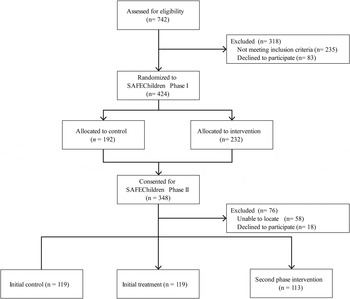
Figure 1 depicts recruitment and assignment of participants across the study. Random assignment accounted for differential retention rates in intervention conditions by assigning 55% (n = 232) of families to the intervention condition and 45% (n = 192) to the control condition. To account for school effects, random assignment was conducted within the classroom. Features of the intervention limited the extent of possible contamination such as tutoring offered individually and family groups conducted after school. Any potential contamination effects provide a further challenge to significant differences attributable to the intervention.
Consolidated Standards of Reporting Trials (CONSORT) chart depicting recruitment and assignment of participants in SAFE Children.

All children assigned to the initial SAFE Children intervention were also randomly assigned to receive a second-phase intervention as youth entered fourth grade in the fall of 2000. To avoid potential selection bias, random assignment occurred regardless of participation patterns in the initial intervention or retention in the study. Contrary to expectation, no differential retention existed between treatment conditions in the first phase of the intervention, and therefore children in the initial intervention were randomly assigned equally to the second phase intervention. Children received either the second-phase intervention (n = 113, 49%) or assessments only (n = 119, 51%). Children in the initial control condition also continued to be assessed (n = 119).
Procedures
Intervention fidelity
As has been done in another project that implemented an intervention based in part on SAFE Children (Multisite Violence Prevention Project, 2013), fidelity to the intervention model was maintained through extensive staff preparation and ongoing supervision. For the multiple-family intervention, group leaders were required to have at least a master's degree in psychology, social work, public health, or a related field, and professional experience working within inner-city communities. Thirty hours of training were required prior to implementing the intervention. Training covered risk and prevention, family intervention theory and methods, and cultural and social class issues. The intervention manual provided detailed description of the goal of each weekly session, educational materials provided to families, in-session activities, and homework instructions for each week.
Staff meetings were held consistently during the intervention to ensure quality service delivery and standardization among group leaders. Weekly group supervision carefully reviewed the goals of each session to ensure leaders worked on the same tasks and approached common issues in a similar manner. In addition, individual supervisions occurred each week to review videotaped sessions and ensure adherence to the intervention protocol. These weekly supervisions focused on maintaining consistency in activities, goals, and intervention strategies. Self-ratings and supervisor ratings of group leaders' session management were conducted each week to assess fidelity. Any indication of inadequate adherence was addressed through increased supervision. In addition, supervision directly focused on issues of race, racism, and inner-city poverty that arose in sessions or elicited reactions from group leaders. Role-plays were conducted to help staff practice and feel comfortable in handling the many ways families raise issues of race and culture, such as accusations of racism among school personnel, avoiding intervention techniques that conflicted with religious or cultural values, and feeling judged by study staff.
The tutoring program also incorporated careful preparation and supervision to ensure fidelity. Tutoring staff included a full-time coordinator, a part-time assistant coordinator, and approximately 40 to 50 tutors recruited from university departments of education, psychology, and social work. Each tutor attended two 3-hr training sessions that reviewed the tutoring manual and phonics methods used in SAFE Children. Trainings used demonstrations as well as role plays with 6-year-old children to model and practice skills. Consistency and reliance on the manual were repeatedly emphasized throughout training and supervision. Tutors were required to attend weekly 1-hr group supervisions to problem solve around barriers. Tutors submitted report sheets that documented which children were tutored during the week and the activities that occurred during the sessions. The project coordinator and assistant observed each tutor twice during the intervention. In addition, students rated tutors five times during the intervention. Feedback was provided immediately to tutors on their performance, and additional training was implemented when needed.
Family participation was tracked to detect differential exposure to intervention components. Of those families assigned to the initial intervention condition, 178 (82%) participated in at least half of the family sessions combined with full participation in the child's tutoring intervention. However, the majority (78%) completed all family sessions. No significant differences between completers and noncompleters were found on any pretest characteristic. Likewise, four-fifths of the families assigned to the booster intervention in fourth grade completed a majority of the intervention sessions, and 69% completed between 90% and 100% of the sessions. Again, no significant differences between completers and non-completers were found on any pretest characteristic.
Assessment
This study used nine waves of data collected across 5 years to measure initial and second-phase intervention effects. Data were obtained through individual interviews with primary caregivers and the targeted child and through teacher assessments. Two pretest assessments occurred in the spring and fall of 1997 to gauge functioning as children transitioned from kindergarten into the first grade. Randomization to SAFE Children or control condition occurred after the pretest assessment to avoid selection bias. Follow-up assessments occurred after the second baseline at 3 months (spring 1998), 6 months (summer 1998), 12 months (fall 1998), 24 months (fall 2000), 28 months (spring 2001), 30 months (summer 2001), and 42 months (summer 2002). Due to financial constraints, only teacher assessments occurred at the 3- and 28-month follow-ups, and only caregivers were assessed at 42 months. Data collected from individual interviews with children and through school records were not used in this study.
Study staff used telephone contacts and home visits to recruit families. The primary caregivers provided consent and participated in interviews. This predominantly included mothers (over 90%). If the mother lived out of the home, interviewers identified the father or an adult female with central responsibilities for caring for the child. The same primary caregiver reported on the child across most follow-up assessments; teacher informants varied over time as youth progressed through school. Interviewers were recruited from the community of study and conducted assessments in two-person teams. After obtaining informed consent and explaining study procedures to the family, the interviewers talked with parents individually and recorded the answers on laptop computers. Child measures were provided to primary caregivers for review upon request. All measures collected in pilot interviews were translated into Spanish and back into English prior to use to ensure families could respond fully. The project coordinator and data management staff checked every interview for proper consent, missing data, accuracy, and out-of-range values. A random sample of 20% of the cases received a follow-up phone call from the project director to assess whether interview procedures were followed. In addition, each child's teacher was asked to fill out questionnaires on the child's behavior, social competence, and self-regulation. Different teachers provided information at each grade or classroom change. Teachers were compensated $10 per child for each assessment. First grade teachers could not be blinded to a child's treatment condition because tutoring occurred at school. Beyond the first grade, teachers were not purposefully blinded; however, it was unlikely that teachers in later grades were aware of intervention status, because the booster reading intervention occurred outside of school and only parents who had participated in the initial SAFE Children were contacted directly for the booster sessions.
Retention across all nine waves of data collection occurred for 361 children (85%). No significant differences existed in attrition across intervention conditions. In addition, no significant differences existed on parent- or teacher-rated child behaviors prior to the initial intervention.
Measures
Teacher Observations of Classroom Adaptation—Revised (TOCA-R)
Child behavior was assessed using the TOCA-R (Kellam, Brown, Rubin, & Ensminger, Reference Kellam, Brown, Rubin, Ensminger, Guze, Earls and Barrett1983). The 42-item structured interview elicited the teacher's experiences with the child and observations of different behaviors and characteristics. The interview did not specify location of the observations of the behaviors, but teachers reported their observations of the children's behaviors that may affect adaptation to school. Teachers rated the adequacy of child behavior on a 6-point rating scale from almost never to almost always. Confirmatory factor analyses with this sample supported the original scale content. Three subscales assessed impulsivity, concentration, and hyperactivity. Higher concentration scores represented better ability to concentrate, whereas higher scores of impulsivity and hyperactivity constituted more problems. Impulsivity (pretest M = 2.25, SD = 0.75) assessed problems with “Waits for turn,” “Interrupts or intrudes on others,” and “Blurts out answer.” Concentration (pretest M = 3.51, SD = 0.84) used 11 items to measure aspects of paying attention at school, such as “Stays on task,” “Completes assignments,” and “Pays attention.” Hyperactivity (pretest M = 2.03, SD = 0.83) assessed behaviors, “Can't sit still,” “Out of seat runs around,” and “Always on the go.” The TOCA-R has been used extensively in studies of minority youth from urban areas and has demonstrated adequate reliability and validity, including correlating with teacher perception of need for medication for attention problems and sensitivity to change over time (Ialongo, Poduska, Werthamer, & Kellam, Reference Ialongo, Poduska, Werthamer and Kellam2001; Schaeffer, Petras, Ialongo, Poduska, & Kellam, Reference Schaeffer, Petras, Ialongo, Poduska and Kellam2003; Werthamer-Larsson, Kellam, & Wheeler, Reference Werthamer-Larsson, Kellam and Wheeler1991). Internal consistency in this study ranged from α = 0.74–0.79 for impulsivity, α = 0.96–0.97 for concentration, and α = 0.72–0.83 for hyperactivity.
Parent Observation of Child Adaptation—Revised (POCA-R)
The POCA-R assessed child behavior and adaptation to the family social environment (Werthamer-Larsson et al., Reference Werthamer-Larsson, Kellam and Wheeler1991). Developed as a corresponding measure to the TOCA-R, the POCA-R structured interview included the same item content on a 4-point Likert-like scale ranging from never/almost never to always/almost always. Confirmatory factor analyses with this sample supported the original scale content. Three subscales assessed impulsivity (pretest M = 1.91, SD = 0.46), concentration (pretest M = 3.20, SD = 0.39), and hyperactivity (pretest M = 2.36, SD = 0.62) with higher scores reflecting more impulsivity and hyperactivity and higher concentration abilities. The POCA-R has demonstrated adequate psychometric properties in extensive use with at-risk urban minority samples (August, Realmutto, Hektner, & Bloomquist, Reference August, Realmuto, Hektner and Bloomquist2001; Ialongo, Werthamer, Brown, Kellam, & Wai, Reference Ialongo, Werthamer, Brown, Kellam and Wai1999). Internal consistency in this sample for the 11-item concentration subscale ranged from α = 0.70–0.80. The 3-item scales measuring parent-reported impulsivity (α = 0.27–0.50) and hyperactivity (α = 0.40–0.61) were lower. Spearman–Brown prophesy formulas calculated equivalent alphas to the 11-item concentration scale for impulsivity (reliability = 0.58–0.79) and hyperactivity (reliability = 0.71–0.85), which indicated suppressed internal consistency due to fewer items. Significant bivariate correlations existed between parent and teacher rated pretest measures of impulsivity (r = .25, p < .01), concentration (r = .41, p<. 01), and hyperactivity (r = .15, p < .01). POCA subscales correlated with each other as well as TOCA subscales at every assessment; bivariate relationships were small to moderate in size and increased in magnitude at later waves.
High-risk families
Families were differentiated as high risk prior to the outset of intervention due to poorer family functioning. These families were identified in order to examine whether treatment effects differed within high-risk groups, as seen with proximal effects of this intervention (Tolan et al., Reference Tolan, Gorman-Smith and Henry2004) and other prevention trials (Hawkins, Catalano, Kosterman, Abbott, & Hill, Reference Hawkins, Catalano, Kosterman, Abbott and Hill1999; Olds et al., Reference Olds, Henderson, Cole, Eckenrode, Kitzman and Luckey1998; Reid, Patterson, Dishion, & Snyder, Reference Reid, Patterson, Dishion and Snyder2002). High-risk families may benefit most from preventive interventions. Risk differentiation was determined in a procedure used in other studies (August et al., Reference August, Realmuto, Hektner and Bloomquist2001; Stoolmiller, Eddy, & Reid, Reference Stoolmiller, Eddy and Reid2000). Families were designated as high risk if their pretest scores fell at or below 1 SD below the mean score for the average of Waves 1 and 2 on composite scores of the scales from either the Family Relationship Scale or the Parenting Practices Questionnaire. The Family Relationship Scale is a 35-item measure with six scales: Beliefs About Family (α = 0.84), Cohesion (α = 0.80), Support (α = 0.63), Communication (α = 0.57), Shared Deviant Beliefs (α = 0.71), and Organization (α = 0.53). The Parenting Practices Questionnaire (Gorman-Smith, Tolan, Zelli, & Huesmann, Reference Gorman-Smith, Tolan, Zelli and Huesmann1996) assesses parenting characteristics with 46-items that comprise five subscales: discipline effectiveness (α = 0.61), discipline avoidance (α = 0.66), positive parenting (α = 0.81), involvement (α = 0.73), and supervision (α = 0.59). The subscales and factor structures of both measures have been replicated with several samples, including those similar to this study (Gorman-Smith et al., Reference Gorman-Smith, Tolan, Zelli and Huesmann1996; Tolan, Gorman-Smith, Huesmann, & Zelli, Reference Tolan, Gorman-Smith, Huesmann and Zelli1997).
The family risk differentiation procedure resulted in 100 (23.7%) families being classified as at high pretest risk. Although prior analyses of this intervention also identified high-risk children due to child-externalizing problems, this investigation did not use this term. High-risk children had been identified using the dependent variables under study in this analyses and therefore were redundant.
High-risk youth behavior
High risk for behavior problems at the outset of the intervention was assessed using the TOCA-R and the POCA-R (Kellam et al., Reference Kellam, Brown, Rubin, Ensminger, Guze, Earls and Barrett1983). Using a similar method in prior research (Tolan et al., Reference Tolan, Gorman-Smith and Henry2004), youth were coded as high risk if a pretest composite score of aggression, hyperactivity, concentration scales fell 1 SD about the sample mean. This procedure resulted in 86 (20.0%) children being classified as high risk for behavior problems at pretest.
Psychopharmacological intervention
Primary caregivers reported on whether children used psychiatric medications. This was assessed at each caregiver interview, and 10% of youth reported some use over the course of the intervention. The percentages did not differ by intervention condition. Because linear and quadratic estimates of growth in medication usage were nonsignificant, we defined medication usage as ever using medications during the course of the study.
Analytic approach
GMM was used to analyze data. The purpose of GMM is to identify empirically the smallest number of classes of individuals with similar developmental trajectories (Muthén, Reference Muthén and Kaplan2004; Muthén & Muthén, Reference Muthén and Muthén2000; Nagin, Reference Nagin1999). Unlike latent growth curve models, GMM tests the assumption that a single trajectory best represents developmental processes. Examination of variance in initial start points and growth estimates determines whether subgroups exist that share common growth trajectories and the extent to which such subgroups are defined by similarity within each group and dissimilarity between groups. These subgroups are represented by a categorical latent variable that allows different groups of individual growth trajectories to vary around different means that may have similar or different forms. This study fit separate growth mixture models for three outcomes–impulsivity, concentration, and hyperactivity–to capture potential treatment effects on unique aspects of ADHD symptomatology. All analyses incorporated repeated measures of ADHD symptomatology from multiple informants. Therefore, latent classes represented growth patterns across behaviors at home and in school.
Analyses were conducted and interpreted in three phases. The first phase estimated a series of unconditional growth mixture models to identify whether heterogeneity existed in developmental trajectories. An iterative process estimated models with one additional latent trajectory class, and fit indices compared whether the inclusion of an additional subgroup improved the model fit to the data. In determining the optimal number of classes, multiple considerations were used to decide on the most parsimonious number of latent trajectory classes (Muthén, Reference Muthén and Kaplan2004; Muthén & Muthén, Reference Muthén and Muthén2000). The Bayesian information criterion (BIC) was evaluated to determine relative model fit across models. A low BIC value indicates a well-fitting model (Nylund, Asparouhov, & Muthén, Reference Nylund, Asparouhov and Muthén2007). In addition, classification quality, or entropy, was examined by reviewing posterior probabilities of class membership. Estimates reflect the average likelihood of membership in the determined latent class. Finally, usefulness and interpretability of the latent classes were considered.
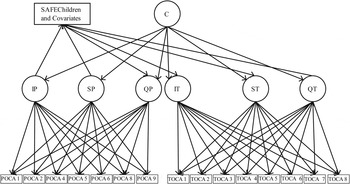
The second phase of analyses estimated models again but included important predictors on growth factors, including treatment assignment (control, initial treatment, booster intervention), gender, ethnicity, and family risk at baseline. This gave estimates of direct effects of intervention and provided adjusted estimates of latent growth classes beyond the influence of other important predictors. Simultaneously, analyses examined whether intervention conditions predicted membership in latent trajectory classes. This tested the main hypotheses that intervention altered developmental course of ADHD symptoms, and this effect existed beyond direct effects of intervention and other important predictors of growth. The third phase of analyses conducted known class analyses to explore whether initial externalizing problems moderated the growth of ADHD symptoms (Muthén & Muthén, Reference Muthén and Kaplan2004). Known class models incorporated a categorical latent variable for externalizing risk to represent the observed groups of externalizing risk versus no externalizing risk; growth factor means varied across classes. Moderation was tested by comparing fit indices of the original models to the known group analyses; support for moderation occurred when estimating the known groups meaningfully lowered the BIC statistics. Figure 2 visually presents the theoretical model tested. Some parameters, including error terms, were excluded to enhance clarity. The figure shows how models incorporated information from parents and teachers; latent trajectory classes were informed by simultaneous estimates of growth reported by parents and teachers.
Conceptual growth mixture model testing the SAFE Children intervention and covariate effects on development of attention-deficit/hyperactivity disorder symptomatology as reported by parents and teachers. Separate models estimated growth of impulsivity, concentration, and hyperactivity. Covariates included initial treatment versus control, booster versus initial treatment only, family risk, females versus males, Latino versus African American. C represents the categorical latent variable representing different trajectory classes. IP, intercept of parent report centered at Time 2; SP, slope of parent report; QP, quadratic function of parent report; IT, intercept of teacher report centered at Time 2; ST, slope of teacher report; QT, quadratic function of teacher report. POCA and TOCA refer to measurement of child behavior assessed through the Parent Observations of Classroom Adaptation—Revised and Teacher Observations of Classroom Adaptation—Revised measures, respectively. The wave of data collection is included for each observation. Separate models tested growth of impulsivity, concentration, and hyperactivity.

Models were estimated using Mplus Version 6.0 (Muthén & Muthén, Reference Muthén and Muthén2007). To limit susceptibility of solutions to local maxima, models were repeatedly estimated with random perturbations of starting values generated by the Mplus program. The number of random sets of starting values was increased to 25 from 10, and final optimizations were increased to 5 from 2. Stable models achieved similar solutions despite different starting values. Data were assumed to be missing at random, and models were estimated using full information maximum likelihood that produces valid estimates in the presence of missing outcomes. Two families had to be dropped because they were missing adequate information to classify family risk; examination of data for these families failed to identify any meaningful differences with other families.
Results
Unconditional models
Models estimated growth of impulsivity, concentration, and hyperactivity across nine waves of data. Time was centered at the start of intervention, which was the second time point, to examine intervention effects across time. Model fit was initially evaluated for unconditional growth models of each of the three outcomes provided by parents and teachers. Excluding the influence of predictors in these initial analyses provided a sense of the variance of growth factors on each outcome. Linear slope and quadratic growth estimates were included in the models. Results indicated that exclusion of quadratic growth worsened the fit of models based on BIC estimates, and therefore all models included higher order growth factors. Models that freely estimated residual variance in growth terms would not converge, so these were fixed to zero for all models. Fixing residual variance of growth factors imposes the assumption that variability in growth not captured by the model is the same for all individuals and does not reflect idiosyncratic differences. Five models were fit because fit statistics suggested models with more than five classes failed to improve model fit across outcomes.
Unconditional model results suggested that heterogeneity existed in growth patterns across all three outcomes. The BIC estimates of impulsivity suggested that a four-class solution (BIC = 1660.06) provided the best fit to the data compared to one-, two-, three-, and five-class solutions (BIC = 1960.22, 1714.63, 1702.07, and 1674.70, respectively). Concentration abilities fit a four-class solution (BIC = 7445.06) compared to one-, two-, three-, or five-class solutions (7839.56, 7543.46, 7503.46, and 7454.00, respectively). Hyperactivity resulted in a four-class model (BIC = 3955.00) when compared with one-, two-, three-, and five-class solutions (BIC = 4312.92, 4044.47, 4000.12, and 3958.54, respectively). These models suggested that a single normative trajectory in ADHD symptoms reported by parents and teachers may not exist; rather, multiple trajectories exist for subgroups within the population. However, inclusion of important predictors may influence latent class trajectories by adding information to models.
Conditional models
Overview
Conditional models incorporated important predictors of growth parameters. Solutions were estimated for a single trajectory up to five-class models for each outcome separately (impulsivity, concentration, and hyperactivity). The optimal number of classes depended on both parent and teacher report although trajectories varied by reporter. Figure 2 also demonstrates how covariates simultaneously predicted growth trajectories reported by parents and teachers as well as membership in latent trajectory classes. Effects on growth trajectories were fixed to be equivalent across classes and therefore represent covariate influences on average growth curves. Gender, ethnicity, and low family risk were centered at the sample grand mean.
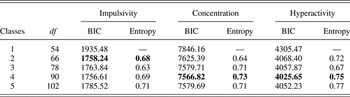
Table 1 summarizes results of optimal number of latent trajectory classes. Fit indices improved (BIC decreased and entropy increased) with more than one latent trajectory class up to a point when fit worsened, as discussed for each outcome below. Although including predictors did not improve model fit to the data when compared to unconditional solutions, the expanded models incorporated important information that may explain differences between latent trajectory classes. Therefore, conditional models were considered more theoretically informative than the better fitting unconditional models.
Fit indices of trajectory classes for conditional models

Note: Bold indicates best fitting solutions based on fit criteria and parsimony. BIC, Bayesian information criterion.
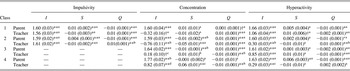
Growth factors were estimated for each reporter and are displayed in Table 2. Rows represent each growth parameter (intercept, slope, and quadratic terms) for each outcome (impulsivity, concentration, and hyperactivity) presented across columns. Significant values indicated greater than zero initial average levels and change. For each outcome, between-class differences on growth factors were examined by estimating 95% confidence intervals for each term and determining whether class estimates fell within the range. Significant positive correlations existed between parent- and teacher-reported intercepts for each outcome as described below; however, substantial variation existed among informants in the shape and form of growth trajectories. Teacher-reported patterns provided the primary differentiation in developmental trajectories for each outcome, whereas parent-reported trajectories exhibited less variation between classes (as indicated by superscripts in Table 2 and discussed below). As a result, only teacher latent trajectories are visually presented, while parent trajectories are described in text.
Conditional generalized mixed model results for optimal number of classes

Note: Values represent unstandardized beta weights with standard errors in parentheses. I, intercept centered at Time 2; S, linear slope; Q, quadratic function. Superscript letters indicate patterns of differences between classes on estimates based on 95% confidence intervals.
†p ≤ .10. *p ≤ .05. **p ≤ .01. The p values reflect significant differences from zero in growth factors.
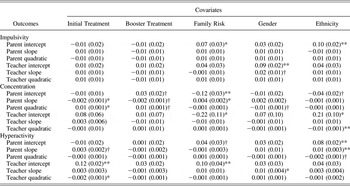
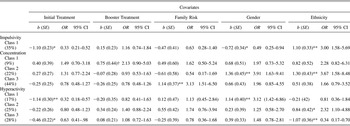
Results of covariate effects on latent growth trajectories (not class membership) are presented in Table 3 and discussed by outcome below. Rows represent the left side of regression equations that predicted growth parameters by respondent (parent and teacher). Columns list variables on the right side of the equation with values indicating unstandardized beta coefficients.
Predictor effects on growth parameters by outcome across latent trajectory classes

Note: Values represent unstandardized beta weights with standard errors in parentheses. Treatment condition was coded using Helmert contrasts; initial treatment contrasts with the control group, whereas booster treatment contrasts with youth in the initial treatment condition. Gender, ethnicity, and family risk were centered and reflect the percentage of each group. Gender, male/female; Ethnicity, African American/Latino; Family Risk, risk identified at baseline.
†p ≤ .10. *p ≤ .05. **p ≤ .01.
Impulsivity
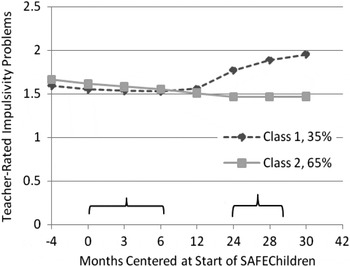
A two-class solution best fit the impulsivity data. Although the solution for the four-class model produced a BIC 2 points lower than the two-class model, this small difference is not meaningful; the two-class model also provides a more parsimonious solution. The intercepts of parent- and teacher-reported impulsivity positively correlated (r = .40, p < .01). Parent-reported impulsivity increased over time and decreased slightly toward the end of the study; no class differences existed on intercept or growth for parent-reported impulsivity. Teacher-reported impulsivity distinguished classes such that a normative and deviant group emerged. Figure 3 displayed teacher-reported impulsivity trajectory classes. Although no differences existed between classes on initial level of impulsivity, Class 1, a smaller group consisting of 35% of youths, exhibited a sharp increase in teacher-reported impulsivity at the beginning of second grade. Class 2, the remaining 65% of youths experienced declining levels of teacher-reported impulsivity that increased slightly by the end of the study. Across classes, African American and high-risk families had higher parent-reported initial levels of impulsivity, while males had higher initial levels of teacher-reported problem behaviors.
Teacher-reported impulsivity across time by latent trajectory classes.

Concentration
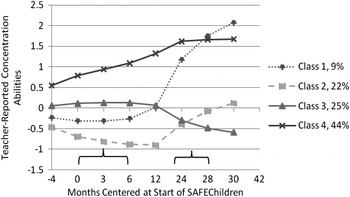
A four-class solution best fit the data for concentration. Teacher-reported trajectory classes were illustrated in Figure 4. Across classes, parent and teacher report of concentration were positively related at the intercept (r = .46, p < .01). The largest class, Class 4 (44%), exhibited the highest levels of parent- and teacher-rated concentration abilities at the beginning of intervention. Teachers reported a significant increase in concentration over time; however, significant negative quadratic effects indicated that both teacher and parent trends plateaued in this class toward the end of the 5-year follow-up period. The next largest class, Class 3 (25%), had lower initial levels of concentration compared to Class 4 that declined over the follow-up period. Parents reported a significant linear decrease that slowed toward the end of the follow-up, while teachers reported a sharper decline 2 years after baseline. Class 2 (22%) reported the lowest initial teacher-rated concentration abilities. Growth according to parents and teachers suggested that concentration abilities improved after initial linear declines. Class 1, the smallest class, comprising 9% of youth, also demonstrated sharp improvements in teacher-reported concentration abilities after initial declines; however, parents of these children reported average initial levels of concentration that remained constant over time.
Teacher-reported concentration across time by latent trajectory classes.

The effects of predictors on growth factors across classes suggested that receipt of the SAFE Children intervention related to declines from initial parent-rated concentration, but these levels increased at the end of the follow-up period. High-risk families reported lower parent- and teacher-reported concentration when the intervention started, while high-risk families experienced significantly greater increases in parent-reported concentration. African American children were reported to have greater levels of initial concentration as compared with Latino families.
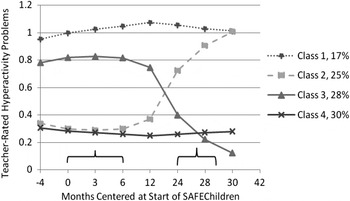
Hyperactivity
Figure 5 presents growth in teacher-reported hyperactivity problems by class. Hyperactivity estimates suggested a four-class solution. Again, parent and teacher report of hyperactivity were related at the intercept (r = .55, p < .01). Growth in parent-rated hyperactivity was similar across classes; all classes reported similar levels of initial symptoms that dipped slightly toward the end of the follow-up period. Classes diverged based primarily on teacher reports. Class 4 (30%), the largest class, exhibited lower levels of hyperactivity at the start of intervention that remained stably low over time. Class 2 (25%) reported low initial levels of hyperactivity that were similar to those of Class 4; however, hyperactivity increased sharply toward the end of the intervention. Class 3 (28%) had higher initial levels of symptoms that declined sharply over time. Class 1 (17%) exhibited the highest initial level of teacher-rated hyperactivity that remained stably high across the study period.
Teacher-reported hyperactivity across time by latent trajectory classes.

Predictors of hyperactivity across classes included the SAFE Children intervention; teachers rated children who received the intervention higher on initial levels of hyperactivity that declined at the end of the follow-up period. Children in higher risk families also had higher initial levels of teacher-reported hyperactivity symptoms, while males exhibited significantly greater linear increases in symptoms over time compared with females. Ethnicity predicted differences across classes in parent-rated hyperactivity. African American children were rated as having higher initial levels of symptoms that increased over time but dipped toward the end of the intervention.
Impact on development course
Latent trajectory class membership for each outcome was predicted by intervention conditions, initial family risk, gender, and ethnicity. Analyses tested whether covariates changed the probability of being in the largest (normative) trajectory class versus another group. Table 4 presents odds ratios and significance tests for each covariate (columns). Classes (rows) for each outcome were ordered from small to large, with the largest class serving as the reference group. Higher odds suggested an increased probability of falling in the latent trajectory class compared with the largest class. For impulsivity, youths in the initial treatment group were significantly less likely to be in the latent class characterized by teacher-reported increases in impulsive behavior over time. In addition, males and African American youths were more likely to be in the more impulsive Class 1. Although significant main effects existed on growth of concentration abilities reported above, concentration latent class membership did not relate significantly to SAFE Children interventions. Males and African American youth were more likely to be in Class 2, typified by lower teacher- and parent-reported concentration abilities. Children from high-risk families were less likely to be in Class 3, characterized by waning levels of concentration reported by teachers but increasing concentration according to parents.
Predictor effects on membership in latent trajectory class by outcome

Note: All comparisons reference the largest, normative class for each outcome. Latent class memberships were derived from parent and teacher reported behaviors over time. Predictor variables were coded as follows: Initial Treatment: –1 = control, 1 = initial treatment; Booster: –1 = control, 0 = initial treatment only, 1 = booster treatment; Family Risk: low risk versus high risk; Gender: female versus male; Ethnicity: Latino versus African American. OR, odds ratio; CI, confidence interval.
†p ≤ .10. *p ≤ .05. **p ≤ .01.
The SAFE Children intervention exhibited effects in predicting developmental course of hyperactivity. Youths who received the initial intervention were significantly less likely to be in Class 1, which demonstrated high levels of teacher-rated hyperactivity that remained stable over time. A significant but smaller effect showed that youths receiving intervention were also less likely to be in Class 3, which demonstrated high levels of teacher-rated hyperactivity that sharply declined midway through the intervention. Thus, youth randomly assigned to the initial phase of SAFE Children avoided developmental trajectories marked by early exhibition of high-level hyperactivity. In addition, males were more likely to be in the class (Class 1) that demonstrated consistently higher levels of hyperactivity. African American youths were more likely to be in Class 2, characterized by increasing levels of teacher-rated hyperactivity, and less likely to be in Class 3, with decreasing symptom levels. Results suggested Latino youth were more likely to be in the latent Class 2 that demonstrated declining hyperactivity problems over time reported by parents and teachers.
Moderation: The role of initial externalizing problems and medication
The inclusion of high-risk youth behavior at pretest failed to improve fit across impulsivity (BIC = 2073.28), concentration (BIC = 11640.91), and hyperactivity (BIC = 14478.10). Therefore, initial externalizing risk was not considered a plausible moderator. Medication treatment over the course of the study was also considered as a possible moderator. Known group analyses including medication usage did not converge due to the very small number of participants in each cell. For instance, hyperactivity had four classes with eight possible medication groups. As a result, medication usage was entered as an auxiliary variable into the models to determine if individuals using medication were more likely to be included in any latent trajectory class (Muthén & Muthén, Reference Muthén and Kaplan2004). No significant differences existed, suggesting even distribution across classes for each outcome.
Discussion
This study provides evidence to support two assertions pertaining to the development and treatment of ADHD symptoms among inner-city elementary school-aged children. First, developmental heterogeneity exists in the growth of child ADHD symptoms as reported by teachers and parents from first through fifth grade. Second, a family- and academically oriented preventive intervention delivered at the transition into elementary school decreases the likelihood of following deviant and negative developmental trajectories of impulsivity and hyperactivity. These effects on developmental course occur beyond improvements in average concentration and hyperactivity over time associated with SAFE Children.
The presence of developmental heterogeneity informs etiological understanding of ADHD symptoms. A strong genetic contribution to ADHD problems has been demonstrated in population-based twin studies, with 75% of variation in children with ADHD explained by genes (Faraone & Mick, Reference Faraone and Mick2010; Faraone et al., Reference Faraone, Perlis, Doyle, Smoller, Goralnick and Holmgren2005; Freitag, Rohde, Lempp, & Romanes, Reference Freitag, Rohde, Lempp and Romanes2010). This genetic effect appears to represent a more distal risk within a chain of conditions that probabilistically lead to subsequent symptomatology. Evidence of small effects for individual genes combined with the discovery of Gene × Environment interactions that exacerbate risk for ADHD emphasize the role of environmental factors in the manifestation of problems. For instance, prior research suggests that polymorphisms on serotonin transporter genes or dopaminergic receptor or transporter genes in combination with childhood psychosocial adversity (such as parental conflict, marital instability, and poverty) relates to elevated risk of clinically significant ADHD problems (Laucht et al., Reference Laucht, Skowronek, Becker, Schmidt, Esser and Schulze2007; Nikolas, Friderici, Waldman, Jernigan, & Nigg, Reference Nikolas, Friderici, Waldman, Jernigan and Nigg2010; Waldman, Reference Waldman2007). Gene × Environment interaction is one possible explanatory mechanism supporting an interplay between individual risk factors and environmental conditions over time in the development of ADHD-related psychopathology.
A developmental psychopathology conceptualization of ADHD emphasizes this interplay and may help explain the delineations of heterogeneous developmental trajectories (Sonuga-Barke & Halperin, Reference Sonuga-Barke and Halperin2010; Taylor, Reference Taylor1999). For instance, in this sample, the beginning of second grade presents a particularly important time of change; it corresponds with the differentiation of impulsivity trajectories and represents the point when one quarter of children demonstrate increases in concentration and hyperactivity problems. This illustration connotes that environmental activators may trigger a cascade of neurocognitive and behavioral endophenotypes, such as disruptions in executive functioning and motivation (Nigg, Reference Nigg2010; Sonuga-Barke & Halperin, Reference Sonuga-Barke and Halperin2010). Whether subclinical or clinical behaviors emerge depends on further interaction within genes and between genes and environments. The developmental psychopathology approach emphasizes the role of various etiological mechanisms and their temporal importance that contribute to the onset, offset, and shifts underlying the developmental heterogeneity of ADHD (Halperin & Healey, Reference Halperin and Healey2011).
This study extends theoretical conceptualizations of environmental contributions to ADHD by demonstrating that randomization to a psychosocial intervention in the transition to school positively impacts impulsivity and hyperactivity developmental trajectories. Children who received the initial intervention at the beginning of first grade were less likely to be on problematic developmental trajectories. SAFE Children's impact on developmental course emerges in the absence of effects on average trends in ADHD symptoms over time investigated in prior studies (Tolan et al., Reference Tolan, Gorman-Smith and Henry2004, Reference Tolan, Gorman-Smith, Henry and Schoeny2009). Findings emphasize the promotive or compensatory role of environmental changes on ADHD symptomatology in the context of developmental heterogeneity.
SAFE Children did not alter the course of concentration abilities, although a nonlinear effect existed on parent-rated change in abilities such that concentration significantly increased over the course of the follow-up period. The presence of positive effects on latent trajectory class membership impulsivity and hyperactivity in combination with the absence of an effect on concentration pathways may reflect the mechanisms of the intervention. SAFE Children may function to prevent comorbidity of ADHD with disruptive behavior problems. Approximately one-third to one-half of children diagnosed with ADHD also meet criteria for oppositional defiant disorder or conduct disorder. Longitudinal research suggests that ADHD symptoms emerge by age seven (second grade) for the majority of children, while comorbidity with other disruptive behavior symptoms appears subsequent to these symptoms (Burke, Waldman, & Lahey, Reference Burke, Waldman and Lahey2010; Diamantopoulou, Verhulst, & van der Ende, Reference Diamantopoulou, Verhulst and van der Ende2008). The developmental heterogeneity of impulsivity observed in this sample at the second grade may reflect a confluence of factors that contribute to increased risk for behavior problems. For example, growing expectations for on-task behavior in school may combine with inconsistent reinforcement schedules at home that expose difficulties in self-regulating behavior. The behavioral intervention strategies integrated into SAFE Children, including reward schedules, parent–teacher communication skills, and academic enhancement through tutoring, mitigate this risk. Heterogeneity of impulsivity trajectories reduces with covarying aspects of the environment, unlike concentration and hyperactivity, further suggesting the importance of contextual influences on symptomatology. In addition, SAFE Children may lack specificity to address the neurocognitive disruptions underlying concentration-related symptoms. SAFE Children's tutoring component addresses concentration through reinforcing on-task behavior and practicing redirection of attention; however, research on the treatment of ADHD questions the ability of nonspecific psychosocial interventions to reduce problems with concentration (Halperin & Healey, Reference Halperin and Healey2011; Sonuga-Barke & Halperin, Reference Sonuga-Barke and Halperin2010). More direct targeting of executive functioning and motivational disruptions may be needed to alter the developmental trajectories for inattentive symptoms of ADHD.
Of particular importance, the study provides support for a developmental–ecological model for prevention of ADHD symptomatology among inner-city children. Inner cities are marked by neighborhood disorganization and violence that impact the development of children directly as well as indirectly through undermining protective resources. Families lack access to mental health services, and often existing services fail to address cultural diversity in an effective manner. SAFE Children directly targeted a multitude of risk factors facing inner-city families at the transition into school in a developmentally and culturally appropriate manner. Findings from this study support these strategies through rigorous evaluation methods: random selection combined with random assignment. Positive treatment effects emerged across outcomes. The preventive intervention demonstrates improvements in average growth in concentration (parent-reported) and hyperactivity (teacher-reported) levels over the 5-year follow-up, which extends prior findings that show proximal effects of SAFE Children on attention and behavior-related abilities (Tolan et al., Reference Tolan, Gorman-Smith and Henry2004, Reference Tolan, Gorman-Smith, Henry and Schoeny2009). The intervention also relates to a two-thirds reduction in the likelihood of membership in the riskiest developmental trajectories of both impulsivity and hyperactivity. SAFE Children alters the developmental course among children at greatest risk for behavioral maladaptation. Furthermore, youth assigned to SAFE Children are one-third less likely to belong to a subgroup that demonstrates early levels of hyperactivity suggesting a preventive influence. Findings must also be considered in context of proximal effects of the initial phase and booster interventions that show largest benefit among youth exhibiting the greatest risk for maladjustment and from the most vulnerable families (Tolan et al., Reference Tolan, Gorman-Smith and Henry2004; Tolan et al., Reference Tolan, Gorman-Smith, Henry and Schoeny2009). More research is needed to determine the effectiveness of the program when implemented within communities and existing service systems; however, these efficacy findings are positive and demonstrate potential to support high-risk family and youth.
Contrary to our hypotheses, the booster intervention implemented in the fourth grade failed to alter developmental course or change symptoms levels over time beyond the effects of the initial phase of SAFE Children. Though contrary to expectations, this finding is useful. Reasons for it may be found in both the content and the timing of the booster.
Regarding content, key components of the initial phase of intervention that addressed attention and hyperactivity were modified in the booster. For instance, one-on-one tutoring that modeled redirection of attention and rewarded on-task behavior used in the initial phase was replaced with reading clubs in the booster that provided less exposure to attention-oriented skills. These modifications were done to enhance the developmental appropriateness of SAFE Children for preventing the emergence of violence and substance use among youth entering adolescence (Tolan et al., Reference Tolan, Gorman-Smith, Henry and Schoeny2009). An unintended negative consequence, however, may have been that participating youth missed opportunities to practice skills that would have addressed ADHD symptoms.
Regarding timing, these findings add to evidence suggesting that, developmentally, attention plateaus around fourth grade, making it difficult to change ADHD symptomatology (Klenberg, Korkman, & Lahti-Nuuttila, Reference Klenberg, Korkman and Lahti-Nuuttila2001). The timing of the initial phase of SAFE Children in the transition into school may represent an ideal period in which to help children learn skills that promote attention and on-task behaviors. By fourth grade, the window for preventive interventions may have closed, and additional treatment components may be necessary to alter the developmental course of these symptoms.
Limitations
Despite its strengths, the study includes limitations that must be considered when interpreting results. First, etiological mechanisms underlying developmental heterogeneity in ADHD symptoms remain unclear and cannot be fully addressed in this study. The potential of direct and interactive effects within genes and between environmental risks must be evaluated in future research given that this study was not genetically informed. Second, outcomes were not measured with standardized instruments that capture the full range of ADHD symptomatology and severity. Although validated with low-income minority youth to capture behavior problems that impacted performance at school and home, the instruments did not exhaustively assess inattention or hyperactivity/impulsivity in a manner that could be used to examine clinical thresholds. In addition, low internal consistency of parent-reported impulsivity and hyperactivity limited statistical power to detect developmental differences in symptoms as well as treatment effects. Repeated measures improved consistency; however, research that incorporates clinical interviews with nationally normed assessments of ADHD symptomatology will provide more precise information.
Third, youth were not followed up past the fifth grade, and therefore it is unclear whether and how subgroup symptom patterns will fluctuate in the transition to adolescence and adulthood. Future research that examines youth across these transitions on developmentally significant psychosocial functioning will better inform prevention efforts. Given that SAFE Children explicitly targets delinquency and substance abuse, it is of particular interest to determine whether subgroups engage in these behaviors at different rates. Fourth, the exciting potential of using GMM to evaluate randomized controlled trials must be tempered by considerations of the assumptions required of these models. Multilevel models reflect relatively new statistical techniques that have yet to be fully evaluated and validated. In particular, models require the assumption that multivariate distribution of outcomes reflect the probability function used to estimate latent classes, and some evidence suggests that deviations from expected distributions may change not only the standard error of parameters, but also the parameter estimates themselves (Van Horn et al., Reference Van Horn, Jaki, Masyn, Ramey, Smith and Antaramian2009). Although data transformations were employed to ensure a normal distribution of outcomes, multivariate normality across latent classes is difficult to determine empirically, which further emphasizes the need for replication in other samples of inner-city youth. Fifth, although not exactly a limitation of this study, it is important that future research replicate analyses with other samples of inner-city youth to further validate the typologies. Despite limitations, this study provides insight on the complex interplay involved in the development of concentration and attention-related behavior. Environmental factors prevent deviant developmental trajectories among at-risk inner-city youth.