In 2017 the Courtauld Institute of Art began digitising its Witt and Conway photographic collections: an internationally important resource of over three million images covering western painting, drawing and printmaking, world architecture, architectural drawings, sculpture, decorative arts and manuscripts.Footnote 1 Using two entirely different methods, one outsourced to a commercial contractor, the other engaging volunteers in-house, we have been able to gain a clear understanding of the economic, practical and social benefits of both approaches. The project also includes two smaller collections: the archive of 22,000 glass plates known as the De Laszlo Collection of Paul Laib Negatives depicting works by many of the major artists working in Britain between 1900 and 1945, and Anthony Kersting's archive of over 160,000 images documenting architecture of almost every European country, Asia, New Zealand, the Middle and Far East.
These initiatives follow a long history of digital scholarship in the Witt and Conway, most especially the pioneering work of the Witt Computer Index under the inspirational leadership of John Sunderland and Cathie Gordon which used Iconclass as a system of classification to create a database rich in descriptive content. This data, along with the Witt Checklist, enabled our subsequent contributions to ULAN, the Getty Research Institute's Union List of Artist Names. However, the possibility of digitising both libraries remained distant until we carried out a full audit of the collections in 2013. The report, which drew its conclusions from extensive random sampling, enabled us to uncover details relating to number, size, condition, volume, length and weight, and was instrumental in turning aspirations held for almost two decades into a tangible and deliverable project.
The Witt Library
The Witt is a large collection of photographs, reproductions and cuttings of paintings, drawings and engravings of Western Art from about 1200 to the present day. Comprising 2,151,862 images in 19,139 boxes, and occupying 1.3 kilometres of shelving, it is believed to be the largest of its type in the UK and the third-largest in the world after the collections at the National Gallery of Art in Washington, DC and the Netherlands Institute for Art History (RKD).Footnote 2
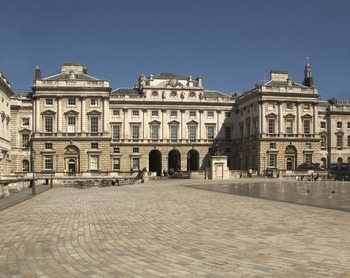
The Courtauld Institute of Art at Somerset House, London. Photographer Tom Bilson. This work is licensed under a Creative Commons Attribution-Non Commercial 4.0 International License. CC BY-NC 4.0

The Library was founded in the 1890s by Sir Robert Witt whilst an undergraduate at Oxford reading History and specialising in the Italian Renaissance. It was there he met his future wife Mary, who also collected photographs of works of art: their friends described their marriage in 1899 in terms of the union of two photographic collections. Initially, the library had a staff of four volunteers who worked under Mary's supervision but it grew, with Witt recalling it ‘overrunning its home and filling the dining-room hall, and even the kitchen basement with its overwhelming flood’.Footnote 3 In 1944 he made a deed of gift and, on his death in 1952, the library moved from his home at 32 Portman Square to 19 Portman Square, next door to the Courtauld at number 20. In the introduction to his Catalogue of Painters and Draughtsmen Represented in the Library of Reproductions of Pictures and Drawings Formed by Robert and Mary Witt (1920) he wrote about the aims of the library:
'What has been attempted, therefore, is to form, after the analogy of the great Oxford Dictionary of the English Language, a kind of Murray's dictionary of Pictures and Drawings, by concentrating and bringing together reproductions of, as nearly as may be, the whole body of European painting and drawing, and arranging it as a Dictionary in the manner most convenient for easy reference. As a Dictionary it has, accordingly, to include not only what is most interesting and important, and not only the work of the great but also that of the little Masters, many of them of quite secondary consideration, yet playing some part in their time, and as such contributing to the general history of the painter's craft’.Footnote 4
In a project supported generously by a private benefactor, we have already digitised over 50% of the British School, a selection of over 260,000 mounted images covering artists born between 1200 and 1799. This work was carried out for us by the Dutch contractor Picturae over a period of four months.Footnote 5 Although not yet public and still very much a proof of concept, the resulting website is allowing us to work through the complex issues surrounding the online publication of a much-appreciated collection which, since its inception, has facilitated research into provenance and attribution as well as wider applications to art history and conservation. We have also experimented successfully with an AI system to retrieve images based on visual content (for example portraits of Elizabeth I, castles, horses, works with a triangular or square composition), which also allows users to find matches to their uploaded images. To take the pilot project to conclusion, another generous private bequest will enable the greater part the remaining two million images to be digitised over 12 months, commencing in early 2020. In digitising the Witt, we will not only secure its long-term preservation but allow it to resume its place as a world-class scholarly resource whilst at the same time reaching new international audiences beyond art historical research. This goal will be enhanced by the Courtauld's membership in PHAROS, an international consortium of fourteen European and North American art historical photo archives. As Witt himself wrote in 1928, reflecting on a lifetime of collecting images and the uniqueness of the resource he had created, ‘the Library naturally contains much material available nowhere else at all, and much also available nowhere else in the form in which it is here found’.Footnote 6
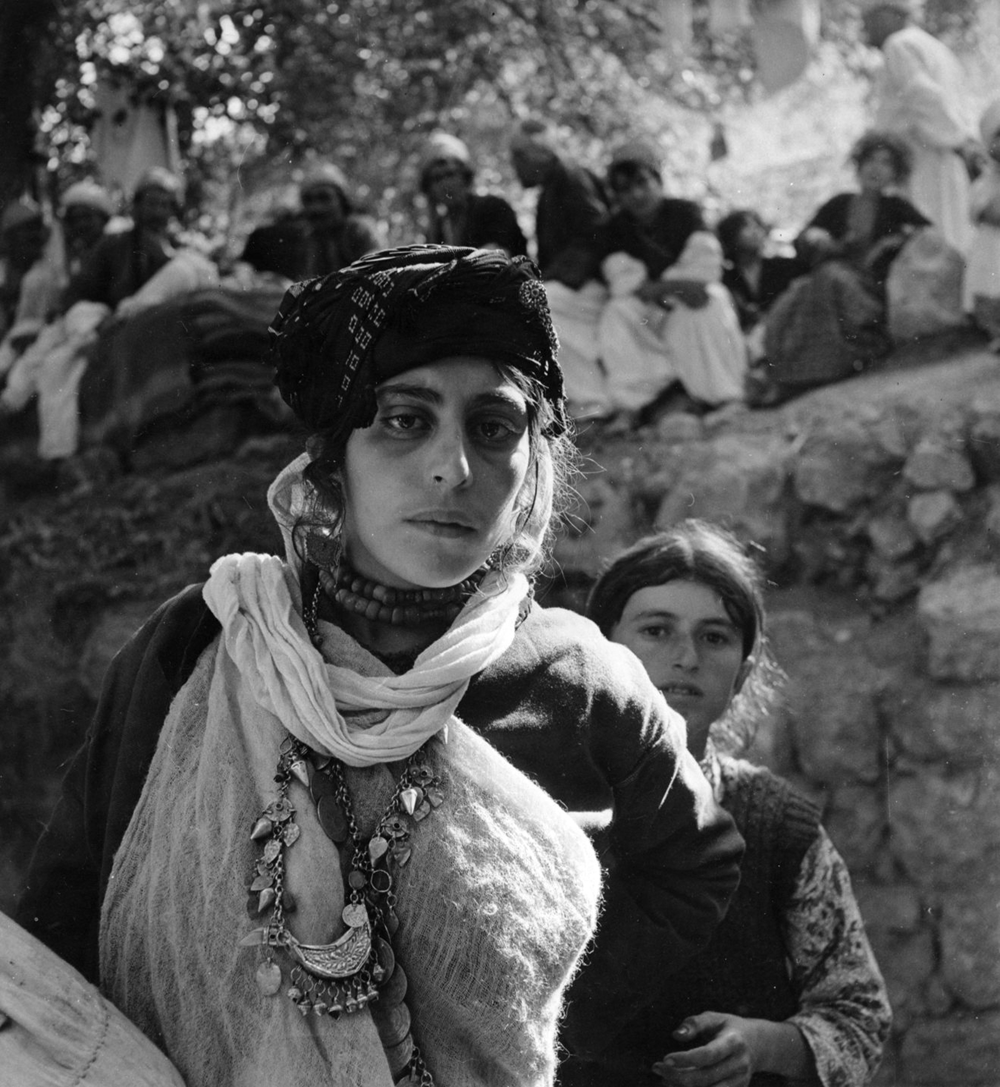
A Yazidi woman at a festival in Lalish, Kurdistan. Photographer Anthony Kersting, 1944. This work is licensed under a Creative Commons Attribution-Non Commercial 4.0 International License. CC BY-NC 4.0

The Conway Library
The Conway comprises almost a million images covering world architecture - both sacred and secular - from the medieval period to the present day as well as sculpture, ivories, decorative art and manuscripts. Unexpected highlights include 1850s prints of Istanbul by James Robertson (from a collection of about 15,000 historic prints), T. E. Lawrence's images of Saudi Arabia, The Macmillan archive of bomb damage across Europe following the Second World War, and twentieth century social housing. It comprises 939,410 images in 9,892 boxes, and occupies 692 metres of shelving.
Martin Conway (later Lord Conway of Allington) began collecting as well as taking photographs of art and architecture while still a student. In 1885, at the age of 28, he was offered the post of Roscoe Professor of Art at Liverpool, and in 1901 he became Slade Professor at Cambridge. A meeting with Robert Witt in 1903 caused him to focus his collecting activities on architecture, sculpture and medieval painting, leaving Witt to collect post-medieval painting. A writer, traveller and mountaineer, one of his interests was of photography as a record of buildings that might suffer war damage (Conway was instrumental in establishing the Imperial War Museum in 1917, and became its first Director General). He wrote in Country Life in 1916:
'The destruction of Louvain and Rheims, the peril still to be evaded of other Belgian and North Italian cities - these horrors are generally realised and deplored; but how many are conscious of the danger that has threatened remoter architectural treasures? Some of them of an almost equal importance, and the more to be deplored because the threatened buildings have not been thoroughly studied, planned and photographed.’Footnote 7, Footnote 8
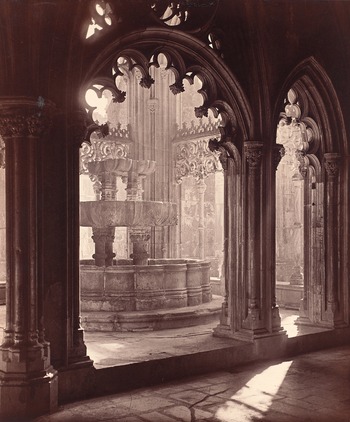
Fountain in the Monastery of Santa Maria da Vitoria, Batalha, Leira, Portugal Photographer: Charles Thurston Thompson c. 1860. Conway Library, Courtauld Institute of Art, London. This work is licensed under a Creative Commons Attribution-Non Commercial 4.0 International License. CC BY-NC 4.0

Both the digitisation of the Witt and Conway collections fall under the scope of Courtauld Connects, an ambitious transformation project that will make The Courtauld's world-class artworks, research and teaching accessible to more people – in the UK and internationally.Footnote 9 However, our initial discussions about digitising the Conway with the National Lottery Heritage Fund – one of the major funders for Courtauld Connects – made us realise that the levels of public engagement and benefit expected of an organisation receiving their support could not be achieved through contracting out the work.Footnote 10 The answer was to rescope the project from one conducted externally, and in a relatively short space of time, to one carried out entirely in-house by volunteers over several years.
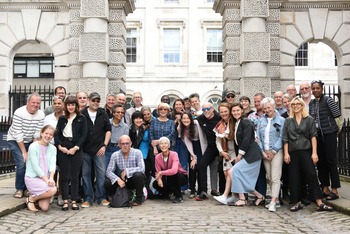
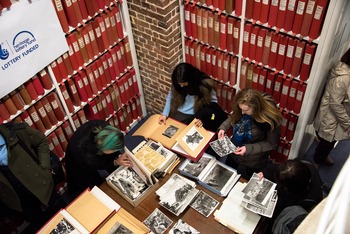
Our volunteer community now comprises 746 members whom, since the first development phase of the project in 2017, have generously donated 19,710 hours. We recruit through every channel, including volunteer centres, community groups, charities with strong social responsibility, local businesses, and the student population of London. Over a third of our volunteers had never heard of the Courtauld before engaging on the project. To drive the project forward we maintain exceptionally high levels of engagement: at the time of writing 45% of our volunteers have engaged in the past 90 days, and another 47% over the past year, leaving only 8% inactive for 12 months or more. Our three highest attending volunteers have each given between 470 and 720 hours to the project since its start. Our volunteers can sign up for two to three shifts a day (evening sessions on Mondays), each comprising 12 to 18 volunteers per shift. The activities on offer include sorting and accessioning, transcription of ledgers, metadata and other handwritten notes, identification of rights holders, photography, quality checking, cleaning, environmental monitoring, and basic preventative conservation. After refining our workflows, our volunteers are now able to digitise around 90 boxes of photographs a week (corresponding to around 8,500 images). We monitor progress across all activities weekly (digitisation, cataloguing, accessions and attributions) and are on track to complete the digitisation of the Conway in August 2021. As well as leading the digitisation of the collections, we have commissioned a conservation plan for their safekeeping, worked with a consultant to value them and, for the first time in their history, implemented a library-wide system of accessioning and labelling.
In contrast to many other volunteer projects we ask for no minimum skills and no minimum hours, setting ourselves the challenge of teaching our volunteers everything they need to know to participate, and removing or minimising barriers as we go on. Our work is supported on a daily basis by TimeCounts, an outstanding volunteer management system which allows anyone participating to book shifts as flexibly as possible, whilst gathering statistics on levels of engagement and retention.Footnote 11
Our volunteer community exceeds end of project diversity targets set by the National Lottery Heritage Fund. Some of our volunteers are drawn to the project through interests in architecture, history or practical photography, others come to improve their English, build self-confidence, or overcome the challenge of travelling to a place of work without the assistance of a carer. We now welcome young people with autism (via My Action For Kids), adults with positive diagnoses of HIV and AIDS (via the Terrence Higgins Trust's Work Positive scheme) adults with experience of mental distress (via various arts and mental health charities). A new initiative under development will allow us to start working with Syrian and Iraqi refugee families recently settled in the UK from towns whose people and architecture are extensively documented in our collections. Earlier this year we provided three work placements to students from local schools and colleges, a three-month graduate internship to a student from Furman University, South Carolina and 20 micro internships to students enrolled in Oxford University's well-established micro internship programme, the outcomes of which are presented as short research topics on our blog.Footnote 12 We also run a weekly corporate volunteering afternoon (in partnership with Benefacto) and are working with our Senior Management Team to set up a volunteering programme for the Courtauld's own staff.
Some of the digitisation volunteers, June 2019. Courtauld Institute of Art, London. This work is licensed under a Creative Commons Attribution-Non Commercial 4.0 International License. CC BY-NC 4.0

Prospective volunteers attending our first open day in January 2017. Courtauld Institute of Art, London. This work is licensed under a Creative Commons Attribution-Non Commercial 4.0 International License. CC BY-NC 4.0

The Conway project will take three times longer than the Witt but, with staff costs and volunteer expenses included, will cost roughly the same. However, there is little to compare with the emotional rewards of involving the diverse audiences whom we hope might engage with our collections in their creation.
Reflecting on their experiences our volunteers write:
‘Digitising this collection makes me feel as if I am traveling around the world when looking at the beautiful black and white photographs. And, perhaps, I would be the first person to stumble upon some of these… who knows?’
‘Every time I begin my shift and enter the archives I feel like I'm entering the past, exploring and looking for treasures which I do frequently come across and then the child in me appears with this enormous grin on my face. It's reintroduced me back into the world of history and architecture that I admire and love, I feel extremely privileged to be a Courtauld Digitisation Volunteer and I know as we all do that our efforts are immensely appreciated.’
‘I volunteer to diversify my professional work experience and gain new skills outside of architecture. Also, I needed to rebuild my confidence in the work environment, after deciding not to go back to work once I had my children. For me volunteering is a stepping stone to the work place, whilst appreciating art and photography and having the privilege to work with a diverse team of amazing fellow volunteers.’
‘I Just wanted to say THANK YOU for the opportunity. I have loads of arty friends, and now when we are out having a get-together, I now say to them that I volunteer at the Courtauld. They look at me and say What The HELL? How did you do that? So thanks!’Footnote 13
Over Summers of 2020 and 2021 we will embark on two tours that will take parts of our collections to ten cities and towns in the UK with connections to the history of the Courtauld Institute through being former locations of Courtauld textile factories. The focus will be local volunteering and the teaching of digital skills through a project drawing on family albums as sources of imagery and prompts for oral histories on local architecture. Images digitised as part of the tour will be displayed on the website as well as being printed, mounted and inserted permanently into the Conway Library boxes, fostering an emotionally significant and respectful connection between the people we meet and our collections.
Common approaches
The Witt, Conway, Laib and Kersting collections will be presented online as a cascading alphabetical list of schools, artists and box names, exactly as the collection is encountered on the shelves, thus preserving the historical, allegorical and genre subdivisions central to Robert Witt and Martin Conway's founding visions. In order for the project to be completed in the space of a few years rather than decades, we will not at this stage catalogue individual images (although this will remain possible in the future, with all images being assigned a unique ID), but rely on the school / artist / box / folder (Witt) and the period / country / location (Conway) groupings that the test of time has shown to be a fast and often serendipitously useful means of retrieval. Comparisons formerly made from image-by-image spreads across a table top will be possible on screen using IIIF.
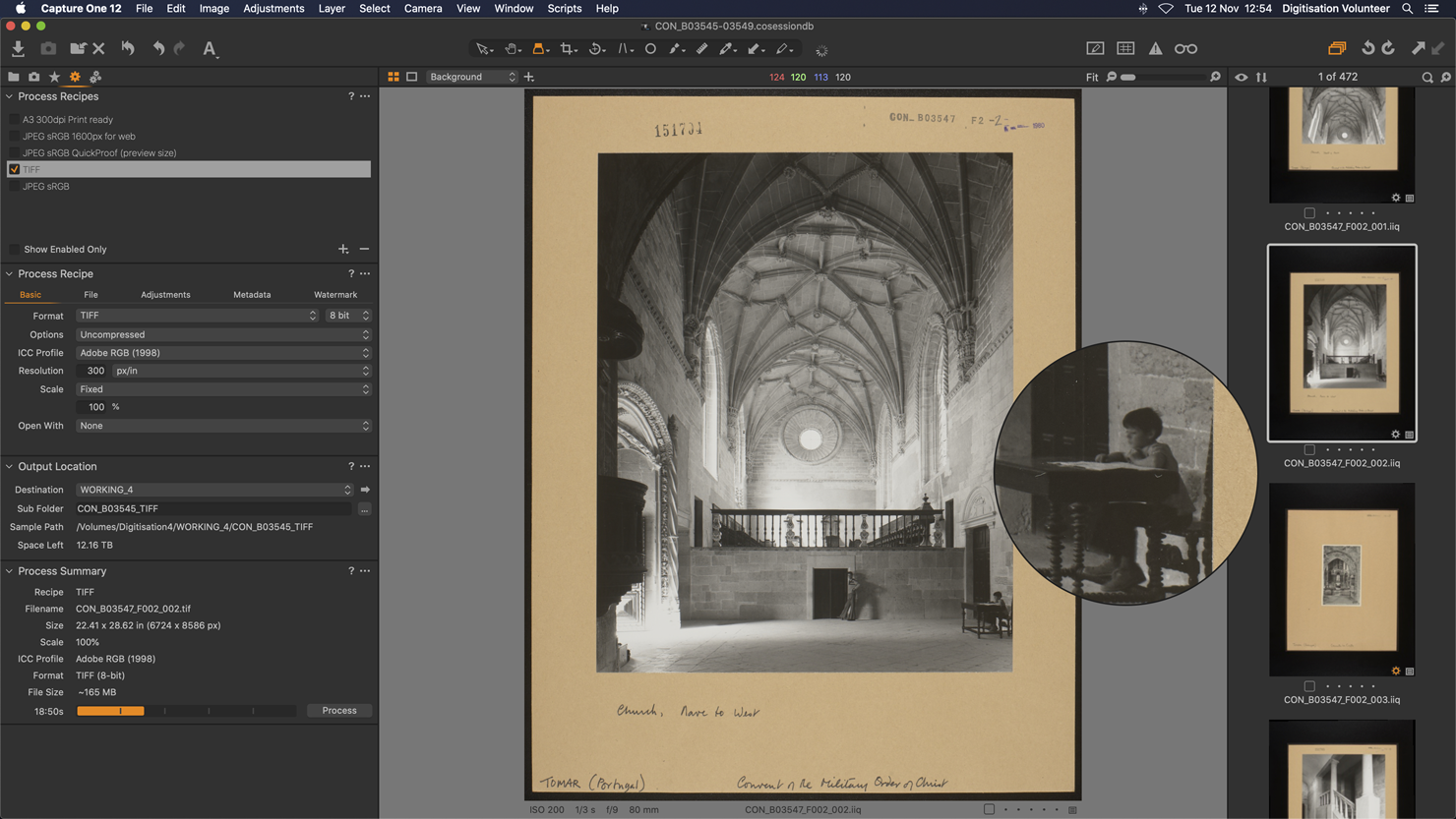
Above all else our approach to digitisation honours the physical integrity of the collections. Using Phase One cameras tethered to Capture One software, we photograph, rather than scan, whole mounts to retain as much of their character as possible: the slight line of shadow to show that a print has been stuck by human hands onto card, the surface texture of the emulsion, the fingerprints (or lack of) which give us, as readers, clues to the number of people who might have handled the object. Our objectives are to safeguard objects as they transition to a (post) digital culture and to avoid the various cleaning processes that often distance digital surrogates from the physical world from which they are drawn. We preserve context as much as content. We never crop but instead leave a narrow border around the edge to emphasise that every print, mount, or glass plate is a physical object with an edge, we never retouch and we record colour as faithfully as possible. Our almost forensic approach to digitisation is a bid to preserve a sense of the physical, described by Peyton Cherry as ‘the quest for and the journey through materiality’. An appreciation that every image presented online has a physical counterpart that still sits in a library box – a set of visual cues pointing to the personalities and voices enmeshed within our collections, and the recognition that appearance online is absolutely not their year zero, but another milestone in their malleable history.Footnote 14
All aspects of the project are run by the Courtauld's Department of Digital Media, of which I am the Head. My staff have worked with agility, daring and unwavering commitment. For this, heartfelt thanks go to Faye Fornasier, our Digitisation Database and Cataloguing Manager and Victoria Bennett, Digitisation Assistant; our Volunteer Manager Sarah Way, her maternity cover Camilla Ellingsen Webster and our incoming Volunteer Manager Caroline Chestnutt; Volunteer Assistant Fran Allfrey, our incoming Conservation Coordinator Mark Long; Matthew Cheale who worked on the Witt pilot project, and to our numerous interns and volunteers who have counted, weighed, moved, catalogued and repaired thousands of boxes and photographed even greater numbers of images with more humour than I ever thought possible.
An image displayed in the Cultural Heritage version of Capture One, immediately after capture with the 100MP camera, showing the level of detail at which we will publish online. This work is licensed under a Creative Commons Attribution-Non Commercial 4.0 International License. CC BY-NC 4.0