Introduction
As ocean environments worldwide change as a result of anthropogenic influences cephalopod populations have been increasing across the globe (Doubleday et al., Reference Doubleday, Prowse, Arkhipkin, Pierce, Semmens, Steer, Leporati, Lourenço, Quetglas and Sauer2016). Coincident and perhaps connected to these population expansions, multiple apparent cephalopod range expansions have been recently documented. These include a northward range expansion in Dosidicus gigas (Steenstrup, Reference Steenstrup1857) in the eastern Pacific Ocean (Zeidberg and Robison, Reference Zeidberg and Robison2007), a southern range expansion of Octopus tetricus (Gould, Reference Gould1852) in Australia (Ramos et al., Reference Ramos, Pecl, Moltschaniwskyj, Strugnell, León and Semmens2014) and a northward and southward range expansion predicted for Octopus insularis (Leite and Haimovici, Reference Leite, Haimovici, Alves and Castro2006; Leite et al., Reference Leite, Haimovici, Molina and Warnke2008) using ecological niche modelling and future ocean conditions (Lima et al., Reference Lima, Ángeles-González, Leite and Lima2020). Each is consistent with the general trend of poleward distribution changes in organisms in response to climate change (Poloczanska et al., Reference Poloczanska, Brown, Sydeman, Kiessling, Schoeman, Moore, Brander, Bruno, Buckley and Burrows2013). Cephalopod range expansion is of particular concern because these marine molluscs may have a large impact on newly invaded ecosystems. Cephalopods have a large impact on energy flow in ecosystems due to their high-metabolic rates (Seibel and Drazen, Reference Seibel and Drazen2007), higher growth rates (Semmens et al., Reference Semmens, Pecl, Villanueva, Jouffre, Sobrino, Wood and Rigby2004), and short lifespans (Wood and O'Dor, Reference Wood and O'Dor2000) and, therefore, likely to exert a much larger influence on that ecosystem than nearly any other invading taxon. For this reason, reports of cephalopods occurring in previously undocumented habitats or geographic range are exceptionally valuable to determine the effects of climate change on marine systems.
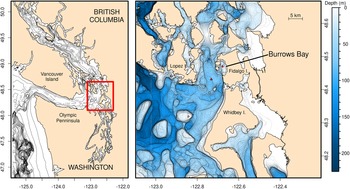
On 14 August 2014, several octopuses were encountered by scuba divers in Burrows Bay, Skagit county, Washington state, USA, located adjacent to the Rosario Strait and north of the Puget Sound (Figure 1). Burrows Bay is a shallow, protected bay with a fine-sediment substrate that can easily be disturbed by a hand passing over the surface. The sediment, brown-grey at the surface, is black and apparently anoxic approximately 2–3 cm below the surface. Approximately 50–70 cm below the surface lies a much denser clay-rich layer. Sea pens, Ptilosarcus gurneyi (Gray, Reference Gray1860), and striped nudibranchs, Armina californica (Cooper, 1863), are common at this location. These octopuses did not belong to either of the species known to occur in shallow water in this region (including areas from southeastern Alaska to northern California): Enteroctopus dofleini (Wülker, Reference Wülker1910), found in shallow subtidal zone at greater than 1500 m (Hochberg, Reference Hochberg, Scott and Blake1998), and Octopus rubescens (Berry, Reference Berry1953), a common intertidal and subtidal octopus at depths of 0–300 m (Hochberg, Reference Hochberg, Scott and Blake1998). The octopus species found in Burrows Bay exhibited two primary distinct characteristics, a lateral fold of skin on the mantle and no other visible mantle papillae. Muusoctopus leioderma (Berry, Reference Berry1911) is also known to occur near Burrows Bay, and to possess a lateral fold of skin on the mantle, but is only known to occur at depths of greater than 70 m (Hochberg, Reference Hochberg, Scott and Blake1998), with peak abundance between 450 and 650 m (Conners et al., Reference Conners, Conrath and Aydin2014). During their discovery between August 2014 and August 2022, over 130 individuals of this octopus species have been observed during 57 total dives at depths as shallow as 11.6 m. All the octopuses were observed at night, despite several attempts to locate them during the day.
Bathymetric map of Salish Sea with blow-up of area near Burrows Bay. Location of octopus collection is denoted by a red circle.

The purpose of this study is to identify the octopus found in Burrows Bay and document its behaviour. Using genetic and morphological data this octopus is identified to species, information on its phylogenetic placement is provided, and the first in situ observations of behaviour are reported.
Materials and methods
Octopus collection and observation
Octopuses were found and collected by hand while scuba diving in Burrows Bay, Skagit county, Washington, USA and placed individually in plastic bags with seawater for transport to Rosario Beach Marine Laboratory, Anacortes, WA (Washington State Scientific Collection Permit no. 14-205). Seven octopuses were encountered at depths of 13–15 m during two dives in August 2014, of which three male octopuses were collected (Table 1). These octopuses were sedated in a 2.5% ethanol–seawater solution in the lab. Once the octopuses were unresponsive, they were killed by adding sufficient ethanol to raise the proportion to 15% ethanol. One arm of one octopus was removed and preserved in 95% ethanol for molecular analysis. The remainder of that octopus and the other two octopuses were then fixed in 8% formalin in seawater. After 1 month octopuses were transferred to 95% ethanol for storage. Burrows Bay was visited again on four occasions in June and August 2015, during which seven more octopuses were observed and filmed. Dives at the site have continued every year since during July–August to continue study of the octopuses in this population.
Record of observations of M. leioderma in Burrows Bay per year from 2014 to 2022, and diver effort

Morphological analysis
For comparison to descriptions of M. leioderma (Berry, Reference Berry1911, Reference Berry1912; Hochberg, Reference Hochberg, Scott and Blake1998), morphological characters were measured for three formalin-fixed octopuses that had been collected in August 2014 from Burrows Bay, Washington. The specimens are deposited at the California Academy of Sciences (CASIZ 236693). A triangular orifice connecting the spermatophoric duct to the anteromedial chamber of the pseudophallus is described as a conserved character of the genus Muusoctopus and has been found in some specimens identified as M. leioderma (Gleadall, Reference Gleadall2004; Gleadall et al., Reference Gleadall, Guerrero-Kommritz, Hochberg and Laptikhovsky2010; Ibáñez et al., Reference Ibáñez, Pardo-Gandarillas, Peña, Gleadall, Poulin and Sellanes2016). For this reason, special attention was paid to the morphology of the pseudophallus during morphological examination. All measurements were taken according to descriptions in Roper and Voss (Reference Roper and Voss1983).
Molecular analyses
To determine phylogenetic placement of the octopus collected in Burrows Bay, four mitochondrial loci were amplified and sequenced: cytochrome b (cytb), cytochrome oxidase subunit III (COIII), 12S ribosomal RNA (12S) and 16S ribosomal RNA (16S). These sequences were selected because previous phylogenetic investigations into the genus Benthoctopus/Muusoctopus, a taxon we suspected to be closely related to the Burrows Bay octopus, had resulted in many sequences for comparison (Allcock et al., Reference Allcock, Strugnell, Ruggiero and Collins2006; Strugnell et al., Reference Strugnell, Voight, Collins and Allcock2009). Cytochrome oxidase subunit I was specifically avoided because a previous investigation had reported difficulty amplifying this locus (Strugnell et al., Reference Strugnell, Voight, Collins and Allcock2009). We did not obtain quality sequences for 16S amplicons, so this locus was omitted from further analyses. To determine whether Burrows Bay octopuses belong to the species M. leioderma, the same loci were sequenced from two museum specimens attributed to this species: CASIZ 31213 collected in 1974 from Simpson Bay, Alaska and CASIZ 031369, the species neotype collected in 1903 from the Gulf of Georgia, British Columbia (Hochberg, Reference Hochberg, Scott and Blake1998). Although initial preservation histories of these samples are not known, the standard practice of the time was to fix the organism in ~10% formalin buffered in seawater, followed by storage in ethanol. Formalin can cross-link proteins with DNA, fragment DNA molecules, and damage nucleotides directly making extraction and amplification of DNA from formalin-preserved samples challenging (Koshiba et al., Reference Koshiba, Ogawa, Hamazaki, Sugiyama, Ogawa and Kitajima1993; Bentzen et al., Reference Bentzen, Shedlock, Haygood and Pietsch1997; Pääbo et al., Reference Pääbo, Poinar, Serre, Jaenicke-Després, Hebler, Rohland, Kuch, Krause, Vigilant and Hofreiter2004). To address these issues modified extraction and amplification procedures were used, including using overlapping primer sets for each locus (Supplementary Table S1) and final sequences were determined from a consensus of multiple, independent extractions and amplifications. We designed these overlapping primer sets to produce amplicons no more than 185 base pairs (bp) long and used for reference consensus sequences we generated for each locus using sequences from the literature of other octopuses in the family Enteroctopodidae (Allcock et al., Reference Allcock, Strugnell, Ruggiero and Collins2006; Strugnell et al., Reference Strugnell, Voight, Collins and Allcock2009). To ensure that contamination from embedded or epidermal symbionts (Humes and Voight, Reference Humes and Voight1997) did not affect the final consensus sequences a BLAST search was performed for each sequenced amplicon before assembly and again on complete sequences after assembly. DNA extraction and sequence amplification was performed at three separate locations (University of Washington, Walla Walla University, and Washington State University), minimizing the potential for modern or amplified DNA contaminating amplification of degraded samples. Further, no modern octopus had been processed in the labs responsible for amplifying sequences from the museum specimens (University of Washington and Washington State University).
Sequencing the Burrows Bay octopus
DNA from Burrows Bay octopus (CASIZ 236693-B) was extracted and amplified at Walla Walla University. Muscle tissue was sampled from the preserved arm to avoid residual sediment on the surface, and samples were homogenized for DNA extraction using a mortar and pestle with liquid nitrogen. DNA was extracted using the DNA Isolation Kit for Cells and Tissues, Version 7 (Roche) followed by phenol–chloroform extraction in which DNA was extracted twice with one volume of phenol–chloroform (50:50), then once with chloroform. The DNA was purified using the GeneJET genomic DNA purification Kit (Thermo Scientific) and then amplified using polymerase chain reaction (PCR). Using this purified DNA, PCR was performed in 50 μl reaction volumes using an annealing temperature of 45°C with short, overlapping primer sets (Supplementary Table S1), some of which have been used previously to investigate relationships in the family Enteroctopodidae (Allcock et al., Reference Allcock, Strugnell, Ruggiero and Collins2006; Strugnell et al., Reference Strugnell, Voight, Collins and Allcock2009). Amplified products were purified using the GeneJET genomic DNA PCR purification kit (Thermo Scientific) according to the manufacturer's protocol and sequenced by Sanger sequencing at Lone Star Labs, Inc. (Houston, TX).
Sequencing CASIZ 31213
DNA from CASIZ 31213 was extracted in a dedicated ancient DNA laboratory at Washington State University, Pullman, Washington. Two extraction methods resulted in amplifiable target DNA. These extractions varied in the reagent used for initial sample washing but both protocols yielded sequence-quality target DNA. Between 16 and 25 mg of tissue was washed with gentle rocking in 750 μl of either ethylenediaminetetraacetic acid (EDTA) or tris/EDTA (TE) for 24 h. After washing, DNA was extracted using a QIamp DNA Mini Kit (QIAGEN) following the kit protocol with the following modification. After adding the lysis reagents (omitting proteinase K) samples were heated to 95°C for 10 min and then immediately transferred to a −20°C freezer for 2 min. This heating step is a modification of Wu et al. (Reference Wu, Patten, Yamashiro and Chui2002) as suggested by Tom Gilbert (pers. comm.) and is designed to reverse formalin-induced DNA–protein cross-links. After cooling, proteinase K was added to the sample and the extraction proceeded according to the standard tissue protocol. Negative controls were included with all extractions. Six independent extractions were done with three replicates of the two washing methods.
PCR amplification was done in 15 μl reaction volumes with Omni Klentaq LA as described in Kemp et al. (Reference Kemp, Monroe, Judd, Reams and Grier2014). Negative controls were included with all PCRs. PCR products were separated via gel electrophoresis using 3% agarose stained with ethidium bromide. Sequencing for each target fragment was performed in both the forward and reverse directions at Molecular Cloning Laboratories (South San Francisco, CA).
Sequencing CASIZ 031369 (neotype)
DNA from the M. leioderma neotype, CASIZ 031369, was extracted and amplified at the Center for Conservation Biology at the University of Washington, Seattle, WA. A single sucker with epidermis intact weighing 5.8 mg was washed in 250 μl of TE overnight. After washing, DNA was extracted using the DNeasy Blood and Tissue Kit (QIAGEN) including the heat treatment step modification described above for CASIZ 31213. PCR amplification was conducted using a pre-amplification PCR approach. The initial reaction mixture matched that used by Kemp et al. (Reference Kemp, Monroe, Judd, Reams and Grier2014) except that 1 U of Platinum® Taq (Invitrogen) and 2 μl of template DNA were used. This reaction started at 94°C for 2 min followed by 30 s each of 94°C, the respective annealing temperature (Supplementary Table S1), and 72°C for 15 cycles. A final 72°C extension for 3 min concluded the reaction. A 4 μl aliquot of amplified product was then used as a template for a 20 μl reaction volume under the same conditions as the first reaction except that the primers were increased to 0.3 μM, bovine serum albumin (BSA) to 0.2 mg ml−1, Platinum® Taq (Invitrogen) to 3 U, and 60 cycles instead of 15. Sequencing was conducted at Eton Biosciences, Inc. (San Diego, CA) in both the forward and reverse directions.
Phylogenetic tree estimation
Additional comparative sequences from the representatives of families Octopodidae and Enteroctopodidae were obtained from GenBank (Supplementary Table S2). Particular emphasis was placed on sampling genus Muusoctopus and family Enteroctopodidae. Sequences were of similar length (within 15% of the longest sequence for each gene, except for three sequences of cytb which were 27% shorter than the longest sequence). COIII and cytb sequences were aligned using the ‘AlignSeqs’ function in the DECIPHER package in R (Wright, Reference Wright2016). The secondary structure of 12S rRNA was estimated and an alignment was performed according to that secondary structure using mLocARNA with the ‘free-endgaps’ setting selected (Will et al., Reference Will, Joshi, Hofacker, Stadler and Backofen2012). Aligned datasets for each gene were concatenated into one dataset and eight partitions were designated: one for each codon position in COIII and cytb genes, and the 12S loops and 12S stems. An appropriate model of molecular evolution was selected for each partition independently (Table 2) using MODELTEST (Posada and Crandall, Reference Posada and Crandall1998) as implemented in the R package ‘phangorn’ (Schliep, Reference Schliep2011). MrBayes v. 3.2.2 (Ronquist and Huelsenbeck, Reference Ronquist and Huelsenbeck2003) was used to estimate phylogenetic tree topology and branch support, using model settings for each partition. Species in the family Octopodidae (Octopus vulgaris, O. rubescens, Octopus bimaculoides, Octopus cyanea, Amphioctopus aegina, Hapalochlaena maculosa, Abdopus aculeatus, O. tetricus, Octopus berrima, and Macroctopus maorum) were designated the outgroup in this analysis. Analyses were run with a stop rule of average standard deviation in split frequencies dropping below 0.01 and sampling once every 10,000 generations. Convergence of molecular evolutionary parameters was assessed using the Gelman–Rubin proportional scale reduction factor output from MrBayes and convergence of tree topology was assessed using the R package RWTY (Warren et al., Reference Warren, Geneva and Lanfear2017). The consensus tree was calculated using a burn-in of 25% of the samples. Single-gene trees were also estimated for each gene using the same methods as the multi-gene tree. Complete code written to perform the phylogenetic analyses in this study including dataset assembly, all analysis parameters, and creation of final figures is available at https://doi.org/10.5281/zenodo.7127592. A knitted html version of the R code included in the Zenodo repository can also be viewed at https://rpubs.com/konthank/972785.
Partitions and parameters used in MrBayes to estimate phylogenetic relationships between octopuses

Results
Morphological analysis
Taxonomically important characteristics were measured from three octopuses collected from Burrows Bay, Washington, USA in 2014 for comparison to published measurements of M. leioderma. Two of the three octopuses were mature males with 37 spermatophores present per individual (Supplementary Figures 11 and 12); the other octopus was a submature male. Some morphological characters of the Burrows Bay octopus coincided with those described for M. leioderma (Hochberg, Reference Hochberg, Scott and Blake1998), including the keel-like lateral mantle fold and number of gill lamellae (Tables 3 and 4). The Burrows Bay octopus lacked an ink sac and anal flaps, and also lacked the vestigial ink duct reported by Hochberg for M. leioderma (Reference Hochberg, Scott and Blake1998). However, some measures deviated from those reported for M. leioderma, such as total length, mantle length, characteristics of the hectocotylized arm (Table 4), and the lack of dorsal papillae over and between the eyes. The Burrows Bay octopuses are smaller (mantle length [ML] of mature males: 33.2 and 40.4 mm) with fewer suckers (52–106, 3R 45–50, Table 4) than have been previously reported for M. leioderma (Gleadall, Reference Gleadall2004; Gleadall et al., Reference Gleadall, Guerrero-Kommritz, Hochberg and Laptikhovsky2010; Ibáñez et al., Reference Ibáñez, Pardo-Gandarillas, Peña, Gleadall, Poulin and Sellanes2016). The morphology of the orifice connecting the spermatophoric duct to the anteromedial chamber of the pseudophallus in the Burrows Bay octopus is slit-like and not triangular (Supplementary Figure 1).
Summary of morphological, behavioural, and genetic evidence for the identification of Burrows Bay octopuses as M. leioderma

Morphological measurements and indices of Burrows Bay octopuses compared to M. leioderma as reported in Hochberg (Reference Hochberg, Scott and Blake1998) and Gleadall et al. (Reference Gleadall, Guerrero-Kommritz, Hochberg and Laptikhovsky2010)

All measurements and indices follow Roper and Voss (Reference Roper and Voss1983).
Living octopuses had smooth, peach orange skin that did not change colour except for very subtle lightening of the arms when startled. Skin texture was unchanging except for the occasional disappearance of the mantle lateral ridge, which became more frequent the longer the octopus was held in captivity, and the transient appearance of longitudinal furrows in the mantle skin, similar to those observed in living E. dofleini, during exceptionally strong mantle contractions. No papillae were observed on the octopus either in life or after fixation and skin was smooth and without minute folds in both living and fixed individuals. In life, eyes are large in comparison with the body, and seem to protrude from the head, but did not protrude after fixation. The museum specimens sampled, CASIZ 31213 and the neotype (CASIZ 031369), also lacked papillae over the dorsal surface, and the lateral fold of skin on the mantle as described in Berry's descriptions (Berry, Reference Berry1911, Reference Berry1912).
Molecular analysis
Sequences of the 12S region of the CASIZ 31213 sample were obtained on a total of 39 independent, overlapping fragments having an average length of 108 bp, resulting in an average coverage of ten sequences per base call (10× coverage). The COIII gene was sequenced using 57 fragments averaging 81 bp in length for a final average coverage of 11 sequences per base call. Finally, cytb was sequenced in 67 fragments averaging 97 bp in length for an average coverage of 13 sequences per base call.
Three independent overlapping sequences were obtained for the neotype 12S, resulting in a 256 bp consensus sequence with 1.54× coverage. Two overlapping sequences were obtained for the neotype COIII, resulting in a 115 bp consensus sequence with 2× coverage, and two independent overlapping sequences were obtained for the neotype cytb, resulting in a 167 bp consensus sequence with 1.25× coverage.
All assembled sequences were deposited in NCBI GenBank (accession nos. 12S: MH361295-MH361298, COIII: MH363733-MH363736, cytb: MH363737-MH363740).
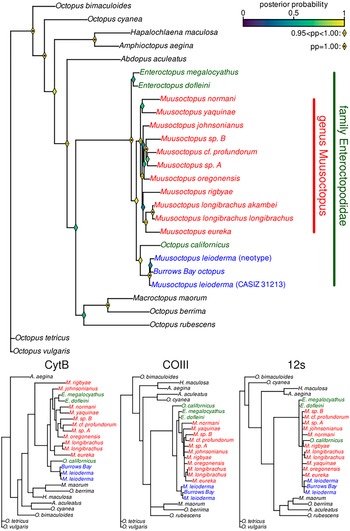
Pairwise genetic distances between the CASIZ 31213, CASIZ 031369 and the Burrows Bay octopuses were relatively low (COIII: 0–2.7%, cytb: 0.6–1.3%, 12S: 0–1.4% K80), comparable to that previously found within the species of Muusoctopus (COIII: 0.8% K80, Ibanez et al., Reference Ibáñez, Pardo-Gandarillas, Peña, Gleadall, Poulin and Sellanes2016) and lower than that found among species (COIII: 5.3–13.7% K80 Ibanez et al., Reference Ibáñez, Pardo-Gandarillas, Peña, Gleadall, Poulin and Sellanes2016, COIII: 5.5–10.6%, cytb: 4.6–12.3%, 12S: 0–5.8% K80, this study). The genus Muusoctopus, without M. leioderma, forms a highly supported, monophyletic clade (posterior probability [PP] > 0.95) within Enteroctopodidae (Figure 2). Octopuses collected from Burrows Bay and Rosario Strait formed a monophyletic clade supported by high PP ( = 1) with the CAS M. leioderma specimens within the Enteroctopodidae. M. leioderma, however, did not form a monophyletic clade with the rest of genus Muusoctopus, and instead was sister to Octopus californicus (Berry, Reference Berry1911) (PP = 0.98).
Consensus Bayesian tree of phylogenetic placement of Burrows Bay octopus within cephalopod superfamily Octopodoidea. Tree is based on partial sequences of cytb, 12S, and COIII. Bayesian PPs are displayed at each node coded by shading. Single-gene trees are shown below multi-gene tree.

Behavioural observations
Octopuses readily crawled into pre-existing holes in the sediment when followed by divers. It is unknown whether these holes were constructed by octopuses or other organisms. Octopuses would also burrow directly into the sediment where no hole existed, although they would often create burrows in shallow depressions or clefts in the sediment. In captivity, these octopuses would form new burrows in deep sediment placed in their tank, also demonstrating the ability to form new burrows.
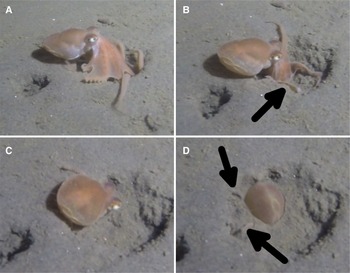
Burrowing would be preceded by what appeared to be a stereotyped series of actions (Figure 3, Supplementary Video). Octopuses would position their body centrally over the location to burrow or hole (Figure 3A). Octopuses would then thrust the medial portions of all four arm pairs into the sediment or hole (Figure 3B) and then begin to pull down the rest of the body (Figure 3C). As the octopus' body descended, the remainder of the arms would enter the mud as well, except for the distal portion of the fourth arms, which would remain above the mud until the entire body was completely buried, at which time the fourth arms pair was also pulled below the substrate (Figure 3D). The burrowing process takes approximately 6 s from the time arms begin to thrust into the substrate until the octopus is completely below the substrate surface.
Video frame capture sequence of in situ M. leioderma burrowing into the mud.

Discussion
In this study we document the presence of an octopus species in Burrows Bay, Washington, never before seen in the shallow waters (<70 m) of the western coast of North America. The invasion of octopuses into new habitats is of particular concern because they are invertebrate predators with a high-metabolic rate exceeding even that of some benthic vertebrate predators such as fishes (Seibel and Drazen, Reference Seibel and Drazen2007), meaning that they consume more prey on a per mass basis than other co-occurring predators. Octopuses also have a remarkably short generation time, and high fecundity compared to other benthic mesopredators (Boyle, Reference Boyle1987). Overall, cephalopod populations appear to be more responsive to environmental change than their chief competitors, which has resulted in general increases in cephalopod populations (Doubleday et al., Reference Doubleday, Prowse, Arkhipkin, Pierce, Semmens, Steer, Leporati, Lourenço, Quetglas and Sauer2016). For these reasons, an octopus invading into new habitats can potentially have an out-sized impact on those ecosystems. The invasion of a previously unknown octopus species into shallow-water environments of the Salish Sea would therefore be of particular concern for the future of these nearshore environments.
Morphological (Table 4) and molecular (Figure 2) data indicate that the octopus species found in Burrows Bay belongs to the species M. leioderma, but likely not to the genus Muusoctopus. Morphological characteristics of the Burrows Bay octopus largely coincided with those previously described for M. leioderma (Hochberg, Reference Hochberg, Scott and Blake1998) with notable differences in size at maturity, hectoctylized arm sucker count (HASC), and presence of dorsal papillae over the eyes (Table 4). However, these size differences may be an artefact of the collection location. The octopuses in Burrows Bay were observed at 11.6 m, the shallowest depth reported for M. leioderma; previously the species was reported at no shallower than 70 m depth (Hochberg, Reference Hochberg, Scott and Blake1998). Ectotherms commonly demonstrate an inverse relationship between temperature experienced during ontogeny and adult body size (Atkinson et al., Reference Atkinson, Morley and Hughes2006). In a related trend, values for meristic characters, such as vertebrae, are often lower in fish that develop at warmer temperatures (McDowall, Reference McDowall2008), and this phenomenon has been suggested to impact sucker counts in octopuses (Voight, Reference Voight2012). Therefore, because temperature is inversely related to depth in most marine systems, it is not surprising that the shallowest occurring individuals of an octopus species have the lower sucker counts and are smaller at maturity than those previously reported.
The Burrows Bay octopus formed a clade with M. leioderma with high branch support, and with genetic distances less than those observed among other species of Muusoctopus. The M. leioderma clade formed a sister clade with O. californicus rather than nesting within the genus Muusoctopus. Fixed specimens from Burrows Bay lacked dorsal papillae and the lateral fold of skin on the mantle described by Berry, but neither are these characteristics present in the neotype (CASIZ 031369).
In life, octopus possessed a well-developed lateral ridge of skin around the posterior and lateral margins of the mantle, which was not present after fixation. A lateral mantle fold was described and illustrated for a fixed specimen by Berry (Reference Berry1912). The lateral ridge around the mantle in living organisms, which has at times been indicated to be diagnostic for M. leioderma (Kozloff, Reference Kozloff1996), appears to be a common characteristic, having evolved multiple times in five families of octopuses (Norman, Reference Norman2000) (Octopodidae: Octopus australis [Hoyle, 1885], O. berrima [Stanks & Norman, 1992], Callistoctopus bunurong [Stranks, 1990], Scaeurgus unicirrhus [Delle Chiaje, 1839, 41], Eledonidae: Eledone cirrhosa [Lamarck, 1798], Enteroctopodidae: Enteroctopus clade II [Hollenbeck and Scheel, Reference Hollenbeck and Scheel2012], M. leioderma [Berry, Reference Berry1911], Muusoctopus sibiricus [Loyning, 1930] [Jorgensen, Reference Jorgensen2009], Bathypolypodidae: Bathypolypus arcticus [Prosch, 1847], and Megaleledonidae: Pareledone charcoti [Joubin, 1905]) and is suggested to be related to burrowing or burying in mud and sand (Norman and Reid, Reference Norman and Reid2000).
M. leioderma has been proposed as a member of genus Muusoctopus based on conservative internal morphology of the pseudophallus of the species (Gleadall, Reference Gleadall2004; Gleadall et al., Reference Gleadall, Guerrero-Kommritz, Hochberg and Laptikhovsky2010; Ibáñez et al., Reference Ibáñez, Pardo-Gandarillas, Peña, Gleadall, Poulin and Sellanes2016). We, however, found the orifice between the spermatophoric duct and the anteromedial chamber to be slit-like and not triangular as had been reported previously (Ibáñez et al., Reference Ibáñez, Pardo-Gandarillas, Peña, Gleadall, Poulin and Sellanes2016). Further, the results of this molecular analysis suggest that Muusoctopus is not the correct generic placement for M. leioderma. The multi-gene analysis supports a close relationship between M. leioderma and O. californicus (PP > 0.90), and none of the single-gene trees supports a hypothesis of M. leioderma nested within the remaining genus Muusoctopus (Figure 2). Sequences for the three loci are not yet available for 22 of the 30 currently described species of Muusoctopus which prevents a thorough genetic assessment. The addition of more species of Muusoctopus or closely related taxa could alter the tree topology. Based on morphology, it seems doubtful, however, that M. leioderma and O. californicus should be considered congeners. O. californicus possesses an ink sac, a skin patch and groove system, and enlarged suckers in males, all of which are absent in M. leioderma (Hochberg, Reference Hochberg, Scott and Blake1998). The funnel organ is VV-shaped in O. californicus and W-shaped in M. leioderma (Hochberg, Reference Hochberg, Scott and Blake1998).
This octopus was regularly observed at night, but never during daytime dives at the same location. The observation of over 130 octopuses over the course of 9 years, and relatively consistent effort per observation (Table 1) indicates this population is somewhat persistent in shallow water at this location. Observation of this population already yielded new information about the behaviour of the species, specifically the ability to quickly burrow directly into soft benthic sediments in addition to its use of pre-existing holes. True burrowing, in contrast to shallow burying, is rare in cephalopods. Subsurface burrowing behaviour has only been described in two other octopus species, Octopus kaurna (Montana et al., Reference Montana, Finn and Norman2015) and Thaumoctopus mimicus (Hanlon et al., Reference Hanlon, Conroy and Forsythe2008), although use of burrows has also been reported in other species such as Octopus minor (Zheng et al., Reference Zheng, Qian, Liu, Li, Iglesias, Fuentes and Villanueva2014). Cursory examination, however, suggests that M. leioderma may not use the same mechanism for burrowing as O. kaurna, which uses a jetting action with the mantle and siphon directed at the substrate to temporarily suspend substrate particles to ‘fluidize’ the substrate and allow the octopus to pull itself underneath (Montana et al., Reference Montana, Finn and Norman2015). M. leioderma was not observed using the same powerful mantle contractions and jetting behaviour.
Why has this shallow-water population of M. leioderma not been observed before? It seems unlikely that this population has simply been overlooked. Shannon Point Marine Center, operated by Western Washington University, lies approximately 5.2 km north of the collection location, and Rosario Beach Marine Laboratory, operated by Walla Walla University, lies 4.9 km south. The fauna of Burrows Bay has been sampled by trawl and scuba, including at night, by members of both institutions for more than 50 years without this species having been reported.
M. leioderma may have recently expanded its vertical distribution into Burrows Bay. Worldwide cephalopod populations have been growing (Doubleday et al., Reference Doubleday, Prowse, Arkhipkin, Pierce, Semmens, Steer, Leporati, Lourenço, Quetglas and Sauer2016), and over recent decades many species of cephalopods have experienced range expansions including D. gigas in the eastern Pacific (Zeidberg and Robison, Reference Zeidberg and Robison2007), Loligo forbesii, Loligo vulgaris, Alloteuthis subulata in the North Sea (van der Kooij et al., Reference van der Kooij, Engelhard and Righton2016), and O. tetricus on the west coast of Australia (Ramos et al., Reference Ramos, Pecl, Moltschaniwskyj, Strugnell, León and Semmens2014). Muusoctopus eureka retreated from the shallow water of the Falkland Islands nearly a century ago and has reappeared in shallow water following recent shallow-water cooling (Laptikhovsky et al., Reference Laptikhovsky, Arkhipkin, Brickle, Hearne and Neely2011). If a recent range expansion of M. leioderma into shallow water has occurred, it would correspond to a larger global trend of cephalopod range expansion.
Based on the morphological and genetic information, we conclude that the octopus found in Burrows Bay, Washington belong to the species M. leioderma. These observations represent the shallowest records for this species at 11.6 m. It is unknown whether M. leioderma has been a long-term inhabitant of the shallow water of Burrows Bay, but some evidence suggests a recent invasion. Phylogenetic analysis also suggests that M. leioderma does not form a monophyletic group with the other members of the genus Muusoctopus, likely necessitating the proposal of a new genus.
Supplementary material
The supplementary material for this article can be found at https://doi.org/10.1017/S0025315423000644
Data
The novel genetic data that support the findings of this study are openly available in NCBI GenBank at https://www.ncbi.nlm.nih.gov/genbank/, accession numbers MH361295-MH361298 and MH363733-MH363740. Specimens collected and measured in this study have been deposited with the California Academy of Science Invertebrate Zoology collection (CASIZ 236693). Complete code underlying the phylogenetic analysis can be found on the online repository Zenodo at https://doi.org/10.5281/zenodo.7127592. Code and data underlying bathymetry map of the study area can be found on the repository Zenodo at https://doi.org/10.5281/zenodo.7144392.
Acknowledgements
We thank those whose helped in observing and collecting these octopuses: Dr James Nestler, Dr Alan Verde, Christopher Reeve, Taylir Schrock, Monica Culler, Levi Evans, Kaitlyn Jacobs, Katie Pekar, Taylor Grace, and Christopher Heinrich. We thank Christina Piotrowski and Dr Terrence Gosliner of the California Academy of Sciences for help in obtaining Muusoctopus leioderma material for genetic sampling. We thank Dr Jan Strugnell for helpful advice on PCR parameters and sharing primer sequences. We thank Dr Brian Kemp for use of his aDNA facilities at Washington State University and Dr Samuel Wasser for use of his facilities at the University of Washington. We thank Dr Tom Gilbert for his guidance on extracting genetic material from formalin-preserved tissues. We thank Jennifer Blaine of the Washington Department of Fish and Wildlife for providing M. leioderma collected during trawl surveys.
Author's contribution
L. G. K. and K. L. O. formulated the research question. L. G. K. carried out sequencing of Burrows Bay octopus, B. M. J. carried out sequencing of CASIZ 31213, and M. W. carried out sequencing of CASIZ 031369. K. L. O. performed data analysis. L. G. K. wrote the first draft of this manuscript. All authors contributed to the design of the study, interpreting the findings, and writing the manuscript.
Financial support
This work was supported by the MJ Murdock Charitable Trust under Grant number 2013260:MNL:2/27/2014.
Competing interest
None.
Ethical standards
Ethics approval was not received for this animal study because ethics approval for cephalopod studies was not required in the USA, where the work was performed, at the time of the study.