Biological disasters occur more often now than in the past due to the increased probability of epidemics and pandemics of emerging and reemerging diseases, as well as bio-terrorism. Reference Tartari, Allegranzi and Ang1-Reference Vetter, Eckerle and Kaiser3 Features of infectious disasters include their contagious nature, high spread, a daily increase in the number of involved victims, and health care service disruption. Managing such disasters requires special approaches and facilities, including drug supply, vaccines, intensive care beds, ventilators, personal protective equipment (PPE), patient-specific care, differences in service delivery for various diseases, specialist personnel, staff education, individual and mass isolation, and other features that distinguish them from other disasters. Reference Vetter, Eckerle and Kaiser3-Reference Bielajs, Burkle, Archer and Smith9 Biological disaster management involves multidimensional and complex considerations. Past and recent epidemic experiences usually involve a sharp decrease in human resources available to provide the required services. Reference Vetter, Eckerle and Kaiser3,Reference Bazeyo, Bagonza and Halage10-Reference Lipsitch, Swerdlow and Finelli14 Such a crisis was observed during the 2014 Ebola epidemic in East Africa, Reference Forrester, Pillai and Beer15 and during the outbreak in Sierra Leone, where a decrease in the number of doctors and nurses available was also reported. Reference Bazeyo, Bagonza and Halage10 This decrease is either due to the illness itself, or the inherent fear of it overwhelming the people and staff. Reference Bazeyo, Bagonza and Halage10,Reference Forrester, Pillai and Beer15 The number of volunteers, which usually compensates for the shortage of human resources in other disasters, also drops in this type of disaster. Reference Burkle4 Challenges in such disasters range from the likelihood of visiting many panicked people in hospitals on one hand, to a failure to attend to true patients at the health centers on the other hand. Reference Burkle4,Reference Burkle8,Reference Forrester, Pillai and Beer15 The main challenge of contagious infections is their rate of spread. A biological agent can traverse the Earth in a short time, and become a disaster. Reference Burkle4,Reference Du, Suo and Jia16,Reference Brownstein, Freifeld and Chan17 In 2002, an outbreak of severe acute respiratory syndrome (SARS) spread from a Chinese village to 40 countries around the world in 10 days. Reference Burkle4 Another example is the spread of COVID-19 to 32 countries from China (Wuhan) between December 2019 and February 22, 2020. 18
The preparedness of hospitals to face these events is of the utmost importance. Pursuing different dimensions of hospital preparedness for biological events can help to manage this type of disaster and mitigate the risks they carry more effectively. The unique nature of disease transmission in these disasters has caused rapidly spreading outbreaks globally ranging from epidemics to pandemics, and including bioterrorist threats. In each country, therefore, hospital preparedness can potentially deal with and control these disasters, in the index countries, and also worldwide. Such local preparedness can improve management and performance in other countries. This study was therefore designed to determine the current state of the preparedness of countries to respond to biological events all over the world. Participants were those countries with any published article regarding their preparedness and response during biological events. The considered outcomes of the present study included information about how to prepare for, and respond to, biological disasters, as well as foreseeable challenges related to their management. This research is a systematic review of resources with any methodology.
METHODS
This article is the result of a systematic review aimed at assessing the preparedness of hospitals to face biological events worldwide. Afterwards, thematic analysis was carried out to discover the factors affecting biological disasters preparedness.
Data Resources
The systematic review was carried out on articles, documents, and reports related to the aim of the research. The search period was from January 1, 2007 to December 30, 2018.
Data resources included PubMed, Scopus, Web of Science, and ProQuest. Considering the search results, 2 journals (the American Journal of Infection Control and the Journal of Hospital Infection) were also searched as key journals for relevant articles. Google Scholar was also searched separately.
Search Strategy
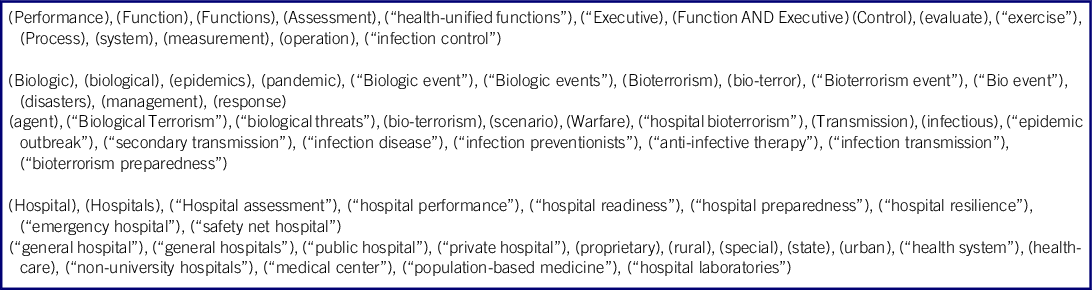
The search components were: ‘performance assessment,’ ‘bio event,’ and ‘hospital.’ In order to discover the maximum number of articles, equivalent words or phrases were determined by the 3-phase method. Equivalent words were obtained for each phrase in the MeSH and Emtree search engines, and they were added after studying 10 relevant articles. The words were completed or revised after specialists consultation.
The final keywords were selected in 3 groups, as described in Table 1.
Key Words of the Study

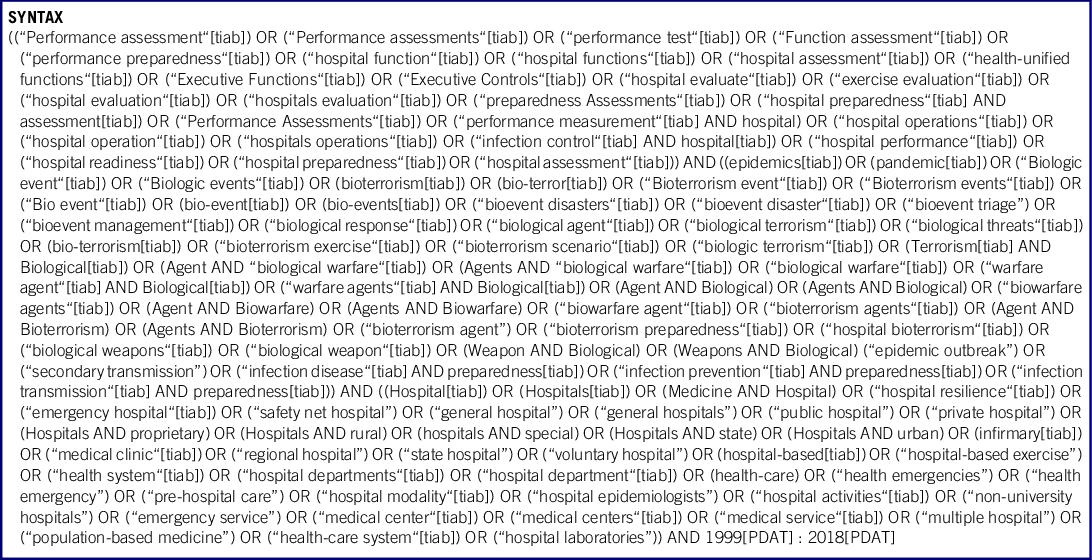
According to the search engine, the desired syntax was edited and a search was carried out. Syntax adjustment and limiting was continued until INR 15 was reached. Table 2 is an example of the process in PubMed.
Search Syntax in PubMed

Inclusion Criteria
-
1) Articles relevant to the study topic and research question;
-
2) Articles that fully or partially addressed preparedness or response to infectious disasters (epidemic, pandemic, or bioterrorism-related);
-
3) Articles published between January 1, 2007 and December 30, 2018;
-
4) Articles dealing with preparedness or response in a country or a geographical area; and
-
5) All research methods.
Exclusion Criteria
-
1) Abstracts of congress articles;
-
2) Articles dealing solely with non-hospital settings;
-
3) Articles on hospital-acquired infections in non-disasters; and
-
4) Articles dealing with only 1 hospital.
Note that article language was not an exclusion criterion. To determine the status of all countries (as was the purpose of this study), no articles were deleted due to lack of access to their full text.
Study Selection and Data Extraction
At the end of the search, and after omitting duplicates, 2 members of the research team screened articles, books, documents, and dissertations independently, according to their titles and abstracts, considering the inclusion and exclusion criteria. To decrease the risk of bias related to individual studies, full texts of remaining titles were analyzed by 2 colleagues using a researcher-produced form. Additionally, to decrease the risk of bias of across studies, any relevant article found was selected without special consideration for the author or publisher. All of the results and reports were considered for this study. Low-quality studies, or those with invalid methodologies, were excluded. Data were extracted from the remaining articles using researcher-produced forms. If there was any disagreement, the paper was reviewed by a third colleague, and the final decision was taken by the research team. The forms (critical appraisal checklist and data extraction tool) were developed and processed during the study.
Data Analysis and Interpretation
After selecting appropriate articles, they were analyzed considering descriptive evaluation (including the type of study, its methodology, findings relevant to the research question, and results). Thematic analysis was used at this phase.
RESULTS
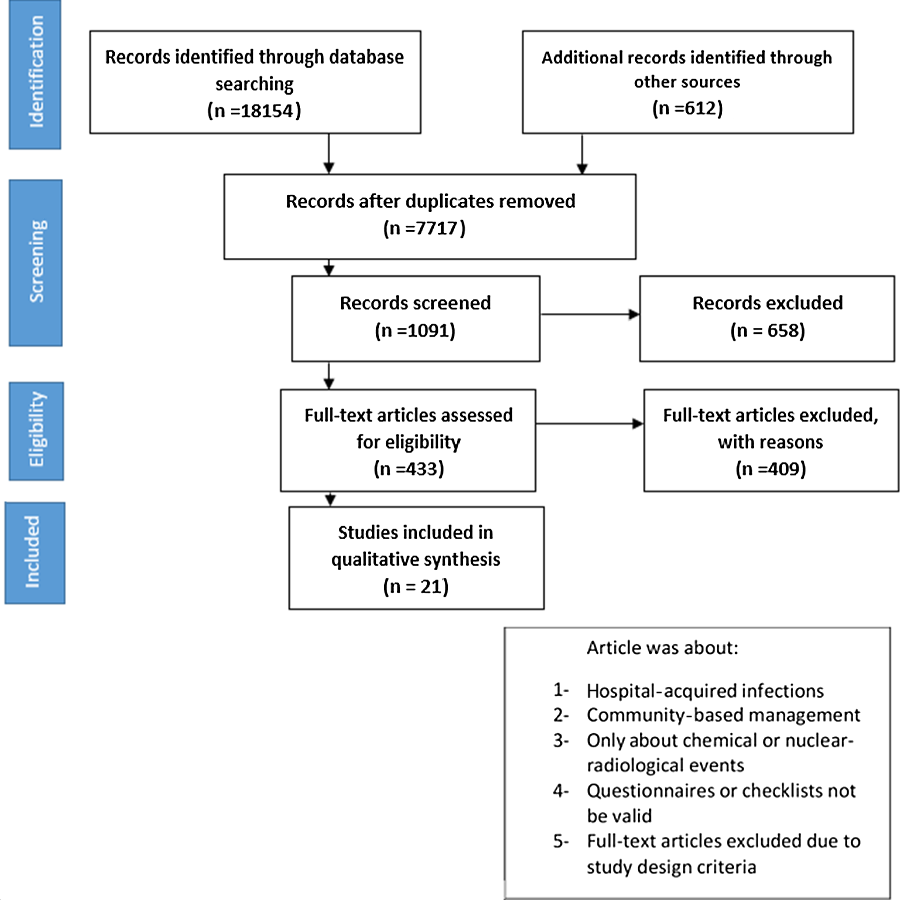
From 1091 articles and documents collated during the search, 433 relevant articles were found, and 21 final articles were entered into the study. Due to the different methods and tools used by the articles, the research team extracted data regarding hospital preparedness and performance in biologic disasters by content analysis. The PRISMA diagram is depicted in Figure 1.
PRISMA Diagram of Studies Included in the Systematic Review.

Description of Studies
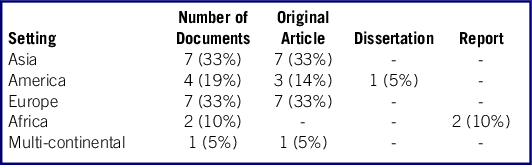
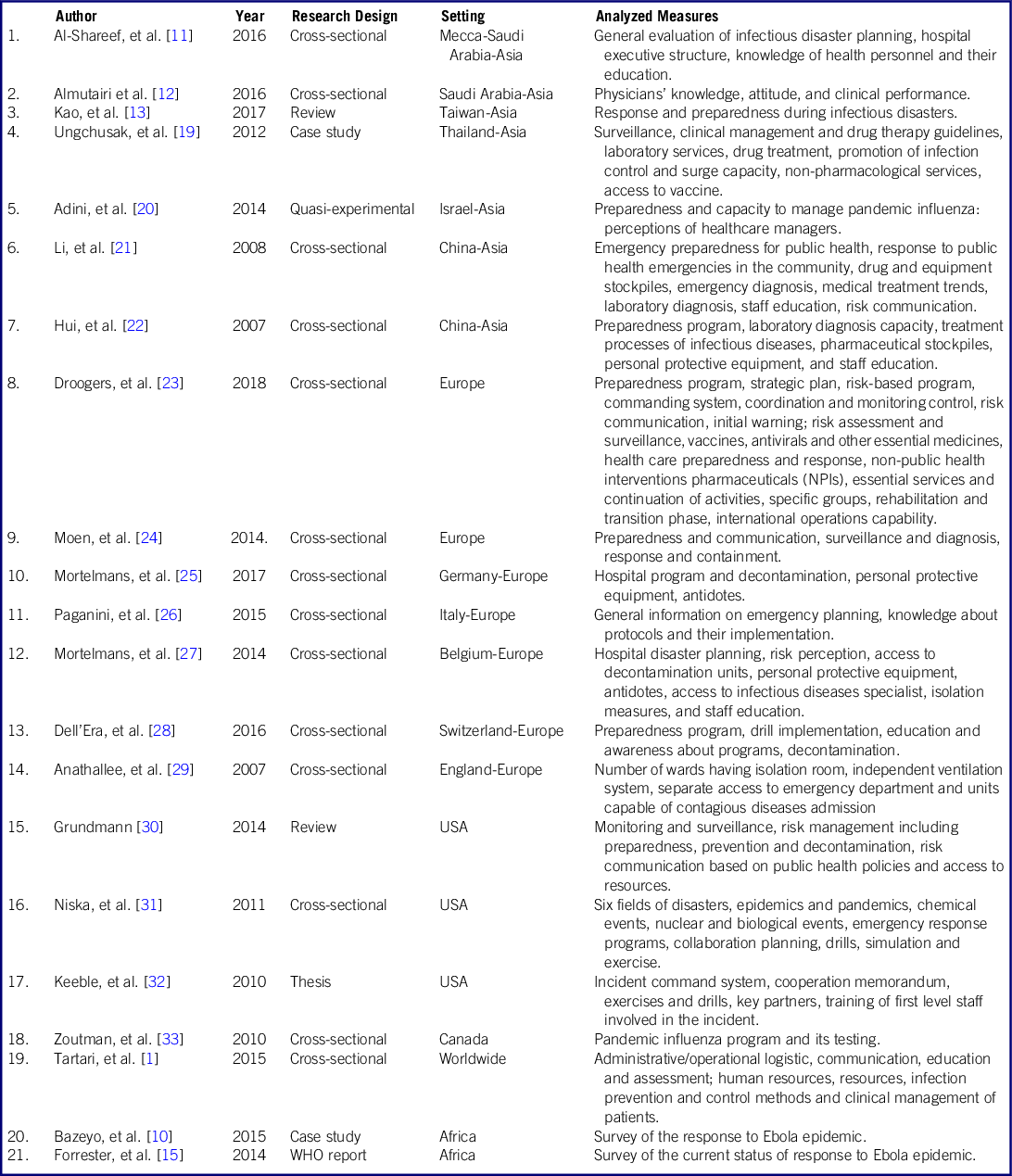
Most of the reviewed documents were original and cross-sectional studies; 7 articles (33%) about Asian hospitals, 7 articles (33%) from Europe, 4 articles (19%) about USA hospitals, 2 articles (10%) about Africa, and 1 article (5%) studied the hospitals in more than 1 continent. The obtained information is described in Table 3.
Number of Articles Encoded by World Region and Type of Documents

Of the documents, 85% were original papers, 20% review articles, 5% dissertations, and 5% were reports. The type of documentation included in the study is as described in Table 3. The results of the systematic review are summarized in Table 4.
Summary of Systematic Review Results

DISCUSSION
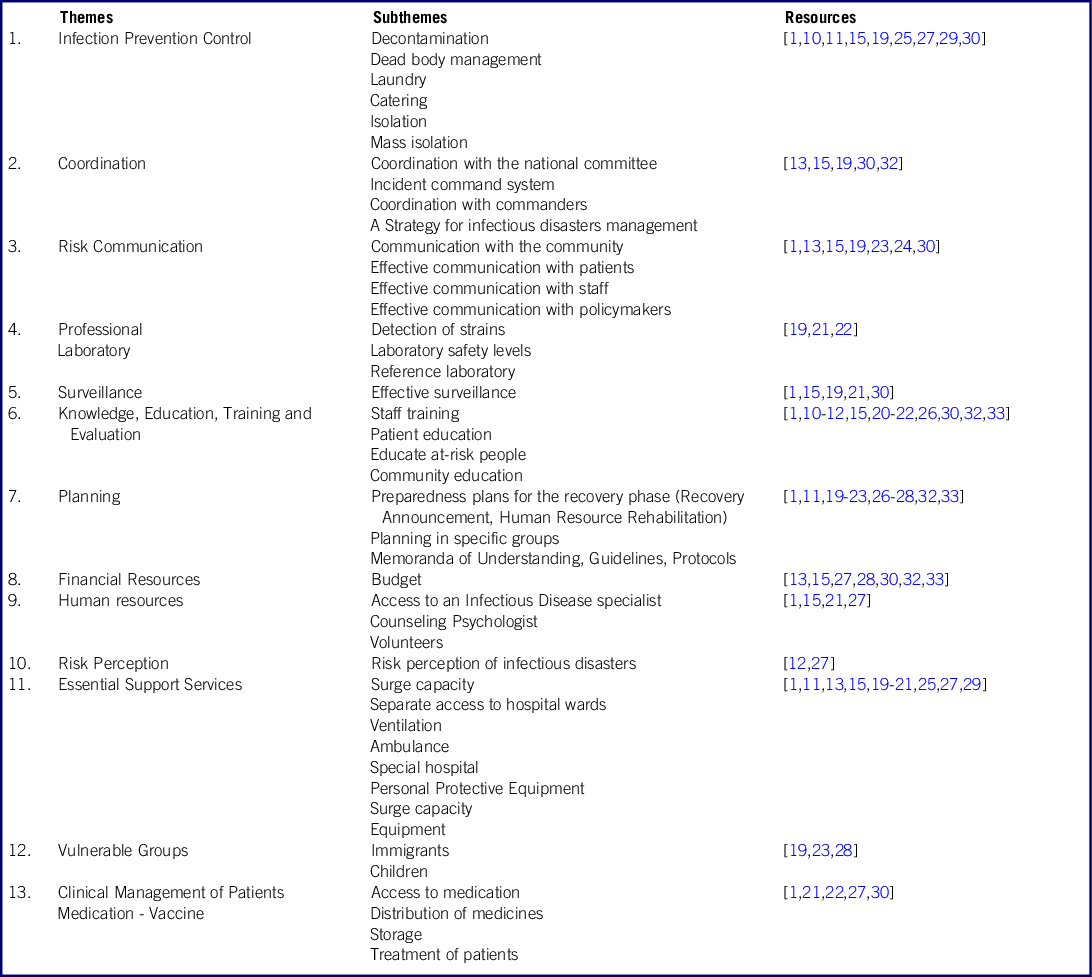
In this phase of the study, and according to the obtained findings (multi-dimensional findings, and a variety of research methods and tools), our team decided to categorize the investigated items using thematic analysis. The items reviewed in all the documents were extracted, and 46 common sub-themes were obtained. After this, the obtained sub-themes were categorized into 13 themes according to similarities and differences. In other words, the articles had evaluated hospitals in 13 general areas. Although all the articles had not discussed all the categories, the reported cases are listed in Table 5 according to the research team’s categorization.
Extracted Themes and Subthemes as Effective Determinants and Components of Biological Disaster Preparedness

Infection Prevention Control (IPC)
IPC data were extracted by thematic analysis, Reference Tartari, Allegranzi and Ang1,Reference Bazeyo, Bagonza and Halage10,Reference Al-Shareef, Alsulimani and Bojan11,Reference Ungchusak, Sawanpanyalert and Hanchoworakul19,Reference Mortelmans, Gaakeer and Dieltiens25,Reference Mortelmans, Van Boxstael, De Cauwer and Sabbe27,Reference Anathallee, Curphey and Beeching29,Reference Grundmann30 as an important factor considered in some articles, which consisted of decontamination, dead body management, laundry, catering, as well as individual and mass isolation. Measures carried out by staff (such as hand washing and use of PPE), and proper isolation of patients (based on the type of illness) affect the performance of hospitals and health centers responding to infectious disasters. Reference Munoz-Price, Arheart and Mills34,Reference Carlos, Capistrano and Tobora35
Our study showed that challenges confronting IPC around the world are in categories such as access to individual and mass isolation, decontamination measures, hospitalization facilities for patients with highly infectious diseases, biological waste disposal, isolated rooms with ≥ 12 air changes per hour, implementing IPC guidelines on the handling of laboratory samples, infection control in food preparation and hospital cleansing and laundries, access to alcohol and gloves, and managing dead bodies.
Risk Perception
Risk perception of infectious disasters is one of the components of the proper preparedness and performance of health systems. Appropriate risk perception is a determining factor in disaster risk reduction implementations. Risk perception was extracted as one of the effective themes influencing hospital preparedness and response Reference Almutairi, Alodhayani and Moussa12,Reference Mortelmans, Van Boxstael, De Cauwer and Sabbe27 but only 71% of Belgian hospitals were considered to be at risk of Chemical, biological, radiological and nuclear (CBRN) events. Reference Mortelmans, Van Boxstael, De Cauwer and Sabbe27 In Saudi Arabia, all physician and nurse participants had high levels of concern about hemorrhagic fever, so they adhered to strict standard measures for infection control. Reference Almutairi, Alodhayani and Moussa12 The threat of an epidemic may be frightening, particularly when it causes community collapse due to over-estimation of the risk, or vice-versa (inadequate follow-up and widespread epidemics by under-estimation). Reference Bonneux and Van Damme36
Planning
The sub-themes identified were: preparedness plans for recovery period (recovery announcement, human rehabilitation), programs for special groups, agreements, guidelines, and protocols. Reference Tartari, Allegranzi and Ang1,Reference Al-Shareef, Alsulimani and Bojan11,Reference Ungchusak, Sawanpanyalert and Hanchoworakul19-Reference Droogers, Ciotti and Kreidl23,Reference Paganini, Borrelli and Cattani26-Reference Dell’Era, Hugli and Dami28,Reference Keeble32,Reference Zoutman, Ford, Melinyshyn and Schwartz33 Some necessary plans included educational programs, contamination prevention, rapid communication, individual and mass quarantine, and rapid diagnostic tests. Reference Grundmann30,Reference Lin, Peng and Tsai37 It should be considered that real preparedness is much different from the existence of a plan.
Essential Support Services
Essential support services are considered to be a basic element for proper preparedness and performance during biological disasters that include surge capacity measures, PPE, appropriate masks, and isolation facilities. Reference Anathallee, Curphey and Beeching29,Reference Wilson and Ridgway38-Reference Stockley, Constantine and Orr41 In our study, essential support services were a major theme, that included the following sub-themes: equipment, separate entrances to wards, ventilation, ambulance, high specialty hospitals, PPE, and surge-capacity. Reference Tartari, Allegranzi and Ang1,Reference Al-Shareef, Alsulimani and Bojan11,Reference Kao, Ko and Guo13,Reference Forrester, Pillai and Beer15,Reference Ungchusak, Sawanpanyalert and Hanchoworakul19,Reference Li, Huang and Zhang21,Reference Mortelmans, Gaakeer and Dieltiens25,Reference Mortelmans, Van Boxstael, De Cauwer and Sabbe27,Reference Anathallee, Curphey and Beeching29 Our review has shown that there is a wide range of equipment coverage around the world.
Surveillance
There are reports of the implementation and use of modern and multipurpose surveillance systems. There have been monitoring reports of symptoms in specific times and regions, syndromic surveillance systems, pre-diagnostic and non-specific criteria monitoring, and health behavior spectrum monitoring. Reference Kman and Bachmann42 Surveillance execution is an important element in appropriate preparedness and performance. Reference Ungchusak, Sawanpanyalert and Hanchoworakul19,Reference Li, Huang and Zhang21,Reference Moen, Kennedy, Cheng and MacDonald24
In 36 European countries, routine influenza surveillance was evaluated as appropriate. Reference Moen, Kennedy, Cheng and MacDonald24 An extensive study in 125 hospitals, across 45 countries, showed that 68% of hospital staff who were engaged in the management of hemorrhagic fever patients were aware of surveillance system and notification processes. Guidelines for suspected cases were available in 70% of hospitals. Reference Tartari, Allegranzi and Ang1 In the early days of the largest Ebola epidemic in Africa, no surveillance system was available. Reference Forrester, Pillai and Beer15
Laboratory
While an appropriate response to biological disasters requires access to laboratory facilities, only 3 studies had evaluated this theme as an aspect of preparedness. Reference Ungchusak, Sawanpanyalert and Hanchoworakul19,Reference Li, Huang and Zhang21,Reference Hui, Jian-Shi and Xiong22,Reference Reilly and Markenson52
Vulnerable Groups
The vulnerable groups are more susceptible than the general population, even during a natural and uncomplicated disaster. They also have more needs, and will be even greater in complex disasters such as biological events, but as only 3 countries had considered it as an element of preparedness, Reference Naik, Vagi, Uzicanin and Dopson43-Reference Cohen, Tamrakar and Lowe50 it was one of the issues mentioned the least in the field of disaster management.
Education, Exercise, and Evaluation
Review of articles in the field of biological disaster response reveals the impact of education and exercise. Reference Djalali, Della Corte and Segond51,Reference Reilly and Markenson52 Hospitals will not have the appropriate response capacity without effective education. Reference Reilly and Markenson52 This theme was extracted after thematic analysis, including the sub-themes of: staff education, patient education, vulnerable group training, and community training. Education is one of the challenges of infectious disaster management. Education gaps were clear during the Ebola epidemic in East Africa. Reference Kratochvil, Evans and Ribner53 The current systematic review showed 11 articles had studied the issue, suggesting the importance and frequency of theme as an element of biological disaster preparedness and response. Reference Tartari, Allegranzi and Ang1,Reference Bazeyo, Bagonza and Halage10-Reference Almutairi, Alodhayani and Moussa12,Reference Forrester, Pillai and Beer15,Reference Ungchusak, Sawanpanyalert and Hanchoworakul19,Reference Li, Huang and Zhang21,Reference Hui, Jian-Shi and Xiong22,Reference Paganini, Borrelli and Cattani26,Reference Grundmann30,Reference Keeble32,Reference Zoutman, Ford, Melinyshyn and Schwartz33
Human Resource
The number of health care workers drops when biological disasters occur, similar to influenza pandemics. Reference Rutkow, Paul, Taylor and Barnett54-Reference Balicer, Barnett and Thompson57 Although the degree to which motivation and the number of available workers decrease in biological disasters varies from country to country, the level of motivation is lower for biological disasters than other disasters. Reference Forrester, Pillai and Beer15,Reference Du, Suo and Jia16,Reference Barnett, Levine and Thompson56 One of the main extracted themes was human resources, including sub-themes of access to an infectious diseases specialist, a counseling Psychologist, and volunteers. Reference Tartari, Allegranzi and Ang1,Reference Forrester, Pillai and Beer15,Reference Li, Huang and Zhang21,Reference Mortelmans, Gaakeer and Dieltiens25 Deficiency of specialist human resources, including infectious disease specialists, psychiatrists, and epidemiologists, was observed in several studies.
Clinical Management of Patients
In this study, and based on thematic analysis, clinical management of patients was one of the extracted themes in facing biological disasters. Reference Tartari, Allegranzi and Ang1,Reference Li, Huang and Zhang21,Reference Hui, Jian-Shi and Xiong22,Reference Mortelmans, Van Boxstael, De Cauwer and Sabbe27,Reference Grundmann30 This theme included sub-themes of access to distribution and storage of drugs and vaccines, and treatment of patients. The results of our study showed that clinical management of specific patients (chronic renal failure patients in need of hemodialysis), diagnostic guidelines, patient tracking, reserves of vaccines and antibiotics, and other pharmaceutical resources are problematic in some research.
Risk Communication
During intentional or unintentional outbreaks of infectious diseases, communication, information, and guidance are often the most important public health tools in risk management. Reference World Health58 Effective communication reduces response time in disasters. Reference Mosquera, Melendez and Latasa59
It was determined by our research that the following items had encountered some problems: sharing specific information (such as free bed numbers and hospital capacity), training programs, answering frequent asked questions, visual tools for personal protection exercises and educational videos, and intra-hospital communication mechanisms. In African countries, even telephone interference had led to inefficient management in the Ebola pandemic. Reference Tartari, Allegranzi and Ang1,Reference Kao, Ko and Guo13,Reference Forrester, Pillai and Beer15,Reference Ungchusak, Sawanpanyalert and Hanchoworakul19,Reference Moen, Kennedy, Cheng and MacDonald24,Reference Grundmann30
Budget
In spite of the high cost of preparedness and performance measures during infectious disasters, proper budgets are not usually allocated. Researches show that a lack of financial resources acts as a major obstacle to proper preparedness. Reference Mortelmans, Van Boxstael, De Cauwer and Sabbe27 The amount of funding varies according to each country’s context. Our study found that in Switzerland, the lack of national funds for enhancing disaster preparedness is one of the main causes of hospital vulnerability to chemical, biological, radiological, nuclear, and burn threats. Reference Dell’Era, Hugli and Dami28 Funding for biological defense has been increasing in the United States since 2000, Reference Grundmann30 but budget strategies for hospital preparedness should be prioritized and rationally reviewed. Reference Keeble32 70% of hospitals in Ontario, Canada had not received adequate funding for influenza epidemics. Reference Zoutman, Ford, Melinyshyn and Schwartz33 At the beginning of the largest Ebola epidemic in east Africa, health care worker salaries were not paid due to the lack of budget. Reference Forrester, Pillai and Beer15
Coordination
Good evidence of the coordination and command of infectious epidemics has been seen in Taiwan. The Epidemic Command Center is responsible for managing infectious epidemics. Unified command and appropriate coordination has been implemented by: determining 6 geographic areas in the country; designating a respondent hospital, a support hospital, and mass isolation sites such as public spaces or determined hospitals in each area; and connecting all of them to the Center of Infectious Epidemics Control. The above mentioned system can be a model for controlling epidemics and other infectious disasters worldwide. Reference Kao, Ko and Guo13
Infectious disasters differ from other disasters in many respects, such as drug supply, vaccines, and special equipment like PPE; so their management requirements include Memoranda of Agreement (MOA), Memoranda of Understanding (MOU), and cooperative planning with other hospitals, health centers, government, local authorities, and support providers. Coordination with foreign organizations (respondent and supportive) as well as national inter-disciplinary coordination can improve management. Reference Avery and Zabriskie-Timmerman60
Limitations
The limitation of our research was that methodology of studies was not similar. The tools used in different studies were also not similar.
CONCLUSION
Although biological events are one of the most important challenges the world is facing, the road to the complete preparedness and performance necessary to confront such disasters is long. The necessary budget, and its management, have an important role to play in preparedness for, and response to, a biological event. Many developed countries seem to be better prepared. Hospitals will have trouble at least in some respects dealing with such events. Although some studies have shown that prior experience of an infectious disaster would be an effective factor for preparedness, there is no evidence to support that conclusion. Although the present study has reviewed the response and preparedness of hospitals to infectious disasters up to 2019, and findings have been from epidemics such as SARS, MERS, and Ebola, many results might be extended to COVID-19 pandemic. Taiwan’s coordination network, which was established for the 2003 SARS epidemic and was modified and tested during the 2009-10 H1N1 influenza pandemic and 2014-2016 Ebola outbreak, is an example to be considered for implementation in the COVID-19 disaster.
Ethics
This study was approved by the National Committee of Ethics of Iran (code number: IR.SBMU.RETECH.REC.1396.205).
Acknowledgement
We would like to thank Dr Seyyed Javad Hosseini Shokuh, who spent valuable time conducting surveys.
Conflict of Interest Statement
All authors disclose that there is no actual or potential conflict of interest, including financial and personal, or any other relationships with authorities or organizations that would constitute a conflict, within 3 years of starting the study.