


Introduction
Drop-out is a significant problem for mental health services, leading to inefficient service delivery and poorer client outcomes, in the context of increasingly limited resources (Wells et al., Reference Wells, Browne, Aguilar-Gaxiola, Al-Hamzawi, Alonso, Angermeyer and Kessler2013). Despite this, literature evaluating predictors of drop-out from therapy is limited and inconclusive, creating a challenge for services to implement client-retention strategies (Wells et al., Reference Wells, Browne, Aguilar-Gaxiola, Al-Hamzawi, Alonso, Angermeyer and Kessler2013).
Dialectical behaviour therapy (DBT) is an evidence-based intervention for individuals with borderline personality disorder (BPD), which has demonstrated its efficacy in reducing parasuicidal behaviours (Linehan et al., Reference Linehan, Armstrong, Suarez, Allmon and Heard1991), but historically has been vulnerable to yielding drop-out rates of between 50 and 60% (Skodol et al., Reference Skodol, Buckley and Charles1983; Waldinger and Gunderson, Reference Waldinger and Gunderson1984). This is concerning, given that DBT is a resource-heavy intervention (Linehan et al., Reference Linehan, Comtois, Murray, Brown, Gallop, Heard and Lindenboim2006). Despite this, more recent randomized controlled trials (RCTs) have achieved much lower drop-out rates at 24% (Linehan et al., Reference Linehan, Korslund, Harned, Gallop, Lungu, Neacsiu and Murray-Gregory2015) but it remains a concern as to whether these rates can be replicated in routine NHS mental health services. Emotional Coping Skills (ECS) has demonstrated its efficacy as an adapted, less intensive form of DBT for individuals presenting with lower levels of risk/complexity (Sambrook et al., Reference Sambrook, Abba and Chadwick2006), but poses similar concerns regarding drop-out (Feigenbaum et al., Reference Feigenbaum, Fonagy, Pilling, Jones, Wildgoose and Bebbington2012).
Emotional Coping Skills (ECS)
ECS is an adapted form of DBT, with an emerging evidence base (Sambrook et al., Reference Sambrook, Abba and Chadwick2006). It follows the same manualised approach developed by Linehan (Reference Linehan1993), focusing on skills development in relation to the four key modules: mindfulness, emotion regulation, interpersonal effectiveness and distress tolerance, spanning 24 sessions over 6 months compared with the full DBT protocol which is 1 year.
Given the pervasive nature of the difficulties associated with BPD and the increasing demands on the NHS, alongside limited resources, services are having to become increasingly creative and innovative in their service delivery of psychological therapies. Understandably, this has resulted in mental health services developing adapted versions of evidence-based therapies, which are transdiagnostic and cost-effective. In this way, ECS programmes have become a common treatment pathway in NHS services in order to meet the high demand, despite lacking adequate empirical support (Crossland et al., Reference Crossland, Hewitt and Walden2017; James et al., Reference James, Taylor, Winmill and Alfoadari2008; McMain et al., Reference McMain, Guimond, Barnhart, Habinski and Streiner2017; Sambrook et al., Reference Sambrook, Abba and Chadwick2006).
ECS programmes and drop-out
McMain et al. (Reference McMain, Guimond, Barnhart, Habinski and Streiner2017) conducted an RCT investigating the efficacy of a DBT skills group without one-to-one sessions as a stand-alone intervention. Despite obtaining promising results indicating that the DBT skills intervention significantly reduced self-harm and suicidal behaviours, whilst improving emotion regulation and distress tolerance skills, their rates of drop-out were high (31%). Drop-out from treatment appeared to be related to finding sessions unhelpful, or barriers related to transportation and medical issues.
Similarly, a recent systematic review (Valentine et al., Reference Valentine, Bankoff, Poulin, Reidler and Pantalone2014) exploring DBT skills programmes as a stand-alone intervention, describe varied levels of attrition across studies, ranging from 24% (Sambrook et al., Reference Sambrook, Abba and Chadwick2006) to 49% (Shelton et al., Reference Shelton, Sampl, Kesten, Zhang and Trestman2009). This stresses the importance of developing insight into predictors of drop-out in order to improve efficiency and efficacy of services.
Predictors of drop-out
There are mixed findings within the literature related to predictors of drop-out from psychological therapy and many studies have methodological weaknesses, which make it difficult to draw firm conclusions (Wells et al., Reference Wells, Browne, Aguilar-Gaxiola, Al-Hamzawi, Alonso, Angermeyer and Kessler2013). Accordingly, it was not possible within the scope of this research to explore many predictors of drop-out that have been highlighted in the literature previously. Unfortunately, a key factor impacting drop-out, the therapeutic alliance, which in multiple studies is indicated as having a significant impact on client-retention (Priebe and Mccabe, Reference Priebe and Mccabe2008; Thomas, Reference Thomas2017; Tompkins and Swift, Reference Tompkins and Swift2015), was unable to be explored within this study and therefore is highlighted as a limitation which will be discussed in greater depth within the discussion.
Within the scope of the present study, literature related to two of the key factors related to drop-out as outlined in the literature will be discussed: symptom severity and substance misuse.
Symptom severity
There are several studies that have explored the impact of symptom severity on drop-out from therapy. Rusch et al. (Reference Rusch, Schiel, Corrigan, Leihener, Jacob, Olschewski and Bohus2008) facilitated a 12-week inpatient DBT programme for women with BPD and found that individuals with higher levels of experiential avoidance and trait anxiety at baseline, were more likely to drop out from therapy. It is possible that clients experiencing higher levels of experiential avoidance and trait anxiety at baseline are likely to experience more distress and may find it more challenging to accept/tolerate difficult emotional experiences, therefore making it more likely for them to drop out from therapy.
Consistent with the findings of Rusch et al. (Reference Rusch, Schiel, Corrigan, Leihener, Jacob, Olschewski and Bohus2008), both Chasson et al. (Reference Chasson, Vincent and Harris2008) and Lincoln et al. (Reference Lincoln, Rief, Westermann, Ziegler, Kesting, Heibach and Mehl2014) found that individuals with higher levels of baseline psychological symptoms were more likely to drop out from their individual CBT sessions. Despite these findings, it is important to note the methodological weaknesses of these studies, such as small sample sizes, reducing the generalizability of the findings (Rusch et al., Reference Rusch, Schiel, Corrigan, Leihener, Jacob, Olschewski and Bohus2008), utilizing exploratory analyses, making the study vulnerable to the effects of confounding variables (Chasson et al., Reference Chasson, Vincent and Harris2008) and conducting multiple statistical analyses without adjusting for Type I error (Lincoln et al., Reference Lincoln, Rief, Westermann, Ziegler, Kesting, Heibach and Mehl2014).
Interestingly, Cairns (Reference Cairns2014) explored client characteristics related to re-referrals and drop-out in Improving Access to Psychological Therapies (IAPT) services and found that clients with more complex symptoms and comorbidities were more likely to experience repeated referrals into IAPT services and were more vulnerable to drop-out, compared with individuals experiencing mild/moderate symptoms. This adds further weight to the association between symptom severity and drop-out from psychological therapy.
Substance use
Substance use is often regarded as a form of psychological/emotional avoidance, leading to increased complexity and poorer engagement in therapy (Kröger et al., Reference Kröger, Harbeck, Armbrust and Kliem2013). Research suggests that up to 57% of individuals with a diagnosis of BPD also meet the criteria for a substance use disorder (SUD) (Trull et al., Reference Trull, Sher, Minks-Brown, Durbin and Burr2000). It is hypothesized that one of the consequences of emotion dysregulation is impaired executive function, leading to poorer attention and impulsivity. Axelrod et al. (Reference Axelrod, Perepletchikova, Holtzman and Sinha2011), suggest that higher levels of impulsivity make individuals more vulnerable to using substances because they are less able to engage with reasoned decision-making, which is why there may be a high comorbidity of SUDs amongst individuals with BPD.
This presents health services with a unique challenge in facilitating sustained engagement for these individuals, given the associated higher levels of psychosocial dysfunction (Bornalova and Daughters, Reference Bornalova and Daughters2007; Maraz et al., Reference Maraz, Andó, Rigó, Harmatta, Takách, Zalka and Demetrovics2016). Kröger et al. (Reference Kröger, Harbeck, Armbrust and Kliem2013) found that substance use was a significant predictor of drop-out from an inpatient DBT programme and therefore recommended the incorporation of additional validation and motivational approaches to enhance client-retention in DBT. Similarly, Bornalova and Daughters (Reference Bornalova and Daughters2007) found that individuals with a SUD comorbid with BPD were significantly more likely to drop out from therapy compared with individuals with a SUD and any other comorbid personality disorder.
Importantly, the authors found that the mindfulness and distress tolerance components of DBT may be linked to better client-retention and a reduction in substance use, where these skills enable individuals to tolerate ‘psychological pain’, allowing sustained engagement in the DBT programme and reducing avoidance through substance use. If individuals use substances in order to avoid unwanted psychological experiences, it may be a challenge to adopt alternative ways of coping, which do not have the immediate relief that substances have, leading to a greater likelihood of drop-out from therapy (Kröger et al., Reference Kröger, Harbeck, Armbrust and Kliem2013).
Research questions and hypotheses
This research study aimed to identify whether symptom severity and substance use were predictors of drop-out from ECS programme in a UK-based CMHT for individuals with BPD or BPD traits. It was predicted that higher levels of symptom severity and substance use would significantly increase the risk of drop-out.
Method
Research design
This service evaluation utilized retrospective data to conduct a quantitative secondary data analysis. Data had initially been collected as part of a service evaluation assessing the efficacy of the ECS programme, where clients provided written consent for data to be used for ongoing research purposes. The predictor variables were classified as independent variables and drop-out was the dependent variable (between-subjects).
Participants
The sample consisted of 49 clients with either a diagnosis of BPD/EUPD (emotionally unstable personality disorder) (using ICD-10 criteria) or assessed as having BPD traits (e.g. emotional instability, maladaptive coping styles, such as self-harm, etc.) and therefore meeting criteria for inclusion into the ECS programme. The mean age of the total sample was 31.2 years (SD = 10.6), and the age range was between 21 and 55 years. 86.8% (n = 46) of the sample were female and 79.2% (n = 42) were White British.
Measures
Problematic Behaviours Questionnaire
This 15-item measure of frequency, type and severity of self-harm was designed by the DBT/ECS team because the team believed that established self-harm measures do not capture the presence of non-self-harm destructive target behaviours, e.g. substance use, excessive eating, restricting food intake and tend to focus on suicide attempts rather than broader ‘target behaviours’ which might be seen in ECS (see Appendix A in the Supplementary Material). This questionnaire provided the opportunity to measure urges in addition to self-harm itself, which was important given that the ECS programme aimed to provide a service to individuals presenting with less risk and complexity. The self-harm urge scale showed good internal reliability, α = .79, suggesting that this was a reliable measure of self-harm in the sample, whilst the self-harm behaviour scale demonstrated poor internal reliability (α = .56).
Target behaviours
The team developed a person-centred measure to identify four main target behaviours (individualized for the client) and the frequency to which it was exhibited within the last month (see Appendix B in the Supplementary Material). The measure utilizes a 7-point Likert scale (zero, 1–3 times a month, once a week, 1–3 times a week, 4–6 times a week, once a day, more than once a day) and is scored from 0 to 6. This measure demonstrated below satisfactory internal reliability (α = .60), which was anticipated as each client’s target behaviours were individual to them.
Distress Tolerance Scale (DTS)
The DTS is a 15-item measure identifying clients’ abilities to tolerate distress, which is categorized into four main areas: tolerance, appraisal, absorption and regulation. This questionnaire demonstrates good construct validity and internal consistency across a number of clinical populations (Simons and Gaher, Reference Simons and Gaher2005; Leyro et al., Reference Leyro, Bernstein, Vujanovic, McLeish and Zvolensky2011). The DTS demonstrated good internal consistency (α = .77) within the present sample overall and for each of the subscales.
Difficulties in Emotion Regulation Scale (DERS)
The DERS is a valid measure of emotion regulation (Neumann et al., Reference Neumann, van Lier, Gratz and Koot2010), which is categorized into six domains: lack of awareness of emotional responses, lack of clarity of emotional responses, non-acceptance of emotional responses, limited access to emotion regulation strategies perceived as effective, difficulties controlling impulses when experiencing negative emotions, and difficulties engaging in goal-directed behaviours when experiencing negative emotions (Gratz and Roemer, Reference Gratz and Roemer2004). The DERS demonstrated good internal reliability in total (α = .85) and for each of the subscales for the current sample.
Generalized Anxiety Disorder-7 item (GAD-7)
The GAD-7 is a measure of anxiety symptoms/severity (Spitzer et al., Reference Spitzer, Kroenke, Williams and Lowe2006) and demonstrates good reliability and criterion/construct validity and demonstrated high internal reliability within the present study (α = .82).
Work and Social Adjustment Scale (WSAS)
The WSAS evaluates the impact of difficulties on occupational and social functioning, and demonstrates good validity and reliability across a range of psychiatric presentations (Mundt et al., Reference Mundt, Marks, Shear and Greist2002). Unfortunately, the WSAS demonstrated below satisfactory internal consistency in the present study (α = .68), suggesting that it may not be a reliable measure of global functioning in this population.
Kentucky Inventory of Mindfulness Skills (KIMS)
The KIMS is a 38-item, well-validated and reliable measure, evaluating mindfulness skills: observing, describing, acting with awareness and accepting without judgement (Baer et al., Reference Baer, Smith and Allen2004). This questionnaire demonstrated high internal reliability (α = .85) and was included because mindfulness is a key concept in DBT, therefore clients struggling to grasp this concept may be more likely to drop out than those able to connect with mindfulness.
Substance use
The electronic patient record system (EPRS) was searched to determine the absence or presence of illicit substance use as a ‘target behaviour’ in the assessment prior to starting the ECS group (alcohol/cigarettes not included). The type of drug and frequency of drug-use was not recorded. Thus, substance use was included if the practitioner assessing for the group deemed substance use was problematic to be worked on in the group as a target behaviour.
Client demographics
The EPRS was searched to identify age, gender and ethnicity of the clients participating in the study.
Procedure
Clients were offered a pre-therapy assessment, where a DBT-trained therapist evaluated their suitability to engage with the ECS programme. In this session, clients were appraised according to their presentation/difficulties, readiness for therapy, motivation and commitment to engage in the full length of the programme and risk issues. Clients that presented with complex presentations and high levels of risk (e.g. comorbid diagnoses, severe self-harm, active suicidal ideation, etc.) were allocated to the full DBT programme, whilst individuals presenting with less risk and complexity were allocated to the ECS programme being assessed here.
Questionnaires were administered during the pre-therapy appointment. Clients also provided written consent for their information from the questionnaires and from EPRS to be used for audit and research purposes. Data from the questionnaires were gathered and securely stored on Trust premises between April 2015 and November 2016.
Interventions
The ECS programme consisted of weekly group therapy sessions (2 hours) focusing on skills development in each of the four modules, facilitated by two DBT-trained clinicians (maximum 15 members per group). After each module was completed, clients were offered a single one-to-one review session to monitor progress through therapy. There were the same four modules as per full DBT: foundation skills including mindfulness, interpersonal skills, emotional regulation, and distress tolerance. The group intake was rolling: some clients left and some clients joined the group at the start of each new module. Foundation skills were repeated at the start of each module. The total duration of the ECS programme was 6 months and multiple ECS groups were run alongside each other. Unlike the full DBT programme, the ECS programme did not include telephone consultation and individual therapy exploring constructs such as formulation and disclosure of historic personal experiences, contributing to clients’ current difficulties. Individuals were classified as drop-outs if they missed three or more sessions consecutively and were discharged from the group. Data relating to stage and reason for drop-out were not collected for the purposes of the present study, but the authors aim to address these aspects in a follow-up research study.
Data analysis
Independent-samples t-tests were conducted on the continuous variables (age, self-harm, target behaviours, DERS, DTS, GAD-7, WSAS, KIMS), using drop-out as the between-subjects factor to identify any significant differences between drop-outs and completers of therapy. A chi-square analysis was conducted with the categorical variables gender and substance use, to identify if there was a significant association between these variables and drop-out.
Power was calculated using G*Power version 3 (Faul et al., Reference Faul, Erdfelder, Lang and Buchner2007). Assuming that a medium effect size (d = 0.5) would be achieved, an a priori power analysis to test the difference between two independent means identified that at least 64 participants in each group was needed to test a two-tailed hypothesis, with power greater than .80 and significance level greater than p = .05. However, given that the current study aimed to conduct a secondary data analysis on an existing data set of 49 participants, it was not possible to increase the sample size. Accordingly, due to this limitation, the current study was underpowered, thereby impacting the likelihood of reliably detecting an effect where there is one present. As a consequence, results should be interpreted with caution.
Ethical considerations
Given that the data were collected as part of routine clinical practice, the present study was deemed a service evaluation. Accordingly, a service evaluation project registration form was completed and approved, registering the study with the NHS Trust. Ethical approval was granted by the University of Southampton ethics committee and Research Governance Office.
Results
Participant characteristics
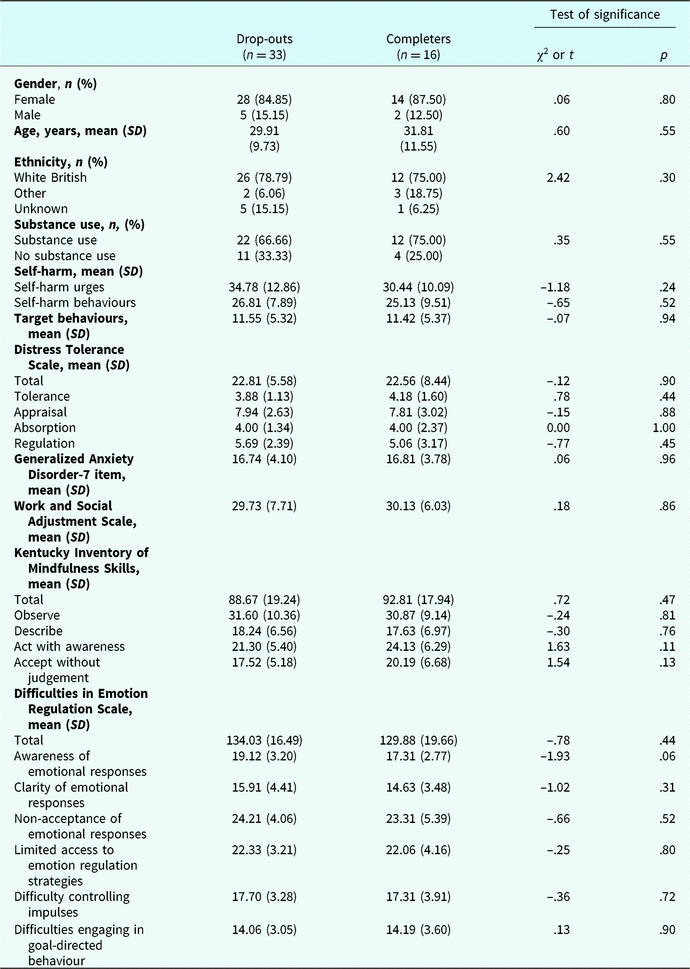
Data from 49 participants were analysed in the study; 33 participants (67.3%) dropped out from therapy, whilst 16 participants (32.7%) completed therapy (Table 1). The majority of the sample were White British (77.6%) and female (85.7%).
Comparison of participants who dropped out with participants that completed the ECS programme

Missing data
Missing data values were replaced with the mean value for the sample (Field, Reference Field2013). In cases where an entire questionnaire had been omitted, this was left as missing data (to reduce likelihood of bias) and accordingly sample sizes for each of the questionnaires varied from 49.
Descriptive statistics
Descriptive statistics revealed that the data for each of the variables were normally distributed. This was determined by evaluating histograms with normal curves plotted. Box and whisker plots revealed no extreme outliers (>3 standard deviations from the mean) (Field, Reference Field2013) and confirmed homogeneity of variance. This was further corroborated by obtaining a non-significant Levene’s test statistic for each of the variables.
Number of sessions attended and reasons for drop-out
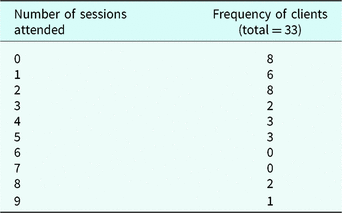
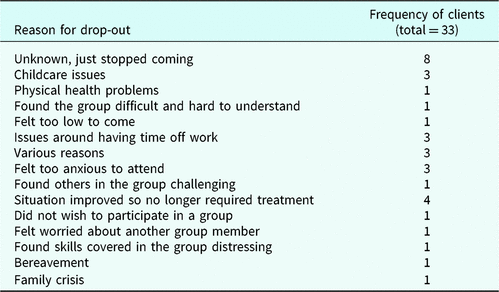
The number of sessions that clients attended before disengaging is outlined in Tables 2 and 3. Findings suggest that the majority of clients dropped out after 0–2 sessions and for the majority of clients, the reason for termination of treatment was unknown. The second most common reason for non-completion was because clients felt they had experienced improvements, which no longer warranted further intervention. Statistical analyses were not possible, given the quantity of feedback received from clients. Data from four of the non-completers was missing.
Number of sessions that non-completers attended prior to disengaging

Reasons for drop-out provided by clients

Symptom severity measures and age
Independent-samples t-test
Independent-samples t-tests were conducted to highlight any significant differences between drop-outs and completers of therapy on the symptom severity measures and age. Effect sizes were calculated using G*Power version 3 (Faul et al., Reference Faul, Erdfelder, Lang and Buchner2007).
The results revealed no significant differences in age between drop-outs and completers of therapy (mean = 29.91, SD = 9.73, SE = 1.69; mean = 31.81, SD = 11.55, SE = 2.89, respectively), t (47) = .60, p = .55, d = .18, 95% confidence interval (CI) [–4.44,8.24].
There were no significant differences in self-harm urge scores between drop-outs and completers of therapy (mean = 34.78, SD = 12.86, SE = 2.27; mean = 30.43, SD = 10.09, SE = 2.52, respectively), t (46) = –1.18, p = .24, d = .38, 95% CI [–11.75, 3.07], suggesting that individuals who dropped out from therapy were not experiencing more urges to self-harm compared with individuals who completed therapy.
There were no significant differences between drop-outs and completers of therapy in the frequency of self-harm behaviours: mean = 26.81, SD = 7.88, SE = 1.39; mean = 25.13, SD = 9.51, SE = 2.38, respectively, t (46) = –.65, p = .52, d = .19, 95% CI [–6.90,3.52], indicating that individuals who dropped out from the ECS programme were engaging in similar levels of self-harm to completers.
Results revealed no significant differences in the frequency of target behaviours between drop-outs and completers of therapy: mean = 11.55, SD = 5.32, SE = .99; mean = 11.42, SD = 5.37, SE = 1.55), t (39) = –.07, p = .94, d = .02, 95% CI [–3.84,3.57].
There were no significant differences in distress tolerance scores between drop-outs (mean =22.81, SD = 5.58, SE = .99) and completers (mean = 22.56, SD = 8.44, SE = 2.11) of therapy, t (46) = –.12, p = .90, d = .03, 95% CI [–4.35,3.85]. Equally, there were no significant differences between the two groups on any of the four DTS subscales (Table 1).
The findings revealed no significant differences in total scores on the DERS between drop-outs and completers of therapy (mean = 134.03, SD = 16.49, SE = 2.87; mean = 129.88, SD = 19.69, SE = 4.92, respectively), t (47) = –.78, p = .44, d = .23, 95% CI [–14.92,6.61], or on any of the six subscales (Table 1). Similarly, there were no significant differences found between drop-outs and completers of therapy on the GAD-7 (mean = 16.74, SD = 4.10, SE = .74; mean = 16.81, SD = 3.78, SE = .95, respectively), t (45) = .06, p = .96, d = .02, 95% CI [–2.41,2.55].
Drop-outs and completers of therapy showed similar levels of social and occupational functioning as indicated by the WSAS (mean = 29.73, SD = 7.71, SE = 1.41; mean = 30.13, SD = 6.03, SE = 1.51, respectively), t (44) = .18, p = .86, d = .06, 95% CI [–4.09,4.87] and also demonstrated comparable mindfulness skills as indicated by their total KIMS scores (and subscale scores, Table 1) (mean = 88.67, SD = 19.24, SE = 3.35; mean = 92.81, SD = 17.94, SE = 4.48), t (47) = .72, p = .47, d = .22, 95% CI [–7.40,15.69].
A Bonferroni correction was applied given the multitude of independent-samples t-tests conducted [increasing the likelihood of obtaining a Type I error (Field, Reference Field2013)]. Accordingly, the α value of .05 was adjusted to .005 (.05/9).
Chi-square analysis
A chi-square cross tabs analysis identified no significant differences in gender or ethnicity between drop-outs and completers of therapy: χ2 (1) = .06, p = .80, Cramer’s V = .04; χ2 (2) = 2.42, p = .30, Cramer’s V = .22, respectively. Similarly, there were no significant differences in substance use between drop-outs and completers of therapy, χ2 (1) = .35, p = .55, Cramer’s V = .09, suggesting that substance users are just as likely as non-substance users to complete therapy.
Discussion
The current study evaluated predictors of drop-out from an ECS programme in a CMHT. Firstly, it was interesting to find comparatively higher drop-out rates for the ECS programme (67.3%) in this study than drop-out rates noted in the literature (24%) (Sambrook et al., Reference Sambrook, Abba and Chadwick2006). In the Sambrook et al. (Reference Sambrook, Abba and Chadwick2006) study, it is possible that the low attrition rate can be attributed to the format in which the ECS programme was delivered, such that all prospective clients were offered pre-group formulation sessions in order to collaboratively explore the function of their self-harm, allowing clients more opportunities to develop therapeutic rapport with facilitators and thereby reducing the likelihood of later drop-out from the group. In line with this, psychological therapies conducted in the USA are funded through private insurance schemes, allowing provision of more intensive services and therefore more opportunities for one-to-one contact between clients and professionals, again increasing the likelihood of established, positive therapeutic relationships, which may explain the better client-retention rates (Basu et al., Reference Basu, Andrews, Kishore, Panjabi and Stuckler2012; Feigenbaum et al., Reference Feigenbaum, Fonagy, Pilling, Jones, Wildgoose and Bebbington2012). Further to this, full DBT programmes also provide increased one-to-one contact, which is likely to account for the better retention rates documented in the literature (Linehan et al., Reference Linehan, Korslund, Harned, Gallop, Lungu, Neacsiu and Murray-Gregory2015).
Interestingly, the finding for the number of sessions attended prior to drop-out might support this theory, indicating that the majority of clients disengaged after having attended between no sessions and two sessions. It is unlikely that within this time-frame a strong therapeutic relationship is likely to have been established, and therefore these clients may have experienced less of an incentive to continue attending the group programme (Basu et al., Reference Basu, Andrews, Kishore, Panjabi and Stuckler2012). Alongside this, Thomas (Reference Thomas2017) found that the degree of agreement between the therapist and client on the tasks and goals of therapy in an adapted DBT programme affected engagement and drop-out, and it may be possible that having more opportunities for one-to-one interactions between clients and therapist facilitates this process, thereby reducing drop-out. This may also explain the lower observed rates of drop-out from full DBT programmes versus adapted ECS groups (Valentine et al., Reference Valentine, Bankoff, Poulin, Reidler and Pantalone2014). Given that the majority of non-completers from the ECS programme did not provide a reason for their termination from therapy, this might again reflect the absence of a strong therapeutic alliance, which is the essential foundation for providing reflexive feedback, which is a process in itself that can facilitate engagement of clients in treatment (Whipple et al., Reference Whipple, Lambert, Vermeersch, Smart, Nielsen and Hawkins2003).
Given that the current study was underpowered, it is important that the results from this study are interpreted with caution. Contrary to the hypotheses, there were no significant differences between drop-outs and completers of therapy with regard to symptom severity and substance use. This could challenge common assumptions held by CMHTs and evidence in the literature highlighting that substance users are more difficult to retain in therapy (Kröger et al., Reference Kröger, Harbeck, Armbrust and Kliem2013). Supporting the current findings, there is evidence to suggest that individuals with BPD and SUDs can demonstrate equivalent retention rates in DBT to individuals with BPD alone (van den Bosch et al., Reference van den Bosch, Verheul, Schippers and van den Brink2002) and that DBT can effectively reduce substance abuse in addition to borderline symptomology (Koerner and Linehan, Reference Koerner and Linehan2000).
The limited sample size is likely to have impacted the power of the study to detect an effect, and therefore it is possible that there remains a relationship between certain variables included in this study and likelihood of drop-out from ECS programmes. Future research should aim to replicate this study, collating data from multiple services and thereby increasing the likelihood of recruiting a sufficient sample size to explore predictors of drop-out.
Limitations
The sample size in this study was limited and there were missing data, resulting in the study being underpowered and affecting the generalizability and robustness of the findings. This is likely to have impacted the possibility of reliably detecting an effect in the study and therefore been a barrier towards exposing possible predictors of drop-out in the current study. Additionally, the study analysed data initially collected for different purposes, therefore the data were not specifically tailored to the rationale of the present study. It would have been useful to have had a measure of the frequency, severity and type of drug-use clients were engaging in, and whether there was dependence, as this may have provided further insight into substance use as a predictor of drop-out and the interactions associated with substance use/dependence and mental health difficulties. The self-harm behaviour measure also demonstrated poor internal reliability, and therefore is unlikely to have been a valid measure able to reliably detect an effect in this particular sample. Future research should aim to use a more robust measure of self-harm behaviour, as it is a key characteristic associated with EUPD (Linehan, Reference Linehan1993).
It would have been beneficial to have employed a measure of the therapeutic alliance from the client and therapist perspectives, as well as a readiness to change measure, given that the literature details the therapeutic relationship as a strong predictor of engagement in therapy (Frank and Gunderson, Reference Frank and Gunderson1990; Hill, Reference Hill2005; Priebe and Mccabe, Reference Priebe and Mccabe2008). The importance of the therapeutic relationship on therapy outcomes, engagement and sustained recovery has been described extensively in the literature (Tompkins and Swift, Reference Tompkins and Swift2015; Stiles et al., Reference Stiles, Barkham and Wheeler2015), and therefore could be a key predictor of drop-out that would be valuable to explore in depth.
Clinical implications and future research
Given that none of the variables explored in the current study was shown to be a predictor of drop-out from the present ECS programme, it may be important that clinicians are mindful of the assumptions that they may be inclined to hold regarding factors that predict drop-out, as these alone may affect drop-out and engagement in therapy (Palmer et al., Reference Palmer, Murphy, Piselli and Ball2009). For example, holding an assumption that substance use leads to a greater risk of drop-out may impact the service provided to prospective clients. Skills in engagement, validation, motivation building and compassion may become unintentionally compromised, leading to a poorly developed therapeutic relationship, increasing the likelihood of drop-out. Accordingly, the assumption becomes strengthened and effective/efficient service-delivery becomes reduced (Palmer et al., Reference Palmer, Murphy, Piselli and Ball2009).
A key variable that is detailed in the literature as impacting risk of drop-out and efficacy of interventions is the therapeutic relationship and therefore this is an important area for future research, which will build upon the current study. Understanding this relationship may provide clinically profound indications of how engagement and sustained retention in therapy can be achieved even in therapeutic modalities where drop-out is usually at its highest.
Recommendations
Results from this study should be disseminated throughout the service, to aid insight of professionals, which may have an effect on client-retention. Given the high rates of drop-out and predictors of drop-out within the service remaining ambiguous, it is proposed that key predictors of drop-out, as highlighted in the literature, continue to be monitored (e.g. the therapeutic relationship, readiness for change and clinician’s perceptions of engagement).
Finally, there is evidence to suggest that providing clients with an opportunity to give feedback regarding the process of therapy can significantly improve client-retention and outcomes in therapy (Miller et al., Reference Miller, Duncan, Brown, Sorrell and Chalk2006). Whipple et al. (Reference Whipple, Lambert, Vermeersch, Smart, Nielsen and Hawkins2003) found that when therapists had access to information regarding client’s perceptions of their progress and the therapeutic relationship, clients were significantly more likely to complete therapy and achieve significant improvements post-therapy than those who did not have access to this information. The outcome rating scale (ORS) and session rating scale (SRS) have been indicated as effective ways of engaging in this process, leading to better client-retention and outcomes (Miller et al., Reference Miller, Duncan, Brown, Sorrell and Chalk2006). It is possible that utilizing these measures may be beneficial for engagement in the ECS programmes.
Acknowledgements
The authors would like to thank the University of Southampton Psychology Department and Solent NHS Trust for enabling this study to take place. Special thanks are also due to all of the staff at St Mary's Hospital who contributed to the data collection.
Supplementary material
To view Supplementary Material for this article, please visit: https://doi.org/10.1017/S1754470X19000151
Ethical statement
The authors have abided by the Ethical Principles of Psychologists and Code of Conduct as set out by the APA. Ethical approval was granted by the University of Southampton ethics committee via ERGO, approval reference number 25828. This piece of research was designed as a service evaluation utilizing secondary data analysis methodology on an existing data set, thereby not warranting NHS ethics application.
Conflicts of interest
Shalini Raman and Thomas Richardson have no conflicts of interest with respect to this publication.
Financial support
This research received no specific grant from any funding agency, commercial or not-for-profit sectors
Key practice points
(1) The current research highlights further ambiguity regarding predictors of drop-out and stresses the importance of gaining further insight, especially for group programmes, which are vulnerable to high rates of attrition.
(2) With consideration of the limitations of this research, it would be important to address methodological issues and explore further variables that have been highlighted as promising avenues for further research in this area.




Comments
No Comments have been published for this article.