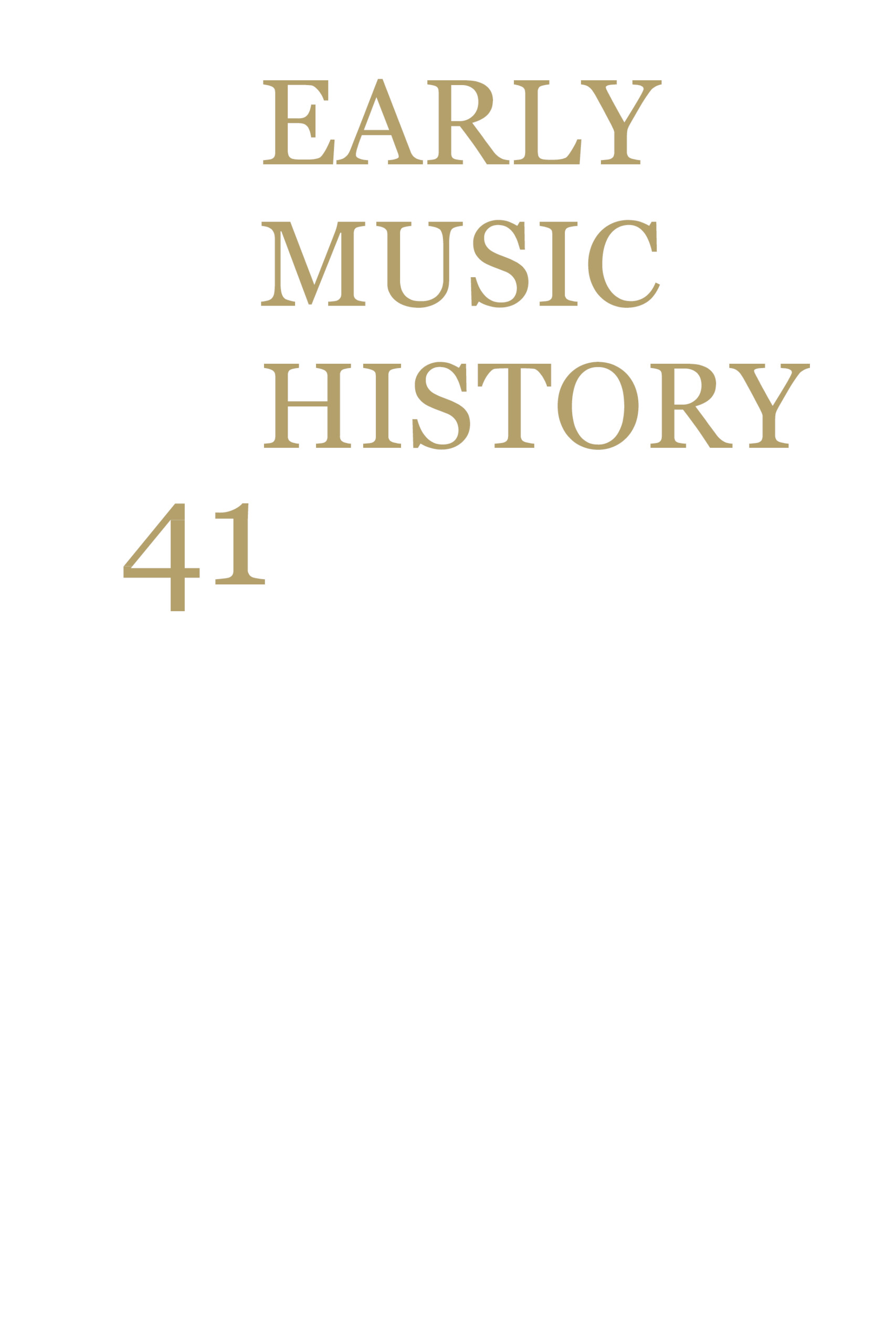


In the early 1490s, the Burgundian-Habsburg court under the direction of Philip the Fair (d. 1506) organised the creation of a new liturgy for the Feast of the Seven Sorrows of the Virgin. Jan van Coudenberghe (d. 1521), secretary to Philip the Fair, recorded the court’s interest in this liturgy as part of his account of the Burgundian-Habsburg court’s propagation of the devotion to the Seven Sorrows of the Virgin.Footnote 1 Writing in 1519 at the request of Philip’s son Charles, Van Coudenberghe recounts the founding of the Seven Sorrows confraternity in the Low Countries in the late fifteenth century and the ways in which the court supported the popular lay devotion. Susie Speakman Sutch and Anne-Laure Van Bruaene have recently investigated the court’s promotion of the devotion for political purposes in the context of vernacular theatre and printed devotional material, but the Seven Sorrows liturgy can also be understood as part of the court’s strategy.Footnote 2 Though the particular manner of the creation of the liturgy has received attention by scholars, the court’s underlying reasons for promoting the Seven Sorrows liturgy and how they accomplished it have remained largely unexplored.Footnote 3
The Burgundian-Habsburg court’s participation in the Seven Sorrows devotion and especially the creation of the liturgy can be understood in the context of the Burgundian tradition of civic engagement and more specifically its plan to restore peace after the civil wars and devastation following the deaths of Charles the Bold and Mary of Burgundy.Footnote 4 While much of the Burgundian dukes’ participation in public ritual centred on secular events such as joyous entries, jousts and archery competitions, the court commonly used religious imagery and participated in the cults of local saints. Andrew Brown and Graeme Small, for instance, have demonstrated how the Burgundian dukes adopted religious rituals popular with their subjects for their own ends, such as processions and the use of relics, to profit from what they call the spiritual capital of the people.Footnote 5 Philip the Fair’s patronage of the Seven Sorrows liturgy is yet another example of the Burgundian interest in the religious life of the people for political benefit and part of the court’s broader attempts to appropriate the Seven Sorrows devotion.
The court did not simply adopt a new devotion to the Virgin, however, but actually helped to give the devotion shape and distinguish it from an earlier Marian devotion. An examination of the Seven Sorrows liturgy will show that the devotion had as its antecedent the devotion to the Compassion of the Virgin. Within the preponderance of Compassion offices circulating in the late fifteenth century, one version clearly emerges as a model for the Seven Sorrows liturgy. A comparison of these offices will point to political motivations for the court’s sponsorship of the new Seven Sorrows liturgy. Finally, plainchant settings of the new liturgy will be examined for their relationship to the court’s competition.
A COMPETITION FOR A NEW SEVEN SORROWS LITURGY
Philip the Fair and his advisers orchestrated the new Seven Sorrows liturgy through what is tantamount to a competition. Van Coudenberghe explains that at Philip’s command, his advisers first examined office and mass texts suitable for the new Marian devotion.Footnote 6 A group of illustrious and learned men, including Michel François de Lille (d. 1502) and François Busleiden (d. 1502), chose the texts compiled by Peter Verhoeven (d. 1523) as the most suitable.Footnote 7 Verhoeven (alias Petrus de Manso), a priest and confessor of the convent of Thabor near Mechelen, was an ardent supporter of the devotion and had already been involved in creating other devotional material for it.Footnote 8 The court presumably distributed Verhoeven’s texts because Van Coudenberghe relates that these texts were set to Gregorian chant by men in places throughout all of Holland. The plainchant settings were then brought to Philip’s musicians for examination. Busleiden and François de Lille, as well as other skilled men, found many good settings amongst those sent to Philip. The best musical setting, however, was one by a leading singer in the Burgundian-Habsburg court chapel. Van Coudenberghe says that Pierre Du Wez (d. 1508), whom he calls one of the most prominent musicians of the time, won the greatest share of praise for his particularly excellent setting.Footnote 9 The court was not disappointed with the outcome because the resulting liturgy was taken up by all the provincials and many collegiate churches set days for its celebration.
SURVIVING SOURCES OF THE SEVEN SORROWS OFFICE AND MASS
The office and mass texts that are arguably those compiled by Verhoeven survive in two sources and will serve as the basis for comparison to earlier offices. One of Philip’s advisers, the previously mentioned Michel François de Lille, wrote a quodlibet or theological treatise, Quodlibetica decisio perpulchra et devota de septem doloribus christifere virginis marie ac communi et saluberrima confraternitate desuper instituta (hereafter Quodlibetica), which defended the devotion from detractors.Footnote 10 Directly following this theological treatise are an office and mass with the rubric of the Sorrows or Compassion of the Blessed Virgin Mary.Footnote 11 The texts appear anonymously, but scholars have linked them to the competition and claimed that they are Peter Verhoeven’s winning texts.Footnote 12 Although explicit arguments for this assumption have not been made, there are nonetheless good reasons to identify this office and mass as the texts submitted by Verhoeven. Perhaps the most obvious reason why scholars have assumed that the office and mass were compiled by him is the mere fact that they are attached to the Quodlibetica, which itself had direct ties to the court because François de Lille was Philip’s confessor. François de Lille himself is not likely to be the author because a statement indicating that the Quodlibetica is completed separates the office and mass from the rest of the treatise, and the Quodlibetica was later reprinted without the liturgical texts.Footnote 13
The strongest case for Verhoeven’s compilation of these texts can be made through the consideration of another piece of propaganda for the devotion. In addition to their preservation in the Quodlibetica, the same office and mass texts also survive in an undated volume printed by Govaert Bac, at the end of a collection of letters concerning the propagation of the devotion and founding of the Seven Sorrows confraternity.Footnote 14 The liturgical texts are immediately preceded by a letter by the printer Gheraert Leeu, in which he petitions Philip the Fair for permission to publish the texts.Footnote 15 Leeu’s letter provides an example of what may have been submitted to Philip the Fair for his competition.Footnote 16 Just as Van Coudenberghe describes the texts that the court received, Leeu asks Philip and his leading advisers first to inspect the texts; he then requests assistance in setting them to music.Footnote 17
Leeu’s request and the context of the rest of Bac’s volume suggest that not only could these texts have been an entry in the competition but that they are also those submitted by Verhoeven.Footnote 18 Leeu had previous connections with Verhoeven. In July of 1492, he had printed a devotional book for the Seven Sorrows containing meditations and woodcuts for each of the sorrows.Footnote 19 The meditations in this print are in fact based on those outlined by Verhoeven in a letter that he wrote to Van Coudenberghe in January of 1492 describing his aspirations for propagating the devotion.Footnote 20 A copy of Verhoeven’s letter to Van Coudenberghe immediately precedes Leeu’s letter in Bac’s edition. While this context alone is not enough to guarantee Verhoeven’s authorship of the liturgical texts that follow, their placement with a letter of a printer with whom he had connections and his own letter propagating the devotion point to his authorship.
Furthermore, the texts that survive in the Quodlibetica and Bac’s volume constitute the only known complete office and mass for the Feast of the Seven Sorrows that circulated in the court environment of Philip the Fair. The rubric specifying the celebration of the texts coincides with the date prescribed by the court and the confraternity: the Saturday before Palm Sunday, unless this should coincide with the Annunciation, in which case the feast could be moved to Quasimodo Sunday (the Sunday following Easter).Footnote 21 Finally, the readings of the office as they appear in the Quodlibetica correspond to Van Coudenberghe’s description of Verhoeven’s office.Footnote 22 Van Coudenberghe states that the readings are taken from numerous holy doctors, that the first five readings relate to the first five sorrows, the sixth reading to the sixth and seventh sorrows, and that the seventh, eighth and ninth readings are drawn from the homily of Augustine on the Gospel of John 19:25–6.Footnote 23 The Quodlibetica office divides the readings and sorrows as Van Coudenberghe describes, using Augustine’s homily for the last three readings and taking the others from the writings of Origen, Anselm, Ambrose, Bernard and Jerome.Footnote 24 Because there is no evidence to the contrary and all the circumstantial evidence points to Verhoeven as the author, there is sufficient ground to take these texts as those that won the competition.
Though no complete musical setting of Verhoeven’s texts is known to survive, partial settings can be found in three manuscripts, all of which post-date the preservation of the texts in the Quodlibetica. Because of its location in an illuminated manuscript from the Alamire workshop, the setting in Brussels, Bibliothèque royale de Belgique, MS 215–16 (Brussels 215–16) has received previous attention by musicologists.Footnote 25 All of the music in this manuscript is devoted to the Seven Sorrows of the Virgin: two polyphonic masses and two motets are included alongside the plainchant for the feast. The surviving plainchant in this manuscript includes a setting of Verhoeven’s Vespers texts and the mass propers, with only slight alterations.Footnote 26 A newly identified setting of Verhoeven’s mass texts can be found in a manuscript containing a collection of offices for various feasts, sequences and alleluias, Bibliothèque royale de Belgique, MS 21123 (Brussels 21123). In this case, Verhoeven’s mass texts are paired with a different office.Footnote 27 The third source is in yet a different type of manuscript, a Gradual, Vienna, Österreichische Nationalbibliothek, Cod. Palatin. Vindobonensis 3787 (Vienna 3787), and thus includes only a setting of the mass propers.Footnote 28 These musical settings indicate that Verhoeven’s texts, at least those for the mass, were in use. A more detailed discussion of these musical sources will follow the examination of the text.
MODELS OF THE QUODLIBETICA OFFICE
Though the court intended to create a new liturgy for the devotion to the Seven Sorrows of the Virgin, the surviving office is actually labelled as an office for the sorrows or the compassion of the Blessed Virgin Mary: ‘Sequitur officium de doloribus seu compassione beatissime Virginis Marie’.Footnote 29 That this new office for the Seven Sorrows was created in the context of Compassion devotion is clear from Van Coudenberghe’s letter. In his description of the text selection process, he relates that the court wanted to establish a new office in hopes of celebrating a solemn festivity of the Compassion of the Virgin, rather than calling it the Seven Sorrows of the Virgin.Footnote 30 Van Coudenberghe had explained earlier in his account, however, that the Virgin of Compassion is now commonly called the Virgin of Seven Sorrows.Footnote 31
Offices for the feast of the Compassion of the Virgin had circulated prior to Philip the Fair’s competition, and Van Coudenberghe explains that some offices written for this feast were submitted for consideration in Philip’s competition.Footnote 32 A major step in the formalisation of Compassion devotion was the establishment of the first indulgenced feast of the Virgin’s Compassion in 1423 by the provincial Synod of Cologne.Footnote 33 The annual feast took place on the first Friday after Jubilate Sunday (the third Sunday after Easter), unless another festivity fell on that same day, in which case the feast would be moved to the Friday after that.Footnote 34 The feast was designed to expiate the crimes of the Hussites, who had burned images of the crucifixion and the Virgin, and for those celebrating it, the archbishop of Cologne granted forty days of indulgence.Footnote 35 The establishment of this feast provided the impetus for the composition of new Compassion offices from which Philip’s advisers could have chosen if they had not designed their own competition.Footnote 36
Multiple Compassion offices were in circulation in the late fifteenth century, but only one version can be shown to be the model for Verhoeven’s texts.Footnote 37 Similar versions of a popular Compassion office survive in numerous manuscripts across Germany and Austria that do not have any texts in common with the Quodlibetica office or its accompanying mass.Footnote 38 One Compassion office and mass circulating in the Low Countries and Germany, however, does have several similarities to the office and mass in the Quodlibetica. The office and mass that most closely resemble Verhoeven’s texts were first printed in Augsburg and Basel as early as 1478.Footnote 39 Another version of this Augsburg/Basel office was printed twice in the Low Countries by Jacobus de Breda in Deventer.Footnote 40 The first version printed in Deventer between 1489 and 1492 contains the same office texts as in the Augsburg/Basel sources and the same mass texts with the exception of the communion text.Footnote 41 The mass also contains an additional sequence for Paschal time and an additional offertory, which is the same as the communion text of the Augsburg/Basel source.Footnote 42 This print may have even been one of the texts that Van Coudenberghe mentions as having been received as an entry in the chant competition, as he includes Deventer in the list of cities from which the court received offices.Footnote 43
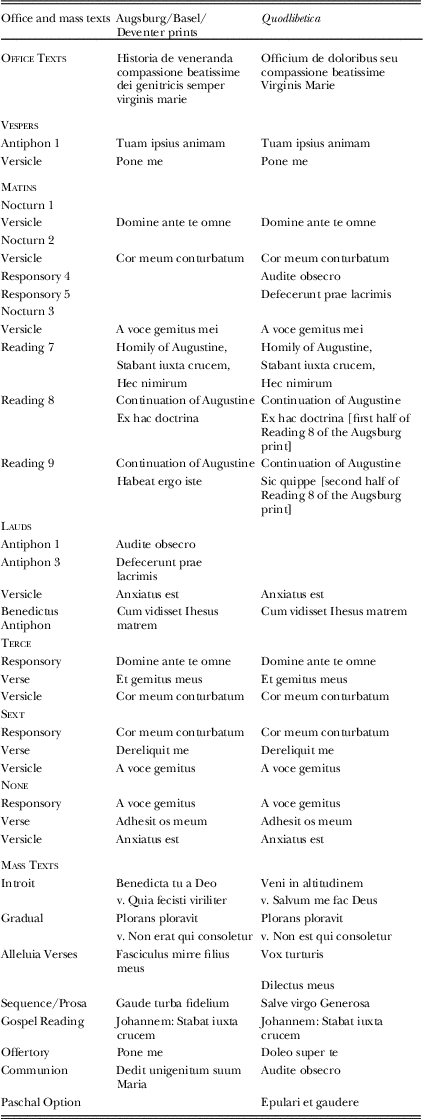
The office and mass texts printed in Augsburg, Basel and Deventer are most likely the liturgical source or model for Verhoeven’s texts.Footnote 44 These offices would have been available to him because they were already in circulation before Bac’s volume and the Quodlibetica were printed.Footnote 45 A comparison of the office texts held in common with the Quodlibetica office as well as the mass texts appears in Table 1. The passage from the Gospel of Luke that supplies the first antiphon for Vespers in the Quodlibetica office, for example, also serves as the first antiphon in this Compassion office, and of the mass texts, the Gradual and Gospel texts are also held in common. A clear indication that Verhoeven’s office is based on this Compassion office can be found in the readings of the third nocturn of Matins. Though the Compassion office draws on more of Augustine’s text, the same variants between the standard version of Augustine’s homily and the Quodlibetica (e.g., word additions and variations in word order) also occur in the same readings in the Augsburg, Basel and Deventer Compassion sources.Footnote 46
Comparison of the texts of the Compassion prints and the Quodlibetica

The lack of correspondence between Verhoeven’s texts and others that could have served as a model also supports the hypothesis that Verhoeven modelled his office on this Compassion office. Following the tradition of many medieval Marian offices, he chose texts from the Song of Songs for many of the antiphons and the first reading of the mass.Footnote 47 Yet Verhoeven did not borrow from common Marian offices, such as the Common of Virgins or the Common of the Blessed Virgin Mary, nor did he use the other Compassion offices.Footnote 48 Even though his borrowing is not complete, the lack of correspondence with other offices shows that the commonalities between Verhoeven’s office and the offices printed in Augsburg, Basel and Deventer are not coincidental.
BORROWING FROM THE COMPASSION TRADITION
The offices of the Seven Sorrows and the Compassion of the Virgin are more fundamentally similar than these textual correspondences reveal. The significance of the textual correspondences must be understood in the larger context of Compassion devotion in the fifteenth century.Footnote 49 Both offices from the Quodlibetica and the Augsburg/Basel/Deventer prints rely on the same two biblical passages for their theological foundation. Verhoeven frames the beginning of the office with a Vespers antiphon from a Gospel passage that was central to Compassion devotion: Luke’s account of the prophecy of Simeon.Footnote 50 Upon completion of the prescribed forty days of purification, Mary brought Jesus to the Temple in accordance with Mosaic Law. Mary and Joseph presented their Son to Simeon, a devout and just man, who had been told by the Holy Spirit that he would not die before he saw the Messiah. After blessing them, Simeon said to Mary: ‘Behold this child is set for the fall, and for the resurrection of many in Israel, and for a sign which shall be contradicted; and thy own soul a sword shall pierce, that, out of many hearts, thoughts may be revealed.’Footnote 51 This passage was the key biblical evidence of the Virgin’s sufferings because it foreshadows the sufferings that she would experience at Christ’s Passion and introduces the sword as a symbol of the Virgin’s suffering.Footnote 52
In her extensive study of the iconographic tradition of the Compassion and Seven Sorrows devotions, Carol Schuler has demonstrated how theologians and artists drew upon Simeon’s prophecy to popularise devotion to the Virgin’s suffering.Footnote 53 In the late twelfth and early thirteenth centuries, references to Mary being pierced with what was known as the sword of compassion (gladius compassionis) or the sword of sorrow (gladius doloris) were common in Passion tracts and plays.Footnote 54 Viewed by medieval commentators as the counterpart to the lance that pierced Christ’s side, the sword symbolised the Virgin’s compassion and her share of Christ’s pain and suffering during His Passion.Footnote 55 Schuler has identified two aspects of the Virgin common by the late thirteenth century in medieval affective writing on the Passion: first, that she is an exemplar or model of the compassionate response to Christ, and second, that she is a mediator, or one capable of stimulating the reader’s affective response.Footnote 56 In both of these roles, the Virgin serves as a conduit to ultimately help the devotee relate to Christ and His sufferings.
The second biblical text that forms the scriptural basis for Compassion devotion is the passage concerning the appearance of Mary at the foot of the cross from the Gospel of John (John 19:25–7). In this passage, Mary stands by the cross, and Jesus gives His beloved disciple to her as a son and gives Mary as a mother to His disciple. This passage serves not only as the Gospel reading for both the Seven Sorrows and the Compassion masses but also as the basis for the readings of the third nocturn of both offices. As mentioned above, the readings of Matins are taken from Augustine’s homily on this passage. Because Mary’s appearance in John’s Gospel is the only textual example of her presence during Christ’s Passion, this passage served as the basis for establishing a link between Mary and Christ’s Passion upon which further elaborations of her sufferings could be made.Footnote 57 Mary’s being given as a mother to John was also symbolic of her role as the universal mother of the Church and further cause for petitioning for her intercession.Footnote 58 The statutes of Cologne establishing the feast of the Compassion specifically call on Mary’s intercession as a Mother, as she was commended to the disciple in John’s Gospel.Footnote 59
Artistic and devotional traditions developed around Mary’s appearance at the foot of the cross as well.Footnote 60 By the thirteenth century, Mary was depicted at the foot of the cross, pierced with a sword and so affected by Christ’s pain that she was often portrayed as swooning.Footnote 61 Eventually the Virgin’s role as a mediator and an exemplar became secondary to her own intercessory power, and she became what Schuler has called an independent object of veneration.Footnote 62 The shift of focus from Mary’s role in relationship to Christ to the Virgin herself is evident in the creation of separate Mater dolorosa and Pietà images where the focus is on her own suffering rather than on that of her Son.Footnote 63
Both the Seven Sorrows and Compassion offices rely on these two texts because there are few places in the Gospels in which the Virgin appears and no passages that describe her suffering. The other texts employed in both offices are taken largely from the Book of Lamentations and the Song of Songs and refer to the Virgin through allusion. For example, the Introit of the Quodlibetica office, Veni in altitudinem, uses the text of Ps. 68 (69):3–4, 2 as an allegory for the Virgin’s suffering, a parallel to the text of the first antiphon of Vespers: ‘I am come into the depth of the sea; and a tempest hath overwhelmed me. My eyes have failed, whilst I hope in my God. Save me, O God, for the waters are come even into my soul.’ In this case, the depth of the sea and the tempest represent the Virgin’s suffering, including the experience of her Son’s Passion. The reference to the water having entered her soul alludes to the sword that pierced the Virgin’s heart in Luke’s narrative of Simeon’s prophecy.
The only significant place in which the Seven Sorrows office and mass stand apart from the Compassion office and mass is the sequence. The Augsburg mass contains the sequence Gaude turba fidelium, a sequence that does not expound on the Virgin’s suffering but rather celebrates the sacrifice of Christ and the role Mary has as a mother for all people.Footnote 64 In contrast, the sequence included in the Quodlibetica, the Salve virgo generosa, narrates the specific moments of sorrow in the Virgin’s life.Footnote 65 Though the enumerations of the Virgin’s sufferings often varied, the sorrows referred to in the sequence text are precisely those that were celebrated in the Low Countries: the prophecy of Simeon in the temple, the flight into Egypt, the loss of Jesus in the Temple, the meeting of Mary and Jesus on the way of the Cross, and the crucifixion, deposition, and burial of Christ.Footnote 66 The enumeration of the Virgin’s sorrows is in fact what separates Seven Sorrows devotion, which commemorates individual sorrows of the Virgin, from Compassion devotion, which does not list individual sorrows.
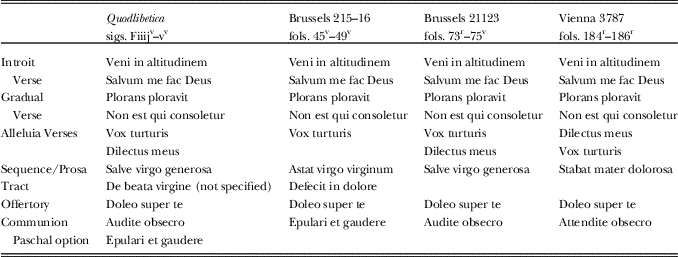
Even though the liturgies differ in their sequences and some antiphon and responsory texts, they present essentially the same picture of the Virgin’s suffering. The surviving musical settings of Verhoeven’s texts further demonstrate this interchangeability between Compassion and Seven Sorrows devotion. In each of the three sources, for instance, the same texts appear with different rubrics. In Brussels 21123, for example, Verhoeven’s texts appear with the title ‘De Passione Christi et septem doloribus beate Marie virginis’, joining the Passion of Christ with the Seven Sorrows of the Virgin.Footnote 67 In this case, Verhoeven’s mass texts appear with an office setting that is found in other sources with a Compassion rubric.Footnote 68 In Vienna 3787, the same mass texts that appear in Brussels 21123 with a Seven Sorrows rubric are present in this Gradual to celebrate the Feast of the Compassion, showing that the Seven Sorrows rubric did not universally replace the Compassion rubric. Furthermore, the mass texts from the Augsburg tradition also appear in Vienna 3787 with the same Compassion rubric as the one accompanying Verhoeven’s text.Footnote 69 Finally, the mass and Vespers texts appear under the rubric ‘De beate Marie virginis doloribus’ in Brussels 215–16 without specifying seven sorrows. Even though the Seven Sorrows liturgy relies on the Salve virgo generosa sequence for its distinctiveness, this sequence is not found in every setting. As can be seen in Table 2, the sequence Astat virgo virginum appears in Brussels 215–16 and the Stabat Mater in Vienna 3787.Footnote 70 Both of these sequences emphasise the Virgin’s suffering under the cross rather than enumerating the sufferings during her entire life.Footnote 71 Though Brussels 21123 is the only manuscript that indicates that the music is for the feast of the Seven Sorrows of the Virgin, Verhoeven’s mass texts do survive in later missals with a Seven Sorrows rubric.Footnote 72
Comparison of the Mass Propers for the Feast of the Seven Sorrows

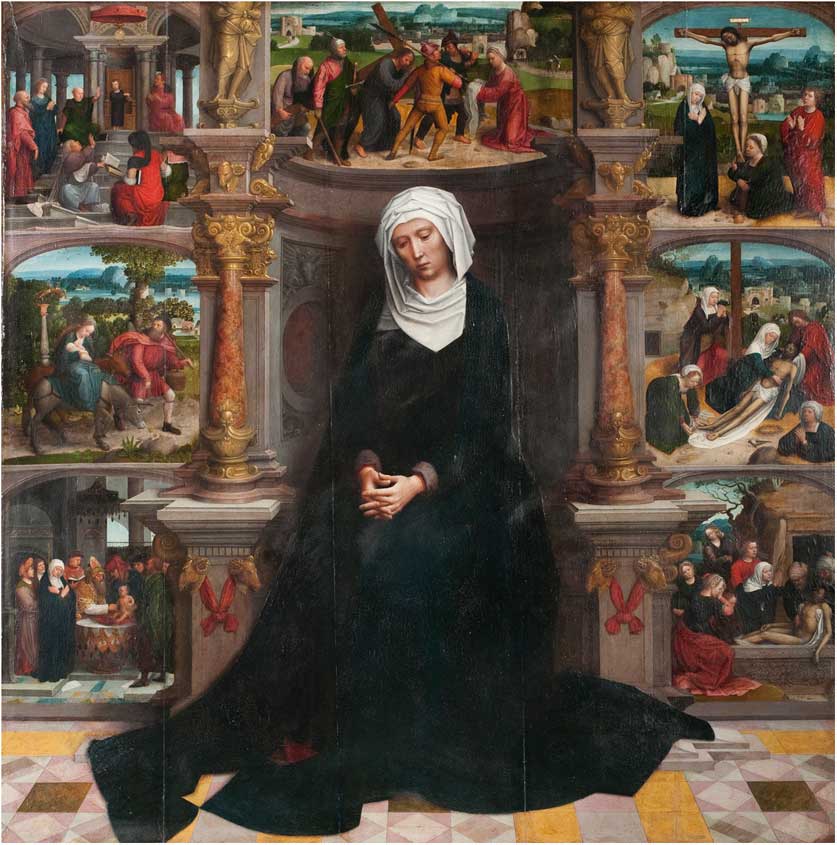
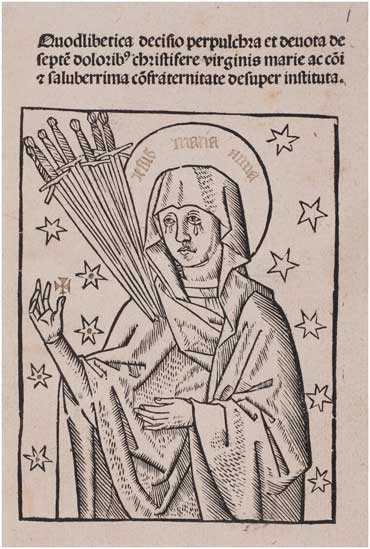
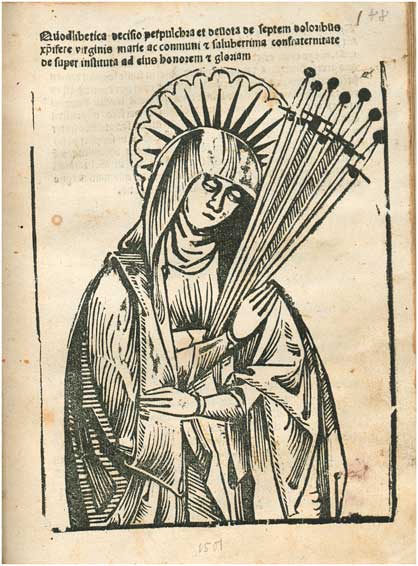
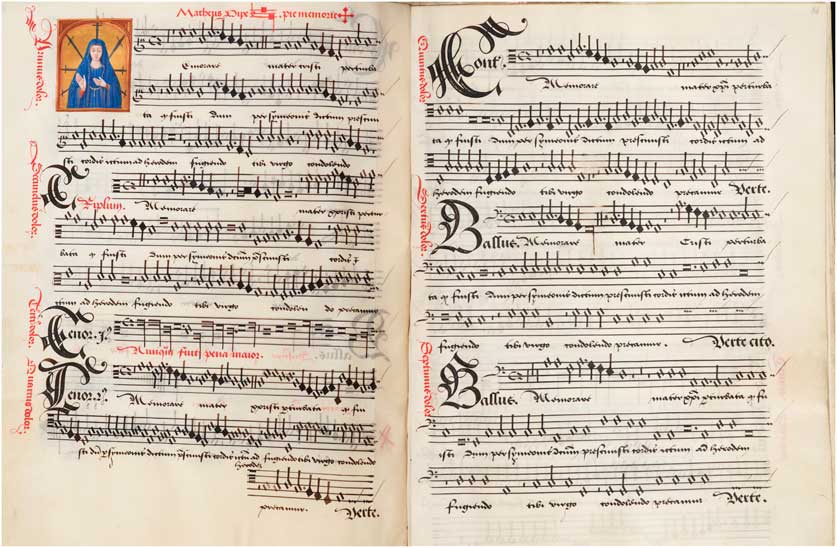
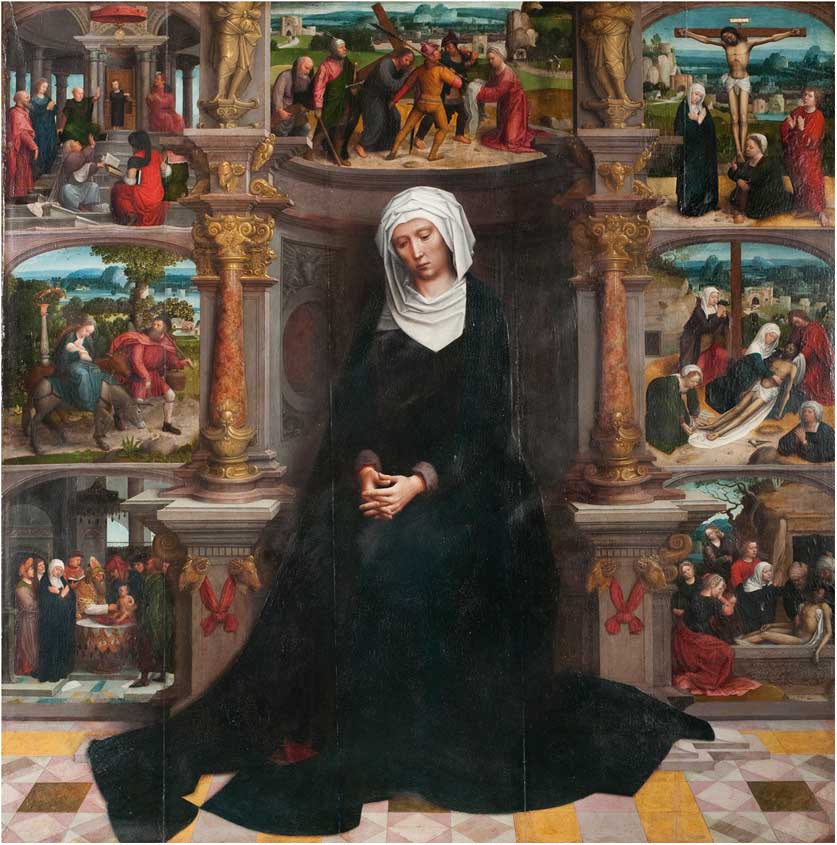
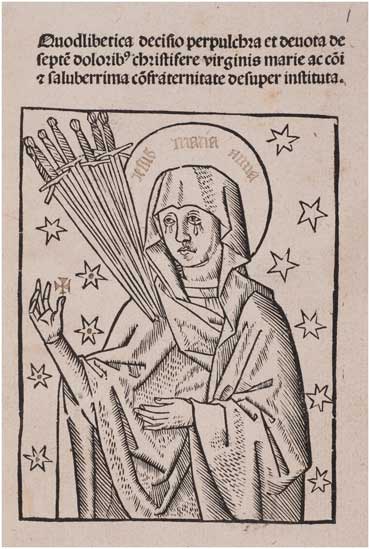
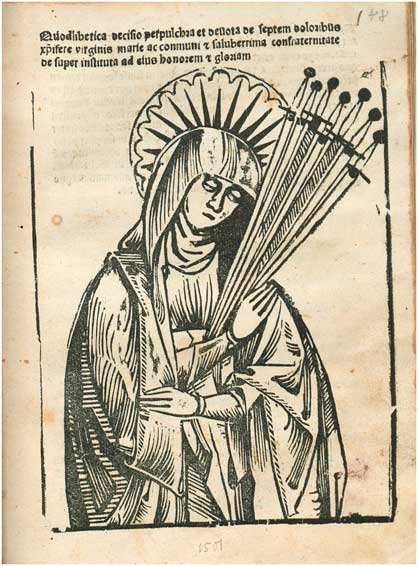
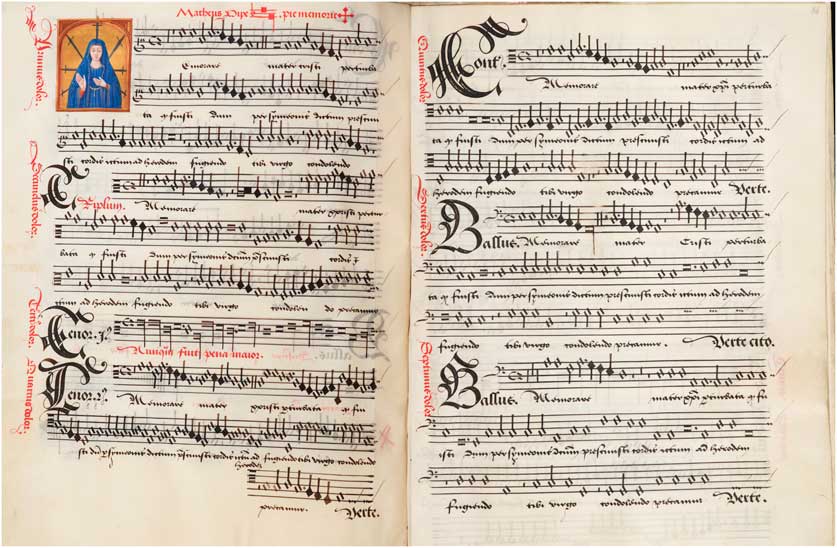
The blurred line between the two devotions required an additional paraliturgical element to make the Seven Sorrows devotion distinct from Compassion devotion. Artistic representations would later aid the devotion in the visualisation of the individual sorrows.Footnote 73 Adriaen Isenbrandt’s Our Lady of Seven Sorrows, for example, portrays a central Mater dolorosa figure surrounded by seven panels, each panel depicting one of the Seven Sorrows (Figure 1).Footnote 74 Unlike such artistic representations in which the number seven is emphasised visually, that number does not appear in the office or mass texts in any way. Verhoeven’s texts in the Quodlibetica consequently rely on a visual depiction of the Virgin of Seven Sorrows to assist the reader in understanding the devotion. The frontispiece of the first printing of the Quodlibetica presents a woodcut of the Virgin with seven swords piercing her heart (Figure 2). A later printing of the Quodlibetica also depicts the sorrowing Virgin with seven symbolic swords both on the frontispiece (Figure 3) and directly preceding the office.Footnote 75 Appearing after these representations, the office could more easily evoke the concept of the Virgin of Seven Sorrows, without enumerating them in the text. One of the musical settings of Verhoeven’s text also relies on paraliturgical cues to specify the seven distinct sorrows. Though the plainchant in Brussels 215–16 lacks a specific Seven Sorrows rubric, the music is given an explicit Seven Sorrows context by the rest of the manuscript. This source deliberately constructs a Seven Sorrows programme through an illumination of the Virgin pierced with seven swords and a seven-voice motet, Matthaeus Pipelare’s Memorare mater Christi, in which each voice is labelled as a sorrow (Figure 4). With such paraliturgical markers, the plainchant can more easily be associated with the Seven Sorrows devotion, even when the Seven Sorrows are not explicitly delineated in all the texts.
Adriaen Isenbrandt’s Our Lady of Seven Sorrows (c. 1518), Church of Our Lady, Bruges. © KIK-IRPA, Brussels
Frontispiece of the Quodlibetica (Antwerp, Thierry Maertens, c. 1494). © Brussels, Bibliothèque royale de Belgique
Frontispiece of the Quodlibetica, second printing (Schrattenthal, 1501). © Munich, Bayerische Staatsbibliothek, Rar.1792#Beibd.1, title page
Brussels, Bibliothèque royale de Belgique, MS 215–16, fols. 33v–34r. © Brussels, Bibliothèque royale de Belgique
Given the similarities between the Compassion and Seven Sorrows devotions, one might question why Philip’s court did not adopt the Compassion devotion itself. The court would not have chosen to approve new texts if the only purpose was to produce a result similar to texts already in circulation. The lack of theological differences between the two offices suggests that part of the court’s motivation for orchestrating a new liturgy must lie outside the liturgical texts themselves. The importance of the liturgy and the Burgundian-Habsburg court’s attempts to promote the new Seven Sorrows devotion can only be fully understood in the context of the larger political agenda of the court.
POPULAR PIETY AND THE APPROPRIATION BY THE BURGUNDIAN-HABSBURG COURT
By creating a liturgy for the Seven Sorrows devotion, the Burgundian-Habsburg court was tapping into a popular lay movement that had begun in the early 1490s. In addition to serving as Philip the Fair’s secretary, Jan van Coudenberghe was also the parish priest at Sts Peter and Paul in Reimerswaal and St Saviour in Bruges and the dean of St Giles in Abbenbroek.Footnote 76 In each of his churches, Van Coudenberghe had a painting hung of a Mater dolorosa modelled on the icons of the Virgin attributed to St Luke in the Roman churches of Santa Maria Maggiore and Ara Caeli.Footnote 77 Under each painting, he hung a twelve-line poem (‘Disce salutator nostros meminisse dolores’) that encouraged the reader to meditate on the Virgin’s suffering and outlined her seven sorrows.Footnote 78 In his history of the devotion, Van Coudenberghe recounts how the paintings immediately became popular devotional sites, with devotees gathering near them to light candles and pray the Pater noster and Ave Maria. Footnote 79
The sites quickly attracted pilgrims, one of whom was in fact Peter Verhoeven. Since 1480, Verhoeven had been the confessor at Thabor, where the Augustinian nuns followed the rule of Windesheim, and he himself was a Windesheimer. His visit to the churches of Reimerswaal and Abbenbroek introduced him to the devotion to the Seven Sorrows of the Virgin and motivated his subsequent letter to Van Coudenberghe.Footnote 80 In his letter, Verhoeven explained how the paintings of the Virgin and their accompanying poem had inspired his desire to spread the Seven Sorrows devotion. He then outlined a plan to make the devotion accessible to a broader audience by proposing a meditation for each of the sorrows. In July of 1492, seven months after Verhoeven wrote his letter to Van Coudenberghe, Gheraert Leeu published the anonymous vernacular treatise in Dutch mentioned above that appears to be the realisation of Verhoeven’s plan.Footnote 81 This treatise begins by presenting woodcuts of the Marian paintings that Van Coudenberghe had hung up as well as the accompanying poem.Footnote 82 The twelve remaining folios serve as a devotional manual: each meditation is preceded by a woodcut depicting that sorrow and is followed by an indication to pray the Pater noster and Ave Maria. This publication meant that the devotion could be practised in private without the requirements of a liturgical context. The woodcuts, for example, served as a visual aid for focusing the devotees’ meditations and guiding them through their exercises. The anonymous author of the treatise explains that the images can guide illiterate lay folk so that they, too, can have the experience of prayerful meditation on the sorrows.Footnote 83 Verhoeven’s original intent in his letter to Van Coudenberghe was to spread the devotion, bringing it to those who had not yet witnessed it or could not visit the pilgrimage sites. The manual did indeed help to propagate the devotion because it was popular enough to be published five more times between 1492 and 1501.Footnote 84
In addition to the popularity of this devotional manual, the increasing intensity of the devotion is attested to by numerous miracles attributed to the Virgin of Seven Sorrows during the 1490s.Footnote 85 Van Coudenberghe collected and published reports of miracles performed by the Virgin for those who visited her shrines, in particular those at the churches of St Giles in Abbenbroek and St Hippolyte in Delft.Footnote 86 In his Quodlibetica, François de Lille reported three miracles that had received official confirmation from the Dean of Voorne and later the recognition of the Bishop of Utrecht, David of Burgundy.Footnote 87 The miracles included the healing of a woman’s chronic pain, the curing of a girl who had been lame from birth, and the restoration of the sight of a blind girl. In each case, the healed woman and the mothers of the girls who had been cured visited the image of the Virgin in St Giles and lit candles, asking for the intercession of the Virgin of Seven Sorrows. As knowledge of the healings spread, miracles such as these were reported in other cities in Holland, Zeeland and Flanders throughout the next decade.Footnote 88
This popular devotional movement took formal shape as a confraternity, a group of lay devotees who promised to venerate the Virgin of Seven Sorrows in return for the spiritual benefits of the community.Footnote 89 The formula for devotion prescribed in the vernacular devotional manuals fulfilled the requirements of the Seven Sorrows confraternity members: every member was obliged to meditate on each of the Seven Sorrows once or twice a week and to pray for each sorrow a Pater noster and Ave Maria.Footnote 90 Modelled on the Holy Rosary confraternity, the confraternity’s statutes indicated that membership was free and open to everyone.Footnote 91 In addition to communities at the original pilgrimage sites, the confraternity quickly developed chapters in Brussels, Antwerp and Mechelen and outside of Brabant and Flanders in Haarlem, Leiden and The Hague.Footnote 92
The Burgundian-Habsburg court laid its claim on the devotion through the Seven Sorrows confraternity. According to Van Coudenberghe, in the early stages of the devotion, Philip, only fourteen years old at the time, had already offered to be its patron, having received the approval of his confessor, François de Lille, and his preceptor, Busleiden.Footnote 93 The second devotional manual printed in 1492 specifically identified Philip as the founder of the Seven Sorrows confraternity.Footnote 94 In 1499, the chamber of rhetoric known as The Lily (De Lelie) founded a chapter of the Seven Sorrows confraternity at St Gorik’s church in Brussels.Footnote 95 Philip patronised this confraternity chapter by donating a luxurious bench, and he along with his sister, Margaret of Austria (d. 1530), are listed as the founders of the confraternity on their coats of arms in the confraternity’s member registry.Footnote 96 Within its first year, the confraternity had gained more than six thousand members and expanded to over eight thousand members, both living and dead, by the end of the eighth year.Footnote 97 The membership included not only the members of the Lily and other devotees from Brussels but also high-ranking clerics and the entire royal family.Footnote 98 Over one hundred illuminated coats of arms appear in the member registry, including those of Margaret of York (d. 1503), Philip the Fair, Margaret of Austria, the emperor-elect Maximilian I (d. 1519) and future emperor Charles V (d. 1558).Footnote 99
The widespread popularity of the devotion can be understood as a response to the period of warfare, famine, disease and economic hardship that had plagued the inhabitants of the Low Countries in the preceding decades. Philip the Fair’s grandfather, Charles the Bold (d. 1477), had instituted oppressive economic policies and allowed power abuses during the 1470s as part of his campaigns to expand the Burgundian territories.Footnote 100 Following his death on the battlefield in 1477, his daughter and heir Mary of Burgundy (d. 1482) had both political and economic crises to solve.Footnote 101 She attempted to make peace with the Estates General, the governing body of deputies from the various principalities of the Low Countries, by issuing the Great Privilege of 1477, which restored more power to the local provinces.Footnote 102
Mary’s early death from a hunting accident in 1482, however, suddenly brought the return of upheaval to the Low Countries. Though she was beloved by her people, her husband Maximilian of Austria, who had assumed the role of regent for their young son Philip, was unpopular and viewed as an unwelcome foreigner.Footnote 103 Throughout the 1480s, Maximilian’s regency was challenged by the territory of Flanders. The cities of Bruges and Ghent led the rebellion, with Bruges imprisoning Maximilian for three months in 1488.Footnote 104 Maximilian responded to the uprisings with great military force, and the continuous warfare took a severe toll on the economy.Footnote 105 After the destruction of the economy and a decade of strife and bloodshed, peace was finally restored in July of 1492.Footnote 106 Philip was proclaimed of age in August 1493, after which time the Low Countries began to experience a period of peace and recovery.Footnote 107 Philip’s reign (1494–1506) was one of relative stability compared to those of his father and grandfather, and his status as natural prince of the Burgundian line made him an immediately popular ruler.Footnote 108
The Seven Sorrows devotion flourished during this period of recovery, and Philip’s advisers actively used the devotion as a tool for political reconstruction. In his history of the devotion, Van Coudenberghe specifically contextualised the beginning of the devotion amidst the suffering and strife of the people following the deaths of Charles the Bold and Mary of Burgundy.Footnote 109 He explained that the Virgin of Sorrows offered a source of consolation and hope for the future because the people could relate their sufferings to hers. As Speakman Sutch and Van Bruaene have convincingly argued, Philip and his advisers appropriated the popular lay devotion to form a ‘large spiritual and emotional community that identified with the Burgundian-Habsburg dynasty and its ideology of peace and territorial unity’.Footnote 110 The court even encouraged the people to relate their sufferings to those of the ducal family, in particular the loss of Mary of Burgundy.Footnote 111
The court’s effort to direct the Seven Sorrows devotion was part of a common practice of the Burgundian dukes to ‘draw on the spiritual capital of their urban subjects’, as described by Brown and Small, and use saints’ intercessory power to create civic order.Footnote 112 Charles the Bold’s membership in the popular guild of Our Lady of the Snow, for instance, allowed him influence over a wide spectrum of the population of Bruges.Footnote 113 Andrew Brown has also documented the use of processions and relics by the dukes for dynastic purposes.Footnote 114 Both Charles and Maximilian, for example, used the prized relic in Bruges, the relic of the Holy Blood, in processions to celebrate military campaigns.Footnote 115 In its use of the Seven Sorrows devotion, Philip’s court attempted to harness the intercessory power of the Virgin of Seven Sorrows and draw on the people’s devotion to her and belief that she could understand and relieve their suffering.
The court’s involvement in the Seven Sorrows confraternity, for example, is one of the ways in which it exerted its influence on the devotion. Though his predecessors were members of confraternities or patronised them, Philip went a step further by declaring himself the head and founder of the confraternity.Footnote 116 Philip and his court further supported the confraternity by seeking papal approval for it. In response to letters that had been written on Philip’s behalf, Pope Alexander VI issued a Bull on 26 October 1494 for the investigation of the confraternity and its statutes in hopes that it would provide stability and apostolic sanction to Philip’s efforts.Footnote 117 The Pope entrusted the task to the deans of Soignies, Zandenburg and Valenciennes, but the actual investigation was not carried out until 1497. In a letter of 2 February 1497, Pierre de l’Estroit, Dean of St Vincent of Soignies of the diocese of Cambrai, delegated the investigation to Paulus de Porta, Dean of St Hermès of Renaix, then residing in Leuven. De Porta investigated the devotion, consulting with the theologians at the University of Leuven, and provided the official apostolic approval to both the confraternity and its statutes in a letter of 13 February 1497.Footnote 118 He also confirmed an additional statute allowing the donation of money for the celebration of the Divine Office and the yearly masses for the deceased as well as maintenance of the chapels dedicated to the devotion. Because it was forbidden to charge dues for the confraternity, this new statute significantly increased the possibility for the use of Philip’s new office and mass.
After Philip’s death in 1506, the leaders of the Burgundian-Habsburg court continued to patronise the confraternity. In 1511 Maximilian I and Philip’s son Charles issued a privilege that elevated the chapel of the Seven Sorrows confraternity of Brussels to a royal chapel and thus gave the members of the confraternity the status of royal servants in Brabant.Footnote 119 The privilege specifically linked the Seven Sorrows devotion to the court’s political agenda of peace and unity. It stated that the members of the confraternity, in addition to seeking salvation for themselves, supported their political leaders and desired to promote friendship throughout the Burgundian territories.Footnote 120
The court’s appropriation of the Seven Sorrows devotion can be considered in the context of what historiographers of the Low Countries call the Burgundian ‘theatre-state’. Originally coined by anthropologist Clifford Geertz in his work on nineteenth-century Bali, the term theatre-state as applied to the late medieval Low Countries encompasses ‘the repeated public demonstration of the grandeur of the dukes and the ducal court through the patronage of art, literature, manuscript and tapestry production, music, ceremony, spectacle, and display’.Footnote 121 As Brown has argued, the concept is an attempt to describe the relationship between Burgundian rituals and state-building.Footnote 122 At the heart of the rituals of the theatre-state was the court’s symbolic communication and negotiation of power with its civic base.Footnote 123 Often relying on what Peter Arnade has called pre-existent urban scaffolding, the Burgundian dukes developed a ritualised context in which to play out the political tensions between the cities and the state.Footnote 124 Van Bruaene has applied the term Habsburg theatre-state to the court’s adoption of the Seven Sorrows devotion, arguing that Philip and Maximilian were keenly aware of their need to manage their public image and participation in public ritual and used religious imagery and vernacular theatre on the theme of the Seven Sorrows as a means of communication with their subjects.Footnote 125 The concept of the theatre-state underscores the consciousness with which Philip’s court engaged in the Seven Sorrows devotion.
THE SEVEN SORROWS FEAST AND ITS POLITICAL SIGNIFICANCE
The court’s involvement in the Seven Sorrows liturgy must be seen as part of its desire to propagate the devotion and communicate with its subjects. The new texts and music made the Seven Sorrows devotion public in a way that it had not been celebrated before. Because the devotion began as a lay movement, the conditions of belonging to a Seven Sorrows confraternity allowed the members to pray and meditate at home. The competition, however, provided the necessary texts and music for public celebrations, and indeed Van Coudenberghe reports that the office and mass were celebrated in multiple collegiate churches.Footnote 126 Though the popular dramatic portrayals of the Seven Sorrows could explain the devotion and help bring people to it, the liturgy provided for the communal celebration of the devotion. The liturgy also gave the devotion specific feast days, as Van Coudenberghe notes that the churches had now set aside specific days on which to celebrate it.Footnote 127
In keeping with their attempts to be sponsors of the devotion, the court was at the helm of creating the liturgy instead of allowing an individual donor to establish it. Philip’s method in doing so contrasts with contemporary examples in two ways: in the lack of a known foundation supporting the initial celebration and in the fact that the roles of writing texts and music were not assigned to particular individuals.Footnote 128 In another feast constructed in the fifteenth century, for example, the job of creating new texts and music was delegated to two people. Identified by Barbara Haggh, the Recollectio festorum Beate Marie Virginis is one of the few instances in which both the compiler of the texts and the composer of the music are known. In 1457, Guillaume Du Fay was commissioned to write music for the new Recollectio feast and was provided with texts by Gilles Carlier, Dean of the Cambrai cathedral.Footnote 129 Like the feast of the Seven Sorrows, this feast was a new addition to the liturgical calendar, in this case introduced at the cathedral of Cambrai. Yet unlike the Seven Sorrows liturgy, the Recollectio office was introduced by a foundation established through a bequest of Michael de Beringhen, canon of the cathedral.Footnote 130 Instead of appointing someone to compile the new office as in the case of the Recollectio office, however, Philip and his advisers chose to draw public attention to the Seven Sorrows devotion by soliciting offices from multiple people.
Not only did the liturgy draw attention to the devotion, but it also gave the devotion legitimacy. The Seven Sorrows devotion did not thrive without criticism. Erasmus, for instance, would later criticise the devotion something of human invention: ‘Nowadays we see depicted there so many silly and mythical stories, like the seven falls of the Lord Jesus, the seven swords of the Virgin, or her three vows, and other idle things of human invention, and also improper representations of the saints.’Footnote 131 While not launching a full-fledged attack on the devotion itself, Erasmus points to a main criticism of the new devotion to the Virgin: its mythical status or lack of scriptural basis. The principal difference between Compassion and Seven Sorrows devotion – the enumeration of the sorrows – was also a point of contention in the beginning stages of the devotion.
The opposition to the Seven Sorrows devotion can be inferred from the energetic reaction of its defenders. In the early 1490s, detractors of the Seven Sorrows approached the theology faculty at the University of Leuven seeking a statement denouncing the devotion and its confraternity.Footnote 132 Unfortunately, no archival evidence survives for the detractors’ claims, but two letters show the consultation of the faculty by supporters defending the devotion. First, a request was written to the bishop of Utrecht, David of Burgundy, for his approval of the Seven Sorrows confraternity and specifically the foundation of confraternities in Mechelen and Antwerp.Footnote 133 Though the request was made in the name of Philip the Fair, F. De Ridder has suggested that Peter Verhoeven may have written this letter because a specific request for the approval of the confraternity chapter at Thabor, where he was the confessor, is included.Footnote 134 Before giving his approval, the bishop wrote to the theology faculty of Leuven asking for their opinion on the Seven Sorrows devotion. Nycolaus de Cluysa notarised a letter on the decision of the theology faculty stating that Mary certainly partook in the sufferings of her Son but that the Seven Sorrows cannot be found in Scripture, and therefore it is best not to enumerate them.Footnote 135 Although the bishop did give his approval of the confraternity, the advocates of the devotion did not find the theological support that they sought.
The court helped to supply the theological justification that was lacking. In his letter granting papal approval, Paulus de Porta cites a remarkable treatise that was published at the request of Philip the Fair that helped him to decide in favour of the devotion.Footnote 136 This treatise was François de Lille’s Quodlibetica, a theological defence of the Seven Sorrows in which he counters objections to both the number of sorrows and the lack of scriptural support for the devotion. In disputatio style, he first presents four arguments against the proposition that the Virgin experienced any sorrow at all and then four more arguments that the sorrows were sevenfold, considering that the sorrows were both greater and lesser in number.Footnote 137 He argues that though the Virgin’s heart was not pierced by a material sword, she did suffer true anguish in her soul and that though the number of sorrows is not expressly indicated in Scripture, it is still possible to conclude that they were seven in number.Footnote 138
The liturgy was another form of theological justification because it provided approved texts with which to celebrate the devotion. Van Coudenberghe is careful to note that renowned scholars and men with musical expertise examined the offices and plainchant settings, mentioning two priests in particular, Michel François de Lille and François Busleiden, both of whom held important positions in the Church and in Philip’s court.Footnote 139 In addition to writing the Quodlibetica, François de Lille was confessor and counsellor to Philip the Fair and had been a professor of theology at the University of Cologne. He would later become the titular bishop of Salembria, a position that was created by petition of the Duke of Burgundy and allowed him to serve as bishop in any place.Footnote 140 Busleiden, preceptor to Philip and later his adviser, also held several prestigious positions: he was provost of St Donatian in Bruges and St Lambert in Liège and dean of the Church of Our Lady in Antwerp.Footnote 141 Busleiden was later appointed counsellor to Philip on 12 October 1498 and promoted to archbishop of Besançon on 14 March 1499.Footnote 142 A petition for a cardinalate by Maximilian and Philip was made on his behalf, but he died before his promotion was published. These two men lent ecclesiastical authority to the choice of the liturgical texts, helping to give legitimacy to the controversial nature of the new devotion.
Given François de Lille’s and Busleiden’s close connections to Philip and his court, one could argue that the court itself may have orchestrated the outcome of the competition and that the evaluation of the submissions was merely for show. The choice of Du Wez’s setting, for instance, may have been a political one, for he had a long association with the court and a distinguished ecclesiastical career as well.Footnote 143 Du Wez had begun as a petit sommelier for the court in 1464 and was promoted to chaplain in 1477. After a brief employment in the papal chapel in 1484, he returned as a chaplain at the court of Maximilian in 1486 for Maximilian’s coronation as King of the Romans. He was listed first among the chaplains on the pay list of Philip’s court chapel for the years of 1492–5, making him the highest-ranking member of the chapel during the probable time of the competition. Du Wez also acquired sought-after ecclesiastical positions, including a benefice at St Gudula in Brussels in 1494 and the positions as provost at the collegiate churches of Our Lady in Condé and St Peter in Douai, holding the latter position until his death in 1508.Footnote 144 In choosing Du Wez as the winner of the competition, Philip’s advisers selected a senior member of the court chapel whose name would have consequently lent status to the music. While the assessment of the entries on musical and theological grounds cannot be underestimated, the choice of the winners certainly had political advantages.
SURVIVING PLAINCHANT SETTINGS OF VERHOEVEN’S TEXTS
One final question remains: which if any of the three surviving musical settings of Verhoeven’s text compilation could be the winner of the court’s plainchant competition? As mentioned earlier, each setting survives in a different type of manuscript, appears under different rubrics, and sets only a portion of the competition text. Of the three, Brussels 215–16 sets the largest portion of texts from the Quodlibetica because it contains music for first and second Vespers and is thus the only one to set part of the Quodlibetica office in addition to the mass.
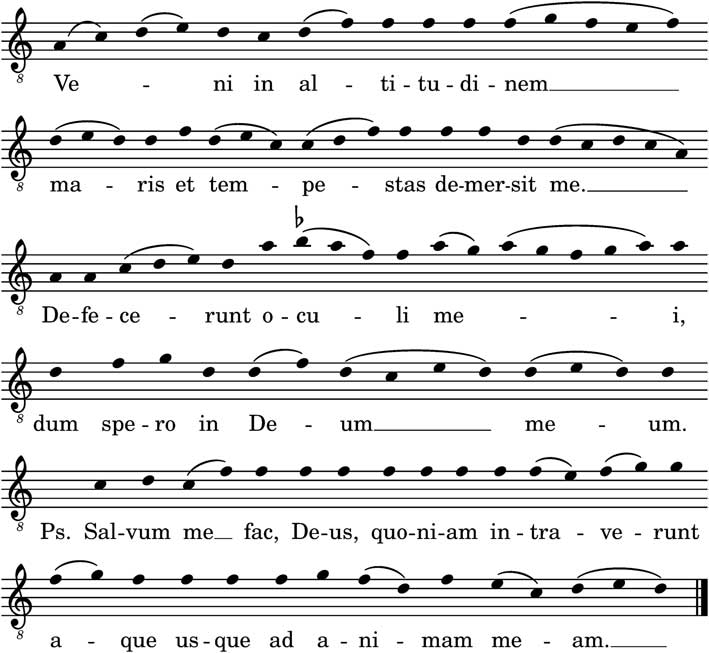
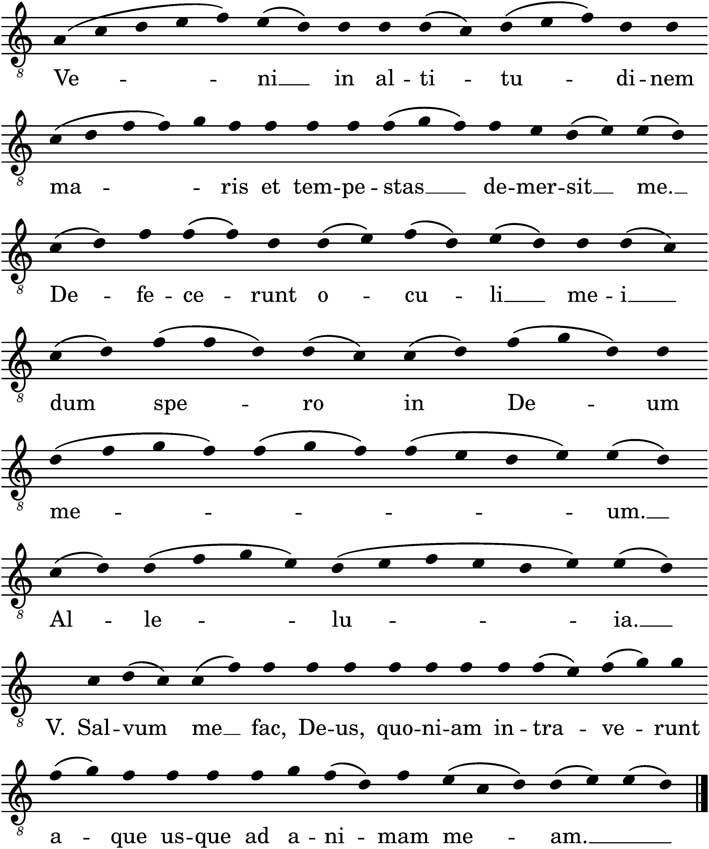
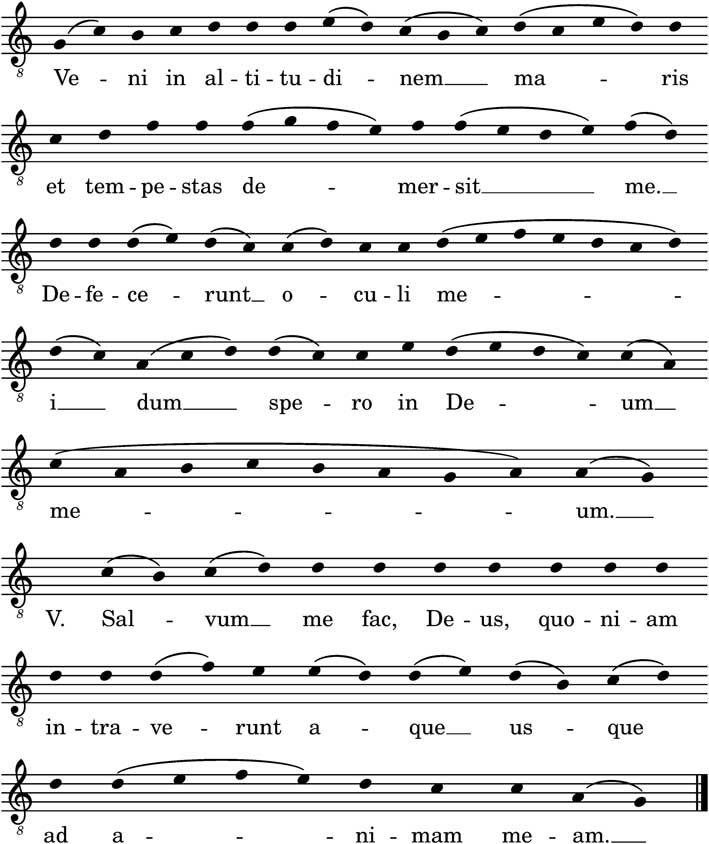
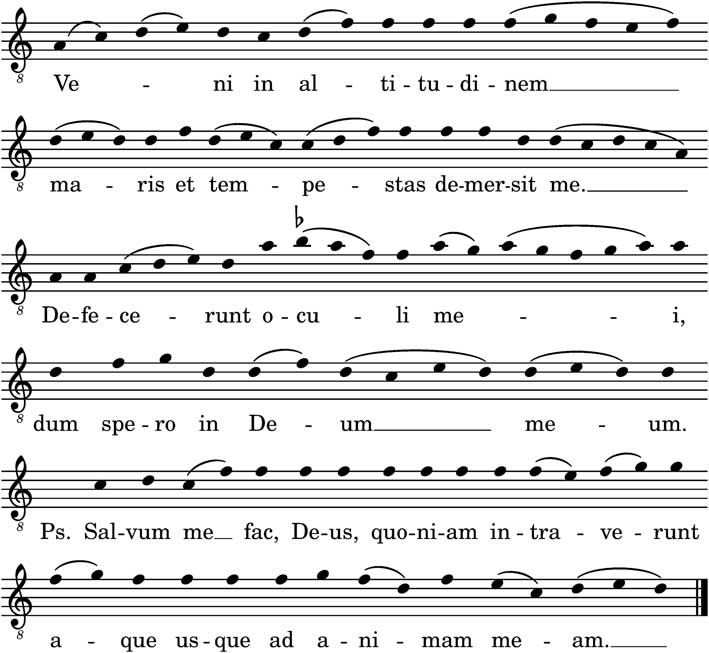
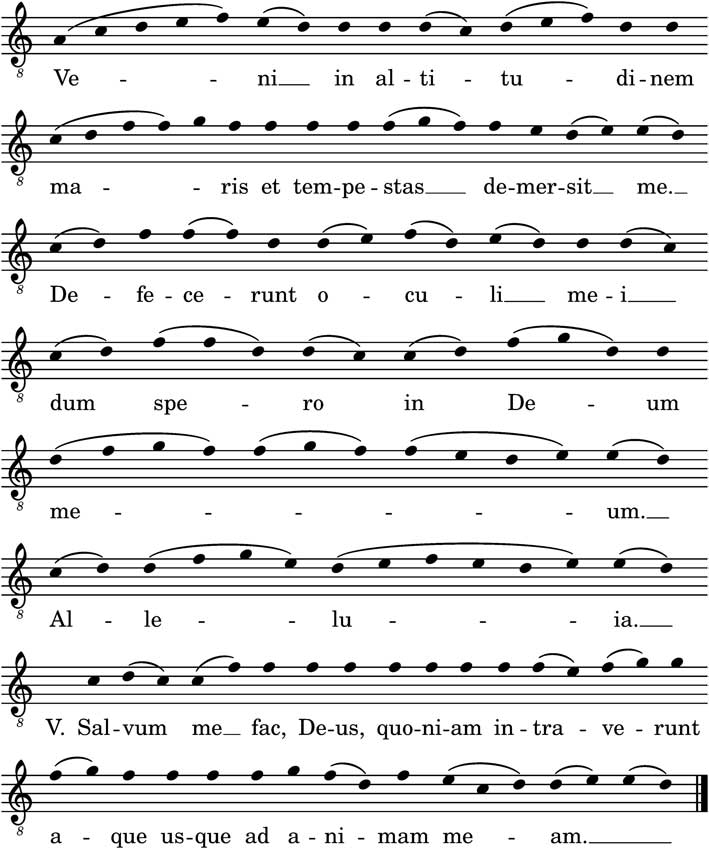
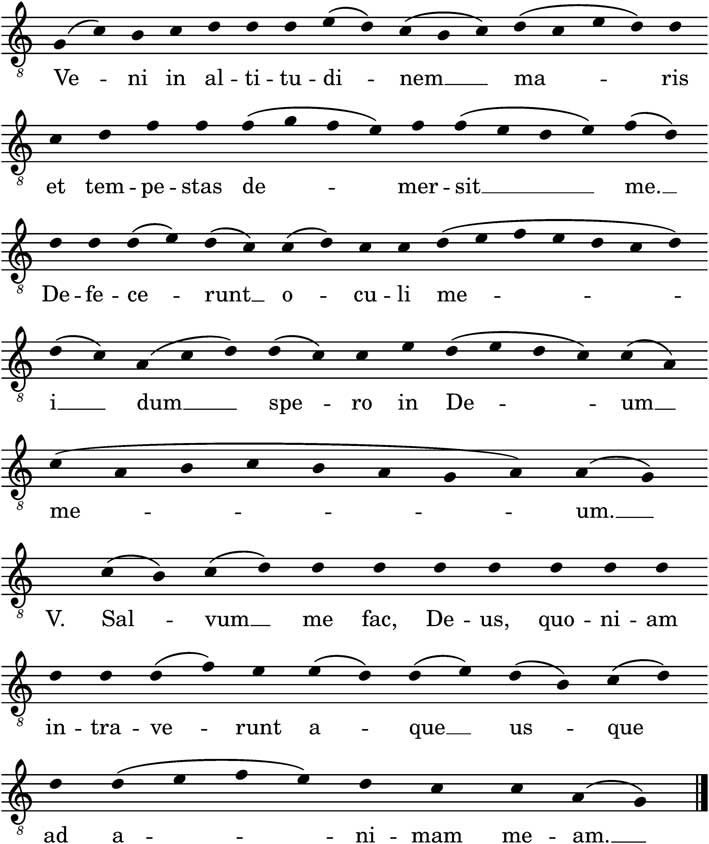
These sources present three different musical settings of the Quodlibetica mass (see above, Table 2).Footnote 145 There is some correspondence between the Brussels manuscripts in that the modes of the introit, gradual and Alleluia are the same in these two sources, but the modes differ in all three sources for the offertory and communion chants. The melodies of the introit, Veni in altitudinem, for example, are set in mode 2 in both of the Brussels manuscripts, while that of Vienna 3787 is in mode 7. The melody of Brussels 215–16 (see Example 1) closely resembles that of the Advent introit Veni, et ostende, particularly in the use of the identical opening melisma.Footnote 146 Subsequently, the melody deviates from the general outline of Veni, et ostende on the words oculi mei, in which it reaches a high point on B♭, followed by a melisma on mei. As mentioned earlier, the text refers to the Virgin’s suffering allegorically through a tempest on the sea. This high point musically illustrates the Virgin being overwhelmed with the flood waters, in the music as well as the text, suggesting that the water has surged even to the Virgin’s eyes, the depth of her suffering consuming her. The introit of Brussels 21123 may also be based on Veni, et ostende, albeit more loosely, taking longer to rise to the reciting pitch F (see Example 2). Neither this setting nor the setting in Vienna 3787 emphasises the text in the way Brussels 215–16 does. The melody of Vienna 3787 opens with a familiar mode 7 gesture and has extended melismas on mei and meum but does not highlight the significant words (see Example 3). Even though the Brussels settings may be loosely based on the same chant, all three chants were set separately without any borrowings between them, and this independence applies to the other mass chants as well.
Introit, Brussels 215–16, fols. 45v–46r
Introit, Brussels 21123, fol. 73r
Introit, Vienna 3787, fol. 184r
Given that each source presents a distinct musical setting, these manuscripts could in theory preserve entries or at least partially preserve entries in the court’s competition. Haggh has previously argued that the setting in Brussels 215–16 was composed by Du Wez because other offices from the competition would have fallen out of use by the time the manuscript was copied in the early sixteenth century.Footnote 147 Given that Brussels 215–16 was produced by the scriptorium associated with the Burgundian-Habsburg court, the supposition that this source preserves the winning entry from the court’s competition is logical. This Alamire manuscript is a more likely candidate to preserve music by a prominent Burgundian-Habsburg court singer than Vienna 3787, for instance, a Gradual for high feasts written in Messine-German notation. Though the provenance of Vienna 3787 is uncertain, Karlheinz Schlager has suggested that it is a late fifteenth-century Benedictine Gradual from the diocese of Salzburg, possibly from Mondsee Abbey.Footnote 148 Given the manuscript’s distance from the court, Vienna 3787 seems less likely to preserve the winning setting than Brussels 215–16, a manuscript that was owned by Charles De Clerc, a high-ranking official in the court’s financial institution.Footnote 149
My discovery of the setting in Brussels 21123, however, presents another possible source of Du Wez’s music from the Low Countries, making Brussels 215–16 no longer the default choice. The manuscript originated in St Leonard’s Church in Zoutleeuw in the early sixteenth century. A rubric for an Alleluia indicates that St Leonard was the patron of the parish of this manuscript (‘Divi Leonardi ecclesie parochialis patroni’), and the acquisition inventory of the Royal Library of Belgium confirms that the manuscript was donated to the library in the nineteenth century by the church in Zoutleeuw whose patron is St Leonard.Footnote 150 An altarpiece depicting the Seven Sorrows of the Virgin by Pieter Aertsen (d. 1575) located in St Leonard suggests that the Seven Sorrows were venerated in this church at the latest by the mid-sixteenth century. There is no connection to the court with Brussels 21123 as there is with Brussels 215–16, but there are indications that the mass and office of Brussels 21123 were used in a region, if not in St Leonard’s church itself, in which the Seven Sorrows devotion was popular. The rubric ‘In festo vij doloribus beate marie virginis’ was added to the office and additional chants were later copied into the manuscript with instructions for their use for this office and mass.Footnote 151 The evidence of this new source does not determine Du Wez’s authorship of the mass setting, but Brussels 21123 does preserve another possible entry or entries if the office and mass were not originally together in Philip’s competition.
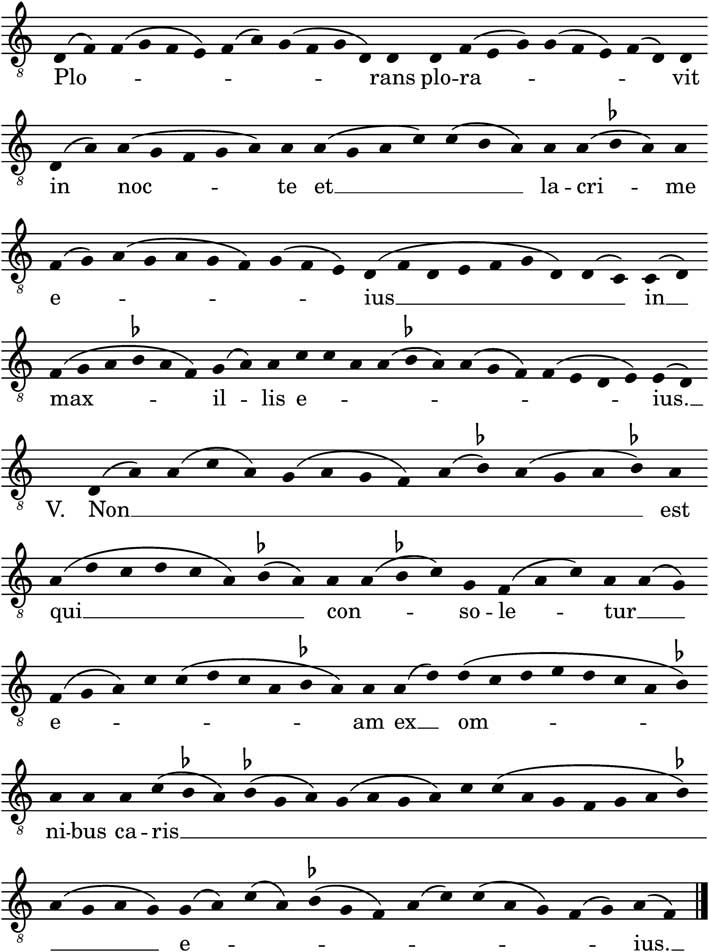
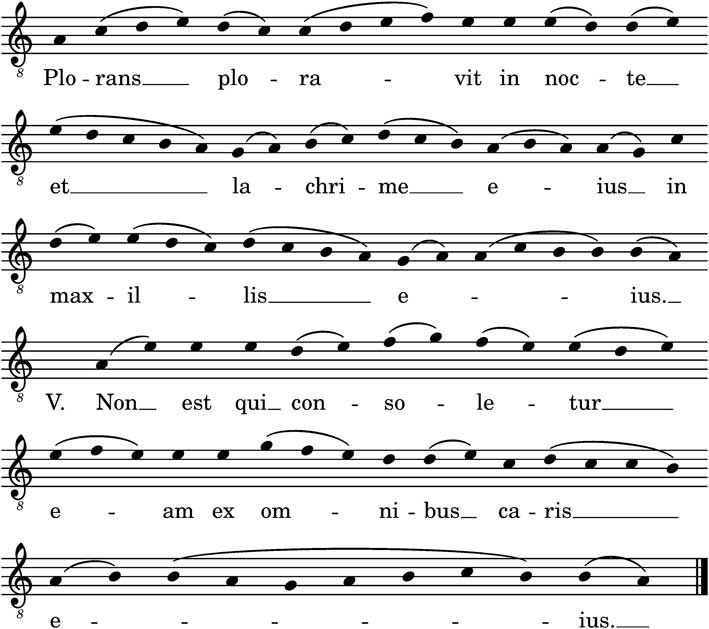
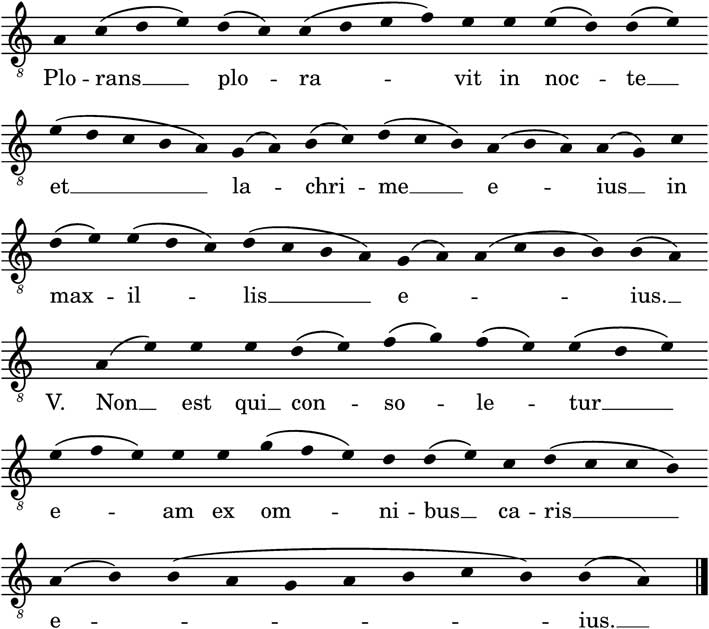
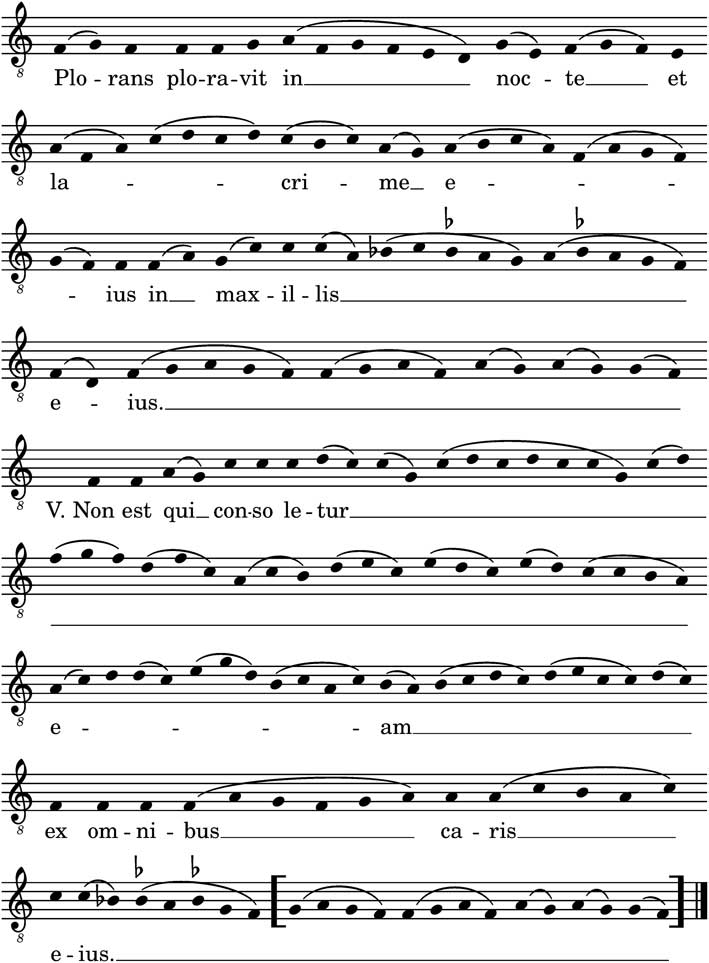
Since the manuscripts themselves cannot provide a definite answer as to which plainchant setting was the winner, we might look then to the music itself to determine which one would have been considered ‘particularly excellent’ or at least if any could be eliminated from consideration. There are no musical reasons, however, to disqualify any of the settings. Each has a mixture of convention and originality. The Vespers antiphons in Brussels 215–16, for example, follow the tradition of modal ordering. Like the introit, the gradual of Brussels 215–16 references an older chant. The melody of Plorans ploravit begins with a similar opening gesture as Beata gens, another mode 1 gradual (see Example 4).Footnote 152 Yet after this initial reference, the verse of the gradual of Brussels 215–16 rises higher than usual, to E on omnibus, and ends on F, uncharacteristically for the mode. The Alleluia of Brussels 215–16 stands out because of its length and large leaps, including an octave leap in the verse.
Gradual, Brussels 215–16, fol. 46r
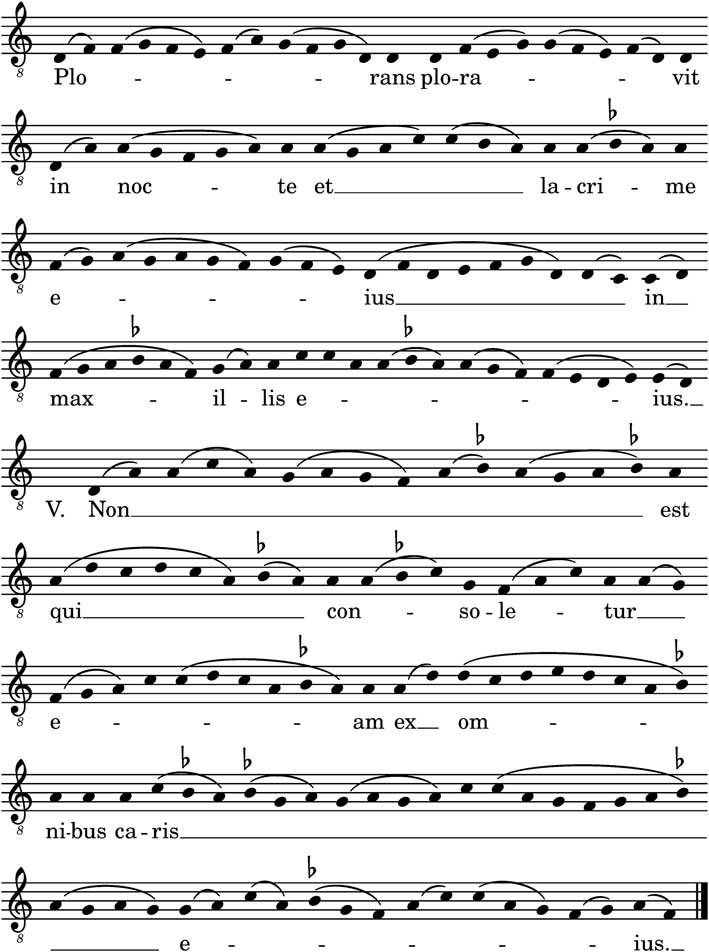
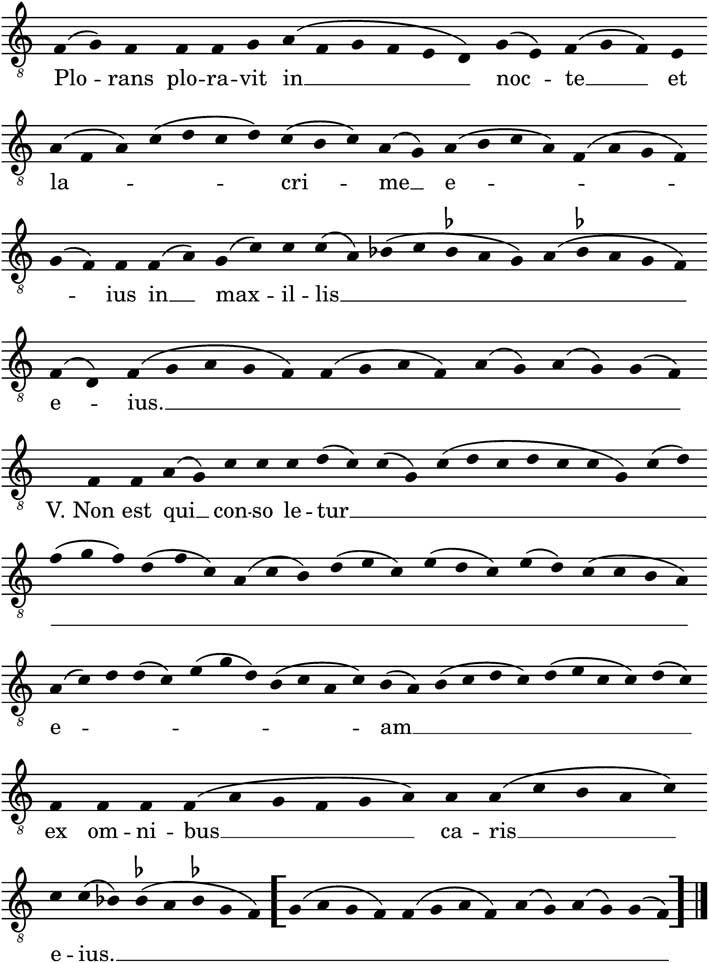
Brussels 21123 also contains both unusual and conventional settings. Uncharacteristically brief for a gradual, the Plorans ploravit setting in Brussels 21123 is significantly shorter than the other two settings and lacks the extended melismas that would be expected of a gradual and the stock phrases typically found in mode 1 graduals (see Example 5). Its two Alleluias, however, use familiar mode 1 openings, found in other Alleluias catalogued by Schlager.Footnote 153 The Vienna 3787 setting has the most obvious reference to an older model and the only borrowing of an entire chant. Its Plorans ploravit is clearly derived from Christus factus est (see Example 6).Footnote 154 Like the other two settings, there are uncommon leaps in the Vienna 3787 setting, particularly in the offertory chant and the Alleluia with the Vox turturis verse.Footnote 155
Gradual, Brussels 21123, fol. 73v
Gradual, Vienna 3787, fol. 184r
Without knowing the aesthetic qualities on which the entries were judged, one cannot say, for instance, that the balanced phrases and well-placed melismas of Brussels 215–16 would have been judged superior to the musical writing of the other two settings. The proximity of Brussels 215–16 to the court environment and the fact that it contains the largest portion of Verhoeven’s text are the best pieces of evidence to support a hypothesis that connects Du Wez to this music. The substitution of the Astat virgo virginum for the sequence in Brussels 215–16 still remains unaccounted for, especially since the setting in Brussels 21123 does set the Salve virgo generosa as called for in the Quodlibetica. Substituting sequences was not uncommon, however, and the Salve virgo generosa circulated with multiple melodies at this time.Footnote 156 That there are only two additional extant settings of Verhoeven’s text, only one of which might have originated in the same region, helps to demonstrate the singularity of Brussels 215–16. A definitive answer as to which source preserves Du Wez’s setting, however, remains unattainable.
CONCLUSION
The new Seven Sorrows liturgy, in addition to printed devotional material, vernacular theatre and miracle cults, popularised the devotion and helped to foster an emotional community for it. Yet the fact that the texts are embedded in an earlier Marian devotion reveals the court’s deeper role in shaping the devotion to the Seven Sorrows of the Virgin. Because many of the texts of the liturgy are borrowed from Compassion devotion, the court could have adopted Compassion devotion in a straightforward way by relabelling an existing Compassion office as a Seven Sorrows office. Yet the Seven Sorrows served as a trademark or brand name for the court to encourage Marian devotion for their political purposes. Instead of using Compassion offices that would have sufficed for their liturgy, the court sponsored a liturgy with a new name under the Seven Sorrows. The new texts and music helped to conceptualise a devotion that was separate and distinct from Compassion devotion and drew attention to the liturgy as a new celebration that was independent of the earlier Compassion devotion.
The identification of the textual model for the Seven Sorrows liturgy also shines light on the tensions amidst which the court was trying to promote the devotion and the opposition that it faced. The close similarity of the new Seven Sorrows office with an older Compassion office has shown that the main difference between the two offices is the enumeration of the Virgin’s sorrows, which for some detractors was not a legitimate basis for establishing a new Marian devotion. Indeed the rubrics for the two liturgies often show that there was a period at the time of the initial establishment of the devotion during which the same texts appeared under both titles. The theological similarities between the devotions reveal the challenges in justifying a new Seven Sorrows devotion and again point to the political importance rather than a liturgical need for creating a new liturgy.
The distinction between the two devotions was particularly important for the court in associating their own political agenda with the Seven Sorrows. Compassion devotion already had political overtones because it was instituted as an act of reparation to counter the actions of the Hussites. The Seven Sorrows devotion was also meant to bring healing to the people following the upheaval of the 1480s and the death of Mary of Burgundy. Van Coudenberghe specifically claims that the new liturgy would help expiate Christ’s anger towards the people.Footnote 157 The intent of both devotions was to help the people recover from difficult political situations through the intercession of the Virgin Mary. The advantage then for Philip the Fair’s court to separate the Seven Sorrows devotion from the earlier Marian devotion was that it provided a new day on which to celebrate the devotion and to which they could attach their own political agenda.
This study has provided an example of the interactions between politics, civic ritual and lay devotion in the formation of a new liturgy. While many Marian feasts share some texts, the similarities between Compassion and Seven Sorrows devotion have provided a unique example of two closely related liturgies in which to observe the impact of political circumstances on the development of the liturgy and its music. As part of the Burgundian-Habsburg court’s arc of propaganda, Philip’s competition not only created a new liturgy but advanced the promotion of the Seven Sorrows devotion.
APPENDIX I
Transcription and translation of an excerpt from Jan van Coudenberghe, Ortus, progressus et impedimenta fraternitatis beatissimae Virginis Mariae de passione quae dicitur de VII doloribus (Antwerp: Michael Hillen van Hoochstraten, 23 November 1519), sig. Bijv–iijr Footnote 158
Accessere his omnibus summorum virorum ac dignitate et eruditione virtuteque et morum splendore clarentium, qui nouae institutionis desiderio accensi, cum sentirent virgineos dolores absque tota Dominicae passionis tragedia repeti et animo volui non posse, nihil vero esse efficacius ad oblitteranda vicia, propagandasque virtutes recordacione Dominicae passionis, propheta dicente: ‘Memoria memor ero, et tabescet in me anima mea’,Footnote 159 vt tantae pietatis beneficium per totam spargeretur ecclesiam, et in omnes gentes exiret, atque ita fieret, vt Virgo intemeratissima, nouo etiam cultu prouocata, patrocinium humani generis coram filio suo susciperet, dulcissimusque Iesus videns in matre se quoque coli, proniore clementia iram in nos suam deponeret. Inde conscripserunt et composuerunt officium et missam Romae, Cameraci, Duaci, Dauentriae, et per totam pene Hollandiam et locis alijs ac provincijs, celebrantes sperantes aliquando diem aliquem festum Virgineae Compassionis, in catholica ecclesia erectum iri, inter quae omnia ista officia tui progenitoris iussu visitata per praefatum dominum Bisuntinum et dominum Salubriensem, gardianum Minorum in Mechlinia, et alios praeclaros et doctos viros. Officium per venerabilem virum magistrum Petrum de Manso, tunc decanum [Biijr] Briliensem,Footnote 160 missum et presentatum quod ex sacra scriptura tam antiphonis vesperorum, laudum, nocturnorum, versiculorum, responsorium tam breuiorum quam aliorum et capitulorum constabat. Preterea lectiones excerpte sunt ex dictis plurimorum sanctorum doctorum, videlicet in quinque primis lectionibus quinque primi dolores, in sexta vero lectione sextus et septimus dolores comprehenduntur, et in septima, octava et nona lectionibus de Omilia divi Augustini super Ioannem, Stabat iuxta crucem Iesu Maria mater eius etcetera, collegit et studiose iuxta ritum ecclesiae Romanae composuit et perstrinxit, ex quo ipsum officium cum missa prae omnibus alijs officijs factis et missis gratum acceptum et electum fuit.
Et predictum officium sic electum, quanta maxima celeritate et diligentia potuit per viros in illa arte peritos in praedictis et alijs locis cantu gregoriano destinatum fuit, nec minori velocitate certatum, omnes qui composuerant ad musicos serenissimi genitoris tui detulerunt, fuereque omnia sedulo examinata, et pleraque omniFootnote 161 laude digna iudicata, tum a praefatis archiepiscopo Bisuntino et Salubriensi episcopo, tum ab alijs res istas callentibus. Verum in primis excelluit compositio Domini Petri du Wez, praepositi Condatensis, viri tempestate illa musice artis primarij, et idcirco potiores ipse partes prae ceterisFootnote 162 est commeritus.
Nec fefellit animos tam pios praecepta spes, nam vixdum in lucem prodierat dictum officium, cum subito provinciales omnes approbantibus episcopis illud obvijs ulnisFootnote 163 ut rem sacrosanctam exceperunt, multaque collegia statos dies illius celebrandi quotannis dedicauerunt, qui in hanc usque diem suo ritu obseruantur.
Added to all these were the greatest men, those most outstanding in dignity, learning, virtue and moral probity; when they, aflame with desire for the new institution, heard that the sorrows of the Virgin could not be recalled and meditated upon without the entire tragedy of the Lord’s Passion, and that indeed there was nothing more effective for obliterating vice and promoting virtue than the recollection of the Lord’s Passion, as the prophet says: ‘I will be mindful and remember, and my soul shall languish within me’; so that the benefit of such great piety might be scattered throughout the entire church and go out to all peoples, and might bring about that the Virgin most pure, called upon in this new devotion, might take up the defence of the human race before her Son, and that Jesus, most sweet, might see that He Himself is also being worshipped in His mother, and might be more inclined to mercy and put away His anger towards us, they then wrote and composed an office and mass, celebrating it at Rome, Cambrai, Douai, Deventer, and throughout nearly all Holland, and in other places and provinces, hoping that at some stage a definite day would be assigned in the Catholic church as the feast of the Compassion of Our Lady, amongst all which those offices inspected at the command of your progenitor [Philip the Fair] by the aforesaid lord of Besançon [François Busleiden] and lord of Salembria [Michel François de Lille], the guardian of the Minorites in Mechelen, and other illustrious and learned men. The office, sent and presented by the venerable gentleman master Petrus de Manso [Peter Verhoeven], at that time dean of Den Briel, was based on the sacred Scriptures, and comprised both antiphons for Vespers, Lauds, and nocturns, and the versicles, responsories and chapters both of the shorter and longer offices and the other ones, and of their capitula. Moreover, the readings were excerpted from the writings of a great number of holy doctors, namely in the first five readings were the first five sorrows; in the sixth reading the sixth and seventh sorrows are treated; and in the seventh, eighth and ninth readings, he selected passages from St Augustine’s homily on St John, Stabat iuxta crucem Iesu Maria mater eius, and diligently composed and arranged the whole according to the rite of the Roman church. As a result, this office and its mass were favoured and chosen before all the other composed offices and their masses.
And the said office, thus selected, was with the greatest speed and care possible set to Gregorian chant by men skilled in that art, in the aforesaid places and elsewhere, and all of those who had written settings brought them to the musicians of your most serene father, and they were all examined minutely, and a good many were found, both by the archbishop of Besançon and the bishop of Salembria as well as by others skilled in those matters, to be worthy of the highest praise. The composition of Father Pierre Du Wez, provost of Condé, one of the most prominent musicians at the time, was particularly excellent, and for that reason he won the greatest share of praise before the rest.
The hope enjoined upon us did not disappoint such pious minds, for hardly had the said office been published when suddenly all the provincials, with the approval of the bishops, eagerly took it up as a matter of great holiness, and many collegiate churches dedicated set days to celebrate it, and these are still observed to this day with their proper rite.
Translated by Grantley McDonald
APPENDIX II
Transcription and translation of an excerpt from Gheraert Leeu’s letter in Confraternitas dolorum beatissime virginis marie Autore domino Philippo archiduce austrie duce burgondie brabantie etc. novissime erecta [Antwerp: Govaert Bac, after 1492], fol. 10r–v
Id quidem tam missa quam horis studiosissime accuratissime magnaque cum lucubratione et vigilia ex sanctorum dictis editum atque contextum tibi, dicte fraternitatis autori dignissimo cum omni humilitate et reverentia offero visitandum ac, si dignum sit, per tuam super illustrem serenitatem clarissimosque proceres et sagacissimos consiliarios tuos corrigendum tuaque precellenti industria correctum et ornatum, idem mihi impressuro rogo humiliter remittendum. Sed ne tedeat dolorum beate Virginis intuitus,Footnote 164 suppliciter exoramus vt sicut te iubente editum est, ita te auxiliante musice dulcedinis meae propriato atque cog[10v]nato tono accommodataque accordantia sit illustratum, quo festiviorem sic amplioris acquirat energieFootnote 165 vigorem cultumque per universam ecclesiam decentiorem acceptiorem necnon tua benigna autoritate roboratum. CuiFootnote 166 effectui cum inclita tua mandaverit serenitas, non solum fratrum congaudio congratulationeque animos perfuderis, verum omnipotenti Deo eiusque intacte matri (quod prestat) gratissimum feceris obsequium. Qui te, patrem patrie longo euo faustum, conservet et incolumem, et beatissime Virginis intervenientibus meritis ab eternis doloribus eripiat.
With all humility and reverence, most worthy founder of the aforementioned fraternity, I offer for your inspection this work, which I have edited and compiled both for the Mass and for the hours, drawing on the words of the saints, with great study and care and at the cost of many late nights. And if you deem it worthy, I submit it to be corrected by your most illustrious serenity, your most brilliant nobles and wisest counsellors. Once it has been corrected and enhanced by your pre-eminent industry, I humbly ask also that it be returned to me for printing. But lest people should become tired of contemplating the sorrows of the Blessed Virgin, we humbly implore you that as it was written at your request, it should be adorned by your help with the sweetness of music of some appropriate and related tone, so that it might thus acquire the more festive vigour of a greater liveliness, and might gain throughout the universal church a liturgy that is more worthy and more pleasing, drawing respectability from your benign authority. And when your heroic serenity has given orders to this effect, you shall not only infuse the hearts of the brethren with shared joy and thanksgiving, but you shall also carry out a most pleasing service to God almighty and His Immaculate Mother (which is the most important things). May he preserve you, father of our fatherland, happy and safe for many years, and snatch you away from eternal pain by the intervention of the merits of the most Blessed Virgin.
Translated by Grantley McDonald