Introduction
Small mammals and specifically rodents are known to harbour a diverse array of helminth parasites including acanthocephalans, trematodes, cestodes and nematodes, with the latter two taxa being the most common (Collins, Reference Collins1972; Haukisalmi, Reference Haukisalmi1989; Feliú et al., Reference Feliú, Renaud, Catzeflis, Hugot, Durand and Morand1997, Reference Feliú, Ventura, Segovia, Jiménez, Ribas and Gisbert2009; Fuentes et al., Reference Fuentes, Cerezuela and Galan-Puchades2000; Wilamowski et al., Reference Wilamowski, Moran and Greenburg2002; Portolés et al., Reference Portolés, Granel, Esteban and Caberet2004; Smales & Spratt, Reference Smales and Spratt2004). Globally, acanthocephalans comprise more than 1200 species, nematodes some 10,500 species, cestodes approximately 5000 species and trematodes more than 15,000 species (Poulin, Reference Poulin2007). Helminth taxa have diverse life-history strategies that include direct (monoxenous) life cycles in which hosts are infected by ingesting contaminated food, and in which the ingestion of eggs can also be facilitated through coprophagy, retrofection or grooming (Taffs, Reference Taffs1976; Anderson, Reference Anderson2000; Carlberg & Lang, Reference Carlberg and Lang2004). In contrast, helminths with an indirect (heteroxenous) life cycle (e.g. cestodes and some nematodes) depend on intermediate hosts (often arthropods or other invertebrates), for the completion of their life cycle, before entering the definitive host (Anderson, Reference Anderson2000; Georgiev et al., Reference Georgiev, Bray, Littlewood, Morand, Krasnov and Poulin2006; Ribas & Casanova, Reference Ribas, Casanova, Morand, Krasnov and Poulin2006).
Several intrinsic and extrinsic factors can influence the host and geographic range of helminth parasites. In particular, parasite life cycle and mode of transmission can affect the availability and survival of free-living infective stages (Anderson, Reference Anderson2000; Turner & Getz, Reference Turner and Getz2010; Dybing et al., Reference Dybing, Fleming and Adams2013). Monoxenous nematodes generally release eggs in the host's faeces, which results in a more dense distribution of free-living infective stages in the environment and availability to hosts, compared to heteroxenous taxa that are more widely distributed (due to mobility of intermediate host) and in lower densities (Anderson, Reference Anderson2000; Turner & Getz, Reference Turner and Getz2010; Dybing et al., Reference Dybing, Fleming and Adams2013). Further, level of host specificity (host range) can affect the local abundance and geographic range of parasites, with generalist parasites (broad host range) often exhibiting higher abundances and larger geographic ranges (Krasnov et al., Reference Krasnov, Shenbrot, Khokhlova and Degen2004; Poulin et al., Reference Poulin, Krasnov, Mouillot and Thieltges2011) compared to specialist species (Price & Clancy, Reference Price and Clancy1983; Gregory, Reference Gregory1990; Poulin, Reference Poulin2007). Helminth parasites of small mammals generally have broad host ranges, of which some species are restricted to confamilial host species (oligoxenous) while other species utilize a wide range of unrelated hosts (euryxenous) (Feliú et al., Reference Feliú, Renaud, Catzeflis, Hugot, Durand and Morand1997, Reference Feliú, Ventura, Segovia, Jiménez, Ribas and Gisbert2009). For example, Mastophorus muris was recovered from members in the rodent family Muridae (Apodemus sylvaticus (Linnaeus) and Mus (Mus) musculus Linnaeus) (Milazzo et al., Reference Milazzo, Aloise, Cagnin, Di Bella, Geraci, Feliu and Casanova2005, Reference Milazzo, Cagnin, Di Bella, Geraci and Ribas2010) as well as Arvicolidae (Microtus (Terricola) duodecimcostatus (de Sélys-Longchamps) as Microtus (Pitymys) duodecimcostatus (de Sélys-Longchamps), and Myodes glareolus (Schreber) as Clethrionomys glareolus (Schreber)) (Haukisalmi et al., Reference Haukisalmi, Henttonen and Tenora1988; Haukisalmi & Henttonen, Reference Haukisalmi and Henttonen1993; Feliú et al., Reference Feliú, Renaud, Catzeflis, Hugot, Durand and Morand1997).
Helminth parasites have a dual environment that includes the environment within the host (definitive and intermediate) and the environment outside the host. It is thus predicted that extrinsic factors related to the host and environment will influence the distribution of helminth species and populations in space and time. Aside from physiological and immunological characteristics of hosts affecting helminth–host interaction, there are other more generalized host properties that may impact on the distribution of helminth species. These include host diet, habitat use and geographic range (Price, Reference Price, Esch, Bush and Aho1990; Behnke et al., Reference Behnke, Barnard, Mason, Harris, Sherif, Zalat and Gilbert2000, Reference Behnke, Harris and Bajer2004; Barnard et al., Reference Barnard, Sayed, Barnard, Behnke, Abdel Nabi, Sherif, Shutt and Zalat2003; Brouat et al., Reference Brouat, Kane, Diouf, Bâ, Sall-Dramé and Duplantier2007; Lutermann et al., Reference Lutermann, Medger and Junker2015). For example, Brouat et al. (Reference Brouat, Kane, Diouf, Bâ, Sall-Dramé and Duplantier2007) suggested that host ecology, such as habitat characteristics, rather than the phylogenetic background, influences the appearance and establishment of helminth community structure in two closely related species of Mastomys Thomas rodents from Senegal. Environmental factors such as vegetation cover and climatic conditions (rainfall, temperature and humidity) can influence the survival and distribution of free-living infective helminth stages (Hulbert & Boag, Reference Hulbert and Boag2001; Brouat et al., Reference Brouat, Kane, Diouf, Bâ, Sall-Dramé and Duplantier2007; Spickett et al., Reference Spickett, Junker, Krasnov, Haukisalmi and Matthee2017) and arthropods that act as intermediate hosts (Dobson & Carper, Reference Dobson, Carper, Peters and Lovejoy1992; Anderson, Reference Anderson2000). For example, the presence of nematode and cestode species in Vulpes vulpes (Linnaeus) from Western Australia was positively related to average relative humidity, long-term average minimum temperature and the percentage cover of native vegetation (Dybing et al., Reference Dybing, Fleming and Adams2013).
Empirical data on the host association and distribution of helminth parasites are vital for any comprehensive ecological study. In addition, updated parasite-host lists and parasite distribution maps are useful in modelling studies to assess the effect of climate change on parasite distribution and the possible impact on disease emergence.
To date, the majority of studies on the helminth diversity associated with small mammals have been conducted in the Palaearctic region (Haukisalmi, Reference Haukisalmi1989; Shimalov, Reference Shimalov2001; Milazzo et al., Reference Milazzo, Casanova, Aloise, Ribas and Cagnin2002; Fuentes et al., Reference Fuentes, Sainz-Elipe and Galan-Puchades2005a, Reference Fuentes, Sainz-Elipe and Galan-Puchadesb). In the Afrotropical region, less is known, with only a few comprehensive studies conducted in North and West Africa (Behnke et al., Reference Behnke, Barnard, Mason, Harris, Sherif, Zalat and Gilbert2000, Reference Behnke, Harris and Bajer2004; Barnard et al., Reference Barnard, Sayed, Barnard, Behnke, Abdel Nabi, Sherif, Shutt and Zalat2003; Fichet-Calvet et al., Reference Fichet-Calvet, Wang, Jomaa, Ismail and Ashford2003; Brouat et al., Reference Brouat, Kane, Diouf, Bâ, Sall-Dramé and Duplantier2007). In South Africa, current information is limited and studies documenting the helminth fauna of small mammals are restricted to incidental observations of a taxonomic nature (Ortlepp, Reference Ortlepp1939; Verster, Reference Verster1960; Collins, Reference Collins1972; Durette-Desset & Digiani, Reference Durette-Desset and Digiani2005), or focus on single-species and single-locality investigations (Froeschke et al., Reference Froeschke, van der Mescht, McGeoch and Matthee2013; Froeschke & Matthee, Reference Froeschke and Matthee2014; Lutermann et al., Reference Lutermann, Medger and Junker2014, Reference Lutermann, Medger and Junker2015). More recently, research has been initiated on the diversity and ecology of helminths associated with the rodent genus Rhabdomys Thomas across South Africa and parts of Namibia (Froeschke et al., Reference Froeschke, Harf, Sommer and Matthee2010; Spickett et al., Reference Spickett, Junker, Krasnov, Haukisalmi and Matthee2017). From these studies, it is evident that Rhabdomys species harbour both nematode and cestode species, and that parasite abundance and species richness display geographic variation across the landscape. As yet, however, descriptive information on the host range and geographic distribution of helminth parasites associated with naturally occurring rodents in South and southern Africa is mostly absent. The region has a rich diversity of rodent species representing several families (Skinner & Chimimba, Reference Skinner and Chimimba2005). In South Africa, the family Muridae is represented by some 50 species (Skinner & Chimimba, Reference Skinner and Chimimba2005; Stuart & Stuart, Reference Stuart and Stuart2007). Further, South Africa has diverse rainfall regimes (all year (south-central), summer (east) and winter (west) rainfall) and vegetation types (e.g. grassland vs. sparse shrub vegetation) and, from this, it is expected that parasite distribution and mean abundances will vary geographically.
To address the paucity of information, we embarked on a countrywide study in South Africa. The aims of the study were to: (1) record the diversity and host range of helminth parasites that are associated with naturally occurring rodents; and (2) provide baseline data on the geographic distribution of nematode and cestode species that are associated with these hosts across South Africa. Presently, there is limited geographic information available for a few helminth species.
Materials and methods
Study area, host collection and parasite recovery
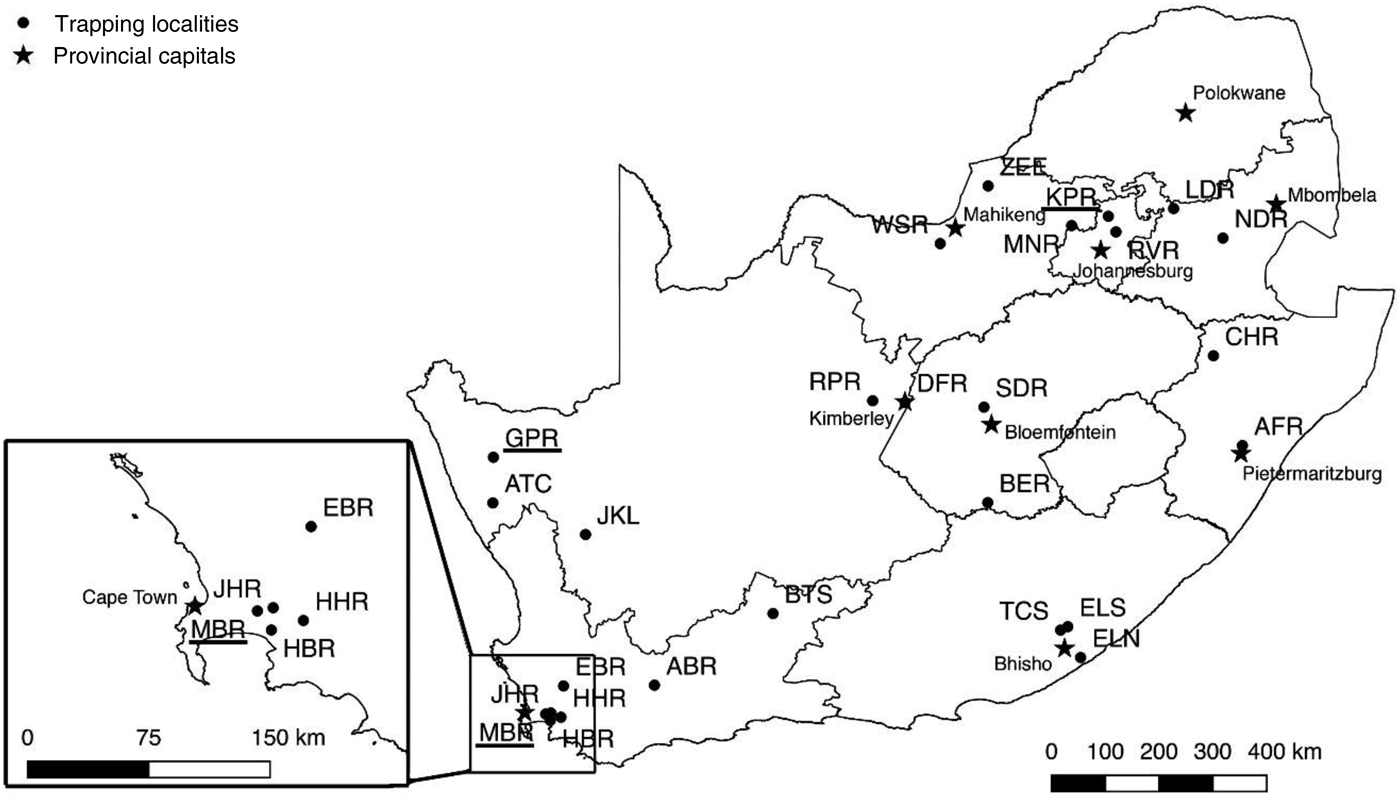
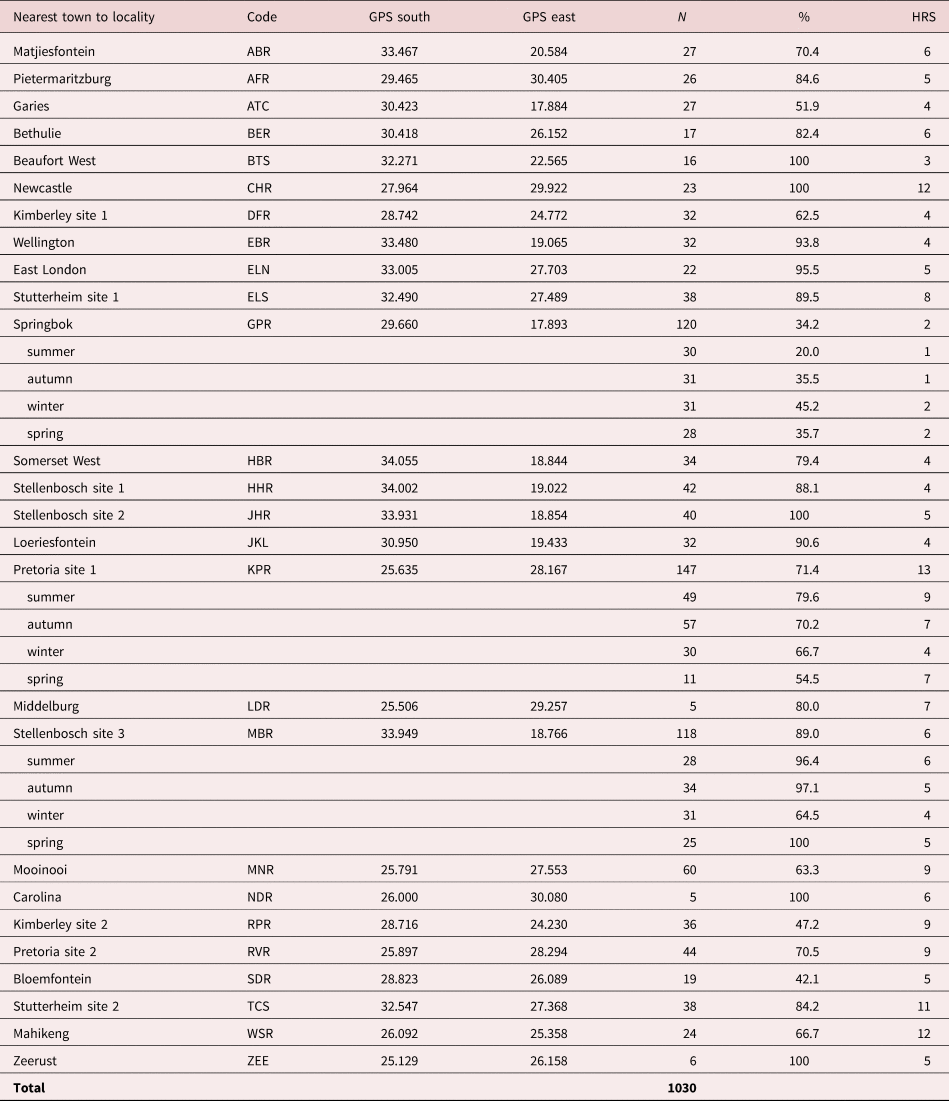
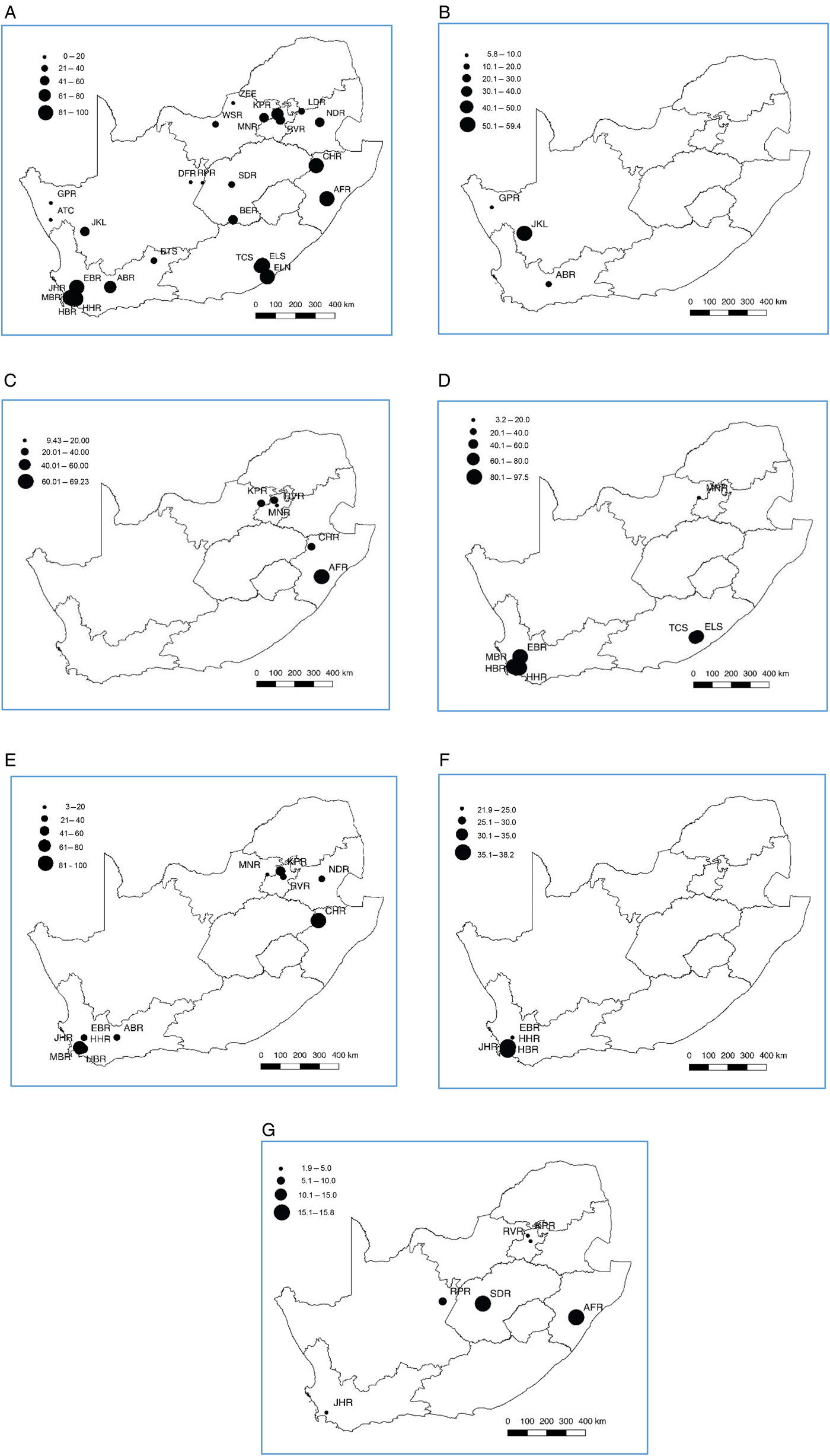
Rodents (Muridae) were trapped at 26 localities across South Africa during 2004–2014 (fig. 1, table 1, supplementary table S1). The main trap season was spring–summer, which is the season when small mammals are more abundant and active (Skinner & Chimimba, Reference Skinner and Chimimba2005). In addition, Rhabdomys spp. were trapped every three months at three localities (Rhabdomys pumilio at GPR, MBR and R. dilectus at KPR) (fig. 1, table 1, supplementary table S2; locality abbreviations listed in fig. 1 and table 1).
Sampling localities (n = 26) for rodents in South Africa. Matjiesfontein (ABR); Pietermaritzburg (AFR); Garies (ATC); Bethulie region (BER); Beaufort West (BTS); Newcastle (CHR); Kimberley site 1 (DFR); Wellington (EBR); East London (ELN); Stutterheim site 1 (ELS); Springbok (GPR); Somerset West (HBR); Stellenbosch site 1 (HHR); Stellenbosch site 2 (JHR); Loeriesfontein (JKL); Pretoria site 1 (KPR); Middelburg (LDR); Stellenbosch site 3 (MBR); Mooinooi (MNR); Carolina (NDR); Kimberley site 2 (RPR); Pretoria site 2 (RVR); Bloemfontein (SDR); Stutterheim site 2 (TCS); Mahikeng (WSR); Zeerust (ZEE). The three underlined localities (GPR, MBR and KPR) were sampled every three months.

Selected localities (n = 26) in South Africa where rodents were collected, GPS coordinates (south and east), number of hosts examined (N), proportion of hosts infected (%) and total number of helminth species recorded in hosts at the particular locality or in a season (HRS).

A standardized sampling design was followed throughout. Animals were trapped using Sherman-type live traps, baited with a peanut butter and oats mixture. Traps were set out in three to five lines (50–100 m length) with 10 m distance between traps and inspected twice per day (morning and afternoon). During the summer months, traps were closed during the heat of the day (11:00–15:00), while the process was reversed in winter when traps were closed during the night – this was done to prevent any trap-related deaths due to adverse environmental conditions. Traps were set for five to seven consecutive days at each locality. Trapped animals were identified using morphological descriptions and distribution maps (Skinner & Chimimba, Reference Skinner and Chimimba2005; Stuart & Stuart, Reference Stuart and Stuart2007). For differentiation between morphologically similar R. pumilio and R. dilectus, we used their geographic distribution as determined by Rambau et al. (Reference Rambau, Robinson and Stanyon2003) and Du Toit et al. (Reference Du Toit, Jansen van Vuuren, Matthee and Matthee2012). In addition, molecular confirmation of the species identity was conducted for Rhabdomys individuals from several of the localities (Du Toit et al., Reference Du Toit, Jansen van Vuuren, Matthee and Matthee2012). In the case of Mastomys coucha and Mastomys natalensis, the species identifications were confirmed in Sands et al. (Reference Sands, Matthee, Mfune and Matthee2015) for several of the localities. In all cases, only adult animals were targeted, and all visibly juvenile animals (see Skinner & Chimimba, Reference Skinner and Chimimba2005) were identified, recorded and released at the capture site. Target animals were removed from the traps, placed in plastic bags and immediately euthanized by intraperitoneal injection with Sodium Pentobarbitone (200 mg/kg).
Carcasses were either frozen in the field and remained frozen until parasite removal in the laboratory, or gastrointestinal tracts, from and including the oesophagus to the anus, were removed immediately and stored in 70% alcohol for later dissection. Each individual was sexed, weighed, measured (snout-to-vent and tail length) and its reproductive state recorded. All helminths (total counts) were recovered from the stomach, small intestine and large intestine and stored in 70% alcohol. The number of nematodes and cestodes were logged according to Haukisalmi & Henttonen (Reference Haukisalmi and Henttonen2001). The helminth species collected are presented in tables 2 and 3; identifications were based on relevant keys and descriptions of various authors. Nematodes that, due to poor preservation or the absence of males (e.g. Heligmosomoidea and Oxyuroidea), could only be identified to genus level, were recorded as ‘sp.’ In cases, however, where specimens were in good condition, but morphological examination provided clear indication that the specimens did not correspond to any of the previously described congeners, they were identified as previously unrecognized species, designated here with numerals (sp. 1, 2, etc.). The same approach was followed for cestodes. Cestodes commonly include morphologically indistinguishable (cryptic) species (e.g. Haukisalmi et al., Reference Haukisalmi, Hardman, Hardman, Rausch and Henttonen2008, Reference Haukisalmi, Hardman, Henttonen, Laakkonen, Niemimaa, Hardman and Gubányi2009). Therefore, nucleotide sequences of a region of nuclear DNA coding for 28S ribosomal RNA (ca. 1400 bp) and a region of mitochondrial DNA coding for 16S-12S ribosomal RNA (ca. 810 bp) were used as additional identification tools for some cestodes. The 28S region was used for Hymenolepididae (Rodentolepis spp.), Catenotaeniidae (Skrjabinotaenia spp. and Meggittina spp.) and Davaineidae (Raillietina spp. and Inermicapsifer spp.), and the region 16S–12S for Catenotaeniidae. The primers and amplification procedures used for 28S have been described in Littlewood et al. (Reference Littlewood, Curini-Galletti and Herniou2000), Lockyer et al. (Reference Lockyer, Olson and Littlewood2003) and Haukisalmi et al. (Reference Haukisalmi, Hardman, Fedorov, Hoberg and Henttonen2016), and those for 16S–12S in Galbreath & Hoberg (Reference Galbreath and Hoberg2012) and von Nickisch-Rosenegk et al. (Reference von Nickisch-Rosenegk, Brown and Boore2001). The DNA sequences will be published in forthcoming molecular systematic analyses (for Catenotaeniidae, see Haukisalmi et al., Reference Haukisalmi, Ribas, Junker, Spickett, Matthee, Henttonen, Jrijer, Halajian, Anders and Nakao2018).
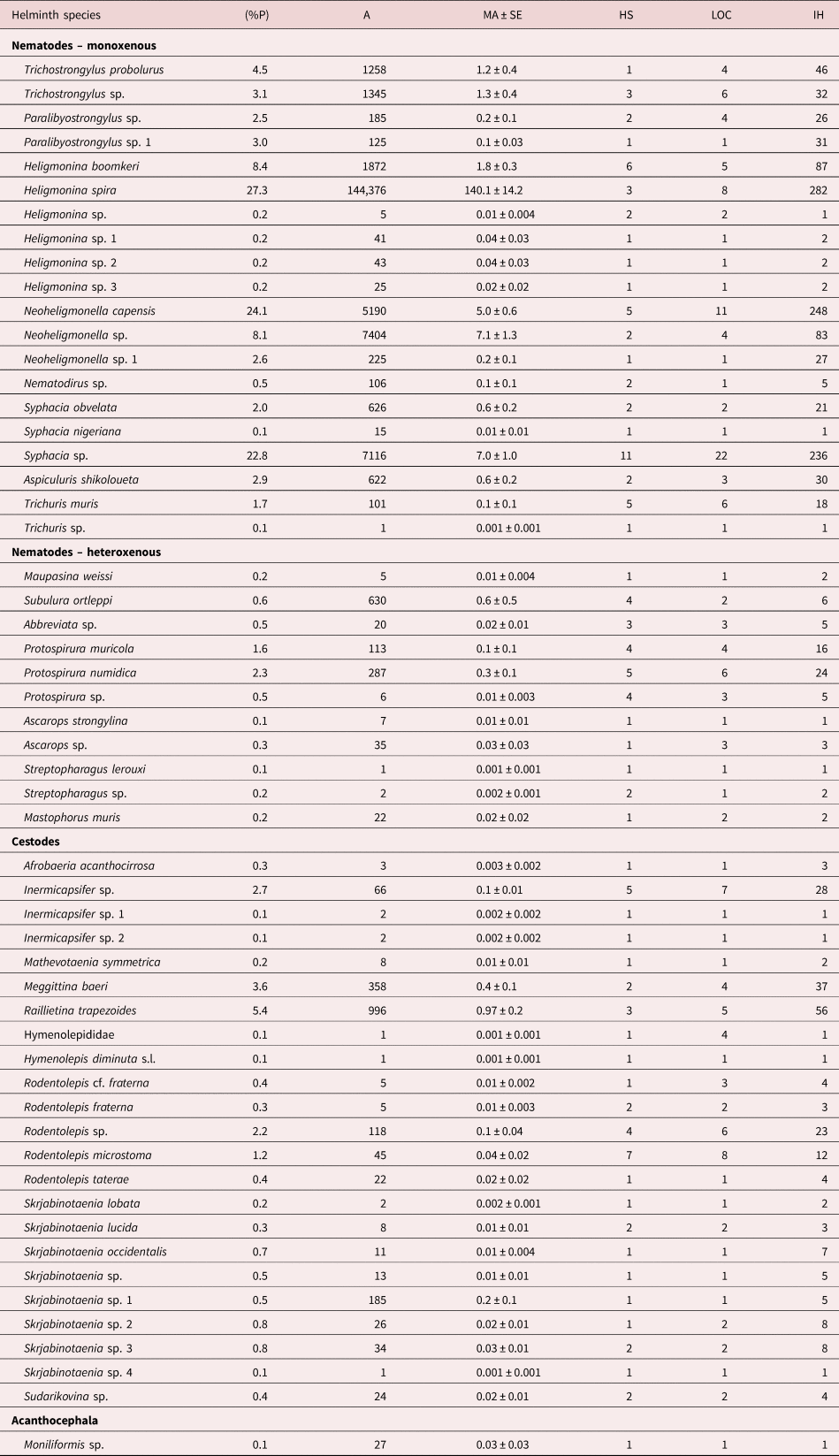
The prevalence (%P), abundance (A) and mean abundance ± standard error (MA ± SE) of monoxenous and heteroxenous nematode and cestode species (n = 55) recorded in rodent species (HS) in South Africa, indicating the number of localities (LOC) where rodents harboured the helminths and the number of infected hosts (IH).

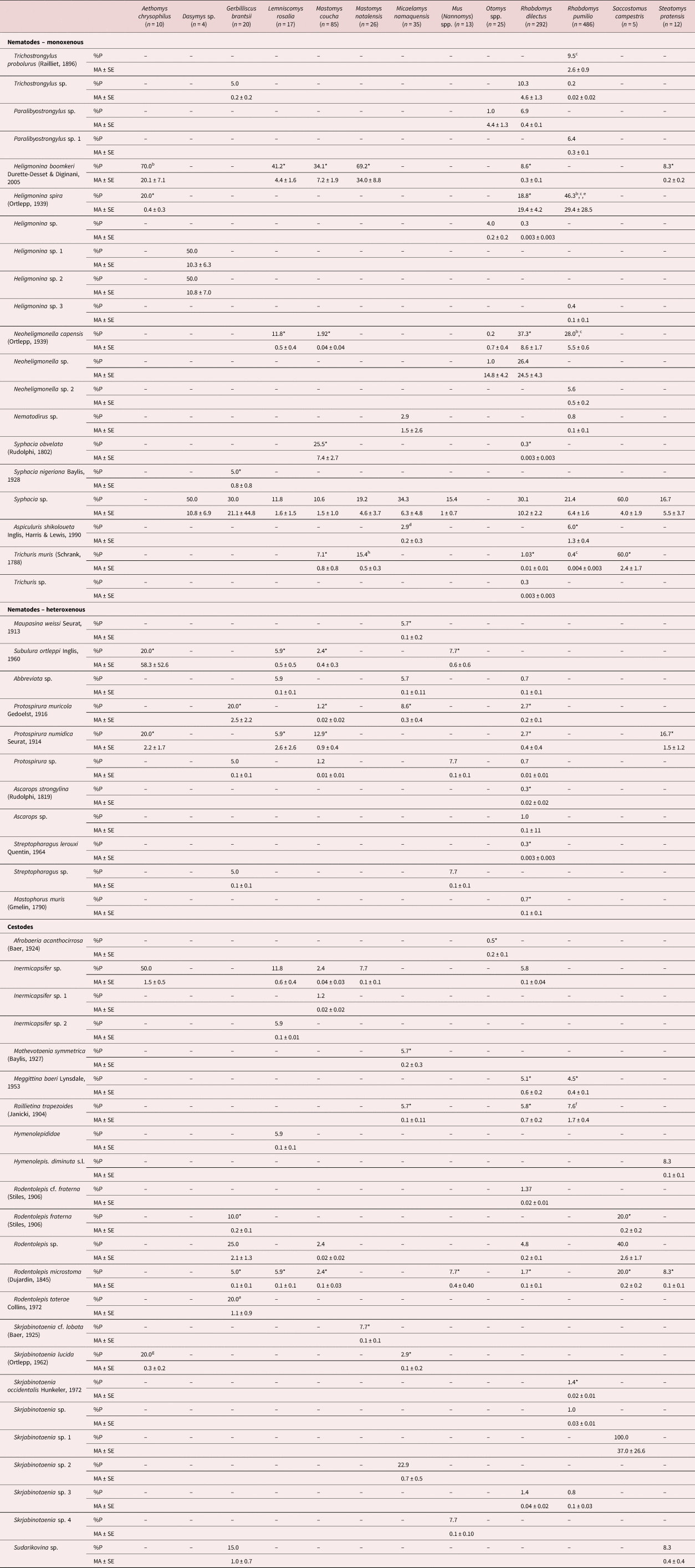
Prevalence (%P) and mean abundance (MA ± SE) of individual nematode and cestode species recovered from rodent host species (n = number of host individuals) in South Africa, also indicating previous records.

* First time this helminth species is recorded from this host species or genus.
References (previous records): aCollins, Reference Collins1972; bDurette-Desset & Digiani, Reference Durette-Desset and Digiani2005; cFroeschke et al., Reference Froeschke, Harf, Sommer and Matthee2010; dInglis et al., Reference Inglis, Harris and Lewis1990; eOrtlepp, Reference Ortlepp1939; fOrtlepp, Reference Ortlepp1940; gOrtlepp, Reference Ortlepp1962; hVerster, Reference Verster1960.
Voucher specimens of each species have been deposited in the National Collection of Animal Helminths at the ARC-Onderstepoort Veterinary Institute, South Africa (accession number of nematodes: S/2016/38) and the Finnish Museum of Natural History, Luomus, Finland (accession numbers of cestodes: KN 3646–KN 3668). Authorities of host and parasite species collected during the present study are listed in supplementary table S2 and table 3, respectively. Taxonomy of the hosts follows Wilson & Reeder (Reference Wilson and Reeder2005).
Data analysis
Counts to determine helminth species richness per host taxon also include helminths that could only be identified to genus level. We realize that in some instances specimens identified to genus level might be conspecific with congeneric species recorded from the same host, which would suggest a higher than realized helminth species richness, but in most instances the overlap was minimal (table 3).
For each helminth species, we calculated the host-species richness (number of host species in which this parasite occurred), overall prevalence (the number of infected hosts divided by the number of hosts examined given as a percentage) and overall mean abundance (number of helminth individuals divided by total number of host individuals examined) following Bush et al. (Reference Bush, Lafferty, Lotz and Shostak1997). In addition, the prevalence and mean abundance of a given parasite species or taxon was calculated for each host species or taxon. Spatial distribution maps were constructed using QGIS (version 2.18.2; QGIS Development Team, 2016). Helminth species (n = 13) occurring at three or more localities were selected to map their geographic distribution with graphic representation of abundance (figs 2–4). The Chao2 index for species richness estimation was calculated for the three most abundant rodent species using the vegan package in R Version 3.5.1 R Core Team (2018).
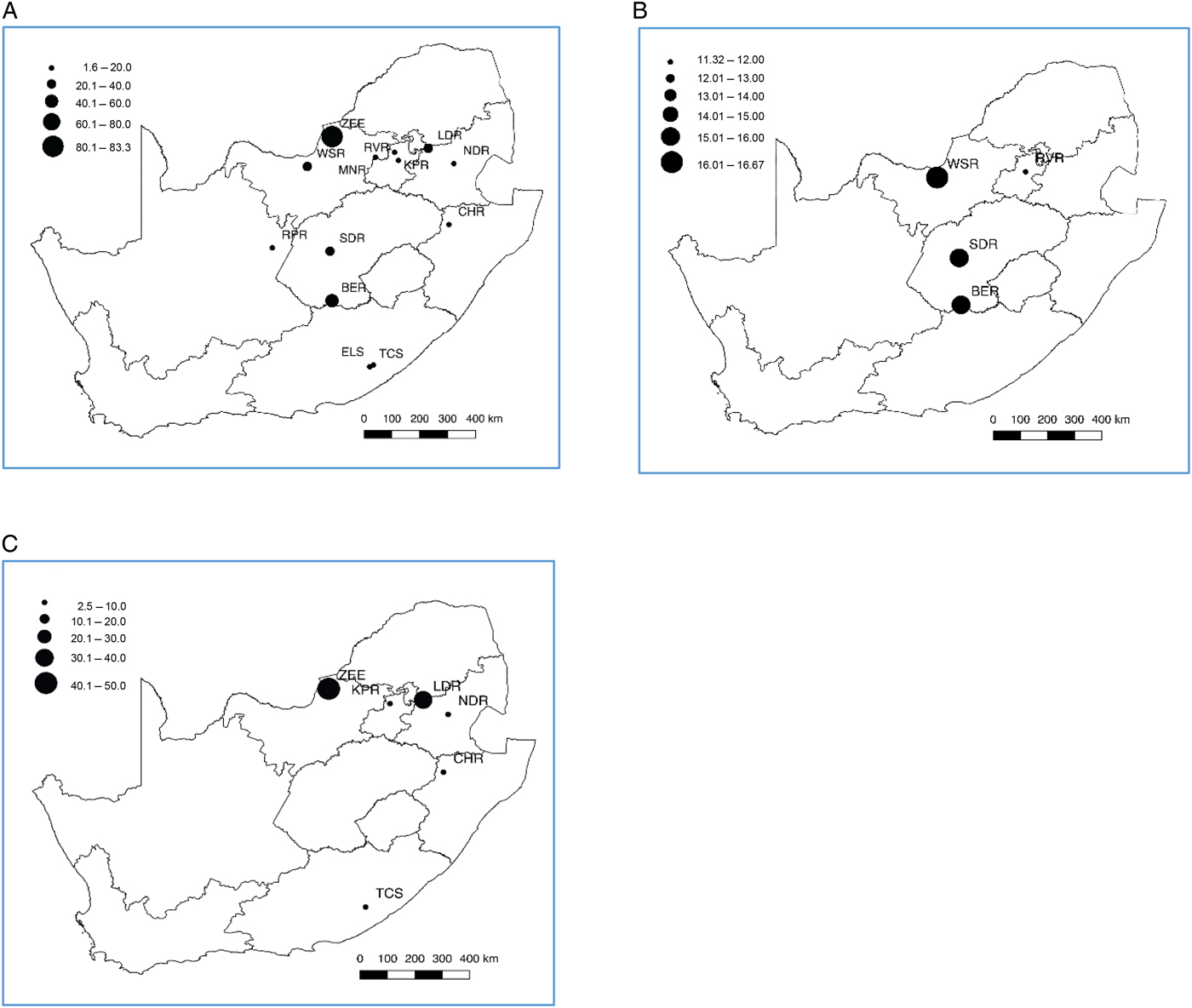
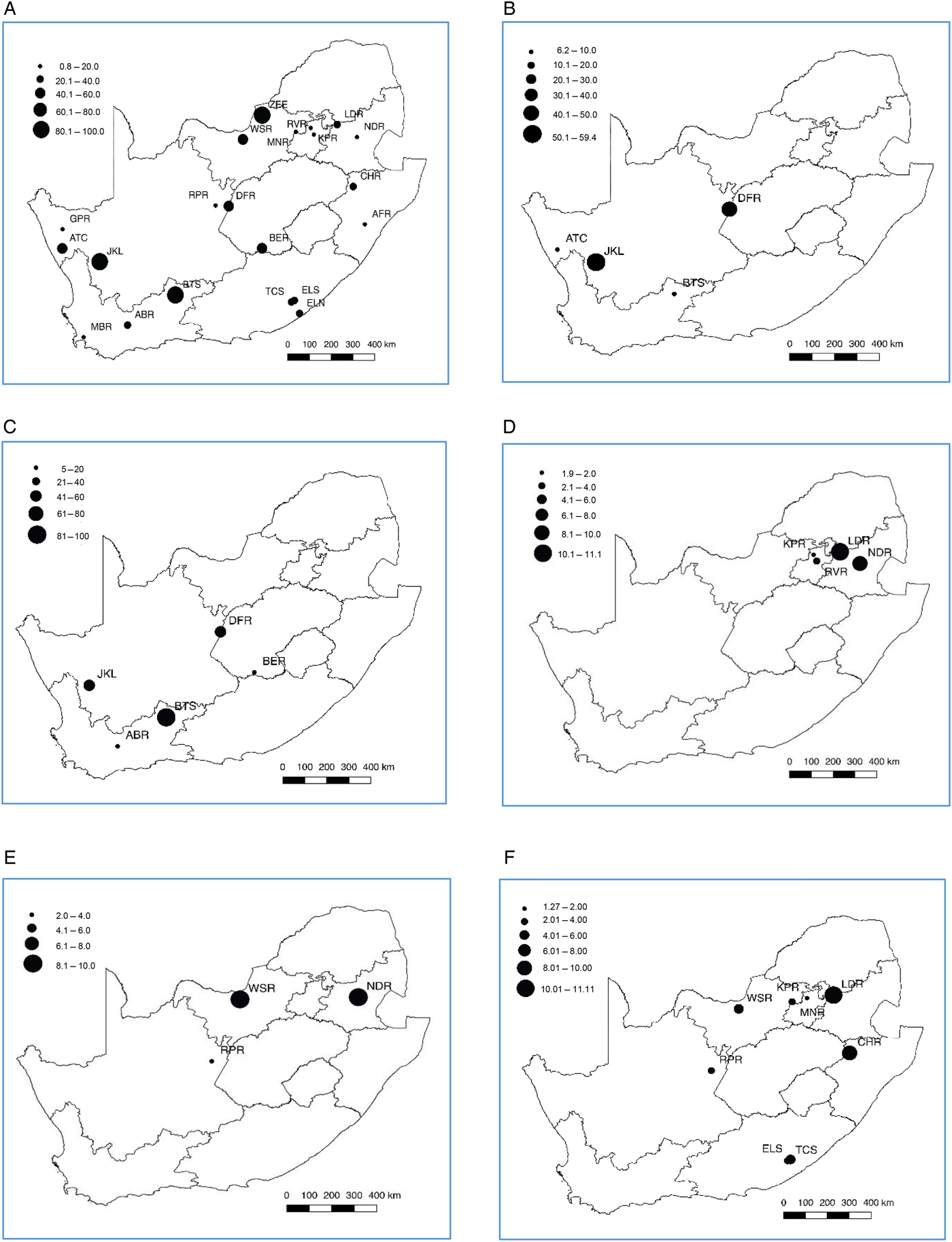
Distribution and graphic indication of relative abundance of monoxenous nematode species recorded in rodents across South Africa. (A) Monoxenous nematodes combined; (B) Aspiculuris shikoloueta; (C) Heligmonina boomkeri; (D) Heligmonina spira; (E) Neoheligmonella capensis; (F) Trichostrongylus probolurus; (G) Trichuris muris.
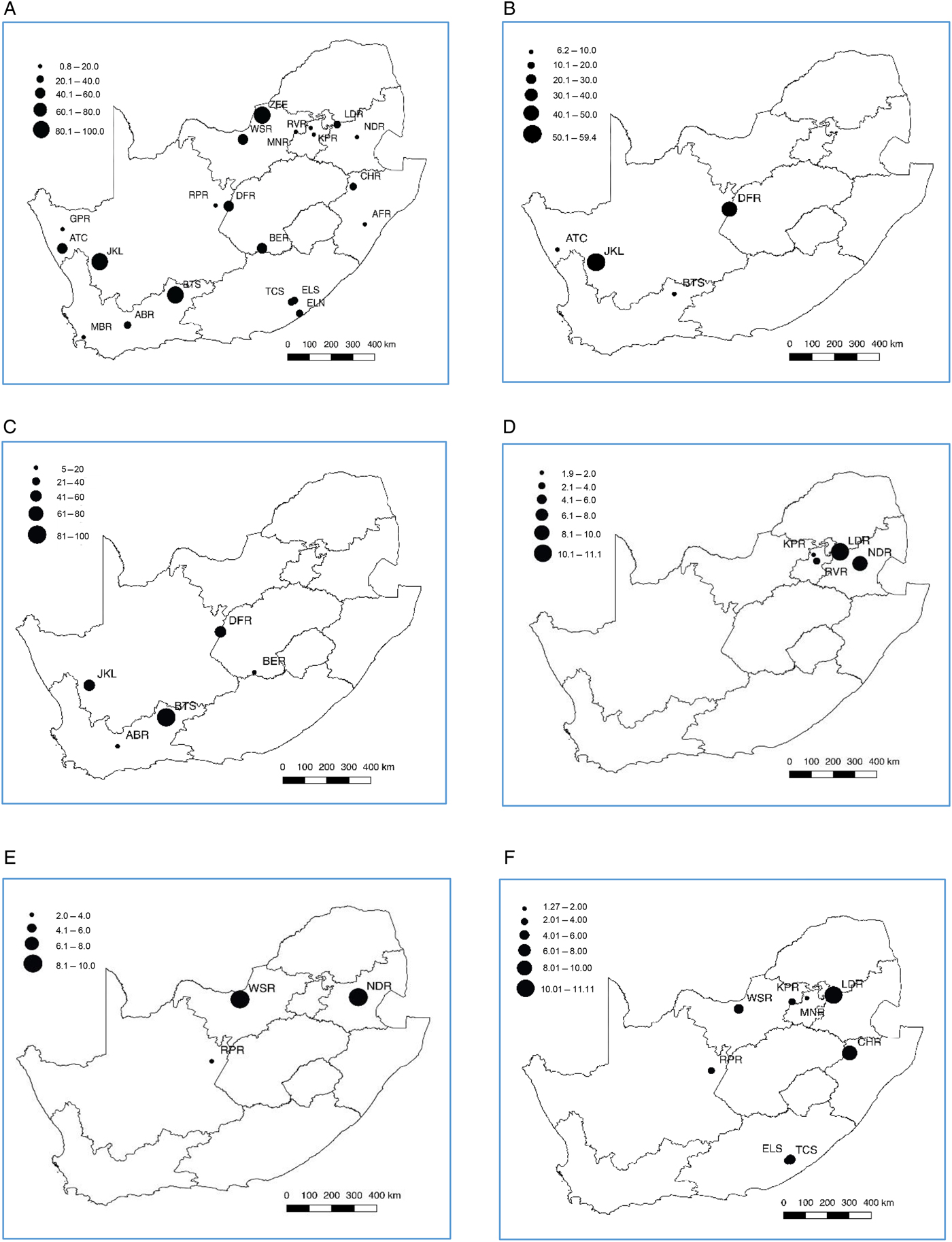
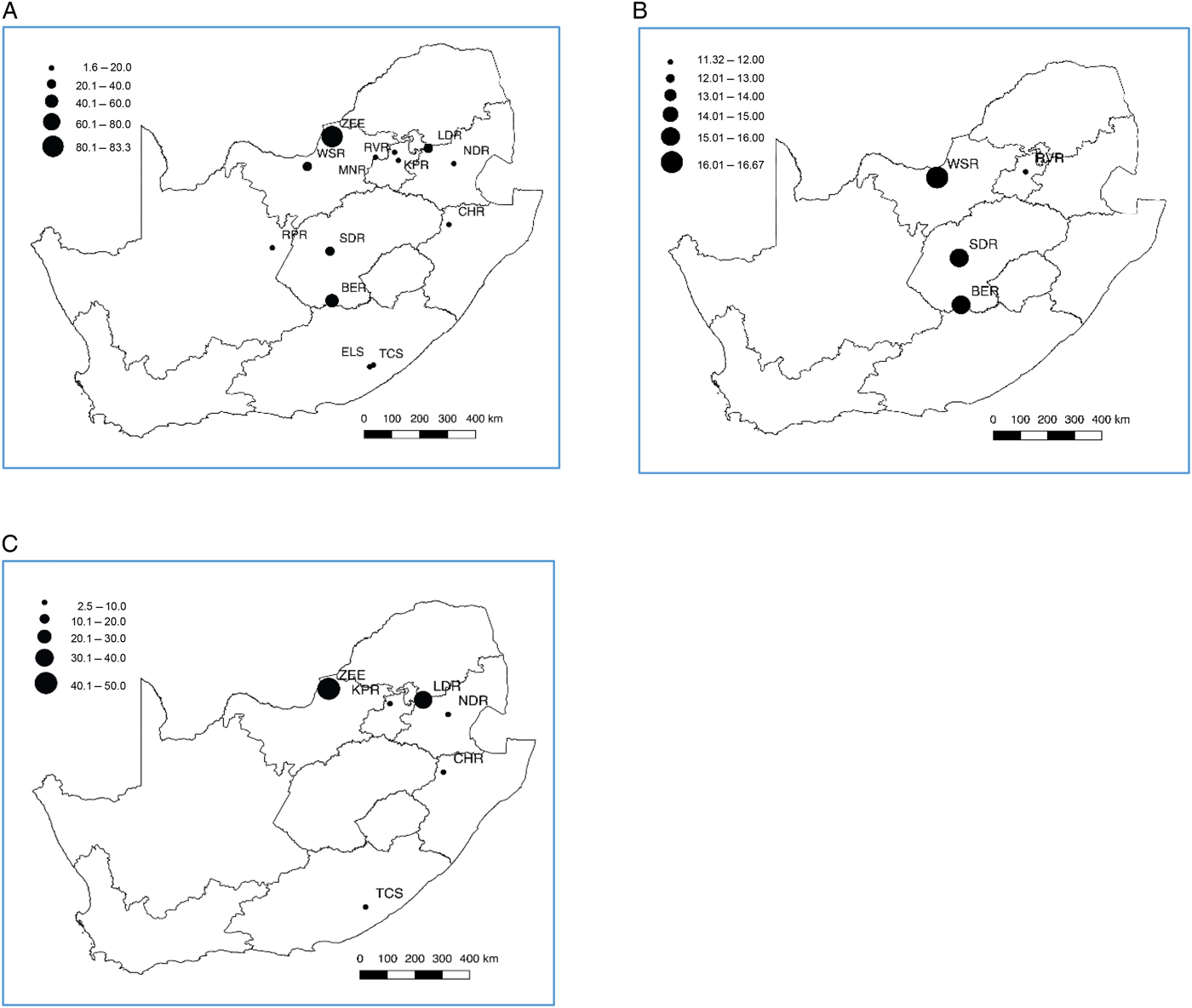
Distribution and graphic indication of relative abundance of heteroxenous nematode species recorded in rodents across South Africa. (A) Heteroxenous nematodes combined; (B) Protospirura muricola; (C) Protospirura numidica.
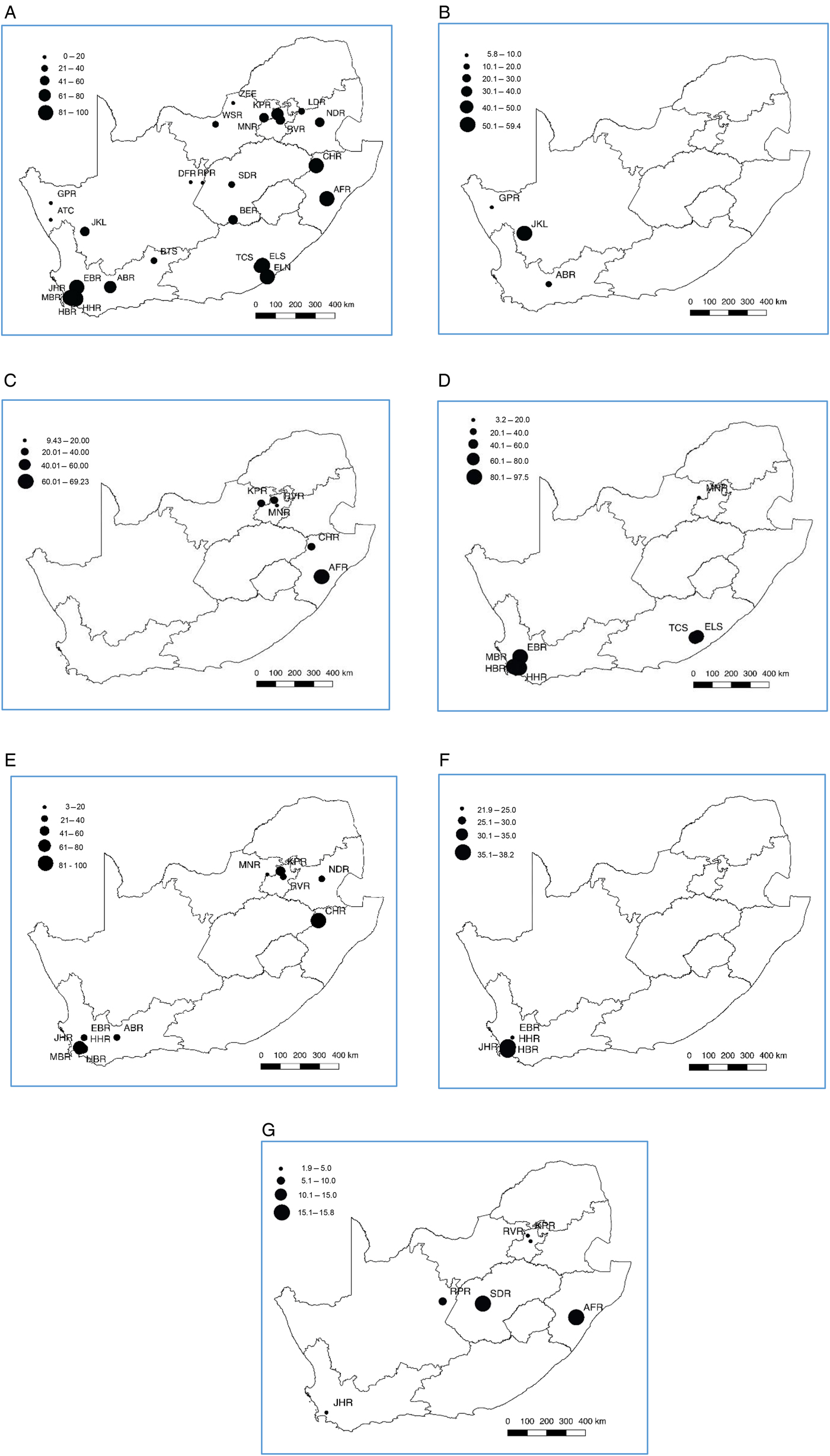
Distribution and graphic indication of relative abundance of cestode species recorded in rodents across South Africa. (A) Cestodes combined; (B) Meggittina baeri; (C) Raillietina trapezoides; (D) Rodentolepis cf. fraterna; (E) Rodentolepis fraterna; (F) Rodentolepis microstoma.
Results
Helminth diversity
In total, 55 helminth taxa were recovered from a total of 1030 host individuals, representing at least 13 rodent species (tables 2 and 3 and supplementary table S2). The helminth species represented 25 genera of which 15 were nematodes (Abbreviata Travassos, 1920; Ascarops van Beneden, 1873; Aspiculuris Schulz, 1924; Heligmonina Baylis, 1928; Mastophorus Diesing, 1853; Maupasina Seurat, 1913; Nematodirus Ransom, 1907; Neoheligmonella Durette-Desset, 1971; Paralibyostrongylus Ortlepp, 1939; Protospirura Seurat, 1914; Streptopharagus Blanc, 1912; Subulura Molin, 1860; Syphacia Seurat, 1916; Trichostrongylus Loos, 1905; Trichuris Roederer, 1761), nine cestodes (Afrobaeria Haukisalmi, 2008; Hymenolepis Weinland, 1858; Inermicapsifer Janicki, 1910; Mathevotaenia Akhumyan, 1946; Meggittina Lynsdale, 1953; Raillietina Fuhrmann, 1920; Rodentolepis Spasskii, 1954; Skrjabinotaenia Akhumyan, 1946; Sudarikovina Spasskii, 1951) and one acanthocephalan (Moniliformis Travassos, 1915) (table 2).
A total of 11 helminth taxa were identified as previously unrecognized species. These include five nematodes of the genera Paralibyostrongylus, Heligmonina and Neoheligmonella, and six cestodes of the genera Inermicapsifer and Skrjabinotaenia (table 3). Phylogenetic analyses on the Catenotaeniidae recorded in the present study confirmed the existence of distinct genetic lineages of Skrjabinotaenia in Saccostomus campestris (Skrjabinotaenia sp. 1), Micaelamys namaquensis (Skrjabinotaenia sp. 2), R. dilectus and R. pumilio (both Skrjabinotaenia sp. 3), as well as confirmed the identifications of Meggittina baeri, Skrjabinotaenia cf. lobata and Skrjabinotaenia lucida collected from hosts in the present study (Haukisalmi et al., Reference Haukisalmi, Ribas, Junker, Spickett, Matthee, Henttonen, Jrijer, Halajian, Anders and Nakao2018).
In general, heteroxenous nematodes and cestodes were present in lower abundance compared to monoxenous nematodes (table 2). The most abundant helminth was the monoxenous nematode Heligmonina spira (140.1 ± 14.2) followed by Neoheligmonella sp. (7.1 ± 1.3) and Syphacia sp. (7.0 ± 1.0). Heligmonina spira was also the most prevalent (27.3%), followed by Neoheligmonella capensis (24.1%) and Syphacia sp. (22.8%) (table 2). The former two species were recorded in the winter and summer rainfall regions. It is interesting to note that Raillietina trapezoides (5.4%, 0.97 ± 0.2) and M. baeri (3.6%, 0.4 ± 0.1), the two cestode species that occurred in both summer and winter rainfall regions, displayed the highest prevalence and mean abundance of all cestode species.
The helminth species richness varied between host species. The two most abundant host species, R. pumilio (n = 486) and R. dilectus (n = 292), harboured the largest number of helminth species. Rhabdomys dilectus harboured 26 helminth taxa, 19 nematodes and seven cestodes. Of the nematodes and cestodes recovered, ten and three nominal species, respectively, represent new parasite records (table 3). Rhabdomys pumilio harboured 16 helminth taxa, 11 nematodes and five cestodes, of which one and two, respectively, are new parasite records for this host. Mastomys coucha (n = 85) had the third largest number of helminth species (13), comprising nine nematode and four cestode taxa, of which seven and one nominal species, respectively, were new parasite records for this rodent. The acanthocephalan, Moniliformis sp., is also a new genus record from this host (table 2). Species richness estimates (Chao2) for R. dilectus, R. pumilio and M. coucha were 30 ± 4.9, 16 ± 0.7 and 15 ± 1.5, respectively.
Host range and geographic distribution of helminths
Most of the helminth species (n = 27; 47%) were recovered from a single host species (tables 2 and 3). However, several helminth species (n = 11) were recorded from four or more host species and even across host families. Members of the nematode genus Syphacia were present in 11 rodent species in four subfamilies. Similarly, the cestode Rodentolepis microstoma was recorded in seven rodent species, representing four subfamilies (Gerbilliscus brantsii (Gerbillinae), L. rosalia, M. coucha, Mus (Nannomys) spp., R. dilectus (all Murinae), S. campestris (Cricetomyinae) and Steatomys pratensis (Dendromurinae); (see table 2), of which the highest prevalence was recorded in S. campestris (20%) (table 3). Heligmonina boomkeri was recorded in five murine species (Aethomys chrysophilus, L. rosalia, M. coucha, M. natalensis, R. dilectus) as well as in S. pratensis. This nematode reached the highest prevalence in A. chrysophilus and M. natalensis (70% and 69.2%, respectively), the latter having a marginally higher abundance than the former (34.0 ± 8.8 and 20.1 ± 7.1, respectively) (table 3). The only acanthocephalan, Moniliformis sp., was recovered from M. coucha (0.1%; 0.03 ± 0.03), which represents a new genus record from this host (table 2).
Of the helminths identified to nominal species level (n = 26), new host records were established for 14 nematodes and nine cestodes (table 3). The nematode with the largest number of new host records was H. boomkeri (five), while seven new host records were established for the cestode R. microstoma (table 3).
The eight nematode and five cestode species, occurring at three or more localities, varied in geographic extent. However, some patterns were evident: monoxenous nematodes were recovered from both the winter and summer rainfall regions (fig. 2A), with some, e.g. Aspiculuris shikoloueta (fig. 2B) and Trichostrongylus probolurus (fig. 2F), recovered from only the winter rainfall region, and H. boomkeri (fig. 2C) from only the summer rainfall region, while heteroxenous nematodes occurred only in the summer rainfall region of South Africa (fig. 3A). Although cestodes showed a countrywide distribution in the combined map (fig. 4A), there was clear separation with some species (e.g. Rodentolepis cf. fraterna, R. fraterna and R. microstoma; fig. 4D–F) associated with the summer rainfall region (present at eight localities), while other species (e.g. M. baeri and R. trapezoides from four and five localities, respectively; fig. 4B, C) occurred in the winter and summer rainfall regions of the country.
Of the monoxenous nematode species recovered, N. capensis was collected at 11 localities (fig. 2E) and H. spira at eight (fig. 2D), while the two most widely distributed heteroxenous nematodes, Protospirura muricola and P. numidica were recorded at four and six localities, respectively (fig. 3B, C). Cestodes were recovered from 20 of the 26 localities (fig. 4A) with R. microstoma and R. trapezoides being the most widely distributed at eight and five localities, respectively. Moniliformis sp. was recovered from one locality in the north-eastern region of South Africa (ZEE, fig. 1).
Discussion
Helminth diversity
The present study highlights the diversity and distribution of helminth species associated with naturally occurring rodents in South Africa. More than 50 helminth taxa were recorded, of which most were nematodes and, in particular, monoxenous species followed by heteroxenous nematodes and cestodes. This pattern is similar to previous studies on rodents conducted in Britain and Spain (Lewis, Reference Lewis1987; Fuentes et al., Reference Fuentes, Sáez, Trelis, Galán-Puchades and Esteban2004). Most of the rodents that were trapped are omnivores that primarily consume plant material (Skinner & Chimimba, Reference Skinner and Chimimba2005) and, as such, it is to be expected that they will have a higher chance of becoming infected with helminths accidentally ingested while feeding on plant material (Sousa & Grosholz, Reference Sousa, Grosholz, Bell, McCoy and Mushinsky1991; Anderson, Reference Anderson2000). Variation in the density and, thus, availability of infective stages may also contribute to this pattern. The infective stages of monoxenous taxa are normally more localized in the environment because multiple eggs are voided with the faeces (Mas-Coma et al., Reference Mas-Coma, Valero and Bargues2008). This is in contrast with heteroxenous taxa where the infective stages for the definitive host would be more widely dispersed by intermediate hosts (Kinsella, Reference Kinsella1991; Georgiev et al., Reference Georgiev, Bray, Littlewood, Morand, Krasnov and Poulin2006; Mas-Coma et al., Reference Mas-Coma, Valero and Bargues2008).
In the present study, several helminth species did not correspond to currently recognized congeneric species. The identifications were based on morphological characters that were compared with taxonomic species descriptions. These taxa will require additional morphological as well as molecular analyses to resolve their taxonomic placement. The incidence of novel undescribed helminth species confirms that the current helminth fauna associated with naturally occurring rodents in South and southern Africa is underestimated. This hypothesis is supported by a recent study on the rodent R. pumilio in South Africa and Namibia, which recorded seven species as previously unrecognized (Froeschke et al., Reference Froeschke, Harf, Sommer and Matthee2010), and in a study on indigenous and invasive synanthropic murid rodents in Gauteng Province, South Africa, Julius et al. (Reference Julius, Schwan and Chimimba2017) recorded a Protospirura sp. that may represent a new species (based on morphological and molecular differences). In addition, the previously undescribed Skrjabinotaenia species in the present study (based on morphology) were molecularly confirmed as unique genetic lineages in a subsequent study (Haukisalmi et al., Reference Haukisalmi, Ribas, Junker, Spickett, Matthee, Henttonen, Jrijer, Halajian, Anders and Nakao2018).
The monoxenous nematodes H. spira and N. capensis were the most abundant and prevalent helminth species overall, as well as in the two Rhabdomys spp. This conforms to previous studies that recorded both nematode species in R. pumilio across multiple biomes in southern Africa (Fynbos, Succulent Karoo and Grassland) (Froeschke et al., Reference Froeschke, Harf, Sommer and Matthee2010). Also, H. spira was the most abundant helminth species, followed by N. capensis, in R. pumilio trapped at ten localities across the Cape Floristic Region in the Western Cape (Froeschke et al., Reference Froeschke, van der Mescht, McGeoch and Matthee2013).
Helminth diversity associated with the most abundant rodent species
The sample sizes for the individual rodent hosts were variable, which hinders accurate comparisons. However, comparisons between the three most abundant rodent species are possible. The two most abundant rodent species (R. dilectus and R. pumilio) harboured multiple helminth taxa. It is interesting to note that between these two species there was no relationship between sample size and helminth taxon richness. Rhabdomys pumilio (n = 486) harboured fewer helminth taxa compared to R. dilectus (n = 292) (16 and 26 helminth taxa, respectively). This implies a substantial impinging effect of biotic and abiotic factors on helminth abundance and diversity (Boomker et al., Reference Boomker, Horak, Watermeyer and Booyse2000; Turner & Getz, Reference Turner and Getz2010; Dybing et al., Reference Dybing, Fleming and Adams2013; Froeschke & Matthee, Reference Froeschke and Matthee2014; Pakdeenarong et al., Reference Pakdeenarong, Siribat, Chaisiri, Douangboupha, Ribas, Chaval, Herbreteau and Morand2014). The mesic, summer rainfall eastern Grassland region of South Africa (R. dilectus habitat) presents favourable environmental and climatic conditions for the survival of free-living stages of parasitic helminths, leading to higher transmission rates and diversity potential. The xeric, winter rainfall Fynbos and Karoo biome regions in the western parts of South Africa (R. pumilio habitat) would decrease survival rates of free-living stages, resulting in more depauperate parasite assemblages. Furthermore, environmental conditions may also influence arthropod diversity and, consequently, the presence of heteroxenous helminths, because of their dependence on arthropods as intermediate hosts (see Spickett et al., Reference Spickett, Junker, Krasnov, Haukisalmi and Matthee2017). The species richness estimates for the two rodent species also predicted a higher species richness for R. dilectus (30 ± 4.9) compared to R. pumilio (16 ± 0.7). Despite the relatively smaller sample size of M. coucha (n = 85) from four localities in the mesic east, 13 helminth taxa were recovered. This count corresponds well with the Chao2 estimate of 15 ± 1.5. This is, however, in contrast to the study by Julius et al. (Reference Julius, Schwan and Chimimba2017) that recorded only six helminth taxa (of which three species correspond to the present study) in M. coucha (n = 84) collected from anthropogenic localities in Gauteng Province, South Africa. It is possible that the inclusion of a more extensive geographic range and natural areas in the present study provided more favourable conditions (environmental, climatic, host diversity and diet) for higher helminth diversity in M. coucha (Spickett et al., Reference Spickett, Junker, Krasnov, Haukisalmi and Matthee2017).
Host range of helminth species
A large number (n = 26) of helminth taxa were recorded in a single host species (i.e. R. dilectus). This is in contrast to previous studies by Feliú et al. (Reference Feliú, Renaud, Catzeflis, Hugot, Durand and Morand1997, Reference Feliú, Ventura, Segovia, Jiménez, Ribas and Gisbert2009). It is anticipated that the host range of most of these helminth species will increase with sampling intensity (i.e. number of individuals per host species), extent (i.e. number of potential host species) and geographic range. In fact, literature documents a wide range of alternate hosts, especially rodents, for 14 of these taxa (Baylis, Reference Baylis1928; Quentin, Reference Quentin1964; Lichtenfels & Quigley, Reference Lichtenfels and Quigley1968; Anderson, Reference Anderson2000). However, some helminth species seemed to be more host-specific – e.g., Ascarops strongylina, Streptopharagus lerouxi and Mastophorus muris were all recorded from R. dilectus only, and not from other co-occurring rodent species at the same localities. The co-occurring rodent in the case of A. strongylina was Otomys sp. (n = 8), in the case of S. lerouxi, R. dilectus co-occurred with M. namaquensis (n = 15), S. campestris (n = 5) and Otomys sp. (n = 1), while in the case of M. muris the co-occurring host was Otomys sp. (n = 13). Ascarops strongylina (a heteroxenous nematode) has previously been recorded in several rodent taxa that are not native to South and southern Africa. For example, M. (M.) musculus, Glis glis (Linnaeus) from Europe and Funambulus palmarum (Linnaeus) from India and Sri Lanka have been reported as paratenic hosts, and sexually mature worms were found in Myospalax psilurus Milne-Edwards in Mongolia (Ganzorig et al., Reference Ganzorig, Batsaikhan, Samiya, Morishima, Oku and Kamiya1999). Its presence in R. dilectus (omnivore) supports the latter authors' opinion that A. strongylina may have a wider definitive and paratenic host range than previously thought. Streptopharagus lerouxi was described from Gerbilliscus leucogaster (Peters) (syn. Tatera lobengulae (de Winton)) in the Congo (Quentin, Reference Quentin1964). In this study, it was absent from several rodent species that co-occurred with R. dilectus at the same localities as well as from any of the gerbils examined in this study. Important to note is that the mean abundance of S. lerouxi was very low in R. dilectus (0.003 ± 0.003), indicating that either this rodent is not a suitable host or that abundance of infected intermediate hosts was low.
Based on previous studies, only two of the present helminth species, Afrobaeria acanthocirrosa (see Haukisalmi, Reference Haukisalmi2008) and Rodentolepis taterae (see Collins, Reference Collins1972), displayed a likely genus-specific host association in Otomys sp. and G. brantsii, respectively. Although these authors did not speculate on reasons for this genus specificity, it most probably relates to host diet, which would promote the likelihood of ingesting an infected intermediate host, as was the case in our study.
Several helminth species seemed to have broader host ranges and were recorded across host genera, subfamilies and even families. Even though this was the case, some of these helminth species did display some level of host preference. For example, H. boomkeri was present in six host species but reached noticeably higher abundances and prevalence in A. chrysophilus (20.1 ± 7.1, 70.0%) and M. natalensis (34.0 ± 8.8, 69.2%) compared to R. dilectus (0.3 ± 0.1, 8.6%) and S. pratensis (0.2 ± 0.2, 8.3%). In addition, the association of H. boomkeri with A. chrysophilus (20.1 ± 7.1, 70.0%) and N. capensis with R. pumilio (5.5 ± 0.6, 28.0%) in the present study supports the findings of Durette-Desset & Digiani (Reference Durette-Desset and Digiani2005). The fact that Syphacia sp. was recorded in 11 host taxa and at 23 of the 26 localities suggests a very broad host and geographic range for this genus. It is likely though that this record represents multiple Syphacia species. In the absence of male specimens, as was often the case in this study, identification to species level is virtually impossible, and can only be confirmed using molecular techniques.
The broad host range and geographic extent of the study provides an opportunity to document novel helminth–host records. For example, five new host records were noted for the monoxenous nematode H. boomkeri, while seven new host records were established for the cestode R. microstoma (see table 3). This, together with the fact that 11 previously unrecognized helminth species were recorded, highlights the need for future descriptive research on helminths of rodents and other small mammals in general for South and southern Africa.
Medically important helminths that were recovered include the cestodes Hymenolepis diminuta s.l. from S. pratensis (MNR) and R. microstoma in a range of hosts (table 3) and localities (fig. 4F). These helminths are known to have zoonotic potential, although human infection is considered rare (Macnish et al., Reference Macnish, Ryan, Behnke and Thompson2003; Waugh et al., Reference Waugh, Lindo, Foronda, Ángeles-Santana, Lorenzo-Morales and Robinson2006). Julius et al. (Reference Julius, Schwan and Chimimba2017) collected Moniliformis moniliformis Bremser, 1811, infections of humans reported from Nigeria and Iran (Ikeh et al., Reference Ikeh, Anosike and Okon1992; Salehabadi et al., Reference Salehabadi, Mowlavi and Sadjjadi2008), and H. diminuta Rudolphi, 1819 from Rattus spp. in urban areas in Gauteng Province, South Africa. Archer et al. (Reference Archer, Appleton, Mukaratirwa, Lamb and Schoeman2017) reported M. moniliformis and H. diminuta from Rattus norvegicus (Berkenhout) in Kwa-Zulu Natal Province, South Africa. Both these helminth species are considered cosmopolitan parasites of rodents (Schmidt, Reference Schmidt1971).
Geographic distribution of helminth species
The present study provides baseline data on the geographic distribution of helminth species in South Africa. It appears that heteroxenous nematodes are restricted to the mesic summer rainfall region, while monoxenous nematodes and cestodes contain species that occur in either or both rainfall regions. Monoxenous and heteroxenous helminths each spend part of their life cycle in the external environment and are, therefore, affected by microclimatic conditions (Nielsen et al., Reference Nielsen, Kaplan, Thamsborg, Monrad and Olsen2007; Mas-Coma et al., Reference Mas-Coma, Valero and Bargues2008). Although the survival and distribution of free-living stages of both monoxenous and heteroxenous taxa will benefit from more favourable climatic conditions (precipitation and temperature), it does seem that the pattern is more complex for heteroxenous nematodes. Apart from seasonal differences in rainfall patterns, the eastern and central regions of South Africa are characterized by higher mean annual precipitation compared to the more xeric western regions (Cramer & Hoffman, Reference Cramer and Hoffman2015). Precipitation facilitates soil moisture, plant growth and seed production (Cramer & Hoffman, Reference Cramer and Hoffman2015). In South Africa, in particular, these conditions have been found to be important for insect abundance and diversity (Procheş & Cowling, Reference Procheş and Cowling2007; Botha et al., Reference Botha, Siebert and van den Berg2016). More specifically, precipitation is an important driver for arthropod taxa that can act as intermediate hosts for heteroxenous helminths (Anderson, Reference Anderson2000; Georgiev et al., Reference Georgiev, Bray, Littlewood, Morand, Krasnov and Poulin2006; Dybing et al., Reference Dybing, Fleming and Adams2013). For example, ambient temperature and precipitation have been shown to influence the diversity and abundance of mites (Krasnov et al., Reference Krasnov, Korallo-Vinarskaya, Vinarski, Shenbrot, Mouillot and Poulin2008). In addition, it was found that environmental conditions could potentially influence the infection of intermediate hosts by heteroxenous taxa (Shostak, Reference Shostak2014). It is, therefore, not surprising that all of the heteroxenous nematodes and some of the cestodes were prevalent and abundant in areas where climate and vegetation are conducive to sustain large and diverse arthropod populations. However, it is important that these patterns be confirmed in further studies.
In conclusion, the study recorded a large diversity of helminth species associated with murid rodents and provides baseline data on possible host and geographic range. Because of the obvious patchiness of certain host species, overall diversity may be underestimated. The study also accentuates the scant published information currently available on the helminths associated with rodents in South Africa. Based on the novelty of the data, it is essential that future research should concentrate on an increased and equal sampling effort for a diverse range of host species.
Supplementary material
To view supplementary material for this article, please visit https://doi.org/10.1017/S0022149X19000403.
Acknowledgements
We thank private landowners and nature reserve authorities for permitting us to conduct fieldwork on their properties, under the following provincial permit numbers: Eastern Cape, CRO37/11CR; KwaZulu-Natal, OP4990/2010; Western Cape, 0035-AAA007-00423; Northern Cape, FAUNA 1076/2011, Free State, 01/8091; Gauteng, CPF 6-0153 and Mpumalanga, MPB. 5331. We thank N. Avenant, M.D. Chipana, J. Coetsee L. Cohen, N. du Toit, A.D. Engelbrecht, R.F. Masubelle, C.A. Matthee, L. Richards and L. van der Mescht for help with field and technical work.
Financial support
This work was supported by the National Research Foundation (NRF), Agricultural Research Council – Onderstepoort Veterinary Institute and Stellenbosch University. The Grant holder acknowledges that opinions, findings and conclusions or recommendations expressed in any publication generated by the NRF-supported research are those of the authors, and that the NRF accepts no liability whatsoever in this regard.
Conflicts of interest
None.