INTRODUCTION
Rice bean (Vigna umbellata (Thunb) Ohwi & Ohashi=Phaseolus calcaratus Roxb.) is a native species of South and Southeast Asia. In India it is a cultigen, the distribution of which is confined mainly to the tribal regions of the North Eastern hills and hilly tracts of Western and Eastern Ghats (Arora et al. Reference Arora, Chandel, Joshi and Pant1980). In the North Eastern region of India, rice bean is an important component of the 1·7 million ha of shifting cultivation areas (called Jhum; Sarma et al. Reference Sarma, Singh, Gupta, Singh and Srivastava1995). Increasing the productivity of Jhum is an important management option to improve the economies of farmers in this region.
As an under-utilized and unexploited legume, rice bean assumes considerable importance and has recently gained attention as a supplementary food crop with potential economic importance for food security. Its dried seeds are usually eaten boiled or as a pulse, whereas young immature pods are consumed as vegetables. Rice bean is also used as fodder, green manure and cover crop. The foliage, green pods, immature seeds and flowers are readily eaten by animals, whereas the seeds are also good for broiler rations (Sarma et al. Reference Sarma, Das and Bujarbaruah2003).
Rice bean exhibits high photosensitivity (Chaudhuri & Prasad Reference Chaudhuri and Prasad1972; Chandel et al. Reference Chandel, Arora and Pant1988; Sarma et al. Reference Sarma, Singh, Gupta, Singh and Srivastava1995; Lokesh et al. Reference Lokesh, Verma, Gupta and Behl2003) in the control of flowering and reproduction. Depending on genotype, it is sown in June–July (the rainy season or kharif) and starts flowering very late, in September and October, when the day length is shorter. The plants face terminal drought at the time of pod formation and are harvested in November–December, when the pods mature. Because rice bean is usually grown as a rainfed crop with little input in shifting cultivation areas, there is a need to breed high-yielding genotypes with wide adaptability to varying climatic conditions. Other important traits these genotypes should possess are earliness (Sarma et al. Reference Sarma, Das and Bujarbaruah2003; Raiger et al. Reference Raiger, Dua, Phogat and Mishra2008) and low plant height (Sarma et al. Reference Sarma, Das and Bujarbaruah2003).
Such varieties have not yet been developed. The present work aims to (a) select suitable rice bean genotypes for cultivation in the shifting cultivation areas of North Eastern Hill Region of India, and (b) develop a hybridization programme to identify suitable genotypes in the segregating population, with the objective of identifying suitable parents for further crossing. Various plant and crop traits will be discussed in the analyses and considerations, with special focus on seed yield/plant, plant height and maturity duration.
MATERIALS AND METHODS
Fifty-two rice bean genotypes were evaluated during the kharif (rainy season) in 2001, 2002 and 2003 at the experimental farm of the Plant Breeding Division, Indian Council of Agricultural Research ICAR Research Complex for NEH Region, Barapani, Meghalaya, India (25°41′ North and 91°56′ East, 1010 m asl). Of these 52 genotypes, 15 originated from the North Eastern Region of India, whereas the remainder were collected from the National Bureau of Plant Genetic Resources (NBPGR), New Delhi, India. In the NBPGR material, eight genotypes were foreign to India, and those remaining constituted a random sample of the Indian rice bean germplasm. Thus, the pool of 52 genotypes studied can be regarded as a sample of the genotypes potentially useful in India. However, since the origin of the NBPGR genotypes was unknown, these were not distinguished in the analyses from those originating from the North Eastern Hill Region.
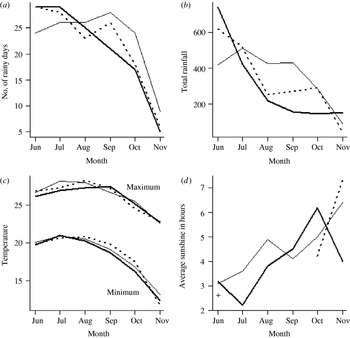
The soil of the experimental field was highly acidic (pH 4·7) and consisted of a sandy loam with 15·4 g/l organic carbon, 126·0 mg/kg available N, 97·40 mg/kg available K, 6·11 mg/kg available P and 5·57 mg/kg available S. The fertilizers (NPK) were applied at the rate of 40:60:50 kg/ha. Weather conditions during the crop growth period in the 3 years were similar (Fig. 1). The experiment was set up as a randomized complete block design with two replications. Plots consisted of five rows each 4 m long. Plants were spaced 0·5×0·1 m apart. The recommended (Sarma et al. Reference Sarma, Das and Bujarbaruah2003) agronomic practices and plant protection measures were followed to ensure normal crop growth. Measurements were recorded on the following traits: number of days to mid-flowering, number of days to maturity, plant height, number of branches/plant, stem thickness, pod length, number of seeds/pod, 100-seed weight, pod weight/plant and seed yield/plant. Measurements for days to mid-flowering and days to maturity were recorded on per plot basis, days to mid-flowering were calculated as number of days required for 50 % of the plants to flower, while days to maturity were calculated as number of days required for 70 % of the pods to turn yellow in colour. For all of the other traits, measurements were made non-destructively on 10 randomly selected plants.
Weather parameters during crop growth period: (a) number of rainy days, (b) total rainfall (mm), (c) temperature (°C) and (d) average daily sunshine (h). ––, 2001;  , 2002; - - - -, 2003.

Analysis of variance was applied to study the main effects of genotype and year on the traits as well as genotype×year interaction. Heritability (Hanson et al. Reference Hanson, Robinson and Comstock1956), genetic advance (Johnson et al. Reference Johnson, Robinson and Comstock1955) and phenotypic and genotypic correlations (Dewey & Lu Reference Dewey and Lu1959) were estimated. Heritability was calculated as the ratio of genotypic variance to phenotypic variance. Genetic advance was calculated with the following formula:

where K is the selection differential at 5 % intensity of selection, h 2 is the heritability and σPh is the phenotypic standard deviation.
The stability of the traits was estimated from the relationship of coefficients of variation (CVs) with trait means from the 3 years.
RESULTS
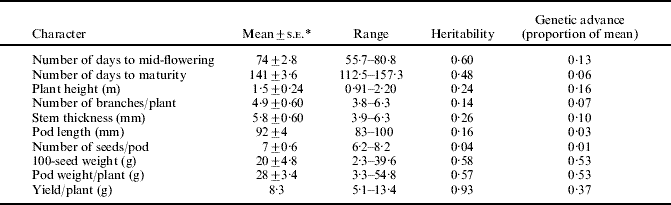
Analysis of variance revealed that the effect of genotype was significant for all traits except number of seeds/pod; the effect of year was significant for all traits except 100-seed weight; and the genotype×year interaction was significant for number of days to mid-flowering and to maturity, number of branches/plant, pod weight/plant and seed yield/plant. Seed yield/plant exhibited high heritability and moderate genetic advance, whereas number of days to mid-flowering and to maturity showed high heritability and low genetic advance. 100-seed weight and pod weight/plant exhibited high heritability and high genetic advance. For other traits, low levels of both heritability and genetic advance were observed (Table 1).
Estimation of performance, heritability and genetic advance for 10 characters in rice bean (Vigna umbellata)
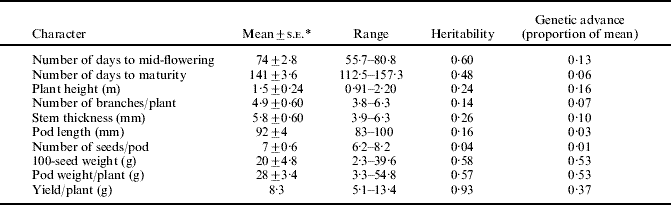
* s.e., standard error of the mean based on the residual variance from the analysis of variance.
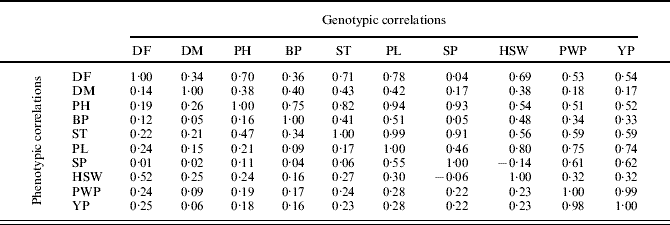
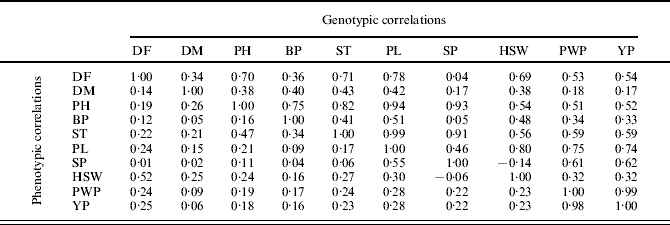
Seed yield was positively but weakly correlated with all traits except number of days to maturity (Table 2). Most of the correlations between other characters were small and positive except that between 100-seed weight and number of seeds/pod, which was negative. Number of days to mid-flowering and number of days to maturity were positively correlated with all other traits except number of seeds/pod.
Genotypic (above diagonal) and phenotypic (below diagonal) correlation coefficients between 10 characters of rice bean (Vigna umbellata)
Sample size n=52.
DF, number of days to mid-flowering; DM, number of days to maturity; PH, plant height; BP, number of branches/plant; ST, stem thickness; PL, pod length; SP, number of seeds/pod; HSW, 100-seed weight; PWP, pod weight/plant; YP, seed yield/plant.
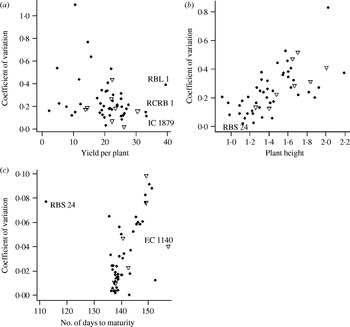
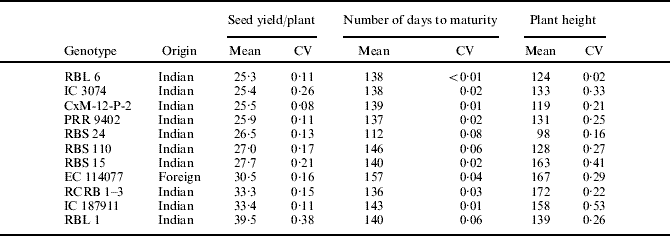
Stability analyses for yield/plant, plant height and number of days to maturity are presented in Fig. 2. Number of days to maturity was the most stable trait among these three since the highest CV for means of this trait over the 3 years was 0·10, while several genotypes had a very unstable yield/plant and plant height; mean CV for number of days to maturity trait was 0·03. Nevertheless, CV for yield/plant of most genotypes was below 0·25, suggesting relatively stable yields. The highest yielding genotype (RBL 1) was relatively unstable (CV=0·38) because of a low yield in 2003 (22 g/plant) compared with that in 2001 (48 g/plant) and 2002 (49 g/plant; Figs 3 and 4). Several other genotypes were also high yielding (Table 3). Two groups clearly differing in plant height could be detected: one comprising mainly genotypes greater than 1·5 m high (of which most were unstable) and the other comprising mainly smaller genotypes (of which most were stable; Fig. 2b).
Mean performance and stability of rice bean (Vigna umbellata) yield/plant, plant height and number of days to maturity: (a) yield/plant (g), (b) plant height (m) and (c) number of days to maturity. ▿, Foreign genotypes; •, Indian genotypes.

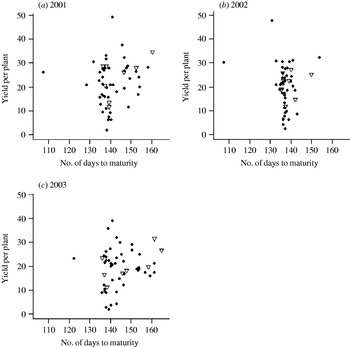
Relationship between rice bean (Vigna umbellata) yield/plant and number of days to maturity in 3 years of study: (a) 2001, (b) 2002 and (c) 2003. ▿, Foreign genotypes; •, Indian genotypes.

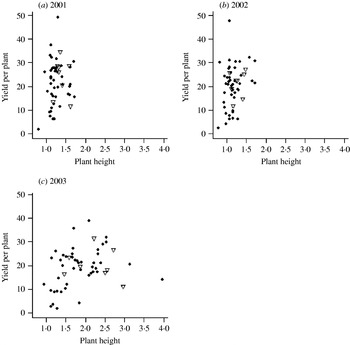
Relationship between rice bean (Vigna umbellata) yield/plant and plant height in 3 years of study: (a) 2001, (b) 2002 and (c) 2003. ▿, Foreign genotypes; •, Indian genotypes.

Mean seed yield/plant, maturity duration and plant height and stability represented by coefficient of variation (CV) of high- yielding rice bean (Vigna umbellata) genotypes
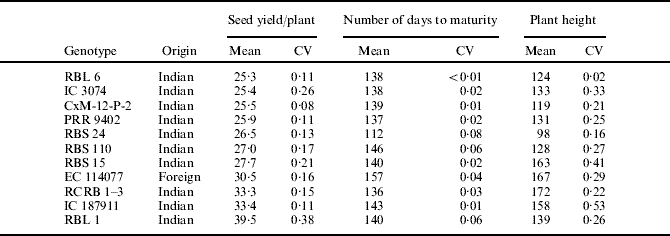
There was generally poor correlation between yield/plant and number of days to maturity (Table 2). One genotype (RBS 24) matured very early in each year, and was also quite high yielding (Table 3). There were a number of other early maturing genotypes with high yield, but some high-yielding genotypes matured late. In 2002, number of days to maturity was similar for most genotypes but varied in 2001 and 2003.
The relationship between yield/plant and plant height was similar in 2001 and 2002, but in 2003 several genotypes had very tall plants. The highest yielding genotype (RBL 1) had moderate plant height. There were quite a few high-yielding genotypes with short plants.
The 52 genotypes assessed could be classed on their suitability for the region on the basis of high yield/plant, low or moderate plant height and early or medium maturity (Table 3). Genotypes which were high yielding but were late maturing are not included except for EC 114077 as an example of a foreign genotype that had quite high yield but late maturity.
DISCUSSION
Despite the restricted number of rice bean genotypes (Sarma et al. Reference Sarma, Das and Bujarbaruah2003; Seehalak et al. Reference Seehalak, Tomooka, Waranyuwat, Thipyapong, Laosuwan, Kaga and Vaughan2006), it was hoped that the germplasm used in the present experiment included genotypes potentially useful for cultivation in shifting cultivation areas of the North Eastern Hill region of India as well as for further hybridization. This proved to be the case; the 52 genotypes studied in the present paper (consisting of 44 Indian and eight foreign genotypes) represent a rich diversity of germplasm of Vigna umbellata.
This diversity could be seen for most traits. There were high and low yielding genotypes, with tall and short plants, early and late maturation and light and heavy seeds. However, heritability was high only for some traits, the highest being for seed yield/plant. High heritability and moderate genetic advance for seed yield/plant was also reported by Borah et al. (Reference Borah, Debchoudhury, Sheikh and Barman2002).
The low variation in number of days to mid-flowering (data not presented) and to maturity (Table 3, Fig. 2) obtained in the analyses may be explained by the highly photosensitive nature of rice bean, a short day crop (Chaudhuri & Prasad Reference Chaudhuri and Prasad1972; Chandel et al. Reference Chandel, Arora and Pant1988; Sarma et al. Reference Sarma, Singh, Gupta, Singh and Srivastava1995; Lokesh et al. Reference Lokesh, Verma, Gupta and Behl2003). Because of this, most genotypes flower and mature quickly, which results in low variation in the number of days to mid-flowering and maturity. Nevertheless, the significant effect of genotype and high heritability estimates obtained for these traits in the present study, together with the weak correlation between the number of days to maturity and yield/plant, suggest that selection for early maturity does not necessarily prejudice yield. Although Singh et al. (Reference Singh, Chakravarti and Singh1997) reported a negative correlation between the number of days to maturity and seed yield, which was not observed in the present study, their conclusion was that yield could be increased by identifying early maturing genotypes.
Sarma et al. (Reference Sarma, Das and Bujarbaruah2003) proposed the selection of dwarf genotypes. In general, plant height in rice bean is rather unstable. Raiger et al. (Reference Raiger, Dua, Phogat and Mishra2008) studied 100 accessions of various origins across nine locations. Only 15 of the accessions were stable in terms of this trait, while for example 100-seed weight was stable across all accessions. Nevertheless, in the present study, the plant height of the highest yielding genotype was 1·39 m (Table 3).
The genotype RBL 1 was the highest yielding. Its low stability of seed yield was due to atypical poor performance in 1 of the 3 years (2003). In this year, plants of all genotypes were generally taller and later to flower and mature, though seed yield was smaller only in some genotypes. However, seed yield/plant of RBL 1 in 2003 was still above the mean genotype yield in that year.
The genotype RBS 24 produced a relatively high yield combined with short stature and the earliest maturity, and was also stable for all these three traits. The yields of genotypes RCRB 1–3 and IC 187911 were high and stable (with mean yield slightly higher than 33 g/plant). Nevertheless, both genotypes were tall. RCRB 1–3 had the second longest pods among the genotypes studied.
Only eight genotypes were of foreign origin, and so their cultivation in the shifting cultivation areas of North Eastern hill region of India and introduction into a hybridization programme needs further investigation. Clearly, they can be high yielding (see Figs 2–4). Some of them also have early maturity and have short plants. However, none of the eight foreign genotypes tested here possessed all these desirable features simultaneously. For example, genotype EC 114077, the best yielding foreign genotype, was late maturing and had tall plants; it also had the thickest stems and the longest pods of all the genotypes.
The present results suggest that improvement in yield, plant height and maturity duration is possible in the rice bean germplasm studied, and that it is possible to obtain each of these traits in a single genotype. However, one of the main constraints is the unpredictable response to various environments.
We would like to thank an anonymous reviewer and the two journal editors whose comments greatly helped us improve the paper.