


Introduction
Being mindful entails bringing one's full attention to one's present experience in an accepting, non-judgemental way. A meta-analytical review by Baer (Reference Baer2003) of 21 studies evaluating Mindfulness Based Stress Reduction (MBSR: Kabat-Zinn, Reference Kabat-Zinn1990) and Mindfulness Based Cognitive Therapy (MBCT: Segal, Williams and Teasdale, Reference Segal, Williams and Teasdale2002) indicated clinical benefit for a variety of problematic conditions, including pain, stress, anxiety, depressive relapse, and disordered eating (Baer, Reference Baer2003). No study applied MBSR or MBCT to psychosis. Indeed, there is a widespread perception that meditation practice is harmful for people with psychosis. A sparse literature of uncontrolled case studies reports negative consequences of meditation practice in those vulnerable to or currently experiencing active symptoms of psychosis (Deatherage and Lethbridge, Reference Deatherage and Lethbridge1975; Yorston, Reference Yorston2001). On the other hand, two randomized trials show that Acceptance and Commitment Therapy (ACT: Hayes, Strosahl and Wilson, Reference Hayes, Strosahl and Wilson1999), which includes a strong mindfulness component, significantly reduces re-hospitalization for in-patients with psychosis (Bach and Hayes, Reference Bach and Hayes2002; Gaudiano and Herbert, Reference Gaudiano and Herbert2006).
Chadwick (Reference Chadwick2006) developed a mindfulness therapy, tailored to the needs and vulnerabilities of people with distressing psychosis and grounded in clinical cognitive research linking distress to how people relate to psychotic experience (Birchwood and Chadwick, Reference Birchwood and Chadwick1997; Freeman and Garety, Reference Freeman and Garety1999; Morrison and Wells, Reference Morrison and Wells2003; Romme, Honig, Noorthoorn and Escher, Reference Romme, Honig, Noorthoorn and Escher1992). Through meditation and discussion patients experience and discover that much of their distress comes from how they react to voices, images and paranoid thoughts. They practise letting go of reactions such as fighting against voices, ruminating on paranoia, and self-judgement, and experience how mindful observation and acceptance of psychotic experience is empowering and calming. An uncontrolled study of 11 patients found pre-post improvement in clinical functioning, and no negative effects (Chadwick, Newman-Taylor and Abba, Reference Chadwick, Newman-Taylor and Abba2005), although this study did not measure changes in mindfulness.
Given that mindfulness practice has been reported as potentially harmful for people with psychosis, the results of Chadwick et al. (Reference Chadwick, Newman-Taylor and Abba2005) should be replicated. The present study has three aims. First, is to undertake a feasibility study for a full RCT for mindfulness groups, to determine effect sizes, using a randomized treatment versus waiting list design. The second aim is to combine data from both groups to seek to replicate the earlier finding of improved clinical functioning following mindfulness therapy. The third aim is to use a validated measure to assess whether mindfulness therapy increases mindfulness.
Method
Design
To assess the effect of group-based mindfulness training, eligible people with psychosis, including distressing voices, were asked to complete baseline questionnaires. The North Wales Organization for Randomized Trials in Health then allocated them at random between group-based mindfulness training and a waiting list for this therapy. Training comprised mindfulness sessions twice a week for 5 weeks, plus practice at home with guided CDs, followed by a further 5 weeks of practice at home. After the 10 weeks of mindfulness practice (a similar duration to MBSR and MBCT), independent-sample t-tests compared the change scores with changes in the waiting-list group. Waiting-list participants then undertook the same regime – twice weekly groups for 5 weeks plus home practice, followed by home practice for a further 5 weeks. These participants were then assessed again. Secondary analyses used paired-sample t-tests to compare scores from participants in either group before and after therapy.
Measures
The primary outcome measure is clinical functioning: presence or absence of (psychotic) symptoms is not the focus of change in acceptance-based therapies (Bach and Hayes, Reference Bach and Hayes2002). A key aspect of this study is the inclusion of a measure of mindfulness to demonstrate that the intervention has affected this core variable. Other measures assessed beliefs about voices, psychotic symptoms, and therapeutic group process.
Clinical Outcomes in Routine Evaluation (CORE, 1988) was used as the primary measure of clinical functioning. The 34 items assess subjective well-being, problems and symptoms, life functioning and risk. Each item is scored on a 5-point Likert scale and the score used is the mean score of all 34 items. CORE was developed for use in routine clinical practice, where it has been found to be both reliable and valid.
Southampton Mindfulness Questionnaire (SMQ: Chadwick et al., Reference Chadwick, Hember, Symes, Peters, Kuipers and Dagnan2008). The 16-item SMQ assesses the degree to which participants respond mindfully to distressing thoughts and images. Eight items are framed positively, 8 negatively. Items are scored on a 7-point Likert scale, worded “strongly disagree” (0) to “strongly agree” (6), yielding a range of 0–96. Psychometric analysis of the SMQ in a sample of 613 students found it to be internally reliable (alpha = 0.85) and significantly positively correlated with measures of mindfulness, emotional experience, self-compassion, psychological symptoms and dissociation (Baer, Smith, Hopkins, Krietemeyer and Toney, Reference Baer, Smith, Hopkins, Krietemeyer and Toney2006). The SMQ has been validated for people with psychosis (Chadwick et al., Reference Chadwick, Hember, Symes, Peters, Kuipers and Dagnan2008).
Psychiatric Symptom Rating Scale. (PSYRATS: Haddock, McCarron, Tarrier and Faragher, Reference Haddock, McCarron, Tarrier and Faragher1999) measures severity and intensity of dimensions of auditory hallucinations (11 items) and delusional symptoms (six items). Items are rated on a 5-point Likert scale. Range of scores is 0–44 (hallucinations) and 0–24 (delusions).
Southampton Mindfulness Voices Questionnaire (SMVQ: Chadwick, Barnbrook and Newman-Taylor, Reference Chadwick, Barnbrook and Newman-Taylor2007). This is a parallel version of the SMQ for people who hear voices: items ask not about mindful responding to distressing thoughts and images (SMQ), but voices. In a sample of 59 people with current distressing voices the SMVQ had a Cronbach's alpha of 0.84, was significantly negatively correlated with measures of negative mood and distress linked to voices, and correlated with another mindfulness measure.
Beliefs about Voices Questionnaire revised (BAVQ-r: Chadwick, Lees and Birchwood, Reference Chadwick, Lees and Birchwood2000). The 35 items measure beliefs about and relationship with distressing voices. Each item is scored 0–3. Six items measure each of perceived malevolence, benevolence and omnipotence, and nine measure a relationship characterized by resistance, eight by engagement.
Therapeutic factors. After their interventions we asked all participants to rank from most to least important two parallel lists of statements relating to the same eight therapeutic factors (Yalom, Reference Yalom1995): Altruism (towards other group members), Group cohesiveness, Universality (discovering that others have similar problems), Interpersonal learning, Guidance on mindfulness, Catharsis, Self-understanding, and Instillation of hope.
Assessment
Inclusion criteria were: at least 18 years old; a psychotic disorder, with prominent, distressing voices for at least 6 months; under care of secondary mental health services; able to commit to meditation practice in group. Commitment to meditation practice was assessed by a 5-minute practice at assessment, followed by discussion of how the person felt about practising mindfulness for 10 minutes at a time as a means of exploring what it was like to relate differently to difficult voices, thoughts, feelings and images. Participants were told that regular 10-minute practice at home was strongly encouraged although not required. Assessments were conducted by the mindfulness trainer, and covered: (1) exploring current coping strategies, including pros and cons, and offering mindfulness as an additional strategy; (2) clients' understanding and any prior experience of mindfulness and meditation; (3) 5-minutes guided mindfulness practice, with brief reflection on the experience; (4) clarification that the group focus was practising mindfulness, not exploration of past history or trauma; (5) guided exploration of concerns and hopes about attendance; (6) clarification that mindfulness is not intended to “get rid” of voices, but to support a new and less distressing relationship with them; (7) discussion of research aspects: information sheet, confidentiality, consent, questionnaires and supervision.
Mindfulness intervention
Both groups were led by the second author, who had completed 3-year training in MBCT and was experienced in working with people with psychosis, with support from a co-facilitator. The first author provided weekly supervision. Intervention followed Chadwick (Reference Chadwick2006). Guided meditation practice lasted 10 minutes and began by grounding awareness in body and breathing. Guidance during meditation was frequent (to minimize likelihood of getting lost in struggling with voices, paranoid rumination) and referred explicitly to psychotic experiences and reactions to them, as well as other difficult bodily, emotional and mental sensations. Sessions comprised two 10-minute mindfulness meditations, each followed by 15–20 minutes of reflective group discussion aimed at facilitating understanding, or metacognitive insight (Teasdale et al., Reference Teasdale, Moore, Hayhurst, Pope, Williams and Segal2002).. Discussion used Guided Discovery, questioning participants in ways that encouraged them to articulate insights, rather than didactic teaching.
All participants experienced psychotic experience during meditation practice at each session. During meditation, participants bring full awareness to difficult voices, feelings, thoughts and images, and also become aware of habitual coping reactions, safety behaviours and their effects. In meditation they practise letting go of these reactions and learn to allow and observe psychotic experiences come and go without reacting. Meditation and discussion lead to insight that struggling, judging and ruminating on psychotic experience creates distress, while mindful observation and acceptance of psychotic experience is empowering and calming. Practice outside groups was encouraged; to support this, CDs of guided 10-minute mindfulness practice, and 3-minute “breathing space” meditation (Segal et al., Reference Segal, Williams and Teasdale2002) were supplied free. Through meditation and reflection clients become aware how their habitual coping reactions to psychosis generate distress, and discover during moments of mindfulness how feared consequences of dropping these reactions are not borne out.
Results
Participants
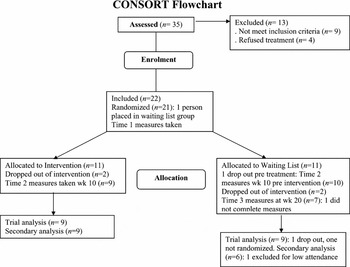
Thirty-five people were assessed against inclusion criteria (Figure 1). Thirteen people were seen only once: 9 did not meet inclusion criteria (8 not currently hearing voices, 1 unable to concentrate during discussion or mindfulness practice) and 4 declined to take part (not because of concerns about mindfulness, but because they were not interested in relating differently to their psychotic experiences, or attending a group, or taking part in a research study). Twenty-two people entered the study (mean age 41.6, SD 8.1); 10 had referred themselves, 10 were referred by NHS staff and 2 by voluntary sector staff. Twenty-one participants had two assessment meetings, and 1 had three. All 22 had experienced distressing voices for at least 2 years, and 19 experienced distressing paranoid beliefs. All participants met DSM IV diagnostic criteria for schizophrenia, and all were on anti-psychotic medication. All were unemployed. Mean duration of illness was 17.7 years (SD 9.8). At assessment one participant reported needing intensive medical care during the life of the intervention group, and was therefore removed from randomization and feasibility analysis, and placed in the waiting-list group
CONSORT flowchart

Intervention group. Two people dropped out: one between assessment and the group starting (he began using heroin again) and one after one session (found it difficult to be in a group). The remaining 9 attended at least six sessions. One participant did not complete the therapeutic factors measure.
Waiting list group. Three people dropped out (after assessment, session 1 and session 2 respectively) – one had started full-time college, one was suffering poor physical health, and one found group membership difficult. One participant who attended fewer than half the mindfulness training sessions was removed from secondary statistical analyses. One person completed only the therapeutic factors after the group. Secondary analyses of outcomes are therefore for 15 participants who attended at least six sessions and completed all outcome measures (therapeutic factors being a process measure).
Feasibility study analysis
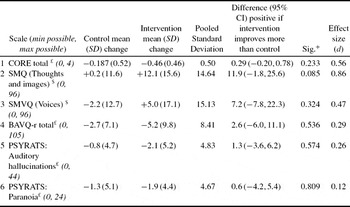
Table 1 compares intervention and control groups. Though all six differences are in the expected direction, none is significant. Thus all comparisons were consistent with mindfulness training being beneficial, but no single measure was conclusive. Table 1 also shows effects sizes for the comparison. Effect sizes for CORE total, SMQ, and SMVQ are medium; effect sizes for other variables are small. Table 1 includes standard deviations for the pooled data across groups to allow preferred sample size calculations. Indicative sample sizes to achieve significant results for the CORE and SMQ are 46 and 22 respectively.
Trial changes (post minus pre): comparison of change scores in experimental group (n = 9) and waiting list control group (n = 9) from baseline to week 10 of mindfulness practice (5 weeks of group plus home practice and 5 further weeks of home practice)

+independent samples t test (2-sided significance level)
$positive changes are improvements
£negative changes are improvements
Replication and other secondary analyses
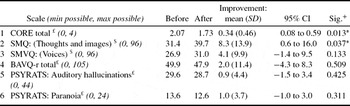
Table 2 shows scores before and after mindfulness training for the 15 participants who attended at least six sessions and completed outcome measures. All comparisons are in the right direction. There are significant improvements in CORE (0.34; 95% confidence interval from 0.08 to 0.59) and SMQ (8.3; 95% confidence interval from 0.6 to 16.0), indicative of improvement in clinical functioning and mindfulness of distressing thoughts and images. When CORE subscales were analysed, risk, and problems and symptoms showed significant improvements. There were no significant changes on PSYRATS, SMVQ or BAVQ-r.
Secondary analyses of scores for all completers (n = 15) pre mindfulness therapy and post 10 weeks of mindfulness training (5 weeks of group plus home practice and 5 further weeks of home practice)

*significant at 5% level (2 sided)
+paired sample t test (2 sided significance level)
$positive changes are improvements
£negative changes are improvements
Therapeutic process
After mindfulness training participants ranked parallel lists of eight statements reflecting distinct group processes. Combined ranks from most to least helpful were: Universality (mean 2.90), Guidance on mindfulness (3.85), Instillation of hope (4.42), Interpersonal learning (4.45), Self-understanding (4.75), Catharsis (5.00), Group cohesion (5.10), Altruism (5.65).
Discussion
The present study used a randomized design to assess a mindfulness intervention developed specifically for people with distressing psychosis, and based in clinical cognitive research. Though feasibility study comparisons were not significant, all comparisons were in the expected direction and effect sizes are reported for all variables of which CORE total, SMQ, and SMVQ are in medium effect size range. We report data that allow sample size calculations and these analyses suggest that 23 people in intervention and control groups would be necessary to achieve statistically significant results for the CORE, although smaller groups would be necessary for the SMQ. The combined pre-post data analysis showed significant improvements in CORE scores (replicating findings from Chadwick et al., Reference Chadwick, Newman-Taylor and Abba2005) and, in addition, showed a statistically significant improvement in mindfulness of distressing thoughts and images (SMQ), suggestive of core fidelity of the intervention. All other secondary comparisons were in the direction of improvement, although not statistically significant. Therapeutic process measures showed the importance of universality (recognition that others have similar problems) and mindfulness practice – the two most helpful factors in Chadwick et al. (Reference Chadwick, Newman-Taylor and Abba2005). All participants reported practising at home during the life of the group and maintaining this over the 5 weeks of home practice (although home practice was not measured formally). Alongside two trials showing that ACT (Hayes et al., Reference Hayes, Strosahl and Wilson1999) significantly reduces re-hospitalization for in-patients with psychosis (Bach and Hayes, Reference Bach and Hayes2002; Gaudiano and Herbert, Reference Gaudiano and Herbert2006), these data indicate that contemporary mindfulness-based interventions are safe and therapeutic for people with distressing psychosis.
Mindfulness interventions are intended to ease distress by changing how people relate to difficult inner experience (Kabat-Zinn, Reference Kabat-Zinn1990). Individuals learn to let go of futile attempts to avoid, get rid of, or control unwanted voices, cognitions and emotions, and learn instead to accept these experiences (Hayes et al., Reference Hayes, Strosahl and Wilson1999). A Grounded Theory analysis (Abba, Chadwick and Stevenson, Reference Abba, Chadwick and Stevenson2008) of 16 clients with psychosis who had attended mindfulness groups supports this theory. Participants described a process of learning to allow unpleasant psychotic sensations to come into awareness; letting go of struggle, judgement and rumination; and accepting both psychotic experience and oneself. Metacognitive insight (Teasdale et al., Reference Teasdale, Moore, Hayhurst, Pope, Williams and Segal2002) is crucial to this process. As people differentiate the psychotic sensation from their habitual coping reactions, so the cost of these reactions comes clearly into view (e.g. “it's so futile when I fight my voices, I feel upset, frustrated, tense and exhausted”). Again, as people let go of habitual coping behaviour, and practise being mindful, so they discover experientially that the feared consequences are not borne out (e.g. “If I stop fighting back, my voices will overwhelm and destroy me”). Mindfulness practice is thus in part a behavioural experiment to test metacognitive beliefs that maintain a distressing relationship with psychotic experience (Chadwick, Reference Chadwick2006). The present approach is compatible with the cognitive model of Morrison (Morrison, Reference Morrison2001; Morrison and Wells, Reference Morrison and Wells2003) who conceptualizes voices and other psychotic sensations as intrusions into awareness, and recommends interventions (including mindfulness) that target attentional focus, strategic cognition, and metacognitive beliefs.
The present study demonstrates the feasibility of an RCT for this intervention with a similar participant group. A future randomized trial with sufficient power would allow analysis of group and time interaction effects, and also for analysis of cognitive and emotional dimensions of the PSYRATS to understand more about mechanisms of change. Of the 26 people who met inclusion criteria, 4 people (15%) declined to participate; 2 people (9%) who initially opted in subsequently dropped out prior to therapy (to attend college and because of heroin use) and 3 (14%) during therapy. None of the stated reasons concerned mindfulness practice: the main issues were difficulty being in a group, not wanting to be part of a research study, and lack of motivation to try and change current relationship with voices. The current sample had long-standing (mean 17.7 years) treatment resistant psychosis; all 22 heard distressing voices, and 19 held distressing paranoid beliefs. Generalization, for example to those with more recent onset, cannot be assumed. In conclusion, the study challenges the widely held perception that meditation practice is necessarily harmful for people with psychosis and makes a strong case for further careful research and clinical practice.



Comments
No Comments have been published for this article.