Introduction
Malawi has made progress in its control of the HIV epidemic. In 2010, Malawi’s HIV prevalence was 11% (NSO & ICF Macro, 2011); 2015–2016 estimates placed national HIV prevalence at 8.8% (NSO & ICF, 2017). However, disparities by region and gender remain. The HIV prevalence in the southern region is twice as high as that in the northern and central regions (12.8%, 5.1% and 5.6%, respectively) (NSO & ICF, 2017). Gender disparities among youth are particularly concerning; HIV prevalence is 4.9% among women aged 15–24, compared with 1% among men of the same age (NSO & ICF, 2017). Gender disparities are even more pronounced in the southern Zomba district, where among women aged 15–49, HIV prevalence is 16.8%, compared with 9.3% among men of the same age (NSO & ICF, 2017). While these most recent estimates represent a considerable improvement from a decade ago (in 2004, HIV prevalence in Zomba district was 24.4% and 10.5% for women and men, respectively) (NSO & ORC, Macro, 2005), it is critical that research and intervention efforts continue to focus on women and eliminating HIV gender disparities.
While women are biologically more vulnerable to sexual transmission of HIV, structural factors that may lead to risky sexual behaviour exacerbate this vulnerability (Chersich & Rees, Reference Chersich and Rees2008). The influence of such structural factors – social, political, economic or environmental – on health and health behaviour is well-documented in the literature (Uchudi et al., Reference Uchudi, Magadi and Mostazir2012). In Malawi, the structural factors associated with risky sexual behaviour that may lead to HIV infection are complex. A known driver of risky sexual behaviour among young women is transactional sex. Due to economic hardship, young girls may decide to date and have sex with older men in exchange for gifts or economic support (Chersich & Rees, Reference Chersich and Rees2008; Nagoli et al., Reference Nagoli, Holvoet and Remme2010). Women living in communities or households with more resources may not face the same economic pressures to engage in risky sexual behaviour (Krishnan et al., Reference Krishnan, Dunbar, Minnis, Medlin, Gerdts and Padian2008). Furthermore, sociocultural norms may also be drivers; women residing in communities where they are given more autonomy may be more empowered to negotiate condom use in sexual encounters, and may have more autonomy in choosing their partners (Zierler & Krieger, Reference Zierler and Krieger1997; Gilbert & Walker, Reference Gilbert and Walker2002; Gupta, Reference Gupta2002; Krishnan et al., Reference Krishnan, Dunbar, Minnis, Medlin, Gerdts and Padian2008).
Zomba district, located in Malawi’s southern region, includes both a large rural population and an urban centre in Zomba city, one of Malawi’s four large cities (Zomba District Assembly, 2009). A profile of Zomba district released in 2009 (within the timeframe in which the original data for this study were collected) reported that 97% of adults 15 years and older were employed in some way. However, as of 2008, 6% of the population received a formal income (Zomba District Assembly, 2009). The vast majority of the population was unpaid or received casual payments. The average household lived on 183 Malawian kwacha, or approximately US$0.39 per day – well under the international poverty line of US$1.90 per day (World Bank, n.d., a; Zomba District Assembly, 2009). As of 2009, Zomba district was the third poorest district in Malawi (Zomba District Assembly, 2009). The residents of Zomba district rely heavily upon subsistence farming, and are vulnerable to related agricultural shocks such as flooding and drought (Zomba District Council, 2017).
The complexity of the structural factors that may influence risky sexual behaviour for young women living within a setting such as Zomba district requires nuanced analysis. The objective of this study was to build on previous work by exploring associations between factors related to economic resources and women’s empowerment, at both individual and community levels, with risky sexual behaviour among young women in Zomba district, Malawi.
Methods
Conceptual framework
The conceptual framework in Figure 1, adapted from work by Barnett and Whiteside (Reference Barnett and Whiteside2002) as well as Sweat and Denison (Reference Sweat and Denison1995), guided design and analyses for this study. This adapted framework has been presented elsewhere (Ward-Peterson et al., Reference Ward-Peterson, Fennie, Baird, Coxe, Trepka and Madhivanan2018); the present work expands upon the adapted framework by including factors related to economic resources and women’s empowerment hypothesized to be involved in the causal pathway for risky sexual behaviour. These factors are presented at four levels (superstructural, structural/macroenvironmental, microenvironmental and individual) in relation to individual risky sexual behaviour and ultimately HIV status, the health outcome that may ultimately result from risky sexual behaviour. Factors occur at varying distances from HIV risk, ranging from distal to proximal; risky sexual behaviour is the individual factor most proximal to HIV status. Variables from all but the superstructural level were included in these analyses and are described in further detail below.
Conceptual framework of multilevel factors contributing to women’s empowerment and economic resources in relation to risky sexual behaviour and HIV status. Adapted from work by Barnett and Whiteside (Reference Barnett and Whiteside2002) as well as Sweat and Denison (Reference Sweat and Denison1995).

Study design
Secondary analyses were carried out on cross-sectional data from the Schooling, Income, and Health Risk (SIHR) study conducted by Baird et al. (Reference Baird, Garfein, McIntosh and Ozler2012) among young women in Zomba district, Malawi; full study methodology is available elsewhere. Briefly, a randomized controlled trial of a cash transfer intervention was carried out in 176 randomly selected enumeration areas (EAs; approximately 4–5 villages) of Zomba district among two strata of unmarried young women: those enrolled in school at baseline (referred to throughout as schoolgirls), and those who were school dropouts at baseline (referred to throughout as dropouts) (Baird et al., Reference Baird, Garfein, McIntosh and Ozler2012). The baseline household survey (Round 1) was conducted from September 2007 to January 2008. After programme implementation began and allocation to intervention or control group was completed, a follow-up household survey (Round 2) was conducted approximately 12 months after Round 1, from October 2008 to February 2009.
Community-level data for the SIHR study were collected using a community questionnaire designed by the SIHR investigators that focused on physical and demographic characteristics, services and activities, economic and political activities, and issues around gender. Components of the questionnaire related to observable community characteristics (including whether children typically wear neat clothes, if children under 10 years old typically wear shoes and housing materials) were completed by the survey enumerator. These factors provide an ‘objective’ measure of the level of poverty in the community. The remaining portions of the questionnaire, including items related to women’s autonomy in the community, were completed through interviews with Village Heads (VHs) or Group Village Heads (GVHs). Most community questionnaires were completed during Round 2 (October 2008–January 2009); EAs not covered by Round 2 questionnaires were visited and VHs or GVHs were interviewed during Round 3 community fieldwork (March–June 2010).
The analyses presented here are limited to participants in the control group with data at Round 2, which consisted of 1407 schoolgirls and 407 dropouts in 88 enumeration areas with 59 community surveys. (It should be noted that the terms ‘schoolgirls’ and ‘dropouts’ refer to the participants’ status at baseline of the SIHR study, and may not be representative of participants’ school enrolment status at Round 2. For example, participants who were dropouts at baseline may have returned to school by Round 2, and vice versa.)
Measures
Outcomes
Risky sexual behaviour was examined using a total of four distinct outcomes. The first outcome was if the individual had ever had sex; the second outcome, for those who reported sexual activity, was if the individual consistently used condoms. Recognizing these outcomes might represent an over-simplified approach to risky sexual behaviour, two indices (one capturing age-related variables and the other capturing partner-related variables) created in previous work for participants reporting sexual activity were utilized as well (Ward-Peterson et al., Reference Ward-Peterson, Fennie, Baird, Coxe, Trepka and Madhivanan2018).
The method used to construct these indices has been described elsewhere (Ward-Peterson et al., Reference Ward-Peterson, Fennie, Baird, Coxe, Trepka and Madhivanan2018). In summary, exploratory factor analysis (EFA) with principal factor analysis and varimax rotation was used; separate EFA was conducted for schoolgirl and dropout strata. The Kaiser criterion was used for determining the number of factors to retain. The EFA was performed using SAS 9.4 on a total of six variables: girl’s age at sexual debut; age when sexual relationship with last partner began; number of lifetime partners; number of partners in the last year; frequency of sex with last partner; and an age difference with last partner of greater than 5 years. In both strata, results loaded on two distinct factors. The first factor consisted of age variables (referred to throughout as Age Factor), including girl’s age at sexual debut and age when sexual relationship with last partner began. The second factor consisted of partner history (referred to throughout as Partner History Factor), and encompassed number of lifetime partners, number of partners in the last year, frequency of sex with last partner, and an age difference with last partner of greater than 5 years. Detailed reporting on the resulting eigenvalues and factor loadings have been previously reported by Ward-Peterson et al. (Reference Ward-Peterson, Fennie, Baird, Coxe, Trepka and Madhivanan2018).
Individual scores for each factor were then computed using a crude method, which has been shown to be more stable than methods based on factor loadings (Grice, Reference Grice2001; DiStefano et al., Reference DiStefano, Zhu and Mîndrilă2009). To create a standardized score, a z-score (with a mean of 0 and a standard deviation of 1) for the values of each variable was generated, by strata. An individual participant’s’ score for each factor was then calculated by averaging these z-scores (Grice, Reference Grice2001; DiStefano et al., Reference DiStefano, Zhu and Mîndrilă2009). A higher score on the Partner History Factor indicated riskier sexual behaviour. Since, for the original age variables, lower ages indicated higher risk, the Age Factor score was reverse-coded whereby a higher Age Factor score indicated higher risk.
Multilevel factors related to economic resources
Several covariates related to economic resources were included in the analyses; two were included at the community level. The first included the number of development projects in the community in the past 5 years. To build on previous work and recognizing the number of development projects alone may be a simplified proxy for economic resources available at the community level, a second community-level covariate, which consisted of a composite score for community resources, was included.
The composite score for community resources was derived using principal components analysis (PCA) with varimax rotation. The Kaiser criterion was used for determining the number of factors to retain. The PCA was performed using SAS 9.4 on four variables directly observed by survey enumerators: whether children typically wear neat clothes; whether children under 10 years old typically wear shoes; type of housing (traditional, semi-permanent or permanent); and distance from Zomba Town (the urban centre) in kilometres. The variable for type of housing was constructed based on Malawi’s Household Socio-Economic Characteristics Report (NSO, 2012), which classifies dwellings based on the type of materials used for construction of the walls and roof. Variables were coded so that increasing values indicated more favourable conditions, except for distance from Zomba Town (since greater distances from Zomba Town indicated greater rurality and were therefore considered less favourable). Variables loaded onto one factor with an eigenvalue of 2.12. Factor scores were as follows: children typically wear neat clothes, 0.59; children under 10 years old typically wear shoes, 0.86; type of housing, 0.68; and distance to Zomba Town, –0.76. The composite indicator was computed using a crude method (Grice, Reference Grice2001; DiStefano et al., Reference DiStefano, Zhu and Mîndrilă2009). After the PCA was completed, distance to Zomba Town (the urban centre) was reverse-coded, so that living closer to Zomba Town was considered more favourable than living in a rural area. A z-score for each variable was then calculated, and the mean of these z-scores generated the community resources score. Data related to the community resource score were available from 55 community surveys.
Variables related to economic resources at the individual level included: household consumption quintiles (monthly consumption, per person, in market unit prices, US dollars); number of shocks experienced by the household in the past 3 years (such as low crop yields, loss of employment, large rise in the price of food or death of a household member); and the number of safety nets used by the household in the past 3 years (such as free food distribution, scholarships for education or direct cash transfers).
Multilevel factors related to women’s empowerment
In addition to factors related to economic resources, covariates related to women’s empowerment were included in analyses as well. At the community level, one variable was the percentage of girls in school. Again recognizing this may be a simplified proxy for other dynamics occurring at the community level and to build on previous work, a score of women’s autonomy in the community was created using PCA (following the same method for the community resource score). The four variables included in the women’s autonomy score were hypothesized to be related to the status of women in the community and were included in the community questionnaire: method of land transfer within families (always/almost always transferred through father, usually transferred through father, sometimes through father/sometimes through mother, usually through mother, always/almost always through mother); method individuals use to trace their descent (father, both father and mother, mother); if it is customary for a woman to inherit land when her husband dies; and if it is customary for either the man or woman to have to move out of the community after a divorce (woman, either woman or man, man, neither). Variables were coded so that increasing values indicated more favourable conditions for women. Variables loaded onto one factor with an eigenvalue of 2.42. Factor scores were as follows: method of land transfer, 0.70; method to trace descent, 0.75; land inheritance, 0.89; and move after divorce, 0.75. As with community resources, the composite indicator was computed using a crude method. A z-score for each variable was calculated, and the mean of those z-scores then generated the score for women’s autonomy at the community level. Data for the women’s autonomy score were available from 59 community surveys.
Variables related to women’s empowerment at the individual level included her belief in her right to refuse unprotected sex and perceived household support for her health. Belief in the right to refuse unprotected sex was based on an aggregate count of the statements the participant agreed with: Does a woman have the right to refuse unprotected sex with her husband when she thinks her husband may have HIV/AIDS? and Does a woman have the right to refuse unprotected sex with her husband when she doesn’t want to risk getting pregnant?, and ranged from zero to two. Perceived household support was based on the question: Compared to 12 months ago, would you say your household cares about your health: more than one year ago, same as one year ago, and less than one year ago? Since religion and tribe may also play a role in women’s empowerment, these variables were controlled for as well, with religion categorized as Protestant, Catholic or Muslim and tribe categorized as Yao, Chewa, Lomwe or Other (which included Tumbuka, Ngoni, Sena, Tonga, Nyanja and Mang’anja). All data related to the household were drawn from the participant’s household of origin.
Additional covariates
Additional covariates included the girl’s age (measured continuously), her highest level of education (primary school vs secondary or higher) and the household’s highest level of education (primary school vs secondary or higher); all participants and households achieved at least primary school. Age was excluded from analysis examining Age Factor as an outcome.
Data source
With two exceptions, the cross-sectional data set utilized for analysis was composed of information from Round 2 of the SIHR study. The first exception was related to characteristics of last sexual partner. If a participant reported ever having sex in Round 2 but had not had a partner in the last 12 months (and therefore information related to the most recent sexual partner was not present in Round 2), information on the last partner reported in the Round 1 survey was used. Finally, for 8 of 59 communities in the control group, community data were not available from Round 2 of data collection; SIHR survey enumerators completed community-level data collection from these communities during Round 3, and these data were utilized in this study.
Statistical analysis
The sampling strategy for Baird et al. (Reference Baird, Garfein, McIntosh and Ozler2012) considered baseline schoolgirls and baseline dropouts as separate strata, so that procedure was followed here. Descriptive statistics included frequency distributions or means with standard deviations.
Given the hierarchical nature of the data, multilevel regression models were used (multilevel logistic regression for binary outcomes and multilevel linear regression for continuous outcomes). Computational details for estimating multilevel regression models are available elsewhere (Sullivan et al., Reference Sullivan, Dukes and Losina1999; Larsen & Merlo, Reference Larsen and Merlo2005; Merlo et al., Reference Merlo, Chaix, Yang, Lynch and Råstam2005a, b and c; Merlo et al., Reference Merlo, Chaix, Ohlsson, Beckman, Johnell and Hjerpe2006). Initially, an empty model (Model A) was estimated (using the GLIMMIX procedure for binary outcomes and the MIXED procedure for continuous outcomes) in order to partition the variance:
 $${\rm{Model}}\,{\rm{A}}:\,\,\,\,\,\,\,\,\,\,\,\,\,\,{Y_{ij}} = {\beta _0} + {r_{0j}} + {e_{ij}}$$
where Y ij = risky sexual behaviour outcome of interest for individual i in community j; β 0 = overall predicted score (or log odds) of the risky sexual behaviour outcome of interest; r 0j = community-level variance; and e ij = individual-level variance.
The intraclass correlation coefficient (ICC), or the proportion of variance attributable to the community level, was calculated from the results of Model A as follows:
 $${\rm{Model}}\,{\rm{B}}:\,\,\,\,\,\,\,\,\,\,\,\,\,\,{\rm{ICC}} = {r_0}_j/({r_{0j}} + {e_{ij}})$$
Next, a random intercepts model was estimated (Model C), using community as the level of the random effect:
 $${\rm{Model}}\,{\rm{C}}:\,\,\,\,\,\,\,\,\,\,\,\,\,\,{Y_{ij}} = {\beta _0} + {\beta _n}{X_{nij}} + {r_{0j}} + {e_{ij}}$$
where Y ij = risky sexual behaviour outcome of interest for individual i in community j; β 0 = overall predicted score (or log odds) of the risky sexual behaviour outcome of interest; X nij = individual-level independent variable n for individual i in community j; β n = fixed effect on individual-level risky sexual behaviour outcome score (or log-odds) of 1-unit increase in X nij; r 0j = residual community-level variance (random effect); and e ij = residual individual-level variance.
If the multilevel regression models did not converge, regression with cluster-robust standard errors (using the SURVEYLOGISTIC procedure for binary outcomes and the SURVEYREG procedure for continuous outcomes; ICC estimates were not produced by these procedures) was carried out (Schempf & Kaufman, Reference Schempf and Kaufman2012; McNeish et al., Reference McNeish, Stapleton and Silverman2017). Multilevel models for the odds of ever having sex and the Age Factor score converged for the schoolgirl strata. The remaining regression models utilized cluster-robust standard errors. Age was centred at the grand mean for all models. The variables included in the final set of models were selected according to theoretical importance as follows: Model 1 incorporated variables related to economic resources, Model 2 incorporated variables related to women’s empowerment and Model 3 incorporated variables related to both economic resources and women’s empowerment. In all models, weights were used to account for SIHR sampling design (in which probability of inclusion varied by age and rural or urban residence). The statistical program SAS 9.4 (Cary, NC, USA) was used for all analyses.
Results
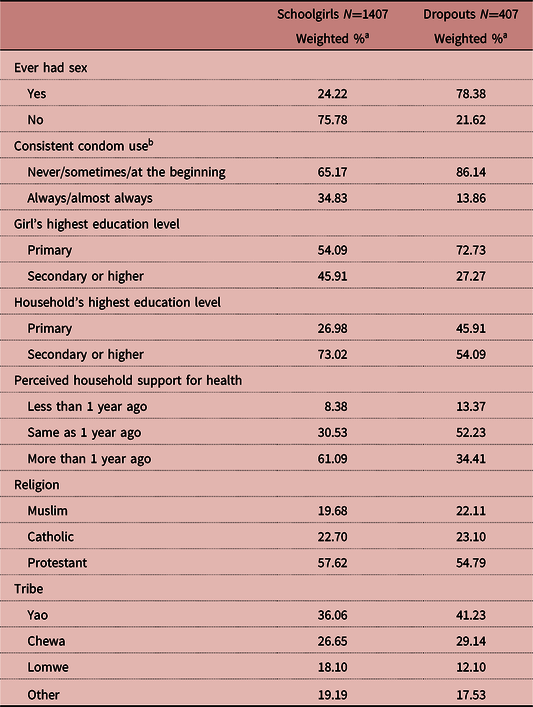
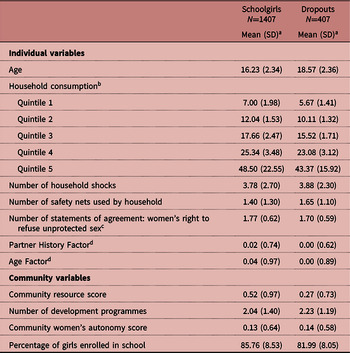
Tables 1 and 2 show descriptive statistics for the baseline schoolgirls and dropouts. Compared with schoolgirls, dropouts were older and less educated (achieving primary school as their highest level of education). Schoolgirls resided in communities with higher resource scores, came from better educated and wealthier households, reported increased household support for health more frequently, were less likely to have ever had sex and more likely to consistently use condoms.
Characteristics of young women in the SIHR study control group, Zomba district, Malawi (weighted proportions)

a Weights were used to account for the sampling design of the SIHR study.
b Among those who had ever had sex (schoolgirls: N=348; dropouts: N=303).
Characteristics of young women in the SIHR study control group, Zomba District, Malawi (means)

SD=standard deviation.
a Weights were used to account for the sampling design of the SIHR study.
b Monthly consumption, per person, in market unit prices, US dollars.
c Statements included: ‘Does a woman have right to refuse unprotected sex with her husband when she thinks her husband may have HIV/AIDS?’ and ‘Does a woman have right to refuse unprotected sex with her husband when she doesn’t want to risk getting pregnant?’
d Among those who had ever had sex and had information available on all variables used to estimate the score (schoolgirls: N=348; dropouts: N=303).
Schoolgirls
Ever having sex and Age Factor score
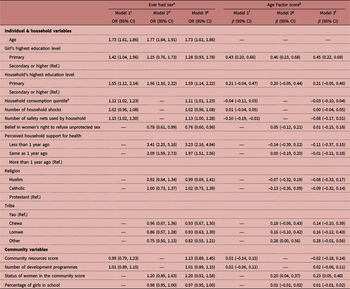
Table 3 shows the fixed effects of the final adjusted multilevel regression models for ever having sex and Age Factor score among schoolgirls. In Model 3, which controlled for both economic factors and factors related to women’s autonomy, the odds of ever having sex increased by 73% with each increasing year of age (OR = 1.73; 95% CI: 1.61, 1.86). Participants from households with a highest education level of primary school had 59% higher odds of ever having sex compared with those from households with a secondary school education or higher (OR = 1.59; 95% CI: 1.14, 2.22). The odds of having sex decreased with increased belief in a woman’s right to refuse unprotected sex (OR = 0.76; 95% CI: 0.60, 0.96). Perceived household support for health was strongly associated with ever having sex, with those reporting less support or the same level of support as one year ago having increased odds of ever having sex compared with those reporting increased support (OR = 3.23; 95% CI: 2.16, 4.84, and OR = 1.97; 95% CI: 1.51, 2.56, respectively). Increasing household consumption quintile was also associated with higher odds of ever having sex (OR = 1.11; 95% CI: 1.01, 1.23). At the community level, the odds of ever having sex decreased with each increasing percentage point of girls enrolled in school (OR = 0.97; 95% CI: 0.95, 1.00), although the upper bound of the confidence interval showed borderline significance (0.996) at the 95% level.
Associations between economic factors and women’s empowerment with ever having sex and Age Factor score among schoolgirls

OR=odds ratio. CI=Confidence Interval.
a Estimated using PROC GLIMMIX. ICC was 0.037 in empty model.
b Estimated using PROC MIXED. ICC was 0.005 in empty model.
c N=1332; observations were dropped from the final model if they had incomplete information on the variables included.
d N=1353; observations were dropped from the final model if they had incomplete information on the variables included.
e N=1318; observations were dropped from the final model if they had incomplete information on the variables included.
f N=334; observations were dropped from the final model if they had incomplete information on the variables included (348 schoolgirls reported ever having sex).
g N=341; observations were dropped from the final model if they had incomplete information on the variables included (348 schoolgirls reported ever having sex).
h Monthly consumption, per person, in market unit prices, US dollars.
In the combined Model 3 for Age Factor score, participants who had achieved a primary school level of education had a higher Age Factor score compared with those achieving secondary school or higher (β = 0.45; 95% CI: 0.22, 0.69), indicating higher risk. At the community level, increasing scores for women’s autonomy were associated with a higher Age Factor score (β = 0.23; 95% CI: 0.05, 0.40).
Consistent condom use and Partner History Factor score
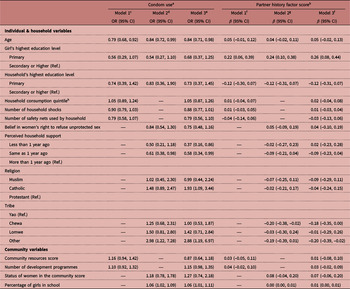
Table 4 shows the final adjusted regression models, utilizing cluster-robust standard errors, for consistent condom use and Partner History Factor score among schoolgirls. In Model 3, the odds of consistent condom use decreased by 16% for each additional year of age (OR = 0.84; 95% CI: 0.71, 0.98). Perceived household support for health was strongly associated with consistent condom use, with those reporting less support or the same level of support as one year ago having decreased odds of consistent condom use compared to those reporting increased support (OR = 0.37; 95% CI: 0.16, 0.86, and OR = 0.58; 95% CI: 0.34, 0.99, respectively). At the community level, the odds of consistent condom use increased with each increasing percentage point of girls enrolled in school (OR = 1.06; 95% CI: 1.01, 1.11).
Associations between economic factors and women’s empowerment with condom use and Partner History Factor score among schoolgirls

OR=Odds Ratio; CI=Confidence Interval.
a Estimated using PROC SURVEYLOGISTIC.
b Estimated using PROC SURVEYREG.
c N=338; observations were dropped from the final model if they had incomplete information on the variables included (348 schoolgirls reported ever having sex).
d N=345; observations were dropped from the final model if they had incomplete information on the variables included (348 schoolgirls reported ever having sex).
e N=338; observations were dropped from the final model if they had incomplete information on the variables included (348 schoolgirls reported ever having sex).
f N=334; observations were dropped from the final model if they had incomplete information on the variables included (348 schoolgirls reported ever having sex).
g N=341; observations were dropped from the final model if they had incomplete information on the variables included (348 schoolgirls reported ever having sex).
h Monthly consumption, per person, in market unit prices, US dollars.
In the combined Model 3 for Partner History Factor score, participants who had achieved a primary school level of education had a higher Partner History Factor score compared with those with a secondary school education or higher (β = 0.26; 95% CI: 0.08, 0.44), indicating higher risk.
Dropouts
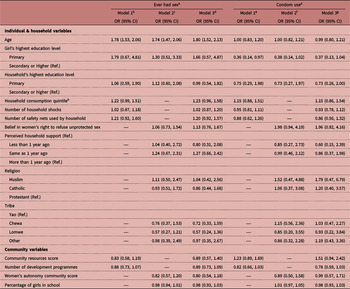
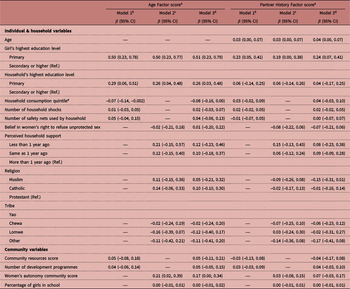
Tables 5 and 6 show the final adjusted regression models, utilizing cluster-robust standard errors, for risky sexual behaviour among dropouts. In Model 3, the odds of ever having sex increased by 80% for each increasing year of age (OR = 1.80; 95% CI: 1.52, 2.13). Participants who had achieved a primary school level of education had higher Age Factor and Partner History Factor scores compared with those with a secondary school education or higher (β = 0.51; 95% CI: 0.23, 0.79, and β = 0.24; 95% CI: 0.07, 0.41, respectively). Additionally, participants from households with only a primary school level of education had higher Age Factor scores compared with those from households with a secondary school education or higher (β = 0.26; 95% CI: 0.03, 0.48).
Associations between economic factors and women’s empowerment with risky sexual behaviour (ever had sex and condom use) among dropouts

OR=Odds Ratio; CI=Confidence Interval.
a Estimated using PROC SURVEYLOGISTIC.
b N=385; observations were dropped from the final model if they had incomplete information on the variables included.
c N=398; observations were dropped from the final model if they had incomplete information on the variables included.
d N=380; observations were dropped from the final model if they had incomplete information on the variables included.
e N=289; observations were dropped from the final model if they had incomplete information on the variables included (303 dropouts reported ever having sex).
f N=295; observations were dropped from the final model if they had incomplete information on the variables included (only 303 dropouts reported ever having sex).
g N=284; observations were dropped from the final model if they had incomplete information on the variables included (only 303 dropouts reported ever having sex).
h Monthly consumption, per person, in market unit prices, US dollars.
Associations between economic factors and women’s empowerment with risky sexual behaviour (age and partner history factor scores) among dropouts

OR=Odds Ratio; CI=Confidence Interval.
a Estimated using PROC SURVEYREG.
b N=289; observations were dropped from the final model if they had incomplete information on the variables included (303 dropouts reported ever having sex).
c N=295; observations were dropped from the final model if they had incomplete information on the variables included (only 303 dropouts reported ever having sex).
d N=284; observations were dropped from the final model if they had incomplete information on the variables included (only 303 dropouts reported ever having sex).
e Monthly consumption, per person, in market unit prices, US dollars.
Discussion
Varying findings across the outcomes support the notion that risky sexual behaviour is a complex construct requiring a nuanced approach to measurement. Had the findings not varied across outcomes, particularly for traditional variables used as proxies for risky sexual behaviour such as ever having sex and condom use, the need for distinct measures would have been negated. The use of indices quantifying various risk factors related to age of sexual activity and partner history in this study was an attempt to move towards more sophisticated measurement of risky sexual behaviour.
Age was a consistent predictor of ever having sex in both the schoolgirl and dropout strata. Aligning with the existing literature showing that achieving a secondary level of education is associated with improved outcomes, these findings suggest that keeping girls in school may be an effective strategy for reducing risky sexual behaviour (Zuilkowski & Jukes, Reference Zuilkowski and Jukes2012). There is strong evidence that low educational attainment negatively impacts condom use and that, for women, low educational attainment increases the risk of early sexual debut (Zuilkowski & Jukes, Reference Zuilkowski and Jukes2012).
Other results differed considerably between the schoolgirl and dropout strata, suggesting the underlying mechanisms related to risky sexual behaviour may vary based on an individual’s history of school enrolment. The findings suggest that education at all levels may play an important role in risky sexual behaviour, ranging from the more distal community level to the intermediate household level to the more proximal individual level. However, differing findings by school enrolment strata related to education within the community and household suggest that while strategies targeting these higher levels may uniquely impact outcomes related to risky sexual behaviour, the magnitude of impact will probably depend upon individual educational background. For example, among the schoolgirl stratum, higher household educational attainment and an increasing percentage of girls enrolled in school at the community level were negatively associated with ever having sex (Table 3, Model 3). Within the same sample, only the percentage of girls enrolled in school at the community level was significantly associated with condom use (Table 4, Model 3). Meanwhile, among the dropout stratum, lower household educational attainment was associated with riskier Age Factor scores. The community-level percentage of girls enrolled in school was not associated with this outcome, and neither community school enrolment nor household educational attainment was associated with other outcomes measuring risky sexual behaviour. Among the dropout stratum, the only other significant covariate (besides age and household education) was individual educational achievement, highlighting the importance of education for this group. Such differing findings across the school enrolment strata highlight the need for tailored, multilevel approaches, designed to impact specific domains of risky sexual behaviour and taking varying baseline individual educational achievement into account.
Among schoolgirls, an increased perception of household support for health was protective for ever having sex and improved consistent condom use. One limitation of the measure used in this study is that it only examined changes in perceived support; if household support was previously high and did not change over the past year, that high level of household support could not be accounted for. Nevertheless, the findings presented here deserve further exploration, particularly because existing evidence related to social support and HIV risk behaviours is mixed (Qiao et al., Reference Qiao, Li and Stanton2014). Additionally, further research is needed to fully explore the sociological phenomenon underlying the results related to tribe and religion.
The finding that, among schoolgirls, belief in women’s right to refuse unprotected sex was associated with lower odds of ever having sex aligns with existing theoretical frameworks (Pettifor et al., Reference Pettifor, Measham, Rees and Padian2004). However, the finding that increasing community-level scores related to women’s autonomy were associated with riskier scores related to age of sexual activity requires further exploration, since literature on this topic is scarce (Hogan et al., Reference Hogan, Berhanu and Hailemariam1999; Hindin, Reference Hindin2000; Pettifor et al., Reference Pettifor, Measham, Rees and Padian2004; Krishnan et al., Reference Krishnan, Dunbar, Minnis, Medlin, Gerdts and Padian2008; Rahman et al., Reference Rahman, Mostofa and Hoque2014). Data were not available to fully assess this potentially complex dynamic.
This study found that belonging to households in higher quintiles of household consumption (a measure of wealth) increased the odds of ever having sex among the schoolgirl stratum. The literature on the topic is mixed. Some have hypothesized that associations between wealth and risky sexual behaviour are due to increases in the likelihood of mobility or having multiple partners (Gillespie et al., Reference Gillespie, Kadiyala and Greener2007). At the community level, no associations between measures of economic resources and risky sexual behaviour were found. This may be because, as one of the poorest countries in the world, poverty is ubiquitous in Malawi (World Bank n.d., b); these null findings may be accounted for by the lack of variation in community-level economic resources across the sample.
A strength of this study includes the use of indices for assessing risky sexual behaviour. Risky sexual behaviour is a multifaceted outcome that cannot be fully measured simply by looking at the presence of any sexual behaviour or the use of condoms. Additionally, the authors created and utilized composite indicators at the community level to more fully measure community resources and women’s autonomy. While other studies have utilized multilevel analysis to examine risky sexual behaviour in Malawi (Uthman et al., Reference Uthman, Moradi and Lawoko2009; Robertson et al., Reference Robertson, Gregson and Garnett2010; Stephenson, Reference Stephenson2010; Uthman et al., Reference Uthman, Lawoko and Moradi2010; Andersson et al., Reference Andersson, Paredes-Solís, Milne, Omer, Marokoane, Laetsang and Cockcroft2012; Hung et al., Reference Hung, Scott, Ricciotti, Johnson and Tsai2012; Uchudi et al., Reference Uchudi, Magadi and Mostazir2012; Kamndaya et al., Reference Kamndaya, Kazembe, Vearey, Kabiru and Thomas2015; Magadi & Uchudi, Reference Magadi and Uchudi2015), to the authors’ knowledge this is the first to utilize a composite indicator for women’s autonomy in the community.
There are several limitations to this study. The risky sexual behaviour indices and community composite measures presented here require further validation in other data sets. One limitation of the use of risky sexual behaviour indices as outcome variables is that they may obscure the relative importance of one item (for example, age of last partner) over another item (for example, frequency of sex with last partner), thereby limiting the interpretability of results. An in-depth validation study may serve to compare results and model performance between the indices and each of their individual items. However, this was beyond the scope of the current study. The risky sexual behaviour indices were included here to supplement commonly used measures of risky sexual behaviour (ever had sex and consistent condom use) and to present a potential alternative to measures of risky sexual behaviour that fail to take multiple aspects of sexual behaviour into account. Furthermore, some variables included in community composite measures (such as those related to children included in the community resource score) were based on the cross-sectional, subjective observation of survey enumerators. In reality, such observations may vary from day to day, but given that these enumerators were from these communities, these observations likely capture something meaningful about the poverty of these locations.
Additionally, a major limitation of this work is the use of self-reported data related to risky sexual behaviour. Future work should utilize biomarkers to confirm self-reported measures; unfortunately, this was beyond the scope of the current study. Furthermore, lack of variation across communities for condom use and Partner History Factor score among the schoolgirl stratum and for all outcomes among the dropout stratum may have contributed to the failure of the multilevel models to converge. Additionally, due to categorization of the variables for religion and tribe that resulted from small cell counts, it was not possible to distinguish differences between membership in different religious denominations and smaller tribal groups. Finally, the cross-sectional structure of this data set precluded a longitudinal analysis of how community-level factors may have impacted changes in individual responses across the various rounds of data collection.
In conclusion, risky sexual behaviour is multifaceted and complex. While various factors related to women’s empowerment played a role, the most consistent variables associated with risky sexual behaviour were those related to education, including the girl’s level of education, the highest level of education of her household of origin and the community percentage of girls enrolled in school. Interventions and programmes seeking to reduce risky sexual behaviour among young women, thereby reducing their risk of HIV infection, should continue to focus on improving access to education at multiple levels.
Funding
This research received no specific grant from any funding agency, commercial entity or not-for-profit organization. Melissa Ward-Peterson is currently supported by an NIMHD centre grant to the Research Center in Minority Institutions at Florida International University (U54MD012393).
Conflicts of Interest
The authors have no conflicts of interest to declare.
Ethical Approval
This research was approved by the Florida International University Social and Behavioural Institutional Review Board. The authors assert that all procedures contributing to this work comply with the ethical standards of the relevant national and institutional committees on human experimentation and with the Helsinki Declaration of 1975, as revised in 2008.