Clostridium difficile infection (CDI) is a common cause of diarrhea in hospitalized patients. With new highly pathogenic, treatment-resistant strains emerging and an expanding epidemiological niche, the prevalence of CDI has increased.Reference Kelly and LaMont 1 The cost of this disease in the United States has been estimated to exceed $1.1 billion annually, accounting for significant morbidity and mortality in hospitalized patients.Reference Kyne, Hamer, Polavaram and Kelly 2
Risk factors for CDI include older age, prolonged hospitalization, recent antibiotic use, systemic comorbidities, and immunosuppression.Reference Bignard 3 Patients with hematological malignancies are also susceptible to CDI, with risk attributable in part to chemotherapy-induced neutropenia and prolonged hospitalization in the case of bone marrow transplant recipients. As reported previously, CDI often complicates the care of patients with hematological malignancies after myelosuppressive chemotherapy.Reference Schalk, Bohr, Konig, Scheinpflug and Mohren 4 Neutropenic enterocolitis is a severe complication of aggressive chemotherapy, with C. difficile being the underlying pathogen in ~6% of these patients.Reference Cartoni, Dragoni and Micozzi 5 Antibiotic exposure further compounds the risk of CDI in leukemia patients. Notably, neutropenic fever warrants empirical antibiotic therapy, which in turn can suppress resident bowel flora and thus permit overgrowth of C. difficile. Reference Ballett and Gerding 6 Lastly, cytotoxic chemotherapy such as Ara-C, used in leukemia, may also induce C. difficile colitis.Reference Anand and Glatt 7
There is a paucity of data on the nationwide incidence of CDI in leukemia patients and the effects of CDI on their in-hospital outcomes. In this study, we aimed to determine the trend of incidence of CDI in hospitalized leukemia patients, to evaluate the impact of CDI on mortality and expense, and to identify the risk factors for developing CDI in this population.
METHODS
Data Source
We performed a retrospective cohort study using data from the Healthcare Cost and Utilization Project (HCUP) Nationwide Inpatient Sample (NIS) from 2005 to 2011. NIS is an all-payer inpatient care database representing a 20% stratified sample of non-federal acute-care hospitals in the United States, including community, general, and academic centers but not long-term care facilities. It contains data from ~8 million hospital stays per year. Each discharge is weighted to allow for estimates projected to a national level. Each individual hospitalization is deidentified and maintained in the NIS as a unique entry with one primary discharge diagnosis and up to 24 secondary diagnoses. 8
Patient Selection
International Classification of Diseases, 9th Revision, Clinical Modification (ICD-9-CM) codes were used to identify subjects from the database. We included adults, aged ≥18 years, with a primary diagnosis code for leukemia (all ICD-9-CM codes used in this study are listed in the Appendix). We excluded cases with a primary diagnosis of CDI and leukemia as a secondary diagnosis. A comparison group was generated by a 10% random selection of non-leukemia patients from NIS, 2005–2011.
Study Variables
The variables of age, gender, ethnicity, teaching status of hospital, in-hospital death or survival, length of hospital stay (LOS), and total hospital charges were extracted from the NIS dataset to provide subject characteristics. Other variables including leukemia, CDI, pneumonia, urinary tract infection (UTI), sepsis, and bone marrow or stem cell transplant were identified by ICD-9-CM diagnosis codes (Appendix). The subgroups of acute myeloid leukemia (AML), chronic myeloid leukemia (CML), acute lymphoid leukemia (ALL), and chronic lymphoid leukemia (CLL) as well as disease in relapse or remission were identified and analyzed separately. Age, LOS, and hospital charges were collected as continuous variables. Age was categorized initially into the following subgroups: 18–25, 26–35, 36–45, 46–55, 56–65 and >65 years old. All other variables were analyzed as categorical variables.
Outcomes
The main outcomes of interest were the trend of incidence of CDI in hospitalized leukemia patients, mortality, LOS, and inflation-adjusted hospital charges in leukemia patients with CDI. In our secondary analyses, we investigated risk factors for developing CDI and the impact of CDI on subject mortality. Hospital charges refer to the charges that the hospital levied to the patients. All dollar amounts in this report were adjusted to inflation based on the year 2011. The LOS refers to the total number of continuous days a patient was hospitalized.
Statistical Analysis
Descriptive statistics were used to describe the baseline characteristics of all patients. The 7-year incidence of CDI was calculated by the number of cases with secondary diagnosis of CDI divided by the total number of hospitalizations from 2005 to 2011. The CDI incidence of all hospitalized patients was compared to that of leukemia patients. CDI incidence was similarly calculated for the 10% randomly selected non-leukemia patients from 2005 to 2011 and compared to that of leukemia patients after adjusting for LOS. To identify risk factors for CDI in leukemia patients, patients were divided into 2 groups based on the presence or absence of a diagnosis of CDI during hospitalization. To evaluate the effect of CDI on in-hospital mortality, subjects were divided into 2 groups based on death or survival. Categorical and continuous variables were compared using a χ2 test and the Mann-Whitney U test, respectively.
A logistic regression model was developed to determine risk factors for developing CDI in leukemia patients using CDI as the dependent variable. To determine the impact of CDI on mortality, the in-hospital outcome of survival or death was used as the dependent variable. The following potential confounding factors were included in the final regression model: age (reference group [Ref]: age≤65), gender (Ref: male), race (Ref: Caucasian), Charlson index score (Ref: 0), teaching status of hospital (Ref: non-teaching hospital), the presence of complications or comorbidities (eg, hypertension, diabetes, pneumonia, etc.), and the performance of bone marrow or stem cell transplant during hospitalization.
All analyses were performed using the Statistical Program for Social Sciences version 19.0 (SPSS, Armonk, NY: IBM Corp.). The discharge weight variable assigned to each discharge was used to project to national estimates. All statistical tests were 2-sided, and P <.01 was considered statistically significant. The University of Nevada School of Medicine Office of Human Research Protection has deemed that research using the NIS and similar deidentified datasets is exempt from institutional approval.
RESULTS
Incidence of CDI in Patients with Leukemia
A total of 1,243,107 cases with a primary discharge diagnosis for leukemia were identified, including 42,438 cases with diagnoses of both leukemia and CDI. Overall, the incidence of CDI in leukemia patients was 3.4%, which was significantly greater than the incidence of CDI in all hospitalized patients (0.85%). During the 7 years studied, the total number of leukemia patients diagnosed with CDI increased by 45.5%. The incidence of CDI in leukemia patients was 3.0% in 2005 and 3.5% in 2011, an increase of 16.7%. By comparison, the incidence of CDI in all hospitalized patients increased by 30.3% (from 7.6 to 9.9%). The increasing trend in CDI was slower in leukemia patients compared to all hospitalized patients. The incidence of CDI in leukemia patients remained 2.3 to 2.8 times higher than in non-leukemia patients after adjusting for LOS (Table 1).
Clostridium difficile Infection Trend in Hospitalized Leukemia Patients, 2005–2011

NOTE. CDI, Clostridium difficile infection; CI, confidence interval; OR, odds ratio.
a Comparison after adjusting for length of hospital stay.
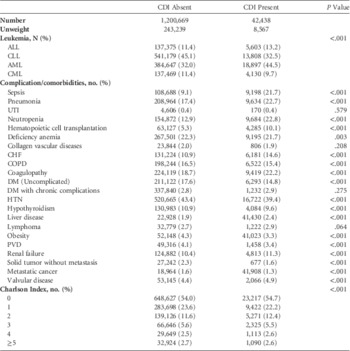
The most common leukemia type identified within the database was CLL (44.6%), followed by AML (32.5%). The incidence of CDI was highest in AML (4.7%), followed by ALL (3.9%), CML (2.9%) and CLL (2.5%), and the difference among these groups was significant (P<.001). Patients with ALL, AML, or CML had a significantly higher incidence of CDI when they were in relapse compared to remission (P<.001). In contrast, while subjects with CLL exhibited a numerical difference in CDI between relapse and remission, this difference was not statistically significant (Table 2).
Differences in CDI Incidence Based on Type of Leukemia

NOTE. CDI, Clostridium difficile infection; ALL, acute lymphoid leukemia; AML, acute myeloid leukemia; CLL, chronic lymphoid leukemia; CML, chronic myeloid leukemia.
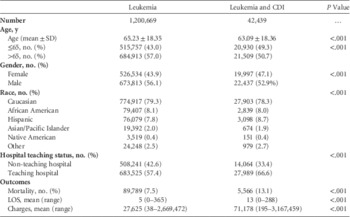
Tables 3 and 4 summarize the subject demographic and clinical features as well as in-hospital outcomes in leukemia patients with or without CDI. Because the CDI incidences in leukemia patients among all of the age subgroups below age 65 were nearly identical, the final analysis regarding age was dichotomized as ≤65 and >65 years old.
Comparison of Demographic Characteristics between Patients with Leukemia and Patients with Leukemia and Clostridium difficile Infection

NOTE. CDI, Clostridium difficile infection; LOS, length of stay; SD, standard deviation.
Comparison of Clinical Features between Patients with Leukemia and Patients with Leukemia and Clostridium difficile Infection

NOTE. CDI, Clostridium difficile infection; ALL, acute lymphoid leukemia; AML, acute myeloid leukemia; CLL, chronic lymphoid leukemia; CML, chronic myeloid leukemia; UTI, urinary tract infection; DM, diabetes mellitus; HTN, hypertension; CHF, congestive heart failure; COPD, chronic obstructive pulmonary disease; PVD, peripheral vascular disease.
Risk Factors for CDI in Leukemia Patients
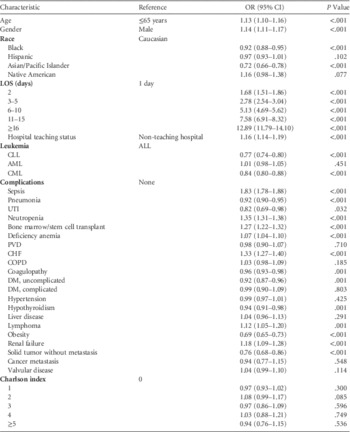
Logistic regression analysis revealed that age>65 years (OR,1.13; 95% CI, 1.10–1.16) and male gender (OR, 1.14; 95% CI, 1.11–1.17) minimally increased the risk for CDI. White race was associated with a higher risk for CDI than for Blacks or Asian/Pacific Islanders. CDI diagnoses occurred during hospitalizations as short as 2 days and incidence increased consistently with increasing LOS. Patients in teaching hospitals had 16% higher risk for CDI compared to those in non-teaching hospitals. CDI risk was higher for acute (ALL and AML) vs. chronic leukemias (CLL and CML). The occurrence of sepsis (OR,1.83; 95% CI, 1.78–1.88) and neutropenia (OR, 1.35; 95% CI, 1.31–1.38) were major clinical complications that significantly increased the risk of CDI. Patients undergoing bone marrow or stem cell transplantation during hospitalization also had increased risk for CDI (OR, 1.27; 95% CI, 1.22–1.32). With regard to comorbidities, congestive heart failure (OR, 1.33; 95% CI, 1.27–1.40), renal failure (OR, 1.18; 95% CI, 1.09–1.28), and lymphoma (OR, 1.12; 95% CI, 1.05–1.20) were significantly associated with CDI. However, increased Charlson index was not associated with the development of CDI (Table 5).
Demographic and Clinical Features Independently Associated with Clostridium difficile Infection in Hospitalized Patients with Leukemia

NOTE. CDI, Clostridium difficile infection; OR, odds ratio; LOS, length of hospital stay; ALL, acute lymphoid leukemia; AML, acute myeloid leukemia; CLL, chronic lymphoid leukemia; CML, chronic myeloid leukemia; UTI, urinary tract infection; DM: diabetes mellitus; CHF, congestive heart failure; COPD, chronic obstructive pulmonary disease; PVD, peripheral vascular disease.
Effect of CDI on Mortality in Leukemia Patients
Logistic regression analysis revealed that CDI independently increased mortality of leukemia patients (OR, 1.17; 95% CI, 1.13–1.22). Other factors that increased mortality were age>65 (OR, 1.90; 95% CI, 1.86–1.94), sepsis (OR, 5.79; 95% CI, 5.69–5.90), pneumonia (OR, 2.14; 95% CI, 2.11–2.18), CHF (OR, 1.13; 95% CI, 1.09–1.16), coagulopathy (OR, 1.85; 95% CI, 1.82–1.89), liver disease (OR, 1.22; 95% CI, 1.15–1.28), and lymphoma (OR, 1.24; 95% CI, 1.19–1.30). Higher Charlson index was associated with increased mortality in leukemia patients.
DISCUSSION
CDI is frequently identified as a cause of diarrhea in the hospital setting. Its incidence ranges from 4.8% to 9% in patients with AML, but this rate is as high as 14%–30.4% in patients with allogenic hemotopoietic stem cell transplant.Reference Spadao, Gerhardt and Guimaraes 9 , Reference Alonso, Treadway and Hanna 10 A recent study reported an incidence of CDI of 3.1% in hematologic patients.Reference Spadao, Gerhardt and Guimaraes 9 These data are in agreement with our study, in which CDI incidence varied from 2.5% to 4.7%, depending on type of leukemia. As in general hospitalized patients, the incidence of CDI in leukemia patients increased from 2005 to 2011. CDI is considered among the most common hospital-acquired infections with a documented increase in frequency and severity beginning ~10 years ago.Reference Loo, Poirier and Miller 11 , Reference Cohen, Gerding and Johnson 12 The increase is attributed in part to the emergence of a hypervirulent strain of C. difficile known as NAP1/BI/027.Reference Cohen, Gerding and Johnson 12 Leukemia has been identified as an independent risk factor for CDI.Reference Dubberke, Reske, Yan, Olsen, McDonald and Fraser 13 Antibiotic prophylaxis with fluoroquinolones is common in patients with hematologic malignancies given that it reduces mortality, febrile episodes, and bacterial infections in neutropenic patients.Reference Gafter-Gvili, Fraser, Paul and Leibovici 14 – Reference Cullen, Steven and Billingham 16 With the emergence of a new fluoroquinolone-resistant C. difficile strain, this class of antibiotic represents a risk factor for occurrence and may be responsible for specific outbreaks of CDI.Reference Loo, Poirier and Miller 11 , Reference Pepin, Saheb and Coulombe 17 , Reference McDonald, Killgore and Thompson 18 In addition to antibiotic exposure, chemotherapy, neutropenia, frequent hospitalization, and performance of bone marrow or peripheral stem cell transplantation have also been found to confer risk of CDI in leukemia patients.Reference Schalk, Bohr, Konig, Scheinpflug and Mohren 4 , Reference Anand and Glatt 7 , Reference Dettenkofer, Ebner and Bertz 19
In our study, leukemia patients with CDI had higher mortality than patients without CDI, though the mortality may not be related directly to CDI. After adjusting for age, comorbidities, and other complications, CDI was found to independently increase the in-hospital mortality by 17%. A recent multi-institutional study reported that the crude mortality in nosocomial C. difficile hospitalized patients was 24.8% and that the CDI-contributable mortality was 6.9%.Reference Loo, Poirier and Miller 11 CDI has been associated with higher mortality in many disease states such as inflammatory bowel disease, liver cirrhosis, and solid organ transplant.Reference Pant, Anderson, O’Connor, Marshall, Deshpande and Sferra 20 – Reference Nguyen, Kaplan, Harris and Brant 22 In addition to the emergence of hypervirulent C. difficile strains,Reference Miller, Gravel and Mulvey 23 , Reference He, Miyajima and Roberts 24 other factors that may account for increased mortality in leukemia patients with CDI include greater severity of leukemia, more comorbidities, and complications like neutropenia and different infections.Reference Cohen, Gerding and Johnson 12
Our study also found that CDI substantially increased LOS with accompanying higher hospital charges. This result mirrors that of several studies that examined the burden of CDI in patients with hematologic diseases, inflammatory bowel disease, and cirrhosis.Reference Nguyen, Kaplan, Harris and Brant 22 , Reference Apostolopoulou, Raftopoulos, Terzis and Elefsiniotis 25 – Reference Bajaj, Ananthakrishnan and Hafeezullah 27 However, determining to what degree CDI contributed to prolonged LOS has been studied only rarely. The issue is problematic because LOS and CDI influence each other and a cause–effect relationship may be bidirectional.Reference Dettenkofer, Ebner and Bertz 19 , Reference Apostolopoulou, Raftopoulos, Terzis and Elefsiniotis 25 , Reference Micek, Schramm and Morrow 28 A recent study using multistate models found that CDI had little additive effect on LOS.Reference Mitchell, Gardner, Barnett, Hiller and Graves 29 To investigate LOS further in the current study, we adjusted for LOS in a regression model and found that the incidence of CDI was still 2.6-fold greater in leukemia than in non-leukemia patients, indicating that factors other than LOS are responsible for the risk of CDI.
We found that women with leukemia had a 14% increased risk for CDI compared to men and that Caucasians patients had a higher risk for CDI compared to Asian/Pacific Islanders and Blacks. A few publications examining the issue of sex and race disposition in CDI have reported variable findings,Reference Schalk, Bohr, Konig, Scheinpflug and Mohren 4 , Reference Ali, Anathakrishnan, Ahmad, Kumar, Kumar and Saeian 21 which may reflect results occurring by chance. The role of sex and race on CDI susceptibility requires further research.
To our knowledge, the comparison of CDI incidence between teaching and non-teaching hospitals has rarely been reported previously. We found that leukemia patients in teaching hospitals were more likely to be diagnosed with CDI and had higher mortality compared with those in non-teaching hospitals. This result may stem from the facts that patients referred to teaching hospitals tend to have more complex illness, greater severity of disease, and higher risk of infection and may receive more acid suppressants and antibiotics.Reference Leung, Metzger and Currie 30
Comparisons of CDI rates between acute and chronic leukemia have rarely been published. We found that acute leukemia had higher incidence of CDI than chronic leukemia. Exposure to antibiotics, use of certain chemotherapeutic agents, prolonged or repeat hospitalization, sustained neutropenia, and allogenic stem cell transplantation are all more common in patients with acute leukemiaReference Schalk, Bohr, Konig, Scheinpflug and Mohren 4 , Reference McKinnell, Miller, Eells, Cui and Huang 31 and may explain the higher risk of CDI. In addition, we found that patients with leukemia relapse had higher incidence of CDI than patients in remission, which possibly reflects greater disease severity or more exposure to known CDI risks factors.
Our results confirm the previously described links between CDI and older age, prolonged hospitalization, and immunodeficiency-related complications of leukemia, such as neutropenia, lymphoma, and bone marrow or stem cell transplant.Reference Schalk, Bohr, Konig, Scheinpflug and Mohren 4 , Reference McKinnell, Miller, Eells, Cui and Huang 31 We also found a higher risk of CDI associated with sepsis, CHF or renal failure. This is not surprising given the extensive antibiotic use that accompanies sepsis and the fact that CHF and renal failure are associated with a higher risk of MRSA infection, prolonged LOS, ICU admissionReference McKinnell, Miller, Eells, Cui and Huang 31 and presence of NAP strain infection.Reference Pant, Sferra, Deshpande and Minocha 32 In addition, our results reveal statistically significant associations with other clinical factors such as deficiency anemia, coagulopathy, uncomplicated diabetes, etc. (Table 5). However, the absolute difference between leukemia and non-leukemia patients with regard to these factors is very small and probably clinically insignificant.
Our study has several limitations. First and foremost, we were not able to adjust for the severity of underlying leukemia. Patients with severe leukemia are typically at greater risk of acquiring CDI and develop worse outcomes after CDI. However, there are no validated measures of determining leukemia severity within large administrative databases or retrospective analyses using hospital discharge codes. A second limitation inherent to administrative data is the possibility of coding errors leading to missed or erroneous diagnoses. Nevertheless, we do not suspect a systematic bias toward any particular diagnosis or error. Third, a major limitation of the NIS is that it lacks information on readmission rates and medication use including antibiotic classification and acid suppressants, which are known to increase the risk of CDI.Reference Schalk, Bohr, Konig, Scheinpflug and Mohren 4 Moreover, the choice of treatment regimen for CDI like metronidazole, vancomycin and/or fidaxomicin, which may affect patient outcomes, is also missing from NIS. Like most dataset studies, study design cannot adjust for this systematic error. However, the risk factors found in our study have been demonstrated previously,Reference Schalk, Bohr, Konig, Scheinpflug and Mohren 4 , Reference McKinnell, Miller, Eells, Cui and Huang 31 , Reference Pant, Sferra, Deshpande and Minocha 32 and risk assessment was not the primary objective of the current study. Fourth, CDI cases were identified using administrative diagnostic codes but not confirmed by laboratory data, thus we could not validate the accuracy of the ICD-9-CM codes in NIS data. Nevertheless, studies have shown that ICD-9-CM coding was an accurate indicator of CDI with sensitivity of 82% and specificity of 99% compared to microbiological data,Reference Scheurer, Hicks, Cook and Schnipper 33 and good correlation has been shown between a C. difficile toxin assay and ICD-9-CM coding (κ=.72).Reference Dubberke, Reske, McDonald and Fraser 34 In addition, the similarity of CDI incidence in our study to the published data that used laboratory assays for case ascertainment supports the accuracy of CDI diagnostic administrative codes.Reference Spadao, Gerhardt and Guimaraes 9
In summary, this large, nationwide study investigating risk factors for CDI in hospitalized leukemia patients identified an overall 3.4% prevalence of CDI but a marked difference between acute and chronic leukemia patients. Leukemia itself was found to be independently associated with CDI, which predicts a higher healthcare burden and higher cost. By independently increasing the risk of mortality in hospitalized leukemia patients, CDI serves as a negative prognostic factor on oncology wards. Gender, race, and admission to teaching hospitals are additional factors that may be explored more in the future to assess their potential impact on CDI risk in these patients.
Acknowledgments
Financial support: No financial support was provided relevant to this article.
Potential conflicts of interest: All authors report no conflicts of interest relevant to this article.
APPENDIX
ICD-9 Codes for Leukemia and Its Complications