1. THE BULBOUS BOW EFFECT REGARDING THE SHIP'S RESISTANCE
In order to understand the bulbous bow effect regarding the ship's resistance, it is necessary to study the science of fluid mechanics. As current research in fluid mechanics goes further than required for the content of this paper, we will only put forward its effects in general.
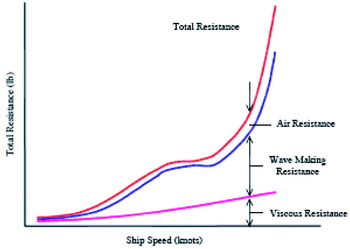
As a ship moves through calm water, it goes through forces acting in the opposite direction. The total sum of these forces through which the ship moves, is called the total resistance of the ship or “drag” and it is a function of hull form, ship speed, and water properties. This resistance increases as speed increases, but the resistance curve is not linear; in fact, resistance is proportional to the nth power speed, where “n” varies from a value of 2 at low speeds to a value of about 5 at high speeds. Many factors combine to form the total resistance force acting on the hull. Figure 1 shows how the magnitude of each main component of resistance varies with the ship speedFootnote 1. At low speeds viscous resistance dominates, and at high speeds the total resistance curve turns considerably upwards as the wave making resistance begins to dominate.
Main components of hull resistance as a function of the ship speed. Drawing: author.

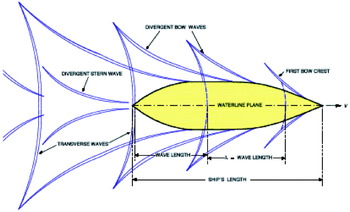
A ship hull, being normally of a rather complex shape, will generally produce a wave pattern which can be broken down into characteristic wave systems: the bow and stern divergent waves and the transverse waves (see Figure 2). All these systems will be in interference with one another, and the success of a particular hull design can usually be judged by how well the designer has been able to produce a favourable interference (wave cancellation)Footnote 2. In addition to the wave interference that exists among the various wave systems produced by the parent hull form itself, further interference can be affected by the introduction of appendages. In developing an efficient hull form, the naval architect automatically provides beneficial interference among the bow, stern and transverse wave systems; and the bulbous bow stands out as a prime solution, being the only appendage form that has so far found general usage in practical hull designs. This is mainly an attempt to reduce the wave making resistance, and bulbous bow optimization is one of the largest contributors to ship resistance reduction. A detailed shape achievement based on wave pattern calculations is possible with current capabilities of computational fluid dynamic (CFD) methods. Analyses like these, performed at different drafts and different speeds of the operational profile, as well as at different trim conditions created owing to bulb size differencesFootnote 3, help in the selection of the optimum bulb and can result in substantial fuel savings each year.
The divergent and transverse wave system patterns generated by a ship ( ). Drawing: author.

Experimentally, the benefit of a bulbous bowFootnote 4 for fast ships was well established by TaylorFootnote 5 – after carrying out a test in the early 1900's. This early form of the bulbous bow was installed for the first time on the battleship USS “Delaware” which entered service in 1910. On a theoretical basis, its effects were first studied by WeinblumFootnote 6 in Germany and by WigleyFootnote 7 in England thanks to the previous works by Sir Thomas Havelock in 1928 about the waves generated by a sphereFootnote 8. By applying the linear wave-resistance theory to the problem of wave cancellation, these researchers were able to essentially verify Taylor's predictionsFootnote 9. However, they did not proceed far enough in their investigations and research was undertaken by Takao InuiFootnote 10 and his Japanese colleagues in the late 1950's and early 1960's to produce and develop a new form of bulbous bow known as “Inui Bow”, which is now being generally referred to as a “waveless” hull and bulb combinationFootnote 11. It will become clear from the formal formulation of the problem, that a complete and exact wave cancellation is not achieved by the bulbous bow. However, it is possible for a given speed to reduce the wave resistance for the hull and bulb combination to a small fraction of that of the hull alone.
During the years of these pioneer works and the 1960's, the bulbous bow was quite successfully applied in ships with relatively high speedFootnote 12. During this period, it could also be verified experimentally although not justified, the power saving obtained with the use of the bulbous bow in ships with a high block coefficient and with relatively slow speed such as oil tankers with a 0·85 block coefficient and with smaller than 0·2 Froude numbers. These results were explained by E. Eckert and S.D. SharmaFootnote 13, basing their opinion on the fact that the bulbous bow is completely different in two different types of ships. It works by diminishing the bow wave system in fast ships, as mentioned before, and therefore, there is a reduction of the wave making resistance; otherwise, in slow ships, the breaking wave resistance diminishes when in ballast situation. In these ships, this means a 20% average of the total resistance. This component due to the formation of the bow breaking waves was discovered in 1969 by E. BabaFootnote 14. However, there is no unanimous opinion among the authors about specifically conferring the profitable effects of the bulbous bow on this type of ship. Some of them confer it partly on the fact that the bulbous bow induces a flow field in the area where the pressure responsible for the bow wave formation normally develops. As the wave-making resistance in these ships is only a small percentage of the total, it is thought to be due to the change in flow velocities which it creates over the hull which suggests that the bulb reduces frictional resistance as wellFootnote 15. However, this resistance is a direct function of the underwater lateral area and the bulbous bow increases it compared to a ship with no bulbous bow.
A bulb must be designed for a specific speedFootnote 16, since amplitudes of bulbFootnote 17 and hull waves vary in opposite directions when the ship speed is changed. However, an optimum bulb for a given speed will be effective, although to a lesser degree, over a small range of speeds about the design speed. Therefore, it is not necessary to operate the ship at the specified speed in order to get the benefits of the bulb. At considerably lower speeds than the design speed, the bulb is generally detrimental because the increase of the underwater lateral area of the bulbous bow increases the viscous resistance that becomes dominant as speed is reduced.
Finally, it is necessary to make two remarks in order to clarify the general statement that the bulbous bow generates a wave that interferes with the main bow wave:
▪ On one hand, for destructive interference with the main bow divergent wave to happen, the two waves must be about 180° out of phase, so the bulb should be projected half a wavelength ahead of the centre of the main bow wave; in most cases this is not feasibleFootnote 18 and only a partial cancellation is possible.
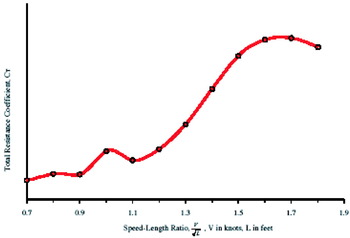
▪ On the other hand, the hollows in the total resistance/speed-length ratio curve (see Figure 3) are due to the bow divergent wave cancelling out the stern divergent wave pattern. So, suppressing the bow wave by interference with the bulb wave may actually increase the wave making resistance, i.e. it is the interaction between the bow and stern waves that creates the hollows or the humps on the resistance curve. This constitutes the most relevant aspect, especially taking into account that unlike warships whose maximum speed is determined by mission requirement, merchant ships are designed to travel at a speed corresponding to a hollow (or valley) in the resistance curve. In fact, the service speed of a merchant ship is usually below the first hump speedFootnote 19. Thus, even though the bulbous bow wave may not cancel out the main bow wave, the important thing is that it can move the centre of the forward wave system further forward and this may produce a more favourable phase difference between the forward and aft wave systems as they interact at the stern when the ship is moving at its design speed.
The typical relationship between CT and speed to length ratio where we can see the typical humps and hollows owing to the interaction between the bow and stern divergent waves. Drawing: author.

2. THE ESCORT TOWING METHODS IN USE BY AN ESCORT TRACTOR VOITH TUG
2.1. Introduction
As a consequence of many serious tanker accidents during the last two decadesFootnote 20, resulting in severe oil spills and catastrophes for the local environment, there is a pressure to improve the safety of maritime transportation. As some of the accidents have been caused by loss of either steering or propulsion close to the shore, one way to improve safety has been found in the introduction of escort towing in restricted waters. Escort towing is an emergency procedure. An escort tug can control tankers at high speeds in the event of a system failure, improving the possibilities of avoiding severe damage should the escorted tanker encounter technical problems. Normally, the escort tug will stay tethered behind the tanker without interfering with its passage; in case of emergency it will, however, be able to act immediately at the request of the tanker.
Basically, there are three types of escort tugsFootnote 21, all of them with omnidirectional propulsion:
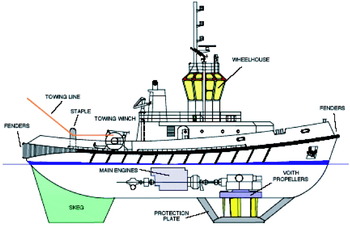
▪ The tractor Voith tug: Voith propulsion forward and towing point aft, i.e. it works stern or skeg first (see Figure 4).
▪ The tractor Z tug: azimuthing Z drivesFootnote 22 propulsion forward and towing point aft, i.e. it works stern or skeg first.
▪ The Azimuth Stern Drive (ASD): azimuthing Z drives propulsion aft and towing point forward, i.e. it works bow first.
In order to best make use of the unique manoeuvring capability of each tug, different tug operating modes are used. There are small differences in how each type of propulsion (Voith or Z drives) can affect the escort towing, especially regarding the most effective attack angle to the water flow in the indirect method, and to the propellers thrust orientation for both direct and indirect methods. So, as this work is about a tractor Voith tug, we explain only the methods in use by this type of escort tugFootnote 23.
A tractor Voith tug showing the most important parts. Drawing: author.

Time delays are critically important in determining the effectiveness or ineffectiveness of a manoeuvre or tug. Manoeuvres at higher tanker speeds are significantly more time-delay sensitive than they are at lower speeds. In the event of a failure, the vessel's quick recognition of and reaction to an emergency situation, together with the tug's rapid response, is critical in reducing track error. If the vessel were allowed to swing course unrestricted, the kinetic energy associated with the vessel's swing would rapidly overpower the tug's ability to control it. It is for this reason that to successfully use a tug to escort a ship, the most important critical factor to be taken into account is that the tug must be tethered (made fast) on the stern in restricted waters so that it will be more effective in an emergency situation by significantly reducing its response timeFootnote 24. All simulation and live trial data carried out clearly indicate that if the escort tugs do not begin to apply their controlling forces within about one minute, the off-track error of the ship will be extremely large. If the escort tug is tethered for the duration of the transit, the tug is immediately available to react in the event of an emergency situation on the shipFootnote 25.
With the intention of understanding the bulbous bow effect in the performance of a tractor Voith tug, it is necessary to analyse the escort towing methods in use nowadays by this type of tug tethered on the stern. As we will see, the performance of an escort tug is determined basically by the relative positions of the centres of three resultant forces:
▪ The Thrust Force: The Voith propellers are forward, and their location is approximately 0·25–0·30 Length of the Water Line (LWL) from forward.
▪ The Centre of Lateral Pressure (CLP): This is the centre of all the underwater parts, which resists a sideways movement of the ship, i.e. it is the point of application of the force exerted by the incoming water flow over the underwater hull of the tug. It is not stationary, but peripatetic and its position mainly depends on the angle of attack of the incoming water flow and the underwater hull form and area. When the water flow towards a tractor tug comes from abeam, the CLP generally lies behind amidships, approximately closer to 0·4 LWL from aft. On the other hand, when the tug turns with its bow into the direction of the water flow, the CLP moves forward approximately to 0·5 LWL.
▪ The Towing Point: In an escort tractor Voith tug the towing point is aft and it is the point from where the line goes in a straight line from the tug toward the ship. Therefore, it is not the towing winch, but the staple that is more aft. The towing point is usually placed at about 15% the LWL from the stern of the tug and it generally lies just above the middle of the skegFootnote 26. This results in an equilibrium angle of about 30 degrees between the centreline of the vessel and the inflow angle for maximum steering forces and of about 60 degrees for maximum braking forces. At this attitude the tractor tug hull is essentially balanced and very small tug steering forces are needed to maintain equilibrium.
2.2. The direct escort towing method
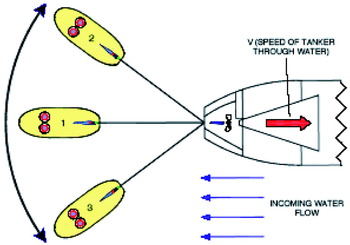
The direct method is an escort towing technique which is defined as a method of operation by which a towing vessel generates towline forces only by thrust at an angle equal to or nearly equal to the towline. This escort towing method is carried out by a stern tug on a line at low speeds, where the tractor simply pulls on its line in the required direction either to give steering assistance and/or to control the ship's speed to create retarding and/or steering forces for the vessel (see Figure 5). As soon as the ship gathers speed in order to be handled, the thrust generated by this method becomes less effective and it finally approaches zero. The speed at which direct steering force becomes zero depends on various parameters such as power, propeller position, underwater lateral resistance, centre of lateral resistance, and stability of the tug. This method can also be used to create drag for the vessel so that eventually it can increase its main engine rpm and gain increased rudder power or avoid stopping and starting its diesel engine. The reason is that as speed decreases, the lift generated by the incoming water flow over the rudder also decreases; but if we can increase the propeller rpm without increasing speed, the stronger propeller discharge current flowing over the rudder with an attack angleFootnote 27 increases the ship's manoeuvrability at slow speeds, i.e. with the drag created by the escort tug, the ship has a lesser headway and more manoeuvrability than without it. This is a very important aspect as a ship transits restricted waters when the speed is the most important factor to generate interactions (squat, interaction ship-to-ship, and the bank effect – the bow cushion and stern suction). So, this is normally used in restricted waterways to let the vessel increase its manoeuvrability while limiting its speed. This type of assistance is known as dynamic ship assist operations in the escort towing slang. The difference between escort towing and dynamic ship assist is that dynamic ship assist is not an emergency procedure, but the tug acts as an improvement to the rudder of the assisted vessel. In escort towing, the task of the tug is to brake or steer the escorted vessel without any danger in case of a technical failure. In dynamic ship assist, the tug will actively take part in the manoeuvring of the assisted vessel. Dynamic ship assist can successfully be used on large vessels in tricky channels, where current would make the channel impossible to negotiate without extra steering power. Both, escort towing and dynamic ship assist are carried out at rather high speeds, i.e. 6 to 10 knots, sometimes even more. That is why the requirements for a tug designed for dynamic ship assist are the same as for an escort tug.
Tractor tug escorting by the direct method. Drawing: author.

2.3. The indirect escort towing method
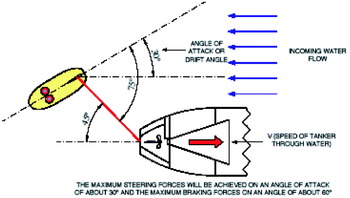
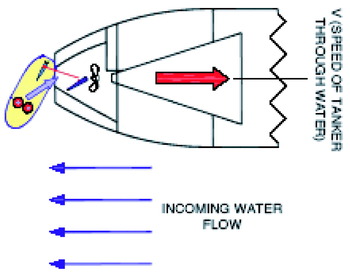
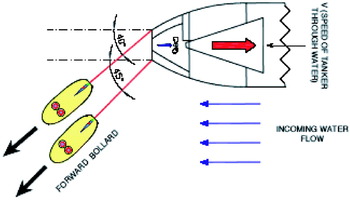
The indirect method is applied by a stern tug on a line at speeds higher than five to six knots. With this towing method, the tug makes use of the hydrodynamic forces created by incoming water flow on the tug's skeg and underwater body. This generates towline forces by a combination of thrust and hydrodynamic forces resulting from a presentation of the towing vessel at an oblique angle to the towline, thereby braking and controlling the motion of an escorted vessel. To perform this manoeuvre (see Figure 6), the tractor turns its working end (stern or skeg first) in the direction the force vector is desired and takes its line to a predetermined angle to the vessel's heading (usually the towline will be placed at a 45° angle to the ship's centreline). Once in position, the tractor places its hull at an effective attack angleFootnote 28 to the water flow in order to generate steering and/or braking forces. The water flow against the tug's skeg and hull creates greater line pull than the tug itself could produce with its engines. These forces are a function of the speed through the water, the design of the tug's skeg and hull form, and the forces applied by the tug's propulsion units. The forces generated with indirect towing increase with speed through the water, first exceeding the tug's mechanical forces at about 6 knots. At the high end of the ship assist speeds -at about 10 knots- the indirect method forces may exceed the bollard pull that the tractor can produce, being up to twice the tractor's rated static bollard pull.
Tractor Voith tug escorting by the indirect method. Drawing: author.

During indirect method operations, the tractor propulsion system is used to provide steering and orientation forces and moments. The entire tractor is therefore similar to a large active rudder. When the hull is directed with an angle of attack to the incoming water flow, lift and drag forces are generated and, together with the thrust of the propulsion units and the external tow rope pull, it can be brought into a state of equilibrium. The magnitude and direction of the force developed in the tow line, which is the useful product of the manoeuvre, is a function of the angle of incidence to the flow, the velocity and the apparent point at which the hydrodynamic forces act on the tug.
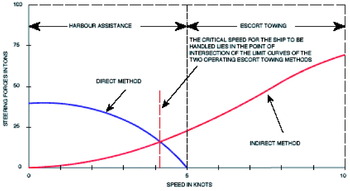
The maximum steering forces of the tractor Voith tug will be achieved on an angle of attack of about 30° and the maximum braking forces on an angle of about 60°Footnote 29. The aft lying towing point of the tractor tug and consequently the small distance between towing point (T) and centre of lateral pressure (CLP) implies that, taking into account the larger longitudinal lever arm, only a little crosswise steering power of a tug is needed to keep the tug in the most effective position to exert the highest steering forces to the assisted ship. This method is almost ineffective when the handled ship is at rest, but it increases considerably as the escorted ship speed increases. The critical speed for the ship to be handled lies at the point of intersection of the limit curves of these two operating methods, the direct one at slow speeds and the indirect one at higher speeds. It is at this point that the steering force the assistance vessel can develop is the lowest and it is a determining factor so as to establish the escort speed (see Figure 7). Nevertheless, the required escorting speed will be determined, on the one hand, by the speed at which the ship to be assisted has sufficient self-control and, on the other hand, by the requirement of staying sufficiently high above the “critical speed” so that adequate steering forces can be introduced from outside in case of emergency.
The steering forces versus tanker speed for a Voith Tractor Tug of 40 tons bollard pull using the direct and the indirect escort towing methods. The critical escort speed concept. Drawing: author.

Significant heeling can happen during indirect towing. The earlier absence of stability criteria, suitable guidelines or published data have led to some rule-of-thumb stability criteria, one of them being that the tug captain must be extremely careful not to trap the tug as it heels over and near the deck immersion edgeFootnote 30. Actually, relying on the deck immersion edge as a stability indicator may give the tug Captain a false sense of securityFootnote 31. Adequate stability is the result of residual righting energy and the range of stability after equilibrium, and it is in the stability topic where Classification Societies mainly concentrate their escort vessel rules, in which a high residual stability is used as a criterionFootnote 32.
2.4. Other escort towing methods used by an escort tractor Voith tug
There are other less important escort towing methods a tractor Voith tug can use and we are going to make a brief reference to them.
2.4.1. The powered indirect method
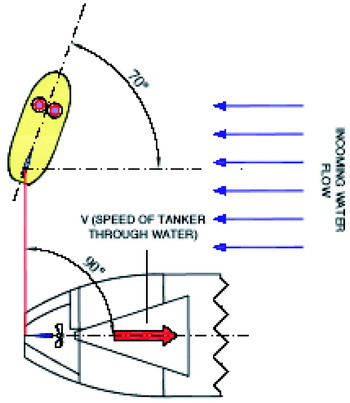
This method is a recent refinement of indirect towing and it has been referred to as “Powered Indirect Towing”. This manoeuvre seeks for the combination of the hull's ability to create towline forces with the mechanical ability of the tractor to improve performance while operating in the five to seven knot range. At these lower speeds, the tethered tractor tug veers out as if in the indirect method, but then it pushes into its towing line at full power. Depending on the speed of the vessel, the tug may be able to get to a position where the tow line is at a 90° angle to the vessel's centreline (all line forces would then be steering forces), with the tug at up to a 70° angle to the water flow (see Figure 8). In the 3–7 knot speed range, tests have shown that the forces created using this powered indirect method are greater than could be achieved by the tractor in the “pure indirect”. Furthermore, as the tractor can very quickly perform this manoeuvre, the created steering forces are faster to apply than with the direct method.
Tractor Voith tug escorting by the powered indirect method. Drawing: author.

2.4.2. The rudder tug method
In the rudder tug method, the tug is tight to the tanker's transom with its towline passing through its staple and up through the tanker's chockFootnote 33. The tug pushes against the tanker's transom and its line in order to provide steering forces. Taking into account the capabilities of this type of tug with omnidirectional propulsion, this is not a standard escort towing method and therefore, not a manoeuvre which is practised by this type of tug, because the direct or the indirect method are more effectiveFootnote 34 (see Figure 9).
Tractor Voith tug escorting by the rudder tug method. Drawing: author.

2.4.3. The tandem escort towing or team towing
This specific way of escorting is made by using two escort tugs as a tandem, both tethered, used at Long Beach Port, CaliforniaFootnote 35. It is called team towing or tandem escort towing, for which modern tractor Voith/tractor Z tugs or ASD tugs can be used. Specific tug procedures have been developed with this method, by which relatively small escort tugs can be used to handle heavy ships by using the direct method (see Figure 10). Escort speeds, while using the team towing system, are relatively low, generally about six knots, with a possible upper limit of eight knots, depending on tug design, crew training, and sea conditions to be faced during the escort.
The Tandem Escort Method with two Tractor Voith Tugs. Drawing: author.

3. THE ESCORT TRACTOR VOITH TUG WITH A BULBOUS BOW IN OPERATION: ANALYSIS OF THIS DESIGN OPTION UNDER THE INDIRECT ESCORT TOWING METHOD
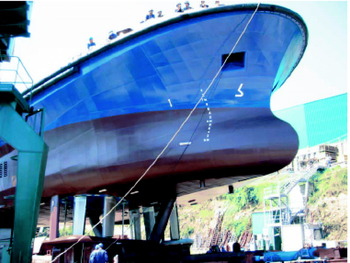
In general, taking into account that the escort speed should be higher than the critical speed (see Figure 7), this implies that if an emergency happens, the indirect method must be employed first in order to generate steering and/or braking forces to the escorted ship. This is why the indirect method is considered the most important escort towing method, since this is the only method in which the escort tug can produce high forces on the assisted vessel at high speeds. It is for this reason that the Classification Societies have chosen the indirect method as the operation for which they have drawn up rules and regulations as regards this type of shipFootnote 36. Accordingly, we now analyse, with the aid of figures and following a synthetic process, the consequences that the bulbous bow involves in an escort tractor Voith tug regarding its performance when using the indirect towing method. See Figure 11 in which the bulbous bow of the escort tractor Voith tug is clearly visible.
Photo showing the escort tractor Voith tug “VELOX” moments before the launching at the Spanish shipyard, Gondán S.A. on 03.07.04. This tug is the first of this type in the world that incorporates a bulbous bow. Photo: author.

3.1. The lateral balance of forces in the indirect method
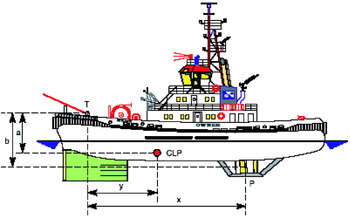
The lateral balance of forces is determined by the relative position of the three forces affecting a tug in the lateral plane. This balance controls how much hydrodynamic force produced by the tug hull is available to be used as towline force, and how much of it has to be used to compensate the forces produced by the thrusters (see Figure 12). According to the laws of physics, the towline force obtained increases when the ratio between the lever towing point-CLP (y in Figure 12) and the lever towing point-propellers thrust (x in Figure 12) decreases. With the aid of the Figure 12, this reasoning can be easily demonstrated mathematically. In force equilibrium, the following equations have to be fulfilled simultaneously:
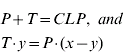
This pair of equations can be solved taking the towline force as a function of the hydrodynamic side force acting on the CLP and the lever arms of the forces acting on the towing point and propulsion thrust respectively:

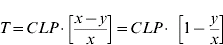
It can be easily seen that the maximum towline force [T] value is achieved when the ratio x/y is maximised.
The athwartships force balance of an Escort Tractor Voith Tug using the Indirect Towing method. Drawing: author.

3.2. The heeling moment of the towline force and the effect of the propeller thrust
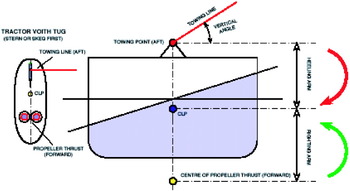
When towrope forces are acting athwartships at a lever arm above the CLP, they will create a heeling moment on the tug in the sense of direction in which the towline is working towards the escorted ship. When the tug's Captain applies the appropriate thrust to adopt the most effective relative position in order to achieve the steering and/or braking forces, the heeling moment generated by the towline is partially counteracted by the thrust acting with a component lever measured from the propeller thrust to the CLP, i.e. the propeller thrust generates a righting moment (see Figure 13).
Escort tractor Voith Tug: the propeller thrust counteracting the heeling moment generated by the towing line when using the indirect method. The towing point is acting transversely to the tug longitudinal axis. Drawing: author.

3.3. The internal righting moment of the tug to achieve the state of balance in response to the heeling moment generated as a result of the external forces at play
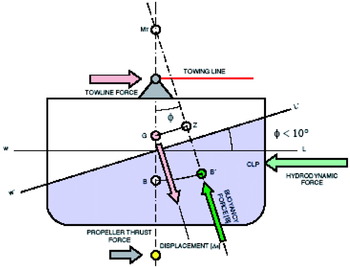
Up to this point we have analysed the external forces acting on the tug that a heel produces as a final result. In order to understand the effect of these forces on the static stability of the ship, it is necessary to correlate them with the correspondent internal righting moment of the tug, considering how the relative positions of the resultant weight of the tug [displacement “Δs”] and the resultant buoyancy force [B] change as the tug is heeled over. With the aid of Figure 14 we analyse this item for small heel angles Footnote 37 (<10°), showing a sectional view of a tug using the indirect method that is being heeled over due to the external moments analysed in previous paragraphs. It shows the relative positions of G and B′ for the tug and the internal righting arm “GZ”, i.e. the perpendicular distance between the action lines of the resultant weight and the resultant buoyant force. The displacement of the ship acts vertically downward at G. Only changes in the distribution of weight affect its location. If no weight changes happen, then no shifts in G will happen. The resultant buoyant force acts vertically upward at B. This centre is located at the centroid of the underwater volume of the ship. When the ship is heeled over by an external moment, the underwater shape changes and thus, the centroid B moves to B′. The point where the centre of buoyancy moves to, in relation to the centre of gravity, defines the stability characteristics of the tug as it is heeled over. In Figure 14 we can see that when the tug is balanced with no outside forces acting on it, G will be vertically aligned with B. As an external moment heels the tug to starboard (the resultant heel derived from the heeling moment generated by the towline force and the righting moment generated by the propeller thrust), G and B will become out of vertical alignment (B moves to B′) creating the righting moment [Δs.GZ] and achieving a state of balance with the tug heeled θ degrees to starboard in this case.
A sectional view of a tractor Voith tug using the indirect escort towing method and representing the external moments and the internal righting moment for heel angles <10°.

3.4. The escort tractor Voith tug performance and the importance of a suitable position of the centre of forces at play
The tractor Voith tug has the propellers thrust forward and its aft lying towing point, and the fact that there is consequently a small distance between towing point (T) and the CLP implies that a lesser crosswise steering power of a tug is needed to keep the tug in the most effective position to exert the highest steering and/or braking forces to the escorted ship (see Figure 12). The skeg of a Voith water tractor tug carries out an attack point shift of hydrodynamic forces (the CLP), towards the end of the ship opposite the propellers, in the direction of the towing point so that it minimises the lever between both of them; consequently, the necessary propeller thrust for the equilibrium of forces under each case of attack angleFootnote 38 will be considerably reduced in order to make use of more power margins available to produce the maximum steering and braking forces, especially at high escort speedsFootnote 39.
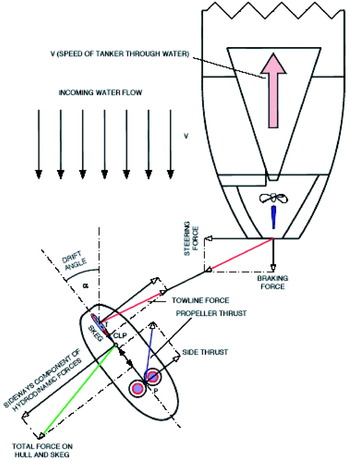
In Figure 15, we can see a sketch showing approximately the forces and the points of application being at play on an escort tractor Voith tug using the indirect method on an escorted ship tethered by the stern. The position of centres of these transverse forces and its respective lever arms are very important regarding the tug's performance. It can be appreciated that the propeller thrust keeps the transverse and longitudinal forces in balance, resulting from the hydrodynamic force on the hull and skeg and from the towline force on the towing point in order to achieve the most effective attack angle.
Escort towing: sketch of forces on an escort tractor Voith assisting a tanker in the indirect method. Drawing: author.

Now we are going to state the interrelationship between the lever arms of the forces at play and its consequences regarding the performance of the tug both in the transversal and vertical directions, given the longitudinal centres of forces (see Figure 16):
▪ In transversal direction, the higher the ratio between the lever arms “x” and “y” is, the less sideways thrust is needed to balance the hydrodynamic forces acting at the CLP and the higher the towline forces will be (see paragraph 3.1 where we particularly proved this assertion).
▪ In vertical direction, the larger the vertical distance between the towing point “T” and the CLP (lever arm “a”), the larger the heel will be. But at the same time, the larger the vertical distance between thrust propulsion force “P” and the CLP (lever arm “b-a”) is, the more heel is reduced by the sideways propulsion thrust (see paragraph 3.2 where we particularly proved this assertion).
In this sense, the clear objectives of a tug escort designer are in any case:
▪ Any required sideways thrust needed to balance the hydrodynamic forces acting at the CLP should be small.
▪ Regarding the heeling moments created, the towing point should be as low as possible because these heeling moments will be greater than the righting moment of the propeller thrust that partially counteracts it.
The relevance of suitable locations of CLP and towing point in a tractor Voith tug. Drawing: author.

Taking into account all the previous considerations, there is no doubt that the CLP should be as aft as possible (let us remember that this is one of the functions that is specifically carried out by the skeg in this type of tugs) and so, what happens if an escort tractor Voith tug has a bulbous bow? From Figure 16, it is clear that it moves the CLP forward and consequently, more propeller thrust is needed to achieve the balance of forces and less towline force is generated. From this point of view, the bulbous bow is detrimental to the performance of an escort tractor Voith tug using the indirect methodFootnote 40. The longitudinal lever arm “x-y” decreases and accordingly, to achieve the balance of forces in adopting the most effective relative position to the water flow, the propeller thrust must be greater and therefore also the righting moment generated by it. So, from this point of view, this design option may be an advantage in order to counteract the heeling moment. But we think that the stability should not be a problem to the tug in most situations taking into account its large initial (with a GM generally of about 3 metres or more) and dynamic stability.
4. CONCLUSIONS
The principle of the bulbous bow is that its geometry can be sized, shaped and positioned i.e. “tuned” to adjust/manipulate “humps” and “hollows” (where some wave-cancellations happen) in the total resistance curve. This generates a favourable interaction between the bow and stern divergent waves –modifying the divergent bow wave– in order to decrease the wave-making resistance within a small range of speeds, below which it is generally detrimental because the viscous resistance forces begin to be dominant. Although in the non-dimensional analysis, the different resistance components are assumed independent of each other, in practice, interaction between viscous and wave making resistances existsFootnote 41 and it is a very complicated matter that sets up the research topic in Marine Hydrodynamic and ship model test. So, although much is known about the bulb, many of its functions are still in dispute, especially its effect from the points of view of viscous resistanceFootnote 42, manoeuvrabilityFootnote 43, sea keeping abilityFootnote 44 and interaction – mainly as regards relative slow ships with a high block coefficient – between wave-making resistance and viscous resistance.
We may conclude that a bulbous bow is advantageous in an escort tractor Voith tug as in the case of the “VELOX”, the first tug of this type in the world to incorporate it, when the tug is in transit or when escorting the assisted vessel with no emergency (usually the escort speed is about 10 knots). This is due to the decrease in wave making resistance, the best sea keeping properties and the performance in waves, owing to the more flared bow. But from the point of view of the performance of the tug in the indirect escort towing method, it is detrimental because it moves the CLP forward with the consequences that we have analysed in this work. Therefore, it is a compromising situation between these two alternatives for the owner, and perhaps if the tug is expected to work in a large escort towing area with many days in bad weather conditions, the option of a bulbous bow may be a good solution.
 where v is the speed of waves in m/s and λ the wavelength in m, the wavelength in this case would be 41 m, and consequently the bulb should be about 20 m ahead of the main bow wave source and so, this is likely to be about 10 m forward of the bow's intersection with the waterline if the ship has a length of about 170 m, rather long perhaps for many ships of this size for the design speed.
 the ship is well below hump speed. Therefore, less horsepower is required to propel the ship. Less horsepower means smaller propulsion machinery, less fuel storage requirements, more cargo storage space, and therefore more chance to make money [Principles of Ship Performance. “Resistance and Powering of Ships” – Ch 07, pp. 7–23 web page: