INTRODUCTION
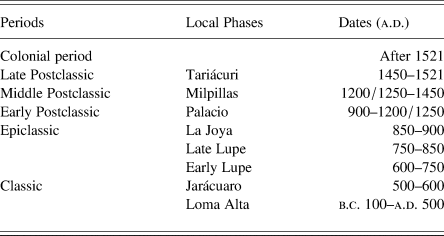
Recent work conducted in northern Michoacan has shed light on a specific and poorly defined time period for this region: the Early Postclassic (Table 1). This area of Mesoamerica is better known for the later Tarascan kingdom, whose apogee in the fourteenth and fifteenth centuries, has been the focus of most archaeological research (Pollard Reference Pollard1993, Reference Pollard and Enkerlin Pauwells2012; Pollard et al. Reference Pollard, Hirshman, Neff, Glascock, Dillon and Boxt2005). As exemplified by the studies led by the French Centro de Estudios Mexicanos y Centroamericanos (CEMCA) in the Zacapu Basin, 30 km north of the Tarascan core located in the Pátzcuaro Lake Basin, scholars have been interested in defining the origins of the Tarascan polity and the long-term history of societies in this area (Arnauld and Faugère-Kalfon Reference Arnauld, Faugère-Kalfon and Darras1998; Faugère-Kalfon Reference Faugère-Kalfon1996; Michelet et al. Reference Michelet, Arnauld and Fauvet-Berthelot1989; Migeon Reference Migeon1990). The extended surveys and excavations conducted (three phases beginning in 1983) have provided consistent information to define the chronological sequence and identify the major changes that occurred in the settlement pattern of the Zacapu Basin (Michelet Reference Michelet and Michelet1992). One of them is undoubtedly the urbanization of the Malpaís of Zacapu ca. a.d. 1250 (Forest Reference Forest2014).
Local chronology for the Zacapu Lake basin.

The Early Postclassic occupation remains under-represented compared to the widespread occupation of the Epiclassic period, however, and the highly nucleated population of the subsequent Middle Postclassic phase at the region (Forest Reference Forest2014; Migeon Reference Migeon1990; Pereira Reference Pereira1999). Consequently, the intermediate chronological phase (locally referred to as Palacio and ranging from a.d. 900 to 1200/1250; Table 1) is still being defined. Many aspects of the Palacio phase remain to be understood, such as the transitions from the earlier to the later phases, accompanying changes in settlement pattern and demographic estimates, and the social, political, and economic organizational structures.
Fieldwork conducted at the major and eponymic site of El Palacio (2010, 2012, 2017) produced new datasets enabling the discussion of novel research questions (Pereira and Forest Reference Pereira and Forest2010, Reference Pereira and Forest2011; Pereira et al. Reference Pereira, Forest, Michelet, Jadot, Barba, Faugère, Elliott and Manin2012, Reference Pereira, Michelet, Jadot, Manin, Elliott and Forest2013, Reference Pereira, Michelet, Forest, Dorison, Manin and Jadot2014). Among the data acquired is the discovery of a series of figurines (Jadot Reference Jadot and Pereira2013), known in the archaeological literature as Mazapan-style. Mazapan-style figurines have almost never been observed in this sector of Michoacan before and, more importantly, they constitute a strong and diagnostic marker of Early Postclassic cultural and economic dynamics among different regions from the Pacific Coast to the Bajío, as well as central Mexico (Grosscup Reference Grosscup1961; Jiménez Betts Reference Jiménez Betts2018; Solar et al. Reference Solar, Magriñá and González2011; Stocker Reference Stocker and Diehl1974, Reference Stocker1983; among others).
The presence of this corpus at El Palacio, therefore, raises questions concerning many of our hypotheses regarding this important but understudied settlement and is critical to our understanding of its interregional cultural and economic connections, as well as the role of this site at local and extra-local scales during the Early Postclassic period. First, the analyses of the technological and iconographic characteristics as well as the context of discovery of the collection of Mazapan-style figurines at El Palacio allow us to provide new insights into the interpretation of these artifacts for the Early Postclassic period. We examine their production based on manufacture process (material, technique, and iconography), which enable us to discuss their nature in a cultural interaction perspective (e.g., adaptation, copy, and import, as suggested by Testard [Reference Testard2014, Reference Testard2018]). Then, we discuss their possible functions and context of use, i.e., some aspects of their social lives (Appadurai Reference Appadurai1986; Overholtzer and Stoner Reference Overholtzer and Stoner2011). Second, the systematic review of collections from other regions of Mesoamerica and their comparison with the figurines from El Palacio allow us to offer a new interpretation of El Palacio's chronological and interregional place within the Postclassic world.
BACKGROUND
Early Postclassic in Northern Michoacan
The Early Postclassic (ca. a.d. 900–1200) is characterized by the continuation of a period of aridity that began ca. a.d. 800–900 and could be implicated in the abandonment of north-central Mesoamerica, as suggested by Brown (Reference Brown1992), Elliott (Reference Elliott and Badal2012), Metcalfe (Reference Metcalfe2006), Metcalfe and Davies (Reference Metcalfe and Davies2007), and confirmed recently by Domínguez and Castro López (Reference Domínguez, López and García2017). The important settlements that flourished in the Bajío and northern Michoacan during the Epiclassic (ca. a.d. 700–900) disintegrated and populations became almost unrecognizable in the archaeological record (Beekman Reference Beekman2010). Recently, Jiménez Betts (Reference Jiménez Betts2018) synthesized the three major characteristics of the Early Postclassic period in West Mexico. The first is “the demise of the Epiclassic period Inland Northern Network,” the second is “the rise of the Aztatlán network along the Pacific Coast” (see also Beekman Reference Beekman2010; Ramírez Urrea Reference Ramírez Urrea2005), and, finally, the third is “an unresolved problem concerning the nature of Toltec presence in this region of Mesoamerica” (Jiménez Betts Reference Jiménez Betts2018:136–137). This latter issue is related to chronological questions (the anteriority of Tula over many settlements interpreted as either influenced or ruled by this Toltec capital) as underlined by Smith (Reference Smith, Kowalski and Kristan-Graham2007:580–584) and a long historiography that has portrayed Tula as the center of a powerful, expansionist Toltec polity. Today, several scholars privilege a nuanced vision, where varied expressions of central highlands models (the Toltec state included) have been formulated by local polities, as part of new political legitimization strategies (Testard Reference Testard2014:128). Consequently, the presence of artifacts or architectural traits that have been traditionally associated with the direct, top-down influence of Tula has to be considered carefully and with strict chronological control.
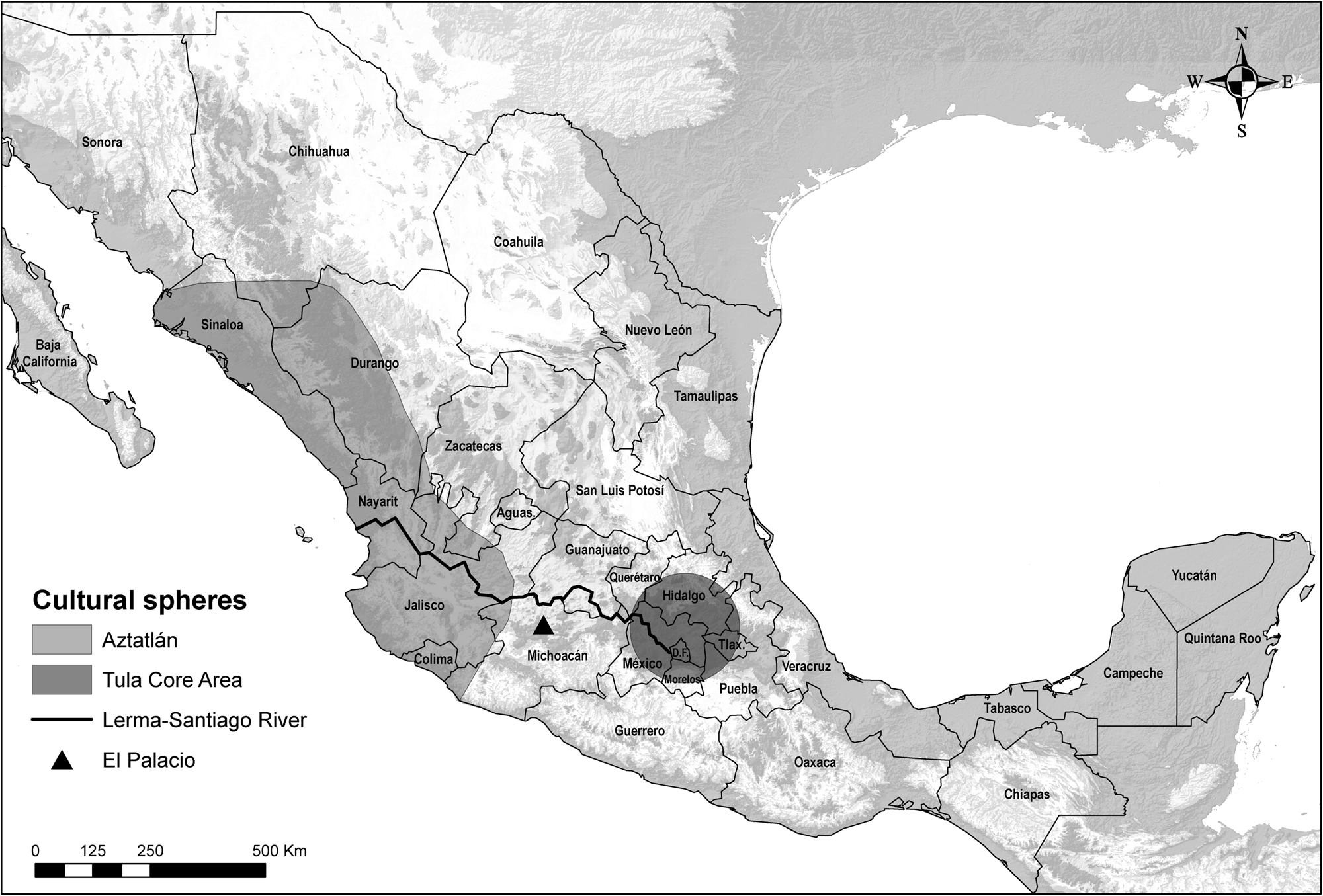
In this complex and shifting cultural and political context, the north-central region of Michoacan has a peculiar and yet critical intermediate position as it is located south of the Bajío and approximately halfway between central Mexico/Tula and the Pacific Coast (Figure 1). Darras and Faugère point out that the Lerma-Santiago River and its tributaries have played a critical role in interregional connections since the Preclassic period, providing long-distance, navigable routes between central Mexico (where the Lerma River originates in the Toluca Valley), the Chapala Lake basin and the Coast of Nayarit, and where the Santiago River ends, near San Blas (Darras and Faugère Reference Darras, Faugère and Faugère2007; Faugère-Kalfon Reference Faugère-Kalfon1996:138). The Angulo River, a direct tributary of the Lerma, runs north-to-south from the Lerma to the north-central region of Michoacan. The Zacapu Basin would, therefore, have been strongly integrated into the interregional dynamics related to this riverine route, as suggested by the ceramic data showing similarities between the north-central Michoacan and the central highlands since the end of the Classic period (Jadot et al. Reference Jadot, Pereira, Neff and Glascock2019; Michelet Reference Michelet, Pomédio, Pereira and Ferńndez Villanueva2013:98–99; Michelet and Pereira Reference Michelet and Pereira2000; Michelet et al. Reference Michelet, Arnauld and Fauvet-Berthelot1989; Pollard Reference Pollard, Williams, Mestas and Esparza2009:228–229).
Location of El Palacio in northern Michoacán and the two large Early Postclassic cultural spheres of Aztatlán and Tula. Map by Forest.

Archaeological research conducted in the Zacapu Basin has documented important changes in settlement pattern, population mobility, and sociopolitical organization from the Late Classic to the Late Postclassic. Among the observations made, the Early Postclassic period (local Palacio phase, a.d. 900–1200/1250; Table 1) is characterized by a major decrease in the number of settlements and in the populations of the region. This phenomenon is partially explained by the eruption of the Malpaís Prieto volcano ca. a.d. 830–960 (Mahgoub et al. Reference Mahgoub, Reyes-Guzmán, Böhnel, Siebe, Pereira and Dorison2017). In contrast, the later Middle Postclassic period (local Milpillas phase, a.d. 1200/1250–1450: Table 1) is characterized by the massive urbanization of the western sector of the basin, most likely resulting from the arrival of new pre-Tarascan populations in the region (Arnauld and Faugère-Kalfon Reference Arnauld, Faugère-Kalfon and Darras1998). Therefore, our current understanding of the Early Postclassic occupation in the Zacapu Basin is derived from a small number of centers that persist and/or rise, such as El Palacio and San Antonio Carupo, after the disintegration of larger Epiclassic settlements (Faugère-Kalfon Reference Faugère-Kalfon1991, Reference Faugère-Kalfon1996). If San Antonio Carupo still presents architecture related to the Bajío cultural landscape, the characteristics of the Early Postclassic settings at El Palacio remain peculiar. The archaeological settlement discussed here, El Palacio, is located on the southeastern sector of a lava flow formation that is today called the Malpaís of Zacapu. As it dominates the modern town of Zacapu, El Palacio has been interpreted as the pre-Hispanic Çacapo mentioned in the Relación de Michoacán: the first place in Michoacan “conquered” by the founding Tarascan lineage, the Uacúsecha (Michelet et al. Reference Michelet, Pereira, Migeon and Manzanilla2005). As part of the Tarascan foundation myth, El Palacio was explored on multiple occasions (Caso Reference Caso1929; Fernández Villanueva Medina Reference Fernández Villanueva Medina1992; Freddolino Reference Freddolino1973; Lumholtz Reference Lumholtz1904) before being integrated into a wide, regional study led by the CEMCA (1983 to 1996) and resulting in the first regional chronological sequence (Arnauld and Faugère-Kalfon Reference Arnauld, Faugère-Kalfon and Darras1998; Michelet et al. Reference Michelet, Arnauld and Fauvet-Berthelot1989). As it was first detected in the stratigraphy of El Palacio, the Early Postclassic occupation of the area became known as the Palacio phase. Various hypotheses have been constructed regarding the site's population and its significance, including the co-presence of various populations at El Palacio (Lumholtz and Hrdlička Reference Lumholtz and Hrdlička1898; Pereira Reference Pereira1999:166–168), the transformations of space and functions of the site (Migeon Reference Migeon1990), and its potential major role at both local and regional scales (Michelet Reference Michelet, Mastache, Cobean, Cook and Hirth2008). In the absence of a systematic survey and excavation undertaken at the site, however, these propositions remained untested.
In 2010, Pereira (Centre National de la Recherche Scientifique [CNRS]) initiated a new series of investigations in the region (Project Uácusecha) in order to further define the pre-Tarascan urbanization of the Malpaís of Zacapu and its associated material culture (Dorison Reference Dorison, Binnberg, Marini and O'Sullivan2017; Forest Reference Forest2014, Reference Forest, Albiez-Wieck and Roskamp2016; Jadot Reference Jadot2016; Manin Reference Manin2015; Pereira and Forest Reference Pereira and Forest2010, Reference Pereira and Forest2011; Pereira et al. Reference Pereira, Forest, Michelet, Jadot, Barba, Faugère, Elliott and Manin2012, Reference Pereira, Michelet, Jadot, Manin, Elliott and Forest2013, Reference Pereira, Michelet, Forest, Dorison, Manin and Jadot2014, and Reference Pereira, Michelet, Dorison, Darras, Faugère, Barba, Stevanato, Quezada and Blanca2015). Under the auspices of this larger research project, several test pits were both excavated and extended in the central area of the site of El Palacio (Forest and Jadot Reference Forest and Jadot2018; Forest et al. Reference Forest, Quezada, Castañeda and Pereira2018; Jadot Reference Jadot2016). The Early Postclassic strata from these excavations yielded an artifact type that had hitherto been unknown in this area—molded figurines, often referred to as Mazapan-style figurines.
Mazapan [-Style] Figurines
Mazapan, from Teotihuacan to Tula
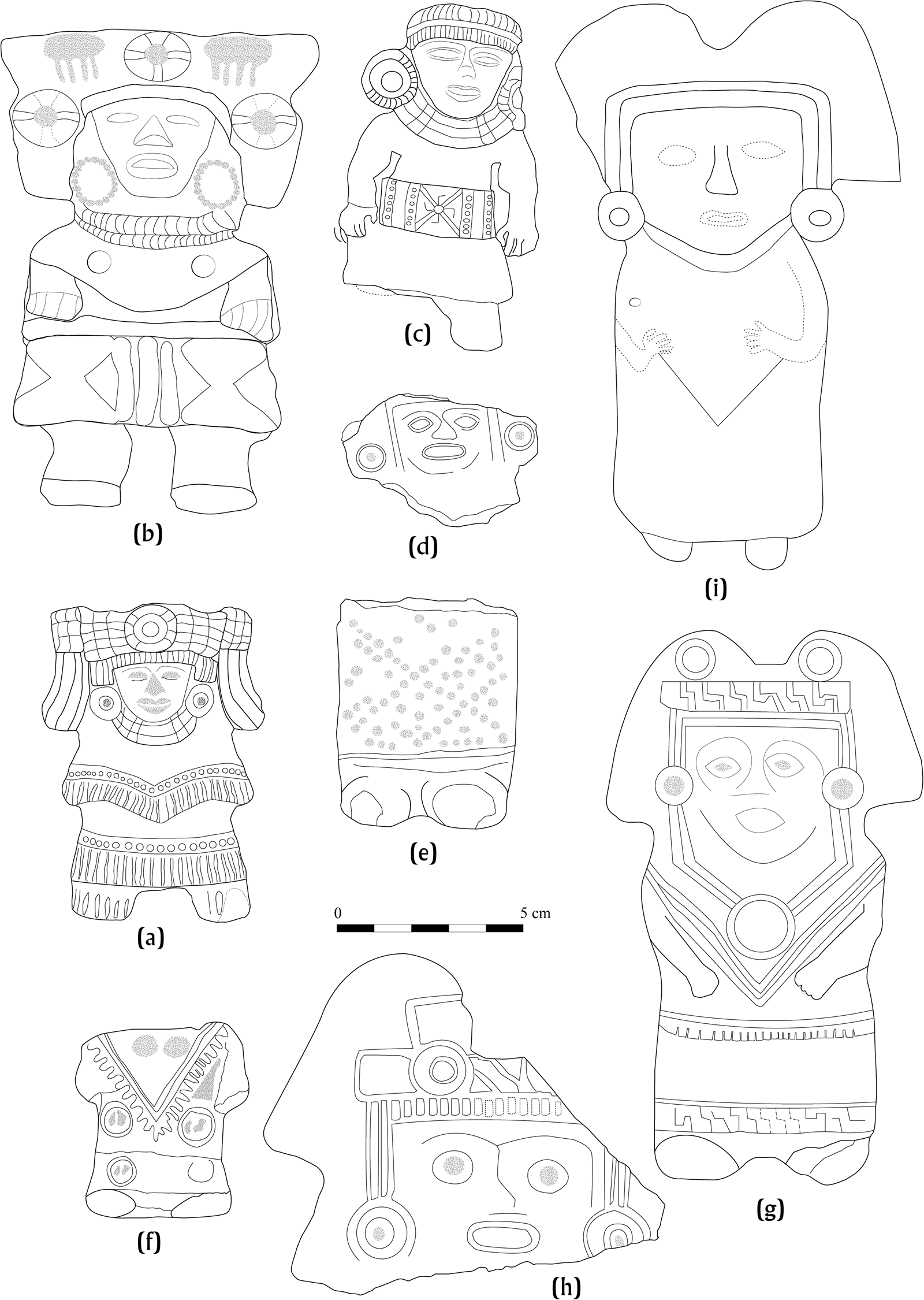
As synthesized by Crider (Reference Crider2013), “Mazapan” refers to both a ceramic complex and an archaeological phase that directly succeeded the Epiclassic in the stratigraphy of the Basin of Mexico. Rattray Childs (Reference Rattray Childs2001:435) defines the Mazapan phase at Teotihuacan between a.d. 900 and 1150. The typical Red-On-Buff ceramic complex (consisting of three wares) was initially identified by Vaillant (Reference Vaillant1932) at San Francisco Mazapa (Teotihuacan) in archaeological strata located between Teotihuacan strata and Aztec strata. The typology was then finalized by Linné (Reference Linné2003 [1934]). Associated with the Mazapan ceramics was a specific type of molded anthropomorphic figurine, examples of which were then named Mazapan figurines (Figures 2c–2d). After being observed at San Francisco Mazapan, the complex was identified systematically at different sites in the northern half of the Basin of Mexico (Figures 2d, 2e, and 2f; Linné Reference Linné2003 [1934]; Vaillant Reference Vaillant1938) and, according to Vaillant (Reference Vaillant1932:488), filled “the gap in the history of the Valley.” He also suggests that the frequent association of Mazapan ceramics and figurines with Plumbate and Fine Orange wares was evidence of interregional interactions between the Basin of Mexico and other regions of Mesoamerica (Vaillant Reference Vaillant1938:544). In the next decade, Acosta (Reference Acosta1940) associated the Mazapan complex with Tula, the major Early Postclassic city at that time in central Mexico, although the diagnostic Red-On-Buff wares were scarce at this site (Figure 2e; Scott Reference Scott1993:4). From this point on, the Mazapan figurines were considered a Toltec production and came to be integrated into what is called the Toltec “package” or “ritual set” (Diehl Reference Diehl and Rice1993:279). Consisting of a series of architectural patterns and ceramic traits associated with the Late Corral (a.d. 900–950) and Tollán (a.d. 950–1150/1200) phases, the Toltec “package” was considered to be evidence of a Toltec intrusion, before being finally dissociated from it by Healan and Stoutamire (Reference Healan, Stoutamire and Healan1989:235). This debate is one facet of a wider, complex, and ongoing scholarly discussion concerning the nature of the Toltec horizon and/or intrusion in Mesoamerica (Smith Reference Smith, Kowalski and Kristan-Graham2007). Mazapan-style figurines may have bearing on this debate as they are often found outside of the Toltec core area. Stocker was the first to distinguish the figurines produced at Tula between a.d. 900–1200, referred to as “Tula culture Mazapan figurines,” from all figurines produced elsewhere, termed “Mazapan figurines” (Stocker Reference Stocker and Diehl1974, Reference Stocker1983; see also Edwards and Stocker Reference Edwards, Stocker, Stocker and Otis Charlton2001), or “Mazapoide” (Guevara Chumacero and Rojas Gaytán Reference Guevara Chumacero and Rojas Gaytán2004:84).
Mesoamerican molded feminine figurines from the Classic to Early Postclassic periods. (a) Xolalpan figurine from Teotihuacan (Solís Reference Solís2009:Catalogue No. 202). (b) Epiclassic figurine from Xochitecatl, Tlaxcala (Proyecto Xochitécatl INAH-UNAM, INAH Catalogue No. 10-547438). (c) Mazapan figurine from Teotihuacan (Museo de sitio de Teotihuacan, INAH Catalogue No. 10-336516). (d) San Francisco Mazapan figurine (Vaillant Collection, American Museum of Natural History, New York, Catalogue No. 30.1/ 2935). (e) Mazapan figurine, type 3, from Tula, Hidalgo (Stocker Reference Stocker1983:64, Plate 44A). (f) Mazapan figurine from Chiconautla, Estado de México (Stocker Reference Stocker1983:113, Plate 72). (g) Mazapan figurine from Punta Mitla, Nayarit (Solar et al. Reference Solar, Magriñá and González2011:66c). (h) Mazapan figurine from Amapa, Nayarit (Grosscup Reference Grosscup1961:393, Figure 1A). (i) Mazapan figurine from Tacachico, El Salvador (Bruhns and Amaroli Reference Bruhns and Amaroli2006:31, Figure 3). Drawings by Testard and Forest.

Location of Mazapan-Style Figurines
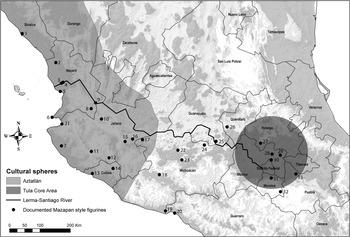
Stocker (Reference Stocker1983:10) observes that “unlike Mazapan ceramics, Mazapan figurines are not confined to the Central Basin.” Figure 3 maps the mention of Mazapan-style figurine locations available in publications. The artifacts have been collected in the Tula region in Hidalgo (Healan Reference Healan2012:70; Healan and Stoutamire Reference Healan, Stoutamire and Healan1989:213; Hernández Reyes et al. Reference Hernández Reyes, Cobean, Mastache and Suarez1999:77; Stocker Reference Stocker and Diehl1974, Reference Stocker1983) and have frequently been recovered in the western states of Jalisco (Beltrán Medina and González Barajas Reference Medina, Carlos, Barajas, Merino Carrión and Cook2007; Kelly Reference Kelly1949; Meighan and Foote Reference Meighan and Foote1968; Solar et al. Reference Solar, Magriñá and González2011), Querétaro (Valencia and Bocanegra Reference Valencia and Bocanegra2013, cited in Jiménez Betts Reference Jiménez Betts2018:156), Nayarit (Figures 2g and 2h; Gifford Reference Gifford1950; Grosscup Reference Grosscup1961; Meighan Reference Meighan1976; Solar et al. Reference Solar, Magriñá and González2011), Colima (Czitrom Reference Czitrom1978; Jarquín Pacheco and Martínez Vargas Reference Jarquín Pacheco, Vargas, Merino Carrión and Cook2007), Guanajuato (Brigitte Faugère, personal communication 2018); Michoacan (Begun Reference Begun2008; Agapi Filini, personal communication 2018; Jadot Reference Jadot2016; Kelly Reference Kelly1947; Lister Reference Lister1949; Michelet and Pereira Reference Michelet and Pereira2000), the Amatzinac Region of eastern Morelos (Hirth Reference Hirth1977:44), Guerrero (Guevara Chumacero and Rojas Gaytán Reference Guevara Chumacero and Rojas Gaytán2004; Mountjoy Reference Mountjoy, Foster and Gorenstein2000; Pulido Méndes Reference Pulido Méndes2008), and Sinaloa (Grosscup Reference Grosscup1961; Lister Reference Lister1955).
Locations of published Mazapan-style figurines in central and West Mexico: (1) Mazatlan; (2) San Felipe Aztatan; (3) Amapa; (4) Santiago Ixcuintla; (5) Chalcalilla-San Blas; (6) Punta Mita; (7) Tomatlan; (8) Ixtlan del Rio; (9) La Playa; (10) Etzatlan; (11) Los Valentines and El Coralillo; (12) Tuxcacuexco; (13) Playa del Tesoro; (14) La Campana; (15) La Peña; (16) Tizapan; (17) Cojumatlan; (18) Apatzingan; (19) Don Martin; (20) Delta del Balsas; (21) Ixtapa; (22) El Palacio; (23) Urichu; (24) El Banco; (25) TR7; (26) El Cerrito; (27) Tula; (28) Xaltocan; (29) San Francisco Mazapa; (30) Chiconautla; (31) Yautepec; (32) Amatzinac; and (33) Cholula. Map by Forest.

Mentions of Mazapan-style figurines are relatively rare among collections from central Mexico, but specimens have been recovered in, for example, Xaltocan (Brumfiel and Overholtzer Reference Brumfiel, Overholtzer, Halperin, Faust, Taube and Guiguet2009:309), Cholula (Noguera Reference Noguera1954:154–158), and Cacaxtla-Xochitécatl (Serra Puche Reference Serra Puche2010, consulted by Testard). Figurines are also located in the States of Veracruz (Drucker Reference Drucker1943), Yucatán (in Mayapan, see Ruppert and Smith Reference Ruppert and Smith1954), and Oaxaca (Scott Reference Scott1993). Haberland (Reference Haberland and Michelet1989) and Bruhns and Amaroli (Reference Bruhns and Amaroli2006) note their presence in Early Postclassic contexts from El Salvador (Figure 2i). Finally, occasional occurrences of such figurines have been documented from more recent contexts in central Mexico (e.g., a.d. 1300 and 1425 in Xaltocan [Brumfiel and Overholtzer Reference Brumfiel, Overholtzer, Halperin, Faust, Taube and Guiguet2009:318]).
Categorization of the Figurines
The Mazapan-style figurines have been the object of very few specialized studies. Although they are mentioned in reports and published literature, there has been little effort at categorization. Further clarification of the spatial distribution of these figurines would necessitate a systematic review of all pertinent technical excavation reports. Two recent studies, however, have investigated these artifacts and pointed out their relevance to the study of the Early Postclassic. The synthesis by Solar and her colleagues (Reference Solar, Magriñá and González2011) is the contemporary reference when approaching these artifacts, their definition, and their interpretations, and Jiménez Betts (Reference Jiménez Betts2018:135–136, 151) integrated the occurrence of Mazapan-style figurines into his definition of the Aztatlán network. Both studies focus on artifacts found in West Mexico.
For the purposes of this paper, three points should be emphasized from the preceding review of our current understanding of the Mesoamerican data. First, the qualitative differentiation of Tula culture Mazapan figurines from those produced elsewhere is difficult to incorporate within a model proposing the direct transfer and adoption of a “Toltec package.” Second, the observation made by Stocker (Reference Stocker1983:10) about the figurines extending “into western and northwestern Mexico although in small quantities” appears to us to be an understatement. Mazapan-style figurines are encountered with greater frequencies outside of central Mexico than in the Tula region, and as distant as El Salvador. Finally, the broad acceptance of the Mazapan-style figurines as a strong marker of the Early Postclassic (a.d. 900–1200) period and an indicator of short- to long-distance interregional connections along the Trans-Mexican Volcanic Belt appears to be supported by both chronological and spatial contextual information.
Apart from Stocker's (Reference Stocker and Diehl1974, Reference Stocker1983) studies of the Tula figurines, however, no typology exists for these artifacts. Since the 1930s, archaeologists have identified “Mazapan figurines” in their collection based on generic features that are widely accepted (Solar et al. Reference Solar, Magriñá and González2011) without ever being systematic examined. This results in (1) a general absence of discriminating criteria for their description and classification, and (2) limited potential for their interregional comparison. Using published descriptions of Mazapan-style figurines (Edwards and Stocker Reference Edwards, Stocker, Stocker and Otis Charlton2001; Gifford Reference Gifford1950; Grosscup Reference Grosscup1961; Haberland Reference Haberland and Michelet1989; Noguera Reference Noguera1954; Scott Reference Scott1993; Solar et al. Reference Solar, Magriñá and González2011; Stocker Reference Stocker and Diehl1974, Reference Stocker1983), we constructed a comparative framework in order to better contextualize those examples recovered from El Palacio. Specimens described and documented within the literature suggest that a series of features, including gender, body positioning, clothing, and ornamentation, may aid in revealing both broad trends and local variations among Mazapan-style figurines, thereby contributing to our understanding of interregional interactions.
The Characteristics of Mazapan and Mazapan-Style Figurines
Certain characteristics (e.g., ceramic fabrics) of the Mazapan and Mazapan-style figurines are rarely, if ever, reported, thus severely limiting direct comparison of many aspects of the manufacture and production location of the figurines. Others are more systematically mentioned, however, and they form a base to initiate a comparison between collections across time and space in Mesoamerica, including the collection from El Palacio. A number of features shared across all Mazapan-style figurines confirm that they belonging to the same broad artifact type.
Although Mazapan-style figurines are always molded, there is a wide range of variation exhibited by the final products. They all present a V-shaped face and a generally rectangular body with no underlining of the waist, neck, or hips. Stocker suggests that figurine form evolved from an Epiclassic style to the typical Postclassic Mazapan style and Tula culture Mazapan figurines through a complete flattening of the figurine profile, a general geometrizing of traits, and very coarse ceramic fabrics. Female representations differ from those of males through the representation of the breast. Every known example is wearing long skirts (typically exhibiting complex patterns), earrings, and headdresses. The latter can take on a variety of shapes (one, two, or three “lobes” with two being the most common). The ornamentation depicted on figurines is likewise variable. Arm position varies, often folded up with the hands placed on the belly, the ribs, or the breast, but at times left pendant along the side of the body. Feet are sometimes absent, although more often represented by two excrescences protruding from the lower line of the clothing. The two feet can be flat (round or square and aligned with the body) or pointed (round and forming a 90° angle with the body).
There is some regional differentiation evident in artifact form. Figurines from both Tula and central Mexico are made in both female and male forms, while examples from West Mexico and El Salvador are exclusively female when gender is recognizable. Regarding clothing, we note that only female representations from West Mexico, the Basin of Mexico, and El Salvador are wearing the traditional quechquemitl to cover their shoulders and part of their breast. The Nahuatl term quechquemitl refers to an exclusively feminine piece of clothing, made up of two rectangles of cloth and assembled in such a way that they form a V with the neck (Anawalt Reference Anawalt, Boone and Benson1984:171; Testard and Serra Puche Reference Testard, Serra Puche, Faugère and Beekman2019). Although present on most of the Epiclassic figurines found at Tula, the quechquemitl seems to completely disappear from the Tula culture Mazapan figurines produced at Tula in the Early Postclassic (Figure 2b; Stocker Reference Stocker1983:95), an observation that clearly distinguishes collections from Tula and the rest of central Mexico. Ornamentation, too, varies by region: Mazapan-style figurines recovered in West Mexico wear a circular pendant or pectoral around their neck; such ornamentation has been observed less frequently in the Salvadorian examples and appears to be entirely absent in the Tula collection and central Mexico. In contrast, body position appears to be unrelated to the geographical region of origin.
In addition to these formal attributes, figurines also exhibit regional variability in terms of their surface treatment and evidence for suspension. Paint, while always applied post-firing, varies in the colors employed. Artifacts from Tula show blue, black, and white, while those from central and West Mexico also use yellow (Meighan and Foote Reference Meighan and Foote1968:Figures 35–36, Plates 20A–20G, cited in Haberland Reference Haberland and Michelet1989:86). In contrast, figurines from El Salvador do not clearly exhibit any preserved painting. Additionally, small perforations (5 mm on average) that might have been used for suspension have been observed in the axillary area among figurines recovered from central and western Mexico and in the headdress in specimens from western Mexico. Such perforations are absent among the Tula and El Salvador examples. This suggests that, in addition to regional styles expressed by the difference in gender, clothing, and ornamentation, there may also have been regional differences in how such figurines were used and/or displayed.
While the use of molds to produce the Mazapan-style figurines is well documented by the final artifacts themselves, the molds are either completely absent from the archaeological reports or never illustrated. The presence of molds is mentioned in Jalisco at Amapa (Grosscup Reference Grosscup1961:392), Ixtapa (Mountjoy Reference Mountjoy, Foster and Gorenstein2000: Figure 7.12), and at Tula (discovered in surface collections and associated with multiple fragments of figurines), demonstrating that this type of artifact was indeed produced at these three locations (Healan Reference Healan2012:70; Healan and Stoutamire Reference Healan, Stoutamire and Healan1989:213, Figure 13.12; Hernández Reyes et al. Reference Hernández Reyes, Cobean, Mastache and Suarez1999:77, Figures 19 and 20; Stocker Reference Stocker1983:281–282). Stocker (Reference Stocker1983:281) notes, however, that, although a high concentration of figurines fragments was encountered during the Tula Urban Survey, the scarcity of molds (one for 38 fragments of figurines) makes the identification of production areas speculative.
Finally, Solar et al. (Reference Solar, Magriñá and González2011) point out a fundamental gap in our knowledge of these artifacts, namely that the available literature makes no mention of figurines found in primary context. Most collections appear to be composed of highly fragmented objects found on the surface, in refuse pits, or in architectural backfills (Solar et al. Reference Solar, Magriñá and González2011:69). It is also very likely that archaeologists have not systematically reported the functional and stratigraphic contexts of Mazapan-style figurines. The fact that these figurines are rarely, if ever, found in their primary depositional context and instead are recovered from middens and backfill deposits has implications for our interpretation of these materials and requires further attention. While Stocker (Reference Stocker and Diehl1974:55) interprets the systematic fragmentation of the figurines at Tula as the result of a breaking ritual, functional interpretations of these figurines before such ritual events remain largely hypothetical.
The discovery of Mazapan-style figurines at El Palacio and their significance in the regional and Mesoamerican frameworks described above question our understanding of the underlying sociopolitical mechanisms of the Early Postclassic. Precisely because of their wide distribution, manufacturing technique (molding), formal and iconographic characteristics, and, finally, their (secondary) depositional context, these artifacts can reveal the different ways in which El Palacio integrated interregional sociopolitical and ritual networks. By questioning the nature of these figurines and categorizing them as adaptations, copies, or imports, we might be able to approach the manipulative processes involved in their production, as well as the different intentionalities of an individual or a group. Once the category has been defined, it can be correlated with a specific anthropological phenomenon of cultural interaction (e.g., indirect diffusion, occasional contact, itinerant craftsmen, religious mission, among others; Testard Reference Testard2014:76–86, Reference Testard2018). The analysis and characterization of these artifacts in the peculiar context of El Palacio can support hypotheses about its place within the Postclassic world.
MAZAPAN-STYLE FIGURINES AT EL PALACIO
Context of Discovery
Apart from one isolated fragment discovered in the 1980s (Michelet and Pereira Reference Michelet and Pereira2000:Figure 4a), the collection of Mazapan-style figurines recovered from El Palacio is the result of three field seasons (2010, 2012, and 2017) conducted within the broader umbrella of the Uacúsecha archaeological project, directed by Pereira. After the first non-systematic surface collection and the partial mapping of the western area of the site were completed in 2010 (Pereira and Forest Reference Pereira and Forest2010), the emphasis was placed on the acquisition of stratigraphic information in order to further understand the settlement history of the site. The site presents various monumental areas with pyramids, ballcourts, and a large residential sector.
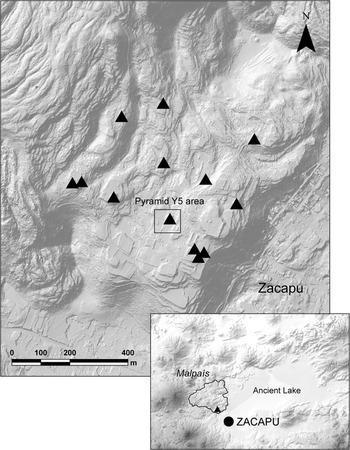
Test pits conducted in 2012 have provided evidence (ceramic complex and radiocarbon dating) of the Epiclassic and Early Postclassic occupation of the site, while test pits conducted in 2017 have provided information regarding changes in stratigraphy and urban morphology during the transition from the Early to the Middle Postclassic at El Palacio. Two test pits were located in the southern area at the site and seven test pits were located in one of the larger civic-ceremonial zone organized around pyramid Y5 (Forest and Jadot Reference Forest and Jadot2018; Forest et al. Reference Forest, Quezada, Castañeda and Pereira2018; Jadot Reference Jadot and Pereira2013:107–124). We focus here on the test pits and surface contexts directly related to pyramid Y5 (Figure 4).
Map of El Palacio and location of excavations. Map by Forest.

Depositional Context
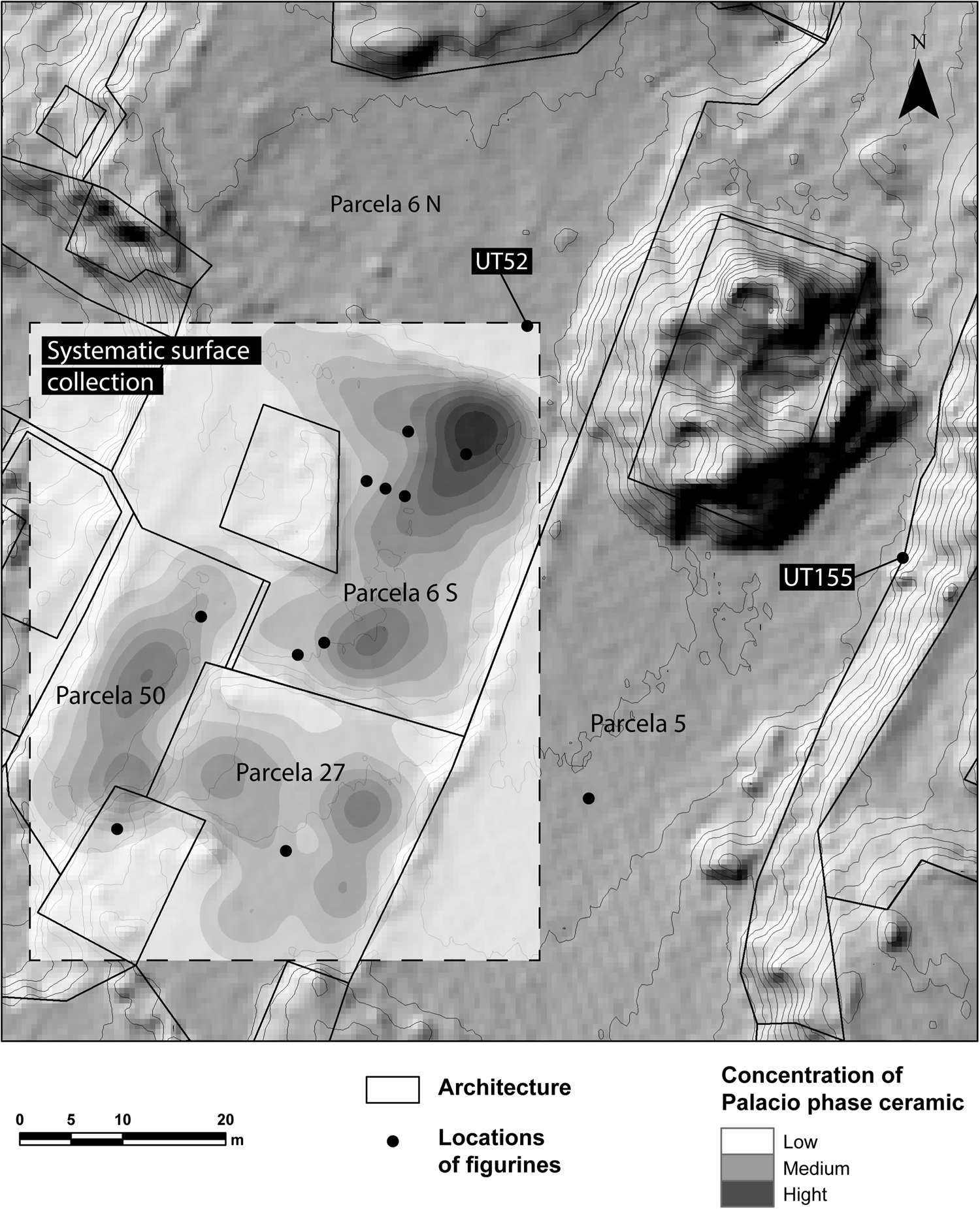
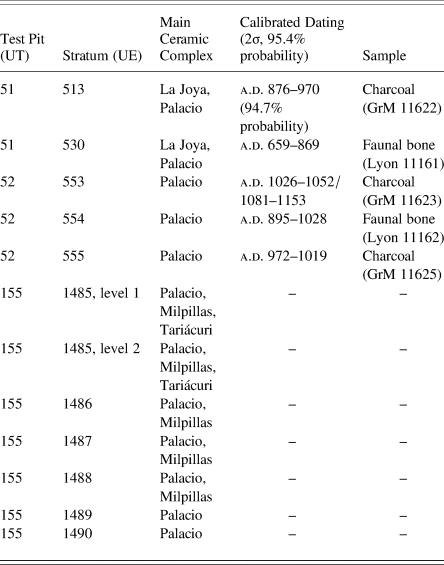
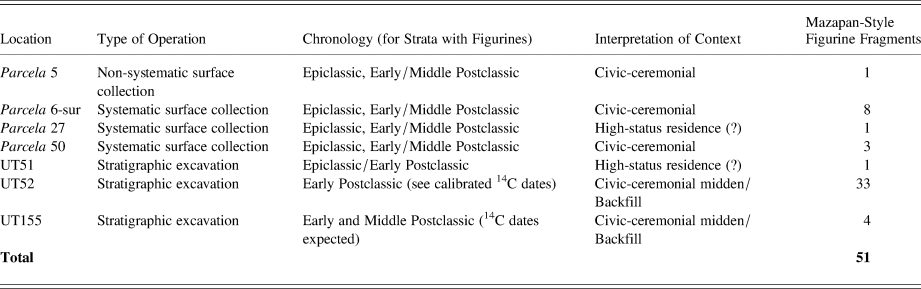
We discovered Mazapan-style figurines in two different depositional contexts in this area: a deposit of systematic discard and in a backfill context, where these materials were intermixed with many others from different occupation periods (Figure 5). Pyramid Y5 is located within a transitional zone at El Palacio. The southeastern area of the site was founded during the Epiclassic and was extended westward during the Early Postclassic (Forest and Jadot Reference Forest and Jadot2018). During the Middle Postclassic, this area of the site was again extended, this time to the north and west, and experienced a period of monumental construction related to the period of urbanization occurring ca. a.d. 1250 in the Malpaís of Zacapu. Important backfills composed of a large number of discarded artifacts from preceding and contemporary time periods were used as terracing materials (Forest et al. Reference Forest, Quezada, Castañeda and Pereira2018). UT155, located east of pyramid Y5, corresponds to that construction episode and represents a leveling backfill made of high-density refuse materials (Forest et al. Reference Forest, Quezada, Castañeda and Pereira2018). Yielding four fragments of Mazapan-style figurines, this archaeological context resulted from the intermixing of several cultural complexes dating from the Epiclassic to the Late Postclassic (Table 2). While this archaeological context provides support for the hypothesis that this area underwent an extensive transformation over time, it does not provide a clear chronological affiliation for the Mazapan-style figurines. In comparison, a series of three radiocarbon dates (Table 2) firmly places UT52, a discard deposit located west of Y5, within the Early Postclassic period (Jadot Reference Jadot and Pereira2013:118–124). It yielded most of our collection: 33 fragments of Mazapan-style figurines as well as fine ceramic sherds and other artifacts (see section Materials Associated with the Figurines). The southern test pit UT51 has also yielded one fragment of a Mazapan-style figurine located in a very compacted and partially burned stratum that likely resulted from a destruction event dated to the late Epiclassic/Early Postclassic period based on radiocarbon dates (Table 2). Finally, 13 fragments of Mazapan-style figurines were collected within the systematically surveyed area (Parcelas 5, 6-sur, 27, and 50, as shown in Figure 5), demonstrating the density of Early Postclassic artifacts in the area surrounding Y5. The Mazapan-style figurines from El Palacio were all fragmented and recovered from elite or ritual contexts; none of these artifacts were recovered from their primary contexts.
Locations of figurines encountered in surface collection and excavations in the pyramid Y5 area. Map by Forest.

Chronological phasing of excavations contexts at El Palacio (UT51 and 52: see Jadot et al. Reference Jadot, Pereira, Neff and Glascock2019).

Materials Associated with the Figurines
A large sample of ceramic pots fragments, spindle whorls, pipe fragments, abundant obsidian prismatic blades and flakes, a few fragments of groundstone, charcoal, faunal remains, and, on rare occasions, fragments of human bones were uncovered alongside the Mazapan-style figurines. The diversity and richness of the assemblage generated by the test pits excavated in the area of pyramid Y5 (e.g., fine ceramic types Palacio Pulido, Palacio Inciso, and Ciénega Rojo, ceramic pipes, and figurines fragments) indicate the ritual and/or high-status character of certain activities in this area of the site, with which the figurines might have been associated, based on the depositional context. The associated ceramic assemblage, characteristic of the Early Postclassic in the region, shows a large proportion of culinary pots (jars, comales, mortars) and service vessels (bowls and plates). Among the locally produced ceramics dating from this specific phase, certain types seem to be relatively similar to types produced in Tula (Jadot Reference Jadot2016:109–110; Michelet Reference Michelet, Pomédio, Pereira and Ferńndez Villanueva2013:98–99), such as the similarity of Palacio Inciso type to the Sillón Inciso type at Tula (Cobean Reference Cobean1990:280–281, 375–383). Another interesting fact about the assemblage is the recovery of rare Plumbate-like sherds, which raises questions concerning the interregional influences of El Palacio during the Early Postclassic. Originated from the Soconusco region in Chiapas (more than 1000 km southeast of Zacapu), the original Plumbate type circulated in central Mexico during the Early Postclassic through the possible relay of Tula (Jadot Reference Jadot2016:334). The analysis of samples from El Palacio, however, indicates that these sherds were mostly the result of local production, and therefore named Plumbate-like (Jadot et al. Reference Jadot, Pereira, Neff and Glascock2019). Only one sherd was part of an imported pot. Finally, the brazier fragments found in the excavation of UT52 are consistent with artifacts produced in the Chapala Lake area (100 km northwest of Zacapu) during the Tizapán phase (a.d. 1100–1250; Ramírez Urrea and Cárdenas Reference Ramírez Urrea, Cárdenas, Liot, Ramírez, Reveles and Schöndube2006:Figure 197F).
Corpus and Analyses
Corpus Composition
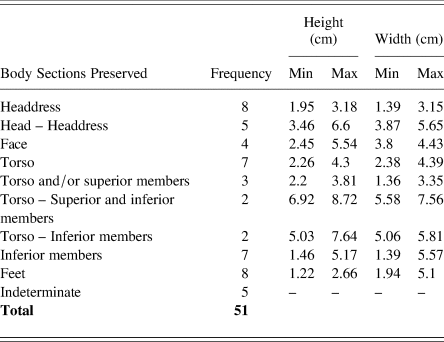
We studied 51 fragments of Mazapan-style figurines from El Palacio (Table 3). The corpus is very fragmented but allows the identification of different body features, clothing, and ornaments. Torsos and upper parts of the body, including the arms, are the best-preserved fragments along with the long skirt fragments (more robust and easily recognizable). Fragments representing headdresses, faces or heads, and feet are present but less common. The high fragmentation of figurines does not allow for the construction of a strict typology and classification. The dimensions of the 51 specimens, however, suggest that two distinct size ranges of figurines are represented. Joyce (Reference Joyce, Halperin, Faust, Taube and Guiguet2009:413) argues that objects of different sizes may be associated with different forms of agency, especially from a performative perspective. With this in mind, we use the estimated height of figurines to partition this collection.
Archaeological contexts and frequency of Mazapan-style figurines at El Palacio. All figures fragments were collected with ceramics, including small modeled objects, lithics (andesite and obsidian), and bones (fauna and human).

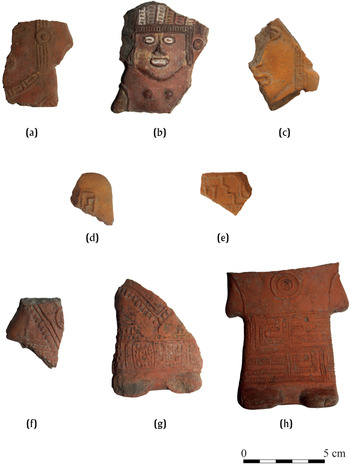
Two specimens (Figures 6g and 6h) are almost-complete figurines with the torso, superior, and inferior extremities preserved (Table 4). Their height is 6.92 and 8.72 cm, respectively. One specimen, with two-thirds of the headdress, the head, and a large portion of the torso preserved (Figure 6b), measures 6.6 cm in height. Based on observations from El Palacio and published information from Stocker (Reference Stocker and Diehl1974, Reference Stocker1983) and Solar et al. (Reference Solar, Magriñá and González2011), the heads of Mazapan-style figurines account for, on average, a third of the total height of the artifact. The total height of these specimens would then reach 9.22 and 13 cm. We refer to figurines within this range of heights as Type I. Besides, three specimens (mostly the face) present similar features but very distinct measurements (Figures 6a, 6c, and 7d), that would definitely form another group. If we apply the same rules of proportions, these Mazapan-style figurines reach at least 18 cm in height. We refer to figurines falling within this range as Type II. The mean thickness of figurine fragments is 0.88 and 0.98 cm for Type I and Type II, respectively.
Examples of Mazapan-style figurines from El Palacio, showing iconographic characteristics. (a–e) Heads and headdress fragments: (a) UT52 and UE554; (b, e) UT52 and UE555; (c) Parcela 50 and surface; (d) UT52 and UE552. (f–h) Figurine bodies and indumentary (UT52 and UE554). Photographs by Jadot.

Examples of Mazapan-style figurines from El Palacio, showing iconographic characteristics. (a–d) Heads and headdresses fragments: (a) Parcela 50, surface; (b, d) UT52, UE554; (c) Parcela 6-sur, surface. (e–g) Figurine torsos and quechquemitl: (e) Parcela 6-sur, surface; (f) Parcela 50, surface; (g) UT52 and UE554. (h–i) Figurine skirts and feet: (h) UT52 and UE554; (i) UT155 and UE1485. Drawings by Sylvie Eliès.

Dimensions and preserved body sections of the 51 Mazapan-style figurine fragments from El Palacio.

Fabrication Process
Macroscopic analysis of the paste of the figurine fragments suggests that they are locally produced. The paste is similar to the ceramic fabrics observed at El Palacio, where a thin volcanic temper is added to the clay to reinforce the paste plasticity and the clay takes on a red-orange color (2.5YR 4/2 to 5YR 6/4; Munsell Color Company 1954) when fired (Jadot Reference Jadot2016). In the section, the paste presents a dark-grey core and fine red margins resulting from reduction firing and rapid cooling in an oxidizing atmosphere. These characteristics are coupled with the existence of fire marks, which indicates that the molded figurines would have been fired in the open air and then removed from the fire for cooling. Such a process has been documented for other categories of culinary and ritual pottery encountered at El Palacio (Jadot Reference Jadot2016:448–449).
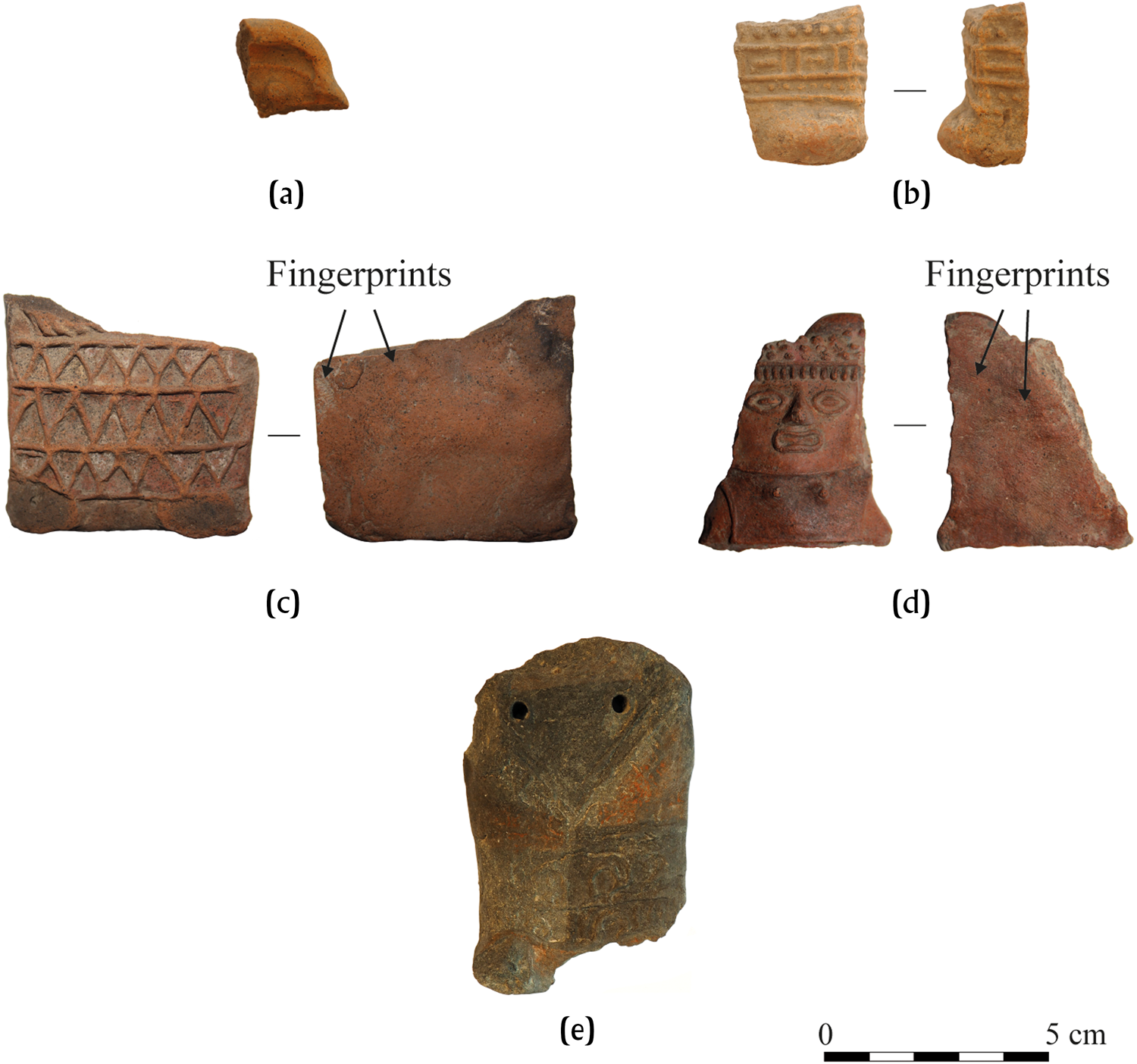
The figurines are made using a single part concave mold incised with facial, body, and ornamental features so as to create low relief. Seven figurines from the collection are also decorated on the sides (Figure 8b). Frequent fingerprints (Figures 8c and 8d) and paste fold marks (Figure 8c) found on the undecorated backs of the figurines confirm this fabrication process. No evidence of the use of anti-adherence materials has been observed; the potter likely waited for the paste to dry slightly and retract in the mold before unmolding it. Only the appliqué of the two modeled schematic rounded feet was made post-molding when the clay was still plastic. No incisions or excisions were practiced, even though doing so would have allowed the production of different types of figurines from the same mold. This observation is consistent with Stocker's (Reference Stocker and Diehl1974:54) assertion that the large variety of figurine features can only be the result of the manufacture and use of a large variety of molds.
Examples of Mazapan-style figurines and mold from El Palacio with interesting technological marks. (a) Mold fragment (Parcela 6-sur, surface). (b) Fragment decorated on the sides (Parcela 6-sur, surface). Fragments presenting (c) fingerprints (UT52 and UE555) and (d) paste fold marks (UT52 and UE554) on the undecorated backs. (e) A fragment presenting perforations (UT155 and UE1488). Photographs by Jadot and Forest.

Three specimens present circular perforations of 4–5 millimeters, made with a small tubular tool while the paste was still plastic and before any surface treatment. Among the 12 fragments that represent figurine torsos, shoulders, and arms, two specimen exhibit this type of perforations (Figure 8e). One specimen (Figure 6c) presents a perforation located at the junction between the headdress and the shoulder, much lower than the examples from the West Mexico corpus reported elsewhere and described in the section Location of Mazapan-style Figurines. Finally, no slip was applied to the figurine surface, but the flat areas on the decorated face were roughly burnished while the paste was still leather-hard in order to even the surface irregularities created by the molding. The back of the figurine stays unsmoothed and unadorned. In a few cases, the front presents post-firing painting in white, yellow, and red (Figure 6b).
Finally, only one ceramic fragment discovered at El Palacio could be a fragment of a mold and represents part of the headdress and the ear ornaments (Figure 8a). With the exception of this fragment from the surface collection, no evidence of on-site production has been observed. This latter observation is consistent with the absence of potter tools or evidence of ceramic production in general, such as pottery discards, fails, or firing places. In addition, the terrain of the malpaís, where El Palacio is located, does not provide the raw material required for ceramic production (e.g., clay, water, and wood). The fabric of the figurine fragments, however, is very similar to the other contemporary vessel pastes at the site, for which we have arguments supporting off-site, although still local, production (Jadot Reference Jadot2016).
Formal Analysis
Regarding the position and body features, the figurine collection from El Palacio is entirely composed of standing, facing characters. Eight fragments represent heads, including seven faces with very consistent configurations. They all show oval-shaped eyes, with clear irises, and eyebrows depicted by arcs that join at the top of a triangular nose. The mouths have a bean-shape and teeth are either not represented, or are depicted with white painting (Figures 6b, 7a, and 7d). Arms are laid diagonally across the abdomen, with hands close to the belt (Figures 6g and 7f), crossed on the abdomen, or hung alongside the torso with defined shoulders (Figure 6f), with the hands open towards the hips or towards the back (Figure 7g). Feet are rounded and projected at a right angle from the inferior border of the skirt. This profile would have enabled the figurines to stand with the help of a support. Regarding clothing, 15 fragments of torsos preserved in the collection allow observation of the upper garment. Nine figurines wear a triangular quechquemitl with a simple or fringed border (Figures 6f, 6g, and 7e–7g). Five figurines are not wearing the garment, including two with representations of breasts (Figures 6b and 8d). One remains undefined. Half of the preserved skirts (17 fragments) present complex designs. Among them, the simplest are composed of triangles and lines (Figure 8c) or a series of concentric circles forming vertical and horizontal bands (Figure 7h). The remaining skirt designs are composed of more elaborated configurations, such as stepped-fret or labyrinthine patterns combined with points. This combination may represent techniques of textile weaving and ornament and, from a symbolic point of view, could refer to the “serpent skin” motif (Figures 6f–6h, 7e, and 7f; Mastache Reference Mastache1971:47–49; Vauzelle Reference Vauzelle2018:290–292). Looking at hairdos, ornaments, and jewelry, all preserved specimens have lateral vertical lines that seem to be depicting long tufts of hair, which appear to be loose hair within which concentric, circular earplugs are depicted (six specimens; Figures 6a–6c, and 7a, 7d). Only one figurine is wearing a necklace designed with vertical stripes and small rectangular elements (Figure 6a), known in other contexts (Toltec and Aztec) as a reference to turquoise, “brightness,” or, once again, the “serpent skin” motif (Vauzelle Reference Vauzelle2018:741–742). Although headdresses are poorly preserved, five types emerge. Type A is composed of diagonal or vertical parallel strips (front), referring to unspun cotton, one of the goddess Tlazolteotl's attributes, combined with two double-pointed circles (sides) (Figure 7a). Type B has a similar general configuration, but the strips are painted in white, black, yellow, and red (Figure 6b). Type C is a simple cluster of points in relief (Figure 8d). Type D is a bilobed headdress frequently observed in Mazapan-style figurines from West Mexico and El Salvador (Figures 6d–6e, 7b, and 7c; Solar et al. Reference Solar, Magriñá and González2011:Figure 1c) and represented by five specimens from El Palacio. Among them, three show a xicalcoliuhqui (stepped-fret or greca) band and two show a striped motif, part of the fringe of the figurine (Figures 6d, 6e, and 7b). Finally, Type E associates the bilobed shape, a double-pointed circles motif, and the vertical parallel strips (Figure 7c). This double-pointed circles motif, a circular motif defined by two parallel contour lines with two plain circles, is frequent among Mazapan-style figurines from El Palacio (six specimens). Based on iconographic and ethnographic contexts from West Mexico (Solar et al. Reference Solar, Magriñá and González2011), as well as iconographic and archaeological examples from Teotihuacan (Pereira and Latsanopoulos Reference Pereira and Latsanopoulos2019:Figure 9d), this feature is interpreted as a mirror on its support (the two contour lines) suspended as a necklace (the small circles indicating perforations) or worn on the headdress (see Figures 2a, 2h, and 2g). From this series of observations, Mazapan-style figurines from El Palacio seem to represent exclusively female characters, as shown by the molding of the breast, the port of the quechquemitl, and fine details such as the presence of jewelry and the styles of headdresses and clothing.
Comparisons and Symbolic Analysis
The symbolic analysis that we propose combines the Direct Historical Approach (Willey Reference Willey1973; Ware Reference Ware, Mills and Fowles2017), with proper integrations of Kubler's critiques on renascence and disjunctions process (Kubler Reference Kubler1969, Reference Kubler1975), and the reference to both synchronic and diachronic sources, particularly from Late Classic, Epiclassic, and Late Postclassic central Mexico (Testard and Serra Puche Reference Testard, Serra Puche, Faugère and Beekman2019). It provides important elements of comprehension and comparisons—in time and space—of these artifacts from El Palacio.
The representation of the breast, observed among El Palacio's figurines as well as on Postclassic figurines from Chalco, and among Millian's (Reference Millian1981) Aztec “Group I,” is considered to be a possible representation of the Late Postclassic goddesses Coatlicue, Cihuacoatl, Cihualpipiltin, or a generic representation of pregnancy, reproduction, and childbirth (Klein and Lona Reference Klein, Lona, Halperin, Faust, Taube and Guiguet2009:330–337). Besides this, the frequency of the quechquemitl is interesting because it is often found on figurines from both the Epiclassic (Testard Reference Testard2010:44; Testard and Serra Puche Reference Testard, Serra Puche, Faugère and Beekman2019) and the Aztec periods. During the later, the garment can be used as a social indicator and a possible glyph for female names (Anawalt Reference Anawalt1981:129; see Séjourné [Reference Séjourné1966:225] for an alternative hypothesis).
The representation of hairstyle made of polychrome parallel lines (loose hair) is frequently found among Epiclassic figurines and possibly refers to Xochiquetzal, goddess of fertility, pregnancy, protector of mothers, and patroness of weavers and embroidery (Piho Reference Piho1973; Testard and Serra Puche Reference Testard and Serra Puche2011, Reference Testard, Serra Puche, Faugère and Beekman2019).
Motifs and patterns of motifs repeatedly found on the Mazapan-style figurines from El Palacio, such as the “serpent skin” motif, the xicalcoliuhqui (stepped-fret), the unspun cotton, the tlapapalli, and the mirrors, could be also associated with important feminine deities.
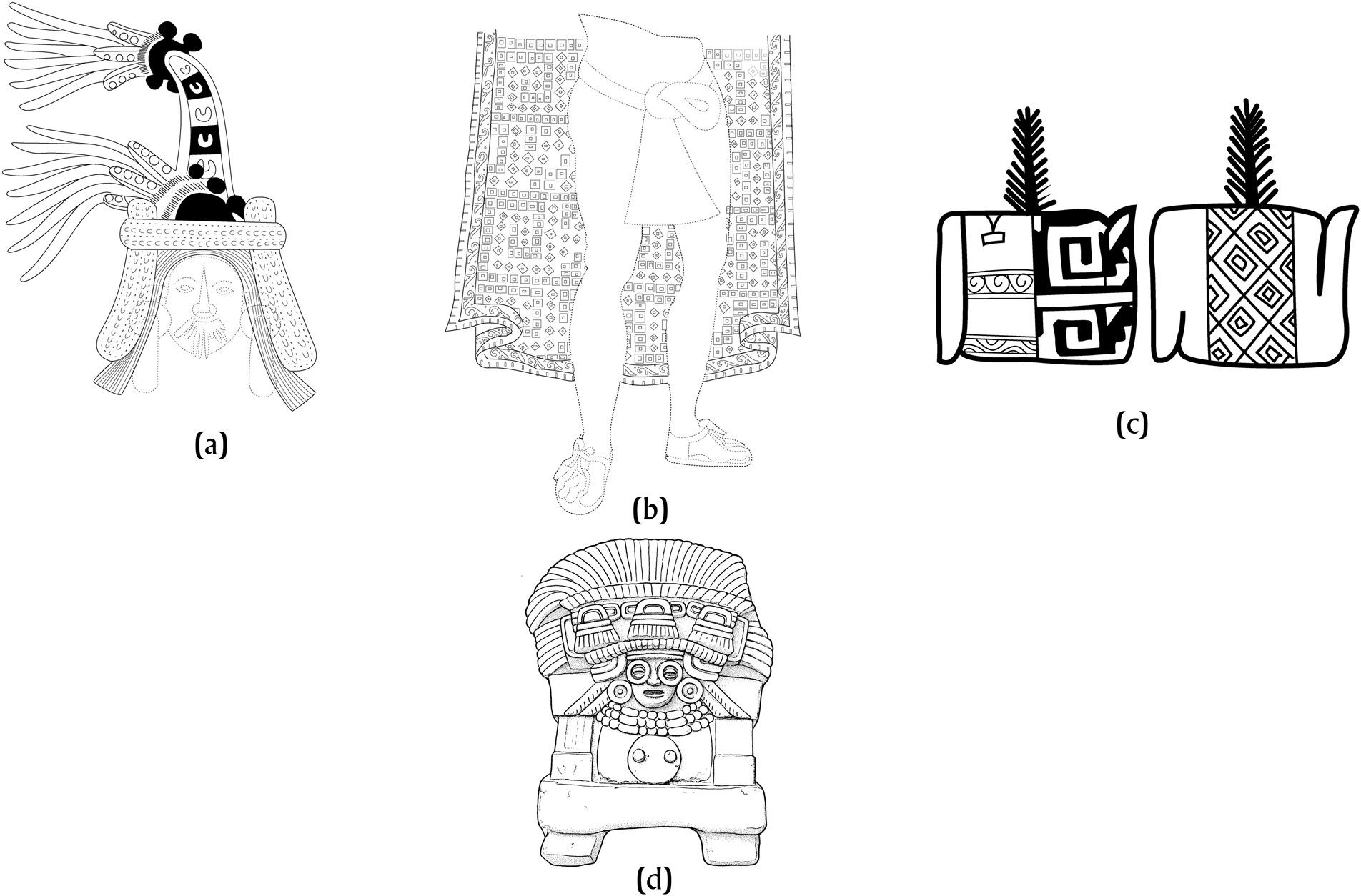
The “serpent skin” motif, composed of points in diamond patterns, would have originated in Teotihuacan before spreading with Early Postclassic Mixteca-Puebla decorated ceramics, and becoming very common in Aztec period ceramics, figurines, and pictorial codices. It is observed on the skirts of Aztec figurines (Kaplan Reference Kaplan1958; Parsons Reference Parsons, Spence, Parsons and Parsons1972; Stocker Reference Stocker1983:202–203, Plates 43 and 46F), and in the Matrícula de tributos (Figure 9c), where it seems to indicate that certain goods were reserved for rulers (Mondragón Vázquez Reference Mondragón Vázquez and Padilla2007). Based on this motif, Stocker (Reference Stocker1983:160–161) associated the Tula culture Mazapan figurines with the goddess Xochiquetzal. Mondragón Vázquez (Reference Mondragón Vázquez and Padilla2007), Tate (Reference Tate2004), and Vauzelle (Reference Vauzelle2018:285–292) assert that the “serpent skin” motif is associated with femininity, fertility rituals, and power. The second pattern is the consistent association of the “serpent skin” motif with the xicalcoliuhqui (stepped-fret or greca), observed on the figurines from El Palacio as well as on the skirts of the figurines from Chalco and in pictographic representations of skirts and capes in Postclassic codices (Figures 9b and 9c). We suggest that it represents the xiuhtlalpilli tilmàtli, a coat made of (real or fake) turquoise worn by the Mexica rulers (Figure 9b) and a potential reference to a process of Toltec legitimization (Anawalt Reference Anawalt1990, cited by Vauzelle Reference Vauzelle2018:317–325). The third pattern, composed of curved lines and dots, is found on various figurines’ headdress at El Palacio (Types A, B, and C). It constitutes a normative Postclassic representation for unspun cotton, one of the goddess Tlazolteotl's attributes (Figure 9a; Sullivan Reference Sullivan, Benson and Boone1977:8; Testard and Serra Puche Reference Testard and Serra Puche2011). The motif is documented at Teotihuacan, during the Classic period, where it is interpreted as an attribute of a protoform of the goddess Tlazolteotl (Séjourné Reference Séjourné1966:Figures 34, 37–38). It is also documented at Xochitécatl (Epiclassic period; Spranz Reference Spranz and Benson1973:223, Reference Spranz, Lauer and Steiner1978), and Tula (Early Postclassic period; Stocker Reference Stocker and Diehl1974:Figure 18 and Type 1F). The fourth motif, the polychrome diagonal bands (headdress of Type B), seems to be consistent with the tlapapalli, a sort of clip composed of four colors and worn on the quechquemitl or the headdress of Xochiquetzal (Danièle Dehouve, personal communication 2018).
Examples of comparative diachronic evidences for indumentary analysis of figurines. (a) Tlazolteotl headdress with “unspun cotton” motif on band and sides parts. Detail from Codex Borbonicus (Reference Borbonicus1510:f. 13). (b) Xiuhtlalpilli tilmatli cape, showing xicalcoliuhqui and diamond-shape designs. Detail from Codex Ixtlilxochitl (Reference Ixtlilxochitl1550:f. 33). (c) Xicolcoliuhqui and “serpent skin” motifs on cotton huipil and skirt tributes to Tenochtitlan. Detail from the Matrícula de Tributos (1522:f. 10). Drawings by Sylvie Eliès. (d) Frontal mirror on Teotihuacan Metepec figurine, American Museum of Natural History, New York. Drawing by N. Latsanopoulos, from Berrin and Pasztory (Reference Berrin and Pasztory1993:231, Figure 98 left).

Finally, Solar et al. (Reference Solar, Magriñá and González2011) and Pereira and Latsanopoulos (Reference Pereira and Latsanopoulos2019) provide evidence suggesting that feminine figurines wearing a mirror as a pectoral or on the headdress likely represent divinities or divine ancestors. Examples from the Mayan highlands depicting the mirror worn as pectoral, however, are interpreted as an indicator of high status reserved for elite and/or rulers. Nevertheless, our observations of the combined iconographic characteristics of the figurines from El Palacio seem to be more consistent with the representations of feminine divinities and ritual practices than with an indicator of social status.
DISCUSSION
Although chronological issues remain important in the definition of the Early Postclassic across Mesoamerica, the Mazapan-style figurines appear to be consistent markers of this time period. The collections reviewed in the literature and the contexts in which they were encountered share many technical and iconographic traits. The figurines collected at El Palacio exhibit many of those traits and should therefore be integrated into this category of Mesoamerican artifacts. Two major points can be stressed based on our review of the literature and analysis of a new collection. First, the figurines recovered from El Palacio shed new light on these artifacts in terms of technology, iconography, performative functions, and their depositional contexts. Second, integrating the study of the El Palacio corpus within a broader Postclassic context supports a better understanding of the nature and role of the site in this time period, within multidirectional interregional connections.
The Mazapan-style figurine fragments from El Palacio are the first to be systematically described in terms of the process of their fabrication. The fabric of the figurines is highly consistent with the local homogeneous fabrics already identified for the Zacapu Basin, indicating that these objects were produced locally. Despite the fact that molding techniques have rarely been documented in Michoacan (Begun Reference Begun2008; Marcus Reference Marcus2018), Jadot reconstructed the molding process and demonstrated the absence of additional techniques (except for the feet, sometimes added with appliqué)—the standard chaîne opératoire is only altered by later perforations and post-firing painting. These examples lend support to Stocker's previous suggestion that a separate mold was made for each of the unique figurines recovered. The scarcity of molds in the archaeological record might be the result of the use of perishable (and possibly disposable) dry clay for their manufacture. Despite the limitations of the published corpus, it can be suggested that the uniqueness of each figurine, the apparent investment in its fabrication (the production of a mold to obtain a seemingly unique final artifact), their systematic fragmentation, and finally their location in dense strata in backfills or middens located in ritual areas reflect a very specific and likely short-term use for most of these artifacts. It is conceivable that both mold and figurine were produced for one ritual occasion, as a unique piece, and then were broken and disposed of after the ritual (see similar cases synthetized by Marcus Reference Marcus2018).
The manufacture of so many different molds would have required a substantial investment of time, an observation that runs contrary to the received wisdom that the use of molds streamlined the production process and is indicative of standardization, intended for mass production in an economic sense. Alternative models have been offered by scholars in Mesoamerica, figurine molding would support reproduction of valued images by non-specialized individual (enlarging ritual community participation) and state ideology carrying media (see synthesis in Joyce Reference Joyce, Halperin, Faust, Taube and Guiguet2009:419–420).
Finally, the collection from El Palacio is consistent with the contexts from which other researchers have reported recovering such artifacts (Haberland Reference Haberland and Michelet1989:82; Klein and Lona Reference Klein, Lona, Halperin, Faust, Taube and Guiguet2009:327; Marcus Reference Marcus1998:312, Reference Marcus2018; Stocker Reference Stocker and Diehl1974:55): highly fragmented material discovered in backfills, refuse areas, and surface collections. In brief, secondary contexts of refuse related to accidental or intentional breaking that does not inform us of their initial location and use. The high concentration of figurine fragments discarded in a ceremonial area of El Palacio (e.g., 33 fragments in the 4 m2 of UT52), however, suggests a consistent pattern of secondary deposition. The multiple fragments of unique figurines were likely found as refuse within the same stratum of this ceremonial district (as in UT52, a.d. 950–1250) because they were “used” here before being discarded. They are also found in backfill involved in the extension of the ceremonial district (as in UT155 a.d. 1200/1250–1450), disconnected from their initial function but still locally available.
The Mazapan-style figurines from El Palacio are exclusively female characters. They present a large variety of features and iconographic motifs (e.g., headdress, quechquemitl, long decorated skirt, ear ornaments, and mirrors) that suggest that they might have embodied divinities associated with the feminine sphere, more specifically goddesses associated with Xochiquetzal (hairstyle, skirt, and tlapapalli) or Tlazolteotl (unspun cotton headdress). This suggestion is in line with the proposition by Solar and colleagues (Reference Solar, Magriñá and González2011) that western Mazapan-style figurines were associated with earth and fertility rituals (see also Jiménez Betts Reference Jiménez Betts2018:151). Furthermore, the archaeological context in which these artifacts were encountered at El Palacio, a ritual area, supports this interpretation. Alternatively, figurines may simply have been, as suggested by Haberland (Reference Haberland and Michelet1989:83) for the Salvadorian collection, hung and exposed on an altar, as observed by Smith (Reference Smith1997:79) in Morelos or placed standing on their feet (Solar et al. Reference Solar, Magriñá and González2011:67; see also Brumfiel and Overholtzer Reference Brumfiel, Overholtzer, Halperin, Faust, Taube and Guiguet2009:310). Such a use would be consistent with the presence of perforations for suspension and the thinness observed on at least three specimens in El Palacio collection. Systematic investigation of the thinness, the location of perforations, and the standing potential of figurines would allow further understanding of the ways in which such figurines were used and displayed and thus help to clarify their potential for embodiment and performance (Marcus Reference Marcus2018).
The ritual and high-status contexts in which these artifacts were encountered at El Palacio are consistent with elite-driven activities, while the composition and high-status character of the artifact assemblage (e.g., Mazapan-style figurines, Plumbate-like, and Red-On-Buff ceramic types) could indicate ties between this local elite and distant contemporaneous cultures of the Mexican highlands. Although produced locally, using local materials, and exhibiting their own iconographic combination of characteristics, the Mazapan-style figurines from El Palacio seem to be part of a “ceremonial subcomplex” integrating the Early Postclassic Highland Network (Jiménez Betts Reference Jiménez Betts2018:168–169, 175–180, 194–195), a local expression of a shared and wider Postclassic international style. As previously observed for the Coyotlatelco/Epiclassic phenomena in central Mexico (Testard Reference Testard2014, Reference Testard2018), the emulation of local elites involved in prestige-good circulation would have resulted in the production of local “packages” composed of hybrid and recomposed recognized and iconic goods. While driving or stimulating the production of this material culture, the local elite of El Palacio would have then integrated into a broader prestigious network, the contours of which are still being defined, but with two major poles: the west Pacific Coast and the central highlands. The specific distribution of Mazapan figurines across West Mexico could suggest a diffusion of these artifacts through a highland route, rather than the Rio Lerma main route. The scarcity of Early Postclassic sites in the Lerma southern versant, however, does not provide adequate data to validate either hypothesis.
The Mazapan-style figurines at El Palacio are contemporaneous with the apogee of both the Aztatlán and the Tula cultural spheres (Jadot Reference Jadot2016:110; Jiménez Betts Reference Jiménez Betts2018; Michelet Reference Michelet, Manzanilla and López Luján2001:175) and seem to share traits with figurines found in both. While many traits are more likely linked to Tula and central Mexico (e.g., the xiuhtlalpilli tilmàtli, “serpent skin,” and unspun cotton motifs, certain arm positions, and standing feet), other evidence could be consistent with a connection to West Mexico (e.g., fine and complex iconography, omnipresence of the quechquemitl, and bilobed headdresses) or El Salvador (constellation of facial features of the “gross-type” documented by Haberland Reference Haberland and Michelet1989:83). Mazapan-style figurines at El Palacio could have been incorporated into ritual practices in different ways, depending on their size and characteristics (Joyce Reference Joyce, Halperin, Faust, Taube and Guiguet2009:213). Beyond that, Jiménez Betts (Reference Jiménez Betts2018:159) suggests that the smaller artifacts are affiliated with Tula while the larger Palacio Type II is more likely related to the Aztatlán complex. These two sizes (local Types I and II) as well as the other congruent characteristics of our corpus seem to support that proposition. Moreover, the presence in the assemblage of six possible cotton-weaving spindle whorls (Huster Reference Huster2013; Smith and Hirth Reference Smith and Hirth1988) suggests the existence of textile production at El Palacio. Hirth (Reference Hirth1977:44) has proposed that this particular activity could form an explanation for economic interaction between Tula and the western regions of Mesoamerica and Jimenez Betts (Reference Jiménez Betts2018:135) includes spindle whorls in the Aztatlán complex “package.”
If the complex interrelation of these cultural influences is obvious, the chronological resolution does not yet allow the determination of anteriority or posteriority, and thus the dynamics of influence, between Aztatlán, El Palacio, and the Tula core area. The status and role of El Palacio in these dynamics remain unclear (e.g., edge, vertex of the network, producer, or influencer). As none of those traits has been observed anywhere else in the region, however, it supports and reinforces the idea of El Palacio being a major center, with elites capable of driving prestige-good production and acquisition strategies, and forming an important monumental and ritual compound in the Zacapu Basin during the Early Postclassic.
Around a.d. 1250, El Palacio was, based on our excavations, deeply impacted by a demographic change resulting from the massive arrival of new populations, to the Zacapu Basin. This population shows a material culture clearly affiliated to the later Tarascan culture and is therefore consider as “pre-Tarascan.” This event transformed the site's morphology and functions during the Milpillas phase (a.d. 1250–1450) and resulted in important changes in the material culture. Despite continuities in the fabrication processes, most of the ceramic complex was replaced (Jadot Reference Jadot2016). The Mazapan-style figurines, and the Plumbate-like and Red-On-Buff ceramics disappear from the Middle Postclassic assemblages (except when reused as intermixed backfill materials), demonstrating fundamental transformations in technological knowledge as well as shifts in the interests of elites and the nature and extent of interregional connections. After an Early Postclassic system of interregional connections and networking, the populations that occupied the Basin of Zacapu shifted to a locally centered structure, material culture, and economic system that prefigured the apogee of the later imperial Tarascan system.
Despite being known across the Mexican highlands, our knowledge of Mazapan-style figurines leaves much to be desired. Their occurrence should be documented more systematically, especially the contexts in which they were encountered, and their form should be described more thoroughly, thereby enabling more rigorous comparisons. Further, petrographic analyses can and should be conducted in order to determine whether these artifacts are local productions or evidence of interregional exchange. Indeed, only a larger sample of these figurines and their systematic analysis would support a clearer understanding of their characteristics and their uniqueness as a cultural manifestation. Despite these gaps in our knowledge of Mazapan-style figurines, the discovery of these artifacts at El Palacio has provided a starting point from which to reevaluate what we know about the local, regional, and interregional dynamics during the Early Postclassic, a complex and fundamental period in the history of western Mesoamerica.
RESUMEN
Las investigaciones arqueológicas recientes llevadas a cabo en la cuenca de Zacapu, en el norte de Michoacán, brindan una nueva luz sobre el posclásico temprano, un período insuficientemente definido para la región, antes del surgimiento del estado tarasco. Una serie de figurillas, conocidas en la literatura arqueológica como de estilo Mazapan, fue descubierta en el sitio de El Palacio, en varios niveles estratigráficos fechados de la fase local del posclásico temprano (900–1200/1250 d.C.). Estos artefactos han sido considerados de manera repetida como marcadores diagnósticos de las dinámicas culturales y económicas del posclásico temprano. Por lo mismo generan nuevas preguntas en cuanto al papel y el estatus de El Palacio a escalas regionales e interregionales.
En este artículo, estudiamos la colección de figurillas de estilo Mazapan encontradas en El Palacio gracias a un examen cuidadoso de los contextos arqueológicos, junto con análisis tecnológicos e iconográficos, apoyados por una revisión sistemática de la literatura científica disponible. Al demostrar su producción local y su asociación con otros artefactos característicos del “estilo internacional” del posclásico temprano, discutimos de su posible uso y de la capacidad de la elite local a conectarse de manera cultural y económica con otras regiones de Mesoamérica. Surgen desde luego varias vías de investigación para definir aún más el período posclásico temprano.
ACKNOWLEDGMENTS
The present article results from collaborative research conducted in Michoacan by the Uacúsecha archaeological project, directed by Dr. Grégory Pereira (CNRS). The research was funded by the French Ministère de l'Europe et des Affaires Étrangères, the CEMCA in Mexico City, and authorized by the Consejo Nacional de Arqueología of the Instituto Nacional de Antropología e Historia in Mexico. We thank these institutions as well as the Fyssen Foundation that supported Elsa Jadot and Marion Forest with postdoctoral fellowships in 2017–2018. Sylvie Eliès (CNRS) produced the fine drawings of Figures 7 and 9. Finally, we thank Grégory Pereira, all the colleagues and collaborators for their help in collecting the data in the field and their analysis at the CEMCA, Brigitte Faugère and Grégory Pereira for their helpful comments on an earlier draft, and Andrew Seidel for his thorough proofreading and important suggestions during the preparation of this text.