

Introduction
In its Chagos Advisory Opinion,Footnote 1 the International Court of Justice (ICJ) addressed two questions posed in a request from the UN General Assembly.Footnote 2 First, had Mauritius's decolonization been completed when it gained independence in 1968, after the excision of the Chagos Archipelago? Second, what were the legal consequences flowing from the United Kingdom's continued administration of the Archipelago? It was thought that the Court might shy away from giving an Opinion in this case as, arguably, it concerned a bilateral sovereignty dispute that the United Kingdom had not agreed to have resolved by judicial decision. However, as it turned out, the Court delivered surprisingly robust responses to the questions posed. The Opinion—and the numerous Separate Opinions that accompanied it—offer a thorough re-evaluation of the customary international law (CIL) concerning the right to self-determination in cases of decolonization.Footnote 3
Background
In 1964, a U.K./U.S. survey of the Indian Ocean revealed that Diego Garcia, in the remote Chagos Archipelago, would make an ideal site for a U.S. military base. The Archipelago was a distant dependency of the Non-Self-Governing Territory of Mauritius and home to the Chagossians.Footnote 4 In 1965, the United Kingdom entered into the “Lancaster House Agreement” with Mauritian ministers to detach the Chagos Islands from Mauritius. It applied considerable pressure to obtain consent, and the transaction was tied with the decision to grant Mauritius its independence. The British Indian Ocean Territory (BIOT) was created in 1965, via the BIOT Order in Council, and the Chagos Islands were separated from Mauritius accordingly. In 1966, the United Kingdom and United States concluded a treaty regarding the use of Diego Garcia. Pursuant to the planned construction of a U.S. base on this island, the Chagossians were forcibly removed from the entire Archipelago. Most were transported to Mauritius, where they have experienced chronic impoverishment during the intervening period.Footnote 5
Mauritius has demanded the return of the Chagos Islands since the 1980s. In 2010, it instituted proceedings, under the UN Convention on the Law of the Sea (UNCLOS), in response to the United Kingdom's declaration of a huge Marine Protected Area (MPA) around the Archipelago.Footnote 6 Mauritius asserted its sovereignty claim during this case; however, the Tribunal ruled that it lacked the jurisdiction to adjudicate this specific contention.Footnote 7 Nonetheless, it decided that the MPA's creation had violated the Convention's provisions.Footnote 8 Subsequent bilateral discussions came to nothing; Mauritius took the matter to the General Assembly.
Jurisdiction and Discretion
The Court found, unanimously, that it had the jurisdiction to give an Opinion, by reference to Article 65 of the UN Charter. However, the issue of whether it should decline to answer the request was less straightforward. The danger was that, by responding, the Court might circumvent the principle that bilateral disputes can only be adjudicated on the basis of consent.Footnote 9 The ICJ decided (by 12 votes to 2) that this risk was overcome by its finding that the dispute was, fundamentally, about decolonization—a process in which the Assembly has performed a leading role. Consequently, the Court held that answering the request would not compromise the integrity of its judicial function. However, by accepting that the bilateral dispute was inseparable from the issue of Mauritius's decolonization, the Court provided a means by which the claims concerning the Archipelago's sovereignty could be resolved. If the dispute was essentially about decolonization, it was conceivable that once the process of Mauritius's decolonization has been completed—through the return of the Chagos Islands—no sovereignty dispute would remain outstanding.
Self-Determination and Customary International Law
To answer the request, the Court would need to decide how, and when, the right to self-determination crystallized in CIL. The timing here was crucial. If this CIL norm emerged before 1965, the United Kingdom was under an obligation to maintain Mauritius's territorial integrity, pending the exercise of the right by the Mauritian people. However, if the right to self-determination acquired CIL status after Mauritian independence, then the United Kingdom had the authority to partition the colony in 1965 as a matter of international law.
The Assembly's first question indicated that the relevant international law was reflected in a number of its own resolutions. In particular, Resolution 1514(XV)(1960) declared that all peoples have the right to self-determination (paragraph 2); that colonial powers cannot place fetters on independence (paragraph 5); and that any disruption of the territorial integrity of a country is incompatible with the Charter (paragraph 6).Footnote 10 However, during the advisory proceedings, the United Kingdom and the United States contended that the right to self-determination emerged as a CIL norm with the adoption of Resolution 2625(XXV)(1970)—i.e., after Mauritius had become independent.Footnote 11
But did these resolutions reflect CIL at the material time? While Assembly resolutions do not create law per se, their content may contribute to the formation of CIL. The requisite standard at the time was that the practice had to be extensive and virtually uniform.Footnote 12 It is widely acknowledged that resolutions may constitute evidence of opinio juris, but whether they amount to manifestations of state practice as well has been more controversial.Footnote 13One potential problem with establishing state practice in support of the right to self-determination appeared to be that instances of decolonization involved the exercise of this entitlement by “peoples,” rather than states, notwithstanding the fact that such events demonstrate the existence of corresponding legal obligations on the part of the colonial powers. Nevertheless, this unduly technical obstacle could be overcome by accepting that the activity of states in connection with the adoption of Assembly resolutions may qualify as state practice.Footnote 14 So, did 1514 generate custom or did this only happen with the passing of 2625? It is notable that the latter was adopted by consensus while 1514 was passed by 89 votes with none against and 9 abstentions—largely the colonial powers.
The ICJ ruled that the adoption of 1514 marked the crystallization of the right to self-determination in CIL.Footnote 15 The Court also took the view that the subject of this entitlement—the “people”—must be defined by reference to the colonial unit as a whole. Moreover, in keeping with paragraph 6, it held that maintaining the territorial integrity of a Non-Self-Governing Territory was a corollary of the right to self-determination. Invoking the formulation it had articulated in the Western Sahara Case,Footnote 16 the Court observed that after 1960 the partitioning of such a territory would violate the right to self-determination, “unless it is based on the freely expressed and genuine will of the people of the territory concerned.”Footnote 17 Applying this test to the circumstances surrounding the negotiation of the 1965 Agreement, the ICJ observed that a high level of scrutiny was required for the purpose of assessing whether consent had been given.Footnote 18 Ultimately, it found that under the 1964 Mauritian Constitution the Mauritian leaders did not possess the authority to agree to the Archipelago's detachment. In effect, the Court held that consent could only have been obtained through a referendum held before the decision was made. It, therefore, reached the conclusion that Mauritius's decolonization had not been lawfully completed in 1968.Footnote 19
State Responsibility
In response to the Assembly's second question, the Court decided that the United Kingdom's continuing administration of the Chagos Islands constituted an international wrongful act for which it bears responsibility.Footnote 20 In this context, the ICJ reaffirmed its view that self-determination manifests an erga omnes character.Footnote 21 However, it stopped short of holding that self-determination has the status of jus cogens, a finding that would have triggered a duty of nonrecognition on all states, as far as the illegal situation in the Chagos Archipelago is concerned.Footnote 22 But, even without such a ruling, states are under a duty not to knowingly assist the United Kingdom in the perpetuation of its internationally wrongful act. If they do so, they run the risk of being found complicit in this breach of international law.Footnote 23
Mauritius was careful not to set out the full ramifications of the Assembly's second question, beyond demanding the return of the Archipelago. This may have been in order to avoid the dispute being characterized as a bilateral one. Beyond calling on the United Kingdom to withdraw from the Archipelago as rapidly as possible, the ICJ left the modalities for the completion of Mauritius's decolonization to the Assembly.Footnote 24 While the main Opinion did not consider the question of reparations, it is clear that the United Kingdom's internationally wrongful act manifests a continuing character. Accordingly, it follows that its responsibility was triggered in 1965 when the BIOT was founded.Footnote 25
The General Assembly
The Court chose to invoke Resolution 2625, which declared that all states are under a duty to cooperate with the United Nations regarding the realization of the principle of self-determination.Footnote 26 In this regard, it may have sought to bolster the Assembly's authority to take the lead in resolving this frustrated instance of decolonization. How will the Assembly react to the Opinion? It is unlikely that it will restrict itself to mandating bilateral negotiations given their previous lack of success. It might call on states to withdraw their recognition of the United Kingdom's administration of the Archipelago in an effort to prompt its government to negotiate.Footnote 27 The Security Council usually declares such collective obligations, but the Assembly might adopt a novel approach to this situation, given self-determination's erga omnes quality and the fact that the United Kingdom holds a veto power in the Council. The Assembly will surely seize this opportunity to bring about Mauritius's decolonization, but whether it will now redouble its efforts to end colonial rule elsewhere remains to be seen.
INTERNATIONAL COURT OF JUSTICE
YEAR 2019
2019 25 February General List No. 169
25 February 2019
LEGAL CONSEQUENCES OF THE SEPARATION OF THE CHAGOS ARCHIPELAGO FROM MAURITIUS IN 1965
Events leading to the adoption of General Assembly resolution 71/292 requesting an advisory opinion.
Geographic location of Mauritius in the Indian Ocean — Chagos Archipelago, including the island of Diego Garcia, administered by the United Kingdom during colonization as a dependency of Mauritius — Adoption on 14 December 1960 of the Declaration on the Granting of Independence to Colonial Countries and Peoples (General Assembly resolution 1514 (XV)) — Establishment of the Special Committee on Decolonization (“Committee of Twenty-Four”) to monitor the implementation of resolution 1514 (XV) — Lancaster House agreement between the representatives of the colony of Mauritius and the United Kingdom Government regarding the detachment of the Chagos Archipelago from Mauritius — Creation of the British Indian Ocean Territory (“BIOT”), including the Chagos Archipelago — Agreement between the United States of America and the United Kingdom concerning the availability of the BIOT for defence purposes — Adoption by the General Assembly of resolutions on the territorial integrity of non-self-governing territories — Independence of Mauritius — Forcible removal of the population of the Chagos Archipelago — Request by Mauritius for the BIOT to be disbanded and the territory restored to it — Creation of a marine protected area around the Chagos Archipelago by the United Kingdom — Challenge to the creation of a marine protected area by Mauritius before an Arbitral Tribunal and decision of the Tribunal.
* *
Jurisdiction of the Court to give the advisory opinion requested.
Article 65, paragraph 1, of the Statute — Article 96, paragraph 1, of the Charter — Competence of the General Assembly to seek advisory opinions — Request made in accordance with the Charter — Questions submitted to the Court are legal in character.
Argument that there is no exact statement of the question upon which an opinion is required — Any lack of clarity in the questions cannot deprive the Court of its jurisdiction — Arguments examined by the Court when it analyses the questions put by the General Assembly.
The Court has jurisdiction to give the advisory opinion requested.
* *
Discretion of the Court to decide whether it should give an opinion.
Integrity of the Court's judicial function — Only “compelling reasons” may lead the Court to refuse to exercise its judicial function.
Argument that advisory proceedings are not suitable for determination of complex and disputed factual issues — Sufficient information on the facts at the disposal of the Court.
Argument that the Court's response would not assist the General Assembly in the performance of its functions — Determination of the usefulness of the opinion left to the requesting organ.
Argument that an advisory opinion by the Court would reopen the findings of an Arbitral Tribunal — Opinion given to the General Assembly, not to States — Principle of res judicata does not preclude the rendering of an advisory opinion — Issues determined by the Arbitral Tribunal not the same as those before the Court.
Argument that the questions asked relate to a pending territorial dispute between two States, which have not consented to its settlement by the Court — Questions relate to the decolonization of Mauritius — Active role played by the General Assembly with regard to decolonization — Issues raised by the request located in the broader frame of reference of decolonization — The Court not dealing with a bilateral dispute by giving an opinion on legal issues on which divergent views are said to have been expressed by the two States — Giving the opinion requested does not have the effect of circumventing the principle of consent by a State to the judicial settlement of its dispute with another State.
No compelling reasons for the Court to decline to give the opinion requested by the General Assembly.
* *
Factual context of the separation of the Chagos Archipelago from Mauritius and the removal of Chagossians from the archipelago.
Discussions between the United Kingdom and the United States on the use of certain British-owned islands in the Indian Ocean for defence purposes — Agreement between the two parties for the establishment of a military base by the United States on the island of Diego Garcia.
Discussions between the Government of the United Kingdom and the representatives of the colony of Mauritius with respect to the Chagos Archipelago — Fourth Constitutional Conference held in London in September 1965 involving representatives of the two parties — Lancaster House agreement — Agreement in principle by representatives of the colony of Mauritius to the detachment of the Chagos Archipelago from the territory of Mauritius.
Situation of the Chagossians — Entire population of Chagos Archipelago forcibly removed from the territory between 1967 and 1973 and prevented from returning — Compensation paid by the United Kingdom to certain Chagossians — Various proceedings initiated by Chagossians before United Kingdom courts, the European Court of Human Rights and the Human Rights Committee — Committee's recommendations that Chagossians should be able to exercise their right to return to their territory — Today Chagossians are dispersed in several countries, including the United Kingdom, Mauritius and Seychelles — By virtue of United Kingdom law and judicial decisions of that country, they are not allowed to return to the archipelago.
* *
Language of the questions posed in resolution 71/292 — Competence of the Court to clarify the questions put to it for an advisory opinion — No need to reformulate the questions in this instance — No need for the Court to interpret restrictively the questions put by the General Assembly.
* *
Question of whether the process of decolonization of Mauritius was lawfully completed having regard to international law.
Relevant period and applicable rules of law.
Relevant period between the separation of the Chagos Archipelago in 1965 and the independence of Mauritius in 1968 — Evolution of the law on self-determination — Right to self-determination has a broad scope of application as a fundamental human right — In these proceedings, the Court only to analyse that right in the context of decolonization — Right to self-determination enshrined by the Charter and reaffirmed by subsequent General Assembly resolutions — Resolution 1514 (XV) represents a defining moment in the consolidation of State practice on decolonization — Declaratory character of resolution 1514 (XV) with regard to the right to self-determination as a customary norm — Resolution 1514 (XV) provides that any disruption of the national unity and territorial integrity of a country is incompatible with the purposes and principles of the Charter — Reaffirmation of the right of all peoples to self-determination by the International Covenants on Civil and Political Rights and on Economic, Social and Cultural Rights — Right to self-determination reiterated in the Declaration on Principles of International Law concerning Friendly Relations and Co-operation among States — Means of implementing the right to self-determination in a non-self-governing territory set out in resolution 1541 (XV) — Exercise of self-determination must be the expression of the free and genuine will of the people concerned — Right to self-determination, under customary international law, does not impose a specific mechanism for its implementation in all instances — Right to self-determination of a people defined by reference to the entirety of a non-self-governing territory — Customary law character of the right to territorial integrity of a non-self-governing territory as a corollary of the right to self-determination — Incompatibility with the right to self-determination of any detachment by the administering Power of part of a non-self-governing territory, unless such detachment is based on the freely expressed and genuine will of the people of the territory concerned.
Right to self-determination, as a customary norm, constitutes the applicable international law during the relevant period.
Functions of the General Assembly with regard to decolonization.
Crucial role of the General Assembly with regard to decolonization — Monitoring of the means by which the free and genuine will of the people of a non-self-governing territory is expressed — General Assembly has consistently called upon administering Powers to respect the territorial integrity of non-self-governing territories.
Examination of the circumstances relating to the detachment of the Chagos Archipelago and its accordance with the applicable international law.
Agreement in principle of the Council of Ministers of Mauritius to the detachment of the Chagos Archipelago given when the colony of Mauritius was under the authority of the United Kingdom, its administering Power — Agreement not an international agreement — No free and genuine expression of the will of the people — Unlawful detachment of the Chagos Archipelago and its incorporation into a new colony, known as the BIOT.
Process of decolonization of Mauritius not lawfully completed when Mauritius acceded to independence in 1968.
* *
Consequences under international law arising from the continued administration by the United Kingdom of the Chagos Archipelago.
Decolonization of Mauritius not conducted in a manner consistent with the right of peoples to self-determination — United Kingdom's continued administration of the Chagos Archipelago constitutes a wrongful act entailing the international responsibility of that State — Continuing character of the unlawful act — United Kingdom under an obligation to bring an end to its administration of the Chagos Archipelago as rapidly as possible — Modalities for completing the decolonization of Mauritius to be determined by the General Assembly.
Obligation of all Member States to co-operate with the United Nations to put the modalities for completing the decolonization of Mauritius into effect — Resettlement on the Chagos Archipelago of Mauritian nationals, including those of Chagossian origin, is an issue relating to the protection of the human rights of those concerned — Issue should be addressed by the General Assembly during the completion of the decolonization of Mauritius.
ADVISORY OPINION
Present: President Yusuf; Vice-President Xue; Judges Tomka, Abraham, Bennouna, Cançado Trindade, Donoghue, Gaja, Sebutinde, Bhandari, Robinson, Gevorgian, Salam, Iwasawa; Registrar Couvreur.
On the legal consequences of the separation of the Chagos Archipelago from Mauritius in 1965,
The Court,
composed as above,
gives the following Advisory Opinion:
1. The questions on which the advisory opinion of the Court has been requested are set forth in resolution 71/292 adopted by the General Assembly of the United Nations (hereinafter the “General Assembly”) on 22 June 2017. By a letter dated 23 June 2017 and received in the Registry on 28 June 2017, the Secretary-General of the United Nations officially communicated to the Court the decision taken by the General Assembly to submit these questions for an advisory opinion. Certified true copies of the English and French texts of the resolution were enclosed with the letter. The resolution reads as follows:
“The General Assembly,
Reaffirming that all peoples have an inalienable right to the exercise of their sovereignty and the integrity of their national territory,
Recalling the Declaration on the Granting of Independence to Colonial Countries and Peoples, contained in its resolution 1514 (XV) of 14 December 1960, and in particular paragraph 6 thereof, which states that any attempt aimed at the partial or total disruption of the national unity and the territorial integrity of a country is incompatible with the purposes and principles of the Charter of the United Nations,
Recalling also its resolution 2066 (XX) of 16 December 1965, in which it invited the Government of the United Kingdom of Great Britain and Northern Ireland to take effective measures with a view to the immediate and full implementation of resolution 1514 (XV) and to take no action which would dismember the Territory of Mauritius and violate its territorial integrity, and its resolutions 2232 (XXI) of 20 December 1966 and 2357 (XXII) of 19 December 1967,
Bearing in mind its resolution 65/118 of 10 December 2010 on the fiftieth anniversary of the Declaration on the Granting of Independence to Colonial Countries and Peoples, reiterating its view that it is incumbent on the United Nations to continue to play an active role in the process of decolonization, and noting that the process of decolonization is not yet complete,
Recalling its resolution 65/119 of 10 December 2010, in which it declared the period 2011-2020 the Third International Decade for the Eradication of Colonialism, and its resolution 71/122 of 6 December 2016, in which it called for the immediate and full implementation of the Declaration on the Granting of Independence to Colonial Countries and Peoples,
Noting the resolutions on the Chagos Archipelago adopted by the Organization of African Unity and the African Union since 1980, most recently at the twenty-eighth ordinary session of the Assembly of the Union, held in Addis Ababa on 30 and 31 January 2017, and the resolutions on the Chagos Archipelago adopted by the Movement of Non-Aligned Countries since 1983, most recently at the Seventeenth Conference of Heads of State or Government of Non-Aligned Countries, held on Margarita Island, Bolivarian Republic of Venezuela, from 13 to 18 September 2016, and in particular the deep concern expressed therein at the forcible removal by the United Kingdom of Great Britain and Northern Ireland of all the inhabitants of the Chagos Archipelago,
Noting also its decision of 16 September 2016 to include in the agenda of its seventy-first session the item entitled ‘Request for an advisory opinion of the International Court of Justice on the legal consequences of the separation of the Chagos Archipelago from Mauritius in 1965’, on the understanding that there would be no consideration of this item before June 2017,
Decides, in accordance with Article 96 of the Charter of the United Nations, to request the International Court of Justice, pursuant to Article 65 of the Statute of the Court, to render an advisory opinion on the following questions:
(a) ‘Was the process of decolonization of Mauritius lawfully completed when Mauritius was granted independence in 1968, following the separation of the Chagos Archipelago from Mauritius and having regard to international law, including obligations reflected in General Assembly resolutions 1514 (XV) of 14 December 1960, 2066 (XX) of 16 December 1965, 2232 (XXI) of 20 December 1966 and 2357 (XXII) of 19 December 1967?’;
(b) ‘What are the consequences under international law, including obligations reflected in the above-mentioned resolutions, arising from the continued administration by the United Kingdom of Great Britain and Northern Ireland of the Chagos Archipelago, including with respect to the inability of Mauritius to implement a programme for the resettlement on the Chagos Archipelago of its nationals, in particular those of Chagossian origin?’.”
2. By letters dated 28 June 2017, the Registrar gave notice of the request for an advisory opinion to all States entitled to appear before the Court, pursuant to Article 66, paragraph 1, of the Statute.
3. By an Order dated 14 July 2017, the Court decided, in accordance with Article 66, paragraph 2, of the Statute, that the United Nations and its Member States were likely to be able to furnish information on the questions submitted to it for an advisory opinion, and fixed 30 January 2018 as the time-limit within which written statements might be submitted to it on those questions and 16 April 2018 as the time-limit within which States and organizations having presented a written statement might submit written comments on the other written statements.
4. By letters dated 18 July 2017, the Registrar informed the United Nations and its Member States of the Court's decisions and transmitted to them a copy of the Order.
5. Pursuant to Article 65, paragraph 2, of the Statute, the Secretary-General of the United Nations, under cover of a letter dated 30 November 2017 from the United Nations Legal Counsel, communicated to the Court a dossier of documents likely to throw light upon the questions formulated by the General Assembly, which was received in the Registry on 4 December 2017.
6. By a letter dated 10 January 2018 and received in the Registry the same day, the Legal Counsel of the African Union requested, first, that the African Union be permitted to furnish information, in writing and orally, on the questions submitted to the Court for an advisory opinion, and, secondly, that it be granted an extension of one month for the filing of its written statement.
7. By an Order dated 17 January 2018, the Court decided that the African Union was likely to be able to furnish information on the questions submitted to the Court for an advisory opinion and that it might do so within the time-limits fixed by the Court. By the same Order, the Court further decided to extend to 1 March 2018 the time-limit within which all written statements might be presented to the Court, in accordance with Article 66, paragraph 2, of the Statute, and to extend to 15 May 2018 the time-limit within which States and organizations having presented a written statement might submit written comments, in accordance with Article 66, paragraph 4, of the Statute.
8. By letters dated 17 January 2018, the Registrar informed the United Nations and its Member States, as well as the African Union, of the Court's decisions and transmitted to them a copy of the Order.
9. Within the time-limit thus extended by the Court in its Order of 17 January 2018, written statements were filed in the Registry, in order of their receipt, by Belize, Germany, Cyprus, Liechtenstein, Netherlands, United Kingdom of Great Britain and Northern Ireland, Serbia, France, Israel, Russian Federation, United States of America, Seychelles, Australia, India, Chile, Brazil, Republic of Korea, Madagascar, China, Djibouti, Mauritius, Nicaragua, the African Union, Guatemala, Argentina, Lesotho, Cuba, Viet Nam, South Africa, Marshall Islands and Namibia.
10. By a communication dated 5 March 2018, the Registry informed States having presented written statements, as well as the African Union, of the list of participants having filed written statements in the proceedings and explained that the Registry had set up a dedicated website from which those statements could be downloaded. By the same communication, the Registry further informed those States and the African Union that the Court had decided to hold hearings which would open on 3 September 2018.
11. On 14 March 2018, the Court decided, on an exceptional basis, to authorize the late filing of the written statement of the Republic of Niger.
12. On the same day, the Registrar informed the United Nations, and those of its Member States which had not presented written statements, that written statements had been filed in the Registry. By the same communication, the Registrar also indicated that the Court had decided to hold hearings which would open on 3 September 2018, during which oral statements and comments might be presented by the United Nations and its Member States, regardless of whether or not they had submitted written statements and, as the case may be, written comments.
13. On 15 March 2018, the Registrar communicated a full set of the written statements received in the Registry to all States having submitted written statements, as well as to the African Union.
14. By communications dated 26 March 2018, the United Nations and its Member States, as well as the African Union, were asked to inform the Registry, by 15 June 2018 at the latest, if they intended to take part in the oral proceedings.
15. Within the time-limit as extended by the Court in its Order of 17 January 2018, written comments were filed in the Registry, in order of their receipt, by the African Union, Serbia, Nicaragua, United Kingdom of Great Britain and Northern Ireland, Mauritius, Seychelles, Guatemala, Cyprus, Marshall Islands, United States of America and Argentina.
16. Upon receipt of those written comments, the Registrar, by communications dated 16 May 2018, informed States having presented written statements, as well as the African Union, that written comments had been submitted and that those comments could be downloaded from a dedicated website.
17. On 22 May 2018, the Registrar transmitted a full set of the written comments to all States having submitted such comments, as well as to the African Union.
18. By letters dated 29 May 2018, the Registrar transmitted to the United Nations, and to all its Member States that had not participated in the written proceedings, a full set of the written statements and written comments filed in the Registry.
19. By letters dated 21 June 2018, the Registrar communicated to the United Nations and its Member States, as well as to the African Union, the list of participants in the oral proceedings and enclosed a detailed schedule of those proceedings.
20. By letters dated 26 June 2018, the Registrar informed Member States of the United Nations participating in the oral proceedings, as well as the African Union, of certain practical arrangements regarding the organization of those proceedings.
21. By a letter dated 2 July 2018, the Philippines informed the Court that it would no longer be making a statement during the oral proceedings. By letters dated 10 July 2018, the Registrar informed Member States of the United Nations participating in the oral proceedings and the African Union accordingly.
22. Pursuant to Article 106 of the Rules of Court, the Court decided to make the written statements and written comments submitted to it accessible to the public with effect from the opening of the oral proceedings.
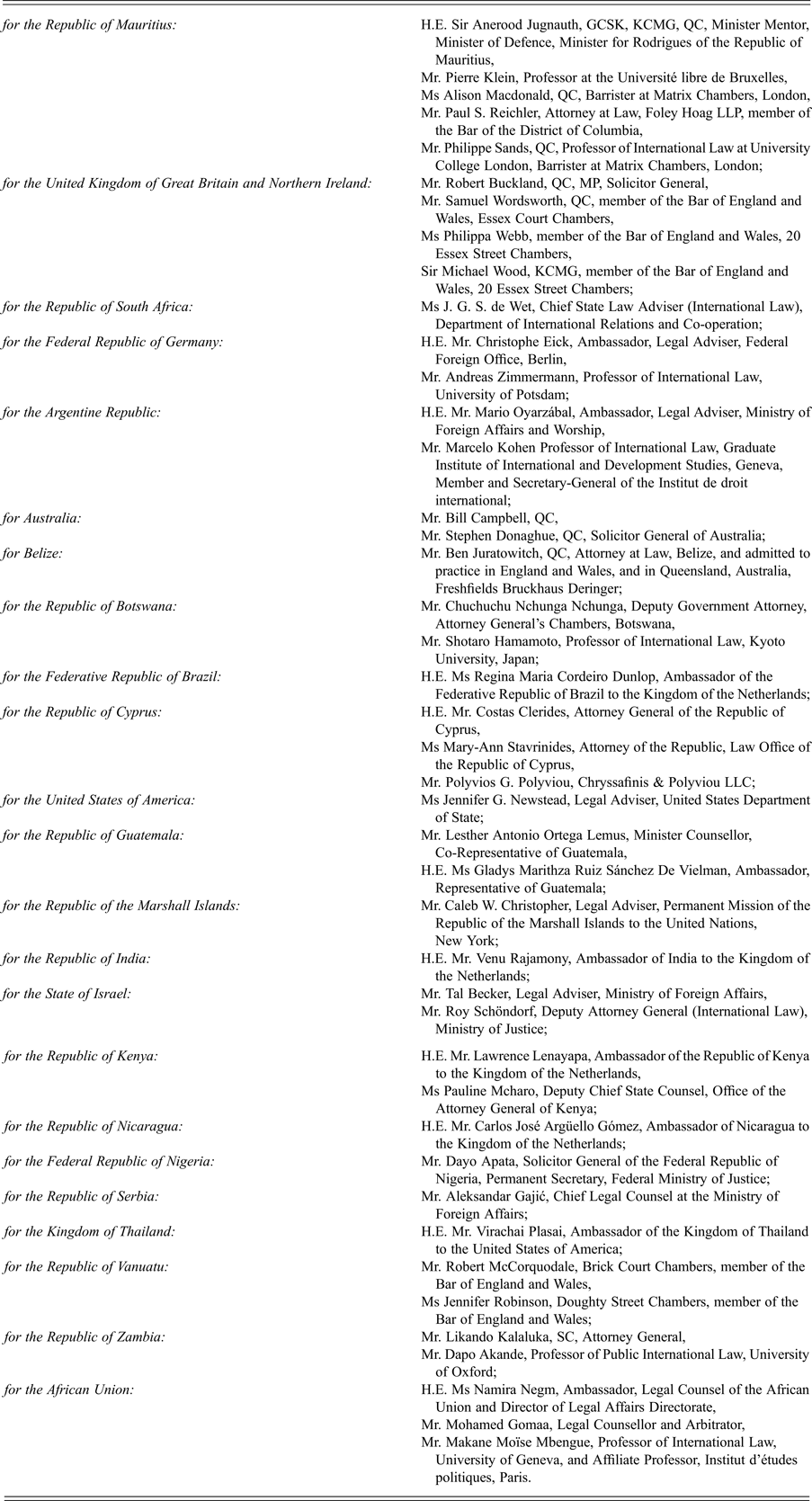
23. In the course of the hearings held from 3 to 6 September 2018, the Court heard oral statements, in the following order, by:
24. At the hearings, a Member of the Court put a question to Mauritius, which replied in writing, as requested, within the prescribed time-limit. The Court having decided that the other participants could submit comments or observations on the reply given by Mauritius, written comments were filed in the Registry, in order of their receipt, by the African Union, Argentina, United Kingdom of Great Britain and Northern Ireland and United States of America. Another Member of the Court put a question to all the participants in the oral proceedings, to which Australia, Botswana and Vanuatu, Nicaragua, United Kingdom of Great Britain and Northern Ireland, Mauritius, Argentina, United States of America and Guatemala, in that order, replied in writing, as requested. The Court having decided that the other participants could submit comments or observations on the replies thus given, Mauritius, the African Union and United States of America submitted such comments or observations in writing.
*
* *
I. Events leading to the adoption of the request for the advisory opinion
25. Before examining the events leading to the adoption of the request for the advisory opinion, the Court recalls that the Republic of Mauritius consists of a group of islands in the Indian Ocean comprising approximately 1,950 sq km. The main island of Mauritius is located about 2,200 km south-west of the Chagos Archipelago, about 900 km east of Madagascar, about 1,820 km south of Seychelles and about 2,000 km off the eastern coast of the African continent.
26. The Chagos Archipelago consists of a number of islands and atolls. The largest island is Diego Garcia, located in the south-east of the archipelago. With an area of about 27 sq km, Diego Garcia accounts for more than half of the archipelago's total land area.
27. Although Mauritius was occupied by the Dutch from 1638 to 1710, the first colonial administration of Mauritius was established in 1715 by France which named it Ile de France. In 1810, the British captured Ile de France and renamed it Mauritius. By the Treaty of Paris of 1814, France ceded Mauritius and all its dependencies to the United Kingdom.
28. Between 1814 and 1965, the Chagos Archipelago was administered by the United Kingdom as a dependency of the colony of Mauritius. From as early as 1826, the islands of the Chagos Archipelago were listed by Governor Lowry-Cole as dependencies of Mauritius. The islands were also described in several ordinances, including those made by Governors of Mauritius in 1852 and 1872, as dependencies of Mauritius. The Mauritius Constitution Order of 26 February 1964 (hereinafter the “1964 Mauritius Constitution Order”), promulgated by the United Kingdom Government, defined the colony of Mauritius in section 90 (1) as “the island of Mauritius and the Dependencies of Mauritius”.
29. In accordance with General Assembly resolution 66 (I) of 14 December 1946, the United Kingdom as the administering Power regularly transmitted information to the General Assembly under Article 73 (e) of the Charter of the United Nations concerning Mauritius as a non-self-governing territory. The information submitted by the United Kingdom was included in several reports of the Fourth Committee (Special Political and Decolonization Committee) of the General Assembly. In many of these reports, the islands of the Chagos Archipelago, and sometimes the Chagos Archipelago itself, are referred to as dependencies of Mauritius. In its 1947 Report, Mauritius is described as comprising the island of Mauritius and its dependencies among which are mentioned the island of Rodriguez and the Oil Islands group of which the principal island is Diego Garcia. The Report of 1948 collectively referred to all of the islands as “Mauritius”. The Report of 1949 states that “there are dependent upon Mauritius a number of islands scattered over the Indian Ocean, of which the most important is Rodriguez … Other dependencies are: Chagos Archipelago … Agalega and Cargados Charajos”.
30. On 14 December 1960, the General Assembly adopted resolution 1514 (XV) entitled “Declaration on the Granting of Independence to Colonial Countries and Peoples” (hereinafter “resolution 1514 (XV)”). On 27 November 1961, the General Assembly, by resolution 1654 (XVI), established the United Nations Special Committee on Decolonization (hereinafter the “Committee of Twenty-Four”) to monitor the implementation of resolution 1514 (XV).
31. In February 1964, discussions commenced between the United States of America (hereinafter the “United States”) and the United Kingdom regarding the use by the United States of certain British-owned islands in the Indian Ocean. The United States expressed an interest in establishing military facilities on the island of Diego Garcia.
32. On 29 June 1964, the United Kingdom also commenced talks with the Premier of the colony of Mauritius regarding the detachment of the Chagos Archipelago from Mauritius. At Lancaster House, talks between representatives of the colony of Mauritius and the United Kingdom Government led to the conclusion on 23 September 1965 of an agreement (hereinafter the “Lancaster House agreement”, described in more detail in paragraph 108 below).
33. On 8 November 1965, by the British Indian Ocean Territory Order 1965, the United Kingdom established a new colony known as the British Indian Ocean Territory (hereinafter the “BIOT”) consisting of the Chagos Archipelago, detached from Mauritius, and the Aldabra, Farquhar and Desroches islands, detached from Seychelles.
34. On 16 December 1965, the General Assembly adopted resolution 2066 (XX) on the “Question of Mauritius”, in which it expressed deep concern about the detachment of certain islands from the territory of Mauritius for the purpose of establishing a military base and invited the “administering Power to take no action which would dismember the Territory of Mauritius and violate its territorial integrity”.
35. On 20 December 1966, the General Assembly adopted resolution 2232 (XXI) on a number of territories including Mauritius. The resolution reiterated that
“any attempt aimed at the partial or total disruption of the national unity and the territorial integrity of colonial Territories and the establishment of military bases and installations in these Territories is incompatible with the purposes and principles of the Charter of the United Nations and of General Assembly resolution 1514 (XV)”.
36. The talks between the United Kingdom and the United States resulted in the conclusion on 30 December 1966 of the “Agreement concerning the Availability for Defence Purposes of the British Indian Ocean Territory” and the conclusion of an Agreed Minute of the same date.
37. Based on the 1966 Agreement, the United States and the United Kingdom agreed that the Government of the United Kingdom would take any “administrative measures” necessary to ensure that their defence needs were met. The Agreed Minute provided that, among the administrative measures to be taken, was “resettling any inhabitants” of the islands. The inhabitants of the Chagos Archipelago are referred to as Chagossians and, sometimes, as the “Ilois” or “islanders”. In this Opinion these terms are used interchangeably.
38. On 10 May 1967, Sub-Committee I of the Committee of Twenty-Four reported that:
“By creating a new territory, the British Indian Ocean Territory, composed of islands detached from Mauritius and Seychelles, the administering Power continues to violate the territorial integrity of these Non-Self Governing Territories and to defy resolutions 2066 (XX) and 2232 (XXI) of the General Assembly.”
39. On 15, 17 and 19 June 1967, the Committee of Twenty-Four examined the Report of Sub-Committee I and adopted a resolution on Mauritius. In this resolution, the Committee “[d]eplores the dismemberment of Mauritius and Seychelles by the administering Power which violates their territorial integrity, in contravention of General Assembly resolutions 2066 (XX) and 2232 (XXI) and calls upon the administering Power to return to these Territories the islands detached therefrom”.
40. On 7 August 1967, general elections were held in Mauritius and the political parties in favour of independence prevailed.
41. On 19 December 1967, the General Assembly adopted resolution 2357 (XXII) on a number of territories including Mauritius, and reaffirmed what it had declared in resolution 2232 (XXI) (see paragraph 35 above).
42. On 12 March 1968, Mauritius became an independent State and on 26 April 1968 was admitted to membership in the United Nations. Sir Seewoosagur Ramgoolam became the first Prime Minister of the Republic of Mauritius. Section 111, paragraph 1, of the 1968 Constitution of Mauritius, promulgated by the United Kingdom Government before independence on 4 March 1968, defined Mauritius as “the territories which immediately before 12th March 1968 constituted the colony of Mauritius”. This definition did not include the Chagos Archipelago in the territory of Mauritius.
43. Between 1967 and 1973, the entire population of the Chagos Archipelago was either prevented from returning or forcibly removed and prevented from returning by the United Kingdom. The main forcible removal of Diego Garcia's population took place in July and September 1971.
44. On 11 April 1979, in a discussion on the detachment of the Chagos Archipelago, Prime Minister Ramgoolam told the Mauritian Parliament “we had no choice”.
45. In July 1980, the Organisation of African Unity (hereinafter the “OAU”) adopted resolution 99 (XVII) (1980) in which it “demands” that Diego Garcia be “unconditionally returned to Mauritius”.
46. On 9 October 1980, the Mauritian Prime Minister, at the thirty-fifth session of the United Nations General Assembly, stated that the BIOT should be disbanded and the territory restored to Mauritius as part of its natural heritage.
47. In July 2000, the OAU adopted Decision AHG/Dec.159 (XXXVI) (2000) expressing its concern that the Chagos Archipelago was “excised by the colonial power from Mauritius prior to its independence in violation of UN Resolution 1514”.
48. On 1 April 2010, the United Kingdom announced the creation of a marine protected area in and around the Chagos Archipelago. On 20 December 2010, Mauritius instituted proceedings against the United Kingdom pursuant to Article 287 of the United Nations Convention on the Law of the Sea (hereinafter “UNCLOS” or “the Convention”) before an Arbitral Tribunal constituted under Annex VII of the Convention, challenging the creation of a marine protected area by the United Kingdom. In those proceedings, Mauritius submitted, inter alia, that (1) the United Kingdom was not entitled to declare a marine protected area or other maritime zones in and around the Chagos Archipelago as it was not a coastal State within the meaning of UNCLOS; (2) the United Kingdom was not entitled to declare unilaterally a marine protected area or other maritime zones because Mauritius had rights as a coastal State within the meaning of Articles 56, paragraph 1, and 76, paragraph 8, of UNCLOS; (3) the United Kingdom should not take any steps to prevent the Commission on the Limits of the Continental Shelf from making recommendations to Mauritius in respect of any submission that Mauritius may make to that Commission regarding the Chagos Archipelago; and (4) the marine protected area was incompatible with the United Kingdom's obligations under UNCLOS.
49. On 27 July 2010, the African Union adopted Decision 331 (2010), in which it stated that the Chagos Archipelago, including Diego Garcia, was detached “by the former colonial power from the territory of Mauritius in violation of [General Assembly] Resolutions 1514 (XV) of 14 December 1960 and 2066 (XX) of 16 December 1965 which prohibit colonial powers from dismembering colonial territories prior to granting independence”.
50. On 18 March 2015, the Arbitral Tribunal constituted under Annex VII of UNCLOS rendered an award in the Arbitration regarding the Chagos Marine Protected Area between Mauritius and the United Kingdom (hereinafter the “Arbitration regarding the Chagos Marine Protected Area”). The Tribunal found, in its Award, that it lacked jurisdiction on Mauritius’ first, second and third submissions, but had jurisdiction to consider Mauritius’ fourth submission. With respect to the first submission, the Tribunal observed that “[t]he parties’ dispute regarding sovereignty over the Chagos Archipelago does not concern interpretation or application” of UNCLOS. On the merits, the Arbitral Tribunal found, inter alia, that, in establishing the marine protected area surrounding the Chagos Archipelago, the United Kingdom had breached its obligations under Article 2, paragraph 3, Article 56, paragraph 2, and Article 194, paragraph 4, of the Convention, and that the United Kingdom's undertaking to return the Chagos Archipelago to Mauritius, when no longer needed for defence purposes, was legally binding.
51. On 30 December 2016, the 50-year period covered by the 1966 Agreement came to an end; however, it was extended for a further period of twenty years, in accordance with its terms.
52. On 30 January 2017, the Assembly of the African Union adopted resolution AU/Res.1 (XXVIII) on the Chagos Archipelago which resolved, among other things, to support Mauritius with a view to ensuring “the completion of the decolonization of the Republic of Mauritius”.
53. On 23 June 2017, the General Assembly adopted resolution 71/292 requesting an advisory opinion from the Court (see paragraph 1 above). Having recalled the events leading to the adoption of that request, the Court now turns to the consideration of the questions of jurisdiction and discretion.
II. Jurisdiction and discretion
54. When the Court is seised of a request for an advisory opinion, it must first consider whether it has jurisdiction to give the opinion requested and if so, whether there is any reason why the Court should, in the exercise of its discretion, decline to answer the request (see Legality of the Threat or Use of Nuclear Weapons, Advisory Opinion, I.C.J. Reports 1996 (I), p. 232, para. 10; Legal Consequences of the Construction of a Wall in the Occupied Palestinian Territory, Advisory Opinion, I.C.J. Reports 2004 (I), p. 144, para. 13; Accordance with International Law of the Unilateral Declaration of Independence in respect of Kosovo, Advisory Opinion, I.C.J. Reports 2010 (II), p. 412, para. 17).
A. Jurisdiction
55. The Court's jurisdiction to give an advisory opinion is based on Article 65, paragraph 1, of its Statute which provides that “[t]he Court may give an advisory opinion on any legal question at the request of whatever body may be authorized by or in accordance with the Charter of the United Nations to make such a request”.
56. The Court notes that the General Assembly is competent to request an advisory opinion by virtue of Article 96, paragraph 1, of the Charter, which provides that “[t]he General Assembly … may request the International Court of Justice to give an advisory opinion on any legal question”.
57. The Court now turns to the requirement in Article 96 of the Charter and Article 65 of its Statute that the advisory opinion must be on a “legal question”.
58. In the present proceedings, the first question put to the Court is whether the process of decolonization of Mauritius was lawfully completed having regard to international law when it was granted independence following the separation of the Chagos Archipelago. The second question relates to the consequences arising under international law from the continued administration by the United Kingdom of the Chagos Archipelago. The Court considers that a request from the General Assembly for an advisory opinion to examine a situation by reference to international law concerns a legal question.
59. The Court therefore concludes that the request has been made in accordance with the Charter and that the two questions submitted to it are legal in character.
60. One of the participants in the present proceedings has argued that the Court lacks jurisdiction because the questions asked “ostensibly relate to one topic, but … in fact relate to a different topic”. Moreover, it contended that there is no “exact statement of the question upon which an opinion is required” within the meaning of Article 65, paragraph 2, of the Statute. According to the same participant, the questions put to the Court do not reflect the real issues, which relate to sovereignty rather than decolonization.
61. The Court is of the view that the arguments raised in these proceedings in relation to Article 65, paragraph 2, of its Statute do not deprive it of jurisdiction to render the advisory opinion. When faced with similar arguments in its Advisory Opinion on the Legal Consequences of the Construction of a Wall in the Occupied Palestinian Territory, the Court observed that “lack of clarity in the drafting of a question does not deprive the Court of jurisdiction. Rather, such uncertainty will require clarification in interpretation, and such necessary clarifications of interpretation have frequently been given by the Court.” (Advisory Opinion, I.C.J. Reports 2004 (I), pp. 153-154, para. 38.) The Court will examine these arguments in paragraphs 135 to 137 below.
62. The Court accordingly has jurisdiction to give the advisory opinion requested by resolution 71/292 of the General Assembly.
B. Discretion
63. The fact that the Court has jurisdiction does not mean, however, that it is obliged to exercise it:
“The Court has recalled many times in the past that Article 65, paragraph 1, of its Statute, which provides that ‘The Court may give an advisory opinion …’, should be interpreted to mean that the Court has a discretionary power to decline to give an advisory opinion even if the conditions of jurisdiction are met.” (Legal Consequences of the Construction of a Wall in the Occupied Palestinian Territory, Advisory Opinion, I.C.J. Reports 2004 (I), p. 156, para. 44; Accordance with International Law of the Unilateral Declaration of Independence in respect of Kosovo, Advisory Opinion, I.C.J. Reports 2010 (II), pp. 415-416, para. 29.)
64. The discretion whether or not to respond to a request for an advisory opinion exists so as to protect the integrity of the Court's judicial function as the principal judicial organ of the United Nations (Legal Consequences of the Construction of a Wall in the Occupied Palestinian Territory, Advisory Opinion, I.C.J. Reports 2004 (I), pp. 156-157, paras. 44-45; Accordance with International Law of the Unilateral Declaration of Independence in respect of Kosovo, Advisory Opinion, I.C.J. Reports 2010 (II), pp. 415-416, para. 29).
65. The Court is, nevertheless, mindful of the fact that its answer to a request for an advisory opinion “represents its participation in the activities of the Organization, and, in principle, should not be refused” (Interpretation of Peace Treaties with Bulgaria, Hungary and Romania, First Phase, Advisory Opinion, I.C.J. Reports 1950, p. 71; Difference Relating to Immunity from Legal Process of a Special Rapporteur of the Commission on Human Rights, Advisory Opinion, I.C.J. Reports 1999 (I), pp. 78-79, para. 29; Legal Consequences of the Construction of a Wall in the Occupied Palestinian Territory, Advisory Opinion, I.C.J. Reports 2004 (I), p. 156, para. 44). Thus, the consistent jurisprudence of the Court is that only “compelling reasons” may lead the Court to refuse its opinion in response to a request falling within its jurisdiction (Legal Consequences of the Construction of a Wall in the Occupied Palestinian Territory, Advisory Opinion, I.C.J. Reports 2004 (I), p. 156, para. 44; Accordance with International Law of the Unilateral Declaration of Independence in respect of Kosovo, Advisory Opinion, I.C.J. Reports 2010 (II), p. 416, para. 30).
66. The Court must satisfy itself as to the propriety of the exercise of its judicial function in the present proceedings. It will therefore give careful consideration as to whether there are compelling reasons for it to decline to respond to the request from the General Assembly.
67. Some participants in the present proceedings have argued that there are “compelling reasons” for the Court to exercise its discretion to decline to give the advisory opinion requested. Among the reasons raised by these participants are that, first, advisory proceedings are not suitable for determination of complex and disputed factual issues; secondly, the Court's response would not assist the General Assembly in the performance of its functions; thirdly, it would be inappropriate for the Court to re-examine a question already settled by the Arbitral Tribunal constituted under Annex VII of UNCLOS in the Arbitration regarding the Chagos Marine Protected Area; and fourthly, the questions asked in the present proceedings relate to a pending bilateral dispute between two States which have not consented to the settlement of that dispute by the Court.
68. The Court will now turn to the examination of these arguments.
1. Whether advisory proceedings are suitable for determination of complex and disputed factual issues
69. It has been argued by some participants that the questions raise complex and disputed factual issues which are not suitable for determination in advisory proceedings. Those participants have contended that in these proceedings the Court does not have sufficient information and evidence to arrive at a conclusion on the complex and disputed questions of fact before it.
70. Other participants have maintained that the factual issues before the Court are not complex and that what really matters is the Court's interpretation of those facts.
71. The Court recalls that in its Advisory Opinion on Western Sahara when it was faced with the same argument, it concluded that what was decisive was whether it had
“sufficient information and evidence to enable it to arrive at a judicial conclusion upon any disputed questions of fact the determination of which is necessary for it to give an opinion in conditions compatible with its judicial character” (I.C.J. Reports 1975, pp. 28-29, para. 46).
72. Moreover, the Court recalls that, in its Advisory Opinion on Legal Consequences for States of the Continued Presence of South Africa in Namibia (South West Africa) notwithstanding Security Council Resolution 276 (1970), it held that
“to enable [it] to pronounce on legal questions, it must also be acquainted with, take into account and, if necessary, make findings as to the relevant factual issues” (I.C.J. Reports 1971, p. 27, para. 40).
73. The Court observes that an abundance of material has been presented before it including a voluminous dossier from the United Nations. Moreover, many participants have submitted written statements and written comments and made oral statements which contain information relevant to answering the questions. Thirty-one States and the African Union filed written statements, ten of those States and the African Union submitted written comments thereon, and twenty-two States and the African Union made oral statements. The Court notes that information provided by participants includes the various official records from the 1960s, such as those from the United Kingdom concerning the detachment of the Chagos Archipelago and the accession of Mauritius to independence.
74. The Court is therefore satisfied that there is in the present proceedings sufficient information on the facts before it for the Court to give the requested opinion. Accordingly, the Court cannot decline to answer the questions put to it.
2. Whether the Court's response would assist the General Assembly in the performance of its functions
75. It has been argued by some participants that the advisory opinion requested would not assist the General Assembly in the proper exercise of its functions. These participants have maintained that the General Assembly has not been actively engaged in the decolonization of Mauritius since 1968. In particular, they have asserted that, after Mauritius became independent in March 1968, it was removed from the list of territories being monitored by the Committee of Twenty-Four and that the Chagos Archipelago was never added to that list. Other participants have argued that the Court's response would be useful to the General Assembly, which continued to be active after 1968 in considering the question of Mauritius and the detachment of the Chagos Archipelago.
76. The Court considers that it is not for the Court itself to determine the usefulness of its response to the requesting organ. Rather, it should be left to the requesting organ, the General Assembly, to determine “whether it needs the opinion for the proper performance of its functions” (Accordance with International Law of the Unilateral Declaration of Independence in Respect of Kosovo, Advisory Opinion, I.C.J. Reports 2010 (II), p. 417, para. 34). The Court recalls that, in its Advisory Opinion on Legality of the Threat or Use of Nuclear Weapons, it did not accept an argument that the Court should refuse to respond to the General Assembly's request on the ground that the General Assembly had not explained to the Court the purposes for which it sought an opinion. The Court observed that:
“it is not for the Court itself to purport to decide whether or not an advisory opinion is needed by the Assembly for the performance of its functions. The General Assembly has the right to decide for itself on the usefulness of an opinion in the light of its own needs.” (I.C.J. Reports 1996 (I), p. 237, para. 16.)
77. In the Advisory Opinion on Legal Consequences of the Construction of a Wall in the Occupied Palestinian Territory, the Court stated that it “cannot substitute its assessment of the usefulness of the opinion requested for that of the organ that seeks such opinion” (I.C.J. Reports 2004 (I), p. 163, para. 62). The Court recalls that “[i]n any event, to what extent or degree its opinion will have an impact on the action of the General Assembly is not for the Court to decide” (Western Sahara, Advisory Opinion, I.C.J. Reports 1975, p. 37, para. 73).
78. It follows that in the present proceedings the Court cannot decline to answer the questions posed to it by the General Assembly in resolution 71/292 on the ground that its opinion would not assist the General Assembly in the performance of its functions.
3. Whether it would be appropriate for the Court to re-examine a question allegedly settled by the Arbitral Tribunal constituted under UNCLOS Annex VII in the Arbitration regarding the Chagos Marine Protected Area
79. Certain participants have argued that an advisory opinion by the Court would reopen the findings of the Arbitral Tribunal in the Arbitration regarding the Chagos Marine Protected Area that are binding on Mauritius and the United Kingdom.
80. Other participants have contended that res judicata does not apply in these proceedings because the same parties are not seeking to litigate the same issue that has already been definitively settled between them in an earlier case.
81. The Court recalls that its opinion “is given not to States, but to the organ which is entitled to request it” (Interpretation of Peace Treaties with Bulgaria, Hungary and Romania, First Phase, Advisory Opinion, I.C.J. Reports 1950, p. 71). The Court observes that the principle of res judicata does not preclude it from rendering an advisory opinion. When answering a question submitted for an opinion, the Court will consider any relevant judicial or arbitral decision. In any event, the Court further notes that the issues that were determined by the Arbitral Tribunal in the Arbitration regarding the Chagos Marine Protected Area (see paragraph 50 above) are not the same as those that are before the Court in these proceedings.
82. It follows from the foregoing that the Court cannot decline to answer the questions on this ground.
4. Whether the questions asked relate to a pending dispute between two States, which have not consented to its settlement by the Court
83. Some participants have argued that there is a bilateral dispute between Mauritius and the United Kingdom regarding sovereignty over the Chagos Archipelago and that this dispute is at the core of the advisory proceedings. According to those participants, to determine the issues in the present proceedings, the Court would be required to arrive at conclusions on certain key points such as the effect of the 1965 Lancaster House agreement. Certain participants have contended that the dispute over sovereignty, which arose in the 1980s in bilateral relations, is the “real dispute” that motivates the request. These participants have further contended that Mauritius’ claims in the Arbitration regarding the Chagos Marine Protected Area revealed the existence of a bilateral territorial dispute between that State and the United Kingdom. Therefore, to render an advisory opinion would contravene “the principle that a State is not obliged to allow its disputes to be submitted to judicial settlement without its consent” (Western Sahara, Advisory Opinion, I.C.J. Reports 1975, pp. 24-25, paras. 32-33; Interpretation of Peace Treaties with Bulgaria, Hungary and Romania, First Phase, Advisory Opinion, I.C.J. Reports 1950, p. 71).
84. Other participants have maintained that there is no territorial dispute between the United Kingdom and Mauritius that would prevent the Court from giving the advisory opinion requested. In particular, they have argued that the questions put to the Court by the General Assembly concern issues located in a broader frame of reference, that is, the law of decolonization and the exercise of the right to self-determination. Some participants have argued that the dispute between Mauritius and the United Kingdom relating to territorial sovereignty over the Chagos Archipelago could neither have arisen independently nor could it be detached from the question of decolonization. Other participants have contended that the United Kingdom, having undertaken in 1965 to return the Chagos Archipelago to Mauritius once it was no longer needed for defence purposes, recognized that the archipelago belonged to Mauritius, and accordingly there could be no territorial dispute.
85. The Court recalls that there would be a compelling reason for it to decline to give an advisory opinion when such a reply “would have the effect of circumventing the principle that a State is not obliged to allow its disputes to be submitted to judicial settlement without its consent” (Western Sahara, Advisory Opinion, I.C.J. Reports 1975, p. 25, para. 33).
86. The Court notes that the questions put to it by the General Assembly relate to the decolonization of Mauritius. The General Assembly has not sought the Court's opinion to resolve a territorial dispute between two States. Rather, the purpose of the request is for the General Assembly to receive the Court's assistance so that it may be guided in the discharge of its functions relating to the decolonization of Mauritius. The Court has emphasized that it may be in the interest of the General Assembly to seek an advisory opinion which it deems of assistance in carrying out its functions in regard to decolonization:
“The object of the General Assembly has not been to bring before the Court, by way of a request for advisory opinion, a dispute or legal controversy, in order that it may later, on the basis of the Court's opinion, exercise its powers and functions for the peaceful settlement of that dispute or controversy. The object of the request is an entirely different one: to obtain from the Court an opinion which the General Assembly deems to be of assistance to it for the proper exercise of its functions concerning the decolonization of the territory.” (Western Sahara, Advisory Opinion, I.C.J Reports 1975, pp. 26-27, para. 39.)
87. The Court observes that the General Assembly has a long and consistent record in seeking to bring colonialism to an end. From the earliest days of the United Nations, the General Assembly has played an active role in matters of decolonization. Article 1, paragraph 2, of the Charter establishes, as one of the purposes of the United Nations, respect for the principle of equal rights and self-determination of peoples. In this regard, the Court notes that Chapter XI of the Charter of the United Nations relates to non-self-governing territories and that the first article in that Chapter, Article 73, provides that administering powers of non-self-governing territories are required, inter alia, to “transmit regularly to the Secretary-General for information purposes … statistical and other information of a technical nature relating to economic, social, and educational conditions in the territories for which they are respectively responsible”. This information was considered by the Fourth Committee (Special Political and Decolonization Committee) of the General Assembly and included in its reports. The work of the Committee continued until 1961 when the Committee of Twenty-Four was established.
88. The Court therefore concludes that the opinion has been requested on the matter of decolonization which is of particular concern to the United Nations. The issues raised by the request are located in the broader frame of reference of decolonization, including the General Assembly's role therein, from which those issues are inseparable (Western Sahara, Advisory Opinion, I.C.J. Reports 1975, p. 26, para. 38; Legal Consequences of the Construction of a Wall in the Occupied Palestinian Territory, Advisory Opinion, I.C.J. Reports 2004 (I), p. 159, para. 50).
89. Moreover, the Court observes that there may be differences of views on legal questions in advisory proceedings (Legal Consequences for States of the Continued Presence of South Africa in Namibia (South West Africa) notwithstanding Security Council Resolution 276 (1970), Advisory Opinion, I.C.J. Reports 1971, p. 24, para. 34). However, the fact that the Court may have to pronounce on legal issues on which divergent views have been expressed by Mauritius and the United Kingdom does not mean that, by replying to the request, the Court is dealing with a bilateral dispute.
90. In these circumstances, the Court does not consider that to give the opinion requested would have the effect of circumventing the principle of consent by a State to the judicial settlement of its dispute with another State. The Court therefore cannot, in the exercise of its discretion, decline to give the opinion on that ground.
91. In light of the foregoing, the Court concludes that there are no compelling reasons for it to decline to give the opinion requested by the General Assembly.
III. The factual context of the separation of the Chagos Archipelago from Mauritius
92. The Court notes that the questions submitted to it by the General Assembly relate to the separation of the Chagos Archipelago from Mauritius and the legal consequences arising from the continued administration by the United Kingdom of the Chagos Archipelago (see paragraph 1 above). Before addressing these questions, the Court deems it important to examine the factual circumstances surrounding the separation of the archipelago from Mauritius, as well as those relating to the removal of the Chagossians from this territory.
93. In this regard, the Court notes that, prior to the separation of the Chagos Archipelago from Mauritius, there were formal discussions between the United Kingdom and the United States and between the Government of the United Kingdom and the representatives of the colony of Mauritius.
A. The discussions between the United Kingdom and the United States with respect to the Chagos Archipelago
94. In February 1964, talks commenced between the Governments of the United Kingdom and the United States on the “strategic use of certain small British-owned islands in the Indian Ocean” for defence purposes. During these talks, the United States expressed an interest in establishing a military communication facility on Diego Garcia. At the end of the talks, it was agreed that the United Kingdom delegation would recommend to its Government that it should be responsible for acquiring land, resettling the population and providing compensation at the United Kingdom Government's expense; that the Government of the United States would be responsible for construction and maintenance costs and that the United Kingdom Government would assess quickly the feasibility of the transfer of the administration of Diego Garcia and the other islands of the Chagos Archipelago from Mauritius.
95. According to a Memorandum of the United Kingdom Foreign Office, the United Kingdom was of the view that the course of action that would best satisfy its major interests would appear to be to detach Diego Garcia and other islands in the Chagos Archipelago from Mauritius prior to the latter's independence, and to place these islands under the direct administration of the United Kingdom, and that this action could be done by Order in Council. The United Kingdom considered that it had the constitutional power to take such action without the consent of Mauritius, but that such an approach would expose it to criticism in the United Nations. The same document also indicated that such criticism would lose most of its force if prior acceptance by the Mauritian Ministers of the detachment was obtained by the United Kingdom, whether such acceptance was obtained by positive consent or by acquiescence. The document further stated that it would best suit the interests of the United Kingdom if the detachment of the Chagos Archipelago was presented to Mauritius as “a fait accompli” or at most if Mauritius was told of the United Kingdom's plans “at the last moment”.
96. According to a declassified internal United Kingdom document dated 23 and 24 September 1965 (Record of UK-US Talks on Defence Facilities in the Indian Ocean, United Kingdom, FO 371/184529), the Governments of the United Kingdom and the United States considered that, rather than detaching the islands of the Chagos Archipelago from Mauritius and the islands of Aldabra, Farquhar and Desroches from Seychelles in two separate operations, their interests would be better served by carrying out the detachment “as a single operation” in order to avoid “a second row” in the United Nations. According to the same document, during the talks, the United Kingdom explained to the United States that the detachment of the Chagos Archipelago from Mauritius would take place in three stages; in the final stage it was envisaged that, when the defence facilities were installed on an island, “it would be free from local civilian inhabitants”.
97. The discussions between the United Kingdom and the United States led to the conclusion of the 1966 Agreement for the establishment of a military base by the United States on the Chagos Archipelago (see paragraph 36 above).
B. The discussions between the Government of the United Kingdom and the representatives of the colony of Mauritius with respect to the Chagos Archipelago
98. The 1964 Mauritius Constitution Order, promulgated by the United Kingdom Government, established a Legislative Assembly consisting of 40 elected members, the Speaker and the Chief Secretary ex officio and up to 15 members nominated by the Governor. The nominated members of the Legislative Assembly held office at the pleasure of the Governor. There was established a Council of Ministers for Mauritius consisting of 10 to 13 appointed members, the Chief Secretary of Mauritius and the Premier of Mauritius; and temporary members who could replace an appointed member who was ill or absent from the island of Mauritius. The Members of the Council were appointed by the Governor, after consultation with the Premier. They had to be Members of the Legislative Assembly. In the discussions between the Government of the United Kingdom and the representatives of the colony of Mauritius, the latter was represented by the Premier of Mauritius, or by the Premier and other Members of the Council of Ministers.
99. In 1964, the Committee of Twenty-Four reported that the Constitution of Mauritius did not allow the representatives of the people to exercise real powers, and that authority was virtually all concentrated in the hands of the United Kingdom Government (see paragraph 172 below).
100. On 29 June 1964, Mr. John Rennie, the Governor of Mauritius, discussed with Sir Seewoosagur Ramgoolam, the Premier of Mauritius, the idea of detaching the Chagos Archipelago from Mauritius. Although he was favourably disposed to providing “facilities”, the Premier indicated that he preferred a long-term lease rather than detachment.
101. On 19 July 1965, the Governor of Mauritius was instructed by the Colonial Office to inform the Mauritian Council of Ministers of the proposal to detach the Chagos Archipelago by constitutionally separating it from Mauritius. On 30 July 1965, the Governor of Mauritius informed the Colonial Office that the Council of Ministers opposed the detachment because of the negative public reaction that it would receive in Mauritius. The Governor indicated that the Council of Ministers expressed a preference for a long-term lease of the islands, while the United Kingdom indicated that a lease was not acceptable.
102. On 3 September 1965, Sir Seewoosagur Ramgoolam and Sir Anthony Greenwood, the United Kingdom's Secretary of State for the Colonies, met in London prior to the start of the Fourth Constitutional Conference and agreed that the discussion on the detachment and the constitutional conference should be kept separate. However, it appears that this approach was later modified to link both matters in a possible package deal.
103. On 7 September 1965, the Fourth Constitutional Conference commenced in London and ended on 24 September 1965. Previous constitutional conferences were held in July 1955, February 1957 and June 1961. During the Fourth Constitutional Conference, there were several private meetings on defence matters. The first meeting on 13 September 1965 was attended by Sir Seewoosagur Ramgoolam, Sir Anthony Greenwood, and Mr. John Rennie. At the meeting, the Premier stated that Mauritius preferred a lease rather than a detachment of the Chagos Archipelago. Following the meeting, the United Kingdom Foreign Secretary and the Defence Secretary concluded that if Mauritius would not agree to the detachment, they would have to “adopt the Foreign Office and Ministry of Defence recommendation of ‘forcible detachment and compensation paid into a fund’”.
104. On 20 September 1965, during a meeting on defence matters chaired by the United Kingdom Secretary of State, the Premier of Mauritius again stated that “the Mauritius Government was not interested in the excision of the islands and would stand out for a 99-year lease”. As an alternative, the Premier of Mauritius proposed that the United Kingdom first concede independence to Mauritius and thereafter allow the Mauritian Government to negotiate with the Governments of the United Kingdom and the United States on the question of Diego Garcia. During those discussions, the Secretary of State indicated that a lease would not be acceptable to the United States and that the Chagos Archipelago would have to be made available on the basis of its detachment.
105. On 22 September 1965, a Note was prepared by Sir Oliver Wright, Private Secretary to the United Kingdom's Prime Minister, Sir Harold Wilson. It read:
“Sir Seewoosagur Ramgoolam is coming to see you at 10:00 tomorrow morning. The object is to frighten him with hope: hope that he might get independence; Fright lest he might not unless he is sensible about the detachment of the Chagos Archipelago. I attach a brief prepared by the Colonial Office, with which the Ministry of Defence and the Foreign Office are on the whole content. The key sentence in the brief is the last sentence of it on page three.”
106. The key last sentence referred to above read:
“The Prime Minister may therefore wish to make some oblique reference to the fact that H.M.G. have the legal right to detach Chagos by Order in Council, without Mauritius consent but this would be a grave step.” (Emphasis in the original.)
107. On 23 September 1965 two events took place. The first event was a meeting in the morning of 23 September 1965 between Prime Minister Wilson and Premier Ramgoolam. Sir Oliver Wright's Report on the meeting indicated that Prime Minister Wilson told Premier Ramgoolam that
“in theory there were a number of possibilities. The Premier and his colleagues could return to Mauritius either with Independence or without it. On the Defence point, Diego Garcia could either be detached by order in Council or with the agreement of the Premier and his colleagues. The best solution of all might be Independence and detachment by agreement, although he could not of course commit the Colonial Secretary at this point.”
108. The second event on the same day was a meeting on defence matters held at Lancaster House between Premier Ramgoolam, three other Mauritian Ministers and the United Kingdom Secretary of State. At the end of that meeting, the United Kingdom Secretary of State enquired whether the Mauritian Ministers could agree to the detachment of the Chagos Archipelago on the basis of undertakings that he would recommend to the Cabinet. The undertakings in the Lancaster House agreement, contained in paragraph 22 of the Record of the Meeting of 23 September 1965, were:
“(i) negotiations for a defence agreement between Britain and Mauritius;
(ii) in the event of independence an understanding between the two governments that they would consult together in the event of a difficult internal security situation arising in Mauritius;
(iii) compensation totalling up to £3[million] should be paid to the Mauritius Government over and above direct compensation to landowners and the cost of resettling others affected in the Chagos Islands;
(iv) the British Government would use their good offices with the United States Government in support of Mauritius’ request for concessions over sugar imports and the supply of wheat and other commodities;
(v) that the British Government would do their best to persuade the American Government to use labour and materials from Mauritius for construction work in the islands;
…………………………………………………………
(vii) that if the need for the facilities on the islands disappeared the islands should be returned to Mauritius”.
The Premier of Mauritius informed the Secretary of State for the Colonies that the proposals put forward by the United Kingdom were acceptable in principle, but that he would discuss the matter with his other ministerial colleagues.
109. On 24 September 1965, the Government of the United Kingdom announced that it was in favour of granting independence to Mauritius.
110. On 6 October 1965, the Secretary of State for the Colonies communicated to the Governor of Mauritius the United Kingdom's acceptance of the following additional understanding that had been sought by the Premier of Mauritius:
(i) the British Government would use their good offices with the United States Government to ensure that the following facilities in the Chagos Archipelago would remain available to the Mauritius Government as far as practicable:
(a) navigational and meteorological facilities;
(b) fishing rights;
(c) use of air strip for emergency landing and for refuelling civil planes without disembarkation of passengers.
(ii) that the benefit of any minerals or oil discovered in or near the Chagos Archipelago should revert to the Mauritius Government.
This additional understanding was eventually incorporated into the final record of the meeting at Lancaster House and formed part of the Lancaster House agreement.
111. In a Minute sent on 5 November 1965 to the United Kingdom Prime Minister, the Secretary of State for the Colonies expressed concern that the United Kingdom would be accused of “creating a … colony in a period of decolonisation and of establishing new military bases when we should be getting out of the old ones”. The Foreign Office also advised that “the islands chosen have virtually no permanent inhabitants”.
112. On 5 November 1965, the Governor of Mauritius informed the United Kingdom Secretary of State that the Mauritius Council of Ministers “confirmed agreement to the detachment of the Chagos Archipelago”. The Governor noted that agreement had been given on the conditions set out in paragraph 22 of the Record of the Meeting of 23 September 1965 (which contained the Lancaster House agreement) and that the Council of Ministers had formulated an additional understanding.
C. The situation of the Chagossians
113. In the early nineteenth century, several hundred persons were brought to the Chagos Archipelago from Mozambique and Madagascar and enslaved to work on coconut plantations owned by British nationals who lived on the island of Mauritius. In the 1830s, 60,000 enslaved persons in Mauritius, including those in the Chagos Archipelago, were set free.
114. Following the 1966 Agreement (see paragraph 36 above), between 1967 and 1973, the inhabitants of the Chagos Archipelago who had left the islands were prevented from returning. The other inhabitants were forcibly removed and prevented from returning to the islands (see paragraph 43 above).
115. On 16 April 1971, the BIOT Commissioner enacted the Immigration Ordinance 1971, which made it unlawful for any person to enter or remain in the Chagos Archipelago without a permit. It also provided for the Commissioner to make an order directing the removal of such a person from the Chagos Archipelago (Chagos Islanders v. Attorney General and BIOT Commissioner (2003) EWHC 2222, para. 34).
116. In the oral proceedings, the United Kingdom reiterated that it “fully accepts that the manner in which the Chagossians were removed from the Chagos Archipelago, and the way they were treated thereafter, was shameful and wrong, and it deeply regrets that fact”.
117. On 4 September 1972, by virtue of an agreement concluded between Mauritius and the United Kingdom, Mauritius accepted payment of the sum of £650,000 in full and final discharge of the United Kingdom's undertaking given in 1965 to meet the cost of resettlement of persons displaced from the Chagos Archipelago. On 24 March 1973, Prime Minister Ramgoolam wrote to the British High Commissioner in Port Louis, acknowledging receipt of the sum of £650,000, but emphasizing that the payment did not affect the verbal agreement on minerals, fishing and prospecting rights reached at Lancaster House on 23 September 1965 and was subject to the remaining Lancaster House undertakings, including the return of the islands to Mauritius without compensation if the need for use by the United Kingdom of the islands no longer existed.
118. In February 1975, Mr. Michel Vencatessen, a former resident of the Chagos Archipelago, brought an action against the United Kingdom Government claiming damages for intimidation, deprivation of liberty and assault in relation to his removal from the Chagos Archipelago in 1971. In 1982, the claim was stayed by agreement of the parties.
119. On 7 July 1982, an agreement was concluded between the Governments of Mauritius and the United Kingdom, for the payment by the United Kingdom of the sum of £4 million on an ex gratia basis, with no admission of liability on the part of the United Kingdom, “in full and final settlement of all claims whatsoever of the kind referred to in Article 2 of this Agreement against … the United Kingdom by or on behalf of the Ilois”. According to Recital 2 of the preamble to the Agreement, the term “Ilois” has to be understood as those who went to Mauritius on their departure or removal from the Chagos Archipelago after November 1965. Article 2 provides:
“The claims referred to in Article 1 of this Agreement are solely claims by or on behalf of the Ilois arising out of:
(a) All acts, matters and things done by or pursuant to the British Indian Ocean Territory Order 1965, including the closure of the plantations in the Chagos Archipelago, the departure or removal of those living or working there, the termination of their contracts, their transfer to and resettlement in Mauritius and their preclusion from returning to the Chagos Archipelago (hereinafter referred to as “the events”); and
(b) Any incidents, facts or situations, whether past, present or future, occurring in the course of the events or arising out of the consequences of the events.”
Article 4 requires Mauritius “to procure from each member of the Ilois community in Mauritius a signed renunciation of the claims”.
120. The sum of approximately £4 million paid by the United Kingdom was disbursed to 1,344 islanders between 1983 and 1984. As a condition for collecting the funds, the islanders were required to sign or to place a thumbprint on a form renouncing the right to return to the Chagos Archipelago. The form was a one-page legal document, written in English, without a Creole translation. Only 12 persons refused to sign (Chagos Islanders v. Attorney General and BIOT Commissioner (2003) EWHC 2222, para. 80).
121. In 1998, Mr. Louis Olivier Bancoult, a Chagossian, instituted proceedings in the United Kingdom courts challenging the validity of legislation denying him the right to reside in the Chagos Archipelago. On 3 November 2000, judgment was given in his favour by the Divisional Court which ruled that the relevant provisions of the 1971 Ordinance be quashed (Regina (Bancoult) v. Secretary of State for Foreign and Commonwealth Affairs & another (No 1) (2000)). The United Kingdom Government did not appeal the ruling and it repealed the 1971 Ordinance that had prohibited Chagossians from returning to the Chagos Archipelago. The United Kingdom's Foreign Secretary announced that the United Kingdom Government was examining the feasibility of resettling the Ilois.
122. On the same day that the Divisional Court rendered the judgment in Mr. Bancoult's favour, the United Kingdom made another immigration ordinance applicable to the Chagos Archipelago, with the exception of Diego Garcia (Ordinance No 4 of 2000). The ordinance provided that restrictions on entry into and residence in the archipelago would not apply to the Chagossians, given their connection to the Chagos Islands. In its written statement, the United Kingdom has submitted that, following the adoption of that ordinance, none of the Chagossians returned to live there although there was no legal bar to them doing so. Chagossians were however not permitted to enter or reside in Diego Garcia.
123. On 6 December 2001, the Human Rights Committee, constituted under the International Covenant on Civil and Political Rights, in considering the periodic reports submitted by the United Kingdom under Article 40 of the said Covenant, noted “the State party's acceptance that its prohibition of the return of Ilois who had left or been removed from the territory was unlawful”. It recommended that “the State party should, to the extent still possible, seek to make exercise of the Ilois’ right to return to their territory practicable”.
124. In June 2002, a feasibility study commissioned by the BIOT Administration concerning the Chagos Archipelago was completed. It was carried out in response to a request made by former inhabitants of the Chagos Archipelago to be permitted to return and live in the archipelago. The study indicated that, while it may be feasible to resettle the islanders in the short term, the costs of maintaining a long-term inhabitation were likely to be prohibitive. Even in the short term, natural events such as periodic flooding from storms and seismic activity, were likely to make life difficult for a resettled population. In 2004, the United Kingdom issued two orders in Council: the British Indian Ocean Territory (Constitution) Order 2004 and the British Indian Ocean Territory (Immigration) Order 2004. These orders declared that no person had the right of abode in the BIOT nor the right without authorization to enter and remain there.
125. In 2004, Mr. Bancoult challenged the validity of the British Indian Ocean Territory (Constitution) Order 2004 and the British Indian Ocean Territory (Immigration) Order 2004 in the courts of the United Kingdom. He succeeded in the High Court. An appeal was brought by the Secretary of State for Foreign and Commonwealth Affairs against the decision of the High Court. The Court of Appeal upheld the decision of the High Court that the orders were invalid on the basis that their content and the circumstances of their adoption constituted an abuse of power by the United Kingdom Government (Regina (Bancoult) v. Secretary of State for Foreign and Commonwealth Affairs (No 2) (2007)).
126. On 30 July 2008, the Human Rights Committee, in considering another periodic report submitted by the United Kingdom, took note of the aforementioned decision of the Court of Appeal. On the basis of Article 12 of the International Covenant on Civil and Political Rights, the Committee recommended that:
“The State party should ensure that the Chagos islanders can exercise their right to return to their territory and should indicate what measures have been taken in this regard. It should consider compensation for the denial of this right over an extended period.”
127. The Secretary of State for Foreign and Commonwealth Affairs appealed the decision of the Court of Appeal (see paragraph 125) upholding Mr. Bancoult's challenge of the validity of the British Indian Ocean Territory (Constitution) Order 2004. On 22 October 2008, the House of Lords upheld the appeal by the Secretary of State for Foreign and Commonwealth Affairs.
128. On 11 December 2012, the European Court of Human Rights, in the Chagos Islanders v. United Kingdom case, declared inadmissible an application made by a group of 1,786 Chagossians against the United Kingdom for breach of their rights under the European Convention on Human Rights. One of the grounds for the decision was that the claims of the applicants had been settled through implementation of the 1982 Agreement between Mauritius and the United Kingdom.
129. On 20 December 2012, the United Kingdom announced a review of its policy on resettlement of the Chagossians who were forcibly removed from, or prevented from returning to, the Chagos Archipelago. A second feasibility study, carried out between 2014 and 2015, was commissioned by the BIOT Administration to analyse the different options for resettlement in the Chagos Archipelago. The feasibility study concluded that resettlement was possible although there would be significant challenges including high and very uncertain costs, and long-term liabilities for the United Kingdom taxpayer. Thereafter, on 16 November 2016, the United Kingdom decided against resettlement on the “grounds of feasibility, defence and security interests and cost to the British taxpayer”.
130. On 8 February 2018, the Supreme Court of the United Kingdom rendered its judgment in the case of Regina (on the application of Bancoult No. 3) v. Secretary of State for Foreign and Commonwealth Affairs (2018). The case was brought by Mr. Bancoult on behalf of a group of Chagossians who were forcibly removed from the archipelago. In the proceedings, Mr. Bancoult challenged the declaration of a marine protected area by the United Kingdom around the Chagos Archipelago. Mr. Bancoult, the appellant, contended that the marine protected area had been established for the improper purpose of rendering impracticable the resettlement of the Chagos islanders on the archipelago. He claimed that this was evidenced by a diplomatic cable sent by the United States Embassy in London to departments of the United States Government in Washington, to elements in its military command structure and to its Embassy in Port Louis, Mauritius. The cable recorded a 2009 meeting in which United States and United Kingdom officials discussed the reasons for the establishment of the marine protected area. The cable was subsequently leaked and published in two national newspapers. Called upon in the appeal to rule on the admissibility of that cable, the Supreme Court held that the cable in question was admissible. However, it dismissed the appeal on other grounds.
131. To date, the Chagossians remain dispersed in several countries, including the United Kingdom, Mauritius and Seychelles. By virtue of United Kingdom law and judicial decisions of that country, they are not allowed to return to the Chagos Archipelago.
IV. The questions put to the Court by the General Assembly
132. Having reviewed the factual background of the present request for an advisory opinion, the Court will now examine the two questions put by the General Assembly:
Question (a): “Was the process of decolonization of Mauritius lawfully completed when Mauritius was granted independence in 1968, following the separation of the Chagos Archipelago from Mauritius and having regard to international law, including obligations reflected in General Assembly resolutions 1514 (XV) of 14 December 1960, 2066 (XX) of 16 December 1965, 2232 (XXI) of 20 December 1966 and 2357 (XXII) of 19 December 1967?”
Question (b): “What are the consequences under international law, including obligations reflected in the above-mentioned resolutions, arising from the continued administration by the United Kingdom of Great Britain and Northern Ireland of the Chagos Archipelago, including with respect to the inability of Mauritius to implement a programme for the resettlement on the Chagos Archipelago of its nationals, in particular those of Chagossian origin?”
133. Some participants have asked the Court to reformulate both questions or to interpret them restrictively. In particular, they have contested the assumption that the resolutions referred to in Question (a) would create international obligations for the United Kingdom, thereby prejudging the answer the Court is requested to give. They have also contended that the legal questions really at issue concern the matter of sovereignty over the Chagos Archipelago, which is the subject of a bilateral dispute between Mauritius and the United Kingdom.
134. One participant has asserted that the General Assembly's request, which does not expressly refer to the legal consequences for States of the continued administration by the United Kingdom of the Chagos Archipelago, should be interpreted in such a way as to limit the advisory opinion to the functions of the United Nations, excluding all issues that concern States, in particular, Mauritius and the United Kingdom.
135. The Court recalls that it may depart from the language of the question put to it where the question is not adequately formulated (Interpretation of the Greco-Turkish Agreement of 1 December 1926 (Final Protocol, Article IV), Advisory Opinion, 1928, P.C.I.J., Series B, No. 16) or does not reflect the “legal questions really in issue” (Interpretation of the Agreement of 25 March 1951 between the WHO and Egypt, Advisory Opinion, I.C.J. Reports 1980, p. 89, para. 35). Similarly, where the question asked is ambiguous or vague, the Court may clarify it before giving its opinion (Application for Review of Judgement No. 273 of the United Nations Administrative Tribunal, Advisory Opinion, I.C.J. Reports 1982, p. 348, para. 46). Although, in exceptional circumstances, the Court may reformulate the questions referred to it for an advisory opinion, it only does so to ensure that it gives a reply “based on law” (Western Sahara, Advisory Opinion, I.C.J. Reports 1975, p. 18, para. 15).
136. The Court considers that there is no need for it to reformulate the questions submitted to it for an advisory opinion in these proceedings. Indeed, the first question is whether the process of decolonization of Mauritius was lawfully completed in 1968, having regard to international law, following the separation of the Chagos Archipelago from its territory in 1965. The General Assembly's reference to certain resolutions which it adopted during this period does not, in the Court's view, prejudge either their legal content or scope. In Question (a), the General Assembly asks the Court to examine certain events which occurred between 1965 and 1968, and which fall within the framework of the process of decolonization of Mauritius as a non-self-governing territory. It did not submit to the Court a bilateral dispute over sovereignty which might exist between the United Kingdom and Mauritius. In Question (b), which is clearly linked to Question (a), the Court is asked to state the consequences, under international law, of the continued administration by the United Kingdom of the Chagos Archipelago. By referring in this way to international law, the General Assembly necessarily had in mind the consequences for the subjects of that law, including States.
137. It is for the Court to state the law applicable to the factual situation referred to it by the General Assembly in its request for an advisory opinion. There is thus no need for it to interpret restrictively the questions put to it by the General Assembly. When the Court states the law in the exercise of its advisory function, it lends its assistance to the General Assembly in the solution of a problem confronting it (Western Sahara, Advisory Opinion, I.C.J. Reports 1975, p. 21, para. 23). In giving its advisory opinion, the Court is not interfering with the exercise of the General Assembly's own functions.
138. The Court will now consider the first question put to it by the General Assembly, namely whether the process of decolonization of Mauritius was lawfully completed having regard to international law.
A. Whether the process of decolonization of Mauritius was lawfully completed having regard to international law (Question (a))
139. In order to pronounce on whether the process of decolonization of Mauritius was lawfully completed having regard to international law, the Court will determine, first, the relevant period of time for the purpose of identifying the applicable rules of international law and, secondly, the content of that law. In addition, since the General Assembly has referred to some of the resolutions it adopted, the Court, in determining the obligations reflected in these resolutions, will have to examine the functions of the General Assembly in conducting the process of decolonization.
1. The relevant period of time for the purpose of identifying the applicable rules of international law
140. In Question (a), the General Assembly situates the process of decolonization of Mauritius in the period between the separation of the Chagos Archipelago from its territory in 1965 and its independence in 1968. It is therefore by reference to this period that the Court is required to identify the rules of international law that are applicable to that process.
141. Various participants have stated that international law is not frozen at the date when the first steps were taken towards the realization of the right to self-determination in respect of a territory.
142. The Court is of the view that, while its determination of the applicable law must focus on the period from 1965 to 1968, this will not prevent it, particularly when customary rules are at issue, from considering the evolution of the law on self-determination since the adoption of the Charter of the United Nations and of resolution 1514 (XV) of 14 December 1960 entitled “Declaration on the Granting of Independence to Colonial Countries and Peoples”. Indeed, State practice and opinio juris, i.e. the acceptance of that practice as law (Article 38 of the Statute of the Court), are consolidated and confirmed gradually over time.
143. The Court may also rely on legal instruments which postdate the period in question, when those instruments confirm or interpret pre-existing rules or principles.
2. Applicable international law
144. The Court will have to determine the nature, content and scope of the right to self-determination applicable to the process of decolonization of Mauritius, a non-self-governing territory recognized as such, from 1946 onwards, both in United Nations practice and by the administering Power itself. The Court is conscious that the right to self-determination, as a fundamental human right, has a broad scope of application. However, to answer the question put to it by the General Assembly, the Court will confine itself, in this Advisory Opinion, to analysing the right to self-determination in the context of decolonization.
145. The participants in the advisory proceedings have adopted opposing positions on the customary status of the right to self-determination, its content and how it was exercised in the period between 1965 and 1968. Some participants have asserted that the right to self-determination was firmly established in customary international law at the time in question. Others have maintained that the right to self-determination was not an integral part of customary international law in the period under consideration.
146. The Court will begin by recalling that “respect for the principle of equal rights and self-determination of peoples” is one of the purposes of the United Nations (Article 1, paragraph 2, of the Charter). Such a purpose concerns, in particular, the “Declaration regarding non-self-governing territories” (Chapter XI of the Charter), since the “Members of the United Nations which have or assume responsibilities for the administration of territories whose peoples have not yet attained a full measure of self-government” are obliged to “develop [the] self-government” of those peoples (Article 73 of the Charter).
147. In the Court's view, it follows that the legal régime of non-self-governing territories, as set out in Chapter XI of the Charter, was based on the progressive development of their institutions so as to lead the populations concerned to exercise their right to self-determination.
148. Having made respect for the principle of equal rights and self-determination of peoples one of the purposes of the United Nations, the Charter included provisions that would enable non-self-governing territories ultimately to govern themselves. It is in this context that the Court must ascertain when the right to self-determination crystallized as a customary rule binding on all States.
149. Custom is constituted through “general practice accepted as law” (Article 38 of the Statute of the Court). The Court has emphasized that both elements, namely general practice and opinio juris, which are constitutive of international custom, are closely linked:
“Not only must the acts concerned amount to a settled practice, but they must also be such, or be carried out in such a way, as to be evidence of a belief that this practice is rendered obligatory by the existence of a rule of law requiring it. The need for such a belief, i.e., the existence of a subjective element, is implicit in the very notion of the opinio juris sive necessitatis. The States concerned must therefore feel that they are conforming to what amounts to a legal obligation. The frequency, or even habitual character of the acts is not in itself enough.” (North Sea Continental Shelf, Judgment, I.C.J. Reports 1969, p. 44, para. 77.)
150. The adoption of resolution 1514 (XV) of 14 December 1960 represents a defining moment in the consolidation of State practice on decolonization. Prior to that resolution, the General Assembly had affirmed on several occasions the right to self-determination (resolutions 637 (VII) of 16 December 1952, 738 (VIII) of 28 November 1953 and 1188 (XII) of 11 December 1957) and a number of non-self-governing territories had acceded to independence. General Assembly resolution 1514 (XV) clarifies the content and scope of the right to self-determination. The Court notes that the decolonization process accelerated in 1960, with 18 countries, including 17 in Africa, gaining independence. During the 1960s, the peoples of an additional 28 non-self-governing-territories exercised their right to self-determination and achieved independence. In the Court's view, there is a clear relationship between resolution 1514 (XV) and the process of decolonization following its adoption.
151. As the Court has noted:
“General Assembly resolutions, even if they are not binding, may sometimes have normative value. They can, in certain circumstances, provide evidence important for establishing the existence of a rule or the emergence of an opinio juris. To establish whether this is true of a given General Assembly resolution, it is necessary to look at its content and the conditions of its adoption; it is also necessary to see whether an opinio juris exists as to its normative character.” (Legality of the Threat or Use of Nuclear Weapons, Advisory Opinion, I.C.J. Reports 1996 (I), pp. 254-255, para. 70.)
152. The Court considers that, although resolution 1514 (XV) is formally a recommendation, it has a declaratory character with regard to the right to self-determination as a customary norm, in view of its content and the conditions of its adoption. The resolution was adopted by 89 votes with 9 abstentions. None of the States participating in the vote contested the existence of the right of peoples to self-determination. Certain States justified their abstention on the basis of the time required for the implementation of such a right.
153. The wording used in resolution 1514 (XV) has a normative character, in so far as it affirms that “[a]ll peoples have the right to self-determination”. Its preamble proclaims “the necessity of bringing to a speedy and unconditional end colonialism in all its forms and manifestations” and its first paragraph states that “[t]he subjection of peoples to alien subjugation, domination and exploitation constitutes a denial of fundamental human rights [and] is contrary to the Charter of the United Nations”.
This resolution further provides that “[i]mmediate steps shall be taken, in Trust and Non-Self-Governing Territories or all other territories which have not yet attained independence, to transfer all powers to the peoples of those territories, without any conditions or reservations, in accordance with their freely expressed will and desire”. In order to prevent any dismemberment of non-self-governing territories, paragraph 6 of resolution 1514 (XV) provides that:
“Any attempt aimed at the partial or total disruption of the national unity and the territorial integrity of a country is incompatible with the purposes and principles of the Charter of the United Nations.”
154. Article 1, common to the International Covenant on Civil and Political Rights and to the International Covenant on Economic, Social and Cultural Rights, adopted on 16 December 1966, by General Assembly resolution 2200 A (XXI), reaffirms the right of all peoples to self-determination, and provides, inter alia, that:
“The States Parties to the present Covenant, including those having responsibility for the administration of Non-Self-Governing and Trust Territories, shall promote the realization of the right of self-determination, and shall respect that right, in conformity with the provisions of the Charter of the United Nations.”
155. The nature and scope of the right to self-determination of peoples, including respect for “the national unity and territorial integrity of a State or country”, were reiterated in the Declaration on Principles of International Law concerning Friendly Relations and Co-operation among States in accordance with the Charter of the United Nations. This Declaration was annexed to General Assembly resolution 2625 (XXV) which was adopted by consensus in 1970. By recognizing the right to self-determination as one of the “basic principles of international law”, the Declaration confirmed its normative character under customary international law.
156. The means of implementing the right to self-determination in a non-self-governing territory, described as “geographically separate and … distinct ethnically and/or culturally from the country administering it”, were set out in Principle VI of General Assembly resolution 1541 (XV), adopted on 15 December 1960:
“A Non-Self-Governing Territory can be said to have reached a full measure of self-government by:
(a) Emergence as a sovereign independent State;
(b) Free association with an independent State; or
(c) Integration with an independent State.”
157. The Court recalls that, while the exercise of self-determination may be achieved through one of the options laid down by resolution 1541 (XV), it must be the expression of the free and genuine will of the people concerned. However, “[t]he right of self-determination leaves the General Assembly a measure of discretion with respect to the forms and procedures by which that right is to be realized” (Western Sahara, Advisory Opinion, I.C.J. Reports 1975, p. 36, para. 71).
158. The right to self-determination under customary international law does not impose a specific mechanism for its implementation in all instances, as the Court has observed:
“The validity of the principle of self-determination, defined as the need to pay regard to the freely expressed will of peoples, is not affected by the fact that in certain cases the General Assembly has dispensed with the requirement of consulting the inhabitants of a given territory. Those instances were based either on the consideration that a certain population did not constitute a ‘people’ entitled to self-determination or on the conviction that a consultation was totally unnecessary, in view of special circumstances.” (Western Sahara, Advisory Opinion, I.C.J. Reports 1975, p. 33, para. 59.)
159. Some participants have argued that the customary status of the right to self-determination did not entail an obligation to implement that right within the boundaries of the non-self-governing territory.
160. The Court recalls that the right to self-determination of the people concerned is defined by reference to the entirety of a non-self-governing territory, as stated in the aforementioned paragraph 6 of resolution 1514 (XV) (see paragraph 153 above). Both State practice and opinio juris at the relevant time confirm the customary law character of the right to territorial integrity of a non-self-governing territory as a corollary of the right to self-determination. No example has been brought to the attention of the Court in which, following the adoption of resolution 1514 (XV), the General Assembly or any other organ of the United Nations has considered as lawful the detachment by the administering Power of part of a non-self-governing territory, for the purpose of maintaining it under its colonial rule. States have consistently emphasized that respect for the territorial integrity of a non-self-governing territory is a key element of the exercise of the right to self-determination under international law. The Court considers that the peoples of non-self-governing territories are entitled to exercise their right to self-determination in relation to their territory as a whole, the integrity of which must be respected by the administering Power. It follows that any detachment by the administering Power of part of a non-self-governing territory, unless based on the freely expressed and genuine will of the people of the territory concerned, is contrary to the right to self-determination.
161. In the Court's view, the law on self-determination constitutes the applicable international law during the period under consideration, namely between 1965 and 1968. The Court noted in its Advisory Opinion on Namibia the consolidation of that law:
“the subsequent development of international law in regard to non-self-governing territories, as enshrined in the Charter of the United Nations, made the principle of self-determination applicable to all of them” (Legal Consequences for States of the Continued Presence of South Africa in Namibia (South West Africa) notwithstanding Security Council Resolution 276 (1970), Advisory Opinion, I.C.J. Reports 1971, p. 31, para. 52).
162. The Court will now examine the functions of the General Assembly during the process of decolonization.
3. The functions of the General Assembly with regard to decolonization
163. The General Assembly has played a crucial role in the work of the United Nations on decolonization, in particular, since the adoption of resolution 1514 (XV). It has overseen the implementation of the obligations of Member States in this regard, such as they are laid down in Chapter XI of the Charter and as they arise from the practice which has developed within the Organization.
164. It is in this context that the Court is asked in Question (a) to consider, in its analysis of the international law applicable to the process of decolonization of Mauritius, the obligations reflected in General Assembly resolutions 2066 (XX) of 16 December 1965, 2232 (XXI) of 20 December 1966 and 2357 (XXII) of 19 December 1967.
165. In resolution 2066 (XX) of 16 December 1965, entitled “Question of Mauritius”, having noted “with deep concern that any step taken by the administering Power to detach certain islands from the Territory of Mauritius for the purpose of establishing a military base would be in contravention of the Declaration, and in particular of paragraph 6 thereof”, the General Assembly, in the operative part of the text, invites “the administering Power to take no action which would dismember the Territory of Mauritius and violate its territorial integrity”.
166. In resolutions 2232 (XXI) and 2357 (XXII), which are more general in nature and relate to the monitoring of the situation in a number of non-self-governing territories, the General Assembly
“[r]eiterates its declaration that any attempt aimed at the partial or total disruption of the national unity and the territorial integrity of colonial Territories and the establishment of military bases and installations in these Territories is incompatible with the purposes and principles of the Charter of the United Nations and of General Assembly resolution 1514 (XV)”.
167. In the Court's view, by inviting the United Kingdom to comply with its international obligations in conducting the process of decolonization of Mauritius, the General Assembly acted within the framework of the Charter and within the scope of the functions assigned to it to oversee the application of the right to self-determination. The General Assembly assumed those functions in order to supervise the implementation of obligations incumbent upon administering Powers under the Charter. It thus established a special committee tasked with examining the factors that would enable it to decide “whether any territory is or is not a territory whose people have not yet attained a full measure of self-government” (resolution 334 (IV) of 2 December 1949). It has been the Assembly's consistent practice to adopt resolutions to pronounce on the specific situation of any non-self-governing territory. Thus, immediately after the adoption of resolution 1514 (XV), it established the Committee of Twenty-Four tasked with monitoring the implementation of that resolution and making suggestions and recommendations thereon (resolution 1654 (XVI) of 27 November 1961). The General Assembly also monitors the means by which the free and genuine will of the people of a non-self-governing territory is expressed, including the formulation of questions submitted for popular consultation.
168. The General Assembly has consistently called upon administering Powers to respect the territorial integrity of non-self-governing territories, especially after the adoption of resolution 1514 (XV) of 14 December 1960 (see, for example, General Assembly resolutions 2023 (XX) of 5 November 1965 and 2183 (XXI) of 12 December 1966 (Question of Aden); 3161 (XXVIII) of 14 December 1973 and 3291 (XXIX) of 13 December 1974 (Question of the Comoro Archipelago); 34/91 of 12 December 1979 (Question of the islands of Glorieuses, Juan de Nova, Europa and Bassas da India)).
169. The Court will now examine the circumstances relating to the detachment of the Chagos Archipelago from Mauritius and determine whether it was carried out in accordance with international law.
4. Application in the present proceedings
170. It is necessary to begin by recalling the legal status of Mauritius before its independence. Following the conclusion of the 1814 Treaty of Paris, the “island of Mauritius and the Dependencies of Mauritius” [“l’île Maurice et les dépendances de Maurice”], including the Chagos Archipelago, were administered without interruption by the United Kingdom. This is how the whole of Mauritius, including its dependencies, came to appear on the list of non-self-governing territories drawn up by the General Assembly (resolution 66 (I) of 14 December 1946). It was on this basis that the United Kingdom regularly provided the General Assembly with information relating to the existing conditions in that territory, in accordance with Article 73 of the Charter. Therefore, at the time of its detachment from Mauritius in 1965, the Chagos Archipelago was clearly an integral part of that non-self-governing territory.
171. In the Lancaster House agreement of 23 September 1965, the Premier and other representatives of Mauritius, which was still under the authority of the United Kingdom as administering Power, agreed in principle to the detachment of the Chagos Archipelago from the territory of Mauritius. This agreement in principle was given on condition that the archipelago could not be ceded to any third party and would be returned to Mauritius at a later date, a condition which was accepted at the time by the United Kingdom.
172. The Court observes that when the Council of Ministers agreed in principle to the detachment from Mauritius of the Chagos Archipelago, Mauritius was, as a colony, under the authority of the United Kingdom. As noted at the time by the Committee of Twenty-Four: “the present Constitution of Mauritius … do[es] not allow the representatives of the people to exercise real legislative or executive powers, and that authority is nearly all concentrated in the hands of the United Kingdom Government and its representatives” (UN doc. A/5800/Rev.1 (1964-1965), p. 352, para. 154). In the Court's view, it is not possible to talk of an international agreement, when one of the parties to it, Mauritius, which is said to have ceded the territory to the United Kingdom, was under the authority of the latter. The Court is of the view that heightened scrutiny should be given to the issue of consent in a situation where a part of a non-self-governing territory is separated to create a new colony. Having reviewed the circumstances in which the Council of Ministers of the colony of Mauritius agreed in principle to the detachment of the Chagos Archipelago on the basis of the Lancaster House agreement, the Court considers that this detachment was not based on the free and genuine expression of the will of the people concerned.
173. In its resolution 2066 (XX) of 16 December 1965, adopted a few weeks after the detachment of the Chagos Archipelago, the General Assembly deemed it appropriate to recall the obligation of the United Kingdom, as the administering Power, to respect the territorial integrity of Mauritius. The Court considers that the obligations arising under international law and reflected in the resolutions adopted by the General Assembly during the process of decolonization of Mauritius require the United Kingdom, as the administering Power, to respect the territorial integrity of that country, including the Chagos Archipelago.
174. The Court concludes that, as a result of the Chagos Archipelago's unlawful detachment and its incorporation into a new colony, known as the BIOT, the process of decolonization of Mauritius was not lawfully completed when Mauritius acceded to independence in 1968.
B. The consequences under international law arising from the continued administration by the United Kingdom of the Chagos Archipelago (Question (b))
175. Having established that the process of decolonization of Mauritius was not lawfully completed in 1968, the Court must now examine the consequences, under international law, arising from the United Kingdom's continued administration of the Chagos Archipelago (Question (b)). The Court will answer this question, drafted in the present tense, on the basis of the international law applicable at the time its opinion is given.
176. Several participants in the proceedings before the Court have argued that the United Kingdom's continued administration of the Chagos Archipelago has consequences under international law not only for the United Kingdom itself, but also for other States and international organizations. The consequences mentioned include the requirement for the United Kingdom to put an immediate end to its administration of the Chagos Archipelago and return it to Mauritius. Some participants have gone further, advocating that the United Kingdom must make good the injury suffered by Mauritius. Others have considered that the former administering Power must co-operate with Mauritius regarding the resettlement on the Chagos Archipelago of the nationals of the latter, in particular those of Chagossian origin.
In contrast, one participant has contended that the only consequence for the United Kingdom under international law concerns the retrocession of the Chagos Archipelago when it is no longer needed for the defence purposes of that State. Finally, a few participants have taken the view that the time frame for completing the decolonization of Mauritius is a matter for bilateral negotiations to be conducted between Mauritius and the United Kingdom.
As regards the consequences for third States, some participants have maintained that those States have an obligation not to recognize the unlawful situation resulting from the United Kingdom's continued administration of the Chagos Archipelago and not to render assistance in maintaining it.
* *
177. The Court having found that the decolonization of Mauritius was not conducted in a manner consistent with the right of peoples to self-determination, it follows that the United Kingdom's continued administration of the Chagos Archipelago constitutes a wrongful act entailing the international responsibility of that State (see Corfu Channel (United Kingdom v. Albania), Merits, Judgment, I.C.J. Reports 1949, p. 23; Gabčíkovo-Nagymaros Project (Hungary/Slovakia), Judgment, I.C.J. Reports 1997, p. 38, para. 47; see also Article 1 of the Articles on Responsibility of States for Internationally Wrongful Acts). It is an unlawful act of a continuing character which arose as a result of the separation of the Chagos Archipelago from Mauritius.
178. Accordingly, the United Kingdom is under an obligation to bring an end to its administration of the Chagos Archipelago as rapidly as possible, thereby enabling Mauritius to complete the decolonization of its territory in a manner consistent with the right of peoples to self-determination.
179. The modalities necessary for ensuring the completion of the decolonization of Mauritius fall within the remit of the United Nations General Assembly, in the exercise of its functions relating to decolonization. As the Court has stated in the past, it is not for it to “determine what steps the General Assembly may wish to take after receiving the Court's opinion or what effect that opinion may have in relation to those steps” (Accordance with International Law of the Unilateral Declaration of Independence in respect of Kosovo, Advisory Opinion, I.C.J. Reports 2010 (II), p. 421, para. 44).
180. Since respect for the right to self-determination is an obligation erga omnes, all States have a legal interest in protecting that right (see East Timor (Portugal v. Australia), Judgment, I.C.J. Reports 1995, p. 102, para. 29; see also Barcelona Traction, Light and Power Company, Limited (Belgium v. Spain), Second Phase, Judgment, I.C.J. Reports 1970, p. 32, para. 33). The Court considers that, while it is for the General Assembly to pronounce on the modalities required to ensure the completion of the decolonization of Mauritius, all Member States must co-operate with the United Nations to put those modalities into effect. As recalled in the Declaration on the Principles of International Law concerning Friendly Relations and Co-operation among States in accordance with the Charter of the United Nations:
“Every State has the duty to promote, through joint and separate action, realization of the principle of equal rights and self-determination of peoples, in accordance with the provisions of the Charter, and to render assistance to the United Nations in carrying out the responsibilities entrusted to it by the Charter regarding the implementation of the principle” (General Assembly resolution 2625 (XXV)).
181. As regards the resettlement on the Chagos Archipelago of Mauritian nationals, including those of Chagossian origin, this is an issue relating to the protection of the human rights of those concerned, which should be addressed by the General Assembly during the completion of the decolonization of Mauritius.
182. In response to Question (b) of the General Assembly, relating to the consequences under international law that arise from the continued administration by the United Kingdom of the Chagos Archipelago, the Court concludes that the United Kingdom has an obligation to bring to an end its administration of the Chagos Archipelago as rapidly as possible, and that all Member States must co-operate with the United Nations to complete the decolonization of Mauritius.
*
* *
183. For these reasons,
The Court,
(1) Unanimously,
Finds that it has jurisdiction to give the advisory opinion requested;
(2) By twelve votes to two, Decides to comply with the request for an advisory opinion;
in favour: President Yusuf; Vice-PresidentXue; Judges Abraham, Bennouna, Cançado Trindade, Gaja, Sebutinde, Bhandari, Robinson, Gevorgian, Salam, Iwasawa;
against: Judges Tomka, Donoghue;
(3) By thirteen votes to one,
Is of the opinion that, having regard to international law, the process of decolonization of Mauritius was not lawfully completed when that country acceded to independence in 1968, following the separation of the Chagos Archipelago;
in favour: President Yusuf; Vice-President Xue; Judges Tomka, Abraham, Bennouna, Cançado Trindade, Gaja, Sebutinde, Bhandari, Robinson, Gevorgian, Salam, Iwasawa;
against: Judge Donoghue;
(4) By thirteen votes to one,
Is of the opinion that the United Kingdom is under an obligation to bring to an end its administration of the Chagos Archipelago as rapidly as possible;
in favour: President Yusuf; Vice-President Xue; Judges Tomka, Abraham, Bennouna, Cançado Trindade, Gaja, Sebutinde, Bhandari, Robinson, Gevorgian, Salam, Iwasawa;
against: Judge Donoghue;
(5) By thirteen votes to one, Is of the opinion that all Member States are under an obligation to co-operate with the
United Nations in order to complete the decolonization of Mauritius.
in favour: President Yusuf; Vice-President Xue; Judges Tomka, Abraham, Bennouna, Cançado Trindade, Gaja, Sebutinde, Bhandari, Robinson, Gevorgian, Salam, Iwasawa;
against: Judge Donoghue.
Done in French and in English, the French text being authoritative, at the Peace Palace, The Hague, this twenty-fifth day of February, two thousand and nineteen, in two copies, one of which will be placed in the archives of the Court and the other transmitted to the Secretary-General of the United Nations.
(Signed)Abdulqawi Ahmed Yusuf, President.
(Signed)Philippe Couvreur, Registrar.
Vice-President Xue appends a declaration to the Advisory Opinion of the Court; Judges Tomka and Abraham append declarations to the Advisory Opinion of the Court; Judge Cançado Trindade appends a separate opinion to the Advisory Opinion of the Court; Judges Cançado Trindade and Robinson append a joint declaration to the Advisory Opinion of the Court; Judge Donoghue appends a dissenting opinion to the Advisory Opinion of the Court; Judges Gaja, Sebutinde and Robinson append separate opinions to the Advisory Opinion of the Court; Judges Gevorgian, Salam and Iwasawa append declarations to the Advisory Opinion of the Court.
(Initialled) A.A.Y.
(Initialled)Ph.C.
Declaration of Vice-President Xue
1. While I am in full agreement with the Advisory Opinion of the Court, I wish to highlight some aspects with regard to the application of the non-circumvention principle in this advisory opinion case.
2. It is a plain fact that the dispute between Mauritius and the United Kingdom concerning the issue of the Chagos Archipelago has been going on for decades. The two States hold divergent views on the nature of the subject-matter of the issue. Whether this bilateral dispute constitutes a compelling reason for the Court to exercise its discretional power to decline to give a reply to the questions put to it by the General Assembly is one of the core issues that was intensely debated in the proceedings.
3. In numerous cases, contentious and advisory, the Court has reaffirmed the fundamental importance of the principle of consent for judicial settlement. It considers that there is a compelling reason to decline to give an advisory opinion, if “to give a reply would have the effect of circumventing the principle that a State is not obligated to allow its disputes to be submitted to judicial settlement without its consent” (Western Sahara, Advisory Opinion, I.C.J. Reports 1975, p. 25, para. 33; Applicability of Article VI, Section 22, of the Convention on the Privileges and Immunities of the United Nations, Advisory Opinion, I.C.J. Reports 1989, p. 191, para. 37; Legal Consequences of the Construction of a Wall in the Occupied Palestinian Territory, Advisory Opinion, I.C.J. Reports 2004 (I), p. 158, para. 47). This non-circumvention principle equally applies to the present proceedings.
4. It is not uncommon that the questions submitted to the Court in advisory proceedings involve a bilateral dispute. As the Court pointed out in the Namibia Advisory Opinion, “[d]ifferences of views among States on legal issues have existed in practically every advisory proceeding” (Legal Consequences for States of the Continued Presence of South Africa in Namibia (South West Africa) notwithstanding Security Council Resolution 276 (1970), Advisory Opinion, I.C.J. Reports 1971, p. 24, para. 34). According to the consistent jurisprudence of the Court, the fact of a pending bilateral dispute, by itself, is not considered a compelling reason for the Court to decline to give an advisory opinion. What is decisive is the object and nature of the request. That is to say, the Court must examine whether the questions put to the Court by the General Assembly concern issues located in a broader frame of reference than the settlement of a dispute (Western Sahara, Advisory Opinion, I.C.J. Reports 1975, p. 26, para. 38; Legal Consequences of the Construction of a Wall in the Occupied Palestinian Territory, Advisory Opinion, I.C.J. Reports 2004 (I), p. 159, para. 50); whether the object of the request is for the General Assembly to “obtain enlightenment as to the course of action it should take”, or to assist the peaceful settlement of the dispute (Interpretation of Peace Treaties with Bulgaria, Hungary and Romania, First Phase, Advisory Opinion, I.C.J. Reports 1950, p. 71), and whether the legal controversy arose during the proceedings of the General Assembly and in relation to matters with which it was dealing, or arose independently in bilateral relations (Western Sahara, Advisory Opinion, I.C.J. Reports 1975, p. 25, para. 34).
5. In the present proceedings, the Court determines that the questions submitted by the General Assembly relate to the decolonization of Mauritius, a subject-matter which is of particular concern to the United Nations. The object of the Request, in its opinion, is not to resolve a territorial dispute between Mauritius and the United Kingdom, but to assist the General Assembly in the discharge of its functions relating to the decolonization of Mauritius. The Court considers that the fact that the Court may have to pronounce on legal issues disputed between Mauritius and the United Kingdom does not mean that, by replying to the Request, it is dealing with a bilateral dispute. It therefore does not consider that to give the requested opinion would have the effect of circumventing the principle of consent.
6. I concur with the above conclusion on the basis of the following considerations. First of all, it is important to note that the scope of Question (a) put to the Court by the General Assembly is specifically defined. The Court is requested to determine the legal status of the decolonization process of Mauritius at a particular point of time, namely, at the time when Mauritius was granted independence in 1968, whether this process was lawfully completed. Apparently, the issue of the Chagos Archipelago has to be examined on the basis of the facts and the law as existed at that time and against the historical background of the decolonization of Mauritius.
7. The evidence submitted to the Court demonstrates that the detachment of the Chagos Archipelago by the United Kingdom was not simply the result of a normal administrative restructuring of a colony by the administering Power, but part of a defensive strategy particularly designed in view of the prospective independence of the colonial Territories in the western Indian Ocean. In other words, the very root cause of the separation of the Chagos Archipelago lies in the decolonization of Mauritius.
8. Historical records further inform the Court that the United Kingdom's approach to securing the “consent” of Mauritius’ Council of Ministers for the detachment of the Chagos Archipelago from Mauritius was apparently intended to serve two purposes, which are, in essence, contradictory to each other: first, to demonstrate to the outside world that the detachment of the Chagos Archipelago was done on the basis of self-determination of Mauritius and, second, to exclude the issue of the detachment of the Chagos Archipelago from Mauritius’ general election in 1967, through which the Mauritian people were to voice their preference with regard to the Territory's independence. Whether such “consent” of Mauritius’ Council of Ministers, which was still under the authority of the administering Power, can be regarded as representing the free and genuine will of the people of Mauritius is a crucial issue that the Court has to determine in accordance with the principle of self-determination under international law, as it has a direct bearing on Question (a).
9. Moreover, both the United Kingdom itself and the United Nations treated the detachment of the Chagos Archipelago as a matter of decolonization rather than a territorial issue. Recently declassified archives of the Foreign Office of the United Kingdom reveal that at the time when the detachment plan was being contemplated, the United Kingdom officials were aware, and even acknowledged, that by detaching the Chagos Archipelago and other islands to set up the British Indian Ocean Territory (hereinafter as the “BIOT”), the United Kingdom was actually creating a new colony. Considering the United Kingdom's mandate as an administering Power under the Charter of the United Nations, they doubted that the planned action could escape criticism in the United Nations (see Written Statement of the Republic of Mauritius, Vol. III, Ann. 70, “U.K. Foreign Office, Minute from Secretary of State for the Colonies to the Prime Minister, FO 371/184529 (5 Nov. 1965)”).
10. The United Kingdom's move to separate the Chagos Archipelago from Mauritius, indeed, did not pass unnoticed. From its inception, the plan to dismember the colonial territories in the western Indian Ocean gave rise to serious concern to the United Nations Special Committee on Decolonization. Resolution 2066 (XX) adopted by the General Assembly on 16 December 1965, 38 days after the United Kingdom established the BIOT, which consisted of, among others, the Chagos Archipelago, was a direct response to the action taken by the United Kingdom. The General Assembly reiterated in a number of resolutions its concern that
“any attempt aimed at the partial or total disruption of the national unity and the territorial integrity of colonial Territories and the establishment of military bases and installations in these Territories is incompatible with the purposes and principles of the Charter of the United Nations and of General Assembly resolution 1514 (XV)”.
Despite the repeated calling from the General Assembly, the construction of the military base on Diego Garcia unfortunately went ahead as planned. Although Mauritius was eventually taken off the list of non-self-governing territories after its independence, the deep concern expressed by the General Assembly was left unaddressed. It is in this frame of reference that the Court is requested to consider the questions put to it by the General Assembly.
11. Another aspect on which divergent views are expressed is the purported initiation of the dispute between Mauritius and the United Kingdom. In characterizing the issue between Mauritius and itself as a bilateral dispute concerning the sovereignty over the Chagos Archipelago, the United Kingdom claims that the dispute between the two States did not arise until 1980. This claim apparently takes the issue of the Chagos Archipelago out of its historical context.
12. It is true that Mauritius raised the issue in the United Nations in 1980, but that does not necessarily mean that the two States started a dispute concerning the sovereignty over the Chagos Archipelago from that time. On 9 October 1980, the Mauritian Prime Minister, at the thirty-fifth session of the General Assembly, recalled the parliamentary statement of the British Prime Minister, by which the United Kingdom confirmed its undertaking to revert the Chagos Archipelago to Mauritius when it is not needed for defence purposes. He called on the United Kingdom to disband the BIOT and return the archipelago to Mauritius as “its natural heritage”. This intervention indicates that the genuine issue between the two States is not about territorial sovereignty, but essentially bears on the applicability of the terms of the detachment of the Chagos Archipelago and its consequential effect on the decolonization process of Mauritius.
13. Historical documents show that at the time when the United Kingdom was contemplating the separation of the Chagos Archipelago from Mauritius, there was no dispute between the administering Power and the colony of Mauritius over the fact that the Chagos Archipelago had always constituted part of the Territory of Mauritius. Both the United Kingdom's administrative acts concerning the relationship of the Chagos Archipelago with Mauritius and the way in which it handled the detachment negotiations with Mauritius, give clear indication that the United Kingdom recognized that the Chagos Archipelago formed part of Mauritius.
14. More telling on this point are the conditions on which Mauritius and the United Kingdom ultimately agreed for the detachment of the Chagos Archipelago. The United Kingdom undertook, among other things (see Advisory Opinion, paragraph 108), to return the Chagos Archipelago to Mauritius once it is no longer needed for defence purposes. This undertaking means that there was no formal transfer of territorial title in the detachment. Although in the subsequent years, officials from either side often referred to the transfer of sovereignty over the Chagos Archipelago, the United Kingdom never officially indicated that it had revoked its undertaking to return the Chagos Archipelago to Mauritius when the agreed condition is met. Even during the present proceedings, the United Kingdom once again confirmed that undertaking.
15. As is recorded, between 1967 and 1973, the entire population of the Chagos Archipelago was either prevented from returning, or forcibly removed and prevented from returning, to the Chagos Archipelago by the United Kingdom. The deplorable situation of the displaced Chagossians has been a lingering issue for the United Kingdom. The struggle of the Chagossians to retain their right to return to their homeland not only gave rise to a number of legal actions in the British national courts, but also led the Mauritian Government to raise the issue in the United Nations. It is under these circumstances that the bilateral dispute between Mauritius and the United Kingdom came to the fore; evidently the dispute was derived from the decolonization process of Mauritius.
16. Lastly, to apply fully the non-circumvention principle in this case, in my view, it is necessary to give some further consideration to the claim raised by the United Kingdom that the issue of the Chagos Archipelago had not been put on the agenda of the General Assembly for nearly five decades and, meanwhile, Mauritius had resorted to bilateral channels and third-party mechanisms for settlement with the United Kingdom. Although acts referred to therein do not fall within the relevant period which the requested questions concern, this claim reflects the special feature of the present case.
17. Indeed, the situation of the Chagos Archipelago is very unique in itself; after 50 years of its independence, Mauritius is still confronted with a question left over from its decolonization process. As an independent sovereign State, Mauritius, nevertheless, has the right to raise the issue with the United Kingdom through the means it sees fit. This freedom of choice of means is inherently embraced in the principle of sovereignty and the right to self-determination. Equally important, as required by its mandate under the Charter of the United Nations, the General Assembly maintains a “particular concern” for decolonization. So long as decolonization remains incomplete, this mandate has no temporal limitation under the Charter.
18. The United Kingdom's claim on the existence of a bilateral dispute actually challenges Mauritius’ position on its decolonization process. Logically, to claim the existence of a territorial dispute with regard to the Chagos Archipelago independently in their bilateral relations, the United Kingdom must set its claim on one premise, that is, Mauritius’ decolonization process was over in 1968 with the Chagos Archipelago ceded to the United Kingdom. Without this premise, there would not even be a starting-point to talk about a territorial dispute. Apparently, the dispute that the United Kingdom has in mind relates to decolonization rather than territorial sovereignty.
19. Decolonization is a process. The right to self-determination is one of the fundamental principles of international law that was well established during the decolonization movement after the Second World War. The paramount importance of the principle of self-determination is reflected in its erga omnes character in the sense that it not only confers a right on the peoples of all non-self-governing territories to self-determination, but also imposes an obligation on all States to see to it that this right is fully respected. As an exercise of its substantive right, Mauritius’ endeavours to resolve the issue of the Chagos Archipelago with the United Kingdom through bilateral and third-party procedures do not by themselves change the nature of the issue as a matter of decolonization, nor do they deprive the General Assembly of its mandate on decolonization under the Charter of the United Nations. As past experiences show, the issue of decolonization may be considered at both bilateral and multilateral levels; they are not mutually exclusive under international law.
20. Given the historical background of the separation of the Chagos Archipelago, it is difficult to accept that the issue of the detachment of the Chagos Archipelago, with the lapse of time, has evolved into a bilateral territorial dispute beyond the frame of decolonization.
21. In light of the foregoing, I am convinced that the Court has properly applied the non-circumvention principle in the present proceedings and, by rendering this Advisory Opinion to the General Assembly, has duly discharged its judicial functions entrusted to it by the Charter of the United Nations.
(Signed) Xue Hanqin.
DECLARATION OF JUDGE TOMKA
Agreement with the conclusions of the Court — Disagreement with the reasoning, in particular in answering the second question — Unfortunate treatment of the Chagossians — Role of advisory proceedings — General Assembly did not consider the situation of the Chagos Archipelago and its population for half a century — Bilateral dispute — Mauritius initiated the request for the Advisory Opinion — Need for restraint in exercising advisory function relating to a bilateral dispute — Failure to interpret properly the text of Question (a) — Law of the Charter of the United Nations on decolonization, and not law on State responsibility, relevant for the completion of the process of the decolonization.
1. I agree with the conclusion reached by the Court that the process of decolonization of Mauritius was not lawfully completed when it acceded to independence in 1968 following the separation of the Chagos Archipelago in 1965. I also agree that the United Kingdom is under an obligation to bring to an end its administration of the said Archipelago. I have deep sympathy for the unfortunate Chagossians who were removed from the Archipelago between 1967 and 1973 against their will and who have been prevented from returning. In the critical period when both the separation of the Archipelago and their removal therefrom were effected, they were not represented in — and defended vigorously enough by — the Government of Mauritius; they were in fact abandoned by the United Nations, which, after 1968, was not interested in their destiny, as the situation of the Chagos Archipelago and of its population was no longer on the agenda of the General Assembly or the Special Committee on Decolonization.
2. To my regret, however, I cannot share the reasoning by which my colleagues have reached the conclusion on the second question asked by the General Assembly, as I will explain. Furthermore, I am concerned that advisory proceedings have now become a way of bringing before the Court contentious matters, with which the General Assembly had not been dealing prior to requesting an opinion upon an initiative taken by one of the parties to the dispute.
3. One such example is the request, initiated in 2008 by Serbia, with which the Court dealt in the advisory proceedings on Accordance with International Law of the Unilateral Declaration of Independence in respect of Kosovo (Advisory Opinion, I.C.J. Reports 2010 (II), p. 403). I was in favour of the Court exercising its discretion and not answering the question (ibid., declaration of Vice-President Tomka, pp. 454 et seq., especially pp. 454-456, paras. 2-9). I, and also Judge Keith (ibid., separate opinion, pp. 482 et seq., especially p. 489, para. 17), did not see any “sufficient interest” for the General Assembly in requesting the Opinion (ibid., p. 455, para. 5). This was because the General Assembly was not dealing with the issue of Kosovo, with which the Security Council was then, and remains even today, seised. The Court expressed the view that “[t]he advisory jurisdiction is not a form of judicial recourse for States but the means by which the General Assembly … may obtain the Court's opinion in order to assist [it] in [its] activities” (ibid., p. 417, para. 33). The Court recalled, almost in a self-gratifying way, that “its answer to a request for an advisory opinion ‘represents its participation in the activities of the Organization’” (ibid., p. 416, para. 30, quoting Interpretation of Peace Treaties with Bulgaria, Hungary and Romania, First Phase, Advisory Opinion, I.C.J. Reports 1950, p. 71). Did the Court really “assist [the General Assembly] in [its] activities”? It seems not so much. The General Assembly, in its resolution 64/298 of 9 September 2010, simply “[a]cknowledge[d] the content of the advisory opinion” without any further action or consideration of the matter.
4. The General Assembly has not dealt with the issue of the Chagos Archipelago for half a century. It requested the present Advisory Opinion in resolution 71/292 of 22 June 2017, as recalled in the Advisory Opinion itself (paragraph 1). However, the crucial facts the Opinion fails to mention relate to the history of the adoption of resolution 71/292. This history reflects that there is a long-standing dispute over the Chagos Archipelago between Mauritius and the United Kingdom, and that the request for the present Opinion has its origin in that very dispute. It was Mauritius which, in 2016, requested to inscribe an additional item into the provisional agenda of the seventy-first session of the General AssemblyFootnote 1. In the explanatory memorandum that Mauritius annexed to the letter requesting the inclusion of this item into the agenda, Mauritius notes that the status of the Chagos Archipelago had already been brought by it before an arbitral tribunal acting under Part XV of the United Nations Convention on the Law of the Sea in the context of contentious proceedings between itself and the United Kingdom. It also recalls certain findings of that tribunalFootnote 2. Speaking in the general debate of the General Assembly, in late September 2016, the then Prime Minister of Mauritius, Sir Anerood Jugnauth, expressed willingness to delay consideration of the item to allow for bilateral talks with the United KingdomFootnote 3. The agreement to postpone consideration of the item until at least June 2017 is reflected in the official records of the General AssemblyFootnote 4. Accordingly, no meeting was scheduled to deal with the request. Only when no progress had been achieved in the eight months that followed, during which Mauritius and the United Kingdom held three rounds of talks, did Mauritius, on 1 June 2017, ask that the item be discussed in the plenary “at the earliest date possible”Footnote 5. It also informed the General Assembly that a draft resolution would be tabled shortly by Mauritius. The text of the draft resolution was prepared by Mauritius and included as part of an aide-memoire circulated by its Permanent Mission in New York in May 2017 to all Member States of the United Nations. The African Group then formally presented this draft resolution (with no change to its text). The draft was adopted without any modification by a majority vote on 22 June 2017Footnote 6.
5. It is to be recalled that, while, as the Court notes, the General Assembly has a “long and consistent record in seeking to bring colonialism to an end” (Advisory Opinion, paragraph 87), these efforts have barely touched on the Chagos Archipelago after Mauritius achieved independence in 1968. Indeed, from 1969 until the request for the present Advisory Opinion, the issue of Chagos Archipelago was on neither the agenda of the United Nations General Assembly nor that of the Special Committee on Decolonization.
6. The Court is, however, convinced that its replies in the present Advisory Opinion will assist the General Assembly in the performance of the latter's functions and that “by replying to the request, the Court is [not] dealing with a bilateral dispute” (Advisory Opinion, paragraph 89) and is, therefore, not “circumventing the principle of consent by a State to the judicial settlement of its dispute with another State” (ibid., paragraph 90). The Court is thus willing to provide “its advice” to the General Assembly on an issue which the latter had not considered for half a century, despite the undisputable role assigned to the General Assembly by the Charter of the United Nations in matters of decolonization. If one can accept this course of action, one must also exercise caution not to go further than what is strictly necessary and useful for the requesting organFootnote 7. The Court must not forget that what looms in the background is a bilateral dispute over which the Court lacks jurisdiction.
7. The Court, in my view, has not given sufficient attention to the formulation of the questions by the General Assembly in the two official languages of the Court, English and French. As a consequence, the Court has gone further than what was required to assist the General Assembly and intrudes upon the bilateral dispute between Mauritius and the United Kingdom. In the first question, the General Assembly asks: “Was the process of decolonization of Mauritius lawfully completed when Mauritius was granted independence in 1968, following the separation of the Chagos Archipelago from Mauritius” (emphasis added). Thus, the requesting organ was interested to know whether the process of decolonization was completed from the point of view of the applicable law, which, as the Court states, is the law on self-determination (see Advisory Opinion, paragraph 161). The General Assembly has not asked the Court to rule on any possible unlawful conduct of the administering Power. The French text of resolution 71/292, equally authentic, makes this abundantly clear when it formulates the question in these terms: “Le processus de décolonisation a-t-il été validement mené à bien lorsque Maurice a obtenu son indépendance en 1968, à la suite de la séparation de l'archipel des Chagos de son territoire” (emphasis added). The term “validité” is a legal term describing whether the act in question fulfils all the legal requirements in order to produce its intended consequences. The Basdevant dictionary of international legal terminology defines “validité” as “[c]aractère de ce qui vaut, de ce qui réunit les conditions requises pour produire ses effets juridiques”Footnote 8. A more recent dictionary (known as the Salmon dictionary) provides a similar definition. According to it, “validité” is “[la] qualité des éléments d'un ordre juridique qui remplissent toutes les conditions de forme ou de fond pour produire des effets juridiques”Footnote 9.
8. The Court, despite stating that it is not “dealing with a bilateral dispute” between Mauritius and the United Kingdom, makes an unnecessary pronouncement on “an unlawful act of a continuing character” of the latter in its answer to the second question of the General Assembly (Advisory Opinion, paragraph 177). Advisory proceedings are not an appropriate forum for making these kinds of determinations, especially when the Court is not asked to make them and they are not strictly necessary for providing advice to the requesting organ.
9. In my view, the consequence under international law that follows from the Court's conclusion that the process of decolonization of Mauritius was not lawfully completed in 1968 (“n'a pas été validement mené à bien”Footnote 10) is that this process remains to be completed in accordance with the obligations of the administering Power under the United Nations Charter. The Charter, as subsequently interpreted, is a source of obligations for the administering Powers of non-self-governing territories, and not customary rules of international law on State responsibility. Moreover, it is a more appropriate role for the General Assembly to see to it that obligations under the Charter of the United Nations are complied with, and not that the rules on State responsibility are implemented. Accordingly, considering that there was no need to decide on matters of State responsibility in order to answer the General Assembly's second question and to “assist it in the performance of its functions”, I am unable to share the reasoning of the Court.
10. The process of decolonization in relation to the Chagos Archipelago can be successfully completed only in negotiations between the key actors, in particular between Mauritius and the United Kingdom. The highest representative of Mauritius expressed, in the spirit of realism and being concerned about security in the region, reassurances that “the exercise of effective control by Mauritius over the Chagos Archipelago would not in any way pose any threat to the military base” and that “Mauritius is committed to the continued operation of the base in Diego Garcia under a long-term framework, which Mauritius stands ready to enter into with the parties concerned”Footnote 11. He reiterated this view before the Court when he stated that “Mauritius recognizes [the] existence [of the base on Diego Garcia] and has repeatedly made it clear to the United States and Administering Power that it accepts the future operation of the base in accordance with international law”Footnote 12.
He continued, “[t]his is a solemn commitment on behalf of Mauritius and we trust the Court will recognize it as such”Footnote 13.
The Court, however, remained silent on this point.
( Signed)Peter Tomka.
[Translation]
I have some reservations about how the Advisory Opinion deals with the principle of “territorial integrity” in the context of the decolonization process. This question is addressed in paragraphs 153 to 160 of the Advisory Opinion. The Court's discussion of it is, in my view, somewhat ambiguous. For this reason, I wish to set out below my opinion on this subject.
I agree, in principle, with the idea that respect for the territorial integrity of a non-self-governing territory is “a corollary of the right to self-determination”, as asserted in paragraph 160 of the Opinion. However, this is only the case — at least indisputably and by reference to the relevant time, i.e. 1965–1968 — if the colonial Power's obligation to respect the “territorial integrity” of the territory concerned is given the following scope. What this obligation seeks to prevent is amputation of part of the territory under colonial administration by a unilateral decision of the administering Power, at the time of or in the period immediately preceding that territory's accession to independence, for the sake of convenience, for strategic or military interests, or, more generally, because of the political or economic interests of the colonial Power itself.
The Court should have stopped there, venturing no further than the above definition, which provides sufficient legal basis for it to respond to the questions before it in the present case, once it found that the detachment of the Chagos Archipelago “was not based on the free and genuine expression of the will” of the Mauritian people, as noted in paragraph 172. Indeed, it having been established that the people of Mauritius as a whole did not give their consent (since that consent was not given in due and proper form) and since the British authorities at no point sought to ascertain the will of the population of the Chagos Islands itself, the fact remains that the detachment of the Chagos Archipelago arose from a unilateral decision of the administering Power, motivated by the pursuit of political, strategic or military advantage.
The Advisory Opinion appears to go beyond that, however, by employing, in paragraph 160, general and abstract formulations which could be understood as giving the principle of “territorial integrity” a near absolute scope, which, in my view, at least under customary international law as it existed at the relevant time, would be highly questionable.
The issue is the following. We know that the boundaries of colonial territories (administrative boundaries separating entities subject to the same sovereign) were defined, by the colonial Powers, somewhat arbitrarily in certain cases, sometimes for the sake of administrative convenience, sometimes for strategic or other such reasons. There was thus no guarantee that the population of a colonial entity was sufficiently homogenous to be animated by a clear common will when it came to deciding its future.
In the case of Mauritius, for example, while it is true that the Chagos Archipelago always formed part of the colony of Mauritius from the latter's cession to the United Kingdom in 1814 until 1965, the geographical boundaries of the colonial entity composed of “the island of Mauritius and its dependencies” varied over time, by decision of the British Government. The Seychelles Islands were detached from Mauritius to form a separate colony in 1903 and, in the years that followed, other islands were detached from the colony of Mauritius to be included in the new colony of Seychelles. Many other examples could be drawn from colonial history, and not only that of the United Kingdom, to illustrate the rather fluid character of colonial boundaries.
It could therefore happen — and in fact did happen in several cases — that the populations of various geographical sub-units within a single colonial entity (according to the boundaries fixed by the administering Power) might express different preferences in the course of the decolonization process. I doubt that in such a circumstance the colonial Power had an obligation to accede to differing requests originating from the various geographical sub-units concerned. But I also doubt, and even more so, that by acceding to them — by agreeing, for example, to partition a territory because the population of a sub-unit of that territory had clearly and freely expressed its will not to take the same path as the rest of the territory — the colonial Power could be regarded as having breached its obligations under customary international law, on the grounds that it had violated the principle of the “territorial integrity” of the territories under colonial administration. I believe this would be to give too broad a scope to that principle. As I said earlier, it undoubtedly aims to prevent the arbitrary break-up of a territory (i.e. dictated solely by the interests of the colonial Power). It cannot, in my view, preclude taking into account, when the particular circumstances so warrant, the freely expressed will of the different components of the population of that territory, even if that leads to partition as a solution. It would, moreover, be paradoxical for the principle of the right of peoples to self-determination enshrined in the Charter — the very foundation of the entire legal edifice relating to decolonization that has been constructed over decades — ultimately to be used as an argument against taking account of the genuine and freely expressed will of the populations concerned. This would be to regard territory as being sacred in some way, its indivisibility taking precedence over the will of the people.
An examination of State practice and the opinio juris at the relevant time confirms the foregoing conclusion under customary international law (the only law on which the Court may base its Advisory Opinion in these proceedings). In several cases, it has happened that various sub-units of a single colonial entity — as delimited by the administering Power during the period preceding accession to independence — have taken different paths during the decolonization process without this being contested, sometimes (as in the case of the British colony of the Gilbert and Ellice Islands in 1974) even with the co-operation of the competent organs of the General Assembly. Moreover, following the adoption of resolution 1514 (XV) of 14 December 1960, which, as the Court rightly notes, represented a “defining moment” in the evolution of the customary international law on decolonization (para. 150), the General Assembly, in the series of resolutions it adopted on this question between 1966 and 1974, consistently referred to the “territorial integrity” of colonial entities. But it generally did so by tying “territorial integrity” to “national unity” and, frequently, to the condemnation of the establishment by administering Powers of military bases on the territories concerned (see, for example, resolution 2232 (XXI) of 20 December 1966, cited in paragraph 35 of the Advisory Opinion). The adoption of these resolutions does not, in my view, indicate that States espoused an absolutist conception of the principle of territorial integrity, which would preclude the partition of a colonial territory during the independence process when such a partition allows the freely expressed will of the populations concerned to be taken into account. This is the case even if the partition is not approved by the majority of the population of the colonial territory taken as a whole. We know that the British authorities at no point consulted or even, it would appear, contemplated consulting the inhabitants of the Chagos Archipelago. If such a consultation had taken place, and the Chagossian people had expressed their free and informed will not to be integrated into the new independent State of Mauritius, the parameters of the question submitted to the Court would, in my view, have been substantially different.
(Signed) Ronny Abraham.
SEPARATE OPINION OF JUDGE CANÇADO TRINDADE
Table of Contents
Paragraphs
I. Prolegomena…………………………[ILM page 489]
II. The Long-Standing United Nations Acknowledgment of, and Commitment to, the Fundamental Right to Self-Determination of Peoples…………………………[ILM page 490]
1. U.N. General Assembly Resolutions along the Fifties…………………………[ILM page 490]
2. U.N. General Assembly Resolution 1514 (XV) of 1960 - Declaration on the Granting of Independence to Colonial Countries and Peoples…………………………[ILM page 491]
3. Successive U.N. General Assembly Resolutions (1961-1966) in Support of the Declaration on the Granting of Independence to Colonial Countries and Peoples…………………………[ILM page 492]
4. U.N. General Assembly Resolution 2066(XX) of 1965 on the “Question of Mauritius”…………………………[ILM page 493]
5. U.N. General Assembly Resolutions (1966-1967) in Support of the Right of Peoples to Self-Determination…………………………[ILM page 493]
6. U.N. General Assembly Resolution 2621(XXV) of 1970 on the Programme of Action for the Full Implementation of the Declaration on the Granting of Independence to Colonial Countries and Peoples.…………………………[ILM page 494]
7. U.N. General Assembly Resolution 2625(XXV) of 1970 - Declaration on Principles of International Law concerning Friendly Relations and Co-operation among States in accordance with the Charter of the United Nations.…………………………[ILM page 494]
III. Eradication of Colonialism: Projection in Time of the 1960 Declaration on the Granting of Independence to Colonial Countries and Peoples and of Successive U.N. General Assembly Resolutions.…………………………[ILM page 494]
IV. The International Law of Decolonization as a Manifestation of the Humanization of Contemporary International Law.…………………………[ILM page 495]
V. The Right to Self-Determination in the Two U.N. Covenants on Human Rights of 1966…………………………[ILM page 498]
1. Article 1 of the two U.N. Covenants on Human Rights of 1966.…………………………[ILM page 498]
2. Human Rights Committee, General Comment n. 12 (of 1984) on Article 1 of the Covenant(s) (Right to Self-Determination of Peoples).…………………………[ILM page 499]
3. Human Rights Committee, Observations on Reports by States Parties to the Covenant on Civil and Political Rights, Focusing on Chagos Islanders.…………………………[ILM page 499]
4. Human Rights Committee: Additional Considerations…………………………[ILM page 499]
VI. The Acknowledgment of the Right to Self-Determination in the Case-Law of the International Court of Justice.…………………………[ILM page 500]
VII. The Acknowledgement of the Right to Self-Determination by the II U.N. World Conference on Human Rights (Vienna, 1993).…………………………[ILM page 501]
VIII. A Question from the Bench to All Delegations of Participants in the Oral Advisory Proceedings.…………………………[ILM page 503]
IX. The Answers from Delegations of Participants in the Oral Advisory Proceedings.…………………………[ILM page 504]
1. Answers from Delegations.…………………………[ILM page 504]
2. Comments on the Answers…………………………[ILM page 506]
3. General Assessment.…………………………[ILM page 507]
X. The Fundamental Right to Self-Determination in the Domain of Jus Cogens…………………………[ILM page 508]
1. Early Acknowledgement of Jus Cogens.…………………………[ILM page 508]
2. Reassertions of Jus Cogens in the Present Advisory Proceedings.…………………………[ILM page 510]
XI. Criticism of the Insufficiencies in the ICJ's Case-Law Relating to Jus Cogens…………………………[ILM page 512]
XII. Opinio Juris Communis and Jus Cogens: Conscience above the “Will”…………………………[ILM page 515]
1. Jus Cogens: The Existence of Opinio Juris Communis.…………………………[ILM page 515]
2. Recta Ratio: Jus Cogens and the Primacy of Conscience above the “Will”.…………………………[ILM page 516]
XIII. Rights of Peoples, Beyond the Strict Inter-State Outlook.…………………………[ILM page 520]
XIV. Conditions of Living: The Longstanding Tragedy of Imposed Human Suffering.…………………………[ILM page 522]
XV. Opinio Juris Communis in U.N. General Assembly Resolutions…………………………[ILM page 525]
XVI. The Duty to Provide Reparations for Breaches of the Right of Peoples to Self- Determination…………………………[ILM page 526]
1. Temporal Perspective…………………………[ILM page 526]
2. Reassertions of the Duty to Provide Reparations in the Present Advisory Proceedings.…………………………[ILM page 527]
3. The Indissoluble Whole of Breaches of the Right and Duty of Prompt Reparations…………………………[ILM page 528]
XVII. The Vindication of the Rights of Peoples, with Reparations, and the Mission of International Tribunals.…………………………[ILM page 530]
XVIII. The Vindication of the Rights of Individuals and of Peoples and the Important Role of General Principles of Law in the Realization of Justice.…………………………[ILM page 533]
XIX. Epilogue: A Recapitulation.…………………………[ILM page 537]
I. Prolegomena
1. I vote in support of the adoption today, 25 February 2019, of the present Advisory Opinion of the International Court of Justice (ICJ), on the Legal Consequences of the Separation of the Chagos Archipelago from Mauritius in 1965, for concurring with the conclusions that the Court has reached, set forth in the dispositif. As I have come to such conclusions on the basis of a reasoning at times clearly distinct from that of the Court, and as there are some points which, in my understanding, either have not been sufficiently dealt with by the ICJ, or deserve more attention, - and even relevant points which have not been considered at all by the Court, - I thus feel obliged, in the present Separate Opinion, to dwell upon them and to lay on the records the foundations of my own personal position thereon.
2. To that end, I shall begin by addressing the long-standing United Nations acknowledgment of, and commitment to, the fundamental right to self-determination of peoples, from 1950 onwards, as reflected in successive resolutions of the General Assembly. Following this, I shall examine the eradication of colonialism, with the projection in time of the 1960 U.N. Declaration on the Granting of Independence to Colonial Countries and Peoples, and of successive U.N. General Assembly resolutions. In logical sequence, I shall then dwell upon the formation of the international law of decolonization as a manifestation of the humanization of contemporary international law.
3. Next, I shall focus attention on the right to self-determination in the two U.N. Covenants on Human Rights of 1966, and on the contribution of the Human Rights Committee on the matter, followed then by the examination of the acknowledgment of that right in the case-law of the ICJ, as well as at the II U.N. World Conference on Human Rights (Vienna, 1993). I shall then turn attention to the question I put to all participating Delegations in the ICJ's oral advisory proceedings, and to their written answers, and comments thereon, and proceed to my own assessment of them.
4. I shall in sequence dwell upon the fundamental right to self-determination in the domain of jus cogens, from the early acknowledgment of this latter to reassertions of jus cogens in the present advisory proceedings. Following this, I shall proceed to my criticism of the insufficiencies in the ICJ's case-law relating to jus cogens. Accordingly, I shall then dedicate my following reflections to jus cogens and the existence of opinio juris communis, to the recta ratio in respect of jus cogens and the primacy of conscience above the “will”, as well as to the rights of peoples beyond the strict inter-State outlook. This will bring me to consideration of conditions of living and the longstanding tragedy of imposed human suffering.
5. In sequence, after examining opinio juris communis in U.N. General Assembly resolutions, I shall dwell upon the duty to provide reparations for breaches of the right of peoples to self-determination, reasserted by participating Delegations in the present ICJ's advisory proceedings. After singling out the indissoluble whole of breach and the duty of prompt reparation, I shall then examine the vindication of the rights of peoples, with reparations, in relation to the mission of international tribunals. This will lead me to address the vindication of the rights of individuals and of peoples and the important role of general principles of law in the realization of justice. Last but not least, I shall, in an epilogue, proceed to a recapitulation of the points sustained in my present Separate Opinion.
II. The Long-Standing United Nations Acknowledgment of, and Commitment to, the Fundamental Right to Self-Determination of Peoples
6. The present Advisory Opinion on the Legal Consequences of the Separation of the Chagos Archipelago from Mauritius in 1965, requested to the ICJ by the U.N. General Assembly, can in my view be properly considered in the framework of the longstanding endeavours of the General Assembly itself in full support of the right of peoples and nations to self-determination. There have been moments of historical importance for the transformation and evolution of contemporary international law, the new jus gentium of our times, reflected, e.g., in its landmark 1960 Declaration on the Granting of Independence to Colonial Countries and Peoples, followed, one decade later, by its célèbre 1970 Declaration on Principles of International Law concerning Friendly Relations and Co-operation among States in accordance with the Charter of the United Nations.
7. There have been, along the years, several other resolutions of the General Assembly to be kept in mind to the same effect, as I shall survey in the present Separate Opinion. The two questions put to the ICJ by the General Assembly are clearly formulated in the following terms:
“Was the process of decolonization of Mauritius lawfully completed when Mauritius was granted independence in 1968, following the separation of the Chagos Archipelago from Mauritius and having regard to international law, including obligations reflected in General Assembly resolutions 1514 (XV) of 14 December 1960, 2066 (XX) of 16 December 1965, 2232 (XXI) of 20 December 1966 and 2357 (XXII) of 19 December 1967?
What are the consequences under international law, including obligations reflected in the above-mentioned resolutions, arising from the continued administration by the United Kingdom of Great Britain and Northern Ireland of the Chagos Archipelago, including with respect to the inability of Mauritius to implement a programme for the resettlement on the Chagos Archipelago of its nationals, in particular those of Chagossian origin?”
8. Those two questions lodged with the ICJ in the present request by the U.N. General Assembly for an Advisory Opinion are to be examined in the aforementioned framework of United Nations action. In this respect, may I initially point out that the fundamental right to self-determination has a long history, preceding the célèbre 1960 Declaration on the Granting of Independence to Colonial Countries and Peoples, going back to the earlier years of the U.N. General Assembly.
1. U.N. General Assembly Resolutions along the Fifties
9. Thus, already in its resolution 421(V) of 04.12.1950, the General Assembly called upon the U.N. Economic and Social Council (ECOSOC) and its then Commission of Human Rights to study the “ways and means to ensure the right of peoples and nations to self-determination”, in connection with the preparatory work of the Draft U.N. Covenant(s) on Human Rights (measures of implementation) (para. D-6). This provision was recalled in subsequent resolutions.
10. In this respect, General Assembly resolution 545(VI) of 05.02.1952, after referring to it, at first underlined the importance of ensuring that fundamental human right, as its violation had “resulted in bloodshed and war in the past and is considered a continuous threat to peace” (preamble). In the operative part of this resolution of February 1952, the General Assembly stated that it
“Decides to include in the International Covenant or Covenants on Human Rights an article on the right of all peoples and nations to self-determination in reaffirmation of the principle enunciated in the Charter of the United Nations” (para. 1).
11. Some months later, the General Assembly, in its resolution 637(VII) of 16.12.1952, asserted (part A) that “the right of peoples and nations to self-determination is a prerequisite to the full enjoyment of all fundamental human rights” (preamble); hence the importance to take “practical steps” to secure its realization (para. 3), with special attention (part B) to the exercise of the right to self-determination exercised by peoples of non-self-governing Territories (para. 1). Resolution 637(VII) of 1952 stressed (part C) the importance of securing “international respect for the right of peoples to self-determination” (preamble and paras. 1-2).
12. In sequence, General Assembly resolution 738(VIII) of 28.11.1953, referring to previous resolutions, reiterated “the importance of the observance of, and respect for, the right to self-determination in the promotion of world peace and of friendly relations between peoples and nations” (preamble). The General Assembly insisted on this point in its following resolution 833(IX) of 04.12.1954 (para. 1(c)), as well as in its resolution 1188(XII) of 11.12.1957 (preamble, and para. 1); in this latter, it further warned that “disregard for the right to self-determination not only undermines the basis of friendly relations among nations” as defined in the U.N. Charter, but also “creates conditions which may prevent further realization of the right itself”, in a situation which “is contrary to the purposes and principles of the United Nations” (preamble).
Thus, already in the fifties (1950 onwards), the U.N. General Assembly, in the aforementioned resolutions, expressed its firm commitment to the fundamental right of self-determination of peoples.
2. U.N. General Assembly Resolution 1514 (XV) of 1960 - Declaration on the Granting of Independence to Colonial Countries and Peoples
13. By the end of the fifties, the time was ripe for another important - and historical - step. In effect, in its resolution 1514(XV) of 14.12.1960, containing the “Declaration on the Granting of Independence to Colonial Countries and Peoples”, the General Assembly at first stressed, in its preamble, the need to secure universal respect for “fundamental human rights” and for the “self-determination of all peoples”; in sequence, it called for “the end of colonialism in all its manifestations”, and to “all practices of segregation and discrimination associated therewith”; it then asserted that “all peoples have an inalienable right to complete freedom, the exercise of their sovereignty and the integrity of their national territory”. To this end, it then declared that:
1. The subjection of peoples to alien subjugation, domination and exploitation constitutes a denial of fundamental human rights, is contrary to the Charter of the United Nations and is an impediment to the promotion of world peace and co-operation.
2. All peoples have the right to self-determination; by virtue of that right they freely determine their political status and freely pursue their economic, social and cultural development.
3. Inadequacy of political, economic, social or educational preparedness should never serve as a pretext for delaying independence.
4. All armed action or repressive measures of all kinds directed against dependent peoples shall cease in order to enable them to exercise peacefully and freely their right to complete independence, and the integrity of their national territory shall be respected.
5. Immediate steps shall be taken, in Trust and Non-Self-Governing Territories or all other territories which have not yet attained independence, to transfer all powers to the peoples of those territories, without any conditions or reservations, in accordance with their freely expressed will and desire, without any distinction as to race, creed or colour, in order to enable them to enjoy complete independence and freedom.
6. Any attempt aimed at the partial or total disruption of the national unity and the territorial integrity of a country is incompatible with the purposes and principles of the Charter of the United Nations.
7. All States shall observe faithfully and strictly the provisions of the Charter of the United Nations, the Universal Declaration of Human Rights and the present Declaration on the basis of equality, non-interference in the internal affairs of all States, and respect for the sovereign rights of all peoples and their territorial integrity”.
14. General Assembly resolution 1514(XV), of 14.12.1960, containing the Declaration on the Granting of Independence to Colonial Countries and Peoples, much contributed to the consolidation of the right to self-determination of peoples. In acknowledging that “the subjection of peoples to alien subjugation, domination and exploitation” is a “denial of fundamental human rights”, contrary to the U.N. Charter (para. 1), the General Assembly notably declared that all peoples “have the right to self-determination” (para. 2).
15. General Assembly resolution 1514(XV) of 1960 defined the right to self-determination as encompassing the right to “freely determine their political status and freely pursue their economic, social and cultural development” (para. 2). It further stated that “[a]ny attempt aimed at the partial or total disruption of the national unity and the territorial integrity of a country is incompatible with the purposes and principles of the Charter of the United Nations” (para. 6).
16. The landmark Declaration on the Granting of Independence to Colonial Countries and Peoples (1960) came to strengthen the international status of non-self-governing territories and of territories under trusteeship (para. 5), and to affirm in a categorical way the right of self-determination of peoples. As I pointed out some years ago, the 1960 Declaration thus went beyond the strictly inter-State dimension, turning attention to peoples and the safeguard of their rightsFootnote 1. The corresponding obligations came to be seen as opposable erga omnes, both vis-à-vis the State administering the territory at issue as well as vis-à-vis all the other States, i.e., obligations due to the international community as a whole.
17. The right to self-determination of peoples (living in non-self-governing territories or in other circumstances) became solidly grounded in the contemporary law of nations. The Law of the United Nations cared to reject the old objections of the wrongly assumed lack of political preparedness or economic inviability of those territories (para. 3). The aforementioned Declaration on the Granting of Independence to Colonial Countries and Peoples (1960) added that the submission of peoples to foreign domination constituted “a denial of fundamental human rights” contrary to the U.N. Charter (para. 1).
3. Successive U.N. General Assembly Resolutions (1961-1966) in Support of the Declaration on the Granting of Independence to Colonial Countries and Peoples
18. After the adoption of its resolution 1514(XV) of 1960 containing the landmark Declaration and already along the first half of the 1960s, the General Assembly monitored, by means of the adoption of successive resolutions, the implementation of the Declaration on the Granting of Independence to Colonial Countries and Peoples, reiterating each time the importance of that Declaration and of the principles encompassed therein (General Assembly resolutions 1654(XVI), of 27.11.1961; 1810(XVII), of 17.12.1962; 1956(XVIII), of 11.12.1963; 2105(XX), of 20.12.1965; 2189(XXI), of 13.12.1966), for the exercise of the peoples’ right to self-determination.
19. Already in 1961, General Assembly resolution 1654(XVI) established the Special Committee on the Situation regarding the Implementation of the Declaration on the Granting of Independence to Colonial Countries and Peoples (also known as the Special Committee on Decolonization or C-24), with the mission of monitoring the implementation of the 1960 Declaration. To this effect, the Special Committee was to make suggestions and recommendations on the progress and extent of the implementation of the 1960 Declaration, and to report its findings to the General Assembly, - as it has kept on doing along the yearsFootnote 2.
20. General Assembly resolution 1654(XVI) of 1961 called upon the States concerned “to take action without further delay” (para. 2) in order to apply promptly the 1960 Declaration contained in the previous G.A. resolution 1514(XV) of 1960. This latter, it may be recalled, called upon all States to observe “faithfully” the provisions and principles contained in itself (para. 7). Thus, the law-making character of the 1960 Declaration on the Granting of Independence to Colonial Countries and Peoples was duly reckoned shortly after its adoption, at the beginning of the sixties. And it was enhanced by successive General Assembly resolutions along the first half of that decadeFootnote 3, and from then onwards.
4. U.N. General Assembly Resolution 2066(XX) of 1965 on the “Question of Mauritius”
21. At the time the United Kingdom was planning the separation of the Chagos Archipelago from Mauritius, before the independence of the latter, the General Assembly adopted its resolution 2066(XX), of 16.12.1965, on the “Question of Mauritius”. It warned that “any step taken by the administering Power to detach certain islands from the Territory of Mauritius for the purpose of establishing a military base would be in contravention of the Declaration [on the Granting of Independence to Colonial Countries and Peoples]”, contained in its earlier resolution 1514(XV) of 1960, and in particular of paragraph 6 thereof (cf. supra).
22. In this new resolution 2066(XX) of 1965, the General Assembly also invited the United Kingdom “to take effective measures with a view to the immediate and full implementation of resolution 1514(XV)”; moreover, after recalling its previous resolution 1514(XV) of 1960 containing the Declaration on the Granting of Independence to Colonial Countries and Peoples, the General Assembly reaffirmed the “inalienable right” of the people of Mauritius to independence in accordance with that resolution (point 2), and invited the United Kingdom to comply with it (point 3) and “to take no action which would dismember the Territory of Mauritius and violate its territorial integrity” (point 4).
5. U.N. General Assembly Resolutions (1966-1967) in Support of the Right of Peoples to Self-Determination
23. Shortly after the detachment of the Chagos Archipelago from Mauritius took place, the U.N. General Assembly adopted several resolutions, notably resolutions 2232(XXI), of 20.12.1966, and 2357(XXII) of 19.12.1967, concerning the reports of the Special Committee on Decolonization. In both resolutions the General Assembly, after referring in their preambles to its aforementioned resolutions, to be implemented by the administering Powers, reaffirmed the “inalienable right” of peoples (of the territories at issue, including Mauritius), to self-determination.
24. General Assembly resolutions 2232(XXI) of 1966, 2357(XXII) of 1967, then reiterated that any attempt aimed at the “partial or total disruption of the national unity and the territorial integrity of colonial Territories and the establishment of military bases and installations in these Territories” is “incompatible” with the principles and purposes of the United Nations Charter and of its own resolution 1514(XV) of 14.12.1960 (paras. 2 and 4).
6. U.N. General Assembly Resolution 2621(XXV) of 1970 on the Programme of Action for the Full Implementation of the Declaration on the Granting of Independence to Colonial Countries and Peoples
25. On the occasion of the tenth anniversary of the Declaration on the Granting of Independence to Colonial Countries and Peoples, the General Assembly adopted resolution 2621(XXV), of 12.10.1970, on the Programme of Action for its full implementation. In its operative part, the continuation of colonialism was typified as a crime. Already in paragraph 1, the General Assembly
“Declares the further continuation of colonialism in all its forms and manifestations a crime which constitutes a violation of the Charter of the United Nations, the Declaration on the Granting of Independence to Colonial Countries and Peoples and the principles of international law”.
26. In adopting the Programme of Action, it called upon U.N. member States to render “all necessary moral and material assistance” to peoples of colonial Territories “in their struggle to attain freedom and independence” (para. 3(2)) and to achieve “the speedy elimination of colonialism” (para. 3(3)(b)(iii)). The General Assembly further called upon compliance with all its relevant resolutions on the question of decolonization, so as to reach “the final liquidation of colonialism” (para. 9(a)).
7. U.N. General Assembly Resolution 2625(XXV) of 1970 - Declaration on Principles of International Law concerning Friendly Relations and Co-operation among States in accordance with the Charter of the United Nations
27. Days later, the next important step in the relevant work of the General Assembly in the present domain was taken, with the adoption of its well-known resolution 2625(XXV), of 24.10.1970, containing the “Declaration on Principles of International Law concerning Friendly Relations and Co-operation among States in accordance with the Charter of the United Nations”, - recognized by the ICJ itself as reflecting customary international lawFootnote 4. In this resolution, the General Assembly reiterated the principle that “States shall refrain in their international relations from the threat or use of force against the territorial integrity or political independence of any State, or in any other manner inconsistent with the purposes of the United Nations” (preamble).
28. This resolution containing the aforementioned Declaration on Principles of International Law then reiterated the duty of every State to promote the realization of the principle of equal rights and self-determination of peoples, notably in order to “bring a speedy end to colonialism” (para. 5(2)(b)). It further also recalled that “[e]very State shall refrain from any action aimed at the partial or total disruption of the national unity and territorial integrity of any other State or country” (para. 5(8)).
III. Eradication of Colonialism: Projection in Time of the 1960 Declaration on the Granting of Independence to Colonial Countries and Peoples and of Successive U.N. General Assembly Resolutions
29. The ICJ itself addressed General Assembly resolution 2625(XXV) of 1970 containing the Declaration on Principles of International Law in the case Nicaragua versus United States (merits, Judgment of 27.06.1986): after referring to the “character of jus cogens” of the prohibition of the use of force in Article 2(4) of the United Nations Charter, it stated that the adoption by member States of the aforementioned 1970 Declaration afforded “an indication of their opinio juris as to customary international law” on the matter (para. 191).
30. For its part, the U.N. General Assembly, in other successive resolutions, has recognized the eradication of colonialism as one of the priorities of the United Nations. It has therein, accordingly, pursuant to its earlier resolutions on decolonization, again called for the attainment of the full exercise of the peoples’ right to self-determination. The General Assembly devoted its resolutions 43/47 of 22.11.1988, 55/146 of 08.12.2000, and 65/119 of 10.12.2010, to three succeeding international decades (periods 1990-2000, 2001-2010, and 2011-2020) for the eradication of colonialism. Furthermore, it subsequently reaffirmed (in 2015-2017) the incompatibility of colonialism, in any form, with the United Nations Charter, the Universal Declaration of Human Rights, and the U.N. Declaration on the Granting of Independence to Colonial Countries and PeoplesFootnote 5.
31. In this respect, on the occasion of the 50th. anniversary of the 1960 Declaration on the Granting of Independence to Colonial Countries and Peoples, the U.N. General Assembly adopted its resolution 65/118, of 10.12.2010, whereby it again reiterated the “inalienable right of all peoples of the non-self-governing Territories to self-determination” (para. 1), after expressing its deep concern as to the fact that “colonialism has not yet been totally eradicated” (preamble). It then declared that
“the continuation of colonialism in all its forms and manifestations is incompatible with the Charter of the United Nations, the [1960] Declaration and the principles of international law” (para. 2).
32. General Assembly resolution 65/118, of 2010, requested the administering Powers to preserve the “cultural identity” and national unity of the peoples concerned, so as to foster their “unfettered exercise” of their right to self-determination and independence (para. 8). It then urged member States “to ensure the full and speedy implementation of the [1960] Declaration and other relevant resolutions of the United Nations” (para. 10). At last, it requested the Special Committee on Decolonization to identify “the most suitable ways” for the speedy and total application of the 1960 Declaration, and to propose measures for “the complete implementation of the [1960] Declaration in the remaining non-self-governing Territories” (para. 12).
33. Half a decade later, the U.N. General Assembly adopted its resolution 70/231, of 23.12.2015, wherein it began again by calling for the prompt “eradication of colonialism”, which continued to be one of the priorities of the United Nations (preamble), reiterating that the persistence of colonialism was
“incompatible with the Charter of the United Nations, the Declaration on the Granting of Independence to Colonial Countries and Peoples and the Universal Declaration of Human Rights” (para. 2).
34. It urged a speedy end to colonialism, so as to enable peoples to exercise their right to self-determination, including independence (paras. 3-4 and 8(a)(c)). This should be done, - it added, - in accordance with the relevant General Assembly resolutions on decolonization, focusing attention on the implementation by member States of General Assembly resolution 1514(XV) of 1960 and other relevant and successive General Assembly resolutions on the matter (para. 8(b)(c)).
35. In the following year, the U.N. General Assembly adopted its resolution 71/122, of 06.12.2016, warning first that the prompt eradication of colonialism has not yet been attained, and has remained “one of its priorities” (preamble). It then reiterated the same considerations found in the previous resolution 70/231, of 2015 (paras. 2-3). Moreover, it urged further advance in the “decolonization agenda” (para. 17), as well as the provision of “moral and material assistance, as needed, to the peoples of the non-self-governing Territories” (para. 15).
36. Once again, in the following year, in its resolution 72/111, of 07.12.2017, the U.N. General Assembly, reiterated these points (paras. 2-3, 18 and 16), and added its significant call upon the administering Powers concerned
“to terminate military activities and eliminate military bases in the non-self-governing Territories under their administration in compliance with the relevant resolutions of the General Assembly” (para. 14).
37. It can thus be seen that, as from General Assembly resolution 1514(XV) of 1960, a new epoch in the progressive development of contemporary international law had started, with the condemnation of colonialism as a denial and breach of fundamental human rights, contrary to the United Nations Charter itself. General Assembly resolution 1514(XV) of 1960 provided the legal framework for such development. The right to self-determination emerged as a true human right in itself, a right of peoples, as promptly captured by expert writing since the adoption of General Assembly resolutions in the early sixtiesFootnote 6.
IV. THE INTERNATIONAL LAW OF DECOLONIZATION AS A MANIFESTATION OF THE HUMANIZATION OF CONTEMPORARY INTERNATIONAL LAW
38. Growing attention and care came to be devoted to the rights of peoples, and in particular to the right to self-determination as a right inherent to all peoples, as a fundamental human right (cf. part V, infra). There was accordingly a decisive move towards the universalization of the United Nations, with the gradual and considerable increase of its membershipFootnote 7, and greater attention to a matter of concern to the whole international community.
39. This move was fully in accordance with the United Nations Charter itself, which, may I here recall, as from its preamble presents the determination of “we, the peoples of the United Nations”, to “reaffirm faith in fundamental human rights, in the dignity and worth of the human person”, and in the “equal rights” of “nations large and small” (2nd. para.). Attention was focused on peoples - as shown in several of its provisions - and on the safeguard of values common to humankind.
40. According to its provisions, the realization of human rights without distinctions (Articles 1(3) and 13(1)(b)) was to be undertaken. There were express references to equal rights and self-determination of peoples (Articles 1(2) and 55), and to State duties towards peoples ensuing therefrom (“sacred trust”, Article 73). Respect was due to peoples, their rights and cultures. There was thus a new vision advanced by the United Nations Charter, so as “to save succeeding generations from the scourge of war, which twice in our lifetime has brought untold sorrow to mankind” (preamble, 1st. para.).
41. In addition, the references to the principles and the purposes of the United Nations were to be kept in mind, as they imposed upon members of the United Nations a “legal obligation” to act in accordance with them. It became their “legal duty to respect” fundamental human rights. Such provisions were adopted, after prolonged consideration before and during the 1945 San Francisco Conference,
“as part of the philosophy of the new international system and as a most compelling lesson of the experience of the inadequacies and dangers of the old”Footnote 8.
42. The humanist outlook of the law of nations was rescued. Civitas maxima gentium resurged in a new context, namely, that of the emergence, in the mid-XXth. century, of an “international law of decolonization”, moving towards a “universal common good”, keeping in mind the juridical equality of all States (including those that emerged from decolonization)Footnote 9. The United Nations, much attentive to peoples, with its universalist outlook, much contributed to foster this humanist perspective proper of the classical conceptions of the totus orbis, or of the civitas maxima gentium.
43. May I here recall that, in his book of remembrances, René Cassin pondered that the United Nations Charter itself could be seen as emanating from “human conscience” against the atrocities of the II world war in disregard for the principle of humanityFootnote 10. Already in its earlier years, - he added, - the United Nations, starting with the General Assembly, counted on the significant role, - from the 1955 Conference of Bandung onwards (infra), - of new States emerged from decolonization, including in the adoption of the two U.N. Covenants on Human Rights of 1966Footnote 11, which provided in common Article 1 for the right to self-determination (cf. part V, infra). The importance of universality for the United Nations was rendered clear.
44. This new era in the progressive development of international law, of the acknowledgment of the right of peoples and nations to self-determination, was due to the awakening of the universal juridical conscience to the needs and aspirations of humankind as a whole, faithful to the perennial legacy of the jusnaturalist thinking of the “founding fathers” of the law of nations. In my own conception, this evolution is another significant manifestation of the historical process of humanization of contemporary international lawFootnote 12.
45. In effect, by the mid-1950s, the right of peoples to self-determination was already being firmly adjudicated at multilateral level. Thus, the 1955 Asian-African Conference of Bandung, held on 18-24.04.1955, with the participation of 29 countries, condemned colonialism and discrimination as a denial of fundamental rights in the sphere of education and culture, and declared its full support for fundamental human rights enshrined into the United Nations Charter and the Universal Declaration on Human Rights, encompassing the right of peoples to self-determination - expressed in U.N. resolutions - as “a prerequisite of the full enjoyment of all fundamental human rights”Footnote 13.
46. The 1955 Asian-African Conference of Bandung condemned “colonialism in all its manifestations” as “an evil which should speedily be brought to an end”, for being “a denial of fundamental human rights” in breach of the United Nations Charter and “an impediment to the promotion of world peace”Footnote 14. Moreover, the 1955 Bandung Conference sustained universal membership of the United NationsFootnote 15. The 1955 Conference, at last, called for respect for fundamental human rights, for the principles and purposes of the United Nations, and for justice and international obligationsFootnote 16; it further called for complete disarmament, including the prohibition and elimination of nuclear weaponsFootnote 17.
47. The 1955 Bandung Conference was promptly followed by other Conferences of the kind (such as those of Cairo, in December 1957-January 1958; of Accra, in April 1958; and of Addis Ababa, in June 1960), giving continuity to their aims. The Asian-African countries came then to count on the support of Latin American and Arab countries as well, fostering the process of decolonizationFootnote 18. The principles initially adopted at the 1955 Conference of Bandung were to become the most immediate antecedent, as well as goals, of the Non-Aligned Movement, founded, six years later, in a Conference held in Belgrade, in the first week of September 1961.
48. Latin American contribution to it benefited from its already firmly-grounded doctrine of international lawFootnote 19. In effect, also in respect of the work of the aforementioned Special Committee on Decolonization (supra), as from its beginning, - and even before it, - delegates of Latin American and Caribbean countries marked their presence and gave their contribution to the U.N. plenary debates of the General Assembly (1960-1961 onwards) in support of decolonization and the right of self-determination of peoplesFootnote 20.
49. The same occurred in even earlier debates of the IV Committee of the General Assembly (1949 onwards), as to the prospects of non-self-governing Territories and the U.N. trusteeship system, with the contribution likewise of delegates of Latin American and Caribbean countriesFootnote 21. The new world-wide movement of non-aligned countries, conformed in 1961, brought a change of paradigm for the United NationsFootnote 22, in pursuance of its universalist outlook.
50. The corpus juris gentium was thereby enriched, with the vindication of the right of peoples to self-determination. In this connection, General Assembly resolution 1514(XV) of 1960, containing the Declaration on the Granting of Independence to Colonial Countries and Peoples, as well as General Assembly resolution 2625(XXV) of 1970, containing the Declaration on Principles of International Law concerning Friendly Relations and Co-operation among States in accordance with the Charter of the United Nations (cf. supra), came to be regarded as “authentic interpretations” of the U.N. CharterFootnote 23, rendering the “postulate of self-determination” of peoples a precept “directly binding on States”Footnote 24, and evidencing such enrichment of the corpus juris gentium.
51. The international law of decolonization was conformed with the support of international organizations, in the line of the aforementioned contribution of the United Nations. Thus, in the African continent, for example, the African Union (AU) - preceded chronologically by the Organization of African Unity (OAU) - has endeavoured, along the years, to secure the achievement of the right to self-determination of peoples, including in respect of the Archipelago of Chagos.
52. The former OAU as well as its successor, the AU, have both categorically condemned the military basis established in the island Diego Garcia (in Chagos). Thus, in its resolution AHG/Res. 99(XVII) of 04.07.1980, the OAU stated that Diego Garcia “has always been an integral part of Mauritius” (para. 3), and “was not ceded to Britain for military purposes” (para. 4). Thus, - it added, - “the militarization of Diego Garcia is a threat to Africa, and to the Indian Ocean as a zone of peace” (para. 5). This being so, it demanded that “Diego Garcia be unconditionally returned to Mauritius and that its peaceful character be maintained” (para. 6).
53. Subsequently, the AU, in its decision CM/Dec. 26(LXXIV) of 08.07.2001, reiterated its
“unflinching support to the Government of Mauritius in its endeavours and efforts to restore its sovereignty over the Chagos Archipelago, which forms an integral part of the territory of Mauritius, and calls upon the United Kingdom to put an end to its continued unlawful occupation of the Chagos Archipelago and to return it to Mauritius thereby completing the process of decolonization” (para. 1).
The AU then called upon “the international community to support the legitimate claim of Mauritius”, so as “to secure the return of the Chagos Archipelago to its jurisdiction” (para. 3).
54. More recently, the AU, in its resolution 1(XXV), of 15.06.2015, began by reasserting, in its preamble, that the “Chagos Archipelago, including Diego Garcia, forms an integral part of the territory” of Mauritius (para. 2); it then deplored
“the continued unlawful occupation by the United Kingdom of the Chagos Archipelago, thereby denying the Republic of Mauritius the exercise of its sovereignty over the Archipelago and making the decolonization of Africa incomplete” (para. 3).
55. After recalling its own previous resolutions and declarations (in the period 2011-2013) on distinct legal mattersFootnote 25 (para. 4), it supported, still in its preamble, the endeavours of Mauritius to exercise effectively “its sovereignty over the Chagos Archipelago, including Diego Garcia, in keeping with the principles of international law” (para. 8). Then, in its operative part, AU resolution 1(XXV), of 15.06.2015, it reiterated its support to Mauritius “in its legitimate pursuit to effectively exercise its sovereignty over the Chagos Archipelago, including Diego Garcia” (para. 3), as well as its full support to “the early and unconditional return of the Chagos Archipelago, including Diego Garcia, to the effective control” of Mauritius (para. 6). To this effect, it renewed its
“call on the United Kingdom to expeditiously end its unlawful occupation of the Chagos Archipelago with a view to enabling the Republic of Mauritius to effectively exercise its sovereignty over the Archipelago” (para. 4).
V. The Right to Self-Determination in the Two U.N. Covenants on Human Rights of 1966
1. Article 1 of the two U.N. Covenants on Human Rights of 1966
56. Within the realm of the United Nations, besides the aforementioned U.N. General Assembly resolutions, another significant initiative was the insertion, with historical influence, of the right of all peoples to self-determination, in the two U.N. Covenants on Human Rights of 1966 (Civil and Political Rights; and Economic, Social and Cultural Rights, respectively). That right could thus be vindicated by individuals and groups of individuals.
57. The right to self-determination, under Article 1 of the two U.N. Covenants, is formulated in the same terms, namely:
“1. All peoples have the right of self-determination. By virtue of that right they freely determine their political status and freely pursue their economic, social and cultural development.
2. The States Parties to the present Covenant, including those having responsibility for the administration of Non-Self-Governing and Trust Territories, shall promote the realization of the right of self-determination, and shall respect that right, in conformity with the provisions of the Charter of the United Nations”.
58. Such formulation, applying equally to civil and political rights, as well as to economic, social and cultural rights, thus enhances the indivisibility of all human rights. Such indivisibility was advanced by the two U.N. Covenants two years before the holding of the U.N. I World Conference on Human Rights (Tehran, 1968), which much contributed to it. The formulation of the célèbre common Article 1 of the two U.N. Covenants thus acknowledges, at their beginning, that the right to self-determination is furthermore essential to the enjoyment of other human rights.
59. Thus, by the mid-sixties, the fundamental right to self-determination was consolidated in the corpus juris gentium, and its importance was universally acknowledged, in a historical process which was much fostered by the landmark General Assembly resolution 1514(XV) of 1960. Such acknowledgment was reflected, e.g., in the work of the U.N. Human Rights Committee, and in the case-law of the ICJ, to which I turn now.
2. Human Rights Committee, General Comment n. 12 (of 1984) on Article 1 of the Covenant(s) (Right to Self-Determination of Peoples)
60. The U.N. Human Rights Committee (HRC) devoted its General Comment n. 12, adopted on 13.03.1984, to Article 1 of the two U.N. Covenants on Human Rights, on the Right to Self-Determination of Peoples. The HRC began its Comment stating that, in accordance with the purposes and principles of the United Nations Charter, Article 1 of the Covenant on Civil and Political Rights (and also of the Covenant on Economic, Social and Cultural Rights)
“recognizes that all peoples have the right of self-determination. The right of self-determination is of particular importance because its realization is an essential condition for the effective guarantee and observance of individual human rights and for the promotion and strengthening of those rights. It is for that reason that States (…) placed this provision as Article 1 apart from and before all of the other rights in the two Covenants” (para. 1).
61. The General Comment proceeded that Article 1 of the two Covenants “enshrines an inalienable right of all peoples” and “imposes on all States parties corresponding obligations” (para. 2), of importance ultimately to the whole “international community” (para. 5). General Comment n. 12 added that the obligations on States parties were “not only in relation to their own peoples but vis-à-vis all peoples which have not been able to exercise or have been deprived of the possibility of exercising their right to self-determination” (para. 6).
62. It followed that all States parties to the two Covenants should take “positive action” to facilitate the realization of “the right of peoples to self-determination”, consistent with their obligations under the United Nations Charter and under international law (para. 6). The HRC, in its Comment, then related Article 1 of the two Covenants in particular to the U.N. Declaration on Principles of International Law Concerning Friendly Relations and Cooperation among States in Accordance with the Charter of the United Nations, contained in General Assembly resolution 2625(XXV) of 24.10.1970 (para. 7).
3. Human Rights Committee, Observations on Reports by States Parties to the Covenant on Civil and Political Rights, Focusing on Chagos Islanders
63. The HRC further addressed the matter in its concluding observations in its consideration of reports submitted by States Parties to the Covenant on Civil and Political Rights (under its Article 40)Footnote 26. It did so in respect of United Kingdom reports, focusing inter alia on the Chagos islanders. Thus, in its concluding observations of 06.12.2001, the HRC stated that the United Kingdom should render “practicable” the right of Chagossians “to return to their territory”; furthermore, - it added, - it “should consider compensation for denial of this right over an extended period”Footnote 27.
64. Subsequently, as the problem persisted, the HRC, in its concluding observations of 30.07.2008, regretted that, “despite its previous recommendation”, the United Kingdom has not included the “British Indian Ocean Territory” (BIOT) in its periodic report, claiming that, “owing to an absence of population, the Covenant does not apply to this territory”; the HRC firmly reiterated that the United Kindgom
“should ensure that the Chagos islanders can exercise their right to return to their territory and should indicate what measures have been taken in this regard. It should consider compensation for denial of this right over an extended period. It should also include the Territory in its next periodic report”Footnote 28.
4. Human Rights Committee: Additional Considerations
65. The HRC thus asserted the right to reparations (a relevant point I shall dwell upon later in the present Separate Opinion - cf. parts XVI-XVII, infra) to the Chagos Islanders, victimized for a prolonged period of time by the United Kingdom. In the present Advisory Opinion, the ICJ has taken into account (paras. 123 and 126) the HRC's Observations of 2001 and 2008 on United Kingdom reports (supra); yet, instead of expanding on their contents and implications, the ICJ rather related them to facts at domestic law level in the United Kingdom (paras. 121-127).
66. The contribution of the HRC to the handling of the matter at issue is to be properly assessed keeping in mind its work as a whole, comprising its Views on communications, its Observations on reports by States Parties to the Covenant on Civil and Political Rights, as well as its General CommentsFootnote 29. The aforementioned General Comment n. 12, of 1984, is not the only relevant one; in my perception, there are points made by the HRC in other General Comments that are to be taken into account here as well.
67. Thus, for example, the principle of humanity was stressed by the HRC in its General Comments n. 9, of 1982 (para. 3), and n. 21, of 1992 (para. 4); and the continuity of obligations under the Covenant was underlined by the HRC in its General Comment n. 26, of 1997 (paras. 3-5)Footnote 30. Of particular importance is its General Comment n. 31, of 29.03.2004, in which, after warning as to the vulnerability of certain groups of persons (such as children - para. 15), the HRC asserted the duty of reparation by States Parties to the individual victimized, whose rights under the Covenant were breached, also in a continuing way (paras. 15 and 19).
68. In the same General Comment n. 31, of 2004, the HRC insisted that “[c]essation of an ongoing violation is an essential element of the right to an effective remedy” (para. 15). It then added that Article 2(3) of the Covenant requires that
“States Parties make reparation to individuals whose Covenant rights have been violated. Without reparation to individuals whose Covenant rights have been violated, the obligation to provide an effective remedy, which is central to the efficacy of Article 2(3), is not discharged. In addition to the explicit reparation required by Articles 9(5), and 14(6), the Committee considers that the Covenant generally entails appropriate compensation. The Committee notes that, where appropriate, reparation can involve restitution, rehabilitation and measures of satisfaction, such as public apologies, public memorials, guarantees of non-repetition and changes in relevant laws and practices, as well as bringing to justice the perpetrators of human rights violations” (para. 16).
VI. The Acknowledgment of the Right to Self-Determination in the Case-Law of the International Court of Justice
69. The foundations of the consolidation of the right to self-determination came to be found not only at normative and doctrinal levels, as they encompassed international case-law as well. Thus, the ICJ, from 1971 onwards, gradually moved from the principle to the right of self-determination, that it clearly acknowledged and upheld, having thus much contributed to the recognition of its importance.
70. In its Advisory Opinion on Namibia (of 21.06.1971), the ICJ recognized that “the subsequent development of international law in regard to non-self-governing territories”, as enshrined in the U.N. Charter, “made the principle of self-determination applicable to all of them”. It further stated that another “important stage in this development” was the U.N. Declaration on the Granting of Independence to Colonial Countries and Peoples (in General Assembly resolution 1514(XV) of 14.12.1960), embracing all peoples and territories which had not yet attained independence (para. 52).
71. There was thus an expansion of the corpus juris gentium in the present domain. Moreover, in the same Advisory Opinion, the ICJ observed that it had to “take into consideration the changes which have occurred in the supervening half-century”, and its interpretation could not “remain unaffected by the subsequent development of law, through the Charter of the United Nations and by way of customary law”, and it added that
“an international instrument has to be interpreted and applied within the framework of the entire legal system prevailing at the time of the interpretation. In the domain to which the present proceedings relate, the last fifty years, as indicated above, have brought important developments. These developments leave little doubt that the ultimate objective of the sacred trust was the self-determination and independence of the peoples concerned” (para. 53).
72. Four years later, in its Advisory Opinion on Western Sahara (16.10.1975), the ICJ reiterated its statement regarding the development of the right to self-determination of peoples and the importance of the U.N. Charter and the 1960 Declaration on the Granting of Independence to Colonial Countries and Peoples, and added that the provisions of this Declaration emphasized that
“the application of the right to self-determination requires a free and genuine expression of the will of the peoples concerned” (paras. 54-56).
73. Two decades later, in its Judgment on the East Timor case (1995), the ICJ recognized the erga omnes nature of “the right of peoples to self-determination”, as evolved from the U.N. Charter and its practice, in line with “one of the essential principles of contemporary international law” (para. 29). In the following decade, in its Advisory Opinion on the Construction of a Wall (2004), the ICJ had the occasion to reiterate that the developments of international law made the principle of self-determination applicable to all non-self-governing territories and that this right was “today a right erga omnes” (para. 88).
74. In this same Advisory Opinion, the ICJ further recalled the terms of General Assembly resolution 2625(XXV) of 1970, according to which
“Every State has the duty to promote, through joint and separate action, realization of the principle of equal rights and self-determination of peoples, in accordance with the provisions of the Charter, and to render assistance to the United Nations in carrying out the responsibilities entrusted to it by the Charter regarding the implementation of the principle (…)” (para. 156).
75. Subsequently, in its Advisory Opinion on the Declaration of Independence of Kosovo (of 22.07.2010), the ICJ stated that
“During the second half of the twentieth century, the international law of self-determination developed in such a way as to create a right to independence for the peoples of non-self-governing territories and peoples subject to alien subjugation, domination and exploitation” (para. 79)Footnote 31.
76. In my Separate Opinion appended to the ICJ's aforementioned Advisory Opinion on the Declaration of Independence of Kosovo (of 22.07.2010), I addressed the people-centered outlook in contemporary international law (paras. 169-172), and its concern with the conditions of living of people (paras. 65-66). This was a manifestation of the overcoming of the inter-State paradigm in international law (paras. 182-188). And I added that
“Contemporary international law is no longer indifferent to the fate of the population, the most precious constitutive element of statehood. The advent of international organizations, transcending the old inter-State dimension, has helped to put an end to the reversal of the ends of the State. This distortion led States to regard themselves as final repositories of human freedom, and to treat individuals as means rather than as ends in themselves, with all the disastrous consequences which ensued therefrom. The expansion of international legal personality entailed the expansion of international accountability” (para. 239).
VII. The Acknowledgement of the Right to Self-Determination by the II U.N. World Conference on Human Rights (Vienna, 1993)
77. Furthermore, in my same Separate Opinion appended to the ICJ's Advisory Opinion on the Declaration of Independence of Kosovo (2010), I moreover recalled that, at the outcome of the historical II World Conference on Human Rights (in the Drafting Committee of which I worked, and of which I keep vivid memories)Footnote 32, the final document it adopted, the 1993 Vienna Declaration and Programme of Action, reasserted the right of all peoples to self-determination. Then, taking into account “the particular situation of peoples under colonial or other forms of alien domination or foreign occupation”, it further stated (para. 2) inter alia that
“(…) The World Conference on Human Rights considers the denial of the right of self-determination as a violation of human rights and underlines the importance of the effective realization of this right.
In accordance with the [1970] Declaration on Principles of International Law concerning Friendly Relations and Cooperation among States in accordance with the Charter of the United Nations, this shall not be construed as authorizing or encouraging any action which would dismember or impair, totally or in part, the territorial integrity or political unity of sovereign and independent States conducting themselves in compliance with the principle of equal rights and self-determination of peoples and thus possessed of a government representing the whole people belonging to the territory without distinction of any kind” [emphasis added]Footnote 33.
78. I then added, in my same Separate Opinion in the ICJ's Advisory Opinion on the Declaration of Independence of Kosovo (2010), that the final document of that memorable United Nations World Conference of 1993 “went further than the 1970 Declaration of Principles, in proscribing discrimination ‘of any kind’”, thus enlarging in scope the “entitlement to self-determination” (para. 181). This wider framework should not pass unnoticed. I then added that
“If the legacy of the II World Conference on Human Rights (1993) convened by the United Nations is to be summed up, it surely lies in the recognition of the legitimacy of the concern of the international community as a whole with the conditions of living of the population everywhere and at any time Footnote 34, with special attention to those in situation of greater vulnerability and standing thus in greater need of protection. Further than that, this is the common denominator of the recent U.N. cycle of World Conferences along the nineties, which sought to conform the U.N. agenda for the dawn of the XXIst century” (para. 185).
79. By the turn of the century, the U.N. Millenium Declaration, contained in General Assembly resolution 55/2, of 08.09.2000, asserted “the right to self-determination of peoples which remain under colonial domination and foreign occupation” (para. 4.), as well as its commitment “to making the right to development a reality for everyone and to freeing the entire human race from want” (para. 11). The 2000 Declaration was particularly attentive to protecting the vulnerable ones (paras. 2, 17 and 26).
80. Half a decade later, the World Summit Outcome, contained in General Assembly resolution 60/1, of 16.09.2005, reasserted the right to self-determination of peoples (para. 5) and the need of respect for it (para. 77), again drawing particular attention to vulnerable people (paras. 55(c)(d) and 143). It recalled that “all human rights are universal, indivisible, interrelated, interdependent and mutually reinforcing” (para. 121). And it affirmed that “all States should act in accordance with the [1970] Declaration on Principles of International Law Concerning Friendly Relations and Cooperation among States in Accordance with the Charter of the United Nations” (para. 73).
81. One and a half decades after the II U.N. World Conference of Human Rights (1993), the U.N. Declaration on the Rights of Indigenous Peoples, enshrined into General Assembly resolution 61/295, of 13.09.2007, acknowledged that the U.N. Charter, the two U.N. Covenants on Human Rights, and the Vienna Declaration and Programme of Action (adopted at the II World Conference on Human Rights) affirmed
“the fundamental importance of the right to self-determination of all peoples, by virtue of which they freely determine their political status and freely pursue their economic, social and cultural development” (16th. preambular para.).
82. It added that “nothing in this Declaration may be used to deny any peoples their right to self-determination, exercised in conformity with international law” (17th. preambular para.). In its operative part, the 2007 Declaration the indigenous peoples’ right to self-determination (Article 3) and its autonomous exercise (Article 4). In case of its breach, the Declaration stressed that indigenous peoples have the right to effective remedies and redressFootnote 35.
83. Twenty-five years have gone by since the adoption of the 1993 Vienna Declaration and Programme of Action, - the same period between the I and II World Conferences on Human Rights (Tehran, 1968, and Vienna, 1993). Yet, regrettably there has been no initiative so far to convene a III World Conference of the kind, despite the world, currently torn by extreme violence, standing in great need of it. Lessons from the past are simply not learned. Despite this apparent indifference, the Declaration and Programme of Action of the II World Conference at least should not be forgotten.
84. As already pointed out, that final document confirmed the consolidation and enlarged scope of the right to self-determination, and, moreover, it underlined the importance of the right to development as a “universal and inalienable” human right to be “implemented and realized”, taking “the human person as the central subject of development” (paras. 10 and 72). The Vienna Declaration and Programme of Action was very attentive to persons belonging to vulnerable groups (para. 24), with a time dimension so as to meet the “needs of present and future generations” (para. 11).
85. Half a decade ago, when the II World Conference on Human Rights completed two decades, I proceeded to a reassessment of itFootnote 36, the advances achieved and new challenges arisen. I pondered therein that the protection of the human being in any circumstances, against all manifestations of arbitrary power, corresponds to the new ethos of our times, reflected in the new jus gentium of our times, wherein the human persons and peoples occupy a central position. The corpus juris of the International Law of Human Rights came to be interpreted and applied bearing always in mind the pressing needs of protection of the victims (in particular those in situations of vulnerability or even defencelessness), fostering the historical process of humanization of international law (cf. supra).
86. Such corpus juris is a true law of protection (droit de protection) of the rights of human beings and peoples, and not of States, - a development which could hardly have been anticipated some decades ago. To this effect, it has developed its own canons, such as those of the realization of superior common values, of the human persons and peoples as subjects of rights (titulaires de droits) inherent to them, of the objective character of the obligations of protection, and of the collective guarantee of the safeguard of the rights to be protected. Hence the utmost importance of the right of access to justice lato sensu, with the new primacy of the raison d'humanité over the old raison d’État, in the framework of the new jus gentium of our times.
VIII. A question from the Bench to All Delegations of Participants in the Oral advisory Proceedings
87. In the course of the oral proceedings on the present matter before the ICJ of the Legal Consequences of the Separation of the Chagos Archipelago from Mauritius in 1965, I have deemed it fit, in the Court's public sitting of 05.09.2018, to put the following question to all Delegations of participants therein:
“Ma question est adressée à toutes les délégations des participants dans cette procédure consultative orale.
Comme il est rappelé dans le paragraphe (a) de la requête de l'Assemblée générale des Nations Unies pour un avis consultatif de la Cour internationale de Justice (A/RES/71/292 du 22 juin 2017), l'Assemblée générale fait référence aux obligations inscrites dans ses résolutions successives pertinentes, à savoir: les résolutions de l'Assemblée générale 1514 (XV) du 14 décembre 1960, 2066 (XX) du 16 décembre 1965, 2232 (XXI) du 20 décembre 1966, et 2357 (XXII) du 19 décembre 1967.
Au cours de la présente procédure consultative orale, plusieurs délégations de participants ont souvent fait référence à ces résolutions.
À votre avis, quelles sont les conséquences juridiques découlant de la formation du droit international coutumier, notamment la présence significative de l’opinio juris communis, pour assurer le respect des obligations énoncées dans ces résolutions de l'Assemblée générale?
Je passe à l'autre langue de la Cour.
My question is addressed to all delegations of participants in these oral advisory proceedings.
As recalled in paragraph (a) of the U.N. General Assembly's Request for an advisory opinion of the International Court of Justice, General Assembly resolution 71/292 of 22 June 2017, the General Assembly refers to obligations enshrined into successive pertinent resolutions of its own, as from 1960, namely: General Assembly resolutions 1514 (XV) of 14 December 1960, 2066 (XX) of 16 December 1965, 2232 (XXI) of 20 December 1966, and 2357 (XXII) of 19 December 1967.
In the course of the present oral advisory proceedings, references were often made to such resolutions by several delegations of Participants.
In your understanding, what are the legal consequences ensuing from the formation of customary international law with the significant presence of opinio juris communis for ensuring compliance with the obligations stated in those General Assembly resolutions?”Footnote 37.
IX. The Answers from Delegations of Participants in the Oral Advisory Proceedings
1. Answers from Delegations
88. The Delegations of participants which provided their written answers to my questionFootnote 38 were those of the African Union, Argentina, Botswana, Guatemala, Mauritius, Nicaragua, the United Kingdom, the United States of America, and Vanuatu. The great majority of several Delegations of participants - all from Africa, Asia and Latin America - stressed the opinio juris communisas to the considerable importance of the fundamental right to self-determination (as from General Assembly resolution 1514(XV) of 1960) to the progressive development of (conventional and customary) international law, as well as to its universalization and humanization. Only a tiny minority of Delegations of participants (notably the United Kingdom and the United States) sought in vain to cast doubt upon such evolution, and to question that opinio juris communis. May I next survey their written answers to my question.
89. To start with, Mauritius considered that the obligations contained in the General Assembly resolutions constitute customary international law, “with the significant presence of opinio juris communis, as at 1960, and thus at 1965”. In particular, Mauritius noted that General Aseembly resolution 1514(XV) of 1960 “crystallised the customary international law on decolonization, sets forth obligations for ‘all States’, including members of the United Nations and administering powers”. In particular, Mauritius stated that the language of the aforementioned resolution is drafted in mandatory terms, and that the “obligations are recognized to reflect obligations under customary law, and to have a peremptory and erga omnes character”. These obligations, - it recalled, - are further affirmed in the subsequent General Assembly resolutions.
90. According to Mauritius, the legal consequences ensuing from the breaches of the obligations set forth in the General Assembly resolutions are as follows: a) the obligation on the part of the United Kingdom to cease immediately its internationally wrongful conduct (that is, its unlawful colonial administration of the Chagos Archipelago), and to return the territory to Mauritius; b) the obligation of the United Kingdom to cease to impair or interfere with Mauritius’ exercise of its sovereignty over the Chagos Archipelago, including the resettlement of people of Chagossian origin; and c) the obligation of all other States not to recognize the legitimacy of the existing colonial administration, either directly or indirectly, and not to aid or assist the United Kingdom in its internationally wrongful conduct.
91. The African Union reiterated the position it took in its oral statement, namely: after surveying the evolution of the principle of self-determination from 1945 until the adoption of General Assembly resolution 1514 (XV) of 1960, it contended that a right to self-determination came to exist under general international law, at the time of the adoption of that ground-breaking resolution. In its understanding, General Assembly resolution 1514(XV) of 1960 crystallised customary international law on decolonization and self-determination.
92. The following resolutions adopted by the General Assembly, - the African Union continued, - came to confirm the opinio juris communis of States. General Assembly resolution 2066(XX) of 1965, in particular, was indicative and confirmative of the prescriptions enshrined in General Assembly resolution 1514(XV) of 1960, and stressed that any attempt aimed at the partial disruption of the territorial unit of Mauritius would be contrary to international law.
93. The African Union identified four legal consequences ensuing from the formation of customary international law, namely: a) the administering Power is obligated to cease its unlawful conduct and any action or omission contrary to the principle of self-determination and the territorial integrity of Mauritius; b) all States must refrain from recognizing the illegal administration of the Chagos Archipelago and any other omission pertaining to such unlawful administration; and c) all international organisations must ensure that their members act in compliance with the customary prescriptions of the aforementioned resolutions, aimed at putting an end to colonialism and, by the same token, ensuring promotion of peaceful regional integration. It then pointed out that the United Nations is, thus, also under an obligation under international law to advance further its mandate on decolonization in compliance with the resolutions of the General Assembly.
94. In their joint answer, Botswana and Vanuatu noted that the General Assembly resolutions demonstrate that the right to self-determination and the corresponding obligation to respect it, were already part of customary international law during the period of adoption of the General Assembly resolutions between 1960 and 1967. They contended that the customary law status of the contents of those General Assembly resolutions places the following obligations on the administering power: a) to take immediately steps to transfer all powers (without conditions) to the peoples of the territories which have not yet gained independence, in order to enable them to enjoy complete independence and freedom; and b) to take no action which would dismember the administered territory and to violate its territorial integrity. Furthermore, - they added, - all States are under the obligations: a) not to recognize an illegal situation resulting from a violation of the right to self-determination; b) not to render aid or assistance in maintaining the situation created by such a violation; and c) to see that impediments to the exercise of the right to self-determination are brought to an end.
95. Argentina, for its part, held the position that the obligations set forth in General Assembly resolutions 1514(XV) of 1960, 2066(XX) of 1965, 2232(XXI) of 1966, and 2357(XXII) of 1967 constitute an expression of opinio juris communis, and are interpretations of the obligations stemming from both conventional and customary international law. Argentina substantiated its position by identifying the legal obligations stemming from each General Assembly resolution. As to the legal consequences arising from a breach of the General Assembly resolutions, it noted that the consequences ensued from: a) customary international law on State responsibility, b) the obligation to settle international disputes peacefully, c) the United Nations practice in the field of decolonization; and d) the obligations incumbent upon the United Nations itself.
96. Under the law of State responsibility, - Argentina continued, - the legal obligations incumbent upon the administering powers were: a) to cease all illegal conduct and restore the territorial integrity of the peoples concerned; b) to allow the peoples entitled to self-determination to exercise their rights; and c) to make appropriate reparation for their illegal conduct. All States are under an obligation not to recognize any aid or assistance that would lead to maintain the colonial situation.
97. The obligation to settle international disputes peacefully, - it went on, - required the administering power to negotiate with the subject concerned (in this case, Mauritius) the completion of decolonization without conditions. Argentina stressed that the duty to “bring a speedy end to colonialism” (as established in the General Assembly resolutions) reinforces the obligation to settle disputes peacefully. Argentina then addressed the contents of the obligations concerning decolonization.
98. In its understanding, the powers of the United Nations in the domain of decolonization encompass obligations as follows: a) not to take unilateral measures that may affect the process of decolonization; b) to respect the competences of the United Nations pertaining to decolonization; and c) to ensure that its conduct is in line with resolutions adopted by the General Assembly (and its Decolonization Committee) regarding the way of putting an end to the colonial situation, without conditions and without delay. At last, Argentina stated that the United Nations itself is to consider what further action is required to bring to an end illegal situations resulting from breaches of the distinct duties enshrined into the general obligation of putting an end, unconditionally and without delay, to colonialism in all its forms and manifestations.
99. Guatemala, for its part, noted that, at the time of their adoption, those General Assembly resolutions constituted a “statement of what was happening in practice through the self-determination-driven process of decolonization the world witnessed from the 1950s and onwards”. Guatemala thus regarded General Assembly resolution 1514(XV) of 1960 as a “codification resolution”, and the other General Assembly resolutions (2066(XX), 2232(XXI), and 2357(XXII)) as sufficiently clear as to the obligations of States in respect of decolonization and as to any “contraventions” of, and “level of compliance with”, obligations related to decolonization.
100. For its part, Nicaragua, likewise referring to those resolutions of the General Assembly, contended that the principles enshrined therein are of customary international law. It noted, in particular, that the right to self-determination is a peremptory norm of international law from which no derogation is permitted. In its understanding, General Assembly resolutions reflect the opinio juris of States, as well as “the opinio juris and practice of the Organization in charge of decolonization”.
101. The United Kingdom maintained that General Assembly resolutions are generally “not binding under international law and only recommendatory in nature”, and added that the negotiating records and explanations of the votes at the adoption of General Assembly resolution 1514(XV) of 1960 disclosed “divided views” as to the content of the resolution. The United Kingdom's own concerns as expressed during those negotiations, and the abstention of the colonial powers at the time of the adoption of that resolution showed that, while General Assembly resolution 1514(XV) of 1960 “marked an important ‘stage’ in the development of the international law on self-determination”, it “did not reflect States’ acceptance of a customary obligation at that time”.
102. The United Kingdom further noted that General Assembly resolution 2066(XX) of 1965 used non-binding language, did not condemn it, nor did it state that the United Kingdom acted in breach of international law. In its view, the two General Assembly resolutions 2232(XXI) of 1966, and 2357(XXII) of 1967, were “omnibus resolutions” that expressed “deep concern”, but did not create any binding legal obligations for U.N. member States. It then added those General Assembly resolutions reflected the development of customary international law, but were not reflective of the customary international law of the time.
103. Furthermore, the United Kingdom observed that, even if the General Assembly resolutions did reflect obligations under customary international law between 1960-1967, there would be no legal consequences to this, as Mauritius consented to the detachment of the Chagos Archipelago. Finally, if the General Assembly resolutions were, in fact, binding, any legal consequence ensuing therefrom would, in its view, have to be based on the 1965 Agreement as interpreted by the Arbitral Tribunal in its Award of 18.03.2015Footnote 39.
104. For its part, the United States argued that it is up to the ICJ to reach a determination as to whether the General Assembly resolutions reflected international legal obligations. It added that, in its view, there was no opinio juris at the time of the adoption of General Assembly resolution 1514(XV) of 1960, nor until the end of the 1960s, there being thus no legal obligations arising from the General Assembly resolutions. In the perception of the United States, there was not extensive or virtually uniform State practice during the relevant period.
2. Comments on the Answers
105. Subsequently to the written answers to my question (supra), Mauritius, the African Union, and the United States provided written comments on the answers presented to the CourtFootnote 40. In its comments, Mauritius recalled that the obligations set forth in General Assembly resolutions 1514(XV) of 1960, 2066(XX) of 1965, 2232(XXI) of 1966, and 2357(XXII) of 1967 constituted customary international law. Mauritius commented that the responses of the United Kingdom and the United States simply repeated their arguments that General Assembly resolutions did not reflect customary international law at the time the Chagos Archipelago was detached from Mauritius, and were therefore not legally binding on the administering power and other States, and could not give rise to legal consequences. Mauritius further noted that neither the administering power nor the United States made any effort to respond to the submissions made by the participating Delegations of various States and the African UnionFootnote 41.
106. Moreover, Mauritius asserted that General Assembly resolution 1514(XV) of 1960 reflected a rule of customary international law in 1960, governing the process of decolonization under any circumstances, and conferring upon the peoples of colonial territories the right to self-determination, including the associated right of territorial integrity. It went on to observe that the United States and the United Kingdom, at the time of the adoption of General Assembly resolution 1514(XV) of 1960, and subsequently, made statements recognizing the existence of the right to self-determination. In 2009, e.g., the United Kingdom declared to the ICJ (as part of its submissions in the advisory proceedings on the Declaration of Independence of Kosovo), that “[t]he principle of self-determination was articulated as a right of all colonial countries and peoples by General Assembly resolution 1514(XV)”Footnote 42.
107. Mauritius then observed that the legal obligations set out in General Assembly resolution 1514(XV) of 1960 are addressed to “all States”, and were reaffirmed in subsequent resolutions, which generally condemned the dismemberment of non-self-governing territories (including Mauritius) as contraventions of those resolutions, making it clear that compliance with those General Assembly resolutions is obligatory as a matter of international law. Mauritius stressed that the United Kingdom's breach of the obligations set out in General Assembly resolution 1514(XV) of 1960 generates legal consequences for the United Kingdom, and for all StatesFootnote 43; such consequences have been set out in written and oral submissions, and in Mauritius’ response to my question put to the participating Delegations in the ICJ public sitting of 05.09.2018 (supra).
108. For its part, the African Union reasserted its position that there already existed, under general international law, a right to self-determination, at the time of the adoption of the General Assembly resolution 1514(XV) of 1960, which “crystallized the customary international law” thereonFootnote 44. The opinio juris communis was then confirmed by General Assembly resolutions 2066(XX) of 1965, 2232(XXI) of 1966, and 2357(XXII) of 1967, among others; and General Assembly resolution 2066(XX) of 1965, - it added, - recalled that “any attempt aiming at partial disruption of the territorial unit of Mauritius would be contrary to international law”Footnote 45.
109. The African Union then expressed its view that “the Administering Power is under an obligation to cease its unlawful conduct and any act or omission contrary to the principle of self-determination and territorial integrity of Mauritius”Footnote 46. The African Union concluded that the obligation to ensure compliance with customary international law on the right to self-determination is incumbent on all States, as well as all international organizations, such as the United Nations and the African Union, so as to put an end to the “illegal administration of the Chagos Archipelago” and to colonialismFootnote 47.
110. Last but not least, in sharp contrast, the United States commented that, in its view, evidence had not been provided on the existence of a rule of customary international law: there was no uniform State practice, and, despite many expressions of support for decolonization, (including by the United States and other administering powers), there was uniform opinio juris at the time when General Assembly resolution 1514(XV) of 1960 was adopted. It added that the alleged lack of opinio juris as to the key elements of self-determination persisted through the negotiation of the Declaration on Principles of International Law contained in General Assembly resolution 2625(XXV) of 1970, there having occurred abstentions reflecting, in its view, a lack of consensus among all StatesFootnote 48.
111. The United States then expressed its view that General Assembly resolutions are not themselves legally binding (subject to limited exceptions not applicable here), even if they use a mandatory language. This being so, - it added, - General Assembly resolutions did not reflect customary international law that would have prohibited the establishment of the British Indian Ocean Territory (BIOT), and, - it added, - in its view there were no legal consequences arising therefrom, and there was thus no need to address the legal consequences of any violations of legal obligationsFootnote 49.
3. General Assessment
112. The views expressed by the participating Delegations, in their answers (and comments thereon) to the question I put to them in the public sitting of the ICJ of 05.09.2018, are, in my perception, necessary and of the utmost importance for the understanding of the matter and the appropriate elaboration of the present Advisory Opinion on the Legal Consequences of the Separation of the Chagos Archipelago from Mauritius in 1965. As the ICJ has not dwelt upon them to this effect, I feel obliged to do so and to assess them in the present Separate Opinion.
113. The ICJ has preferred to consider, in the present Advisory Opinion (paras. 48, 50, and 67), the award rendered on 19.03.2015 by an Arbitral Tribunal in the case of the Chagos Marine Protected Area (Mauritius versus United Kingdom)Footnote 50, - invoked by the United Kingdom in its answers to my question (cf. supra), - in my view of far less relevance to this Advisory Opinion than the U.N. General Assembly resolutions on the fundamental right of peoples to self-determination, which deserved far greater attention on the part of the ICJ. This being so, one needs to keep in mind that the case before the Arbitral Tribunal concerned the United Kingdom's unilateral establishment of a marine protected area (MPA) around the Chagos Islands, an issue - I deem it appropriate to add - that was properly considered by Judges J. Kateka and R. Wolfrum in their Joint Dissenting and Concurring Opinion annexed to the Tribunal's AwardFootnote 51.
114. To the two Judges, a “central question” that should have been considered by the Arbitral Tribunal on the merits, was the separation of the Chagos Archipelago from Mauritius, determining whether it was “contrary to the legal principles of decolonization as referred to in U.N. General Assembly resolution 1514 and/or contrary to the principle of self-determination” (para. 70, and cf. para. 67), as developed between 1945 and 1965, a period when more than fifty states had gained their independence in the process of decolonization (para. 71).
115. After recalling that General Assembly resolution 1514(XV) of 1960 “clearly stated” that the detachment of a part of a colony (in the cas d'espèce, the Chagos Archipelago) was “contrary to international law” (para. 72), Judges J. Kateka and R. Wolfrum concluded that the United Kingdom, by establishing the MPA in breach of its prior commitments vis-à-vis Mauritius, thus violated UNCLOS, rendering the MPA “legally invalid” (paras. 86 and 89). The two Judges further noted the “disturbing similarities between the establishment of the BIOT in 1965 and the proclamation of the MPA in 2010”, disclosing “a complete disregard” for the rights of Mauritius and its territorial integrity, in putting - as a colonial power - the “British and American defence interests” above “Mauritius’ rights, such as the total ban on fishing in the MPA” (para. 91).
116. Of far greater importance to the present Advisory Opinion on the Legal Consequences of the Separation of the Chagos Archipelago from Mauritius in 1965, is the finding that, in the great majority of the answers (and comments thereon) provided by the participating Delegations in response to my question, - as seen in the survey above, - the view which has prevailed was clearly in strong support to the fundamental right to self-determination. This latter was acknowledged as also part of general or customary international law (on State responsibility).
117. Those participating Delegations which, in addition to their answers, have presented also comments on them, have elaborated further on their respective prevailing positions (supra), in full support of fundamental right to self-determination. Moreover, there was the view which has likewise prevailed in the positions taken by the Delegations of participants, in both the written and oral phases of the present advisory proceedings, on a point of great significance, namely, the fundamental right of peoples and nations to self-determination as belonging to the domain of jus cogens.
118. According to such prevailing view, moreover, that fundamental right is enshrined in a peremptory norm (cf., on jus cogens, parts X, XI and XII, infra); the relevant General Assembly resolutions in support of it disclose an opinio juris communis, with erga omnes duties (of compliance with the fundamental right of self-determination). In my understanding, there is no reason nor justification for the ICJ, in its present Advisory Opinion, not having expressly held that the fundamental right of peoples to self-determination belongs to the realm of jus cogens.
119. This is a point which has been made by several participating Delegations throughout the present advisory proceedings, and has not been taken into account by the ICJ in its own reasoning. It is a matter which deserves careful consideration, to which I shall next turn attention. It could never have been left out of the reasoning of the present Advisory Opinion of the ICJ; there is no justification for not having addressed it. The fundamental right of peoples to self-determination indeed belongs to the realm of jus cogens, and entails obligations erga omnes, with all legal consequences ensuing therefrom.
X. The Fundamental Right to Self-Determination in the Domain of Jus Cogens.
1. Early Acknowledgement of Jus Cogens.
120. The evolution that I have examined in the previous parts of the present Separate Opinion appended to this ICJ's Advisory Opinion on the Legal Consequences of the Separation of the Chagos Archipelago from Mauritius in 1965 shows that respect for the right to self-determination of peoples has crystallized as an imperative for the United Nations, in conformity with contemporary international law. The consolidation of peremptory norms of jus cogens, with the corresponding obligations erga omnes of protection, is bound to pave the way for the creation of a true international ordre public based upon the respect and observance of human rights.
121. In my earlier Separate Opinion appended to the ICJ's Advisory Opinion on the Declaration of Independence of Kosovo (of 22.07.2010), after dwelling upon the humanitarian tragedy of the local population, I devoted one part (XIV) of it to the path towards “a comprehensive conception of the incidence of jus cogens” (paras. 212-217). In the present advisory proceedings before the ICJ on the Legal Consequences of the Separation of the Chagos Archipelago from Mauritius in 1965, we are once again before a humanitarian tragedy, this time a long-standing one, of the Chagossians forcefully displaced from their homeland and abandoned to try to survive in intergenerational poverty, with all its consequences.
122. This being so, in my present Separate Opinion, I once again devote this part (X) of it to jus cogens, as encompassing here the fundamental right to self-determination. In historical perspective, it should not pass unnoticed that the right to self-determination, as formulated in Article 1 of the two U.N. Covenants on Human Rights of 1966 (part III, supra), came promptly - in the same year of their adoptionFootnote 52 - to be regarded as “a peremptory norm of international law”Footnote 53, belonging to the domain of jus cogens.
123. Further to the jurisprudential construction thereon (cf. infra), the International Law Commission (ILC) has also given its contribution on the matter. In this respect, along the six years before the adoption of the 1969 Vienna Convention on the Law of Treaties, the conceptualization of jus cogens was carefully examined and upheld by the members of the ILC within the framework of the law of treatiesFootnote 54. On several occasions, as from the early sixties, jus cogens was directly attached to the right to self-determination.
124. For example, in the ILC debates of 1963, it was contended, e.g., that a treaty “imposed on a former colony which had since become an independent State would certainly be void for illegality”, because it would breach the jus cogens norm of self-determinationFootnote 55. In the ILC work of 1966 on jus cogens, some of its members stressed the importance of the principles of the juridical equality of States and of the self-determination of peoples in relation to “treaties violating human rights”Footnote 56; jus cogens has its effect upon treaties incompatible with itFootnote 57. And in the ILC work of 1968 on jus cogens, some of its members reiterated that the right of peoples to self-determination “should be respected”Footnote 58.
125. The fact remains that, even well before that, already in its earlier years, - shortly after its creation, - the United Nations had already engaged itself into the attainment of self-determination of peoples; it soon provided evidence of the peremptory character of the right to self-determinationFootnote 59, in the already examined successive resolutions of the General Assembly (cf. parts II and III, supra), as well as in international Conferences. Thus, already one and a half decades before the II U.N. World Conference on Human Rights of 1993 (cf. part VI, supra), the U.N. World Conference to Combat Racism and Racial Discrimination of 1978 drew attention to “the principles of non-discrimination and self-determination as imperative norms of international law”Footnote 60.
126. By that time, in a study prepared in 1979-1980 by the Special Rapporteur of the old U.N. Sub-Commission on Prevention of Discrimination and Protection of Minorities (H. Gros Espiell), titled “The Right to Self-Determination-Implementation of United Nations Resolutions”, he singled out, from the start, “the exceptional importance” of “self-determination of peoples in the modern world”, which has led to its acknowledgment as a jus cogens normFootnote 61. He recalled, to this effect, the relevant parts of the work of the ILC which led to the drafting of the 1969 Vienna Convention of the Law of TreatiesFootnote 62.
127. He then pointed out that jus cogens found its place in Articles 53 and 64 of that 1969 Vienna Convention; no examples of it were expressly mentioned therein, so as to leave the issue of the content of jus cogens open to evolution. Thus, - Gros Espiell added, “[t]oday no one can challenge the fact that, in the light of contemporary international realities”, self-determination necessarily has “the character of jus cogens”Footnote 63. Furthermore, in the view of the Special Rapporteur, the fundamental principles of the United Nations Charter embodied in the General Assembly resolution 2625(XXV) of 1970, including the one of self-determination of peoples, are manifestations “in contemporary international law” of jus cogens Footnote 64.
128. Most of the international legal theory, - he went on, - supports the view that the right to self-determination has the character of jus cogens, as “a condition or prerequisite for the exercise and effective realization of human rights”Footnote 65. Special Rapporteur H. Gros Espiell then concluded that the existence of jus cogens is per se based on natural law, and the right of peoples to self-determination is nowadays one of the manifestations of jus cogens Footnote 66.
2. Reassertions of Jus Cogens in the Present Advisory Proceedings
129. In this respect, in the course of the present advisory proceedings on the Legal Consequences of the Separation of the Chagos Archipelago from Mauritius in 1965, this issue has been brought to the ICJ's attention in several written and oral submissions of the participating Delegations, in support of jus cogens (namely, those of African UnionFootnote 67, ArgentinaFootnote 68, BelizeFootnote 69, BrazilFootnote 70, ChileFootnote 71, CubaFootnote 72, CyprusFootnote 73, DjiboutiFootnote 74, KenyaFootnote 75, MauritiusFootnote 76, NamibiaFootnote 77, NigeriaFootnote 78, The NetherlandsFootnote 79; NicaraguaFootnote 80; SerbiaFootnote 81; SeychellesFootnote 82; South AfricaFootnote 83; and ZambiaFootnote 84), or else singling out its effects erga omnes (namely, those of ChinaFootnote 85; GuatemalaFootnote 86; IndiaFootnote 87; BotswanaFootnote 88; and VanuatuFootnote 89). May I proceed to a review of their arguments presented to the Court, as to the support to the jus cogens nature of the fundamental right to self-determination, and the erga omnes obligations ensuing therefrom.
130. In its Written Statement, Mauritius sustained that it is well-established that the fundamental right to self-determination falls within the category of peremptory norms; in its understanding, this discards the argument of the United Kingdom, as the nature of the right at issue is such that no State could claim to be a so-called “persistent objector” to it, in clear disregard for a commitment to the international rule of lawFootnote 90. Furthermore, in its written answer to the question I put to the participating Delegations (parts VIII-IX, supra), Mauritius recalled the mandatory terms of the General Assembly resolutions on the matter, acknowledging the peremptory nature of the fundamental right at issue, with the ensuing obligations under customary law endowed with an erga omnes characterFootnote 91.
131. For its part, the African Union likewise stated that it is undisputed that the right of peoples to self-determination is regarded as jus cogens. It added that the erga omnes character of the obligations ensuing therefrom “entails a corresponding duty on the part of all States and international organisations to enforce” the fundamental right to self-determinationFootnote 92. The relevance of this right in the domain of jus cogens was likewise pointed out in the Written Statements and oral pleadings of Latin American States.
132. Thus, Nicaragua sustained, in its oral pleadings, that the obligation erga omnes to respect the right of self-determination is so compelling that no derogation from it is permitted. It added that the right at issue is so fundamental that it cannot be curtailed by any sort of “agreement”, nor can it at all be “put aside by a colonial Power”Footnote 93. Moreover, in its written answer to the question I put to the participating Delegations (parts VIII-IX, supra), Nicaragua stressed the relevance of General Assembly resolution 1514(XV) of 1960 for the consolidation of the right to self-determination in accordance with the U.N. Charter and the related respect for the territorial integrity of colonial territories, forming part also of customary international law. The right to self-determination, - it reiterated, - is “a peremptory norm from which no derogation is permitted”Footnote 94.
133. In its Written Statement, Cuba expressed its concern for the violation of jus cogens in respect of the territorial integrity of Mauritius, “its right to exercise sovereignty over the Chagos Archipelago”, as well as “the right to return to the Archipelago of the Mauritian citizens forcibly displaced by the United Kingdom”Footnote 95. For its part, Argentina underlined the erga omnes obligations related to “the right of peoples to self-determination”Footnote 96. The same point (effects erga omnes) was also made by China Footnote 97, Guatemala Footnote 98, India Footnote 99, Botswana Footnote 100, and Vanuatu Footnote 101.
134. In its Written Statement, Brazil drew attention to the importance of compliance with erga omnes obligations in the context of decolonization, to as to secure the right of peoples to self-determination; such obligations are “owed to all, and to the international community as a whole”Footnote 102. It added that the right to self-determination has been recognized in successive U.N. resolutions, in multilateral declarations, and in the ICJ's own decisions, making it clear that the General Assembly's request for the present Advisory Opinion “transcends the realm of any bilateral relationship”, as it deals with matters “directly of concern to the United Nations” as a wholeFootnote 103.
135. In its Written Statement, Belize sustained that the right to self-determination under customary international law is reflected in the U.N. Charter, in resolutions of the U.N. General Assembly, in State practice, and in the jurisprudence of the ICJ. It is a peremptory norm of international law, a right with erga omnes effects, from which no derogation is permitted. Belize recalled that self-determination as a legal right began to be articulated in the fifties, being subsequently reaffirmed in numerous concordant General Assembly resolutions; it reflected customary international law in 1965, when the United Kingdom separated the Chagos Archipelago from MauritiusFootnote 104.
136. It added that great importance was promptly attributed to General Assembly resolution 1514(XV) of 1960, and in the early sixties the right to self-determination was already acknowledged as a peremptory norm of international law. In this respect, Belize then recalled that, in their debates of 1963, certain members of the U.N. International Law Commission (ILC) referred to the right to self-determination as a settled norm of jus cogens Footnote 105.
137. In its oral pleadings, Cyprus rebutted the argument of an alleged bilateral dispute between Mauritius and the United Kingdom, sustaining that matters pertaining to self-determination in general, and the lawful completion of a process of decolonization in particular, can never be properly characterized as purely bilateral matters between a former colonial Power and a former colony. This is confirmed, - it added, - by “the jus cogens character of the right to self-determination”, and by “the erga omnes character of the obligations it generates”; the relevant obligations are owed to the international community as a whole, and all States have a legal interest in their proper implementationFootnote 106.
138. According to Cyprus, the jus cogens character of the right to self-determination and the erga omnes character of the obligations it generates stress two points, namely: first, precisely because the duty not to participate in colonialism is a duty owed to the international community as a whole, consent by one or more States to the perpetuation of colonialism by another State cannot absolve the latter State of the aforementioned duty; and secondly, precisely because colonialism constitutes an infringement of the right to self-determination, which is “a jus cogens norm, all States are under a positive duty not to recognize as lawful any situation perpetuating colonialism”Footnote 107.
139. In its oral pleadings, Zambia likewise discarded the argument of the United Kingdom that there was here an alleged bilateral dispute between the United Kingdom and Mauritius regarding sovereignty over territory, thus rendering it to decide it without the U.K.’s consent. The wording of the first question put to the ICJ by the General Assembly, quite distinctly, was about the international law obligations regarding decolonization. Zambia sustained that this is a matter squarely within the competence of the General Assembly and thus not at all simply bilateral: in particular, this matter is about the implementation of the right to self-determination, which the ICJ itself has held that it gives rise to obligations erga omnes Footnote 108.
140. In expressing its particular attention to the matter before the ICJ, Djibouti, in its Written Statement, sustained that the right to self-determination is an erga omnes norm of concern to the international community as a wholeFootnote 109. Such right of peoples to self-determination “has an erga omnes character”, as acknowledged by the ICJ itself (e.g., in the East Timor case (1995), and, accordingly, it cannot “be regarded as only a bilateral matter”: it is indeed a concern of the international community as a whole, expressing one of the “essential principles of contemporary international law”Footnote 110.
141. Djibouti added that this was further acknowledged by the ICJ in its Advisory Opinion on the Construction of a Wall (2004), where it upheld (in para. 159) the “exercise by the Palestinian people of its right to self-determination”. In sum, this right to self-determination “gives rise to an obligation to the international community as a whole to permit and respect its exercise”, it being thus incumbent on all States and international organizations to act in accordance with that obligationFootnote 111.
142. In the understanding of Kenya, the right of peoples to self-determination rests in the domain of jus cogens, and entails a corresponding duty erga omnes, on the part of all States to the international community as a whole, to enforce this right. This discards the allegation that one would be here concerned with a bilateral dispute. The failure to respect the right to self-determination is the failure to respect an obligation owed to the international community as a wholeFootnote 112.
143. For their part, Namibia and Seychelles, even without expressly mentioning jus cogens or erga omnes effects, as to the right of self-determination, submitted, in their Written Statement Footnote 113 and Written Comments Footnote 114, respectively, that, at the relevant time of the mid-1960s, - the time of the excision of the Chagos Archipelago, - “the right to self-determination was firmly established”. And Chile sustained, in its Written Statement, the “normative” character of the right of peoples to self-determination “firmly established” since the U.N. Declaration on the Granting of Independence to Colonial Countries and Peoples, contained in General Assembly resolution 1514 (XV) of 1960, followed by the subsequent codification of the right to self-determination in the two U.N. Covenants on Human Rights of 1966, demonstrating how well-established that right had becomeFootnote 115.
144. In its Written Statement, The Netherlands submitted that the obligation to respect and promote the right of peoples to self-determination in a colonial context, as well as the obligation to refrain from any forcible action which would deprive such peoples of this right, is an obligation arising under a peremptory norm of international lawFootnote 116. It added that the fundamental character of the right of self-determination has been stressed in the process of decolonization, and explicitly acknowledged by States as a peremptory norm of international lawFootnote 117.
145. In its oral pleadings before the ICJ, Nigeria held that self-determination has assumed the status of erga omnes. The exercise of the right of self-determination by the Chagossians should, in its understanding, be done in the context of exercising the right in the form of internal self-determination within the sovereignty of Mauritius and clearly not in the form of exercise of external self-determination that would result in disintegration of the territorial integrity and sovereignty of MauritiusFootnote 118.
146. For its part, Serbia recalled that “rules and principles of decolonization” are well established in the Law of the United Nations, as from the 1960 Declaration on the Granting of Independence to Colonial Countries and Peoples, contained in General Assembly resolution 1514(XV) of 14.12.1960. Serbia strongly urged full implementation of the peremptory norm of international law that any attempt aimed at the “partial or total disruption” of the “territorial integrity of a country” is incompatible with the purposes and principles of the U.N. CharterFootnote 119.
147. In its oral pleadings, South Africa, attentive to the case-law of the ICJ, stressed the most fundamental character of the right to self-determination, belonging to jus cogens, and entailing obligations erga omnes Footnote 120, thus prohibiting any violation of that right; it added that there is thus need to uphold the rule of law and to strengthen a rule-based international legal orderFootnote 121. South Africa then recalled the United Kingdom's actions vis-à-vis Seychelles, and vis-à-vis Mauritius and the Chagossians.
148. It pointed out that, at the time when the British Indian Ocean Territory (BIOT) was created, the islands of Aldabra, Desroches and Farquhar were similarly separated from Seychelles and colonized as part of the BIOT; those islands were, however, rightfully returned to Seychelles upon its independence in 1976. This stands in sharp contrast with what happened in the case of Mauritius and the Chagossians, with the U.K.’s allegation of the strategic location and the defence value of the Chagos ArchipelagoFootnote 122.
149. In South Africa's understanding, this has amounted to “the continued unlawful and incomplete decolonization process of Mauritius and the violation of the jus cogens right to self-determination as well as the ongoing human rights violations” Footnote 123. It concluded that the “jus cogens right to self-determination”, and the territorial integrity of a nation, “cannot be disregarded for the sole purpose of protecting the defence interests and military ambitions of anotherFootnote 124.
150. In South Africa's view, the “violation of human rights in relation to the failure to complete the decolonization process of Mauritius” in of “a continuing nature”, and it is essential to enable the United Nations “to protect peoples left vulnerable by colonialism”Footnote 125. At last, in its understanding, the Chagos Archipelago should be promptly returned to MauritiusFootnote 126. In my perception, all the above reassertions of jus cogens in the course of the present advisory proceedings are significant, though the Court unfortunately has not addressed this important point in the present Advisory Opinion (cf. infra).
XI. Criticism of the Insufficiencies in the ICJ'S Case-Law Relating to Jus Cogens.
151. As just seen, there has been special attention devoted, in the course of the present advisory proceedings, by participating Delegations, to jus cogens with its incidence on the fundamental right to self-determination (cf. part X, supra). Furthermore, I have already pointed out that the United Nations Charter, from the start, made express references to equal rights and self-determination of peoples (Articles 1(2) and 55) (part IV, supra), and that the United Nations became promptly committed to, and engaged in, the realization of the fundamental right to self-determination of peoples (part II, supra).
152. The evolution of the matter under the United Nations Charter led to the acknowledgment of the jus cogens character of that right: soon it became “overwhelmingly characterized as forming part of the peremptory norms of international law”, thus generating “effects erga omnes”Footnote 127. Bearing this in mind, may I now proceed to a review of the presence of jus cogens in the case-law of the ICJ. In effect, there have been occasions when the ICJ expressly acknowledged, in rather brief terms, the concept of jus cogens (encompassing norms endowed with a peremptory character), as raised in the course of proceedings, but without providing explanations or elaborating on it.
153. One can find, e.g., brief references to jus cogens in its Judgments in the cases of North Sea Continental Shelf (of 20.02.1969, para. 72), Nicaragua versus United States (of 27.06.1986, para. 190), Arrest Warrant (of 14.02.2002, paras. 56 and 58), Jurisdictional Immunities of the State (of 03.02.2012, paras. 92-93 and 95-97), as well as in its Advisory Opinions of Threat or Use of Nuclear Weapons (of 08.07.1996, para. 83), and of Kosovo (of 22.07.2010, para. 81). The ICJ went further than that, in the case of the Obligation to Prosecute or Extradite, in stating, in its Judgment (of 20.07.2012), that “the prohibition of torture is part of customary international law and it has become a peremptory norm (jus cogens)” (para. 99).
154. In the case concerning Armed Activities on the Territory of the Congo (New Application, 2002) (D.R. Congo versus Rwanda, jurisdiction and admissibility, Judgment of 03.02.2006), the ICJ, in addressing the relationship between peremptory norms (of jus cogens) and the establishment of its own jurisdiction, observed that the fact that a dispute relates to compliance with a norm having the character of jus cogens, “which is assuredly the case with regard to the prohibition of genocide, cannot of itself provide a basis for the jurisdiction of the Court to entertain that dispute. Under the Court's Statute that jurisdiction is always based on the consent of the parties” (para. 64).
155. The ICJ reiterated its position in its subsequent Judgments in the two cases of the Application of the Convention against Genocide (in relation to Bosnia, of 26.02.2007, para. 161; and in relation to Croatia, of 03.02.2015, para. 87). In my own understanding, the determination of jus cogens has ineluctable legal consequences, largely overlookedFootnote 128 by the ICJ in its case-law to date. In my understanding, the ICJ cannot at all keep on overlooking the legal consequences of jus cogens, obsessed with the consent of individual States to the exercise of its own jurisdiction (cf. part XVIII, infra, paras. 298-301).
156. In effect, I have been devoting special attention to the incidence of jus cogens with its legal consequences, e.g., in my lengthy Dissenting Opinion (paras. 318-320 and 536) in the case of the Application of the Convention against Genocide (Croatia versus Serbia, Judgment of 03.02.2015)Footnote 129, wherein I warned that the 1948 Convention against Genocide is oriented to protection to groups of human beings in situation of vulnerability, and not to States, and ought to be thus interpreted and applied bearing in mind the pressing needs of protection of members of those groups, and not to susceptibilities of States (paras. 517-524 and 542)Footnote 130.
157. Other examples may be referred to, e.g., my extensive three Dissenting Opinions in the three Judgments of the ICJ (of 05.10.2016) dismissing the cases of Obligations Concerning Negotiations Relating to Cessation of the Nuclear Arms Race and to Nuclear Disarmament (Marshall Islands versus United Kindgom, India and Pakistan), wherein I sustained that the absolute prohibitions of jus cogens have come nowadays to encompass the threat or use of nuclear weapons, “for all the human suffering they entail: in the case of their use, a suffering without limits in space or in time, and extending to succeeding generations” (paras. 186-187).
158. Jus cogens thus goes beyond the law of treaties, - I added,- “extending itself to the law of the international responsibility of the State, and to the whole corpus juris of contemporary International Law, and reaching, ultimately, any juridical act” (para. 188). In this domain, there is, in my understanding need of a people-centred approach, with the raison d'humanité prevailing over the raison d’État, and attention being kept on “the devastating and catastrophic consequences of the use of nuclear weapons” (para. 321). Recta ratio (as cultivated in jusnaturalism), the universal juridical conscience, - I continued, - prevails over the “will” and the strategies of individual States, pointing to
“a universalist conception of the droit des gens (the lex praeceptiva for the totus orbis), applicable to all (States as well as peoples and individuals), given the unity of the human kind. Legal positivism, centred on State power and “will”, has never been able to develop such universalist outlook, so essential and necessary to address issues of concern to humankind as a whole, such as that of the obligation of nuclear disarmament” (para. 224).
159. In the path towards nuclear disarmament, - I proceeded, - “the peoples of the world cannot remain hostage of individual State consent” (para. 321). We are here before the absolute prohibitions of jus cogens, “of arbitrary deprivation of human life, of infliction of cruel, inhuman or degrading treatment, and of infliction of unnecessary suffering”, fostering the current historical process of humanization of international law (para. 321).
160. The positivist outlook unduly overlooks the opinio juris communis as to the illegality of all weapons of mass destruction, such as nuclear weapons, and the obligation of nuclear disarmament, under contemporary international law. I then concluded that the existence of nuclear weapons is “the contemporary tragedy of the nuclear age; today, more than ever, human beings need protection from themselves. Nuclear weapons have no ethics, and ethics cannot be separated from law, as taught by jusnaturalist thinking” (para. 322)Footnote 131.
161. I have considerably examined the matter of jus cogens, furthermore, in my Separate Opinion (paras. 212-217) appended to the Advisory Opinion on the Declaration of Independence of Kosovo (of 2010); in my two Dissenting Opinions (paras. 124-125 and 140-153; and paras. 117-129, 214-220, 225, 288-299 and 316, respectively) in the case of Jurisdictional Immunities of the State (Order of 2010; and Judgment of 2012); in my Dissenting Opinion (paras. 180 and 195) in the case of the Application of the U.N. Convention on the Elimination of All Forms of Racial Discrimination (CERD - Judgment of 2011); in my Separate Opinion (paras. 44-51, 82-94, 175 and 181) in the case of the Obligation to Prosecute or Extradite (Judgment of 2012); in my two Separate Opinions (para. 165; and para. 95) in the case of A.S. Diallo (Judgments of 2010 and 2012)Footnote 132.
162. In my two Separate Opinions in this case of A.S. Diallo, I addressed, at the merits stage (2010), the relationship of jus cogens with consular assistance and human rights (para. 165), and, at the reparations stage (2012), the relationship of jus cogens with the realization of justice itself (para. 95). It is not my intention to reiterate here, in the present Separate Opinion in the ICJ's Advisory Opinion on the Legal Consequences of the Separation of the Chagos Archipelago from Mauritius in 1965, all that I have developed on the matter in my previous Individual Opinions in the case-law of the ICJ. I deem it sufficient to refer to them herein. Along one decade here in the ICJ, I have been dedicating considerable attention to the importance and the expansion of the material content of jus cogens in the contemporary law of nations, as recorded in my aforementioned successive Individual Opinions.
163. This being so, I feel obliged to express here my criticism that the case-law of the ICJ relating to the matter has appeared reluctant and far too slow; the ICJ could and should have developed much further its considerations as to the legal consequences of a breach of jus cogens, in particular when faced, - as it is now in the present Advisory Opinion, and in successive cases in recent years, - with situations of grave violations of the rights of the human person and of peoples.
164. This is an issue of the utmost importance, which has been brought to the attention of the Court already for a long time. For example, in the early seventies, in the course of the advisory proceedings of the ICJ in respect of Namibia (1970-1971), jus cogens was duly addressed by a couple of participating Delegations. On the occasion, while Hungary drew attention to the rights related to obligations erga omnes Footnote 133, Pakistan referred to General Assembly resolution 2145(XXI) of 1966 as “the expression of the world community in respect of the most fundamental of all rights of a people, that is, the right of self-determination”, generally recognized as one of jus cogens, evidenced by its incorporation in Article 1(1) of the two U.N. Covenants on Human RightsFootnote 134.
165. Subsequently, in the advisory proceedings of the ICJ in relation to Western Sahara (1975), likewise, Spain referred to the right of peoples to self-determination as a norm of jus cogens, in the sense of a peremptory norm of general international law recognized by the international community of States as a whole; Spain further characterized General Assembly resolution 1514(XV) of 1960 as the “Grande Charte de décolonisation”Footnote 135.
166. For its part, Algeria also asserted the character of jus cogens of the right of peoples to self-determination; it added that jus cogens has become a “norme originaire” of contemporary international law, “d'où découle la construction de tout l’édifice de la communauté internationale de notre temps”, and that on the basis of the right of peoples to self-determination the international community “s'est en effet considérablement élargie et enrichie”Footnote 136. Dwelling further upon that, Algeria stressed that it is the right to self-determination, “dénominateur commun englobant de ce fait la décolonisation, qui constitute la norme supérieure relevant du jus cogens”Footnote 137.
167. As it can be seen, this issue has been brought to the ICJ's attention for a long time, almost half a century, and the Court could and should have developed much further its jurisprudential construction thereon. Moreover, breaches of jus cogens have been detected in expert writing in distinct contexts, for example, the acknowledgment that grave violations of the right to self-determination “amount to an international crime”Footnote 138.
168. As to the present Advisory Opinion on Legal Consequences of the Separation of the Chagos Archipelago from Mauritius in 1965, I find it most regrettable that the ICJ has not even mentioned the very important issue of the jus cogens character of the fundamental right to self-determination and its legal consequences, extensively dealt with by participating Delegations, in several of their written and oral submissions (in support of jus cogens) in the course of the present advisory proceedings, as I have already pointed out (cf. part X, supra).
169. The Court, for reasons which escape my comprehension, in face of such an important matter as that of the present request by the General Assembly of its Advisory Opinion, has avoided even mentioning jus cogens, limiting itself to refer in passim (in paragraph 180) to “respect for the right to self-determination” as “an obligation erga omnes”. This does not make much sense to me, as it is utterly incomplete. It appears as if the Court remains (in 2019) haunted by the Barcelona Traction ghost of 1970 (beholding only obligations erga omnes, without jus cogens), as well by the East Timor injustice (to its people) of 1995, resulting from its strictly inter-State outlook.
XII. Opinio Juris Communis and Jus Cogens: Conscience above the “Will”
170. Jus cogens is nowadays definitively related to the realization of justice itself. Other factual contexts can be referred to, as examined, e.g., in my recent studies of international adjudication of cases of massacresFootnote 139. In such a difficult context, I have addressed, e.g., in my Dissenting Opinion in the case of Jurisdictional Immunities of the State (ICJ's Judgment of 2012), the breach of jus cogens in connection with the configuration of crimes of State, e.g., in cases of a criminal State policy (paras. 207-213), of large-scale human rights violations (paras. 214-217 and 231), and of impunity (paras. 294 and 305-306)Footnote 140.
1. Jus Cogens: The Existence of Opinio Juris Communis.
171. There is an opinio juris communis as to the fundamental right to self-determination in the domain of jus cogens, on the part of States themselves which have participated in the present advisory proceedings, as I have endeavoured to demonstrate in the present Separate Opinion (part X, supra). This being so, it is high time, - the way I perceive it, - with all the more reason, for the ICJ to embark on a more comprehensive jurisprudential construction on jus cogens, without shortcomings, encompassing the legal consequences of its breach. In my understanding, the invocation of “consent” of individual States cannot deprive jus cogens of all its legal effects, nor of the legal consequences of its breach. This applies in respect of distinct situations, including the right of peoples to self-determination.
172. I have, in my work along many years, been drawing attention to this. Over three decades ago, for example, in my intervention at the United Nations Conference (debates in Vienna of 12.03.1986 on the concept of jus cogens) which ended up adopting the 1986 Vienna Convention on the Law of Treaties between States and International Organizations or between International Organizations (1986), I deemed it fit to warn as to the manifest incompatibility with the concept of jus cogens of the voluntarist conception of international lawFootnote 141, which appeared incapable to explain even the formation of rules of general international law and the incidence in the process of formation and evolution of contemporary international law of elements independent of the “free will” of the StatesFootnote 142. With the assertion of jus cogens in the two Vienna Conventions on the Law of Treaties (1969 and 1986), the next step consisted in determining its incidence beyond the law of treatiesFootnote 143.
173. In the period 1994-2008, as Judge of the IACtHR, I wholly devoted myself to the jurisprudential expansion of the material content of jus cogens Footnote 144. By then, the IACtHR, - followed by the ICTFY, - became the contemporary international tribunal which has most contributed for the conceptual evolution of jus cogens, in the faithful exercise of its functions of protection of the human person, so much needed in situations of the most complete adversity or vulnerability.
174. As I pointed out one decade ago, the evolution of contemporary international law does not emanate from the inscrutable “will” of the States, but rather from human conscience. General or customary international law emanates not so much from the practice of States (not devoid of ambiguities and contradictions), but rather from the opinio juris communis of all the subjects of international law (States, international organizations, human beings, peoples, and humankind as a whole)Footnote 145.
2. Recta Ratio: Jus Cogens and the Primacy of Conscience above the “Will”
175. Above the “will” stands the human conscience, the universal juridical conscience. The fact that, despite all the sufferings of past generations, there persist in our days new forms of sufferings imposed upon human beings, - illustrated by new situations of chronic and growing poverty, forced displacement, uprootedness, social exclusion or marginalization (as exemplified, inter alii, by the forcefully displaced Chagossians - cf. infra), - does not mean that Law does not exist to prevent or avoid them (and to provide redress): it rather means that Law keeps on being flagrantly violated, to the detriment of millions of human beingsFootnote 146 around the world.
176. The ongoing historical process of humanization of international law stands in reaction to such injustice. It bears in mind the universality and unity of the human kind, which inspired, more than four and a half centuries ago, the historical process of formation of the droit des gens. In effect, already in the XVIth. century, the “founding fathers” of international law drew attention to the principle of equality and non-discrimination: as from human equality, Francisco de Vitoria and Bartolomé de Las Casas became pioneers in the struggle against oppressionFootnote 147, and their penetrating lessons have, along the centuries, kept on echoing in human conscience up to date.
177. In their vision, compliance with the norms of the emerging law of nations (droit des gens) - in its universality - stood above State sovereignty. They kept in mind States, peoples and individuals (to whom the principle of equality was fundamental) as subjects of the droit des gens Footnote 148. The vision of the human person as subject of international law projected itself along the following centuriesFootnote 149. As I have pointed out in a recent assessment of the legacy of the lessons of F. Vitoria,
“The droit des gens thus applies to all persons, whether they have consented with it or not; it stands above the will. There is an obligation of reparation of its violations, establish by it to fulfil a necessity of the international community itself, with the same principles of justice applying to States as well as to peoples and individuals who conform them”Footnote 150.
178. To F. Vitoria, in the universality of the law of nations, in the line of natural law thinking, human solidarity marked presence. In the main work of his legacy, his Relecciones - De Indis (1538-1539), F. Vitoria, attentive to the duty of conscience, to the raison d'humanité (instead of the raison d’État), referred to the common goodFootnote 151, and to reparation for damages (restitutio)Footnote 152. The renewed jus gentium could not derive from the “will” of States, as it was a lex praeceptiva (proper of natural law) apprehended a recta ratio inherent to humankind. In F. Vitoria's vision, the jus gentium applied to all States, peoples and human beings (even without their consent), and the societas gentium was a manifestation of the unity of humankind. The way was thus paved for the apprehension of a true jus necessarium, transcending the limitations of the jus voluntarium Footnote 153.
179. In the search for the common good and in the line of jusnaturalist thinking, F. Vitoria sustained that the corpus juris ensues from the recta ratio Footnote 154, and not from the “will” of States. Hence the importance attributed to fundamental general principles of law, and to rights and duties of all inter se Footnote 155, well above State sovereigntyFootnote 156. The support by the “founding fathers” of international law to the aforementioned duty of reparation for damages to those victimized, was related also to their denunciation of the extreme and pitiless violence of colonization.
180. For his part, Bartolomé de Las Casas formulated the most forceful criticism of colonialism, discarding it as entirely illegitimate, and calling for, and insisting upon, the duty of reparation to the indigenous peoples. He was particularly poignant in his denunciations, both in his Brevísima Relación de la Destruición de las Indias (1542), and in the subsequent debates of the “Junta de Valladolid” (1550-1551)Footnote 157, on the serious damages inflicted upon the native populations; to him, the barbarians were not these latter, but the colonizers who caused them such damagesFootnote 158.
181. B. de Las Casas denounced the situation of extreme adversity imposed by the colonizers upon the native inhabitants, depriving them of their rightsFootnote 159. He added that this was in grave breach of the law of nations (droit des gens), emanated from recta ratio, in the ius naturale, common to all nationsFootnote 160. Jus gentium was thus called, - he proceeded, - as it was common to, and should be complied with, by all nations, in the search for the common goodFootnote 161. Ius naturale, - he insisted, - could not at all be ignored, and the human rights of peoples should be respected, avoiding all forms of violence, including forced displacementFootnote 162.
182. F. Vitoria and B. Las Casas, among others (infra), advanced the humanist vision of the emerging droit des gens, revealing the conscience of the dignity inherent to all human beings (dignitas hominis)Footnote 163, and the existence of an international objective justice, faithful to jusnaturalismFootnote 164. The duty of reparation, emanating from the principle neminem laedere, with its profound historical roots, aimed at fulfilling a need of the international community as a wholeFootnote 165.
183. Still at the time of F. Vitoria in the XVIth. century, the thinking of his contemporary Domingo de Soto was also related to his own, both pursuing the same ideal; this can be seen in Domingo de Soto's book De Iustitia et Jure (1557), showing his reasoning oriented by recta ratio and the humanist outlook in search of the common goodFootnote 166. In my Declaration appended to the ICJ's Order (of 11.04.2016) in the case of Armed Activities on the Territory of the Congo (D.R. Congo versus Uganda), in addressing the urgent need of providing collective reparations, I deemed it fit to recall the duty of reparation “firmly-rooted in the history of the law of nations” (paras. 11-12 and 15-16), as from the aforementioned classic works of the XVIth. century, besides those of Juan de la Peña (De Bello contra Insulanos, 1545); Bartolomé de Las Casas (De Regia Potestate, 1571); Juan Roa Dávila (De Regnorum Justitia, 1591); Alberico Gentili (De Jure Belli, 1598).
184. They were followed, in the XVIIth. century, - I added, - by the writings of Juan Zapata y Sandoval (De Justitia Distributiva et Acceptione Personarum ei Opposita Disceptatio, 1609); Francisco Suárez (De Legibus ac Deo Legislatore, 1612); Hugo Grotius (De Jure Belli ac Pacis, 1625, book II, ch. 17); Samuel Pufendorf (Elementorum Jurisprudentiae Universalis - Libri Duo, 1672, and On the Duty of Man and Citizen According to Natural Law, 1673). Then came, along the XVIIIth. century, - I proceeded, - the writings of Cornelius van Bynkershoek (De Foro Legatorum, 1721; Questiones Juris Publici- Libri Duo, 1737); Christian Wolff (Jus Gentium Methodo Scientifica Pertractatum, 1764, and Principes du droit de la nature et des gens, 1758).
185. I then pondered, in the same Declaration, that “[t]he more we do research on the classics of international law (largely forgotten in our hectic days), the more we find reflections on the victims’ right to reparations for injuries” (para. 17), in the writings of the “founding fathers” of the law of nations, in the light of the principle neminem laedere. The duty of reparation for injuries was clearly and lucidly seen as
“a response to an international need Footnote 167, in conformity with the recta ratio, - whether the beneficiaries were (emerging) States, peoples, groups or individuals” (para. 19).
186. Shortly afterwards, to the ICJ's new Order (of 06.12.2016) in the case of Armed Activities on the Territory of the Congo, I appended a Separate Opinion wherein I examined in detail the contents of the lessons on the duty of reparation in the writings of F. Vitoria, B. de Las Casas, J. Roa Dávila, A. Gentili, H., F. Suárez, S. Pufendorf, C. WolffFootnote 168 (paras. 11-15). In their humanist outlook, the “founding fathers” of the droit des gens envisioned redress for damages as fulfilling an international need in conformity with recta ratio. They found inspiration in the much earlier writings of Thomas Aquinas (from the XIIIth. century). I then added that:
“The emerging jus naturae et gentium was universalist, directed to all peoples; law and ethics went together, in the search for justice. Reminiscent of Cicero's ideal of societas hominum Footnote 169, the ‘founding fathers’ of international law conceived a ‘universal society of the human kind’ (commune humani generis societas) encompassing all the aforementioned subjects of the law of nations (droit des gens)” (para. 16).
187. Still at the time of C. Wolff, in the mid-XVIIIth. century, the Vattelian reductionism (in E. de Vattel, Le Droit des gens ou Principes de la loi naturelle appliquée à la conduite et aux affaires des nations et des souverains, 1758) was proposed. As time went on, - I proceeded, - such reductionist outlook of the international legal order came to prevail in the XIXth and early XXth centuries, under the unfortunate influence of legal positivism, beholding only absolute State sovereignties and subsuming human beings thereunder (para. 17), and incapable of reaching or even understanding universality.
188. This had the well-known disastrous consequences for human beings and peoples, that marked the tragic and abhorrent history of the XXth. century. Yet, - I added, -
“The legacy of the ‘founding fathers’ of international law has been preserved in the most lucid international legal doctrine, from the XVIth-XVIIth centuries to date. It marks its presence in the universality of the law of nations, in the acknowledgment of the importance of general principles of law, in the relevance attributed to recta ratio. It also marks its presence in the acknowledgment of the indissoluble whole conformed by breach and prompt reparation” (para. 18).
189. The truth is that the awareness never vanished that it was important to rescue and preserve the humanist and universalist outlook, so essential in the current process of humanization of international law and of construction of the new jus gentium of the XXIst centuryFootnote 170. The perennial legacy of the “founding fathers” of the law of nations (droit des gens) thus remains topical nowadays, and keeps on being cultivatedFootnote 171, so as to face new challenges that contemporary international tribunals currently face, “from an essentially humanist approach” (para. 30).
190. In my view, one is to move beyond the unsatisfactory inter-State outlook (like the “founding fathers” of international law did), if one is to foster the progressive development of international law in particular in the domain of collective reparations for damages (para. 31). And I concluded that
“It is in jusnaturalist thinking - as from the XVIth century - that the goal of prompt reparation was properly pursued. Legal positivist thinking - as from the late XIXth century - unduly placed the ‘will’ of States above recta ratio. It is in jusnaturalist thinking - revived as it is nowadaysFootnote 172 - that the notion of justice has always occupied a central position, orienting law as a whole; justice, in sum, is at the beginning of all law, being, moreover, its ultimate end” (para. 32).
192. In my perception, in rescuing the universalist vision which marked the origins of the most lucid doctrine of international law, the aforementioned historical process of humanization of international law contributes to the construction of the new jus gentium of the XXIst century, oriented by the general principles of lawFootnote 173. This historical process is enhanced by its own conceptual achievements, such as, to start with, inter alia, the acknowledgment of jus cogens and the corresponding obligations erga omnes of protection, disclosing likewise the universalist outlook of the law of nationsFootnote 174.
193. The existence of peremptory norms of international law goes ineluctably beyond conventional norms, extending to every and any juridical actFootnote 175. The domain of the jus cogens, beyond the law of treaties, encompasses likewise general international lawFootnote 176. One and a half decades ago I sustained, in my Concurring Opinion appended to the IACtHR's Advisory Opinion n. 18 (of 17.09.2003) on the Juridical Condition and the Rights of Undocumented Migrants, my understanding that jus cogens is not a closed juridical category, but rather one in evolution and expansion (paras. 65-73). In sum, jus cogens is
“(…) an open category, which expands itself to the extent that the universal juridical conscience (material source of all Law) awakens for the necessity to protect the rights inherent to each human being in every and any situation. (…)
The concept of jus cogens in fact is not limited to the law of treaties, and is likewise proper to the law of the international responsibility of the States. (…) In my understanding, it is in this central chapter of international law, that of the international responsibility (perhaps more than in the chapter on the law of treaties), that jus cogens reveals its real, wide and profound dimension, encompassing all juridical acts (including the unilateral ones), and having an incidence (including beyond the domain of State responsibility) on the very foundations of an international law truly universal” (paras. 68-70).
194. For its part, the ICJ needs, in my perception, to put an end to its obsession with State consent (to the point of calling it a “principle”), so as to proceed to its own jurisprudential construction on jus cogens. Eight years ago, in my Dissenting Opinion in the case of the Application of the CERD Convention (Georgia versus Russian Federation, preliminary objections, Judgment of 01.04.2011), after a lengthy examination of the problem at issue, I warned:
“In the present Judgment, the Court entirely missed this point: it rather embarked on the usual exaltation of State consent, labelled, in paragraph 110, as ‘the fundamental principle of consent’. I do not at all subscribe to its view, as, in my understanding, consent is not ‘fundamental’, it is not even a ‘principle’. What is ‘fundamental’, i.e., what lays in the foundations of this Court, since its creation, is the imperative of the realization of justice, by means of compulsory jurisdiction. State consent is but a rule to be observed in the exercise of compulsory jurisdiction for the realization of justice. It is a means, not an end, it is a procedural requirement, not an element of treaty interpretation; it surely does not belong to the domain of the prima principia” (para. 211).
195. In my understanding, general principles of law guide all legal norms, standing above the “will” of States. They emanate, like jus cogens, from human conscience, rescuing international law from the pitfalls of State voluntarism and unilateralism, incompatible with the foundations of a true international legal order. As I have been pointing out for years, they reflect the idea of an objective justice, and give expression to common superior values, which can fulfil the aspirations of humankind as a wholeFootnote 177.
196. Their relevance becomes evident in the construction, in our days, of a new and universal jus gentium, the international law for humankindFootnote 178. Jus cogens, well above jus dispositivum, exists and has expanded to benefit of human beings and peoples, and ultimately of humankindFootnote 179. We can here acknowledge the prevalence of the jus necessarium over the jus voluntarium, with jus cogens occupying a central position and presenting itself as the juridical expression of the international community as a wholeFootnote 180.
197. Even if the large majority of those engaged in the legal profession in our times do not share this outlook, for having accommodated themselves to legal positivism, there are a few jurists conforming the more lucid international legal doctrine who have dedicated themselves to a proper understanding of the very foundations of the law of nations. These minority jurists have duly valued the idea of an objective justice, the primacy of jus cogens above State consent, the primacy of conscience above the “will”. They have embraced this cause - which is my own - in distinct cultural milieux, around the world.
198. To recall but a couple of examples, in the Far East, e.g., the Chinese jurist Li Haopei criticized positivists for having attempted to base international law simply on State consent, which was nothing but a “layer of loose sand”, for, if it were really so, international law would cease to be effective whenever States withdrew their consent. He further criticized the attitude of positivists of intentionally ignoring or belittling the value of general principles of law, and held that peremptory norms of international law have emerged to confer an ethical and universal dimension to international law and to serve the common interests of the international community as a whole and, ultimately, of all humankindFootnote 181.
199. In the Caribbean, e.g., to the Cuban jurist M.A. D'Estéfano Pisani the concept of jus cogens, rooted in natural law, reflects the juridical achievements of humankind; moreover, it warns States as to the need to abide by fundamental principles and peremptory norms, which deprive of legitimacy any act or situation (under the law of treaties or customary law) incompatible with themFootnote 182. In my own perception, the views of both of them are correct: law and ethics go together, and it is in the line of jusnaturalism that we can keep on constructing a truly universal international law.
200. As to international case-law, the ICJ has missed a historical and precious occasion to advance its own case-law relating to jus cogens in the present Advisory Opinion on the Legal Consequences of the Separation of the Chagos Archipelago from Mauritius in 1965. Distinctly from the ICJ's reluctant position, my own endeavours and contribution in support of this jurisprudential construction have been duly recognized in expert writing, for drawing attention to the fact that “jus cogens ascribes an ethical content to the new jus gentium, the international law for humankind”Footnote 183, and thereby for giving expression to the universalist and humanist paradigm to guide the progressive development of international law to the ultimate benefit of the international community as a wholeFootnote 184.
201. There is pressing need today for the ICJ to elaborate its reasoning on jus cogens (not only obligations erga omnes) and its legal consequences, taking into account the progressive development of international law. It cannot keep on referring only to obligations erga omnes without focusing and elaborating on jus cogens wherefrom they ensue. Furthermore, in my understanding, the situation of the forcefully displaced Chagossians, in inter-generational perspective, is to be kept carefully in mind, in the light of the successive resolutions of the U.N. General Assembly examined in the present Separate Opinion.
XIII. RIGHTS OF PEOPLES, BEYOND THE STRICT INTER-STATE OUTLOOK.
202. In the course of the present Separate Opinion, I have recalled, from the start (cf. part II, supra), that the prompt and long-standing United Nations’ acknowledgment of, and commitment to, the fundamental right to self-determination, were undertaken in the framework of the rights of peoples, in the light of the United Nations Charter itself, attentive to them. The United Nations, guided by its own Charter, has, since its earlier years, always supported and promoted the rights of peoples, acting beyond the traditional inter-State outlook.
203. There were historical antecedents to be taken into account, such as the minorities and mandates systems at the time of the League of NationsFootnote 185, later followed by non-self-governing territories and the trusteeship system under the United Nations Charter. I just refer to them briefly here, as this is a point lying beyond the framework and scope of the present Separate Opinion.
204. May I add that, even before the current era of the ICJ, its predecessor, the Permanent Court of International Justice (PCIJ), issued Advisory Opinions on matters concerning “communities” (e.g., its Advisory Opinion on the Greco-Bulgarian “Communities”, 1930) as well as “minorities” (e.g., its Advisory Opinions on Access to German Minority Schools in Upper Silesia, 1931; on Treatment of Polish Nationals in Danzig, 1932; on Minority Schools in Albania, 1935)Footnote 186.
205. Looking back in time, we find that the safeguard of the rights of peoples has thus its historical roots, preceding the United Nations. Nowadays, in the current era of the ICJ, a point to be underlined, in my perception, is that, in the course of the present advisory proceedings of the ICJ on the Legal Consequences of the Separation of the Chagos Archipelago from Mauritius in 1965, there have been successive references to, and reliance upon, rights of peoples, in the submissions of participating Delegations.
206. Given the importance of the matter, may I retake it here, for additional considerations. In a key-note address I delivered in a ceremony held at the United Nations in Geneva, on 16.12.2009Footnote 187, on the occasion of the retaking by the United Nations (by an initiative of Cuba) of the right of peoples’ to peace, I dwelt upon the matter, singling out, inter alia, the references to, and reliance upon, peoples’ rights in ICJ proceedings. In the early seventies, e.g., in the first Nuclear Tests cases (atmospheric testing, Australia and New Zealand versus France, 1973-1974), the right of peoples to live in peace was acknowledged and asserted before the ICJ.
207. The submissions of the parties, in the written and oral phases of the proceedings, were particularly significant, even more than the actual outcome of the cases. In its application instituting proceedings (of 09.05.1973), e.g., Australia contended that it purported to protect its people and the peoples of other nations, and their descendants, from the threat to life, health and well-being arising from potentially harmful radiation generated from radio-active fall-out generated by nuclear explosionsFootnote 188. For its part, New Zealand went even further in its own application instituting proceedings (also of 09.05.1973)Footnote 189, making clear that it was pleading on behalf not only of its own people, but also of the peoples of the Cook Islands, Niue and the Tokelau IslandsFootnote 190.
208. In its memorial on jurisdiction and admissibility (of 29.10.1973), New Zealand further argued that “the atmospheric testing of nuclear weapons inevitably arouses the keenest sense of alarm and antagonism among the peoples and governments of the region in which the tests are carried out”Footnote 191. Moreover, in its request (of 14.05.1973) for the indication of provisional measures of protection, New Zealand recalled two precedents (in 1954 and 1961) of threats to peoples’ right to live in peaceFootnote 192. Thus, beyond the strict confines of the strictly inter-State contentieux before the ICJ, both New Zealand and Australia rightly looked beyond it, and vindicated rights of peoples to health, to well-being, to be free from anxiety and fear, in sum, to live in peace.
209. Two decades later, the matter was brought to the fore again, in the mid-nineties, in the second Nuclear Tests cases (underground testing, New Zealand versus France, 1995). Although this time only New Zealand was the applicant State (as from its request of 21.08.1995), five other States lodged with the ICJ applications for permission to interveneFootnote 193: Australia, Solomon Islands, Micronesia, Samoa and Marshall Islands. Australia argued (on 23.08.1995) that the dispute between New Zealand versus France raised the issue of the observance of obligations erga omnes (paras. 18-20, 24-25 and 33-34).
210. On their part, Solomon Islands, Micronesia, Samoa and Marshall Islands, also underlining the need of fulfilment of obligations erga omnes (paras. 20 and 25), contended (on 24.08.1995) that, as member States of the South Pacific Forum, they have consistently opposed activities “related to nuclear weapons and nuclear waste disposal in their Region, for example, by seeking to establish and guarantee the status of the Region as a nuclear-free zone” (para. 5). And they added that
“(…) The cultures, traditions and well-being of the peoples of the South Pacific States would be adversely affected by the resumption of French nuclear testing within the region in a manner incompatible with applicable legal norms” (para. 25).
211. Other pertinent examples of resort to peoples’ rights before the ICJ could here be briefly recalled. In its Judgment of 22.12.1986 in the case of the Frontier Dispute (Burkina Faso versus Mali), the ICJ Chamber, in drawing the frontier line as requested by the parties (para. 148), took note of their contentions, inter alia, concerning the modus vivendi of the people living in four villages in the region (farming, land cultivation, pasturage, fisheries)Footnote 194.
212. Shortly afterwards, in the course of the proceedings (of 1988-1990) in the case of Phosphate Lands in Nauru (Nauru versus Australia), e.g., the ICJ took cognizance of successive contentions invoking peoples’ rightsFootnote 195 (e.g., over their natural resourcesFootnote 196), and their modus vivendi Footnote 197. Furthermore, earlier on, in its Advisory Opinion of 16.10.1975 on Western Sahara, the ICJ itself had utilized the expression “right of peoples” (para. 55), in the framework of the application of the “principle of self-determination” (paras. 55 and 59).
213. Two decades later, in the case concerning East Timor (Portugal versus Australia, Judgment of 30.06.1995), although the ICJ found that it had no jurisdiction to adjudicate upon the dispute (a decision much discussed in expert writing), yet it acknowledged the rights of peoples to self-determination (para. 29) and to permanent sovereignty over their natural resources (para. 33), and added that “the principle of self-determination of peoples” has been recognized by the U.N. Charter and in its own jurisprudence as “one of the essential principles of contemporary international law” (para. 29).
214. In the East Timor case, however, the ICJ did not extract the legal consequences therefrom. Attentive to the inter-State scheme of the contentieux before itself, it took into account the alleged interests of a third State (which had not even accepted its own jurisdiction), inconsistently taking them for granted (by means of the application of the so-called Monetary Gold “principle”), to the detriment of the people of East Timor. The lesson to be extracted therefrom is, in my understanding, that the outdated strictly inter-State mechanism of the contentieux before the ICJ cannot and does not amount to a restriction to the reasoning of the Court.
215. When the matter lodged with it concerns the rights of peoples, as in the aforementioned examples, the ICJ reasoning is to transcend ineluctably the strictly inter-State outlook. Otherwise justice cannot be done. The nature of the matters lodged with the ICJ is to lead to its proper reasoning. I have had the occasion to dwell upon the issue in my successive Dissenting Opinions in the case of the Application of the Convention against Genocide (2015), and in the three cases of Obligations Concerning Negotiations Relating to Cessation of the Nuclear Arms Race and to Nuclear Disarmament (2016).
216. Thus, in the case of the Application of the Convention against Genocide (Croatia versus Serbia, Judgment of 03.02.2015), I further warned that
“Contrary to what contemporary disciples of Jean Bodin and Thomas Hobbes may still wish to keep on thinking, the Peace Palace here at The Hague was not built and inaugurated one century ago to remain a sanctuary of State sovereignty. It was meant to become a shrine of international justice, not of State sovereignty. Even if the mechanism of settlement of contentious cases by the PCIJ/ICJ has remained a strictly inter-State one, by force of mental inertia, the nature and subject-matters of certain cases lodged with the Hague Court along the last nine decades have required of it to go beyond the strict inter-State outlook. The artificiality of the exclusively inter-State outlook, resting on a longstanding dogma of the past, has thus been made often manifest, and increasingly so.
More recently, the contentious cases wherein the Court's concerns have had to go beyond the strict inter-State outlook have further increased in frequencyFootnote 198. The same has taken place in the two more recent Advisory Opinions of the CourtFootnote 199. Half a decade ago, for example, in my Separate Opinion in the ICJ's Advisory Opinion on the Declaration of Independence of Kosovo (of 22.07.2010), I deemed it fit to warn against the shortcomings of the strict inter-State outlook (para. 191), and stressed the need, in face of a humanitarian crisis in the Balkans, to focus attention on the people or population concerned (paras. 53, 65-66, 185 and 205-207), in pursuance of a humanist outlook (paras. 75-77 and 190), in the light of the principle of humanity (para. 211).
The present case concerning the Application of the Convention against Genocide (Croatia versus Serbia) provides yet another illustration of the pressing need to overcome and move away from the dogmatic and strict inter-State outlook, even more cogently. In effect, the 1948 Convention against Genocide, - adopted on the eve of the Universal Declaration of Human Rights, - is not State-centered, but rather people-centered. The Convention against Genocide cannot be properly interpreted and applied with a strict State-centered outlook, with attention turned to inter-State susceptibilities. Attention is to be kept on the justiciables, on the victims, - real and potential victims, - so as to impart justice under the Genocide Convention” (paras. 494-496).
217. Likewise, in my three recent Dissenting Opinions appended to the three Judgments of the ICJ (of 05.10.2016) in the cases of Obligations Concerning Negotiations Relating to Cessation of the Nuclear Arms Race and to Nuclear Disarmament, I deemed it fit to warn, inter alia, that the submissions made, and elements put forward by the contending parties in the course of the proceedings before the ICJ, “have gone beyond the inter-State outlook. In my perception, there is great need, in the present domain, to keep on looking beyond States, so as to behold peoples’ and humankind's quest for survival in our times” (para. 295).
218. The present Advisory Opinion on the Legal Consequences of the Separation of the Chagos Archipelago from Mauritius in 1965, which the ICJ has just adopted today, is yet another occasion marking the presence of the rights of peoples, in particular, the right of peoples to self-determination. This time, distinctly from previous occasions, the ICJ has taken due account of it, even if additional points could have been made, as I have pointed out in the present Separate Opinion. I shall next address another one of these latter.
XIV. Conditions of Living: the longstanding Tragedy of Imposed Human Suffering
219. In my own conception, the right to life - of forcefully displaced Chagossians and their descendants - comprises the right to dignified conditions of living. In the course of the present advisory proceedings before the ICJ, the following statement was made, in the public hearing of 03.09.2018, by the representative of the Chagossian community (Ms. M. Liseby Elysé):
“My name is Liseby Elysé. (…) I form part of the Mauritius delegation. I am telling how I have suffered since I have been uprooted from my paradise island. I am happy that the International Court is listening to us today. And I am confident that I will return to the island where I was born. In Chagos everyone had a job, his family and his culture. (…) We did not lack anything. In Chagos everyone lived a happy life.
But one day the administrator told us that we had to leave our island, leave our houses and go away. All persons were unhappy. They were angry that we were told to go away. But we had no choice. They did not give us any reason. (…) [O]ne day, a ship called Nordvaer came. The administrator told us we had to board the ship, leaving everything, leaving all our personal belongings behind except a few clothes and go. People were very angry about that and when this was done, it was done in the dark. We boarded the ship in the dark so that we could not see our island. (…) We were like animals and slaves in that ship. People were dying of sadness in that ship.
And as for me I was 4 months pregnant at that time. The ship took 4 days to reach Mauritius. After our arrival, my child was born and died. Why did my child die? For me, it was because I was traumatized on that ship (…). I maintain we must not lose hope. We must think one day will come when we will return on the land where we were born. My heart is suffering, and my heart still belongs to the island where I was born.
(…) [N]obody would like to be uprooted from the island where he was born, to be uprooted like animals. And it's heart breaking. And I maintain justice must be done. And I must return to the island where I was born. (…)
(…) I am very sad. I still don't know how I left my Chagos. They expelled us by force. And I am very sad. My tears keep rolling every day. I keep thinking I must return to my island. I maintain I must return to the island where I was born and I must die there and where my grandparents have been buried. In the place where I took birth, and in my native island”Footnote 200.
220. Bearing this testimony in mind, the lessons of F. Vitoria and B. de Las Casas (supra), after five centuries, remain topical in our times; they both addressed sources of violence against people, which go much further back in time. There are several illustrations to this effect, many centuries earlier, in the ancient Greek tragedies of Aeschylus, Sophocles and Euripides. To recall but one example, may I refer to the sadness expressed by Euripides’ Hecuba (circa 423 b.C.):
“Those who have power should not exercise it unjustly or suppose in their prosperity that fortune which always be their friend; I, too, was prosperous once, but am so no longer; a single day robbed me of all my wealth, my happiness”Footnote 201.
221. Likewise, in Euripides’ Suppliant Women (also circa 423 b.C.), there are expressions of the need “to learn the truth from human suffering”Footnote 202; after all, those who generate human suffering do not recognize their duty towards the othersFootnote 203. An end should be put to that, ceasing struggles and living in peace with each other (951), as, after all,
“Life is such a brief moment; we should pass through it as easily as we can, avoiding pain”Footnote 204.
222. Despite the awareness in such warning, the occurrence of human tragedy persisted. In Euripides's Trojan Women (415 b.C.), the lamentations of distinct characters seem remindful, some 25 centuries ago, of those of the expelled Chagossians in the present matter before the ICJ; one of them asks:
“Are the Trojan women firing their quarters because their transportation from this land to Argos is imminent, and are they setting fire to their bodies in a suicide bid?”Footnote 205.
Another character says: “She will not go onto the same ship as us. (…) And once she has reached Argos, the wretched woman will meet the wretched death”Footnote 206. And the chorus complains:
“The name of our land will go into oblivion. All is scattered and gone, and unhappy Troy is no more”Footnote 207.
223. Imposed human suffering is perennial, as much as the presence of good and evil are, everywhere. Tragedy thus kept on being studied along so many centuries; it was found to disclose, as paradigm, in addition to its inevitability, human insecurity and blindness, and the need to face truth; attention was to be turned to human fate, given the imperfection of human justiceFootnote 208. Euripides was particularly sensitive to human suffering and guilt, given the inhumanity with which many people treat each other, and the need for all to work together towards the common good.
224. Along the centuries, there have fortunately been, from time to time, a few lucid thinkers who were attentive to this need. For example, in the mid-XXth. century, the historian Marc Bloch, killed during the II world war (in 1944) by the nazis, left for posterity his book Apologie pour l'histoire, ou Métier d'historien, published only posthumously (in 1949); it contains a reflection worth recalling here briefly.
225. M. Bloch was, for example, critical of the positivist approach to history, having stressed the need to go beyond the simple observation of facts, in search of truth and values and the lessons from the past, given the persistence of human crueltyFootnote 209. This also applied to the history of lawFootnote 210. Having experienced and kept in mind the profound sufferings during the two world wars in the XXth. century, in his Apology of History he further stressed the need to find truth and justice together, thus briefly referring to the contemporaneity of Aeschylus's Oresteia as a wholeFootnote 211.
226. In this respect, may I here add that, in Aeschylus's Oresteia, - composed of the trilogy of tragedies Agamennon, The Libation Bearers, and Eumenides, - first performed in 458 b.C. (two years before Aeschylus's death), - in face of human cruelty the contrast is shown between revenge and justice. Hope finds expression in the transition from personal revenge to institutionalized litigation and trial; towards the end of Eumenides, it is made clear that, instead of vengeance or retaliation, resort is to be made to the jury trial in order to render justice, and the chorus states:
“The murderous man-killing stroke we forbid from taking your life (…). Grant this, you mighty gods, (…) spirits of justice and right. (…) Justice is your communion (…). Let all together find joy in each other, a commonwealth for friend and foe, one joint spirit shared by all, for this heals the sufferings of humankind”Footnote 212.
227. Along the centuries, sufferings inflicted by human cruelty have persisted, but human conscience has awakened for the need to bring justice to the victims. The sufferings imposed by colonialism throughout the last centuries continue nowadays to be studiedFootnote 213, with growing attention, for the sake of the preservation of memory in the search of justice. In his testimony of decolonization, Frantz Fanon pointed out in 1958 that, ever since the Conference of Bandung three years earlier (cf. supra), the emancipated Afro-Asian countries, moved by solidarity, were seeking to enhance the “libération” of human beings, giving rise to “un nouvel humanisme”Footnote 214, thus contributing to “le processus d'humanisation du monde”Footnote 215.
228. The statement which I have reproduced above (para. 219), made by the representative of the Chagossian community (Ms. M. Liseby Elysé) during the present ICJ's advisory proceedings on Legal Consequences of the Separation of the Chagos Archipelago from Mauritius in 1965, brings to the fore, in my perception, the concern of ancient Greek tragedies with the painful human condition aggravated by violence and the imposition of human suffering, to the detriment of the vulnerable victims.
229. Already at their time, there was acknowledgment of the links between the living and their dead (e.g., in Sophocles's Antigone, of circa 442 b.C.), the right of all to be buried together, in the same place, - as here claimed by the forcefully displaced Chagossians. To ancient Greek tragedians, as death is inevitable, it is important to keep in mind the human condition, particularly in face of adversity. The perennial lesson remains, of the imperative of respect for the equal dignity of all human beings.
230. Along the years, in my Individual Opinions, both in the ICJ and earlier on in the IACtHR, I have been not seldom referring to ancient Greek tragedies, as I again do in the present Separate Opinion, in face of the urgent need to put a definitive end to colonialism unduly and unjustly prolonged in time. The United Nations, as I have pointed out (cf. parts II-III, supra), since its earlier years in the fifties, engaged itself in support of the prevalence of the fundamental right of peoples to self-determination, conscious of the need to put an end to the cruelty and evil of colonialism, the persistence of which amounts, in my understanding, to a continuing breach of jus cogens nowadays (cf. supra).
231. In our times, as to the matter here presented to the ICJ by the U.N. General Assembly's request for the present Advisory Opinion, the Chagossians expelled from their homeland were abandoned in other islands in extreme poverty, in slums and empty prisons, - in chronic poverty with social marginalization or exclusion which led even to suicidesFootnote 216. In my aforementioned Dissenting Opinion in the case of the Application of the CERD Convention (2011), after upholding that the fundamental principle of equality and non-discrimination belongs to the realm of jus cogens Footnote 217, I sustained that
“In contemporary jus gentium, the conditions of living of the population have become a matter of legitimate concern of the international community as a whole, and contemporary jus gentium is not indifferent to the sufferings of the population” (para. 195).
XV. Opinio Juris Communis in U.N. General Assembly Resolutions
232. This is a key point, likely to remain in mind of the U.N. General Assembly, under the relevant provisions of the U.N. Charter, as from today's delivery by the ICJ of its present Advisory Opinion on the Legal Consequences of the Separation of the Chagos Archipelago from Mauritius in 1965. After all, as already surveyed in the present Separate Opinion, successive U.N. General Assembly resolutions have been giving a remarkable contribution to the universal acknowledgment and consolidation of the right of peoples to self-determination (cf. supra).
233. In historical perspective, such contribution has been regarded as a most significant one in the history of the United Nations, bringing justice to peoples in the light of principles and in pursuance of universalismFootnote 218. The two respective Declarations contained in General Assembly resolutions 1514(XV) of 1960 and 2625(XXV) of 1970 are of utmost significanceFootnote 219, for their contribution to the progressive development of international law.
234. Other resolutions are also significant: for example, it has not passed unnoticed that General Assembly resolution 2621(XXV), also of 1970, characterized ongoing colonialism as a crime (in breach of the 1960 Declaration the Granting of Independence to Colonial Countries and Peoples, and of the principles of international law); and the subsequent 1974 U.N. Charter of Economic Rights and Duties of States determined that persisting colonialism called for a duty of restitution and full compensation, and the duty of liberating a territory occupied by force (Article 16)Footnote 220 (cf. part XVI, infra).
235. In the course of the present advisory proceedings of the ICJ, several participating Delegations have stressed the incompatibility with successive U.N. General Assembly's resolutions (1514(XV), 2066(XX), 2232(XXI) and 2357(XXII)) of the detachment of Chagos from Mauritius and the forced displacement of the Chagossians in the period 1967-1973. This has been underlined by Indiain its Written Statement (paras. 36-43 and 53), which has called for a rectification by the United Kingdom of such continuing situation not in accordance with international law (paras. 62 and 65).
236. Likewise, Cuba has stated, in its Written Statement, that such situation was in breach of the aforementioned U.N. General Assembly's resolutions, and has invoked jus cogens in support of compliance with these latter (pp. 1-2). Brazil’s Written Statement has recalled the relevance of the warning of U.N. General Assembly's resolution 2066(XX) against the detachment of Chagos from Mauritius (para. 22). In the same line of reasoning, Guatemala, in its Written Statement, has contended that the present situation of the Chagos Archipelago remained a continuing wrongful act, which must be brought to an end by the United Kingdom, in order to complete the decolonization of Mauritius (para. 36).
237. For its part, China has drawn attention, in its Written Statement, to the importance of the function of the U.N. General Assembly revealed by its several resolutions on the decolonization of Mauritius; it circumstances so required, it has added, the General Assembly may seek guidance from the ICJ on decolonization issues (paras. 5-6, 9-11 and 16-17). After reiterating the importance of self-determination of peoples as affirmed in General Assembly resolution 1514(XV) and subsequent resolutions (such as General Assembly resolution 2625(XXV) of 24.10.1970 (paras. 7-8 and 13), it has also drawn attention to its support to the historical process of decolonization advanced by a large number of countries of Asia, Africa and Latin America (paras. 6, 12-13 and 18-19).
238. The African Union’s Comment has identified, in the present General Assembly's request for an ICJ Advisory Opinion, the ascertainment of the administering authority's violation of territorial integrity, affecting the exercise of the right to self-determination (para. 51). Furthermore, in its Statement, the African Union has referred, first, to General Assembly resolutions, - like resolution 2066(XX), - holding the separation of the Chagos Archipelago to be a breach of international law (paras. 158 and 160-161); and, secondly, to resolutions of the former Organization of African Unity (OAU)Footnote 221, expressing concern at the unilateral detachment of the Chagos Archipelago from Mauritius, and the situation of the island Diego Garcia (paras. 176-177).
239. Likewise, Mauritius has invoked, in its Statement, the relevant resolutions of the General Assembly (2066(XX), 2232(XXI) and 2357(XXII)) and the resolutions and decisions of the old OAU and the African Union (AU) to put an end to the unlawful occupation of the Chagos Archipelago, returning it to Mauritius, and to complete the process of decolonization thereon (paras. 2.41, 4.23-4.44 and 7.3). In this context, Liechtenstein’s Written Statement has emphasized the role of the U.N. General Assembly in overseeing decolonization (paras. 16-17).
240. In its Written Statement, South Africa has addressed the human rights effects of the violation of territorial integrity at issue. South Africa has held that it considered, - like the ECtHR's Judgment (of 10.05.2001) in the case Cyprus versus Turkey, - that forced displacement of persons constitutes a continuing violation of the International Law of Human Rights (paras. 80-84). There have been other statements to the same effect.
241. For example, Cyprus, for its part, in its Written Statement, has addressed the direct concern and role of the U.N. General Assembly in the decolonization process at issue, the jus cogens character of the right to self-determination, and the erga omnes nature of the obligations relating to self-determination (paras. 26-27). And Namibia has added, in its Written Statement, that the “firmly established” right to self-determination (including in the work of the United Nations on decolonization) requires the “free and genuine consent” of the population concerned, expressed through referenda or plebiscites, so as to determine the future of the country (p. 3).
XVI. The Duty to Provide Reparations for Breaches of the Right of Peoples to Self-Determination
1. Temporal Perspective
242. There has been yet another key issue, which I now turn to, that has been duly addressed by some participating Delegations in the course of the present advisory proceedings, namely, that of the duty to provide reparations to peoples, deprived of their means of subsistence, self-determination and development, and thus entitled to just and fair redress. May I at first observe that the issue can be properly approached in historical perspective. It is to be kept in mind that the successive abuses and atrocities that, along the XXth. century and beginning of the XXIst. century, have victimized millions of individuals, never faded humanist thinking, which has continued flourishing in the hope of a better future.
243. An example is afforded, inter alia, by the assertion, shortly after the II world war, of juridical “personalism” (e.g., in the writings of Emmanuel Mounier, 1949-1950), aiming at doing justice to the individuality of the human person, to her inner life, and stressing the need for transcendence (on the basis of one's own experience of life)Footnote 222. In a world of violence amidst the misuses of language, there were thus also endeavours of preservation of lucidity. As I have pondered in this respect,
“This and other precious trends of humanist thinking, almost forgotten (surely by the legal profession) in our hectic days, can, in my view, still shed much light towards further development of reparations for moral damages done to the human person”Footnote 223.
244. In this respect, may I here recall that the aforementioned U.N. Declaration on the Rights of Indigenous Peoples, contained in General Assembly resolution 61/295, of 13.09.2007 (cf. part VII, supra), has some provisions on the duty of redress or reparation for damages in respect of the right of peoples to self-determination (Articles 8, 10-11, 20, 28 and 32). According to them, just and fair redress or reparation is due when: a) people are dispossessed of their land or territory or resourcesFootnote 224; b) people are deprived of their cultural valuesFootnote 225; c) people are subjected to forced population transfer in breach of their rightsFootnote 226; d) people are deprived of their means of subsistence or developmentFootnote 227, or subjected to adverse impactFootnote 228. The Declaration expressly refers to reparations in distinct forms, such as restitutionFootnote 229, or, when this is not possible, just, fair and equitable compensationFootnote 230, or other appropriate redressFootnote 231.
2. Reassertions of the Duty to Provide Reparations in the Present Advisory Proceedings
245. It is reassuring that, in the course of the present ICJ's advisory proceedings on the Legal Consequences of the Separation of the Chagos Archipelago from Mauritius in 1965, several participating Delegations have expressly addressed the right to reparations, stressing the need of providing adequate redress. Distinct forms of reparation have been claimed, such as restitutio in integrum, compensation and satisfaction.
246. In its Written Statement, the African Union has advanced its view that there is here an obligation to make restitutio in integrum, entailing “the full return of the Chagos Archipelago to Mauritius”, as reflected in its own resolutions and decisions and earlier in those of the OAU; it added that the United Kingdom must “expeditiously end its unlawful occupation of the Chagos Archipelago”, and facilitade “the early and unconditional return” of it, “including Diego García”, to MauritiusFootnote 232.
247. According to the African Union, restitutio may have to be accompanied by compensation, as expressly pointed out by the ICJ itself in its Advisory Opinion (para. 153) on Legal Consequences of the Construction of a Wall in the Occupied Palestinian Territory (of 09.07.2004)Footnote 233. The African Union has then also submitted that “the violation of the right of permanent sovereignty over natural resources”, as a “principle of customary international law” enshrined in General Assembly resolution 1803(XVII) of 14.12.1962, is likely “to have caused reparable damage”Footnote 234, for which Mauritius and its people should be granted compensation to repair the damage caused by the incomplete decolonisation of Mauritius and the unlawful administration of the Chagos ArchipelagoFootnote 235.
248. The African Union has next pondered that simple resettlement “would not be sufficient to repair the damage caused to the Chagossians and their property”, as a result of their removal from the Archipelago, followed by the prohibition of return to it. Hence the need of “an additional measure of compensation, covering both the material and moral damage suffered”, to be granted to the Chagossians, in accordance with a principle acknowledged by the African Court on Human and Peoples’ Rights (in a Judgment on reparations of 05.06.2015)Footnote 236.
249. The African Union has further recalled that the 1974 U.N. Charter on Economic Rights and Duties of States, contained in General Assembly resolution 3281(XXIX) of 12.12.1974, stated that States practising coercive policies, such as colonialism, are “responsible for restitution and full compensation” to the countries and peoples concerned (Article 16). It further stated that, in case the Chagossians were not thereby fully repaired, it could be necessary to provide an appropriate satisfactionFootnote 237.
250. In addition, also in its oral pleadings, the African Union has pointed out that all legal consequences (starting with those for the United Kingdom) flowing from the unlawful decolonisation process should be considered, notably the reparations to which the Chagossians are entitledFootnote 238, given “the continued and illicit presence of the United Kingdom in the Archipelago of Chagos”, with its “military preoccupations” together with the United States affecting the Mauritius people's right to developmentFootnote 239.
251. For its part, Mauritius, in its Written Comments (on other Written Statements), has sustained that the United Kingdom is under an obligation to put an “immediate end” to the current “untenable” and “unlawful situation”, and to provide “full reparation to Mauritius for the injury caused”Footnote 240. Mauritius added that the United Kingdom is obliged under general international law to “make restitutio in integrum by returning the Chagos Archipelago to Mauritius”, and to provide compensation for the material and moral damage suffered by the ChagossiansFootnote 241, in addition to satisfaction, by means of an ICJ's acknowledgment of the United Kingdom's failure of compliance with its international obligations towards Mauritius and its people, in particular the ChagossiansFootnote 242.
252. In its oral pleadings, Nicaragua has contended that, as a consequence of the fact that the United Kingdom had not completed the process of decolonization of Mauritius, it now has the obligation “to complete the process of decolonization of Mauritius by reverting to it the Archipelago of Chagos and making reparation for any injury caused by the prolonged occupation”Footnote 243. The reparation due to Mauritius should include the means “to implement a programme for the resettlement on the Chagos Archipelago of its nationals, in particular those of Chagossian origin”; Nicaragua then added that the United Kingdom should, after more than 50 years of this occupation of Chagos, “as soon as possible proceed to end this prolonged colonial occupation”Footnote 244.
253. For its part, Belize, in its oral pleadings, has likewise upheld that, as the United Kingdom, administering State, had maintained the separation of the Chagos Archipelago from Mauritius, it was under obligation “to cease forthwith its internationally wrongful conduct and to make reparation for the breach”, so as to restore its territorial integrityFootnote 245. In its understanding, the administering State has remained responsible for that “internationally wrongful act”, and it was under the duty “to restore the territorial integrity of Mauritius as it was immediately prior to the commencement of the breach of international law in 1965”Footnote 246.
254. South Africa has asserted, in its Written Statement, that, as a consequence of “the non-completion of the decolonization of Mauritius”, that breach of an international obligation entails the duty of the responsible State of providing “appropriate reparations” for the damages caused to “Mauritius and the Chagossian people” by the violations of international lawFootnote 247. South Africa has added that that in instances where the damages entail a “serious breach of a peremptory norm of international law (jus cogens), such as the maintenance of colonialism by force in violation of the jus cogens right to self-determination”, such damages “may be regarded as extraordinarily injurious”Footnote 248.
255. In its Written Statement, Seychelles, for its part, has denounced that, in “the process of being removed from their homes and resettled elsewhere, the Seychellois Chagossians faced a myriad of indignities and disrespect for their fundamental human rights”; it has considered “essential to note that no compensation has ever been rendered to the community in the Seychelles in comparison to Chagossian communities located in other jurisdictions”Footnote 249. Seychelles has then called for “due consideration” to the “legitimate concerns of the Seychellois Chagossian community”Footnote 250.
256. May I add that other participating Delegations (e.g., of Namibia, Argentina, Brazil, Kenya, Serbia) have also submitted that the United Kingdom should pursue promptly the measures for the resettlement of Chagossians on the Chagos Archipelago, without expressly characterizing them as measures of reparationFootnote 251. Even so, it should be kept in mind that the resettlement of Chagossians on the Archipelago of Chagos is directly linked to restitutio in integrum as a form of reparation.
3. The Indissoluble Whole of Breaches of the Right and Duty of Prompt Reparations
257. In my understanding, the provision of appropriate redress to the victims is clearly necessary and ineluctable here. As just seen, it has attracted much attention, and has been carefully addressed by some participating Delegations in the present ICJ's advisory proceedings. In my perception, there is no justification for the ICJ not having addressed in the present Advisory Opinion the right to reparations, in its distinct forms, to those forcibly expelled from Chagos and their descendants.
258. Even more so as, in the present Advisory Opinion, the ICJ has correctly asserted the occurrence of breaches by the “administering power”, the United Kingdom, in the detachment of the Chagos Archipelago without consultation with the local population, and in disrespect of the territorial integrity of Mauritius (paras. 172-173), as pointed out in successive resolutions of the U.N. General Assembly.
259. This has led the ICJ further to assert, also correctly, that “the United Kingdom's continued administration of the Chagos Archipelago constitutes a wrongful act entailing the international responsibility of that State” (para. 177). It then added that
“Accordingly, the United Kingdom is under an obligation to bring an end to its administration of the Chagos Archipelago as rapidly as possible, thereby enabling Mauritius to complete the decolonization of its territory in a manner consistent with the right of peoples to self-determination” (para. 178).
In concluding on this point, the ICJ reiterated that “the United Kingdom has an obligation to bring to an end its administration of the Chagos Archipelago as rapidly as possible”, and added that “all States must co-operate with the United Nations to complete the decolonization of Mauritius” (para. 182).
260. The ICJ thus responded here to the two questions contained in the request for its Advisory Opinion by the General Assembly (cf. supra). Yet, its responses are not complete, as it has not addressed the breach of jus cogens, nor the due reparations (in its distinct forms) to those victimized. Time and time again I have been sustaining, within this Court, that the breach of a right and the duty of prompt reparation form an indissoluble whole; the duty of redress cannot be overlooked.
261. For example, in my Separate Opinion in the ICJ's Order (of 06.12.2016) in the case of Armed Activities on the Territory of the Congo (D.R. Congo versus Uganda), after observing that breach and reparation conform an indissoluble whole (paras. 10-19), I pondered that
“Breach and reparation, in my understanding, cannot be separated in time, as the latter is to cease promptly all the effects of the former. The harmful effects of wrongdoing cannot be allowed to prolong indefinitely in time, without reparations to the victims. (…) The duty of reparation, a fundamental obligation, arises immediately with the breach, to be promptly complied with, so as to avoid the aggravation of the harm already done, and restore the integrity of the legal order.
Hence its fundamental importance, especially if we approach it from the perspective of the centrality of the victims, which is my own. The indissoluble whole conformed by breach and reparation admits no disruption by means of undue and indefinite prolongation of time. (…)” (paras. 21-22).
262. More recently, one year ago, in the case of Certain Activities Carried out by Nicaragua in the Border Area (Compensation owed by Nicaragua to Costa Rica), I appended to the ICJ's Judgment (of 02.02.2018) a lengthy Separate Opinion, wherein, inter alia, I made the point that:
“Reparation comes indeed together with the breach, so as to cease all the effects of this latter, and to secure respect for the legal order. The original breach is ineluctably linked to prompt compliance with the duty of reparation. I have already sustained this position on earlier occasions within this Court (as in, e.g., my Dissenting Opinion in the case of Jurisdictional Immunities of the State, Germany versus Italy, Greece intervening, Judgment of 03.02.2012).
Later on, in my Declaration appended to the Court's Order of 01.07.2015 in the case of Armed Activities on the Territory of the Congo (D.R. Congo versus Uganda), I reiterated that breach and prompt reparation, forming, as they do, an indissoluble whole, are not separated in time. Any breach is to be promptly followed by the corresponding reparation, so as to secure the integrity of the international legal order itself. Reparation cannot be delayed or postponed.
As cases concerning environmental damage show, the indissoluble whole formed by breach and reparation has a temporal dimension, which cannot be overlooked. In my perception, it calls upon looking at the past, present and future altogether. The search for restitutio in integrum, e.g., calls for looking at the present and the past, as much as it calls for looking at the present and the future. As to the past and the present, if the breach has not been complemented by the corresponding reparation, there is then a continuing situation in violation of international law.
As to the present and the future, the reparation is intended to cease all the effects of the environmental damage, cumulatively in time. It may occur that the damage is irreparable, rendering restitutio in integrum impossible, and then compensation applies. In any case, responsibility for environmental damage and reparation cannot, in my view, make abstraction of the intertemporal dimension (…). After all, environmental damage has a longstanding dimension. (…)
As the breach and the prompt compliance with the duty of reparation form an indissoluble whole, accordingly, this duty is, in my perception, truly fundamental, rather than simply ‘secondary’, as commonly assumed in a superficial way. Already in the previous case on reparations decided by this Court, that of A.S. Diallo (Guinea versus D.R. Congo, reparations, Judgment of 19.06.2012) I pointed this out in my Separate Opinion [paras. 97-98]: the duty of reparation is truly fundamental, of the utmost importance, as it is ‘an imperative of justice’” (paras. 12-16).
263. Another point which I addressed in that Separate Opinion was that a proper consideration of reparations cannot at all limit itself only to compensation; it has to consider reparations in all its forms (paras. 30-36 and 59-65). The examination of the subject-matter of the present Advisory Opinion, and the ICJ's finding of the occurrence of breaches in relation to decolonization (supra), bring to the fore the corresponding prompt reparation due, in all its forms, namely: restitutio in integrum, appropriate compensation, satisfaction (including public apology), rehabilitation of the victims, guarantee of non-repetition of the harmful acts or omissions.
XVII. The Vindication of the Rights of Peoples, with Reparations, and the Mission of International Tribunals
264. Another point which should not here pass unnoticed is that, nowadays, there is vindication of, besides rights of individuals and groups, also of rights of peoples, encompassing reparations. This brings to the fore the mission of contemporary international tribunals in this respect. In the course of the present advisory proceedings on the Legal Consequences of the Separation of the Chagos Archipelago from Mauritius in 1965, references have been made by some of the participating Delegations to illustrative decisions of international tribunals.
265. In this connection, may I recall that the 1981 African Charter on Human and Peoples’ Rights expressly dwells upon the rights of peoples. As from its preamble, it refers to the consciousness of the duty of undertaking “to eliminate” colonialism and neo-colonialism, and “to dismantle aggressive foreign military bases” (para. 9). After asserting the equality of peoples (Article 19), it affirms that all peoples “have the unquestionable and inalienable right to self-determination” (Article 20(1)). Moreover, the Charter adds that all peoples are entitled to dispose of their natural resources (Article 21(1)), and, in “case of spoliation, the dispossessed people” has the right to recovery of its property and to “an adequate compensation” (Article 21(2))Footnote 252. The Charter also asserts the States’ right to development (Article 22(2)).
266. This being so, it is understandable, and reassuring, that the issue started being addressed under the African Charter even before the era of the African Court of Human and Peoples’ RightsFootnote 253, also by its predecessor, the older African Commission on Human and Peoples’ Rights (set up in 1987). The issue has nowadays been considered by both the Commission and the Court, in the two relevant cases of the Endorois and the Ogiek communities (both concerning Kenya).
267. The landmark Endorois case, originally filed with the African Commission in 2003, was decided by it on 25.11.2009Footnote 254. The Commission declared that the expulsion of the Endorois indigenous community from their land in Kenya was unlawful, having violated some rights protected under the African CharterFootnote 255. Accordingly, in its recommendations, the Commission awarded reparations to the Endorois people for their forced eviction from their ancestral land, and for all the loss suffered (para. 298, and dispositif n. 1).
268. Having considered the situation of vulnerability of the victims, the reparations envisaged by the Commission comprised restitution of traditional land to the Endorois people, and compensation for the harm they suffered during their forced displacement. Furthermore, the Commission's decision referred to the interrelationship, under the African Charter, between civil and political rights, and economic, social and cultural rights, which cannot be dissociated from each other (para. 242). For the first time, a decision of the Commission addressed the right to development as well (para. 277).
269. Still in its decision in the Endorois case (merits), the African Commission, in order to reach its recommendations, examined carefully the relevant international jurisprudence on the matter, in particular and extensively that of the IACtHR (paras. 159-162, 190, 197-198, 205, 258-266, 284-285, 287 and 289)Footnote 256. Its award of reparations in the Endorois case was received with attention and good will, and its repercussions were promptly acknowledged in expert writingFootnote 257.
270. Subsequently, in 2012, the African Commision referred the other case, concerning the Ogiek community, to the African Court, which rendered its Judgment on 26.05.2017. The Court likewise found that the forced eviction of the Ogiek people from their ancestral lands in Kenya violated their rights to land (para. 131), in addition to some other rights protected under the African CharterFootnote 258. The Court then ordered that all appropriate measures should be taken within a reasonable time to provide distinct forms of reparations to the forcibly displaced Ogiek people: a separate judgment has thus been foreseen to that effect (paras. 222-223 and 227)Footnote 259. The matter remains currently with the African Court, expected to rule soon on the issue of reparations in the Ogiek case. The Judgment of 2017 of the African Court has likewise already had its first repercussionsFootnote 260.
271. References can also be made here to other regional (European and Inter-American) systems of international protection of human rights. As to the ECtHR, I have already indicated (part XV, supra), e.g., that, in the course of the present ICJ's advisory proceedings on the Legal Consequences of the Separation of the Chagos Archipelago from Mauritius in 1965, South Africa referred, in its Written Statement, to the Judgment (of 10.05.2001) of the ECtHR in the case of Cyprus versus Turkey, concerning forced displacement of Greek-Cypriot nationals (para. 82); South Africa added that, as to the continuing forced displacement of Chagossians by the United Kingdom in the matter of the present ICJ's Advisory Opinion, it constituted a “continuing injury” calling for reparations (para. 84).
272. In effect, the ECtHR provided reparations in the aforementioned case of Cyprus versus Turkey, in its subsequent Judgment of 12.05.2014, - a decision which shows the relevance of that cas d'espèce, invoked by South Africa before the ICJ. Yet, the same cannot be said in respect of another decision (of 11.12.2012), of a Chamber the ECtHR, namely, the one it rendered in the case of Chagos Islanders versus United Kingdom, - briefly referred to by the ICJ in the present Advisory Opinion (para. 128). That decision, dismissive of the Chagossians’ claim as inadmissible, was unfortunate, as, apart from 471 of them, most of the Chagossians had received no reparation at all.
273. Moreover, in unduly requiring the large majority of the Chagossians then to exhaust local remedies, it left them without protection. In further holding that new generations of Chagossians, not born there (in Chagos), could not claim to be “victims” of expulsions, the ECtHR/4th. Chamber further limited their ability to seek redress in the future, inconsistently with the European Convention on Human Rights and with general principles of international law. An unknown “waiver” of the kind does further harm to the forcibly expelled Chagossians as well as to their victimized descendants.
274. In my understanding, the harm suffered by the originally expelled Chagossians extends to their descendants, to the new generations (even if regarded as “indirect” victims). May I add that the IACtHR has adopted a position quite distinct from that of the ECtHR/4th. Chamber in the Chagos Islanders case, and a far more advanced one. In my book of memories of the IACtHR, I have dedicated a whole chapter (XIX) of it to the projection of human suffering of victims in timeFootnote 261.
275. Not surprisingly, Chagossians have much resented the ECtHR Chamber's decision in the case of Chagos Islanders, which, in their perception, has endorsed the “colonial mentality”, in holding that the fact that only a part of the forcibly expelled persons received some compensation at domestic law level, in its view, unduly preempted the Chagossians, in their great majority, from lodging their claim with the ECtHRFootnote 262. Furthermore, such a decision of the ECtHR/4th. Chamber of 11.12.2012, in the case of Chagos Islanders, briefly referred to by the ICJ in the present Advisory Opinion (para. 128), - may I add, - is not in conformity with the jurisprudence constante of the ECtHR itself on the matter.
276. Moreover, the ECtHR/4th. Chamber, in dismissing the claims of the petitioners, stated that they had already been “settled” in domestic courts “definitively” (para. 83). At the same time that it decided to do nothing for the petitioners, it at least acknowledged that
“The heart of the applicants’ claims under the Convention is the callous and shameful treatment which they or their antecedents suffered from 1967 to 1973, when being expelled from, or barred from return to, their homes on the islands and the hardships which immediately flowed from that” (para. 83).
277. This having been so, the petitioners deserved to have been treated by the ECtHR/4th. Chamber in full accordance with the European Convention, as their claims had not at all been settled in domestic courts, and the great majority of them had received no compensation at all; moreover, along all this prolonged time, they and their descendants have been seeking justice. This is a situation to be kept in mind, in the United Nations search for the realization of justice, reflected, inter alia, in the already examined labour of the HRC (cf. part V, supra).
278. As to the IACtHR, - in another regional system of protection of human rights, - its contribution has been substantial in providing reparations for breaches of peoples’ rights, - like in its Judgments in the cases, inter alia, of Mayagna Awas Tingni Community versus Nicaragua (of 31.08.2001), of Indigenous Community Yakye Axa versus Paraguay (of 17.06.2005), of Moiwana Community versus Suriname(of 15.06.2005), of Indigenous Community Sawhoyamaxa versus Paraguay (of 29.03.2006).
279. As I have analysed this issue elsewhereFootnote 263, suffice if here, in the present Separate Opinion, to single out briefly a couple of those cases, which in fact concerned the peoples’ fundamental right to life lato sensu, comprising their cultural identity. To all the IACtHR's Judgments on such cases I appended my Separate Opinions, focusing on these points. Those Judgments have had a direct bearing on the safeguard of the rights of peoples, their cultural identity and their very survival.
280. Thus, shortly after the aforementioned Judgment of 2005 (merits and reparations) in the case of the Indigenous Community Yakye Axa, the IACtHR issued its Interpretation of Judgment of (06.02.2006); I appended likewise my Separate Opinion thereto, wherein I warned that:
“One cannot live in constant uprootedness and abandonment. The human being has the spiritual need of roots. The members of traditional communities value particularly their lands, that they consider that belongs to them, just as, in turn, they ‘belong’ to their lands. In the present case, the definitive return of the lands to the members of the Community Yakye Axa is a necessary form of reparation, which moreover protects and preserves their own cultural identity and, ultimately, their fundamental right to life lato sensu” (para. 14).
281. This case of the Yakye Axa Community (2005-2006), like the case of the Indigenous Community Sawhoyamaxa (2006), pertained both to the forced displacement of the members of two local communities out of their lands (as a result of State-sponsored commercialization of such lands), and their survival at the border of a road in conditions of extreme poverty. In the latter case of the Indigenous Community Sawhoyamaxa (2006), in my Separate Opinion I deemed it fit to ponder:
“The concept of culture, - originated from the Roman ‘colere’, meaning to cultivate, to take into account, to care and preserve, - manifested itself, originally, in agriculture (the care with the land). With Cicero, the concept came to be used for questions of the spirit and of the soul (cultura animi). With the passing of time, it came to be associated with humanism, with the attitude of preserving and taking care of the things of the world, including those of the past. The peoples - the human beings in their social milieu - develop and preserve their cultures to understand, and to relate with, the outside world, in face of the mystery of life. Hence the importance of cultural identity, as a component or aggregate of the fundamental right to life itself” (para. 4).
282. Moreover, in the same Separate Opinion in the case of the Sawhoyamaxa Community, I further stressed the “close and ineluctable relationship” between the right to life lato sensu and cultural identity (as one of its components). In so far as members of indigenous communities are concerned, - I added, - “cultural identity is closely linked to their ancestral lands. If they are deprived of these latter, as a result of their forced displacement, their cultural identity is seriously affected, and so is, ultimately, their very right to life lato sensu, that is, the right to life of each one and of all the members of each community” (para. 28). When this occurs, they are driven into a situation of “great vulnerability”, of social marginalization and abandonment, as in the cas d'espèce (para. 29).
283. On yet another occasion in the aforementioned case of the Moiwana Community (2005), the IACtHR addressed the massacre of the N'djukas of the Moiwana village in Suriname and the drama of the forced displacement of the survivors. The Court duly valued the relationship of the N'djukas in Moiwana with their traditional land, having warned that “larger territorial land rights are vested in the entire people, according to N'djuka custom; community members consider such rights to exist in perpetuity and to be unalienable” (para. 86(6)). The Court's Judgment ordered a series of measures of reparationsFootnote 264, including measures to foster the voluntary return of the displaced persons to their original lands and communities, in Suriname, respectivelyFootnote 265.
284. In my extensive Separate Opinion (paras. 1-93), I recalled that the surviving members of the Moiwana Community had complained, in the course of the proceedings (public hearing of 09.09.2004) before the IACtHR, of the destruction (in 1986) of their “the cultural tradition” (para. 80)Footnote 266. There was, thus, in the cas d'espèce, beyond moral damage, - I added, - the configuration of a true spiritual damage (paras. 71-81). And, even beyond the right to a project of life, I dared to identify and attempted to conceptualize what I termed the right to a project of after-life (paras. 67-70)Footnote 267. In fact, the expert evidence produced before the IACtHR referred expressly to “spiritually-caused illnesses”Footnote 268. I then sustained, in my Separate Opinion, on this particular point, that
“Spiritual damage, like the one undergone by the members of the Moiwana Community, is a serious harm, requiring corresponding reparation, of the (non-pecuniary) kind I have just indicated. (…)
The N'djukas had their right to the project of life, as well as their right to the project of after-life, violated, and continuously so (…). Some of the measures of reparations ordered by the Court in the present Judgment duly stand against oblivion, so that this atrocity never occurs again. (…)
In sum, the wide range of reparations ordered by the Court in the present Judgment in the Moiwana Community case (…) has concentrated on, and enhanced the centrality of, the position of the victims (…). In the cas d'espèce, the collective memory of the Maroon N'djukas is hereby duly preserved, against oblivion, honouring their dead, thus safeguarding their right to life lato sensu, encompassing the right to cultural identity, which finds expression in their acknowledged links of solidarity with their dead” (paras. 81 and 91-92)Footnote 269.
285. There are, thus, as it can be seen, elements in international jurisprudence in support of the vindication of the rights of peoples, accompanied by the provision of due reparations. In my perception, there was no reason for the ICJ, in the present Advisory Opinion on the Legal Consequences of the Separation of the Chagos Archipelago from Mauritius in 1965, not to have taken into due account this significant issue of the vindication of the rights of peoples with due reparations, in pursuance of the mission of contemporary international tribunals.
286. After all, as I have already pointed out in the present Separate Opinion (cf. part XVI, supra), the duty to provide reparations for breaches of the right of peoples to self-determination has been addressed by some of the participating Delegations in the course of the present advisory proceedings. This should have been taken expressly into account by the Court in the present Advisory Opinion, in conformity with general principles of international law.
287. In any case, - as I have also already indicated (para. 259, supra), - the ICJ itself has correctly found (para. 177) that the United Kingdom's “continued administration” of the Chagos Archipelago “constitutes a wrongful act entailing the international responsibility of that State”. The ICJ has also rightly found (para. 181), as to “the resettlement on the Chagos Archipelago of Mauritian nationals, including those of Chagossian origin”, that “this is an issue relating to the protection of the human rights of those concerned, which should be addressed by the General Assembly during the completion of the decolonization of Mauritius”.
XVIII. The Vindication of the Rights of Individuals and of Peoples and the Important Role of General Principles of Law in the Realization of Justice
288. This brings me to my last line of reflections. Fundamental principles are, in effect, the foundations of the realization of justice itself, and jusnaturalist thinking has always stressed their importance. The jus necessarium is thus conformed by laws which are just, emanating from recta ratio. General principles of law, grasped by human conscience along the centuries, are thus of the utmost relevance in the interpretation, application, and progressive development of international lawFootnote 270.
289. The recognition of the “general principles of law”, and their insertion into the indication of “formal” sources of international law found in Article 38 of the Statute of the Hague Court (PCIJ/ICJ), are of the utmost relevance, and require greater attention on the part of contemporary legal thinking. After all, they inform and conform the norms of international law. The aforementioned general principles of law have always marked presence in the search for the realization of justice, wherein basic considerations of humanity have a role of the utmost importance.
290. The basic posture of an international tribunal can only be principiste, without making undue concessions to State voluntarism. Legal positivism has always attempted, in vain, to minimize the role of general principles of law, but the truth is that, without those principles, there is no legal system at all. Those principles give expression to the idea of an objective justice, paving the way to the application of the universal international law, the new jus gentium of our times.
291. Those principles assume a great importance, in face of the growing contemporary tragedy of forced displaced persons, or undocumented migrants, in situations of utmost vulnerability, in distinct parts of the worldFootnote 271. Such continuing and growing human tragedy shows that lessons from the past seem to be largely forgotten. This reinforces the relevance of fundamental principles and values, already guiding the action of the United Nations - in particular its General Assembly, as shown in the present Separate Opinion, - as well as international jurisprudence (mainly of the IACtHR) on the matterFootnote 272.
292. In effect, I have had the occasion to ponder, e.g., in my Concurring Opinion in the ground-breaking IACtHR's Advisory Opinion n. 18 (of 17.09.2003) on the Juridical Condition and Rights of Undocumented Migrants, that
“Every legal system has fundamental principles, which inspire, inform and conform their norms. It is the principles (derived etymologically from the Latin principium) that, evoking the first causes, sources or origins of the norms and rules, confer cohesion, coherence and legitimacy upon the legal norms and the legal system as a whole. It is the general principles of law (prima principia) which confer to the legal order (…) its ineluctable axiological dimension; it is they that reveal the values which inspire the whole legal order and which, ultimately, provide its foundations themselves. This is how I conceive the presence and the position of the principles in any legal order, and their role in the conceptual universe of Law. (…)
From the prima principia the norms and rules emanate, which in them find their meaning. The principles are thus present in the origins of Law itself. The principles show us the legitimate ends to seek: the common good (…), the realization of justice (…), the necessary primacy of law over force (…). (…) [I]f there are no principles, nor is there truly a legal system. Without the principles, the ‘legal order’ simply is not accomplished, and ceases to exist as such” (paras. 44 and 46).
293. In the ICJ likewise, I have been sustaining the same position. For example, in my lengthy Separate Opinion in the ICJ's earlier Advisory Opinion (of 22.07.2010) on the Declaration of Independence of Kosovo, I singled out, inter alia, the relevance of the principles of international law in the framework of the Law of the United Nations, and in relation with the human ends of the State (paras. 177-211), leading also to the overcoming of the strictly inter-State paradigm in contemporary international law. I do so again, in the present Separate Opinion in the ICJ's new Advisory Opinion of today, 25.02.2019, on the Legal Consequences of the Separation of the Chagos Archipelago from Mauritius in 1965.
294. The addition, in Article 38(1)(c) of the PCIJ/ICJ Statute, to general principles of law, of the qualification “recognized by civilized nations”, was, in my perception, distracted, done without reflection and without a minimal critical spirit, - keeping in mind that in 1920, in 1945, and nowadays, it was and remains impossible to determine which are the “civilized nations”. No country is to consider itself as essentially “civilized”; we can only identify the ones which behave in a “civilized” way for some time, and while they so behave.
295. In my view, the aforementioned qualification was added to the “general principles of law” in Article 38 of the Statute of the PCIJ in 1920 by mental lethargy, and was maintained in the Statute of the ICJ in 1945, wherein it remains until now (beginning of 2019), by mental inertia, and without a critical spirit. We ought to have some more courage and humility, much needed, in relation to our human condition, given the notorious human propensity to unlimited cruelty. From the ancient Greek tragedies to contemporary ones, human existence has always been surrounded by tragedy. Definitively, there do not exist nations or countries “civilized” per se, but only those which behave in a civilized way for some time, and while they so behaveFootnote 273.
296. It is important to keep this awareness, especially in an epoch like the present one, in which there is lesser and lesser dedication to reading and thinking, and to seeking to extract lessons from the past. In sum, it is to be kept always in mind that, in effect, there are no nations which are by their own nature civilized. There are, precisely, nations which for some time behave in a civilized way, while and to the extent they act in conformity with international law, and with due respect to the rights of the human person and of peoples. And the ultimate material source of international law, and of all Law, is, as I have been sustaining for yearsFootnote 274, the human conscience, the universal juridical conscience.
297. The ICJ cannot here keep on pursuing a strictly inter-State outlook, as it is used to: in the present General Assembly's request for its Advisory Opinion, we are in face of the relevant rights of peoples, - which the U.N. General Assembly has always been attentive and sensitive to, - on the foundation of the United Nations Charter itself. The focus here is on the importance of the rights of peoples, such as their right to self-determination, which count on the firm support of the great majority of participating Delegations.
298. In the present Advisory Opinion, the ICJ is attentive, - as it is used to, - to individual States’ “consent”, either in referring to arguments of participating Delegations (paras. 67, 83, 95, 106) or in presenting its own reasoning (paras. 85, 90, 172); the ICJ even refers to “consent” as being a “principle” (para. 90). For years, within this Court, I have been sustaining that “consent” is not - cannot be - a “principle”.
299. Thus, in my extensive Dissenting Opinion in the ICJ's Judgment (of 01.04.2011) in the case concerning the Application of the Convention on the Elimination of All Forms of Racial Discrimination (Georgia versus Russian Federation), - in which the Court found it had no jurisdiction to examine the application, - I pointed out the ICJ's “outdated voluntarist conception”, together with the attitude of “a considerable part of the legal profession” to keep on stressing “the overall importance of individual State consent, regrettably putting it well above the imperatives of the realization of justice at international level” (para. 44, and cf. para. 127).
300. After referring to the dissatisfaction of the more lucid international legal doctrine with States’ reliance on their own terms of consent, and its endeavours “to overcome the vicissitudes of the ‘will’ of States” (paras. 188-189), I stressed the importance of general principles of law and fundamental values, standing well above State consent (para. 194), such as the fundamental principle of equality and non-discrimination, belonging to the realm of jus cogens (para. 195). And I added, in concluding my Dissenting Opinion, that:
“(…) The ICJ cannot remain indifferent to such injustice of ‘human fates’, and to human suffering. It cannot keep on overlooking tragedy. As this latter persists, being seemingly proper to the human condition, the need also persists to alleviate human suffering, by means of the realization of justice. (…) This goal - the realization of justice - can hardly be attained from a strict State-centered voluntarist perspective, and a recurring search for State consent. This Court cannot, in my view, keep on paying lip service to what it assumes as representing the State's ‘intentions’ or ‘will’. (…)
(…) [I]n my understanding, consent is not ‘fundamental’, it is not even a ‘principle’. What is ‘fundamental’, i.e., what lays in the foundations of this Court, since its creation, is the imperative of the realization of justice (…). State consent is but a rule to be observed (…). It is a means, not an end, it is a procedural requirement (…); it surely does not belong to the domain of the prima principia. (…).
Fundamental principles are those of pacta sunt servanda, of equality and non-discrimination (at substantive law level), of equality of arms (égalité des armes - at procedural law level). Fundamental principle is, furthermore, that of humanity (permeating the whole corpus juris of International Human Rights Law, International Humanitarian Law, and International Refugee Law). Fundamental principle is, moreover, that of the dignity of the human person (laying a foundation of International Human Rights Law). Fundamental principles of international law are, in addition, those laid down in Article 2 in the Charter of the United NationsFootnote 275.
These are some of the true prima principia, which confer to the international legal order its ineluctable axiological dimension. These are some of the true prima principia, which reveal the values which inspire the corpus juris of the international legal order, and which, ultimately, provide its foundations themselves. Prima principia conform the substratum of the international legal order, conveying the idea of an objective justice (proper of natural law). In turn, State consent does not belong to the realm of the prima principia; recourse to it is a concession of the jus gentium to States, is a rule to be observed (…).
Such rule or procedural requirement will be reduced to its proper dimension the day one realizes that conscience stands above the will. This sums up an old dilemma (faced by the Court as well as by States appearing before it), revisited herein, in the framework of contemporary jus gentium. To this Court, conceived as an International Court of Justice, the realization of justice remains an ideal (…).After all, there is nothing so invincible as an ideal, - such as that of the realization of justice, - which has not yet been realized: it keeps on banging human conscience until it blossoms and sees the light of the day” (paras. 209 and 211-214).
301. The arguments of a tiny minority of participating Delegations overlooking or minimizing the rights of the human person and of peoples (such as their right to self-determination), could even have been dismissed by the Court, which however gave space to them in its own reasoning (cf. e.g., paras. 133-134). In this respect, the narration by the ICJ of the arguments presented to it by participating Delegations requires a precision, if not a correction.
302. For example, inter alia, in paragraphs 133 and 159, when the Court refers to arguments of “some participants”, they were only two (United Kingdom and United States); when in paragraph 145 it refers to “others”, they were only the same two participants; when in paragraph 176 it refers to “a few participants”, once again they were only the same two participants; when in paragraph 145 it again refers to “some participants”, although the language is the same, this time they were numerous, a majority of twenty participants (namely, African Union, Argentina, Belize, Botswana, Brazil, Chile, Cyprus, Djibouti, Guatemala, Kenya, Marshall Islands, Mauritius, Namibia, the Netherlands, Nicaragua, Serbia, Seychelles, South Africa, Vanuatu, Zambia).
303. The Court's narration is imprecise, using the same expression, e.g., “some participants”, which may refer to contentions by the majority of twenty of the participating Delegations, or else by only two of them. Inadequacies of the kind speak for themselves. Furthermore, the ICJ does not address opinio juris communis in a wider sense (keeping in mind all subjects of the law of nations, including individuals and peoples), it refers only to the element of opinio juris in the traditional sense. Some of the arguments of several participating Delegations (e.g., on jus cogens, and on the duty of reparations for damages) have not been addressed, nor even mentioned, by the Court, unlike other points (that it considered) raised by a tiny minority of participating Delegations (United Kingdom and United States).
304. After all, in examining a matter of the importance of the one contained in the General Assembly's request for an Advisory Opinion of the ICJ on the Legal Consequences of the Separation of the Chagos Archipelago from Mauritius in 1965, - may I reiterate, - one cannot pursue here a strictly inter-State outlook. This is a matter of concern to the United Nations as a whole, whose Charter is particularly attentive to the right of peoples.
305. In any case, the conclusions of the ICJ, set forth in the dispositif, are constructive and deserving of attention, in addition to its findings - as I have also already indicated (paras. 259 and 287, supra), - of the occurrence of a continuing “wrongful act” entailing the international responsibility of the State concerned, and of the identification of the issue of “the resettlement on the Chagos Archipelago of Mauritian nationals, including those of Chagossian origin”, as “an issue relating to the protection of the human rights of those concerned”, to be duly “addressed by the General Assembly during the completion of the decolonization of Mauritius”. I thus trust this Advisory Opinion of the ICJ, despite its insufficiencies, may assist, with its conclusions in the dispositif, the U.N. General Assembly in seeking the realization of justice for those victimized in the Chagos Archipelago, in conformity with the United Nations Charter and the general principles of international law.
XIX. Epilogue: A Recapitulation
306. With the conclusion and presentation of my present Separate Opinion, I feel in peace with my conscience: from all the preceding considerations, I trust to have made it crystal clear that my own reasoning in respect of some of the points dealt with in the present Advisory Opinion is clearly distinct from that of the Court itself, as well as in respect of some points not addressed by it. My position is grounded not only on the assessment of the arguments produced before the ICJ by the participating Delegations, but above all on issues of principle and on fundamental values, to which I attach even greater importance.
307. This being so, I have thus felt obliged, in the faithful exercise of the international judicial function, to lay on the records, in the present Separate Opinion, the foundations of my reasoning, covering issues of principle and touching on the foundations of contemporary international law. I deem it fit, at this concluding stage, to recapitulate all the points I have made, faithful to my own conception of the law of nations, expressed herein, for the sake of clarity, also stressing their interrelatedness.
308. Primus: The United Nations has, from its earlier years onwards, made clear its longstanding acknowledgment of, and commitment to, the fundamental right of peoples to self-determination. Secundus: Illustrations to this effect are found in successive General Assembly resolutions, from 1950 onwards, stressing the importance of respect for that right of peoples to sustain friendly relations among nations, in conformity with the principles and purposes of the United Nations.
309. Tertius: General Assembly resolution 1514(XV), of 14.12.1960, containing the landmark Declaration on the Granting of Independence to Colonial Countries and Peoples, much contributed to the consolidation of the right to self-determination of peoples. Turning attention to the rights of peoples, it went beyond the strictly inter-State dimension. Quartus: Already in 1961, the General Assembly established the Special Committee on Decolonisation, to secure the implementation of the 1960 Declaration, endowed with a law-making character.
310. Quintus: The right to self-determination of peoples became solidly grounded in the contemporary law of nations, as acknowledged by successive General Assembly resolutions along the sixties. Sextus: In its resolution 2066(XX), of 16.12.1965, the General Assembly warned that the detachment of certain islands from the Territory of Mauritius “for the purpose of establishing a military base” would be in breach of the 1960 Declaration.
311. Septimus: On the occasion of the tenth anniversary of the 1970 Declaration, the General Assembly adopted resolution 2621(XXV), of 12.10.1970, wherein it typified the continuation of colonialism as as a crime. Octavus: In the same year, General Assembly resolution 2625(XXV), of 24.10.1970, containing the new Declaration on Principles of International Law concerning Friendly Relations and Co-operation among States in accordance with the Charter of the United Nations, called for the realization of self-determination of peoples, so as to put a speedy end to colonialism.
312. Nonus: More recently, along the last decade, new General Assembly resolutions have insisted on the pressing need of prompt eradication of colonialism as one of the priorities of the United Nations, in the proper implementation of the inalienable right of all peoples to self-determination. Decimus: This comprises the termination of military bases and activities in non-self-governing territories.
313. Undecimus: The new era of the international law of decolonization, impulsed by Asian-African countries as from the 1955 Conference of Bandung, saw the light of the day, with the support also of Latin American and Arab countries. Duodecimus: Such international law of decolonization became a manifestation of the humanization of contemporary international law. Tertius decimus: The corpus juris gentium was thereby enriched, stressing the fundamental right of peoples to self-determination.
314. Quartus decimus: Other resolutions, adopted successively by the Organization of African Unity, and later on by the African Union, condemned the militarization of Diego Garcia and called for the return of the Chagos Archipelago (including Diego Garcia) to Mauritius, so as to complete the process of decolonization. Quintus decimus: Moreover, at United Nations level, the right of all peoples to self-determination was significantly inserted, with historical influence, in the two U.N. Covenants on Human Rights of 1966 (Civil and Political Rights; and Economic, Social and Cultural Rights, respectively).
315. Sextus decimus: The right to self-determination, under Article 1 of the two U.N. Covenants, is formulated in the same terms, thus enhancing the indivisibility of all human rights. Septimus decimus: The Human Rights Committee (HRC), in its General Comment n. 12 (of 1984), related the right to self-determination of peoples under Article 1 of the two U.N. Covenants to the 1970 Declaration on Principles of International Law.
316. Duodevicesimus: Furthermore, the HRC, in its Observations on a report by the United Kingdom, called for compliance with the right to return of Chagos islanders, and compensation for the prolonged denial of that right. Undevicesimus: In other General Comments, the HRC stressed the principle of humanity; the vulnerability of certain groups of persons; the right of redress (reparations).
317. Vicesimus: The foundations of the right to self-determination came to be found at normative, doctrinal and jurisprudential levels, including, as to this latter, the case-law of the International Court of Justice (ICJ). Vicesimus primus: It was, moreover, sustained in a wider framework by the U.N. II World Conference on Human Rights (1993). Vicesimus secundus: Such developments, with its repercussions, fostered the aforementioned historical process of humanization of contemporary international law.
318. Vicesimus tertius: It became clear that the corpus juris in this domain has become a true law of protection (droit de protection) of the rights of human beings and peoples, and not of States. Vicesimus quartus: The primacy of the raison d'humanité came to prevail over the old raison d’État, in the framework of the new jus gentium of our times. Vicesimus quintus: The participating Delegations, in their written answers (and comments thereon) to a question I put to them at the end of the present advisory proceedings, stressed the opinio juris communis as to the considerable importance of the fundamental right to self-determination to the progressive development of international law.
319. Vicesimus sextus: Such fundamental right became an imperative for the United Nations, belonging to the realm of jus cogens. Vicesimus septimus: Already in its work in the mid-sixties, the International Law Commission (ILC) also gave its contribution on the matter (jus cogens). Vicesimus octavus: A rapporteur of the old U.N. Sub-Commission on Prevention of Discrimination and Protection of Minorities, on the implementation of U.N. resolutions on the right to self-determination, did the same, upholding the character of jus cogens of this fundamental right to self-determination.
320. Vicesimus nonus: Likewise, in the course of the present advisory proceedings, this issue has been brought to the ICJ's attention in several written and oral submissions of the participating Delegations, in support of the jus cogens nature of the fundamental right to self-determination, and the erga omnes obligations ensuing therefrom. Trigesimus: There is no justification for the ICJ not having addressed jus cogens in the present Advisory Opinion.
321. Trigesimus primus: The United Nations itself has, from the start, been deeply committed to, and engaged in, the realization of the fundamental right to self-determination of peoples, endowed with a jus cogens character. Trigesimus secundus: In the case-law of the ICJ, there are brief references to jus cogens, which, however, deserves far greater attention. Trigesimus tertius: The ICJ should have developed much further its jurisprudence on jus cogens.
322. Trigesimus quartus: There is a relationship between jus cogens and the realization of justice itself. Trigesimus quintus: There is here need of a people-centred approach: the raison d'humanité prevails over the raison d’État, in the line of jusnaturalist thinking. Trigesimus sextus: There is an opinio juris communis as to the fundamental right to self-determination in the domain of jus cogens, as shown by the great majority of participating Delegations in the present advisory proceedings.
323. Trigesimus septimus: The “consent” of individual States cannot deprive jus cogens of all its legal effects, nor of the legal consequences of its breach. Trigesimus octavus: This applies in respect of distinct situations, including the right of peoples to self-determination. Trigesimus nonus: Conscience - the universal juridical conscience - stands above the “will”. Quadragesimus: There is a manifest incompatibility with jus cogens (and the corresponding obligations erga omnes) of the positivist voluntarist conception of international law.
324. Quadragesimus primus: The current historical process of humanization of international law (inspired in the legacy of the thinking of the “founding fathers” of the law of nations) stands in reaction to the injustice done to all those in situations of vulnerability and repression. Quadragesimus secundus: There is, in humanist thinking, a conscience of the dignity inherent in all human beings. Quadragesimus tertius: The new jus gentium of our times pursues a universalist outlook, values objective justice, and is oriented by general principles of law.
325. Quadragesimus quartus: When the matter lodged with the Court concerns the rights of peoples, as in the present advisory proceedings, the ICJ reasoning is to transcend ineluctably the strictly inter-State outlook; otherwise justice cannot be done. Quadragesimus quintus: The nature of the matters lodged with the ICJ is to lead to its proper reasoning. Quadragesimus sextus: Along the centuries, sufferings inflicted by human cruelty have persisted (e.g., such as the ones imposed by colonialism), but human conscience has awakened for the need to bring justice to the victims.
326. Quadragesimus septimus: The fundamental principle of equality and non-discrimination belongs to the domain of jus cogens. Quadragesimus octavus: In contemporary jus gentium, the conditions of living of the population have become a matter of legitimate concern of the international community as a whole. Quadragesimus nonus: In the course of the present advisory proceedings, several participating Delegations have acknowledged the opinio juris communis expressed clearly in successive U.N. General Assembly resolutions as to the duty of all to respect the fundamental right of peoples to self-determination.
327. Quinquagesimus: Another key issue addressed by some participating Delegations in the course of the present advisory proceedings has been that of the duty to provide reparations to peoples for breaches of their fundamental right to self-determination. Quinquagesimus primus: Those Delegations sustained that the peoples who suffered harm are entitled to just and fair redress. Quinquagesimus secundus: The breaches of that right correctly established in this Advisory Opinion call for the ineluctable duty of reparation, in all its forms.
328. Quinquagesimus tertius: The breach of a right and the duty of prompt reparation form an indissoluble whole; the duty of redress cannot be overlooked. Quinquagesimus quartus: The provision of appropriate redress to the victims is clearly necessary and ineluctable here. Quinquagesimus quintus: There is no justification for the ICJ not having addressed their right to reparations, in their distinct forms, in the present Advisory Opinion.
329. Quinquagesimus sextus: This matter brings to the fore the mission of contemporary international tribunals in this respect - as to rights of peoples, - as also pointed out by some of the participating Delegations. Quinquagesimus septimus: There are relevant decisions in the case-law of the international courts (African, Inter-American, European) of human rights, in support of the vindication of rights of peoples, with reparations (in its distinct forms) for forced displacement.
330. Quinquagesimus octavus: General principles of law have always marked presence in the search for the realization of justice, wherein basic considerations of humanity are of the utmost importance. Quinquagesimus nonus: Legal positivism has always attempted, in vain, to minimize the role of general principles of law, but without them there is no legal system at all; they are in the foundations of any legal system.
331. Sexagesimus: It is the general principles of law (prima principia) which confer to the legal order its ineluctable axiological dimension. Sexagesimus primus: General principles of law give expression to the idea of an objective justice, paving the way to the application of the universal international law, the new jus gentium of our times. Sexagesimus secundus: The basic posture of an international tribunal can only be principiste, without making undue concessions to State voluntarism.
332. Sexagesimus tertius: General principles of law do not need the distracted qualification found in Article 38(1)(c) of the PCIJ/ICJ Statute. After all, it is impossible to determine which are the “civilized nations”; we can only identify the countries which behave in a “civilized” way for some time, and while they so behave. Sexagesimus quartus: In the present Advisory Opinion the ICJ is attentive to State “consent”, which however is not a “principle”.
333. Sexagesimus quintus: General principles of law and fundamental values stand well above State consent. Sexagesimus sextus: In addressing the jus cogens right of peoples to self-determination, opinio juris communis and the duty of reparations for damages have to be kept in mind; they cannot be overlooked, as they were in the present Advisory Opinion. Sexagesimus septimus: In addressing a matter of the importance of the jus cogens right of peoples to self-determination, one cannot pursue a strictly inter-State outlook: this is a matter of concern to the United Nations as a whole, whose Charter is particularly attentive to the rights of peoples.
334. Sexagesimus octavus: In any case, in the present Advisory Opinion the ICJ correctly determined the occurrence of a continuing “wrongful act” entailing the international responsibility of the State concerned. Sexagesimus nonus: The Court further related this to the protection of human rights, i.e., requiring “the resettlement on the Chagos Archipelago of Mauritian nationals, including those of Chagossian origin”, to be duly “addressed by the General Assembly during the completion of the decolonization of Mauritius”.
335. Septuagesimus: The present Advisory Opinion, thus, despite its insufficiencies, may assist, with its conclusions in the dispositif, the General Assembly in seeking the realization of justice for those victimized in the Chagos Archipelago, in conformity with the United Nations Charter and the general principles of international law. Septuagesimus primus: Fundamental principles are, in effect, the foundations of the realization of justice, giving expression to the idea of an objective justice for the application of the universal international law, the humanized new jus gentium of our times.
(Signed) Antônio Augusto Cançado Trindade.
1. In addition to our respective Separate Opinions, we consider it appropriate to present this Joint Declaration, given the significance that we attach to the normative content of the relevant resolutions of the United Nations General Assembly on the matter dealt with in the present Advisory Opinion. The Court should have paid more attention to the value of key resolutions of the General Assembly, such as resolutions 1188(XII) of 11.12.1957, 1514(XV) of 14.12.1960, 2621(XXV) of 12.10.1970, and 2625(XXV) of 24.10.1970. In not doing so, the Court has, in our view, diminished the value of these resolutions in the development of the fundamental right to self-determination in general international law.
2. The resolutions that were adopted by the General Assembly before 1960Footnote 1 reflect a strong commitment to fundamental human rights by affirming the dignity and worth of the human person and respect for the principle of equal rights. These resolutions provided a foundation that was essential for the right to self-determination that was definitively elaborated in the General Assembly's landmark resolution 1514(XV) on 14.12.1960 (hereinafter the “1960 Declaration”). The 1960 Declaration marked an important step for humankind in the evolution of international law as to the right of peoples to self-determination. Given that in 1960 one-third or more of the world's population lived under colonial domination, the Declaration must be seen as a giant leap for liberation and justice. Along with the creation of the Special Committee entrusted with monitoring its implementation on 27.11.1961Footnote 2, the 1960 Declaration demonstrates the clear intention of the General Assembly to make effective the right of peoples to self-determination in international law. Indeed, the 1960 Declaration was an affirmation of the right to self-determination as a universally applicable norm from which there can thus be no derogation.
3. The General Assembly had a very significant impact in ensuring the completion of the decolonization process throughout the world, notably through the adoption of several resolutions reaffirming the 1960 Declaration and monitoring its implementation throughout the yearsFootnote 3.
4. The 1960 Declaration crystallized the right of peoples to self-determination in general international law. Its paramount importance was subsequently confirmed by the Court in its Advisory Opinion of 1975 on Western Sahara, in which it notably stated that it “provided the basis for the process of decolonization which has resulted since 1960 in the creation of many States which are today Members of the United Nations”Footnote 4.
5. The Declaration on Principles of International Law Concerning Friendly Relations, adopted in 1970, (hereinafter the “Declaration of 1970”) reaffirmed the fundamental elements of the right of peoples to self-determination, notably, the obligation to respect the territorial integrity of Non-Self-Governing territories, and the defining element of the free will of the people concerned to achieve the completion of decolonizationFootnote 5. The Declaration of 1970 constituted another example of the great value of General Assembly resolutions in the affirmation of the right of peoples to self-determination as a right in general international law.
6. In emphasizing over the years the fundamental right of peoples to attain freedom and independence as a cardinal rule of international law, the General Assembly has effected through its resolutions and their implementation an almost complete decolonization around the world. The present Advisory Opinion of the Court is to be viewed within this historical framework.
7. After all, given the importance of General Assembly resolutions to the issues raised in the proceedings before the Court, greater emphasis should have been placed on the value of General Assembly resolutions. Undoubtedly, General Assembly resolutions on the matter have a normative value in that they demonstrate the continuing development of the opinion juris communis in customary international law.
8. In the present Advisory Opinion, the Court should have devoted more of its reasoning to highlight the importance of General Assembly resolutions in the consolidation of the right of peoples to self-determination, and, given the relevance of jus cogens to the issues raised in the proceedings, the Court should have pronounced on the jus cogens character of the right of peoples to self-determination.
(Signed) Antônio Augusto Cançado Trindade.
( Signed) Patrick ROBINSON.
There are compelling reasons for the Court to exercise its discretion not to render Advisory Opinion — Advisory Opinion has effect of circumventing absence of United Kingdom consent to judicial settlement of dispute with Mauritius regarding sovereignty over Chagos Archipelago.
1. I agree with my colleagues that the Court has jurisdiction to give the requested Advisory Opinion. I also concur in the Court's rejection of several grounds on which it was claimed that the Court should exercise its discretion not to render an advisory opinion (the contentions that the facts are complex and disputed, that the Advisory Opinion will not assist the General Assembly and that an arbitral tribunal has already settled certain matters presented by the request). However, I consider that the Advisory Opinion has the effect of circumventing the absence of United Kingdom consent to judicial settlement of the bilateral dispute between the United Kingdom and Mauritius regarding sovereignty over the Chagos Archipelago and thus undermines the integrity of the Court's judicial function. For this reason, I believe that the Court should have exercised its discretion to decline to give the Advisory Opinion.
2. Successive advisory opinions have stated that the Court has discretion to decline to render an advisory opinion. This discretion exists “so as to protect the integrity of the Court's judicial function and its nature as the principal judicial organ of the United Nations” (Accordance with International Law of the Unilateral Declaration of Independence in respect of Kosovo, Advisory Opinion, I.C.J. Reports 2010 (II), pp. 415-416, para. 29). However, as the Court recalls today, only “compelling reasons” will lead it to decline a request as to which it has jurisdiction (Advisory Opinion, paragraph 65). There are “compelling reasons” to decline to give an advisory opinion when “to give a reply would have the effect of circumventing the principle that a State is not obliged to allow its disputes to be submitted to judicial settlement without its consent” (Western Sahara, Advisory Opinion, I.C.J. Reports 1975, p. 25, para. 33).
3. I fully understand the impetus for today's Advisory Opinion. Both the events leading to the detachment of the Chagos Archipelago and the treatment of the Chagossians cry out for an authoritative judicial pronouncement. The General Assembly, which made the request, has played a significant role in shaping the law relevant to self-determination. Its resolutions during the 1960s addressed decolonization, both generally and with particular reference to Mauritius. I do not take issue with the Court's statement today that “[t]he issues raised by the request are located in the broader frame of reference of decolonization, including the General Assembly's role therein, from which those issues are inseparable” (Advisory Opinion, paragraph 88). However, these circumstances do not alter my conclusion that the response to the request has the effect of circumventing the lack of United Kingdom consent to adjudicate its bilateral dispute with Mauritius and thus that there is a compelling reason for the Court to decline to give an advisory opinion.
4. The Court has chosen to say very little today about the substance of the bilateral dispute, the persistent refusal of the United Kingdom to consent to adjudicate that dispute and the relationship between that dispute and the questions presented in the request. I set out my understanding of these points in the following paragraphs.
5. There is a bilateral dispute between the United Kingdom and Mauritius regarding sovereignty over the Chagos Archipelago. In 2001, Mauritius proposed that the two States take their dispute to the International Court of Justice (Written Statement of the United Kingdom, Ann. 62). The United Kingdom did not agree (ibid., para. 5.12).
6. Because the United Kingdom's 1 January 1969 optional clause declaration excluded disputes with Commonwealth States, that declaration could not serve as the basis for the Court's jurisdiction in a contentious case. In 2004, after Mauritius indicated that it would withdraw from the Commonwealth in order to provide a basis for the Court's jurisdiction, the United Kingdom amended its optional clause declaration to exclude disputes with States that are or have been members of the Commonwealth (ibid., para. 5.19 (b)). In that same year, the Minister for Foreign Affairs of Mauritius, while addressing the United Nations General Assembly, affirmed that “Mauritius has always favoured a bilateral approach in our resolve to restore our exercise of sovereignty over the Chagos Archipelago” and stated that “we shall use all avenues open to us in order to exercise our full sovereign rights over the Chagos Archipelago” (United Nations General Assembly, Official Records, Fifty-ninth Session, 14th Plenary Meeting, Tuesday, 28 September 2004, 3 p.m. (verbatim record A/59/PV.14) [extract], dossier No. 300).
7. On 20 October 2011, Mauritius proposed to the United Kingdom negotiations within the meaning of Article 22 of the International Convention on the Elimination of All Forms of Racial Discrimination (CERD) on the basis that Mauritius “has sovereignty over the Chagos Archipelago”, and that Mauritius “does not recognize the so-called ‘BIOT’ [‘British Indian Territory’] which the United Kingdom purported to create by illegally excising the Chagos Archipelago from Mauritius prior to its independence” (Written Statement of the United Kingdom, Anns. 70 and 72). (Earlier that year, the Court had determined that Article 22 requires, as a precondition to the Court's jurisdiction, negotiation or the procedures expressly provided for in the Convention (Application of the International Convention on the Elimination of All Forms of Racial Discrimination (Georgia v. Russian Federation), Preliminary Objections, Judgment, I.C.J. Reports 2011 (I), p. 130, para. 148).) The United Kingdom declined on the basis that there was no dispute within the meaning of Article 22 of the CERD (Written Statement of the United Kingdom, Ann. 71).
8. In arbitration that it initiated in 2011 pursuant to Annex VII of the United Nations Convention on the Law of the Sea, Mauritius asked the Arbitral Tribunal to find that the United Kingdom was not the “coastal State” with respect to the Chagos Archipelago because the “UK does not have sovereignty over the Chagos Archipelago” (Chagos Arbitration, Memorial of Mauritius, para. 1.3 (i), quoted in Written Statement of the United Kingdom, para. 5.19 (c), footnote 231). As the United Kingdom observed during oral proceedings in this Advisory Opinion proceeding, Mauritius asked the Tribunal to apply “the rules of general international law that are applicable under the [Law of the Sea] Convention, including ius cogens principles concerning decolonisation and the right to self-determination” (UK, CR 2018/21, p. 28, para. 8 (a) (Wordsworth), quoting Chagos Arbitration, Memorial of Mauritius, para. 1.6). The United Kingdom countered that the Tribunal did not have jurisdiction over the sovereignty issue. The Tribunal concluded that “[t]he Parties’ dispute regarding sovereignty over the Chagos Archipelago does not concern the interpretation or application of the Convention” (Chagos Marine Protected Area Arbitration (Mauritius v. United Kingdom), PCA No. 2011-03, Award of 18 March 2015, para. 221) and thus that it did not have jurisdiction over the sovereignty dispute.
9. The events summarized above demonstrate that there is a bilateral dispute about sovereignty over the Chagos Archipelago, that Mauritius has repeatedly sought adjudication or arbitration of that dispute and that the United Kingdom has consistently refused its consent thereto.
10. To determine whether the request would circumvent the lack of consent to adjudication of the sovereignty dispute, it is necessary to compare the subject-matter of this bilateral dispute with the issues presented by the request.
11. To be sure, there is no reference to “sovereignty” in the request. However, Mauritius’ own statements make clear that the dispute over sovereignty is at the heart of the request. In its May 2017 aide-memoire regarding the draft request, Mauritius stated that the proposal to request an advisory opinion related to “the completion of the process of decolonization of Mauritius, thereby enabling Mauritius to exercise its full sovereignty over the Chagos Archipelago” (Written Statement of the United Kingdom, Ann. 3: Republic of Mauritius, Aide Memoire, May 2017).
12. In the present proceedings, Mauritius concludes its Written Statement with the submission that
“international law requires that … [t]he process of decolonisation of Mauritius be completed immediately, including by the termination of the administration by the United Kingdom of Great Britain and Northern Ireland of the Chagos Archipelago, so that Mauritius is able to exercise sovereignty over the totality of its territory” (Written Statement of Mauritius, Conclusions, p. 285).
13. Mauritius also states in its Written Comments:
“sovereignty over the Chagos Archipelago is predicated on, and fully disposed of by, the Court's determination of the decolonisation issue. There is no basis for a separate consideration or determination of any question of territorial sovereignty.” (Written Comments of Mauritius, para. 2.47.)
14. The centrality of the dispute over sovereignty is confirmed by observations of States other than Mauritius, as well as the Assembly of the African Union, in connection with the request. When Congo introduced the proposed request on behalf of African States Members of the United Nations, it stated that the request was made
“in pursuit of the effort of all African States, including Mauritius, to complete the decolonization of Africa and to allow a State member of both the African Union and the United Nations to exercise its full sovereignty over the Chagos archipelago in accordance with international law and the right of self-determination”. (United Nations, General Assembly, Seventy-first Session, 88th Plenary Meeting, Thursday, 22 June 2017, 10 a.m. (A/71/PV.88, dossier No. 6, p. 5 (Congo). See also p. 9 (Venezuela, speaking on behalf of the Non-Aligned Movement), p. 14 (India), p. 15 (Kenya), p. 18 (Uruguay), p. 19 (El Salvador) and p. 21 (Indonesia).)
15. A 2017 resolution of the Assembly of the African Union stated that the Assembly:
“RESOLVES to fully support the action initiated by the Government of the Republic of Mauritius at the level of the United Nations General Assembly with a view to ensuring the completion of the decolonization of the Republic of Mauritius and enabling the Republic of Mauritius to effectively exercise its sovereignty over the Chagos Archipelago, including Diego Garcia” (African Union, 28th Session, Resolution on Chagos Archipelago, Assembly/AU/Res.1 (XXVIII) (30-31 Jan. 2017), doc. EX.CL/994 (XXX), Written Statement of Mauritius, Ann. 190).
16. These statements must inform an understanding of the meaning and purpose of the request. As Mauritius itself told the Court, “plainly any ongoing unlawful colonisation will give rise to a sovereignty dispute between the State whose territory is colonised and the administering power” (Written Statement Mauritius, para. 1.38). The questions of decolonization and sovereignty cannot be separated.
17. The request differs in important respects from the request in Western Sahara, which the Court found no compelling reason to decline to answer. In Western Sahara, there was a “legal controversy” between Morocco and Spain (Advisory Opinion, p. 25, para. 34). However, the Court observed in that Advisory Opinion that “[t]he issue between Morocco and Spain regarding Western Sahara is not one as to the legal status of the territory today, but one as to the rights of Morocco over it at the time of colonization”. The Court therefore concluded that “[t]he settlement of this issue will not affect the rights of Spain today as the administering Power” (ibid., p. 27, para. 42). The Court also found that “the request for an opinion does not call for adjudication upon existing territorial rights or sovereignty over territory” (ibid., pp. 27-28, para. 43).
18. By contrast, the present request places before the Court the lawfulness of past United Kingdom conduct, the present-day consequences of that conduct for the rights of that State and the adjudication of sovereignty over territory. The Court gives a comprehensive answer. It declares that “the process of decolonization of Mauritius was not lawfully completed when that country acceded to independence in 1968, following the separation of the Chagos Archipelago” (Advisory Opinion, paragraph 183, subparagraph (3)). It also concludes that “the United Kingdom's continued administration of the Chagos Archipelago constitutes a wrongful act entailing the international responsibility of that State” that has a “continuing character” (Advisory Opinion, paragraph 177) and thus that “the United Kingdom is under an obligation to bring to an end its administration of the Chagos Archipelago as rapidly as possible” (Advisory Opinion, paragraph 183, subparagraph (4)).
19. The Advisory Opinion, like the request, avoids references to sovereignty. Yet the Court's pronouncements can only mean that it concludes that the United Kingdom has an obligation to relinquish sovereignty to Mauritius. The Court has decided the very issues that Mauritius has sought to adjudicate, as to which the United Kingdom has refused to give its consent.
20. The Court has exercised its discretion to render the Advisory Opinion on the basis that the issues presented by the request are located in “a broader frame of reference” (Advisory Opinion, paragraph 88). Surely any bilateral dispute that attracts sufficient support in the General Assembly so as to lead that organ to request an advisory opinion could be described as falling within a “broader frame of reference”. Were that not the case, the General Assembly would not vote to put the matter forward to the Court.
21. Today the Court recites once again that there would be “compelling reasons” to decline to give an advisory opinion when such a reply “would have the effect of circumventing the principle that a State is not obliged to allow its disputes to be submitted to judicial settlement without its consent” (Advisory Opinion, paragraph 85, quoting Western Sahara, Advisory Opinion of 16 October 1975, I.C.J. Reports 1975, p. 25, para. 33). However, the decision to render today's Advisory Opinion demonstrates that this incantation is hollow. It is difficult to imagine any dispute that is more quintessentially bilateral than a dispute over territorial sovereignty. The absence of United Kingdom consent to adjudication of that bilateral dispute has been steadfast and deliberate. Mauritius was thwarted by this absence of consent, so took another route, pursuing the present request and thereby fulfilling the affirmation of its Foreign Minister in 2004 (see paragraph 6 above) that the State would use “all avenues open to us in order to exercise our full sovereign rights over the Chagos Archipelago”. The delivery of this Advisory Opinion is a circumvention of the absence of consent.
22. The Court could have chosen, in the exercise of its discretion, to provide a more limited response to the request (possibly reformulating the request in order to do so). For example, the lack of United Kingdom consent to adjudication of the bilateral dispute would not stand in the way of an opinion limited to the questions of law presented by Question (a), i.e. whether there was, as of 1965-1968, a customary international law right of self-determination of peoples; the content of any such right and the obligations of colonial States that were a consequence of the right to self-determination. Such a response would have provided legal guidance to the General Assembly without undermining the integrity of the Court's judicial function. I regret that the Court has not taken such an approach.
23. The Charter of the United Nations and the Statute of the Court give the Court the functions of settling legal disputes in contentious cases and of responding to requests for advisory opinions. To preserve the integrity of both functions, the distinctions between them must be respected. I consider that the Advisory Opinion fails to do so and instead signals that the advisory opinion procedure is available as a fall-back mechanism to be used to overcome the absence of consent to jurisdiction in contentious cases. Some may find this to be a welcome development, but I consider that it undermines the integrity of the Court's judicial function. For this reason, I dissent.
(Signed) Joan E. DONOGHUE.
Separate Opinion of Judge Gaja
Decolonization of a non-self-governing territory — Principle of territorial integrity — Role of the General Assembly in determining how decolonization should be effected — Principle of self-determination.
1. While I concur with the Court's negative answer to the first question addressed by the General Assembly, whether the “process of decolonization of Mauritius [had been] lawfully completed” in 1968, I do not find it necessary to base this conclusion on the status at that time of the rule concerning self-determination with regard to non-self-governing territories. In the context of decolonization, the principle of territorial integrity, as expressed in paragraph 6 of General Assembly resolution 1514 (XV), implies that the whole colonial territory needs to be considered, although, contrary to the view expressed in paragraph 160 of the Advisory Opinion, it does not necessarily require that the whole territory be attributed to one and the same newly independent State. Since the Chagos Archipelago was administered until November 1965 as a dependency of Mauritius, the decolonization of the colonial territory relating to Mauritius had to include the Archipelago. Under Article 73 of the Charter of the United Nations, an administering Power of a non-self-governing territory had to promote the well-being of the inhabitants and their self-government. Establishing a new colony (the British Indian Ocean Territory) in order to construct a military base on the Archipelago and expelling the indigenous population were not steps in that direction and could not be regarded as a form of decolonization consistent with the obligations flowing from the Charter.
2. The will of the peoples belonging to the non-self-governing territory did not play any significant role in the process that led to the separation of the Archipelago from Mauritius. The Chagossians were never consulted or even represented. The people of Mauritius were never given an opportunity to express their views on the separation of the Archipelago or on any issue relating to its future status. The Council of Ministers of Mauritius was involved in some negotiations in the autumn of 1965, about two years before Mauritius reached independence, but had little choice in the matter. Its position hardly affected the administering Power's decision to separate the Archipelago from the rest of the territory of the colony, which was effected by an Order in Council of 8 November 1965. As was later observed in a memorandum by a Foreign Office official, the consent of the representatives of Mauritius to the separation “was sought for essentially political reasons” (Written Statement of Mauritius, Ann. 124). These pursued the objective of mitigating criticism for establishing a new colony as late as 1965, moreover with the aim of building a military base. In any event, the representatives of Mauritius never accepted a definitive separation of the Archipelago, given that in September 1965 the administering Power had agreed at the constitutional conference at Lancaster House that “if the need for the facilities on the islands disappeared the islands should be returned to Mauritius” and that “the benefit of any minerals or oil discovered in or near the Chagos Archipelago should revert to the Mauritius Government”; also the existence of “fishing rights” of Mauritius was mentioned (Written Statement of the United Kingdom, Ann. 33).
3. The General Assembly did not specifically ask the Court to state whether the decolonization of Mauritius is still incomplete. This request may however be considered implicit in the second question, which refers to the “consequences under international law … arising from the continued administration by the United Kingdom of Great Britain and Northern Ireland of the Chagos Archipelago”. Once the first question addressed to the Court by the General Assembly has been answered in the negative, the consequence must follow that the decolonization of Mauritius is still incomplete. It is uncontested that the separation of the Archipelago continues, that there is a large military base on Diego Garcia and that no programme for the resettlement in the Archipelago of the indigenous population has been implemented. All this indicates that, under the perspective of decolonization, nothing of significance has changed in the factual situation over the last fifty years. Moreover, the affirmation in international law of the right of peoples to self-determination has enhanced the obligation of the administering Power to decolonize.
4. When answering the second question the Court thus rightly stated that there continues to exist an obligation for the administering Power to decolonize the Chagos Archipelago. With regard to the ascertainment of that obligation, the fact that there has been a long-standing dispute between Mauritius and the United Kingdom over the Archipelago does not raise any issue of judicial propriety. Decolonization is a principle of international law from which erga omnes obligations flow, as the Court noted in its Advisory Opinion on the Wall with regard to “the obligation to respect the right … to self-determination” (Legal Consequences of the Construction of a Wall in the Occupied Palestinian Territory, I.C.J. Reports 2004 (I), p. 199, para. 155). In so far as the Advisory Opinion addresses questions relating to the completion of the decolonization of Mauritius, the questions raised are also of concern to third States and to the international community. With regard to these issues, the Court should not decline to exercise its jurisdiction.
5. However, the General Assembly has not requested the Court to state how decolonization should be effected in relation to the Chagos Archipelago, thus completing the process of decolonization of Mauritius. This is a task that the General Assembly may have wished to retain in full. Accordingly, in paragraphs 178 and 179 the Court should have left this determination entirely to the General Assembly, and not only the “modalities necessary for ensuring the completion of the decolonization of Mauritius”.
6. In contemporary international law, decolonization implies the implementation of the principle of self-determination. As the Court noted in its Advisory Opinion on Western Sahara, “[t]he right of self-determination leaves the General Assembly a measure of discretion with respect to the forms and procedures by which that right is to be realized” (I.C.J. Reports 1975, p. 36, para. 71). By referring in its two questions to three resolutions of the years 1965 to 1967 which stress the requirement of maintaining the integrity of what was the colonial territory, the General Assembly may have considered that, as the result of the process of decolonization, the Archipelago would become part of Mauritius. However, the General Assembly may revisit the issue and in particular take into account the will of the Chagossians who were expelled by the administering Power and of their descendants. The compensation that many of them received for their displacement does not make their will insignificant under the perspective of self-determination. What may weigh against their consultation is rather their limited number and their present dispersion.
7. As recalled above, the General Assembly's second question refers more generally to the “consequences under international law … arising from the continued administration by the United Kingdom of Great Britain and Northern Ireland of the Chagos Archipelago”. In order to specify some of these consequences, it would be essential for the General Assembly to determine first how the process of decolonization should be completed. Moreover, certain consequences would depend on the attitude that the administering Power took if it were considered to be under an obligation to transfer the Archipelago to another State (presumably, Mauritius) in view of completing decolonization. In any event, the Court has preferred not to speculate about the conduct that the administering Power would take in such a case and the ensuing legal consequences that could arise for that Power and for other States. If the Court had chosen to express views on bilateral questions such as the alleged existence of an obligation for the United Kingdom to make reparation to Mauritius, an issue of judicial propriety would have arisen, given the lack of consent of the two States concerned regarding the submission of their dispute to the Court.
(Signed) Giorgio Gaja.
Separate Opinion of Judge Sebutinde
The Advisory Opinion omits certain important facts from its narrative, which facts have a direct bearing upon the first question posed by the General Assembly — The Court has also missed the opportunity to recognize that the right to self-determination within the context of decolonization, has attained peremptory status (jus cogens), whereby no derogation therefrom is permitted — As a direct corollary of that right is the erga omnes obligation to respect that right — A failure to recognize the peremptory status of the said right has led to the failure of the Court to properly and fully consider the consequences of its violation when answering Question (b).
I. Introduction
1. From the outset, let me state that I agree that the Court should exercise its advisory jurisdiction in the matter referred to it by the United Nations General Assembly in resolution 71/292 of 22 June 2017. In my view, there are no compelling reasons for the Court not to do so. Secondly, the Court correctly recognizes that by 1960 the obligation to respect the right to self-determination of non-self-governing countries and peoples had attained the status of a customary rule opposable to all States (erga omnes) and was, therefore, applicable from 1965 to 1968 during the decolonization process of Mauritius (paragraph 180). The Court also correctly opines that during the process of decolonizing Mauritius, the United Kingdom as administering Power, was under a duty to respect the territorial integrity of the whole of Mauritius, including the Chagos Archipelago (paragraph 173). By unlawfully detaching the Chagos Archipelago in 1965 and incorporating it into a new colony known as the British Indian Ocean Territories (BIOT) prior to Mauritius’ independence in 1968, the United Kingdom violated the right of the Mauritian people to self-determination in failing to respect the territorial integrity of the former colony as a whole unit.
2. Furthermore, I concur that the applicable law for determining the consequences of the United Kingdom's continued administration of the Chagos Archipelago (Question (b)) is the international law applicable today (paragraph 175). The Court rightly opines that the United Kingdom's continued administration of the Chagos Archipelago constitutes “a wrongful act … of a continuing character” entailing the international responsibility of that State (paragraph 177). In sum, I concur with the conclusions that the Court has reached and, therefore, have voted in favour of all points (1) to (5) in the operative paragraph 183 of the Advisory Opinion. However, it is regrettable that, in recounting the history of this case and in its reasoning, the Court has glossed over certain vital facts that, in my view, deserve more attention and which facts could have strengthened its conclusions. In this separate opinion I attempt to shed more light on these areas.
3. In order to be able to answer the two questions referred to the Court in resolution 71/292 of 22 June 2017, the Court is required to address the following issues:
(a) whether the right to self-determination was part of customary international law during the process leading up to the independence of Mauritius, (i.e. from 1965 when the Chagos Archipelago was separated from the rest of Mauritius until 1968 when independence was attained);
(b) if so, whether the inhabitants of Mauritius were entitled to exercise that right in respect of the Chagos Archipelago;
(c) whether the separation by the United Kingdom, of the Chagos Archipelago from the rest of Mauritius in 1965 was in conformity with the right of the inhabitants to self-determination;
(d) whether the process of decolonization of Mauritius was lawfully completed in 1968, on attaining independence without the Chagos Archipelago; and
(e) what consequences if any, arise under international law, from the United Kingdom's continued administration of the Chagos Archipelago.
4. I start, in Part II of this separate opinion, by recognizing the vital role the United Nations has played in the decolonization process and in the development of the right to self-determination as a rule of customary international law. In Part III, rather than analysing the role of the United Nations in decolonization only in relation to the resolutions specified in General Assembly resolution 71/292 of 22 June 2017, and in isolation of the facts surrounding the decolonization of Mauritius, as the Advisory Opinion appears to have done (see paragraphs 92-131; 144-162; 163-169 and 170-174), I hope to give the reader a deeper insight by rehearsing the historical facts leading to the separation of the Chagos Archipelago from Mauritius, with particular emphasis on the role of the United Nations prior to, during and after that separation. In Part IV, I examine the question whether the process of decolonization of Mauritius was lawfully completed in 1968, on attaining independence without the Chagos Archipelago. Lastly, in Part V, I wish to examine more thoroughly the consequences under international law of the United Kingdom's continued administration of the Chagos Archipelago.
II. The role of the United Nations in decolonization and the development of the right to self-determination
5. In their written and/or oral statements, some States have suggested that the United Nations General Assembly has not demonstrated sufficient interest in the status of the Chagos Archipelago once Mauritius attained its independence; at least not enough to justify the Court entertaining the request now before it. Others have cast doubt on the existence of the right to self-determination during the period leading up to Mauritius’ independence, suggesting that the request was in fact a ploy by the African Union to front a “bilateral dispute” on behalf of Mauritius. I respectfully disagree on both accounts.
6. Customary international law arises from a general and consistent practice of States, accepted as lawFootnote 1. The Court in its jurisprudence, has relied on, and interpreted Article 38 (1) (b) of its Statute to include two elements that assist the Court to determine the existence of an alleged customary international law, namely, State practice and opinio juris. Furthermore, the Court has held that a series of resolutions may demonstrate the evolution of opinio juris towards the creation of a rule of customary international law. For example in the Nuclear Weapons Advisory Opinion, the Court stated:
“General Assembly resolutions, even if they are not binding, may sometimes have normative value. They can, in certain circumstances, provide evidence important for establishing the existence of a rule or the emergence of an opinio juris. To establish whether this is true of a given General Assembly resolution, it is necessary to look at its content and the conditions of its adoption; it is also necessary to see whether an opinio juris exists as to its normative character. Or a series of resolutions may show the gradual evolution of the opinio juris required for the establishment of a new rule.”Footnote 2
7. From its inception, the United Nations has played a unique, continuous and undeniable role in supporting non-self-governing countries and peoples break the yoke of colonial bondage and domination through a number of avenues. When the United Nations was established in 1945, 750 million people, almost one third of the world's population, were under colonial domination. Today, as a result of efforts by the United Nations, fewer than two million people live in non-self-governing territories. In Article 1 (2) of the Charter of the United Nations (“Charter”) one of the purposes of the United Nations is to “develop friendly relations among nations, based on respect for the principle of equal rights and self-determination of peoples, and to take other appropriate measures to strengthen universal peace”. Article 55 of the Charter also refers to “conditions of stability and well-being, which are necessary for peaceful and friendly relations among nations based on respect for the principle of equal rights and self-determination”. The right to self-determination is also reflected in Chapter XI (Arts. 73 and 74) of the CharterFootnote 3. Under those provisions, administering Powers in charge of non-self-governing territories recognize the principle that the interests of the inhabitants of those territories are paramount; and to accept as a sacred trust the obligation to promote to the utmost, the well-being of the inhabitants of those territories, and to that end to ensure due respect for their social, economic, political, and educational advancement; to assist in developing appropriate forms of self-government and to take into account the political aspirations and stages of development and advancement of each territory. Administering Powers are also obliged to submit periodic reports to the United Nations on the condition of the territories under their control, which reports assist the United Nations to monitor progress on the decolonization process in those territories.
8. Subsequently in 1950, the General Assembly reaffirmed the right to self-determination in multiple resolutions. In resolution 421 (V) of 4 December 1950 the Assembly called upon the Commission of Human Rights “to study ways and means which would ensure the right of peoples and nations to self-determination”, whilst on 5 February 1952 the Assembly passed resolution 545 (VI) referring to “the right of peoples and nations to self-determination”, which the General Assembly noted, had been recognized as “a fundamental human right”. In that resolution, the Assembly also directed the Commission of Human Rights which was considering the drafting covenants on human rights, to include an article to the effect that “[a]ll peoples shall have the right of self-determination”. That same year on 16 December 1952 the Assembly passed resolution 637 (VII) urging Member States to “recognize and promote the realization of the right to self-determination of the peoples of Non-Self-Governing and Trust Territories”, a right that was stated to be “a prerequisite to the full enjoyment of all fundamental human rights”. The General Assembly passed many resolutions in the 1950s urging respect for the right to self-determinationFootnote 4.
9. On 20 December 1960 the General Assembly unanimously adopted (with 97 votes to none and four abstentions) resolution 1514 (XV) known as the Declaration on the Granting of Independence to Colonial Countries and PeoplesFootnote 5 (“Declaration 1514”). This resolution declared, inter alia, that “[a]ll peoples have a right to self-determination” and proclaimed that colonialism should be brought to “a speedy and unconditional end”, thereby crystallizing that right. For the first time, the General Assembly recognized that the right to self-determination was to be exercised by the non-self-governing countries and peoples in respect of the whole of their territory as a single unit. The resolution provided that, “all peoples have an inalienable right to complete freedom, the exercise of their sovereignty and the integrity of their national territory”, adding that, “the integrity of their national territory shall be respected”, and that “[a]ny attempt aimed at the partial or total disruption of the national unity and the territorial integrity of a country is incompatible with the purposes and principles of the United Nations” Footnote 6. Thus resolution 1514 is a pivotal declaration upon which subsequent resolutions, including those enumerated in the request, hang. All General Assembly resolutions adopted after resolution 1514 and concerned with its implementation with regard to Mauritius, refer to “the inalienable right” of the inhabitants to self-determination and urge the administering Power to “take no action which would dismember the territory of Mauritius and violate its territorial integrity” (emphasis added).
10. A year later, the General Assembly established the Special Committee on the Situation with Regard to the Implementation of the Declaration on the Granting of Independence (“Special Committee”)Footnote 7, to monitor, on a case-by-case basis and in accordance with the relevant General Assembly resolutions on decolonization, the implementation of resolution 1514 and to make recommendations on its application. It is through this Special Committee that the United Nations General Assembly has, to date, kept its finger on the pulse of decolonization. Resolution 1514 was followed by many more General Assembly resolutions aimed at monitoring and calling for its implementation in response to the periodic findings of the Special CommitteeFootnote 8. In the 15 years between the adoption of the Charter in 1954 and resolution 1514 in 1960, nineFootnote 9 former non-self-governing territories gained independence, while between 1960 and 1965 a further 35Footnote 10 were decolonized and attained self-determination. These newly independent States joined the United Nations family where they continue to date, to promote and urge the implementation of the right to self-determination by voting in favour of various resolutions of the General Assembly calling on administering Powers that still hold on to colonial territories to implement resolution 1514. In particular, the General Assembly passed specific resolutions calling for the full decolonization of Mauritius, including resolutions 2066 (XX) of 16 December 1965, 2232 (XXI) of 20 December 1966 and 2357 (XXII) of 19 December 1967.
11. During the same period, legal scholars considered resolution 1514 to represent the wishes and beliefs of the full membership of the United Nations, noting that it confirmed the right of self-determination as an enforceable international legal rightFootnote 11. Furthermore, certain members of the International Law Commission referred to the right of self-determination as “a settled rule of jus cogens”Footnote 12. In 1966 two human rights covenants were adopted. Both recognized in common Article 1 that “All peoples have the right of self-determination” by which “they freely determine their political status and freely pursue their economic, social and cultural development” thereby reproducing the language of resolution 1514 verbatim. Article 3 thereof stated:
“The States parties to the Covenant, including those having responsibility for the administration of Non-Self-Governing and Trust Territories, shall promote the realization of the right of self-determination, and shall respect that right, in conformity with the provisions of the Charter of the United Nations.”Footnote 13
In 1990, the General Assembly proclaimed 1990-2000 as the International Decade for the Eradication of Colonialism and adopted a plan of action. 2001-2010 was declared as the Second Decade for the Eradication of Colonialism and 2011-2020 as the Third. In addition, the United Nations has through its various other organs assisted non-self-governing territories organize pre-independence processes such as referenda or plebiscites in order to ascertain the free will of the peoples concerned as to their future administration. Since 1945 more than 80 former colonies and trust territories have attained self-determination through independence or through free association with an independent State.
12. In its jurisprudence, the Court has endorsed the principle and right of self-determination as formulated in resolution 1514. In the Namibia Advisory Opinion Footnote 14, the Court referred to resolution 1514 as an “important stage” in the development of international law regarding non-self-governing territories. In the Western Sahara Advisory Opinion Footnote 15, the Court referred to that resolution as the process of decolonization, observing:
“The principle of self-determination as a right of peoples, and its application for the purpose of bringing all colonial situations to a speedy end, were enunciated in the Declaration on the Granting of Independence to Colonial Countries and Peoples, General Assembly resolution 1514 (XV)Footnote 16.”
In the Wall Advisory Opinion, the Court noted that the principle of self-determination of peoples has been enshrined in the United Nations Charter and reaffirmed by the General Assembly in resolution 2625 (XXV), pursuant to which “[e]very State has the duty to refrain from any forcible action which deprives peoples referred to [in that resolution] of their right to self-determination”Footnote 17.
13. There is no doubt that by 1965 when the United Kingdom as administering Power, separated the Chagos Archipelago from Mauritius, the inalienable right of non-self-governing countries and peoples to self-determination existed under customary international law. The right inhered in the Mauritian peoples, including the Chagossians, in respect of Mauritius as a single non-self-governing territorial unit. The preservation of the territorial integrity of Mauritius as a single unit, prior to the attainment of independence, was therefore an integral part of the right to self-determination. That right gave rise to a corresponding obligation upon the United Kingdom as administering Power, not to take any measure that would dismember the territory of Mauritius or prevent her peoples (including the Chagossians) from being able to freely and genuinely express and implement their will concerning their political future with respect to the whole of their territory. While the inalienable right to self-determination is jus cogens (i.e. from which no derogation is permitted), the corresponding obligation incumbent upon the administering Power, is an obligation erga omnes (in which the international community as a whole is interested.) This brings me to the question whether the separation by the United Kingdom of the Chagos Archipelago from Mauritius in 1965 was in conformity with the right of the inhabitants to self-determination.
III. Whether the separation of the Chagos Archipelago from Mauritius was in conformity with the right to self-determination
14. In order for the separation of the Chagos Archipelago to have been in conformity with the right to self-determination, it would have had to occur subject to the free and genuine will of the people of Mauritius, including the Chagossians. Indeed some States that participated in these proceedings argue that Mauritius willingly ceded the archipelago to the United Kingdom (or at least acquiesced to its separation). However, the majority of States refute this assertion and maintain that the separation was without the free and genuine consent of the inhabitants of Mauritius. Accordingly, it is incumbent upon the Court to carefully examine the facts leading to the separation of the Chagos Archipelago in order to determine whether the free and genuine will of the Mauritians was obtained prior to the separation. I am of the view that the Court has glossed over some facts, which, in my view, are vital to this determination. In paragraph 172 of the Advisory Opinion, the Court opines that, “when the Council of Ministers agreed in principle to the detachment from Mauritius of the Chagos Archipelago, Mauritius was, as a colony, under the authority of the United Kingdom”. Citing from a report of the Special Committee of 24 to the effect that “real legislative or executive powers, and that authority is nearly all concentrated in the hands of the United Kingdom Government and its representatives”, the Court concludes that “it is not possible to talk of an international agreement when one of the parties to it, Mauritius … was under the authority of the latter”. In my view, the “free and genuine will of the people” was not necessarily vitiated simply because at the time of negotiating the separation Mauritius was a colony under the executive and legislative authority of the United Kingdom as administering Power. If that alone were the measure, many former colonies would argue that being in similar fiduciary positions, they were unable to realize full independence. There are additional circumstances omitted from the Advisory Opinion, which when considered in the context of the relationship between the administering Power and the colony, vitiated any expression of the free and genuine will of the Mauritians to the separation of the Chagos Archipelago. As the Opinion does not detail these circumstances I will throw more light on them in this separate opinion.
(a) Negotiations between the United Kingdom and the United States of America
15. As early as April 1963, the US State Department proposed discussions with the United Kingdom on the “strategic use of certain small British-owned islands in the Indian Ocean”, (including Diego Garcia administered by Mauritius and the island of Aldabra administered by the Seychelles) for purposes of establishing a communication facility that both States would jointly survey. Although the United States had the option to negotiate the acquisition and use of these islands directly with Mauritius and the Seychelles, the former preferred that the islands be detached and placed under direct British administration in order to ensure “security of tenure”; freedom from “local pressures” and to insulate the islands from “future political and economic encumbrances”, which problems the alternative option might have presented. On the other hand, the United Kingdom, while recognizing that it had full constitutional power to hand over these islands without the consent of Mauritius, was mindful of the damage this was likely to cause its reputation within the international community since by this time, the right to self-determination was taken very seriously within the United Nations. The United Kingdom was therefore concerned that it secure the prior consent of the Mauritian Ministers or at least their acquiescence to the separation. At the same time the United Kingdom wanted to keep from the Mauritians and the Seychelles the involvement of the United States from the deal and reckoned that the best way was to present them with a “fait accompli”, and they would only “at a suitable time be informed in general terms about the proposed detachment of the islands”. The islands were jointly surveyed by the United Kingdom and the United States in July and August 1964, in order to determine the implications on the proposed acquisition of the islands for military purposes, on civilian population. In the view of the United Kingdom's representatives, there would “be no insurmountable obstacle to the removal, resettlement and re-employment of the civilian population of the islands required for military purposes”. The Newton Report demonstrates that the United Kingdom was very much alert to the possibility of the Mauritian Ministers rejecting the deal if they knew the full import of the separation, including that they were going to be deprived of opportunities for improved trade and employment. Furthermore, in order to minimize international scrutiny, the United Kingdom and the United States agreed that the detachment of the various islands would be done as a single operation, rather than “taking two bites at the cherry of detachment”.
16. By March 1965 word of the impending separation of the Chagos Archipelago from Mauritius was rife amongst the international community, with growing “unfavourable reactions from the African and Asian States, the United Nations and the Cairo Conference of Non-Aligned Countries”. Nonetheless, the United Kingdom and the United States were determined to go ahead with the separation of the islands and the establishment of a military base thereon, regardless of the legal or international consequences. Another aspect that would require “great secrecy” was the financial quid pro quo that would be offered to the Mauritians in exchange for the loss of their territory. Thus by the time the United Kingdom held discussions with the Mauritians, legal and administrative decisions had already been taken by the United Kingdom as administering Power in consultation with the United States, behind the back of the Mauritians, to detach the Indian Ocean islands for military purposes, by forming a new colony known as the British Indian Ocean Territories. It was also already settled that compensation would be deposited into a fund, except that the amount was not yet agreed upon.
(b) Negotiations between the United Kingdom and the Mauritians
17. Although negotiations between the United States and the United Kingdom over the separation of the islands had taken place nearly two years previously, the subject was only formally presented to the Mauritian Council of Ministers in July 1965. The Mauritian Ministers were unanimously opposed to the detachment of the archipelago, preferring instead to offer the United Kingdom/United States a 99-year lease over the Chagos Archipelago. The Mauritians were also concerned that in any event, the fishing, agricultural and mineral rights of Mauritius needed to be preserved. They were under the misapprehension that their peoples would continue residing on the islands along with the military base. What the Mauritians did not get was that the presence of Mauritian inhabitants upon the islands in question had already been ruled out by the United Kingdom/United States as incompatible with the military purposes for which the islands were required. The Mauritians even proposed a tripartite negotiation with the United Kingdom and the United States, which was rejected outright. The United Kingdom made it abundantly clear that a leasehold arrangement was “extremely troublesome” and that acceptance by the Mauritians to the detachment “was the only acceptable arrangement”. This impasse paved the way for the famous Constitutional Conference held in London between 7 to 24 September 1965. The British Government organized this Conference in such a way that “independence” and “agreement to the detachment” formed part of an inseparable “package deal”. It must be recalled that resolution 1514 (XV) adopted barely four years previously, specifically warned that “[a]ny attempt at the partial or total disruption of the national unity and the territorial integrity of a country is incompatible with the purposes and principles of the Charter of the United Nations”. Thus although the detachment took place some three years before Mauritius’ independence, all parties involved knew full well that the two were inextricably linked, and that the proposed detachment would go against the provisions of the Charter and resolution 1514.
(c) The 1965 Constitutional Conference
18. One week before the talks, the British Prime Minister made it abundantly clear to the Colonial Secretary that the United Kingdom's “position on the detachment of the islands should in no way be prejudiced” during the Constitutional Conference. The talks between the Mauritian delegates and British colonial authorities took place against the backdrop of (a) uncertainty about whether the United Kingdom would grant Mauritius in view of the disagreement over the Chagos Archipelago; (b) an irreversible commitment on the part of the United Kingdom to separate the Chagos Archipelago, no matter what; (c) opposition by the Mauritian Ministers to the detachment; and (d) insistence on the part of the Colonial Secretary that the Mauritian Ministers agree or acquiesce to the detachment in order to shield the United Kingdom from domestic and international criticism. Ultimately, the Mauritian delegation believed that the United Kingdom as administering Power had the legislative and executive upper-hand to grant or withhold Mauritius’ independence. The bottom line was that “if Mauritian acquiescence could not be obtained, then the course of … forcible detachment and compensation paid into a fund” seemed essential.
19. In order to try and resolve the impasse, the Colonial Office arranged a smaller parallel meeting on the side-lines of the Constitutional Conference, strictly to discuss the separation of the Archipelago. This private meeting was attended by Governor Rennie, Premier Ramgoolan, three Mauritian party leaders and a leading independent Mauritian Minister. This meeting was preceded by private meetings between Greenwood, Rennie and Ramgoolan on 13 and 20 September 1965, but no agreement was reached. While the Mauritians offered a 99-year lease, the British rejected the offer, insisting on forcible excision of the islands subject to compensation. Finally, one day before the end of the Constitutional Conference on 23 September 1965, a private meeting was arranged between Sir Ramgoolam (without his ministers) and Prime Minister Harold Wilson at 10 Downing Street. The object of this meeting was “to frighten [Ramgoolam] with hope: hope that he might get independence; Fright lest he might not unless he is sensible about the detachment of the Chagos Archipelago”. In that meeting, Premier Ramgoolam caved in, agreeing to the detachment “in principle”, in exchange for independence. Years later after Mauritius attained independence without the Chagos Archipelago, Sir Ramgoolam confessed that he “agreed” to the detachment because “there was a nook [sic] around his neck. He could not say no … otherwise the nook [sic] could have tightened.”
(d) The Lancaster House undertakings
20. The third and final private meeting between the Mauritian Ministers and Colonial Secretary Greenwood on “defence matters” took place only a few hours after Premier Ramgoolam's meeting with Prime Minister Wilson. Once again Secretary Greenwood did not miss the opportunity to heap pressure on the Mauritians when he suggested that “he was required to inform his colleagues at 4 p.m. of the outcome of his talks with the Mauritian Ministers about the detachment of the archipelago. He was therefore anxious that a decision should be reached at the present meeting.” Greenwood made it abundantly clear that forcible detachment by Order in Council was a very likely fall-back option. At this meeting Premier Ramgoolam who did not speak much, made one last attempt to reject detachment in favour of a lease but he was quickly put in his place. Thereafter an elaborate set of conditions upon which the detachment would occur. Many of these conditions were still-born as Mauritian civilians were never going to be allowed on the islands once the military base was established. It was however, important to the United Kingdom/United States for it to appear that the detachment had been agreed to by a majority if not all the Mauritian Ministers and this is exactly the narrative that was peddled in international meetings, from this point forward.
21. Given the above circumstances in which the Mauritians are alleged to have agreed to or acquiesced to the detachment, enabled by the unequal relationship between the United Kingdom and Mauritius, it cannot be said that the people of Mauritius freely and genuinely agreed to cede the Chagos Archipelago to the United Kingdom, before attaining their independence. Accordingly, the separation by the United Kingdom of the Chagos Archipelago from Mauritius in 1965 was clearly in violation of the right of the inhabitants of Mauritius to self-determination in as far as it was contemplated that Mauritius would be granted independence without part of its territory. The detachment flew in the face of resolution 1514 (XV) as well as provisions of the Charter. It was precisely against this background that the General Assembly adopted additional resolutions calling for the implementation of resolution 1514.
IV. Whether the process of decolonization was lawfully completed in 1968 when Mauritius attained independence without the Chagos Archipelago
22. As shown above, although Mauritius attained independence three years after the detachment of the Chagos Archipelago, the United Kingdom had ensured that the negotiations for the detachment and for independence formed a single package. Needless to say there was much international reaction to the detachment of the Chagos Archipelago from Mauritius and the forcible removal of the Chagossians from the islands. Unsurprisingly, there were statements of disapproval from Mauritius itself, from the United Nations and from important groupings like the Organisation of African Unity; the African Union; the Non-Aligned Movement; the Group of 77 and China; the African, Caribbean and Pacific Group of States and the Africa-South America Summit. Upon attaining independence, Sir Ramgoolam became the first Prime Minister of Mauritius but his Government faced widespread criticism over the detachment. He was however steadfast in pledging that Mauritius would seek the return of the archipelago from the United Kingdom by means of “patient diplomacy at bilateral and international levels”.
23. The immediate reaction of the United Nations General Assembly was to adopt resolution 2066 (XX) on 16 December 1965 specifically on Mauritius, in which it not only called upon the United Kingdom to take effective measures to implement resolution 1514 (XV), but also called upon it “to take no action which would dismember the Territory of Mauritius and violate its territorial integrity”Footnote 18. It can be argued that up until the day of Mauritius’ independence, it was legally possible for the United Kingdom to give back the archipelago to Mauritius. But perhaps that would have been wishful thinking on the part of the United Nations. More resolutions followed on 20 December 1966Footnote 19 and 19 December 1967Footnote 20 calling upon the United Kingdom and other colonial Powers to implement resolution 1514. In the case of Mauritius these exhortations fell on deaf ears. Not only did Mauritius attain independence without the Chagos Archipelago, which by now formed part of a new colony under the United Kingdom (the British Indian Ocean Territories or “BIOT”); but its entire population on the islands was forcibly removed and prevented from returning thereto.
24. To answer the above question, the process of decolonization of Mauritius was not lawfully completed in 1968 when she attained independence because part of her territory (the Chagos Archipelago) remained colonized, to date. In order for decolonization to have been completed, the people of Mauritius, including the Chagossians, would have had to exercise their right to self-determination in respect of the whole of their territory. This brings me to Part V where I discuss in more detail, the consequences under international law, of the United Kingdom's continues administration of the BIOT.
V. Consequences under international law, of the United Kingdom's continued administration of the Chagos Archipelago
25. The Court makes an oblique reference, as late as paragraph 180, to “the right to self-determination [being] an obligation erga omnes”. However, the Court fails in the Opinion to recognize that the right to self-determination has evolved into a peremptory norm of international law (jus cogens), from which no derogation is permitted and the breach of which has consequences not just for the administering Power concerned, but also for all States. The legal controversy that the General Assembly has presented to the Court directly implicates the territorial integrity rule in the context of decolonization. Therefore, it is incumbent on the Court to properly identify the content and nature of the rule in order to render maximum assistance to the General Assembly. Having failed to recognize the peremptory nature of the rule at issue, the Court has, in my view, insufficiently articulated the consequences of the United Kingdom's continued administration of the Chagos Archipelago for third States. This represents a regrettable retreat from the more thorough and insightful explications of the right to self-determination that the Court has offered in previous opinions.
26. I will proceed in section (a), by recalling the nature of peremptory norms and the consequences arising from their breach. In section (b), I will demonstrate that, in the context of decolonization, the right to self-determination, including its territorial integrity component of self-determination has evolved into a peremptory norm of international law. In section (c), I will explain why the United Kingdom's violation of the territorial integrity of Mauritius during the decolonization process amounted to a serious breach of a peremptory norm. Finally, in section (d), I will explain the consequences that should flow from that serious breach for third States.
(a) Peremptory norms and the consequences arising from their breach
27. Peremptory norms occupy a superior position within the hierarchy of customary international law. As set forth in Article 53 of the 1969 Vienna Convention on the Law of Treaties (hereinafter the “Vienna Convention”), a peremptory norm “is a norm accepted and recognized by the international community of States as a whole as a norm from which no derogation is permitted”. The Court has expressly recognized the supremacy of peremptory norms in the international legal order and has held that the prohibitions against genocide and torture are norms of a peremptory characterFootnote 21.
28. The status of a norm as peremptory has significant consequences. As reflected in Article 53 of the Vienna Convention, the primary consequence is non-derogation. The consequence of invalidity of treaties that conflict with a peremptory norm, which follows from the rule of non-derogation, is set forth in Articles 53 and 64 of the Vienna Convention. Article 53 provides that “[a] treaty is void if, at the time of its conclusion, it conflicts with a peremptory norm”. Article 64 further provides that “[i]f a new peremptory norm of general international law emerges, any existing treaty which is in conflict with that norm becomes void and terminates”. These rules are now part of customary international law. This is reflected in the extensive practice of States declaring that a given treaty was invalid due to a purported inconsistency with a peremptory normFootnote 22.
29. Additionally, the serious breach of a peremptory norm of international law has significant consequences for all States. As set forth in Article 41 of the International Law Commission's Articles on the Responsibility of States for Internationally Wrongful Acts (“ILC Articles on State Responsibility”):
(a) States shall co-operate to bring to an end through lawful means any serious breach within the meaning of Article 40.
(b) No State shall recognize as lawful a situation created by a serious breach within the meaning of Article 40, nor render aid or assistance in maintaining that situation.
These rules have also achieved the widespread State practice and opinio juris necessary to constitute customary international lawFootnote 23.
(b) The status of the right to self-determination as a peremptory norm
30. There can be no doubt that the inalienable right to self-determination sits at the pinnacle of the international legal order. It is set forth in Article 1, paragraph 2, of the United Nations Charter as one of the purposes and principles of the United Nations. Characterizations of the right to self-determination as a peremptory norm stretch back many decades and are now far too common to ignore. Eminent jurists, including former and current Members of this Court, have recognized the peremptory character of the right to self-determinationFootnote 24. It has also been recognized as a peremptory norm by courts and tribunalsFootnote 25, United Nations Special RapporteursFootnote 26, ILC membersFootnote 27, and the ILC itselfFootnote 28. In 1964, when the Sixth Committee of the General Assembly discussed the ILC's draft articles on the law of treaties, many States endorsed the characterization of the right to self-determination as a peremptory norm and only one State voiced oppositionFootnote 29. These statements and instruments inexorably demonstrate that the right to self-determination is a rule of special importance in the international legal order.
31. In my view, the Court should have expressly recognized that in the context of decolonization, the rule requiring respect for the territorial integrity of a self-determination unit is now a peremptory norm. It lies at the very heart of the right to self-determination. Any derogation from this rule during a decolonization process would present the colonial Power with the opportunity to endlessly perpetuate colonial domination, thereby rendering the right to self-determination illusory.
32. State practice demonstrates that in the context of decolonization, the relevant self-determination unit is the entirety of a colonial territory. Since resolution 1514, the General Assembly has routinely taken this position. On a few rare occasions the international community has made exceptions to this practice in recognition that the relevant people for the purposes of self-determination did not correspond to the colonial boundaries. However, this was strictly in accordance with the expression of the free and genuine will of the peoples concerned and did not constitute a derogation from their peremptory right to self-determination. For example, the decolonization processes in the colonial territories of the British Cameroons and Ruanda-Urundi both recognized two self-determination units within the respective colonial boundaries entitled to separately express their will as to their future political status.
33. With respect to Ruanda-Urundi, the United Nations Commission tasked with seeking the “reconciliation of the various political factions in the Territory”Footnote 30, was “compelled to admit the regrettable fact that the Territory was divided” along sectarian linesFootnote 31. The Fourth Committee acknowledged the existence of two separate peoples wishing to accede to independence as separate StatesFootnote 32. In resolution 1746 (XVI), the General Assembly accepted decolonization on this basis as legitimate and declared that Ruanda-Urundi would emerge as the two independent and sovereign States of Rwanda and Burundi on 1 July 1962. The international community accepted the decolonization process as legitimate and Rwanda and Burundi were each admitted as Members to the United Nations shortly thereafter.
34. In the case of the British Cameroons, the United Kingdom administered the northern part of the territory as part of Nigeria and the southern part as a separate unit. In 1958, the United Nations Visiting Mission to the Cameroons under British Administration observed that the northern region had close affinities with the people of northern Nigeria whereas the southern region had close affinities with the people of the French CameroonsFootnote 33. Accordingly, it recommended that, “the wishes of the northern and southern peoples of the Trust Territory should be determined separately”Footnote 34. Consistent with the recommendation of the Visiting Mission, in resolution 1350 (XIII) the General Assembly requested for “separate plebiscites in the northern and southern parts of the Cameroons under United Kingdom administration”Footnote 35. In the plebiscite in the northern region in 1959, in which the options were either joining Nigeria or postponing the decision, a majority of the concerned people voted in favour of postponing the decisionFootnote 36. In the plebiscite in the southern region in 1961, in which the options were joining Nigeria or joining Cameroon, the majority voted to join CameroonFootnote 37. In the second plebiscite in the northern region later on that same year, in which the options were joining Nigeria and joining Cameroon, the majority voted to join NigeriaFootnote 38. Again, the General Assembly endorsed the outcome of the plebiscites as a legitimate expression of the free and genuine will of the peoples concernedFootnote 39.
35. The decolonization processes in Ruanda-Urundi and the British Cameroons do not constitute derogations from the rule protecting the territorial integrity of a self-determination unit. They constitute derogations from the principle of uti possidetis. The Court explained the principle of uti possidetis in Frontier Dispute as follows:
“The essence of the principle lies in its primary aim of securing respect for the territorial boundaries at the moment when independence is achieved. Such territorial boundaries might be no more than delimitations between different administrative divisions or colonies all subject to the same sovereign. In that case, the application of the principle of uti possidetis resulted in administrative boundaries being transformed into international frontiers in the full sense of the term … Uti possidetis, as a principle which upgraded former administrative delimitations, established during the colonial period, to international frontiers, is therefore a principle of a general kind which is logically connected with this form of decolonization wherever it occurs.”Footnote 40
36. Thus, uti possidetisis properly understood as one means of identifying the self-determination unit in the context of decolonization. It is a doctrine related to, but clearly distinct from the territorial integrity component of self-determination. The latter guarantees the territorial integrity of a country or a self-determination unit, not necessarily the integrity of colonial boundaries as such. Unlike the right to self-determination, the Court has never suggested that uti possidetis may be a peremptory norm of international law.
37. On the other hand, the Court has repeatedly alluded to the peremptory nature of the rule protecting the territorial integrity of a self-determination unit in cases in which that aspect of the right to self-determination was implicated. The Advisory Opinion in Namibia concerned South Africa's failure to respect the territorial integrity of Namibia in violation of General Assembly resolution 2145 (XXI) terminating the mandate for South West Africa. The Court implied that the right to self-determination had peremptory character in that context by indicating that all States had a duty of non-recognition which flowed not only from Security Council resolution 276 but also from general international lawFootnote 41.
38. In East Timor, another case implicating territorial integrity and self-determination in the context of decolonization, the Court made an important contribution to the understanding of international law by observing that the “right of peoples to self-determination, as it evolved from the Charter and from United Nations practice, has an erga omnes character”Footnote 42. It also alluded to the peremptory status of the rule protecting the territorial integrity of a self-determination unit by describing self-determination in that context as “one of the essential principles of contemporary international law”Footnote 43.
39. In Construction of a Wall, the Court recognized that Israel's construction of a wall and Israeli settlements in occupied Palestinian territory could disrupt the territorial integrity of the Palestinian self-determination unit by “creat[ing] a ‘fait accompli’ on the ground that could … become permanent”Footnote 44. The Court did not expressly hold that the right to self-determination is a peremptory norm. However, again, it implied the elevated status of that right within the hierarchy of international legal norms by venerating its “character and … importance”Footnote 45. Consequently, the Court held that the breach of the right of the Palestinian people to self-determination entailed the consequences applicable for the breach of a peremptory norm in language strikingly similar to Article 41 of the Articles on State Responsibility:
“Given the character and the importance of the rights and obligations involved, the Court is of the view that all States are under an obligation not to recognize the illegal situation resulting from the construction of the wall in the Occupied Palestinian Territory, including in and around East Jerusalem. They are also under an obligation not to render aid or assistance in maintaining the situation created by such construction. It is also for all States, while respecting the United Nations Charter and international law, to see to it that any impediment, resulting from the construction of the wall, to the exercise by the Palestinian people of its right to self-determination is brought to an end.”Footnote 46
40. These cases should be read as confirming the widespread State recognition that the rule requiring respect for the territorial integrity of a self-determination unit in the context of decolonization is non-derogable. It is implicit in the third principle set forth in the Atlantic Charter of 1941, recognized in the Final Communiqué of the Asian-African conference of Bandung of 1955, declared as customary international law in paragraph 6 of General Assembly resolution 1514 (XV) of 1960 — reiterated in General Assembly resolution 2625 (XXV) of 1960 and resolution 1654 (XVI) of 1961, and reinforced by the Charter of the Organization of African Unity of 1963. As today's Advisory Opinion confirms, it has come to be embodied in Articles 1, paragraph 2, 55, and 73 of the United Nations Charter. Presently, there is no State on the planet that has not signed on to an international legal instrument protecting the territorial integrity of a self-determination unit during the process of decolonization.
41. The international community's consistent opposition to any act that disrupts territorial integrity during the decolonization process developed very early in United Nations practice. In its very first session the General Assembly passed resolution 65 (I) rejecting South Africa's proposal to annex South West Africa. In 1966, it passed resolution 2145 (XXI) declaring that South Africa had failed to fulfil its obligations to South West Africa under the mandate and terminating it. Resolution 2325 (XXII) of 1966, which the General Assembly passed in response to South Africa's continued presence in South West Africa, is particularly pertinent. It called on all Member States to co-operate to end South Africa's flagrant violation of South West Africa's territorial integrityFootnote 47. The General Assembly reprised that call in resolution 2372 (XXII) of 1968 and further invoked the duty of non-recognition by calling on all States “to desist from those dealing … which would have the effect of perpetuating South Africa's illegal occupation of Namibia”. These duties achieved near universal compliance and eventually South West Africa became the independent Republic of Namibia.
42. Similarly, the international community strenuously opposed the attempt of a racist minority régime to establish the State of Southern Rhodesia in 1965 in violation of the right of the Zimbabwe people to self-determination. The General Assembly adopted resolution 2022 (XX) appealing to States not to recognize the minority governmentFootnote 48, and to co-operate to end the unlawful situation by, inter alia, rendering moral and material help to the people of Zimbabwe in their struggle for independenceFootnote 49. These duties were nearly universally observed by States and the people of Southern Rhodesia ultimately achieved independence in 1980 and became the Republic of Zimbabwe. Thus, South West Africa and Southern Rhodesia are both examples of the General Assembly invoking the universal co-operation and non-recognition duties associated with the breach of a peremptory norm due to violations of the territorial integrity of a self-determination unit.
43. The General Assembly also has a history of implying the special character of the territorial integrity rule. In resolution 35/118, the General Assembly “[c]ategorically reject[ed] any agreement, arrangement or unilateral action by colonial and racist Powers which ignores, violates, denies or conflicts with the inalienable rights of peoples under colonial domination to self-determination and independence”. Its characterizations of self-determination as an “inalienable right” in a long string of resolutions concerning the territorial integrity of a self-determination unit imply that that right has a peremptory character in this contextFootnote 50. If the rule protecting the territorial integrity of a self-determination unit is inalienable, it is difficult to imagine any circumstance under which its derogation would be permitted. The United Nations has also repeatedly characterized any attempt by a colonial administration to annex territory during the decolonization process as an act of aggression within the meaning of the United Nations CharterFootnote 51. The rule prohibiting aggression, or the unlawful use of force, has been widely recognized as a peremptory normFootnote 52. Thus, when the General Assembly equates self-determination to non-aggression, it implies that self-determination also has a peremptory character.
(c) The United Kingdom's breach of the territorial integrity rule is serious
44. There can be no doubt that the United Kingdom's breach of the peremptory rule requiring respect for the territorial integrity of Mauritius during the decolonization process is serious. The United Kingdom used its position as the administering Power for the purposes of territorial aggrandizement at the expense of the people of Mauritius. Its actions amounted to a de facto annexation that subverted the right of the people of Mauritius to self-determination by denying them any opportunity to express their will as to the fate of the Chagos Archipelago. This conduct is wholly irreconcilable with the right to territorial integrity. It negates the very raison d’être of Article 73 of the Charter — “to develop self-government [with] due account of the political aspirations of the peoples”Footnote 53.
(d) Consequences
45. Having failed to recognize the peremptory status of the territorial integrity rule in the context of decolonization, the Court has failed to properly articulate the consequences of the United Kingdom's internationally wrongful conduct. Any treaty that conflicts with the right of the Mauritian people to exercise their right to self-determination with respect to the Chagos Archipelago is void. This has clear implications for the agreement between the United Kingdom/United States. Further consequences flow from the serious nature of the United Kingdom's internationally wrongful conduct. All States are under an obligation to co-operate to bring an end to the United Kingdom's unlawful administration of the Chagos Archipelago. Moreover, all States are under an obligation not to recognize as lawful the situation created by the United Kingdom's continued administration of the Chagos Archipelago and not to render aid or assistance in maintaining the illegal situation.
46. The consequences prescribed for serious breaches of peremptory norms reflect the special interest that the international community has in guaranteeing that they are honoured. Without the right to self-determination the entire international legal order would crumble. It is a bedrock principle on which so many rights that the international community holds dear are built. It is regrettable that almost six decades after the General Assembly passed resolution 1514 (XV), the odious institution of colonization is yet to be eradicated and the right to self-determination is yet to be universally recognized. The Court's words in the Namibia Advisory Opinion of 1971 remain applicable to Mauritius today; “all States should bear in mind that the injured entity is a people which must look to the international community for assistance” in its struggle for self-determinationFootnote 54.
Conclusion
47. In answer to the two questions posed by the United Nations General Assembly in resolution 71/292 my opinion is as follows. The right of non-self-governing countries and peoples to self-determination existed under customary international law as a peremptory norm (jus cogens) by 1965 when the United Kingdom as administering Power, separated the Chagos Archipelago from Mauritius. The right inhered in the Mauritian peoples, including the Chagossians, as a single non-self-governing territorial unit. The preservation of the territorial integrity of Mauritius as a single unit, prior to the attainment of independence, was an integral part of her right to self-determination. That right gave rise to a corresponding obligation upon the United Kingdom as administering Power, not to take any measure that would dismember the territory of Mauritius or prevent her peoples (including the Chagossians) from being able to freely and genuinely express and implement their will concerning their political future with respect to the whole of their territory.
48. By detaching the Chagos Archipelago from Mauritius in 1965 and establishing a new colony in respect thereof known as the BIOT, prior to ascertaining the free and genuine will of the Mauritian people in that regard, the United Kingdom violated its obligation erga omnes, not just to Mauritius, but to the international community as a whole, not to take any measure that would prevent the Mauritian people from freely exercising their right to self-determination with respect to the whole of their territorial unit to which that right related. As a result, the process of decolonization of Mauritius was not lawfully completed when she attained independence in 1968.
49. Accordingly the people of Mauritius still possess the right to self-determination in relation to the whole of their territory (including with respect to the Chagos Archipelago) and the United Kingdom's continued administration of the Chagos Archipelago (as part of the BIOT) constitutes a continuing wrongful act in international law, entailing the international responsibility of that State. The United Kingdom remains under an obligation first, not to take any measure that would prevent the people of Mauritius from freely exercising their right to self-determination in relation to the whole of their territory; secondly, to immediately bring to an end its administration over the Chagos Archipelago and to return it to Mauritius. Thirdly, the United Kingdom is under an obligation to “as far as possible, wipe out all the consequences of the unlawful act” (including the forcible displacement of the Chagossians), and to “reestablish the situation which would, in all probability, have existed if that [unlawful] act had not been committedFootnote 55”.
50. Since the obligation to respect the right to self-determination, including the obligation to respect the territorial integrity of the non-self-governing territory as a single unit, is an obligation erga omnes, all States have an obligation to co-operate to bring an end to the United Kingdom's unlawful administration of the Chagos Archipelago. Moreover, all States are under an obligation not to recognize as lawful the situation created by the United Kingdom's continued administration of the Chagos Archipelago and not to render aid or assistance in maintaining the illegal situation.
51. The United Nations, in accordance with its role on decolonization, should continue supporting Mauritius until it realizes full self-determination for all its peoples, including the Chagossians. I wish to say a word about the resettlement of the Chagossians. Now that Mauritius is an independent State, it is not inconceivable that some Chagossians may wish to return home to the archipelago, while others may wish to remain part of a third State such as the Seychelles or even the United Kingdom. Consistent with the right to self-determination, that choice is entirely in the hands of the Chagossians, which they must be permitted to exercise freely and genuinely.
(Signed) Julia Sebutinde.
Right to self-determination under customary international law — Importance of pre-1960 General Assembly resolutions in the development of the right to self-determination as a rule of customary international law — Role of the Declaration on the Granting of Independence to Colonial Countries and Peoples (resolution 1514 (XV)) in the development of the right to self-determination as a rule of customary international law — Whether purported consent to the detachment of the Chagos Archipelago was a free and genuine expression of the will of the people of Mauritius including the Chagossians — Right to self-determination as a norm of jus cogens — The need to find a solution for the plight of the Chagossians.
1. I have voted in favour of all the findings in the operative paragraph of the Court's Opinion. The purpose of this separate opinion is to address issues that have either not been dealt with in the Court's Advisory Opinion or, in my view, not sufficiently stressed, clarified or elaborated.
2. Part I will be devoted to an analysis of General Assembly resolutions in the period 1950 to 1957 and the Declaration on the Granting of Independence to Colonial Countries and Peoples resolution 1514 (hereinafter “1514”) with a view to demonstrating their impact on the development of the right to self-determination as a rule of customary international law. Part II will address the status of the right to self-determination as a norm of jus cogens. Part III will examine the question of Mauritius’ “consent” to detachment against the background of the requirement that decolonization must reflect the free and genuine will of the peoples concerned. Part IV will be devoted to the situation of the Chagossians.
Introduction
3. These proceedings present a snapshot of the classic workings of a political and economic system — European colonialism — that, in its application, wrought more death, injury, suffering and injustice than any other in the history of mankind. But man's basic humanity came to the fore and was reflected in the growth and maturation of a right whose basis is respect for the inherent dignity and worth of the human person. This right — the right to self-determination and independence — effected the release of more than one third of the population of the world from the chokehold that colonialism had placed on almost every continent.
Part i: General Assembly resolutions in the period 1950 to 1957 and resolution 1514
General Assembly resolutions in the period 1950-1957
4. From 1950 to 1957 the General Assembly on several occasions addressed the right to self-determination. The Advisory Opinion has not sufficiently addressed the significance of these resolutions and their contribution to the development of the right to self-determination as a rule of customary international law.
5. An important part of the history of the development of the right to self-determination as a rule of customary international law is that the United Nations has always been very clear in treating it as a fundamental human right. Thus, the first set of United Nations resolutions addressing this subject relate to the inclusion in the proposed International Covenants on Human Rights of an article on the right to self-determination. The significance of this approach is that the right has the same basis as all other fundamental human rights, that is, respect for the inherent dignity and worth of the human person.
6. Resolution 421 (V) of 1950 called on the Commission of Human Rights to “study ways and means which would ensure the right of peoples and nations to self-determination”. Section D of the resolution which was specifically devoted to this study was adopted by 30 to 9 votes with 13 abstentions.
7. In the preamble of resolution 545 (VI) of 1952, the General Assembly recognized the right to self-determination as a fundamental human right and decided that an article on the right should be included in the proposed International Covenants on Human Rights as follows: “All peoples shall have the right of self-determination.” The preamble was adopted by 41 votes in favour, 7 against, and 2 abstentions. The article for inclusion in the proposed Covenant was adopted by 36 votes in favour, 11 against and 12 abstentions.
8. In 1952, at its seventh session the General Assembly adopted resolution 637 A (VII), which stated in its preamble that the right of peoples and nations to self-determination is a “prerequisite to the full enjoyment of all fundamental human rights”. The resolution urged Member States to “recognize and promote the realization of the right of self-determination of the peoples of Non-Self-Governing and Trust Territories”. It also stated that the freely expressed wishes of the peoples should be “ascertained through plebiscites or other recognized democratic means, preferably under the auspices of the United Nations”. Resolution 637 A (VII) was adopted by 40 votes in favour, 14 against with 6 abstentions. Also, resolution 637 C (VII) called on the Commission of Human Rights to make recommendations concerning international respect for the right of peoples to self-determination. Resolution 637 C (VII) was adopted with 42 in favour, 7 against and 8 abstentions.
9. In 1953 the General Assembly adopted resolution 738 (VIII) “inviting the Commission on Human Rights to make recommendations concerning international respect for the right of peoples and nations to self-determination”. The resolution was adopted by 43 votes in favour with 9 against and 5 abstentions.
10. In 1954, in resolution 837 (IX) the General Assembly stepped up the pressure on the Commission on Human Rights by requesting it to “complete its recommendations concerning international respect for the right of peoples and nations to self-determination, including recommendations concerning their permanent sovereignty over their natural wealth and resources”. This resolution was adopted with 41 votes in favour, with 11 against and 3 abstentions.
11. Notably, from as early as 1955 the view was being expressed by the United Nations Secretariat that the General Assembly “had already recognized the right of peoples and nations to self-determination; the next step was to formulate an appropriate article by which States would undertake a solemn obligation to promote and respect that right”Footnote 1.
12. In 1955, the Third Committee of the General Assembly adopted a provision to be inserted in the two draft Covenants on Human Rights in identical language, acknowledging that “all peoples have the right of self-determination”. What is to be noted here is the difference between this formulation and the earlier formulation in resolution 545 (VI) in 1952 that “[a]ll peoples shall have the right to self-determination”Footnote 2. The formulation in the 1955 resolution is declaratory of an existing right. The provision also stipulated that all “States Parties, including those having responsibility for the administration of Non-Self-Governing … Territories [should] promote the realization of [that] right”. The records of the Third Committee reveal a marked difference in the position of those States supporting the right to self-determination and its inclusion in the two draft Covenants on Human Rights and those States, principally colonial Powers, opposing that position.
13. Perhaps the most important resolution adopted in the period, and certainly the one that received the greatest support, was resolution 1188 (XII) of 11 December 1957. In that resolution, which was adopted by 65 votes to none with 13 abstentions, the General Assembly reaffirmed that “Member States shall, in their relations with one another, give due respect to the right of self-determination”.
14. Thus, between 1950 and 1957, the General Assembly adopted eight resolutions on the right of peoples and nations to self-determination and independence. Each resolution was adopted by a majority of the membership of the United Nations. The records reveal that with the exception of one year the votes trended towards an increase in the majority supporting the resolutions. Generally, the resolutions called for respect for and implementation of the right to self-determination by States, particularly by including in the two proposed Covenants on Human Rights an article on that right. The seven-year period from 1950 to 1957 ended with the adoption of a resolution, with no negative votes, calling for States to respect the right to self-determination.
15. One can see in the resolutions the strong determination of the General Assembly to affirm the existence of the right to self-determination and to ensure that colonial Powers understood that they had an obligation to respect that right. An interesting feature of the debates in that seven-year period was the recognition that the right to self-determination was a human right and one that was indispensable for the enjoyment of all human rights. At the same time the States promoting the right to self-determination, no doubt inspired by the foundational principle in Article 1, paragraph 2, of the United Nations Charter (hereinafter “the Charter”), made a strong connection between the self-determination of peoples and the development of friendly relations among nations. That Article, along with Article 55 of the Charter, shows that the Charter saw self-determination as a basis for the development of friendly relations among all nations.
16. The General Assembly was unrelenting in the attention that it paid to the development of the right to self-determination. The resolutions adopted in the seven-year period instilled confidence in peoples under colonial domination. Between 1957 and 1960, and prior to the adoption of 1514 on 20 December 1960, 18 countries under colonial domination became independent.
17. It is arguable that the analysis of the flurry of General Assembly resolutions over the seven-year period 1950 to 1957 shows that State practice and opinio juris combined to establish the right to self-determination as a rule of international law by 1957 and that, consequently, when these 18 countries — all African with the exception of one — became independent, they did so in exercise of an existing right under international law. Addressing the South African Parliament in February 1960, the British Prime Minister, Sir Harold MacMillan, speaking of the growth of African independence, said: “The wind of change is blowing through this continent and whether we like it or not, this growth of national consciousness is a political fact.”Footnote 3 Sir Harold, in this famous speech, accurately foresaw that the momentum towards independence that had been building up — no doubt due in part to the activity of the General Assembly — would lead to the independence of dozens of African counties. In September of 1960 alone, 15 countries became independent.
Resolution 1514 (XV): Declaration on the Granting of Independence to Colonial Countries and Peoples
18. The right to self-determination, the nascent beginnings of which could be witnessed from the Covenant of the League of Nations, and the development of which progressed steadily from 1945 to 1950, experienced a very rapid growth from 1950 to 1957 and reached a crescendo when the landmark 1514 was adopted on 20 December 1960Footnote 4. 1514 and resolution 2625 of 1970, Declaration on Principles of International Law concerning Friendly Relations and Co-operation among States in accordance with the Charter of the United Nations (hereinafter the “Friendly Relations Declaration”) are among the greatest achievements of the United Nations, and their adoption at such a relatively early period in the life of the United Nations shows an admirable sensitivity on the part of that body to global issues relating to equality, justice, development and peace. They both reflect customary international law. Today the United Nations consists of 193 Members and about one half of that membership can with confidence trace their independence to rights and obligations established by 1514.
19. I set out below brief comments on 1514.
Preamble
20. Perhaps the most important preambular paragraph is the very last in which the General Assembly “solemnly proclaims the necessity of bringing to a speedy and unconditional end colonialism in all its forms and manifestations”. European colonialism had been in existence for over 400 years and had resulted in inequality, loss of liberty, untold human suffering, immeasurable loss of life and, generally, flagrant violations of fundamental human rights in Africa, Asia, the Americas and the Caribbean. This preamble makes it clear that the United Nations was resolute in its requirement that colonialism as a political and economic system had to end as quickly as possible.
21. Brief comments on the operative paragraphs of 1514 are set out below:
Paragraph 1
“The subjection of peoples to alien subjugation, domination and exploitation constitutes a denial of fundamental human rights, is contrary to the Charter of the United Nations and is an impediment to the promotion of world peace and co-operation.”
22. In 1955, 29 countries from Africa and Asia met in Bandung, Indonesia to discuss Western Colonialism and other related issues. Paragraph 1 of 1514 repeats verbatim paragraph 1 (b) of the Final Communiqué of that ConferenceFootnote 5.
23. Not much attention was paid during the proceedings to this paragraph, which enures for the benefit of dependent peoples. In the oral hearing, only one participant commented on it. But in my view it is of fundamental importance in understanding what 1514 seeks to achieve. Alien subjugation, alien domination and alien exploitation are the classic features of colonialism. In this paragraph, 1514 neatly encapsulates the horrors of colonialism. Exploitation is at the epicentre of colonialism. It was a political and economic system of governance that was wholly exploitative of dependent peoples; when it was twinned with the enslavement of people of African descent, as it was in Mauritius for over 100 years, and in North and South America and the Caribbean for hundreds of years, its ugly underbelly was exposed. In 1753, Jamaica was Britain's most valuable colony. The average white Jamaican was 52.3 times wealthier than the average white person in England and WalesFootnote 6. This apparent asymmetry was due to raw exploitation through enslavement, the economic crutch of colonialism.
24. Paragraph 1 provides the rationale for 1514, which must be read and interpreted against that background. The paragraph identifies three features of the subjection of peoples to alien subjugation, domination and exploitation. First, the subjection is a denial of fundamental human rights. It is therefore a denial of rights that exist under customary international law, some of them of a peremptory character. The paragraph stresses the link between the right to self-determination and the enjoyment of human rights that the resolutions adopted in the seven-year period between 1950 and 1957 also emphasized. Colonialism, seen through the prism of 1514, breaches customary international law. Second, the subjection of peoples to alien subjugation, domination and exploitation is contrary to the Charter; in particular it would be contrary to the purposes and principles of the Charter. Third, it is an impediment to the promotion of world peace and co-operation. Again, the principles set out in Article 1 of the Charter address the maintenance of peace and the achievement of international co-operation. In short this paragraph proclaims that colonialism is contrary to international law.
25. As envisaged by 1514, the three classic features of colonialism — alien subjugation, exploitation, and domination — are to be eliminated through the exercise of the right to self-determination.
Paragraph 2
“All peoples have the right to self-determination; by virtue of that right they freely determine their political status and freely pursue their economic, social and cultural development.”
26. As important as paragraph 1 is, paragraph 2 is the central pillar on which the entire resolution is structured. All the other paragraphs acquire meaning in light of this paragraph. In particular, the ills identified in paragraph 1 are to be remedied by the exercise of the right to self-determination, proclaimed by, and defined in this paragraph, which could easily have been placed first.
27. This paragraph enures for the benefit of dependent peoples and must be read against the background of several General Assembly resolutions that prodded the Human Rights Commission to include in the two draft Covenants on Human Rights, a provision on the right to self-determination. The language of this paragraph is similar to the wording recommended by the Third Committee to the General Assembly in 1955, and differs from the wording of the 1952 resolution which read: “All peoples shall have …” The paragraph is declaratory of an existing right. An important feature of this paragraph is that it tells us what self-determination means: self-determination finds expression through the freedom of peoples to determine their political status. It therefore sets the standard by which the transition from colonial to independent status is to be measured. For self-determination to be lawful, it must accord with the free and genuine expression of the will of the peoples as to their political status.
Paragraph 3
“Inadequacy of political, economic, social or educational preparedness should never serve as a pretext for delaying independence.”
28. The paragraph makes clear that the exercise of the right to self-determination, reflected in the freedom of all peoples to determine their political status, is not to be delayed on the basis of inadequate preparedness. It directly addresses the conduct of colonial Powers. The background to the paragraph is the colonial practice of using lack of preparedness as a pretext for delaying independence. The mantra of colonial administrations was that dependent peoples cannot be independent until they had gone through a myriad of preparatory constitutional stages, the last of which was usually internal self-government. Gradualism in relation to the right of dependent peoples to independence through their freely expressed will was a basic feature of colonialism. It was outlawed by 1514. There is a subtle relationship between this paragraph and Article 73 (b) of the Charter, in which administering Powers are mandated to assist non self-governing territories “in the progressive development of their free political institutions, according to the particular circumstances of each territory and its peoples and their varying stages of advancement”. This embrace of gradualism, which may have been warranted in 1945, is rejected by 1514. The distance between 1945 and 1960 is remarkable.
Paragraph 4
“All armed action or repressive measures of all kinds directed against dependent peoples shall cease in order to enable them to exercise peacefully and freely their right to complete independence, and the integrity of their national territory shall be respected.”
29. This paragraph shows a sensitivity on the part of the General Assembly to the imbalance in the power relationship between a colonial administration and a dependent people. Again, it directly addresses the conduct of colonial Powers. It is very blunt in the obligations it imposes on colonial Powers not to use repressive measures to prevent dependent peoples exercising their right to self-determination and independence. Importantly, it also tells colonial Powers that they must respect the integrity, that is, the wholeness of the national territory of dependent peoples.
Paragraph 5
“Immediate steps shall be taken, in Trust and Non-Self-Governing Territories or all other territories which have not yet attained independence, to transfer all powers to the peoples of those territories, without any conditions or reservations, in accordance with their freely expressed will and desire, without any distinction as to race, creed or colour, in order to enable them to enjoy complete independence and freedom.”
30. Again, as in the case of the two previous two paragraphs, the addressees of this paragraph are the colonial Powers. It requires colonial States to transfer all powers to colonized peoples in conformity with their freely expressed will so that they can become free and independent. It is very relevant to this case. It has a temporal element in that it requires that colonial Powers take immediate steps to ensure that this is achieved.
31. When this paragraph is read in conjunction with paragraph 7, which requires all States to observe faithfully and strictly the provisions of the Declaration, it becomes clear that the attainment of independence by colonized peoples is not a grant or gift from the colonizing State. Rather, independence results from the discharge by the colonizing State of an obligation imposed on it by international law. It is also clear from this paragraph, as well as from paragraph 2, that the basis for the transfer of power from colonizer to colonized is the freely expressed will of the peoples. The Court said as much in Western Sahara when it held, in construing paragraphs 2 and 5, that the “application of the right of self-determination requires a free and genuine expression of the will of the peoples concerned”Footnote 7. Action by a colonial Power that prevents the transition from colonial domination to independence from taking place in accordance with the free and genuine expression of the will of the peoples is unlawful. However, the freely expressed will of dependent peoples is not only a criterion by which the lawfulness of the application of the right to self-determination is measured; it is also the basis for the exercise of that right, that is, it requires that, when colonial peoples through their freely expressed wishes, call for self-determination and independence, power should be transferred to them by the colonial authorities forthwith.
Paragraph 6
“Any attempt aimed at the partial or total disruption of the national unity and the territorial integrity of a country is incompatible with the purposes and principles of the Charter of the United Nations.”
32. Again, the addressees of this paragraph are colonial Powers. It deals with the important question of the integrity of the national territory of dependent peoples. Territorial integrity is addressed four times in 1514. The last preambular paragraph speaks of the inalienable right that all peoples have to the integrity of their national territory. The fourth paragraph requires that colonial States respect the integrity of the national territory of dependent peoples. Paragraph 6 goes a step further by declaring that an attempt by an administering Power to dismember partially or totally the national unity and territorial integrity of a country is incompatible with the purposes and principles of the Charter. This paragraph incorporates a very serious and solemn declaration. The fourth reference to territorial integrity is in paragraph 7, which calls for respect for the sovereign rights of all peoples and their territorial integrity. The relevance of this paragraph to this case is that it clarifies that the unit for self-determination for colonial peoples is their territory in its entirety.
33. Territorial integrity is presented in this paragraph and elsewhere as a critically important element of the right to self-determination. There are three references to the Charter in 1514, namely, in paragraphs 1, 6 and 7. Of the three, paragraph 6 is the only one that directly speaks of incompatibility with the purposes and principles of the Charter. Since these purposes and principles are generally recognized as reflecting customary international law, and by some, as embodying norms of jus cogens, 1514 has placed a breach of respect for the territorial integrity of dependent peoples at the very highest level in international law.
34. The United Kingdom argued that the right to self-determination did not become customary international law until the adoption of the Friendly Relations Declaration in 1970, which it agrees reflects customary international law. It stressed that the Friendly Relations Declaration was adopted by consensus after six years of negotiations and, hence, was more carefully considered than 1514, which was adopted within a shorter period. It also contended that there was a significant difference between paragraph 6 of 1514 and paragraph 7 of the Friendly Relations Declaration. Whereas the former addresses the territorial integrity of a “country”, the United Kingdom notes that paragraph 7 speaks of the territorial integrity or political unity of sovereign and independent States. Accordingly the United Kingdom argued that what was protected by customary international law was the territorial integrity of sovereign States and not the territorial integrity of a non-self-governing territory prior to independence. However, it is not surprising that resolution 2625 references States while 1514 does not. This is so because 1514 is wholly concerned with the rights of colonial peoples to self-determination and independence, while the subject of resolution 2625 is the rights and duties of sovereign States. In any event, although resolution 2625 does not set out to deal with colonial peoples, the 14th preambular paragraph treats with their situation as follows: “Convinced in consequence that any attempt aimed at the partial or total disruption of the national unity and territorial integrity of a State or country or at its political independence is incompatible with the purposes and principles of the Charter.” This provision is a replica of paragraph 6 of 1514 except that there is a reference not only to the territorial integrity of a country, but also that of a State. It is made abundantly clear that the right to self-determination has a territorial dimension that colonial Powers are obliged to respect. The unit for self-determination is the territory of colonial peoples in its entirety.
Paragraph 7
“All States shall observe faithfully and strictly the provisions of the Charter of the United Nations, the Universal Declaration of Human Rights and the present Declaration on the basis of equality, non-interference in the internal affairs of all States, and respect for the sovereign rights of all peoples and their territorial integrity.”
35. This paragraph addresses an obligation that is imposed on all States. That 1514 is normative and binding is reflected in this paragraph which requires all States to observe “faithfully and strictly” the provisions of the resolution as well as those of the Charter and the Universal Declaration of Human Rights. 1514 is in good company when it is placed alongside those two instruments of such seminal and pivotal importance. It occupies the same lofty space as those two instruments. Certainly the Universal Declaration of Human Rights reflects customary international law. By placing 1514 in the same bracket as the Universal Declaration, the General Assembly sent a clear message as to how it was to be viewed by the international community.
36. While 1514, in a general sense, is addressed to the international community as a whole, there are some paragraphs in respect of which the direct addressees are colonial Powers, and these paragraphs specifically identify their obligations in respect of dependent peoples; other paragraphs enure more specifically for the benefit of dependent peoples, identifying the rights which they have on the road to independence. Of course, all the paragraphs directly implicate both dependent peoples and the colonial Powers as well as the international community at large.
Status of resolution 1514 (XV) and the right to self-determination as customary international law
37. 1514 was adopted with a vote of 89 in favour, none against and 9 abstentions. That 89 States supported 1514 and not a single State voted against it must count for something in assessing its legal status; it must be taken as strong evidence of the international community's acceptance, not only of its content and but also of the normative value of that content. In fact, the lack of negative vote is strong evidence of the element of opinio juris required for the formation of customary international law.
38. In Legality of the Threat or Use of Nuclear Weapons Footnote 8, the Court found that resolutions adopted with substantial numbers of negative votes and abstentions did not have the opinio juris necessary for the formation of customary international law. That finding has absolutely no application to 1514, which had no negative votes and relatively few abstentions — only 9 — about 10 per cent of the total votes. After commenting that the number of abstentions was relatively low, Rosalyn Higgins, later to become a Member and President of the Court, concluded that “[t]he Resolution must be taken to represent the wishes and beliefs of the full membership of the United Nations”Footnote 9. Plainly speaking, by the end of 1960, the colonial Powers recognized that the movement of colonial peoples to independence had become irreversible. The wind of change of which Sir Harold MacMillan had spoken ten months before had, by the end of 1960, taken on the force of a hurricane.
39. The development of the right to self-determination, which had commenced even before adoption of the Charter in 1945, reached a watershed with the adoption of 1514 in December 1960.
40. 1514 expresses in solemn form the right that had developed from the mandate system after the first World War, was enshrined in Article 1, paragraph 2, of the Charter and reflected in a number of General Assembly resolutions between 1950 and 1957. These resolutions played an important role in the development of the right as a rule of customary international law. In Legality of the Threat or Use of Nuclear Weapons, the Court held that “a series of resolutions may show the gradual evolution of the opinio juris required for the establishment of a new rule”Footnote 10. It may be argued that the eight General Assembly resolutions adopted over a period of seven years show the evolution of the opinio juris required for the establishment of the right to self-determination as a rule of customary international law, and general practice sufficient to meet the requirement for the formation of a rule of customary international law.
41. The main difference between 1514 and the pre-1960 resolutions is that the latter did not fully define the right to self-determination. It was left to 1514 to demarcate the contours of that right. Nonetheless, 1514's relationship and connectedness with that group of resolutions cannot be overlooked. The largest number of countries to become independent in a single year did so in 1960, prior to the adoption of 1514, and achieved their independence on the back of these eight resolutions. Thus while they did not fully define the right to self-determination, they certainly laid the foundation for 1514's historic achievement in defining with greater clarity than had been done before the content and scope of the right to self-determination. In paragraph 150 of the Advisory Opinion — after noting that 28 countries achieved independence in the 1960s — the Court expressed the view that “there is a clear relationship between resolution 1514 (XV) and the process of decolonization following its adoption”. This is certainly a fair conclusion but, by the same token, would it not be equally true to speak of a clear relationship between the eight resolutions and the achievement of independence by 18 countries prior to the adoption of 1514? The fact that the pre-1960 resolutions do not fully define the right to self-determination does not mean that they do not have normative elements. For example, the resolutions recognize the right to self-determination as a fundamental human right, and envisaged it as a “prerequisite to the full enjoyment of all human rights”, urged Member States to recognize and promote the right of self-determination of the people of non-self-governing countries. They also stated that the freely expressed wishes of the people should be ascertained through recognized democratic means and declared that all peoples have the right to self-determination, implying that the right is existing. Moreover, one resolution called on States to give due respect to the right to self-determination, a resolution that had no negative votes and 13 abstentions. In light of the foregoing the pre-1960 resolutions should not be overlooked as they include normative elements contributing to the growth of the right to self-determination into a customary rule of international law.
42. Even though it is arguable that the right to self-determination became a rule of customary international law in 1957, it may be safer to conclude that its crystallization as a rule of customary international law took place in 1960 with the adoption of 1514. In 1963, Rosalyn Higgins concluded that 1514, “taken together with seventeen years of evolving practice by the United Nations organs, provides ample evidence that there now exists a legal right to self-determination”Footnote 11.
43. In 1966, the General Assembly adopted by consensus the International Covenant on Economic Social and Cultural Rights (hereinafter “ICESCR”) and the International Covenant on Civil and Political Rights (hereinafter “ICCPR”). Common Article 1 of both Covenants provides that “all peoples have the right of self-determination by virtue of which they freely determine their political status and freely pursue their economic social and cultural development”. This is precisely the language used in 1514. Written in the present tense, this is very strong and forceful language, declaratory of existing rights. Indeed the entire Declaration is clear and unequivocal in the language it uses. Rosalyn Higgins captures very well the essence and spirit of the resolution when she commented that “the right to self-determination is regarded not as a right enforceable at some future time in indefinite circumstances, but a legal right here and now”Footnote 12.
44. The question of the relationship between the right to self-determination in the context of decolonization and its broader application outside that context is addressed by the Court in paragraph 144. The Court clarified that its Advisory Opinion is confined to the right to self-determination in the context of decolonization. However, the fact that the right to self-determination set out in paragraph 2 of 1514 is not only included in the two Covenants, but included as the first article in both, speaks to its significance not merely as a fundamental human right, but as one that is seen as indispensable for the enjoyment of all the rights set out in the two Covenants. During the drafting of the two Covenants some countries, principally western colonial Powers, opposed the insertion of the right to self-determination in the two Covenants on the basis that it was a collective right. However, at the instigation of other countries, mainly developing countries, the right was included in the two Covenants on the basis that it was indispensable for the enjoyment of the individual rights set out in the two Covenants.
45. The incorporation of the right to self-determination as the first article in the two international covenants, which have received widespread ratifications, solidifies its development as a fundamental human right, and indeed, the foundation for all other human rights. There is a unity in the right to self-determination that serves the purposes of 1514 — the right of all peoples to determine their political status through their freely expressed will in the context of decolonization — and the right to self-determination that serves the purposes of the two Covenants — the enjoyment of fundamental rights by every individual. This unity is achieved by the existence of a common basis applicable to both purposes, namely, respect for the inherent dignity and worth of the human person.
46. The development of the right to self-determination as a basic human right is wholly consistent with the post-Second World War focus on individual human rights, itself the greatest advance in international law since 1945. The right is therefore located at the very centre of this great normative development. In that regard, the Court held that 1514 “provided the basis for the process of decolonization which has resulted since 1960 in the creation of many States”Footnote 13.
47. In conclusion, 1514 is a normative laden declaration, rich with ore protective of values fundamental to the international community. The resolution is as potent a force for liberation and justice as was emancipation following the abolition of enslavement in many parts of the world in the 1830s.
Part II: The status of the right to self-determination as a norm of jus cogens
48. This part commences with an examination of the Court's case law on jus cogens with a view to ascertaining the assistance that it offers in considering this question. The opinion will then examine the jus cogens character of the right to self-determination from the point of view of the law of treaties and the law of State responsibility.
49. An interesting feature of the Court's Advisory Opinion is that it offers no comment on the question of the status of the right to self-determination as a norm of jus cogens. This feature is remarkable in light of the fact that a high number of participants in the proceedings argued that the right to self-determination is a norm of jus cogens. While the Court is not obliged to address all the arguments raised in proceedings brought before it, one would have expected that in view of the obvious importance attached by so many participants to the characterization of the right to self-determination as a norm of jus cogens, it would have devoted some time to this question. In its Advisory Opinion the Court is content to follow its earlier characterization in the case concerning East Timor of the right as one that establishes obligations erga omnes.
50. This approach might appear to be an example of what some see as a general reluctance on the part of the Court to engage fully with the concept of jus cogens. However, an examination of the Court's case law shows that in the past it has made reference to jus cogens on many occasions and has actually pronounced on its application in a number of cases. In my view, the Court's case law, State practice and opinio juris, and scholarly writing are sufficient to warrant characterizing the right to self-determination as a norm of jus cogens, and to justify the conclusion that it possessed that status in the relevant period 1965-1968.
51. Before commencing an examination of the Court's case law on jus cogens, it is useful to comment briefly on three cases that are relevant to the issues raised by the norm of jus cogens in these proceedings.
52. The Reservations to the Convention on the Crime of Genocide Advisory Opinion, 1951 is cited because, although not addressing jus cogens in explicit terms, it contains a passage that has been interpreted as highlighting features of that norm. Below is the passage:
“The origins of the Convention show that it was the intention of the United Nations to condemn and punish genocide as ‘a crime under international law’ involving a denial of the right of existence of entire human groups, a denial which shocks the conscience of mankind and results in great losses to humanity, and which is contrary to moral law and to the spirit and aims of the United Nations (Resolution 96 (I) of the General Assembly, December 11th 1946). The first consequence arising from this conception is that the principles underlying the Convention are principles which are recognized by civilized nations as binding on States, even without any conventional obligation. A second consequence is the universal character both of the condemnation of genocide and of the co-operation required ‘in order to liberate mankind from such an odious scourge’ (Preamble to the Convention) …
The objects of such a convention must also be considered. The Convention was manifestly adopted for a purely humanitarian and civilizing purpose. It is indeed difficult to imagine a convention that might have this dual character to a greater degree, since its object on the one hand is to safeguard the very existence of certain human groups and on the other to confirm and endorse the most elementary principles of morality. In such a convention the contracting States do not have any interests of their own; they merely have, one and all, a common interest, namely, the accomplishment of those high purposes which are the raison d'etre of the convention”Footnote 14.
There are four propositions in this statement which, as will be seen later, have been considered very relevant to the identification of a norm of jus cogens. First, genocide is a crime that shocks the conscience of mankind. Secondly, the principles underlying the Genocide Convention are accepted as binding on all States, even in the absence of a treaty. Third, condemnation of the crime of genocide is universal. Fourth, the Genocide Convention has a “purely humanitarian purpose”Footnote 15 that reflects “the most elementary principles of morality”Footnote 16.
53. In 1966 in the South West Africa casesFootnote 17 the Court, by the casting vote of its President, found that Ethiopia and Liberia had no jus standi to bring a claim against South Africa for its violation of the various provisions of the Covenant of the League of Nations and the terms of the Mandate in respect of South West Africa, including practising apartheid in its administration of South West Africa. It is fair to say that no decision of the Court has received greater criticism than this Judgment. James Crawford, as he then was, described the criticism as “severe and deserved”Footnote 18.
54. Four years later, in the Barcelona Traction case, Belgium brought a claim against Spain by way of diplomatic protection in respect of losses allegedly suffered by Belgian shareholders of the Barcelona Traction Light and Power Company, that was incorporated in Canada and which had been declared bankrupt by a court in Spain. The central issue was whether Belgium had standing to bring its claims on behalf of Belgian shareholders. In a famous dictum the Court explained the difference between obligations in the performance of which all States have an interest and those in the performance of which all States do not have an interest. The Court held that:
“In particular, an essential distinction should be drawn between the obligations of a State towards the international community as a whole, and those arising vis-à-vis another State in the field of diplomatic protection. By their very nature the former are the concern of all States. In view of the importance of the rights involved, all States can be held to have a legal interest in their protection; they are obligations erga omnes.
Such obligations derive, for example, in contemporary international law, from the outlawing of acts of aggression, and of genocide, as also from the principles and rules concerning the basic rights of the human person, including protection from slavery and racial discrimination. Some of the corresponding rights of protection have entered into the body of general international law (Reservations to the Convention on the Prevention and Punishment of the Crime of Genocide, Advisory Opinion, I.C.J. Reports 1951, p. 23); others are conferred by international instruments of a universal or quasi-universal character.”Footnote 19
55. The significance of the Barcelona Traction case is its recognition that some rights and obligations do not only exist at a bilateral level or even multilateral level; there are rights and obligations in the protection and observance of which all States have a legal interest. In that regard the Court referred to obligations erga omnes relating to “the basic rights of the human person”. It also cited a passage from its Advisory Opinion in Reservations to the Convention on the Crime of Genocide Footnote 20 (see paragraph 52 above). The dictum therefore means that there is a wider public, communitarian interest that international law recognizes and protects. In fact the examples given by the Court indicate that the essence of obligations erga omnes is that they protect the fundamental values of the international community, such as those relating to respect for the inherent dignity and worth of the human person, the prohibition of aggression and genocide.
56. Many scholars see this finding — which was not absolutely necessary for the Court's reasoning in the Judgment — as the Court compensating for its decision in the 1966 South West Africa cases, a decision that ignored the developments which had taken place in international law in the field of decolonization and, more generally, wider communitarian interests. According to James Crawford, as he then was, the Court “was in effect apologizing for getting it wrong in 1966”Footnote 21. It has been suggested that in Barcelona Traction the Court very much wanted to address jus cogens, but avoided doing so and instead introduced the concept of obligations erga omnes.
The Court's case law on jus cogens
57. In the North Sea Continental Shelf cases in 1969 the Court made it clear that it did not wish to enter into a discussion of jus cogens or even less, to pronounce on it. While it would not have been necessary for the Court to rule on the application of jus cogens in that case, one can detect a kind of reluctance to engage with the topic of jus cogens that many would say has become a feature of its work. Although the North Sea Continental Shelf cases were decided a few months before the adoption of the Vienna Convention on the Law of Treaties, (hereinafter “VCLT”), the Court would undoubtedly have been familiar with the 1966 Report of the International Law Commission on the Law of Treaties. That Report included a draft Convention on the Law of Treaties, Article 50 of which addressed jus cogens.
58. In the Military and Paramilitary Activities in and against Nicaragua case the Court addressed jus cogens as follows:
“A further confirmation of the validity as customary international law of the principle of the prohibition of the use of force expressed in Article 2, paragraph 4, of the Charter of the United Nations may be found in the fact that it is frequently referred to in statements by State representatives as being not only a principle of customary international law but also a fundamental or cardinal principle of such law. The International Law Commission, in the course of its work on the codification of the law of treaties, expressed the view that ‘the law of the Charter concerning the prohibition of the use of force in itself constitutes a conspicuous example of a rule in international law having the character of jus cogens (paragraph (1) of the commentary of the Commission to Article 50 of its draft Articles on the Law of Treaties, ILC Yearbook, 1966-11, p. 247). Nicaragua in its Memorial on the Merits submitted in the present case states that the principle prohibiting the use of force embodied in Article 2, paragraph 4, of the Charter of the United Nations ‘has come to be recognized as jus cogens’. The United States, in its Counter-Memorial on the questions of jurisdiction and admissibility, found it material to quote the views of scholars that this principle is a ‘universal norm’, a ‘universal international law’, a ‘universally recognized principle of international law’, and a ‘principle of jus cogens’Footnote 22.
59. The Court's reasoning on the status of the prohibition of the use of force is in three stages. First, the statements of many State representatives confirm that the prohibition of the use of force is a rule of customary international law. Second, these statements also confirm that the prohibition is “a fundamental or cardinal principle of that law”. Here the Court might be understood as implying that the prohibition of the use of force is a norm of jus cogens. Third, that latter conclusion is supported by the Court apparently citing with approval the observation of the International Law Commission that the prohibition of the use of force is a norm of jus cogens.
60. Even though it is fair to infer from this paragraph that the Court endorses the view that the prohibition of the use of force is a norm of jus cogens, again, one can detect a slight hesitancy to become fully engaged in a discussion of that norm. Certainly, the Court does not delve deeply into the content of the norm of jus cogens, and its recognition that the prohibition of the use of force is a norm of jus cogens can only be described as oblique.
61. In Armed Activities on the Territory of the Congo, the Court had to consider the relationship between peremptory norms of general international law and consent to its jurisdiction. The Court referred to the following passage from its 1951 Advisory Opinion on Reservations to the Convention on the Crime of Genocide (see paragraph 52, above) that may be said to provide an insight into the Court's views on the jurisprudential underpinnings of a norm of jus cogens:
“The first consequence arising from this conception is that the principles underlying the [Genocide] Convention are principles which are recognized by civilized nations as binding on States, even without any conventional obligation. A second consequence is the universal character both of the condemnation of genocide and of the co-operation required ‘in order to liberate mankind from such an odious scourge’ (Preamble to the Convention).”Footnote 23
In the very same paragraph, that is, paragraph 64 of Armed Activities on the Territory of the Congo, the Court observed that the prohibition of genocide was “assuredly” a norm of jus cogens. The Court identified two principal features of jus cogens, namely it is a norm that is recognized as binding on States, irrespective of a treaty obligation to do so, and it has a universal character in that it is applicable to all States.
62. In his separate opinion in Armed Activities on the Territory of the Congo Footnote 24, Judge ad hoc Dugard commented that this was the first time the Court had expressly embraced the concept of jus cogens, pointedly adding that this was so even though it had in the past endorsed the notion of obligations erga omnes Footnote 25.
63. In Application of the Convention on the Prevention and Punishment of the Crime of Genocide Footnote 26, and Application of the Convention on the Prevention and Punishment of the Crime of Genocide Footnote 27, the Court, by referring to its earlier finding in Armed Activities on the Territory of the Congo that the prohibition of genocide was “assuredly” a peremptory norm of international law, must be taken as confirming that finding. In fact, in its 2015 Judgment in Application of the Convention on the Prevention and Punishment of the Crime of Genocide, the Court went further and found that “the prohibition of genocide has the character of a peremptory norm (jus cogens)”Footnote 28. It also cited the well-known passage from the 1951 Reservations to the Convention on the Crime of Genocide Advisory Opinion (see paragraph 52, above) which has been frequently relied on for its identification of the features of jus cogens. In Prosecutor v. Jelisic, a trial chamber of the International Criminal Tribunal for the former Yugoslavia held that, in the Reservations to the Convention on the Crime of Genocide Advisory Opinion, the International Court of Justice went beyond the identification of the prohibition of genocide as a customary norm and placed it “on the level of jus cogens because of its extreme gravity”Footnote 29.
64. The values stressed in the 1951 Advisory Opinion in the Reservations to the Convention on the Crime of Genocide and confirmed 55 years later in Armed Activities on the Territory of the Congo (2006), and again 54 and 64 years later in the Application of the Convention on the Prevention and Punishment of the Crime of Genocide (2007, 2015) cases, concern the inherent dignity of the human person and thus, fundamental human rights; it is in that context that we find references to “purely humanitarian and civilizing purpose” and “the most elementary principles of morality”. The 1951 Advisory Opinion therefore, although not containing any express reference to jus cogens, provides clear signposts and indicia for the identification of norms that are jus cogens.
65. In Legality of the Threat or Use of Nuclear Weapons, Advisory Opinion, the Court observed that “[t]he question whether a norm is a part of the jus cogens relates to the legal character of the norm”Footnote 30. It decided not to determine whether norms of international humanitarian law are part of jus cogens. In the Court's view the General Assembly's request for its advice related to the applicability of principles and rules of humanitarian law in relation to the use of nuclear weapons and not to the legal character of those norms. The Court found that “the fundamental rules [of humanitarian law] are to be observed by all States whether or not they have ratified the conventions that contain them, because they constitute intransgressible principles of international customary law”Footnote 31. While scholars have pondered over the meaning of the biblical sounding phrase, “intransgressible principles”, the better view is that the Court was not just addressing rules of customary international law, but peremptory norms of general international law. Here again, the Court, notwithstanding its explanation for not dealing with jus cogens, appears to exhibit a reluctance to get to the heart of that concept.
66. In Questions relating to the Obligation to Prosecute or Extradite, we find the clearest explanation to date of the Court's view of the kind of evidence needed to substantiate a finding that a norm of general international law has become a peremptory norm within the meaning of Article 53 of the VCLT. Paragraph 99 of the Court's Judgment is set out below:
“In the Court's opinion, the prohibition of torture is part of customary international law and it has become a peremptory norm (jus cogens).
That prohibition is grounded in a widespread international practice and on the opinio juris of States. It appears in numerous international instruments of universal application (in particular the Universal Declaration of Human Rights of 1948, the 1949 Geneva Conventions for the protection of war victims; the International Covenant on Civil and Political Rights of 1966; General Assembly resolution 3452/30 of 9 December 1975 on the Protection of All Persons from Being Subjected to Torture and Other Cruel, Inhuman or Degrading Treatment or Punishment), and it has been introduced into the domestic law of almost all States; finally, acts of torture are regularly denounced within national and international fora.”Footnote 32
Article 53 of the Vienna Convention provides that jus cogens is a norm of general international law that is peremptory. In principle this means that any of the three sources of law set out in Article 38 (1) (a), (b) and (c) of the Court's Statute can give rise to a peremptory norm of general international law. However, peremptory norms of general international law most usually derive from rules of customary international law. Treaties, of course, will not — in and of themselves — give rise to peremptory norms, but when they contain provisions that reflect rules of customary international law, those provisions may become peremptory norms of general international law. The first sentence of this paragraph addresses the growth (“has become”) of the prohibition of torture, as part of customary international law and thus, general international law, into a peremptory norm (jus cogens).
67. The Court cites several instruments of universal application as evidence of State practice and opinio juris sufficient to establish that the prohibition of torture is a peremptory norm of general international law. An examination of the various instruments cited by the Court, which include the Universal Declaration of Human Rights and the ICCPR, shows that the prohibition of torture, which is part of customary international law, has become a peremptory norm. That is so because they all reflect the values that the Court identified in the often cited passage from the 1951 Reservations Advisory Opinion (see paragraph 52, above). These are values that protect a wider communitarian interest rather than the interest of individual States. The instruments are also very widely accepted by States, thereby signifying acceptance and recognition of the non-derogability of the norm prohibiting torture.
68. In paragraph 99 the Court also identifies the inclusion of the prohibition of torture in the domestic laws of many States and the regular denunciation of acts of torture in national and international fora as material with an evidentiary value in determining the jus cogens character of the prohibition of torture.
69. The first sentence in paragraph 99 refers to the prohibition of torture as part of customary international law and also as a peremptory norm. The next and longer sentence begins with the words, “[t]hat prohibition”, giving rise to some uncertainty as to whether the various evidentiary material that follows relates to the prohibition of torture as part of customary international law or as a norm of jus cogens. The Court had already noted in paragraph 97 that the parties in the case had agreed that acts of torture are regarded by customary international law as international crimes, independently of the Torture Convention. It is therefore reasonable to conclude that the prohibition that is referred to in the longer sentence relates to the prohibition of torture as a peremptory norm. Of course, it is possible that it could relate to the prohibition of torture both as a part of customary international law and as a peremptory norm. The first view is to be preferred, and would seem to be a necessary one for the approach taken in this Opinion, since the jus cogens requirement of recognition and acceptance by the international community of States as a whole of the non-derogability of the norm does not apply to a norm of customary international law.
Evidentiary material supporting the jus cogens character of the right to self-determination
70. The separate opinion now turns to an examination of the evidentiary material that substantiates the characterization of the right to self-determination as a norm of jus cogens, substantially following the approach in paragraph 99 of the Obligation to Extradite or Prosecute.
1. International Instruments of universal application
71. Below are international instruments referring to the right to self-determination:
(a) The right to self-determination is a Charter right. Not only is it set out in the Charter, it is reflected in Article 1, paragraph 2, as one of the purposes of the United Nations. The Charter identifies this purpose as “to develop friendly relations among nations based on respect for the principle of equal rights and self-determination of peoples”. The purposes of the Charter have a very special significance in the architecture established by the United Nations after the Second World War for the maintenance of international peace and security. The development of friendly relations among States is an important part of this system. This Opinion has already referred to the Court in Military and Paramilitary Activities in and against Nicaragua citing the International Law Commission's statement in its commentary on Article 50 of its draft Articles on the Law of Treaties that the prohibition of the use of force is a norm of jus cogens. This is a strong authority for concluding that a norm that derives from the Charter and which, in particular, reflects a purpose of the United Nations, as does the right of peoples to self-determination in Article 1, paragraph 2, of the Charter, is very likely to warrant characterization as jus cogens.
(b) Unsurprisingly, the 1970 Friendly Relations Declaration includes the principle of equal rights and self-determination of peoples as a principle of international law relating to friendly relations and co-operation among States, and imposes a duty on States to take the necessary action to promote the realization of that principle. In the Legal Consequences of the Construction of a Wall Advisory Opinion, the Court referred to this duty. In paragraph 148 of its current Advisory Opinion, the Court also refers to this principle, pointing out that consequent on the Charter making the principle of equal rights and self-determination one of the purposes of the United Nations, it then included provisions to “enable non-self-governing territories ultimately to govern themselves”.
(c) United Nations Declaration on the Elimination of All Forms of Racial Discrimination — General Assembly resolution 1904 of 20 December 1963 — the fourth preambular paragraph refers to the Declaration on the Granting of Independence to Colonial Peoples and Countries, that is, 1514.
(d) In 1966 the General Assembly adopted the ICCPR and the ICESCR. Paragraph 1 of Article 1 of both Covenants is identical to paragraph 2 of 1514. In its Advisory Opinion, the Court cited the two Covenants, indicating that paragraph 1 common to both Covenants affirms the right to self-determination. It has already been explained earlier in this separate opinion that the fact that the Advisory Opinion is confined to the right to self-determination in the context of decolonization does not in any way render the two Covenants irrelevant. The basis for the second paragraph in 1514 and Article 1, paragraph 1, of the Covenants is the same: respect for the inherent dignity and worth of the human person. This common basis points to the indivisibility of the rights set out in the two Covenants on the one hand and the rights addressed by the second paragraph of 1514 on the other. The entry into force of the two Covenants after the relevant date of 1968 becomes less important for the following reasons. First, the rights which the two Covenants entrench are based on the fundamental right of all peoples to self-determination as reflected in common Article 1, paragraph 1, of the Covenants and paragraph 2 of 1514; that right had crystallized as a customary rule before 1968. Second, General Assembly resolution 2200 A which annexed the two Covenants received extremely strong support, having both been adopted unanimously by a body which at that time had 106 Member States.
(e) General Comment No. 12 of the United Nations Human Rights Committee, established pursuant to the ICCPR, adopted on 13 March 1984 stated that
“the right of self-determination is of particular importance because its realisation is an essential condition for the effective guarantee and observance of individual human rights and for the promotion and strengthening of those rights. It is for that reason that States … placed this provision as Article 1 apart from and before all of the other rights in the two Covenants.”
There can hardly be any value requiring more protection than that relating to respect for the inherent dignity and worth of the human person. The two Covenants seek to provide that protection. How can a norm that is essential — some say indispensable — for the enjoyment of all the rights in the two Covenants be anything other than a compelling right from which, in the wider public interest of the international community, no derogation is permitted?
(f) In 1993, the Second World Conference on Human Rights adopted the Vienna Declaration and Programme of Action, paragraph 2 of which provided, inter alia, that “the World Conference on Human Rights considers the denial of the right of self-determination as a violation of human rights and underlines the importance of the effective realisation of this right”.
(g) In resolution 61/295 of 13 September 2007, the General Assembly adopted the United Nations Declaration on the Rights of Indigenous Peoples which affirmed “the fundamental importance of the right to self-determination of all peoples, by virtue of which they freely determine their political status and freely pursue their economic social and cultural development”.
(h) By resolution 2106 (XX), the fourth preambular paragraph of the International Convention on the Elimination of All Forms of Racial Discrimination, adopted by the General Assembly on 21 December 1965, affirms the right to self-determination as follows:
“Considering that the United Nations has condemned colonialism and all practices of segregation and discrimination associated therewith, in whatever form and wherever they exist, and that the Declaration on the Granting of Independence to Colonial Countries and Peoples of 14 December 1960 (General Assembly resolution 1514 (XV)) has affirmed and solemnly proclaimed the necessity of bringing them to a speedy and unconditional end”.
(i) General Assembly resolution 1803 of 14 December 1962 — the second preambular paragraph refers to the instruction given to the Commission on Permanent Sovereignty over Natural Resources to conduct a survey of the status of permanent sovereignty over natural wealth and resources as a basic constituent of the right to self-determination.
(j) The Vienna Convention on Succession of States in respect of Treaties — the sixth preambular paragraph refers to the principles of international law embodied in the Charter such as the principle of equal rights and self-determination of peoples.
(k) The International Convention on the Suppression and Punishment of the Crime of Apartheid — General Assembly resolution 3068, 30 November 1973 — the third preambular paragraph refers to 1514.
The instruments referred to above that were adopted after 1968 are all confirmatory of the right to self-determination. Following the approach of the Advisory Opinion in paragraph 143, reference may be made to, and reliance placed, on them.
2. The views of States
72. States have on many occasions expressed the view that the right to self-determination is a norm of jus cogens:
(a) At the Vienna Conference on the Law of Treaties 1968-1969 various States made that assertion — the Soviet Union and several developing countries. On the occasion of the adoption of the Friendly Relations Declaration many counties also made the same assertion.
(b) In 1979 there was a very telling statement from the Legal Adviser to the United States State Department contained in a memorandum to the Acting Secretary of State, Warren Christopher. In that memorandum, the United States Legal Adviser expressed the view that the Soviet Union's invasion of Afghanistan was contrary to Article 2, paragraph 4, of the Charter as well as to the principle of self-determination of peoples. Given that Article 2 (4) was to be considered a peremptory norm of international law, he indicated that the 1978 Treaty between the USSR and Afghanistan was null and void by virtue of its conflict with a norm of jus cogens. Antonio Cassese describes this statement as “a very skilful and subtle way of elevating self-determination — albeit in an indirect and roundabout way — to the rank of jus cogens”Footnote 33.
3. Views of international bodies and scholars
73. While it is principally State-oriented action, such as United Nations resolutions and multilateral conventions, that should be relied on to establish the right of self-determination as a norm of jus cogens — and this is so because Article 53 describes a peremptory norm of general international law as “one that is accepted and recognized by the international community of States as a whole” (my emphasis) — reference may also be made to influential views of certain international bodies and learned scholars:
(a) Although the work of the International Law Commission on peremptory norms of general international law (jus cogens) is not yet concluded, it is noted that the Special Rapporteur has on several occasions in his reports described the right to self-determination as a peremptory norm, for example, paragraphs 92, 97, and 99 of his Third Report.
(b) In that regard, paragraph 3 of the 1966 International Law Commission's commentary on Article 50 of the VCLT addressed, inter alia, the question whether the Commission should provide an illustrative list of norms of jus cogens. It was decided not to do so. However paragraph 3 of the Commentary on Article 50 indicated that some members of the Commission expressed the view that if examples were given, treaties violating the principle of self-determination should be included. Similarly, paragraph 5 of the International Law Commission's 2001 Commentary on Article 40 of the draft Articles on Responsibility of States for Internationally Wrongful Acts, identifies the right to self-determination as a peremptory norm that is “clearly accepted and recognised”Footnote 34.
(c) Another example is James Crawford's (as he then was) description of 1514 as having “a quasi-constitutional status in international law which is similar to the Universal Declaration on Human Rights and the Charter itself”Footnote 35. To place the right to self-determination in the same company as the Universal Declaration and the Charter is to put one's estimation of the status of the right at the very highest level.
Article 53 of the VCLT
74. Article 53 of the VCLT states:
“Treaties conflicting with a peremptory norm of general international law (‘jus cogens’)
A treaty is void if, at the time of its conclusion, it conflicts with a peremptory norm of general international law. For the purposes of the present Convention, a peremptory norm of general international law is a norm accepted and recognized by the international community of States as a whole as a norm from which no derogation is permitted and which can be modified only by a subsequent norm of general international law having the same character.”
75. This Article, which gave rise to so much controversy at the Vienna Conference on the Law of Treaties, is fairly straightforward in its presentation and meaning. There are four points to be made. First, the consequence of a breach of the norm by a treaty is that the treaty is rendered void. This was a seminal development in international law, based on the traditional principle of sovereignty of States, and in particular, in the law of treaties in which the principle of pacta sunt servanda is paramount. Ultimately the controversy at the Conference was resolved by the insertion of Article 66 in the Convention giving to a party to a dispute concerning the application of jus cogens to a particular treaty the right to bring that dispute to the International Court of Justice. Second, the norm in question must be a norm of general international law and must obviously meet the requirements for that status. As we have seen, it is most usually norms of customary international law that become peremptory norms of general international law. Third, the norm in question must not only be a norm of general international law; it must be a norm that is accepted and recognized by the international community of States as a whole as a norm from which no derogation is permitted. This is indeed the most important criterion for the identification of a norm of jus cogens. The material set out by the Court in Obligation to Extradite or Prosecuteat paragraph 99 provides evidence of this acceptance and recognition in relation to the prohibition of torture. What is required is acceptance and recognition by the international community of States as a whole — an important consideration, signifying that unanimity among all States is not required. Fourth, the consequence of a norm being a peremptory norm of general international law is that there can be no derogation from it. This consequence goes to the core of a norm of jus cogens. It is the distinguishing feature of such a norm.
76. The foregoing analysis shows that there is a close relationship between obligations erga omnes and a norm of jus cogens. Certainly both norms reflect fundamental values of the international community. While a jus cogens norm will always result in an obligation erga omnes, an erga omnes obligation will not always reflect a norm of jus cogens.
77. In light of the analysis of the case law of the Court and Article 53 of the VCLT, it is concluded that the right to self-determination is a norm of jus cogens and had that status at the relevant period for the following reasons:
(a) it is a norm of customary international law that has become a peremptory norm of general international law, which is recognized and accepted by States as a whole even without conventional obligation to do so;
(b) it is a norm that reflects principles that have a moral and humanitarian underpinning, serving a wider public, communitarian purpose;
(c) it is a norm that protects one of the most fundamental values of the international community, namely, the obligation to respect the inherent dignity and worth of the human person, which forms the basis of the right of peoples to freely determine their political status on the bases set out in 1514. Indeed, as a right that is seen as essential for the enjoyment of all the rights entrenched in the ICCPR and ICESCR, how could it not be a norm of jus cogens?
(d) it is a norm that is universally applicable in that it applies to all States;
(e) the evidentiary material set out in paragraphs 71 to 73 above establishes not only the existence of the norm of the right to self-determination as a rule of customary international law, but also as a peremptory norm of general international law; in particular, the instruments referred to show the recognition and acceptance by States of the non-derogability of the norm.
78. A comment is warranted on the Court's case law as a whole.
79. In its case law, the Court's reasoning on jus cogens is largely based on the well-known passage of the 1951 Reservations to the Convention on the Crime of Genocide Advisory Opinion, (paragraph 52 above) in which the term jus cogens does not appear. That, of course does not invalidate reliance on the passage.
80. Scholars have argued that Barcelona Traction was an apology for the 1966 Judgment on South West Africa. Given that that case established obligations erga omnes — itself a concept closely related to jus cogens — there would seem to be a historical, if not jurisprudential, connection between the development of the law on jus cogens and the development of the law on decolonization, which was at the heart of the 1966 Judgment in the South West Africa cases.
81. There is no need to venture into the stormy seas of the debate concerning the doctrinal basis of jus cogens: natural law or consent-based positivism. However, there is an inescapable contrast between the strong natural law tone of the 1951 Reservations case — “contrary to moral law” and “the most elementary principles of morality” — and the more positivist, consent and evidence-based approach in Obligations to Extradite or Prosecute. The contrast remains striking, notwithstanding the Court's description, 61 years later, of rules of international humanitarian law as “the intransgressible principles of international customary law” in the Legality of the Threat or Use of Nuclear Weapons. Twelve years before that decision, a trial chamber of the International Criminal Tribunal for the former Yugoslavia found that “most norms of international humanitarian law in particular those prohibiting war crimes, crimes against humanity and genocide, are also peremptory norms or jus cogens i.e. of a non-derogable and overriding character”Footnote 36. It may be that the doctrinal controversy will be settled along the lines of Judge Bedjaoui's declaration in the Legality of the Threat or Use of Nuclear Weapons that
“[t]he resolutely positivist, voluntarist approach of an international law still current at the beginning of the century … has been replaced by an objective conception of international law, a law more readily seeking to reflect a collective juridical conscience and respond to the social necessities of States organized as a community”Footnote 37.
Here the eminent judge seems to be steering a course, avoiding the pitfalls of both natural law and positivism and instead, mooring his approach to an international law reflecting what he calls a “collective juridical conscience”.
82. The most striking feature of the Court's case law is the apparent reluctance that it reveals on the part of the Court to engage fully with the subject of jus cogens, at times only finding its application in an indirect and oblique manner, and at other times, not pronouncing on the application of the norm. Consequently, the keen observer may conclude that, despite finding the application of jus cogens several times in its work, the Court's embrace of the concept is somewhat hesitant.
Application of the norm of jus cogens in the law of treaties in the context of these advisory proceedings
83. Having found that the right to self-determination is a norm of jus cogens, the question arises whether there was a treaty between the United Kingdom and the United States that conflicted with it. If that is the case, that treaty would, pursuant to Article 53 of the VCLT, be void.
84. On 30 December 1966, the United Kingdom and the United States adopted an Exchange of Notes constituting an Agreement concerning the Availability for Defence Purposes of the British Indian Ocean Territory (with Annexes) (“the 1966 Agreement”)Footnote 38. Paragraph 2 (a) of the 1966 Agreement provides:
“In the case of the initial United States requirement for the use of a particular island the appropriate governmental authorities shall consult with respect to the time required by the United Kingdom authorities for taking administrative measures that may be necessary to enable any such defence requirement to be met.”
85. An Agreed Minute of the same date indicates that “the following agreement and understanding [was] reached:
With reference to paragraph 2 (a) of the Agreement, the administrative measures referred to are those necessary for modifying or terminating any economic activity then being pursued in the islands, resettling any inhabitants, and otherwise facilitating the availability of the islands for defence purposes.”
86. In addition to the 1966 Agreement imposing an obligation on the United Kingdom to make the island available to the United States for defence purposes, it also dealt with the collateral matter of the administrative measures that the United Kingdom would have to take in relation to the discharge of that obligation. These measures are as much a part of the 1966 Agreement as the United Kingdom's agreement to make the islands available for defence purposes. Significantly the United Kingdom was charged with the responsibility of the resettlement of the inhabitants. Although the Agreed Minute speaks of resettlement, it necessarily implies removal of the inhabitants prior to their resettlement. The Court's Advisory Opinion indicates that all the Chagossians were removed between 1967 and 1973.
87. The objective of the 1966 Agreement to make the islands available to the United States for defence purposes and the obligations incurred by the United Kingdom under the Agreed Minute, including in particular, resettlement of the Chagossians who had been removed, are all in conflict with the right of the peoples of Mauritius including the Chagossians, to self-determination. The Advisory Opinion makes clear that the essence of this right is the obligation to respect the freely and genuinely expressed will of colonial peoples as to their political status and economic, social and cultural development. Nowhere in the proceedings is there any evidence that the peoples of Mauritius, including the Chagossians, were consulted and their freely and genuinely expressed will ascertained as to the establishment of the military base on the islands of the archipelago, and the removal and resettlement of the inhabitants of the islands. Of course, the 1966 Agreement was concluded against the background of the United Kingdom's detachment of the Chagos Archipelago from Mauritius some 13 months before, on 8 November 1965. The Court in its Advisory Opinion has found that this act contravened the right to self-determination. However that finding does not mean that other acts carried out in the decolonization process by the administering Power did not also contravene the jus cogens norm of the right to self-determination.
88. The 1966 Agreement therefore conflicts with the right to self-determination of the peoples of Mauritius including the Chagossians, and is void by virtue of Article 53 of the VCLT, since that right is a norm of jus cogens. The 1966 Agreement is incapable of producing any legal effects. According to the Monetary Gold principle, the Court will not exercise jurisdiction where the legal interests of a third State would form “the very subject matter” of the claimFootnote 39. In my view, that principle would not prevent the Court making a finding of voidness of the 1966 Agreement in the circumstances of these proceedings.
Application of the norm of jus cogens in the law of State responsibility in the context of these advisory proceedings
89. In its Advisory Opinion, the Court found that the detachment of the archipelago by the United Kingdom was an unlawful act. The legal consequences of an unlawful act that breaches a peremptory norm are addressed by Articles 40 and 41 of the International Law Commission draft Articles on Responsibility of States for Internationally Wrongful Acts, 2001. These Articles, which would appear to reflect general international law, relate to the consequences of serious breaches of an international obligation. Article 41 is devoted to consequences of a serious breach of an obligation arising under a peremptory norm of general international law. “Serious breach” is defined as a “gross or systematic failure by the responsible State to fulfil the obligation”. It is beyond question that the United Kingdom's detachment of the archipelago from Mauritius is a gross failure on the part of the United Kingdom. States have an obligation not to “recognize as lawful a situation created by a serious breach within the meaning of Article 40, nor render aid or assistance in maintaining that situation”. The Commentary to the Draft Articles makes clear that this duty applies to all States, including the responsible State. In the Legal Consequences of the Construction of a Wall, the Court found that all States had a similar obligation in respect of the breach of the right to self-determination, which it confirmed as a right establishing obligations erga omnes.
Part III: the question of Mauritius’ “consent” to detachment
90. The principal findings of the Court in relation to this question are set out in paragraph 172 of the Advisory Opinion. First, it is stated that at the time of the “consent” to the detachment, Mauritius “was, as a colony, under the authority of the United Kingdom”. The Court then cites a passage from a report from the Committee of Twenty-Four to the effect that by the Constitution of Mauritius, it was the United Kingdom and its representatives and not the people of Mauritius that had real power. Second, it was the view of the Court that one could not speak of an international agreement when one “party” to it “was under the authority of the latter”. Third, the Court concludes that, having reviewed the circumstances in which the Council of Ministers agreed in principle, the detachment was not based on the “free and genuine expression of the will of the people concerned”.
91. In my view, the circumstances in which Mauritius is said to have “consented” to the detachment may be seen as forming part of a single transaction commencing with the meetings between the Mauritian Premier and the United Kingdom's Prime Minister on 23 September 1965, and ending with the Council of Ministers confirming “agreement” with the detachment on 5 November 1965. The Advisory Opinion does not sufficiently identify the particular circumstances which demonstrate that the detachment was not based on the free and genuine expression of the will of the people of Mauritius, including the Chagossians. The separate opinion will now examine these particular circumstances.
92. The Advisory Opinion referred to the meeting on 23 September 1965 between the Premier of Mauritius and the British Prime Minister, and to the following brief that the Prime Minister's Private Secretary sent to him in advance of the meeting:
“Sir Seewoosagur Ramgoolam is coming to see you at 10.00 tomorrow morning. The object is to frighten him with hope: hope that he might get independence; Fright lest he might not unless he is sensible about the detachment of the Chagos Archipelago … The key sentence in the brief is the last sentence of it on page three.”Footnote 40
The key last sentence read: “The Prime Minister may therefore wish to make some oblique reference to the fact that H.M.G. have the legal right to detach the Chagos by Order in Council, without Mauritius consent but this would be a grave step.” (Emphasis in original.)
93. During the meeting at 10 a.m. on 23 September 1965, the British Prime Minister made it abundantly clear to Sir Seewoosagur that he could return to Mauritius “either with Independence or without it” and that “the best solution of all might be Independence and detachment by agreement”Footnote 41. Sir Seewoosagur was between the proverbial rock and a hard place. He “agreed” to the excision in order to obtain independence. The attempt by the United Kingdom to depict Mauritius as misrepresenting what actually happened during the meeting is not convincing; nor is the attempt to downplay the significance of the meeting with the submission that “Mauritius focuses on a short internal minute prepared for the Prime Minister ahead of the meeting, and also on a small part of the United Kingdom's record of the meeting”. September 23, 1965 was a dark day in British diplomacy; on that day British colonial relations reached a nadir. The intent to bully, frighten and coerce the Mauritian Premier was all too obvious. If one needs an explanation of what was meant in paragraph 1 of 1514 by alien subjugation, domination and exploitation, one need look no further than the United Kingdom's treatment of the Mauritian Premier. The intent was to use power to frighten the Premier into submission. It is wholly unreasonable to seek to explain the conduct of the United Kingdom on the basis that it was involved in a negotiation and was simply employing ordinary negotiation strategies. After all, this was a relationship between the Premier of a colony and its administering Power. Years later, speaking about the so-called consent to the detachment of the Chagos Archipelago Sir Seewoosagur is reported to have told the Mauritian Parliament, “we had no choice”Footnote 42. It is also reported that Sir Seewoosagur told a news organization, the Christian Science Monitor that: “There was a nook around my neck. I could not say no. I had to say yes, otherwise the [noose] could have tightened.”Footnote 43 It is little wonder then that, in 1982, the Mauritian Legislative Assembly's Select Committee on the Excision of the Archipelago concluded that the attitude of the United Kingdom in that meeting could “not fall outside the most elementary definition of blackmailing”Footnote 44.
94. The Premier of Mauritius was appointed by the Governor under a constitutional provisionFootnote 45 that directed him to appoint as the Premier the person in the Legislative Assembly who appeared to him to command the support of the majority of the members of that Assembly. The people of Mauritius gained adult suffrage in 1957. The Assembly consisted of 40 elected and 15 nominated members. It is possible that the Premier as well as any decision that he made could be seen as reflecting the will of the peoples of Mauritius, provided he was himself free and independent in making decisions affecting his people. But the circumstances in which the Premier gave his “consent” to the detachment of the Chagos Archipelago during his meeting with the British Prime Minister were wholly antithetical and repugnant to the free expression of his own will. The general atmosphere was one of intimidation and coercion. Therefore any “consent” to the detachment given by the Premier in those circumstances would not accord with what was required by the customary and peremptory norm of the right to self-determination. That norm, as we have seen, required the free and genuine expression of the will of the peoples as to their political future. This subversion of Sir Seewoosagur's personal will meant that his decision could not reflect the collective will of the people of Mauritius including the Chagossians.
95. The United Kingdom argued that the Mauritian Council of Ministers consented to the detachment on 23 September and on 5 November 1965. However, the Council of Ministers that gave its consent could not, by virtue of the manner in which it was constituted, be seen as reflecting the free and genuine expression of the will of the people. It simply was not sufficiently independent of the Governor to be capable of reflecting in its decision-making the will of the peoples of Mauritius including the Chagossians. The Council consisted of 10 to 13 members, the Chief Secretary and the Premier. The members of the Council were appointed by the Governor, after consultation with the Premier. They were persons who were either elected or nominated members of the Legislative Assembly, which consisted of 40 elected members and up to 15 members nominated by the GovernorFootnote 46. The nominated members of the Legislative Assembly held office at the pleasure of the GovernorFootnote 47. The Governor presided over the meetings of the Council and determined whether a meeting could take place at all. Questions regarding membership of the nominated members of the Council were determined by the Governor acting in his discretionFootnote 48. Moreover, although under Section 59 of the Constitution, the Governor was obliged to consult with the Council of Ministers on policy matters, he was not obliged to do so in any situation where, in his judgment, “Her Majesty's service would sustain material prejudice if the Council was consulted thereon”Footnote 49. The important point about this Council is that every single member (even those elected) ultimately owed his appointment to the Governor. There could be no Council without the Governor. It is entirely possible that, showing scant regard for democratic governance, the Council of Ministers could have been constituted by the Governor with 13 persons nominated by him and holding office at his pleasure. The lack of real power by the representatives of Mauritius has been highlighted by the Court in its reference to the Committee of Twenty Four's Report that in Mauritius power was effectively in the hands of the United Kingdom and its representatives, and not the representatives of Mauritius.
96. Although the Governor's appointment of members of the Council of Ministers was done after consultation with the Premier, he had no obligation to give effect to any recommendation that might have been made by the Premier. In those circumstances a decision of that Council “consenting” to the detachment could never be taken as reflecting the free and genuine expression of the will of the people. Structured as it was, it is not unlikely that the Council would reflect the will of the Governor rather than the will of the people. The Governor's allegiance was not to the people of Mauritius including the Chagossians but to Her Majesty. That is why the Mauritius (Constitution) Order provided that the Governor was not obliged to consult the Council in any situation where, in his view, such consultation would prejudice Her Majesty's service. On that basis therefore the “consent” of the Council of Ministers to the detachment amounts to nothing because it was not representative of the will of the peoples of Mauritius including the Chagossians.
97. No doubt it was the presence of undemocratic features in colonial governance of the kind described above that prompted the General Assembly to emphasize that the will of the people was to be ascertained through “plebiscites or other recognized democratic means, preferably under the auspices of the United Nations”Footnote 50. Principle IX of resolution 1541 (XV) of 15 December 1960 reiterates that integration should be based on the result of the “freely expressed wishes of the territory's peoples acting with full knowledge of the change in their status, their wishes having been expressed through informed and democratic processes, impartially conducted and based on universal adult suffrage”.
98. The United Kingdom also argued that the “consent” of Mauritius to the detachment was given in the general election that was held in 1967. The United Kingdom maintained that the political party which supported the detachment won the majority in those elections and therefore this meant there was no negative public reaction to the detachment. The reality, however, is that by the time of the elections in 1967 the detachment was a fait accompli in that it had already been carried out and the United Kingdom had already entered into an agreement with the United States of America for the archipelago to be used for defence purposes for 50 years. In the election the people were not given the option of retaining the archipelago as part of Mauritius with independence. That election therefore cannot be seen as a reflection of the will of the peoples of Mauritius, including the Chagossians, as to the detachment.
99. The story of the Chagossians as told in these proceedings is in three parts — the detachment of the archipelago in 1965, the Agreement to allow the United States to install a military base on the islands and the removal of the Chagossians from the islands. Both in its several parts and as a whole, this is a story of alien subjugation, domination and exploitation, condemned by 1514, and which in every respect breached the jus cogens right of the people of Mauritius, including the Chagossians, to self-determination and independence.
100. This analysis substantiates the conclusion of the Court that the detachment was not based on the free and genuine expression of the will of the people concerned.
Part IV: the plight of the Chagossians
101. The Court's Advisory Opinion devotes a section to what is described as “the situation of the Chagossians”. Given the circumstances in which they find themselves some five and a half decades after the detachment of the archipelago, it might be more appropriate to speak of “the plight of the Chagossians”.
102. The Chagossians are a people uprooted from their homeland and taken against their will to other places, an act strikingly redolent of the abduction of millions from Africa four centuries ago, their transportation to other countries and enslavement to work on plantations. The majority of Chagossians were forcibly removed. Others who had travelled outside the archipelago for various purposes were prevented from returning. Mr. Louis Olivier Bancoult, was born on Peros Banhos in 1964. His family and himself had travelled to Mauritius for medical treatment. They were prevented from returning to their home. Mr. Bancoult would have left the archipelago when he was about one year old. He is the founder and Chairperson of the Chagos Refugee Group and has been involved in a representative capacity either directly or indirectly in all of the litigation that has taken place since the Chagossians’ removal from the archipelago. He has challenged the action of the United Kingdom Government in its courts on several occasions over the last twenty years, the last case being Bancoult No. 5, a decision of the United Kingdom's Divisional Court on 8 February 2019. Mr. Bancoult, who deserves a prestigious international award for the courage and tenacity he has shown on behalf of his people, has not succeeded in any of his actions. Today, as the Court has said in its Advisory Opinion, he and the other Chagossians have not been able to return to their home as a result of United Kingdom laws and decisions of its courts.
103. A number of Chagossians attended the advisory proceedings in the Great Hall of Justice. Ms Marie Liseby Elysé was one. She made a statement for presentation to the Court. Since she would have only been able to address the Court in Kreol and is unable to read a written statement, her statement was presented in the form of a video recording. An English translation of her speech was submitted to the Court. Ms Elysé presents a human face in this distressing saga, an aspect of which — the administration of the archipelago by the United Kingdom — the Court has found must now be brought to an end.
104. Below is the transcript of the statement by Ms Elysé – 14 August 2018:
“My name is Liseby Elysé. I was born on 24 July 1953 in Peros Banhos. My father was born in Six Iles. My mother was born in Peros Banhos. My grandparents also were born there. I form part of the Mauritius delegation. I am telling how I have suffered since I have been uprooted from my paradise island. I am happy that the International Court is listening to us today. And I am confident that I will return to the island where I was born.
In Chagos everyone had a job, his family and his culture. But all that we ate was fresh food.
Ships which came from Mauritius brought all our goods. We received our groceries. We received all that we needed. We did not lack anything. In Chagos everyone lived a happy life.
But one day the administrator told us that we had to leave our island, leave our houses and go away. All persons were unhappy. They were angry that we were told to go away. But we had no choice. They did not give us any reason. Up to now we have not been told why we had to leave.
But afterwards ships which used to bring food stopped coming. We had nothing to eat. No medicine. Nothing at all. We suffered a lot. But then one day, a ship called Nordvaer came. The administrator told us we had to board the ship, leaving everything, leaving all our personal belongings behind except a few clothes and go. People were very angry about that and when this was done, it was done in the dark. We boarded the ship in the dark so that we could not see our island. And when we boarded the ship, conditions in the hull of the ship were bad. We were like animals and slaves in that ship. People were dying of sadness in that ship.
And as for me I was 4 months pregnant at that time. The ship took 4 days to reach Mauritius. After our arrival, my child was born and died. Why did my child die? For me, it was because I was traumatized on that ship, I was very worried, I was upset. This is why when my child was born, he died. I maintain we must not lose hope. We must think one day will come when we will return on the land where we were born. My heart is suffering, and my heart still belongs to the island where I was born.
But nobody would like to be uprooted from the island where he was born, to be uprooted like animals.
And it's heart breaking. And I maintain justice must be done. And I must return to the island where I was born.
Don't you feel that it is heart breaking when someone is uprooted from his island like an animal and he does not know where he is being brought?
And I am very sad. I still don't know how I left my Chagos. They expelled us by force. And I am very sad. My tears keep rolling every day. I keep thinking I must return to my island. I maintain I must return to the island where I was born and I must die there and where my grandparents have been buried. In the place where I took birth, and in my native island.
I certify that this is an accurate translation from Kreol into English.
Anirood Pursunon Deputy Permanent Secretary Prime Minister's Office 17 August 2018”
105. Ms Elysé’s statement paints a picture of a simple, happy and almost idyllic life on the archipelago. It was her “paradise lost” that Mr. Bancoult, just a year old when he left, has spent the last two decades of his life trying to “regain”.
106. Ms Elysé said that the conditions in the hull of the ship that transported the Chagossians from the archipelago were “bad”, and that they were “like animals and slaves in that ship”. The irony of this statement should not be lost on the international community, since some two centuries before her ancestors had been brought to the island and enslaved to work on coconut plantations; they were freed in the 1830s, but in the hull of the ship she experienced another enslavement.
107. The right to return to one's country is a basic human right protected by Article 12 of the ICCPR. It is the humanity of the Chagossians that has been violated. The 1951 Reservations to the Convention on the Crime of Genocide Advisory Opinion speaks about that humanity when it refers to conduct “contrary to moral law” and a purpose that “endorses the most elementary principles of morality”. The Court in the well-known passage of which these phrases are a part, identifies the very essence of a norm of jus cogens and an obligation erga omnes: principles that protect the fundamental values of the international community.
108. In Secretary of State for the Foreign and Commonwealth Affairs v. the Queen (on application of Bancoult) 2007 EWCA Civ. 498, Judge Sedley spoke persuasively of the right to return to one's home when he said in the Court of Appeal judgment:
“The point is that the two Orders in Council negate one of the most fundamental liberties known to human beings, the freedom to return to one's own homeland, however poor and barren the conditions of life, and contingent though return may be on the property rights of others; and that they do this for reasons unconnected with the well-being of the people affected.”
This judgment of the Court of Appeal that was in favour of Mr. Bancoult's position was overturned by the House of Lords.
109. The story of the Chagossians is a human tragedy that has no place in the twenty-first century. It is a story that would appear to bely the greatest advance in international law since 1945: as a response to the atrocities of the Second World War, the development of a body of law based on respect for the inherent dignity and worth of the human person. The United Kingdom itself was a significant actor in that development, which must now be made by all those concerned to work to the advantage of the Chagossians.
110. The Court has rightly taken note of the apology given by the United Kingdom for the treatment of the Chagossians.
111. The General Assembly identified the question of the resettlement of the Chagossians as an issue on which it wished to be advised by the Court. The Court, noting that this question relates to fundamental rights of the individual, has remitted it to the General Assembly, stressing that it should be taken into account during the completion of the decolonization of Mauritius.
(Signed) Patrick Robinson.
The present Opinion makes an important contribution to the law of decolonization and to the Court's advisory function — The unnecessary statement of responsibility made in paragraph 177 blurs the distinction between the Court's advisory and contentious jurisdiction.
1. In my view the present Opinion makes an important contribution both to the law of decolonization and to the Court's advisory function. Being in agreement with the Court's reasoning, I voted in favour of its findings on both jurisdiction and admissibility, and the answers given to the questions referred to it by the General Assembly. However, I would like to record my disagreement with the Court's statement of responsibility made in paragraph 177 of the Opinion. In this declaration, I shall set the reasons why.
2. In order to consider this question, it is important to recall the distinction between the Court's contentious and advisory jurisdiction. This distinction, already drawn by the PCIJ in Eastern Carelia, was formulated as follows in the Western Sahara Advisory Opinion:
“In certain circumstances … the lack of consent of an interested State may render the giving of an advisory opinion incompatible with the Court's judicial character. An instance of this would be when the circumstances disclose that to give a reply would have the effect of circumventing the principle that a State is not obliged to allow its disputes to be submitted to judicial settlement without its consent. If such a situation should arise, the powers of the Court under the discretion given to it by Article 65, paragraph 1, of the Statute, would afford sufficient legal means to ensure respect for the fundamental principle of consent to jurisdiction.”Footnote 1
3. In the present case, the Court has been requested to determine whether Mauritius’ decolonization process was “lawfully completed” (first question of the General Assembly). If not, the Court is asked to ascertain the legal consequences arising from the “continued administration” by the United Kingdom of the Chagos Archipelago (second question). In my opinion, this Request, more than any other before, sits on the borderline between, on the one hand, the provision of legal assistance to the General Assembly in relation to decolonization (a matter in relation to which the Court's advisory function is fully appropriate), and on the other, the settlement of a bilateral dispute by way of contentious proceedings without the required consent of the Parties. One cannot deny that the Request concerns a situation in which two States claim sovereignty over a territory; indeed, Mauritius has repeatedly attempted to bring the matter of Chagos to the attention of this Court, but the United Kingdom has not consented to the Court's jurisdiction —a decision that it is free to make in accordance with Article 36 of the Statute.
4. In such circumstances, the Court's task in the present Opinion is limited to considering the lawfulness of Mauritius’ decolonization process (and to stating any legal consequences arising therefrom) without dealing with the bilateral aspects of the pending dispute. For this purpose, the Court must rely on the law of decolonization as developed by the United Nations Charter and subsequent resolutions and practice, leaving aside any determination of State responsibility.
5. For the most part, the present Opinion adequately focuses on such questions in a manner that I find persuasive. In particular, I agree with the reasoning in paragraph 136, where the Court rightly points out that the
“General Assembly asks the Court to examine certain events which occurred between 1965 and 1968, and which fall within the framework of the process of decolonization of Mauritius as a non-self-governing territory. It did not submit to the Court a bilateral dispute over sovereignty which might exist between the United Kingdom and Mauritius.”
However, in paragraph 177 the present Opinion goes beyond this statement in ruling that the United Kingdom's continued administration of the Chagos Archipelago constitutes a wrongful act entailing the international responsibility of that State. I do not disagree with the substance of this conclusion, but in my view such a statement crosses the thin line separating the Court's advisory and contentious jurisdiction.
6. One may argue that the Court has already made similar determinations in the Namibia and Wall Advisory Opinions. However, the circumstances in both cases were different. In the first, the United Nations Security Council had already declared in resolution 276 (1970) that “the continued presence of the South African authorities in Namibia is illegal and that consequently all acts taken by the Government of South Africa on behalf of or concerning Namibia after the termination of the Mandate are illegal and invalid”Footnote 2. Such a finding is missing in the present case. Similarly, in Wall the Court was able to rely on the United Nations Security Council's determination that the occupation of Palestinian territory was illegal, notably in resolution 242 (1967)Footnote 3.
7. It follows that the above-mentioned statement of responsibility is not only pointless — it is not reflected in the dispositif, and should not be so — but also unsupported by the Court's case law. This is without prejudice to my agreement with the Court's answer to the second question, as reflected in the dispositif.
( Signed) Kirill Gevorgian.
Agreement with the operative part of the Opinion — Broad agreement with the reasoning of the Court — Binding nature of General Assembly resolution 1514 (XV) as a result of its endorsement by Security Council resolutions — Question of the possibility of compensation for the Chagossians.
1. Although I voted in favour of all the subparagraphs of the operative part of the present Advisory Opinion and essentially concur with the Court's reasoning, I consider it necessary to clarify certain points that should have been addressed by the Court.
2. In determining the applicable law, the Court sought to ascertain at what point the right to self-determination became crystallized as a customary rule. Above all, it noted the importance of General Assembly resolution 1514 (XV), which it views as a defining moment in the evolution of the position of States on decolonization. The Court also cited previous and subsequent General Assembly resolutions.
3. I agree with this reasoning, especially since the Court has previously reiterated that “General Assembly resolutions, even if they are not binding, may sometimes have normative value” (see paragraph 151 of the present Advisory Opinion; Legality of the Threat or Use of Nuclear Weapons, Advisory Opinion, I.C.J. Reports 1996 (I), pp. 254-255, para. 70). However, I think that the Court should have gone further by referring to relevant resolutions of the Security Council.
4. Indeed, apart from the fact that General Assembly resolution 1514 (XV) was adopted by an overwhelming majority, with no votes against and nine abstentions, I would point out that, when dealing with questions relating to decolonization between 1960 and 1965, the Security Council expressly endorsed this resolution. It did so in several resolutions, in particular those relating to the situation in the territories under Portuguese administration. Thus, in resolution 180 (1963), the Security Council “[c]onfirms … resolution 1514 (XV)” and “[a]ffirms that the policies of Portugal … are contrary to the principles of the Charter and the relevant resolutions of the General Assembly and of the Security Council”, before calling upon Portugal to implement the “immediate recognition of the right of the peoples of the Territories under its administration to self-determination and independence”. Then, in resolution 183, adopted five months later, the Security Council “[c]alls upon all States to comply with … resolution 180 (1963)” which, as indicated above, confirms General Assembly resolution 1514 (XV). Later, in resolution 218, adopted in 1965 on the same question, the Security Council “[r]eaffirms the interpretation of the principle of self-determination as laid down in … resolution 1514 (XV)”. I would also mention Security Council resolution 217 (1965) on the situation in Southern Rhodesia, which also “[r]eaffirms” resolution 1514 (XV).
5. In addition to its normative value, the fact that resolution 1514 (XV) was clearly endorsed by the Security Council in the above-mentioned resolutions attests to its binding nature. I would recall here that Article 25 of the United Nations Charter provides that “[t]he Members of the United Nations agree to accept and carry out the decisions of the Security Council in accordance with the present Charter”.
6. Besides, in addressing the second question submitted by the General Assembly, the Court rightly states that “the resettlement on the Chagos Archipelago of Mauritian nationals, including those of Chagossian origin” is an issue “relating to the protection of the human rights of those concerned, which should be addressed by the General Assembly during the completion of the decolonization of Mauritius”. Nonetheless, it is regrettable that the Court did not expressly mention, in this context, the possibility of compensation for the Chagossians. Not only did a large number of participants in the proceedings call the Court's attention to this matter, it is also worth noting that the United Nations Human Rights Committee (as cited in paragraph 126 of the present Advisory Opinion) had recommended that the United Kingdom ensure that
“Chagos islanders can exercise their right to return to their territory and should indicate what measures have been taken in this regard. It should consider compensation for the denial of this right over an extended period.” [CCPR/C/GBR/CO/6, para. 22.]
7. As a final note in this regard, I would recall the Wall case, in which the Court considered that Israel “ha[d] an obligation to compensate, in accordance with the applicable rules of international law, all natural or legal persons having suffered any form of material damage as a result of the wall's construction” (Legal Consequences of the Construction of a Wall in the Occupied Palestinian Territory, Advisory Opinion, I.C.J. Reports 2004 (I), p. 198, para. 153).
(Signed) Nawaf Salam.
Declaration of Judge Iwasawa
Right of peoples to self-determination — Free and genuine expression of the will of the people concerned — Principle of territorial integrity — Discretion to give an advisory opinion — Principle of consent in judicial settlement.
1. I agree with the conclusions drawn by the Court in the operative part of the present Advisory Opinion. As certain aspects of the Court's reasoning in reaching those conclusions may not be sufficiently clear, I offer my understanding of the reasoning. At the same time, I wish to elaborate upon my reasons for supporting the conclusions.
2. The Court is the principal judicial organ of the United Nations. According to its consistent jurisprudence, “[t]he Court's Opinion is given not to the States, but to the organ which is entitled to request it; the reply of the Court … represents its participation in the activities of the Organization, and, in principle, [a request] should not be refused” (Interpretation of Peace Treaties with Bulgaria, Hungary and Romania, First Phase, Advisory Opinion, I.C.J. Reports 1950, p. 71), and “only ‘compelling reasons’ could lead it to such a refusal … There has been no refusal, based on the discretionary power of the Court, to act upon a request for advisory opinion in the history of the present Court.” (Legality of the Threat or Use of Nuclear Weapons, Advisory Opinion, I.C.J. Reports 1996 (I), p. 235, para. 14.)
3. In the present proceedings, the Court observes that
“the opinion has been requested on the matter of decolonization which is of particular concern to the United Nations. The issues raised by the request are located in the broader frame of reference of decolonization, including the General Assembly's role therein, from which those issues are inseparable” (Advisory Opinion, paragraph 88).
The Court thus concludes that to give the opinion requested would not have the effect of circumventing the principle of consent by a State to the judicial settlement of its dispute with another State (paragraph 90).
4. The dynamic of decolonization is the right of peoples to self-determination, a cardinal element of which is the free and genuine expression of the will of the people concerned. The Court stressed this point in 1975, stating that “the application of the right of self-determination requires a free and genuine expression of the will of the peoples concerned” (Western Sahara, Advisory Opinion, I.C.J. Reports 1975, p. 32, para. 55).
5. In response to Question (a), the Court concludes that the process of decolonization of Mauritius was not lawfully completed in 1968 (Advisory Opinion, paragraph 174). In my understanding, the Court draws this conclusion on two grounds: first, that the detachment of the Chagos Archipelago was not based on the free and genuine expression of the will of the people concerned (paragraph 172); and, second, that the detachment was contrary to the principle of territorial integrity (see paragraph 173).
6. While the lack of the free and genuine expression of the will of the people is in itself a reason for the Court's conclusion (paragraph 172), it also forms the basis of the Court's finding concerning the principle of territorial integrity. The Court confirms that any detachment by the administering Power of part of a non-self-governing territory, “unless based on the freely expressed and genuine will of the people of the territory concerned”, is contrary to the principle of territorial integrity (paragraph 160). The principle of territorial integrity applies to a non-self-governing territory forming one territorial unit. In these proceedings, the Court finds that at the time of its detachment from Mauritius in 1965, the Chagos Archipelago was an integral part of that non-self-governing territory (paragraph 170). There have been cases in which either a part of a non-self-governing territory was separated or a non-self-governing territory was split into more than one State. A separation or split of a non-self-governing territory is not contrary to the principle of territorial integrity as long as it is based on the free and genuine will of the people concerned. Paragraph 173 of the Opinion suggests that, in the case of Mauritius, the detachment of the Chagos Archipelago was contrary to the principle of territorial integrity because it was not based on the free and genuine will of the people concerned.
7. In response to Question (b), the Court highlights the obligations of the United Kingdom and all Member States under international law relating to decolonization.
8. As a result of its detachment from Mauritius, the Chagos Archipelago was incorporated into a new colony of the United Kingdom known as the BIOT. Thus, the Chagos Archipelago is to be regarded as a non-self-governing territory in accordance with Chapter XI (Declaration regarding Non-Self-Governing Territories) of the Charter of the United Nations, even though the United Kingdom has not submitted information under Article 73 (e)of the Charter. As the administering Power, the United Kingdom has international obligations with respect to the Chagos Archipelago, including an obligation to respect the right of peoples to self-determination and obligations arising from Chapter XI of the Charter. In the present proceedings, it follows from these obligations that the United Kingdom has an obligation to bring to an end its continued administration of the Chagos Archipelago as rapidly as possible.
9. As the right of peoples to self-determination has an erga omnes character (East Timor (Portugal v. Australia), Judgment, I.C.J. Reports 1995, p. 102, para. 29; Legal Consequences of the Construction of a Wall in the Occupied Palestine Territory, Advisory Opinion, I.C.J. Reports 2004 (I), p. 172, para. 88), all States have the duty to promote its realization and to render assistance to the United Nations in carrying out its responsibilities to implement that right (Declaration on the Principles of International Law concerning Friendly Relations and Co-operation among States, General Assembly resolution 2625 (XXV)). In the present proceedings, it follows from this duty that all Member States have an obligation to co-operate with the United Nations in order to complete the decolonization of Mauritius (Advisory Opinion, paragraph 180).
10. In its Advisory Opinion, the Court states that the decolonization of Mauritius should be completed “in a manner consistent with the right of peoples to self-determination” without elaboration (paragraph 178). It emphasizes that “[t]he modalities necessary for ensuring the completion of the decolonization of Mauritius fall within the remit of the United Nations General Assembly, in the exercise of its functions relating to decolonization” (paragraph 179). Thus, the Court neither determines the eventual legal status of the Chagos Archipelago, nor indicates detailed modalities by which the right to self-determination should be implemented in respect of the Chagos Archipelago. The Court gives an opinion on the questions requested by the General Assembly to the extent necessary to assist the General Assembly in carrying out its function concerning decolonization. Giving the opinion in this way does not amount to adjudication of a territorial dispute between the United Kingdom and Mauritius. For these reasons, I agree that to give the opinion requested does not have the effect of circumventing the principle of consent by a State to the judicial settlement of its dispute with another State (paragraph 90).
(Signed) Yuji Iwasawa.


