Introduction
In most mid-20th-century industrial societies, long-term care (LTC) of older people was mainly organised as unpaid work in the private family household and treated as married women's duty. In view of the ‘greying of society’, on the one hand, and the rise in the number of women in gainful employment, on the other, the welfare states of post-industrial societies have, since the early 1990s, increasingly been faced with the task of reorganising the care of older persons (Pavolini and Ranci, Reference Pavolini and Ranci2008; Ranci and Pavolini, Reference Ranci, Pavolini, Ranci and Pavolini2013; Léon, Reference Léon2014; Gori et al., Reference Gori, Fernandez and Wittenberg2016). European welfare states have introduced new social rights and extended their infrastructure of publicly funded care provision for older people. As a consequence of such reforms, informal, unpaid care work in the private sphere of the family – mainly provided by female relatives – has partly been transformed into formal, paid care work in the formal employment system outside the family.
However, many older people still receive care delivered by family members (Colombo et al., Reference Colombo, Llena-Nozal, Mercier and Tjadens2011; Bettio and Verashchagina, Reference Bettio and Verashchagina2012), and some welfare states like Denmark and Germany have introduced pay and elements of social security for family care-givers (Frericks et al., Reference Frericks, Jensen and Pfau-Effinger2014).
It is common to analyse LTC policies for older persons on the basis of the concept de-familialisation/familialisation, which defines policies that support extra-familial care as de-familialising, and policies that promote the provision of care by family members as familialising. Since the two are opposites in this logic, a specific policy must be either de-familialising or familialising (Lister, Reference Lister, Baldwin and Falkingham1994; Esping-Andersen, Reference Esping-Andersen1999; Pavolini and Ranci, Reference Pavolini and Ranci2008; Saraceno and Keck, Reference Saraceno and Keck2010).
Some authors doubt that de-familialisation and familialisation should be treated as opposites (Leitner, Reference Leitner2003; Saxonberg, Reference Saxonberg2013; Lohmann and Zagel, Reference Lohmann and Zagel2016). But there is also a lack, firstly, of a new theoretical understanding and relational grasp that takes into account the newer policies of pay for familial care and, secondly, of methodologically suitable empirical studies.
This article aims to explore how far the concept of de-familialisation/familialisation is still an adequate approach to the classification of welfare state policies towards LTC for older people. It investigates the question of the relation between the generosity of welfare state policies supporting extra-familial care and that of policies supporting paid family care, and of how different combinations of LTC policies affect gender equality in the relationship between labour force participation and family care (the ‘work–care relationship’).
It aims to challenge the common assumption about the relationship between familial and extra-familial LTC policies and argues that LTC policies on extra-familial care for older persons and LTC policies on paid family care represent two different types of policy which can vary relatively autonomously of one another in theory. Therefore, different combinations of both types of LTC policies can be expected that are likely to have varying effects on gender equality. As a consequence, we must reconsider our assumptions about the role of care policy in realising gender equality.
The article is based on a cross-national empirical study that analyses the generosity of LTC policies on extra-familial care and paid family care separately and in their interplay, and the consequences of different combinations of LTC policies for gender equality in the work–care relationship. It introduces a new multi-dimensional approach to measuring the generosity of LTC policy for older persons directly at the institutional level of the regulations on extra-familial and paid family care. The comparative analysis includes five European welfare states in different parts of Europe that show significant differences in their welfare state tradition (Esping-Andersen, Reference Esping-Andersen1990, Reference Esping-Andersen1999; Ranci and Pavolini, Reference Ranci, Pavolini, Ranci and Pavolini2013; Frericks et al., Reference Frericks, Jensen and Pfau-Effinger2014; Gori et al., Reference Gori, Fernandez and Wittenberg2016). These are Denmark, Germany, the Czech Republic, Italy and Ireland. The paper analyses care policy law documents as well as data from the Mutual Information System on Social Protection (MISSOC, 2017), OECD Labour Force Statistics 2016 (Organisation for Economic Co-operation and Development (OECD), 2017), the European Quality of Life Survey (EQLS; European Foundation for the Improvement of Living and Working Conditions, 2012) and the research project FAMICAP (‘Institutional Framework of Care by Family Members Between Market Logic and Family Solidarity’) funded by the German Research Foundation (DFG). The focus of the paper is mainly restricted to the legal regulations set out by welfare state institutions in the field of LTC for older people and how these frame both the paid care work of family members and extra-familial care.
The findings support the argument that both types of policies vary autonomously and that different combinations of both types of policies affect gender equality in different ways. The paper brings new insights into the ways welfare states act in their care policies, which helps clarify how the concept of de-familialisation/familialisation can be understood and what this means for the relationship between care policies and gender equality.
In its second part, the article discusses currently popular approaches to the analysis of welfare state policies on LTC for older persons and takes a critical look at the concept of de-familialisation/familialisation. The third and fourth parts introduce the theoretical and methodological framework. The findings of the cross-national comparative study of LTC policies are presented and discussed with regard to their consequences for the concept of de-familialisation/familialisation in the fifth part. The following section then discusses hypothetical consequences of different combinations of LTC policies for gender equality as well as reviews data on structures of gender equality. The article ends with a few conclusions.
Overview of the literature
The concept of care refers mostly to work that serves to support others in coping with their everyday lives (Daly and Lewis, Reference Daly, Lewis and Lewis1998; Leira and Saraceno, Reference Leira, Saraceno, Hobson, Lewis and Siim2002; Anttonen and Sipilä, Reference Anttonen, Sipilä, Pfau-Effinger and Geissler2005; England, Reference England2005). The concept of ‘care’ was brought into theoretical debate by feminist scholars (Waerness, Reference Waerness and Sassoon1987; Fraser, Reference Fraser1990; Lewis, Reference Lewis1992; Thomas, Reference Thomas1993; Tronto, Reference Tronto1993). With this concept, scientific concepts of welfare production were broadened with a critical intention: to emphasise the dichotomisation of societal life into public and private spheres (Fraser, Reference Fraser1990). It was argued that activities like child care and care for older people are specific types of work, which can take place in different spheres of society and are deeply embedded in a social context. In the context of capitalist industrial society, care work was mainly provided on an informal, unpaid basis by women in private households in the context of the ‘male breadwinner family’, in which men acted as ‘male breadwinners’ on the basis of paid formal employment in the public sphere of the economy. According to feminist theorising, gender differences that are connected with the distinction between the public and private sphere were a main basis of gender inequality in capitalist societies (Fraser, Reference Fraser1990; Thomas, Reference Thomas1993; Tronto, Reference Tronto1993; England, Reference England2005; Anttonen and Zechner, Reference Anttonen, Zechner, Pfau-Effinger and Rostgaard2011; for an overview, see Leira and Saraceno, Reference Leira, Saraceno, Hobson, Lewis and Siim2002). The concept has also found particular resonance in comparative welfare state research, which stresses the important role of welfare state policies for the development of care work (Knijn and Kremer, Reference Knijn and Kremer1997; Daly and Lewis, Reference Daly and Lewis2000; Anttonen and Sipilä, Reference Anttonen, Sipilä, Pfau-Effinger and Geissler2005; Himmelweit, Reference Himmelweit, Scott, Dex and Joshi2008; Kröger, Reference Kröger2011).
In the last decade, analysis of reforms in welfare state LTC policies for older people has become an engaging branch of international comparative social research. Its main focus is on tendencies towards the relocation of this care out of the private household sphere, where it was traditionally mostly carried out by women on an informal and unpaid basis, and its transformation into formal, paid and professionally performed gainful employment (Anttonen and Sipilä, Reference Anttonen, Sipilä, Pfau-Effinger and Geissler2005; Bettio et al., Reference Bettio, Simonazzi and Villa2006; Knijn and Verhagen, Reference Knijn and Verhagen2007; Lyon and Glucksmann, Reference Lyon and Glucksmann2008; Bettio and Verashchagina, Reference Bettio and Verashchagina2012; Theobald, Reference Theobald2012; Ranci and Pavolini, Reference Ranci, Pavolini, Ranci and Pavolini2013; Estevez-Abe et al., Reference Estevez-Abe, Yang and Choi2016).
However, some scholars emphasise that the theoretical concept of a dichotomy of formal and informal care work is too narrow, since it is possible that care by family members has some features of formal care work, in that it is paid and connected with some elements of social security. Geissler and Pfau-Effinger (Reference Geissler, Pfau-Effinger, Pfau-Effinger and Geissler2005) have introduced the concept of ‘semi-formal care work’ for this new type of care work by family members. Ungerson (Reference Ungerson2004) emphasises that the pay is often based on ‘routed wages’. It was shown that several European welfare states have introduced such new forms of care work by family members (Ungerson and Yeandle, Reference Ungerson and Yeandle2007; Da Roit and Le Bihan, Reference Da Roit and Le Bihan2010; Grootegoed et al., Reference Grootegoed, Knijn and Da Roit2010; Pfau-Effinger et al., Reference Pfau-Effinger, Jensen and Och2011; Frericks et al., Reference Frericks, Jensen and Pfau-Effinger2014). Rummery (Reference Rummery2009) analysed the gendered implications of ‘cash-for-care’ schemes and argued that even in principle gender-neutral policies can have significantly gendered outcomes and are often associated with high risks of poverty for caring women.
The concept of de-familialisation/familialisation of care policies
The main focus of much research on welfare state policies on the care of older people is on the de-familialising role of LTC policies. This concept was developed in feminist discussions on the welfare state, particularly in the work of Lister (Reference Lister, Baldwin and Falkingham1994) and McLaughlin and Glendinning (Reference McLaughlin, Glendinning, Hantrais and Mangen1994). It was then introduced into the concepts of general welfare state research, particularly by Esping-Andersen (Reference Esping-Andersen1999: 45–46). It refers to the formalisation of care work through outsourcing it out of the family, which was seen as a prerequisite to the integration of women into gainful employment unburdened by familial responsibilities and the only way for women to gain financial autonomy. Therefore, ‘de-familialization would indicate the degree to which social policy (or perhaps markets) render women autonomous to become “commodified”, or to set up independent households, in the first place’ (Esping-Andersen, Reference Esping-Andersen1999: 51).Footnote 1
The term ‘familialisation’ refers to the opposite of this: retention of care within the family, or policies that support care performed by family members (Lister, Reference Lister, Baldwin and Falkingham1994; Esping-Andersen, Reference Esping-Andersen1999; Saraceno, Reference Saraceno2016). The concepts de-familialisation/familialisation are often used in such a way that they are treated as opposites, on the basis of an ‘either–or’ argument: welfare states either generously support extra-familial care or they support care performed by family members, with the aim of maintaining traditional structures of gender inequality and/or finding a cheap alternative to publicly funded extra-familial care.
Some authors are critical of treating de-familialisation and familialisation as two opposite poles on a continuum, between which the empirical country cases are situated (Pfau-Effinger, Reference Pfau-Effinger2005a; Saxonberg, Reference Saxonberg2013; Lohmann and Zagel, Reference Lohmann and Zagel2016). Leitner (Reference Leitner2003) and Saraceno and Keck (Reference Saraceno and Keck2010) offer a more differentiated typology, arguing that familialisation may not only be based on the absence of welfare state support, but also on the welfare state's active support of care-giving by family members.
Here, however, there is a lack of an alternative theoretical concept that deals with the new policies of paid familial care systematically and in relation to their generosity. Also, empirical studies are lacking which measure the care policies directly in terms of their institutional basis (and not indirectly). Among the common indirect indicators of the generosity of care policy is the size of the share of care-dependent older persons who receive extra-familial care. This variable is, however, not well suited to measure the degree of de-familialisation of care policy or its generosity, since this is influenced not only by policy factors, but also by cultural values (Eichler and Pfau-Effinger, Reference Eichler and Pfau-Effinger2009).
It is also common in typologies about welfare states and gender to assume that the degree of de-familialisation of care policy is closely connected with the degree to which it endorses the aim of gender equality (Lewis, Reference Lewis1992; Lister, Reference Lister, Baldwin and Falkingham1994; McLaughlin and Glendinning, Reference McLaughlin, Glendinning, Hantrais and Mangen1994; Sainsbury, Reference Sainsbury1996, Reference Sainsbury1999; Esping-Andersen, Reference Esping-Andersen1999; Bambra, Reference Bambra2004, Reference Bambra2007). In this view, de-familialising policies promote gender equality since they ‘free’ women from their caring role in the family, while familialising policies contribute to maintaining women's traditional caring role and gender inequality.
Different from such approaches, that of Knijn and Kremer (Reference Knijn and Kremer1997) conceptualises public support of paid familial care as a ‘social right to care’ for family members which can contribute to gender equality by offering time and money in order to empower the mostly female family members to give care for older relatives in need of care. Ungerson (Reference Ungerson2004) emphasises that welfare states which offer pay for family care promote a ‘commodification’ of family care-givers which can improve their financial autonomy to different degrees. In addition, Leitner (Reference Leitner2003) argues that especially ‘optional familialisation’ – combining a generous policy on extra-familial as well as familial care – might foster gender equality because it offers people a real choice between extra-familial and familial care.
Theoretical framework
This article argues that the application of the de-familialisation/familialisation concept to a comparative analysis of care policies is problematic because it treats two different dimensions of LTC policies for older people as opposites, but which in fact can relate in different ways. Therefore, policies on extra-familial care, on the one hand, and paid care of family members, on the other, should be conceptualised rather as two, in theory, relatively independent types of care policy, and it is an open question how they actually relate to each other in different welfare states, and what their consequences for gender equality are in the different cases.
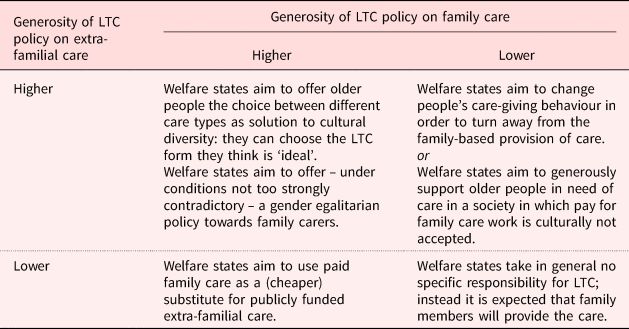
However, what possible explanation is there why these policies could also relate in any other than an opposing way? We argue that welfare states can pursue different aims with different combinations of care policies towards extra-familial care and towards familial care (see also Table 1).
Theoretical policy aims associated with different combinations (degrees of generosity) of long-term care (LTC) policies on family care and extra-familial care

Source: German Research Foundation (DFG) project FAMICAP (‘Institutional Framework of Care by Family Members Between Market Logic and Family Solidarity’).
The combination of a generous policy towards familial care and a generous policy towards extra-familial care
A generous policy towards familial care might be part of an overall generous care policy that aims to reduce care-related gender inequality. In the usual argument, welfare states promote the paid care work of family members with the aim of maintaining the traditional gender division of labour, and/or because this is a less-costly alternative to publicly paid, professional extra-familial care. This argument neglects the possibility that people may prefer to care themselves for their relatives in need of care. Empirical research shows that this is possible if the society has a relatively strong cultural tradition that treats family care as the ‘ideal’ form of care –despite a relatively generous welfare state policy towards extra-familial care (Eichler and Pfau-Effinger, Reference Eichler and Pfau-Effinger2009). However, a care policy of generous conditions for extra-familial care but unpaid or low-paid family care would lead to substantial financial disadvantages for family care-givers in the form of their dependence on a breadwinner, and in many cases also encourage the persistence of gender inequality.
It is therefore plausible to assume that ideal-typically, welfare states that are generous towards extra-familial care and aim for a more gender-egalitarian policy might in addition also want to create conditions for family care that help to avoid such disadvantages for family care-givers, as well as discourage the persistence of gender inequality in family care. Orloff (Reference Orloff1993) points out that the problems connected with the traditional form of unpaid and informal family care could be in part mitigated if caring family members received relatively generous pay for the care, giving them the chance to act as ‘financially autonomous care-givers’ for their relatives. A main precondition for this would be that care policies also robustly support extra-familial care, so that relatives also have the option to be free of the duty to provide family care (Leitner, Reference Leitner2003, Reference Leitner2013).
The generosity of a policy would be greatest if the family care relationship were constructed as formal care-giving employment with the same legal conditions of pay and social security as care work in the formal employment system. With such a policy, welfare states would aim to promote a more gender-egalitarian division of labour within the family, because this offers care-giving female – and male – relatives greater financial independence and potentially also the ability to act as ‘financially autonomous carers’. Such policies could hypothetically detach the (female) carer from her financial dependency on the (male) breadwinner – the fundamental basis of gender inequality in the traditional male breadwinner model. Also, it is plausible that if the pay is generous enough, men will have a greater incentive to share in the family care-giving, since then families will likely not suffer a reduced income (given the fact that men in most families earn the greater part of the family income), which in turn will encourage gender equality, especially if the paid family care scheme includes social security rights and can be combined with part-time employment.
Additionally, generous access to publicly financed LTC is another important precondition for a LTC policy that promotes gender equality because restrictions on access by some older people in need of care (imposed by high-threshold means- or needs-testing) might force them to rely on unpaid familial care (or spend their own money on extra-familial care).
The combination of a less-generous policy towards familial care and a generous policy towards extra-familial care or vice versa
However, it is also possible that welfare states might support only one type of LTC policy generously, but not the other type of LTC. We assume mainly two objectives that welfare states may pursue by supporting just extra-familial care – but not familial care – generously: on the one hand, with this type of LTC policy welfare states could be aiming to change the behaviour of older care-dependent people and their families towards care in that they shift their policy away from family care provision and make extra-familial care more attractive; on the other hand, welfare states may aim to support only extra-familial care generously if the society does not culturally endorse the state's paying for the care performed by family members. From a gender-egalitarian perspective this type of LTC policy can relieve family members and especially women of the responsibility to provide care, while at the same time showing no significant financial recognition of familial care work.
Yet the opposite case, in which the welfare state generously supports family care but shows a low generosity in regard to extra-familial care, is also possible. This kind of LTC policy can be based on the welfare state's aim to use paid family care as a less-expensive substitute for publicly funded extra-familial care. In its effects, on the one hand, this LTC policy leaves low-income families hardly any alternative to providing the care themselves. On the other hand, this LTC policy can support caring family members in their financial autonomy if the payment is generous enough.
A combination of a less-generous policy towards familial care and a less-generous policy towards extra-familial care
Finally, it can also be the case that welfare states show no generosity in both types of LTC policies, with the aim of keeping the families of care-dependent older persons responsible for the care provision. Such a policy preserves traditional gender inequalities to the disadvantage of mostly female relatives of older people in need of care.
However, it should be considered that the causal relation between LTC policies and structures of gender equality in the work–care relationship is rather complex. Their effect can be modified by several factors which include cultural ideals related to the care of older relatives (Eichler and Pfau-Effinger, Reference Eichler and Pfau-Effinger2009), and socio-economic factors like gender pay gaps and the availability of jobs in the labour market (Schäfer and Gottschall, Reference Schäfer and Gottschall2015).
Methodological framework
This article evaluates these theoretical assumptions, using a cross-national comparative case study of LTC policies in five European welfare states as the methodological approach. The study was conducted in the context of a research project funded by a national research foundation. The study countries are Denmark, Germany, the Czech Republic, Italy and Ireland, representing different regions of Europe and different types of welfare state tradition (Esping-Andersen, Reference Esping-Andersen1999; Guo and Gilbert, Reference Guo and Gilbert2007; Ranci and Pavolini, Reference Ranci, Pavolini, Ranci and Pavolini2013; Frericks et al., Reference Frericks, Jensen and Pfau-Effinger2014; Gori et al., Reference Gori, Fernandez and Wittenberg2016), as well as different traditions regarding gender and care work (Lewis, Reference Lewis1992; Sainsbury, Reference Sainsbury1996; Leitner, Reference Leitner2003; Bambra, Reference Bambra2004; Pfau-Effinger, Reference Pfau-Effinger2005b). The paper uses document analysis of care policy laws, and data from MISSOC, EQLS, OECD Labour Force Statistics 2016 and the research project FAMICAP. The empirical analysis is mainly restricted to the analysis of legal regulations in force in the relevant national welfare state institutions.Footnote 2
The article introduces an innovative methodological framework for the measurement of the generosity of LTC policies at the level of national institutional regulation. Such an analysis can show how the preferences of care-dependent older people in their choice between extra-familial and family care can be supported by the respective care policies. The study treats LTC policies on paid family care and LTC policies on extra-familial care as two different variables. For each it measures the degree of generosity. Finally, it analyses how care policies towards paid family care relate to extra-familial care policies in terms of their generosity. It also discusses the impact of these care policies on gender equality.
The generosity of LTC policies on paid family care is measured by three main indicators. The first (1) is the degree of generosity in the access by care-dependent older persons to paid care performed by family members. This is measured by the degree of restrictions based on (a) a needs-test, (b) a means-test and (c) the specification of which family members can be paid for providing the care.
In theory, a paid family care policy of the highest possible generosity would be universal in access, offering this care to all older people who claim to need it without any preconditions as to their family carer. Care policy of the lowest generosity strongly restricts older persons’ access to publicly paid family care to those with particularly marked care need based on a high-threshold needs-test, and/or to some groups of poor older persons, and/or to those whose care can be delivered by a specified category of family member. We consider only the most rigid restriction that occurs overall, because a high generosity on one dimension cannot compensate for a low generosity on another.
The next indicator (2) measures the generosity of care policy in terms of the average amount of the pay for family care-giving. The degree of generosity is measured by the estimated difference between the public pay for family care-givers and the average pay of care workers in the formal employment system.Footnote 3 In theory, care policies of the highest generosity would offer the same level of pay to family carers that extra-familial care employees receive. Care policies of the lowest level of generosity would not offer payment at all to family carers.
The third indicator (3) measures the degree of generosity of care policies in terms of social security rights of caring family members – the number of relevant social security systems in which family carers can be included. In theory, the most generous welfare states should offer family care-givers unemployment benefits, pensions and health insurance deriving from their care work, while welfare states with the lowest level of policy generosity would offer none of these social benefits.The overall degree of generosity of LTC policies on paid family care (4) is based on the calculation of their average value on all three dimensions (1), (2) and (3).
The generosity of extra-familial LTC policies is measured here (1) by the degree to which a care policy assures care-dependent older people access to publicly paid, extra-familial care. In theory, an extra-familial LTC policy of the highest generosity would be universal; offering publicly funded extra-familial care to all older persons who claim to be in need of care. Care policy of the lowest generosity would vigorously restrict access to publicly paid extra-familial care to only those older persons with a particularly severe care need based on a high-threshold needs-test, and/or to older people with low income levels. We consider here only the most rigid restriction that occurs overall, because high generosity in one dimension cannot compensate for low generosity in another.
The second indicator (2) measures the generosity of extra-familial LTC policies in terms of the average share of co-payment that the welfare state contributes to the total cost of the extra-familial LTC. In theory, generosity is highest where the state pays for the whole care provision, and lowest where it does not co-finance the extra-familial care at all. The overall degree of generosity (3) is based on the calculation of the average of the two dimensions (1) and (2).
Finally, we analyse how familial and extra-familial LTC policies relate to each other in terms of their generosity levels, and we ordinally rank the LTC policies with regard to their average generosity level.
In order to analyse the implications for gender equality of the work–care relationship, we analyse in a first step whether LTC policies hypothetically support gender equality. In a second step, we examine whether cross-national differences in structures of gender equality in the work–care relationship correspond to the differences between the combinations of familial and extra-familial LTC policy. The indicators for the structures of gender equality include the gender gap in the labour force participation rates of people of later working age (55–64), which is in many countries the biggest group of people of working age with older relatives in need of care (Bettio and Verashchagina, Reference Bettio and Verashchagina2012), and the gender gap in the daily provision of care to older relatives by people of later working age (55–64).
The analysis of the welfare states’ support of gender equality concludes with an ordinal ranking of the five welfare states on each of our three indicators by which we measured that support. Finally, the average level of support for gender equality is calculated by forming the mean of all ranking positions of a welfare state on the three indicators in order to investigate the relation between gender equality and different combinations of LTC policies in the five welfare states that we investigated.
Findings of the empirical study: relation between familial and extra-familial LTC policy types
Generosity of LTC policies on paid family care
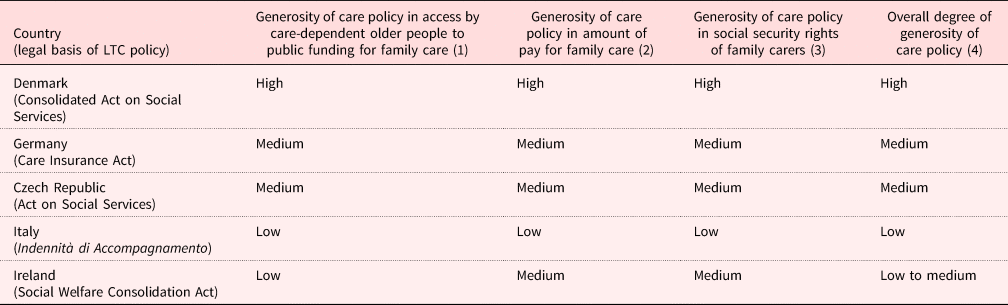
Table 2 shows the differences in the level of generosity of LTC policies on paid family care in the studied countries.
Generosity of long-term care (LTC) policies on paid family care for older people in five European countries

Notes: (1) Generosity of care policy in access by care-dependent older people to paid family care by lowest ranking sub-indicator (a = needs-test, b = means-test, c = preconditions regarding family carer). (a) High generosity = access by older people to paid family care without needs-test or per low-threshold needs-test (one or two of ten tested needs according to the International Classification of Functioning, Disability and Health (ICF)); medium generosity = access by older people to paid family care per medium-threshold needs-test (three or four of ten tested needs according to ICF); low generosity = access by older people to paid family care per high-threshold needs-test (five or more of ten tested needs according to ICF) or the requirement of full-time care; since the differences between the categories five to ten are smaller than between the other categories, we include more categories for low generosity than for the other levels. (b) High generosity = access by older people to paid family care per (or without) means-test that excludes only on the basis of high income (over €7,500 per month); medium generosity = access by older people to paid family care per means-test that excludes on the basis of medium income (over €5,000 per month); low generosity = access by older people to paid family care per means-test that excludes on the basis of even low income (over €2,500 per month) and assets. (c) High generosity = access by older people to paid family care restricted by no or one specification for family carers; medium generosity = access by older people to paid family care restricted by two specifications for family carers; low generosity = access by older people to paid family care restricted by three or more specifications for family carers. Potential specifications for family carers: access to paid family care dependent on (i) place of residence of family carer, (ii) income of family carer (means-test), (iii) employment status of family carer. (2) High generosity = 67–100 per cent or above of the average pay for full-time professional care with basic qualification; medium generosity = 34–66 per cent of average pay for full-time professional care with basic qualification; low generosity = below 34 per cent of average pay for full-time professional care with basic qualification. (3) High generosity = family carer covered by all main social security systems (pension, health, unemployment); medium generosity = family carer covered by one to two social security systems; low generosity = family carer not covered by any of the main social security systems. (4) Average of value of indicators (1), (2) and (3).
Source: Analysis of legal basis of care policy institutions on the basis of document analysis in the countries of the study, secondary analysis of empirical studies and the Mutual Information System on Social Protection data (MISSOC, 2017), German Research Foundation (DFG) project FAMICAP (‘Institutional Framework of Care by Family Members Between Market Logic and Family Solidarity’); data for 2016, German data for 2017. Data for average pay for full-time professional care with basic qualification (160 hours per month): Bettio and Verashchagina (Reference Bettio and Verashchagina2012).
Denmark
The Danish welfare state care policy is highly generous in the access of older people to paid family care, since access is universal and not restricted by needs-testing, means-testing or preconditions regarding the relation to the family carer (Consolidated Act on Social ServicesFootnote 4). The generosity of care policy in the pay levels and social security rights of family carers is high as well. If an older person chooses care provision by a family member, the family member can obtain a formal employment contract (full- or part-time) with the local authorities. The municipality must ensure that the employment contract for family carers complies with general wage levels, work-related rights and social rights as set forth in the collective wage agreement for professional carers (Sections 94, 95, 96, 118). Accordingly, the pay is legally fixed at 100 per cent of the standard wages of care workers in formal public care services, and family care-givers have comprehensive social security rights (pension, health, unemployment). Altogether, LTC policies on paid family care have a high degree of generosity in the Danish welfare state.
Germany
The German welfare state offers an individual right to all older people to receive payments for family care, if they pass a needs-test in the form of a medium-threshold health-status test (Care Insurance Act (Pflegeversicherungsgesetz) (Sozialgesetzbuch XI Footnote 5)). The generosity of policy on pay for care provided by family members is overall at a medium level. The amount of this pay differs with the different care levels (€316–901) and is about half the amount of the pay for care provision by a professional care service at the corresponding care level (Section 37). The social security rights of family carers are of medium-level generosity, comprising pension entitlements for those who perform care over ten hours per week (Section 19) and work under 30 hours per week in formal employment (Section 44, para. 1), as well as unemployment insurance entitlements under specific conditions like previous employment. The family care provision gives no further entitlements, e.g. health insurance (Frericks et al., Reference Frericks, Jensen and Pfau-Effinger2014). Altogether, the degree of generosity in the support of family care in Germany is at medium level.
Czech Republic
Under the Czech LTC policy, older people are eligible for paid family care if they pass a needs-test in the form of a medium-threshold health-status test (Act on Social ServicesFootnote 6). Therefore, the generosity is at a medium level. The family care payment amount varies with the estimated extent of care need, from €33 to 489 per month, which is more than one-third of the wages of care workers employed in formal care services for the same amount of care and is therefore of medium generosity. Relatives of a care recipient on at least care-level 2 (out of four levels) can be credited for their care in the pension insurance system and receive health insurance (Baríková, Reference Baríková and Österle2011; Colombo et al., Reference Colombo, Llena-Nozal, Mercier and Tjadens2011), so that the generosity of the social security rights of family carers is also medium. Altogether, the generosity of Czech LTC policy on paid family care is of medium level.
Italy
The Italian LTC policy, the Indennità di Accompagnamento,Footnote 7 gives older people with high care-needs access to cash payments for family care. Access to the payment is possible only for older persons needing full-time care, as evaluated by a high-threshold needs-test. Accordingly, the LTC policy generosity of access by older persons to paid family care is low. The payment for family care is a fixed monthly amount of €512 – less than one-third of the standard wage of full-time formal care workers – so that the generosity of payment for family care is low. The generosity of social security rights for family carers is also low, since they are entitled to only minor pension credits that compensate for 25 days per year, even when the family care is full-time (Lamura et al., Reference Lamura, Polverini, Principi, Balducci, Melchiorre, Quattrini and Gianelli2004). Altogether, the generosity of welfare state support for paid care by family is ranked low.
Ireland
The Irish welfare state gives older people of high care need the right to payments for familial care (Social Welfare Consolidation ActFootnote 8), but the generosity of the LTC policy on paid family care is generally low. Only those older persons are eligible who require full-time care as evaluated by a high-threshold needs-test. Furthermore, the group of family care-givers who generally qualify for direct payment is limited by various preconditions.
There are two basic programmes for family care-givers which converge in some regards, but differ in others considerably:
(1) The Carer's Allowance is designed as an income substitute for family carers on low incomes (per means-test) whose weekly assets and income amount to less than €332 per single person and €665 per couple. The Carer's Allowance is €816 per month for carers younger than 66 and €928 for those of retirement age and over. As this is around half the wages of formal care workers, the generosity of payment is of medium level.
(2) The Carer's BenefitFootnote 9 applies only to persons who leave their paid employment in order to care for a relative. The payment generosity is at a medium level: €820 per month for persons under 66 – also about half the wage of formal care workers.
The generosity of social security rights in both programmes is at medium level. For the Carer's Allowance, social insurance contributions are covered by the welfare state; for Carer's Benefit recipients, the credited social insurance contribution amount depends on the carer's work history (Mahon et al., Reference Mahon, Bailey and O'Nolan2014). Altogether, the degree of generosity of support for family care in Ireland is at low-to-medium level.
To summarise: altogether, the cross-national comparative analysis indicates that among the five welfare states there are substantial differences in the generosity of care policies on paid family care (Table 2). LTC policy on paid family care has a high level of generosity in Denmark, a medium level in Germany and the Czech Republic, a low-to-medium level in Ireland, and a low level of generosity in Italy.
Generosity of LTC policies on extra-familial care
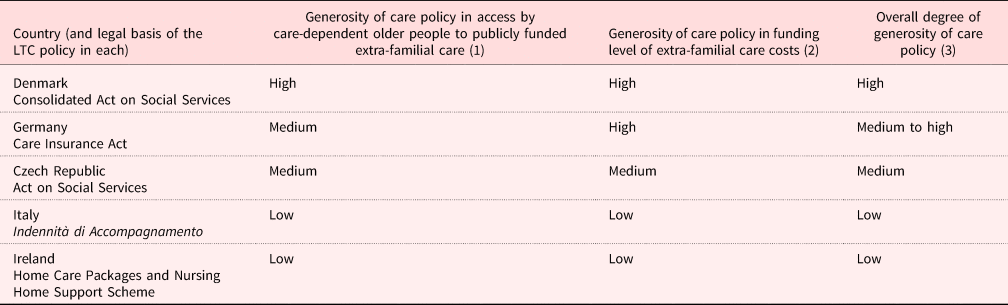
In this part we analyse the degree of generosity of LTC policies on extra-familial care (Table 3).
Generosity of long-term care (LTC) policies on extra-familial care for older people in five European countries

Notes: (1) Generosity of LTC policy in the access to extra-familial care by lowest ranking sub-indicator (a = needs-test, b = means-test). (a) High generosity = access by older people to publicly funded extra-familial care, without needs-test or per low-threshold needs-test (one or two of ten tested needs according to the International Classification of Functioning, Disability and Health (ICF)); medium generosity = access by older people to publicly funded extra-familial care per medium-threshold needs-test (three or four of ten tested needs according to ICF); low generosity = access by older people to publicly funded extra-familial care per high-threshold needs-test (five or more of ten tested needs according to ICF or requirement of full-time care). (b) High generosity = access by older people to publicly funded extra-familial care without or per means-test that excludes only on the basis of high income (over €7,500 per month; medium generosity = access by older people to publicly funded extra-familial care per means-test that excludes on the basis of medium income (over €5,000 per month); low generosity = access by older people to publicly funded extra-familial care per means-test that excludes on the basis of even low income (over €2,500 per month) and assets. (2) High = 67–100 per cent of the share of extra-familial care costs; medium = 34–66 per cent of the share of extra-familial care costs; low = below 34 per cent of the share of extra-familial care costs. (3) Average of value of indicators (1) and (2).
Source: Analysis of the legal basis of care policy institutions – document analysis of the countries in the study, secondary analysis of empirical studies and the Mutual Information System on Social Protection data (MISSOC, 2017), German Research Foundation (DFG) project FAMICAP (‘Institutional Framework of Care by Family Members Between Market Logic and Family Solidarity’); data for 2016, German data for 2017.
Denmark
In Denmark, all citizens have an individual right to public support for extra-familial care. They can get physical care or help with everyday life without a needs-test or a means-test (Consolidated Act on Social Services). Thus, generosity in terms of older persons’ access to extra-familial care is on a high level. The same applies to generosity in terms of the amount of public co-funding of extra-familial care costs, since all costs are covered (Section 83). Altogether, Danish care policy shows a high degree of generosity towards older people who choose extra-familial care.
Germany
In Germany, care-dependent older persons have an individual right to public support for extra-familial care (Sozialgesetzbuch XI). The care policy has a medium level of generosity of older people's access to extra-familial care since it is based on a medium-threshold needs-test (Section 15). The amount of public funding for extra-familial care is legally fixed and paid directly by the public care insurance to the care service agencies or residential care homes. The public co-financing of the care costs is meant to cover fully the costs of the necessary physical care and to some extent also household services at the different care levels (Section 36). For care recipients in residential care, mainly only care-related tasks are covered, so that they have considerable additional expenditures for housing, food and household services (Rothgang et al., Reference Rothgang, Iwansky, Müller, Sauer and Unger2011: 203f.). Nevertheless, the generosity of public care-cost payments can be ranked as high. Altogether, the generosity of the care policy on extra-familial care in the German welfare state is medium to high.
Czech Republic
In the Czech Republic, access to public funding for extra-familial LTC is based on a medium-threshold health-status test, so that the generosity of care policy is at medium level. The Act on Social Services allows care-dependent older people to receive cash benefits for their physical care in their own household, covering on average from one- to two-thirds of these care costs. Older persons in residential care get full coverage of the care, but have to pay up to 85 per cent of their own income to cover food and accommodation costs (Österle, Reference Österle2010; Colombo et al., Reference Colombo, Llena-Nozal, Mercier and Tjadens2011; Janoušková et al., Reference Janoušková, Kampichler, Saxonberg, Kuronen, Kröger, Pfau-Effinger and Frericks2014). The generosity of public co-financing of the extra-familial care costs is thus on a medium level. Altogether, the Czech welfare state's policy on extra-familial LTC is of medium generosity.
Italy
The central Italian welfare state offers the Indennità di Accompagnamento, a national cash benefit to care-dependent older people to pay for extra-familial care services. Access to the payment is at a low level of generosity since it is restricted to needs-tested, full-time care (Costa-Font, Reference Costa-Font2010; Da Roit and Le Bihan, Reference Da Roit and Le Bihan2010). The monthly flat-rate payment is €512, covering on average less than one-third of the cost of formal full-time extra-familial care, so that the generosity of the policy on public co-funding of the care costs is low. Altogether, the Italian extra-familial LTC policy on older persons shows a low level of generosity.
Ireland
The Irish welfare state's extra-familial LTC policy for older people is rather fragmented, and its generosity in terms of access is low (Timonen et al., Reference Timonen, Doyle and O'Dwyer2012). Only older persons with high-level care need, after passing a high-threshold needs-test, have access to different kinds of services within the Home Care Package programme (Health Service Executive, 2016). Furthermore, community care and social care services are only for older persons of low income and in possession of the means-tested Medical Card. The access to residential care is, in accordance with the Nursing Homes Support Scheme Act, both means-tested and needs-tested since it is primarily only for people of high-level care need who are unable to live on their own.
Policy generosity of funding for extra-familial LTC is low as well. Co-payment amounts for care differ with the income of care recipients (European Commission, 2014). Care-dependent older persons are expected to contribute 80 per cent of their yearly income, 7.5 per cent of the value of all their assets per annum and a one-time payment of 22.5 per cent of the value of their homes, all towards their own care costs (Department of Health and Children, 2016). The policy of the Irish welfare state on extra-familial care therefore is altogether of low generosity.
Overall, our findings show that the welfare states in the study differ considerably in the degree of generosity of their extra-familial care policies (Table 3). Danish welfare state care policy is highly generous, while the German welfare state is of medium to high generosity in this regard. The Czech welfare state's policy on extra-familial LTC shows medium generosity, while both Italy and Ireland's are low-level generous.
Relation between familial and extra-familial LTC policy in terms of generosity levels
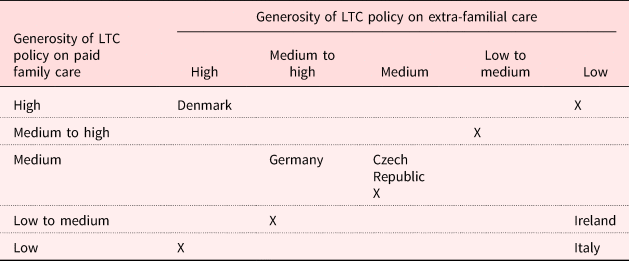
Our findings (Table 4) do not confirm the common assumption that welfare states prefer to support generously either extra-familial care or care delivered by family members instead of extra-familial care. Welfare states tend to combine both types of care policy in other ways than by treating them as opposites. Often, both types of care policy have a similar degree of generosity.
The relation between long-term care (LTC) policies on paid family care and extra-familial care on the basis of their generosity

Note: X: expected result on the common assumption that the two types of care policies are opposites.
Source: German Research Foundation (DFG) project FAMICAP (‘Institutional Framework of Care by Family Members Between Market Logic and Family Solidarity’).
In Denmark, LTC policy generosity is high for both types of care; in Germany and the Czech Republic, both types of LTC policies show about medium generosity, while the generosity is around a low level in Italy and Ireland. There are some minor deviations which, however, do not change the overall picture; e.g. LTC policy on extra-familial care in Germany is somewhat more generous (medium to high) than LTC policy on paid family care (medium). On the other hand, in Ireland LTC policy on paid family care shows a low-to-medium generosity, while extra-familial care policy shows a low generosity level.
Discussion: relation between familial and extra-familial LTC policy types
If our findings had matched the common assumption of the relation between the generosity levels of both LTC policy types, we would have found that, among the countries of the study, the policy generosity of paid family care varied in the opposite direction from that of the policy on publicly paid extra-familial care. In that case, the degree of generosity of family care would increase with a decrease in the generosity of policies on publicly paid extra-familial care (indicated by ‘X’ in Table 4).
Instead, the findings indicate that de-familialising and familialising care policies vary relatively independently of each other. They even indicate that welfare states may offer similar generosity towards both types of LTC policy. Both are often part of a general care policy that treats both types of LTC in a similar way, though in a more generous or a less generous manner.
Findings of the empirical study: relation between different combinations of LTC policy and gender equality
The findings of the analysis of the relation between familial and extra-familial LTC policy indicate that we get better insight into the relationship between care policy and gender equality if we treat them as two different types of care policy and analyse how different combinations of both types affect gender equality in the work–care relationship.
The analysis of the relation between the different combinations of care policy types and gender equality deals with the hypothetical consequences of different combinations of familial and extra-familial LTC policies for gender equality in the work–care relationship. This part also reviews empirical data on the structures of gender equality within the five welfare states of the study and how they are associated with the various combinations of LTC policy. It is followed by a discussion of the findings.
Hypothetical consequences of LTC policy for gender equality
In this part, we analyse whether different LTC policies hypothetically support gender equality by guaranteeing comprehensive access to public support for both types of care by liberating relatives from care obligations, ensuring their financial autonomy when caringFootnote 10 or by providing incentives for men to take up family care-giving.
Denmark
Denmark shows a high generosity towards paid care delivered by family members and an equally high level of generosity towards extra-familial care. This LTC policy offers in comparison the most comprehensive support for gender equality. On the one hand, the highly generous support of extra-familial care potentially relieves relatives of older persons in need of care from any care obligations. On the other hand, the highly generous LTC policy on paid family care includes family care-givers in the formal employment sector by offering the same conditions of pay and social rights to family care-givers and professional care workers. This recognition of paid family care as formal employment in the private household facilitates the financial autonomy of familial carers and supports gender equality. At the same time, men will have more incentive to share the family care, as in that case families will not likely have significantly less job income (since in most families men earn more than women). This in turn will encourage gender equality, especially if high generosity of pay for family care is combined with highly generous social security rights. Furthermore, the Danish LTC policy strongly supports gender equality among female and male family carers by preventing the need for unpaid family care by a comprehensive access to care for all older people in need of care without needs-testing or means-testing for extra-familial care or paid family care.
Germany
The German LTC system also supports gender equality insofar as it offers a highly generous public support for extra-familial care at the care recipient's home or in residential care. As a consequence, neither female nor male family members are forced to stay at home to provide care for their relatives in need of care. However, in case they choose to care, the welfare state offers financial support and social security rights for family carers – but average wages and social security rights are less generous than in formal employment. Since traditionally most family carers have been women, this policy might perpetuate gender inequality. The prevalent gender pay gap might additionally promote gender inequality because it is financially less attractive for men to interrupt their career to provide care. Furthermore, the access to public support for extra-familial care and paid family care is restricted by a medium-threshold needs-test. For older people not yet eligible for LTC support this may lead to a situation where the still mostly female relatives will have to provide family care without payment if their older relatives cannot afford to finance an extra-familial care provider privately.
Czech Republic
The Czech welfare state offers medium-level support for both types of care. The medium public support for extra-familial care only partly reduces family care-giving – family care is still a necessary supplement. Against the background of the medium-level public support of familial care which does not offer equal wages or social security rights in the formal employment system, a significant disadvantage for the mainly female family carers results in terms of their financial autonomy. Since the pay and social rights for familial care are less generous than those in formal care employment, this policy creates less incentive for male relatives to provide care. In addition, due to a medium-threshold needs-test for both types of LTC, older people with minor care needs often have to rely on unpaid family carers – mainly female relatives – either in case the older person cannot afford to pay privately for extra-familial care, or when extra-familial care is not available because of lacking infrastructure, characteristic for rural areas in the Czech Republic (Baríková, Reference Baríková and Österle2011).
Italy
The Italian LTC policy offers a fixed cash payment that can either be used as a subsidy to buy extra-familial care services or as support for care delivered by family members. In each case the amount is too small to cover the actual costs of the care. While the welfare state sets no explicit incentives to promote the use of extra-familial services, especially in families of low household income, it is likely that family members will still be obliged to supplement or provide care for their older relatives, as privately paid, full-time formal care services are not an affordable alternative. Since the low pay and the uncomprehensive social security rights offered for family care are not the equal of those set for formal care workers, the Italian LTC policy tends to lead to a persistence of traditional structures of gender inequality. The mainly female family carers carry the burden of care-giving to a large extent since, on the one hand, relatives of older people with less than a high-threshold care need cannot be paid for their care work and often are not able to finance extra-familial care providers privately; on the other hand, public funding of extra-familial care as well as paid family care is not very generous.
Ireland
In Ireland, the low-level generosity of welfare state support for extra-familial care offers, besides privately paid services, scarcely any other care options for family members than to care for their older relatives themselves. However, the LTC policy on familial care is based on a medium level of generosity in terms of payment and social security rights, which alleviates the situation to a certain degree. Though only relatives with a low additional income or an interruption of their career in order to provide care for older persons with high care needs are entitled to receive public support for their care-giving. Against the background of gendered differences in wage and career patterns, this further aggravates gender inequalities. Altogether, LTC policy of the Irish welfare state to a substantial degree supports the persistence of traditional structures of gender inequality. The greater part of the care obligation still mostly rests on women's shoulders due to the absence of options that either relieve carers of their care obligations or adequately compensate them for their care in order that they can achieve financial autonomy.
The findings show that the Danish welfare state, with its combination of generous extra-familial with generous familial LTC policy, offers hypothetically the best conditions for gender equality. The German welfare state offers support for gender equality on a somewhat lower level, since it offers a relatively high generosity of LTC policy on extra-familial care, while its generosity towards familial care is only medium. The support of gender equality by the Czech welfare state is on a medium level; it neither offers comprehensive support for extra-familial LTC nor for family care. Finally, the support of gender equality by the LTC policies of the Irish welfare state is comparably low and only the support of gender equality in Italy is even lower. Both welfare states reinforce the persistence of traditional structures of gender inequality within the family to a substantial degree.
Structures of gender equality which are related to LTC policies
The next part analyses differences in the structures of gender equality that are related to different LTC policies.
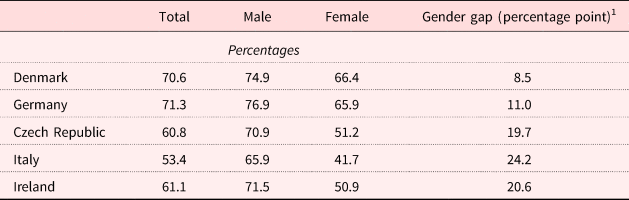
As a first measure of gender equality, we use the gender gap in the labour force participation rates of older people of working age (55–64), measured as the distance between the percentage of male workers and female workers. In the case of total gender equality, the gender gap would be 0.0 per cent. The gender gap is smallest in Denmark (8.5%), followed by that of Germany (11.0%). It is substantially wider in the Czech Republic (19.7%) and Ireland (20.6%), while the widest gender gap can be found in Italy (24.2%) (Table 5).
Gender gap in labour force participation rates of people age 55–64

Note: 1. Difference in percentage points equals distance between men's labour force participation rate and women's labour force participation rate.
Source: OECD Labour Force Statistics 2016 (Organisation for Economic Co-operation and Development, 2017), own calculation of gender gap.
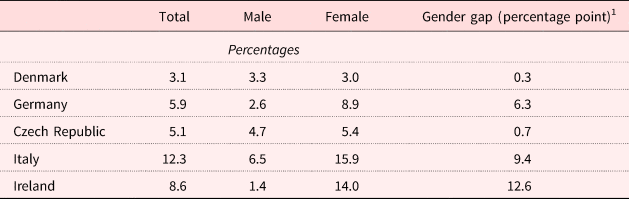
We have also analysed the gender gap with regard to the proportion of people of working age (55–64) who carry out daily care tasks for an older relative,Footnote 11 measured as the distance between the percentage of men and women who perform family care. Gender equality is higher the nearer the gender gap is to 0.0 per cent. The findings show that the most equal gender distribution in care-giving is found in Denmark (0.3%) and the Czech Republic (0.7%), the countries which therefore show the highest gender equality in regard the daily care provision. The gender gap is somewhat wider in Germany (6.3%) and in Italy (9.4%). The gender gap is widest in Ireland (12.6%) (Table 6).
Gender gap among the people age 55–64 providing daily care to older relatives

Note: 1. Difference in percentage points equals distance between the proportion of men who daily care for an older relative and the proportion of women who daily care for an older relative.
Source: European Quality of Life Survey (EQLS) 2012, own calculation of gender gap.
Discussion: relation between the different combinations of LTC policy types and the indicators for gender equality
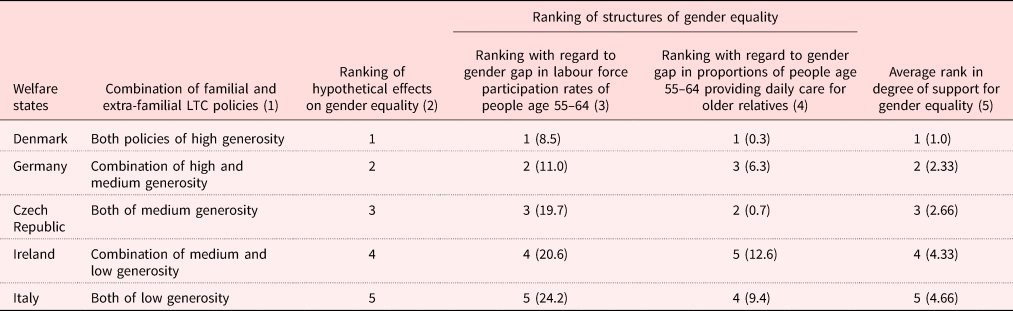
Our findings show how the indicators for the welfare states’ ranking in regard to gender equality are related to the different combinations of LTC policy for extra-familial care and LTC policy for familial care. It turns out that there is a relatively close relationship between the type of combination of familial and extra-familial LTC policy and the indicators for gender equality in the work–care relationship (Table 7).
Relation between different combinations of long-term care (LTC) policies and gender equality

Notes: (1) Combination of LTC policy based on generosity of familial and extra-familial LTC policy. If the degree of the generosity level of one of the respective LTC policies falls between two categories (e.g. medium to high), we round it up to the next-higher category. (2) Ordinal ranking of welfare states with regard to hypothetical effects of their LTC policy on gender equality. Rank 1 indicates the most gender-egalitarian hypothetical effects of the policy. Rank 5 indicates the least gender-egalitarian hypothetical effects of the LTC policy. (3) Ordinal ranking of welfare states with regard to their gender gap in labour force participation rates of people age 55–64. Rank 1 indicates the smallest gap between male and female labour force participation. Rank 5 indicates the biggest gap between male and female labour force participation (percentages are in parentheses). (4) Ordinal ranking of welfare states with regard to their gender gap in proportions of people age 55–64 providing daily care for older relatives. Rank 1 indicates the smallest gap with regard to the proportion of male and female relatives who provide care on a daily basis. Rank 5 indicates the biggest gap with regard to the proportion of male and female relatives who provide care on a daily basis (percentages are in parentheses). (5) Ranking based on the mean of all ranking positions (in parentheses) of a country with regard to their respective indicators (2), (3) and (4).
Source: German Research Foundation (DFG) project FAMICAP (‘Institutional Framework of Care by Family Members Between Market Logic and Family Solidarity’); European Quality of Life Survey (EQLS) 2012, author's own calculations; OECD Labour Force Statistics 2016 (Organisation for Economic Co-operation and Development, 2017), author's own calculations.
The welfare state in which both types of policy have a high level of generosity, Denmark, ranks highest among the five countries in the average degree of support for gender equality, highest in the hypothetical consequences for gender equality, and highest in regard to the gender gap in the labour force participation rate of people of later working age and in the daily care provision for an older relative.
Welfare states in which both types of LTC policies have about a medium level of generosity, Germany and the Czech Republic, have also on average a medium rank among the countries of the study in the degree of support for gender equality. In relation to the other countries, Germany ranks second and is followed by the Czech Republic in the hypothetical consequences of LTC policies on gender equality, as well as in regard to the gender gaps in labour force participation rates of people of working age. Germany has also a middle rank for what concerns the gender gap in the daily care of older relatives. The Czech Republic represents an interesting deviation: it has a higher degree of gender equality and ranks at the top among countries with a small gender gap in the daily care of older relatives, together with Denmark. This is puzzling as the medium generosity of pay for family care in the Czech Republic is not thought to incentivise men strongly to participate in familial LTC. Factors that could promote the comparably strong male participation in LTC might include cultural ideals about the care of older people which diminish the traditional priority of women as the main family carers (Eichler and Pfau-Effinger, Reference Eichler and Pfau-Effinger2009).
Finally, welfare states with a lower level of generosity in both types of LTC policies, which include Ireland and Italy in our study, rank on average the lowest with regard to the support for gender equality.
In summary, our findings indicate that the ranking of the average degree of support for gender equality in the hypothetical consequences and the structures of gender equality corresponds to the generosity level of the different combinations of extra-familial and familial LTC policies. Since the behaviour of people is constrained, but not determined, by the combinations of LTC policy types, the relation between hypothetical and structural consequences for gender equality and the structures of gender equality that we find in the different countries is not monocausal: cultural and socio-economic factors that we did not investigate in this study may also have influenced the differences.
Conclusion
The main aim of this article is to evaluate how far the concept of de-familialisation/familialisation is still an adequate classification scheme for different welfare state LTC policies for older people. Authors who use this concept often assume that welfare states use generous LTC policy on paid family care as a type of retrenchment instrument in order to reduce their financing of extra-familial care (Ranci and Pavolini, Reference Ranci and Pavolini2015). In contrast, welfare states with a de-familialising policy with generous support for extra-familial care are thought to introduce policies more supportive of gender equality in order to ‘free’ women from their caring role (Lister, Reference Lister, Baldwin and Falkingham1994; McLaughlin and Glendinning, Reference McLaughlin, Glendinning, Hantrais and Mangen1994; Esping-Andersen, Reference Esping-Andersen1999). De-familialisation and familialisation are often understood to represent the two poles of a continuum on which the empirical cases are situated. Accordingly, it is assumed that welfare states support in their LTC policies either extra-familial care or paid care delivered by family members.
This paper challenges the common use of this concept, arguing that it is not adequate to oppose LTC policies on extra-familial and paid family care in this way. Our findings support instead the supposition that, in theory, the two types of care policy can vary relatively independently of each other. They indicate that welfare states can offer a similar generosity in both types of care policy, and that both are often part of a general care policy that treats both types similarly, though more or less generously.
With regard to the consequences for gender equality, the findings indicate that the tendency that traditional structures of gender inequality are maintained is, against common assumptions, often relatively high in welfare states with a low generosity of LTC policy on paid family care. Since these welfare states often combine a policy of low generosity towards familial care with a policy with a low generosity towards extra-familial care, there is a relatively high likelihood in these welfare states that female relatives may be obliged to take on the family care tasks, and that they likely do so under particularly poor conditions of pay and social security.
Care policy of medium or high generosity towards paid family care is, by contrast, in part embedded in an overall generous care policy in welfare states, which potentially combats gender inequality associated with care because it offers women and men, to a high or at least medium degree, the option to either ‘free’ themselves from the necessity of caring for their relatives or else to act as financially autonomous family care-givers. The Irish LTC policy deviates somewhat from this trend, since it offers more generous support and incentives to paid family care than to extra-familial care.
The policy implications of the analysis suggest that welfare states that combine highly generous LTC policy on extra-familial care and care performed by family members will promote gender equality the most by offering family members both the option not to perform care themselves and use generous extra-familial services instead, as well as generous financial and social security provisions for persons who wish to care for their relatives, thus also offering an attractive option for men to act as family carers.
In contrast, in those welfare states that show a near or low-level generosity towards both types of LTC policies, it will be most likely that family members, and therein mainly women, are forced to care for their relatives on a poorly paid or completely unpaid basis, especially when the family cannot afford extra-familial care services.
In welfare states that support only one of the two types of LTC policies generously, it is also to be expected that gender equality can only be partly achieved, since either the mainly female carers do not have a real option not to perform care due to a lack of public funding for extra-familial care, or to act as financially autonomous carers, in case of a lack of generous financing of familial care.
The paper brings new insights into the ways welfare states act in their care policies. It helps to clarify how the concept of de-familialisation/familialisation can be understood, and what this means for the relationship between care policies and gender equality. It turns out that we get a better understanding of the relationship between care policy and gender equality if we analyse the importance of different combinations of extra-familial and familial care policy for gender equality.
In future research, it would also be fruitful to analyse more welfare states with regard to the relation between LTC policies on extra-familial and familial care to see how far our results can also be confirmed for a larger variety of countries. Furthermore, it would be profitable to analyse historical change in LTC policies in order to find out what concrete policy aims welfare states associate with the introduction of different combinations of familial and extra-familial care policies, including the role of retrenchment, and change in gender equality.
Author ORCIDs
Birgit Pfau-Effinger http://orcid.org/0000-0001-8915-8397.
Acknowledgements
The paper benefited from feedback on a previous version of the paper at the RC19 of ISA Conference, Bath, UK, August 2015 and the Transforming Care Conference, Milan, Italy, June 2017. We thank the anonymous reviewers for their many insightful comments and suggestions. Many thanks as well to Franz Zurbrugg for his work on the copyediting of the paper and the translation of considerable parts, and to Tom Ring and Jan Meid for research assistance.
Financial support
This work was supported by the German Research Foundation (DFG) (grant agreement number PF 578112).