Early life nutrition is critical for the long-term development and performance of livestock. The concept of “lactocrine programming” states that bioactive, non-nutritive factors in colostrum transferred from dam to offspring can influence postnatal development with lasting effects into adulthood (Bagnell and Bartol, Reference Bagnell and Bartol2019). Colostrum is rich in immunoglobulins, cytokines, lactoferrin and hormones that mediate passive immunity and support the development of the gastrointestinal tract (Hammon et al., Reference Blum and Hammon2000; Blum and Baumrucker, 2008). During the transition to mature milk, the concentration of bioactive compounds decreases, with transition milk (TRANS) containing lower levels of factors such as insulin-like growth factors, growth hormone, and nucleotides (Hammon et al., Reference Blum and Hammon2000; McGrath et al., Reference McGrath2016).
Feeding colostrum has been shown to improve the antioxidant-prooxidant balance in calves, increasing antioxidant levels and reducing reactive oxygen metabolites (ROM), which helps to regulate the redox balance and reduce oxidative stress (Kankofer and Lipko-Przybylska, Reference Kankofer and Lipko-Przybylska2008). In our companion study (Ostendorf et al., Reference Ostendorf, Ghaffari, Cohrs, Koch and Sauerwein2025), we found that calves fed TRANS had greater energy and feed intake, along with moderate improvements in health and antioxidant status during the first 14 weeks of their life. However, these benefits did not translate into significant long-term differences in growth, feeding behavior or oxidative status during the pre-weaning and weaning period. TRANS feeding may reduce health risks (Conneely et al., Reference Conneely, Berry, Murphy, Lorenz, Doherty and Kennedy2014; Kargar et al., Reference Kargar, Bahadori-Moghaddam, Ghoreishi, Akhlaghi, Kanani, Pazoki and Ghaffari2021), promote growth (Van Soest et al., Reference Van Soest, Cullens, VandeHaar and Nielsen2020) and improve the development of the gastrointestinal tract (Pyo et al., Reference Pyo, Hare, Pletts, Inabu, Haines, Sugino, Guan and Steele2020; Van Soest et al., Reference Van Soest, Weber Nielsen, Moeser, Abuelo and VandeHaar2022) during the pre-weaning period. However, while the short-term benefits of TRANS feeding are well documented, its long-term effects on first lactation performance are still unclear and require further investigation.
Postnatal developmental programming is shaped by nutritional strategies in early life, including management of colostrum and pre-weaning nutrient intake (Faber et al., Reference Faber, Faber, McCauley and Ax2005; Soberon et al., Reference Soberon, Raffrenato, Everett and van Amburgh Me2012). Faber et al., (Reference Faber, Faber, McCauley and Ax2005) demonstrated that calves fed 4 L of colostrum had greater milk production in both first and second lactations than calves fed 2 L of colostrum, suggesting that early feeding may influence future productivity. It is important to note that feeding only 2 L of colostrum is insufficient for achieving optimal passive transfer of immunity in newborn calves. Current recommendations advise administering at least 10% to 12% of the calf's BW in high-quality colostrum within the first 2 hours after birth to ensure adequate passive transfer of immunoglobulins and immune protection (Godden and Woolums, Reference Godden and Woolums2019). Thus, it is plausible that continued TRANS feeding could have lasting effects on long-term development, including performance in the first lactation.
To better understand how early nutrition affects developmental trajectories, it is important to conduct longitudinal studies that follow calves through all life stages, including the first lactation. However, such studies face challenges due to the limited infrastructure for long-term studies (van Niekerk et al., 2021). This study is the first to examine the long-term effects of TRANS feeding on performance during first lactation, filling a significant gap in lactocrine programming. We hypothesized that feeding TRANS would improve reproductive performance, lactation outcomes and oxidative status, ultimately increasing overall health and productivity compared to feeding MR. The objective of this study was to investigate the long-term effects of TRANS feeding during the first five days of life on growth, reproductive and lactation performance, and oxidative and inflammatory status, as compared to MR.
Materials and methods
The experiment was conducted at the research facility Hofgut Neumühle with the approval of the relevant authority (Landesuntersuchungsamt Rheinland-Pfalz, Germany, G23-20-082).
Animals, diets, feeding, and management
Thirty female German Holstein heifers were monitored from birth until d 200 in their first lactation. The rearing practices of these heifers and results of their performance and oxidative status were described previously (Ostendorf et al., Reference Ostendorf, Ghaffari, Cohrs, Koch and Sauerwein2025). A total of 30 neonatal calves were enrolled in the study, which was conducted between July 2021 and March 2024. Calves recruited in this trial were born between September 2021 and April 2022. Within 2 hours of birth, each calf received 3.5 to 4.0 L of colostrum from its dam, administered via an esophageal tube if necessary (Fig. 1). Afterwards they were moved to straw bedded single hutches and received a second feeding of 1 to 1.5 L of colostrum 11.5 h after birth. Immediately after the second colostrum feeding, calves were randomly allocated to one of two experimental groups: TRANS (12 L/d transition milk from their dam for 5 days) or MR (12 L/d milk replacer for 5 days), with n = 15 calves per group (Fig. 1). Calves were alternately assigned to either the TRANS or MR group, considering their sex and the parity of the dam. Continuous calving during the recruitment period ensured an even distribution of the animals between the two groups and in the group housing. After 10 differential feedings, all calves were fed with 12 L of MR. At day 14 calves were moved from the single housing into the group housing system in an open straw pen (Fig. 1). They received their 12 L of MR and pelleted starter via an automated feeding system (Vario Kombi, Förster Technik, Engen, Germany) until week 8 of life and were gradually weaned until week 14 (Fig. 1). After weaning, all heifers were fed TMR for growing heifers until late gestation, when they were switched to the ration fed to lactating cows (the composition of the TRANS, MR and TMR diets is shown in Ostendorf et al., (Reference Ostendorf, Ghaffari, Cohrs, Koch and Sauerwein2025).
Schematic representation of the study design and blood sampling including immediately after birth, pre-weaning, at weaning (week 14), post-weaning (months 8), first insemination (months 13) and calving (mean age 26 ± 2.3 months) and postpartum (until week 28).

The first insemination was performed at a minimum of 400 kg BW and 13 months of age, when standing estrus was observed (Fig. 1). Three weeks before estimated calving, the heifers were moved to the milking herd to get used to the milking parlor (GEA Farm Technologies GmbH, Bönen, Germany). Before imminent calving, the heifers were moved to straw-bedded calving pens and re-introduced to the herd approximately 10 d after calving (Fig. 1). Daily milk production was recorded using the herd management system Dairy Plan C21 (GEA Farm Technologies GmbH, Bönen, Germany) and milk samples were collected biweekly as pooled aliquots from morning and evening milking (Fig. 1). The samples were analyzed for milk fat, protein, lactose and somatic cell content using an infrared analyzer (MilkoScan FT + 600, Foss Analytical A/S, Hillerød, Denmark) in the regional laboratory of the milk recording organization, (Landeskontrollverband Rheinland-Pfalz-Saar e.V. Bad Kreuznach, Germany). Body weight was recorded monthly with a mobile electronic scale until calving. After calving, BW was recorded twice daily after milking using an automatic scale (GEA Farm Technologies GmbH, Bönen, Germany). Backfat thickness was determined biweekly using ultrasound and body condition was scored accordingly (BCS, 5-point scale, Edmonson et al., Reference Edmonson, Lean, Weaver, Farver and Webster1989).
Blood samples
Blood samples were taken 3 weeks before estimated calving, 12 to 24 h after calving and 3 weeks after calving. Nine mL of blood were collected from the coccygeal vein using EDTA vacutainer tubes (Beckton Dickinsons AG, Allschwil, Germany). Samples were centrifuged for 20 min at 1850 g at 4°C. Plasma was collected and the aliquots were stored at − 80°C until further analysis.
The Ferric Reducing Ability of Plasma (FRAP) assay was used to determine the antioxidant capacity of plasma (Chen et al., Reference Chen, Lindmark-Månsson, Gorton and Åkesson2003). Reactive Oxygen Metabolites (ROM) were measured using the detection of ROM (dROM) test (Alberti et al., Reference Alberti, Bolognini, Macciantelli and Caratelli2000). The Oxidative stress index (Osi) was calculated as the ratio of dROM/FRAP × 100. Oxidative damage was measured as the intensity of lipid peroxidation as Thiobarbituric Acid Reactive Substances (TBARS, Gutteridge and Quinlan, Reference Gutteridge and Quinlan1983) and as advanced oxidation protein products (AOPP, Witko-Sarsat et al., Reference Witko-Sarsat, Friedlander, Capeillère-Blandin, Nguyen-Khoa, Nguyen, Zingraff, Jungers and Descamps-Latscha1996). Total protein concentration as reference for AOPP was measured using the Bradford assay (Bradford, Reference Bradford1976). Haptoglobin and adiponectin in the plasma of the heifers were measured using in-house-developed ELISA (Hiss et al., Reference Hiss, Mielenz, Bruckmaier and Sauerwein2004; Mielenz et al., Reference Mielenz, Mielenz, Singh, Kopp, Heinz, Häussler and Sauerwein2013). The inter and intra assay CV of the oxidative markers were < 6% and of ELISA for haptoglobin and adiponectin measurements < 14%, indicating good assay performance.
One heifer from the MR group was euthanized at 21 months of age, due to a leg fracture. After completion of all blood samples, 6 heifers were sold during the first lactation for managerial reasons: 4 from the TRANS group and 2 of MR.
Statistical analysis
The sample size for this study was based on our companion study (Ostendorf et al., Reference Ostendorf, Ghaffari, Cohrs, Koch and Sauerwein2025) which assessed growth performance parameters in calves. The power analysis, conducted with a significance level of 0.05 and a power of 0.8, indicated that a cohort of 30 calves (15 per treatment group) would be sufficient to detect meaningful differences.
Statistical analysis was conducted using PROC MIXED in SAS, with time (age) as a repeated measures factor. The model included fixed effects of treatment (feeding), time (week or month), treatment-time interaction, with individual heifers as random effects. Before analysis, the normality of residuals was assessed using the Shapiro-Wilk test, and homogeneity of variance was checked with the Levene test, both performed using the UNIVARIATE procedure of SAS (version 9.4, SAS Institute Inc., Cary, NC). Data not meeting the normal distribution assumption were log10-transformed. Various variance-covariance structures (autoregressive type 1, compound symmetry, and Toeplitz) were tested to identify the best-fitting model. Based on the Akaike Information Criterion (AIC) and Bayesian Information Criterion (BIC), autoregressive type 1 was selected for all parameters. Tukey-Kramer adjustment was applied for post-hoc tests to evaluate the significance of the group × time interaction. Significance was declared at P ≤ 0.05, trends at 0.05 < P ≤ 0.10. All heifers of the TRANS group and 14 heifers of the MR group were included in the analysis of the blood parameters, while post calving performance data included 11 TRANS heifers and 12 of the MR group.
Results
Performance during the rearing period
Detailed information about performance and feed intake data is presented in the companion paper (Ostendorf et al., Reference Ostendorf, Ghaffari, Cohrs, Koch and Sauerwein2025). In brief, calves had similar BW, ADG and liquid feed intake during the first 14 weeks of life. Starter intake differed numerically, energy intake significantly between the groups. TRANS calves had a higher energy intake during the differential feeding period compared to MR calves, as well as during the weaning phase. Both groups showed high BW gains with ADG of over 1 kg/d up to 14 weeks of age, even during weaning. Health data showed a trend for fewer health incidences in TRANS calves, as well as numerical differences in other health parameters observed. However, the samples size of this study was too small to make further assertions on the health effects of the treatments used.
Reproductive and growth performance
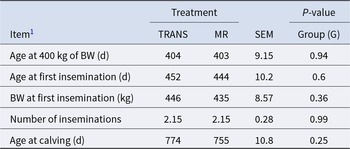
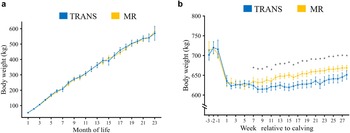
Our results showed no differences between heifers fed TRANS and MR for age at 400 kg BW, age at first insemination, BW at first insemination, number of inseminations or age at calving (Table 1). Both treatment groups had easy calving, needing no assistance (P = 0.24), with birth weights of calves at 41.0 ± 0.67 kg in TRANS heifers and 42.1 ± 0.69 kg in MR heifers (P = 0.61). Colostrum quality, measured as brix values, was consistent across both groups: 24.9% in TRANS and 24.5% in MR heifers (P = 0.72). Both treatment groups had similar BW development during the rearing period and reached BW of around 700 kg before calving (712 ± 10.7 kg in TRANS, 688 ± 9.5 kg in MR).
Reproductive and growth performance of heifers fed milk replacer (MR) or transition milk (TRANS) during the first 5 days after birth

1 Data are presented as least squares means (LSmeans) ± SEM (standard error of the mean).
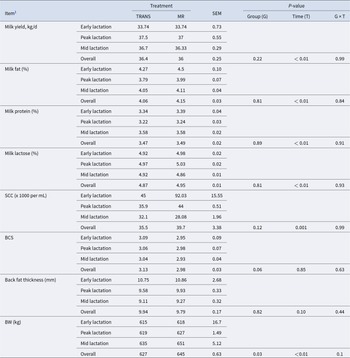
However, postpartum BW was greater in heifers fed MR compared to those fed TRANS (Table 2; Fig. 2). Body condition score tended (P = 0.06) to be higher in TRANS-fed heifers during the first 200 d of lactation, while overall BW was lower in TRANS-fed heifers (P = 0.03; Table 2). Milk yield, ECM yield and milk composition (fat, protein and lactose) were neither affected by treatment (TRANS vs. MR) nor the time x treatment interaction (Table 2). Time had a significant effect on all variables except BCS and BFT, without interaction between time and treatment for any variable (Table 2).
Body weight of heifers fed milk replacer (MR) or transition milk (TRANS; during the first 5 days after birth) from birth to first calving (a) and during first lactation (b). Data is given as mean ± SEM.

Milk production, composition, body weight, body condition scores, and back fat thickness of heifers fed milk replacer (MR) or transition milk (TRANS)

1 Early lactation period (week 1–5), Peak lactation (week 6–8), Mid lactation (week 9–28), Overall (week 1–28).
Blood parameter
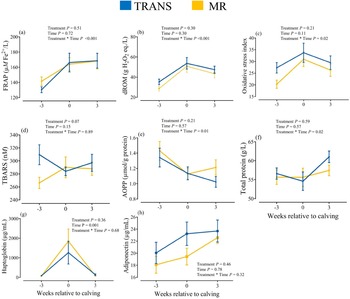
No significant treatment effects were observed for FRAP (Fig. 3a), dROM (Fig. 3b), and Osi (Fig. 3c), although time and a significant treatment × time interaction affected these variables (P < 0.01), with larger changes in these values in the MR group. A trend in treatment effects was noted for TBARS (P = 0.07), but without time or treatment × time interaction (Fig. 3d). Similarly, no significant treatment effects were observed for AOPP (Fig. 3e) or total protein (Fig. 3f); however, treatment × time interactions were observed for both AOPP (P = 0.01) and total protein (P = 0.02), with values varying in the weeks relative to calving. No treatment effects were observed for haptoglobin (Fig. 3g) and adiponectin (Fig. 3h). Haptoglobin was affected by time (P < 0.01) and peaked around calving, while adiponectin levels increased from pre-calving to post-calving. No significant interactions between treatment and time were observed for haptoglobin and adiponectin.
Plasma measurements of Ferric Reducing Ability of Plasma (FRAP) (a), reactive Oxygen Metabolites (dROM) (b), oxidative stress index (c), Thiobarbituric Acid Reactive Substances (TBARS) (d), Advanced Oxidation Protein Products (AOPP) (e), total protein (f), haptoglobin (g), and adiponectin (h) in heifers, taken 3 weeks before parturition, 12–24 h after parturition, and 3 weeks after parturition. Data is given as mean ± SEM.

Discussion
Our results suggest that while TRANS may influence early developmental stages (Ostendorf et al., Reference Ostendorf, Ghaffari, Cohrs, Koch and Sauerwein2025), its long-term effects on performance during first breeding and lactation were limited. Both treatment groups reached the target BW for insemination at a comparable age and had similar reproductive performance indices.
No differences were found between the TRANS and MR groups in terms of milk yield, ECM yield, or milk composition (fat, protein, lactose). TRANS heifers showed a numerical lower SCC than the MR group, especially during the transition period. However, differences were not significant and remained on levels below the threshold for a healthy udder of 100,000 cells/mL (Tho Seeth and Krömker, Reference Tho Seeth and Krömker2021).
In a meta-analysis Gelsinger et al., (Reference Gelsinger, Heinrichs and Jones2016) found that other aspects, like management, are more important for long-term benefits than early life nutrition. However, a positive correlation can be seen between the provision of adequate nutrients and ADG over 0.5 kg/d with first lactation performance (Gelsinger et al., Reference Gelsinger, Heinrichs and Jones2016; Jiang et al., Reference Jiang, Wang, Li, Liu, Zhuang, Li, Wang, Wang, Yang, Shao and Cao2025). Both treatment groups of the present study were well above an ADG of 0.5 kg (1.02 kg/d in MR and 1.06 kg/d in TRANS, Ostendorf et al., Reference Ostendorf, Ghaffari, Cohrs, Koch and Sauerwein2025) and had low health incidences. In terms of lactation performance, both groups achieved milk yields that were above the regional Holstein average, with heifers producing approximately 2,000 kg more than the current local standard (Annual Report of the Rhineland-Palatinate-Saar State Control Association, 2023).
The high milk yield of dams in our study herd likely resulted in some dilution of transition milk during the first 5 days postpartum. Nevertheless, the transition milk provided likely contained higher concentrations of bioactive compounds compared to the milk replacer. Therefore, any potential dilution probably had minimal impact on observed differences between groups. This interpretation aligns with previous findings, although direct comparisons are challenging due to differences in experimental design and duration of transition milk feeding (Van Soest et al., Reference Van Soest, Weber Nielsen, Moeser, Abuelo and VandeHaar2022; Pyo et al., Reference Pyo, Hare, Pletts, Inabu, Haines, Sugino, Guan and Steele2020). Notably, both cited studies focused only on short-term effects and did not assess long-term outcomes. While variations in early energy and nutrient intake may explain some findings, they do not account for the BW differences observed during lactation. Notably, the heifers in this study were exceptionally well managed, resulting in above-average daily weight gains and superior lactation performance.
This result challenges our original hypothesis and suggests that the early developmental benefits associated with TRANS for only 5 d after birth do not necessarily translate into sustained improvements in fertility or production outcomes under the conditions of this study.
The finding that BW was about 18 kg lower in the TRANS group than in the MR group only during lactation was surprising in view of the short-term TRANS feeding in the neonatal stage, and the lack of long-term effects on growth, reproduction or lactation performance. The BW loss around calving was not different between both groups; the differences became only evident when the animals started re-gaining weight around week 8 of lactation. Unfortunately, we have no feed intake data from this time and also did not assess body size to offer potential explanations for the BW difference. Further investigation into energy balance and metabolic parameters is needed to identify the underlying causes of these differences.
Markers of the oxidative status
When examining markers of oxidative stress, we observed typical patterns around calving (Ghaffari et al., Reference Ghaffari, Daniel, Sadri, Schuchardt, Martín-Tereso and Sauerwein2024), but no significant differences between treatment groups. Time and treatment × time interactions were significant for some markers, but the lack of clear treatment effects suggests that TRANS feeding had no sustained effect on oxidative stress. Although trends in certain blood factors such as TBARS and significant interactions in AOPP and total protein indicate areas for further investigation, their biological relevance in this context remains unclear. Haptoglobin, an acute phase protein indicative of inflammation, increased around calving as expected. Variability between animals was high for Hp, consistent with previous findings (Nightingale et al., Reference Nightingale, Sellers and Ballou2015). Adiponectin, an important regulator of lipid and glucose metabolism that was also suggested as a negative acute phase protein, showed increasing concentrations in both groups at and after calving; the increase after calving is in line with the literature whereas mostly decreasing values from late pregnancy to calving were reported (Sauerwein and Häußler, Reference Sauerwein and Häußler2016). For adiponectin, also no group differences were observed. In general, it should be noted that both groups were on a relatively high level of feed allowance, i.e., 12 L/d, from birth to the onset of weaning. At that level, the animals are likely better equipped for their start in life and thus the TRANS feeding might be less important.
In summary, under the conditions of this study, TRANS feeding did not provide any significant long-term advantage over MR feeding for heifer development or performance except for postpartum BW. Future studies should address the extent to which TRANS feeding affects re-gaining of BW during the first lactation and what the consequences are for energy homeostasis.
Acknowledgements
This study was part of the “Calf and Heifer Net” project funded by the German Federal Ministry of Food and Agriculture (Bonn, Germany). We thank the staff of the Educational and Research Centre for Animal Husbandry, Hofgut Neumühle for their support and effort, as well as B. Heitkönig and T. Blees for excellent technical assistance in blood analyses. This study followed the guidelines of the German Law for Animal Welfare by permission of the local authority in charge (G23-23-089; Landesuntersuchungsamt Rheinland-Pfalz, Koblenz, Germany). The authors have not stated any conflicts of interest. C. S. Ostendorf: https://orcid.org/0009-0002-8591-6001; M. H. Ghaffari: https://orcid.org/0000-0002-5811-3492; K. J. Hemmert: https://orcid.org/0009-0005-1368-3968; C. Koch: https://orcid.org/0000-0002-0695-5110; H. Sauerwein https://orcid.org/0000-0002-6905-4053.