1. Introduction
Quantifying expressions can occur in two syntactic contexts with different semantics, as we illustrate with Modern English many and French beaucoup. One context is represented in 1: The quantifier combines with an indefinite nominal, and the example denotes a large portion of a set, which may or may not be presupposed (see section 3.1). The other context is represented in 2: The quantifier occurs with a PP that contains a definite DP, and the example denotes a large portion of a presupposed set. The first environment is usually referred to as the cardinal or quantitative construction, and the second the proportional or partitive construction. We use the first label in each case.
-
(1)


-
(2)
In generative grammar, several analyses have been proposed for the relationship between quantifying expressions and the elements they quantify. In particular, the structural position of the quantifier within the nominal is debated as head versus modifier; the structural position of the quantified constituent is discussed as a specifier versus complement position (on both points, see, for example, Cardinaletti & Giusti Reference Cardinaletti, Giusti, Everaert and van Riemsdijk2006 versus Jackendoff Reference Jackendoff1977); the morphology of the quantified constituent (concord versus genitive) may depend on its DP-internal versus embedded position (for different views on French de, see Doetjes Reference Doetjes1997:154 and den Dikken Reference Doetjes2006).
In this paper, we investigate the German quantifying word viel ‘much/many’, which undergoes a number of interesting morphosyntactic changes in the language's history. First of all, the morphology on viel changes from noun-like in Old High German (OHG), as in 3a,b, to adjectival in later stages of German, as in 3c. Second, the quantified nominal, which we refer to as the dependent (dep), occurs in the genitive in the earliest stages of German. We show that the proportional construction, which involves structurally larger constituents such as DPs, retains the genitive throughout the history of the language. In contrast, the structurally smaller dependents in the cardinal construction (Adj+N or N) change from genitive case to agreement with viel in their features. Exemplifying with a dependent noun, viel had genitive (gen) dependents in OHG, which could either precede or follow viel, as shown in 3a and 3b, respectively. Over the course of Early New High German (ENHG), concord (con) becomes increasingly frequent, as in 3c, and is required today with non-DP dependents.
-
(3)
In general terms, we propose that the alternation between 3a and 3b involves a process of prosodically motivated reordering, leading to a structural reanalysis of both viel itself and its dependent. This reanalysis changes OHG filu from a genitive-assigning noun to a quantifier higher up the DP; that is, filu changes from a head to a modifier. With the matrix N0 empty, the dependent can now be integrated into the matrix nominal, resulting in concord, as shown in 3c.
A closer examination of these developments reveals that they involve several different types of reanalysis. The changes to viel itself result from two reanalyses: first, the grammaticalization of viel from a noun to a quantifying particle, that is, reanalysis from one head to another head, as in 4a; and second, the later degrammaticalization of viel from a quantifying particle to a quantifying adjective, which we characterize as a reanalysis of a head to a specifier, as in 4b. The changes to the dependent involve “downward reanalysis,” in Roberts & Roussou's (Reference Roberts and Roussou2003:208) terms, into a complement position, as in 4c.
-
(4)
Note that the reanalysis of a head to a specifier proposed in 4b is at odds with theories of syntactic change such as van Gelderen Reference Gelderen2004. In section 8.2, we fully motivate this unusual type of reanalysis as a reflex of degrammaticalization driven by analogy. In short, we propose that the morphological developments in question, namely, the rise of adjectival inflection on viel and the change from genitive case to concord, result from the syntactic reanalyses of viel and its dependents. In fact, in both cases, the morphological developments follow the syntactic reanalyses. Note also that while connected, the changes to viel do not stand in a simple causal relation to the changes to the dependent.
This paper is organized as follows. In section 2, we introduce the corpora used in this study. In section 3, we lay out our theoretical assumptions about the structure of the DP, especially the positions of viel and its dependents. In sections 4–7, we present the historical data on the development of viel from its Germanic roots to Modern German (MG). For each period, we analyze the development of viel, showing how the position and properties of viel and its dependents change over time. Section 8 discusses some implications of our account for theories of syntactic reanalysis. In section 9, we briefly conclude the paper.
2. Corpora
Although other German quantifiers have undergone the case and word order changes outlined above, in this study we have chosen to focus on viel only.Footnote 1 We concentrate on viel because it occurs very frequently with a dependent constituent, and thus the changes described here are well attested. Additionally, viel is not discussed by Roehrs (Reference Roehrs2008), who focuses on indefinite pronouns with dependent adjectives such as nichts Gutes ‘nothing good’. Thus, the current study also adds to the existing synchronic research on quantifiers and their dependent elements.
The word viel has several uses, but given our interest in the structural positions of viel and its dependent nominal, we systematically investigate only instances of viel that are immediately adjacent to a dependent. That is, we did not include instances of viel as an adverb, as in 5a, or viel without a dependent, as in 5b; nor do we include instances where the dependent is discontinuous from viel, as in 6.Footnote 2
-
(5)
-
(6)
To our knowledge, this investigation of viel and its dependent represents the first systematic study of the morphological and syntactic changes to these elements over the 1,200 years in the history of German. Overall, we collected over 850 examples of viel with a dependent nominal in historical stages of German. These data draw on several corpora. In addition, we also consulted various reference grammars to exclude the possibility of accidental gaps in the data. The data from the reference grammars was not counted in our tables.
For OHG (700–1100), we searched the TITUS database for examples of filu in Tatian, Isidor, Otfrid, and the works of Notker. Examples from the late OHG texts Williram and Wiener Notker (a later version of Notker's Psalter) were found in the Bochumer Mittelhochdeutsch-Korpus (Wegera Reference Wegera, Besch, Betten, Reichmann and Sonderegger2000). Despite searching all major OHG texts, totaling about 460,000 words, we identified only 20 instances of filu with a dependent.
Most of our data for Middle High German (MHG; 1100–1350) were gathered from the 51 prose texts of the Bochumer Mittelhochdeutsch-Korpus (approximately 550,000 words). This corpus is lemmatized and tagged for grammatical features, allowing an automated search for vil immediately preceded or followed by a noun, adjective, determiner, or pronoun. This resulted in over 200 instances of vil with a dependent element.
For ENHG (1350–1700), we analyzed all 40 texts of the Bonner Frühneuhochdeutsch-Korpus (approximately 480,000 words). Like the Bochum corpus, these are all prose texts from a variety of genres (including sermons, philosophical treatises, chronicles, and literary works). Because functional items such as viel are not lemmatized in the Bonner corpus, we searched for all words beginning in vi- and fi- immediately preceded or followed by a potential dependent. Verifying each example by hand to ensure that these were all instances of viel with a dependent constituent yielded over 600 examples of viel with an adjacent dependent element.
Unlike our historical studies, the data on MG are qualitative rather than corpus-based. Our grammaticality judgments of the examples are based on the descriptions in Vater Reference Vater1984, Reference Vater and Vater1986, Duden Reference Dudenredaktion1995, and native-speaker intuitions of one co-author, supplemented by Google searches for the more marginal cases.
Finally, some notes are in order on our glossing of morphological features, especially the case of viel and its dependents. Because viel in early stages of German is generally uninflected, we identify its case based entirely on context. In contrast, the case of the dependent is determined using morphological criteria: It is genitive (gen) if it bears unambiguous genitive morphology, and concord (con) if it is clearly inflected for nominative, accusative, or dative agreeing with viel.Footnote 3 If viel and its dependent occur in a gender/number combination where the paradigm does not distinguish genitive from other cases (for example, feminine singular nouns), we label the dependent as gen/con (that is, ambiguous). As for the glosses themselves, for uninflected forms such as filu, the stem and the case feature are separated by a period, as in 3a,b. In contrast, we use hyphens to set off inflected forms from stems in both the example and the gloss, as with vil-en in 3c.
3. Theoretical Assumptions About Structure and Case Assignment
In this section, we discuss our assumptions about the structure of the DP, namely, the cardinal and proportional constructions as well as the internal structure of adjectival elements. Furthermore, we lay out our assumptions about case assignment. We show that quantifiers and their quantified constituents have received different structural analyses in the literature, and we claim that these different analyses are needed to account for the observed empirical changes, which we discuss in detail in subsequent sections.
3.1. The Structure of the Cardinal and Proportional Constructions
Vague numerals such as many have received much attention in the literature. Focusing on German, viel may appear in two constructions in MG, depending on the type of dependent:Footnote 4
-
(7)
-
(8)
The syntactic difference between 7 and 8 is that viele in the cardinal construction is followed by an adjective and/or noun in concord, whereas viele in the proportional construction is followed by a definite DP in the genitive or in a PP with von ‘of’. Although the morphosyntax of these constructions is our primary concern in this paper, a word about their semantics is in order.Footnote 5 The cardinal construction in 7 has two readings (Partee Reference Partee, Powers and de Jong1988). On one reading, it asserts the existence of a large number of members of a set denoted by the noun (and adjective). On the other reading, the cardinal construction denotes a large number of members of a pre-established set denoted by the noun (and adjective). This subset relation is a presuppositional reading. The proportional construction in 8 has only the second, presuppositional reading.
A number of analyses have been proposed for quantificational expressions (see Cardinaletti & Giusti Reference Cardinaletti, Giusti, Everaert and van Riemsdijk2006 for a detailed survey). The proposals differ with respect to the structural position of the quantifier within the nominal, the position of the quantified constituent, and the locus of case assignment. Our account of the different stages of viel and its dependent over time, summarized above in 3 and 4, borrows features of several of these proposals. In fact, we hypothesize that a quantifying expression may have different syntactic representations: Viel may be a noun, particle, or adjective at various stages.
Beginning with the structural position of the quantifier, one option is to assume that the quantifying expression is the head of the nominal. Such a claim is made by Cardinaletti & Giusti (Reference Cardinaletti, Giusti, Everaert and van Riemsdijk2006), who derive phrases such as many of the women from this underlying structure:
-
(9)
Abstracting away from the details of their derivation, the quantifier is a lexical element in Q, which is the head of the entire nominal. The quantified constituent of the women is in the specifier position of QP. We use a similar structure for OHG filu in section 4.3.
Cardinaletti & Giusti (Reference Cardinaletti, Giusti, Everaert and van Riemsdijk2006:45) go so far as to claim that some instances of MG viel have this structure. They base this claim on the morphology of viel: When viel is not preceded by a determiner, it inflects like one: dies-e viel-en Kinder ‘these many children’ versus viel-e Kinder ‘many children’. While we agree that OHG filu was in a head position, we think this analysis is incorrect for MG viel. We argue that the inflection -e on viel is not necessarily that of a determiner, but of a strong adjective, seen when an adjective is not preceded by a determiner (compare the garden-variety adjective in diese nett-en Kinder ‘these nice children’ versus nett-e Kinder ‘nice children’).
Alternatively, the quantifier could also be a modifier of the nominal (for example, Jackendoff Reference Jackendoff1977). We discuss two options for the position of the quantifier as a modifier. First, in Abney's (Reference Abney1987) DP hypothesis, a quantifier appears as the head of the QP, a phrase in the NP/DP projection line. The AdjP housing adjectives is just below QP (Abney Reference Abney1987:339):
-
(10)
In this structure, the quantifier also has head status. Unlike 9, though, it is not at the bottom of the tree, but is in the middle of the projection line. Our structure for early MHG has vil in this kind of a head position (section 5.2).
However, contrary to Abney's assumption that adjectives head an AdjP in the direct NP/DP projection line, there is evidence from MG that adjectives build complex phrases on their own. Since the phrasal status of quantifying adjectives is one of the main diachronic developments in our study, we discuss this evidence in some detail. Corver (Reference Corver1997) notes that adjectives can be modified by a degree adverb (zu ‘too’) which itself can be modified by a degree word (etwas ‘somewhat’). MG viel has the same property:
-
(11)
Moreover, as pointed out by Svenonius (Reference Svenonius, Duncan, Farkas and Spaelti1994:445–446) for English (see also Alexiadou et al. Reference Alexiadou, Haegeman and Stavrou2007:348ff.), the degree adverb scopes over the adjective immediately to its right but not over any additional adjectives, as shown in 12a. The same holds for quantifiers: German sehr ‘very’ scopes over viel, but not over any additional adjectives, as shown in 12b.
-
(12)
Building structure from the bottom up, we follow Corver (Reference Corver1997) in that adjectives project APs, degree elements DegPs, and adjectival inflections build InflPs (although we use these labels slightly differently from Corver: Following Leu Reference Leu2008, our inflectional phrase InflP is head-initial). Applying this analysis to quantificational viel (Q), the bracketed phrase in 11b can be assigned the structure in 13.
-
(13)
Given the evidence that quantifiers are complex specifiers, we propose a second analysis of the quantifier as a modifier, which also assumes Abney's (Reference Abney1987) DP hypothesis but with some modifications. Like Abney (Reference Abney1987:339), we assume several functional projections above NP but below the DP layer (for a survey, see Alexiadou et al. Reference Alexiadou, Haegeman and Stavrou2007). We identify the intermediate functional projection housing MG viel as the Cardinal Phrase (CardP) because viel is in complementary distribution with cardinal numbers:
-
(14)
Unlike Abney, we assume, with Cinque (Reference Cinque, Cinque, Koster, Pollock, Rizzi and Zanuttini1994, Reference Cinque2005, Reference Cinque2010), Gallmann (Reference Gallmann1996), Giusti (Reference Giusti1997), and Julien (Reference Julien2005), that the adjective along with its projected structure sits in Spec, AgrP. Similarly, viel and its projected structure as in 13 is located in Spec, CardP. This yields the following structure of the cardinal construction in MG (see also section 5.3):
-
(15)
The proportional construction in MG involves one addition to this structure, as we discuss next.
3.2. The Proportional Construction in More Detail
A remaining question concerns the quantified expression in the proportional construction, which appears in the genitive case in MG, as in 8a, and as a PP in many other languages besides MG, as in 8b (see, for example, English in 2a and French in 2b). One could argue that the quantifier is in a local relation with the proportional dependent, as in Cardinaletti & Giusti's (Reference Cardinaletti, Giusti, Everaert and van Riemsdijk2006) analysis illustrated in 9 above. In fact, we argue in section 4.3 that noun-like OHG filu assigns genitive case to all of its dependents this way.
For later periods of German, we propose a different analysis, following Jackendoff (Reference Jackendoff1977:112) and Abney (Reference Abney1987:344), who argue that the proportional construction involves a null element in the matrix N0 position (PRO for Jackendoff; eN for Abney). The quantified expression is then in the complement position of this null element.
-
(16)
Note that the tree for the proportional construction is basically the same as that of the cardinal construction, except that the proportional construction involves an added complement to N.
Milner (Reference Milner1978) demonstrates that the quantificational part of the proportional construction is not just a simple element (quelques) but must be larger (quelques-unes), implying that the proportional construction has two nominals:
-
(17)
Milner further notes that under certain conditions, the element intervening between the quantifier and the proportional dependent can be overt, like the noun peintures ‘paintings’ in 18.
-
(18)
The same point can be made for MG, as in 19a. To be clear, the bracketed phrase in 19a relates to the phrase in 19b, in that the first has an overt matrix noun and the second an overt noun in the dependent.
-
(19)
We follow Milner Reference Milner1978 in assuming that the null element in the proportional construction with MG viel is an elided noun marked by strike-through in 16 above. The elided noun in 16 is the assigner of genitive case in the proportional construction. That the proportional construction and the cardinal construction are basically the same is confirmed by the fact that the overt noun in the cardinal construction can also assign genitive, in this instance to a possessive:
-
(20)
Recall that in the proportional construction, viele picks out a large but nonspecific subset of entities from a pre-established set. Under our interpretation, the definiteness of the dependent DP indicates that the set is pre-established, while the nondistinctness between the elided matrix noun and the overt one in the dependent results in a subset relationship between the two nominals. In the cardinal construction, the matrix noun and the noun in the possessive are completely different. This explains the difference in interpretation of the genitive in the two constructions between presupposition and possession.
Summing up this short review of the literature, we have seen that previous studies view the quantifier itself either as the head of the nominal (Cardinaletti & Giusti Reference Cardinaletti, Giusti, Everaert and van Riemsdijk2006) or as a modifier (Jackendoff Reference Jackendoff1977, Abney Reference Abney1987, among others). Whether the head or the modifier of the nominal, the quantifier can have the syntactic status of a low or high head (Cardinaletti & Giusti, Jackendoff, Abney); alternatively, under the modifier analysis, the quantifier can also be in a complex specifier (as in our extension of Corver's analysis of adjectives). Finally, analyses differ as to whether the quantifier in the proportional construction is in a local relation with its dependent (Cardinaletti & Giusti Reference Cardinaletti, Giusti, Everaert and van Riemsdijk2006) or whether the dependent is embedded under a null noun (Jackendoff Reference Jackendoff1977, Milner Reference Milner1978, Abney Reference Abney1987).
Rather than selecting a single analysis that accounts for all of the diachronic data of viel, we show in sections 4–7 that various elements of each of these proposals are necessary to account for the behavior of viel and its dependents at different stages of the language. Given our general proposal that viel changed from a head to a modifier, we conclude that quantifying expressions may have different syntactic representations. Therefore, from this point forward we avoid labeling viel with the general term “quantifier”; instead, we concentrate on its morphosyntactic representation at a given stage: OHG filu as a quantifying N0 head, early MHG vil as a quantifying Card0 head, and later MHG/ENHG/MG viel as a quantifying adjective in a specifier position.Footnote 6
3.3. Internal Structure of the Dependent
Having shown in sections 3.1 and 3.2 that the different parts of quantifying expressions may be located in various structural positions, we now turn to the internal structure of the quantified expression, more specifically, to the dependent constituent. First of all, note that under different analyses, the dependent as a whole can occupy different positions vis-à-vis the quantifier. For Cardinaletti & Giusti (Reference Cardinaletti, Giusti, Everaert and van Riemsdijk2006), it can be in the quantifier's specifier position. For Abney (Reference Abney1987), dependent adjectives and nouns are housed in phrases in the complement position of the quantifier, while the proportional construction has the dependent in the complement of a null N. Second, note that we assume that, unlike viel, lexical nouns, adjectives, and determiners (to the extent that they are available in the early periods of German) have not changed their structural positions; in other words, they are in N, AgrP, and D, respectively, throughout the history of German.
With these assumptions in mind, let us examine the internal structure of the various kinds of dependents. Let us begin with unmodified dependent nouns. In early stages of German, there are several analytical possibilities for viel and its dependent noun not modified by an adjective or a determiner. Such nouns are structurally ambiguous between a head N, an NP, or a NumP.
Let us now turn to adjectives. German adjectives are inflected for case, number, and gender, agreeing with a following noun. This is why we assume that dependent adjectives involve AgrP, which contains NumP and NP. This entails that dependent adjectives followed by a noun are structurally similar to dependent adjectives not followed by a noun. The ability of German adjectives to occur with a null noun is well known, as in ich mag nur grüne ‘I like only green (ones)’. In such cases, we assume that the null noun is licensed by the inflection of the adjective.
In dependent nonpronominal DPs, D0 can be of different lexical categories: articles, demonstratives, and (with some qualification for the older varieties) possessive elements. Structurally, they involve DPs that contain the lower phrases (CardP, AgrP, NumP, and NP). Finally, we assume that pronominal dependents also make up a DP, where, on par with adnominal determiners, the pronoun is in D0 (Abney Reference Abney1987:284, fleshing out ideas in Postal Reference Postal and Dinneen1966).
The structural sizes (that is, the various heights of the projections) of the four types of dependents on viel can be summed up as follows:
-
(21)
Notice that only dependent Ns are structurally ambiguous, as they are the only type of dependent that can have a nonbranching structure as shown in 21a; all other dependents involve larger constituents. This becomes relevant in section 5, where we discuss embedded dependents of different sizes that integrate into the matrix DP at different times (or not at all). A unified treatment of all dependents beginning with an adjective, as in 21b, is empirically justified by the parallel development of dependent bare adjectives and dependent adjectives followed by a noun. Finally, considering that 21c,d involve DPs, one might expect them to pattern in a similar fashion. This is indeed the case as both of these dependents have remained in the genitive throughout the history of German.
3.4. Direction of Case Assignment
The quantifying word viel and nouns exhibit a number of similarities in earlier stages of German, not only in morphology (see section 4.3) but also with regard to word order and case assignment. Nouns assign genitive to their dependent DPs. In OHG and MHG, these genitive dependents could precede the head noun, as in 22a,c, or follow it, as in 22b,d.
-
(22)
In OHG, prenominal genitives were more frequent (Lockwood Reference Lockwood1968:17, Braunmüller Reference Braunmüller1982:163, Schrodt Reference Schrodt2004:22). We assume that GEN+N represents the base order, while postnominal genitives are derived by rightward movement within the DP. In our view, postnominal genitives do not represent the unmarked order because we do not observe any properties of the OHG prenominal genitives—such as topicalization—that might indicate that they moved to that position. Starting in late OHG, the N+GEN order becomes more frequent (Schrodt Reference Schrodt2004:22), and according to Demske (Reference Demske2001:219), this becomes the unmarked order by ENHG. In MG, prenominal genitive DPs are no longer possible, as shown by 22c versus 23b.
-
(23)
One might be tempted to think that this change from GEN+N in OHG to N+GEN in later stages represents a change in the headedness of NP. However, there is reason to believe that the NP can have two positions for dependents of the noun. This can be shown using MG de-verbal nouns in 24a. The postnominal position is clearly a complement, and the prenominal position is a specifier, which is restricted to proper names, as shown by the ungrammaticality of a regular DP in this position in 24b.Footnote 7 Although rare, a noun with two dependents is attested in OHG as well, as shown in 25.
-
(24)
-
(25)
Given the co-occurrence of prenominal and postnominal dependents in both OHG and in MG, we argue that there has been no change in the headedness of NP; instead, both a specifier and a complement are involved. Given the preponderance of prenominal genitives in OHG, we believe that these are typically specifiers, but they can be moved rightward if heavy. To explain the absence of prenominal genitives today, we argue that genitive in MG is assigned to the complement position of N. Thus, there was a change in case assignment by nouns from specifier to complement.
As we demonstrate in section 4.2, viel and its dependents have similar word order variation in OHG, with genitive dependents both preceding and following viel. As far as we know, there is no reason to believe that genitive was a default case in earlier stages of German. As such, genitive case must have had a source. With the word order parallelism between OHG filu and OHG nouns in mind, we propose that filu could assign genitive at that stage. We assume that case assignment occurs under structural adjacency. This is a local relation where the head assigns case to its specifier or to its complement, immediately ruling out adjunctions as case positions. The only other way for a nominal to be licensed in the larger structure is under agreement with that element (for some discussion of concord, see Norris Reference Norris2014). For our different word orders, this means the following.
If genitive is assigned to a specifier, we expect the dependent to precede viel; a dependent will only follow viel if it moves rightward, and that movement should be motivated. Likewise, if genitive is assigned to the complement, dependents should mostly follow viel; a dependent will only precede viel if it moves leftward (and again, that movement should be motivated). While word orders are often ambiguous between base-generation and a derived constellation, derived orders are often characterized by certain discourse properties, which motivate the movement. We incorporate this observation into our analysis below.
In MG, viel, much like nouns, does not allow preceding genitive dependents, as shown in 26a. However, while nouns allow singular genitive DPs as complements, as shown in 23a, viel has developed some restrictions (for details, see section 7) and only allows plural DPs to appear in the genitive, as shown in 26b,c.
-
(26)
Therefore, in the next sections we propose that over the history of German, viel underwent a similar development to genitive-assigning nouns: It assigned genitive to its specifier early on (compare Cardinaletti & Giusti's Reference Cardinaletti, Giusti, Everaert and van Riemsdijk2006 structure), but later it began to assign genitive to its complement (compare Abney's Reference Abney1987 structure).
The following sections 4–6 take up the development of viel in the different diachronic periods of German. For each period, we discuss the cardinal construction (dependent nouns and adjectives), the proportional construction (dependent DPs and pronouns), and then the properties of viel itself. After that, we turn to the details of our analysis for each stage of the language, showing how the base-generated orders and reordering mechanisms changed over time. We show that viel climbed up the tree, and that the noun and adjective dependents became integrated into the matrix DP. In contrast, we claim that DP and pronominal dependents are still embedded but have a new case assigner today, an elided noun.
4. OHG
4.1. Etymology of Viel
We start with some general remarks on the history of viel in the Germanic languages. The German word viel ‘much, many’ is of Indo-European origin (compare Greek polys ‘much, many’), tracing back to Proto-Indo-European +pelu- +plllu‘abundance, many’ (Pfeiffer Reference Pfeiffer1997:1516). It has cognates in all other Germanic languages; however, none of the reference grammars of the oldest stages of the Germanic languages describe in any detail the use of filu or its cognates with the genitive case. To explore the properties of this quantifier in the oldest attested Germanic language, we searched the portions of the Gothic Bible available on Project Wulfila. While we do not find any clear examples of Gothic filu in concord with a dependent noun, we find many examples of filu with the noun managei ‘crowd’ in the genitive:
-
(27)
In the Greek source, both ὄχλος ‘crowd’ and πολύς ‘great’ are nominative singular. The use of genitive on the dependent of filu versus the use of concord in the Greek source indicates that this is a genuine feature of Gothic grammar. Such examples provide evidence that filu could select a genitive noun in Gothic, which makes them the earliest attested instances of this construction in Germanic. Finally, note that the dependent can precede or follow filu, and both orders occur independently of the word order in the Greek source text.Footnote 8
4.2. Data with Filu
Turning now to OHG, we find filu occurring with the four types of dependent constituents: dependent noun, adjective (noun), DP, and pronoun. Beginning with the combination filu+N, all clear instances of dependent nouns involve the genitive. In one of these, the genitive plural noun precedes filu, as in 28a, and in six the noun follows filu, as in 28b.
-
(28)
Despite the fact that these nouns are genitive, they are genuine examples of the cardinal construction. While OHG does not yet have a full-fledged definite article system and so it is theoretically possible that these bare dependent nouns are definite, we have examined each in context. To the extent that we can make interpretative judgments about these examples, the dependent nouns do not have specific reference and thus do not seem to involve a presuppositional interpretation. Thus, these belong to the cardinal construction.
We have found only one adjective that precedes filu in OHG, shown in 29a. More frequently, dependent adjectives follow filu, either without a following noun, as in 29b, or with, as in 29c.
-
(29)
We have found three instances in which the dependents of filu are unambiguously DPs, as they have a determiner preceding the noun. In all three, the dependent is in the genitive and follows filu:
-
(30)
Finally, we have found five instances of filu with a dependent pronoun. In four of these, the dependent pronoun precedes filu, as in 31a. Unlike dependent nouns, which usually follow, a pronominal dependent follows filu only once in OHG, as in 31b. All of these pronouns are in the genitive.
-
(31)
Turning now to the properties of filu itself, we only find invariant filu, as expected from earlier scholars’ observations. According to Behaghel (Reference Behaghel1923, I:3–4), OHG filu only appears in nominative and accusative singular contexts. No examples where quantifying filu is modified appear until the 11th century. Then we find one example in which filu is modified by the degree wh-word fuîe (swie) ‘however’. In other words, the surface string degree Adv+filu+DEP is absent throughout most of OHG. Note also that there are many examples of adverbial filu modified by another adverb:
-
(32)
In sum, dependent nouns and adjectives mostly follow filu (10 versus 2 occurrences), and dependent DPs always follow (3 occurrences). Dependent pronouns usually precede filu (4 versus only 1 occurrence). All unambiguous examples of dependent elements in OHG are in the genitive.
4.3. Filu as a Semilexical Quantifying Noun
Following Behaghel (Reference Behaghel1923, I:3–4), we assume that OHG filu was structurally a noun in OHG.Footnote 9 First, just as lexical nouns assign genitive case to their dependent DPs, we argued above that filu assigns genitive to its dependent constituents. Second, from a morphological point of view filu appears to be a u-declension noun (Braune & Eggers Reference Braune and Eggers1987). Third, even when the dependent lexical noun is plural, the verb may show agreement with singular, that is, the head of the nominal is filu rather than the lexical noun, as shown in 29. This continues into MHG and the early part of ENHG (Ebert et al. Reference Ebert, Reichmann, Solms and Wegera1993:333). Fourth, if we were to assume that filu was already an adjectival quantifier in OHG/MHG, its occurrence after its dependent noun would be mysterious, as adjectives generally precede nouns in all stages of German (but see Dürscheid Reference Dürscheid2002 on some special cases in MG). The word-order variation described above follows straightforwardly from the assumption that filu is a noun because genitive DPs may precede or follow their head nouns in older stages of German. Moreover, because Gothic also has both filu+DEP and DEP+filu, the word-order variability in OHG appears to be more general in the earliest Germanic languages.
It is clear, however, that filu has lost some of its nominal properties already in OHG; therefore, we argue that filu is a semilexical noun. First, the noun filu has a quantificational function rather than a lexical meaning. Second, the late OHG text Wiener Notker seems to have a reduced final vowel (-e or -i) when filu functions as a quantifier, indicating that quantificational filu has lost its specification as a u-stem noun by the end of this period. Third, unlike lexical nouns, filu does not have inherent gender, and it is not modified by determiners or adjectives (there are no examples in our OHG or MHG corpora). Fourth, its syntactic distribution is limited in that it does not appear in dative or genitive contexts or in the plural until well into the MHG period.Footnote 10 We submit that this limited morphological distribution is due to the underspecification of filu with respect to inflectional class. No longer a member of a particular noun class, filu may only appear in the unmarked cases, that is, nominative and accusative, which are subject to the fewest licensing conditions. The failure of filu to occur in the plural or with adjectives or determiners suggests some degree of structural simplifi-cation. In particular, the semilexical noun filu does not project the functional phrases above NP that accommodate number (NumP), adjectives (AgrP), and determiners (DP).
Analyzing filu as originally a noun-like element allows us to account for instances where the genitive dependent is found to its left, as this is the more frequent order for genitive dependents with ordinary nouns in OHG (Schrodt Reference Schrodt2004:22). With filu in N, we propose that all dependent constituents, regardless of the cardinal/proportional distinction (that is, structural size of the dependent), start out in Spec, NP. Example 28a repeated below as 33a has the structure in 33b.
-
(33)
Considering the singular form of the verb was in 33a, it is clear that the plural noun in the genitive cannot be the head of the construction. Rather, it is filu, which is consistent with our structure in 33b.Footnote 11
As evidence that even adjectival dependents are in Spec, NP (and not in Spec, AgrP higher up in the matrix nominal, where modifying adjectives occur), note that a) they are in genitive rather than in concord, b) there can be only one genitive adjective because there is only one Spec, NP per nominal (unlike the multiple positions for agreeing adjectives proposed by Cinque and others to account for stacking of adjectives), and c) a genitive adjectival dependent can be followed by an agreeing noun in the genitive, as shown in 29c. Our analysis of filu with genitive dependents in its specifier is in line with Cardinaletti & Giusti's (Reference Cardinaletti, Giusti, Everaert and van Riemsdijk2006) treatment of quantifiers with prepositional dependents.
The fact that we also find dependents to the right of viel in OHG can then be accounted for by a general heaviness constraint, that is, the well-known tendency in German for heavier elements to appear to the right of lighter ones (Behaghel Reference Behaghel1923, III:367). Support for this claim comes from the dichotomy between pronouns and nonpronominal dependents. On the one hand, although there are hundreds of examples in the history of German of dependent nouns following viel, only three nouns precede, with one noun being from OHG, as in 28a, and two from MHG, as in 35, with no occurrences in ENHG. On the other hand, pronoun dependents of viel usually occur to its left from OHG until today (see examples 31a, 43a, and 63a).
If we are correct that filu assigns genitive to its specifier, we can capture the different word orders by proposing that pronouns and some nouns and adjectives stay in situ, while the heavier dependents, especially DPs, usually undergo rightward movement. We derive this reordering by adjunction to the right within the matrix nominal. The derivation of 30, repeated below as 34a, is shown in 34b,c.
-
(34)
In our view, the fact that dependents appear to the right of filu more frequently than the genitive arguments of ordinary nouns provides further evidence that filu has grammaticalized into a lexically light element.
Next we discuss the four types of dependents in OHG. At this stage, we have a single analysis for all four types, including both the cardinal construction i–ii and the proportional one iii–iv.
-
i) Noun: We find DEPN+filu and also, by reordering, filu+DEPN because a dependent lexical noun is heavier than semilexical filu, a constraint which seems to have been more prevalent in OHG (than in earlier Gothic).
-
Adjective (Noun): Four out of five examples follow filu.
-
Nonpronominal DP: We find only filu+DEPDP by reordering, due to the heaviness of the dependent.
-
Pronoun: Because pronouns are exempt from the heaviness constraint, there is only DEPpron + filu in our data at this stage, except for one instance of wh-moved filu, as in 31b.
In sum, OHG filu behaves like a noun, albeit not a fully lexical one, and we have argued that filu assigns genitive to its dependents in the specifier position. This accounts for the occurrence of genitive dependents to the left of filu, and those to the right of filu can be explained as having undergone rightward movement due to a general heaviness constraint.
5. MHG
5.1. Data with Vil
The most recent edition of Paul's MHG grammar mentions that vil can take a genitive dependent (2007:359). Paul also notes that when vil is in a dative context, the dependent noun can appear with dative morphology, resulting in concord. Behaghel (Reference Behaghel1923, I:532) maintains that this is the only way for dative to be marked, since vil itself is generally uninflected in MHG. Note that while there are two forms of this word in MHG, vil and vile, we argue at the end of this section that this is mere phonological variation rather than inflection (and we gloss it as an invariant form throughout this section). Overall, our MHG corpus study shows a clear preference for the genitive with vil in most contexts throughout the period.
Beginning with dependent nouns, we find only two examples in our corpus of MHG prose where the dependent precedes vil. One example from our corpus, given in 35a, is clearly genitive, and the other, in 35b, is ambiguous. Note that land is formally ambiguous between singular and plural; even if it is plural, it is still ambiguous between accusative plural and genitive plural.
-
(35)
Much more frequently, the dependent noun follows vil. There are 52 examples of a dependent masculine singular or neutral singular noun following vil, as in 36, all of which are in the genitive.
-
(36)
There are 106 instances where the noun following vil is ambiguous between genitive and concord. Nearly all of these are plural nouns in nominative or accusative contexts. Because plural nouns are not inflected for nominative, accusative, or genitive case, one cannot determine whether the noun is in the genitive (assigned by vil) or in concord with vil, as in 37. The remaining examples are mostly feminine singular nouns, which generally lack case inflection.
-
(37)
This leaves only seven unambiguous instances of concord between vil and a noun. All of these involve dative plural vil followed by a noun with the dative plural inflection -n:
-
(38)
Dependent adjectives precede vil only six times in our corpus, and all involve ander(e) ‘other’, which is morphologically ambiguous between nominative/accusative plural ander(e) and genitive plural ander-er with elision of the second -er, as in 39.
-
(39)
More frequently, dependent adjectives (with or without a noun) follow vil. There are 13 instances of vil followed by an adjective that is unambiguously genitive, either an adjective alone, as in 40a, or with a noun, as in 40b.
-
(40)
There are five ambiguous instances because there is no overt noun, and the adjectives have the weak inflection -en, ambiguous between nominative/accusative/dative plural (that is, concord) and genitive plural, as shown in 41a.Footnote 12 There are only four instances of vil+Adj(N) in clear concord, as shown in 41b.
-
(41)
There is a smaller number of dependents of viel that are unambiguously DPs, as they begin with some kind of determiner. Of the 10 DPs preceding vil, most are unambiguously genitive, as in 42a. In nine instances, the DP follows viel—most are plural, and all unambiguous examples are genitive, as in 42b. The only two examples that appear to be possible concord involve possessive determiners such as ir, as in 42c, which tends to be uninflected in MHG (Paul Reference Paul2007:216). While formally ambiguous, examples such as 42c are still counted as genitive because dependent DPs otherwise never show concord at any stage of German.
-
(42)
Turning now to dependent pronouns, as in OHG, most immediately precede vil, and all are genitive. There are six instances of a pronoun preceding vil, as in 43a. There are only two instances of vil with a following dependent pronoun, both of which are in the construction (s)wie vil ‘how(ever) much’, as in 43b.
-
(43)
As for vil itself, as noted by Behaghel (Reference Behaghel1923, I:3–4), it was originally only used in the nominative and accusative singular, but it begins to appear in other cases in MHG. In our MHG prose corpus, we find no instances of dative vil until after 1250. Dative vil only becomes common in the 14th century (see example 38).
The form vile occurs more rarely in our MHG corpus (42 instances with -e versus 180 bare vil). In most instances, vile is nominative/accusative plural, as in 41b (compare MG viele). Some other instances of vile are used in other feature combinations of number and case (which makes them different from the MG forms), for example, dative plural, as in 38 (compare MG vielen) or feminine dative singular (compare MG vieler). In the remaining 15 instances, vile is nominative/accusative singular, as in 35a (compare usually uninflected MG viel). Thus, at this stage, this -e probably does not represent any kind of inflection, and vile is simply a phonological variant of vil. In other words, the vowel at the end of OHG filu could reduce to schwa, resulting in vile, or be lost entirely, yielding vil.
Modification by a degree adverb can be a clue as to whether vil is a head or a phrase. While there was only one late instance of this in OHG—see 31b—in MHG there are 34 instances of (al)so vil ‘so much’ with a dependent:
-
(44)
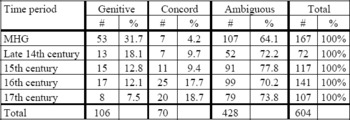
To sum up, dependent nouns in MHG, as in OHG, show a strong tendency to follow vil, with only two instances of the order DEP N +vil. Adjectives tend to follow vil as well, except for ander ‘other’, which often precedes vil. Dependent DPs precede or follow vil in about equal numbers. As in OHG, dependent pronouns tend to precede MHG vil. Note also that adjectives (with or without a following noun) are more likely to appear in concord (4 out of 17 unambiguous examples, or 23.5%) than nouns (7 out of 60, or 11.6% of the unambiguous instances), and that all concord nouns are in dative plural. This suggests that dependent adjectives and plural nouns were at the forefront of the development from genitive to concord.
As for diachronic trends within the MHG period, note first that dependents are very rare until 1250, with only three instances in the 12th century and seven examples from the period between 1200 and 1250. Second, all of the examples of DEPDP+vil are from the 12th and 13th centuries. In the 14th century, this order has been replaced by vil+DEPDP. Furthermore, while the only concord forms in MHG were with Adj+N and plural nouns (becoming more frequent after 1250), we show in section 6.1 that ENHG has concord with singular nouns starting around 1350. In other words, concord with bare singular nouns lags behind by about 100 years. Given the high frequency of singular noun dependents, we believe that this fact is not accidental, and that it represents an important difference. In light of these and other changes to vil and its dependents within the MHG period, we postulate two stages of development in MHG.
5.2. Early MHG: Vil as a Quantifying Particle
As already visible in the earliest MHG attestations, vil loses its nominal morphology in that final -u reduces to schwa or is completely lost. There is thus no longer evidence that vil is a quantifying semilexical noun. However, before 1250 it is not yet a full quantifying adjective either because it does not show inflection or modification by degree adverbs. We assume that vil is a particle at this intermediate stage. On our analysis of agreement inflection, an inflected adjectival element projects InflP and is in a complex specifier; conversely, an invariant particle is best treated as a head. We suggest that the development of vil from a semilexical noun to an invariant quantifying particle involves a structural change: MHG vil climbed from N0 to Card0. In section 3.1, we argued that CardP houses cardinal numbers, which already in MHG show concord with the nouns they modify:
-
(45)
We take these examples to show that CardP existed at that time and was available for vil to climb into.
With vil in Card0 and N0 now empty, one possible analysis for the dependent is to get case in Spec, CardP, with subsequent rightward movement and adjunction to CardP. The derivation of example 36 repeated below as 46a is given in 46b,c.
-
(46)
With regard to reordering and case assignment, this represents a continuation of the way genitive case was assigned at the OHG stage, with the qualification that these operations now occur higher up in the tree. Note that vil, like its OHG counterpart, continues to be an impoverished nominal: While filu was a bare NP with no projections above it, vil is in a bare CardP that contains only an NP with no intermediate projections.Footnote 13
However, there is reason to believe that the underlying position of dependents may have changed too, at least by the 13th century.Footnote 14 Unlike in OHG, there is no longer clear evidence for DEPN+vil or DEPAdj+vil as basic orders. Therefore, we propose that the effect of the OHG heaviness constraint, which caused most dependent elements to reorder to the right of the lexically light filu, has led to reanalysis of dependent elements as base-generated on the right in MHG.
Adjectives may have undergone the change first. For the earliest stage of MHG (until 1250), there is only one attestation of a dependent adjective (noun), and that is in concord, as shown in 41b. If morphological ambiguity was the cause of the change from genitive to concord, one should find concord first with nouns (as claimed by Ebert et al. Reference Ebert, Reichmann, Solms and Wegera1993:332), rather than with adjectives, which show a greater number of distinctions in the genitive than nouns: Adjectives are always marked for genitive in all genders/numbers (-es, -er), especially in combination with a noun; however, nouns by themselves only inflect for genitive in the masculine and neutral singular (-s). The fact that the first example of concord involves Adj+N suggests that the cause was syntactic, not morphological. We believe that concord appears in this instance because the head position of the NP was filled by a semilexical noun: first filu, later [eN], as shown in 46b,c.
We suggested in section 4.3 that semilexical nouns built an impoverished extended projection. In other words, AgrP was not part of their structure, and thus the structure in 46c does not have room for an adjective. Therefore, the only way adjectives could become part of the structure at this stage was as a result of reanalysis of rightward movement into an adjoined position in 46c as base-generation in an adjoined position in 47. Because this type of adjoined position is not a case position, the dependent adjective in this instance must resort to concord with vil to be licensed in the structure.Footnote 15
-
(47)
The next reanalysis involves noun dependents, which were integrated into the matrix nominal. To illustrate, 46c was reanalyzed as 48.
-
(48)
Assuming that genitive case can in principle be assigned to a specifier or a complement, the string vil+DEPN is structurally ambiguous between derived adjunction to the right and base-generation in a complement position. A child acquiring MHG would have been overwhelmingly presented with the vil+DEPN order. With N0 available and null, she could analyze a dependent noun as being base-generated in the complement position of Card, where it receives case. Note that merging a regular noun under N0 relexicalizes this position. As we show in the next section, this relexicalization has consequences for adjectival, DP, and pronominal dependents. At this stage, our analysis of vil is essentially that of Abney (Reference Abney1987), as in 10, in that vil is a head with the dependent noun in its complement position.
As in section 4.3, we conclude this stage with a discussion of the four types of dependents (concentrating here on the word-order facts):
-
i) Noun: These occur exclusively in the order vil+DEPN. This order no longer results from rightward movement but represents the base order.
-
ii) Adjective (Noun): The only example at this stage is in the order vil+DEPAdj(N). This involves base-generation in an adjoined position to the right of vil.
-
iii) Nonpronominal DP: There are only two examples of dependent DPs at this stage, one of which precedes and the other follows vil. Thus it is not clear which order is the underlying order. It is possible that nonpronominal DPs are still in Spec, CardP, or that they have already undergone the reanalysis discussed in section 5.3 below.
-
iv) Pronoun: There are no attested examples of dependent pronouns at this stage.
To sum up: vil has been reanalyzed from a semilexical noun to an uninflected quantifying particle in Card. The dependent noun has changed from Spec, NP (perhaps via Spec, CardP) to the complement of Card. However, adjectival dependents at this stage are arguably base-generated in an adjoined position to the right of Card.
5.3. Later MHG: Vil as a Quantifying Adjective
After 1250, a number of changes take place with vil itself. It begins to appear in dative, genitive, and plural contexts. The loss of the restriction of vil to the nominative/accusative singular indicates that it has shed all vestiges of its previous status as a semilexical noun. Furthermore, vil can now be modified by a degree adverb such as so. Under our assumptions that adjectives are phrases in complex specifiers, modification by so is evidence that vil is now in a phrasal position. We conclude from this that vil has gone from being a quantifying particle to a quantifying adjective, by analogy with ordinary adjectives.
However, the addition of morphology may lag behind syntactic reanalysis (Haspelmath Reference Haspelmath and Floricic2010), so vil does not yet show adjectival morphology. Because vil precedes all other adjectives, it is not simply reanalyzed into the canonical adjective position (Spec, AgrP) but must remain in a layer just above AgrP. In section 5.2, we proposed that dependents are no longer base-generated as vil's specifier; instead they are either adjoined (if adjectival) or base-generated in the complement position of Card0 (if a noun). This leaves the specifier position of CardP empty, allowing vil to climb further up the tree. At this stage, vil is thus a modifying quantifier in a complex specifier, as in our proposal for MG viel in 15. One difference from the MG structure, however, is the internal structure of this complex specifier: While MG viel is modified and inflected, thus topped off by a DegP and InflP, as shown in 13, MHG vil is not yet inflected, as in 49a, so it projects only as high as DegP, as in 49b.Footnote 16
-
(49)
If this is correct, there is no overt element in Card, and dependent elements in the complement position of Card0 appear to lack a case assigner for genitive case. For this reason, we introduce a null quantifier that we call some, which may appear in Card0 and assign genitive case to its non-DP complement, as shown in 49b.
The null quantifier some is needed in MHG and ENHG for independent reasons. First, at these stages of the language, there were genitive DPs that seem to be quantified but lack an overt quantifier or assigner for genitive case, as with the genitive subject in 50a. Second, quantified adjectives that lack an overt quantifier also appear in the genitive, as in 50b. The genitive case and quantificational semantics of these DPs and adjectives follow if genitive case is assigned by a null quantifier. Third, the indefinite pronoun was ‘something’ is an alternative to etwas. In other work, we argue that like viel, et- is a quantifier that assigns genitive case (Roehrs & Sapp, forthcoming). The genitive form of the dependent in 50c follows if et- has a covert counterpart some.
-
(50)
All MG equivalents of 50a–c are no longer in the genitive. This change can be explained by assuming that the null quantifier, like overt quantifiers, lost its case-assigning properties after ENHG.
The structure in 49b predicts the following surface sequences to be impossible as base-generated orders (Deg=degree adverb, such as so ‘so’):
-
(51)
The order in 51a is predicted to be impossible because concord arises after the reanalysis of dependents as base-generated on the right has been completed. The order in 51b is ruled out because with vil itself now a phrase in Spec, CardP, there is no case position available to the left of viel. Indeed, these orders are extremely rare. The only exceptions are pronouns and some DPs that precede vil, which we discuss below.
In the last section, we argued that the matrix N0 position was relexicalized. This has at least two consequences. First, with a lexical noun building a full projection, adjectives could be integrated into the matrix nominal. In early MHG, the only dependent adjective is in concord, which we proposed is base-generated in an adjoined position (see 47 above). By the late 13th century, however, another reanalysis takes place when examples of dependent adjectives in the genitive re-emerge (see 40 above). With the matrix N0 a lexical noun now (rather than the semilexical filu or the null noun in earlier structures), this noun could build a full extended projection including AgrP above it. Genitive case is assigned by some in Card0 to its complement AgrP, resulting in a genitive adjective and noun:
-
(52)
This new analysis continues alongside the older adjunction analysis shown in 47, resulting in both genitive and concord with adjectival dependents.Footnote 17
The second consequence of the relexicalization of the matrix N0 position is its ability to assign case to its complement. For the new underlying position of DP and pronominal dependents (that is, the proportional construction), we propose that genitive is assigned to the DP by an elided noun, just as in the MG proportional construction shown in 16. For DP dependents that precede vil, we maintain that the dependent is generated in the complement position as shown in 53 before moving to the left by topicalization.
-
(53)
Note that there are two case assigners at this stage of the development: some for the cardinal construction and elided noun for the proportional construction. Ultimately, this has different consequences for the two constructions: Genitive is later lost in the cardinal construction but preserved in the proportional (see sections 6 and 7).
Unlike nouns and adjectives, which almost exclusively follow vil, dependent DPs sometimes precede and sometimes follow vil, while pronominal dependents nearly always precede vil. In fact, pronouns remain to the left of viel throughout the history of German. It is quite likely that this involves a separate constraint that only becomes visible once the new base order (vil+DEP) is established. Note that this fits well with the often-made observation that pronouns are subject to their own word order constraints (for example, Corver & Delfitto Reference Corver, Delfitto and van Riemsdijk1999, Haider Reference Haider2010:131). As for the few nonpronominal DP dependents that precede vil at this stage, as in 54, we propose that they are moved leftward for discourse reasons. Thus, we argue that rightward movement due to the heaviness constraint, which worked on one type of base-generated order (the OHG order DEP+filu), was replaced by leftward movement, which worked on another type of base-generated order (vil+DEP). Note that both directions of movement (heaviness-based rightward movement in OHG and leftward movement of pronouns and topics in MHG/ENHG) generate the same surface word orders. However, this change in the underlying structure results in a new unmarked order, as well as a difference in the discourse conditions that result in the marked order.
In the new unmarked pattern, nouns, adjectives, and DPs follow vil, whereas the old unmarked surface order (dependent preceding vil) now occurs with pronouns or (for nonpronominal constituents) comes to mark a kind of topicalization, as illustrated in 54. In 54a (whose underlying structure appears in 53 above), the dependent DP der vische is the topic because the passage is about fishing, and the new information is the amount of fish caught (so vile). In 54b, various kinds of good works are mentioned in the beginning of the sentences, so that in andere gude wercke veile ‘other good works’ is background and ‘many’ is the new information.
-
(54)
We assume that this leftward movement of dependents is akin to leftward movement of DPs in the middle field of the clause, as it targets pronouns due to lightness, and nonpronominal dependents due to information structure.
At this stage, our discussion of the four types of dependents concentrates on case assignment:
-
i) Noun: In the singular, these are exclusively genitive, which we argued above is assigned to the complement of Card. Under locality, case can only be assigned to the specifier or complement of the case-assigner. As dependents almost always occur on the right, and the specifier is now occupied by vil, the dependent must be receiving genitive in the complement position. The reanalysis from one case position (the specifier) to another (complement of Card) was facilitated by the fact that a dependent noun could be analyzed as a head, and the matrix N0 involved a null element, as in 46c. While singular noun dependents continue to be in genitive (as was the case since OHG, despite the structural reanalysis), we begin to see concord with dative plural nouns in the 13th century. Recall that the first example of concord (with any type of dependent) was with an Adj+N in the 12th century. What dative plural nouns and Adj+N have in common is that both are structurally more complex than singular nouns. We assume that overt inflections indicate the presence of functional heads, and that the lack of overt inflection may indicate the absence of the relevant functional head. Specifically, since singular nouns have no overt morphology for number, they may not project NumP, yielding a three-way ambiguity, as in 55a.Footnote 18
-
(55)
Unlike singular nouns, plural nouns as in 55b and adjectives as in 55c are structurally more complex and thus harder to integrate into the matrix DP. Therefore, adjectives and plural nouns tend to be base-generated in adjoined position at first, showing up in concord first (despite the fact that the genitive forms of adjectives are much less ambiguous with concord).
-
-
ii) Adjective (Noun): Abstracting away from ander ‘other’, adjectives seem to go from only concord in early MHG to competition between concord and genitive in later MHG.Footnote 19 We argue that the former continues an adjoined structure, while the latter results from reanalysis into the newly relexicalized matrix nominal.
-
iii) Nonpronominal DP: All of these are genitive. As a DP, this kind of dependent is structurally too large to integrate as the complement of Card0 in the matrix nominal, and instead is the (embedded) complement of an elided noun, which assigns it genitive case. As a result, about half of dependent nonpronominal DPs follow vil, which represents the new underlying order (vil+DEPDP). Those that precede (DEPDP+vil) appear to be topics, as in 54a.
-
iv) Pronoun: All are genitive, which we also assume is assigned by an elided noun to the pronominal DP in its complement position. These almost always precede vil (DEPpron+vil) via leftward movement. In the two exceptions, the dependents follow (s)wie vil and thus seem to involve wh-movement of vil stranding the pronoun, as in 43b.
To sum up this stage: vil has been reanalyzed from Card0 to Spec, CardP and is now a quantifying adjective. Dependent nouns receive genitive case when singular, having been reanalyzed as the head of the NP complement of Card, but may appear in concord with dative plural, which involves adjunction of a NumP to CardP. Dependent adjectives (with overt or covert noun) are either adjoined to CardP (resulting in concord) or appear in complement of Card0 (resulting in genitive assigned by the higher Card0 head); the latter scenario is a consequence of the relexicalization of the N0 position where a lexical noun can build a full extended projection. As for DP dependents, they remain in the genitive, which is assigned now by an elided noun, a second consequence of this relexicalization of the N0 position.
6. ENHG
6.1. Data with Viel
The ENHG grammar by Ebert et al. (Reference Ebert, Reichmann, Solms and Wegera1993) makes some mention of the relationship between viel and its dependent constituent. First, they note that viel can be used with what they call “partitive genitive” or attributively, by which they mean that the dependent is in concord (1993:320). Second, Ebert et al. claim that the use of viel with the genitive begins to decline in MHG and continues to decline throughout ENHG. They characterize this change as the restructuring of the head of the NP, where viel is replaced by the (formerly dependent) noun (1993:333). This change can in part be seen in subject-verb agreement: Subject viel+genitive plural typically occurs with a singular verb until the 15th century, but this is rare by the 16th century (1993:333). According to Ebert et al., the loss of viel+genitive begins with dative plural (1993:333, see also Behaghel Reference Behaghel1923, I:532), although we showed in section 5.1 that the first instance of concord goes as far back as the 12th century (see 41b above), and that instance is nominative plural.
In the ENHG data from our corpus search, we can see the change of non-DP dependents from genitive to concord in full swing, with a great deal of variation in our corpus. We begin with instances of viel with dependent nouns. Note first of all that there are no examples of viel preceded by a dependent simple noun, neither in genitive nor in concord. The order viel+DEPN has become the rule.
Masculine and neutral singular nouns are easily classified as genitive versus concord, because most masculine and neutral nouns inflect with -s in the genitive singular. We find 53 such dependent nouns in the genitive after a nominative/accusative viel:
-
(56)
There are 321 instances where the case of the noun following viel is ambiguous. The vast majority of these are plural or feminine singular nouns, as in 57, which are unmarked for case with the exception of dative plural.Footnote 20
-
(57)
Turning now to clear instances of concord, the first type involves a masculine or neutral singular noun lacking the genitive inflection: There are 33 such nouns, a few of which even have the dative singular inflection -e, as in 58a. The second type consists of 30 dative plural contexts, in which the noun bears the dative plural inflection -n added to the plural form, as in 58b (repeated from 3c).
-
(58)
Dependent adjectives usually show the genitive/concord distinction more clearly than other types of dependents because adjectives are more highly inflected than nouns in ENHG. Therefore, adjectival inflection is a crucial diagnostic for the changing structural relationship between viel and its dependent. The major exception is neutral singular because the adjectival inflection -s is ambiguous between nominative/accusative (that is, concord) and genitive. Beginning with the 59 clear cases of genitive, most involve nominative/accusative viel followed by a genitive plural adjective (noun), as in 59, with a few examples involving a feminine genitive singular dependent.
-
(59)
Turning now to the ambiguous examples, there are two instances of an ambiguous dependent adjective preceding viel, both involving ander, both of which have ambiguous case marking, as in 60a. There are 15 instances of viel followed by a neutral singular adjective that has the inflection -s, which can mark nominative/accusative (that is, concord) or genitive, as in 60b. There is also an additional example, shown in 60c, where the inflection -er is ambiguous between feminine dative singular and feminine genitive singular.
-
(60)
There is only one example of viel with a preceding adjective in concord, shown in 61a, which again involves ander. There are 67 instances of viel in concord with a dependent adjective, most with plural nouns, as in 61b, but a few with singular.
-
(61)
Turning now to dependent, nonpronominal DPs, these are mostly plural. There are five examples of preceding dependent DPs, as in 62a. In 12 instances, the genitive DP follows viel, as in 62b. Unlike dependent nouns and adjectives, all dependent DPs are unambiguously genitive.
-
(62)
There are 19 instances of viel with a pronominal dependent in our ENHG corpus. Similar to nonpronominal DPs, pronouns dependent on viel are always in the genitive. Most of these precede viel, as in 63a. There is just one instance of a dependent pronoun following viel shown in 63b; crucially, this pronoun heads the following relative clause and is thus “attracted” to the right.
-
(63)
A later alternative to the genitive is a PP introduced by von ‘of’. We find no instances of viel with a dependent von-phrase in our OHG or MHG databases. It does not show up in our ENHG corpus until the 17th century:
-
(64)
As for changes to the quantifier itself, while MHG had the two variants vil and vile, in our earlier ENHG texts we find only the invariant form viel, and this remains true until the 16th century. Because MHG vile was a mere phonological variant of vil and not an inflected form, the loss of -e is not a genuine change in the morphology, but rather a phonological development, namely, the widespread ENHG apocope (deletion of -e) in Upper German (Ebert et al. Reference Ebert, Reichmann, Solms and Wegera1993:80). As a result, the vast majority of instances of nominative/accusative plural viel are uninflected. Starting in the 16th century, we find the first signs of inflection on viel. There are five instances of vielem (masculine/neutral dative singular). The form vieler occurs five times as genitive or dative feminine singular and 14 times as genitive plural. The most common inflected form of viel is the dative plural vielen, which occurs 39 times, always in concord with the dependent. Finally, in the 17th century, the nominative/accusative plural inflection -e begins to appear, as the effects of apocope are reversed in the written language under the influence of East Middle German dialects (Ebert et al. Reference Ebert, Reichmann, Solms and Wegera1993:81). As in MHG, ENHG viel can be modified by a degree adverb, such as so viel ‘so many’, as in 56, and gar viel ‘very many’, as in 61b. These occur regardless of whether the dependent is in genitive or in concord.
In conclusion, the word order facts for ENHG viel and its dependents are largely similar to those of MHG. All dependent nouns, nearly all dependent adjectives (with optional nouns), and most DPs follow viel. The exceptions are pronominal dependents, which overwhelmingly precede viel, as in 63a, the adjective ander ‘other’, as in 60a and 61a, and five preceding genitive DPs, as in 62a. As for the case of the dependent, in the cardinal construction there is more variation between genitive and concord in ENHG than there was in MHG. In contrast, dependent pronouns and DP remain genitive throughout the period.
6.2. Summary of the Diachronic Developments
The following tables summarize the data from OHG, MHG, and ENHG. The increase in the total numbers from OHG to ENHG is striking. Because all three corpora are about equal in size (roughly half a million words each), this indicates that the construction viel+DEP has become more frequent over time. Recalling that the text types in our corpora are fairly similar, especially in MHG and ENHG, this is probably not due to text type. It may be due in part to the expansion of viel itself into new contexts: from only nominative/accusative singular in OHG to all cases and numbers by MG. However, we believe that the dramatic increase in this construction results from the changing structural relationship between viel and its dependent.
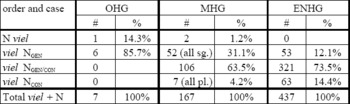
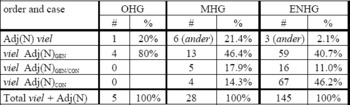
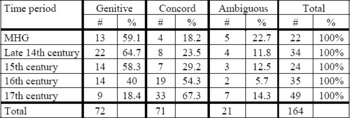
Turning now to the different types of dependents, we see in the first line of table 1 and 2 the disappearance of nouns and adjectives preceding viel. The fourth line of each table shows the rise of nouns and adjectives in concord.
Position and case of bare noun dependent on viel.

Position and case of adjective (noun) dependent on viel.

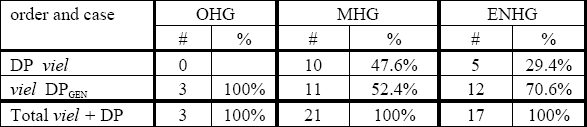
In the proportional construction, dependent nonpronominal DPs begin to show a preference for appearing after viel in ENHG. Moreover, these show only genitive at all periods, as shown in table 3.
Position and case of DPs dependent on viel.

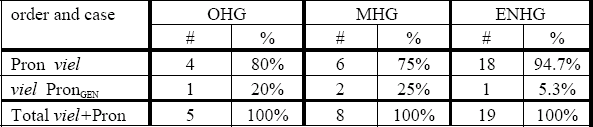
Pronouns likewise occur only in the genitive and are the only type to maintain a strong preference to precede viel, as shown in table 4.
Position and case of pronouns dependent on viel.

As we discuss in detail in section 7, MG no longer allows dependent nouns and adjectives to occur in the genitive. Only concord is possible. As to DP and pronominal dependents, they continue to be in the genitive but have developed some interesting restrictions.
6.3. ENHG: Change of Dependent from Genitive to Concord
As we have shown, clear instances of concord between vil and its dependent begin to appear in MHG, first with adjectives and with dative plural nouns. Over the course of ENHG, concord gradually begins to overtake genitive. A second development is the increase in adjectival morphology on viel itself (vielem, vieler, etc.) after 1550. This indicates that viel continues to be a quantifying adjective in Spec, CardP, and that the morphology is catching up to the syntactic change that began in MHG.
The change from genitive to concord that began with dependent adjectives and plural nouns in MHG, which we claim was a result of the structural ambiguity (adjoined versus complement positions as discussed in section 5.2), accelerated in ENHG. This may have been facilitated by morphological ambiguities that arose due to phonological change in ENHG (to be discussed below), as in the traditional account reported by Ebert (Reference Ebert, Reichmann, Solms and Wegera1993:332–334).
As for noun dependents, to our knowledge, Ebert et al. (Reference Ebert, Reichmann, Solms and Wegera1993:333) were the first to claim that the change from genitive to concord in these constructions involves reanalyzing the dependent noun as the head of the whole nominal. We qualify this statement such that this reanalysis only occurred with the cardinal construction. We illustrate the change with the examples below, where the noun in 65a (repeated from 44a) is clearly marked as neutral genitive singular, and the one in 65b is in concord. Structurally, we propose that genitive dependents indicate the continuing presence of the null quantifier/case assigner some in 66a, as in 49b above. When some is absent (especially later), concord results. Note also that with the addition of full adjectival inflection to viel at the end of the ENHG period, we assume that viel ultimately projects InflP above DegP, as shown in 66b.
-
(65)
-
(66)
Note again that the change from genitive to concord on the dependent is not a direct consequence of the changes to viel (which is already in Spec, CardP at this stage).
While the proportional construction iii–iv maintains the exclusive use of the genitive, the two types of dependents in the cardinal construction i–ii in ENHG show a change in progress from genitive to concord, with a great deal of variation in our corpus. Since this variation is such a dominant feature of this stage, we provide some concrete numbers for dependent nouns and adjectives in each century:
-
i) Noun: Because there is no clear marking of genitive case on plural and feminine singular nouns, the majority of viel+DEPN (321 out of 437, that is, over 73%) is ambiguous between genitive and concord, a factor which must have greatly facilitated the reanalysis of the other nouns to concord. The change from genitive to concord is visible only with masculine/neutral singular nouns due to the presence or absence of the genitive singular inflection -s, and in the dative plural due to the additional inflection -n. Over the course of ENHG, one sees a steady diachronic trend in favor of concord, as shown in table 5.
Table 5.Genitive versus concord with dependent nouns in MHG and ENHG.Footnote 21
While viel+NGEN is clearly on a downward trend in the 17th century, according to Grimm's Deutsches Wörterbuch (DWB) it survives into the 19th century, especially with infinitives, as in 67a and in idioms, as in 67b, some of which continue to occur as fossilized forms today.Footnote 22
-
(67)
-
-
ii) Adjective (Noun): Recall from table 2 above that about half of adjectival dependents are in concord, and 11% are ambiguous. The main source of this ambiguity is the neutral singular (-es) when no overt noun is present. Whereas MHG distinguished neutral nominative/accusative singular -ez from neutral genitive singular -es, these two endings have merged by ENHG, resulting in 15 instances that are ambiguous between genitive and concord, as in 60b.Footnote 23 Whereas previous scholarship attributes the change from genitive to concord to this ambiguity (Ebert et al. Reference Ebert, Reichmann, Solms and Wegera1993:334), our data show that neutral singular adjective dependents in -es form only a small portion of the dependents of viel. Moreover, concord began to arise in MHG, a few hundred years before phonological developments created these ambiguities in the ENHG adjectival paradigm.
Although there is morphological ambiguity with some dependent adjectives, we proposed above that the cause of the rise of concord is the structural ambiguity of dependents base-generated to the right of viel. While a genitive dependent adjective (noun) must be in the complement position of Card0 in order to be assigned case by some, the position of concord dependents that begin with an adjective is ambiguous. Concord adjectives could be assigned the same structure proposed for concord in MHG (see 47 above), in which an AgrP adjoins to CardP. Alternatively, concord adjectives could appear within an AgrP, in the complement position of Card. In this latter case concord would result from the disappearance of the case assigner some (see 66b above). As with nouns, one observes a steady decline of the genitive, with concord overtaking the genitive in the 16th century (see table 6).
Table 6.Genitive versus concord with dependent adjectives in MHG and ENHG.Footnote 24
The use of viel with a genitive adjective (noun) declines in the modern period. The last example cited in the Deutsches Wörterbuch is the following:
-
(68)
-
-
iii) Nonpronominal DP: These dependents in the proportional construction continue to be in the genitive. As in MHG, some (5 out of 17) appear to the left of viel, presumably due to leftward movement.
-
iv) Pronoun: All continue to be genitive, for the same reason as nonpronominal DPs. These dependents overwhelmingly appear to the left of viel due to their lightness (see 63a above). The one exception is a heavy pronoun modified by a relative clause (see 63b).


Summing up the ENHG development, there is a change in progress from genitive to concord in the cardinal construction. With noun dependents, this change was probably facilitated by the high degree of syncretism in the nominal paradigms, where 73% of the tokens are ambiguous. With adjectives (often occurring with nouns), which show significantly less morphological ambiguity (11%), we argue that the variation between genitive and concord is a result of structural ambiguities: adjoined versus complement position and the presence versus absence of some.
7. MG
This section starts with the empirical facts based on Vater Reference Vater1984, Reference Vater and Vater1986, Duden Reference Dudenredaktion1995, native-speaker intuitions, and Google searches. As such, the following presentation is not quantitative in nature but only qualitative. Nevertheless, the data show that the processes seen in ENHG are now complete. Only concord is possible now with dependent nouns and adjectives, while only genitive is grammatical with dependent pronouns and nonpronominal DPs. As for viel itself, it is now quite clearly adjectival.
Beginning with the dependent, we distinguish singular from plural, which reveals some differences. With noun dependents, only concord is possible. This is clear in the singular example 69a. Without an adjective present, plural nouns are ambiguous between concord and genitive, as in 69c, although we assume that these involve concord (compare 71).
-
(69)
As for adjectives, only forms in concord are available in the current grammar, independently of whether or not a following noun is absent or present. This is first shown for the singular (note that the masculine/neutral genitive singular adjective inflection in MG is always -en, thus gutes cannot be genitive):
-
(70)
The plural forms pattern similarly:
-
(71)
In addition to the -es inflection that marks neutral singular nominative/accusative agreement, as in 70a, there is another -es morpheme not limited to nominative and accusative contexts, as shown in 72b. Following Roehrs Reference Roehrs2008, we refer to this morpheme special -s . Note also that adjectives with special -s cannot co-occur with a noun.Footnote 25
-
(72)
Turning to DP dependents, part of the proportional construction, concord is not an option here at all. Interestingly, the genitive singular seems to be awkward and only a von-phrase is fully grammatical (note that inflected vieles seems to be a bit worse in 73b than uninflected viel).
-
(73)
In the plural, genitive forms are completely fine:
-
(74)
Like DP dependents, singular pronouns in concord are sharply ungrammatical. Furthermore, genitive forms are quite marked and only a von-phrase or da-compound is fully felicitous:
-
(75)
As to the plural counterparts, concord is also impossible here, as shown in 76a. Unlike the singular, though, genitive pronouns in the plural, as in 76b, are felicitous but marked (sounding old-fashioned) in predicative contexts. When the pronoun forms the antecedent of a relative clause, the markedness effect in 76b disappears, as 76c shows. Note that pronouns are the only type of dependent in MG that can precede viel. As might be expected, von-phrases, as in 76d, are fine.
-
(76)
The basic generalization that seems to emerge is that non-DP dependents such as nouns and adjectives (the cardinal construction) exhibit only concord forms but not genitive. Conversely, dependents involving pronouns or NPs introduced by determiners (the proportional construction) can only appear in the genitive but not in concord. For the second part of the generalization, there are two minor qualifications: (i) genitives are less felicitous in the singular; that is, when viel combines with a DP involving a mass noun or when it combines with a singular pronominal; (ii) except under certain conditions, genitive plural pronouns may sound archaic.
The syntactic representation of viel and its dependents in MG was discussed in sections 3.1 and 3.2 above. Recall our claim that viel became an adjectival quantifier in late MHG. We argue that the MG cardinal construction in 15 retains the structure for the cardinal construction arrived at in ENHG, and that the MG proportional construction in 16 remains unchanged from MHG to the present (except that a von-PP now exists as an alternative to the genitive). Considering that OHG filu was in N, an alternative analysis for the MG proportional construction would be to treat viel as a noun, thus explaining the genitive case. Under this alternative, while viel in the cardinal construction changed from a noun to an adjectival quantifier (accounting for concord), viel in the proportional construction would be a direct continuation of OHG filu. However, the following data from MG demonstrate that viel changed to an adjective, even in the proportional construction.
While at first glance viel may appear to have nominal inflection, as shown in 77a,b, we submit that viel has adjectival inflection in both the cardinal and proportional constructions. In the cardinal construction, viel is clearly not a noun because it may inflect like an adjective and can be followed by a noun in concord, as shown in 77c. In the proportional construction, it also inflects like an adjective, as best seen when viel itself is in the genitive plural, as in 77d.
-
(77)
Recall from section 3.2 that under certain conditions, the matrix noun can be overt even in the proportional construction such as 19a.
In addition, both cardinal and proportional viel can be modified by a degree adverb such as sehr ‘very’, as shown in 78. Nouns do not have these types of inflections in German, nor do they tolerate a degree adverb directly in front of them.
-
(78)
Moreover, viel has a weak ending if it is preceded by a determiner and a strong ending if it is not. This holds for the cardinal construction, such that the weak inflection -en appears in 78a versus the strong -em in 77a. Likewise, in the proportional construction in 79d one also observes the weak ending -en versus strong -e in 78b. Note in passing that we do not have any diachronic examples of viel preceded by a determiner. Crucially, the alternation between weak and strong inflections is not possible with nouns (or determiners). Furthermore, viel has comparative and superlative forms, just like ordinary adjectives. The comparative and superlative forms of viel can also occur in both cardinal and proportional constructions, as in 79a,c and 79b,d, respectively.
-
(79)
Clearly, proportional viel, just like cardinal viel, is not a noun but a quantifying adjective. In fact, there are no morphological differences between cardinal and proportional viel, so we adopt just one morphosyntactic analysis of viel, which synchronically is more parsimonious. If, as we have claimed in section 3.2, viel is in the same position in both constructions in MG, the difference in the two constructions results from the interaction between the type of dependent and viel rather than a property of viel alone.Footnote 27
It should be noted, however, that viel is not a garden-variety adjective. First of all, adjectival inflection is optional in some feature combinations, for example, in the neutral dative singular (see 77c above). Second, while there are ordinary adjectives in German that assign genitive, the word order of these adjectives and their genitive arguments is the opposite of that of viel and its dependent. With ordinary adjectives, the genitive argument usually precedes the adjective, as shown in 80a,b, whereas dependents of viel must follow it, as shown in 80c,d.
-
(80)
Clearly, the use of genitive with viel is different from its use with regular adjectives. This difference follows immediately if the actual case assigner is not viel (anymore) but a different element, namely, an elided noun, as argued in section 3.2 above.
The one structure that we have not discussed yet involves adjectives with a null noun. These fall into two types: First, when the adjective is in concord, we assume the regular complementation structure of the cardinal construction where the noun is elided. Second, recall that some speakers may have the ending -es in dative contexts, a pattern that we labeled special -s. Our account, which hinges on the gradual loss of adjunction as a base position, can explain this inflectionally irregular pattern. We propose that special -s represents a remnant of the MHG/ENHG structure of base-generated adjunction of adjectives, and that it mediates adjunction between viel and the adjective, similar to French de in constructions such as une bonne chose de dite ‘(a good thing de said =) at least, that is said’ (Roehrs Reference Roehrs2008:21). Following Rubin Reference Rubin, Agbayani and Tang1996, we represent this mediation structurally as a Modifier Phrase (ModP). Special -s is in Mod, and the adjective undergoes leftward movement. Example 72b repeated below as 81a has the structure in 81b.
-
(81)
Note that special-s appears in a subtype of the cardinal construction, in that the dependent is a non-DP.
We propose that this invariant -es is a result of reanalysis of inflectional -es from Infl0 to Mod0. Note that special -s cannot attach to a noun: ∗mit viel Geldes ‘with much money-s’. This difference between adjectives and nouns follows immediately from our proposal. On the one hand, only adjectives went through a stage of base-generated adjunction; singular nouns were almost immediately integrated into the matrix DP. On the other hand, the genitive inflection on the noun Geld-es was never in Infl, thus unable to undergo reanalysis to Mod.
To sum up the diachronic developments, viel has changed from a semilexical noun (OHG filu) to a quantifying particle in Card0 (MHG vil) to a quantifying adjective in Spec, CardP (MG viel, viele, vieler, etc.). The dependents undergo a number of developments, facilitated by the reanalyses of viel, although this is not a causal relation. In general, all dependents began as genitive phrasal constituents in Spec, NP in OHG, before being reanalyzed to a base-generated position on the right in MHG. Specifically, dependent nouns became integrated into the matrix DP, occupying the empty N0 position left behind by the reanalysis of vil to a higher position. When viel ceased to assign case, this integration resulted in concord within the matrix DP. Adjective dependents were adjoined but eventually were also integrated into the matrix DP, again resulting in concord. Structurally larger DP and pronominal dependents never integrated into the matrix DPs. As a result of these structural differences, especially the absence versus presence of a determiner, the cardinal and proportional constructions developed in different ways.
8. Discussion
In this section, we explore some broader implications of our analysis for theories of syntactic reanalysis, in particular head-to-head reanalysis as grammaticalization, head-to-specifier reanalysis as analogy-driven degrammaticalization, and “downward” reanalysis.
8.1. Three Types of Reanalysis
Under our analysis, it may appear that viel and its dependent switch positions in OHG versus MHG. While this appears to be the case on the surface, we have argued that although related, these are separate developments. In fact, they represent very different kinds of reanalysis: The semilexical element filu/vil climbs up the tree, while its lexical dependents end up in lower positions in the tree (depending on their own structural size). Furthermore, the upward reanalysis of filu/vil proceeds in two stages, one of which can be considered grammaticalization and the other a kind of degrammaticalization. These different types of reanalysis have different effects on the structure: While the change of viel from N0 to Spec, CardP led to a more elaborate structure, the developments of the dependent resulted in a simpler structure, at least with regard to the noun and adjective dependents.
The first type of reanalysis is that of the lexical dependents, using Roberts & Roussou's dichotomy between grammaticalization and “downward reanalysis” (2003:208). The change in the structure of dependents shares the following properties with Roberts & Roussou's examples of downward reanalysis. First, there is no category change: A noun dependent remains a noun, an adjectival dependent remains an adjective, etc. Second, the change is not limited to individual lexemes, but affects any dependent element. Third, because no new functional material is created, there are no interface effects, that is, no phonological reduction (other than the loss of genitive inflection) or change in the lexical semantics of the dependent. Finally, this change cannot be cyclic: Once the dependent was reanalyzed into its appropriate position in the lower part of the tree (nouns in N0, adjectives in Spec, AgrP, DPs and pronouns in complement of N0), there is no possibility for it to be reanalyzed again any further downward. We discuss the particulars of the reanalysis of the four kinds of dependents again in section 8.3 below.
The second reanalysis, the upward reanalysis of filu N to vil Card, is compatible with Roberts & Roussou's view of grammaticalization within the generative framework (2003:208). For Roberts & Roussou, grammaticalization involves the overt realization of functional structure, as the grammaticalized word is reanalyzed as being merged in a functional projection. Our analysis differs slightly from Roberts & Roussou's, in that we think new functional material can be added to an extended projection. Two examples are provided in our study: When the impoverished NP originally projected by semilexical filu becomes a full DP by MG (see sections 4–7) and when quantifying words in CardP gain DegP and later InflP (see section 8.2 below).
Be that as it may, our proposal for vil's reanalysis from N0 to Card0 shows nearly all of the properties predicted by Roberts & Roussou. First of all, this is a category change, from the semilexical noun filu to the quantifying particle vil. Second, the reanalysis only affects isolated lexemes, rather than an entire class: filu is one of only a tiny number of quantificational nouns that undergo this process. Third, because it winds up in a functional rather than a lexical projection, there is phonological reduction from filu to vil(e).Footnote 28 Finally, the change is cyclic, in that one upward reanalysis may be followed by another: After the N0-to-Card0 change, vil is able to undergo a second reanalysis into a specifier position (as shown by Roehrs & Sapp, forthcoming, the other grammaticalizing quantifiers undergo similar cycles of upward reanalysis).
As for the third type of change, the upward reanalysis of vil Card to viel Spec-CardP, we have claimed that the modification of and change in inflection on viel is evidence for head-to-specifier reanalysis. Roberts & Roussou only discuss cases of head-to-head reanalysis (2003:195–198). Van Gelderen (Reference Gelderen2004:263) discusses further types of syntactic change: In addition to head-to-head reanalysis, she also mentions instances of specifier-to-specifier and specifier-to-head reanalysis. At face value, note that our head-to-specifier reanalysis appears to contradict van Gelderen's (Reference Gelderen2004) Spec-to-Head Principle, which claims that grammaticalization moves in that direction due to a general preference for heads over specifiers. To our knowledge, the head-to-specifier change proposed here is a novel one and thus requires some additional explanation. In fact, the change of viel from an uninflected particle to an adjective, although involving a higher structural position, is not an instance of grammaticali-zation: Viel does not lose its status as a free morpheme, nor does it undergo any phonological reduction or semantic bleaching during this stage of change. Rather than becoming less complex, viel gains adjectival inflection. We believe that this point is crucial, as the addition of inflection is one of the properties of degrammaticalization mentioned in Norde Reference Norde, Katerina, Gehweiler and König2010:136.
While much of the literature on grammaticalization claims that this is a unidirectional process (for example, Hopper & Traugott Reference Hopper and Traugott2003, chapter 5), more recent work claims that degrammaticalization exists but is a less regular process than grammaticalization (Szczepaniak Reference Szczepaniak2011:26) and does not necessarily require that each aspect of grammaticalization be reversed (Willis Reference Willis2007:2). We follow Norde's (Reference Norde, Katerina, Gehweiler and König2010:131) definition, according to which a change can be considered degrammaticalization if it acquires “substance on one or more linguistic levels” and identify the addition of inflection as the key feature of the degrammaticalization of vil.
Willis (Reference Willis2007:29) notes that the addition of inflection through degrammaticalization is only likely if the phonological form of the word to be degrammaticalized can be interpreted as having the inflection of the target category. In the case of vil, reanalysis as an inflected adjective was possible because both forms in early MHG (vil and vile, both reductions of filu), while actually uninflected, could be interpreted as an agreeing adjective: MHG nominative singular adjectives (along with neutral accusative singular) can be uninflected, thus vil is parallel to blint-Ø ‘blind-nom.sg’, and -e is an adjectival inflection of various feature combinations. Inflection emerges in the 16th century when the formerly free variation between uninflected vil and vile is reinterpreted as variation between zero-inflected viel and inflected viele.
Summary of development of inflection on viel.

We turn next to this third type of reanalysis, which led to a more elaborate and thus less expected structure.
8.2. Inflectional Harmonization in the German DP
The change from Card0 to Spec, CardP seems to involve degrammaticalization, that is, reanalysis into an inflecting, open-class category. As pointed out above, van Gelderen (Reference Gelderen2004) shows that grammaticalization often reanalyzes specifiers to heads for economy reasons. Unlike grammaticalization, which is motivated by economy, degrammaticalization results in more complex structures and seems to go against economy, which calls for an explanation. Kiparsky (Reference Kiparsky, Jonas, Whitman and Garrett2012) claims that degrammaticalization can only arise by analogy. Thus, we suggest that degrammaticalization is able to override economy principles when a new, more complex structure results from analogy with an already existing complex structure. In this section, we show that the increased complexity resulting from the head-to-specifier reanalysis of viel is part of a larger tendency in German to harmonize inflection across the different categories of determiners and modifiers in the DP.
In section 5.3 above, we claimed that viel became a phrasal constituent, based on two arguments: modification of viel by degree adverbs such as so and the later emergence of adjectival inflection on viel. These two developments imply a complex element incompatible with a head position. In line with the discussion in section 3 above, lexical categories build full extended projections. For adjectives and adjectival quantifiers, degree words are part of the higher structure of these types of projections. As for the adjectival inflection, just as an inflected verb consists of a stem and inflection each projecting a phrase (VP and TP, see Chomsky Reference Chomsky1957 and much subsequent work), we claimed in section 3.1 that in MG, adjectival elements build extended projections topped off by inflectional phrases:
-
(82)
As for the relationship between modification and inflection, on the one hand, and the structural position of viel, on the other hand, we argue that as long as viel was in Card, there could be no degree adverb and no adjectival inflection. Once it becomes compatible with a degree adverb (around 1250), we conclude that viel has changed to the lexical category of adjective. As stated above, it takes several hundred more years for viel to show adjective-like agreement morphology. Assuming that structure is built from below, note that the phrasal hierarchy of our tree in 82b directly predicts these two diachronic stages, with the degree words (DegP) appearing before the inflection (InflP). The fact that modification by a degree word precedes the appearance of inflection also falls under Haspelmath's (Reference Haspelmath and Floricic2010) Behaviour-before-coding Principle. While Haspelmath's principle is a universal generalization without a deeper explanation, we derive such an explanation for the change discussed here from our structural assumptions. We posit that adjectival inflection on viel lags behind its syntactic distribution as an adjective because structurally lower positions manifest themselves before structurally higher ones do.
German seems to have undergone some kind of “inflectional harmonization”, whereby inflections on demonstratives and adjectives are extended to articles (created in the process) and quantifiers. As OHG demonstratives and adjectives are already inflected, they build an extended projection on the basis of the stem (DeicP or AdjP, respectively), topped off by InflP. From OHG to MHG, the full system of definite articles develops. Assuming that German articles such as der ‘the’ consist of d- plus the inflection -er, and that d- is inserted to support the inflection, we follow Roehrs Reference Roehrs2013 in that InflP is being extended to the projection of the noun. In a similar vein, we propose that InflP was extended to viel.
Thus, inflectional harmonization seems to have been a fairly general process. In fact, numerals also changed from nominal inflection in OHG (zweio ‘two-gen.pl’, compare tago ‘day-gen.pl’) to adjectival inflection in MHG (zweier ‘two-gen.pl’, compare blinder ‘blind-gen.pl’), which is consistent with this harmonization. This indicates that like viel, they also underwent N0 → Card0 → Spec, CardP. Note, however, that unlike viel, numerals have (mostly) lost their inflection by MG again (MHG zweier → MG zwei).
Summing up this section, we have argued that the reanalysis of viel to an inflected adjective is an instance of degrammaticalization, in the sense of Norde Reference Norde, Katerina, Gehweiler and König2010. Whereas grammaticalization may be motivated by economy (van Gelderen Reference Gelderen2004), we proposed that degrammaticalization is due to analogy (Kiparsky Reference Kiparsky, Jonas, Whitman and Garrett2012). In the next section, we turn to the reanalysis involving the integration of some dependents into the matrix DP, which, like grammaticalization but unlike degrammaticalization, results in a simpler structure.
8.3. Structural Size and the Loss of Genitive
The dependents fall into three categories, based on the type of development they undergo: Nouns and adjectives; DPs; pronominal DPs. Noun and adjective dependents change their position relative to viel and go from genitive to concord. DP dependents have always tended to follow viel, and have remained in the genitive. Finally, pronominal DPs have preceded viel, and like DPs they have stayed genitive. We proposed that all four dependents changed their base position from specifier to complement. For nouns and adjectives, we proposed that they integrate fully into the lower part of the matrix DP, explaining both the new surface order and the loss of genitive. DP and pronominal dependents moved to a lower complement position, where they receive genitive from a new case assigner. The difference between the first three dependents on the one hand and pronouns on the other hand is that the former were originally reordered by a heaviness constraint, but the latter are subject to their own reordering mechanism. This explains why pronouns have retained the old surface order.
We proposed that the loss of the genitive is tied to the structural size of the dependent. At the adjunction stage, what appears to be a simple, dependent noun must have been a phrase (at least an NP, if singular), that is, there was one NP adjoined to CardP. CardP itself contained an NP headed by a semilexical null noun, as shown in 83a. The reanalysis into the head of the matrix NP resulted in a more economical structure in 83b consisting of one NP only.
-
(83)
In contrast, DP and pronominal dependents never integrated into the matrix DP because of their own DP layer.
Recall that empirically, adjective and plural noun dependents pattern together vis-à-vis singular nouns, in that they surface with concord earlier. We proposed that the plural nouns project NumP while adjectives project AgrP. Therefore, these two types are intermediate between the smallest dependent (N0) and the largest (DP). They do not integrate immediately because the semilexical [eN] in the matrix DP does not build a full extended projection involving NumP or AgrP, as shown in 84a. Therefore, they go through the intermediate stage of base-generated adjunction yielding the early forms of concord. Once lexical nouns become established under the matrix N0, they relexicalize this position, causing N0 to project a full extended phrase. Relexicalization of the N0 position results in two developments that affect the different kinds of dependents. First, the extended phrase allows adjectives and plural nouns such as liute ‘people’ to be integrated as well. This integration also results in a simpler structure shown in 84b.
-
(84)
Second, as may be expected, the newly relexicalized position may now be elided and can assign genitive case to the dependent in the proportional construction.
In sum, integration into the matrix DP is subject to economy conditions: If a dependent could be structurally accommodated, it was. If a dependent could not be, it was not. A dependent of intermediate structural size (AgrP, NumP) could not be integrated right away, but had to wait until some other change had occurred. To put it more concretely, the integration of singular nouns (thereby introducing a lexical noun at the root of the projection) paved the way for integration of the larger structures containing adjectives and plural nouns. Recall also from tables 1 and 2 that the constructions viel+DEPN and viel+DEFAdj(N) increased dramatically in frequency from OHG to ENHG. We believe that this is largely due to the fact that more and more dependents of this kind were integrated, which led to a transition from a bi-nominal structure in OHG to a mono-nominal one in MG.
We have proposed that structural ambiguity and economy considerations are the driving force behind the change from genitive to concord. This analysis contrasts with the conventional accounts of the change from genitive to concord, which rely on morphological ambiguity. Ebert et al. (Reference Ebert, Reichmann, Solms and Wegera1993:333) claim that MHG dependents of vil begin to change from genitive to concord with dative plural nouns; Behaghel (Reference Behaghel1923, I:532) argues that this was the only way to mark dative on vil+N in MHG, since vil itself usually lacks inflection. For the indefinite pronouns such as etwas ‘something’ and nichts ‘nothing’, Ebert et al. (Reference Ebert, Reichmann, Solms and Wegera1993:334) argue that the rise of concord resulted from the ambiguity of neutral singular adjectival -es between genitive and nominative/accusative.
We believe that our structural account is preferable to these morphological explanations for a number of reasons. First of all, our first attestation of concord in MHG is not with a dative plural noun, but with a dependent adjective and noun in the nominative plural (see 41b above). In fact, despite the clear morphological marking of adjectives as genitives across all genders and numbers in MHG, they were the first to surface with concord forms. Second, while it is true that the neutral singular adjectival inflection -es becomes ambiguous in ENHG, table 2 shows that only 11% of dependent adjectives in our ENHG data are ambiguous between genitive and concord. This number is so low that the conventional explanation—that ambiguity in neutral singular adjectives led to the loss of genitive dependent—looks rather implausible for viel. In a similar vein, morphological ambiguity does not explain the fact that certain distributions are essentially unattested, and the few cases that do show such surface orders have specific discourse properties.
9. Conclusion
This paper has argued that the base-generated positions of viel and its dependent change over time and are subject to changing reordering constraints. Factoring in varying displacement operations, reanalysis occurs when either a derived or a base surface order is reinterpreted as a (new) base-generated order. Furthermore, the changes in the case of some types of dependents are structurally, rather than morphologically motivated, resulting to some extent from the changes to viel. The first change was when viel no longer appeared in the N0 of the matrix DP, leaving that position available for reanalysis of some dependents, which could receive genitive case there. The next reanalysis of viel—as a quantifying adjective in Spec, CardP—resulted in its inability to assign genitive case altogether.
These developments have a number of theoretical implications. First, quantifying expressions can have different representations in syntax. Viel is first attested as a nominal quantifier in N0 in Gothic and OHG, serving as the head of the matrix nominal (compare Cardinalletti & Giusti 2006). By early MHG, it has become a quantifying particle in Card, having turned into an Abney-style modifier. Over the course of MHG, it is reanalyzed as a quantifying adjective in Spec, CardP, becoming a modifier under a Corver-style analysis. Viel thus goes through two stages of reanalysis that moves it up the tree. The first change shares properties with well-known examples of grammaticalization, while the second change is a rare instance of degrammaticalization via head-to-specifier reanalysis.
Second, different types of dependents have different structural sizes, which results in different changes. The case and base-generated position of each kind of dependent is determined by economy considerations. The simplest dependents (singular nouns) were integrated into the matrix DP first, followed by more complex structures (adjectives in AgrP and plural nouns in NumP). Dependent DPs, including pronouns, never integrated and continue to surface in the genitive.
Third, while grammaticalization is consistent with head-to-head reanalysis, we associate head-to-specifier reanalysis with degrammati-calization driven by analogy. The changes to the base order represent a third type of change, namely, “downward reanalysis” in the sense of Roberts & Roussou Reference Roberts and Roussou2003, which is neither grammaticalization nor degrammaticalization.
Fourth, inflectional change may lag behind syntactic change. Due to analogy with ordinary adjectives, viel begins to show some adjectival properties (modification by so) several hundred years before it shows adjectival morphology. In our analysis, this delay is directly captured by the assumption that structurally lower positions manifest themselves before structurally higher ones do.
Finally, the current study has put forth a number of hypotheses about the diachronic development of German viel. Future investigation of other quantifiers, including those outside the Germanic languages, will reveal how general these types of changes are. Moreover, it would be interesting to see if the changes to Romance quantifiers (as documented, for example, by Déprez Reference Déprez, Sleeman and Perridon2011) are structurally related to the variation in the form of the dependent. Consider cardinal constructions such as French beaucoup de livres ‘many (de) books’: While some treat de as a marker of genitive case (Doetjes Reference Doetjes1997:154), we believe it may have developed a different function in this construction (on this point, compare den Dikken's Reference Dikken2006 proposal that de is a “nominal copula”). In clearer cases of concord such as une bonne chose de dite ‘a good thing (de) said’, we think it is likely that de has become a facilitator of adjunction. However, de in proportional constructions such as beaucoup de ces livres ‘many of these books’ may well continue to be a genitive marker. Careful diachronic investigation of such constructions should shed more light on their contemporary analysis.