United States foreign economic assistance, exclusive of funds for the reconstruction of Iraq, represents only about 0.2 percent of gross national product (GNP) and less than 1 percent of federal budget outlays. Although the United States is the largest aid giver in dollar amounts, it often is the smallest Organization for Economic Cooperation and Development (OECD) donor in terms of percentage of GNP. But then even the most generous donors in percentage terms, such as Denmark and Norway, dedicate less than 1 percent of their GNP to foreign economic assistance. Looked at this way, it is difficult to anticipate that aid can do much to advance economic, social, and political well-being in recipient countries and, indeed, it seems, it achieves little on these dimensions.Footnote 1 The paucity of foreign assistance donations is a focal point of current policy debate, with some arguing that the difficulty with economic assistance programs as a means to alleviate poverty is that the inputs are too modest to have a significant, lasting impact.Footnote 2 Burnside and DollarFootnote 3 suggest that aid is only effective at alleviating poverty when it is accompanied by good policies within the recipient nation; although this result has been challenged.Footnote 4 Dollar and Levin suggest donors are increasingly selective with respect to recipient policy and that this could greatly reduce world poverty.Footnote 5
Others claim government-to-government aid is the wrong way to dispense assistance because either it leads to corruption in the recipient nationFootnote 6 and damages long-term public financeFootnote 7 or it leads to agency problems and bureaucratic inefficiencies that undermine poverty alleviation.Footnote 8 From this perspective, the central problem with aid programs lies not in how much is given but rather how it can be given in a manner than promotes, rather than retards, economic productivity. Recipient and donor motives restrict the efficacy of aid outputs. In either case, whether the problem is with inputs, outputs, or both, the supposition behind the current debate seems to be that at least donors, and perhaps recipients also, view aid primarily as an instrument to alleviate poverty.
In contrast we argue that poverty alleviation is not the sole, or perhaps even the main, reason donors disperse aid. We develop and test a model of aid-for-policy deals in which donor leaders give aid to recipient leaders in return for policy concessions. While questionable from a normative perspective, aid-for-policy deals are a rational allocation of resources and effort by both recipients and donors that advance the interests of political elites in each nation. When aid is given for these purposes, the aid is not designed to relieve poverty and reduce misery. As such we should not be surprised when it fails to fulfill normatively desirable goals. Instead such aid perpetuates poverty and promotes the political survival of leaders.
We develop and test implications of a new model derived from Bueno de Mesquita and colleagues' selectorate theory of political competition.Footnote 9 Bueno de Mesquita and colleagues speculated about the equilibrium conditions associated with foreign aid but offered no formal model of the process and only limited tests of their conjectures. Bueno de Mesquita and Smith modeled the political incentives for donor leaders to offer aid and for recipient leaders to accept it, but they did not include the prospect of bargaining over the size of concessions.Footnote 10 They tested their model's predictions using U.S. bilateral aid data. The model here generalizes Bueno de Mesquita and Smith's earlier model by allowing nations to bargain over the size of policy concessions. This new, more general model leads to new implications that are tested here using bilateral aid flows from all OECD donors. As we shall summarize below, the literature suggests that the United States is motivated to give aid for different reasons than other states. Looking across the OECD, our analysis finds no such difference. We find that in all nations, aid transfers occur according to the political survival interests of donor and recipient government leaders, as identified by the theory. Recipient and donor leaders seek substantive policies and resource allocations that protect their hold on power. To the extent that such policies and allocations are compatible with good economic or social performance, they will make social-welfare enhancing, “good” decisions. Yet, such instances are coincidental. If faced with a contradiction between actions that enhance their own political welfare and actions that advance societal well-being, donor and recipient leaders will select those policies that benefit themselves.
The article proceeds as follows. In the first section we review the pertinent research on foreign aid, noting that no one has thus far provided a general model that considers simultaneously the strategic political interests of donor elites and recipient elites; that is, the parties who must agree to give and to accept aid. The second section contains a simple exposition of selectorate politics, the model of political competition against which we consider the survival incentives of leaders to trade aid for policy concessions. In the third section we present a model of foreign aid designed to answer four questions: (1) Who gives aid? (2) How much do they give? (3) Who gets aid? (4) How much do they get? The fourth section explains how we test the model's predictions, while the fifth section presents the empirical findings. In our concluding section we reflect on what our model and empirical results suggest about the effects of foreign aid on people in recipient countries. When aid is given in return for policy concessions, it is a winning proposition for donor political elites, donor constituents, and recipient political elites but it is often a bane for the citizenry in most recipient countries. We use these results to suggest why so many people in aid-receiving societies seem both to hate the U.S. government and wish that they could migrate to the United States.
Literature
That aid is important in influencing recipient-government economic behavior is clear.Footnote 11 The literature on foreign aid's impact on fiscal policy and growth identifies public-sector factors that diminish the potentially beneficial impact of economic assistance programs. The most prominent negative factor is that corrupt officials tend to consume aid dollars rather than disperse them to stimulate economic growth.Footnote 12 This would seem to be a conundrum facing the foreign aid community. How can donors motivate recipients to use aid money to advance social welfare? President George W. Bush's millennium challenge program—which in its first four years disbursed less than 10 percent of its target aid increment—focuses on programs designed to improve economic freedom, invest in people, and lead to just (presumably democratic) governance.Footnote 13 Yet, the political consequences of aid receipts mimic the effects of the resource curse.Footnote 14 Thus, aid diminishes the likelihood of the just governance and democratic reforms it is supposed to motivate.
Other researchers, sensitive to the problems inherent in converting aid dollars into effective economic policies, argue implicitly that not all forms of economic assistance are equally susceptible to misuse. Mavrotas and Ouattara, for instance, develop a model in which different categories of aid have different impacts on the recipient's economy.Footnote 15 They contend that taking aid heterogeneity into account can provide guidance about the conversion of aid into public fiscal policy. Some forms of aid are less fungible and so are less easily diverted to unintended uses. Although they do not explicitly address the issue of government misuse of aid, their results suggest that different forms of aid lead to different degrees of economic distortion.
While many studies examine limitations in recipient societies, another important strand of the aid literature focuses on donor interests rather than recipient abuses. McKinley and Little, for instance, investigated the motivations for U.S. and British aid giving.Footnote 16 They found that donor interests dominate recipient needs. Others also examine donor interests but distinguish between motivations behind aid given by the U.S. government and economic assistance given by other states. They maintain that non-U.S. aid giving is substantially motivated by humanitarian concerns.Footnote 17 Maizels and Nissanke distinguish the degree of humanitarian motivation as a function of whether aid donations are bilateral or multilateral.Footnote 18 While some aid is surely distributed to alleviate poverty and suffering—about 12 percent of U.S. aid ostensibly is targeted specifically as humanitarian relief—the evidence suggests that humanitarian concerns are not especially prominent. For instance, the neediest states do not receive the most aidFootnote 19 or even a disproportionately large share. In fact, the average rank order correlation between per capita income and per capita U.S. aid receipts among aid recipients year-to-year since 1980 is only −0.03. Where a recipient is in the cross-national income pecking order seems irrelevant to how much aid they get, at least from the United States. Perhaps because of findings such as this, researchers have begun to examine more closely the presumed distinction between U.S. strategic aid giving and the alleged humanitarian motivations behind aid given by other states. In this regard, it is noteworthy that some evidence contradicts the claim that non-U.S. aid is driven by humanitarian concerns. While some contend that Scandinavian countries in particular give foreign aid for humanitarian purposes,Footnote 20 the first systematic empirical study of this question finds otherwise. Schraeder, Hook, and Taylor report that Swedish aid is strongly motivated by prosocialist ideology and by trade benefits aimed at countries in which the Swedish impact can be large rather than in response to humanitarian need.Footnote 21 Hook and Zhang similarly report that even after the Japanese government announced that it would give aid for democratization, human rights, and restraint in military spending, its aid giving is still dominated by self-interest rather than altruism.Footnote 22
Whether given for humanitarian purposes or for strategic reasons, it does not follow that aid cannot also be effective at ending or at least diminishing poverty. Burnside and Dollar report that while aid allocations are not strongly influenced by the quality of development policies, good development policies in conjunction with aid lead to better economic performance. Alesina and Dollar press the issue of aid benefits further. They contrast the flow of aid with that of foreign direct investment (FDI), finding a sharp distinction between the use of FDI and foreign aid.Footnote 23 Countries with good economic policies tend to attract significant foreign investment. Foreign aid, in contrast, is allocated largely without regard to economic policy and in regard to the political and strategic considerations of the donor. That still leaves open the question of whether donor interests reinforce good economic policy, run counter to it, or are orthogonal to the policies pursued by recipients. One might interpret the findings by Alesina and Dollar as implying a selection effect in aid giving: countries with better prospects for growth attract FDI, leaving only the inferior candidates for growth to receive aid. If correct, that, of course, would help explain why aid seems so ineffective in promoting growth, although it seems contrary to the zero correlation between per capita income and aid receipts. The model we develop suggests that another selection effect is also at work in aid giving. The political survival incentives of leaders provides an equilibrium account consistent with the zero correlation between per capita income and aid receipts, while explaining who gets aid and how much they get in a manner that carries direct implications for the generally poor translation of aid into growth.
The model developed in the next section suggests that even if a donor is interested in the implementation of good policies in recipient countries, leaders in donor nations are also influenced by other considerations. Much of the time, aid giving best serves donor and recipient interests when its policy consequences run against normatively desirable outcomes, such as the reduction of poverty. Indeed, the model suggests that aid is most likely to produce the primary ends sought by donors when recipients are free to divert assistance funds to their personal accounts or those of their politically loyal cronies.
The literature to date has done a careful job of assessing the empirical record. It has looked at donor motivations. It has separately looked at recipient motivations. The evidence, however, has not been tied to an explicit, general theory that can explain aid giving and getting by simultaneously investigating the strategic interests and interplay of donors and recipients. We attempt to build on the important insights from the empirical literature by constructing a game theoretic model that helps sort out the fundamentals of aid while also leading to novel, testable hypotheses.
A Selectorate Model of Political Survival
Before turning to our model of foreign aid, we briefly summarize the selectorate theory on which our approach to foreign aid is built.Footnote 24 This theory assumes that political leaders seek to maximize their tenure in office. The theory conceives of all polities as being dependent on two institutions, the selectorate and the winning coalition. The selectorate, S, is the set of people with a potential say in who is to be leader. The essential feature of the selectorate is that it is the pool of individuals from which a leader draws supporters to form a winning coalition, W. Incumbent leaders must maintain the support of their winning coalition or else they are deposed. The size of both the winning coalition and the selectorate can vary enormously across political systems. In democratic states, the selectorate is typically all adult citizens and the winning coalition is a relatively large proportion of this selectorate. The exact proportion of the selectorate that leaders require to retain power depends on the electoral rules. For example, in a two-party directly elected presidential system, about 50 percent of the selectorate constitutes a winning coalition. In contrast, a leader in a single-member district, first-past-the-post parliamentary system only needs about 25 percent support—half the votes in half the districts—to control the government. In monarchies or military juntas, selectorates and winning coalitions are much smaller than in democracies, typically being composed of aristocrats or military elites and key bureaucrats. Autocratic states generally have relatively small winning coalitions, although selectorate size can vary greatly. Rigged electoral systems, for instance, have a small coalition but often have a relatively large selectorate. Although standard regime type classifications are associated with particular configurations of selectorate and coalition size, S and W are inherently continuous measures. Thus, they not only allow us to distinguish between broad and somewhat arbitrary regime classifications, they also allow, in principle, distinctions between the institutions within each classification, as illustrated by our comparison of presidential and parliamentary democracies.
In the selectorate theory, incumbents face political rivals and need to maintain the support of their coalition or be deposed. To buy their coalition's support, leaders allocate the state's available resources (R) between private goods (z) and public goods (g). The essential difference between these two forms of policy provisions is that while the latter provides benefits to all members of society, the former enriches only those members of the coalition to whom they are allocated.
Of course in reality no public policy is either a pure private or public good. However, one of the essential features of selectorate theory is that coalition size shapes the relative private/public focus of policy. For instance, while a clean environment is a public good, environmental policy regulation can focus on either the provision of a clean environment (a public good) or opportunities for securing bribes and restricting market competition to generate monopoly rents (private goods). Leaders, motivated by a desire to retain office, provide those policies that best reward their coalition members. When coalition size is small, leaders can generate high levels of benefits for their supporters by predominately channeling state resources into the provision of private goods. However, as coalition size increases, private goods become an increasingly expensive mechanism for rewarding supporters and so leaders shift their policy allocations toward a greater provision of public goods.
The types of policies induced by political institutions affect the ease with which leaders fulfill their survival objectives. In large-coalition systems political survival is relatively difficult. Since most of the policy rewards are in the form of public goods that benefit selectors whether or not they are in the winning coalition, supporters jeopardize only the small private portion of the rewards they receive if they defect from the incumbent. In contrast, in small-coalition systems the private goods focus engenders a loyalty norm. When new leaders attain office they require the support of only W of the S potential supporters. When W is small (and particularly when S is large), each supporter has only a relatively low probability of being included in the new coalition. Since in small W systems private goods provisions are valuable and the prospects of obtaining them under alternative leadership are relatively low (W/S), supporters in small-coalition systems tend to be loyal.
Aid-for-Policy Deals
Against this backdrop of selectorate political competition, we now consider aid transfers between a potential donor, state A, and a potential recipient, state B. Aid decisions are made by leaders, not nations, in this case AL and BL. We conceive of aid deals as the granting of policy concessions by the recipient in exchange for cash (or in-kind) transfers by the donor. Throughout, we index variables relating to nations A and B with subscript A and B respectively. The winning coalition sizes in nations A and B are W A, and W B. Initially, leader AL has R A resources at her disposal to provide private and public goods. Government resources in nation B are R B. Aid-for-policy deals arise from the possibility of AL transferring some of her resources to BL in exchange for policy concessions. Consistent with the literature,Footnote 25 we assume bilateral aid is largely fungible such that the recipient leader can spend the resources as she sees fit.
The leaders use resources to provide private (z) and public (g) goods for their supporters. Each selector has an additively separable utility function over these goods: U(g,z) = v(g) + u(z), where v() and u() are continuous, concave utility functions and u(0) = 0. The price of providing public goods is p. Winning coalition size provides an implicit price for private goods, as it characterizes the number of selectors who receive private goods. Given resources, R, leaders' policy allocations are subject to the budget constraint, pg + Wz ≤ R.
In addition to private and public goods, selectors care about their leader's performance on all other issues relative to a potential political rival. We denote this performance as θ. For the purposes of this article we do not explicitly model a leader's performance on these other issues, treating it instead as a random variable with distribution F(x) = Pr(θ ≤ x), where F(x) has full support.
The final component in a selector's evaluation is whether their leader obtained or made a foreign policy concession. These concessions can be numerous and varied, such as adopting a pro-A security position, preferentially trading with nation A, or lending nation A support in international organizations. Japan, for instance, provides aid to a number of nations, some of which are land-locked, in exchange for their support at the International Whaling Commission.Footnote 26 Kuziemko and Werker estimate that nations elected to the United Nations Security Council receive a 59 percent increase in aid from the United States due to their enhanced ability to promote U.S. interests.Footnote 27
The model treats policy concessions as a public good for the donor and a public bad for the recipient. Of course, in reality no policy concession is a pure public good; all policy has redistributive consequences. Yet, leaders have considerable discretion as to how to convert aid and policy concessions into the political rewards they desire. As noted earlier, bilaterial aid is generally fungible in the recipient nation. Donor leaders also have some discretion in converting policy concessions between public and private rewards. Suppose, for instance, a donor obtains preferential access to a recipient's markets in exchange for aid. Such agreements are often explicit through tied aid. The recipient might have to purchase tractors from the donor. While the preferential access might benefit the donor's economy in general, the tied aid benefits tractor manufacturing areas the most. However, donor leaders can offset these private benefits somewhat by withholding other assistance that would have gone to these areas in the absence of the aid deal. Obviously, a donor leader could not offset a huge private benefit, but in general they do not need to, as the amount of aid to any specific recipient is generally miniscule. In rich donor nations the effects of aid are small since the amount of aid is small. Despite this, Milner and Tingley find congressional support for U.S. aid is shaped by constituency interest groups and their affinity for the recipients.Footnote 28
Since the political rewards from aid-for-policy deals are generally fungible we treat them as a single policy dimension, y ∈ [0,1], in which nation B's most preferred policy is 0 and nation A's most preferred policy is 1. For convenience we assume quadratic preferences. Therefore, if leader BL implements a policy y then all members of nation B receive the payoff −σBy 2 and all members of nation A receive the payoff −σA(1 − y)2, where σA and σB represent the salience of the policy issue in each nation.
We can now state the aid-for-policy game.
Aid-for-Policy Game
1. AL can propose an aid-for-policy deal (r, y) that consists of r resources in exchange for policy y, where r ∈ [0,R A − k] and y ∈ [0,1].
2. If AL offers a deal, then BL decides whether or not to accept. If BL accepts, then BL sets policy to y, and r resources are transferred from nation A to nation B and nation A pays a transaction cost of k resources to implement the deal. If no aid deal is accepted, then BL implements B's preferred policy of y = 0.
3. Political competition occurs in nations A and B as follows: (1) Leaders AL and BL allocate their available resources between private (z) and public goods (g). (2) In each nation, θ, the leader's performance on all other issues is revealed. (3) Selectors choose their leader. The incumbent is deposed if any of her coalition members chooses not to support her; otherwise the incumbent survives. Selectors receive the continuation payoff Q if a new leader is chosen.
Selectorate Political Competition
If leader L provides g public and z private goods, then her supporters' payoffs are v(g) + u(z) + θ, that is, the value of the public and private goods that the leader provides and L's performance on all other issues. Alternatively, L's supporters can abandon her, precipitating her ouster. In this stripped down representation of the selectorate theory, we model the expected payoff associated with a challenger coming to office as Q. Bueno de Mesquita and colleagues provide characterizations of Q derived in the context of an infinitely repeated game.Footnote 29
Leader L survives in office provided that v(g) + u(z) + θ ≥ Q. This occurs with probability Pr(θ ≥ Q − v(g) − u(z)) = 1 − F(Q − v(g) − u(z)). L's primary goal of political survival is best achieved by maximizing the rewards she gives her supporters given her available resources: maxg,zv(g) + u(z) subject to the budget constraint pg + zW ≤ R. This maximization implies the first order condition:

The following definitions greatly simplify the exposition of the aid-for-policy game. First let (g*,z*) = (g*(R,W),z*(R,W)) be the policies that solve equation (1): these are the policies that maximize the rewards to a coalition of size W given R resources. Second, let V(R,W) represent the level of benefits from these optimal rewards: V(R,W) = v(g*(R,W)) + u(z*(R,W)). The comparative statics of these policy provisions and rewards are dg*(R,W)/dW > 0, dz*(R,W)/dW < 0, dg*(R,W)/dR > 0, dz*(R,W)/dR > 0, and V R(R,W) = dV(R,W)/dR > 0, V W(R,W) < 0, V RW(R,W) < 0, and V RR(R,W) < 0.
Aid-for-Policy Deals
Suppose AL offers BL r resources in exchange for switching to a more pro-A policy of y. If BL accepts the deal, then she increases her available resources from R B to R B + r but imposes the cost of −σBy 2 on her supporters (and the rest of the citizens in nation B). Given that she optimally allocates her resources over private and public goods, her coalition's welfare under the contingencies that she rejects or accepts aid are v(g*(R B,W B)) + u(z*(R BW B)) = V(R B,W B) and v(g*(R B + r,W B)) + u(z*(R B + r,W B)) − σBy 2 = V(R B + r,W B) − σBy 2. Since leader BL's political survival is best enhanced by maximizing her coalition's welfare, a comparison of these two payoffs enables us to calculate the minimum level of aid, ρ̂(y), that BL would accept in exchange for y policy concessions. In particular, ρ̂(y) is the level of aid (r) that solves the following equation:

The comparative statics of equation (2) allow us to characterize how nation B's political institutions and resource level affect the amount of aid required to purchase BL's policy compliance: dρ̂(y)/dy > 0, d 2ρ̂(y)/dy 2 > 0, dρ̂(y)/dσB > 0, dρ̂(y)/dW B > 0, dρ̂(y)/dR B > 0, d 2ρ̂(y)/dydW B > 0, d 2ρ̂(y)/dydR B > 0. The amount of aid required to purchase a policy concession is increasing in the salience, coalition size, and resource base of nation B. The marginal cost of buying additional concessions is also increasing in the size of the policy concession and B's winning coalition size and resources. We now turn to the question of which aid-for-policy deal, if any, leader AL offers.
Level of Aid to Buy
Aid-for-policy deals enable leader AL to deliver policies favored by her coalition and the citizens of nation A, with the latter effect being an externality of the deal rather than its objective. But, buying a policy concession comes at a price. AL must give up resources that might otherwise have been used to fund private and public goods provisions for her coalition. In particular, to buy the concession y, leader AL must give up ρ̂(y) + k resources. That is the minimum level of resources required to purchase y concessions (ρ̂(y)) and finance the transaction costs (k). If AL offers such a policy deal then her coalition's payoff is

Since AL wants to maximize her survival, if she proposes an aid-for-policy deal (ρ̂(y*),y*), she should propose the package that maximizes her survival:

This programming problem is globally concave and so the first order condition (J) provides a characterization of any interior solution:

Define y* as the value of y, which solves J(y) = 0, equation (4), if such a solution exists; otherwise y* = 0. If AL requests this optimal concession and offers the minimum level of aid that BL will accept in return for the concession then AL's coalition's welfare is V(R A − ρ̂(y*) − k,W A) − σA(1 − y*)2. If, alternatively, AL offers no aid-for-policy deal, then her coalition receives a payoff of V(R A,W A) − σA2. AL only offers the optimal aid-for-policy deal when the value gained from obtaining the policy concession outweighs the loss of the private and public goods that the leader could have bought with the resources spent on the aid deal; condition L.

The following proposition follows directly from these results.
Proposition: The Subgame Perfect Equilibrium strategies of the leaders in the aid-for-policy game are as follows: If

The Comparative Statics of Aid Transfers
Aid-for-policy deals must be acceptable to each leader! Recipient leaders must prefer (at least weakly) the additional rewards they can give their coalition rather than receiving no aid and making no concessions. The donor leaders must value the policy concessions they obtain for their coalition more highly than the direct rewards they could have provided their supporters had they not spent resources on aid. The structure of the game gives all the bargaining leverage to nation A since it has the proposal-making power and so offers the minimal amount of aid that makes leader BL indifferent. Under alternative bargaining structures, BL could extract more aid for her concessions. However, the inherent feature of all bargains is that BL makes her coalition better off by accepting the aid-for-policy deal and AL makes her coalition better off by giving up resources to obtain concessions. Political institutions and resources affect the bargains leaders are willing to make. We examine these comparative statics.
The size of AL's optimal policy concession, y*, is increasing in the salience of the policy for nation A (σA), A's coalition size (W A), and A's resources (R A) and y* is decreasing in the salience of the policy for B (σB), B's coalition (W B) and B's resources (R B). Leader AL only seeks aid-for-policy deals if the value of the policy sought from B exceeds the value of the domestic private and public goods that AL could otherwise have bought for her coalition with the resources spent on aid. This is more likely to be the case when policy concessions can be bought cheaply. The aid resources needed to obtain policy concessions are smaller when policy salience in nation B (σB) is low and B's coalition and resources are small. Hence, aid recipients are more likely to be nondemocratic nations with low levels of government revenues than rich democratic states.
Nation A's resources and institutions also affect A's willingness to engage in aid-for-policy deals. Such deals are attractive when concessions are valuable (high salience, σA) and when the marginal value of retaining resources for the provision of private and public goods is low (large W A and large R A). Wealthy democratic nations are more likely to be aid donors than are poor autocratic states.
We now turn to how much aid, if any, is given. The amount of aid given is increasing in the salience of the policy for nation A (σA) and the size of A's winning coalition (W A) and resources (R A). As these variables increase, A seeks greater policy concessions and so must provide greater levels of aid to obtain BL's acquiescence. Variables relating to the recipient nation have competing effects on the amount of aid given. As salience, coalition size and resources in nation B rise then policy compliance from B becomes increasingly expensive for AL to obtain. This increases the amount of aid given up to a point. However, as the cost of purchasing policy compliance rises, the donor has mounting incentives to seek smaller policy concessions to keep the cost under control. The implications of these competing effects is best illustrated through the following hypothetical examples.
We start by examining the case in which the potential donor's salience for the policy issue is small relative to its resources and coalition size. Under these circumstances, aid-for-policy deals do not occur. Even if the recipient state is a poor, small-coalition system from which concessions can be bought cheaply, the lack of donor salience means that the value of the concessions is insufficient to offset the transaction cost and the opportunity cost of forgone private and public goods. We should expect no aid when either the donor's salience for policy compliance is low or the potential donor is a poor, small-coalition system.
Now consider the more interesting cases in which the potential donor is a high resource, large-coalition system that values the policy concession. In these settings, whether aid is given depends on the price at which policy concessions can be obtained. Suppose that B is a small-coalition, low-resource nation. This means the potential recipient agrees to make policy concessions in exchange for relatively small amounts of aid. Given these contingencies, the donor buys close to the maximum concession. From this starting point, consider what happens as nation B's coalition or resource base increases. An increase in W B or R B reduces the marginal value of aid resources from the perspective of the recipient leader. Therefore, aid-for-policy deals become more expensive.
Although initial increases in W B or R B increase the cost at which policy compliance can be bought, provided that the cost is still relatively low, the donor still buys large concessions. However as W B or R B increase further, policy concessions becomes increasingly expensive. This eventually leads the donor leader to seek smaller, less costly concessions. As W B and R B become increasingly large (so that the price of obtaining policy concessions becomes ever larger), this substitution effect becomes increasingly prominent and so reduces the positive relation between W B,R B, and the level of aid. Eventually W B and R B become sufficiently large that aid-for-policy deals are too expensive and no aid is given at all. In sum, the overall level of aid donations depends on the joint effect of how many concessions are bought and the cost of each concession. This leads to a nonmonotonic relationship with the total amount of aid initially increasing in the recipient's resources and coalition size before declining as donors seek fewer (of the increasingly costly) concessions. In the empirical section, we model this predicted nonmonotonic relationship between recipient resources and coalition size and aid received using a quadratic relationship.
We illustrate the logic of the argument by considering the failure of U.S. attempts to buy policy concessions from Turkey. In the run-up to the 2003 invasion of Iraq, the United States sought permission to base U.S. troops in the predominately Muslim nation of Turkey. Such basing rights were of value for the United States because a second, northern front would have improved its ability to engage the Iraqi army on favorable terms. Although Turkey is allied with the United States through the North Atlantic Treaty Organization (NATO), the idea of assisting a predominately Christian nation to invade a fellow Muslim nation was domestically unpopular. During negotiations in February 2003, the United States offered Turkey $6 billion in grants and up to $20 billion in loan guarantees. Given Turkey's population of approximately 70 million, these aid totals amounted to approximately $370 per capita.Footnote 30 The Turkish government is relatively democratic. On Polity's −10 to +10 democracy-autocracy scale it scored 7 in 2003.Footnote 31 Turkey was also relatively wealthy with a gross domestic product (GDP) of $240 billion.Footnote 32 The Turkish leaders needed to compensate a substantial proportion of a relatively wealthy population through increased policy rewards. Although the magnitude of the U.S. offer would have allowed the Turkish leaders to direct more than a thousand dollars toward each of their supporters, that was not enough to compensate them for the sought-after concession. In the end the United States obtained a much smaller concession, only being allowed to coordinate rescue missions for downed pilots and the like out of NATO bases in Turkey.
As a thought experiment, suppose Turkey had been a corrupt electoral system and so rather than needing, for example, the support of half of the registered electorate (that is, about 20 million of 40 million registered voters), its leaders needed only the support of 1 percent of the selectorate (that is, 400,000 out of 40 million), a percentage considerably larger than the size of the winning coalition in, for example, North Korea.Footnote 33 While under democratic rule, the U.S. offer would allow a Turkish leader to direct an additional $1,300 to each of his essential supporters, under the small-coalition setting the leader could provide each supporter with $65,000, an amount more likely to elicit support for the government even if it had allowed a U.S. invasion of Iraq through Turkey. Under such an institutional setting, it is far more likely that the United States could have acquired Turkish acquiescence, and at a much lower price.
Data
The theory predicts that the size of aid-for-policy deals and whether any such deals occur depend on the salience of the policy, the level of resources, and the political institutions in prospective donor and recipient nations. We test these predictions using bilateral OECD data for essentially all countries during the years 1960–2001.Footnote 34 The data are organized by country-pair years where the countries are the prospective recipient (B) and the prospective donor (A); that is, each of the OECD members). Because there is a division of opinion in the literature about whether countries other than the United States give aid primarily for altruistic purposes while the United States is said to give aid for strategic reasons, we test the theory for all OECD countries and also for all OECD countries while separating U.S. choices with a dummy variable, us, coded 1 for those observations in which the prospective donor is the United States, and coded 0 otherwise. We also construct interaction terms, as explained below, to capture any differences in how the United States fits the theory or alternative explanations compared to other OECD member states.
Our empirical investigation focuses first on how much aid recipients get, if they get any. Any prospective donor must make this calculation first before deciding whether to give aid or not, as that determination depends on how expensive the desired policy concessions are expected to be. Then, having determined the cost, we assess the likelihood that a prospective recipient receives foreign assistance from a prospective donor. We measure the size of bilateral aid donations as the logarithm of total gross economic aid in constant U.S. dollars.Footnote 35 This dependent variable is called ln(aid). When we turn to answering the question, “Who gets aid?,” the dependent variable, getaid, is a dummy coded as 1 for each bilateral prospective donor-recipient pair that resulted in aid being given in the year in question and coded as 0 otherwise.
Coalition sizes, W A and W B, are estimated using Bueno de Mesquita and colleagues' five-point measure of winning coalition size.Footnote 36W is normalized to vary between 0 and 1, with 1 representing the most democratic countries and 0 the most autocratic. The estimate of winning coalition size relies on the Polity dataFootnote 37 components regtype (regime type), xrcomp (the competitiveness of executive recruitment), xropen (the openness of executive recruitment), and parcomp (competitiveness of participation). One point is added to the index of W for each of the following conditions: if the regtype is nonmilitary, if xrcomp is greater than or equal to 2 (meaning the chief executive is not chosen by heredity or in rigged, unopposed elections), if xropen is greater than 2, and if parcomp equals 5 (indicating the presence of a competitive party system). It is unfortunately difficult to test the predictions with respect to the donor's coalition size because, as predicted by the theory, virtually all the donor nations are coded as having the largest coalition size, W A = 1.
In the theory, the variables R B and R A reflect the magnitude of resources available to the leaders of each government. We measure this concept as the logarithm of government spending, which we construct using Penn World Tables dataFootnote 38 as the logarithm of the product of population, per capita GDP (rgdpch), and the government's share of GDP (kg). To reflect the nonmonotonicity anticipated in the effect of R B by the theory, we also include a squared version of the measure in our specifications.
While the logarithm of government spending directly measures the theoretical term R B, it is a problematic measure. Two of R B's components, per capita income and population, belong in the econometric specification in their own right: per capita income as a control for poverty and humanitarian need and, as we shall explain below, population as a measure of salience (σa). This clouds the interpretation of R B. Therefore, as an alternative we also include the components of the R B variable (and their quadratic counterparts) in separate specifications. In particular in Models 2, 4, 6, and 8 we replace the R B terms with the logarithm of per capita income (wealthB), the logarithm of population (ln(populationB)), and the government's share of GDP (gov.share).
We measure saliencies using a variety of variables. For ease of discourse, we shall assign each of these variables as a determinant of either the donor's or the recipient's salience. However, we recognize that there is considerable overlap and concessions that are highly salient for the donor are also likely to be salient for the recipient, and vice versa. Recipient salience is measured with a dummy variable, cold war, coded as 1 during the years up to and including 1989 and 0 after. We believe that taking aid from OECD members (allies of the United States) was a costly signal during the cold war regarding which side the recipient chose. As such, the recipient's salience for taking aid from the United States or another OECD member during the Cold War was expected to be elevated, meaning that aid was less likely to be given, but if given, it would be a greater amount than after the Cold War. Unfortunately we do not have data on Soviet aid giving so we cannot control for the extent to which Soviet aid served as a substitute for the United States or other OECD-member assistance.
For prospective donors, the salience of the policy concession sought from BL is measured with three indicators: distance, population, and colony. distance is estimated as the logarithm of the distance in miles between each prospective recipient's and each prospective OECD donor's capital city. population is measured as the logarithm of the prospective recipient country's population in millions as reported by Penn World Tables. colony is a dummy variable coded as 1 if the potential recipient country had been a colony of the prospective donor. The general idea is that policy concessions from geographically closer, more populous countries are valued more than comparable concessions from small distant countries. Similarly, former colonies hold higher salience for donors than do states with which they had no special prior relationship.
In addition to factors likely to influence aid-for-policy deals, we need to assess aid donations given for humanitarian reasons as an alternative motivation for aid. To the extent that aid is given for humanitarian purposes, nations in most need should be most likely to receive aid and to receive substantial amounts. We use two measures of humanitarian need: the logarithm of per capita income (wealthB) and life expectancy (at birth, from the World Bank's World Development Indicators). There are limitations to both measures. Unfortunately, per capita income is an important component of B's resource measure that makes it hard to disentangle the humanitarian need from the policy concession motivation. Since those people trapped in poverty without access to education and healthcare tend to die young, life expectancy serves as a proxy for need. Our choice of this measure reflects trade-offs between a variable that reflects humanitarian needs and data availability. While direct measures of poverty, such as the proportion of the population living on less than a dollar per day, might better capture need, such data have limited availability.Footnote 39
We estimate the effects of trade with the logarithm of the value of trade imports and exports between each dyad consisting of prospective recipient B and prospective donor A. These data, labeled trade, are taken from Gleditsch.Footnote 40 Likewise, in some analyses we also control for the national security relationship between each pair, A and B, based on Bueno de Mesquita's method of estimating shared security policy interests.Footnote 41 He devised a method to estimate the similarity of A's and B's pattern of military alliance commitments with all other states in the world each year. This has been shown in numerous studies to be strongly associated with how reliable alliance commitments prove to be.Footnote 42 We refer to this variable as alignment. It can vary between −1 and +1 and, in our data set, actually varies between −0.35 and +1. In the models that include alignment, we also include alignment squared. The assumptions behind this are that there is no reason to buy policy concessions from close friends and that it is too expensive to purchase concessions from bitter enemies. Countries whose alignment score with the prospective donor are in the neutral range (around a value of 0) are most susceptible to making security-based aid for policy deals. The alignment data, based on Kendall's tauB, are drawn from EUGene.Footnote 43 In several of the models, we control for the level of multilateral aid (ln(multilateral aid)), measured as the logarithm of the total amount of multilateral aid in constant dollars using data from the OECD.Footnote 44
W B and R B (and their component measures), life expectancy, trade with B, and alignment with B are each lagged by 1 year to capture the information A's government would have had at the time it decided whether to give aid and if so, how much to give to B. Eliminating the lag does not change the results. When we distinguish patterns for the United States from the rest of the OECD members, we include interaction terms for the United States and W B, R B, R A (that is, U.S. resources), distance, population, cold war, life expectancy, trade, and alignment.
The theory, consistent with the empirical literature, suggests aid giving is a two-step process.Footnote 45Table 1 uses regression analysis to examine how much aid is given, conditional upon any aid being given. Table 2 uses a logit model to assess whether any aid was given. Unfortunately, the dependence between how much is given and whether any is given at all introduces bias into estimates. These statistical difficulties create inference problems for both our theory and existing studies. To assess where bias is likely to be introduced, in the Appendix we derive the likelihood implied by the theory. This shows that while logit provides a reliable assessment of whether aid is given, caution is required with respect to the amount of aid given, as least squares estimates are biased. Unfortunately, this bias is hard to correct, as we discuss in the Appendix.
Determinants of the amount of aid given

Notes: Standard errors in parentheses, * significant at 5%; ** significant at 1% (two-tailed tests).
Who gives aid to whom?

Notes: Standard errors in parentheses, * significant at 5%; ** significant at 1% (two-tailed tests).
The regression model uses fixed effects for each recipient nation. We provide a replication archive with all the data and code used.Footnote 46 This archive also provides a wide range of alternative specification and robustness tests, including donor fixed effects, dyad fixed effects, simple ordinary least squares (OLS), the inclusion of numerous combinations of control variables, and the inclusion or exclusion of Israel and Egypt.
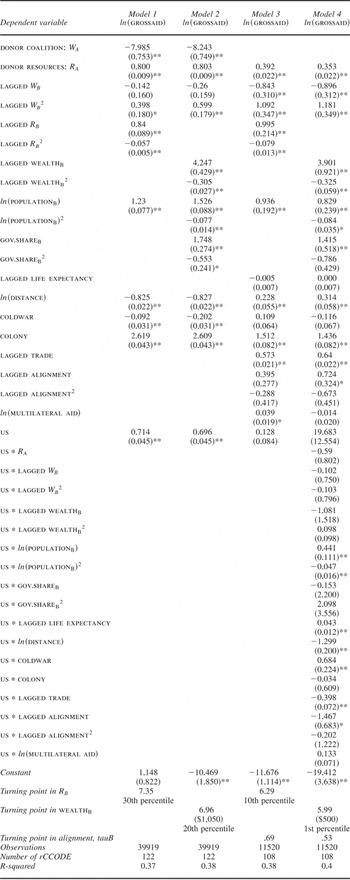
Model 1 provides a barebones assessment of the theory, including measures of institutions, resources and salience for donors and recipients, and a dummy variable for the United States. The square of the recipient's resources is also included because the theory suggests a nonmonotonic relationship between the amount of aid and recipient resources. As discussed above, components of the resource measure R B deserve individual inclusion in the specification. To help disentangle these effects, the components of R B are disaggregated in Models 2 and 4. Model 3 reassesses Model 1 in the presence of controls for life expectancy at birth as a measure of humanitarian need, trade, multilateral aid, and security alignment. Given the debate as to whether the United States is more or less likely to use aid strategically, Model 4 includes interactions between the variables in Model 3 and a us dummy variable to assess whether the United States fits the theory differently from other OECD nations. Table 2 uses similar specifications to determine whether any aid is given.
Results
Table 1 tests the hypotheses regarding how much aid is given (conditional upon some aid being given). The results are broadly consistent with the theoretical expectations. In each of the four models, more aid flows to larger-coalition regimes. As government revenues increase in recipient regimes, so too does the amount of aid received. As anticipated in the model, this is true up to a turning point after which the presumed expense of policy concessions leads donors and recipients to agree on more limited arrangements and, as we show later, a lower probability of any aid being given.
Salience also has the expected effects. Generally, countries geographically closer to the donor receive more, as do former colonies and countries with larger populations. The effect of the Cold War on the level of aid varies according to the model specification.
Donor resources and institutions affect the level of aid. As expected, rich donors give more aid than poor donors, as witnessed by the highly significant positive coefficient on the R A variable. Donor winning coalition size, W A, is also predicted to influence the amount of aid given. However, the significant negative coefficient estimates for W A seem opposite to our expectations. While initially disconcerting, this is the consequence of a selection effect predicted by the theory. In the vast majority of observations, winning coalition size for the donor nation takes its maximum value (W A = 1). Indeed, this is an implication of the theory. The only exceptions are a number of years for Spain, Greece, and Portugal, during which Spain and Greece gave no economic aid and Portugal only gave aid to six former colonies.Footnote 47 When we include a control for multilateral aid, which is available from 1975 onward, we cannot estimate the impact of W A, since in this timeframe all donors have maximal coalition size. Given this lack of variance (as anticipated by the formal model), the appropriate interpretation of W A is a fixed effect dummy for Portuguese colonies before 1968.
Recipient coalition size influences the amount of aid received. The largest coalition systems receive the greatest amount of aid, conditional upon receiving any aid. The analysis includes both linear and quadratic terms for W B and indicates a U-shaped relationship between coalition size and the amount of aid given. Care should be taken in interpreting the impact of these two variables since the variable W B is an ordinal index rather than a cardinal variable with some natural interpretation. In Models 1 and 2, the turning point is between 0 and 0.25 indicating that the two smallest sizes of coalition receive the least amount of aid. Models 3 and 4 suggest coalitions of size between 0.25 and 0.5 receive the least aid. Model 4, which includes interactions between the dummy us variable and each of the regressors, shows that the United States responds to coalition size no differently than other donors. In each case, the largest coalition systems receive the most aid.
Model 1 indicates a nonmonotonic relationship between the recipient government's resources and the amount of aid given. Initially, increases in resources lead to greater levels of aid being given; however beyond a certain point, around the 30th percentile in terms of recipient resources, additional recipient resources lead to a decrease in additional aid. Government resources depend on population size, per capita income, and the government share of GDP. Since these first two factors legitimately belong in the model in their own right as measures of donor salience and need, Model 2 attempts to unpack their separate impact.
Model 2 includes quadratic terms for per capita income, population size, and government share of GDP for the recipient nation. The estimates indicate that, across the entire range of the sample, the amount of aid given is increasing in the size of a recipient's population and increasing in the government's share of GDP, although in both cases at a diminishing rate. Recipient wealth, measured as the logarithm of per capita income, has an interesting effect on the amount of aid. If aid were provided purely on a needs basis, we might expect the most aid to go to the poorest nation. This is not the case. The amount of aid given increases as recipient wealth increases up to approximately the 20th percentile (circa $1,000 per capita income) in terms of recipient wealth. Beyond this point, greater recipient wealth leads to a decline in the amount of aid given. Adding higher-order terms, such as cubics, does not diminish this nonmonotonicity. Consistent with the predictions of the theory, aid is initially increasing with recipient resources and then declining. Unfortunately, it remains hard to separate the effects of humanitarian need from aid-for-policy deals since it is fairly poor nations that receive and are expected to receive the most aid based on either explanation. One might argue that the humanitarian case implies that the wealth coefficient should be strictly negative so that the absolutely poorest receive the most aid, rather than nonmonotonic. If that view is accepted, then the wealth coefficient is inconsistent with the humanitarian hypothesis.
Model 3 provides an alternative measure of humanitarian need, life expectancy, as well as control variables for donor-recipient trade and security alignments. The small and insignificant coefficient estimates for life expectancy suggests that humanitarian need has at best only a very modest impact on the amount of aid given. A ten-year improvement in life expectancy (about one standard deviation) reduces the amount of aid by less than 2 percent of a standard deviation. In Model 4, which separates the effects for the United States, life expectancy appears to have no impact on aid amounts for other OECD donor. Furthermore, this model suggests that the United States gives more aid to those nations with higher life expectancies. These results do not support the contention of scholars such as Lumsdaine and Noel and Therien that non-U.S. aid giving is based on humanitarian concerns.Footnote 48 They do however support their claims that the United States is more strongly motivated by strategic considerations.
While there is little evidence of humanitarian need influencing the level of aid, trade and security concerns certainly do. Trade relations strongly influence the level of aid given. OECD nations give more to nations with whom they actively trade. The inclusion of trade relations also reverses the relationship between aid flows and distance. However, this is perhaps unsurprising since trade is to a large part determined by distance, and trade flow may reflect the ease of communications between states better than geographical distance. Model 4 suggests that compared to other OECD members, the United States is less motivated by trading relations.
Security alignments matters to the OECD members in an expected manner. Those recipients who are moderately aligned with the donor receive the most aid. The United States is likely to give more to nations aligned against it than are other OECD nations. No clear pattern emerges as to how the amount of multilateral aid affects the amount of bilateral aid. Unfortunately, with both trade and security alignments, it is difficult to disentangle whether trade and security-support lead to aid or whether these are policies being bought with aid.
The general pattern for the amount of assistance provided by the United States to recipient countries largely follows the pattern for the rest of the OECD, and this is true even if we delete Egypt and Israel—the two largest U.S. aid recipients—from the analysis. The principle difference is the scale of aid; the United States gives more. Yet, the analysis does indicate some interesting differences. For instance, the United States tends to give more to larger nations compared to other OECD donors. This perhaps reflects greater resources of the United States. The coefficients also suggest that, contrary to the findings for other OECD nations, the United States gives less aid as its resources increase. This anomaly is best explained by the relative position of the United States. It is worth remembering that at the beginning of the post-war period many of the OECD donors were themselves recipients of U.S. aid and that the United States dominated the world economy. While the United States remains the largest economy, its economic hegemony is greatly diminished. It is no longer the only practical provider of large scale aid.
Perhaps the fundamental question regarding countries giving humanitarian aid concerns whether aid is given to relieve need as distinct from how much aid is given for that purpose. According to the theory, those leaders who require high levels of aid before being willing to provide policy concessions are, for that very reason, less likely to receive any aid. Therefore, those least likely to receive aid are large-coalition “democratic” governments with high government revenues and for whom the policies at stake are highly salient. Nations with large coalitions and large resources are most likely to give foreign aid. Table 2, which contains logit analyses of whether any aid is given, supports these predictions. The results are robust across the models even if we delete Egypt and Israel, the aid recipients most transparently receiving aid in exchange for a policy agreement, most notably the Camp David peace agreement.
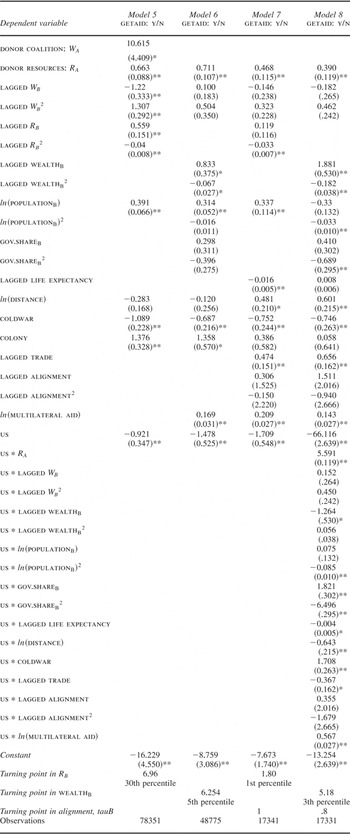
The results are broadly supported across Models 5 through 8. Rich, large-coalition nations are most likely to give aid. The coefficients on donor coalition size and donor resources are positive and highly significant (although because of data availability the impact of coalition size can only be estimated in the absence of controls for multilateral aid). Donors are also likely to give aid when the salience of the policy is high. In this regard, donors are more likely to give to large population former colonies. Although we saw earlier in Models 1 and 2 that donors tend to give more aid to nations that are geographically close to them, the estimates in Table 2 suggest distance has ambiguous effects on the decision to give aid.
Although the theory predicted that increasing recipient coalition size would reduce the likelihood of receiving aid, the estimates suggest coalition size has little impact on the likelihood of receiving aid. Only in Model 5 are the coefficient estimates significant, although even here, a joint hypothesis test of the sum of the coefficient estimates on the linear and squared coalition variables is insignificant.
Models 5 and 7 assess the likelihood that nation B receives aid in terms of the government resource variable R B. The marginal effect of government resources on the probability of receiving aid is nonmonotonic. For nations with very low government resources, the probability of receiving aid is increasing in government resources. However, beyond a certain point, around the 30th percentile in terms of resources in Model 5, increasing resources reduces the likelihood of aid. In Model 7, this turning point is at the 1st percentile in terms of resources, indicating that, across the whole sample, as resources increase, governments are less likely to receive aid.
Model 6 unpacks the components of government resources. Population has competing effects. A large population makes the recipient's policies salient to a potential donor. However, a large population is also indicative of large government resources that make it expensive for the donor to obtain concessions. The estimates in Model 6 suggest that larger nations are more likely to get aid, although the marginal effect of an increase in population decreases as population size increases. Governments with large shares of the economy are more likely to be recipients of foreign aid. Wealth reduces the likelihood of receiving aid.
Consistent with expectations, as a government's resources and wealth increase, it becomes less likely to receive foreign aid. Unfortunately, this evidence fails to distinguish between strategic and needs-based theories, since in both arguments increasing wealth should diminish the likelihood of aid. Model 7 includes life expectancy as a measure of humanitarian need. Just as this measure had little impact on the amount of aid given, it also has relatively little influence on the likelihood of aid being given. If a nation that had a 50 percent chance of receiving aid improved its life expectancy by ten years, then this would only reduce its likelihood of receiving aid by 3 percent. Indeed in Model 8, which separates the effects of the United States, the coefficient estimates suggests that OECD members are more likely to give to nations with higher rather than lower life expectancies; that is, with less need rather than more need, although the effect is not significant. In this model, the likelihood of the United States of giving aid is reduced if life expectancy improves. However the effect is extremely small, with a ten-year improvement in life expectancy reducing the likelihood of aid by only 1 percent. Unless per capita income is the sole means by which donors judge need, these results are hard to rectify with a humanitarian basis for aid.
Models 7 and 8 include controls for trade and security relations. Donor are most likely to give aid to those nations with whom they trade and their allies. Model 8 assesses whether the United States fits the theory differently from other OECD nations. Although many of the coefficient estimates on the U.S. interaction variables are significant, substantively the pattern of U.S. aid is similar to other OECD members.
Table 2, in conjunction with Table 1, helps sort out the extent to which aid giving is needs based. Those nations with low life expectancies are no more likely to receive aid from OECD members than are nations with higher life expectancies and the difference in the likelihood that they will receive aid is minimal.
Overall, the theory seems to fit the data well. While in Model 5, 51 percent of prospective recipient-years result in a country receiving aid, the theory sorts them out sufficiently well that it correctly categorizes 73 percent of cases, resulting in close to a 50 percent proportionate reduction in error. Each of the logit analyses yields a signal-to-noise ratio of greater than 81 percent, indicating that as the estimated probability of getting aid increases so too does the set of cases that actually received aid.
Conclusion
Current debate about foreign aid revolves around three questions: is too little given to make a difference? Is an increase in aid donations a mistake unless donors first institute means to prevent corruption by recipient leaders? Do donors give assistance for humanitarian reasons or for domestic gains? We proposed and tested a formal model that helps illuminate answers to these questions. By positing that, in addition to humanitarian concerns, recipient and donor leaders are each motivated to maximize their political survival prospects, we derived predictions about optimal aid decisions with regard to giving and getting aid and with regard to the amounts given and taken. The pattern of bilateral OECD aid donations between 1960 and 2001 is broadly consistent with the theory's predictions.
The results indicate that the amount of aid given and to whom it is given are both consistent with the decisions expected from political leaders who are motivated to enhance their political survival. As such, at least part of aid giving appears to be driven by institutionally induced considerations in recipient and donor nations. Thus, the answer to the first question posed above is that the right amount of aid is given for the purposes that motivate donors and recipients, even if this is suboptimal from the perspective of alleviating poverty.
The second question focuses attention on the corrupt uses to which aid money is often put. The theory suggests that these corrupt uses by small-coalition, autocratic leaders, are an essential, if not necessarily conscious, part of the decision by donors to give aid, as well as being in the more obvious interest of corrupt leaders in receiving aid. Large-coalition donors depend on effective policy implementation for their political survival. They find it easier to purchase policy concessions from small-coalition leaders who rely on cronyism and corruption as those leaders can best afford to sacrifice their own society's public-goods-oriented policies to stay in power.
Humanitarian need, as indicated by life expectancy, does not seem to motivate the decision to give aid by either the United States or other OECD members. Neither does it substantially affect the amount of aid given. Donors give aid to large, geographically proximate states, especially those with whom they maintain trade relations or whose security alignments may be up for grabs. The neediest do not receive the most; rather, those whose policy compliance can be purchased at an affordable price apparently are offered aid and agree to take it.
Selectorate theory suggests that aid transfers improve the survival of political leaders in both donor and recipient states. If it did not, then these leaders would not participate in such deals. Aid also improves the welfare of citizens in donor states because it purchases the policy concessions they desire. Paradoxically, the losers from aid are the average citizens in recipient states: precisely the people who are the nominal beneficiaries. They are harmed in two ways. First, they get policies they would rather not have. For instance, since the Camp David peace agreement, the United States pays Egypt to recognize Israel and maintain peace with it. These policies are not especially popular among ordinary Egyptians. It is worth noting that the Egyptian government has done little in the way of education to make this policy more palatable. Doing so would reduce the amount of aid the government could extract in the future! Second, the aid helps their autocratic incumbent leadership survive and continue to pursue unpopular policies in the future. Thus, citizens in the recipient state get “bad policies” and “bad leaders.” Indeed, another selectorate model and a large body of evidence indicates that foreign aid, just like oil or other contributors to the resource curse, also decreases the likelihood of a regime becoming more democratic and increases the risk that it will become less so.Footnote 49 With these consequences in mind, it is little wonder that the United States, as the world's largest and most nearly ubiquitous donor, is the target of so much enmity.Footnote 50 Yet precisely because the U.S. government pursues policies to enrich its people, it is also a popular destination for those fleeing their own state.
Selectorate theory challenges the fundamental assumption that motivates current debate regarding foreign aid; namely, that aid is intended to alleviate poverty and promote development rather than being an equilibrium exchange of money for policy compliance. Selectorate theory might not be the only explanation to account for the findings in this article. However, the attraction of embedding a theory of aid transfers in the selectorate model is that the selectorate framework accounts for a wide range of other political, economic, and social phenomena. For instance, extensions of the selectorate theory examine endogenous institutional changeFootnote 51 so that the theory not only accounts for the occurrence of aid transfers but also for their domestic economic and political consequences.
Yet frontier questions remain. For instance, we know that there are instances of aid given for humanitarian reasons and of aid given for policy compliance reasons. Resolving which circumstances are conducive to which type of aid is an important research goal. Equally important is the nature of the aid delivery mechanism. It appears that bilateral aid, the type discussed here, is more amenable to aid-for-policy deals than is multilateral or nongovernmental organization (NGO) aid since the donor can more explicitly tie policy compliance to bilateral aid. But whether multilateral aid or NGO donations overcome the recipient country's regime's political survival incentives remains unexplored. Pushing these debates forward must surely be among the important next steps for those who wish to better understand aid policy or wish to further probe the reliability of the selectorate perspective on aid.
Appendix
In this section we derive the likelihood function associated with the theoretical model. This analysis suggests that although standard discrete choice models, such as logit or probit, are appropriate to analyze whether aid is given, standard regression approaches to estimating the amount of aid are problematic. We derive our econometric model using a standard latent variable formulation, where y 1* represents the maximum amount leader AL would pay for the optimal concession and y 2* represents the amount required to purchase the optimal concession from leader BL. We observe economic aid, y = y 2*, only if y 1* ≥ y 2*.
Suppose a standard linear approach: y 1* = x 1 β1 + ɛ1 and y 2* = x 2 β2 + ɛ2, where (ɛ1,ɛB) are error terms that we assume are bivariately normally distributed with mean zero and variance
 . We next derive the likelihood function associated with this model for observations of aid giving and nonaid giving.
If aid is observed, y > 0, then y 2* ≤ y 1*, which implies that ɛ2 ≤ x A βA − x 2 β2 + ɛA. Therefore the errors, ɛ2, on observations of aid giving are truncated and lie in the interval (−∞,x 1 β1 − x 2 β2 + ɛ1). Unfortunately this makes the likelihood very difficult to calculate because the right truncation is stochastic and therefore we must integrate ɛ1 out. Given ɛ1, the distribution of ɛ2 = y − x 2 β2 is normal with mean ɛ1σ12 /σ12 and variance σ22(1 − (σ12 /σ1σ2)2). Therefore the probability density of observing y aid given x 1 and x 2 is
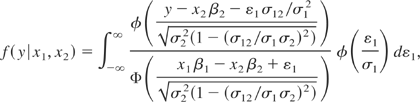
where Φ and φ are the standard normal distribution and density.
By way of comparison, the standard regression framework, y = zγ + υ, where E [υ2] = συ2 has a likelihood function of φ((y − zγ)/συ). Thus, the coefficient estimates reported in Table 2 are inconsistent.
The situation is less problematic for observations of no aid giving. No aid implies y 1* < y 2*. The contribution to the likelihood function from such observations is captured by Pr(y 1* < y 2*) = Pr(ɛ1 − ɛ2 < x 2 β2 − x 1 β1). Since E [ɛ1 − ɛ2] = 0 and E [(ɛ1 − ɛ2)2] = σ12 + σ22 − 2σ12, Pr(y 1* < y 2*) = Φ((x 2 β2 − x 1 β1)/(σ12 + σ22 − 2σ12)), where Φ() is the standard normal distribution. This formulation is reminiscent of a standard probit model where the ratio of the beta coefficient and the square root of the variance can only be identified up to a normalizing constant. In particular, the standard assumption is that the variance of the error term in the latent variable formulation is 1. Thus, provided that the variables appropriate for assessing AL's willingness to pay (that is, the x 1's) and size of aid required to purchase concessions (that is, the x 2's) are both included in the specification, standard discrete choice models such as logit or probit, are appropriate for assessing whether aid is given.
The likelihoods derived above provide a potential means to simultaneously estimate both whether aid is given and how much. Unfortunately, there is no simple way to calculate the integral for cases of aid donation. Hence rather than use a maximum likelihood approach, we estimated the model using a Markov Chain Monte Carlo (MCMC) approach. Unfortunately, our Monte Carlo studies suggest that the algorithm often performs poorly. We believe these problems stem from limits in numerical accuracy in our random number generators. In Monte Carlo studies with simulated data, if one parameter in the model is fixed, then the others can be reliably recovered using MCMC techniques. Unfortunately, without the anchor of fixing one parameter, the Markov chain tends to drift toward ever higher variance and beta parameters.