Significant outcomes
-
• Use of a simple and complex written picture description task can reliably discriminate the performance of healthy elderly controls and minimal–moderate Alzheimer's disease (AD) patients.
-
• The findings indicate the need for a screening task that assesses multiple components of language.
-
• The inclusion of lexico-semantic language measures in screening assessments would increase their initial sensitivity, whereas visuospatial and graphomotor measures would be useful in documenting the progression of the disease.
Limitations
-
• The longitudinal findings are limited by subject attrition; as a result, the analyses and conclusions drawn are based on a small sample, thus limiting the wider application of the findings.
-
• Although the sample included minimal, mild and moderate AD patients, they could not be sub-grouped for disease severity owing to the small sample size.
Introduction
Alois Alzheimer's first case report described a woman of 51 years who ‘[w]hen writing repeated individual syllables several times, left out others and quickly became stranded’ (Reference Henderson, Buckwalter, Sobel, Freed and Diz1); however, most language research on Alzheimer's disease (AD) has focused on oral language production.
Mild to moderate AD patients have a typical writing pattern characterised by reduced quantitative production, defective narrative organisation, word omissions (especially function words), multiple intrusions and perseverations (Reference Henderson, Buckwalter, Sobel, Freed and Diz1–Reference Lambert, Eustache, Viader, Dary, Rioux and Lechevalier2); they also produce sentences that are shorter and less grammatically complex (Reference Kemper, LaBarge, Ferraro, Cheung, Cheung and Storandt3–Reference Neils-Strunjas, Shuren, Roeltgen and Brown4).
Numerous studies (Reference Appell, Kertesz and Fisman5–Reference Faber-Langendoen, Morris, Knesevich, Labarge and Begg6) have found that deficits in written language are early and prominent findings in AD, and indeed may be more sensitive indicators of language dysfunction than dysnomia (Reference Croisile, Ska and Brabant7). Although there is relative preservation of motor output, phonology and syntax in spontaneous speech, multiple graphemic and orthographic errors are found in written descriptions (Reference Forbes, Venneri and Shanks8), as are grammatical errors, implausible detail (Reference Horner, Heyman, Dawson and Rogers9) and less information (Reference Bertolucci, Miranda, de Luccia and Ortiz10–Reference Groves-Wright, Neils-Strunjas, Burnett and O'Neill11).
In a longitudinal spelling study on 22 AD patients (MMSE ranging from 10 to 26), Platel et al. (Reference Platel, Lambert and Eustache12) found agraphia to evolve through three phases related to disease severity. The initial damage to the semantic system caused an over-reliance on the phonological system; therefore, the initial stage was dominated by phonologically plausible errors. However, as the disease progressed into the second stage, the phonological system was also impaired and phonologically implausible errors were dominant. Finally, in the third stage, output was extremely limited and most errors were caused by impaired graphomotor skills. Pestell, Shanks, Warrington and Venneri (Reference Pestell, Shanks, Warrington and Venneri13), and Forbes et al. (Reference Forbes, Venneri and Shanks8), however, failed to differentiate mild–moderate AD patients in terms of error type. Although the prevalence of phonological errors increased with disease severity, there was no shift in error type (plausible/implausible); both the patient groups produced a large number of phonologically plausible errors, but phonologically implausible errors were also evident, even among mild AD patients.
Numerous longitudinal studies have documented a decline in narrative language performance among AD patients, including deterioration in idea density of written language (Reference Snowdon, Greiner and Markesbery14–Reference Kemper, Marquis and Thompson15), verbal fluency (Reference Papagno16), semantic skills and sophistication of vocabulary in writing (Reference Garrard, Maloney, Hodges J and Patterson17–Reference Le, Lancashire, Hirst and Jokel18), despite the relative preservation of overall structure and syntax. In a case study by the talented and accomplished writer, Iris Murdoch, Garrard et al. (Reference Garrard, Maloney, Hodges J and Patterson17) observed signs of deterioration in her writing before her diagnosis of AD, especially in semantic skills and sophistication of vocabulary. More recent analyses across her literary opus revealed that subtle abnormalities in her writing with impoverished vocabulary and syntax detectable even in middle age, almost two decades before clinical diagnosis (Reference Le, Lancashire, Hirst and Jokel18).
To date, no longitudinal assessment has been carried out on the spontaneous narrative writing skills of AD patients.
Aims of the study
The main aim of this study was to document the progressive nature of the spontaneous writing impairments occurring in minimal–moderate AD patients using a standardised measure. In particular, this study aimed to build up a profile of the deterioration in performance, on a simple and complex narrative description task, over a period of 12 months.
If the writing impairment experienced by AD patients is due to a primary breakdown in semantic processing and secondary breakdown in phonological processing, deficits should be most evident on those aspects of spontaneous writing that deal with lexical semantic processing. Furthermore, if the initial breakdown in lexical processing is followed by a subsequent breakdown in visuospatial and graphomotor skills, the sensitivity of the latter measures should increase over time.
Method
Participants
Study 1 – cross-sectional study
The participants comprised 30 healthy elderly individuals and 31 probable AD patients. All patients underwent structural and/or dynamic imaging, clinical assessment and neuropsychological testing. All probable AD patients spoke English as their first language, and met the NINCDS–ADRDA clinical criteria for a diagnosis of probable dementia of the Alzheimer type (Reference McKahnn, Drachman and Folstein19). Those patients who were in the minimal dementia severity range were re-examined at 6-month intervals and clinical diagnosis was confirmed. Informed consent was obtained from all patients, as specified by the Grampian Health Board and the University of Aberdeen Joint Ethics Committee. Before administering the written picture description task, a brief interview was carried out with each patient and their relative/guardian. Only those patients who were able to give consent were tested.
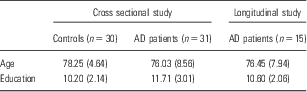
The 30 healthy controls (18 men and 12 women) were recruited from the University of Aberdeen Participation Panel. All these participants had been part of this panel for a number of years and were regularly attending cognitive testing sessions and taking part in a range of projects. Longitudinal evidence of normal cognitive functioning was therefore available. All controls spoke English as their first language, were literate, met the exclusion criteria of WMS III and WAIS III standardisation samples (Reference Wechsler20), and had visual acuity sufficient to read newsprint. They were aged between 71 and 89 years (mean 78.25, SD 4.64), with a mean of 10.20 (SD 2.14) years of education (see Table 1). As an additional precaution to ensure normal cognitive functioning at the time of assessment for this study, all controls over the age of 80 were also assessed with the MMSE. None of the participants scored below 27/30.
Mean (SD) age, education, MMSE for AD patients and healthy controls

AD, Alzheimer's disease.
The 31 patients (19 men and 12 women) were aged between 53 and 90 years (mean 76.03, SD 8.56), with a mean of 11.71 (SD 3.01) years of education (see Table 1). The patient group had a mean MMSE of 22.29 (SD 4.11), with a minimum of 16 and a maximum of 29. According to the cut-off scores established by Folstein (Reference Folstein, Folstein and Mchugh21), 16 patients fell within the minimal range (24–30), 9 within the mild range (19–24) and 6 within the moderate range (12–18) of dementia severity.
To ensure that the patients and controls were matched in terms of age and education, a one-way ANOVA was carried out with age and education as the dependent factors. Results indicated that there was no significant difference for age [F(3,60) = 2.32, NS] or education [F(3,60) = 2.45, NS]. As there was no significant difference between any of the groups in terms of age or education, all analyses were carried out using the raw scores.
Neuropsychological assessment
All patients and controls were assessed at the time of entering the study using a comprehensive battery of neuropsychological tests including: the Paired Associate Learning test (Reference Wechsler20), a forward and backward digit span task (Reference Wechsler20), a semantic and phonemic word fluency task (Reference Forbes-McKay, Venneri and Shanks22), a 20-item naming task, the shortened version of the Token Test (Reference De Renzi and Vignolo23), a digit cancellation task (Reference Spinnler and Tognoni24) and the Coloured Progressive Matrices (Reference Raven, Court and Raven25).
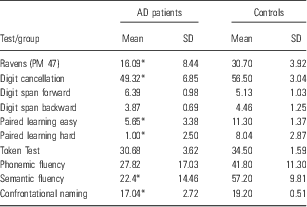
As indicated in Table 2, the AD patients performed within the normal range on the Token task, the digit span and the measure of phonemic fluency; however, deficits were evident on confrontation naming, semantic fluency, paired associate learning, digit cancellation and coloured progressive matrices.
Mean and SD scores on the neuropsychological battery for AD patients and healthy controls

AD, Alzheimer's disease.
*Performance fell two standard deviations below the mean of controls.
Study 2 – longitudinal study
For various reasons, such as, illness, departure from the area, loss of contact or inability to complete the task, the full 12-month assessment of spontaneous writing was not possible for 16 (52%) of the original 31 AD samples. The 15 patients who were reassessed had a mean age of 76.45 (SD 7.94), with a mean of 10.60 (SD 2.06) years of education (see Table 1). Of the 15 participants who were reassessed, five patients fell within the minimal range (24–30), six within the mild range (19–24) and four within the moderate range (12–18) of dementia severity at the time of the baseline assessment. Mean MMSE annual decline was 0.27 (SD 1.33). To determine whether those patients who completed the longitudinal assessment differed from those who dropped out in terms of initial MMSE, age or education, a one-way ANOVA was carried out with age, education and initial MMSE as the dependent factors. Results indicated that there was no significant effect for age [F(1,29) = 2.46, NS], but there was a significant effect for education [F(1,29) = 4.38, p < 0.05] and MMSE [F(1,29) = 4.95, p < 0.05]. The subgroup of ‘survivors’ had significantly less years of education (mean 10.60, SD 2.06) and lower initial MMSE scores (mean 21.13, SD 2.79) than those who dropped out (years of education – mean 12.75, SD 2.06; MMSE mean 24.12, SD 4.44). The two groups, however, did not differ in terms of their performance on any of the psychometric or neuropsychological measures carried out at baseline.
Materials
Spontaneous writing was assessed using a narrative description task comprising two simple line drawings that depict a domestic scene, namely, ‘The Cookie Theft Picture’ (Reference Goodglass and Kaplan26) and ‘The Tripping Woman Picture’ (Reference Semenza and Cipolotti27) and two complex line drawings that depict a traffic scene, ‘The Traffic Chaos Picture’ and the ‘The Bus Stop Picture’ (see Forbes–McKay and Venneri (Reference Forbes-McKay and Venneri28) for further details on complexity, scoring, validity and reliability).
Procedure
Study 1 – cross-sectional study
Before administering the task, there was a brief discussion with each patient and their relative/guardian, and only those able to consent were tested. Each individual was instructed to describe in writing everything that they could see happening in one simple and one complex picture. The descriptions were transcribed and later analysed on a writing analysis scale, which comprised eight 7-point Likert-type scales including: Goodglass and Kaplan's (Reference Goodglass and Kaplan26) measures for phrase length and grammatical form; a modified version of their measure for paraphasias, in which semantic (words related to the target in terms of meaning), visual (words related to the target visually) and phonological (words that share some similar sounds, initial phoneme or number of syllables to the target) paraphasias were measured separately; and three additional scales measuring areas of writing known to deteriorate in AD patients, namely, information content, error monitoring and the number of pictorial themes described in each picture.
Each measure was scored on a 7-point Likert-type scale ranging from 1 (severely impaired functioning) to 7 (no abnormality) (see Forbes, Venneri and Shanks (Reference Forbes, Venneri and Shanks29)). For example, the scales for paraphasias ranged from 1 (paraphasia present in every sentence) to 7 (paraphasias absent) with intervening scores representative of the proportion of sentences containing a paraphasia. The scale for information content, ranged from 1 (indefinite, redundant and irrelevant phrases present in every sentence) to 7 (indefinite, redundant and irrelevant phrases absent) with intervening scores representative of the proportion of sentences containing indefinite, redundant and irrelevant phrases. The error monitoring scale ranged from 1 (no errors corrected) to 7 (all errors corrected) with intervening scores representative of the proportion of errors corrected. In terms of pictorial themes, the total number of actions observable in each picture was calculated, the scale ranged from ‘1’ to ‘7’ representative of the number of observations made. Ratings were carried out by KFM, who devised the rating scales and has extensive experience of using them (see Forbes et al. (Reference Forbes, Venneri and Shanks29–Reference Forbes, Venneri and Shanks30)). As demonstrated by Forbes-McKay and Venneri (Reference Forbes-McKay and Venneri28), the scales have high validity; interrater, parallel forms and test–retest reliability among healthy individuals and AD patients.
Study 2 – longitudinal assessment
The procedure for study 2 was the same as study 1; however, to document the language deterioration suffered over time, writing was reassessed after a period of 6 months and 12 months. To control for practice effects the stimuli were rotated every 6 months; for example, if presented with the ‘Bus Stop’ and ‘Cookie Theft’ pictures at baseline, patients were presented with the ‘Traffic Chaos’ and the ‘Tripping Woman’ pictures at 6 months.
Statistical analysis
Baseline cross-sectional assessment
To examine the effects of group (healthy controls and AD patients), on the performance score of each speech variable, a one-way ANOVA was carried out for each writing measure.
Longitudinal assessment
To examine the effects of time (baseline, 6 months and 12 months) on the performance score of each writing variable, a one-way repeated ANOVA was carried out for each writing measure across all patients.
Results
Study 1 – cross-sectional analysis
Simple task
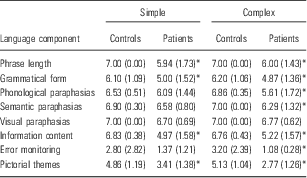
Results from a series of one-way ANOVAs indicated that group had a significant effect on the measures of: phrase length [F(1,60) = 11.34, p = 0.001; η2 = 0.16], grammatical form [F(1,60) = 10.39, p = 0.002; (η2 = 0.15], information content [F(1,60) = 39.56, p < 0.001; (η2 = 0.40] and number of pictorial themes [F(1,60) = 19.03, p < 0.001; (η2 = 0.24]. Group had no significant effect on phonological paraphasias [F(1,60) = 3.28, p = 0.12], semantic paraphasias [F(1,60) = 4.12, p = 0.05], visual paraphasias [F(1,60) = 5.27, p = 0.03] or error monitoring [F(1,60) = 5.57, p = 0.02]. Tests were conducted using Bonferroni-adjusted α levels of 0.006 per test (0.05/8). Table 3 shows a summary of mean scores for the control and patient groups on this task.
Mean (SD) scores on the simple and complex task for AD patients and healthy controls

AD, Alzheimer's disease.
*Significant main effect of group, p < 0.006 tests were conducted using Bonferroni-adjusted α levels of .006 per test (0.05/8).
Complex task
Results from a series of one-way ANOVAs indicated that group had a significant effect on the measures of: phrase length [F(1,60) = 14.50, p < 0.001; (η2 = 0.19], grammatical form [F(1,60) = 17.99, p < 0.001; (η2 = 0.23], phonological paraphasias [F(1,60) = 15.23, p < 0.001; η2 = 0.20], semantic paraphasias [F(1,60) = 8.64, p = 0.005; η2 = 0.12], information content [F(1,60) = 27.10, p < 0.001; η2 = 0.31], error monitoring [F(1,60) = 19.47, p < 0.001; η2 = 0.34] and number of pictorial themes [F(1,60) = 63.46, p < 0.001; η2 = 0.52]. Group had no significant effect on visual paraphasias [F(1,60) = 4.02, p = 0.05]. Tests were carried out using Bonferroni-adjusted α levels of 0.006 per test (0.05/8). Table 3 shows a summary of mean scores for the control and patient groups on this task.
Longitudinal analysis
Simple task
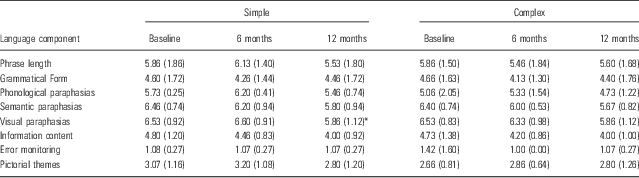
Results from a within-subjects ANOVA demonstrated a significant main effect of time on visual paraphasias [F(2,28) = 8.93, p = 0.001; η2 = 0.39]. Further analysis using Bonferroni pairwise comparisons indicated that the patients produced significantly more visual paraphasias at 12 months than at baseline or 6 months (p < 0.05). There was no significant effect of time on the measures of grammatical form [F(2,28) = 0.25, p = 0.78], information content [F(2,28) = 4.29, p = 0.02], phrase length [F(2,28) = 0.62, p = 0.54], pictorial themes [F(2,28) = 0.53, p = 0.59], semantic paraphasias [F(2,28) = 2.97, p = 0.07] or phonological paraphasias [F(2,28) = 1.26, p = 0.29].
As the patients performed at floor on the measure of error monitoring, ANOVA was not calculated on this measure. Tests were completed using Bonferroni-adjusted α levels of 0.007 per test (0.05/7). Table 4 summarises the mean score for each writing variable in the patient group.
Mean (SD) scores on the simple and complex task at baseline, 6 months and 12 months in the patient group

*Significant main effect of time, p < 0.007. Tests were conducted using Bonferroni-adjusted α levels of .007 per test (0.05/7).
Complex task
Results from a within-subjects ANOVA demonstrated no significant effect of time on the measures of grammatical form [F(2,28) = 0.70, p = 0.50], information content [F(2,28) = 4.20, p = 0.03], phrase length [F(2,28) = 0.45, p = 0.64], pictorial themes [F(2,28) = 0.22, p = 0.80], semantic paraphasias [F(2,28) = 0.61, p = 0.54], visual paraphasias [F(2,28) = 4.06, p = 0.03] or phonological paraphasias [F(2,28) = 0.49, p = 0.61].
As the patients performed at floor on the measure of error monitoring, ANOVA was not calculated on these measures. Tests were carried out using Bonferroni-adjusted α levels of 0.007 per test (0.05/7). Table 4 summarises the mean score for each writing variable in the patient group.
Discussion
This study found that impairments at the level of the semantic system were present early in the course of the disease. In addition to a breakdown in grammatical form and phrase length, the minimal–moderate AD patients produced writing that contained significantly more phonological and semantic paraphasias, more empty and indefinite phrases, fewer repaired errors, and were able to abstract and describe fewer pictorial themes than the healthy elderly controls. Therefore, the findings from the cross-sectional study are consistent with previous research (1−3, 7–8, 10, 14, 17–18).
As the disease progressed, the impairment in grammatical complexity and phrase length, the number of indefinite and empty phrases, semantic and phonological paraphasias, and unresolved errors did not increase. Performance levelled off and these measures were no longer sensitive in monitoring decline. However, the measure of visual paraphasias did demonstrate a significant decline over 12 months.
There is a view that language production in AD degenerates progressively from a lexico-semantic impairment to a more widespread dysfunction including phonological, visual and motor processing (Reference Platel, Lambert and Eustache12). The patients in the present study, however, produced semantic, visual and phonological paraphasias at baseline, 6 months and 12 months, that is, at all points in the assessment, although with an increased quantity of all error types. Therefore, it seems more likely that the writing disorder in AD is multi-componential in nature even among those patients in the early stages of the disease. The disorder of spontaneous written language seems to reflect impairments at the lexico-semantic level, the visuospatial level and the phonological level at all levels of dementia severity.
With the exception of minor word-retrieval problems and a simplification of grammatical form, language abilities tend to be well maintained in later life (Reference Heine, Ober and Shenaut31). Impairments evident in the healthy elderly appear linked to a more general decline in other cognitive functions such as memory, attention and executive function. Although the current control sample showed impairments in error monitoring, grammatical form and pictorial themes, they produced very few indefinite terms or semantic paraphasias and no visual paraphasias. When controls did fail to produce the target word, errors were typically phonological in nature. Considering the qualitative and quantitative differences shown between the two groups, the writing impairment in AD cannot reflect age-associated factors.
In line with the findings of Hodges et al. (Reference Hodges, Salmon and Butters32), Forbes-McKay, Shanks and Venneri (Reference Forbes-McKay, Shanks and Venneri33), the proportion of phonologically and visually related errors produced by the AD patients increased as the disease progressed.
Although in the longitudinal study the group could not be stratified by severity, the results of the current study indicate that the majority of minimal–moderate AD patients experience a primary impairment in semantic knowledge, with a secondary impairment in visuoperceptual and phonological processing. Therefore, despite the heterogeneity of AD, there is a relatively common pattern of impairments shown across the current sample. Although the conclusions drawn are limited by a small sample that limits the wider application of the findings, these are consistent with previous studies. Analysis of the patients’ biographical characteristics and neuropsychological performance also indicates that there was very little difference between those who survived and those who dropped out. Although the speed of deterioration may vary, the pattern of impairment appears relatively consistent.
Furthermore, in line with the findings of Ehlrich et al. (Reference Ehrlich, Obler and Clark34), the need to integrate more information and identify more pictorial themes in the complex task increases the sensitivity of the narrative description task in the cross-sectional study.
In conclusion, as AD progresses over time, patients show a qualitative and quantitative deterioration in language production. Despite the heterogeneity of patients, the current results show a pattern of impairment dominated by semantic errors, with a secondary impairment to the phonological and visual aspects of writing. By the final stages of the assessment, the patients show a global language problem, characterised by indefinite and empty phrases, short grammatically simple sentences, word finding difficulties, visual, phonological and semantic errors, and an inability to repair such errors.
Acknowledgments
This study was supported by an educational studentship to KFM at the University of Aberdeen. These data were collected while KFM and AV were employed by the University of Aberdeen and MFS was employed by Grampian Healthcare NHS Trust.
Authors’ contributions
Katrina Forbes-McKay, Mike Shanks and Annalena Venneri contributed to the conception, design of and interpretation of data, and to the drafting and revising of the article. Katrina Forbes-McKay was additionally responsible for the acquisition and analysis of data.