Most adult learners cannot attain native competence in a second language (L2). Scholars have proposed various accounts for this limited attainment of older learners compared to young children. This study considers alternative explanations in terms of language experience with the first language (L1; i.e., regarding transfer) and the L2 (i.e., regarding proficiency). Although the question of whether or not adults’ L1 can influence L2 morphosyntactic processing—and the underlying question of whether L1 and L2 processing depends on the same or different cognitive systems—has been the focus of numerous studies for decades, the answer remains unclear.
On the one hand, some scholars believe that morphosyntactic information is processed through the L1 parser and that the processing and representation of features that are similar in the L1 and the L2 rely on common neurocognitive mechanisms (e.g., Carroll, Reference Carroll2001; Ellis, Reference Ellis, VanPatten and Williams2006; Frenck-Mestre, Reference Frenck-Mestre2005; Hopp, Reference Hopp2007; Juffs, Reference Juffs2005; MacWhinney Reference MacWhinney, Kroll and de Groot2005, Reference MacWhinney, Gass and Mackey2011; Schwartz, Reference Schwartz1987; Tokowicz & MacWhinney, Reference Tokowicz and MacWhinney2005). On the other hand, others argue that adult learners’ difficulty processing L2 morphosyntax is not due to L1-L2 discrepancies but to inadequate L2 grammatical representations that make learners rely more on lexical, semantic, and pragmatic information than on syntactic information (e.g., VanPatten, Reference VanPatten, VanPatten and Williams2007; VanPatten & Keating, Reference VanPatten, VanPatten and Williams2007). Clahsen and Felser’s (Reference Clahsen and Felser2006a, Reference Clahsen and Felser2006b) shallow structure hypothesis, which is particularly relevant for our study, predicts that these inadequate L2 grammatical representations affect adult learners’ L2 processing of syntactic information (in which transfer is rare) but not of morphological information (in which transfer is possible). This is so because morphological processing depends on local agreement rather than on complex structure-building mechanisms. To shed light on this debated topic and to gain a better understanding of the conditions and linguistic structures that may drive L1 transfer, we use eye-tracking methodology to examine how L1 English (poor morphology) and Romanian (rich morphology) adults use adverbs and verbs to process temporal agreement both in their L1 and in L2 Spanish (rich morphology).
In general, in languages with verbal morphology, temporal reference is expressed with lexical cues (e.g., adverbs) and morphological cues (e.g., verbal inflections; see Evans, Reference Evans2003). Learners begin to use implicit cues—for example, chronological order—then use lexical cues (e.g., Bardovi-Harlig, Reference Bardovi-Harlig2000; Ellis & Sagarra, Reference Ellis and Sagarra2010b; Lee, Reference Lee2002; Lee, Cadierno, Glass, & VanPatten, Reference Lee, Cadierno, Glass and VanPatten1997; Leeser, Reference Leeser2004; Musumeci, Reference Musumeci1989; Rossomondo, Reference Rossomondo2003; Sagarra, Reference Sagarra and Han2008), and only later use morphological cues (e.g., Dietrich, Klein, & Noyau, Reference Dietrich, Klein and Noyau1995; Giacalone-Ramat, Reference Giacalone-Ramat1992; Skiba & Dittmar, Reference Skiba and Dittmar1992; Starren, Reference Starren2001). Learners’ early preference for lexical over morphological cues can be explained in terms of cue salience—namely, the more salient the cue, the easier to detect. Salience is determined by physical, psychological, and experiential factors as well as the interactions between these factors. Physical factors include duration in speech (e.g., syllabicity), length in characters in writing, prosodic stress in speech (e.g., pitch and loudness), position in a string (initial and final cues are at an advantage), segmentation from the speech stream (independent lexical items are easier to segment than morphological cues), and redundancy. Psychological factors include learned attention and cue reliability, which are contingent on form-function mapping. Experiential factors include entrenchment, which is based on frequency and regularity, and order of learning (first learned cues block later ones). Finally, examples of usage interactions between these factors consist of more frequent strings becoming less salient in the language over time (Zipf’s Reference Zipf1949 law) and initial cue learning having more of an impact than later cue learning (i.e., learning curve).
From a physical and psychological standpoint, adverbs are more salient than verbal inflections to express tense because adverbs (a) appear more often at initial sentential position; (b) tend to precede verbs, thus making verbal inflections more redundant; (c) are independent items that are easier to segment from the speech stream; and (d) are more reliable and regular (i.e., whereas verbal inflections have varying allomorphs—particularly in morphologically rich languages—adverbs do not). The low saliency of verbal inflections hinders their acquisition (Ellis, Reference Ellis, VanPatten and Williams2006, Reference Ellis2007; Goldschneider & DeKeyser, Reference Goldschneider and DeKeyser2001) because low-proficiency learners’ limited L2 knowledge forces them to rely more on the most salient and reliable cue: the lexical cue—that is, the temporal adverb and the explicit subject. However, the physical and psychological characteristics that make adverbs more salient than verbal morphology influence L1 and L2 acquisition alike. In line with the associative learning theory (Kruschke & Blair, Reference Kruschke and Blair2000), we argue that experiential factors with both the L1 (transfer) and the L2 (proficiency) modulate cue selection in adult learners.
Associative learning theory (Kamin, Reference Kamin, Campbell and Church1969; Kruschke, Reference Kruschke2006; Kruschke & Blair, Reference Kruschke and Blair2000) posits that once a cue has been learned as a reliable predictor of an outcome, subsequent learning of other cues paired with the same outcome associated with the first cue is more difficult. This phenomenon is called blocking, and the shifting of a learner’s attention to certain aspects of the linguistic input as a result of language experience is called learned attention. There is mounting evidence that processing L2 cues at intermediate levels depends on the L1—namely, the richer the L1 morphology, the greater the reliance on L2 morphological cues—and that only later can learners rely on L2 cues following L2 settings (Bordag & Pechmann, Reference Bordag and Pechmann2007; Ellis, Reference Ellis, VanPatten and Williams2006; Parodi, Schwartz, & Clahsen, Reference Parodi, Schwartz and Clahsen2004). Perceiving the L2 through the already tuned L1 processor can be beneficial, if the structure is similar in the L1 and the L2, or detrimental, if the structure is different in the two languages or unique to the L2 (see Tolentino & Tokowicz, Reference Tolentino and Tokowicz2011, for a review of event-related potentials [ERPs] and fMRI studies on the role of crosslinguistic similarity in L2 morphosyntactic processing). For example, Anglophones’ L1 knowledge that grammatical morphemes are often redundant and overshadowed by more salient lexical cues can lead to blocking of grammatical morphemes in morphologically rich L2s in which morphological cues are valuable predictors of tense. The accumulation of L2 blocking experiences can slow L2 learning because learners repeatedly ignore L2 cues important for interpretation that are considered irrelevant in their L1.
For example, Ellis and Sagarra (Reference Ellis and Sagarra2010a, Reference Ellis and Sagarra2010b, Reference Ellis and Sagarra2011) found that pretraining in adverbs or verbs in a morphologically rich, miniature language (i.e., a subset of Latin) biased participants’ reliance on adverbs or verbs in *adverb-verb (*heri cogito “yesterday I think”) and *verb-adverb (*cogito heri “I think yesterday”) sentences—where * indicates a grammatical incongruence—which indicates proficiency or short-term learned attention effects. Additionally, native speakers of a language without verbal morphology (i.e., Chinese) relied more on adverbs than did native speakers of a language with poor morphology (i.e., English) who, in turn, relied more on adverbs than did native speakers of a language with rich morphology (i.e., Russian, Spanish), which is indicative of L1 or long-term learned attention effects. When the complexity of the miniature language was increased, it is interesting to note that all participants tended to rely on adverbs, which suggests that learners’ preference for lexical over morphological cues at early stages of acquisition may be due to cognitive constraints.Footnote 1
A number of studies have employed self-paced reading tasks to investigate language experience effects with the L1 and the L2 on L2 morphological processing. For example, Jiang (Reference Jiang2004, Reference Jiang2007) and Jiang, Novokshanova, Masuda, and Wang (Reference Jiang, Novokshanova, Masuda and Wang2011) reported that native speakers of Russian—but not Chinese or Japanese—are sensitive to number agreement violations in L2 Spanish. Additionally, Sagarra and Herschensohn (2010, Reference Sagarra and Herschensohn2011) showed that intermediate—but not beginning—learners are sensitive to L2 gender agreement violations.
Because these studies employ a self-paced reading task, they cannot determine whether or not blocking and transfer modulate attention to morphological cues. This question is important because it is not clear whether learners will attend to the later experienced cues at all or whether they will attend to these cues but fail to perceive their relevance. Eye-tracking is the only technique that allows us to address this question, due to the fact that, unlike self-paced reading, it includes early processing data (see Wilson & Garnsey, Reference Wilson and Garnsey2009, on the importance of early processing data).
Two eye-tracking studies are particularly relevant to our research project on temporal reference. In the first study, Ellis et al. (Reference Ellis, Hafeez, Martin, Chen, Boland and Sagarra2012) conducted an eye-tracking replication of Ellis and Sagarra (Reference Ellis and Sagarra2010a) with English learners of a subset of Latin. Apart from replicating the proficiency effects in the adverb pretraining group on accuracy in the perception and production tasks, the findings showed that a brief training session with adverbs changed attention allocation to these cues, as indexed by total duration time.Footnote 2 In effect, the adverb pretraining group (a) looked longer at adverbs and less at past and present tense verbs than the verb pretraining group and (b) looked longer at adverbs than past tense verbs. In the second study, Ellis and Sagarra (Reference Ellis and Sagarra2010b) investigated the processing of adverb-verb and verb-adverb congruent or incongruent sentences in L2 Spanish (learned in a classroom) using beginning and intermediate English learners of Spanish, English monolinguals, and Spanish monolinguals. The results showed that (a) beginning learners relied so heavily on adverbs that they were insensitive to tense incongruencies, (b) low-intermediate learners and English monolinguals were sensitive to and tended to rely on adverbs to resolve tense, and (c) Spanish monolinguals were sensitive to and relied more on verbs to resolve tense incongruencies. LaBrozzi (2009) replicated this Spanish eye-tracking study with English intermediate learners—with or without an immersion experience—and concluded that the immersed group relied less on adverbs and more on verbs than the stay-at-home group and that all learners had more difficulty processing past tense than present tense verbs. These results suggest that studying abroad can facilitate attention to morphological cues due to increased exposure. It is important to note that this cannot be attenuation of a L1 in an immersion setting because the participants took an inhibitory control test that was unrelated to the processing of lexical or morphological cues.
Taken as a whole, these eye-tracking studies indicate the presence of L2 experience effects on morphological processing: Beginners do not attend to verbal morphology because it is redundant and less salient than temporal adverbs, whereas intermediate learners seem to attend to verbal morphology (although they may not be able to analyze it for function).
However, because these studies are all based on native speakers of a morphologically poor language (i.e., English) learning a morphologically rich language (i.e., either a subset of Latin or Spanish), they cannot determine if L2 learners rely on the application of general heuristic strategies or on the application of processing strategies specific to the L1 when processing inflectional morphology in the L2. To address this issue, we measured the eye-movement records of native speakers of both English and Romanian while reading adverb-verb and verb-adverb congruent or incongruent sentences in L2 Spanish.
THE STUDY
The literature discussed previously indicates that learning history explicates that earlier learned cues—in the L1 and in the L2—can block the acquisition of later experienced cues. This lexical preference is exacerbated by the overrepresentation of lexical cues in the classroom on the part of both the instructors and other learners. Additionally, exposure to intensive amounts of morphological cues seems to counterbalance this overuse of lexical cues. Thus, in this study, we investigate L1 and L2 experience effects of learned attention in the processing of L2 lexical cues (i.e., adverbs) and morphological cues (i.e., verbal inflections) to assign temporal reference with native speakers of a morphologically poor L1 (i.e., English) and a morphologically rich L1 (i.e., Romanian) in a morphologically rich L2 (i.e., Spanish).
This study was guided by four principal research questions and subsequent predictions:
-
1. Sensitivity effects: Are low-proficiency and high-proficiency English and Romanian learners of Spanish and English as well as Romanian and Spanish monolinguals sensitive to adverb-verb and verb-adverb tense incongruencies?
We predict that all participants will show sensitivity to these incongruencies as evidenced in studies that show sensitivity to verbal and nominal agreement violations by native speakers and by low- and high-proficiency learners (e.g., Ellis & Sagarra, Reference Ellis and Sagarra2010b; Sagarra, Reference Sagarra and Han2008; Sagarra & Herschensohn, Reference Sagarra and Herschensohn2010).
-
2. Effects of cue location in the sentence: If the participants are sensitive, do they rely on the first cue they encounter to assign tense to the rest of the sentence, or do they rely on their preferred cue independent of its sentential position?
We hypothesize that participants will rely on their preferred cue. In incongruent sentences, if the preferred cue is the first one, they will regress to it. Conversely, if the preferred cue is the second one, they will look at it longer.
-
3. First language experience effects (i.e., transfer): Does previous L1 experience affect the processing of L2 lexical and morphological cues? Considering that Romanian is a morphologically rich language and English is a morphologically poor language, do Romanian learners rely more on morphological cues than do English learners of the same proficiency level?
In accordance with the tenets of the associative learning theories, we expect that learners’ experience with the L1 will influence the acquisition of later experienced L2 cues. Thus, we predict that native speakers of a morphologically rich L1 (i.e., Romanian learners, Romanian monolinguals, and Spanish monolinguals) will rely more on morphological cues than do native speakers of a morphologically impoverished L1 (i.e., English learners and monolinguals).
-
4. Second language experience effects (i.e., proficiency): Does previous L2 experience affect the processing of L2 lexical and morphological cues?
As with Research Question 3, we expect to find language experience effects that follow associative learning models: High-proficiency learners will rely more on morphological cues than do low-proficiency learners because lexical cues are learned earlier than morphological cues.
The Technique
We chose eye-tracking over other online techniques to investigate native and nonnative morphosyntactic processing in sentence reading because it captures both early and late processing routines while participants read complete sentences at a natural pace. First, eye-tracking is ecologically more valid than techniques that present words and sentences at a fixed rate (e.g., ERPs and other techniques that use rapid serial visual presentation) because recent studies have suggested that word presentation rate modulates sentence comprehension (see Ditman, Holcomb, & Kuperberg, Reference Ditman, Holcomb and Kuperberg2009, for a review). Second, eye-tracking simulates what participants do during natural reading better than techniques that force participants to read sentences word by word (or segment by segment) and prevent them from regressing to previously read text (e.g., ERPs and self-paced reading, also known as moving window techniques). Allowing participants to regress is important because some studies find lateFootnote 3 but not early structural processing effects (e.g., Pynte & Colonna, Reference Pynte, Colonna, Kennedy, Radach, Heller and Pynte2000) or first pass reading times that reflect nonstructural processing (e.g., Trueswell, Tanenhaus, & Garnsey, Reference Trueswell, Tanenhaus and Garnsey1994). Furthermore, regressions account for approximately 10% of all eye fixations, and word-by-word (or segment-by-segment) reading is mentally taxing, as it requires constant attention to the text (Rayner & Clifton, Reference Rayner, Clifton and Medin2002). Finally, eye-tracking is preferable over self-paced reading because eye-tracking provides measures that allow researchers to make inferences about both early and late processing mechanisms. For example, Wilson and Garnsey (Reference Wilson and Garnsey2009) used both self-paced reading and eye-tracking tasks and concluded that early processing data from eye-tracking—absent in self-paced reading—provided more robust evidence of verb-bias influence on structure building (see Dussias, Reference Dussias2010, and Sagarra & Seibert Hanson, Reference Sagarra and Seibert Hanson2011, for more information on this topic and on the additional benefits and uses of eye-tracking for L2 processing research).
Methods
Participants
There were 218 participants: 61 low-proficiency learners (i.e., English-Spanish, n = 31; Romanian-Spanish, n = 30), 59 high-proficiency learners (i.e., English-Spanish, n = 30; Romanian-Spanish, n = 29), and 98 monolinguals (i.e., English, n = 37; Romanian, n = 32; Spanish, n = 29). Data collection took place in two American universities (for the English learners and monolinguals), the Instituto Cervantes in Bucharest, Romania (for the Romanian learners and monolinguals), and the monolingual Spanish region of Teruel (for the Spanish monolinguals). Participants were between 18 and 43 years old (working memory and processing speed start decreasing at the age of 40, Park et al., Reference Park, Welsh, Marschuetz, Gutchess, Mikels, Polk, Noll and Taylor2003), had at least a high school education, and were accurate above chance at choosing one of the two semantically congruent pictures in the eye-tracking tasks. Additionally, they had normal vision, completed all tasks, and received extra credit (in the case of the low-proficiency English learners) or monetary compensation for participating in the study.
The learners were Romanian native speakers living in Romania and English native speakers living in the United States. All learners began learning Spanish postpuberty, had basic or no knowledge of other morphologically rich languages, and scored above 90% on both the grammar test (to control for knowledge of the target verb tenses) and the vocabulary test (to ensure that lack of word familiarity did not affect eye-movement fixations; see Williams and Morris, Reference Williams, Morris, Radach, Kennedy and Rayner2004, for more information about this topic). Additionally, they had to score between 40% and 65% (i.e., low proficiency) or between 70% and 95% (i.e., high proficiency) on the Spanish proficiency test. A one-way ANOVA showed significant differences in proficiency levels, F(3,123) = 130.495, MSE = 6,887.901, p < .001, and Bonferroni post hoc tests revealed (a) significant differences between the English (M = 53.20, SD = 8.09) and Romanian (M = 57.40, SD = 6.81) low-proficiency groups and the English (M = 80.71, SD = 7.63) and Romanian (M = 81.11, SD = 6.46) high-proficiency groups (all p < .01), and (b) nonsignificant differences between the low-proficiency groups or between the high-proficiency groups. The Romanian learners and the Romanian and Spanish monolinguals completed a section of the TOEFL, and statistical analyses were performed on the percentage score obtained on the test (the score of a few participants is missing because they refused to take the test and stated that their English level was too low). The independent-samples t test for the learners showed nonsignificant differences between the Romanian low-proficiency (M = 73.00, SD = 21.28) and the Romanian high-proficiency (M = 76.67, SD = 16.09) learners, t(61) = −0.776, p > .05, which indicates that the two groups had similar English proficiency. The independent-samples t test for the monolinguals revealed that the Romanians (M = 57.97, SD = 21.44) knew more English than the Spaniards (M = 30.83, SD = 21.75), t(54) = 4.649, p < .05. This finding is not surprising considering that Romanians have more English contact hours in school than Spaniards and that many English-language television programs are not translated into Romanian. Most importantly, the English proficiency level of the two monolingual groups was not high enough to affect their L1 morphological processing. Finally, the three monolingual groups have always lived in a monolingual community, have not lived abroad for more than four months, and have basic or no knowledge of other L2s with rich morphology.
Procedure
For the data reported in this article, participants completed a language history questionnaire (5 min), a Spanish proficiency test (learners only; 10–20 min), and an English proficiency test (Romanian learners and Romanian and Spanish monolinguals only; 10–15 min). Afterward, all participants completed a reading eye-tracking task (20–40 min). The Spanish sentences of the eye-tracking task were translated into English and Romanian for the English and Romanian monolingual groups. The three languages of the study have adverb-verb and verb-adverb agreement. Participants completed all tasks in a laboratory in one session.
Screening tests.A language history questionnaire was administered in the participants’ L1 and was used to determine their linguistic background, dominant language, and previous and current contact with Spanish or other languages. The L2 Spanish proficiency test was adapted from the Diploma de Español como Lengua Extranjera “Diploma of Spanish as a Foreign Language” exam and included 60 multiple-choice items that assessed grammar, reading, and listening. The English proficiency test was a 20-item multiple-choice test taken from the grammar section of the TOEFL. The vocabulary and grammar tests were only administered to L2 learners and evaluated grammatical and lexical knowledge of the target verbs by asking learners to match both conjugated Spanish regular verbs in different tenses, persons, and numbers (via a 32-item grammar test) and Spanish nouns, adverbs, and infinitives (via a 122-item vocabulary test) with their L1 translation equivalents.
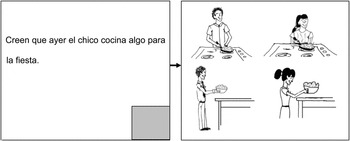
Eye-tracking tasks.Participants completed the eye-tracking task with an EyeLink 1000 machine from SR Research (sampling rate: 1,000 Hz; spatial resolution: .32° horizontal, .25° vertical; averaged calibration error: .01°). Participants looked at a black dot—located where the sentence would begin—to ensure calibration, read a two-line sentence at their own pace, fixated on a grey box in the lower right corner of the screen when ready, and then looked at four pictures and clicked on the one that best corresponded to the sentence they just read (see Figure 1).
Sample trial in the eye-tracking task.

There were 85 sentences in Spanish (L2 learners, Spanish monolinguals), English (English monolinguals), or Romanian (Romanian monolinguals): 5 practice, 32 experimental (8 per condition; for a complete list of the experimental sentences, please refer to the appendix), and 48 fillers. Participants were randomly assigned to one of four sets. All sentences (experimental and fillers) were 10–13 words long, contained vocabulary and grammar adequate for beginning L2 Spanish, and had 2- to 3-syllable regular, transitive verbs typical of beginning L2 courses that were not cognates in English, Spanish, or Romanian. Apart from the verbs, 80–100% of the words forming each sentence (experimental or filler) were noncognates in any of the three languages to reduce possible lexical priming effects. Also, a given noun or verb was not repeated more than twice in the entire experiment. A Latin square design divided the sentences into blocks (each block containing fillers and only one sentence of a given condition), and the sentences within each block were pseudorandomized. This procedure minimized the possibility that two experimental sentences of the same condition would appear next to each other. The experimental sentences followed the same syntactic structure and never had an adverb or a verb at the beginning or at the end of the sentence, to avoid potential prelinguistic processing and spillover effects. Half of the experimental sentences had the present-marking adverb now and half had past-marking adverbs—of which half were single-word adverbs (in Spanish) like yesterday and half had multiple-word adverbs like last week. We used short and long adverbs to control for potential length effects that would make one cue more salient than the other. Thus, some of our sentences had shorter adverbs with longer verbs, and others had longer adverbs with shorter verbs. Examples of the four experimental conditions include (where // indicates the break onto the next line) the following:
-
(1) Adverb-verb congruent:
Creen que ayer el chico cocinó algo para//la fiesta
“They believe that yesterday the boy cooked something for//the party”
-
(2) Adverb-verb incongruent:
Creen que ayer el chico cocina algo para//la fiesta
“They believe that yesterday the boy cooks something for//the party”
-
(3) Verb-adverb congruent:
Creen que el chico cocin ó algo ayer para//la fiesta
“They believe that the boy cooked something yesterday for//the party”
-
(4) Verb-adverb incongruent:
Creen que el chico cocina algo ayer para//la fiesta
“They believe that the boy cooks something yesterday for//the party”
We measured early processing with first pass (or gaze) duration (i.e., time spent in the interest region before moving on or looking back) and late processing with second pass duration (i.e., duration of all refixations); total duration was not calculated, to tease apart early from late processing mechanisms. After each sentence, participants completed a comprehension task with four pictures (see Figure 1): [+/− grammatically congruent, +/− semantically congruent]. One-third of the semantic changes affected the subject (like in Figure 1), one-third the verb, and one-third the object.
RESULTS AND DISCUSSION
In this section, we present the results and discussion of the eye-tracking data, which generated two data sets: sentence reading data and picture accuracy data (picture viewing data reported elsewhere). For both data sets, generalized linear mixed model (GLMM) analyses were carried out, with sensitivity, cue location in the sentence, L1 (and proficiency for L2 learners), and all their possible interactions as fixed factors and with subject as a random factor. We used a conservative approach to build the GLMM analyses: We selected (a) the Satterthwaite approximation for df (useful to handle smaller sample sizes, potential unbalanced data, and complicated covariance types), and (b) the robust estimation for the test of fixed effects and coefficients (useful to handle potential violations of model assumptions). Finally, all pairwise comparisons were calculated using Bonferroni post hoc tests.
Picture Accuracy Data
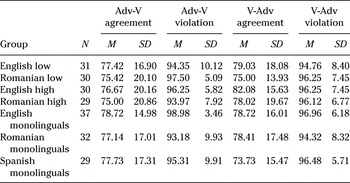
The picture accuracy score was based on 1 point per correct picture in correct sentences and 1 point per one of the two semantically congruent pictures in incorrect sentences.Footnote 4 The descriptive statistics shown in Table 1 indicate that participants were accurate on at least 75% of the trials.
Accuracy on picture selection reported in percentages

Note.
Adv = adverb; V = verb; mean percentages (k = 8 per condition).
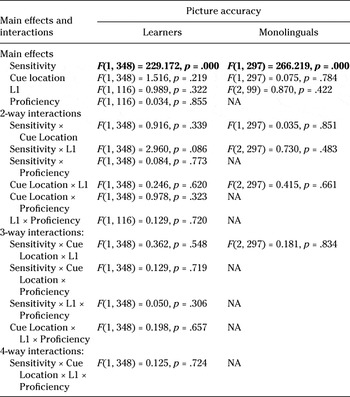
A 2(Sensitivity) × 2(Cue Location) × 2(L1) × 2(Proficiency) GLMM and a 2(Sensitivity) × 2(Cue Location) × 3(L1) GLMM were conducted for both the learners and the monolinguals, respectively. The GLMMs showed an effect for sensitivity in the learners. Post hoc tests showed that participants were more accurate in incorrect than correct sentences because for correct sentences there was a single correct answer, whereas for incorrect ones there were two—namely, the picture that corresponded to the tense of the adverb and the one that corresponded to the tense of the verb. Table 2 summarizes main effects and interactions.
Summary of Significant Main Effects and Interactions for the Picture Accuracy Data

Note.
Significant effects are indicated in bold. NA = not applicable (i.e., proficiency does not apply to monolingual groups)
Sentence Reading Data
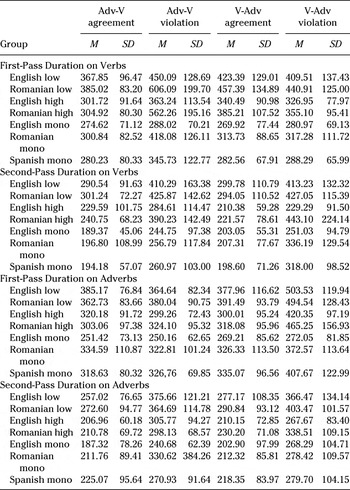
Fixations below 120 ms were excluded following previous research and standard procedure in numerous psycholinguistic studies (e.g., Rayner & Pollatsek, Reference Rayner and Pollatsek1989). Sentences without at least one 120 ms fixation on both the adverb and the verb were excluded to make sure participants had clearly processed the two. For multiple-word adverbs, the 120 ms fixation had to occur on the word that indicated past tense (e.g., on pasado “last” in el mes pasado “last month”), but the mean reading times (RTs) on multiple-word adverbs included all words. The mean RTs analyzed were first pass duration (i.e., early processing) and second pass duration (i.e., late processing); see the Methods section for a definition of these terms. Descriptive statistics are shown in Table 3.
Mean reading times at target words

Note.
Adv = adverb; V = verb; mean percentages (k = 8 per condition). See Table 2 for n values.
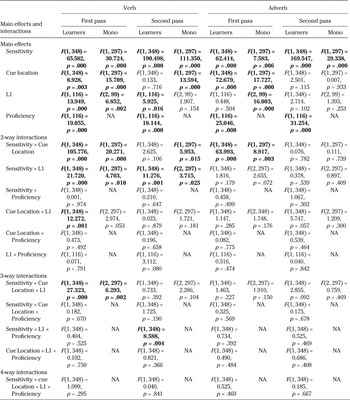
Eight GLMMs were carried out: four 2 × 2 × 2 × 2 GLMMs for L2 learners (i.e., first pass duration on verbs, second pass duration on verbs, first pass duration on adverbs, second pass duration on adverbs) and four 2 × 2 × 3 GLMMs for the monolingual groups. Table 4 summarizes main effects and interactions. Due to space limitations, data are organized by research question, and results and discussion are presented together.
Summary of Significant Main Effects and Interactions for the Sentence Reading Data

Note.
Significant effects are indicated in bold. Mono = monolinguals; NA = not applicable (i.e., proficiency does not apply to control groups)
Research Question 1: Sensitivity Effects
The first research question examined whether the participants were sensitive to adverb-verb and verb-adverb incongruencies, and the results show that all participants were sensitive. These findings are in line with previous studies that have shown that, unlike beginning learners, low-proficiency learners are sensitive to verbal and nominal discord (e.g., Sagarra, Reference Sagarra and Han2008; Sagarra & Herschensohn, Reference Sagarra and Herschensohn2010). Additionally, high-proficiency Romanian learners and Romanian monolinguals relied on verbs to resolve such incongruencies, similar to the findings in Ellis and Sagarra (Reference Ellis and Sagarra2010b), but all participants relied on adverbs in the same way.
First Pass Duration on Verbs
There was a significant main effect for Sensitivity and a significant interaction of Sensitivity × Cue Location, Sensitivity × L1, and Sensitivity × Cue Location × L1: All participants except the English monolinguals looked longer at verbs in *adverb-verb than adverb-verb sentences (all p < .01). These results support our prediction that morphologically rich L1 learners and monolinguals would rely on the verb to resolve adverb-verb incongruencies. The unexpected finding that English learners behaved like Romanian learners is associated with L2 proficiency: Our higher proficiency learners belonged to a higher proficiency level than those of Ellis and Sagarra (Reference Ellis and Sagarra2010b) and had already learned to rely on verbal cues. The fact that the English monolinguals do not show this effect corroborates our explanation.
Second Pass Duration on Verbs
There was a significant main effect for sensitivity for all participants: Everybody regressed longer to verbs in incorrect than correct sentences regardless of verb location (all p < .01, and p < .05 for English monolinguals in verb-adverb sentences). Additionally, for L2 learners, there was a significant interaction of Sensitivity × L1 and Sensitivity × Proficiency: Romanian advanced learners regressed longer to verbs in incorrect sentences than English advanced learners (p < .01), but the interaction was not significant for correct sentences. As for the monolingual groups, significant interactions of Sensitivity × Cue Location and Sensitivity × L1 were obtained: Romanian and Spanish monolinguals regressed longer to verbs in *verb-adverb incongruent than verb-adverb congruent sentences (all p < .01). These findings support our prediction that native speakers of morphologically rich languages would regress longer to verbs than native speakers of morphologically poor languages. There were no L1 differences in the low-proficiency learners because their proficiency was lower than that of high-proficiency learners. Therefore, the effect of taking longer to process verbs in *adverb-verb than adverb-verb sentences occurs at intermediate levels regardless of the learners’ L1, whereas taking longer to regress to verbs in *verb-adverb than verb-adverb sentences occurs at high-proficiency levels and only in morphologically rich L1 learners.
First Pass Duration on Adverbs
There was a significant main effect for sensitivity and a significant interaction of Sensitivity × Cue Location: All participants looked longer at adverbs in *verb-adverb than verb-adverb sentences (all p < .01). Thus, our prediction that only morphologically poor L1 participants would do this was not supported (see next paragraph for an explanation).
Second Pass Duration on Adverbs
There was a significant main effect for sensitivity: All participants regressed longer to adverbs in incorrect than correct sentences regardless of adverb location (all p < .01, and p < .05 for English low proficiency in verb-adverb sentences). Like with first pass duration on adverbs, our prediction that only morphologically poor L1 participants would regress longer to adverbs in *verb-adverb than verb-adverb sentences was not supported. Consequently, why were significant interactions of Sensitivity × L1 and Sensitivity × Proficiency found in verb but not adverb viewing times? These findings could be due to the fact that (a) lexical cues are more salient—and thus easier to learn—than morphological cues, and (b) lexical cues are present in Romanian, Spanish, and English, whereas a rich morphological system is only present in Romanian and Spanish.
Research Question 2: Cue Location Effects
The second research question explored whether or not cue location modulates the processing of temporal adverbs and verbal inflections. The findings revealed that participants spent more time at their preferred cue, regardless of its location. Although all participants used the first cue to determine when the second one was incongruent (i.e., everyone looked longer at verbs and adverbs in second rather than first position in incongruent sentences), the learners also took longer to process verbs as a second cue in correct sentences because Spanish is not their L1, and, as such, they needed more time to check that the two cues agreed with each other (i.e., the learners are more lexical than the Spanish monolinguals). Additionally, Romanian and Spanish monolinguals regressed longer to verbs (a) in *verb-adverb than *adverb-verb sentences, in general, and (b) in *verb-adverb sentences as specifically compared to English monolinguals.
First Pass Duration on Verbs
There was a significant main effect for cue location: Apart from the obvious finding that all participants looked longer at verbs in second than first position in incorrect sentences because they realize that the second temporal cue is incongruent with the first one, learners also looked longer at verbs in second rather than first position in correct sentences (adverb-verb > verb-adverb) because they are processing a nonnative language and need additional time to check whether the second cue agrees with the first one. As for interactions, there was a significant interaction of Sensitivity × Cue Location: All participants except the English monolinguals looked longer at verbs in *adverb-verb than adverb-verb sentences. These results were expected for morphologically rich L1 learners and monolinguals. The unexpected findings for morphologically poor L1 learners were due to our learners being more proficient, and thus more morphologically tuned, than Ellis and Sagarra’s (Reference Ellis and Sagarra2010b) learners. The fact that these results are not obtained in the most lexically biased group (i.e., the English monolinguals) corroborates our explanation. Finally, there was a significant interaction of Cue Location × L1 (learners only) and Sensitivity × Cue Location × L1: Romanian learners looked longer at verbs in *adverb-verb sentences than English learners.Footnote 5
Second Pass Duration on Verbs
There was a significant main effect for cue location (monolinguals only) and a significant interaction of Sensitivity × Cue Location (monolinguals only): Romanian and Spanish monolinguals regressed longer at verbs in *verb-adverb than *adverb-verb sentences, and regressed longer in *verb-adverb sentences than English monolinguals (all p < .05), in line with our predictions. As expected, cue location was irrelevant with regard to the way learners regressed to verbs.
First Pass Duration on Adverbs
There was a significant main effect for cue location and a significant interaction of Sensitivity × Cue Location: All participants looked longer at adverbs in *verb-adverb than verb-adverb sentences (Sensitivity × Cue Location)—we only predicted this effect in English native speakers; see the first research question for an explanation—and in *verb-adverb than *adverb-verb sentences (main effect for cue location), which is in line with our prediction that all participants would look longer at adverbs in second rather than first position in incorrect sentences (all p < .01). In contrast with the results for first pass duration on verbs, in which learners also looked longer at verbs in second rather than first position in correct sentences, cue location did not play a role for first pass duration on adverbs for correct sentences.
Second Pass Duration on Adverbs
Contrary to our prediction, cue location did not have a significant main effect on second pass duration times on adverbs for any group. This could be related to the differences between processing verbs and adverbs discussed in Research Question 1. However, there was a significant interaction of Cue Location × L1 in the learners: Romanian learners regressed longer to adverbs in second than first position for both correct and incorrect sentences (i.e., *verb-adverb > *adverb-verb; verb-adverb > adverb-verb: all p < .01). We explain these findings in the next section.
Research Question 3: L1 Experience Effects (Transfer)
The third research question investigated whether previous L1 experience influences the learning of L2 lexical and morphological cues for tense. Our prediction that learners’ experience with the L1 would affect the acquisition of later experienced L2 cues following associative learning theories was supported for verb but not adverb times. For verb times, L1 learners and monolinguals of morphologically rich languages looked longer at verbs in *adverb-verb sentences than L1 learners and monolinguals of morphologically impoverished languages. Romanian learners looked longer at verbs in adverb-verb sentences than English learners, and Romanian advanced learners regressed longer to verbs in all incorrect sentences than English advanced learners. These L1 effects are in line with the findings obtained in previous studies with miniature languages and complete natural languages (e.g., Ellis et al., Reference Ellis, Hafeez, Martin, Chen, Boland and Sagarra2012; Ellis & Sagarra, Reference Ellis and Sagarra2010a, Reference Ellis and Sagarra2010b). Contrary to our expectations, there were no L1 effects for adverb times for any group. The only exception—Romanian and Spanish monolinguals looked longer at adverbs than English monolinguals—was due to differences in adverb length (see a more detailed discussion in the subsection First Pass Duration on Verbs that follows). As mentioned earlier, verbs differ from adverbs in that adverbs are more salient than verbs and that adverbs are present in the three languages under investigation, whereas a rich morphological system only applies to Romanian and Spanish.
First Pass Duration on Verbs
There was a significant main effect for L1 (all participants) and a significant interaction of Sensitivity × L1 (all participants), Cue Location × L1 (learners only), and Sensitivity × Cue Location × L1 (all participants). In line with our prediction, Romanian native speakers looked longer at verbs in *adverb-verb sentences than English native speakers (Romanian low proficiency > English low proficiency; Romanian high proficiency > English high proficiency; Romanian monolinguals > English monolinguals). Additionally, Romanian and Spanish monolinguals, but not English monolinguals, looked longer at verbs in *adverb-verb than adverb-verb sentences. These L1 differences cannot be due to lexical differences (i.e., verbs are shorter in English than in Romanian) because this difference is absent in the rest of the conditions. Therefore, these findings indicate that when native speakers of a morphologically rich language encountered an incorrect sentence with the verb following the adverb, they took longer to process the verb (their preferred cue), and they took longer to process the verb than native speakers of a morphologically poor language.
Second Pass Duration on Verbs
The learner data showed a significant main effect for L1 and a significant interaction of Sensitivity × L1 and Sensitivity × L1 × Proficiency: Romanian advanced learners regressed longer to verbs in incorrect sentences than English advanced learners (p < .05 for *adverb-verb; p < .01 for *verb-adverb). These findings show that Romanian learners regressed longer to verbs, their preferred cue, than English learners. Similarly, the monolingual data revealed a significant interaction of Sensitivity × L1: Romanian and Spanish monolinguals regressed longer to verbs in *verb-adverb than verb-adverb sentences, and Romanian and Spanish monolinguals regressed longer to verbs than English monolinguals. These data support our expectation to find L1 effects.
First Pass Duration on Adverbs
Our hypothesis that there would be L1 effects was not supported. The only exception—Romanians’ and Spaniards’ longer first pass duration on adverbs than that of Anglophones (all p < .01, and p < .05 in Spanish vs. English monolinguals for adverb-verb sentences)—was possibly caused by the fact that English adverbs are shorter than their Romanian and Spanish counterparts (i.e., compare last week with săptămâna trecută and la semana pasada). The fact that this difference was obtained in all conditions corroborates our interpretation of the findings.
Second Pass Duration on Adverbs Contrary to our prediction, there were no L1 effects. Refer to the first research question for an explanation of differences between verb and adverb data.
Research Question 4: L2 Experience Effects (L2 proficiency; Learners Only)
The last research question examined whether more or less experience with L2 cues affects later learned cues. Our hypothesis that we would find differences between low- and high-proficiency learners was confirmed. However, the differences were due to the logical trend for lower proficiency learners to read more slowly and to regress longer. Comparing these results (for low- and high-proficiency learners) to the findings of Ellis and Sagarra (Reference Ellis and Sagarra2010b; for beginners and intermediates), we conclude that L2 proficiency effects on cue reliance are only evident when contrasting beginners with intermediate or advanced learners.
First Pass Duration on Verbs
There was a significant main effect for proficiency: English and Romanian low-proficiency learners looked longer at verbs in adverb-verb, verb-adverb, and *verb-adverb sentences than English and Romanian high-proficiency learners, respectively (all p < .01, p < .05 for *verb-adverb sentences in the case of the English and Romanian learners, and p = .078 in verb-adverb sentences in the case of the Romanian learners). However, this proficiency effect was simply caused by low-proficiency learners reading more slowly than high-proficiency learners. Low- and high-proficiency learners were similar in *adverb-verb sentences due to a combination of two effects: the low-proficiency learners’ being slower than the high-proficiency learners on the one hand, and the high-proficiency learners’ being more sensitive to adverb-verb incongruencies on the other.
Second Pass Duration on Verbs
There was a significant main effect for proficiency: In correct sentences, English and Romanian low-proficiency learners regressed longer to verbs than English and Romanian high-proficiency learners, respectively (all p < .05, and p < .01 for English learners in verb-adverb sentences). There was also a significant interaction of Sensitivity × L1 × Proficiency: In incorrect sentences, Romanian high-proficiency learners regressed longer to verbs than English high-proficiency learners (p < .05 for *adverb-verb; p < .01 for *verb-adverb). Taking these results together, we conclude that lower proficiency learners need to regress more than higher proficiency learners, and that L1 differences are evident once a high-proficiency level is reached.
First Pass Duration on Adverbs
There was a significant main effect for proficiency: English and Romanian low-proficiency learners looked longer at adverbs in correct sentences than English and Romanian high-proficiency learners, respectively (all p < .05). Again, lower proficiency learners tended to regress more to adverbs than higher proficiency learners, regardless of whether or not sentences were correct. This effect was not found in incorrect sentences, due to low-proficiency Romanian learners’ tendency to regress more and high-proficiency Romanian learners’ higher sensitivity to tense violations.
Second Pass Duration on Adverbs
There was a significant main effect for proficiency: Low-proficiency learners regressed longer to adverbs than high-proficiency learners (all p < .05, except in *verb-adverb sentences for all learners) because of their lower-proficiency level.
CONCLUSION
In this study, we examined L1 and L2 experience effects in adult acquisition of lexical and morphological cues for temporal reference in L2 Spanish. Native speakers of a language with either rich or poor morphology read sentences with adverb-verb and verb-adverb tense congruencies or incongruencies and chose one of four pictures after each sentence, half of which represented a present action and half a past action, and half of which were semantically congruent and half semantically incongruent. First and second pass duration times from eye-tracking reading data revealed these findings:
-
1. Sensitivity effects: All participants were sensitive to incongruencies.
-
2. Cue location effects: Participants regressed to the preferred cue regardless of its position. The only exception (i.e., Romanian and Spanish monolinguals regressed longer to verbs that preceded rather than followed adverbs in incorrect sentences) was due to processing incongruencies of native speakers of morphologically rich L1s, who simply took longer to process the verb.
-
3. First language effects (i.e., transfer): L1 effects were present on verbs but not on adverbs. For verbs, Romanian learners and monolinguals and Spanish learners and monolinguals looked longer at verbs (their preferred cue) in *adverb-verb (first pass duration for learners and monolinguals), adverb-verb (first pass duration for learners), and *verb-adverb (second pass duration for advanced learners) sentences than English learners and monolinguals. No L1 effects were obtained for adverbs because (a) they are more salient and (b) they are present in the three L1s of the study, whereas a rich morphological system is not.
-
4. Second language effects (i.e., proficiency): When comparing low- and high-proficiency learners, proficiency differences were only related to the logical trend for low-proficiency learners to read more slowly and regress longer than high-proficiency learners.
In conclusion, this study of learned attention effects in adult L2 learners confirms that earlier experience with the L1 affects later processing of lexical and morphological cues to temporal reference at high- but not low-proficiency levels. These findings are in line with scholars who advocate transfer effects (e.g., Carroll, Reference Carroll2001; Ellis, Reference Ellis, VanPatten and Williams2006; Frenck-Mestre, Reference Frenck-Mestre2005; Hopp, Reference Hopp2007; Juffs, Reference Juffs2005; MacWhinney Reference MacWhinney, Kroll and de Groot2005, Reference MacWhinney, Gass and Mackey2011; Schwartz, Reference Schwartz1987; Tokowicz & MacWhinney, Reference Tokowicz and MacWhinney2005). It is important to note that the results of this study are not contrary to Clahsen and Felser’s (Reference Clahsen and Felser2006a, Reference Clahsen and Felser2006b) shallow structure hypothesis because we investigated morphological agreement, and his claims against transfer only apply to syntactic agreement.
LIMITATIONS AND FUTURE RESEARCH
The present study informs us about how language experience with the L1 and the L2 affect the processing of morphological cues accompanied by temporal adverbs but cannot speak to the processing of morphological cues that are nonredundant or to those that agree with other types of lexical cues. To address this limitation, data with subject-verb agreement that allow for the presence or absence of an explicit subject in Spanish have been collected. Furthermore, the results of the present study are restricted to the written mode. Although prosody is present during reading comprehension (e.g., Kitagawa & Fodor, Reference Kitagawa, Fodor, Fanselow, Féry, Schlesewsky and Vogel2006), it will be important to see whether the results of a reading eye-tracking task will also apply to a listening eye-tracking task (data analysis in progress). Because input mode influences the processing of morphological cues (Leeser, Reference Leeser2004; Wong, Reference Wong2001), humans rely on features such as prosody to understand language (Fodor, Reference Fodor1998; Pynte & Colonna, Reference Pynte, Colonna, Kennedy, Radach, Heller and Pynte2002) and extract rules (De Diego Balaguer & López-Barroso, Reference De Diego Balaguer and López-Barroso2010; Peña, Bonatti, Nespor, & Mehler, Reference Peña, Bonatti, Nespor and Mehler2002), and participants cannot relisten to previously processed information. Finally, even if there is mounting evidence that beginning learners are more lexically dependent than more proficient learners (e.g., Bardovi-Harlig, Reference Bardovi-Harlig2000; Ellis & Sagarra, Reference Ellis and Sagarra2010b; Lee, Reference Lee2002; Leeser, Reference Leeser2004; Rossomondo, Reference Rossomondo2003), we seem to ignore why this is so. One possibility is that working memory constraints are more obvious at early stages of acquisition when L2 knowledge is minimal. The results of a working memory test together with the findings of a group of Spanish native speakers who completed the eye-tracking tasks under capacity-demanding conditions (e.g., listen to four digits before reading or listening to the sentence and recall them orally after selecting one of the four pictures) will shed light on this topic (data analysis in progress).
APPENDIX EXPERIMENTAL SENTENCES
Cuentan que ayer la niña preguntó/pregunta la hora en la clase.
Cuentan que la niña preguntó/pregunta la hora ayer en la clase.
Anuncian que la semana pasada el jefe firmó/firma la carta en la oficina.
Anuncian que el jefe firmó/firma la carta la semana pasada en la oficina.
Dicen que anoche el maestro compartió/comparte las respuestas con sus alumnos.
Dicen que el maestro compartió/comparte las respuestas anoche con sus alumnos.
Cuentan que la semana pasada el chico facturó/factura maletas con unas drogas.
Cuentan que el chico facturó/factura maletas la semana pasada con unas drogas.
Piensan que ahora el gerente escala/escaló la montaña con su hermano.
Piensan que el gerente escala/escaló la montaña ahora con su hermano.
Descubren que ahora el chico escucha/escuchó conversaciones de la jefa.
Descubren que el chico escucha/escuchó conversaciones ahora de la jefa.
Cuentan que ahora la abuela lleva/llevó un paraguas en la calle.
Cuentan que la abuela lleva/llevó un paraguas ahora en la calle.
Cuentan que ahora el nieto dibuja/dibujó un pájaro para su hermana.
Cuentan que el nieto dibuja/dibujó un pájaro ahora para su hermana.
Dicen que el mes pasado el chico cocinó/cocina una tortilla para la fiesta.
Dicen que el chico cocinó/cocina una tortilla el mes pasado para la fiesta.
Avisan que el año pasado la empleada imprimió/imprime todo en papel caro.
Avisan que la empleada imprimió/imprime todo el año pasado en papel caro.
Dicen que el mes pasado el chico adivinó/adivina la respuesta con sus amigos.
Dicen que el chico adivinó/adivina la respuesta el mes pasado con sus amigos.
Explican que anteayer el cocinero gritó/grita la receta a un camarero.
Explican que el cocinero gritó/grita la receta anteayer a camarero.
Creen que ahora el hombre guarda/guardó el dinero en la cama.
Creen que el hombre guarda/guardó el dinero ahora en la cama.
Comentan que ahora el tío limpia/limpió el coche en la calle.
Comentan que el tío limpia/limpió el coche ahora en la calle.
Piensan que ahora el novio graba/grabó la canción con la grabadora.
Piensan que el novio graba/grabó la canción ahora con la grabadora.
Piensan que ahora el chico investiga/investigó el secuestro con la policía.
Piensan que el chico investiga/investigó el secuestro ahora con la policía.
Comentan que anteayer el muchacho saltó/salta a la cuerda en el gimnasio.
Comentan que el muchacho saltó/salta a la cuerda anteayer en el gimnasio.
Descubren que ayer el ladrón cambió/cambia el dinero en una tienda.
Descubren que el ladrón cambió/cambia el dinero ayer en una tienda.
Creen que anoche el abuelo recogió/recoge el regalo para la fiesta.
Creen que el abuelo recogió/recoge el regalo anoche para la fiesta.
Creen que la semana pasada el chico esperó/espera el metro en la estación.
Creen que el chico esperó/espera el metro la semana pasada en la estación.
Explican que ahora el hombre llena/llenó el coche con gasolina diesel.
Explican que el hombre llena/llenó el coche ahora con gasolina diesel.
Avisan que ahora la compañía manda/mandó las cartas por correo normal.
Avisan que la compañía manda/mandó las cartas ahora por correo normal.
Avisan que ahora el cirujano necesita/necesitó tijeras para la operación.
Avisan que el cirujano necesita/necesitó tijeras ahora para la operación.
Avisan que ahora el bombero apaga/apagó el fuego de la iglesia.
Avisan que el bombero apaga/apagó el fuego ahora de la iglesia.
Dicen que el año pasado el jefe mejoró/mejora las condiciones de la oficina.
Dicen que el jefe mejoró/mejora las condiciones el año pasado de la oficina.
Descubren que anoche la esposa gastó/gasta dinero en zapatos caros.
Descubren que la esposa gastó/gasta dinero anoche en zapatos caros.
Dicen que el mes pasado el jefe recibió/recibe el contrato en el correo.
Dicen que el jefe recibió/recibe el contrato el mes pasado en el correo.
Comentan que anteayer el hijo cepilló/cepilla al perro en el comedor.
Comentan que el hijo cepilló/cepilla al perro anteayer en el comedor.
Anuncian que ahora el gerente cancela/canceló el vuelo por mal tiempo.
Anuncian que el gerente cancela/canceló el vuelo ahora por mal tiempo.
Dicen que ahora el primo corta/cortó el pelo en su piso.
Dicen que el primo corta/cortó el pelo ahora en su piso.
Explican que ahora la hija aprende/aprendió idiomas con sus amigas.
Explican que la hija aprende/aprendió idiomas ahora con sus amigas.
Cuentan que ahora la abuela barre/barrió el suelo con la nieta.
Cuentan que la abuela barre/barrió el suelo ahora con la nieta.