I am honored by the care that Drs Gill, Bell, and Lyons have taken in reading and responding to my article “What We Talk About When We Talk About Provenance.” I am also grateful to Alexander Bauer, the editor of this journal, for the idea of inviting them to comment upon it. Many of their observations have made me want to go back and revise the original text, but I will instead acknowledge and reflect here upon those places where they have prompted me either to clarify my arguments or to change my mind. Later in this article, I will use the recent exhibition, Pergamon and the Hellenistic Kingdoms of the Ancient World, which was on view at the Metropolitan Museum of Art (MMA) in the spring and summer of 2016, as a fresh source of evidence and examples.
Footnote 1
David Gill helpfully sets his and Christopher Chippindale’s Reference Chippindale and Gill2000 article in the larger context of their professional activity, both before and after its publication.
Footnote 2
When I express concern that their approach will not change attitudes, I am referring only to the provenance scale they developed for the 2000 article, not to their entire scholarly output. On the contrary; I am sure I was not the only student of ancient material culture whose eyes were first opened by their 1993 article on collecting Cycladica to the intellectual consequences of the antiquities trade. At both the macro level (raising awareness and changing attitudes) and the micro (for example, tracking down the ownership history of looted objects like the Methyse krater in Minneapolis), the profound and positive impact of their work can scarcely be overstated. I acknowledge the paradox that it should happen to have been a study by these very scholars that prompted the targeted criticism of my article. “What We Talk About When We Talk About Provenance” focuses on this particular article because the instrument at its core—the provenance scale—lays bare a set of disciplinary conventions that are rarely articulated so explicitly and are, in my view, problematic in interesting ways. This does not change the larger fact that in seeking to raise awareness of those conventions’ harmful intellectual consequences, I am standing on Chippindale and Gill’s figurative shoulders.
Gill restates and expands on several points I make in my article, such as the value of knowing who alleged that a given work came from a particular place. I am pleased (and not surprised) that he and I are in agreement about this point. The fact remains that this criterion was not factored into his much-cited 2000 provenance analysis. Instead, the scale left unchallenged the premise that the adverbs qualifying secondhand reports of find-spots constitute meaningful information, gradable from p2 to p4, and that the identity of the sources does not. The aim of “What We Talk About …” was to challenge these premises, among others.
Malcolm Bell defends Chippindale and Gill’s scale as “a useful and effective investigative tool” for the purposes of their article, as distinct from my concern with “epistemological issue(s).” He thereby suggests a sort of apples-and-oranges mismatch between their intentions and the evaluative standards I apply. But this begs the question: what “investigative tool” is innocent of epistemology? By design, diagnostic scales privilege particular ways of knowing, eliminating background “noise” to give a clear measure of a chosen criterion. Historians and social scientists like Hayden White, Thomas Kuhn, and Michel Foucault have been telling us for close to two generations now that the questions we ask predetermine our interpretations. Critical review of any kind not only demands examination of what an author consciously intended, but it also requires excavation of the values and assumptions left implicit, unstated, and unconscious because they are so deeply ingrained and “naturalized” in the field or culture. It is only by reading against the grain that we are ever able to break out of dominant paradigms. Chippindale and Gill’s Reference Chippindale and Gill2000 provenance scale, in other words, can be both a useful instrument to measure the thing it set out to measure and a reflection of disciplinary norms in need of critical re-evaluation.
Claire Lyons argues that the high percentage of ungrounded works in the exhibits I analyze in Appendix B reflects the fact that two of them showcased private collections, whereas the numbers in the Augustus show are more encouraging because it drew upon “the great European public collections.” It is certainly true that there are more grounded classical objects in European national collections than there are in North American, Asian, or African national collections or in private collections anywhere in the world. As discussed recently in the MMA’s Pergamon exhibit, this reflects nineteenth-century and early twentieth-century practices of colonialism and partage. But an abundance of grounded options does not necessarily mean that grounded objects will predominate in a given exhibition. Only three of the seven items borrowed from the great European public collection at the British Museum for the Pergamon show are grounded, as are only three of the nine from the Louvre, for example. The preference for ungrounded works is due, I believe, to art history’s unquenchable love for the polished and the whole or, alternatively, for the expressive fragment (rather than the merely broken fragment). Objects that have passed through the art market gleam with a particular patina that the battered works recovered from archaeological excavations can rarely compete with.
Lyons also suggests that exhibitions that focus on a particular site rather than a particular private collection will include more grounded objects. The MMA’s show on the site of Pergamon does not support this claim, however. While the core of the exhibit comprised 60 sculptures that went directly from the ground of Pergamon to the Pergamon Museum in Berlin in the nineteeth and early twentieth centuries, the show as a whole barely made the cut: only 145 of 281 total objects (excluding coins and counting each individual piece from groups or ensembles) are grounded (or 51 percent). In other words, only 38 percent of the objects chosen to supplement the core material from Berlin are grounded (85 of 221). Of course, this has much to do with the show’s North American venue and the sourcing for additional loans primarily from other US collections, where grounded classical objects are rare. That said, it is worth underscoring that it was a choice to turn to the Getty, the Boston Museum of Fine Arts, the Cleveland Museum of Art, the Princeton University Art Museum, and the Walters Art Museum to fill out the show’s cases. A very different, more socially complex story of the Hellenistic world could have been told perhaps had the MMA’s curators considered the options at the Penn Museum or the University of Michigan’s Kelsey Museum, the majority of which have rich archaeological histories. Or, indeed, if the curators had stuck to the grounded objects at the British Museum and the Louvre. As far as the comparanda go, those featured in the catalogue entries of the Pergamon exhibit are grounded 49 percent of the time, a number that suggests little change from the norm that prevailed in the 1990s (see Appendix A, where the average for the seven exhibits was 43 percent).
David Gill doubts my suggestion that museums may be entering a new era of candor regarding their collecting histories. His skepticism is not unfounded. My optimism was fanned in part by Fordham University’s unusual, frank discussion of the ethical complexities surrounding the Walsh bequest. Gill bases his doubts in part on the serious problems with particular items in the Walsh collection and on Fordham’s more recent acquisition of ungrounded early Christian mosaics, whose inscriptions point to Syrian origins. That some portion of the objects in the Walsh collection was looted, however, is neither a surprise nor a reason to tone down the praise for the catalogue’s self-reflexive language. As Claire Lyons notes, major American collectors in the 1980s and 1990s were all swimming in the same sea, buying from the same dealers, who sourced their wares through the same networks of middlemen and tombaroli. This is not to excuse the behavior; my point is simply that compared to the catalogues that were eventually published of, say, the Fleischman or Levy–White collections, the Walsh catalogue alone acknowledges the dilemma that these private collections now present for museums.
Gill is right, however, that Fordham’s handling of the mosaics bequest (from a donor who insists upon anonymity) suggests far less understanding of, and openness about, the material, intellectual, and ethical complexities of ungrounded antiquities. The initial January 2014 press release said nothing about provenance or ethics, and it quoted Fordham professor Michael Peppard, who declared that the mosaics offer “everything you want as a historian,” despite the complete loss of information about their ancient setting!
Footnote 3
Following an outcry on social media and on the Chasing Aphrodite and Looting Matters blogs, an editor’s note was appended to the press release assuring readers that the gift was accepted only after a “thorough provenance review.” Some of the ownership history has since been presented in an article on the mosaics’ inscriptions by Michael Peppard.
Footnote 4
But a promised, complete account of their modern history by museum curator Jennifer Udell has yet to appear, and multiple requests for provenance documents by Jason Felch to the Fordham University spokesman in January 2016 went unanswered.
Footnote 5
For those looking for signs of increasing museum transparency, the Pergamon catalogue offers little to cheer. One would never know from the lengthy entry on the Morgantina silver, for example, that these 16 objects are still partially owned by the museum (the MMA and the Aidone archaeological authority now have joint custody, but the collection line of the tombstone states simply “Museo Regionale di Aidone”) or, indeed, that they were ever in the MMA’s collection at all (noticeably absent from the entry citations is the 1984 publication of the silver by the MMA curator Dietrich von Bothmer); let alone that the wrangling over their ownership was one of the more inflammatory episodes in the recent debates about looted antiquities (Catalogue no. 178).
Footnote 6
And there could hardly be a better illustration of the slipperiness of the “said to be” label than the provenance information in this entry: “Said to be from Morgantina, House of Eupolemos.” In this case, the source of the report was most decidedly not a vendor or middleman. Rather, it was, first, the archaeologist in charge of the looted site (Malcolm Bell), then the cultural patrimony officials of the source country, and, eventually, the MMA itself, which ultimately found the evidence of looting (including the very holes where the tombaroli claimed to have found the pieces) impossible to ignore. It is hard not to see a degree of cynicism in this unconventional use of the “said to be” qualifier, as if the MMA were defiantly stamping its foot and declaring “we still don’t believe you!”
In fact, the only acknowledgement of the intellectual, legal, or ethical complexities of collecting antiquities that I could find anywhere in the Pergamon show’s weighty catalogue appeared in a single footnote to a brief entry on a relatively minor object: a small, white-painted terracotta vessel, which was apparently “confiscated in Piraeus” (Catalogue no. 92). No further information about the circumstances of the confiscation is provided. The exhibition also included a breathtaking quantity of Hellenistic gold jewelry, lent from Munich, the Getty, the Benaki Museum in Athens, the Walters, Princeton, the Boston Museum of Fine Art, and from the MMA’s own holdings. This would have been an excellent moment to closely scrutinize the collecting histories of these spectacular and remarkably similar objects, which surfaced on the market at various moments in the twentieth century with a variety of “said to be” provenances (sometimes more than one per object). One wonders whether the opportunity to dig deep into their ownership histories was passed over because at least some of the lenders preferred blissful ignorance. (It is perhaps not irrelevant here that in 1990 the Getty’s jewelry passed through the hands of the disgraced London dealer Robin Syme, whose role in many of the Fleischmans’ and the Getty’s antiquities acquisitions triggered a number of returns.)
Some objects in the Pergamon show also lend support to Gill’s and Lyons’s important critique of my argument, namely that the distinction I posit between grounded and ungrounded objects is too black and white. The limitations of the binary are readily exposed by an object like the 10-layered sardonyx cameo in Vienna featuring parallel portraits of a Ptolemaic king and queen (Catalogue no. 129). This piece does not appear ever to have resided in the ground at all but, rather, to have passed from elite hand to elite hand. The chain can be traced back to the thirteenth century, when it was affixed to a reliquary in Cologne. A handful of other extraordinary cameos, such as the Tazza Farnese and the Grand Camée de France, have similar biographies. For these objects, it is their documented ownership history, not their documented discovery in the ground, that (all but) ensures their authenticity.
Lyons notes the messy example of the Morgantina silver and Gill that of the Icklingham bronzes. Both have undergone what Colin Renfrew has described as “post-disjunctive forensic recontextualization”—that is, the archival, archaeological, and scientific research that can sometimes allow objects that surface on the art market to be reconnected to their find-spot.
Footnote 7
Do such works count as grounded or ungrounded? Arguably the latter, insofar as we still cannot be certain that all of the objects purportedly from these ensembles were actually found together. Nor can we guarantee that unscrupulous middlemen did not add some fakes into the mix to bolster the market value of the whole. As far as evidence of ancient practices goes, these still are not as good as the bronze statuettes recovered from the Mahdia shipwreck (Catalogue nos. 233–36) or the various silver services discovered at Pompeii and Herculaneum. That said, we know a lot more about the Morgantina silver and the Icklingham bronzes than we do about, say, the Sevso treasure or the Baker dancer (Catalogue no. 158).
In drawing a “bright line” between grounded and ungrounded objects, I do not mean to suggest that research of the type described by Renfrew and Lyons should not be undertaken. I agree with Lyons that museums have an ethical obligation to learn as much as possible about the objects in their care. Lyons’s accounts of highly productive collaborations at the Getty between curators, conservators, scientists, and archaeologists, which have yielded valuable, new information about “the sources of clay, stone, and metal alloys; techniques and toolwork; dating and decay; and … restor[ation]” are inspiring, and she makes a convincing case that “materiality should be on a par with archaeology.” Two clear examples of such multi-disciplinary research can be found in the Pergamon catalogue: the “Plaketten” hydria in the National Archaeological Museum in Athens, for which chemical analysis identified the Egyptian origin of the clay (Catalogue no. 89), and the bronze statuette of Demosthenes at Harvard, for which chemical analysis allayed concerns about its authenticity (Catalogue no. 9).
On the other hand, the Pergamon catalogue also inadvertently reveals how rare such research is. To return to the jewelry for a moment, one wishes for more information about the dotted letters that spell out ZOI on the inside of the suspension loops of the MMA’s pair of gold armbands (Catalogue no. 166). The yearning only intensifies when one reads in the footnote that the “same inscription appears on five pieces from the so-called Karpenisi Hoard (also referred to as the Thessaly Treasure), a group of 45 jewels that appeared on the Athens antiquities market in 1929”! The MMA acquired their armbands in 1956. Where were they in 1929? Is it possible they came from the same hoard? Is anything known about the Karpenisi ensemble that might shed light on the museum’s pieces or vice versa? This is not the only catalogue entry that raises more questions than it answers. One can only lament that more attention was not paid to the “materiality” of ungrounded objects such as the “unique” vase in the shape of a duck in the Walters Art Museum, which appears to be a faience version of a vessel type more commonly known in red figure (Catalogue no. 163); the terracotta gorgon medallion from Basel, whose details are “unusually sharp,” its quality “singular,” and its method of manufacture (modeled freehand rather than mold-made) also unusual (Catalogue no. 76); and the terra-cotta statuette of the Diadoumenos in the MMA’s own collection, whose pattern of breakage and preservation might raise suspicions (Catalogue no. 61).
The fact is that few institutions or private collectors seem to be sponsoring the kind of intensive research on their ungrounded holdings that Lyons discusses. There are structural reasons why such work is unlikely to become the norm any time soon, ranging from the cost (and here it should be noted that it is not surprising to see the Getty and Harvard as leaders in the field, given their extraordinary resources), to the reward structures in academia (which discourage humanities scholars from participating in multi-authored studies), to nervous donors or board members (who might prefer to keep mistakes and dirty laundry hidden). It should also be said that when such research is performed, it is often in response to concerns about forgery or illicit trafficking, as the cases of the Morgantina silver and the Icklingham bronzes illustrate.
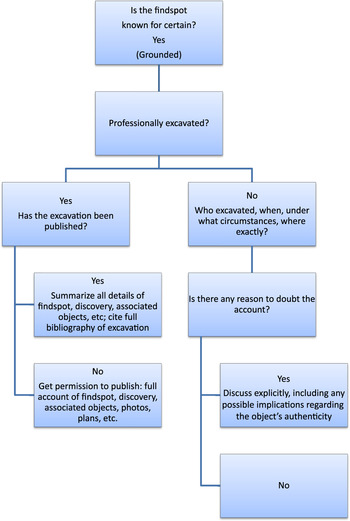
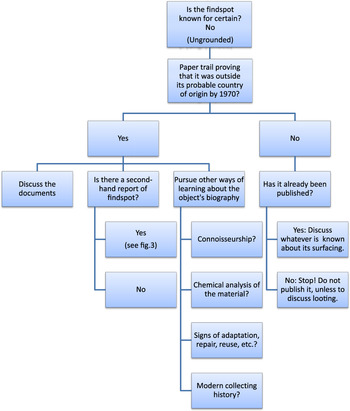
That said, the important point is the one Lyons makes: “[N]ot all apparent dead-ends are hopeless.” My description of the difference between grounded and ungrounded as a “bright line” inaccurately implies a finality on one side of the divide. A better metaphor than a line in the sand might be a best practices decision tree, with the differentiation between grounded and ungrounded objects as its first ramification. The “grounded” branch divides further according to whether or not the site was professionally excavated and whether or not the excavation has already been published (figure 1). If an object is ungrounded, the first question should be whether or not its first appearance outside its probable country of origin post-dates the 1970 UNESCO Convention and, if so, whether or not it has already been published (figure 2).
Footnote 8
If it has not, then to publish it would lend it legitimacy—legitimacy that enhances its market value and encourages the further looting of archaeological sites. Many reputable journals like the American Journal of Archaeology would refuse to serve as the venue for such a publication. Some scholars refuse to discuss newly surfaced antiquities even if they have already been published elsewhere. At a minimum, any mention of such objects should include a discussion of what is and is not known of their modern collecting history.
Figure 1.
Best Practices Decision Tree for Grounded Objects.
Figure 2.
Best Practices Decision Tree for Ungrounded Objects.
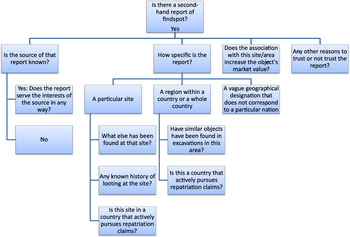
If there is a solid paper trail proving that an ungrounded object was exported by 1970, there are at least three things a responsible scholar should do: (1) discuss those documents in detail; (2) ask if there is a secondhand report of the find-spot; and (3) as suggested by Lyons, pursue other ways of learning about the object’s “biography.” The latter two branches ramify further. Other clues about the object’s “biography” might include connoisseurship, chemical analysis of the material, physical signs of adaptation, repair, reuse, and so on, and its modern collecting history. A secondhand report of the find-spot triggers further questions to critically evaluate the plausibility of the claim (figure 3). Is the source of the report known? If so, one should consider whether and in what way the claim might serve the interests of the source.
Figure 3.
Best Practices Decision Tree for Ungrounded Objects with a Second-Hand Report of Findspot.
Often, find-spot claims are crafted to strike a balance. An object’s association with a plausible site can bolster a potential buyer’s faith in its authenticity (and, thus, its price). On the other hand, vendors want to avoid providing grounds for repatriation claims from countries (such as Greece, Turkey, and Italy at the moment) that have been particularly aggressive in pursuing them, or that will trigger outrage from the international community concerned about looting in war-torn regions (like Syria and Iraq). Reports of find-spots that perfectly balance these competing concerns (e.g., “Eastern Mediterranean”) deserve particular scrutiny. Alleged associations with especially prestigious sites, such as a royal residence or a capital city, also deserve extra caution.
My point with these decision trees is to convey my basic agreement with Lyons that ungrounded antiquities still have plenty to tell us and that their modern owners have a responsibility to uncover as much of their past as possible. I maintain the view expressed in “What We Talk About …” as well as in my book, however, that no matter how much of their history we might recover, as records of ancient practices, they can never obtain the epistemological status of objects discovered in documented archaeological contexts. They cannot offer as solid a foundation upon which to build interpretations about the ancient world, and they can, on occasion, lead us badly astray. Ultimately, this is also the principle at the core of Chippindale and Gill’s work, from their landmark study of Cycladica to their 2000 analysis of classical collections, to Gill’s recent reports in the Journal of Art Crime. I look forward to continuing the conversation.






I am honored by the care that Drs Gill, Bell, and Lyons have taken in reading and responding to my article “What We Talk About When We Talk About Provenance.” I am also grateful to Alexander Bauer, the editor of this journal, for the idea of inviting them to comment upon it. Many of their observations have made me want to go back and revise the original text, but I will instead acknowledge and reflect here upon those places where they have prompted me either to clarify my arguments or to change my mind. Later in this article, I will use the recent exhibition, Pergamon and the Hellenistic Kingdoms of the Ancient World, which was on view at the Metropolitan Museum of Art (MMA) in the spring and summer of 2016, as a fresh source of evidence and examples. Footnote 1
David Gill helpfully sets his and Christopher Chippindale’s Reference Chippindale and Gill2000 article in the larger context of their professional activity, both before and after its publication. Footnote 2 When I express concern that their approach will not change attitudes, I am referring only to the provenance scale they developed for the 2000 article, not to their entire scholarly output. On the contrary; I am sure I was not the only student of ancient material culture whose eyes were first opened by their 1993 article on collecting Cycladica to the intellectual consequences of the antiquities trade. At both the macro level (raising awareness and changing attitudes) and the micro (for example, tracking down the ownership history of looted objects like the Methyse krater in Minneapolis), the profound and positive impact of their work can scarcely be overstated. I acknowledge the paradox that it should happen to have been a study by these very scholars that prompted the targeted criticism of my article. “What We Talk About When We Talk About Provenance” focuses on this particular article because the instrument at its core—the provenance scale—lays bare a set of disciplinary conventions that are rarely articulated so explicitly and are, in my view, problematic in interesting ways. This does not change the larger fact that in seeking to raise awareness of those conventions’ harmful intellectual consequences, I am standing on Chippindale and Gill’s figurative shoulders.
Gill restates and expands on several points I make in my article, such as the value of knowing who alleged that a given work came from a particular place. I am pleased (and not surprised) that he and I are in agreement about this point. The fact remains that this criterion was not factored into his much-cited 2000 provenance analysis. Instead, the scale left unchallenged the premise that the adverbs qualifying secondhand reports of find-spots constitute meaningful information, gradable from p2 to p4, and that the identity of the sources does not. The aim of “What We Talk About …” was to challenge these premises, among others.
Malcolm Bell defends Chippindale and Gill’s scale as “a useful and effective investigative tool” for the purposes of their article, as distinct from my concern with “epistemological issue(s).” He thereby suggests a sort of apples-and-oranges mismatch between their intentions and the evaluative standards I apply. But this begs the question: what “investigative tool” is innocent of epistemology? By design, diagnostic scales privilege particular ways of knowing, eliminating background “noise” to give a clear measure of a chosen criterion. Historians and social scientists like Hayden White, Thomas Kuhn, and Michel Foucault have been telling us for close to two generations now that the questions we ask predetermine our interpretations. Critical review of any kind not only demands examination of what an author consciously intended, but it also requires excavation of the values and assumptions left implicit, unstated, and unconscious because they are so deeply ingrained and “naturalized” in the field or culture. It is only by reading against the grain that we are ever able to break out of dominant paradigms. Chippindale and Gill’s Reference Chippindale and Gill2000 provenance scale, in other words, can be both a useful instrument to measure the thing it set out to measure and a reflection of disciplinary norms in need of critical re-evaluation.
Claire Lyons argues that the high percentage of ungrounded works in the exhibits I analyze in Appendix B reflects the fact that two of them showcased private collections, whereas the numbers in the Augustus show are more encouraging because it drew upon “the great European public collections.” It is certainly true that there are more grounded classical objects in European national collections than there are in North American, Asian, or African national collections or in private collections anywhere in the world. As discussed recently in the MMA’s Pergamon exhibit, this reflects nineteenth-century and early twentieth-century practices of colonialism and partage. But an abundance of grounded options does not necessarily mean that grounded objects will predominate in a given exhibition. Only three of the seven items borrowed from the great European public collection at the British Museum for the Pergamon show are grounded, as are only three of the nine from the Louvre, for example. The preference for ungrounded works is due, I believe, to art history’s unquenchable love for the polished and the whole or, alternatively, for the expressive fragment (rather than the merely broken fragment). Objects that have passed through the art market gleam with a particular patina that the battered works recovered from archaeological excavations can rarely compete with.
Lyons also suggests that exhibitions that focus on a particular site rather than a particular private collection will include more grounded objects. The MMA’s show on the site of Pergamon does not support this claim, however. While the core of the exhibit comprised 60 sculptures that went directly from the ground of Pergamon to the Pergamon Museum in Berlin in the nineteeth and early twentieth centuries, the show as a whole barely made the cut: only 145 of 281 total objects (excluding coins and counting each individual piece from groups or ensembles) are grounded (or 51 percent). In other words, only 38 percent of the objects chosen to supplement the core material from Berlin are grounded (85 of 221). Of course, this has much to do with the show’s North American venue and the sourcing for additional loans primarily from other US collections, where grounded classical objects are rare. That said, it is worth underscoring that it was a choice to turn to the Getty, the Boston Museum of Fine Arts, the Cleveland Museum of Art, the Princeton University Art Museum, and the Walters Art Museum to fill out the show’s cases. A very different, more socially complex story of the Hellenistic world could have been told perhaps had the MMA’s curators considered the options at the Penn Museum or the University of Michigan’s Kelsey Museum, the majority of which have rich archaeological histories. Or, indeed, if the curators had stuck to the grounded objects at the British Museum and the Louvre. As far as the comparanda go, those featured in the catalogue entries of the Pergamon exhibit are grounded 49 percent of the time, a number that suggests little change from the norm that prevailed in the 1990s (see Appendix A, where the average for the seven exhibits was 43 percent).
David Gill doubts my suggestion that museums may be entering a new era of candor regarding their collecting histories. His skepticism is not unfounded. My optimism was fanned in part by Fordham University’s unusual, frank discussion of the ethical complexities surrounding the Walsh bequest. Gill bases his doubts in part on the serious problems with particular items in the Walsh collection and on Fordham’s more recent acquisition of ungrounded early Christian mosaics, whose inscriptions point to Syrian origins. That some portion of the objects in the Walsh collection was looted, however, is neither a surprise nor a reason to tone down the praise for the catalogue’s self-reflexive language. As Claire Lyons notes, major American collectors in the 1980s and 1990s were all swimming in the same sea, buying from the same dealers, who sourced their wares through the same networks of middlemen and tombaroli. This is not to excuse the behavior; my point is simply that compared to the catalogues that were eventually published of, say, the Fleischman or Levy–White collections, the Walsh catalogue alone acknowledges the dilemma that these private collections now present for museums.
Gill is right, however, that Fordham’s handling of the mosaics bequest (from a donor who insists upon anonymity) suggests far less understanding of, and openness about, the material, intellectual, and ethical complexities of ungrounded antiquities. The initial January 2014 press release said nothing about provenance or ethics, and it quoted Fordham professor Michael Peppard, who declared that the mosaics offer “everything you want as a historian,” despite the complete loss of information about their ancient setting! Footnote 3 Following an outcry on social media and on the Chasing Aphrodite and Looting Matters blogs, an editor’s note was appended to the press release assuring readers that the gift was accepted only after a “thorough provenance review.” Some of the ownership history has since been presented in an article on the mosaics’ inscriptions by Michael Peppard. Footnote 4 But a promised, complete account of their modern history by museum curator Jennifer Udell has yet to appear, and multiple requests for provenance documents by Jason Felch to the Fordham University spokesman in January 2016 went unanswered. Footnote 5
For those looking for signs of increasing museum transparency, the Pergamon catalogue offers little to cheer. One would never know from the lengthy entry on the Morgantina silver, for example, that these 16 objects are still partially owned by the museum (the MMA and the Aidone archaeological authority now have joint custody, but the collection line of the tombstone states simply “Museo Regionale di Aidone”) or, indeed, that they were ever in the MMA’s collection at all (noticeably absent from the entry citations is the 1984 publication of the silver by the MMA curator Dietrich von Bothmer); let alone that the wrangling over their ownership was one of the more inflammatory episodes in the recent debates about looted antiquities (Catalogue no. 178). Footnote 6 And there could hardly be a better illustration of the slipperiness of the “said to be” label than the provenance information in this entry: “Said to be from Morgantina, House of Eupolemos.” In this case, the source of the report was most decidedly not a vendor or middleman. Rather, it was, first, the archaeologist in charge of the looted site (Malcolm Bell), then the cultural patrimony officials of the source country, and, eventually, the MMA itself, which ultimately found the evidence of looting (including the very holes where the tombaroli claimed to have found the pieces) impossible to ignore. It is hard not to see a degree of cynicism in this unconventional use of the “said to be” qualifier, as if the MMA were defiantly stamping its foot and declaring “we still don’t believe you!”
In fact, the only acknowledgement of the intellectual, legal, or ethical complexities of collecting antiquities that I could find anywhere in the Pergamon show’s weighty catalogue appeared in a single footnote to a brief entry on a relatively minor object: a small, white-painted terracotta vessel, which was apparently “confiscated in Piraeus” (Catalogue no. 92). No further information about the circumstances of the confiscation is provided. The exhibition also included a breathtaking quantity of Hellenistic gold jewelry, lent from Munich, the Getty, the Benaki Museum in Athens, the Walters, Princeton, the Boston Museum of Fine Art, and from the MMA’s own holdings. This would have been an excellent moment to closely scrutinize the collecting histories of these spectacular and remarkably similar objects, which surfaced on the market at various moments in the twentieth century with a variety of “said to be” provenances (sometimes more than one per object). One wonders whether the opportunity to dig deep into their ownership histories was passed over because at least some of the lenders preferred blissful ignorance. (It is perhaps not irrelevant here that in 1990 the Getty’s jewelry passed through the hands of the disgraced London dealer Robin Syme, whose role in many of the Fleischmans’ and the Getty’s antiquities acquisitions triggered a number of returns.)
Some objects in the Pergamon show also lend support to Gill’s and Lyons’s important critique of my argument, namely that the distinction I posit between grounded and ungrounded objects is too black and white. The limitations of the binary are readily exposed by an object like the 10-layered sardonyx cameo in Vienna featuring parallel portraits of a Ptolemaic king and queen (Catalogue no. 129). This piece does not appear ever to have resided in the ground at all but, rather, to have passed from elite hand to elite hand. The chain can be traced back to the thirteenth century, when it was affixed to a reliquary in Cologne. A handful of other extraordinary cameos, such as the Tazza Farnese and the Grand Camée de France, have similar biographies. For these objects, it is their documented ownership history, not their documented discovery in the ground, that (all but) ensures their authenticity.
Lyons notes the messy example of the Morgantina silver and Gill that of the Icklingham bronzes. Both have undergone what Colin Renfrew has described as “post-disjunctive forensic recontextualization”—that is, the archival, archaeological, and scientific research that can sometimes allow objects that surface on the art market to be reconnected to their find-spot. Footnote 7 Do such works count as grounded or ungrounded? Arguably the latter, insofar as we still cannot be certain that all of the objects purportedly from these ensembles were actually found together. Nor can we guarantee that unscrupulous middlemen did not add some fakes into the mix to bolster the market value of the whole. As far as evidence of ancient practices goes, these still are not as good as the bronze statuettes recovered from the Mahdia shipwreck (Catalogue nos. 233–36) or the various silver services discovered at Pompeii and Herculaneum. That said, we know a lot more about the Morgantina silver and the Icklingham bronzes than we do about, say, the Sevso treasure or the Baker dancer (Catalogue no. 158).
In drawing a “bright line” between grounded and ungrounded objects, I do not mean to suggest that research of the type described by Renfrew and Lyons should not be undertaken. I agree with Lyons that museums have an ethical obligation to learn as much as possible about the objects in their care. Lyons’s accounts of highly productive collaborations at the Getty between curators, conservators, scientists, and archaeologists, which have yielded valuable, new information about “the sources of clay, stone, and metal alloys; techniques and toolwork; dating and decay; and … restor[ation]” are inspiring, and she makes a convincing case that “materiality should be on a par with archaeology.” Two clear examples of such multi-disciplinary research can be found in the Pergamon catalogue: the “Plaketten” hydria in the National Archaeological Museum in Athens, for which chemical analysis identified the Egyptian origin of the clay (Catalogue no. 89), and the bronze statuette of Demosthenes at Harvard, for which chemical analysis allayed concerns about its authenticity (Catalogue no. 9).
On the other hand, the Pergamon catalogue also inadvertently reveals how rare such research is. To return to the jewelry for a moment, one wishes for more information about the dotted letters that spell out ZOI on the inside of the suspension loops of the MMA’s pair of gold armbands (Catalogue no. 166). The yearning only intensifies when one reads in the footnote that the “same inscription appears on five pieces from the so-called Karpenisi Hoard (also referred to as the Thessaly Treasure), a group of 45 jewels that appeared on the Athens antiquities market in 1929”! The MMA acquired their armbands in 1956. Where were they in 1929? Is it possible they came from the same hoard? Is anything known about the Karpenisi ensemble that might shed light on the museum’s pieces or vice versa? This is not the only catalogue entry that raises more questions than it answers. One can only lament that more attention was not paid to the “materiality” of ungrounded objects such as the “unique” vase in the shape of a duck in the Walters Art Museum, which appears to be a faience version of a vessel type more commonly known in red figure (Catalogue no. 163); the terracotta gorgon medallion from Basel, whose details are “unusually sharp,” its quality “singular,” and its method of manufacture (modeled freehand rather than mold-made) also unusual (Catalogue no. 76); and the terra-cotta statuette of the Diadoumenos in the MMA’s own collection, whose pattern of breakage and preservation might raise suspicions (Catalogue no. 61).
The fact is that few institutions or private collectors seem to be sponsoring the kind of intensive research on their ungrounded holdings that Lyons discusses. There are structural reasons why such work is unlikely to become the norm any time soon, ranging from the cost (and here it should be noted that it is not surprising to see the Getty and Harvard as leaders in the field, given their extraordinary resources), to the reward structures in academia (which discourage humanities scholars from participating in multi-authored studies), to nervous donors or board members (who might prefer to keep mistakes and dirty laundry hidden). It should also be said that when such research is performed, it is often in response to concerns about forgery or illicit trafficking, as the cases of the Morgantina silver and the Icklingham bronzes illustrate.
That said, the important point is the one Lyons makes: “[N]ot all apparent dead-ends are hopeless.” My description of the difference between grounded and ungrounded as a “bright line” inaccurately implies a finality on one side of the divide. A better metaphor than a line in the sand might be a best practices decision tree, with the differentiation between grounded and ungrounded objects as its first ramification. The “grounded” branch divides further according to whether or not the site was professionally excavated and whether or not the excavation has already been published (figure 1). If an object is ungrounded, the first question should be whether or not its first appearance outside its probable country of origin post-dates the 1970 UNESCO Convention and, if so, whether or not it has already been published (figure 2). Footnote 8 If it has not, then to publish it would lend it legitimacy—legitimacy that enhances its market value and encourages the further looting of archaeological sites. Many reputable journals like the American Journal of Archaeology would refuse to serve as the venue for such a publication. Some scholars refuse to discuss newly surfaced antiquities even if they have already been published elsewhere. At a minimum, any mention of such objects should include a discussion of what is and is not known of their modern collecting history.
Best Practices Decision Tree for Grounded Objects.
Best Practices Decision Tree for Ungrounded Objects.
If there is a solid paper trail proving that an ungrounded object was exported by 1970, there are at least three things a responsible scholar should do: (1) discuss those documents in detail; (2) ask if there is a secondhand report of the find-spot; and (3) as suggested by Lyons, pursue other ways of learning about the object’s “biography.” The latter two branches ramify further. Other clues about the object’s “biography” might include connoisseurship, chemical analysis of the material, physical signs of adaptation, repair, reuse, and so on, and its modern collecting history. A secondhand report of the find-spot triggers further questions to critically evaluate the plausibility of the claim (figure 3). Is the source of the report known? If so, one should consider whether and in what way the claim might serve the interests of the source.
Best Practices Decision Tree for Ungrounded Objects with a Second-Hand Report of Findspot.
Often, find-spot claims are crafted to strike a balance. An object’s association with a plausible site can bolster a potential buyer’s faith in its authenticity (and, thus, its price). On the other hand, vendors want to avoid providing grounds for repatriation claims from countries (such as Greece, Turkey, and Italy at the moment) that have been particularly aggressive in pursuing them, or that will trigger outrage from the international community concerned about looting in war-torn regions (like Syria and Iraq). Reports of find-spots that perfectly balance these competing concerns (e.g., “Eastern Mediterranean”) deserve particular scrutiny. Alleged associations with especially prestigious sites, such as a royal residence or a capital city, also deserve extra caution.
My point with these decision trees is to convey my basic agreement with Lyons that ungrounded antiquities still have plenty to tell us and that their modern owners have a responsibility to uncover as much of their past as possible. I maintain the view expressed in “What We Talk About …” as well as in my book, however, that no matter how much of their history we might recover, as records of ancient practices, they can never obtain the epistemological status of objects discovered in documented archaeological contexts. They cannot offer as solid a foundation upon which to build interpretations about the ancient world, and they can, on occasion, lead us badly astray. Ultimately, this is also the principle at the core of Chippindale and Gill’s work, from their landmark study of Cycladica to their 2000 analysis of classical collections, to Gill’s recent reports in the Journal of Art Crime. I look forward to continuing the conversation.