Introduction
In psychiatry, the need for neuropsychological studies comparing patients across several diagnostic groups to each other, and also to controls, has become increasingly clear. By testing whether deficits on standardized behavioral paradigms are diagnostically specific, such studies could ultimately inform nosology and identify biomarkers that might aid in the diagnostic process. Here, we compare youths with bipolar disorder (BD), major depressive disorder (MDD), anxiety disorders (ANX) and severe mood dysregulation (SMD) to each other and to controls on a probabilistic response reversal (PRR) task. PRR is of particular interest because the circuitry mediating its performance has been well studied in humans and non-human primates (Cools et al. Reference Cools, Clark, Owen and Robbins2002; Fellows & Farah, Reference Fellows and Farah2003; Clark et al. Reference Clark, Cools and Robbins2004; Izquierdo & Murray, Reference Izquierdo and Murray2004; Budhani et al. Reference Budhani, Marsh, Pine and Blair2007; Bellebaum et al. Reference Bellebaum, Koch, Schwarz and Daum2008).
In a reversal learning task, participants first acquire a stimulus/response relationship by trial-and-error learning, and then, when the stimulus/response relationship is reversed without explicit warning, participants must adapt their response. From an affective neuroscience perspective, reversal learning taps into cognitive flexibility, defined as the ability to adapt one's thinking and behavior in response to changing environmental conditions including rewards (Cools et al. Reference Cools, Clark and Robbins2004; Stemme et al. Reference Stemme, Deco, Busch and Schneider2005). Deficits in reversal learning may be associated with irritability, a clinical symptom shared by patients with BD, SMD, MDD and ANX. That is, irritability in youths may be due in part to the frustration that occurs when they are unable to adapt to changing reward contingencies in the environment (Blair & Cipolotti, Reference Blair and Cipolotti2000; Blair, Reference Blair2004).
Moreover, reversal learning is mediated by the same frontostriatal circuit implicated in BD, MDD and ANX (Drevets, Reference Drevets2000; Thomas et al. Reference Thomas, Drevets, Dahl, Ryan, Birmaher, Eccard, Axelson, Whalen and Casey2001; Blumberg et al. Reference Blumberg, Charney and Krystal2002; Monk et al. Reference Monk, Nelson, McClure, Mogg, Bradley, Leibenluft, Blair, Chen, Charney, Ernst and Pine2006; Krain et al. Reference Krain, Gotimer, Hefton, Ernst, Castellanos, Pine and Milham2008; Pfeifer et al. Reference Pfeifer, Welge, Strakowski, Adler and DelBello2008). In particular, data from animal models, healthy adult humans, and adults following neurosurgical resection have shown that the prefrontal cortex (PFC), including the orbitofrontal cortex, mediates the reversal of stimulus/response associations (Blair et al. Reference Blair, Colledge and Mitchell2001; Clark et al. Reference Clark, Cools and Robbins2004; Cools et al. Reference Cools, Clark and Robbins2004; O'Doherty et al. Reference O'Doherty, Dayan, Schultz, Deichmann, Friston and Dolan2004; Budhani et al. Reference Budhani, Marsh, Pine and Blair2007) whereas the ventral striatum transforms concrete stimulus exemplar information into motor responses (Knutson et al. Reference Knutson, Westdorp, Kaiser and Hommer2000; Cools et al. Reference Cools, Clark and Robbins2004). Other regions that may play an accessory role include the parietal cortex, which is implicated in decision making in the presence of uncertainty (Paulus et al. Reference Paulus, Hozack, Zauscher, McDowell, Frank, Brown and Braff2001; Huettel, Reference Huettel2006; Chamberlain et al. Reference Chamberlain, Menzies, Hampshire, Suckling, Fineberg, del Campo, Aitken, Craig, Owen, Bullmore, Robbins and Sahakian2008).
Previously, we have shown that BD youths have impaired reversal learning on the PRR task. Compared to typically developing controls, BD youths have impaired probabilistic reversal learning on the PRR task (i.e. reversal of pair whereby preferred stimulus is rewarded 80% and punished 20%), making more errors and committing more errors to achieve minimal competence (defined as six consecutive correct responses). In addition, compared to controls, fewer BD patients achieved this minimal competence (Gorrindo et al. Reference Gorrindo, Blair, Budhani, Dickstein, Pine and Leibenluft2005).
We now extend this research by examining the specificity of PRR performance in five age-, IQ- and sex-matched groups (SMD, MDD and ANX plus expanded groups of BD and control youths). We include youths with SMD because these patients suffer from attention deficit/hyperactivity disorder (ADHD)-like symptoms of hyperactivity plus severe irritability, and their diagnostic status vis-à-vis BD is unclear (Carlson, Reference Carlson1998; NIMH, 2001; Leibenluft et al. Reference Leibenluft, Charney, Towbin, Bhangoo and Pine2003). Although some studies show that SMD youths share some deficits with those with narrow-phenotype BD, including face emotion labeling (Guyer et al. Reference Guyer, McClure, Adler, Brotman, Rich, Kimes, Pine, Ernst and Leibenluft2007; Rich et al. Reference Rich, Grimley, Schmajuk, Blair, Blair and Leibenluft2008), others show differences between SMD and BD, including family history and longitudinal course (Brotman et al. Reference Brotman, Schmajuk, Rich, Dickstein, Guyer, Costello, Egger, Angold, Pine and Leibenluft2006, Reference Brotman, Kassem, Reising, Guyer, Dickstein, Rich, Towbin, Pine, McMahon and Leibenluft2007). Thus, it remains unclear if SMD is a developmental presentation of BD, a depression-spectrum illness, or another disorder.
Given that our prior findings indicate 80:20 reversal deficits in BD youth, in the current study we tested whether such deficits were also present in the other patient groups. Given that frontostriatal dysfunction has been implicated in all of our patient groups, our primary hypothesis was that they would have reversal learning deficits on the 80:20 trials versus typically developing controls.
Method
Subjects
Participants (aged 7–17 years) were enrolled in Institutional Review Board (IRB)-approved studies conducted at the National Institute of Mental Health (NIMH) Intramural Research Program Mood and Anxiety Disorders Program. Prior to participation, the studies were explained, and parents and children gave written informed consent and assent respectively. Recruitment included advertisements in local parenting magazines, on support groups' websites, and distributed to psychiatrists nationwide.
BD (n=35) inclusion criteria were: (1) meeting DSM-IV-TR criteria for BD, including history of at least one full-duration hypomanic (>4 days) or manic (>7 days) episode wherein the child exhibited abnormally elevated or expansive mood plus at least three other DSM-IV-TR criterion ‘B’ mania symptoms; (2) ongoing mental health treatment; and (3) a primary carer to grant consent and to participate in the research.
SMD (n=35) inclusion criteria were: (1) abnormal mood (anger or sadness), present at least half of the day most days; (2) hyperarousal (more than three of insomnia, agitation, distractibility, racing thoughts or flight of ideas, pressured speech, intrusiveness); (3) markedly increased reactivity to negative emotional stimuli manifest verbally or behaviorally more than three times a week; and (4) severe impairment in at least one setting (home, school or peers) and at least mild impairment in a second setting. SMD symptom onset must be before age 12 and must be currently present for at least 12 months without symptom-free periods >2 months (Leibenluft et al. Reference Leibenluft, Charney, Towbin, Bhangoo and Pine2003).
ANX group (n=30) inclusion criteria were the presence of at least one of the following DSM-IV-TR anxiety disorders: generalized anxiety disorder, separation anxiety disorder, or social phobia. Such grouping of ANX youths has been used by the Research Units on Pediatric Psychopharmacology (RUPP, 2001) and in other randomized controlled trials for pediatric anxiety (Birmaher et al. Reference Birmaher, Axelson, Monk, Kalas, Clark, Ehmann, Bridge, Heo and Brent2003). The MDD group (n=18) inclusion criterion was the presence of current DSM-IV-TR MDD. Additional inclusion criteria for ANX and MDD subjects were: (1) a Pediatric Anxiety Rating Scale (PARS) score >10 (RUPP, 2002) and/or a Children's Depression Rating Scale (CDRS) score >39 (Poznanski et al. Reference Poznanski, Freeman and Mokros1985); (2) a Children's Global Assessment Scale (CGAS) score<60 (Shaffer et al. Reference Shaffer, Gould, Brasic, Ambrosini, Fisher, Bird and Aluwahlia1983); and (3) persistent anxiety and/or depression (consistently elevated PARS and/or CDRS) during 3 weeks of supportive psychotherapy.
Exclusion criteria for all patient groups (BD, SMD, ANX, MDD) were: IQ<70; autistic or Asperger's disorder; medical illness that is unstable or could cause psychiatric symptoms; pregnancy; or substance abuse within 2 months. For the BD group, children with irritable mania only, without elevated or expansive mood, were excluded (Geller et al. Reference Geller, Williams, Zimerman, Frazier, Beringer and Warner1998; Leibenluft et al. Reference Leibenluft, Charney, Towbin, Bhangoo and Pine2003). For the SMD group, exclusion criteria were: (1) cardinal BD symptoms including elevated/expansive mood, grandiosity/inflated self-esteem, or episodically decreased need for sleep; and (2) distinct episodes of >1 day, and (3) psychosis. For both the ANX and MDD groups, exclusion criteria were: obsessive–compulsive disorder, exposure to extreme trauma or post-traumatic stress disorder, or history of mania or psychosis.
Typically developing normal control (NC; n=35) inclusion criterion was a negative psychiatric history. Exclusion criteria were: IQ<70; ongoing medical illness; pregnancy; and lifetime psychiatric or substance disorder.
All participants were evaluated by graduate-level clinicians with high inter-rater reliability (κ>0.75) using the Kiddie-Schedule for Affective Disorders Present and Lifetime version (K-SADS-PL) administered to parents and children separately (Kaufman et al. Reference Kaufman, Birmaher, Brent, Rao, Flynn, Moreci, Williamson and Ryan1997). Because SMD is not a DSM-IV-TR diagnosis, the K-SADS-PL was used to assess DSM-IV-TR diagnoses, and a separate module developed with Dr J. Kaufman to assess for SMD was administered. For BD youths, co-morbid diagnoses were assessed by inquiring about symptoms during a time of relative euthymia to ensure that BD symptoms were not counted toward another diagnosis.
All participants completed the Wechsler Abbreviated Scale of Intelligence as an overall measure of cognitive function to ensure that there were not between-groups differences that might confound interpretation of PRR performance. Subjects (not controls) completed the CDRS and CGAS. BD and SMD subjects completed the Young Mania Rating Scale (YMRS; Young et al. Reference Young, Biggs, Ziegler and Meyer1978). However, SMD subjects' YMRS scores should not be interpreted as a measure of mania severity per se because, by definition, they could not be in a manic episode, but rather as a measure of the severity of SMD hyperarousal symptoms, which are modeled on mania ‘B’ criteria (Leibenluft et al. Reference Leibenluft, Charney, Towbin, Bhangoo and Pine2003).
With respect to prior publication, data from all SMD, ANX and MDD subjects, and also from 16/35 BD and 22/35 NC, have not been reported previously (Gorrindo et al. Reference Gorrindo, Blair, Budhani, Dickstein, Pine and Leibenluft2005).
PRR behavioral task
The self-paced PRR task was administered on a laptop computer. Participants were instructed to ‘Find out which animal is usually correct and choose it every time, even if it is occasionally wrong. At some point, it may change so that the other animal is usually correct, in which case you should choose that one every time.’ Each trial required a selection to continue. After each selection, subjects received on-screen performance feedback (e.g. ‘you win 100 points’ or ‘you lose 100 points’) and a running total of their score.
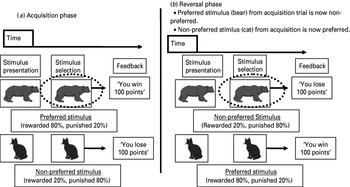
The task consisted of six stimuli pairs of animal drawings presented in random quadrants of the screen. Of these, the first and last pairs were ‘dummy’ pairs on which no data were collected. Of the remaining four pairs, in one pair shown for 80 trials (80:20 reversing pair), during the initial 40 trials (80:20 acquisition phase) one stimulus was rewarded in 80% of trials (and punished 20%) and the other stimulus was rewarded 20% (and punished 80%); during the subsequent 40 trials (80:20 reversal phase), the stimulus/response relationship was reversed (Fig. 1). In a second pair shown for 40 trials (80:20 non-reversing acquisition pair), one stimulus was rewarded in 80% of trials (and punished 20%) and the other was rewarded in 20% of trials (and punished 80%), without a subsequent reversal phase. In a third pair shown for 80 trials (100:0 reversing pair), during the initial 40 trials (100:0 acquisition phase) one stimulus was rewarded in 100% of trials (and punished 0%) and the other stimulus was punished in 100% of trials (and rewarded 0%); during the subsequent 40 trials (100:0 reversal phase), the stimulus/response relationship was reversed. In the fourth pair shown for 40 trials (100:0 non-reversing acquisition pair), one stimulus was rewarded 100% (and punished 0%) and one stimulus was rewarded 0% (and punished 100%), without a subsequent reversal phase. Of note, the psychological processes underlying the two non-reversing acquisition pairs and the initial 40 presentations of the reversing pairs are identical, as subjects must acquire stimulus/response relationships without reversing them. The order of 80:20 or 100:0 conditions varied randomly among subjects. Error data were collected for each pair (80:20 reversing, 100:0 reversing, 80:20 non-reversing acquisition, 100:0 non-reversing acquisition).
Example of 80:20 reversing pair. (a) Acquisition phase. (b) Reversal phase: preferred stimulus (bear) from acquisition trial is now non-preferred; non-preferred stimulus (cat) from acquisition is now preferred.

Statistical analysis approach
The overall aim of this study was to determine the specificity of 80:20 probabilistic reversal learning deficits previously identified in BD youths versus controls by comparing expanded samples of both to newly recruited samples of SMD, MDD and ANX youths. Thus, our primary data analysis focused on the 80:20 reversing pair performance across five groups (BD, SMD, MDD, ANX, controls) matched for age, sex and IQ. Additionally, we examined non-probabilistic reversal learning performance on the 100:0 pair. To ensure that potential reversal learning deficits were not the result of failure to acquire the initial stimulus/response relationship, we used the binomial theorem to categorize each subject's performance as better than chance (yes/no) on the acquisition phase for each pair, and then, for our analyses of reversal phase performance, we excluded participants who did not perform better than chance during the acquisition phase of each pair. We also evaluated between-group differences in 80:20 and 100:0 reversing pair acquisition phase performance. Thus, we conducted four analyses of variance (ANOVAs): two for errors made in the reversal phases of the 80:20 and 100:0 reversing pairs (controlling for acquisition performance), and two for errors made in the acquisition phase of the 80:20 and 100:0 reversing pairs. Where significant effects of group were found, we then examined pair-wise differences, with Cohen's d effect size calculated for all significant pair-wise comparisons (small, d<0.3; medium, d=0.3–0.8; large, d>0.8).
We performed a secondary analysis to determine if our present results replicate our previous finding of greater 80:20 reversal phase errors in BD versus control subjects by using a t test to compare 80:20 reversal phase errors in previously unreported BD subjects (n=16) to controls (n=22) (Gorrindo et al. Reference Gorrindo, Blair, Budhani, Dickstein, Pine and Leibenluft2005). Although insufficiently powered to examine all potential medication effects, we explored stimulant medications' effect on our primary 80:20 reversal phase errors analysis by comparing those BD and SMD subjects taking stimulant medication versus those who were not.
We also evaluated the impact of feedback on behavioral choice on the subsequent trial, that is whether, following a reward or a punishment, the subject stayed with, or shifted from, the response that had engendered the reward/punishment. For the reversal trials, we calculated win-stay and lose-stay percentages for both correct and incorrect responses following the receipt of reward or punishment (Budhani et al. Reference Budhani, Richell and Blair2006). Thus, for correct responses: (a) win-stay percentage=[number correct-win-stay/(number correct-win-stay+number correct-win-shift)]×100, and (b) lose-stay percentage=[number correct-lose-stay/(number correct-lose-stay+number correct-lose-shift)]×100. We performed similar calculations for win-stay and lose-stay percentages after incorrect responses. Separate ANOVAs were then conducted on the four percentages obtained to examine group differences.
Results
Demographics
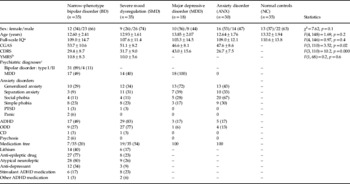
There were no between-group differences in age [F(4, 148)=1.69, p=0.2], full-scale IQ [F(4, 146)=0.97, p=0.4] or sex (Pearson χ2=7.62 p=0.1) (Table 1). During PRR, 20% of BD, 54% of SMD, 100% of ANX and 100% of MDD subjects were medication free.
Participant demographics

CGAS, Children's Global Assessment Scale; CDRS, Children's Depression Rating Scale; YMRS, Young Mania Rating Scale; ADHD, attention deficit/hyperactivity disorder; ODD, oppositional defiant disorder; CD, conduct disorder.
Values given as mean ± standard deviation or n (%).
a Full-scale IQ data were unavailable for two SMD subjects. CGAS data unavailable for one BD, one SMD and two ANX subjects. Post-hoc pair-wise comparison of CGAS: BD>MDD p=0.05, BD>ANX p=0.06. CDRS data unavailable for two ANX and two MDD subjects. Post-hoc pair-wise comparison of CDRS scores: MDD>BD p=0.000, MDD>SMD p=0.001, MDD>ANX p=0.000.
b YMRS data for BD and SMD subjects only.
c Current psychiatric diagnoses based on the Kiddie Schedule for Affective Disorders Present and Lifetime version (K-SADS-PL).
Although all subjects were moderately impaired by CGAS rating, there was a main effect of group [F(3, 110)=3.52, p=0.02], with BD subjects less impaired (higher CGAS) than MDD (p=0.05) and a similar trend versus ANX subjects (p=0.06), possibly because MDD and ANX subjects were unmedicated and enrolling in a treatment study whereas most BD subjects were medicated and enrolling in a phenomenology study. There was a main effect of group on CDRS scores [F(3, 110)=10.2, p=0.000], with MDD subjects reporting significantly more depression than others (p<0.001 v. BD, SMD and ANX).
Among BD subjects, 20/35 (57%) were euthymic (YMRS<12, CDRS<40), 9/35 (26%) were hypomanic (YMRS 13–24, CDRS<40), 2/35 (5.5%) were manic (YMRS>25, CDRS<40), 1/35 (3%) was depressed (YMRS<12, CDRS>40), and 3/35 (8.5%) were mixed (YMRS>12, CDRS>40). YMRS scores did not differentiate BD from SMD subjects [BD YMRS 10.8±8.3; SMD YMRS 10.0±5.6; F(1, 68)=0.2, p=0.6]. Among SMD subjects, 6/35 (17%) were depressed (CDRS>40).
PRR primary analysis
80:20 reversing pair performance
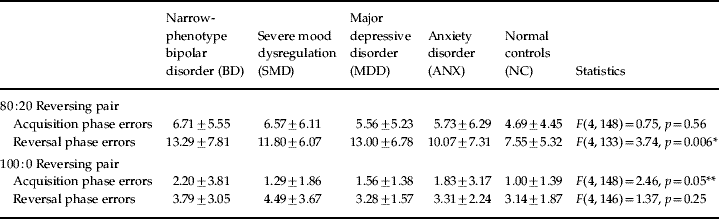
On the 80:20 reversing pair, we excluded 4/35 BD, 5/35 SMD, 1/18 MDD, 3/30 ANX and 2/35 control subjects because they did not perform better than chance on the acquisition phase. The rate of exclusion did not differ between groups (χ2=1.93 p=0.75). ANOVA of errors for the 80:20 reversing pair showed an effect of group [F(4, 133)=3.74, p=0.006, observed power=0.88]. Bonferroni corrected post-hoc pair-wise comparisons revealed that BD subjects made significantly more reversal errors than controls (BD>NC p=0.008, Cohen's d=0.86) with a similar trend in MDD subjects (MDD>NC p=0.07, Cohen's d=0.89). Patients with SMD or ANX did not differ from controls (SMD>NC p=0.13, Cohen's d=0.74, ANX>NC p=1.0, Cohen's d=0.39). The ANOVA of 80:20 reversing pair acquisition phase errors did not show a significant effect of group [F(4, 148)=0.75, p=0.56, observed power=0.24] (Table 2).
Acquisition and reversal phase errors

Separate analyses of variance (ANOVAs) were conducted for our primary analysis of errors in the 80:20 reversing pair and also the 100:0 reversing pair, including only those subjects who performed better than chance during the acquisition phase of each pair. Separate ANOVAs were also conducted for errors made during the acquisition phase of the 80:20 and 100:0 reversing pairs.
On the 80:20 reversing pair, 4/35 BD, 5/35 SMD, 1/18 MDD, 3/30 ANX and 2/35 control subjects were excluded because their acquisition phase performance was not better than chance. This was not significantly different between groups (χ2=1.93 p=0.75).
On the 100:0 reversing pair, 1/35 BD, 0/35 SMD, 0/18 MDD, 1/30 ANX and 0/35 control subjects were excluded because their acquisition phase performance was not better than chance. This was not significantly different between groups (χ2=2.77 p=0.60).
Significant post-hoc pair-wise comparisons:
* 80:20 reversal phase errors: BD>NC p=0.008, Cohen's d=0.86, MDD>NC p=0.07, Cohen's d=0.89, SMD>NC p=0.13, Cohen's d=0.74, ANX>NC p=Cohen's d=0.39. ** 100:0 acquisition phase errors: BD>NC p=0.05, Cohen's d=0.63, MDD>NC p=1.0, Cohen's d=0.4, SMD>NC p=1.0, Cohen's d=0.18, ANX>NC p=1.0, Cohen's d=0.34.
100:0 reversing pair performance
On the 100:0 reversing pair, we excluded one BD and one ANX subject because they did not perform better than chance on the acquisition phase. The rate of exclusion did not differ between groups (χ2=2.77 p=0.6). The ANOVA of errors for the 100:0 reversing pair did not show a significant effect of group [F(4, 146)=1.37, p=0.25, observed power=0.42]. The ANOVA of 100:0 reversing pair acquisition phase errors showed a significant effect of group [F(4, 148)=2.46, p=0.05, observed power=0.69], with Bonferroni corrected post-hoc pair-wise comparisons showing a significant difference only between BD and control subjects (p=0.05, Cohen's d=−0.63).
PRR secondary analysis
Replication of finding in BD versus controls
We examined data from previously unreported BD subjects (n=16) and controls (n=22). Although there was no significant difference in the percentage of each group performing better than chance on the 80:20 acquisition phase (BD 87%, NC 95%; χ2=0.81, p=0.37), previously unreported BD subjects made significantly more errors on the 80:20 reversal phase than previously unreported controls (BD 12.50±8.47, NC 7.86±5.82, t=2.00, df=36, p=0.05, Cohen's d=0.64). Thus, using an independent sample, we have replicated our original finding of greater 80:20 reversal errors in BD versus control subjects.
Effect of stimulant medication
Given that prior work has demonstrated the effect of stimulants on reversal learning in those with primary ADHD, we conducted exploratory analyses of the effect of stimulant medications on our primary finding of 80:20 reversal phase errors (Kempton et al. Reference Kempton, Vance, Maruff, Luk, Costin and Pantelis1999). Controlling for 80:20 acquisition phase performance as in our primary analysis, we did not find a significant difference in 80:20 reversal phase errors comparing those BD and SMD subjects currently on stimulant medications (n=13) to those not (n=48) (p=0.47, t=−0.74). Therefore, stimulants do not seem to affect our primary finding.
Effect of feedback
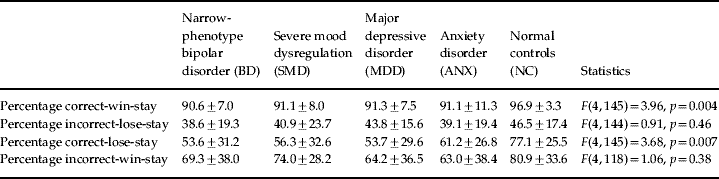
We conducted four ANOVAs on the win-stay and lose-stay percentages for correct and incorrect responses to examine group differences in impact of feedback on behavioral choice on the subsequent trial during the reversal phase (see Table 3). These revealed significant group differences for both correct-win-stay [F(4, 145)=3.96, p=0.004, observed power=0.90] and correct-lose-stay percentages [F(4, 145)=3.68, p=0.007, observed power=0.87] but not the incorrect-win-stay [F(4, 118)=1.06, p=0.38, observed power=0.33] or incorrect-lose-stay percentages [F(4, 144)=0.91, p=0.46, observed power=0.28].
Probabilistic response reversal 80:20 reversing pair effect of feedback

Percentage correct-win-stay=[no. correct-win-stay/(no. correct-win-stay+no. correct-win-shift)]×100.
Percentage incorrect-lose-stay=[no. incorrect-lose-stay/(no. incorrect-lose-stay+no. incorrect-lose-shift)]×100.
Percentage correct-lose-stay=[no. correct-lose-stay/(no. correct-lose-stay+no. correct-lose-shift)]×100.
Percentage incorrect-win-stay=[no. incorrect-win-stay/(no. incorrect-win-stay+no. incorrect-win-shift)]×100.
Significant post-hoc pair-wise comparisons: percentage correct-win-stay: BD<NC p=0.01, Cohen's d=−1.15, SMD<NC p=0.02, Cohen's d=−0.94, ANX<NC p=0.03, Cohen's d=−0.70. Percent correct-lose-stay: BD>NC p=0.01, Cohen's d=−0.82 and SMD>NC p=0.03, Cohen's d=−0.73.
With respect to the correct-win-stay percentage, pair-wise comparisons showed that controls were significantly more likely to maintain their correct response following a reward than BD (p=0.01, Cohen's d=−1.15), SMD (p=0.02, Cohen's d=−0.94) or ANX youths (p=0.03, Cohen's d=−0.70). With respect to correct-lose-stay percentages, pair-wise comparisons showed that controls were significantly more likely to maintain their correct response even after receiving a punishment than patients with pair-wise analyses showing a significant difference between BD (p=0.01, Cohen's d=−0.82) and SMD (p=0.03, Cohen's d=−0.73) groups versus controls.
Discussion
In this first study to evaluate the specificity of reversal learning in youths with mood and anxiety disorders, our main finding is that impaired probabilistic reversal learning was present in BD youths, with a trend in those with MDD (p=0.07, Cohen's d=0.89) versus typically developing controls. SMD subjects were not significantly different than controls, although given the associated effect size (p=0.13, Cohen's d=0.74), this might represent a type II error. ANX youths did not have reversal learning deficits, and the small effect size suggested that this was not a type II error (p=1.0, Cohen's d=0.39). This leads us to conclude that: (1) youths with BD clearly have a deficit in reversal learning; (2) such a deficit might also be present in MDD and perhaps in SMD, although the results are equivocal; and (3) youths with ANX do not have reversal learning deficits. Moreover, secondary analyses reveal that BD and SMD may show particular difficulty in using reinforcement expectancy information to guide their behavioral choices, as they are more likely to shift away from a correct response whether they have received either a reward or ‘spurious’ punishment (Blair, Reference Blair2009).
Among the diagnostic groups examined in our present study, reversal learning problems are most consistent and robust in BD youths. Besides our prior study using the PRR task, we have also demonstrated that narrow-phenotype BD youths have reversal learning deficits on the non-probabilistic intra-dimensional/extra-dimensional shift task (ID/ED; Cambridge Cognition, UK). Specifically, we have shown that BD youths made more errors and required more trials and time to complete a simple reversal than controls (Dickstein et al. Reference Dickstein, Treland, Snow, McClure, Mehta, Towbin, Pine and Leibenluft2004). In a follow-up study, we evaluated the specificity of these deficits by comparing ID/ED performance in an expanded sample of narrow-phenotype BD and control youths compared to a newly recruited SMD sample. We found that narrow-phenotype BD subjects had specific deficits on the simple reversal stage (i.e. reversals involving simple purple shapes) versus both controls and SMDs. However, both BD and SMD subjects were impaired on the compound reversal stage (i.e. reversals involving compound stimuli of white line drawings superimposed on purple shapes; subjects must discern which of the two stimuli is linked to reward) (Dickstein et al. Reference Dickstein, Nelson, McClure, Grimley, Knopf, Brotman, Rich, Pine and Leibenluft2007a). Overall, both our previous results from the ID/ED task and our PRR results presented here lead to a similar conclusion, namely that reversal learning deficits are found consistently in BD youths, whereas data in SMD youths suggest the possibility of deficits, but are not definitive. It is possible that the seeming inconsistency between SMD's performance on the ID/ED and PRR tasks may reflect the effect of co-morbid ADHD in increasing cognitive performance variability, suggesting the need for future comparisons to adequately powered samples of youths with primary ADHD (Ben Pazi et al. Reference Ben Pazi, Gross-Tsur, Bergman and Shalev2003; Doyle, Reference Doyle2006). However, our secondary analyses suggest that probabilistic reversal learning deficits are unaffected by concomitant stimulant usage, unlike what has been found in those with primary ADHD (Kempton et al. Reference Kempton, Vance, Maruff, Luk, Costin and Pantelis1999).
The neural basis of reversal learning deficits in pediatric BD remains unknown. However, emerging neuroimaging data using tasks other than reversal learning implicate several frontal regions, including dorsolateral, ventromedial and anterior cingulate cortices, along with the amygdala and striatum in the pathophysiology of pediatric BD (Blumberg et al. Reference Blumberg, Martin, Kaufman, Leung, Skudlarski, Lacadie, Fulbright, Gore, Charney, Krystal and Peterson2003; Rich et al. Reference Rich, Vinton, Roberson-Nay, Hommer, Berghorst, McClure, Fromm, Pine and Leibenluft2006; Dickstein et al. Reference Dickstein, Rich, Roberson-Nay, Berghorst, Vinton, Pine and Leibenluft2007b; Leibenluft et al. Reference Leibenluft, Rich, Vinton, Nelson, Fromm, Berghorst, Joshi, Robb, Schachar, Dickstein, McClure and Pine2007; Nelson et al. Reference Nelson, Vinton, Berghorst, Towbin, Hommer, Dickstein, Rich, Brotman, Pine and Leibenluft2007; Pavuluri et al. Reference Pavuluri, O'Connor, Harral and Sweeney2007, Reference Pavuluri, O'Connor, Harral and Sweeney2008). Reversal learning studies in animal models, healthy adult humans, and adults after neurosurgical resection indicate that it is mediated by similar regions, including both the frontal cortex (dorsomedial, inferior and ventromedial) and the striatum (Blair et al. Reference Blair, Colledge and Mitchell2001; Cools et al. Reference Cools, Clark, Owen and Robbins2002, Reference Cools, Clark and Robbins2004; Clark et al. Reference Clark, Cools and Robbins2004; O'Doherty et al. Reference O'Doherty, Dayan, Schultz, Deichmann, Friston and Dolan2004; Budhani et al. Reference Budhani, Marsh, Pine and Blair2007). Recently, a study using this PRR task found that adolescents with psychopathic traits had a relatively selective failure within the ventromedial frontal cortex, possibly indicating impaired representation of outcome information. By contrast, such adolescents did not have alterations in either the dorsomedial or inferior frontal cortex, suggesting an intact ability to alter motor responses (Finger et al. Reference Finger, Marsh, Mitchell, Reid, Sims, Budhani, Kosson, Chen, Towbin, Leibenluft, Pine and Blair2008). Our study suggests that BD youths may have neural alterations in frontostriatal regions mediating reversal learning, especially those involved with the receipt of unexpected, spurious reward and punishment (Ramnani et al. Reference Ramnani, Elliott, Athwal and Passingham2004; Abler et al. Reference Abler, Greenhouse, Ongur, Walter and Heckers2008). At present, we are using event-related functional magnetic resonance imaging (fMRI) to determine the neural basis of the reversal learning impairment in pediatric BD.
With respect to MDD youths, we found that they had a trend towards impaired probabilistic reversal learning, but no deficit in non-probabilistic reversal learning. One previous study failed to find reversal learning deficits in MDD youths (n=30) versus controls (n=49) using the non-probabilistic ID/ED task (Kyte et al. Reference Kyte, Goodyer and Sahakian2005). These results are consistent with ours, in that MDD youths in our study did not have a reversal learning impairment for the non-probabilistic 100:0 contingency, although they did at a trend level for the 80:20 (probabilistic) pair. fMRI has not been used to study the circuitry mediating reversal learning in patients with MDD, but several regions of the PFC and the striatum have been implicated in the pathophysiology of depression (Milham et al. Reference Milham, Nugent, Drevets, Dickstein, Leibenluft, Ernst, Charney and Pine2005; Rosenberg et al. Reference Rosenberg, MacMaster, Mirza, Smith, Easter, Banerjee, Bhandari, Boyd, Lynch, Rose, Ivey, Villafuerte, Moore and Renshaw2005; Roberson-Nay et al. Reference Roberson-Nay, McClure, Monk, Nelson, Guyer, Fromm, Charney, Leibenluft, Blair, Ernst and Pine2006; McClure et al. Reference McClure, Monk, Nelson, Parrish, Adler, Blair, Fromm, Charney, Leibenluft, Ernst and Pine2007). Thus, reversal learning deficits in MDD youths may reflect dysfunction in the ventromedial frontal cortex that represents outcome information, dysfunction in the dorsomedial and inferior frontal cortex that alters motor responses to the stimulus, or dysfunction in the striatum that mediates reward processing. Testing these hypotheses will require future comparative neuroimaging studies in BD versus MDD subjects.
With respect to ANX, we did not find deficits in any aspect of the PRR task. Nevertheless, previous studies have demonstrated that ANX subjects, including those with trait anxiety, have deficits in paradigms requiring goal-directed stimulus attention and task switching, such as the Wisconsin Card Sorting Task (WCST; Eysenck et al. Reference Eysenck, Derakshan, Santos and Calvo2007). In particular, Eysenck et al. have argued that anxiety's effect on attentional control results not from impaired performance effectiveness [i.e. task performance indexed to behavioral standard (errors)] but rather from impaired processing efficiency (i.e. performance effectiveness indexed to effort spent). However, it is important to note that the WCST is thought to rely on attentionally based category shifting (Robbins et al. Reference Robbins, James, Owen, Sahakian, Lawrence, McInnes and Rabbitt1998). By contrast, reversal learning tasks rely on the ability to update reinforcement values associated with different responses to objects (Mitchell et al. Reference Mitchell, Rhodes, Pine and Blair2008; Xue et al. Reference Xue, Ghahremani and Poldrack2008). The current data indicate that the latter capacity is intact in ANX subjects even if attention-based category shifting is not. It should also be noted that we combined patients with different anxiety disorders into one group based upon precedent from pediatric anxiety randomized controlled trials (RUPP, 2001; Birmaher et al. Reference Birmaher, Axelson, Monk, Kalas, Clark, Ehmann, Bridge, Heo and Brent2003). It is possible that heterogeneity of anxiety disorders may have contributed to our negative finding in the ANX group. Indeed, recent data suggest that specific deficits in stimulus/reinforcement-based decision making are present in adults with generalized anxiety but not in those with social phobia (Devido et al. Reference Devido, Jones, Geraci, Hollon, Blair, Pine and Blair2008). Unfortunately, in the present sample there were insufficient numbers of ANX youths with either generalized anxiety disorder or social phobia, but not both, to evaluate this possibility. Therefore, future studies are needed to determine whether more homogeneous samples of anxious youths had cognitive flexibility or reversal learning deficits.
Our study is limited by psychotropic medications and MDD sample size. Although all MDD, ANX and control subjects were medication free, only 7/35 (20%) of BD and 19/35 (54%) of SMD subjects were unmedicated. Thus, we could not perform an adequately powered comparison of unmedicated BD or SMD youths to those with MDD or ANX. Future studies examining the effect of psychotropic medication on reversal learning in youths is warranted, because a recent study in healthy adults found that those taking the selective serotonin reuptake inhibitor citalopram had impaired probabilistic learning but unaltered response inhibition, whereas the opposite was true for those taking the noradrenaline reuptake inhibitor atomoxetine (Chamberlain et al. Reference Chamberlain, Muller, Blackwell, Clark, Robbins and Sahakian2006). Although prior work in those with primary ADHD has demonstrated the impact of such medications, our exploratory analyses evaluating the effect of stimulant medication did not show significant differences between those BD and SMD participants currently taking stimulant medications versus those not (Kempton et al. Reference Kempton, Vance, Maruff, Luk, Costin and Pantelis1999).
Another limitation of our study is the relatively small sample of MDD subjects. However, the MDD sample was sufficiently large to show a non-significant trend with a large effect size on the 80:20 reversal phase. Future work in expanded samples would be important to verify this result. Nevertheless, this study is a first step in showing that impaired probabilistic reversal learning may be a shared behavioral deficit in youths with mood disorders.
Conclusions
Our findings suggest that PRR is present in BD youths, and possibly in those with MDD or SMD, but not anxiety disorders. Future studies, including those using event-related fMRI, are necessary to determine the brain/behavior interactions mediating this behavioral deficit in BD and MDD youths, and also to identify perturbations associated with acquisition versus reversal phase learning. Additional work is also needed to examine how psychotropic medications affect the behavior/brain interaction mediating probabilistic reversal learning.
Acknowledgments
This research was funded by the NIMH Division of Intramural Research Programs. Additional support for Dr Dickstein includes a NIMH career development award K22 MH74945 and a NARSAD Young Investigator Award.
Declaration of Interest
None.