Implications
The significant prevalence of gastric ulcers in heavy pig production (21%) indicates that remedial measures should be addressed. Estimates of prevalence of mild ulcers must be adjusted in the case of overnight lairage, or only severe and scarred ulcers counted, in order to give a true picture of the farm situation. Further study of the role of helminth infection and of housing and management stressors is required to clarify their suggested importance as risk factors.
Introduction
Oesophago-gastric ulcers (OGU) in pigs are an important pathology linked to multifactorial genetic, nutritional and management causes. Robertson et al. (Reference Robertson, Accioly, Moore, Driesen, Pethick and Hampson2002) suggest that the extent of this problem has increased in parallel with the process of intensification of farms. Sampling in large-scale abattoir studies has reported prevalences around 30% (Robertson et al., Reference Robertson, Accioly, Moore, Driesen, Pethick and Hampson2002; de Oliveira et al., Reference de Oliveira, Bernardi, Vogt, Scartezzini, Hepp and Lunge2010; Swaby and Gregory, Reference Swaby and Gregory2012). Variation can be partly explained by the use of different methods of evaluation, but it is clear from the data that OGU constitute a prevalent problem in many different countries (Nielsen and Ingvartsen, Reference Nielsen and Ingvartsen2000; Amory et al., Reference Amory, Mackenzie and Pearce2006; Thomson and Friendship, Reference Thomson and Friendship2012; Di Martino et al., Reference Di Martino, Capello, Scollo, Gottardo, Stefani, Rampin, Schiavon, Marangon and Bonfanti2013).
The economic significance of OGU has been highlighted in the case of mortality, caused by acute development with massive bleeding. In a Canadian study (Melnichouk, Reference Melnichouk2002), 27% of necropsies on finishing pigs indicated that mortality was due to haemorrhage from OGU. Although the results of different studies are conflicting, it is believed that the presence of OGU results in slower growth (Thomson and Friendship, Reference Thomson and Friendship2012).
Data on OGU prevalence are available mainly on bacon pigs, therefore this study aimed, first of all to evaluate the frequency of OGU by postmortem examination on pigs bred for cured ham and produced under the protected designation of origin (PDO) requirements in which they are reared according to a specific feeding plan and slaughtered at 9 months of age and at a weight ranging from 160 to 170 kg. Moreover, the study aimed at better understanding the risk factors for OGU development in the specific contest of the heavy pig production system, as OGU are an important pathological condition with multifactorial aetiology at the farm level encompassing feeding (particle size, type of cereals, etc.), housing system, management and provision of enrichment (Wondra et al., Reference Wondra, Hancock, Behnke, Hines and Stark1995; Smith and Edwards, Reference Smith and Edwards1996; Scott et al., Reference Scott, Chennells, Campbell, Hunt, Armstrong, Taylor, Gill and Edwards2006; de Oliveira et al., Reference de Oliveira, Bernardi, Vogt, Scartezzini, Hepp and Lunge2010). Therefore, the abattoir study was supplemented by a pilot study of farm risk factors by means of a questionnaire to the owners of the sampled batches of pigs. As it cannot be excluded that stress caused by transport and lairage at the slaughterhouse (Davies et al., Reference Davies, Grass, Marsh, Bahnson and Dial1994; Lawrence et al., Reference Lawrence, Anderson, Adeola and Cline1998; Swaby and Gregory, Reference Swaby and Gregory2012) can also affect the OGU development, this aspect was investigated. A further aim of the study was to evaluate the possible relationships between OGU and other carcass pathologies and on-farm mortality.
Material and methods
Abattoir sampling
Carcasses were evaluated in an abattoir (about 4000 pigs slaughtered/day) in Emilia Romagna (Italy) specialised in the slaughter of pigs for production of PDO ham. Data were collected for 14 days between March and September 2015, by two inspectors, previously trained using photographic material and sample stomachs to standardise use of the scoring system. Over the 14 days, 228 different batches of pigs were assessed, with an average of 16 batches/day (range 13 to 19). The farm of origin was identified for each batch of pigs; a total of 120 different farms were sampled, with 45 sampled on at least two occasions. The number of stomachs examined per batch was ~100 (range 44 to 115) giving a total sample of 22 551 stomachs.
Scoring of gastric ulceration
Each stomach, about 10 min after exsanguination of the carcass, was opened along the large curvature by a machine that also removed most of the gastric contents using a jet of water at room temperature. The time available to score each stomach, determined by the processing speed, was about 7 to 10 s. Oesophago-gastric ulcers were classified using the scoring method proposed by Robertson et al. (Reference Robertson, Accioly, Moore, Driesen, Pethick and Hampson2002), which provides a scale of four values, where 0=healthy, 1=hyperkeratosis, 2=erosion and/or mild ulcer and 3=severe ulcer. The detailed description of the evaluation system is shown in Supplementary Table S1. In addition, each stomach was also evaluated for the presence of scarring.
Based on the order of the slaughter, it was possible to identify which batches of pigs had been subject to overnight lairage (the first 10 of the daily list), so as to take account of the fasting time (about 12 h). This time was subsequently added to that from the last meal at the farm before loading and that for travel to the slaughterhouse. At the abattoir, data on lungs, pleura and livers of each animal were collected by two trained veterinarians. The Mycoplasma-like lung lesions were scored according to the method of Madec and Derrien (Reference Madec and Derrien1981), giving a score from 0 to 4 on the percentage of tissue affected by the lesion for each lobe (excluding the accessory lobe). The lungs of each pig were also scored (presence/absence) for scars, abscesses, consolidations with firm and heavy tissue from secondary bacterial infections and lobular/chessboard pattern lesions (scattered multifocal spots of purple to grey discolouration indicative of probable co-existence of viruses and Mycoplasma) (Caswell and Williams, Reference Caswell and Williams2013). Pleural lesions were evaluated using the slaughterhouse pleuritis evaluation system (SPES) grid (score from 0 to 4 depending on the extent and location of pleural adhesions) and an Actinobacillus pleuropneumoniae (APP) index was calculated (Dottori et al., Reference Dottori, Nigrelli, Bonilauri, Merialdi, Gozio and Cominotti2007). Sequestra (firm, rubbery and mottled dark red purple to lighter white areas with abundant fibrin and haemorrhagic, necrotic parenchyma; often associated with A. pleuropneumoniae) were also recorded (presence/absence). In the liver, white spots and lesions due to ascarid migration were assessed using a scale from 1 to 3, where 1=⩽3 lesions; 2=from 4 to 10 lesions; 3=>10 lesions. Data on carcass weight, dressing percentage (carcass weight/live weight), lean meat percentage, subcutaneous fat thickness, condemnation rate and PDO standard compliance were also collected.
Questionnaire survey
Data collection involved the distribution of a questionnaire to the farms of origin of the animals sampled at the abattoir, with the aim of identifying risk factors for the development of OGU. The farmers were contacted by telephone to explain the objectives of the study and request participation. The questionnaire was then sent via e-mail or completed by a phone interview. Out of 120 identified farms, 20 questionnaires were returned, corresponding to 44 out of the total of 228 batches. The questionnaire, which included questions on housing, breeding management and specific data for each batch of pigs (mortality, health), is available in the Supplementary Material S1.
Statistical analyses
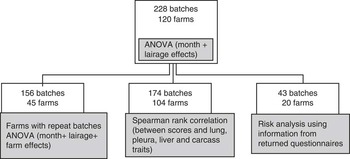
A descriptive analysis of the 228 batches analysed, corresponding to 22 551 stomachs, was used to show prevalence of each score of gastric lesion (0, 1, 2, 3, scar). The statistical unit used for data processing was the batch. Different sub-data sets and the corresponding statistical analyses are summarised in Figure 1. An ANOVA (PROC GLM; SAS Institute Inc., Cary, NC, USA) was carried out to assess the effect of month of slaughter (March to September) and overnight lairage (yes, no) on the percentage of different scores recorded on 228 batches. As the distributions of the percentage of stomachs for scores 0, 3 and for the scars were not normally distributed, a log (ln+1) transformation was applied. A further analysis assessed the effect of farm of origin, as 45 of the 120 farms were sampled at least twice, with inclusion of data on 156 batches. To determine whether there was a correlation between OGU and pathologies assessed on other organs or carcass traits, data were collated from 174 batches for which assessments on lung, pleura, liver and carcasses were available. The prevalence was calculated for each lesion and a Spearman’s rank correlation calculated. For 30 batches, for which information was available on mortality during the growing period, the correlation between lesion score prevalence and batch mortality was calculated.
Flow diagram of the amount of data collected (batches and farms) and corresponding statistical analyses carried out.

Using data from 43 batches from the 20 farms that returned a questionnaire (17% of the farms), an analysis was performed for the identification of risk factors. The 43 batches were divided into two groups: ʻproblemʼ batches in which the sum of percentage of stomachs with scores 2 or 3 was >20%, and ʻno problemʼ batches with lower prevalence. This threshold was set using the approach of Robertson et al. (Reference Robertson, Accioly, Moore, Driesen, Pethick and Hampson2002). A similar analysis was carried out for the presence of scars, and the threshold designated for a ʻproblemʼ batch was arbitrarily set at 15% on the basis of the distribution recorded. A χ 2 or Fisher’s exact test was used to assess the general association between risk factors and the dichotomous outcome response variables (problem batches for ulcers and for scars). A risk ratio (RR) was then calculated for each level of the significant factors (P<0.05) when they were estimable. Factors which showed associations (P<0.2) in the univariable analyses, and for which the data were complete (n=43) and RR could be calculated, were first tested for their interactions. Absolute κ-values>0.40 for a pair of risk factors was considered to show high association and closely related variables with redundancy of information were excluded. The remaining risk factors were entered into a multivariable analysis using a generalized linear model (PROC GENMOD, SAS Institute Inc.) with a log-binomial distribution (McNutt et al., Reference McNutt, Wu, Xue and Hafner2003) and a forward stepwise selection. Two models were run, one for the ulcers (score 2+3) and one for the scarred ulcers. Farm was included as a repeated factor. Risk ratio was calculated for factors significant in the final multivariable model.
Validity of the final models was evaluated by taking into account R 2 and/or adjusted R 2 for linear models, quasilikelihood under the independence model criterion (QIC) for genralized linear models and P-values for factors included for all the models. The assumptions of homoscedasticity and independence of the residuals were graphically tested.
Results
Prevalence of lesions
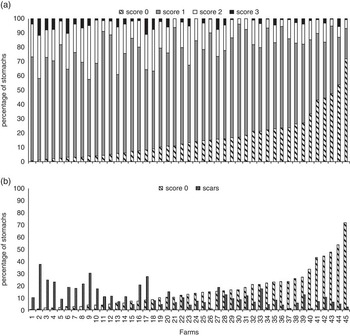
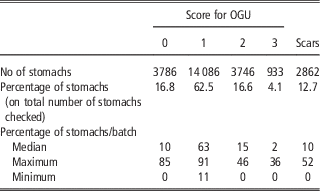
Table 1 shows the distribution of lesion scores across the study period for the 22 551 stomachs evaluated. The prevalence of stomachs positive for ulcers (score 2 or 3) was 21% and for scars was 13%. Considering the batch level, 7.5% of the 228 batches had <1% of stomachs affected by the presence of scars, but there were some batches in which prevalence was >50%. For farms that had at least two batches sampled on different days, the effect of production unit proved to be highly significant for both ulcer score and scars (P<0.0001). Figure 2a and b illustrates the range across farms, showing that the relationships between prevalence of healthy stomachs, severe OGU and scarred OGU had relevant differences. The R 2 of the statistical models adopted for OGU scores ranged from 8% to 20% not considering the farm effect, whereas when it was included the R 2 increased to over 70% for all the scores. The farm effect accounted for almost the 50% of the global variability.
The distribution of gastric ulcer severity scores (a) and the frequency of stomachs with ulcer scars (b) for pigs from 45 different farms involved in the study.

Percentage of stomachs with gastric ulcers of different severity score in 22 551 pigs from 228 batches sampled over a 7-month period

OGU=Oesophago-gastric ulcers.
Influence of overnight lairage, fasting time and the month of slaughter
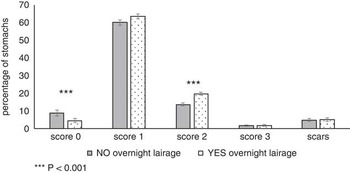
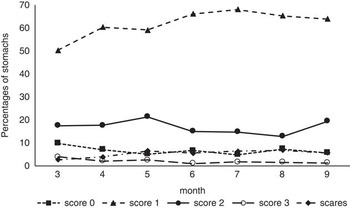
The effect of overnight lairage on the prevalence of ulcers is shown in Figure 3. The percentage of the stomachs devoid of injury was significantly reduced in batches slaughtered after overnight lairage (P<0.001), whereas there was a significant increase in score 2 lesions (P<0.001). There was no effect on the prevalence of scarring. Analysis of a subset of 43 batches for which information on the time of feed withdrawal on farm and the duration of transport was available showed no significant difference in the prevalence of problem batches (>20%, score 2+3) between total fasting times of ⩽24 or >24 h (χ 2=0.529, P=0.467), for distances of ⩽100 or >100 km (χ 2=0.228, P=0.632), or for journey times of ⩽1 or >1 h (χ 2=0.228, P=0.633). The effect of slaughter month is shown in Figure 4. There was a significant effect of month on the prevalence of score 1 (P<0.001), 2 (P<0.001), 3 (P<0.01) and scars (P<0.01). In the period June to August, the percentage of stomachs with score 1 and scars was increased.
Percentages (least squares means±SE) of stomachs with different degrees of severity of ulceration in relation to overnight lairage of pigs.

Percentages (least squares means±SE) of stomachs broken down by ulcer severity score and presence of scars according to the month of slaughter of pigs.

Association of different gastric lesion scores and their relationship with other carcass pathologies and on-farm mortality
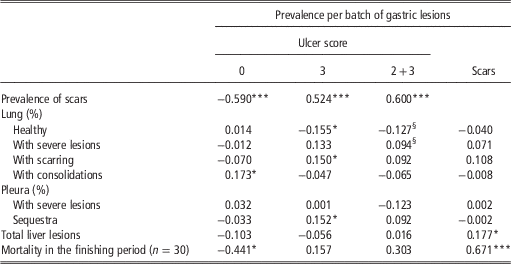
The prevalence of scarring in a batch was negatively correlated to the prevalence of healthy stomachs and positively and significantly correlated to the prevalence of serious ulcers (Table 2). The significant correlations at the batch level between the percentage of stomachs with different OGU scores and other pathological alterations in the pleura, lungs and livers of the animals are shown in Table 2. Only few variables showed statistically significant relationships and these were generally weak. In particular, score 3 OGU showed a weak positive correlation with lung scarring and sequestra, and a weak negative correlation with the percentage of healthy lungs. For 30 batches for which farm records were available, mortality at the farm showed a negative correlation with the prevalence of undamaged stomachs, and a strong positive correlation with scars. The only significant correlation involving carcass traits was a negative association between dressing percentage and score 2+3 ulcers (r=−0.308, P<0.001) and a weaker positive association with healthy stomachs (r=0.210, P<0.05).
Coefficients of correlation (Spearman’s correlation, n=174 batches of pigs) and their significance in associations between gastric lesions (scores of 0, 3, 2+3 and scarring), lesions in other organs and mortality

§ P<0.10; *P<0.05; ***P<0.001.
Risk factors related to production practice
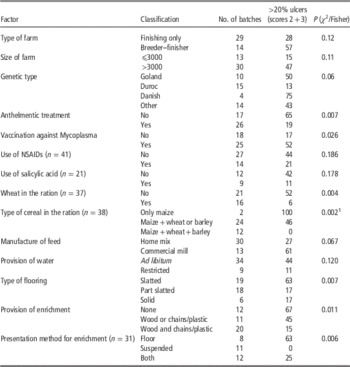
The type of production had no significant effect on prevalence of ulcers (score 2+3 batch prevalence >20%, Table 3), and herd size and genetic type showed only a weak tendency for association. When antiparasitic treatments (anthelmintic or combined anthelmintic/acaricide) were not provided, risk of ulcers increased by a factor of three (RR 3.36, CI 1.42 to 7.97, P=0.007). Vaccination against Mycoplasma hyopneumoniae was associated with a significant increase in risk of ulcers (RR 3.12, CI 1.04 to 9.37, P=0.026), though other vaccinations (Porcine circovirus 2, A. pleuropneumoniae) showed no association. The use of nonsteroidal anti-inflammatory drugs (NSAIDs) and salicylic acid had a weak association with ulcers (0.05<P<0.2). The cereals used in the diet (maize only, maize plus wheat or barley, or all three cereals) influenced the prevalence of ulcers (P=0.011); wheat in the ration was protective, and the combination wheat and barley seemed to be even more effective. Other dietary factors with a weak association with ulcers (0.05<P<0.2) were feed manufacturing source and method of water provision. Housing on a solid floor gave nearly four times less risk than that associated with the use of a slatted floor (fully slatted v. solid, RR=3.79, CI 1.0 to 23.4, P=0.044). No farms provided straw, but the provision of objects as environmental enrichment had a significant protective effect (no enrichment v. wood and/or chains/plastic, RR=2.58, CI 1.26 to 5.30, P=0.013). The method of presentation was also important, enrichment only on the floor giving three times greater risk (floor v. hanging or both, RR=3.13, CI 1 to 9.83, P=0.042).
Risk factors for a high prevalence (>20%) of significant ulcers (score 2+3) from an analysis of 43 batches of pigs. Results are shown for all measures with P<0.20 in univariable analysis

1 Risk ratio not estimable.
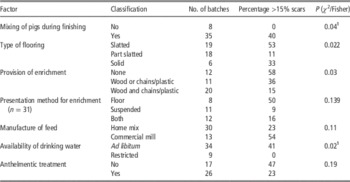
Risk analysis which differentiated batches with a frequency of scars >15% (Table 4) showed that mixing of pigs during the finishing period was associated with increased scarring (P=0.04, RR not estimable). Slatted flooring was again a risk factor (fully slatted v. solid, RR= 4.74, CI 1.20 to 18.7, P=0.04), and provision of environmental enrichment was protective (no enrichment v. wood and/or chains/plastic, RR=2.58, CI 1.15 to 5.80, P=0.025). The method of presentation of enrichment also showed a tendency, with presentation only on the floor giving almost four times greater risk (floor v. hanging or both, RR=3.83, CI 1.08 to 13.55, P=0.03). Although no dietary factors showed a significant association, the availability of drinking water ad libitum was associated with an increased risk (P=0.02, RR not estimable). Dietary factors with a weak association with ulcers (0.05<P<0.2) were feed manufacturing source. The only veterinary factor tending towards association was use of anthelminthics.
Risk factors for a high prevalence (>15%) of scarred ulcers from an analysis of 43 batches of pigs. Results are shown for all measures with P<0.20 in univariable analysis

1 Risk ratio not estimable.
Considering ulcer problems (score 2+3), among the 14 variables that showed association in the outcome of the univariable analyses (Table 3), four were excluded from the multivariable analysis because available data were for <43 batches (use of NSAIDs, wheat in the ration, type of cereal in the ration and method of presentation of enrichment) and five other were excluded due to high correlation with other factors showing greater statistical relevance (type of farm, size of farm, manufacturer of feed and enrichment). Five variables were entered into the multivariable model and only three were retained: anthelmintic treatment (RR=5.0, CI 1.17 to 21.9, P=0.03) and M. hyopneumoniae vaccination (RR=5.6, CI 1.10 to 28.0, P=0.04) with significant effect, respectively, and type of flooring with a strong tendency (P=0.06). This model reached the lowest value for the QIC (44.3). Multivariable analysis of the ʻproblemʼ batches for scarred ulcers was unable to show a significant association with any of the factors tested.
Discussion
The prevalence of OGU in this study (21%, score 2+3) is less than that reported from a previous experiment on pigs in Italian heavy pig production (63%, score 2+3) in groups raised without straw (Di Martino et al., Reference Di Martino, Capello, Scollo, Gottardo, Stefani, Rampin, Schiavon, Marangon and Bonfanti2013), and is also slightly >30% typically reported from abattoir studies in other countries using a similar scoring scale on pigs slaughtered at lighter weights (Robertson et al., Reference Robertson, Accioly, Moore, Driesen, Pethick and Hampson2002; Swaby and Gregory, Reference Swaby and Gregory2012). These results suggest that the slaughter weight per se is not a relevant factor for the development of OGU and that farm management plays a more important role. The study demonstrated a very significant variation between farms, as has been observed previously (Robertson et al., Reference Robertson, Accioly, Moore, Driesen, Pethick and Hampson2002; Swaby and Gregory, Reference Swaby and Gregory2012). The presence of herds with a very low prevalence of OGU shows that this is a potentially controllable pathology, and therefore a better understanding of the causes can lead to viable prevention strategies. Hessing et al. (Reference Hessing, Geudeke, Scheepens, Tielen, Schouten and Wiepkema1992) reported a strong significant ‘litter-effect’ on gastric ulceration which might indicate a genetic predisposition for the development of gastric lesions. In the current study, genotype of pig showed some association with ulcer prevalence. One complication in using abattoir data is the potential for post-farm alteration in ulcer severity. Scores recorded at the abattoir may depend to some extent on the recent development of ulcers, due to factors such as fasting and pre-slaughter transport stress. Pigs delivered to the abattoir in the evening and slaughtered after overnight lairage had a higher frequency of stomachs with erosions and a lower proportion of stomachs with no injuries than pigs slaughtered immediately after unloading. Davies et al. (Reference Davies, Grass, Marsh, Bahnson and Dial1994) and Swaby and Gregory (Reference Swaby and Gregory2012) also reported that the frequency of severe ulcers can be higher in pigs held overnight in the lairage compared with pigs slaughtered on the day of arrival at the abattoir. Other authors (Straw et al., Reference Straw, Henry, Nelsson, Doster, Moxley, Rogers and Webb1994; Lawrence et al., Reference Lawrence, Anderson, Adeola and Cline1998) have reported that fasting or interruption of the feed supply contributes to OGU. For this reason, the presence of scarring, not affected by overnight lairage and unlikely to reflect events immediately before slaughter, might give a better indication of the farm situation as stated for pigs slaughtered at lower weight (Swaby and Gregory, Reference Swaby and Gregory2012). There was a significant correlation between the prevalence of scars and severe (score 3) ulcers, which were also unaffected by overnight lairage, suggesting that a monitoring tool based on these measures might be more informative about the real prevalence of OGU at the farm.
There is little published on time of year effects on OGU. It is reported that in southern US high summer temperatures adversely affect feed intake, which might favour an increase in the prevalence of OGU (Thomson and Friendship, Reference Thomson and Friendship2012). Hessing et al. (Reference Hessing, Geudeke, Scheepens, Tielen, Schouten and Wiepkema1992) found no relation between gastric lesions and climatic stressors. The increase in minor lesions during this period may also be linked to the increased stress during handling and transport under higher ambient temperatures. The higher presence of scars, however, can be traced back to predisposing factors at the farm.
Ramis et al. (Reference Ramis, Gómez, Pallarés and Muñoz2005) suggested that an increase in OGU in pigs from large farms might be due to increased infection pressure from other diseases. The weak correlations between lung and pleura lesions and the development of OGU support an association with respiratory diseases, possibly as a consequence of inappetence and the increased levels of histamine due to infection (Thomson and Friendship, Reference Thomson and Friendship2012). Abattoir recording alone does not allow an accurate estimation of the prevalence of OGU as a complete picture would also include ulcers that led to death of the animal at the farm. The analysis of the relationship between OGU and mortality during the fattening cycle showed a strong positive correlation between the presence of scars and mortality. This supports previous reports that gastric ulcers are responsible for a significant share of overall mortality during fattening (Melnichouk, Reference Melnichouk2002). The fact that the different scores for the lesions did not show such strong correlations with mortality as in the case of scars, may be due to the fact that the latter are indicative of a chronic pathological process, that likely better reflect the true prevalence of OGU at the farm.
The questionnaire study can only be considered as a pilot for future work because of the low rate of questionnaire return. Only 17% of farms returned their questionnaires; however, these showed a good range of management methods that gives the analysis a reasonable external validity. The disappointing return suggests that better interaction with farmers is needed to explain the practical relevance of associating data collected at the farm with information obtained by the abattoir. However, some interesting indications emerged from analysis of the responses, which merit further investigation. In line with the findings of the carcass pathology analysis, few health-related factors proved significant. The apparent negative relationship between vaccination for Mycoplasma and prevalence of OGU is surprising, as literature suggests that the prevention of respiratory disease should result in a decrease of OGU (Thomson and Friendship, Reference Thomson and Friendship2012). However, vaccination could be a proxy variable for herd health status, being used where the pathogen challenge is greater, and not fully protective throughout the life of the pig. Another unexpected result was that the use of antiparasitics resulted in a significant reduction in risk of OGU. There is no previous report of such a link in the literature, although Greve (Reference Greve2012) notes that it is debated if Hyostrongylus rubidus infection can affect the pathogenesis of OGU of the glandular stomach. It is also interesting that, in the current study, there was a significant, though weak, correlation between prevalence of OGU, OGU scars and liver lesions resulting from Ascaris infection. As parasitic infection may cause inflammation, resulting in the release of histamine, a mechanistic route to predispose OGU exists (Thomson and Friendship, Reference Thomson and Friendship2012).
Previous research has focussed on risk factors related to nutrition. It was not possible from this study to draw conclusions about two of the most studied risk factors, particle size (Wondra et al., Reference Wondra, Hancock, Behnke, Hines and Stark1995) and pelleting of feed (Wondra et al., Reference Wondra, Hancock, Behnke, Hines and Stark1995; Amory et al., Reference Amory, Mackenzie and Pearce2006); farmers could not provide information on the particle size of feed, and all of them used a liquid feeding system. The main nutritional factor to emerge as protective was using a combination of different cereals rather than only corn, even if the percentage of wheat and barley in the ration was very small. The addition of wheat decreased OGU risk, whereas the combined provision of wheat and barley seemed to be even more effective. Although this confirms that barley should be preferred as a cereal by virtue of greater fibre content and structural stability during processing resulting in a larger particle size (Nielsen and Ingvartsen, Reference Nielsen and Ingvartsen2000), the benefit of wheat is more surprising given other reports that wheat can be a risk factor (Smith and Edwards, Reference Smith and Edwards1996; Nielsen and Ingvartsen, Reference Nielsen and Ingvartsen2000). However, in these studies, the inclusion of wheat in the diet was then at much higher levels and in comparison with barley rather than maize. Early studies showed that maize-based diets gave greater risk than wheat-based diets, with other cereals such as oats being even more protective (Reese et al., Reference Reese, Muggenburg, Kowalczyk, Hoekstra and Grummer1966). Although the use of maize is unavoidable in the region of the Po Valley, it therefore could beneficially be associated with other cereals to decrease the risk of an ulcerogenic diet. Another unexpected result was that restriction of drinking water reduced the risk of scarred ulcers. The only previous association of OGU with water related to the water source (bore-hole water being a risk factor; Robertson et al., Reference Robertson, Accioly, Moore, Driesen, Pethick and Hampson2002) and was suggested to relate to possible effects of pH, buffering capacity or microbiological quality.
A number of factors relating to housing conditions were highlighted by the study. The risk associated with slatted flooring has been reported previously (Amory et al., Reference Amory, Mackenzie and Pearce2006; Scott et al., Reference Scott, Chennells, Campbell, Hunt, Armstrong, Taylor, Gill and Edwards2006). In many studies this has had a confounded effect with the presence of straw bedding which can be a protective factor, possibly through the provision of dietary fibre (Nielsen and Ingvartsen, Reference Nielsen and Ingvartsen2000; Di Martino et al., Reference Di Martino, Capello, Scollo, Gottardo, Stefani, Rampin, Schiavon, Marangon and Bonfanti2013; Herskin et al., Reference Herskin, Jensen, Jespersen, Forkman, Jensen, Canibe and Pedersen2016). This was not the case in the current study, and an alternative suggestion might be the greater stress of living in a slatted system, where both physical and behavioural challenges can be greater (Scott et al., Reference Scott, Chennells, Campbell, Hunt, Armstrong, Taylor, Gill and Edwards2006). It has been suggested that physical injuries, such as foot lesions or tail biting, as well as other secondary diseases, may cause inflammation resulting in the release of histamine to increase prevalence of gastric ulcers (Thomson and Friendship, Reference Thomson and Friendship2012). Although the ulcerogenic effects of exposure to stressors have been well documented in rodents (Overmier and Murison, Reference Overmier and Murison2000), the role of stress in the pathogenesis of OGU in the pig is less clear. Behavioural stress markers have been found to be associated with the risk of acute ulcers in pigs (Dybkjaer et al., Reference Dybkjaer, Vraa-Andersen, Paisley, Moller, Christensen and Agger1994), but Jensen et al. (Reference Jensen, Pedersen, Nielsen, Heller, Ladewig and Jørgensen1996) failed to increase gastric ulceration by experimentally inducing chronic intermittent stress in pigs.
Even though none of the 20 farms that replied to the questionnaire provided straw, the provision of other forms of environmental enrichment decreased OGU risk. This was the case for provision of hanging chains and plastic objects, and also the case when wood was supplied in suspended form, but not when given on the floor. It is known in the latter case that material quickly becomes soiled and provides little enrichment value (Scott et al., Reference Scott, Taylor, Gill and Edwards2009). The beneficial effect of non-ingestible manipulable objects suggests a link between alleviation of exploratory motivation and reduced stress. It is known that barren environmental conditions induce behavioural signs of stress, however, Day et al. (Reference Day, Spoolder, Burfoot, Chamberlain and Edwards2002) previously found no effects of the provision of different point-source objects (metal chain, chopped straw or a nutritious toy) on the occurrence of gastric ulcers in pigs. In other situations, long-term housing stress has been linked to increased severity of gastric damage, for example, in stall housed gilts in comparison with those in groups (Geverink et al., Reference Geverink, Schouten, Gort and Wiegant2003), and they suggest that the length of housing period is important in this outcome. Furthermore, a beneficial effect of reduced stress is supported by the association between mixing of pigs and prevalence of scarred ulcers. Mixing causes stressful disruption of the social hierarchy (Ruis et al., Reference Ruis, de Groot, Te Brake, Ekkel, van de Burgwal, Erkens, Engel, Buist, Blokhuis and Koolhaas2001) and modification of feed intake (de Jong et al., Reference de Jong, Lambooij, Korte, Blokhuis and Koolhaas1999), and might lead to greater competition for access to food, resulting in a decrease of intake in subordinate pigs when feed quantity or accessibility is restricted. Hessing et al. (Reference Hessing, Geudeke, Scheepens, Tielen, Schouten and Wiepkema1992) also reported that mixing of unfamiliar pigs, as compared with keeping the litter together in a farrow to finish system, resulted in higher prevalence of gastric lesions.
Conclusions
This study has provided the first large-scale assessment of the prevalence of OGU in heavy pig production systems. It has also highlighted the possibility of new risk factors not previously reported in the literature. Prophylactic use of antiparasitic agents, directed primarily at the treatment of gastrointestinal nematodes, decreased the risk of developing gastric lesions. The economic benefit which can be derived from these treatments may therefore be greater than just the reduction of losses in performance due to the presence of parasites, as a reduction in the prevalence of OGU might reduce mortality and improve productive indices. Many factors that are usually considered important for animal welfare also showed an association with OGU such as solid flooring, presence of environmental enrichment and absence of mixing animals all decreased risk, highlighting the potential for psychological, as well as physical, stressors to affect OGU. If it is decided to include abattoir screening of OGU in future programmes for the assessment of well-being on farm, only severe lesions of score 3 and scarring should be used as for pigs slaughtered at lower weight, minor injuries are more related to prolonged fasting and, to a lesser extent, to the transport stress. In addition to being important for protection of animal welfare, screening of OGU at slaughter should be linked to a flow of information back to the farmer, allowing him to obtain an estimate of the prevalence and then implement the necessary preventive measures and verify their effectiveness.
Acknowledgements
The authors thank the abattoir O.P.A.S. – Italcarni Società Cooperativa Agricola, Carpi, Modena for hosting the research team; Chemifarma S.p.A. and Merial Italia S.p.A. for partial funding; and University of Padova that supported the research in collaboration with Prof Sandra Edwards through the call ʻVisiting Scientist 2016ʼ.
Supplementary material
To view supplementary material for this article, please visit https://doi.org/10.1017/S1751731117000799