

This article explores the justification and method for depoliticizing sovereign wealth funds (SWFs)Footnote 1 from a Chinese perspective and is based on the experiences of the China Investment Corporation (CIC) during the two years after its establishment in 2007.
SWFs gained new prominence during and after the autumn of 2007 when their high-profile investments stirred up controversy regarding how nations were managing their foreign exchange (forex) reserves. This public attention was the result of three factors: first, forex reserve levels had increased dramatically over the previous decade to reach record highs; second, central banks in an increasing number of developing and developed countries began to prefer diversifying their reserves by investing in financial markets which offered higher rates of return than United States (US) Treasury bonds;Footnote 2 and third, despite their large size and high growth rate, SWFs are opaque in their operations.Footnote 3 Hence, officials and analysts have raised four main concerns: (1) SWFs could be used to further political objectives through strategic acquisitions;Footnote 4 (2) the sheer size of such sovereign investments raises the risk of creating equity price bubblesFootnote 5 and volatility in financial markets;Footnote 6 (3) SWFs might have a detrimental effect on the corporate governance of the firms they have invested in due to their political motives or lack of sophistication;Footnote 7 and (4) new forms of financial protectionism may emerge as a reaction to SWFs.Footnote 8
Thus, SWFs have been depicted mainly in a negative light as “barbarians at the gate”,Footnote 9 political monsters, or presumed offenders—in a word, SWFs have been politicized. A February 2008 poll showed that Americans are overwhelmingly opposed to SWF investments.Footnote 10 Many politicians have responded to this public distrust through hearings, statements, and regulations hostile to sovereign investments.Footnote 11 Some countries have created and implemented adverse economic policies.Footnote 12 Some commentators pointed out that the worst-case scenario could have emerged had the SWFs of so-called authoritarian governments finally emerged as a viable challenger, like Trojan horses, to the liberal democratic path taken by the advanced industrialized states.Footnote 13 Opposition was particularly focused against investments by SWFs headquartered in the Middle East or East Asia.Footnote 14 Given this climate, SWFs were put on the agenda of the Group of Eight (G8), the International Monetary Fund (IMF), and the Organization for Economic Co-operation and Development (OECD), ultimately resulting in the creation of a voluntary code—the Generally Accepted Principles and Practices (GAPP) or Santiago Principles—in October 2008.Footnote 15 Today, however, SWFs are no longer seen as something to be dreaded and their investments no longer consistently make headlines; sometimes they are even called “a source of stability” in times of financial turbulence.Footnote 16
In particular, the CIC has been subjected to this bias, which may well be related to China’s increasing economic and geopolitical power. For over a decade, China’s forex reserve management regulator—the State Administration for Foreign Exchange (SAFE)—has invested its reserves in financial markets through its secretive subsidiary, SAFE Investment Company Ltd., registered in Hong Kong in 1997.Footnote 17 But since its deal with Blackstone in May 2007, any CIC investment faces the danger of being misinterpreted as possessing a non-commercial goal.
This article borrows the definition of accountability from Grant and KeohaneFootnote 18 to analyse the need for depoliticizing SWFs and the possible solutions to the concerns mentioned above. Part I proposes a dual-layer accountability mechanism to define depoliticization. Part II presents the background of the CIC, the legal framework surrounding it, and the flaws of such a system. Part III reviews the investment policies and practice between CIC and financial markets. Part IV concludes with a brief three-step approach to depoliticize CIC.
I. Depoliticization and accountability
The term “depoliticization” is fraught with ambiguity. In this article, the term is used to refer to replacing a form of political accountability for regulating SWF operations, with legal and market accountability. The investments of SWFs are changing the landscape of global finance.Footnote 19 But it is noteworthy that these state agencies or their subsidiaries do not enjoy sovereign status in transactions and dispute resolution in accordance with relevant prescriptions and practices.Footnote 20 Once SWFs invest in another country, home countries implicitly acknowledge that the funds may be considered as ordinary commercial entities without any privilege or special treatment resulting from their sovereign nature.Footnote 21 Simply put, just like any other actor, the funds must comply with the commercial regulations and ethnic and environmental standards established by the host countries; they also are pressured to become more transparent and accountable.
While accountability is a “protean concept”,Footnote 22 Mashaw observes that accountability could generally mean “the right to hold other actors to a set of standards, to judge whether they have fulfilled their responsibilities in light of these standards, and to impose sanctions if they determine that these responsibilities have not been met”.Footnote 23 Closely linked with mechanisms affecting the efficiency and effectiveness of the operation of SWFs is the legal regime between the home states and the funds, and the market regime between the funds and the investors. In this context, “legal accountability refers to the requirement that agents abide by formal rules and be prepared to justify their actions in those terms, in courts or quasi-judicial arenas”.Footnote 24
The market accountability model suggests that market competition provides rewards and sanctions through the aggregation of individual investor or consumer choices.Footnote 25 Moreover, market accountability—including information disclosure, competition, and the caveat emptor principle—is important for investment decision-making.
As all the concerns and controversies about SWFs centre on who is to be held accountable or how the boundary between state and market can be drawn, I propose that the SWFs, home states, final controllers of the funds, and investors both at home and abroad should be held to legal and market accountability. The legal accountability mechanism emphasizes the role of enforceable and explicit rules, which are preset and rule-based, rather than discretionary and sometimes unpredictable rules which can be subject to arbitrary power held by political elites.Footnote 26 “In most western countries, legal accountability is of increasing importance to public institutions as a result of the growing formalisation of social relations.”Footnote 27 The salient features are its integrity, predictability, and explicitness, which ensure transactional security and predictability.Footnote 28
But both types of accountability reduce flexibility and efficiency in the decision-making process. Hence, there must be a trade-off. As SWFs develop, they necessitate further transparency and disclosure of their investment motivation such that there is adequate legal accountability. However, this is not easy to implement. There are SWFs operating with detailed institutional rules on capital resources and investment portfolios, and there are SWFs—from countries like China and those from the Middle East—which rely on guidance from the political sphere. Given Westerners’ understanding of law and democracy, it is not unusual that SWFs from the latter states are viewed as politically motivated entities without the proper checks and balances. Furthermore, the opaqueness in their decision-making intensifies concerns about their non-commercial objectives and potential harm to host states’ interests or “strategic sectors”. As such, a rules-based structure would greatly aid transparency and soothe all suspicions about politically motivated SWFs. Nonetheless, it is difficult to imagine a framework that can regulate the wide range of SWFs operating in different legal, political, and fiscal cultures and yet remain nimble enough to reflect market changes.
II. CIC’s incorporation and legal framework
A. Background and Facts
On 29 September 29 2007, for a variety of reasons, the Chinese government established CIC as a professional investment agency.Footnote 29 The first reason was that China’s forex reserves had reached an unprecedented level of US$1.4 trillion in August 2007,Footnote 30 an amount in excess of China’s medium-term needs.Footnote 31 Second, empirical research also showed that over the long term, the return on reserves invested was close to zero or even negative.Footnote 32 Third, other costs associated with holding excessive reserves—such as sterilization costs, opportunity costs, balance sheet risks, and the like—were increasingly unacceptable.Footnote 33 Fourth, rapid accumulation of reserves might create a false sense of security and reduce the incentive to tackle difficult reforms such as currency policy.Footnote 34 Fifth, because over two-thirds of the Chinese reserves were invested in low-yield US Treasury bonds,Footnote 35 China was vulnerable to losses led by either a strengthening of the yuan or a rise in American interest rates. The compulsory settlement of the foreign exchange system made this situation more unsustainable than ever.Footnote 36 Citizens and firms were only permitted to hold a limited amount of foreign currency and required to sell the excess to the People’s Bank of China (PBOC).Footnote 37 Hence, PBOC is likely to be the largest, as well as the terminal, buyer of foreign exchange at the expense of the issuance of the same amount of base currency.
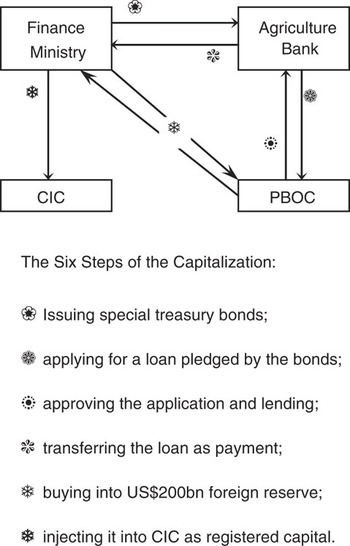
These factors have made diversifying reserve management a necessity for China. As early as 1997, SAFE quietly set up a commercial entity in Hong Kong, known as the China SAFE Investment Company,Footnote 38 with the purpose of investing in stock and equities. Yet little is known about its operations.Footnote 39 According to the plan to have a commercial agency invest surplus reserves in a diversified way that was approved at the 28th meeting of the Standing Committee of the National People’s Congress (NPC), the Finance Ministry will issue to the public in three batches RMB1.55 trillion in special treasury bonds with outstanding terms of more than ten years. This will allow the public to buy into US$200 billion reserves from PBOC as the registered capital of CIC.Footnote 40 In 2007, the Ministry issued two batches, which totalled RMB1.2 trillion and injected it into CIC.Footnote 41 The specific process can be divided into six steps as described in
Figure 1.
Figure 1

Since its formation, CIC has encountered considerable criticism and comment for its financial performance. The huge losses incurred during its first two years have especially attracted public bombardment regarding CIC’s investment policies, level of expertise, and accountability. When Lou Jiwei, Chairman of CIC, announced that “CIC has booked small losses in its external investments in 2008 … [and its] financial performance is far better than other sovereign wealth funds in the world”,Footnote 42 several economists and observers pointed out that Lou’s explanation hid the fact that CIC’s overseas investments were exposed to more than US$10 billion in losses, and CIC’s position was balanced by stock price appreciation of state-controlled financial institutions on the Shanghai and Hong Kong Stock Exchanges. Commentators also concluded that the marked feature of CIC’s investment was “being strong at civil war and fragile at overseas competition”.Footnote 43
B. The Legal Status of CIC
While there are several significant differences in terms of capital resourcing that distinguish CIC from the IMF’s working definition of a “sovereign wealth fund”,Footnote 44 CIC is nonetheless generally considered as a typical SWF. For the following reasons, however, CIC should really be legally classified as a special State-Owned Enterprise (SOE) rather than a SWF.
First, the registered capital of CIC comes from fiscal revenue rather than foreign exchange reserves. While the final result is that CIC gets US$200 billion from PBOC through the Finance Ministry, as Figure 1 illustrates, this legal structure has profound implications. On the one hand, the structure successfully enables the central bank to avoid violating Article 29 of the Act of the People’s Bank of China (PBOCA), which explicitly prohibits the central bank from overdrafting for any level of government and subscribing bonds issued by domestic governmental agencies, such as treasury bonds.Footnote 45 To legitimize the transfer of US$200 billion reserves to a commercial entity, namely the Agriculture Bank of China, certain measures must be taken. Although the same effect is produced, this sale on the payment balance sheet of the central bank is a legitimate and proper way to manage the reserves in line with the PBOCA.Footnote 46 This method of capitalization does not affect the total amount of basic currency, lest inflation escalates and the Finance Ministry’s debt increases. The adoption of this novel structure changes the nature of the money; yet in terms of registered capital resource, there is no difference between CIC and China’s other SOEs.
Second, there is no dynamic linkage, either institutional or practical, between the PBOC and CIC, suggesting that CIC will operate on the basis of the US$200 billion registered capital separately and independently of forex reserve administration. Because the issuance of a special bond must be approved by the NPC or its Standing Committee, if the surplus reserves grow, PBOC cannot transfer them to CIC by itself; rather, any plan would involve at least another three parties: the NPC or its Standing Committee as an approval agency, the Finance Ministry as an issuer, and one or more commercial banks as subscribers or underwriters in line with the Budget Act.Footnote 47 Thus, there is no alternative means of transferring surplus forex reserves to CIC without the involvement of the legislature, the Finance Ministry, and a private third party.
Third, CIC is viewed as a full ministerial enterprise. As a well-known practice and part of the command and control economy’s legacy, almost all the state or collectively owned enterprises and their leaders are categorized into different administrative levels like civil servants.Footnote 48 They have been periodically scaled and estimated by the State Assets Supervision and Administration Commission (SASAC), and the Organization Department of the Communist Party of China (CPC), in terms of administrative ranking, such as full-ministerial, deputy-ministerial, and so on, according to the strategic importance and performance of the enterprises in their charge.Footnote 49 And the leaders’ promotion and remuneration are, in a large part, determined by the evaluation of these agencies.
It is not uncommon that outstanding SOEs’ leaders are appointed to key positions in the provinces, ministries, and such like. This practice is viewed as a significant way of forming cadres with a deep understanding of economic principles and practical management.Footnote 50 As a consequence, the leaders consider themselves more as administrators or cadres than as professional managers and are probably promoted, demoted, or transferred to other positions by the commands of relevant authorities. It is believed that CIC is a full ministerial-level enterprise, ranking higher than common SOEs under the supervision of the central government SASAC. This is because Lou is the former Vice-Secretary-General of the State Council, a full ministerial-level position, and all the other directors are deputy-ministerial cadres.Footnote 51 Therefore, in terms of administrative ranks, CIC is a rare enterprise controlled directly by the State Council and enjoys similar (if not the same) political status as the PBOC, SASAC, Finance Ministry, or Commercial Ministry. This special arrangement preserves its independence and protects its operation from governmental interference on the one hand, and shadows CIC with non-commercial motivation as well as low risk awareness and market sensitivity on the other.
Although whether or not the bureaucratic competition between the PBOC and the Finance Ministry has been serious remains unclear, it will be difficult for CIC to stay independent and unaffected in operation. Based on the PBOCA and related rules, SAFE should be the sole agency in charge of the regulation, management, and operation of reserves subject, in turn, to the principles of safety, liquidity, and profitability. Also, the Professional Commercial Corporation has been established for almost a decade.Footnote 52 From this viewpoint, it does not seem necessary to have another outside manager under the control of the State Council. Nonetheless, the battle between CIC and SAFE Corporation is becoming evident, if not intense—this will have a potential impact on their operations and increase the difficulty of forecasting the future of China’s overseas governmental investments.Footnote 53 There is no direct hierarchical relationship between them, and the impact of this phenomenon will be detailed later in this section.
CIC, however, cannot be equated with common SOEs in China—its position is somewhat special. CIC is a legal person exclusively funded by the state’s fiscal reserve and is not sponsored by either the Finance Ministry or SASAC. It is approved by and under the direct authority of the State Council, making CIC an exception. Besides, after its merger with Central Huijin Corporation, CIC has become one of the biggest shareholders of all the main financial institutions in China, including several of the biggest banks and securities firms and the sole reinsurance company. Therefore, there are some concerns about whether CIC should be viewed as a financial holding company subject to the supervision and regulation of the financial regulators.
C. A Comparative Analysis with Selected SWFs
Compared with some other high-profile SWFs, there is more that can be done to provide CIC with an effective legal accountability arrangement. Among all the SWFs, Singaporean funds such as Temasek and the Government of Singapore Investment Corporation (GIC) are probably the most aggressive and profitable in recent years.Footnote 54 Yet both of them have specific and clear institutional orientations in domestic laws and even in the Singapore Constitution.Footnote 55 Under the Constitution, each Singaporean SWF has been designated as a “Fifth Schedule Company” and is regulated accordingly.Footnote 56 For example, the appointment and removal of their directors and group managing director requires the assent of Singapore’s President.Footnote 57 Also, they are periodically audited by the national auditor-general, and the boards are accountable to the President to ensure that every disposal of investment is transacted at a fair market value.Footnote 58 Moreover, neither the President nor the government is involved in directing investment, divestment, or other business decisions. Such legal arrangements erect a firewall between government companies and relevant agencies under strict supervisory legislation for personnel, reporting and disclosure, and asset transfer—as well as laying a firm foundation for the purely commercial operation of both SWFs.
The difference in capital resources between Temasek and GIC, however, should not be overlooked and probably contributes to a clearer understanding of CIC. Temasek is the owner of the assets under its management, yet GIC simply plays a trustee role, like a professional asset manager. As for GIC, the clients set the investment objectives and monitor its overall performance. Then GIC receives fees to finance its operating expenditure. Actually, the gold standard of SWFs, the Norwegian Pension Fund-Global falls into this category as well. This is the reason why Temasek is reluctant to be described as an SWFFootnote 59 and declines to accept the nine principles reached by the US Treasury, the Singaporean and Abu Dhabi governments, the Abu Dhabi Investment Authority, and GIC.Footnote 60 It is not difficult to find that CIC and Temasek share the same type of capital resource, that is, fiscal revenue rather than foreign exchange reserve; they are not a conduit to invest reserves on behalf of their government, but instead legally own those assets under their management.
The SWFs of some other countries, such as Russia, the Republic of Korea, and Norway, also have clear-cut legislation to regulate the funds’ corporate governance, portfolio decision-making procedure, asset transfer, and the qualification and appointment of directors and senior managers.Footnote 61 These arrangements explicitly define the relationship among SWFs and relevant administrative agencies in the respective countries. To some degree they also address the distrust of SWFs that is attributable to concerns about ideology, massive concentrations of economic power, and the political “black box” in the course of decision-making.Footnote 62
D. The Negative Effects of CIC’s Legal Arrangement
Apart from the misunderstanding regarding its source of capital, the lack of a legal accountability mechanism seems to be a more pressing problem for CIC. Most decisions by and about CIC seem insulated from public participation and an effective accountability mechanism even when the US$200 billion fiscal debt was generated overnight. Although it is much more transparent than the SAFE Corporation, there remains much criticism and doubt over the management of CIC. This has caused many after-effects both at home and abroad.
For one, CIC will be directly exposed to considerable domestic public criticism. Because there are no clear firewalls establishing it as an autonomous state fund—unlike other agencies that have more state control—citizens are obviously worried about its investment profile and returns, as well as the risk of corruption (since such large sums of money are involved). This is despite the fact that CIC is directly supervised by the State Council, which is still traditionally viewed as a more responsible, people-caring government entity than local or subordinating departments and agencies. Moreover, the freedom of the press that is granted for finance matters has enabled widespread publicity over any CIC issue. So CIC is exposed to both pre-trial and post-trial publicity through the media and the Internet for any practical and potential loss. Because of the lack of legal and express mandates, as well as the investment policies in place, any defence or explanation is viewed as an excuse for CIC’s wrong decision—leading to the questioning of CIC’s limited expertise and even loyalty. As a result, CIC’s management and decision-making can be broadly influenced, its independent and professional status cannot be sustained, and all of these issues can be politicized at home. Taking into account the political-cadre commitment of the leaders and high-level managers, CIC probably has to focus more upon the external feedback coming from different social classes than it does upon its investment and performance. Here, the absence of a legal accountability mechanism is a double-edged sword: it enables the CIC to enjoy more flexibility in the decision-making process, while at the same time limiting its legitimacy and efficiency. Under these circumstances, it is a difficult undertaking to maintain a “politics proof”, commercial, and professional operation.
Second, CIC faces additional negative publicity in host countries for lacking proper or predictable legal accountability. Combined with conventional ideological biases, the transfer of CIC’s considerable assets with little supervision and regulation will cause the citizenry of recipient countries to fear that its real purposes are not merely economic. Because no formal institutionalization of CIC has taken place in China, the public and legislatures of the recipients have been more inclined to make or search for rules to regulate CIC and foreign government investments for their security and interests. To counter this, CIC might declare that it will be a long-term passive actor, thereby also losing credibility for its supposed commercial interests.
All of these factors have a negative impact on the accountability and independence of CIC’s decision-making. They also weaken the function of market accountability and are excuses for trade protectionism. The reality in the past year shows that home regulators should play a more important role in the development of SWFs and make their lack of expertise and experience in international investment a top priority.
But the history of China’s reform can probably be understood as a history of marketization. CIC’s incorporation and investments can be considered key steps in deepening and expanding the nation’s market-oriented economy along the path of reform and opening, which began in 1978.Footnote 63 In comparison with peer SWFs in other countries, neither its legal accountability nor market accountability are adequate.Footnote 64 Historically, the central government has always seen the financial industry as a significant sector and been hesitant to let foreign and private investors into the market. It seems that the excessive reserve and financial globalization make the “state first policy” obsolete. CIC’s investment suggests that the Chinese government began to outsource the state-held financial assets mainly to foreign asset managers to earn rational returns over the long term. CIC’s investment returns, good or bad, are a step forward to a more market-oriented economy; although, as a matter of degree, there are some drawbacks to the growing pains that arise in the institutional and market efficiencies around the corporation.
China’s ongoing reforms also represent a transition from a foundation for the modern state upon the “rule of man” or a “rule by law” towards a “rule of law” or “legal state”, to adopt the political jargon.Footnote 65 While the Chinese government maintains that it is committed to governance under the rule of law, compared with its reforms in the economic sphere, political reforms have been lacking and the rule of law remains very thin. Unfortunately, the fiscal system is one of the most difficult and complicated dimensions of governance because it deals with how a government obtains its wealth—i.e. the extractive capacity of state. Accompanying the economy’s gradual liberalization, China has been transforming from an owner-state to a tax- and budget-state, which requires the rule of law rather than rule by law.Footnote 66 Market liberalization breeds, and continues to develop, the rule of law in China, though with typically pragmatic movements and Chinese characteristics. On the one hand, while still under the control of the State Council, CIC has been placed in the current legal framework and even pushed into international markets without most, if not all, of the privileges enjoyed at home. This legitimization is indeed a kind of progress. In the context of CIC’s formation, the State Council does not (at least not so arbitrarily or publicly), play its old roles as a money-maker with a soft budget or as a de facto self-disciplined market regulator. Instead, it is an indirect and implied controller behind the scenes and a tax collector. On the other hand, this progress is not as apparent, especially in Westerners’ minds—most of whose states have achieved the fiscal as well as governance transformations of modern states even before the last century.Footnote 67 Considering the complexity of these reforms, and the development of governance in China over the last few decades, the gap, both cognitive and normative, is not impassable at all—though the room for improvement remains huge.
The immediate conclusion can be drawn that the essential elements of the controversies surrounding SWFs can be dealt with by addressing the distance and connections between SWFs and their host governments. Whether a SWF has a credible and effective legal framework when operating on the international market is the key to running a commercially oriented fund. The nature of the arrangement itself, not the opaqueness of its operation, should be given special attention because the latter is not unique or fresh but merely a common and tricky problem to be tackled.
III. CIC’s investment policy and market accountability
If the lack of legal accountability could be corrected in some proper way, CIC and other SWFs could be equated with other institutional investors in the global financial market, such as hedge funds, private equities, or pension funds. In other words, on the condition that non-commercial motivations can be separated from the operation of SWFs by an effective legal accountability mechanism, SWFs share plenty of similarities with other institutional investors, especially in decision-making and risk management. Because their final objective is a sustainable return rather than geopolitical influence, SWFs should act as reasonable and rational investors subject to the common principles of wealth management, with the same exposure to risks and competition. There is no other form of market-driven accountability that could be applied to public funds that would not also apply to private investors in this highly globalized financial market. This has three implications: first, SWFs should be treated in the same as private investors by host country regulators—especially for market entrance requirements. Second, in practice, SWFs should not place self-imposed restraints upon the proper functioning of market principles—such as giving up shareholder rights in response to fears about their excessive influence. Third, the transparency issues posed by SWFs should not be exaggerated and large private investors should be treated in a similar fashion—this is especially true of hedge and private equity funds.
A. CIC’s Investment Practice
It seems that CIC has no coherent or concrete investment policy as some commentators suggested.Footnote 68 In the following sections, the investments of CIC, both at home and abroad, will be examined and then compared to other selected SWFs. Additionally, the implications of its market accountability mechanism will be addressed.
1. Overseas investments
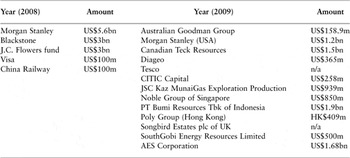
Despite criticisms regarding lack of transparency, the basic outline of CIC’s initial investment strategy is relatively clear. For example, “[r]oughly $110 billion of the fund’s capital has been dedicated to the domestic financial sector”,Footnote 69 while “[t]he remaining $90 billion, slated for international markets, has drawn the most interest from international observers”.Footnote 70Table 1 presents the investments that CIC made in its first two years.
CIC Overseas InvestmentsFootnote 71

The first US$8 billion of international investments went to high-profile stakes in Blackstone and Morgan Stanley.Footnote 72 The Blackstone deal was a direct stake before Blackstone’s Initial Public Offering (IPO) that has lost nearly half of its value, provoking considerable criticism from the public in China.Footnote 73 CIC’s stake in Morgan Stanley, however, was structured to limit CIC’s potential downside: CIC held convertible bonds with a 9 percent return, convertible to stock after a tie-up period.Footnote 74 Still, the fund’s leadership had grown wary of the US financial sector as a result of its recent losses.Footnote 75 It is believed that both deals at least appeared to have been helped along by personal connections. The chairman of Blackstone’s Greater China operations, Antony Leung, is a former finance secretary of Hong Kong and is known to be on very good terms with the mainland’s financial authorities.Footnote 76
CIC officials have gone out of their way to describe these two stakes as anomalous, insisting that most investments would be made in international stock markets through third-party managers. Chairman Lou has stressed that CIC would be “focusing on financial portfolios”.Footnote 77 President Gao Xiqing has specified that the fund would concentrate on “the cash market, fixed income, equity and hedge funds”,Footnote 78 as well as private equity.
In addition to plans CIC has already confirmed, rumours abound regarding potential tie-ups with Chinese SOEs looking to expand abroad. Not long before the official establishment of CIC in September 2007, Li Rongrong, head of SASAC, publicly lobbied for the new institution’s funds to be used to assist Chinese state-owned firms to grow into more “influential” multinational firms.Footnote 79 Unnamed sources in December 2007 claimed that CIC would shift its attention to natural resources, and specifically work to assist Chinese SOEs in their outward investment plans. Some unconfirmed news reports that CIC would assist China Petrochemical Corporation in acquiring overseas assets seemed to buttress these reports.Footnote 80 Also, the fund was engaged in discussions with Hainan Province about a potential investment in a commercial crude oil reserve.Footnote 81 Following this, CIC also discussed assisting Shenhua Energy in purchasing 15.85 percent of Fortescue.Footnote 82
2. Domestic investments
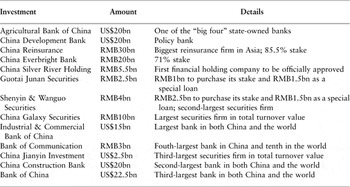
Though receiving less attention outside China, CIC’s role in the domestic economy may ultimately prove to be much more important than its role in the global market. By absorbing Huijin, CIC has assumed a controlling ownership of almost all the heavyweight domestic financial institutions. Table 2 presents CIC’s subsidiaries, including affiliated companies and details of the investment.
CIC’s Subsidiary and Affiliated Companies

Through a joint venture with Morgan Stanley, Huijin also owns the China International Capital Corporation (CICC), the largest investment bank on the mainland. CICC has been involved in all of the recent high-profile outward investments: Chinalco, Shenhua, CNOOC, PetroChina, and Sinopec. CICC is also looking to expand its role in China’s financial markets by developing into a full-service financial outfit offering private equity, asset management, and wealth management services.Footnote 83
B. Some Implications
CIC has announced that the assets under its management would be roughly divided into three equal parts: one-third to take over Central Huijin Investment, one-third for overseas investments, and the rest to bail out unreformed state banks.Footnote 84 On account of the role it has played in these institutions, and its special political background as described above, in practice CIC exerts its influence and discharges the functions of SASAC to improve the quality and competitiveness of the whole financial sector. As such, CIC is like Temasek as well as like a de facto SASAC; CIC is not only a heavyweight business entity, or even a quasi-monopolist, but also a quasi-governmental agency performing multiple functions. At least with regards to its stakes in domestic financial firms, CIC hardly operates like a private and purely commercial investor. This will be true as long as China relies on state banks and state-controlled securities markets to support its economic policy objectives, including exchange rate management. Ironically, though, CIC’s non-commercial, strategic stakes in the domestic financial sector have been the most profitable of all its investments to date.Footnote 85 CIC also has a mandate to advance the governance of its affiliated Chinese enterprises and support their attempts to expand globally.Footnote 86 Therefore, it is clear that CIC serves strategic purposes beyond purely commercial functions.Footnote 87
As CIC is fiscally debt-based, the cost of treasury debt and the expected appreciation of the RMB become the “hurdle rate” which CIC must beat in order to be economically viable over the long term. As most observers expect inflationary pressures to rise and the RMB to appreciate much more quickly, the actual hurdle rate is probably going to be significantly higher. So if CIC is run as a long-term passive investor, it will be hard to succeed by this measure.Footnote 88
This mixture of public and private functions, however, is similar to the royal wealth funds of the Gulf countries, and is blurring the boundary between public agencies and commercial entities. This dynamic will compromise a fund’s ability to comply with commercial principles. The conflicts of objectives will then lead to unnecessary ambiguities and some worries around investment principles, strategies, policies, and other resultant difficulties in transparency.
Worthy of special note is the impact that CIC—as a controlling actor in China’s financial industry—has on the possibility for interest transfers and market monopolization, especially in the context of the Anti-Monopoly Law of August 2008.Footnote 89 Under the definition and standard for “dominant market position” based on market share,Footnote 90 CIC will be presumed dominant in at least the banking and reinsurance sectors. Besides, although there is not any explicit rule directly concerning financial holding companies in China, this behemoth, with both economic and political significance, will definitely impinge on the effectiveness of the financial regulation.Footnote 91 Therefore, there is a practical need to define the relationship between CIC and the financial regulators in both China and the rest of the world.
In sum, apart from the lack of effective and explicit legal mechanisms, the market accountability of CIC has been fragmented and incoherent. At home, CIC plays the role of quasi-administrator for state-owned financial assets. But it also plays a quasi-commercial role, though it has shown self-restraint from involvement in the management of the affiliated companies and has been careful to keep a lower profile than other private investors. These two roles of CIC cause opaqueness in the market.
IV. Concluding remarks: three steps to depoliticize cic
Questions involving the boundary between government and private markets have proved to be difficult to answer with regards to China, particularly in the context of the economy’s gradual liberalization and the reform that has accompanied it since the late 1970s. It is important to place the establishment of CIC within this context of reform and liberalization and to view its policies and multifaceted mandate as a key step in the deepening of the market-oriented economy. Beijing’s reluctance to expose the Chinese financial system to external investors has been well documented, but it could well be that CIC will play a key role in the move towards greater liberalization. Given the size of China’s foreign reserves, it appears that policy-makers have reason to feel more comfortable about embracing the next face of financial globalization. Clearly, this role is apparent in CIC’s domestic investment and control over financial institutions, but it also pertains to its external investments, where, if successful, CIC can assist in the establishment of professional investment expertise more broadly. It is therefore in the interest of Western countries to see CIC flourish as a professional investment company that serves as a catalyst for the latest efforts at building a market-oriented economy in China, with a less politicized financial services sector. Indeed, it appears likely that the more success CIC enjoys, the less it will be subjected to political pressure and employed to further political aims.Footnote 92
The near future will witness more CIC-like state-controlled conglomerates or national champions emerging in certain businesses vital to the national interest and people’s wellbeing.Footnote 93 From this perspective, CIC is just a microcosm of the transfer of global wealth and economic power now under way, the origins of which lay in China’s market-oriented reforms during the last three decades.
However, Chinese officials, as well as officials from other home states, should recognize that the concerns raised by recipient countries are not entirely irrational or unreasonable. For the most part, it is the opaqueness of the internal domestic structure—where a firewall between the state and the market is lacking—that is creating controversy among both the public and policy-makers regarding the nature and methods of CIC’s investments. Therefore, it is imperative for China and other governments to substitute political mechanisms with legal and market mechanisms. This means that home countries should move first to mitigate the concerns. As for China, the State Council or NPC should clarify the legal status of CIC in special legislation and ensure “arm’s-length” relationships between the professional investment institutions and administrative agencies. All of these active measures are expected to produce a comparatively clear boundary between government and private market aspects of the fund and will be helpful in eliminating concerns and controversies in the foreseeable future. As for market accountability, special efforts should be made to create an incentive-compatible remuneration scheme. This should also be different from a valuation system for either civil servants or CPC cadres, in order to attract experts and skilled staff. To further abate worries about its motivations and objectives, CIC should periodically apply the ex post disclosure principle for transparency: its annual report reveals rough fiscal information and the following year discloses the information in a more transparent, concrete portfolio along with transactional details. This permits the fund to avoid losing its competitive edge in the market. In this regard, the best benchmark for policy development is the Santiago Principles.
The second step is to eschew laws and regulations that target SWFs specifically, and by definition treat them differently from other large institutional investors. While host countries have legitimate concerns over the potential of sovereign investors for distorting the functioning of private capital markets, they also have an interest and responsibility to advance the free flow of capital across borders. The key, therefore, is to establish a regulatory framework that guards against the dangers posed by sovereign investors, but that does so in a neutral manner: singling out SWFs is likely to be counter-productive in ensuring that they act as highly professional, commercially orientated players in the global financial markets.
As a final step, SWFs and other governmental investment vehicles should be encouraged to participate in ongoing negotiations about the global investment architecture, in the form of both bilateral investment agreements and multilateral frameworks, rules, and guiding principles.Footnote 94 If sincere steps are taken along these lines in both the countries that have SWFs and the countries that are the recipients of such investments, there will be no need to create new national or international regulatory agencies or to formulate targeted regulations aimed at sovereign investors as a new force in the global financial system.
 ” (“CIC” and “waster of state asset” in Chinese) as keywords.