Introduction
Protein-losing enteropathy associated with failing Fontan circulation remains a significant challenge in long-term, single-ventricle circulation management. We report a novel experience with remission of recalcitrant protein-losing enteropathy after treatment of Cryptosporidium gastroenteritis with a combination of antimicrobials including nitazoxanide, paromomycin, and azithromycin. Notably, azithromycin is a macrolide antimicrobial with a multi-faceted mechanism of action thought to contribute to its anti-inflammatory effects irrespective of its anti-bacterial properties. The use of azithromycin in reducing chronic inflammatory exacerbations, such as those in non-cystic fibrosis bronchiectasis, based on its anti-inflammatory properties, has been thoroughly reported. Focused research surrounding the potential role of alternative anti-inflammatory agents in Fontan-associated protein-losing enteropathy management, such as azithromycin, may be beneficial in providing alternative, cost-effective means of protein-losing enteropathy management in severe cases.
Case report
We report the case of a 17-year-old, 19-kg male who presented with the chief complaint of a right lower extremity animal wound complicated by the development of lower right extremity cellulitis. Our patient has a complex past medical history including a cardiac diagnosis of hypoplastic left heart syndrome. After successful Norwood/Sano and Glenn procedures, he underwent a low-risk fenestrated Fontan procedure at age four. Extracardiac history is significant for hypogammaglobulinaemia with severe T-cell deficiency, osteoporosis, congenital hypothyroidism, and heterozygous pathogenic deletion of chromosome 2q13.
He was initially diagnosed with protein-losing enteropathy approximately three months after his Fontan procedure in 2011. Cardiac catheterisation at that time demonstrated acceptable haemodynamics and no important anatomic obstruction or valve regurgitation. He was managed with standard of care heart failure medications and traditional protein-losing enteropathy therapies for many years, with only occasional need for supplemental albumin. He was subsequently referred for cardiac transplant; however, he was denied secondary to his immunologic disorder.
In 2023, he progressed to severe protein-losing enteropathy recalcitrant to standard therapy requiring weekly outpatient albumin infusions and frequent admissions for intensive albumin repletion. Catheterisation and imaging were performed in August 2023, which was significant for a hypoplastic innominate vein with a large decompressing vein to the superior vena cava, Dori type 3 lymphatics, and acceptable haemodynamics. Cardiac catheterisation was repeated in April 2024, at which time the innominate vein was successfully dilated without evidence of remaining decompression channels.
Immediately preceding his admission, he failed intravenous dopamine therapy, which was complicated by occlusion and thrombosis of the central line, necessitating line removal, dopamine discontinuation, and thrombosis treatment with low-molecular-weight heparin. He was maintained with close follow-up and outpatient albumin infusions until February 2024. Over the following five months, he required nine admissions and received a monthly average of 184 g (9.7 g/kg) albumin to maintain a monthly average serum level of 2.2 g/dL. In the few weeks prior to admission, his average albumin serum level was 1.45 g/dL despite 150 g repletion.
Our patient was most recently admitted for cellulitis treatment with intravenous ampicillin/sulbactam and subsequently transitioned to enteral amoxicillin/clavulanate. After clinical resolution of cellulitis, his course was further complicated by difficulty maintaining albumin serum concentrations within patient-specific goals as well as resulting fluid overload requiring close titration of diuretics. His albumin on admission was 1.1 g/dL, and he progressively required 1.5–3 g/kg albumin repletion one to three times per week while admitted. He continued to be unresponsive to traditional supportive measures consistent with his history.
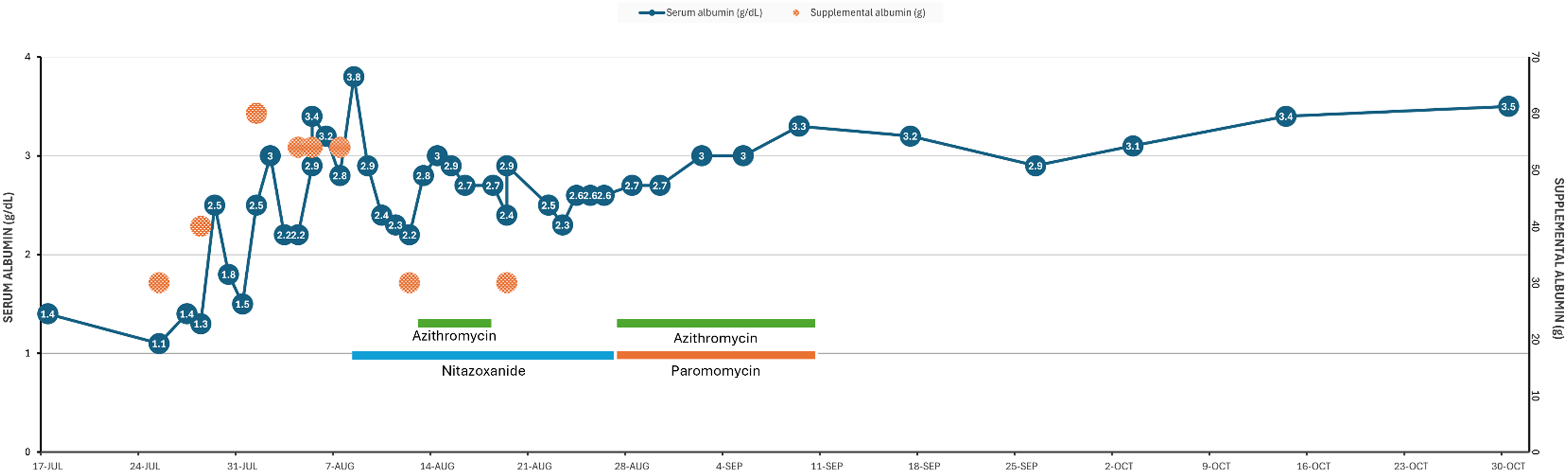
He developed persistently increased stool output not felt to be related to his recent antibiotic therapy for cellulitis and was diagnosed with Cryptosporidium gastroenteritis. His stool output remained significantly elevated at a 7-day average of 39 cc/kg/day with continued detection of Cryptosporidium in the stool despite a 22-day course of nitazoxanide (500 mg twice daily) and high-dose loperamide. He was converted to salvage therapy with a 2-week course of azithromycin (250 mg once daily) and paromomycin (250 mg twice daily) combination therapy. Reference Sparks, Nair, Castellanos-Gonzalez and White1
After starting this therapy, his serum albumin levels began to rise without the need for repletion. Simultaneously, his stool output improved as depicted in Figure 1. Six weeks into admission and two weeks without albumin repletion, combination antimicrobial therapy was discontinued. He was then discharged with an albumin level of 3.3 g/dL without changes to his long-standing home medications.
Trends in serum albumin, supplemental albumin requirements, and select antimicrobial exposure prior to, during, and after admission.

To date, our patient has been without readmission, maintains a normal serum albumin level of 3.7 g/dL and remains clinically well. It has been over 11 months since his last albumin infusion and he remains asymptomatic of his disease.
Discussion
The relative cure of severe and recalcitrant protein-losing enteropathy in a failing Fontan physiology has not been documented, to our knowledge, outside of orthotopic heart transplantation. Our patient had been exposed to most, if not all, of the modern measures attributed to reduction in disease severity, such as albumin infusions, maintenance enteral budesonide, pulmonary vasodilators, dopamine, and low-molecular weight heparins, without appreciable improvement in disease symptomology. Reference Schleiger, Ovroutski and Peters2,Reference Venkatesh, Gao, Abudayyeh, Pai and Varadarajan3 Therefore, it is important to discuss our novel experience with remission of severe protein-losing enteropathy, potentially highlighting non-pressure-related aetiologies of this challenging disease.
Given the nature of this limited report and complexity of the patient, it is not possible to prove causation. However, a few interesting trends should be noted in the review of the data presented. Firstly, the most appreciable cause of acute on chronic diarrhoea was complicated by Cryptosporidium gastroenteritis. To date of publication, there are no data to quantify the prevalence of gastrointestinal pathogens in the Fontan-associated protein-losing enteropathy population. Our patient was recalcitrant to a prolonged course of first-line therapy nitazoxanide as evidenced by continued detection of Cryptosporidium by gastrointestinal polymerase chain reaction. Switching to a salvage therapy combination of azithromycin in combination with paromomycin appeared to provide gradual resolution of stool output, as well as contributed to serum albumin retention. It should be noted that while treatment of Cryptosporidium gastroenteritis has not been associated with protein-losing enteropathy remission, it is prudent to acknowledge literature surrounding the use of azithromycin for non-infectious indications. Azithromycin is a macrolide antimicrobial that works via inhibition of cell chemotaxis, cytokine synthesis, adhesion molecule expression, and reactive oxygen species generation. Reference Diego, Milara, Martinez-Moragón, Palop, León and Cortijo4 This mechanism is thought to contribute to the anti-inflammatory effects of azithromycin irrespective of its anti-bacterial properties as supported by a recent meta-analysis describing the effects of azithromycin on chronic bronchiectasis. Reference Li, Liu and Ou5
Analysis of this patient’s course and response to therapies deviates from current beliefs about the progression of Fontan-associated protein-losing enteropathy. An interesting theory about the potential unmeasured impact of gastrointestinal pathogens on the progression or flare of chronic protein-losing enteropathy patients is raised which current protein-losing enteropathy therapies do not address. Future research is needed regarding Fontan-associated protein-losing enteropathy and the use of alternative anti-inflammatory agents such as azithromycin in addition to quantifying gastrointestinal pathogen burden in this population.
Acknowledgements
SP and ML provided invaluable feedback to the drafting of this original research report.
Financial support
This research received no specific grant from any funding agency, commercial, or not-for-profit sectors.
Competing interests
None.