I. INTRODUCTION
Dye-sensitized solar cells (DSSC) are considered to be a potential candidate for solar energy conversion devices due to their environmental friendly, cost-effective, and simple fabrication characteristics.Reference O’Regan and Grätzel1–Reference Lee and Chang10 One of the important issues for designing high efficient solar cell devices is to find efficient photoelectrode materials with suitable nanostructures and electronic band structure. TiO2 is one of the most promising candidate material widely investigated for use in photocatalysis, photoelectrodes, and solar cells. Wide band gap (3.2 eV) of the TiO2 limits a photocatalytic property in the visible light region. To extend the activity of a photoelectrode into the visible light region, various approaches were used including doping TiO2 with other impurities and sensitization with semiconductors, which can absorb light in the visible light region. Semiconductor nanocrystals, known as quantum dots (QDs), as an alternative to photosensitive dyes offer various advantages over dyes. It was recently established that QDs generate multiple electron–hole pairs per photon, improving device efficiency. Semiconductor QDs such as CdS, CdSe, PbS, PbSe, and InP have been studied as sensitizers of photoelectrodes using several TiO2 structures.Reference Zeng, Tao, Sui, Zhou and Zhao8, Reference Wang, Bai, Zhang, Li and Guo11 Among these, cadmium sulfide (CdS) is relatively suitable and more stable in the presence of sacrificial reagents. TiO2 nanotubes (NTs) and nanorods (NRs) were found to be competent structures due to their direct electrical pathway for photogenerated electrons, which increases the electron transport rate and in turn may improve the performance of the photovoltaic application.Reference Lee, Chi and Liau12–Reference Chang and Lee14
In this study, we evaluated CdS QD-sensitized TiO2 NRs (single crystalline) on fluorine-doped tin oxide (FTO)-coated glass substrate and polycrystalline TiO2 NTs as a photoanode for a solar cell. Single crystalline NRs may significantly improve performance of the quantum dot solar cell due to the better charge transport and collection properties.Reference Liu and Aydil15, Reference Feng, Shankar, Varghese, Paulose, Latempa and Grimes16 Structural defects in polycrystalline TiO2 NTs provide recombination centers for electron–hole pairs, which also increase resistance in the nanostructure. Moreover, as-sensitized CdS/TiO2 samples were heat-treated to improve the crystallization of CdS and CdS–TiO2 interface. Measurements of photocurrent and overall cell efficiency confirmed that the NR-based solar cells showed higher photocatalytic performance, compared to NT-based solar cell without heat treatments.
II. EXPERIMENTAL DETAILS
Paces of FTO glass substrates (2 × 2 cm) were cleaned in solution containing deionized (DI) water:acetone:2-propanol (ratio1:1:1) in a supersonic cleaner. Hydrothermal solution contained 30 mL DI water, 1 mL titanium 2-butoxide (Sigma-Aldrich, St. Louis, MO), and 30 mL HCl. Cleaned samples were arranged in autoclave cell containing hydrothermal solution. Hydrothermal process conducted at 180 °C for 5 h. After cooling down until room temperature, samples were taken out and cleaned in DI water. Samples’ colors were changed from transparent to white opaque color. After drying under nitrogen flow, samples were annealed at 450 °C for 30 min in tube furnace. TiO2 NTs arrays were grown by electrochemical anodization of Ti foils with thickness of 0.1 mm and 99.6% purity (Alfa Aesar, Royston, UK). Substrates were thoroughly cleaned by sonication in trichloroethylene, acetone, and methanol before anodization. Anodization was carried out in electrolyte containing of 0.15 M NH4 F in solution with ratio of 19:1 in formamide and DI water and 35 V for 3 h at room temperature using a platinum foil as the counter electrode. Amorphous TiO2 NTs formed by the anodization processes were annealed for crystallization at 550 °C in air for 4 h. Further, both NRs and NT samples were sensitized with CdS QDs by using successive ionic layer adsorption and reaction (SILAR) method. In typical experimenters, 0.1 mol CdSO4 and 0.1 M Na2S were used as Cd and S sources, respectively. Samples were dipped in to each source solution (Cd and S) for 3 min. After each dipping samples were rinsed with DI water. Dipping and rinsing (Cd→DI→S→DI) was comprised as a one cycle. Desired amount of CdS was obtained after 10 SILAR cycles. Each time after dipping into each source, samples were washed with DI water and dried under nitrogen gas flow. TiO2 NR/NT after CdS QD sensitization was heat-treated at 300 °C for 30 min in an inert environment (in nitrogen-filled glove box) to avoid oxidation. Counter electrodes were prepared by spin coating of platinum solution containing H2PtCl6·6H2O on FTO. QDs-based solar cells were assembled by sandwiching a ∼25-μm-thick Surlyn frame (Solaronix, Aubonne VD, Switzerland) between the prepared electrodes and a platinized FTO electrode. Photoelectrochemical measurements were performed under AM 1.5 sun condition using polysulfide electrolyte [2 M S, 0.5 M Na2S, and 0.5 M KCl in DI water:methanol solution (7:3 vol%)].
III. RESULTS AND DISCUSSION
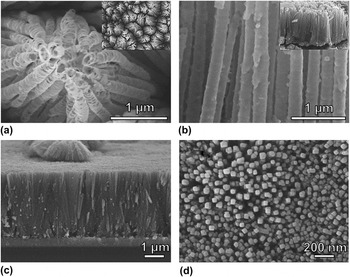
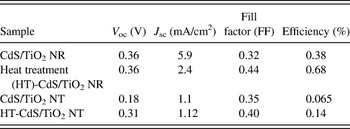
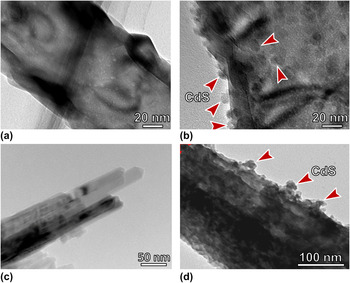
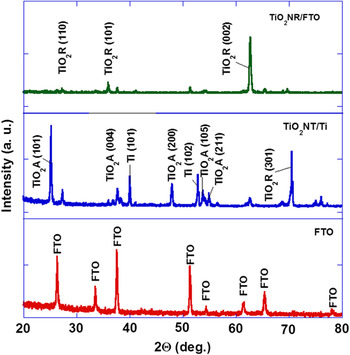
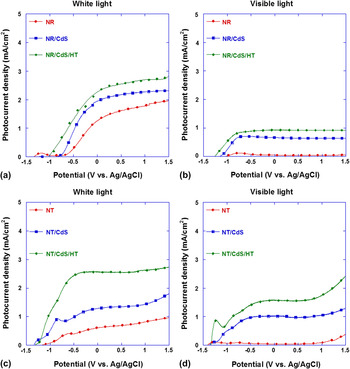
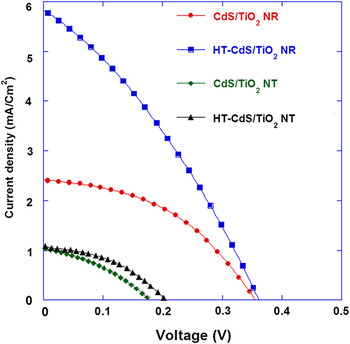
Morphologies of the grown NT and NRs were studied by using a field emission scanning electron microscope (FE-SEM). Figures 1(a) and 1(b) show cross-sectional and surface FE-SEM images of TiO2 NTs obtained by anodizing method and Figs. 1(c) and 1(d) show cross-sectional and surface image of TiO2 NRs grown by using hydrothermal method. It is confirmed that morphology of the NRs can be controlled by changing experimental parameters such as time, temperature, and concentration of the solution. Average length of the NTs and NRs was 6 and ∼1 μm, respectively. Figure 2 shows transmission electron microscope (TEM) images of TiO2 NTs (a) and CdS-sensitized TiO2 NTs (b), respectively. Bare TiO2 NRs and after sensitization with CdS can be seen in Figs. 2(a) and 2(b) respectively. From TEM images shown in Fig. 2(b), we can see well-isolated CdS nanoparticles with average size of 10 ± 3 nm. Nanoparticles are regularly distributed inside and outside the NT as indicated with arrowheads. In NR case, CdS nanoparticles are mainly distributed on the outside surface of NRs. Figure 3 shows x-ray diffraction (XRD) pattern of the TiO2 NRs and NTs along with bare FTO glass as a reference. From the XRD result of TiO2 NTs, we can see that it is polycrystalline in nature and composes of mixed anatase and rutile phases. However, NRs show only rutile single crystalline TiO2 phase, compared to NTs, and (002) diffraction peak was increased, indicating that NRs are oriented perpendicular to the FTO surface and grow in the [001] direction. Photoelectrochemical tests of the samples were performed in three-electrode system in Na2S electrolyte and results are shown in Fig. 4. Photocurrent densities of the bare TiO2 and CdS/TiO2 NRs under white and visible light irradiations are shown in Figs. 4(a) and 4(b), respectively. After CdS sensitization, photoresponse of CdS/TiO2 samples under visible light was greatly increased. Further heat treatment of the CdS/TiO2 at 300 °C for 30 min even more improved photoresponse of the samples under both white and visible light. Identically, TiO2 NTs and CdS/TiO2 NTs show similar behavior to NRs in terms of additional heat treatment of the CdS/TiO2 as shown in Figs. 4(c) and 4(d). Improved CdS/TiO2 photoresponses of the electrodes after heat treatment are attributed to several factors. As-deposited CdS has a very low degree of crystallization, which improves after heat treatment as reported in Ref. Reference Chi, Liau and Lee17. Furthermore, during heat treatment, CdS nanocrystallites increase in size; this in turn results in decreasing the band gap of the CdS QDs according to the quantum confinement theory. Consequently, CdS with decreased band gap absorbs light in the larger portion of the visible light region. Figure 5 shows I-V curves of the CdS-sensitized solar cells using TiO2 NR and NTs photoanodes. Overall photocurrent efficiency measurements were carried out under standard conditions (light intensity: 1000 W/m2, illumination condition: AM 1.5, working electrode: FTO glass/CdS QDs-sensitized TiO2 NRs, counter electrode: FTO glass/Pt film). Table I shows summary of all the studied cells’ performances. As seen from the results, efficiency of the CdS/TiO2 NR was 0.38% and increased up to 0.68% after heat treatment. Efficiency of the CdS/TiO2 NTs-based solar cells is lower (0.065%) than NR-based solar cell; however, it shows similar trend, i.e., increasing (0.14%) after heat treatment. Superior performance of the NR could be explained due to the single crystalline nature of NRs, which has less structural defects. Crystal structure and crystallites of the semiconductor have crucial effect on solar cell performance. The defects operate as trapping and recombination centers between photogenerated electrons and holes, resulting in a decrease in the electron–hole mobility. In the TiO2 NTs, mainly, grain boundaries act as a recombination sites for photogenerated electron–holes. Therefore, effective charge transport and collection in polycrystalline TiO2 NTs are lower than NRs, resulting lower photocurrent density. It is clear that cells efficiency is quite low compared to other research groups; however, it confirms the advantages of the single crystalline TiO2 nanostructures over polycrystalline nanostructure for DSSC application.
FE-SEM images of the surface (a) and cross-sectional (b) views of TiO2NTs; (c) and (d) show surface and cross-sectional images of the hydrothermally grown NRs on FTO, respectively.

TiO2 NR- and NT-based CdS QD-sensitized solar cells performance.

Bright field TEM images of the TiO2 NTs before (a) and after (b) CdS sensitization process. (c) shows bright field image of the TiO2 NRs. TiO2NRs after CdS sensitization are shown in (d).

XRD analysis of hydrothermally grown TiO2 NRs and anodized TiO2NTs.

Photocatalytic properties of the TiO2 NRs and NTs. Photocurrent density of TiO2 NRs under white (a) and visible light (b) illumination. (c) and (d) show photocurrent density of TiO2NTs under white and visible light irradiation, respectively.

Overall photoconversion efficiency results (I-V curve) of CdS QDs-sensitized solar cells.

IV. SUMMARY
Single crystalline TiO2NRs arrays on FTO glass were fabricated by a hydrothermal method. Improved visible light activity of the photoanodes was achieved by sensitization with CdS nanoparticles. Photocatalytic measurements revealed that single crystalline NRs show higher photocurrent compared to polycrystalline NTs, which was attributed to low structural defects within the NRs. It was also confirmed that single crystalline NR-based solar cell showed higher efficiency than polycrystalline NT-based solar cell.
ACKNOWLEDGMENT
This work was supported by Mid-Career Researcher Program through NRF grant funded by the MEST (Grant No. 2011-0017965).