How did medical events and the geographic mobility of Union Army veterans while in service affect their postwar migration? The main purpose of the present research is to understand the effects of health and information on migration decisions in nineteenth-century America. It is widely accepted that information is a key determinant of geographic mobility and location choice, and that health is an important element of a person's human capital that can affect both the cost and benefit of migration. Only a few studies have explicitly investigated the effect of information on migration, and those have relied mostly on highly indirect measures of information, such as the extent of chain migration. Even less is known about the link between health and geographic mobility. To my knowledge, this study is the first to attempt to consider explicit measures of health and improved information together with other conventional variables on human capital attributes as determinants of migration.
The longitudinal data on Union Army veterans used in this study provide a unique opportunity to examine the effects of health and prior mobility on migration. Military service during the Civil War seriously damaged the health of a large number of recruits who survived the war. Because most battles were fought in either border or southern states, recruits from the North were deployed to distant regions, and thus had opportunities to gain first-hand knowledge about other locations. Wartime medical experiences and geographic moves were unanticipated events, not related to the choice or characteristics of the soldiers. By exploiting these special features of wartime experiences, I can mitigate potential problems of endogeneity and self-selection bias commonly confronted by previous studies on migration. Also, the data allow a rare opportunity to examine the association between health and mobility at relatively young ages thanks to the wide variations in wartime medical experiences.
My study deepens our understanding of the determinants of migration in the nineteenth-century United States in several ways. First, it provides the very first rigorous evidence of how particular wounds and diseases influenced the probability of migration and the choice of destinations among migrants in the nineteenth-century United States, where geographic mobility was exceptionally high. It also offers fresh evidence regarding how prior mobility affected general geographic mobility and choice of destination. In addition, this article gives new insight into the question of what kinds of information (e.g., information on passage, regions, and particular localities) mattered in making migration decisions, which has not been thoroughly explored.
HEALTH, INFORMATION, AND MOBILITY
Throughout human history, migration has been a major form of investment by which people can improve their lifetime material (and sometimes nonmaterial) wellbeing. In the past, when access to formal education was limited to relatively few people, migration was perhaps a more important way of investing in human capital than it is today. It is now well established that geographic mobility in the United States during the nineteenth-century was exceptionally high by both historical and comparative standards.Footnote 1 The active interregional and rural-urban movement of the population seeking better opportunities is one of the main explanations for the high economic and social mobility observed in nineteenth-century America that gave it the reputation for being a “land of opportunity.” It also contributed to the rapid growth of the U.S. economy by reallocating the labor force from low-wage to high-wage regions.
Naturally, one of the central issues among social scientists in various fields is why people migrate and how migrants choose their destinations. Studies viewing migration as a personal decision assume that migration is a type of investment that entails cost but produces a stream of return.Footnote 2 According to this human capital model of migration, the extent and patterns of geographic mobility are thus determined by the elements of the expected costs and benefits of migration. It has been established by previous studies that age, race, ethnicity, occupation, education, wealth, family structure, previous migration history, and labor market conditions of both the place of origin and potential destinations are important determinants of migration decisions.Footnote 3
Health can affect geographic mobility in several ways. First, poor health increases the cost of relocation by curtailing one's physical capacity to move to and settle in a different location. Second, expectation of early death or early retirement arising from health problems will shorten the expected length of remaining work life, and thus diminish the anticipated net gain from the investment. Third, a decrease in productivity caused by bad health can reduce the economic gains from migration. Finally, severe disabilities or sickness may restrict one's occupational choice, or even labor force participation itself, consequently eliminating a potential path by which geographic mobility improves a migrant's economic status, namely, occupational mobility.
So far, there is no clear evidence supporting any of the possible mechanisms through which health can affect geographic mobility. Most studies on the relationship between health and migration focus on the adverse impacts of geographic transfers on health.Footnote 4 In contrast to the abundant literature on the effect of migration on health, it is difficult to find evidence regarding how health influences geographic mobility. The absence of evidence seems to reflect the lack of appropriate data to be used to identify the previous health condition of the movers and nonmovers.
Information is also a potentially important determinant of the net benefit of migration. First, obtaining more information on regions outside the place of origin and general knowledge about moving itself (such as routes and transportation) may decrease the cost of migration. Second, information on the labor-market conditions and living environments of other locations could help a person to find a destination that would offer greater gains from migration. Finally, a better-informed person would have less uncertainty about the expected net benefit of migration. For a risk-averse person, a diminishment of the uncertainty would increase the expected utility from migration, even if the expected net benefit remains unchanged.
The negative effect of distance on migration has often been suggested as evidence of the adverse effect of diminishing information on migration.Footnote 5 Lack of information about housing markets has been cited as a serious barrier to intra-urban migration for blacks.Footnote 6 The positive effect of education on the probability of migration of blacks out of the South in the late nineteenth and early twentieth centuries has been explained in part by the advantages more educated persons had in obtaining information on the labor markets in other regions.Footnote 7
The prevalence of chain migration in many different times and places also indicates the importance of information as a determinant of mobility, especially in international migration. Numerous studies have found that the number of previous immigrants from a given country, province, or community significantly increased the subsequent rate of immigration from the place.Footnote 8 This pattern of migration is largely explained by the effects of increased information as well as greater provision of the fixed costs of migration (such as remittance, prepaid tickets, and networked assistance upon arrival) by previous migrants. However, the size of migrant stock, even that of a narrowly defined community, is a highly indirect measure of information. It is unknown what fraction of the migrant-stock effect actually represents the effect of increased information rather than that of greater provision of support before departure or upon arrival. Nor is it clear what kind of information was particularly valuable for potential migrants.
Prior geographic mobility provides another measure of the information about particular locations a potential migrant possesses. A person who had visited a particular place would certainly possess more information about the location than someone who had not. Prior migration can also affect a person's mobility by changing his or her preferences (e.g., attitudes toward risk) or cognitive constructs.Footnote 9 Prior mobility has some advantages as a more direct measure of information. If the specific destination of a migrant is known along with his prior mobility, it is possible to infer what kind of information he obtained from previous migration.Footnote 10 On the other hand, using prior mobility as a determinant of migration is subject to self-selection bias because past migration is by no means a random event.Footnote 11 Therefore, it is difficult to identify the pure effect of information on migration by looking at the influence of prior migration on individuals who could freely choose to move.
MILITARY EXPERIENCES OF UNION ARMY SOLDIERS
The wartime experiences of Union Army veterans provide a unique opportunity to study the impacts of health on migration. Of the entire Union Army, one out of four soldiers was wounded and two-thirds suffered from illness at least once while in service. As a consequence, a large number of survivors returned home disabled or weakened. The horrible ordeals of the unfortunate servicemen whose limbs were amputated or who succumbed to severe camp diseases are vividly described in soldiers' diaries and letters. Although it is much less frequently documented how wartime illness or wound affected the survivor's later civilian life, it appears that many were haunted by the scars for the rest of their lives. Alonzon Allen, for example, was shot near the spine in a battle while serving in the Fifth New Hampshire Regiment. In 1875 a doctor documented his condition: “He is still extremely nervous, excitable, timid, and restless …. He cannot handle his legs freely: they are woody.”Footnote 12 Even such a relatively fortunate veteran as William Ray, a Wisconsin volunteer, was not completely free from the long shadow of the war, as a compiler of his postservice diaries commented. “His most frequent references to his wartime service had to do with his health, especially his head wounds, which were aggravated by hot weather.”Footnote 13
Very little is documented about how the medical experiences of the recruits while in service affected their postservice geographic mobility. Military service records of the Union Army veterans linked to later censuses enable us to tackle this untouched issue. Furthermore, some features of the wartime experiences provide an ideal setting in which to analyze the influence of health on economic mobility. The studies of the impact of health on economic mobility are often subject to an endogeneity problem, because current health is in part influenced by past socioeconomic status, and because socioeconomic conditions at different ages are, to an extent, correlated.Footnote 14 The Union Army data have advantages in dealing with this problem over the modern datasets. First, there were fewer factors to mask the true effect of poor health on economic mobility in the mid-nineteenth century because there were much less effective medical or health care services to be purchased. Second, and more important, the military medical records enable us to isolate unanticipated changes in health. All recruits who passed the medical examination were presumably in relatively good health at the time of enlistment. Illnesses and injuries while in service were purely unanticipated events at enlistment.
In addition, the geographic scope of the military actions that took place during the Civil War provides an excellent opportunity to examine how prior mobility affects migration. Because most battles were fought either in border or southern states, many recruits from northern states were deployed to distant regions along with their regiments. The distance and pattern of transfers differed greatly from regiment to regiment.Footnote 15 The unique nature of geographic movement while in military service, which is ideal for the purpose of my study, is that it was exogenously determined, completely unrelated to the recruit's decision. Because recruits were normally enlisted in a regiment organized near where they lived along with other men from their community, most did not choose their military units.Footnote 16 The enlisted men just went where their regiments were ordered to go. Thus, using wartime geographic mobility as a measure of information is not subject to the potential self-selection bias frequently confronted by studies examining the effect of prior mobility on migration decisions.
It is difficult to find direct evidence showing how wartime geographic moves affected postservice mobility of the veterans.Footnote 17 However, some anecdotes from remaining Civil War letters and diaries offer useful clues to fill this gap to some extent. According to these sources, the Civil War military service was an eye-opening experience for many recruits who had never been away from their community. Larry Logue noted, for example: “Their journey from home took them to a ‘camp of instruction,’ where they were to become soldiers. Many of the recruits had never been this far from home, which made the experience novel enough.”Footnote 18 Similarly, a student of Civil War letters remarked: “Union soldiers used early letters to draw attention to the exotic nature of a region most entered for the first time…. Letters sent from the more exotic Deep South conveyed an even greater sense of wonder.”Footnote 19
The newly enlisted men often traveled from town to town by train en route to the front before they began to march.Footnote 20 Such a long journey to the South should have provided them with some knowledge and information about other cities and about major routes and transportation systems as well. Union soldiers also had opportunities to collect firsthand knowledge of the climate, soil, and terrain of the areas where their camps were located.Footnote 21 To take an example, a recruit from Wisconsin wrote in his diary dated October 27, 1861: “The Potomac River is about half a mile from here and there is a gradual rise to within about forty rods of the house of about one foot in ten I should think…. Betwixt the river and the house there is various kinds of trees such as cedars, very pretty ones, prettier than the Wisconsin cedars.”Footnote 22
Union Army soldiers may have returned home with a wider knowledge of the South, but perhaps not with a good impression of the region and its people. Union troops were treated as invaders by Southerners. Civilians in occupied areas engaged in a host of partisan activities. Guerrillas ambushed Union troops, murdered Unionist civilians, and vanished into the civilian population. To Union soldiers, the wartime South was “a murky world in which social roles were turned upside down, everyone seemed to be the enemy, and sudden death could come from anywhere.”Footnote 23 As far as the majority of Union soldiers are concerned, therefore, it is unlikely that military deployment to the South played a role in offering desirable destinations to potential migrants. Indeed, very few Union Army veterans migrated to the South after the war (see the next section).
Meanwhile, wartime experiences could have changed a soldier's preferences towards migration. The highly mobile wartime military life and frequent exposures to the shortage of rations and other necessities could have accustomed soldiers to the hardships that were often confronted by migrants in the past.Footnote 24 Consistent with this conjecture, there was a widespread contemporary belief that “the constant movement of military service might increase the soldiers' rootlessness, making them accustomed to a moving and irregular life and leading them to prefer a nomadic life.”Footnote 25
Another possible pathway by which Civil War military service affected a veteran's mobility is the difficulty in readjustment to civilian society after the war ended. As hundreds of thousands of discharged men entered the labor market, increasing numbers of veterans were going jobless, which often led them to relocate. Logue succinctly puts it: “Employment became available for some of the seekers, while others traveled West and South, taking work as farmhands, teamsters, miners, or whatever else they could find.”Footnote 26 In addition, a few soldiers, such as deserters, criminals, alcoholics, and morphine addicts, encountered a hostile reception at home.Footnote 27 These veterans perhaps had additional motives to leave their hometowns. Dora Costa and Matthew Kahn found that deserters were more likely to migrate out of their communities to avoid shame and ostracism.Footnote 28
DATA
This study is based on a sample of the several primary data sources that were collected and linked as part of the project titled “Early Indicators of Later Work Levels, Disease, and Death.”Footnote 29 I also utilize an auxiliary data set, entitled Regimental History Records, that provides information on events in the histories of Union Army regiments. This data set was originally collected from The Compendium of the War of the Rebellion, compiled by Frederick Dyer.Footnote 30 The types of military events contained in the source include “organized,” “mustered in,” “attached,” “detached,” “moved to,” “duty at or stationed at,” “operations,” “combat or combat preparation,” and “discharged.” The states where each event began and ended are identified, along with starting and ending dates and the number of men wounded or killed during the action. By matching this source to the Union Army sample based on the name of the regiment in which the recruit served, I inferred which states each veteran entered while in service.
For the purpose of examining patterns of geographic mobility after the Civil War, the recruits were located in, and linked to, the manuscript schedules of the 1880 population census. An initial search yielded 20,315 men who were alive when the 1880 census was enumerated (including those whose death dates are unknown) and for whom information on some basic characteristics such as birthplace and age at enlistment are given. As a result of the linkage process, 7,229 veterans (36 percent of those who were searched) were successfully linked to the 1880 census.Footnote 31 The sample is further restricted to 6,882 men who were aged 18 to 45 at enlistment and for whom the county of residence prior to military service is known.
Of these veterans, 3,144 are also linked to the 1860 census. Census records provide additional information on socioeconomic structure and on household structure prior to and shortly after the military service of recruits. They contain information on age, occupation, place of birth, personal and real estate wealth, place of residence, and literacy for other household members as well as the recruits. Among the variables required for this study, wealth and family structure prior to enlistment are found only in the 1860 census. Therefore, I limit the sample to the 1,097 recruits who were linked to both the 1860 and 1870 censuses whenever wealth or family structure is concerned.
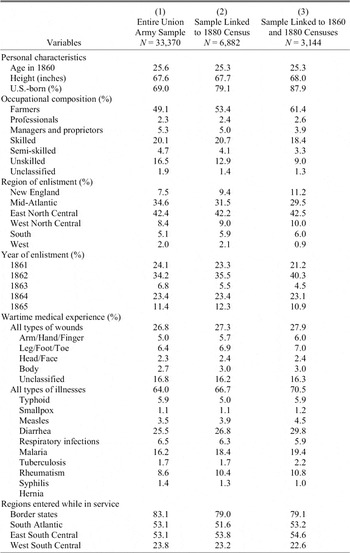
Table 1 compares some key characteristics of recruits between the entire and selected samples. A comparison of the first and second columns of the table shows that the sample linked to the 1880 census is generally similar to the entire Union Army in terms of personal characteristics, medical experiences, and geographic movements while in service. The only notable difference is that in the linked sample, the native-born (79 percent) and farmers (53 percent) are overrepresented compared to the recruits at large, of whom 69 percent were U.S.-born and 49 percent were farmers. For the smaller sample linked to both the 1860 and 1880 censuses, the percentages of the native-born and farmers are even higher, 88 percent and 61 percent, respectively (column 3 of Table 1). Also, a slightly larger fraction of the men found in both censuses suffered illnesses while in service.Footnote 32 Even if we cannot preclude the possibility that the sample is subject to selection bias resulting from linkage failure, it is likely that the results of this study generally represent the experiences of the entire Union Army, if not the northern male population at large.Footnote 33
SOME CHARACTERISTICS OF THE ENTIRE AND SELECTED SAMPLES OF UNION ARMY RECRUITS AGED 18 TO 45

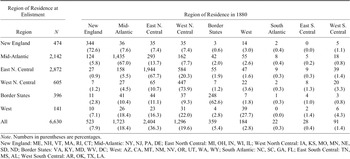
Table 2 provides the pattern of regional migration of the veterans in the sample. About two-thirds of the veterans remained in the same region they resided in at the time of enlistment. The rate of interregional migration was highest for recruits from the West (72 percent), followed by those from the border states (37 percent). For the migrants from New England, equally important regions of destination were the Mid-Atlantic, East North Central, and West North Central regions. The majority of migrants from the Mid-Atlantic headed to the Midwest, especially the West North Central region. A large fraction of the migrants from the East North Central region moved to the West North Central region. As in the case of the population at large, the geographic mobility of the veterans was characterized predominantly by East-West migration. Only 2 percent of the veterans had migrated to the South by 1880. Two-thirds of the migrants to the South settled in the West South Central region.
REGIONAL MIGRATION OF VETERANS FROM ENLISTMENT TO 1880

Note:
Numbers in parentheses are percentages.
New England: ME, NH, VT, MA, RI, CT; Mid-Atlantic: NY, NJ, PA, DE; East North Central: MI, OH, IN, WI, IL; West North Central: IA, KS, MO, MN, NE, SD, ND; Border States: VA, KY, MD, WV, DC; West: AZ, CA, MT, NM, NV, OR, UT, WA, WY; South Atlantic: NC, SC, GA, FL; East South Central: TN, MS, AL; West South Central: AR, OK, TX, LA.
MEASURING HEALTH AND INFORMATION
Military service during the Civil War seriously damaged the health of recruits who survived the war. Wartime illnesses were mainly caused by infectious diseases, although some chronic conditions such as rheumatism and hernia were also prevalent. Diarrhea was the most common disease in the army camp, contracted by a quarter of the recruits in the sample, followed by malaria (16 percent), respiratory infections such as pneumonia and bronchitis (7 percent), typhoid (6 percent), and measles (4 percent). The unusually high rates of disease contraction were due to the peculiar nature of the army camp, in which a large number of men from heterogeneous socioeconomic and ecological backgrounds were confined in an extremely unhealthy environment.
Many of the recruits who contracted infectious diseases while in service, if they survived, probably recovered from the illnesses rather quickly, even before they were discharged from their service. However, the damage caused by those acute diseases may have had persistent influences on their later health. Studies have found that infectious diseases affect the odds of suffering chronic conditions such as heart, respiratory, and musculoskeletal disorders at older ages.Footnote 34 I use dummy variables indicating whether a veteran experienced a particular type of wound or disease as well as wounds and illnesses in general as a measure of health. The particular wartime events considered here include five types of wound by location and ten diseases that were most common among Union Army recruits: typhoid, smallpox, measles, diarrhea, respiratory infections, malaria, tuberculosis, rheumatism, syphilis, and hernia.
Illnesses and wounds are not the only kinds of health damage suffered by veterans who fought in a bloody war. The intense violence involved in war, such as being exposed to heavy combat, witnessing friends and comrades die, and watching the enemy before or after killing them, may have inflicted serious war trauma on the survivors. It has been reported that Post-Traumatic Stress Disorder (PTSD) was widespread and severe not only among the veterans who served in Vietnam, but those of the Civil War as well.Footnote 35 There is a large body of research linking war trauma with various mental and physical health outcomes.Footnote 36 As an index of wartime stress, I use dummy variables indicating the four categories of the company mortality from wounds: (1) zero; (2) 3 percent or less; (3) 3 percent to 5 percent; and (4) more than 5 percent (denoted as Co. wound mortality 1 through 4). The underlying assumption is that soldiers whose units suffered higher casualties experienced more severe wartime stress.Footnote 37 In addition to the variables on wartime experiences I have added variables on height at the time of enlistment as an indicator of the nutritional status of recruits.Footnote 38
I use several different measures of geographic mobility while in service, each of which represents a particular type of information. First, I consider how far the veteran moved from his place of origin while in service. The underlying rationale for using the measure is that distance traveled can influence the mover's cognition of other places, general knowledge about the passage, attitudes toward risk, and preference for relocation. The information obtained from prior mobility may differ between latitudinal (East-West) and longitudinal (North-South) moves. Richard Steckel noted that an important basis of the dominant pattern of East-West migrations in nineteenth-century America was the desire of the migrants to relocate to areas where their agricultural knowledge of the climate and soil type would still be applicable.Footnote 39 It is likely, therefore, that the veterans who moved vertically (North-South) were exposed to a greater variety of unfamiliar environments than those who traveled the same distance horizontally. Also, the veterans may have collected different kinds of information from their military movements depending on the direction. To consider these potential differences, I use separate variables on both longitudinal and latitudinal moves in the analysis (denoted “North-South move” and “East-West move” in the tables reporting the results of regression analyses), representing the distance from the county of residence at enlistment and the longitudinally (or horizontally) most distant state the veteran had ever entered while in service.Footnote 40
The second measure of wartime geographic mobility is the distance (measured in the unit of longitudinal degrees) a given recruit moved below latitude 40° north (denoted “latitudes moved below 40 degrees” in the table reporting the regression results). This measure represents how far a person entered into the South during his service. The most peculiar feature of the military deployment during the Civil War is that it was predominantly south-bound. The vast majority of the recruits entered the border states such as Virginia and Maryland. More than half of the Union Army entered either the South Atlantic or the East South Central region, and nearly a quarter of them marched into the West South Central region. A natural question arising from this pattern of wartime mobility is how wartime experiences of visiting the South affected northern veterans' later migration to the region. I assume that the lowest latitude reached by a given soldier represents the extent of his exposure to the environments and labor-market conditions in the South.
Finally, dummy variables indicating whether a veteran had ever entered a particular region in the South (such as the South Atlantic, the East South Central, or the West South Central) are used as measures of the information on broadly-defined regions. These variables will be employed in analyzing the determinants of the general mobility and the probability of choosing the South as the destination among the movers. In addition, dummy variables for entering particular states are used in examining how location-specific information affected the choice of state among the migrants to the South.
CONCEPTUAL FRAMEWORK
A soldier discharged from military service faced a choice between remaining in his previous place of residence and moving to another place. Moving to a different place can bring a rise in life-time income or social status, but at the same time, incurs a cost of relocation. Consider, for example, a general value function of migration of the following form

where Y is the income in the place of origin (denoted by superscript O) or the new location (N), r the discount rate, C the cost of migration, and T the expected age of death or retirement. A person contemplating migration from a given origin to given destinations decides whether or not to move based on the net benefits of migration (V), and, if multiple options are available, chooses the place that would maximize the size of V.
Assume that the parameters of V are determined by health measured by wounds and illnesses (denoted D) and wartime stress (S), information measured by wartime geographic mobility (I), other observable personal characteristics, such as age, nativity, literacy, place of residence, and year of enlistment (denoted X), and unobservable individual heterogeneity (θ).Footnote 41Y denotes the gains from migration. A reduced-form model of postservice geographic mobility, denoted by M, can be presented as

As suggested above, the wartime medical experiences and geographic moves were probably unrelated to the soldier's choice or personal characteristics. This implies Cov(D,θ) = 0, Cov(S,θ) = 0, and Cov(I,θ) = 0 Under this condition, the regression coefficients for D, S, and I will not be subject to an endogeneity or self-selection bias.
To make several predictions about the effects of the independent variables on migration, first, wartime wounds and diseases would have diminished geographic mobility (∂M/∂D < 0). This prediction comes from the conjecture that D would, by deteriorating health, diminish the length of work life (∂T/∂D < 0) and the gains from migration (∂Y/∂D < 0), and increase the cost of relocation (∂C/∂D > 0). Moreover, poor health could increase a person's discount rate (∂r/∂D > 0). For these reasons, it is likely that each of the four terms in the right-hand-side (RHS) of equation 3 is negative.

Second, wartime geographic moves would have increased post-service geographic mobility (∂M/∂I > 0). This prediction is based on the conjecture that the each of two terms in the RHS of equation 4 is positive because more information would increase the net gains from migration (∂Y/∂I > 0 and ∂C/∂I < 0).
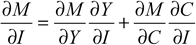
Third, the direction of the effect of wartime stress (S) on M is not as obvious as that of D or I. S would be related negatively to T and Y, and positively to r if it adversely affected health. But the sign of its effect on C is ambiguous. Mental illnesses resulting from wartime stress could increase C. On the other hand, psychological trauma could make it difficult for the veteran to remain in his original community, diminishing the cost of leaving it. Thus, the overall effect of S depends on the sign of ∂C/∂S and, if it is negative, then on the relative magnitudes of the sum of the first three terms and of the final term in the RHS of equation 5.

Finally, the anticipated effects of other personal characteristics (X) are that older age is associated with a shorter remaining work life (T) and greater psychological cost of relocation (C). Therefore, the impact of age on mobility among adults is likely to be negative. Immigrants may have been more mobile because their connections to the community where they resided at the time of enlistment were less strong. Illiterate persons should have been at a disadvantage in obtaining information required for migration decisions.
Estimation of the reduced-form model does not tell which parameter in equation 1 was a relatively important pathway by which a particular independent variable affected M. If D had a strong negative effect on M, for example, it is unclear which term in the RHS of equation 3 was the major factor. By testing several hypotheses based on some reasonable assumptions, we gain additional insight into the question of why a particular wartime event affected subsequent geographic mobility.
First, it would be reasonable to assume that the effect of D on Y differs by occupation, depending on the type of human capital required by the job. For example, if D largely affected physical strength, D should have affected Y more strongly for persons employed in physically more demanding jobs. On the other hand, the effect of D on other parameters (T, r, and C) was presumably similar across different occupations. In other words, D affected the health of individuals similarly regardless of their occupation. Under these assumptions, if the effect of D on M differed by occupation (∂M/∂D|i ≠ ∂M/∂D|j, where i and j denote different occupations), we may infer that D affected M largely by changing Y.
Second, it is likely that wartime geographic mobility increased M by offering more general knowledge about moving itself or by mitigating the psychological cost of relocation. It would also be reasonable to assume that the marginal effect of I on C decreases as the stock of I increases (∂ 2C/∂I 2 < 0). Under these conditions, veterans with more prewar experience of migration should have been less affected by the military experiences.
Third, if I affected M, mainly by providing information specific to the places visited by a soldier, then prior entry into a particular state or region j (Ij) while in service would significantly increase or decrease the probability of migration to j (Mj), depending on the contents of the information (∂Mj/∂Ij ≠ 0). Similarly, distinct types of I (such as East-West or North-South moves) would have affected M differently.
Finally, military service in the Civil War should have increased both D and I because soldiers were more likely to be wounded, to contract diseases, and to be mobile than civilians. That is, E(D | UA) > E(D | NV) and E(I | UA) > E(I | NV), where UA and NV denote, respectively, Union Army veterans and nonveterans in the North. Thus, the overall impact of the Civil War on the geographic mobility of the northern population at large depends on the sign of (∂M/∂D)ΔD + (∂M/∂I))ΔI, where ΔD and ΔI stand for, respectively E(D | UA) – E(D | NV) and E(I | UA) – E(I | NV).
HEALTH, WARTIME MOBILITY, AND MIGRATION
The measured rates of migration will depend heavily on the size of the geographic units used. The larger the geographic unit employed, the lower the rate of migration across the units. Accordingly, I employ four different measures of geographic mobility and corresponding specifications for regressions: the distance of migration measured in miles, the probability of moving to a different county, the probability of moving to a different state, and the probability of moving to a different region.Footnote 42
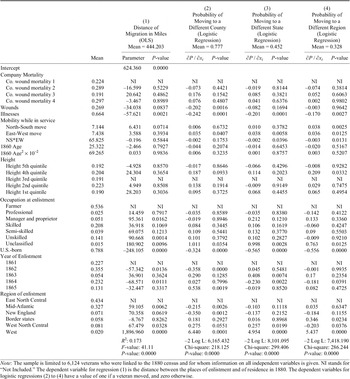
Table 3 presents the results of baseline OLS and logistic regressions. They suggest that wounds and illnesses experienced while in service had significant negative effects on the measures of geographic mobility. The size of the impacts of wartime medical experiences on the probabilities of migration was large. Suffering any wounds while in service reduced the probability of moving to a different county by 20 percent (see the parameter for the variable denoted wounds in column 2 of Table 3). Any type of wartime illness diminished the probability of inter-county migration by 24 percent (illnesses in column 2). Wounds and illnesses in general also had modest but significant effects on the distance of migration, diminishing it by, respectively, 34 miles and 54 miles (wounds and illnesses in column 1), or 8 percent and 12 percent of the sample average distance of migration (448 miles).Footnote 43
Wartime wounds and illnesses affected different aspects of geographic mobility. Contracting any disease while in service had a strong negative effect on the distance of migration among migrants as well as the probability of leaving the place of origin. It diminished the probability of interstate migration by 20 percent and the chances of interregional migration by 17 percent (illnesses in columns 3 and 4). The results of regressions conducted exclusively for the movers to a different county (not reported here) suggest that wartime illnesses decreased the distance of migration by 43 miles, which is not much different from the result for the entire sample. This indicates that the observed negative effect of having suffered illness on the distance of migration largely reflects its impact on the distance conditional on moving, rather than the probability of migration. In contrast, wartime wounds mostly affected the veteran's decision whether or not to move, rather than how far he would move (wounds in column 2). Wounds incurred while in service did not significantly decrease the probabilities of interstate and interregional migrations (wounds in columns 3 and 4). Among movers, moreover, it diminished the distance of migration by only 17 miles.
The company mortality from wounds, a measure of the extent of combat exposure, did not have any significant effect on geographic mobility (co. wound mortality 1 to 4, columns 1 to 4). This result is in contrast to the result that Union Army veterans who fought in high-mortality companies saved much less than those who served in low-mortality companies.Footnote 44 This may indicate that geographic mobility is determined mainly by physical health, not mental health, which could have been more seriously damaged by trauma from bloody battles (∂Y/∂S = 0 in equation 5). It is also possible, as noted above, that psychological trauma made it difficult for the veteran to remain in his original community, offsetting the potential impacts of poor health caused by combat exposure (∂C/∂S < 0 in equation 5). Height, another measure of health, had no systematic effect on geographic mobility, either.
Wartime geographic movements had significant effects on some measures of postservice geographic mobility. The measure of North-South moves significantly increased the probability of interregional migration and the distance of migration (North-South move in columns 1 and 4). On the other hand, the measure of East-West moves is positively related to the probabilities of moving to a different county and moving to a different state (East-West move in columns 2 and 3). The magnitudes of the effects were substantial. For instance, entering a state located to the south of the place of enlistment by seven degrees of latitude (the sample mean of the latitudes moved) was associated with an increase in the probability of interregional migration by 27 percent (North-South move in column 4: 7 × 0.038) and an increase in the distance of migration by 45 miles (North-South move in column 1: 7 × 6.431). Similarly, visiting a state that is horizontally distant from the place of origin by the sample mean (7.4 degrees) increased the probabilities of intercounty and interstate migrations by 26 percent (East-West move in column 2: 7.4 × 0.035) and 28 percent (East-West move in column 3: 7.4 × 0.038), respectively.
The direction of wartime mobility affected the patterns of postservice migration, too. North-South movements in the army largely affected the distance of migration among movers. It did not have any significant effect on the probability of relatively short-range migrations, such as intercounty and interstate migrations (North-South move in columns 2 and 3). If the regression analysis is limited to migrants to a different county, the size of the effect of the latitudes moved is even bigger (7.8 miles, compared to 6.4 miles for the full sample). On the other hand, latitudinal mobility while in service affected the probability of migration, not the distance (East-West move in columns 2 and 3). This pattern could be explained by the fact that veterans who moved longitudinally were probably more likely to be exposed to an environment much different from their place of origin than those who traveled the same distance horizontally. Therefore, longitudinal mobility during military service should have provided more useful information for long-distance migration.Footnote 45
Among other variables included in the regressions, immigrant status stands out as the most powerful determinant of geographic mobility. Natives were much less mobile than immigrants by all four measures of mobility (U.S.-born in columns 1 to 4). Age is negatively related to geographic mobility, as found in other studies on the determinants of migration, but its effect is statistically insignificant for all four measures of mobility (1860 age in columns 1 to 4). The veterans whose occupations at enlistment were unknown were more mobile than those whose occupations were reported (unclassified in columns 1 to 4). Managers and proprietors, and unskilled workers moved farther on average than did farmers and professionals (farmer, professional, managers and proprietor, unskilled in column 1). The effect of the year of enlistment on mobility depended on the measure of mobility chosen. In general, the veterans who entered the army in either 1862 or 1864 were less mobile than the others (year of enlistment 1862 and 1864 in columns 1 and 2). Finally, the veterans from the West were much more likely to migrate, and move a longer distance than the rest (West in columns 1 to 4). The enlistees from the West North Central region were more mobile than those from the Northeast, although they were less likely to move out of the region (West North Central in columns 1 to 4).Footnote 46
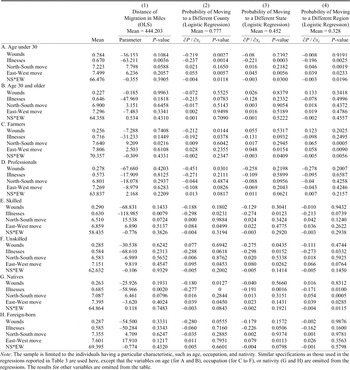
As noted in the section “Conceptual Framework,” the variations across individuals with different characteristics offer useful clues to the question of why wartime events affected subsequent geographic mobility. To examine the several hypotheses suggested above, I performed regressions separately for several subsamples of the veterans with different ages, occupations, and nativities. Table 4 presents summary results of the regressions, reporting the coefficients only for the variables on health and wartime mobility.
RESULTS OF OLS AND LOGISTIC REGRESSIONS: CORRELATES OF THE DISTANCE AND PROBABILITY OF MIGRATION

Note:
The sample is limited to 6,124 veterans who were linked to the 1880 census and for whom information on all independent variables is given. NI stands for “Not Included.” The dependent variable for regression (1) is the distance between the places of enlistment and of residence in 1880. The dependent variables for logistic regressions (2) to (4) have a value of one if a veteran moved, and zero otherwise.
As hypothesized, the effect of wartime illnesses on mobility was stronger for the veterans employed in occupations that required greater physical strength (artisans and manual laborers) than for those engaged in jobs for which nonphysical human capital was more important (professionals, managers, and proprietors). The marginal effect of illnesses for the unskilled (see row F in Table 4) and artisans (row E) is statistically significant and large in magnitude for the three probabilities of migration (columns 2, 3, and 4). In contrast, the effect of illnesses for professionals (row D) is insignificant for all four measures of mobility (columns 1 to 4). If poor health restricted mobility by limiting the person's ability to move (C), by increasing the discount rate (r), or by diminishing the remaining length of life (T), its effect should not differ by occupation. Thus, the major link between wartime illnesses and geographic mobility was probably the decline in the benefits of migration (Y) caused by diminished physical ability.
The regression results also support the hypothesis that veterans with more prewar experience of migration should have been less affected by the military experiences. Older men and immigrants presumably had more prewar experience of moving compared to the young and natives, respectively. Table 4 shows that measures of geographic moves while in service had much weaker effects on the mobility of older persons (row B) and immigrants (row H) than, respectively, younger recruits (row A) and natives (row G). As explained in the section “Conceptual Framework,” this result suggests that the increased general information about geographic transfers and reduced psychological resistance to moving to a new location were perhaps major mechanisms by which prior mobility affected subsequent migration.
WARTIME EXPERIENCES AND POSTWAR MIGRATION BY AGE, OCCUPATION, AND NATIVITY

Note:
The sample is limited to the individuals having a particular characteristic, such as age, occupation, and nativity. Similar specifications as those used in the regressions reported in Table 3 are used here, except that the variables on age (for A and B), occupation (for C to F), or nativity (G and H) are omitted from the regressions. The results for other variables are omitted from the table.
Wartime mobility, especially longitudinal moves, had a particularly powerful positive effect on long-distance migration of farmers (row C, column 4). The mobility of the unskilled was strongly influenced by latitudinal moves while in service (row F, columns 2 to 4). In contrast, wartime mobility decreased the postwar mobility of white-collar workers (row D, columns 1 to 4, especially columns 2 and 3). These results suggest that new information on climate and lands in other regions collected while serving in the army could be one of the possible links between wartime mobility and postwar migration, especially for farmers. The general information on labor market conditions in other regions obtained in the course of military deployment might be another connecting factor, especially for less-skilled workers, as indicated by the strong relationship between latitudinal moves while in service and the probability of migration among the unskilled. A white-collar worker's human capital should be more heterogeneous and location-specific than a manual worker's. Therefore, the information on distant labor markets collected during the war should have been too general and incomplete to influence a white-collar worker's migration.
LOCATION-SPECIFIC INFORMATION AND CHOICE OF DESTINATION
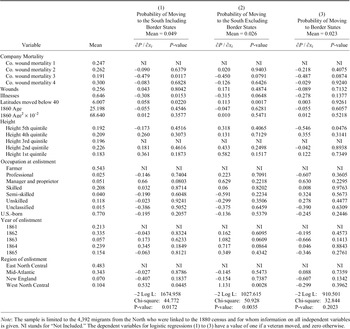
The results given above suggest that wartime geographic mobility increased the probability and distance of migration of the recruits after their service. I will examine whether the information on a particular place obtained while carrying out military missions indeed increased the probability of moving to that place. As noted, the geographic moves of Union Army soldiers while in service were predominantly south-bound. Given this peculiar feature of the military deployment, I focus on the patterns of migration to the South to examine how location-specific information influenced the choice of destination among the migrants. More specifically, I attempt to answer below the following two questions: How did geographic mobility while in service affect the probability of choosing the South as the destination among the interstate migrants? Did experience of entering a particular state while in service increase the probability of moving to the state among the migrants to the South?
The Union Army recruits who were sent to the South on military missions should have collected some knowledge about the region as a whole, such as its climate, terrain, soil, and socioeconomic conditions. Many of them were presumably strangers to the region. Therefore, veterans' impressions of the South and the information they acquired about it should have varied considerably depending on their wartime experiences. A natural question arising from this unique aspect of the Civil War is how such different region-specific information affected the veterans' decisions to migrate to the South.
As a measure of the region-specific information, I consider how far a given veteran entered into the South while in service, represented by the difference between latitude 40° north and the lowest latitude he had ever reached. The underlying assumption is that the lowest latitude reached by the veteran represents the extent of his exposure to the environments and labor-market conditions in the South. The regression analysis is limited to the veterans who enlisted in the North, excluding those from the West and the border states, who migrated to a different region by 1880. The following three types of migration to the South were separately considered in the regressions: (1) moving to the South including the border states, (2) moving to the South excluding the border states, and (3) moving to the border states.
Table 5 presents the results of logit regressions. They suggest that the deeper a veteran had moved into the South while in service, the higher the probability that he would migrate to the South (latitudes moved in columns 1 and 2). However, the measure of prior mobility to the South had no significant effect on the conditional probability of moving to the border states (latitudes moved in column 3). The magnitude of the effect of wartime mobility is quite large. A south-bound move by one degree of latitude was associated with an increase in the probability of choosing the South (excluding the border states) as the postwar destination by 11.3 percent (latitudes moved in column 2). This implies that wartime movement to the South by the sample mean (6 degrees or about 746 miles) would have increased the conditional probability of migration to the South by 68 percent (6 × 0.113).Footnote 47
LOGISTIC REGRESSIONS: CORRELATES OF THE PROBABILITY OF MOVING TO THE SOUTH AMONG THE MIGRANTS FROM THE NORTH

Note:
The sample is limited to the 4,392 migrants from the North who were linked to the 1880 census and for whom information on all independent variables is given. NI stands for “Not Included.” The dependent variables for logistic regressions (1) to (3) have a value of one if a veteran moved, and zero otherwise.
It is also notable that suffering illnesses while in service strongly reduced the conditional probability of moving to the South (illness in columns 1 to 3). It was reported above that illnesses in general restricted long-distance migration of the veterans (see Table 3). Poor health could have been an even more serious obstacle to migration to the South than moving to other regions owing to the relatively severe disease environment in the South. In contrast, wartime wounds had no significant effect on the conditional probability of moving to the South (wounds in columns 1 to 3). The migrants from the West North Central region were much more likely to choose the South as their destination (West North Central in columns 1 and 2), probably due to the fact that the West South Central region was the most attractive location to the migrants within the South and it is geographically close to the West North Central region.Footnote 48
The results given above suggest that region-specific information did matter for the migrants when choosing the destination. Now, I go one step further to examine whether possessing information on a particular state affected the probability of choosing that state among the migrants to the South. A veteran who had decided to migrate to the South had 14 choices for his destination (the number of the states in the South, including the District of Columbia, to which at least one veteran from the North chose to move). To analyze how wartime experience of visiting a particular state affected the veteran's choice, I employ the following conditional logit model. In this model, the probability that veteran i moved to state j is
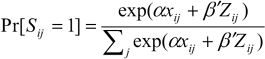
where xij stands for a dummy variable that has a value of one if the veteran i had ever entered state j while in service, and Zij denotes a vector of other determining factors of location choice. The conditional logit model has some advantages: the predicted probabilities are bounded between zero and one, and the probabilities add up to one over states for a given individual. More importantly, the conditional logit recognizes the grouped nature of the data, with 14 observations for each veteran.
As other determining factors of the probability of choosing state j (elements of Zij), variables on the longitudinal and latitudinal distances between the veteran i's state of origin and state j, and the increase in the adult population in state j between 1860 and 1880, are included.Footnote 49 Other things being equal, a person would be less likely to choose a more distant state over a neighboring state. It is therefore expected that the coefficients on the distance variables have negative signs. The increase in the adult population is a proxy for the general attractiveness of the state for potential migrants. It is anticipated that, other conditions being equal, the veterans were more likely to choose a state with a larger population growth.
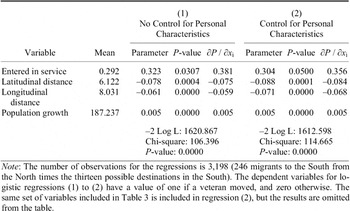
Table 6 presents the results of conditional logit regressions based on the model presented above. The second column reports the result of the regression in which variables on personal characteristics and wartime medical experiences (the same set of variables included in Table 3) are controlled for. The results strongly suggest that, holding the longitudinal and latitudinal distances and the population growth constant, the migrants to the South were more likely to settle in a state they had entered while in service. The estimated coefficient shows that a wartime visit to a particular state increased the conditional probability of choosing that state as the destination by 38 percent (entered in service in column 1). As expected, the longitudinal and latitudinal distances are negatively related to the probability of choosing the state. Also, the migrants to the South were more likely to choose the state that had experienced a larger population growth. Including the variables on personal characteristics and wartime medical experiences does not change the results significantly.
CONDITIONAL LOGISTIC REGRESSIONS: CORRELATES OF THE PROBABILITY OF MIGRATION TO A PARTICULAR STATE AMONG MIGRANTS TO THE SOUTH

Note:
The number of observations for the regressions is 3,198 (246 migrants to the South from the North times the thirteen possible destinations in the South). The dependent variables for logistic regressions (1) to (2) have a value of one if a veteran moved, and zero otherwise. The same set of variables included in Table 3 is included in regression (2), but the results are omitted from the table.
CONCLUSIONS AND FURTHER IMPLICATIONS
This article has explored how injuries, sickness, and geographic mobility of Union Army veterans while in service affected their post-service migrations. The results suggest that wartime wounds and illnesses significantly diminished veterans' geographic mobility after the war. Illnesses while in service had a particularly strong negative effect on the distance of migration among migrants. On the other hand, wartime wounds mostly decreased the probability, not the distance, of migration.
Geographic moves while in service also influenced the choice of destination among the migrants. The deeper a veteran had moved into the South while in service, the higher the probability that he would migrate there. Furthermore, the results of conditional logit analyses suggest that the migrants to the South were more likely to settle in a state they had entered while in service, when other determinants of the choice of state, such as the distance and population growth, are controlled for.
The results of this study provide the first direct evidence suggesting that health was a powerful determinant of geographic mobility in the nineteenth century. Given that the infectious diseases considered in the present study were widespread among the civilian population until the end of the nineteenth century, it is likely that the strong negative relationship between illnesses and geographic mobility found for the army recruits was true for the population at large, too. There is increasing evidence that economic costs arising from poor health are substantial.Footnote 50 The high prevalence of various infectious diseases in the past should have adversely affected the economic mobility of the infected people by limiting their geographic mobility. The decline in prevalence of infectious diseases since the late nineteenth century, therefore, should have exerted a favorable effect on overall geographic mobility.
This study suggests that health differences could be one of the important elements of self-selection in migrations. That is, migrants are more productive than nonmovers with similar personal characteristics thanks partly to their superior health. In addition, health could influence other unobservable determinants of geographic mobility, such as the psychological cost of relocation and attitudes towards risk.
This article, unlike other studies, has distinguished between the effects of different types of information on migration, namely, general knowledge on moving itself obtained from prior geographic moves; region-specific (or latitude-specific) information gained from entering a particular region; and state-specific information collected while visiting a particular state. The results suggest that all types of information mattered in migration decisions, but in different ways.Footnote 51
This study also provides insight into how prior mobility affects subsequent migration. The major link between wartime illnesses and postwar geographic mobility was probably the decline in the benefits of migration caused by diminished physical ability. Increased general knowledge about geographic transfer itself and reduced psychological cost of moving were probably important mechanisms by which prior mobility affected subsequent migration.Footnote 52
Finally, this study suggests that the Civil War had mixed effects on the geographic mobility of Union Army veterans. It reduced the probability of migration by damaging their health. On the other hand, it stimulated their geographic mobility by sending them to distant regions. Given that the measures of health and wartime geographic mobility are by no means complete, and the estimated magnitudes of their effects on geographic mobility are not fully accurate, it is difficult to determine which impact of the war was stronger. However, the regression results and the aggregate migration rates of the veterans suggest that the overall net effect of the war on the veterans' geographic mobility was probably positive. First, by multiplying the sample means and the regression coefficients of the variables on wounds, illnesses, and wartime mobility, I calculated the size of the effect that each of the wartime experiences had on geographic mobility.Footnote 53 The results of the computations generally suggest that the positive effect of wartime mobility was strong enough to dominate the negative effect of wartime medical events.Footnote 54 Second, the migration rates of the native-born veterans aged 25 to 45 were higher than the migration rates for the random sample of native-born males at the same age between 1860 and 1880 reported in a study by Joseph Ferrie.Footnote 55 The intercounty and interstate migration rates were respectively 77 percent and 42 percent for the veterans, whereas they were respectively 58 percent and 37 percent for the random sample. The measures of geographic mobility should be even lower for non-veterans.Footnote 56