1. Introduction
Siderites and sideritic ironstones are important for interpreting the depositional conditions of sedimentary basins, especially when traditional data such as field/outcrops and fossils are not available or insufficient (e.g. Mozley, Reference Mozley1989; Khim, Choi & Park, Reference Khim, Choi and Park2000; Choi, Khim & Woo, Reference Choi, Khim and Woo2003; Lim et al. Reference Lim, Jung, Yang and Yoo2004; Akinlotan, Reference Akinlotan2017c). Their usefulness in interpreting depositional environments is well documented (e.g. Oertel & Curtis, Reference Oertel and Curtis1972; Curtis, Pearson & Somogyi, Reference Curtis, Pearson and Somogyi1975; Gautier, Reference Gautier1982; Postma, Reference Postma1983; Curtis & Coleman, Reference Curtis, Coleman and Gautier1986; Bahrig, Reference Bahrig1989; Mozley, Reference Mozley1989, Reference Mozley1996; Mozley & Wersin, Reference Mozley and Wersin1992; Browne & Kingston, Reference Browne and Kingston1993; Mortimer, Coleman & Rae, Reference Mortimer, Coleman and Rae1997; O. O. Akinlotan, unpub. Ph.D. thesis, Univ. Brighton, 2015; Rodrigues et al. Reference Rodrigues, De Ros, Neumann and Borghi2015). The elemental composition of siderites may be indicative of deposition in freshwater environments (e.g. Mozley, Reference Mozley1989; Baker, Kassan & Hamilton, Reference Baker, Kassan and Hamilton1996; Lim et al. Reference Lim, Jung, Yang and Yoo2004) and can demonstrate a shallow burial depth of sediments (e.g. Spiro, Gibson & Shaw, Reference Spiro, Gibson and Shaw1993; Khim, Choi & Park, Reference Khim, Choi and Park2000; Choi, Khim & Woo, Reference Choi, Khim and Woo2003). The distinctive geochemical trends in siderites from varying depositional environments was presented by Mozley (Reference Mozley1989), while siderites have been described as pure or impure based on their elemental composition (e.g. Baker, Kassan & Hamilton, Reference Baker, Kassan and Hamilton1996; Lim et al. Reference Lim, Jung, Yang and Yoo2004). Siderites are indicative of early diagenesis in the adjacent sediments within the basin (e.g. Mozley, Reference Mozley1989; Hart, Longstaffe & Plint, Reference Hart, Longstaffe and Plint1992; Browne & Kingston, Reference Browne and Kingston1993; Baker, Kassan & Hamilton, Reference Baker, Kassan and Hamilton1996; Mortimer, Coleman & Rae, Reference Mortimer, Coleman and Rae1997; Köhler et al. Reference Köhler, Konhauser, Papineau, Bekker and Kappler2013; Rodrigues et al. Reference Rodrigues, De Ros, Neumann and Borghi2015). Their presence in any environment may be indicative of reducing/anoxic conditions (Huber, Reference Huber1958; Bahrig, Reference Bahrig1989; Browne & Kingston, Reference Browne and Kingston1993; Mirza, Mohialdeen & Awadh, Reference Mirza, Mohialdeen and Awadh2016; Franchi et al. Reference Franchi, Rovere, Gamberi, Rashed, Vaselli and Tassi2017; Isaack et al. Reference Isaack, Gischler, Hudson, Anselmetti, Buhre and Camoin2017) while they also provide useful information about palaeo-salinity (Garrels, Reference Garrels1960; James, Reference James1966; Curtis & Spears, Reference Curtis and Spears1968; Bahrig, Reference Bahrig1989; Cundy, Hopkinson & Whitby, Reference Cundy, Hopkinson and Whitby2008; Loope et al. Reference Loope, Kettler, Weber, Hinrichs and Burgess2012).
In the Weald, SE England (Fig. 1), ironstones occur on a basin-wide scale and were once of great economic importance providing valuable sources of ores for the iron industry (e.g. Wooldridge & Goldring, Reference Wooldridge and Goldring1953; Worssam, Reference Worssam1972; Lake & Thurrell, Reference Lake and Thurrell1974; Taylor, Reference Taylor1990, Reference Taylor1991, Reference Taylor1992). Some of these ironstones have been named as sideritic mudstones, clay-ironstones and sphaerosiderites (Lake & Thurrell, Reference Lake and Thurrell1974; Lake & Shephard-Thorn, Reference Lake and Shephard-Thorn1987; Hopson, Wilkinson & Woods, Reference Hopson, Wilkinson and Woods2008; Robinson et al. Reference Robinson, Scotchman, White and Atkinson2010) and have been described from the Wealden strata (Fig. 1) since the early the 1900s (e.g. Milner & Bull, Reference Milner and Bull1925; Sweeting, Reference Sweeting1925; Wooldridge & Goldring, Reference Wooldridge and Goldring1953; Taylor, Reference Taylor1963; Worssam, Reference Worssam1972; Lake & Thurrell, Reference Lake and Thurrell1974; Taylor, Reference Taylor1990, Reference Taylor1991, Reference Taylor1992; O. O. Akinlotan, unpub. Ph.D. thesis, Univ. Brighton, 2015; Akinlotan, Reference Akinlotan2017c). The sideritic ironstones within the Lower Cretaceous Weald Basin of SE England (Fig. 1) are used as a case study to demonstrate the importance of the composition of sideritic ironstones as key indicators of depositional environments. The English Lower Cretaceous is used because the facies is very important geologically in Earth history. The Lower Cretaceous of the Weald exposes some of the principal outcrops of the Lower Cretaceous facies and some of their most complete successions in the whole of NW Europe (e.g. Reference Stewart and ElliottStewart, 1981a; Booth, Reference Booth2005; Hopson, Wilkinson & Woods, Reference Hopson, Wilkinson and Woods2008; Radley & Allen, Reference Radley and Allen2012; Akinlotan, Reference Akinlotan2016).
The location of the Weald and the study areas in SE England: (1) Pett Level (Haddock's Cottages and Cliff End), Fairlight, near Hastings; (2) West Hoathly Quarry, Sharpthorne; (3) Houghton Green, Rye. (Modified after Goldring, Pollard & Radley, Reference Goldring, Pollard and Radley2005, fig. 1.)

Despite the wide occurrence of the Wealden sideritic ironstones and their potential to aid the reconstruction of depositional conditions, mineralogical and geochemical data on them are scarce in the literature. Similarly, the interpretations of the depositional conditions of other Lower Cretaceous facies based on the geochemistry of siderites and sideritic ironstones appear to be scarce in the published literature apart from Robinson et al. (Reference Robinson, Scotchman, White and Atkinson2010) who examined sphaerosiderites from the Ashdown Formation (see Fig. 2). Geochemical and mineralogical data on the composition of the Lower Cretaceous sideritic ironstones are presented from the Wadhurst Clay Formation (lower–middle Valanginian) within the Weald Basin in SE England (Figs 1, 2). The aims of this paper are to: (1) present preliminary analyses of the mineralogy and geochemistry of the sideritic ironstones and the relationship of these compositions to their host rocks; (2) use the mineralogy and geochemistry of the sideritic ironstones to test the previous depositional models of the ironstones and other facies within the Wadhurst Clay Formation.
The stratigraphy of the Wealden facies in the Weald and Wessex basins. (After Allen & Wimbledon, Reference Allen and Wimbledon1991, fig. 2.)

2. Geological setting
Wealden is a term used for the non-marine sandstones and mudstones between the Purbeck Beds and the Lower Greensand of the Weald in SE England, including those around the Isle of Wight and Dorset (Fig. 1). The name is also used more widely to refer to the Lower Cretaceous non-marine rocks of northwestern Europe (e.g. Allen & Wimbledon, Reference Allen and Wimbledon1991; Hopson, Wilkinson & Woods, Reference Hopson, Wilkinson and Woods2008; Radley & Allen, Reference Radley and Allen2012). The Weald of Kent and Sussex is the type area for the non-marine Wealden formations of NW Europe and broadly equates to the Weald Basin in SE England (Radley & Allen, Reference Radley and Allen2012; O. O. Akinlotan, unpub. Ph.D. thesis, Univ. Brighton, 2015; Akinlotan, Reference Akinlotan2016, Reference Akinlotan2017b). The Hastings Beds (upper Berriasian – Valanginian) and the Weald Clay (Hauterivian – lower Aptian) make up the non-marine Wealden successions (Fig. 2) in the Weald Basin (e.g. Lake & Shephard-Thorn, Reference Lake and Shephard-Thorn1987; Booth, Reference Booth2005; Hopson, Wilkinson & Woods, Reference Hopson, Wilkinson and Woods2008; Radley & Allen, Reference Radley and Allen2012; O. O. Akinlotan, unpub. Ph.D. thesis, Univ. Brighton, 2015; Akinlotan, Reference Akinlotan2017c). The Ashdown, Wadhurst Clay and Tunbridge Wells Sand formations informally referred to as the Hastings Beds (Berriasian–Valanginian) make up the lower section of the Weald Basin.
The sideritic ironstones, which occur as nodules, tabular bands and spherulites, were formed as a result of partial replacement of shells in mudstones and shelly limestones within the Wealden strata (e.g. Taylor, Reference Taylor1963; Lake & Thurrell, Reference Lake and Thurrell1974; Lake & Shephard-Thorn, Reference Lake and Shephard-Thorn1987). Lake & Shephard-Thorn (Reference Lake and Shephard-Thorn1987) noted penecontemporaneous deformational structures in the sideritic ironstones from borehole samples and suggested biochemical precipitation and syn-depositional formation mechanisms. Although sideritic ironstones are present throughout the Weald Basin, the most common sideritic horizons occur at the base of the Wadhurst Clay Formation (lower Valanginian, Fig. 2) where the thickest portions occur. As a result, the ironstone represents an important marker bed where present (O. O. Akinlotan, unpub. Ph.D. thesis, Univ. Brighton, 2015; Akinlotan, Reference Akinlotan2017c).
The Wadhurst Clay Formation comprises principally soft, dark grey shales and mudstones, with minor sandstone, conglomerate, calcareous grit, clay ironstone and lignite, which have been weathered penecontemporaneously at the surface to heavy, mottled, greenish grey khaki (Lake & Young, Reference Lake and Young1978; Reference Stewart and ElliottStewart, 1981a, Reference Stewart, Collinson and Lewin1983; Hopson, Wilkinson & Woods, Reference Hopson, Wilkinson and Woods2008; Radley & Allen, Reference Radley and Allen2012; O. O. Akinlotan, unpub. Ph.D. thesis, Univ. Brighton, 2015; Akinlotan, Reference Akinlotan2017c). The rocks within this formation were deposited in predominantly fluvial and non-marine environments under both braided and meandering river systems. Lagoonal and marginal conditions were recognized in the Wadhurst Clay Formation (Allen, Reference Allen1975, Reference Allen1981; Reference Stewart and ElliottStewart, 1981a, Reference Stewart, Collinson and Lewin1983; Lake & Shephard-Thorn, Reference Lake and Shephard-Thorn1987; O. O. Akinlotan, unpub. Ph.D. thesis, Univ. Brighton, 2015; Akinlotan, Reference Akinlotan2017c).
3. Depositional and facies models of the Weald Basin
The depositional and facies models of the Hastings Beds/Weald Basin have been described in detail (e.g. Allen, Reference Allen1975, Reference Allen1981; Lake & Shephard-Thorn, Reference Lake and Shephard-Thorn1987; Allen, Reference Allen1989; Allen et al. Reference Allen, Alvin, Andrews, Batten, Charlton, Cleevely, Ensom, Evans, Francis, Hailwood, Harding, Horne, Hughes, Hunt, Jarzembowski, Jones, Knox, Milner, Norman, Palmer, Parker, Patterson, Price, Radley, Rawson, Ross, Rolfe, Ruffell, Sellwood, Sladen, Taylor, Watson, Wright, Wimbledon and Banham1998; Radley & Allen, Reference Radley and Allen2012; O. O. Akinlotan, unpub. Ph.D. thesis, Univ. Brighton, 2015; Akinlotan, Reference Akinlotan2017c) and these are summarized here to provide an appropriate context for the interpretations presented in this study. The Weald Basin is a subsiding graben-like basin open to the sea and surrounded by tectonically active horsts. The environment of deposition is generally a coastal mud plain with lagoons that are loosely connected to the sea. Five major rivers spread out from fault-scarps on the basin margin. Increased river flow generated sandy braid plains and sometimes alluvial fans as a result of the periodic marginal up-faulting of surrounding massifs and climatic changes. The alluvial plains supported plants and vertebrates such as dinosaurs. Plant colonization was common. Channel patterns fluctuated between low to high sinuosity. The Wadhurst Clay Formation experienced variable depositional patterns including channelling, lagoonal and marginal conditions. The massive sandstone members in the formation and in the basin represent multi-storey network braided channel fills formed during the uplift and river rejuvenation of basin margins. The climate was warm with a marked wet and dry season generally Mediterranean in nature. Periodic heavy rainfall was common. The London massif was the main supplier of arenaceous materials and controlled salinity by acting as a barrier against incursions from the sea. Salinity was mainly controlled by the effectiveness of coastal protection against sea advancement. The major controls on sedimentation are the vertical movements (faulting) of the source massifs while other controls include eustasy and geomorphology.
4. Materials and methods
4.a. Study locations
Representative ironstone samples were collected from the base of the Wadhurst Clay Formation, lower Valanginian (Fig. 2), because this is the stratigraphic column where the thickest portion (10–15 cm) of the ironstone exists in all the study locations. These locations (Fig. 1) are Cliff End (Pett Level) [TQ 888 132], West Hoathly [TQ 374 328 – TQ 375 329] and Houghton Green, Rye [TQ 931 224 – TQ 933 243]. These locations are strategic and geologically important because they: present most of the complete successions; are part of the principal partial reference sections of the Wealden facies in NW Europe; are spatially spread across the Weald Basin. There were great constraints on the number of samples available for this study. Permission for sampling allowed by Natural England was limited to one sample for a 10–15 cm thick exposure at each location. This is because all the locations (except West Hoathly) are either Sites of Special Scientific Interest (SSSI) and/or Geological Conservation Review (GCR) sites and are protected by law. Accessibility of the exposed ironstone section also contributed to rationed sampling. Though limited in number, the ironstone samples used for this study are representative of the Wealden ironstones and present consistent compositions as presented in the results section below. As a result of the limited samples available, this study aims to present preliminary findings on the mineralogical and geochemical composition of the sideritic ironstones that will stimulate further investigations when larger datasets from more locations become available.
The outcrops at Cliff End fall within the uppermost part of the Ashdown Formation and the lowermost section of the Wadhurst Clay Formation. Cross-bedded and channelized sandstones, siltstones and mudstones that are arranged rhythmically dominate the section. One ironstone sample was collected from the accessible part of the lower section of the Wadhurst Clay Formation. The West Hoathly Quarry in the lower Wadhurst Clay Formation is dominated by mudstone. One ironstone sample was collected from this location. The section at Houghton Green Rye is also in the Wadhurst Clay Formation. Cross-bedded and channelized fine-grained sandstone (the Cliff End Sandstone) dominates this section. In the upper part of the section, which is calcareous, shelly fragments of bivalves are very common. One ironstone sample was collected from this section.
4.b. Laboratory analyses
X-ray diffraction (XRD) analysis was carried out to examine the mineralogy of the ironstones using a PANalytical's X'Pert Pro X-ray diffractometer (PANalytical, Almelo, The Netherlands). The samples were pulverized into powder using an agate pestle and mortar. The powdered samples were inserted into the X-ray diffractometer in a 10 mm diameter deep well mount using Cu-Kα radiation at 40 kV voltage and 40 mA beam current. Data analysis was carried out using PANalytical's HighScore Plus software. The software identifies minerals from different peak positions by comparing peak heights to a standard material and assumes variations in peak height are related to mineral proportions. The software, using the Reference Intensity Ratio (RIR) technique (e.g. Hubbard & Snyder, Reference Hubbard and Snyder1988), gives a semi-quantitative estimate of the percentage composition of the identified minerals in each sample by comparing peak heights to a standard material.
The X-ray fluorescence (XRF) energy-dispersive (benchtop) method was used to measure the chemical composition of the ironstones. A benchtop X-ray spectrometer, PANalytical's MiniPal2 ED-XRF (PANalytical, Almelo, The Netherlands), was used. For each sample, 10 g was pulverized and homogenized using a mechanical ball mill. The powdered sample was then pressed into a pellet (4 cm diameter and 0.4 cm thick). The pellets were used to analyse the major- and trace-element compositions of the ironstones. Scanning Electron Microscopy (SEM) analysis was also conducted on samples from West Hoathly and Houghton Green Rye to examine the surface textures of grains at higher magnification. The two ironstone samples were crushed into rock chips. The samples were thinly coated with 4 nm of platinum using a Quorum 150T sputter coater. The coatings applied to the grains are generally too thin to interfere with optical microscope analysis. Each sample was then mounted on an aluminium stub of a diameter of c. 8 mm that was coated with an adhesive. The stub and the sample were inserted into a vacuum chamber of a Zeiss EVO LS 15 SEM and bombarded with electrons. All the samples were imaged using a beam current of 10 −11 A and accelerating voltage of 20 kV. The resulting images are secondary.
5. Results
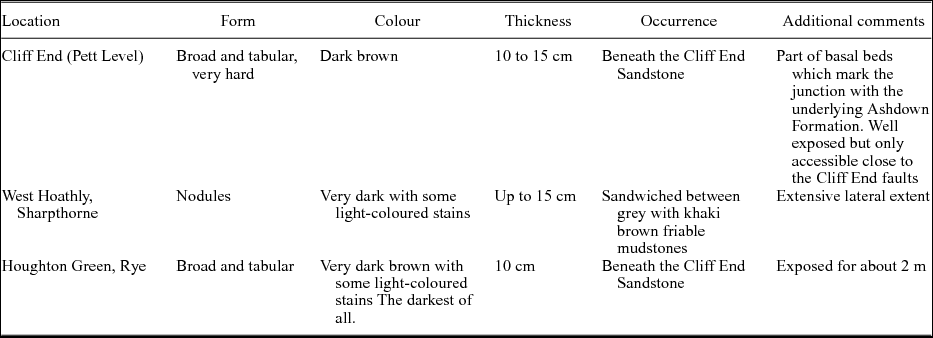
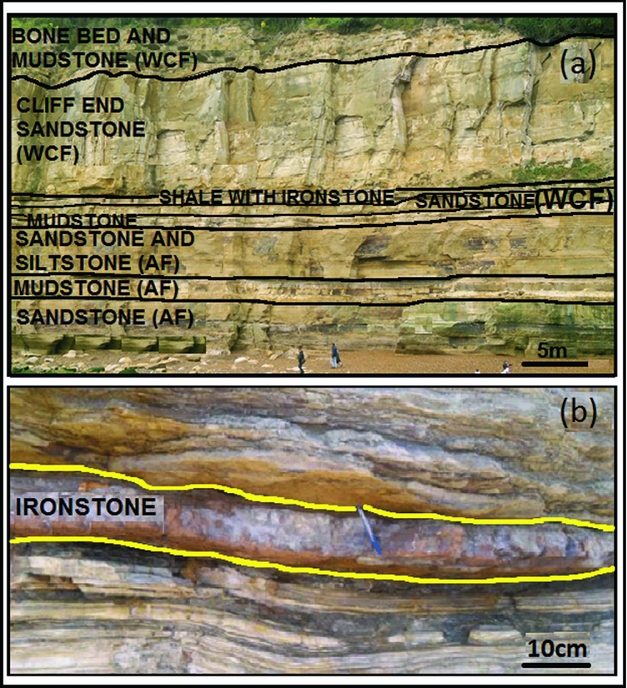
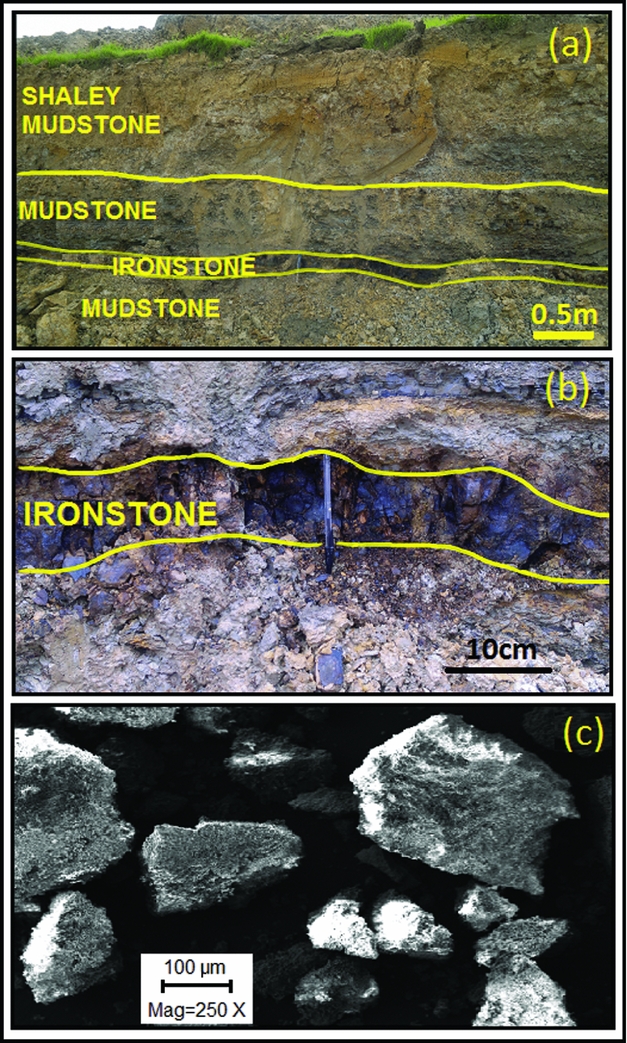
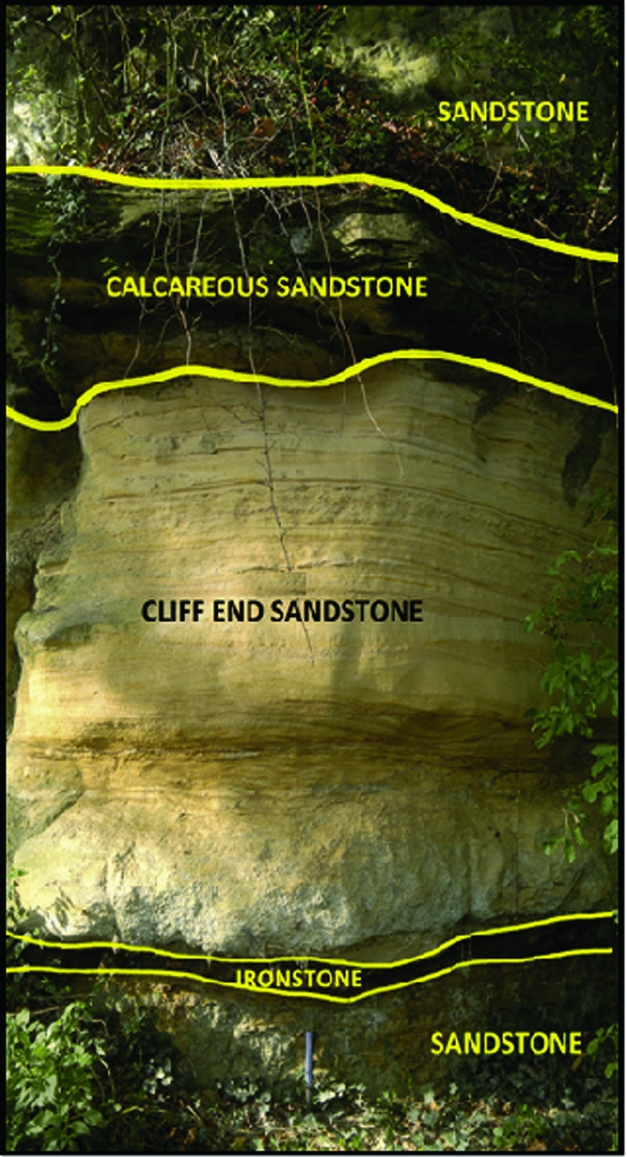
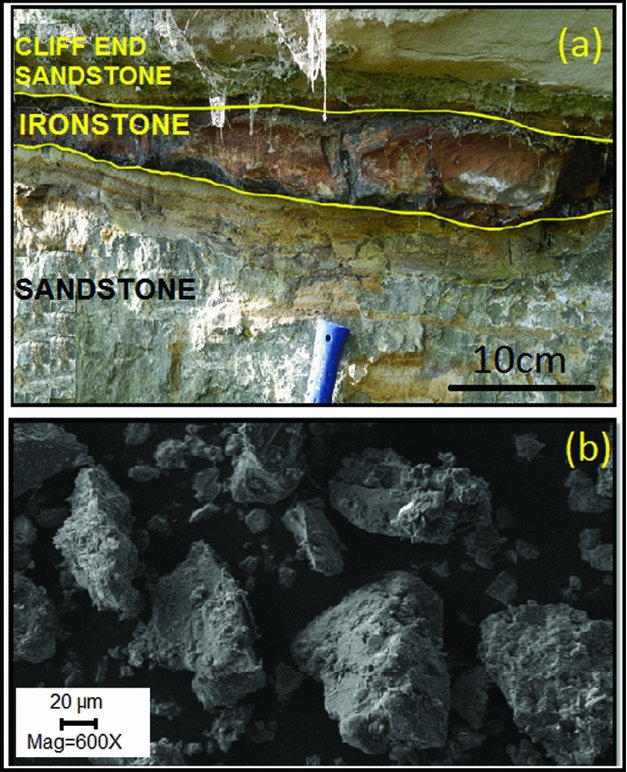
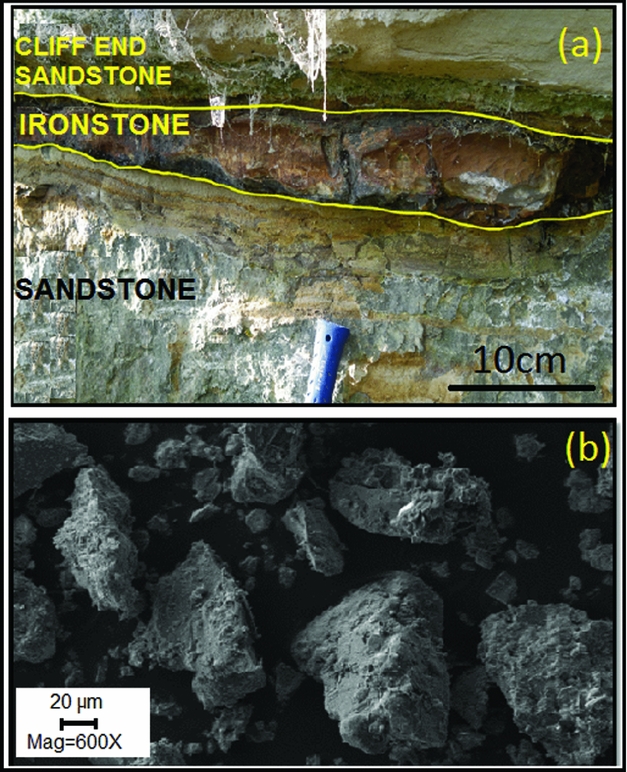
In this current study, field description (Table 1) shows that sideritic ironstones (Figs 3–6) generally occur as tabular or nodular ironstones within mudstones and shales. The ironstones at Cliff End (Fig. 3) and Houghton Green, Rye (Figs 5, 6) occur in tabular forms while the ones at West Hoathly Quarry occur as nodules (Fig. 4). The ironstones are generally dark and sometimes have light-coloured stains. They range in size between 10 and 15 cm. The surface textures of the grains of selected sideritic ironstones at higher magnification obtained via SEM analysis are presented in Figures 4 and 6.
Field description of the sideritic ironstones

(a) The section at Cliff End (Pett Level), Fairlight (AF – Ashdown Formation; WCF – Wadhurst Clay Formation). Direction: north. (b) A closer view of the sideritic ironstone.

(a) The section at West Hoathly quarry. Direction: east. (b) A closer view of the sideritic ironstone. (c) Secondary SEM image of the sideritic ironstone.

The section at Houghton Green, Rye. Direction: west. The geological hammer in the lower centre for scale is 20 cm long.

(a) A closer view of the sideritic ironstone at Houghton Green, Rye. (b) Secondary SEM image of the sideritic ironstone.
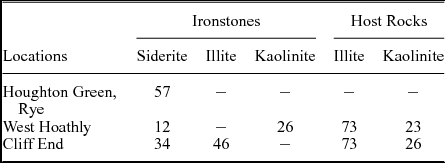
The mineralogy of the ironstones from the three locations within the Wadhurst Clay Formation is shown in Figure 7. The ironstone at West Hoathly Quarry has c. 12% siderite and 26% kaolinite. The clay mineralogy of the facies within the Wadhurst Clay Formation has previously been discussed (Akinlotan, Reference Akinlotan2017a). Kaolinite in the host mudstone in this location is 23% (O. O. Akinlotan, unpub. Ph.D. thesis, Univ. Brighton, 2015). At Cliff End, siderite makes up c. 34% of the ironstone while illite constitutes 46 %. The amount of illite in this ironstone can be traced to the clay mineral constituent of the host shale (Table 2). The host shale has c. 73% illite (O. O. Akinlotan, unpub. Ph.D. thesis, Univ. Brighton, 2015). The ironstone at Houghton Green, Rye contains the greatest amount of siderite. The ironstone composition has c. 57% siderite in addition to quartz. The clay mineral percentage determination in the host, which is sandstone, was not reliable owing to analytical calibration issues. Based on the available data from these three locations within the Wadhurst Clay Formation, it appears that the amount of siderite in these ironstones ranges from 12 to 57% (Table 2). The amount of siderite in these ironstones is at its peak in Houghton Green, Rye in the eastern part of the basin, followed by the ironstone at Cliff End in the southeast of the basin and then at West Hoathly Quarry in the northwestern part of the basin. The concentration of siderite appears to generally increase with the quantity of kaolinite in the adjacent host rocks. It is, however, important to note that this conclusion is made based on the limited number of samples available for this study and further analyses will be required to support this conclusion.
(a) The XRD peak patterns of the three ironstones. S – siderite; K – kaolinite; I – illite; Q – quartz; WH – West Hoathly; CE – Cliff End; HGR – Houghton Green, Rye.

Summary of the mineralogy of sideritic ironstones and the host rocks

Data for the host rocks are from O. O. Akinlotan (unpub. Ph.D. thesis, Univ. Brighton, 2015). Values are (%).
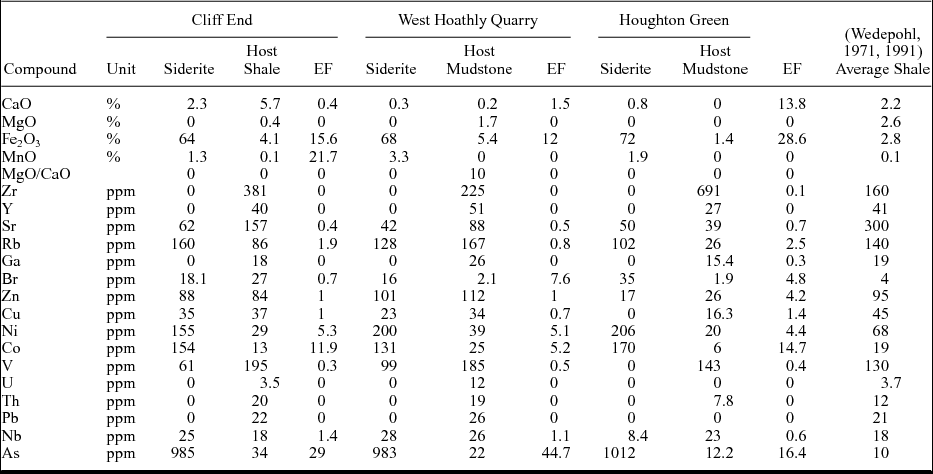
The elemental composition of the ironstones based on XRF analysis is given in Table 3. The sideritic ironstones regardless of their locations have generally similar elemental composition, which corresponds to their mineralogy, which was ultimately derived from the host rocks. This suggests that the original composition of the host strata has significant influence on the composition of the sideritic ironstones. However, it is important to point out that the relatively higher CaO in the sideritic ironstone at Cliff End is attributable to the extremely high fossil content of the host shale (O. O. Akinlotan, unpub. Ph.D. thesis, Univ. Brighton, 2015). When compared to the average crustal shale (Wedepohl, Reference Wedepohl1971, Reference Wedepohl and Merian1991), the sideritic ironstones and their host rocks are consistently enriched in Fe, Co and As (Table 3). The sideritic ironstones are also variably enriched in Mn, Ni and Br (Table 3).
Elemental compositions of the sideritic ironstones, their hosts and average crustal shale

The compounds are in (%) while the elements are in (ppm). EF is the Enrichment Factors = concentration in sideritic ironstone/concentration in host. Values shown as 0 are below the limits of detection.
6. Discussion
6.a. Early diagenesis
Evidence from the mineralogy (Fig. 7) confirms the presence of siderite in the ironstones under consideration. Since siderites form during early diagenesis (e.g. Browne & Kingston, Reference Browne and Kingston1993; Baker, Kassan & Hamilton, Reference Baker, Kassan and Hamilton1996; Köhler et al. Reference Köhler, Konhauser, Papineau, Bekker and Kappler2013), it can be safely and reasonably assumed that the sideritic ironstones under consideration are early diagenetic in nature. Furthermore, the occurrence of these sideritic ironstones shows that diagenesis in the Wealden strata was limited to the early phase, which means that diagenetic alteration to the rocks was minimal. It is important to note that the clay minerals within the host rocks of the siderites have been described as detrital in origin (Jeans et al. Reference Jeans, Mitchell, Fisher, Wray and Hall2001; Jeans, Reference Jeans2006; Akinlotan, Reference Akinlotan2017a) and that any diagenetic alteration to them was negligible (Allen, Reference Allen1981; Sladen & Batten, Reference Sladen and Batten1984; Akinlotan, Reference Akinlotan2017a). The relatively shallow depth of burial of the Wealden facies (Allen, Reference Allen1981; Sladen & Batten, Reference Sladen and Batten1984) and the low geothermal gradient of ~10 °C km−1 (Rollin, Reference Rollin1995; Westaway, Maddy & Bridgland, Reference Westaway, Maddy and Bridgland2002) meant that there was no significant diagenetic alteration to the Wealden facies pointing to an early phase of diagenesis. All these lines of evidence support the early diagenetic nature of the sideritic ironstones, which sets the context for further discussion in the subsequent sections. Loope et al. (Reference Loope, Kettler, Weber, Hinrichs and Burgess2012) have pointed out that it is possible for early diagenetic siderite to be significantly altered and modified by later diagenetic processes when pore waters become oxic. In that scenario, pre-existing siderite concretions were oxidized leading to the formation of rind structures around the siderite. In the Wealden sideritic ironstones under consideration, lack of significant marine influences on them ruled out any late diagenetic alterations.
6.b. Freshwater and non-marine environments
Mozley (Reference Mozley1989) has demonstrated the distinctive geochemical trends for freshwater siderites, which include high Mn content and low Mg/Ca ratio. The Mg/Ca ratio for pure siderites may vary from 0.2–0.5 (e.g. Lim et al. Reference Lim, Jung, Yang and Yoo2004) and 0.3–1.8 (e.g. Baker, Kassan & Hamilton, Reference Baker, Kassan and Hamilton1996). In the sideritic ironstones under current study, the concentration of Mn is generally high while the Mg/Ca is near zero (with Mg below detection limits in all the ironstone samples). As a result, the observation of high enrichment of Fe and Mn and the low Mg/Ca ratio in these sideritic ironstones confirms that they are chemically pure. This confirms that the sideritic ironstones and their hosts are of freshwater and non-marine origin (e.g. Mozley, Reference Mozley1989; Browne & Kingston, Reference Browne and Kingston1993; Khim, Choi & Park, Reference Khim, Choi and Park2000; Choi, Khim & Woo, Reference Choi, Khim and Woo2003; Lim et al. Reference Lim, Jung, Yang and Yoo2004). Robinson et al. (Reference Robinson, Scotchman, White and Atkinson2010) examined the geochemistry of sphaerosiderites from the underlying Ashdown Formation in Hastings and concluded that they were formed in freshwater conditions. Modern siderites have been described from freshwater environments from the lower Holocene on the west coast of Korea (Khim, Choi & Park, Reference Khim, Choi and Park2000; Choi, Khim & Woo, Reference Choi, Khim and Woo2003; Lim et al. Reference Lim, Jung, Yang and Yoo2004) and these have similar elemental compositions to the Wealden ironstones under consideration. In addition, the extremely high concentration of Co in the ironstones (Table 3) also points to a periodical input of freshwater into the Weald Basin (e.g. Xu et al. Reference Xu, Hannah, Bingen, Georgiev and Stein2012a,Reference Xu, Lehmann, Mao, Nägler, Neubert, Böttcher and Escherb).
The sideritic ironstones within this formation like other sideritic ironstones described elsewhere (see below) might give an indication of the burial depth of the host rocks when the siderites were formed. Modern sideritic ironstones have been formed at shallow depths (e.g. Khim, Choi & Park, Reference Khim, Choi and Park2000; Choi, Khim & Woo, Reference Choi, Khim and Woo2003) while Spiro, Gibson & Shaw (Reference Spiro, Gibson and Shaw1993) reported a maximum burial depth of 1400 m for siderites in Tertiary lacustrine shales (Lowmead and Duaringa basins, Australia). It is possible for siderites or sideritic ironstones to be preserved at deeper depths after formation; however, any significant burial is unlikely in the Weald Basin because it has been confirmed that the Wealden facies were never buried beyond 1.5–2 km (Allen, Reference Allen1981; Sladen, Reference Sladen1983).
6.c. Reducing conditions
The formation of siderite in an environment is a direct indication of reducing conditions in such an environment (e.g. Bahrig, Reference Bahrig1989; Browne & Kingston, Reference Browne and Kingston1993; Mirza, Mohialdeen & Awadh, Reference Mirza, Mohialdeen and Awadh2016; Franchi et al. Reference Franchi, Rovere, Gamberi, Rashed, Vaselli and Tassi2017; Isaack et al. Reference Isaack, Gischler, Hudson, Anselmetti, Buhre and Camoin2017). In addition, Huber (Reference Huber1958) confirmed that siderite is stable under intermediate to moderately reducing conditions. The occurrence of siderite is a direct indication of reducing conditions in the Wadhurst Clay Formation at the time of deposition. Pye et al. (Reference Pye, Dickson, Schiavon, Coleman and Cox1990) have shown that siderite concretions are actively forming in the upper Holocene marsh and sandflat sediments on the coast of north Norfolk. These siderites are forming in reduced sediments where sulphate-reducing bacteria are present and active. They then concluded that siderite is likely to form when Fe reduction exceeds sulphate reduction. The rarity of pyrite in the Wealden ironstones is indicative of limited sulphate, which points to freshwater conditions.
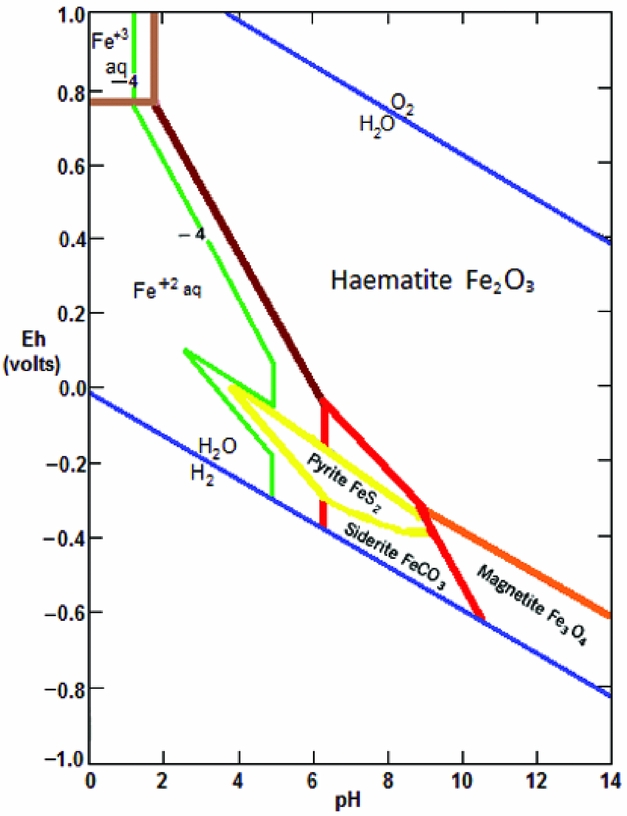
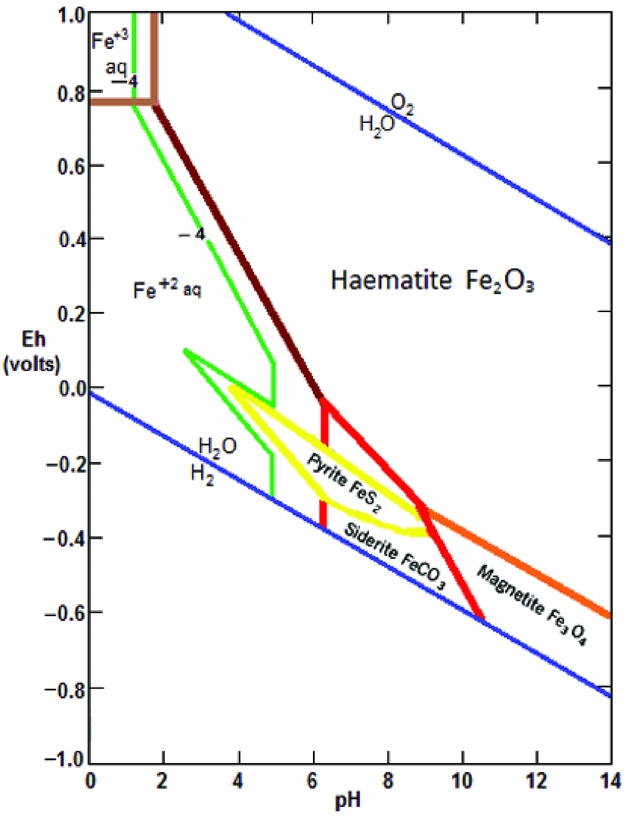
Loope et al. (Reference Loope, Kettler, Weber, Hinrichs and Burgess2012) have shown that one of the conditions for the precipitation of siderites is the non-acidic nature of the pore waters. A careful review of the siderite stability field (Fig. 8) also indicates that siderite forms under weakly reducing conditions between pH 6–10 (e.g. Bahrig, Reference Bahrig1989). The presence of siderite in the Wadhurst Clay Formation provides useful information about the pH level of the depositional environments of the Weald Basin. Allen (Reference Allen1989) proposed a pH of between 6 and 8.5 based on modern shelly molluscs and noted that the lowest salinities were found in the arenaceous facies while the highest salinity is present in the argillaceous formations. The described sideritic ironstones in this study support a pH of between 6 and 8.5 at the site of deposition of the rocks within the Wadhurst Clay Formation (e.g. Browne & Kingston, Reference Browne and Kingston1993). The variable salinities in these successions may be due to tidal influences and/or dilution of brackish waters into the basin (Allen, Reference Allen1975, Reference Allen1981; Stewart, Reference Stewart, Collinson and Lewin1983).
Stability fields of iron oxides, sulphide and carbonate with total dissolved sulphur = 10-6 M and total dissolved carbonate = 1 M, at 250 °C. (Modified from James, Reference James1966 and Garrels, Reference Garrels1960.) Green line shows the position of isoconcentrations of Fe in solution at activity of 10–4. Blue line shows theoretical limit of water stability.
6.d. Correlation with host strata
The analyses of the mineralogy and geochemistry of the Wealden sideritic ironstones show that the ironstones have strong mineralogical and geochemical correlation with their host strata (Tables 2, 3). For instance, there is a consistency in the types of clay minerals present within the ironstones and their host rocks. The dominant clay minerals in the Wadhurst Clay Formation are illite and kaolinite (O. O. Akinlotan, unpub. Ph.D. thesis, Univ. Brighton, 2015) and these are also present within the ironstones (Fig. 7). The sideritic ironstones and their host rocks are consistently enriched in Fe, Co and As (Table 3). The enrichment factors (Table 3) also clearly show systematic increase in Fe2O3 and Co and decrease in CaO and V between the host rocks and the ironstones. The review of the present data though not extensive suggests that the composition of the hosts is one of the main controls on the formation of the siderite within the ironstones. In the case of the Wealden ironstones under consideration, the composition of the host rocks is mainly controlled by the provenance, tectonics, transport, and depositional and post-depositional processes. The materials within the original strata were detrital with minimal diagenetic alteration and have travelled a relatively small distance of c. 300 km (Akinlotan, Reference Akinlotan2017c). This means the composition of the sideritic ironstones reflects that of the original provenance of the host rocks.
6.e. Formation mechanism
A more detailed investigation of the exact formation mechanisms of the sideritic ironstones under study is highly recommended for future studies, and the data from this current study will be extremely useful as a starting point. Based on the available data from this study and in comparison to other siderites described elsewhere (e.g. Curtis, Pearson & Somogyi, Reference Curtis, Pearson and Somogyi1975; Browne & Kingston, Reference Browne and Kingston1993; Baker, Kassan & Hamilton, Reference Baker, Kassan and Hamilton1996; Lim et al. Reference Lim, Jung, Yang and Yoo2004; Robinson et al. Reference Robinson, Scotchman, White and Atkinson2010; Rodrigues et al. Reference Rodrigues, De Ros, Neumann and Borghi2015), the likely scenario for the formation of the Wealden sideritic ironstones is attempted here. The observation of strong mineralogical and geochemical correlation between the ironstones and their host strata supports a previous formation model that the sideritic ironstones were formed from the adjacent mudstones and shales. The compositional link between the ironstones and their hosts is an indication that the ironstones were originally deposited as argillaceous facies (mudstones or shales) and were then subjected to early diagenetic replacement of the shells within the mudstones and shales (Lake & Thurrell, Reference Lake and Thurrell1974; Lake & Shephard-Thorn, Reference Lake and Shephard-Thorn1987). During early diagenesis (e.g. Browne & Kingston, Reference Browne and Kingston1993; Baker, Kassan & Hamilton, Reference Baker, Kassan and Hamilton1996; Lim et al. Reference Lim, Jung, Yang and Yoo2004; Köhler et al. Reference Köhler, Konhauser, Papineau, Bekker and Kappler2013; Rodrigues et al. Reference Rodrigues, De Ros, Neumann and Borghi2015), the Ca in the shells within the argillaceous facies principally composed of CaCO3 was replaced by Fe. The initial concentration of CaO in the host rocks was systematically reduced in the sideritic ironstones while Fe2O3 rapidly increased in the sideritic ironstones when compared to its original concentration in the host rocks (Table 3). The eventual formation of the sideritic ironstones occurred under freshwater, reducing/anoxic and shallow depth conditions as shown by data from this current study (e.g. Browne & Kingston, Reference Browne and Kingston1993; Baker, Kassan & Hamilton, Reference Baker, Kassan and Hamilton1996; Lim et al. Reference Lim, Jung, Yang and Yoo2004; Rodrigues et al. Reference Rodrigues, De Ros, Neumann and Borghi2015; Mirza, Mohialdeen & Awadh, Reference Mirza, Mohialdeen and Awadh2016). Like other pure siderites discussed elsewhere (Mozley, Reference Mozley1989; Spiro, Gibson & Shaw, Reference Spiro, Gibson and Shaw1993) the formation mechanism of the sideritic ironstones was largely controlled by the active roles of meteoric waters and bacterial activities (Browne & Kingston, Reference Browne and Kingston1993; Baker, Kassan & Hamilton, Reference Baker, Kassan and Hamilton1996; Lim et al. Reference Lim, Jung, Yang and Yoo2004; Robinson et al. Reference Robinson, Scotchman, White and Atkinson2010; Rodrigues et al. Reference Rodrigues, De Ros, Neumann and Borghi2015).
6.f. Other proxies for depositional environments of the Weald Basin
Having interpreted the depositional environments of the Weald Basin using the mineralogy and geochemistry of sideritic ironstones, it is appropriate to consider other proxies previously used to review the depositional environments of the Weald Basin. Based on field/outcrop data, the rocks within the Wadhurst Clay Formation were interpreted to have been deposited under non-marine and freshwater conditions (e.g. Kirkaldy, Reference Kirkaldy1939, Reference Kirkaldy1947; Worssam, Reference Worssam1972; Allen, Reference Allen1975, Reference Allen1981; Reference Stewart and ElliottStewart, 1981a,Reference Stewartb, Reference Stewart, Collinson and Lewin1983; Lake & Shephard-Thorn, Reference Lake and Shephard-Thorn1987; O. O. Akinlotan, unpub. Ph.D. thesis, Univ. Brighton, 2015; Akinlotan, Reference Akinlotan2017c). The enrichment of redox-sensitive elements such as Mo, V, Co and U in the Wadhurst Clay Formation (Akinlotan, Reference Akinlotan2017b,c) also confirms that anoxic/reducing conditions prevailed during the deposition of strata and the ironstones (e.g. Elbaz-Poulichet et al. Reference Elbaz-Poulichet, Seidel, Jézéquel, Metzger, Prévot, Simonucci, Sarazin, Viollier, Etcheber, Jouanneau, Weber and Radakovitch2005; Brumsack, Reference Brumsack2006). The clay minerals within the Wadhurst Clay Formation are dominated by detrital illite and kaolinite mineralogy (C. P. Sladen, unpub. Ph.D. thesis, Univ. Reading, 1980; Sladen, Reference Sladen1983, Reference Sladen, Lake and Shephard-Thorn1987; Taylor, Reference Taylor1990; Hallam, Grose & Ruffell, Reference Hallam, Grose and Ruffell1991; Taylor, Reference Taylor1991, Reference Taylor1992; Jeans, Reference Jeans2006; O. O. Akinlotan, unpub. Ph.D. thesis, Univ. Brighton, 2015; Akinlotan, Reference Akinlotan2017c). The lack of significant amounts of illite-smectite within the facies also supports the argument that the depth of burial has not been deep enough to enable any significant diagenetic transformation of smectite to illite-smectite (Akinlotan, Reference Akinlotan2017c). Evidence from fossil data (e.g. Hughes, Reference Hughes1955; Stewart, Reference Stewart1978; Batten, Reference Batten, Banner and Lord1982; Morter, Reference Morter1984; Parkes, Reference Parkes1993; Feist, Lake & Wood, Reference Feist, Lake and Wood1995; Horne, Reference Horne1995; Jarzembowski, Reference Jarzembowski1995; Goldring, Pollard & Radley, Reference Goldring, Pollard and Radley2005; Cope, Reference Cope2008; Naish & Sweetman, Reference Naish and Sweetman2011) including work on vertebrate and invertebrate biostratigraphy (e.g. dinosaurs, charophytes, ammonites, molluscs, ostracods, insects), trace fossils and palynology have presented interpretations of the palaeo- and depositional environments similar to the ones presented in this study.
6.g. Comparison to other siderites
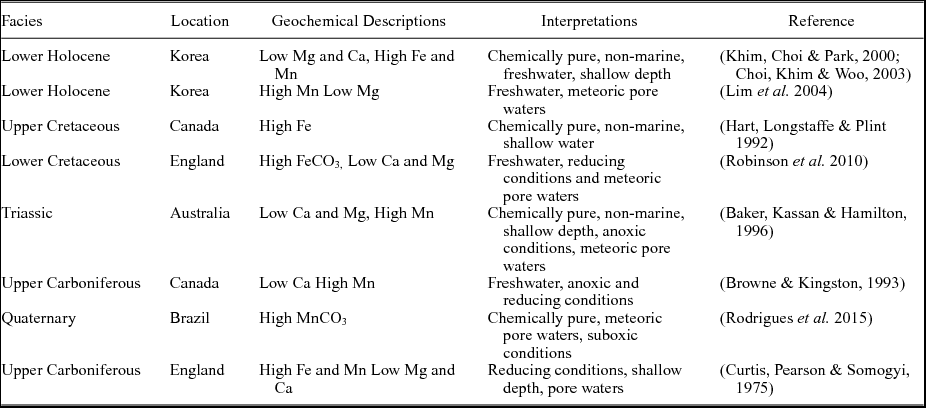
A summary of geochemical studies on siderites and their interpretations is presented in Table 4. Apart from the work of Robinson et al. (Reference Robinson, Scotchman, White and Atkinson2010) that examined sphaerosiderites in the Ashdown Formation and a brief discussion of the Wealden sideritic ironstones by O. O. Akinlotan (unpub. Ph.D. thesis, Univ. Brighton, 2015) and Akinlotan (Reference Akinlotan2017c), it thus appears that geochemical analyses on siderites and sideritic ironstones from the Lower Cretaceous facies are scarce in the literature. This means that the present study presents one of the first interpretations of depositional environments of the Lower Cretaceous facies based on the geochemical composition of sideritic ironstones. The geochemical composition of the present siderites has revealed that they are chemically pure, formed at a shallow depth from meteoric pore waters in non-marine, freshwater environments and reducing conditions. This present study will be useful for depositional interpretations of the Lower Cretaceous facies based on the geochemistry of siderites or sideritic ironstones.
Description of selected siderites and their interpretations

7. Wider implications
The results presented in this work have wider implications for understanding the depositional conditions of sedimentary basins elsewhere. The importance of mineralogical and geochemical compositions of sideritic ironstones as effective means of understanding sedimentary basins is reinforced, such that when traditional datasets such as field and fossil data are not readily available or insufficient to enable adequate interpretations, the mineralogical and elemental compositions of sideritic ironstones will be useful for understanding the depositional conditions of sedimentary basins. The use of sideritic ironstones as indicators of depositional environments is well documented (e.g. Oertel & Curtis, Reference Oertel and Curtis1972; Curtis, Pearson & Somogyi, Reference Curtis, Pearson and Somogyi1975; Gautier, Reference Gautier1982; Postma, Reference Postma1983; Curtis & Coleman, Reference Curtis, Coleman and Gautier1986; Bahrig, Reference Bahrig1989; Mozley, Reference Mozley1989, Reference Mozley1996; Mozley & Wersin, Reference Mozley and Wersin1992; Browne & Kingston, Reference Browne and Kingston1993; Mortimer, Coleman & Rae, Reference Mortimer, Coleman and Rae1997; Rodrigues et al. Reference Rodrigues, De Ros, Neumann and Borghi2015). This approach that is used here comprehensively for the first time within the Weald Basin supports the growing use of the composition of sideritic ironstones to interpret depositional environments either as the main dataset or as a supplemental dataset, especially when traditional datasets are not available or insufficient. Within the Wadhurst Clay Formation in the Weald Basin, the interpretations of the depositional environments made from the mineralogy and geochemistry of the sideritic ironstones validate previous interpretations from other proxies. Sideritic ironstones will give an indication of the nature of the environment (freshwater or marine) and will provide information about the extent of burial depth at the time of formation. They will indicate anoxic/reducing conditions, the timing of diagenesis and provide information on the palaeo-salinity of the adjacent rocks. More importantly, sideritic ironstones will provide useful information about the original component of the host rocks.
The results presented in this work can be applied to other non-marine Lower Cretaceous facies such as in China (e.g. Tang et al. Reference Tang, Luo, Zhou, You, Georgi, Tang and Wang2001; Li et al. Reference Li, Xu, Liu, Zhou, Wang, Sun and Liu2013; Chen et al. Reference Chen, Wang, Wei, Lv, Gan and Jin2014; Ju & Sun, Reference Ju and Sun2016; Li, Wen & Huang, Reference Li, Wen and Huang2016) and South America (e.g. Legarreta, Kokogián & Boggetti, Reference Legarreta, Kokogián and Boggetti1989; Paredes et al. Reference Paredes, Foix, Colombo Piñol, Nillni, Allard and Marquillas2007; Richiano, Reference Richiano2014; Garrido & Salgado, Reference Garrido and Salgado2015; Ferreira et al. Reference Ferreira, Ferreira, Ramos and Carvalho2016) and can also be used as analogues for other non-marine Lower Cretaceous facies elsewhere (e.g. Watson & Alvin, Reference Watson and Alvin1999; Haywood, Valdes & Markwick, Reference Haywood, Valdes and Markwick2004; Dejax, Pons & Yans, Reference Dejax, Pons and Yans2007; Yans et al. Reference Yans, Gerards, Gerrienne, Spagna, Dejax, Schnyder, Storme and Keppens2010; Rippen et al. Reference Rippen, Littke, Bruns and Mahlstedt2013; Pott, Guhl & Lehmann, Reference Pott, Guhl and Lehmann2014; Fisher & Watson, Reference Fisher and Watson2015).
8. Conclusions
The analyses of the mineralogy and the geochemistry of the sideritic ironstones in the Weald Basin, SE England have provided a good opportunity to test previous depositional models on the Wealden facies using the composition of the ironstones. The review of the trace-element assemblage has demonstrated that the sideritic ironstones are chemically pure and this points to a freshwater origin. The sideritic ironstones reveal reducing and anoxic conditions and also provide information about the salinity of the palaeo-depositional environments of the Wadhurst Clay Formation within the Weald Basin. The likely scenario for the formation of the sideritic ironstones from meteoric waters and bacterial activities is suggested while the detailed investigation of the exact formation mechanisms of the sideritic ironstones is highly recommended for further studies. The strong geochemical correlation between the ironstones and their host rocks has led to the suggestion that the composition of the host rocks is one of the main controls on the formation and quantity of the siderite within the ironstones. More generally, the analyses of the data from this work have helped to demonstrate a strong relationship between the composition of sideritic ironstones and their host rocks. These also confirm that the composition of the host rocks has significant controls on the composition of sideritic ironstones. This conclusion has been made from limited datasets in non-marine settings and will require further testing in different depositional settings. The results of these analyses further enforce the importance of the mineralogy and elemental composition of sideritic ironstones as useful tools for interpreting the depositional conditions of sedimentary basins, especially when traditional data are not available and can supplement sedimentological interpretations when traditional data are insufficient. These interpretations on the depositional environments of the Lower Cretaceous Weald Basin based on the geochemistry of sideritic ironstones can be applied to other non-marine Lower Cretaceous facies elsewhere.
Acknowledgements
This paper emanated from doctoral research conducted at the University of Brighton and supervised by Prof. Andy Cundy, Dr John Ullyott and Dr Martin Smith. A University of Brighton International Research Scholarship and the School of Environment and Technology provided part funding. Many thanks to the reviewers who made constructive comments to improve the final draft.