Caddis-flies are a group of amphibiotic holometabolous insects with aquatic larvae (often living in transportable retreats called caddis cases) and aerial, moth-like adults. Many taxa of caddis-flies are ecologically specific and indicative of (palaeo)environments. The caddis-flies represent a minor component of the insect assemblage of the Bembridge Marls deposits (Isle of Wight, England, which was considered to be early Oligocene in age (Gale et al. Reference Gale, Huggett, Pälike, Laurie, Hailwood and Hardenbol2006), but now considered to be latest Eocene (Priabonian) in age (Hooker et al. Reference Hooker, Collinson, Grimes, Sille and Mattey2007, Reference Hooker, Grimes, Mattey, Collinson, Sheldon, Koeberl and Montanari2009). However, the composition is unusual compared to other assemblages because of the abundance of Beraeidae.
A total of 71 fossil specimens were studied, mainly as isolated wings, sometimes accompanied with the incomplete body remnants. The majority of them (53 specimens, or 74%) belong to the small and rare family Beraeidae, hitherto unknown as fossils in rocks. Four fossils (6%) represent four other families (Phryganaeidae, Philopotamidae, Polycentropodidae, and incertae familiae), and the remaining 14 (20%) do not permit family identification because of insufficient preservation. All the material comes from the Insect Limestone, Bembridge Marls, at the northwest side of the Isle of Wight, southern England, and is kept at the Natural History Museum, London (NHMUK) as a part of P.B. Brodie, R.W. Hooley and E.J. A'Court Smith Collections.
1. Material and methods
The fossils were examined using a Wild (Heerbrugg, Switzerland) microscope with drawing tube, and photographed using Nikon Coolpix 4500 digital camera. Some pictures were taken by photographers at the NHM. Line drawings were hand made, based on photographs and sketches made under the drawing tube.
2. Systematic palaeontology
Order Trichoptera Kirby, Reference Kirby1815
Family Beraeidae Wallengren, Reference Wallengren1891
Description. Wings 3·5–5 mm, rarely 7 mm long, densely pubescent, male fore wing usually with a basal pit furnished with a cover and scaled folds. Venation specialised (reduced and modified) and sexually dimorphic (e.g., fore wing of all males except Beraeodes minutus with extra M branch). Sc and R run parallel up to their apices, lacking interconnecting cross-vein. RS is forking somewhat after wing midlength and often accompanied with rs3+4-m cross-vein nearby. Discoidal cell (DC, cf. Text-fig. 5) lost. Apical forks F2 and F3 often present. CuA often ends in fork. Hind wings are still more modified, with F3 present only in females.
Remarks. Being ecologically indicative and dominant in the assemblage, Beraeidae deserves special discussion. The family comprises seven extant and one extinct genus from the Upper Eocene Baltic amber (Ulmer Reference Ulmer1912; Morse Reference Morse2006; Wichard Reference Wichard2013). Living Beraeidae mainly occur in Europe (Beraea Stephens, Reference Stephens1833; Beraeodes Eaton, Reference Eaton1867; Ernodes Wallengren, Reference Wallengren1891; Beraeamyiia Mosely, Reference Mosely1930; and Beraeodina Mosely, Reference Mosely1931). Other living genera, often of debatable identity (Wiggins Reference Wiggins1978), are known from rare records from Tanzania (Notoernodes Andersen & Kjaerandsen, Reference Andersen and Kjaerandsen1997) and Japan (Nipponoberaea Botosaneanu, Nozaki & Kagaya, Reference Botosaneanu, Nozaki and Kagaya1995). The eleventh, extinct genus is Pseudoberaeodes Ulmer, Reference Ulmer1912 from Baltic amber. Additionally, a few species of Beraea are recorded in North America, Algeria and Central Asia, Beraeodes in the Caucasus and Ernodes from Turkey, the Caucasus and Japan.
All Beraeidae are small insects with densely pubescent wings only 3·5–5 mm, rarely 7 mm long. Wing venation is much reduced, modified and sexually dimorphic. Beraeidae are poor fliers and often abundant locally near their eclosion sites but never in other circumstances (V.D. Ivanov, pers. comm. 2006). Larval Beraeidae populate springs and streams with clear, cold water and feed on dead plant matter. They build small sandy tubes as caddis cases. Several European Beraea and Ernodes are known to develop out of water among mosses or larger plant fragments near stream or spring.
Beraeidae fossils from the Bembridge Marls all belong to the genus Beraeodes, which is otherwise known from the unique living species B. minutus (Linnaeus, Reference Linnaeus1761) and B. pectinatus Ulmer, Reference Ulmer1912 from the Baltic amber. The Bembridge material under revision includes holotypes of two more extinct species, B. anglicus Cockerell, Reference Cockerell1921 and B. vectensis Cockerell, Reference Cockerell1921. Additional specimens of both species (18 of B. vectensis and two of B. anglicus), and 32 specimens of insufficient preservation state, are referred to as Beraeodes indet.
Apparently, Beraeodes represents a strikingly relict genus, with the majority of known species being extinct before the mid-Tertiary. The venational similarity and, possibly, close relationship between Beraeodes and Pseudoberaeodes known solely from Baltic amber, also suggests a long history for Beraeodes.
Genus Beraeodes Eaton, Reference Eaton1867
1867 Bereodes Eaton, p. 400.
1879 Beraeodes McLachlan, p. 499 (emendation justified under ICZN 1999, # 33.2.3.1).
Type species. Phryganea minuta Linnaeus, Reference Linnaeus1761 (by monotypy), from Europe.
Beraeodes vectensis Cockerell, Reference Cockerell1921
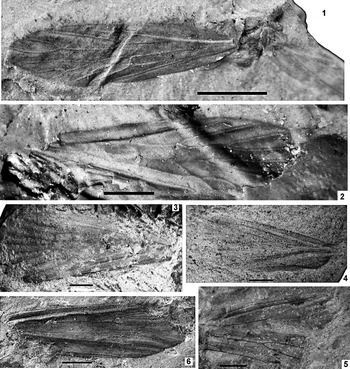
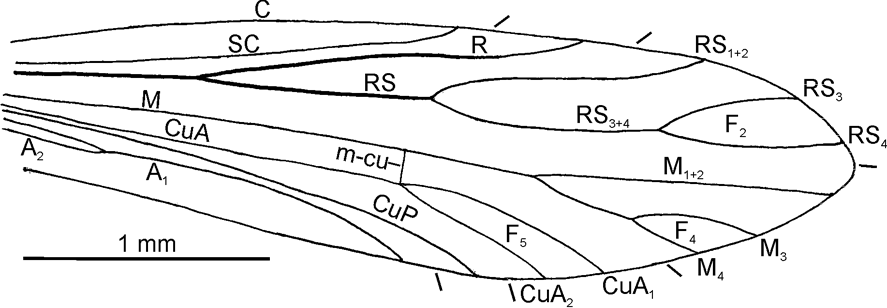
Plate 1, fig. 1; Text-fig. 1
1921 Beraeodes vectensis Cockerell, p. 479, fig. 48.
(1) Beraeodes vectensis Cockerell, Reference Cockerell1921, NHMUK In.43473, holotype; (2) Beraeodes anglicus Cockerell, Reference Cockerell1921, NHMUK I.10240, holotype; (3) Bembridgea insularia sp. nov., NHMUK I.8668, holotype; (4) ?Plectrocnemia incompleta sp. nov., NHMUK In.24595, holotype; (5) Wormaldia longaeva sp. nov., NHMUK I.9718, holotype; (6) Paleodicella anomala sp. nov., NHMUK In.24630, holotype. Scale bars=1 mm.

Beraeodes vectensis Cockerell, Reference Cockerell1921, holotype, NHMUK I.9134, late Eocene, Bembridge Marls, Isle of Wight, England. Abbreviations: F1–F5=apical forks; other venational symbols are standard.

Holotype. NHMUK I.9134/In.43473, Brodie/Hooley Collections (part and counterpart), female fore and hind wings with thoracic fragments. Insect Limestone, Bembridge Marls, Isle of Wight, England.
Other material. 18 fossils, all NHMUK: three males (I.9256, I.9356(1), Brodie Collection, body and wings; In.26041, Hooley Collection, fore wing) and 15 females: wings with incomplete body (I.9288, I.9770, I.9863, Brodie Collection; In.17397, Smith Collection) and isolated fore wings (I.8964, I.9716, I.10038, Brodie Collection; In.17290, In.17351, In.17393, In.17499, Smith Collection; In.24633, In. 25382, In.25409, Hooley Collection; PI II.2823, part and counterpart, north end Thorness Bay, Collected 22.05.05, A.J. Ross).
Diagnosis. Sc short, reaching 0·5 of wing length. RS base at 0·25 wing length, RS3+4 forking slightly basad of RS1+2 apex, with stalk 1·2 times as long as RS4. Cross-vein m–cu vertical.
Description. Fore wing lanceolate, acuminate apically, with fore and hind margins straight. Costal area widened sub-basally, subcostal area narrow. Sc and R short, reaching respectively 0·5 and 0·7 of wing length, R straight. RS base at 0·25 wing length, RS stalk subequal to RS1+2, forking near wing midlength. RS3+4 forking slightly basad of RS1+2 apex, with stalk 1·2 times as long as RS4. Cross-vein rs-m absent. M forking at 0·65 wing length, with no F3. F1+2 straight. M3+4 stalk subequal to M4. Cross-vein m–cu vertical, placed at wing midlength at base of long F5. CuP simple, long, meeting wing hind margin just anterior of A1. A1 meeting wing hind margin at level of RS fork. Hind wing narrower than fore wing, with no venation preserved. Fore wing length 3·0–6·5 mm (holotype: length 3·5 mm; width 0·9 mm; hind wing length 2·8 mm, width 0·7 mm).
Comparison. The present species is very similar to B. minutus, but differs in having short Sc, and in distal position of bases of RS and RS4. Differs from another similar species B. pectinata from the Eocene Baltic amber in having cross-vein m–cu vertical and not oblique.
Remarks. B. vectensis is venationally similar also to Ernodes, which differs in shorter RS stalk and longer M branches, as well as in vertical m–cu. The high morphological stability of Beraeodes (except B. anglicus, see below) and related genera known almost exclusively from Europe may indicate their slow evolution within this territory only.
Wing length range of the species (3–6·5 mm) is unusually wide. However, no venational differences correlated with the wing size is observed, and distribution is not distinctly bimodal. One specimen with a wing length of 3·0 mm has been recorded (I.9256); eight with a wing length of 3·5 mm (I.9134 (=In.43473), I.9288, I.9770, I.10038, In.17290, In.17351, In.24633, In.25409); two with a wing length of 4·0 mm (I.8964, I.9356(1)); two with a wing length of 4·5 mm (In.25382, In.26041); one with a wing length of 5·0 mm (In.17393); one with a wing length of 6·0 mm (In.17499); and one with a wing length of 6·5 mm (In.17397). Excluding male wings (I.9256, I.9356(1), In.26041) makes the pattern slightly more bimodal: the progression 1:8:2:2:1:0:1:1:1 turns into 8:2:1:0:0:1:1:1. This might indicate the male In.26041 and females In.17393, In.17499, In.17397, with wing lengths of 4·5 mm and 5·0–6·5 mm respectively, as belonging to a distinct species with identical venation. However, with the limited information available, formal description of this species looks premature.
Beraeodes anglicus Cockerell, Reference Cockerell1921
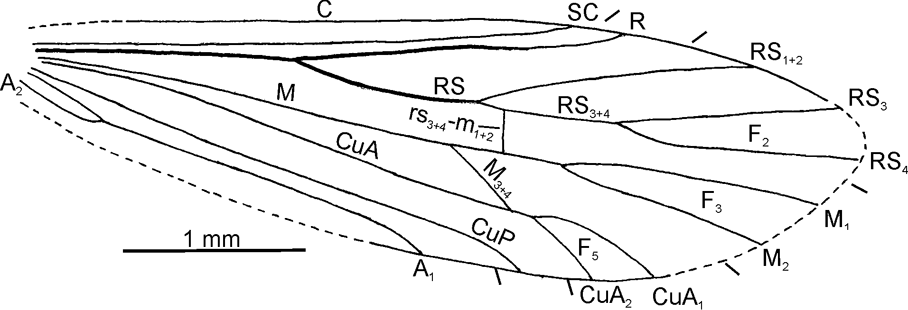
Plate 1, fig. 2; Text-fig. 2
1921 Beraeodes anglica Cockerell, p. 479, fig. 49.
Beraeodes anglicus Cockerell, Reference Cockerell1921, holotype, NHMUK I.10240, late Eocene, Bembridge Marls, Isle of Wight, England. Abbreviations: F1–F5=apical forks; other venational symbols are standard.

Holotype. NHMUK I.10240, isolated female fore wing; Brodie Collection; Insect Limestone, Bembridge Marls; ‘Gurnard Bay’, Isle of Wight, England.
Other material. In addition to the holotype, two isolated fore wings I.9175 and I.9215 from the same collection.
Diagnosis. F4 and F5 fused traceless. Cross-vein m–cua placed on M at long distance from both F3 and base of M4+5
Description. Fore wing lanceolate, not coloured, with fore margin straight, slightly convex only basal of its junction with Sc and R. Costal and subcostal spaces narrow. Sc meeting wing fore margin at c. 5/8, R at c. 3/4 of wing length. RS leaving R at c. 3/8 of wing length and branching beyond wing midlength, slightly distal of branching of M. RS and M reduced in branching: apparently F1 is lost and F4 and F5 are fused traceless. RS stalk 0·75 as long as RS1+2. F2 base at level of R apex, shorter that F3. Cross-vein rs–m single, subvertical, slightly beyond RS fork. Apparent m–cua cross-vein long, oblique, evidently represent stalk of F4 fused with F5. F4+5 short, forking slightly distal of m-cua. CuP simple, long. A1 long, meeting wing hind margin at wing midlength at a distance from CuP apex. A2 very short. Forewing length 4·5 mm, width 1·1 mm.
Comparison. Differs from all congeners in complete fusion of F4 and F5, and also in m-cua placed on M at long distance from both F3 and base of M4+5 (“oblique m-cu cross-vein”).
Family Phryganeidae Leach, Reference Leach and Brewster1815
Genus Bembridgea Sukatsheva, gen. nov.
Derivation of name. After the source stratum name Bembridge Marls.
Type species. Bembridgea insularia sp. nov., from Bembridge Marls, Isle of Wight, England.
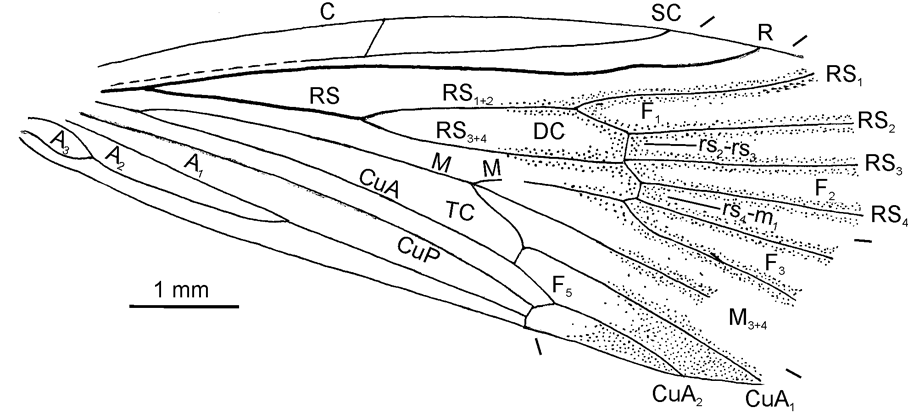
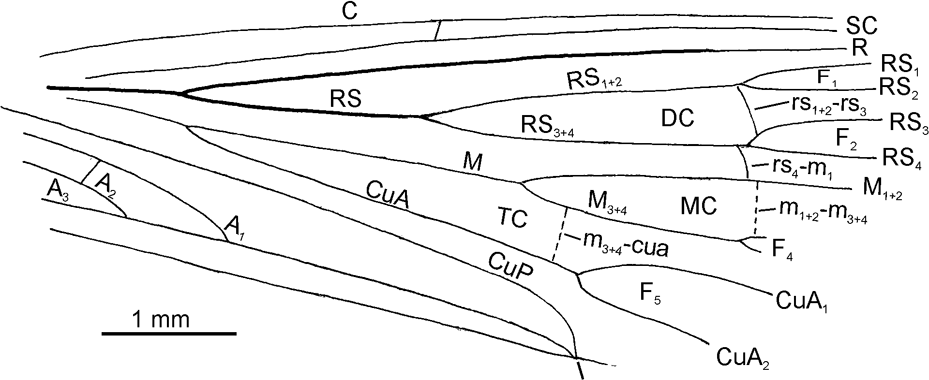
Diagnosis. Fore wing wide in apical half, strongly narrowing basally, roughly 2·5 times as long as wide. Costal area very wide, crossed with strong, weakly oblique cross-vein at level of RS fork. Subcostal area abruptly narrowed in basal half. F1 starting moderately within DC. DC long and wide, 1·3 times as long as RS stalk. Cross-vein m–cu of moderate length, S-like bent. F4 lost. A2 comparatively long (0·55 times as long as A1).
Comparison. The new genus is similar to a group of venationally uniform genera, including Trichostegia Kolenati, Reference Kolenati1848, Oligotricha Rambur, Reference Rambur and Rambur1842, Hagenella Martynov, Reference Martynov1924 and Semblis Fabricius, Reference Fabricius1775, in having F4 lost and m–cua S-like bent. It differs from these, as well as from all other Phryganeidae, in having c–sc cross-vein displaced distally, DC cell longer, sc–r crossvein lost, costal space wider, and F1 in more distal position.
Bembridgea insularia Sukatsheva, sp. nov.
Plate 1, fig. 3; Text-fig. 3
Bembridgea insularia Sukatsheva, sp. nov., holotype, NHMUK I.8668, late Eocene, Bembridge Marls, Isle of Wight, England. Abbreviations: DC=discoidal cell; F1–F5=apical forks; TC=thyridial cell; other venational symbols are standard.

Derivation of name. From insula, the Latin for island.
Holotype. NHMUK I.8668, isolated fore wing, probably male; P.B. Brodie Collection; Insect Limestone, Bembridge Marls; Isle of Wight, England.
Diagnosis. As for genus.
Description. Wing fore margin slightly convex. Sc straight, long, reaching level of rs–m. Subcostal area narrow basally, wide apically. R long, straight, slightly waved subapically. RS and M bases leveled. F1, F2, F3 long, straight. Cross-veins rs2–rs3 and rs4-m1 straight and strong. M forking at wing midlength, slightly before midlength of DC. Bases of F2 and F3 levelled slightly distal of F1 base. MC cell lost. Sinuate m–cu connecting the very point of M, forking with right-angled basal corner of F5 placed basal of level of F1 base. CuA2 slightly arching inside F5 after receiving arching cua2–cup cross-vein. CuP bending at right angle at cua2–cup to reach wing hind margin vertically, thus forming, jointly with cua2–cup and apical section of CuA2, smooth low curve delimiting narrow cell characteristic of Phryganeidae. A1 ending at vertical section of CuP. Wing length 12·5 mm as preserved, wing width 5 mm.
Remark. Ecology unknown: extant phryganeids are diverse bionomically and give no clue to way of life of the new species.
Family Polycentropodidae Ulmer, Reference Ulmer1906
Genus Plectrocnemia Stephens, Reference Stephens1836
Type species. Plectrocnemia senex Stephens, Reference Stephens1836 (nec Pictet, Reference Pictet1834), =Plectrocnemia geniculata McLachlan, Reference McLachlan1871 (monobasic); contemporary Europe.
?Plectrocnemia incompleta Sukatsheva, sp. nov.
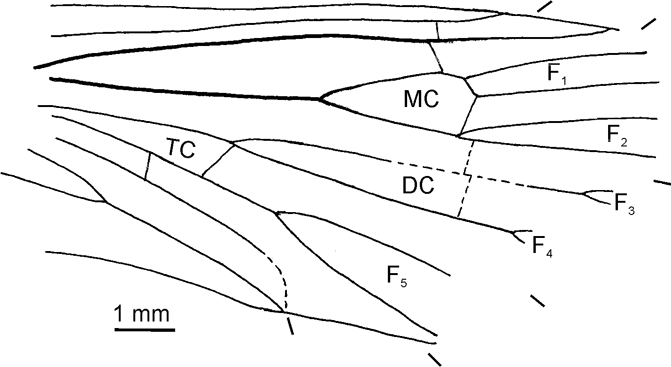
Plate 1, fig. 4; Text-fig. 4
Plectrocnemia incompleta Sukatsheva, sp. nov., holotype, NHMUK In.24595, late Eocene, Bembridge Marls, Isle of Wight, England. Abbreviations: DC=discoidal cell; F1–F5=apical forks; MC=median cell; TC=thyridial cell; other venational symbols are standard.

Derivation of name. From incompletus, the Latin for incomplete.
Holotype. NHMUK In.24595, incomplete fore wing; R.W. Hooley Collection, Natural History Museum, London; Insect Limestone, Bembridge Marls, late Eocene; ‘Gurnard Bay’, Isle of Wight, England.
Diagnosis. Costal space with single oblique cross-vein at level of RS fork. F1 present, long. DC closed, long and wide.
Description. Fore wing comparatively narrow, with fore and hind margins straight. Costal space narrow, slightly widening basally, with single oblique cross-vein at level of RS fork. Subcostal space ribbon-like narrow. DC closed with straight cross-vein rs1+2–rs3+4, 1·3 times as long as RS stalk. F1 and F2 long, sessile. RS and M bases levelled. M forking far distal of RS. F3 short or lost. F4 long, levelled with F2 basally. Weak cross-veins m1+2–m3 and m3+4–cua may exist. F5 wide. CuP and A1 coinciding at wing hind margin. A2 and A3 short. Strong interanal cross-vein present. Postanal space narrow. Fore wing more than 7 mm long, 2·5 mm wide.
Remarks. Taxonomy of Polycentropodidae is based on body structures, and particularly male genitalia, which are not available for the present fossil. Based on the fore wing fragment at hand, the new species is attributed tentatively to Plectrocnemia, based mainly on presence of F1, on long, wide, and closed DC, and on presence of c–sc cross-vein which is placed somewhat distal of RS fork. On the other hand, long F1 is unknown in extant and Eocene (Baltic amber) Plectrocnemia and characteristic rather of Neuroclipsis McLachlan, Reference McLachlan1864, which has no cross-vein midlength in the costal space. This justifies description of the new species based on the insufficient material.
Contemporary Plectrocnemia are most abundant in Europe, but known also in North America and, rarely, in Australia, with larvae frequenting streams and springs.
Family Philopotamidae Stephens, Reference Stephens1829
Genus Wormaldia McLachlan, Reference McLachlan1865.
Type species. Hydropsyche occipitalis Pictet, Reference Pictet1834 (selected by Ross Reference Ross1949); contemporary Europe.
Wormaldia longaeva Sukatsheva, sp. nov.
Plate 1, fig. 5; Text-fig. 5
Wormaldia longaeva Sukatsheva, sp. nov., holotype, NHMUK I.9718, late Eocene, Bembridge Marls, Isle of Wight, England. Abbreviations: DC=discoidal cell; F1–F5=apical forks; MC=median cell; TC=thyridial cell; other venational symbols are standard.

Derivation of name. From longaevus, the Latin for long living.
Holotype. NHMUK I.9718, I.9866(1), incomplete fore wing (part and counterpart); P.B. Brodie Collection; Insect Limestone, Bembridge Marls; Gurnard Bay, Isle of Wight, England.
Diagnosis. F1 base wide, F2 sessile, F4 present, long-stalked. Cross-vein rs2–rs3+4 long, meeting very base of F2.
Description. Wing fore margin straight. Costal space narrow, slightly widening basally, lacking cross-veins. Subcostal space narrow except for basally and apical, with short vertical cross-vein basal of Sc apex. R long, simple. DC short, wide, subtriangular, about half as long as RS stalk. All five apical forks present, F1 and F2 long, straight, F1 with wide straight base, F2 sessile. Cross-vein r–rs1+2 strong, oblique, placed at widest place of DC, just before sc–r and base of F1. F3 stalk 1·3 times as long as F4 stalk. F5 long and wide. TC short, closed with strong, slightly oblique m3+4–cua placed at M fork. Cross-vein cua–cup oblique, placed slightly distal of junction of A1 and CuP and A2. A1 short, apparently co-incident at wing hind margin. A2 short. Postcostal area very wide. Wing fragment 5·9 mm long and 3 mm wide as preserved.
Comparison. Differs from the type species in having F1 base wide, F4 present, and rs2–rs3+4 long and meeting very base of F2. Differs from other extinct (Upper Cretaceous and Eocene) species as follows: long stalk of F4 differentiates it from W. angularia Mey, Reference Mey1986, W. contigua Mey, Reference Mey1986 and W. media Ulmer, Reference Ulmer1912; presence of F4 differentiates it from W. advenaria Mey, Reference Mey1988; wide base of F1 differentiates it from W. phaeromonia Ivanov & Melnitsky, Reference Ivanov and Melnitsky2005, W. sukatshevae Ivanov & Melnitsky, Reference Ivanov and Melnitsky2005, W. vlipla Ivanov & Melnitsky, Reference Ivanov and Melnitsky2005, W. myanmari Wichard & Poinar, Reference Wichard and Poinar2005, W. praecursor Botosaneanu, Reference Botosaneanu1995 and W. praemissa (Cockerell Reference Cockerell1916); and sessile base of F2 differentiates it from W. aequalis (Hagen Reference Hagen and Berendt1856) and W. congenera (Ulmer Reference Ulmer1912). Presence of F4 may indicate position of the new species within the W. copiosa (McLachlan Reference McLachlan1868) species group as defined by Malicky (Reference Malicky1983).
Remarks. Taxonomy of Wormaldia is based mainly on the body morphology, including structure of male genitalia which are not available for the new species. The wing venation of Philopotamidae is known to vary even between left and right wing of one and the same specimen: this makes attribution and comparison of W. longaeva tentative.
Ivanov & Melnitsky (Reference Ivanov and Melnitsky2005) conclude that based on genital and sternal structures, the Baltic amber Wormaldia (W. aequalis, W. congenera, W. media, W. phaerimonia, W. sukatshevae, W. vlipla) are related to the extant North Pacific and not to European species. It is not clear if this holds true with the present species.
Larval Wormaldia develop in cold, often mountain streams.
Familia incertae sedis
Genus Paleodicella Sukatsheva, gen. nov.
Derivation of name. From palaios, the Greek for old, and the leptocerid genus Adicella.
Type species. Paleodicella anomala sp. nov., by monotypy and present designation; late Eocene of Bembridge Marls, England.
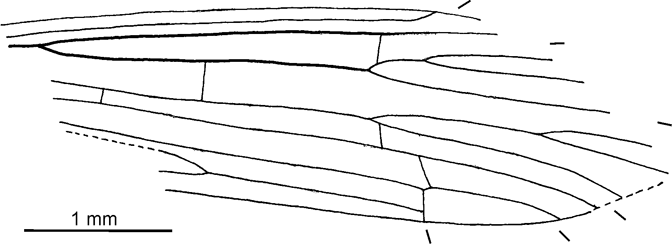
Diagnosis. Fore wing long and narrow (length more than three times width). Costal and subcostal areas narrow. Cell DC very short, open. F1 long, F2 and F4 absent. Cell TC very long. Cell enclosed by CuA2, vertical CuP apex, and wing hind margin, long and wide. Hind wing narrow, with F1 present.
Comparison. Similar to some Leptoceridae (Adicella McLachlan, Reference McLachlan1877, Erotesis McLachlan, Reference McLachlan1877, and several other genera) in having DC short. However, venation of the new genus is otherwise so unusual that does not permit attribution to a family with any certainty.
Species included. Type only.
Paleodicella anomala Sukatsheva, sp. nov.
Plate 1, fig. 6; Text-fig. 6
Paleodicella anomala Sukatsheva, sp. nov., holotype NHMUK In.24630; late Eocene, Bembridge Marls; Isle of Wight, England.

Derivation of name. From anomalos, the Greek for illegal.
Holotype. NHMUK In.24630, incomplete fore and hind wings; R.W. Hooley Colllection, Natural History Museum, London; Insect Limestone, Bembridge Marls; Gurnard Bay, Isle of Wight, England.
Diagnosis. As for genus.
Description. Fore wing with fore margin straight. SC long, straight, reaching level of F1 base, R long, straight, lacking apical bend. F1 long, petiolate, three times as long as its stalk. F3 0·9 times as long as its stalk. Cross-vein r–rs1+2 strong, strictly vertical unlike slightly oblique m3+4–cua and cua1–cua2. Cell TC long, starting more close to RS base than to rs–m cross-vein. F5 wide, its fore branch CuA1, its hind branch CuA2 slightly arching, running backward almost vertically in a characteristic manner of Leptoceridae. CuP and A1 long, jointly forming vertical section at level of F1 base. A2 of moderate length. Hind wing with forks F1 and F3 present, DC open, otherwise venation is not clear enough. Fore wing length 6·4 mm, width 3.2 mm.
3. Conclusion
The caddis-fly assemblage of the Bembridge Marls is composed of abundant Beraeidae with one dominant and another far subordinate species, and three other families (Phryganeidae, Philopotamidae and Polycentropodidae). All families recorded are also known in the Baltic amber assemblage, which is rather similar to the Bembridge Marls one both in time (Late Eocene; Hooker et al. Reference Hooker, Collinson, Grimes, Sille and Mattey2007, Reference Hooker, Grimes, Mattey, Collinson, Sheldon, Koeberl and Montanari2009; Perkovsky et al. Reference Perkovsky, Rasnitsyn, Vlaskin and Taraschuk2007) and space, but differs much in taphonomy (rock fossils vs. amber inclusions). The present assemblage agrees with at least some others of comparable age in having two of its five genera extinct and three other extant; assemblages of the Baltic amber and Florissant shales also have some half of their constituent genera extinct (respectively, 26:30 and 8:8; Ulmer Reference Ulmer1912; Meyer Reference Meyer2003). In spite of all of this, composition of the Bembridge Marls Trichoptera is strictly unique in being dominated by Beraeidae. As it was explained in the beginning of the present paper, Beraeidae is a small, uncommon family rarely recorded as fossils and in no other case found abundant there.
Another unexpected but equally unmistakable feature of the assemblage is its ecological appearance. With the exception of the sole specimen of eurybiotic Phryganeidae, all identifiable caddis-flies belong to groups with psychro- and oxyphilous larvae restricted to springs, or at most to cold streams. This indicates an abundance of cold water and the absence of fresh lakes and slow, warm, running waters in the vicinity of the Insect Limestone mother water body.
4. Acknowledgements
The author is thankful to Andrew J. Ross for his help, to Phil Crabb (NHMUK) for photography, and to INTAS for financial support. I acknowledge with many thanks the help of A.P. Rasnitsyn in editing the present article. I also thank E.D. Lukashevich for photography of the fossils and A.S. Aristov for preparing the final version of the line drawings. The present work contributes to INTAS Project No. 03-51-4367. It is additionally supported in part by the Presidium RAS Program “Origin and evolution of Biosphere, Subprogram II”.