The current economic crisis is obliging all Organisation for Economic Co-operation and Development (OECD) countries to stabilize healthcare expenditure that has risen relentlessly over the past decades (12). Any generalized contraction in health expenditure is not socially desirable and governments are committed to reducing wastage of resources and encouraging market access of cost-effective therapies.
Health technology assessment (HTA) is expected to provide policy makers with reliable, documented information on the effectiveness and costs of healthcare therapies (Reference Banta and Andreasen2). For instance, the economic stimulus recently approved by the U.S. Congress (780 million Euros for comparative effectiveness studies on 100 selected primary research areas) (Reference Iglehart9) is expected to reinforce the role of HTA as a key tool for rational decision making in healthcare management (Reference Conway and Clancy5;Reference Volpp and Das15).
At the same time, however, conflicts of interest due to healthcare industry influence is emerging as a critical issue in many aspects of medical research, education, and practice. Several proposals have been made to enhance transparency, all aimed at protecting the integrity of research and welfare of patients (Reference Steinbrook14). This can affect full economic evaluations (FEEs) too (Reference Krimsky10). Industry can be expected to increase its efforts in the HTA field to lobby third party payer decisions, so this might become a major concern in the very near future unless decision makers boost their critical skills in interpreting FEE results.
Inspired by events in the past years in pharmaceutical research, where the majority of published papers were sponsored clinical trials with positive outcomes, we reviewed the pharmacoeconomic studies in the international literature (Reference Lexchin, Bero, Djulbegovic and Clark11). The prime objective was to investigate whether sponsorship by the pharmaceutical industry affected the results of FEEs based on modeling. In particular, we focused on the flourishing literature based on Markov models, by far the most widely exploited tool for estimating lifetime costs and benefits (Reference Bala and Mauskopf1).
METHODS
We made a literature search of the international database PubMed to find all the studies on pharmacological treatments based on Markov models published in English in the period January 1, 2004 to June 30, 2009 (Supplementary Table 1, which can be viewed online at www.journals.cambridge.org/thc2010024). We selected the FEEs that focused on single drugs only, specifically cost-effectiveness (CEA) and cost-utility analyses (CUA).
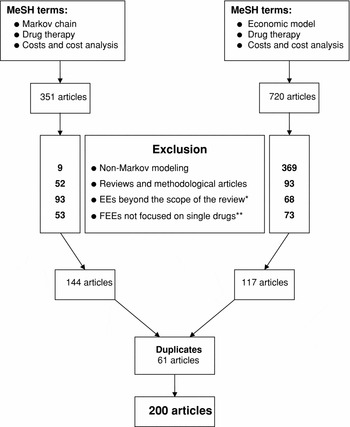
We conducted two searches: the first with the medical subject headings “Markov chain,” “drug therapy,” and “costs and cost analysis”; the second replacing the search term “Markov chain” with “economic model.” Figure 1 summarizes the search strategy and its results: 200 articles including FEEs based on Markov models were considered eligible.
Literature search strategy. *Cost analyses, FEEs other than CEA or CUA, FEEs focused on non-pharmacological alternatives (e.g., screening, radiotherapy, surgery). **FEEs conducted on broad therapeutic groups or therapeutic regimens. CEA, cost-effectiveness analysis; CUA, cost-utility analysis; EE, economic evaluation; FEE, full economic evaluation; MeSH, medical subject heading.

For the analysis, we classified the FEEs into two groups according to whether or not they had financial backing from the pharmaceutical industry, so the authors’ affiliations and acknowledgments were examined closely. Studies co-signed by at least one author affiliated to a pharmaceutical company and/or studies that declared any type of company funding were considered sponsored, other studies were classified as not sponsored. Articles were further investigated to see whether at least one co-author was affiliated to a consultancy company (CC). Finally, we assessed the main conclusions, which were classified as (i) “favorable” if the drug studied was clearly claimed to be a preferred choice (e.g., cited as “cost-effective” or with “an acceptable incremental cost-effectiveness ratio”), (ii) “doubtful” when some uncertainty was expressed in the final comments (e.g., “results should be interpreted with caution”, “the drug might be cost-effective under some assumptions”), and (iii) “unfavorable” when final comments were negative (e.g., “the strategy is unlikely to be considered cost-effective” or “is economically unattractive”).
Absolute and relative frequencies were used to describe the variables, the Pearson χ2 test to analyze them at the 5 percent level of significance (p ≤ .05).
Because any critical assessment is a subjective exercise by definition, two reviewers (D.K. and G.C.) assessed the 200 articles separately to minimize discretionary effects. A final meeting was arranged to achieve consensus and a third reviewer (L.G.) took a final decision on the eight items (1.6 percent of the total) that were judged differently (inter-rater agreement test, K = 0.9).
RESULTS
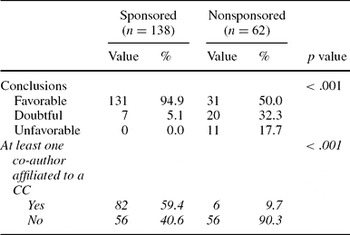
The most frequent technique was CUA (more than 70 percent), followed by CEA (15 percent); CEA and CUA were conducted together in the remaining articles. Of the 200 articles 138 (69 percent) were sponsored, 162 (81 percent) reached favorable conclusions, and 88 (44 percent) were backed by a CC.
Subgroups differed significantly in both the conclusions and CC participation (Table 1). Sponsored studies were much more likely to report favorable conclusions than nonsponsored ones (95 percent and 50 percent, respectively, p < .001), the former even omitting unfavorable conclusions. CCs were involved mostly in sponsored studies (59 percent vs. 10 percent, p < .001).
Relationships between Sponsorship and Conclusions in the Studies Reviewed
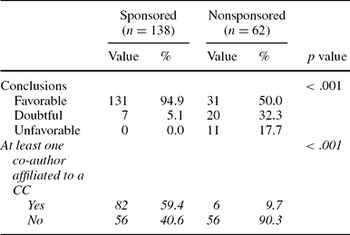
CC, consultancy company; n, number.
DISCUSSION
This review focused on the sponsorship of pharmacoeconomic studies built on Markov models. The major aim was to see whether and to what extent the conclusions were influenced by pharmaceutical industry funding.
As in all reviews where references are retrieved from a single international database, we may have missed some studies despite our best efforts, although the systematic bibliographic search techniques should have minimized this. In addition, the large sample and the highly significant findings should restrict this potential limitation.
The review found a substantial share of studies supported by the pharmaceutical industry, almost all concluding in favor of the drug studied, without any unfavorable conclusions at all. Sponsored studies often called on consultancy companies too, which understandably compete with each other for financial support, casting doubts on the credibility of conclusions.
Markov models proved suitable for achieving the expected results, being very flexible and open to various assumptions. Thresholds set by public agencies like NICE might also help manufacturers and consultants target their models, the desired favorable result being known ex ante (Reference Bell, Urbach and Ray3;Reference Burls and Sandercock4). This probably encourages companies to develop a general stochastic model, then adapting it to more than one country by tailoring and customizing epidemiologic and cost data. The presence of pharmaceutical sponsorship is highly predictive of a positive conclusion, with a risk of error less than 1 percent.
It is hard to identify any effective strategy to limit the potential for manipulation of modeling results, and safeguarding competence and transparency might be more important in HTA than in other healthcare fields. However, at least some precautions can be suggested for international journals to help unskilled readers boost their awareness of potentially flawed results. A first, obvious one is full disclosure of the authors’ conflicts of interest in the acknowledgements to articles, an issue that has been amply debated (Reference Bell, Urbach and Ray3;Reference Krimsky10;Reference Philips, Ginnelly and Sculpher13). Even so, we still found some worrying examples in our review: thirteen articles did not report any acknowledgement at all; and two, co-signed by employees of pharmaceutical companies, actually denied any conflict of interest (Reference Dong, Sorensen and Manninen6;Reference Gerkens, Nechelput and Annemans8). We believe that international journals should strengthen their checks on competing interests of sponsored economic evaluations based on modeling, because these exercises are so open to discretionary assumptions. This would suggest an accurate policy of peer reviewing too, by enhancing widespread expertise on FEEs throughout medical journals (only 28 percent of the articles reviewed were published in nonmedical journals).
Further evidence is that more than two-thirds of the published articles are sponsored by pharmaceutical companies, the remaining third being either fund less (66 percent) or financed by public agencies like NICE (34 percent). There seems to be ample scope for independent studies in this field, and public authorities should encourage them if they really want HTA to become a credible tool in supporting healthcare decision making. The present ambiguous situation of HTA in Italy can help in understanding the major drawbacks in the absence of a clear-cut strategy. Both central and regional authorities have very recently set up HTA agencies, claiming that this is the most appropriate tool for assessing the new emerging technologies to be injected in the SSN (the Italian NHS). The major weakness of this flourishing trend are the very limited public financial resources and many agencies are already looking to industry for money (Reference Garattini and Casadei7). We are convinced that transparency can only be achieved if HTA is managed and funded by public authorities or by established nonprofit institutions on their behalf.
In conclusion, the results of this review confirm in the field of pharmacoeconomic studies that the best way of limiting confounding factors is by clearly distinguishing assessors from manufacturers and marketers of any new technology.
CONTACT INFORMATION
Livio Garattini, BA (lgarattini@marionegri.it), Chief, Daniela Koleva, MD (Daniela.koleva@marionegri.it), Researcher, Gianluigi Casadei, MD (gianluigi.casadei@marionegri.it), CESAV, Centre of Health Economics A. e A. Valenti, Department of Public Health, Mario Negri Institute, Via Carnozzi, 3 c/o Villa Carnozzi, Ranica (BG), Italy 24020
CONFLICT OF INTEREST
All authors report having no potential conflicts of interest.