

Introduction: New approaches in crop production systems and the process engineering
The area of tension in which current plant production systems in arable farming occur is demonstrated in missing alignment to challenges we will face in the future. The necessity for increasing productivity and efficiency is in conflict with a lot of problems which complicate a sustainable intensification (Backhaus et al., Reference Backhaus, Broers, Kögel-Knabner, Schwerin and Thrän2014). On the one hand an increasing shortage and contamination of the production factors soil, water, air (EU-Commission, 2002; Haenel et al., Reference Haenel, Rösemann, Dämmgen, Freibauer, Döring, Wulf, Eurich-Menden, Döhler, Schreiner and Osterburg2016) and a high use of finite resources (EU-Commission, 2014) are mentioned. But on the other hand projected changes and impacts of climate change rather require considerable adaptations of current forms of production (Balmann und Schaft, Reference Balmann and Schaft2008, IPCC, 2011). Initial approaches in the area of urban farming as well as vertical farming are set, nevertheless these aren’t real alternatives for replacing the current conventional produced plant biomass and food production in times of growing world population. In order to provide crop products in a socio-economic and ecological sustainable way in premium quality a profound change of production systems must be achieved. The arable crop production can only be organized sustainable if the focus is placed on multifunctionality (positive externalities, ecosystem services) and the tasks connected to this. Taking into account the described situation the solution could be the rethinking of the present earnings-oriented crop production system. So far production systems have been adapted to the machinery available on the market. The typical arable fields are large and are set in a geometric simple way and are cultivated with simple crop rotations and pure cultures allowing a technologically and economically efficient cultivation. The restructuring and development of other new cultivation concepts should not be done in the same scheme as today, therefore the process engineering should not be geared towards existing technologies or possible future technologies. New technological developments, like for example in digital farming or precision farming or the range of autonomous machinery shall be adapted to the requirements of sustainable system solutions in cultivation. New opportunities are created meeting the requirements for an optimal plant growth.
In this context the first question that arises here is the demands of crops for a sustainable and multifunctional crop production system and optimal growth. By means of these demands special challenges for technical implementation are crystallized. Hereinafter these challenges are clarified.
Requirements of an optimal crop production system in terms of a sustainable intensification in arable farming
The development of a sustainable crop production system should take into account diverse economic, ecological as well as social aspects as a complex causal network. The most important key points for the development of new cultivation systems should be explained in the next part.
In order to improve the yields in times of limited total area, decreasing raw material availability, as well as extreme weather events that are regularly happening, an optimal crop production system has to react on it. An efficient usage of given location potentials help to counteract in this context and to think about new cultivation systems. High yields and best qualities depend on the optimal combination and usage of the growth factors light, water, nutrients, air and temperature. Apart from parameters of yield and quality of ecosystem services must be taken into account. For example by increasing biodiversity with new ranges of varieties in crops and cultivar compositions, creation of buffer zones, as well as preserving and keeping soil fertility.
Furthermore new cultivation systems should include positive effects on socio-economic development of rural areas. This includes not only the reduction of environmental impacts, but also positive influence on landscape by more diversity in cultivation in even smaller structures. As a result so called agrarian deserts without trees and bushes but rather only monocultures could be avoided.
In order to implement the explained requirements to achieve prospective crop production systems current cultivation systems need to be rethought in a complex way. These new systems cannot and should not be cultivated with present process engineering.
The aim of this paper is drawing up a crop production system which meet mentioned challenges and in a next step deriving process requirements for its management. Thereafter prospects and opportunities but also restrictions and risks of new technologies for the implementation of future cropping systems must be taken into consideration.
With narrow row equal space planting towards an innovative cropping system
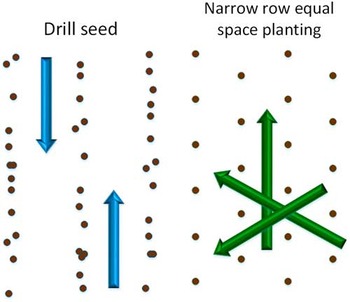
During narrow row equal space planting the seed placement is in form of equilateral triangles (Figure 1) and contains in contrast to traditional sowing technology like seed drill or single-seeding many benefits (Griepentrog, Reference Griepentrog1999; Götz and Bernhardt, Reference Götz and Bernhardt2008; Demmel et al., Reference Demmel, Hahnenkamm, Kormann and Peterreins2000). On the one hand all plants have the same planting distances that allows an equal and homogenous growth of leafs and roots. Thereby photosynthesis is increasing because of the optimal leaf area development. Moreover an early and homogenous ground cover leads to an efficient weed suppression and related reduction of herbicide application.
Possible machining direction of drill seed in comparison to narrow row equal space planting.

Simultaneously unproductive evaporation and risk of erosion could be reduced. By means of a homogenous distribution of roots in the soil waters and nutrients could be absorbed evenly and leaching can be positively lowered (Taube et al., Reference Taube, Balmann, Bauhus, Birner, Bokelmann, Christen, Gauly, Grethe, Holm-Müller, Horst, Knierim, Latacz-Lohmann, Nieberg, Qaim, Spiller, Täuber, Weingarten and Wiesler2003). Resistances to plant protection products are constantly on the rise. Simultaneously a lack of pesticide authorizations is occurring. The idea is to replace herbicides more and more by mechanical weed control procedures.
Narrow row equal space planting enables a cross and transverse processing of the arable land, so that especially in the near range of the plant the soil is tilled without damaging the crops.
With the possibility of cross and transverse processing of the arable soil an intra row tillage would already be feasible with existing hoes without any effort for sensor technology. As Götz and Bernhardt (2010) have already discovered that tillage in crossing directions improves the effectiveness of weed control clearly. However the process time remained at the same level as typical mechanical weed control within the rows.
Beside these possible yield and quality improvements there are further aspects within the scope of narrow row equal space planting. An efficient nutritional element uptake leads to a reduction of nutrient run off or endangered by erosion. Simultaneously a reduction of the use of herbicides, as well as a reduction of soil erosion and water eutrophication can be achieved with narrow row equal space planting (Götz and Bernhardt, Reference Götz and Bernhardt2008; Taube et al., 2013).
In addition to the single-origin narrow row equal space planting an establishment of different cultivars could affect further positive aspects. The combination of different cultivars with different properties could give a guarantee for higher yield security in times of changing climatic conditions. In a next step triangulated sowing systems with different cultivars for positive effects and synergies should be strived for increasing biodiversity and sustainability. A first consideration in this context is for example the combination of winter- and summer cereals with grain legumes or leaf crops. Harvest could be in one or a successive process. The technical challenge comprised inter alia the development in reliable separation or rather in selective harvest in successive process.
Cultivar associations in “Spot Farming”
Regarding to yield security and resource protection an optimal crop production system consequently must be able to respond to the recurrent heterogeneity of arable production areas, like difference in yield potential, soil properties, availability of water and nutrients and potential of erosion.
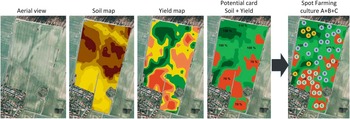
A major opportunity to overcome the field heterogeneity and taking into consideration small specific differences is the so called “Spot Farming”. The idea is to divide fields in small, independent spots and cultivate them with different cultures, culture associations and crop rotations in the principle of narrow row equal space planting presented above. The Spot Farming delimitation could be easily done based on the orientation on site specific soil and yield maps. From the intersection of these Spots different soil qualities and yield potentials within the field could be identified (Figure 2).
Example for plant communities in Spot Farming taking into consideration small specific differences (According to Claas 2016).

Spots with very low productivity could be used in an extensive way with cultures adapted to it, or even a conscious use as refuges or buffer zones, like blossoming plants. In specific cases cultivation with landscape elements for protecting erosion is quite conceivable.
Technical capability and requirements for the implementation of cropping strategies
The mentioned Spot Farming capabilities, in particular with extension of diversification within the spots (narrow row equal space planting of different cultures) cannot be efficiently managed with the current process engineering. Therefore the question rises if new or even known procedural devices could implement and fulfill the objectives sought of sustainability, success and efficiency.
From today’s view following subjects should be considered in this context:
-
– Digital and precision farming
-
– Geo-referencing
-
– Remote sensing
-
– Autonomous agricultural machines
-
– Sensor technology
-
– Use of non chemical methods for plant protection
The domain of digital and precision farming is already helping to identify local and small specific differences on agricultural land. These technical equipments could help to develop the Spot Farming in an efficient and usable way. A particularly big challenge in this domain will be generating methods for data preparation and data evaluation for guaranteeing a naturally, ecologically implementation and especially fulfilling the basic demands of the crop for an optimal growth potential. The crop cultivation alone would not accomplish these challenges. Instead, the interaction of different parts of landscape systems and agroecosystems are of particular importance. Cross-linking of expert systems could be an alternative to increase the productivity of agricultural production and simultaneously reducing negative impacts of crop production systems towards an acceptable level. By changing the crop production system, phytosanitary pressure could be lowered and naturally upcoming defence mechanisms of plants could be consequently strengthened. Thereby genetic resources become more transferred to breeding in favor of yield parameters.
Concerning plant breeding research, aspects like germination capacity of seeds need to be considered and improved. The use of narrow row equal space planting involving lower stock densities per unit area can only be efficient if the germination capacity of seeds is ensured to pare down the default rate to the minimum.
Present process technology mostly geared for spatial efficiency in conjunction with highly optimized impact power. Basic reasoning for preservation of required impact power is within use of autonomous systems. They would be able to deal with the mentioned Spot Farming system on single plant level. Autonomous machines could cultivate the crops need-based by using data of remote sensing. Satellite data would allow the coordination between swarms of robots an efficient management. The high impact power is influenced and can be safeguarded with variation in robot numbers, and with permanent readiness of these small machines. Highly promising are the wider processing windows for smaller and even lighter vehicles, associated with site-specific optimized growing space of crops in Spot Farming. Even if recent development trajectory in this area offer an initial step, a variety of outstanding issues should be clarified until new crop production systems and suitable process technology will come to the market. The development needs comprises several important considerations such as prospective energy supply systems, logistics, security and legal conditions, to required sensor technology and management systems.
Within the framework of processing engineering, the constituted cropping system Spot Farming and the narrow row equal space planting has high demands on sowing technology. Seeders or possibly future seeder units should be able to allocate seeds of different cultures in claimed accuracy of placement in the soil. A geo-referenced seed-placement adjusted to ground conditions especially soil depth would be a first step towards new, efficient cropping systems. Knowledge regarding the exact location of single seeds would entail various process advantages of crop management during vegetation season. One example would be an efficient implementation of cross and transverse processing as mechanical weed control without affecting plant growth.
One further challenge in the framework of processing engineering is the area of roll over frequency with the consequence of soil compaction. In today’s traditional techniques these problems are already well-known, especially on the headland. Within the scope of small scaled and autonomous process engineering the risk of increasing the soil compaction is higher, due to the enhanced roll over frequencies in cross and transverse processing.
Therefore expected yield enhancement within the narrow row equal space planting couldn’t be achieved.
Possible development steps could move towards satellite based utility vehicles with rubber belt or wheeled vehicles with the opportunity rotating freely 360 degree. Besides mechanical weed control these small and especially soil conserving machines could perform diverse agricultural tending measures permanently and appropriately, like fertilization and plant protection due to their wide application window. These tending measures should be implemented by using geo-referenced data from satellite-based remote sensing on single plant-level.
Conclusions
The basic concept of future crop cultivation should be more efficient and sustainable at the same time. The fundamental approach setting first the crop and the cultivation related requirements in the forefront and afterwards thinking about technological solutions could be promising. Simple continuation of current development paths in crop production will come up against borders in foreseeable future.
Portrayed cropping strategies with narrow row equal space planting and Spot Farming could be a conceivable way for achieving a sustainable intensification of crop production systems in the future. Site-specific soil and yield maps could be potentially used to select cultures and crop rotations according to the field heterogeneity. Furthermore these maps could provide information which allows the use of small autonomous machinery in a more needs-based and demands-driven way.
Acknowledgements
This research project is funded by the Federal Ministry of Food and Agriculture (BMEL) based on a decision of the Parliament of the Federal Republic of Germany within the framework of the federal programme “organic farming and other forms of sustainable agriculture”.