Willem Levelt observed in 1989 that language production was the stepchild of psycholinguistics. More recently, experimental research into speech production has developed considerably. However, to some extent, Levelt's criticism is still valid for written production. It is true that some notable research has been done (for a review of early research see Kellogg, Reference Kellogg1994; for recent approaches related to working memory in writing, see Kellogg, Olive, & Piolat, Reference Kellogg, Olive and Piolat2007), but it is also true that few models of writing individual words have been proposed and few systematic studies have been carried out. Most of the evidence about the cognitive processes involved in spelling and writing comes from neuropsychological studies of brain damaged patients (Tainturier & Rapp, Reference Tainturier, Rapp and Rapp2001). Error performance, such as slips of the pen, has been almost the only source of data regarding the spelling of normal subjects (see Wing & Baddeley, Reference Wing, Baddeley and Frith1980), and few studies have been carried out using online measures of the process of writing words.
A general assumption has been that writing involves several processing levels between the intention to write and motor execution (e.g., Caramazza, Reference Caramazza1988; Ellis, Reference Ellis1988; Tainturier & Rapp, Reference Tainturier, Rapp and Rapp2001; van Galen, Reference van Galen1991). In the model proposed by van Galen (Reference van Galen1991), these stages are similar to those proposed in speech production models (Dell, Reference Dell1986, Reference Dell1988; Levelt, Reference Levelt1989). As with models of speech production there appears to be broad agreement about the two kinds of processes involved in writing a word. On the one hand, there are central processes, which in the case of spelling include retrieving, assembling, and selecting the abstract orthographic representations; on the other hand, there is a set of peripheral processes related to motor execution, gestures, and output movements. This distinction between central and peripheral processes is supported by the existence of central and peripheral dysgraphias (e.g., Delattre, Bonin, & Barry, Reference Delattre, Bonin and Barry2006; Ellis, Reference Ellis1988).
Neuropsychological research has led to the suggestion that the central word-spelling process consists of two parallel routes: a lexical route, which generates the spelling of familiar words according to whole-word knowledge, and a sublexical route, which is useful for novel words and relying on a system of phoneme-to-grapheme conversion rules (Caramazza, Miceli, Villa, & Romani, Reference Caramazza, Miceli, Villa and Romani1987; Ellis, Reference Ellis and Ellis1982, Reference Ellis1988; Shallice, Reference Shallice1981; Tainturier & Rapp, Reference Tainturier, Rapp and Rapp2001). Although there is general agreement on the main features of the two routes to spelling, notable differences in architecture have been suggested, ranging from traditional symbolic models to interactive activation and parallel distributed processing models. In general, the sublexical route converts phonological units into corresponding orthographic units and subsequently assembles them into an abstract letter sequence.
The distinction between lexical and nonlexical routes makes a great deal of sense in languages with relatively deep orthographies, such as English, because whole-word knowledge is required to spell the many inconsistent and irregular words. In languages with transparent orthographies, however, the benefit of such knowledge is less clear. In Spanish, for example, the use of the sublexical route is potentially sufficient given the consistent links between phonology and orthography, that is, each letter of the alphabet has a unique pronunciation and only a few letters map on to the same phoneme (Álvarez, Carreiras, & Perea, Reference Bogaerts, Meulenbroek, Thomassen, Simner, Leedham and Thomassen2004). However, any attempt to specify how a phoneme-to-grapheme process might operate, even in a transparent language like Spanish, depends on a clear understanding of the phonological units that are converted into orthographic functional units.
A relatively consistent assumption of dual route models is that the graphemic output from both routes is held in an output buffer prior to some output process occurring (such as allographic conversion). This graphemic buffer is conceptualized as a working memory system specialized for maintaining the activation of orthographic representations (e.g., Buchwald & Rapp, Reference Buchwald and Rapp2003; Caramazza & Miceli, Reference Caramazza and Miceli1990). It is unclear, however, whether the sequencing of information occurs prior to the graphemic buffer or is a function of the graphemic buffer. In addition and more relevant to our research, it is also unclear if the graphemic representations in the graphemic buffer consist of linearly ordered strings of abstract letter identities coded spatially, as has been hypothesized (Caramazza et al., Reference Caramazza, Miceli, Villa and Romani1987; for a proposal against this view, see Caramazza & Miceli, Reference Caramazza and Miceli1990). Hence, a main concern of the present paper is the precise nature of these graphemic representations, in particular what sort of sublexical units are involved in spelling and how these units serve as input for subsequent processes that compute concrete letter-shape representations for writing by normal subjects.
In the few studies that have been conducted investigating lexical and sublexical processes in writing there is some evidence suggesting that the graphemic representation is more than a mere linearly ordered sequence of graphemes. A small number of studies have examined whether syllable-like structures are computed in writing. The first studies with normal subjects were not very conclusive (Bogaerts, Meulenbroek, & Thomassen, Reference Bogaerts, Meulenbroek, Thomassen, Simner, Leedham and Thomassen1996; Zesiger, Orliaguet, Boe, & Mounoud, Reference Zesiger, Orliaguet, Boë, Mounoud, Faure, Lorette and Vinter1994). Zesiger et al. found no effect of syllabic structure in hand writing French words. However, longer interkeypress intervals were found at syllable boundaries than within the first syllable. In a post hoc analysis, Bogaerts et al. found that stroke durations and trajectory lengths in handwritten Dutch words were affected by the syllabic structure of those words: These measures were longer for the first letter of a word in which the first syllable was a consonant–vowel–consonant (CVC, e.g., gas) than for the same letter but in a word starting with a CV syllable (e.g., ga).
Neuropsychological findings provided more convincing evidence that syllables could be processing units in writing. For instance, Caramazza and Miceli (Reference Caramazza and Miceli1990) observed that the spelling errors of an Italian patient, L.B., were constrained by syllabification rules. To be more specific, L.B.'s spelling performance depended on the distinction between consonants and vowels and on the graphosyllabic structure. Caramazza and Miceli suggested that orthographic representations have a multidimensional and hierarchical structure made up of four levels: a grapheme identity tier, an orthographic CV-status tier, a graphosyllabic tier, and information about the germination. However, an English-speaking patient studied by Jóndóttir, Shallice, and Wise (Reference Jóndóttir, Shallice and Wise1996) showed a different pattern of errors than L.B.; this evidence led the authors to argue that orthographic representations do not need to include syllabic or CV information and to suggest that “languages differ in the organization of the graphemic buffer just as they differ with respect to the perceptual salience of the syllable. Spellers of Italian and of English might differ in the number of tiers in the graphemic buffer” (p. 190). According to Jóndóttir et al., the orthographic CV level proposed by Caramazza and Miceli is unnecessary because their patient's outputs can be explained by the function of basic phonological information, which is not necessarily syllabic. However, recent work by Buchwald and Rapp (Reference Buchwald and Rapp2006) presented relevant evidence against this phonological hypothesis (for different points of view, see Buchwald & Rapp, Reference Buchwald and Rapp2003; Caramazza et al., Reference Caramazza, Miceli, Villa and Romani1987; McCloskey et al., Reference McCloskey, Badecker, Goodman-Schulman and Aliminosa1994; Shallice, Rumiati, & Zadini, Reference Shallice, Rumiati and Zadini2000; Tainturier & Caramazza, Reference Tainturier and Caramazza1996).
Leaving aside neuropsychological work, little is known about which sublexical units are represented in the graphemic buffer when normal subjects spell or write words, and this is particularly the case with online measures of the process of writing. Kandel, Álvarez, and Vallée (Reference Kandel, Álvarez and Vallée2006) recently employed a copying task in which the participants (normal adults) had to copy words presented on a computer monitor by writing on a graphics tablet. In this study interletter intervals (ILIs) were measured. These were defined as the time interval between two letters separated by a pen lift when writing in uppercase letters, and it was assumed that this measure provides information on the timing of the processes involved in written word production. This assumption was mainly derived from the model proposed by van Galen (Reference van Galen1991), who argues that increases in the movement time of comparable writing units reflect increased processing demands of upcoming writing-movement sequences. Experiment 1 was carried out in French and compared pairs of words sharing the same first four letters but differing in the complexity of the first syllable (e.g., in the CCV tra.ceur and the CCV trac.tus, a dot will mark the syllable boundary throughout this article, although the stimuli presented did not contain the dots). Results showed that between-syllable ILIs (e.g., the interval between a and c in tra.ceur) were longer than the interval between the same letters, in the same serial position, but within the same syllable (e.g., a and c in trac.tus). However, this result was significant only by participants when the most frequent and simple syllabic structures were used (CV pa.rent vs. CVC par.don). The explanation for this difference is that the production of these simple syllables might be automatic or require fewer processing demands than the more complex or less frequent syllables. In Experiment 2, French and Spanish speakers wrote cognate words with an embedded sequence that was always intrasyllabic in French and intersyllabic in Spanish (e.g., gn in si.gne or sig.no) or words with a sequence that was intersyllabic in both languages (gm in pig.ment or pig.mento). Results showed that, in Spanish, both ILIs were equivalent (both were intersyllabic) whereas they were different in French (intrasyllabic intervals were shorter than intersyllabic intervals). In Experiment 3, bilingual subjects had to write gn words in both languages. It was found that the ILIs were significantly longer in Spanish (intersyllabic) than in French (intrasyllabic). These outcomes support the idea that syllables are programming structures that are important to the processes underlying written language production (for a study with children, also see Kandel & Valdois, Reference Kandel and Valdois2006).
It is important to note that the syllabic boundary effects found by Kandel et al. (Reference Kandel, Álvarez and Vallée2006) appeared during movement execution and that no syllabic effect was found on latencies, suggesting that graphosyllabic components constitute the inputs to the lower and peripheral modules of the motor production system when the orthographic representation is activated. It is interesting that similar syllabic boundary effects have been found in the time that occurs between keystrokes when typing German (see Weingarten, Nottbusch, & Will, Reference Weingarten, Nottbusch, Will, Pechmann and Habel2004, for a review) and in French (Zesiger et al., Reference Zesiger, Orliaguet, Boë, Mounoud, Faure, Lorette and Vinter1994). We propose that the influence of a syllabic boundary on movement execution (i.e., ILIs) supports the notion of cascaded processing. The distinction between staged and cascaded processing, proposed mainly in the field of spoken-word production (e.g., Damian, Reference Damian2003; Kello, Plaut, & MacWhinney, Reference Kello, Plaut and MacWhinney2000) has been recently applied to writing (Delattre et al., Reference Delattre, Bonin and Barry2006). A cascaded processing architecture takes place when manipulations related with central processes (e.g., those that produce syllabic or phonological effects) moderate peripheral operations like movement execution. In other words, there is cascaded processing in which central processes are not necessarily completed before written responses are initiated, as possibly had occurred in the case of the syllabic boundary effects found by Kandel et al. (Reference Kandel, Álvarez and Vallée2006). A related cascaded activation account has been also proposed by Sage and Ellis (Reference Sage and Ellis2004), in which they argue that the influence of lexical factors is at the level of the graphemic buffer. We argue that the cascaded activation extends beyond the buffer to motor execution.
The experimental tasks employed by Kandel et al. (Reference Kandel, Álvarez and Vallée2006; Kandel & Valdois, Reference Kandel and Valdois2006) were copying tasks: Both the input and the output were orthographic. Hence, it is possible that the syllabic boundary effects are, at least partially, the result of the orthographic processing of the input word (i.e., a direct result of the visual-recognition process) because syllabic effects have been reported when participants have read both Spanish (i.e., Álvarez et al., Reference Álvarez, Carreiras and Taft2001; Carreiras, Álvarez, & de Vega, Reference Carreiras, Alvarez and de Vega1993) and French (Mathey & Zagar, Reference Mathey and Zagar2002). Perhaps stronger and clearer support for the notion of syllables as processing units in writing would be to find syllabic effects when the input is not orthographic but is auditory or even nonlinguistic material, such as pictures. In addition, the syllabic boundary effects obtained in Kandel et al.'s (Reference Kandel, Álvarez and Vallée2006) Experiments 1a and 1b in French has not been replicated in other languages. The syllabic boundary effect was not tested in Spanish in the Kandel et al. study. Spanish written production was explored in Experiment 2 but was restricted to a particular and uncommon kind of word and infrequent letter sequences. That is, a comparison of two intersyllabic intervals was undertaken—gn (e.g., signo) words were compared to gm (like pigmento) and resulted in a null effect. In both Experiment 2 and Experiment 3 Spanish was contrasted with French and hence was not a direct test of the syllabic effect in Spanish, a transparent orthography. Thus, it is not known whether equivalent ILIs over a syllable boundary are longer than those inside a syllable and thus whether syllabic units are important to the sequencing of orthographic information in the output buffer in a transparent orthography. That is why we consider it essential to explore whether the effect arises in Spanish and whether it is possible to find the syllabic boundary effect using words with frequent and canonical syllabic structures in Spanish (CV and CVC), especially when the syllabic boundary effects are not robust in French with these structures.
We conducted two experiments in Spanish, using almost the same methodology employed by Kandel et al. (Reference Kandel, Álvarez and Vallée2006) in French. Thus, we compared words with the same letters in the same position but differing in the presence or absence of a syllable boundary. All the words had simple and common syllabic structures in Spanish (CV vs. CVC). Similar to Kandel et al., we measured the ILIs. Thus, we compared the time interval between letters such as a and r in ba.res vs. bar.ba. If syllables are representational units in writing processes, the ILIs should be longer between syllables than within syllables. In the first experiment, words were presented aurally, and in the second experiment, the stimuli were pictures. We think that this is a reliable test of whether the effects observed in French, with copying tasks, were actually due to writing processes and not a by-product of the unusual input modality. In addition, we wanted to explore if it was possible to find, using the most frequent and simple syllabic structure in Spanish, the syllabic boundary effects that were not completely clear in French. Novel objectives of the present research were also to expand the temporal framework under study, measuring what is happening to other ILIs, as well as to rule out alternative explanations of the syllable boundary effect and explore any relationship to morphology and syllable frequency and structure.
EXPERIMENT 1
Method
Participants. Twenty-four students between the ages of 18 and 22 from introductory psychology courses at the Universidad de La Laguna took part in the experiment in order to obtain extra course credit. All were native speakers of Spanish, with normal or corrected-to-normal vision and no known hearing problems.
Materials. Sixty Spanish words (5–8 letters long) were selected from the Spanish-word pool of Alameda & Cuetos (Reference Alameda and Cuetos1995; see Appendix A). Thirty words had a CV first syllable, and the other 30 had a CVC first syllable. Both types of words were selected in pairs sharing the first 3 letters and phonemes, and each pair was matched for number of letters, number of syllables (ba.res/bar.ba), word frequency (Alameda & Cuetos, Reference Alameda and Cuetos1995), and stress position (only 2 pairs out of 30 differed in the stressed syllables). The critical bigram in each pair of words was the letters over the first syllable boundary in the CV words. Thus, these letters were intersyllabic in the CV words and intrasyllabic in the CVC words (e.g., the letters a and r span the boundary between syllables in the CV word, ba.res, but are intrasyllabic in the CVC word, bar.ba). In all cases the critical bigram consisted of the same letters in the same serial position. Because the bigram immediately after the second critical letter differs in both experimental conditions (es and ba in the previous examples), we controlled as much as possible for its frequency. The mean frequency of this bigram in the CV words (intersyllabic condition) was 1,939 per million (range = 29–4,195) and 2,358 per million (range = 552–6,302) for CVC words (intrasyllabic condition). This difference was not statistically significant, t (29) < 1. The mean word frequency (Alameda & Cuetos, Reference Alameda and Cuetos1995) of the CV words was 10.5 per million (range = 1–113) and 10 for the CVC words (range = 1–69.5), which did not differ significantly, t (29) < 1. All stimuli were digital recordings of a native Spanish speaker made using SoundEdit16 software and a Macintosh G4 computer.
Procedure. The experimental task was a writing-to-dictation task. Stimuli were presented aurally, one at a time via headphones, and participants were instructed to write the words in uppercase letters (with an Intuos Inking Pen) on lined paper that overlaid a Wacom Intuos GD-1218-U graphics tablet. Stimulus presentation and the digital recording of responses were controlled by Spellwrite software (Cottrell, Reference Cottrell1999) running on a Macintosh G4 computer. The software sampled the location of the pen at the rate of 200 samples per second. Participants were asked to start writing as soon as possible after the onset of the stimulus but were asked to write the words at their natural writing speed. The presentation rate was under the control of the participant: with the pen, each participant simply pressed a button on the graphics tablet labelled “next” (siguiente in Spanish) in order to present the next item. Ten practice items preceded the experiment so that the participant became familiar with the procedure. The 60 experimental items were presented in a different random order for each subject. The experiment was conducted individually and in a quiet room. The interval between the critical letters was defined as the time between the last pen lift in the first letter of the bigram and the first pen down for the second letter.
Results and discussion
Interletter temporal intervals more than 2.5 SD above or below the mean for each participant in each condition, responses with spelling errors (3.8% of responses), and responses in which the participants did not lift the pen between the critical letters (4.4%) were excluded from the analysis. There was no significant difference in the frequency of spelling errors between the conditions, t (23) = 1.07, p = .29. However, there were slightly more recording errors in the CVC items (1.5 errors/subject) than the CV items (0.87 errors/subject), t (23) = 2.08, p = .05.
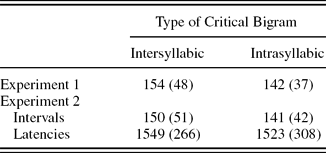
Means for the critical ILIs for the CV and CVC initial syllable words were submitted to separate t tests performed both by participants and by items. The mean and standard deviation for the ILIs are shown in Table 1. The t tests revealed that the difference between the two experimental conditions was significant, t 1 (23) = 2.96, p = .006; t 2 (29) = 3.41, p = .002. Within-syllable intervals (e.g., between a and r in the CVC initial syllable word bar.ba) were consistently shorter (142 ms) than between-syllable intervals (154 ms; e.g., the interval between a and r in a CV initial syllable word ba.res). This difference of 12 ms corresponds to a small to moderate effect for the subject analysis (Cohen d = .28) and a large effect for items (d = .87), reflecting the small variance in responses, particularly between items.
Mean (standard deviation) interletter intervals and initiation latencies (ms) as a function of their syllabic status (intra- vs. intersyllabic) for auditory word presentation in Experiment 1 and picture presentation in Experiment 2
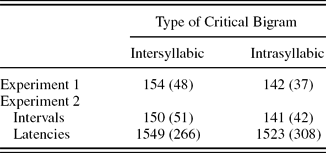
The most notable observation of this data is that the syllabic boundary effects in the transition between adjacent letters previously obtained in French emerge in another language with clear syllable boundaries: Spanish. The transition from one letter to the next, that is, the temporal interval between the pen lift in one letter and the pen down at the start of the next, is longer when these two letters are split by a syllable boundary than when both are within the same syllable. The second observation is that the findings are not specific to the mode of stimulus input because similar results were obtained from the dictation task in Spanish as previously found in a copying task in French (Kandel et al., Reference Kandel, Álvarez and Vallée2006). Thus, there is good evidence that syllables are linguistic units that are involved in the processing of writing in Spanish and French. It is important to note that this syllabic boundary effect occurs in words with the most frequent and simple syllabic structure in Spanish: CV and CVC, unlike the results obtained in French (Kandel et al., Reference Kandel, Álvarez and Vallée2006; Experiment 1a). In addition, the data seem to support cascaded processing, because the effects are obtained in performance. That is, writing movements are affected by central processes related to the orthographic (or phonological) representations implicated in spelling. We will return to this issue in our general discussion.
There is, however, one potential confound in the stimuli: the CV condition could be considered to have contained a higher proportion of morphologically complex words than the CVC condition. If one takes into account verb and gender suffixes, then the whole set is very similar in complexity; however, the conditions differed in other types of morphological complexity. For example, the CV condition contained more plural words (nine; e.g., bares–bars) than the CVC condition. This difference was due mostly to the process of matching the words for length. Hence, the possibility exists that the longer ILIs observed between syllables in the CV condition might have been due to morphological complexity.
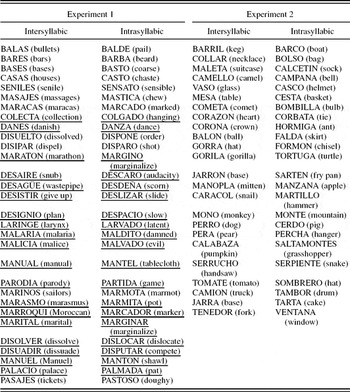
To determine if the syllable boundary effect was due to morphological complexity, we selected pairs of words from each condition matched on morphological structure, such that pairs were either monomorphemic or equally complex (e.g., both verbs in infinitive form). We also included those pairs in which the word in the CVC condition was morphologically more complex than its counterpart in the CV condition. These 19 pairs can be seen underlined in Appendix A. Again, the critical ILIs of these pairs were submitted to t tests both by participants and by items. As with the overall analysis the mean ILI for the between-syllable condition (154 ms, SD = 44 ms) was significantly longer than for the within-syllable condition (141 ms, SD = 37 ms): t 1 (23) = 2.91, p = .008; t 2 (18) = 2.59, p = .012. This result suggests that the differences obtained between the two kinds of words cannot be explained in terms of morphological complexity.
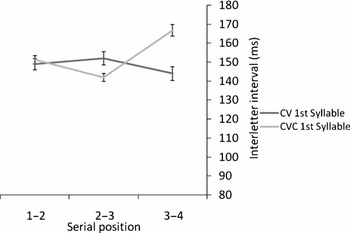
Analysis of other ILIs. The only ILI that has been considered and analyzed in both the experiments by Kandel et al. (Reference Kandel, Álvarez and Vallée2006) as well as our Experiment 1 has been the critical one, which is intrasyllabic in one condition and intersyllabic in the other. No other ILI has been measured to date, resulting in a lack of information about other temporal variables and about what is happening in other ILIs. For example, it might be that the intervals between all letters in the words in the CV condition were longer than those in the CVC condition rather than it being an effect localized at the syllable boundary. To test for this possibility we conducted analyses of two different ILIs (both by participants and by items) across both conditions. The ILI between the first and the second letters are intrasyllabic in both the CVC and CV conditions, and thus, if the results of Experiment 1 and Kandel et al. are due to the syllabic transition, there should be no difference between these ILIs. In contrast, the interval between the third and fourth letters should demonstrate a significant difference between the conditions but in the opposite direction (i.e., longer times for CVC words) because this transition is the boundary between the first and the second syllables in the CVC words (e.g., between l and d in fal.da) and is intrasyllabic in the CV words (e.g., between l and ó in ba.lón).
Figure 1 reveals that the difference in the first ILI (1–2 ILIs) was not significant (t 1 < 1, t 2 < 1). However, as expected, there was an inverse significant difference in the interval between the third and fourth letters, t 1 (24) = 4.08, p = .002; t 2 (58) = 4.46, p < .001. In this case, we found longer times for the CVC words (mean ILI = 167 ms) than for the CV words (mean ILI = 144 ms).
Mean interletter intervals as a function of the two kinds of words (CV vs. CVC in the first syllable) for the three first serial positions in the word: between the first and second letter or 1–2, between the second and third or 2–3 (the critical one), and between the third and fourth (3–4).

Syllabic frequency of the second syllable. There is another factor that might influence the ILI effect: the frequency of the second syllable. In Spanish this factor is important when reading words (i.e., Álvarez et al., Reference Álvarez, Carreiras and Taft2001; Carreiras et al., Reference Carreiras, Alvarez and de Vega1993) and in speech production (Carreiras & Perea, Reference Carreiras and Perea2004). Hence, it is not unreasonable to suspect that it might have an effect on writing as well. In Experiment 1 the difference between the two conditions in the frequency of the second syllable was relatively large: 5,257 per million (Alameda & Cuetos, Reference Alameda and Cuetos1995) for the intrasyllabic condition and 2,503 for the intersyllabic condition. Thus, it is possible that the longer ILIs in the intersyllabic condition in Experiment 1 might be reflecting a greater cognitive load associated with the frequency of the next syllable (which is generally low frequency). To analyze this option, the critical ILI durations were submitted to an analysis of covariance carried out by items, using the syllable frequency of the second syllable as a covariate. The results showed again the effect of our manipulation, namely, a significant difference between intersyllabic and intrasyllabic conditions, F (1, 57) = 10.82, p = .002. The covariate (syllable frequency of the second syllable) did not reach significance (F < 1). Thus, it does not appear that this factor is responsible for the syllabic boundary effect at the critical ILI.
EXPERIMENT 2
The use of a dictation task in Experiment 1 suggests that the syllable effect observed in French with a copying task is not restricted to processes specific to orthographic input. However, in Experiment 1 both the input and the output were linguistic, so a concern is the potential influence of speech processing on the subsequent written production. It is plausible that the spoken stimulus may have contributed to participants producing the word in phonologically obvious units such as syllables, because they “hear” the word being spoken in syllables, which biases them toward producing it in syllables. The evidence supporting syllables as fundamental units for segmentation in speech perception is extensive, at least in some languages (see, e.g., Bradley, Sánchez-Casas, & García-Albea, Reference Álvarez, Carreiras and Taft1993, in Spanish; Mehler, Dommergues, Frauenfelder, & Seguí, Reference Mehler, Dommergues, Frauenfelder and Seguí1981, in French; Sebastián-Gallés, Dupoux, Seguí, & Mehler, Reference Sebastián-Gallés, Dupoux, Seguí and Mehler1992, in Catalan and Spanish). Hence, it is not unreasonable to suspect some transfer or influence of syllabic information (like syllable boundaries) from the perception/comprehension processes to the written output system. Thus, a stronger test of the implication of syllables in writing would be to use nonlinguistic material, such as pictures, as input.
In a similar vein, although the available evidence suggests that the syllable effect is localized at the syllable boundary and is manifested during performance (in fact during movement execution), we cannot rule out the possibility that any difference observed between the experimental conditions could be the result of processes that occur prior to the onset of the first movement. If this were the case then one might expect that syllable structure would have an effect on the time taken to initiate a response. With the dictation task it is difficult to determine differences in initiation time because there is no theoretically neutral point from which to time the response. That is, it is unclear if one should time from the start of the auditory stimulus (analogous to the visual lexical decision task), from the end of the stimulus (the only point at which all information about the stimulus is available), from the uniqueness point (the point in the sound stream where the word differs from all other words), or the recognition point as defined experimentally (perhaps by tasks such as the auditory gating task). A more simple and less controversial solution is to examine initiation times with a visual stimulus such as a picture. Thus, this variable was measured in Experiment 2.
Our syllabic boundary effects obtained in the critical ILIs suggest that the motor program for a word is not completely assembled into one unit before the first movement is made. However, if the syllabic effect of Experiment 1 took place in early stages of processing or there is some initial difference between the two types of words, then an effect should be found in this measure. Besides, if the syllabic boundary effect found in the previous experiment is a consequence of the influence of the input word (namely, it is somehow the product of auditory lexical access), no effect should be expected in this experiment. In addition, Experiment 2 allows us to control for possible morphemic influences, at least much more than we did in Experiment 1.
Method
Participants. Twenty-one undergraduate psychology students from the University of La Laguna (ages 17–21) took part in the experiment in exchange for course credit. They were native speakers of Spanish, reported no hearing deficits, and had normal or corrected-to-normal vision.
Materials. The stimuli consisted of 48 line drawings taken from Snodgrass and Vanderwart (Reference Snodgrass and Vanderwart1980). The name of each stimulus was assumed to be the most frequent name for that picture according to the Spanish norms (Sanfeliu & Fernández, Reference Sanfeliu and Fernández1996). Picture names were from 5 to 11 letters long (see Appendix A). Word names were selected in pairs matched according to the number of syllables. In each pair, there were always 2 critical letters (e.g., a and m) in the same serial position that were intrasyllabic in one member (a CVC word like cam.pa.na) and intersyllabic in the other (a CV word like ca.me.llo). Due to limitations in the selection of pictorial materials, only approximate matches for word frequency (Alameda & Cuetos, Reference Alameda and Cuetos1995) and word length across conditions were possible. The mean word frequency of the intrasyllabic target words was 22 per million (range = 0.5–163) and 33 per million (range = 0.5–234) for the intersyllabic words. This difference did not reach statistical significance (t < 1). The mean word length of items in the intersyllabic condition was marginally less than that of the intrasyllabic words (5.8 vs. 6.5 letters, respectively). This difference was statistically significant, t (23) = 3.47, p = .002, but because the longer words are also those in which we predicted a shorter ILI this is unlikely to be a problem. Unlike Experiment 1, word pairs did not necessarily start with the same letter; however, all pairs shared the same critical bigram. Nevertheless, we controlled for the frequency of the first bigram. The mean first bigram frequency per million for the intrasyllabic condition was 6,944 (range = 1,574–14,954) and 7,791 for intersyllabic condition (range = 520–14,954; t < 1). In addition, as in Experiment 1, the immediate frequency of the bigram after the second critical letter was controlled (mean = 2,787, range = 422–6,387) for the intrasyllabic condition and 1985 (range = 461–3,659) for the intersyllabic condition, t (23) = 1.62, p = .12.
Procedure. The participants were tested individually. During a preliminary pretesting phase, participants were asked to learn the name associated with each picture. To that end, pictures were presented in a book, with each name printed below the picture. This procedure was used to ensure a high level in consistency of the names participants provided for each picture in the experimental phase. Participants had free time for this task.
The procedure in the experimental phase was essentially the same as in Experiment 1 except that pictures (instead of spoken words) were presented via an external monitor connected to a Macintosh PowerBook G4 and latencies, taken from picture onset to the initiation of the written response, were also measured. Participants were instructed to write down the name of each picture as soon as possible after it appeared on the screen in uppercase letters while maintaining their natural writing speed. The same software was used in this experiment as in Experiment 1.
Results and discussion
We excluded from the analysis ILIs and latencies more than 2.5 SD above or below the mean for each participant in each condition, those responses with spelling errors (1% of responses) or an incorrect picture name (6% of responses), and those responses in which participants did not lift the pen between the critical letters (5% of response). There were no significant differences between conditions in the excluded data. The critical interletter temporal intervals for intra- and intersyllabic conditions as well as latencies were submitted to separate t tests, performed both by participants and by items. The mean (and standard deviation) ILI durations and latencies are shown in Table 1.
Analysis revealed that the difference between the two experimental conditions was significant, t 1 (20) = 2.21, p = .039; t 2 (22) = 2.92, p = .007. Intrasyllable intervals (the temporal interval between a and m in cam.pa.na) were again shorter than intersyllable intervals (a and m in ca.me.llo). As in Experiment 1, the mean effect was only 10 ms, which corresponded to a small effect in the subject analysis (d = .21) and a medium effect in the item analysis (d = .69). The analysis of initiation latencies showed no significant differences (t 1 < 1, t 2 < 1).
The null effect of the difference in latencies between the two conditions suggests that the syllabic effect previously obtained actually occurs during movement execution, at the moment of writing, and not during preliminary phases. In addition, the consistency of the syllabic effect across a range of input stimuli, that is, pictures in Experiment 2, spoken words in Experiment 1, and written words in Kandel et al. (Reference Kandel, Álvarez and Vallée2006) indicates that the effect is independent of the processing of the input. That the syllabic boundary effect was again obtained in the critical ILI in this experiment indicates that the effect is related to spelling and/or writing processes and most likely the representations in the graphemic buffer. We will revisit this issue in the general discussion.
It should also be noted that in this experiment the stimuli were matched for morphological complexity (most of the stimuli were monomorphemic) and that the syllabic effect remained strong. This is consistent with the results of the post hoc analysis of morphology in Experiment 1 and suggests that this factor cannot explain the syllabic boundary effect observed in these experiments.
Syllabic structure of the second syllable. In Experiment 1, we tested a potential characteristic of the second syllable that might have influenced the magnitude of the syllable boundary effect: its syllable frequency. There is, however, another potential confound common to both experiments. In Experiment 1, the syllable following the critical bigram was a CVC in 17 of the CV words but only 2 of the CVC words. This pattern was repeated in Experiment 2, with nine of the items in the CV condition having a CVC or more complex second syllable, whereas only 5 words in the CVC condition had such a complex second syllable. Thus, the complexity of the second syllable was greater in the condition where longer critical ILIs were found. Therefore the syllabic boundary effect might be a function of this second-syllable complexity rather than the syllabic boundary per se. To explore this possibility, we selected only those pairs of words matched on second-syllable structure: the 13 pairs with CV second syllables in Experiment 1 and the 13 pairs with the same characteristic in Experiment 2. We carried out two 2 × 2 analyses of variance, both by participants and by items, with the critical ILI as the dependent variable. The factors were types of words (CV vs. CVC first-syllable words) and Experiments 1 and 2. The main effect of syllable boundary was significant by items, F 2 (1, 24) = 5.71, p = .03, and approached significance by subjects F 1 (1, 43) = 2.89, p = .09. Again the ILI in the intersyllabic condition (mean = 150 ms, SD = 14.4 ms) was longer than in the intrasyllabic condition (mean = 141 ms, SD = 15 ms). The main effect of stimulus type (auditory vs. picture) did not reach significance, F 1 (1, 43) = 1.72, p > 1; F 2 < 1, and neither did the interaction (F 1 < 1, F 2 < 1). Thus, it appears that there is little evidence to suggest that the complexity of the second syllable accounts completely for the syllabic boundary effect obtained in both experiments. It should be noted that even if syllable complexity were to contribute to the duration of an ILI, this would still be evidence that the syllabic structure of a word is being passed to the output system. The observation that second-syllable frequency has no effect on the timing of the written response seems to suggest that any such effects are divorced from the motor assembly process.
GENERAL DISCUSSION
The results of these two experiments reported are straightforward: ILIs in writing are influenced by the existence (or not) of a syllable boundary between letters. Longer ILIs were found between letters that form a syllable boundary than between letters within the same syllable. A similar effect has been obtained in French by Kandel et al. (Reference Kandel, Álvarez and Vallée2006), but it has not been properly demonstrated using the canonical syllabic structure in Spanish. In addition, our two experiments as well as the post hoc analyses of Experiment 1 provide novel information and refute three possible alternative explanations of the main result. First, it is clear that the effect is not dependent on linguistic input, because an almost equivalent syllable boundary effect was found when participants had to write picture names. Second, the analyses of other ILIs (the first and the third ILI) in Experiment 1 is consistent with the notion of longer ILIs at syllable boundaries. Third and finally, it appears that morphological complexity as well as both syllable frequency and the structure of the second syllable cannot account for the syllable boundary effects, as indicated by the analyses of appropriate subsets of the stimuli, the covariance analysis conducted in Experiment 1, and the analysis of the two experiments together.
The first general conclusion that can be drawn from these experiments is methodological. Until very recently, most of the research into the cognitive processes involved in writing words has used offline measures, such as error analyses, frequently with neuropsychological patients. Very little is known about the central psycholinguistic processes of spelling in normal subjects and how these processes affect peripheral functions, like movement durations. The relatively new, online methodology of measuring temporal variables in the execution of hand writing, such as ILIs, seems a promising way to investigate the processes underlying written word production because this measure is sensitive to linguistic manipulations of the stimuli.
The second general conclusion is the theoretical implications of the observed syllable boundary effect. Despite the limited range of methods so far employed in spelling research there is agreement about some of the general mechanisms underlying the writing of words. It is clear that an abstract orthographic representation needs to be computed by the central spelling mechanisms. For example, Caramazza and colleagues (Reference Caramazza, Miceli, Villa and Romani1987) propose that normal spelling works by computing grapheme-level representations and their serial order. The short-term graphemic buffer has the role of maintaining these graphemic representations until a subsequent serial selection occurs that drives the temporally ordered production of their forms (Buchwald & Rapp, Reference Buchwald and Rapp2003). In this study we explored the type of information computed at the graphemic level, in particular the possibility that the spelling system computes representations other than single letters, such as syllables.
Early neuropsychological research assumed that the graphemic representations in the graphemic buffer consist only of linearly ordered strings of abstract letter identities coded spatially (Caramazza et al., Reference Caramazza, Miceli, Villa and Romani1987). However, subsequent studies have suggested that orthographic representations are multidimensional, including a graphosyllabic level of processing (Caramazza & Miceli, Reference Caramazza and Miceli1990). Several neuropsychological reports provide converging evidence for the relevance of syllables as units of representation in spelling and writing processes (for a range of views about this issue, see Jóndóttir, Shallice, & Wise, Reference Jóndóttir, Shallice and Wise1996; McCloskey et al., Reference McCloskey, Badecker, Goodman-Schulman and Aliminosa1994; Shallice et al., Reference Shallice, Rumiati and Zadini2000; Tainturier & Caramazza, Reference Tainturier and Caramazza1996; Tainturier & Rapp, Reference Tainturier, Rapp and Rapp2001). It is obvious that our findings are consistent with these proposals.
Compared with reading research, relatively little work has been done on the spelling and writing processes of normal subjects. Nevertheless, our data are in agreement with earlier studies like that of Bogaerts et al. (Reference Bogaerts, Meulenbroek, Thomassen, Simner, Leedham and Thomassen1996), in which stroke durations and trajectory length of the first letter of CVC words were found to be longer than for CV words. In addition, similar outcomes have been found in typing, in which syllable boundaries have resulted in longer interkeystroke intervals, both in French (Zesiger et al., Reference Zesiger, Orliaguet, Boë, Mounoud, Faure, Lorette and Vinter1994) and in German (Weingarten, Nottbusch, & Will, Reference Weingarten, Nottbusch, Will, Pechmann and Habel2004). Although there is no previous systematic research into the cognitive processes underlying writing Spanish, the study most comparable to ours is that by Kandel et al. (Reference Kandel, Álvarez and Vallée2006), carried out in French. They employed basically the same methodology and logic as the two experiments presented here and also measured a critical ILI that could be either inter or intrasyllabic. The main difference is that they used a copying task of visually presented words. As in our study, Kandel et al. reported longer critical ILIs in the intersyllabic condition than in the intrasyllabic condition. This fact strongly suggests that the effects are genuinely the consequence of processes involved in the production of handwritten words and are not a product of the type of input. The syllable boundary effect arises with copying, dictation, and written picture naming tasks. It is especially notable that the third type of input, pictures, as presented in our Experiment 2, produced effects almost identical to the other two cases with linguistic input. This would appear to rule out the possibility that the observed syllable boundary effect results from a carryover of the input processing on to writing movements. This is important because syllabic processing in Spanish is well documented both in speech perception (e.g., Bradley et al., Reference Bradley, Sánchez-Casas and García-Albea1993; Sebastián-Gallés et al., Reference Sebastián-Gallés, Dupoux, Seguí and Mehler1992) and in word reading (e.g., Álvarez et al., Reference Álvarez, Carreiras and Taft2001; Carreiras et al., Reference Carreiras, Alvarez and de Vega1993).
Apart from being the first evidence that syllables are functional graphemic representational units in Spanish, there are several other aspects of this research that need highlighting. The first relates to alternate explanations of the syllable boundary effect in the ILIs that have not been systematically studied previously (as in the experiments by Kandel et al.). Post hoc analysis of subsets of the stimuli employed in Experiment 1 suggest that neither the frequency of the second syllable of the stimuli, its structure in terms of consonant and vowels, nor the morphological complexity of the words accounts for the observed pattern of data. Whether these factors produce effects at the motor production stage is still unclear, but it can be said that we have no evidence to suggest that this is the case for the effects reported here.
The second concerns the relatively new online methodology used here, which together with the measurement of ILIs, has produced a notable and novel outcome concerning the temporal locus of syllabic effects. As mentioned before, this finding is consistent with previous neuropsychological research. However, this evidence is based on offline measures, such as errors, which do not provide accurate information about the moment when the effects take place.
In contrast, our results as well as those by Kandel et al. (Reference Kandel, Álvarez and Vallée2006) demonstrate that central processes responsible for spelling involve syllabic representations and have a consequence for peripheral writing movements. In other words, central processes do not appear to be completely isolated from the later processes that drive the handwritten response.
At least two theoretical possibilities need to be considered. The first is that the programming is incomplete at the initiation of writing a word and that syllable units are converted to motor programs as the word is being produced. Thus, the movement to write the first syllable is prepared before its initiation, but the second syllable is then processed before producing its first letter, as suggested by Kandel et al. (Reference Kandel, Álvarez and Vallée2006) and by Kandel and Valdois (Reference Kandel and Valdois2006). They presented evidence that the lexical search is carried out before movement initiation, and when the orthographic representation is activated, its graphosyllabic components are the inputs to the more peripheral modules of the motor production system. Thus, the delay at the syllable boundary in the ILIs might indicate that the motor system programs the next syllable during the interval between the letters regardless of the input modality. One obvious problem with this proposition is that a syllable boundary adds only about an extra 10 ms to the ILI, and this does not seem enough time to program a whole unit (the next syllable).
The second theoretical option concerns the difference between staged and cascaded processing, which has been proposed in speech production (e.g., Kello et al., Reference Kello, Plaut and MacWhinney2000) and recently has been applied to writing (Delattre et al., Reference Delattre, Bonin and Barry2006). This distinction is based on the degree to which central processes influence subsequent processing. If spelling processing is truly staged, central spelling processes are completed before motor execution starts and should have little influence on latter stages of processing. Because syllables appear to have a representational or functional role (Caramazza & Miceli, Reference Caramazza and Miceli1990; Kandel et al., Reference Kandel, Álvarez and Vallée2006), they would be expected to have a central role and thus not influence motor output. Our findings demonstrate that processes related to syllabification affect the duration of the handwritten responses and are thus evidence of a cascaded functioning. In fact, Delattre et al. (Reference Delattre, Bonin and Barry2006) provide some convincing reasons why writing can be cascaded, whereas speech production is staged, at least according to some authors like Damian (Reference Damian2003). Thus, it would appear that information about the syllabic structure of Spanish words, derived from central representations of these words, cascades into the representations stored in the graphemic buffer. However, the question about the locus of the sequencing of syllabic information (before the graphemic buffer or in the graphemic buffer) cannot be answered with our results and is clearly a matter for upcoming research.
We have presented novel evidence for a role of syllables during writing execution in Spanish whereas Kandel et al. (Reference Kandel, Álvarez and Vallée2006) show a similar pattern in French. What remains unclear is what happens with other languages, in particular those with a less clear syllabic structure. There is some suggestion that syllables and phonology in general might be expected to have different effects on different languages depending on the characteristics of each language (Jóndóttir et al., Reference Jóndóttir, Shallice and Wise1996). We believe this is an issue that deserves future attention. In addition, a number of important questions remain unanswered. It is unclear if the syllable effect observed is the result of the sound structure of the word constraining the spelling of the word as phonological structures (as suggested by Jóndóttir et al., Reference Jóndóttir, Shallice and Wise1996) or if syllables result in purely orthographic units (e.g., Buchwald & Rapp; Reference Buchwald and Rapp2006; Caramazza & Miceli, Reference Caramazza and Miceli1990). In other words, the question is whether the activation that cascades to the motor execution process comes from central orthographic processes or from central phonological processes. If syllables are purely phonological representations, then the locus of their influence needs to be clarified. One possibility is that they act as phonological units early in the phonology-to-orthography conversion process, in either the sublexical route of a dual model (Caramazza, Reference Caramazza1988; Ellis, Reference Ellis1988) or in a single, direct meaning-to-spelling route (e.g., Perfetti, Reference Perfetti, Perfetti and Rieben1997). As noted previously, a phonological procedure alone would be sufficient to produce correct spellings in languages like Spanish, with an almost one to one phonology–orthography correspondence and with very clear syllabic boundaries. However, the goal of the present work was much more concrete and modest, and our data do not allow us to reach a definitive conclusion about the routes from meaning to spelling. Regardless of whether one favors a dual or single route model of Spanish spelling, the pervasive argument for a graphemic buffer (see, e.g., Buchwald & Rapp, Reference Buchwald and Rapp2006; Tainturier & Rapp, Reference Tainturier, Rapp and Rapp2001) suggests that a productive conceptualization of the spelling process is to draw a distinction between central processes and output motor processes, with the graphemic buffer acting as a bridge between these processes. Our data is consistent with the representations in the graphemic buffer being maintained in syllabic units. We favor a cascaded account of central syllabic information being carried forward to the graphemic buffer.
APPENDIX A
Table A.1 contains the words used in Experiments 1 and 2, grouped by the experimental conditions (intersyllabic vs. intrasyllabic bigrams). English translations are given in parentheses.
Words used in Experiments 1 and 2, grouped by experimental conditions (intersyllabic vs. intrasyllabic bigrams)

ACKNOWLEDGMENTS
Preparation of this article was supported by Spanish Ministry of Science and Technology Grant SEJ2007-66860/PSIC (to C.J.Á.). We express our gratitude to Margaret Guillon for her helpful comments.