INTRODUCTION
Despite attainment of supposed social and political equality in the post-civil rights era, African Americans continue to experience socioeconomic disparities relative to Whites (National Urban League 2008). Such disparities spawn continuing calls to action and debates about approaches for equalizing African Americans' socioeconomic circumstances and rectifying various other social ills imperiling the Black community (Smiley Reference Smiley and Smiley2006, Reference Smiley and Smiley2007; West Reference West and Smiley2006). Some of these debates focus on individual and group-based contributions toward Black political activism, centered principally on generational differences between civil rights and post-civil rights generation adults in their attitudes and commitment to racial group politics (Cosby Reference Cosby2004; Cosby and Poussaint, Reference Cosby and Poussaint2007; McWhorter Reference McWhorter2000, Reference McWhorter2006; Ogbar Reference Ogbar2007).
Weightier critiques of Black political engagement seem to focus on the future of young Black Americans and their role in personal or group-based social mobility or political participation. Negative views about Black youth claim that they lack a Black-consciousness-oriented value system, manifested as an unsatisfactory vision and fulfillment of racial group advancement (Cosby Reference Cosby2004; McWhorter Reference McWhorter2000). From Cosby and Poussaint's (Reference Cosby and Poussaint2007) perspectives, Black youth's deficient value orientations stem from their learning from “bad parents,” parents who somehow fail to convey meaningful messages for them to understand the continuing salience of Black consciousness. For McWhorter (Reference McWhorter2000, Reference McWhorter2006), the messages learned are somewhat different. Black youth (and other Blacks) learn messages that contribute to “losing the race” because they learn to devalue personal initiative and emphasize systemic racism as a basis for pursuing group advancement. These arguments suggest that generational differences in Blacks' consciousness and initiative affect Black group advancement.
Studies investigating Black generational differences, nevertheless, find minimal distinctions in racial identity and policy preferences between, particularly, post-civil rights and civil rights generation Blacks (Simpson Reference Simpson1998). As Simpson notes about generational commonalities, “The ‘tie that binds’—being Black—has strands of history, music, family life, and discrimination” (p. 162). Blackness, then, is cultural, social, experiential, and perhaps dynamic. Yet, the predominant discursive frame for critiques levied about Black generational differences reduces to normative judgments about whether Black psychological “stasis” is positive and whether Black psychological “dynamism” is negative for Black group advancement. In other words, critics seemingly view changes or nuances in the conveyance and exemplification of Black consciousness as threatening to Black group advancement. For example, different, perceivably “improper” messages about race, transmitted presumably through a process known as racial socialization, are perceived as disrupting continuity in prevailing beliefs about what is best for the Black racial group, and different generational cohorts, with presumably variegated values and beliefs about Black politics, are perceived as disturbing traditional approaches to Black group advancement.
For younger generations of Black Americans, these critiques translate into concern about how and to what extent they learn about race and incorporate it into their political vision for Black America. Meanwhile, a salient underlying assumption is that young Black Americans' consciousness and political orientations are different from older generations'—a consequence of generationally different messages acquired about race. Subsequently, young Black Americans are often blamed by critics as disturbing the continuity of Black politics, as we know it. This assumption about generational differences in racial learning, however, should be empirically tested to determine whether younger Black Americans' (the post-civil rights generation/hip-hop generation) racial socialization experiences are similar or dissimilar to the experiences of previous generations of Black Americans.
This paper ascertains whether there is a generational divide in Black Americans' racial socialization experiences. Using an original survey, the 2007 National Politics and Socialization Survey (NPSS), this paper measures ten types of racial socialization messages among Black Americans—socialization about Black group status, Black pride, Black discrimination based on colorism, Black public behavior, Black intraracial relations, Black interracial relations, Black intraracial distrust, Black interracial distrust, Black politics, and Blacks' emphasizing less on race and racism. Four different age cohorts—(1) World War II generation (age 67 and older, born in and before 1940); (2) civil rights generation (ages 54–66, born 1953–1941); (3) mid-civil rights generation (ages 43–53, born 1964–1954); and (4) post-civil rights generation Black Americans (age 42 and under, born 1965 and after)—are analyzed for this cross-generational analysis.
The paper proceeds with a review of literature on generational politics and political socialization, followed by a discussion on racial socialization and the importance of incorporating it into political science research for the sake of cross-generational analysis among Black Americans. Finally, there is a review of the empirical analyses for the ten socialization messages and discernment of generational differences.
THEORETICAL BACKGROUND
Generational Politics and Political Socialization
Political socialization is a process whereby people learn normative values, attitudes, and practices associated with a political system (Easton and Dennis, Reference Easton, Dennis and Sigel1970, Reference Easton, Dennis and Dennis1973; Hyman Reference Hyman1959; Sigel Reference Sigel1970). Studies in political socialization peaked in the 1960s and 1970s, as a part of an interest to examine the political learning and generational transmission of political values, orientations, and consciousnesses during an era of marked political change for emerging and modified democracies (Dennis Reference Dennis1973; Ichilov Reference Ichilov and Ichilov1990; Renshon Reference Renshon1977; Sigel, Reference Sigel1970). These studies focused on subjects ranging from the actual learning process of inculcating ideas, information, and attitudes about politics to assessing the sources of political socialization, to describing the types of information learned about the political system, to analyzing generational differences in learning about the political system, and even to describing the stability and changes in political learning over the life cycle or during specific historic epochs (Dennis Reference Dennis1973; Hess and Torney, Reference Hess and Torney1967; Jennings and Niemi, Reference Jennings and Niemi1981; Renshon, Reference Renshon1977; Sears, Reference Sears and Ichilov1990).
Part of the generational studies of political socialization focused on the processes by which socialization messages were either transmitted from one generation to another or sustained or changed over the life process. This further divides learning into pre-adulthood and adulthood learning over a lifetime. For example, Jennings and Niemi (Reference Jennings and Niemi1981) describe four models of political socialization: (1) the lifelong persistence model; (2) the lifelong openness model; (3) the life-cycle model; and (4) the generational model. The lifelong persistence model suggests that what people learn persists over their lifetimes, building upon new information learned and new life experiences. The lifelong openness model recognizes scant foundational learning during the formative, pre-adult years, focusing instead on political learning occurring subsequent to various political stimuli over people's lifetimes. The life-cycle model suggests that political orientations are malleable during specific life stages. The generational model builds on the seminal work by Mannheim (Reference Mannheim and Kesckemeti1928), which proposes that political orientations endure pre-adult learning but are shaped based upon salient influences of major political and social events.
In order to study the sociopolitical orientations of Black Americans, the generational model is most pertinent. Black Americans have incorporated their own agency and political will to change and challenge de facto and de jure discrimination throughout American history, and political strategies, identities, and consciousnesses have been influenced by public policies that have dictated their access to second-class versus full citizenship and rights (Dawson Reference Dawson1994, Reference Dawson2001; Harris-Lacewell Reference Harris-Lacewell2004; McAdam Reference McAdam1982; Tate Reference Tate1993). These experiences have informed generations of Black Americans about the context and content of their sociopolitical and economic circumstances. In more modern times, Jim Crow-era politics and Black political consciousness have been integral to Black political development, and Black Americans' protest and contestation over their full inclusion in American society heightened during the modern Civil Rights Movement, resulting in civil rights policy changes that undergird Black Americans' modern-day civil rights protections (Morris Reference Morris1984).
Early studies of Black Americans' political socialization focused on studying the origins of their discontent with the political system during the latter 1960s protest era. These studies examined Blacks' political trust, political efficacy, and ultimate dissatisfaction with the political system (Abramson Reference Abramson1972, Reference Abramson1977; Greenberg Reference Greenberg and Dennis1973). One such study finds Black children initially have positive views of the political system and political authorities that become more negative as they become older. Although White children show similar declines in their views, nonetheless they have more positive assessments than Black children (Greenberg Reference Greenberg and Dennis1973). Other studies of Black political knowledge also cite disparities in their knowledge compared to Whites, prompting inquiries about Blacks' political socialization processes (Delli Carpini and Keeter, Reference Delli Carpini and Keeter1996). Thus, comparatively, the literature often treats Blacks' political socialization experiences as divergent from Whites', in part due to their experiences with race and racial discrimination in America.
Despite the relevance for analyzing Black Americans' political orientations beyond the 1960s protest era, there is a paucity of studies about Black Americans' political socialization in the post-civil rights era, becoming even less critically engaging and sensitive to possible generational differences in sociopolitical learning during different historic epochs in Black Americans' political development (Simpson Reference Simpson1998; Price Reference Price2009). This epistemological phenomenon calls for a return to political socialization analysis of Black Americans' socialization experiences, but more importantly, it begs the research of Black generational cohorts to determine stability or change in the transmission of messages about race and politics with respect to Black Americans' sociopolitical circumstances. Studying Black racial socialization and wedding it with Blacks' political socialization addresses the foundations of their sociopolitical knowledge.
Race remains pivotal in Black Americans' identities and political consciousness (Allen et al., Reference Allen, Dawson and Brown1989; Dawson Reference Dawson1994; Price Reference Price2009; Tate Reference Tate1993). Yet, it is less clear how and what such messages about race are transmitted across generations of Black Americans. Conceivably, certain messages about race are sustained over time to make race salient in Black Americans' consciousness, and over time, historic events can influence the character of this consciousness (Delli Carpini Reference Delli Carpini and Sigel1989). As the generational model suggests, change in emphasis on these messages should be evident via the effects of major political and social events on Blacks' lives. To this end, the four generational age cohorts previously outlined describe major political and social events that will have affected the formative development of contemporary Black life experiences.
The World War II generation (age 67 and older, born before 1940) came of age during a major war in which the military was desegregated, Black soldiers were fighting for democracy abroad, yet returning to America to face racial discrimination and discrepant democracy (Klinkner and Smith, Reference Klinkner and Smith1999). For those born during the civil rights generation (ages 54–66, born 1953–1941), their formative years include passage and adoption of public policies that were prominent for Blacks' sociopolitical inclusion—Brown v. Board of Education (1954 and 1955), the Civil Rights Act of 1964, the Voting Rights Act of 1965—and the beginning and height of the modern Civil Rights Movement (Branch Reference Branch1988, Reference Branch1998). The mid-civil rights generation (ages 43–53, born 1964–1954) includes Black Americans whose formative years encapsulate the decline of the Civil Rights Movement—desegregation coupled with massive resistance, remnants of Black power tenets, riots across major U.S. cities in protest of racialized urban blight, and the conclusion of the Vietnam conflict (Branch Reference Branch2006). As for the post-civil rights generation (age 42 and under, born 1965 and after), their salient formative experiences include much overlap with the mid-civil rights generation. Distinctly, however, this generation came of age during the emergence of rap, a new performative art form (with the first release of a rap album in the latter 1970s) and hip-hop culture (dress and lifestyle) that developed among young urban Black Americans and transformed into a mainstream, internationally consumed art form, eventually transcending racial and generational boundaries and informing political expression to the present day (Ogbar Reference Ogbar2007). In a post-civil rights era, this generation likely received mixed information about group progress but also less emphasis on these messages because societal racial attitudes toward Blacks and Black culture, especially, were becoming seemingly less stringent, less overtly racist, and less rigidly segregated (Schuman et al., Reference Schuman, Steeh, Bobo and Krysan1997).
Hip hop and hip-hop-embracing youth have also become the target of many debates about their influence on Black America's representation and progression (Payne and Gibson, Reference Payne, Gibson, Neville, Tynes and Utsey2009). These debates often center on whether hip-hop culture, especially among youth, produces Black cultural messages that are distinct (perhaps in more negative ways) from Black cultural messages of prior generations. If there is something distinct about Black Americans who came of age during the cultural emergence of hip hop, then, borrowing from the logic of critics about the motivation and commitment of Black youth to advance Black group interests, we should see distinct racial socialization messages and emphases on these messages between this age cohort and the civil rights generation, in particular, but also with previous generations of Black Americans.
Although the critiques levied against Black youth tend to typify their attitudes and implicitly their racial socialization experiences as distinct and less group-centric than older Black Americans, as the literature in Black psychology suggests, Blacks generally have different levels of Black identity development (Cross Reference Cross1991). From this logic stems the question, is there really something generationally distinct about how Blacks learn about being Black in America? Moreover, how do these distinctions manifest themselves in Blacks' racial socialization?
Over time, Blacks have had to challenge negative constructions of Blackness to develop positive, less group-deprecating, Black identities (Parham Reference Parham, Neville, Tynes and Utsey2009). Therefore, given Black elite's critiques and the nature of Black identity development over time in response to negative constructions of race, in addition to differences in post-civil rights generation Blacks' racial socialization experiences, we should see that the World War II, mid-civil rights, and post-civil rights/hip-hop generations received distinct racial socialization messages from the civil rights generation—a generation that propelled a massive social movement toward Blacks' civil rights attainment. Other Black generations likely received different and perhaps less emphatic Black racial socialization messages than the civil rights generation during their formative years and in their sociopolitical contexts. This is, part and parcel, a reflection of events and (Black) political discourse that developed differently during the era of their racial socialization experiences.
Notably, these generational cohorts are not necessarily mutually exclusive as far as overlap in people's ages, life experiences, or even exposure to information about other significant life events during these generations' experiences. It also proves hard to distinguish what age should fit in one cohort versus another due to the overlap in experiences that may be less distinctive from year to year. However, it is believed that experiencing certain historic events during one's formative years contributes to unique, salient, memorable experiences that will have affected how Black Americans learned about race, especially from their family members, during these historic periods. Considering these effects, Black generational experiences are defined by race and politics, thus centrally locating the examination of how Blacks learn about race, or what is known as racial socialization, into an understanding of Blacks' political socialization (Demo and Hughes, Reference Demo and Hughes1990; Peters Reference Peters, McAdoo and McAdoo1985).
Research on Racial Socialization
Racial socialization is the process by which African Americans learn the meaning of their status as “low-status” racial group members (Caughy et al., Reference Caughy, O'Campo and Randolph2002; Peters Reference Peters, McAdoo and McAdoo1985) and learn information that affects their “Africanized” world view (Dawson Reference Dawson2001; Harris-Lacewell Reference Harris-Lacewell2004; Price Reference Price2009; White Reference White1984). This socialization serves as a preparation for Black children to understand how race affects their social status, culture, and racial group history (Sanders Thompson Reference Sanders Thompson1994). Much of the research on racial socialization focuses on the messages that parents transmit to their children about race (Demo and Hughes, Reference Demo and Hughes1990; Hughes and Chen, Reference Hughes and Chen1997; Martin and McAdoo, Reference Martin, McAdoo and McAdoo2007; McAdoo Reference McAdoo and McAdoo2007; McHale et al., Reference McHale, Crouter, Kim, Burton, Davis, Dotterer and Swanson2006; Phinney and Chavira, Reference Phinney and Chavira1995; Sanders Thompson Reference Sanders Thompson1994).
Extant studies of racial socialization indicate that an overwhelming number of Black Americans report having received such messages from their own parents (Bowman and Howard, Reference Bowman and Howard1985; Hughes and Chen, Reference Hughes and Chen1997; Sanders Thompson Reference Sanders Thompson1994; Thornton Reference Thornton, Taylor, Jackson and Chatters1997; Thornton et al., Reference Thornton, Chatters, Taylor and Allen1990). For example, in studies assessing data in the 1979–1980 National Survey of Black Americans, approximately sixty-four percent of Black American adults report transmitting racial socialization messages to their children (Thornton et al., Reference Thornton, Chatters, Taylor and Allen1990). Meanwhile, sixty-eight percent of Black American adolescents report receiving such messages from their parents (Bowman and Howard, Reference Bowman and Howard1985).
Several other socialization agents and institutions—familial ties and peer relations, Black institutions (churches and educational environments), Black media, and Black social networks—also provide contexts and networks that educate Black Americans about race (Dawson Reference Dawson1994; Martin and McAdoo, Reference Martin, McAdoo and McAdoo2007; McAdoo Reference McAdoo and McAdoo2007). These agents structure the heuristic link of Black individual interests to Black racial group interests, thus, enhancing group members' knowledge about racial group political interests and contributing to an African American consciousness that supplants racial group interests for self-interest (Dawson Reference Dawson1994). Racial socialization experiences, relatedly, engage Black Americans in various information networks that can assist them in navigating the stress related to racism's effect on their life circumstances (Thompson et al., Reference Thompson, Anderson and Bakeman2000; Stevenson et al., Reference Stevenson, Reed, Bodison and Bishop1997) and that can assist them in improving their resiliency (Miller Reference Miller1999; Miller and MacIntosh, Reference Miller and MacIntosh1999) and coping with racial discrimination (Scott Reference Scott2003).
As an important influence on African Americans' identity with other Blacks and other racial groups (Miller Reference Miller1999; Miller and MacIntosh, Reference Miller and MacIntosh1999; Mutisya and Ross, Reference Mutisya and Ross2005; Sanders Thompson Reference Sanders Thompson1999), emphases on certain racial socialization messages affect how African Americans identify with other groups and interact with these groups in different contexts (Harris Reference Harris1995). For example, emphasis on one such message, “integrative/assertive” parental socialization, or getting along with other racial groups, increases feelings of group pride and interracial contact (Demo and Hughes, Reference Demo and Hughes1990). Still, other socialization messages potentially detract from interracial contact by emphasizing not trusting Whites, in particular, but may be counterbalanced with racial coping strategies that stress to younger Black Americans the importance of achieving anything, being proud about being Black, and being aware of racial discrimination experiences (Lesane-Brown et al., Reference Lesane-Brown, Brown, Caldwell and Sellers2005).
In sum, Black racial socialization messages incorporate norms and attitudes about racial pride, cultural awareness, racism awareness, spiritual coping, familial caretaking, individual advancement, and egalitarianism (Boykin and Toms, Reference Boykin, Toms, McAdoo and McAdoo1985; Martin and McAdoo, Reference Martin, McAdoo and McAdoo2007; Stevenson Reference Stevenson1994). Despite similar general topics transmitted about race, parents, as major influences on children's racial socialization, emphasize messages differently (Hughes and Chen, Reference Hughes and Chen1997; Thornton et al., Reference Thornton, Chatters, Taylor and Allen1990), and even parents' own racial socialization experiences influence the kinds of messages relayed to their children (Hughes and Chen, Reference Hughes and Chen1997). Moreover, being married, being a mother, living in the Northeast, being older, and being more educated influence the likelihood that parents relay racial socialization messages (Thornton et al., Reference Thornton, Chatters, Taylor and Allen1990). These various factors can structure Black political perspectives in complex and multi-dimensional ways (Allen et al., Reference Allen, Dawson and Brown1989; Sanders Thompson Reference Sanders Thompson1992), as Blacks have several ideological perspectives about challenging racial inequality in America (Dawson Reference Dawson2001). Racial socialization potentially serves as a source of these ideological perspectives, making the study of racial socialization critical.
Fitting Racial Socialization Research into Political Science Research
Many of the studies on racial socialization experiences have been limited to data collected in the 1979–1980 National Survey of Black Americans (Jackson Reference Jackson1991). As such, even the youngest persons in this survey (age 18) will have come of age during the latter part of the Civil Rights Movement and the “Black Power” movement, two movements which, contextually, we may think would have had large effects on how race influenced Black Americans' understandings of their life experiences.
Political socialization studies of Blacks in the early 1960s and 1970s tended to “otherize” and pathologize Black socialization experiences, as political scientists attempted to explain disparate trust orientations among African American adults and children (Abramson Reference Abramson1972, Reference Abramson1977). Moreover, there is scant research investigating political socialization and the influence of race on this socialization, especially accounting for socialization experiences among younger Black adults who live in a society with different race relations than those even in the latter 1970s.
Racial socialization studies have been mostly concentrated in psychology research. More recent studies of Black racial socialization, for example, have moved toward studying the influence of cultural and racial influences on African American family life (Dodson Reference Dodson and McAdoo2007; Peters Reference Peters and McAdoo2007). Yet, political socialization studies, in general, have waned (Peng Reference Peng1994), and political studies of Black socialization have remained remote since their height over thirty years ago. Thus, it is highly pertinent for political scientists to research contemporary Black racial and political socialization experiences, and notably so in the post-civil rights era.
Studying racial socialization as a part of a political science research agenda, therefore, is important because it considers (1) the political implications of learning about race in different ways; (2) the effect that the salience of race may have on Black Americans' political orientations; (3) how different entities within Black social and political spaces become sources of racial socialization; and (4) whether there is stability or change in racial socialization experiences and messages across Black age cohorts that may or may not have had lived experiences with historical, institutionalized racism such as with Jim Crow. Thus, this paper engages the salience and stability of specific messages about race in Black Americans' contemporary socialization experiences. It also considers the broader implications of these experiences for Black identity and racial consciousness as resources for modern-day Black American politics.
DATA AND METHODS
The National Politics and Socialization Survey
Public opinion data for this analysis are analyzed from the National Politics and Socialization Survey (NPSS), a survey developed by the author. The NPSS is a national, web-based survey administered by Luth Research Group via the SurveySavvy panel. SurveySavvy has a panel of over one million potential respondents of which Black, Latino, and White respondents were contacted to participate in the survey based on a stratified sampling technique. This technique involved randomly sampling adults age eighteen and older, who live in the United States, using a proprietary algorithm to ensure an equal opportunity for each panel participant to be selected for participation based on gender and age specifications relative to the U.S. Census demographics for the racial groups. Additionally, sample quotas were set for each racial group, such that Black Americans comprised the largest number of respondents (n = 500) and Whites and Latinos comprised the remainder of the sample (n = 250 per White and Latino groups) for a targeted sample size of N = 1000. Respondents sampled for the survey administration, then opted in to participate in the survey. NPSS was in the field from December 26, 2007 through January 2, 2008.
Ultimately, the survey sample comprises N = 1021 respondents, of which n = 517 Blacks, n = 252 Whites, and n = 252 Latinos. The analysis here, however, is limited to respondents who identified as “Black.” Questions on the survey ask respondents about their racial socialization (Black Americans only), political socialization experiences, social, political, and racial attitudes, and attitudes about current events. (See the Appendix for the demographic characteristics of the Black sample.) The questions in the NPSS on racial socialization do not include an exhaustive list of subjects for which one may learn about how being Black in America has an effect (if any) on one's life. Many of the questions and measures in the survey, however, draw upon those used in the 1979–1980 National Survey of Black Americans (Jackson Reference Jackson1991). Additional questions probe how trust plays a part in racial socialization experiences.
Dependent Variables
Herein, racial socialization comprises ten components:
(1) Socialization about Black Group Status;
(2) Socialization about Black Pride;
(3) Socialization about Skin Color Discrimination;
(4) Socialization about Black Public Behavior;
(5) Socialization about Black Intraracial Relations;
(6) Socialization about Black Interracial Relations;
(7) Socialization about Racialized Distrust—Intraracial;
(8) Socialization about Racialized Distrust—Interracial;
(9) Socialization about Black Politics; and
(10) Socialization about Less Emphasis on Race—Racelessness.
Each of these components addresses several aspects of racial socialization mentioned in the literature. Specific measures for racial socialization experiences address trust in racial groups or socialization about racialized distrust (intraracial and interracial). While this question may be considered an aspect of “cautious/defensive” socialization, the measures herein ask respondents to consider the extent to which messages about distrust were relayed in a manner that specifically stated race as a means by which to assess trust.
Respondents are also asked to tell the extent to which each of these racial socialization messages was “emphasized” in their acquiring messages about what it means to be Black in America. Each item is recoded to reflect the level of emphasis of the socialization message in the respondents' learning about what it means to be Black—0, “No emphasis at all”; 1, “Not much emphasis”; 2, “Neither emphasized nor de-emphasized”; 3, “Some emphasis”; and 4, “Much emphasis.”
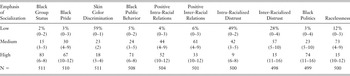
Separate questions that comprise each aspect of racial socialization are combined into ten additive scales. The scales vary according to the number of items in the scale. Generally, the scales indicate “0, No Socialization” to whatever is the highest numeric value on the additive scale per message, which then would be synonymous with “High Socialization” (see Table 1 for the several questions' coefficients for scale reliability in the NPSS that comprise each of these ten components of racial socialization). Additionally, the additive scales are further divided into three categories to denote the respondents' socialization experiences into categories of the level of emphasis placed on each message in racial socialization—“low-emphasis,” “medium-emphasis,” or “high-emphasis.” I provide univariate statistics about the emphasis level of racial socialization for each message (see Table 2). I also analyze an ordered probit regression model for each of the scales to determine relevant predictors of receiving racial socialization with “low-,” “medium-,” or “high-” emphasis. (Ordered probit regression analysis of the “racelessness” scale is excluded due to a low Cronbach's alpha coefficient.) I combine all the racial socialization measures into a larger scale of “overall racial socialization” (Cronbach's α = .80), analyze a factor analysis of latent factors, and test for statistically significant explanatory factors of the resultant two factors—Black consciousness socialization and Black protectiveness socialization. (I elaborate on these factors later.)
Racial Socialization Messages Received among Black Americans

Source: 2007 National Politics and Socialization Survey.
Note: Frequencies are in the parentheses; percentages may not sum to 100 due to rounding.
Categorical Emphases of Racial Socialization Messages

Source: 2007 National Political and Socialization Survey.
Note: Values on the scales are in the parentheses; percentages may not sum to 100 due to rounding.
The next sections describe the independent variables in the models and demonstrate results of the level of emphasis placed on racial socialization messages that NPSS respondents recall were conveyed to them about being Black in America. Additional discussion elaborates on results of the ordered probit regression models for nine of the racial socialization scales and the resultant factors of a combined racial socialization scale.
Independent Variables
Black Ethnicity
Considering that the sample comprises a diverse mixture of Blacks in America who identify as African American, West Indian, and African, I control for Black ethnicity, where Non-African American (West Indian and African) = 1, else = 0, compares these ethnic groups' racial socialization experiences to African Americans. Much of the literature on Blacks in America focuses on the “African American” ethnic group. This group, however, has distinct historic experiences with race and race relations in the United States compared to West Indian and African ethnic groups (Assensoh Reference Assensoh, Alex-Assensoh and Hanks2000; Waters Reference Waters1999). Controlling for those who identify as “Non-African American” versus “African American,” thus, assists us in contextualizing any ethnic differences in emphases on racial socialization about U.S. race relations. Gender (coded Female = 1, Male = 0). I anticipate that Black women will have received more emphasis on racial socialization messages about skin color. This is because skin color and color discrimination, also referred to as “colorism,” have been disproportionate concerns for Black women (and other women of color) as far as issues related to beauty.
Generations
The World War II Generation (coded 1, else = 0) includes Blacks age 67 and older who were born before 1940 (through 1931, the eldest Black respondent in the NPSS sample being 76). The Mid-Civil Rights Generation (coded 1, else = 0) comprises Blacks who are ages 43 through 53, who were born between 1964 and 1954. The Civil Rights Generation includes Blacks ages 54 through 66, who were born between 1953 and 1941. The Post-Civil Rights Generation of Black Americans (coded 1, else = 0), includes Blacks who are age 42 and under, who were born 1965 through 1988. (The youngest persons in the sample are age 19.) I develop two models of comparison—one that compares each of the aforementioned generational cohorts to the post-civil rights generation and another that compares the civil rights generation to all other generations. The post-civil rights generation comparative model determines whether the post-civil rights generation received different emphases on racial socialization compared to each of the prior generations. The civil rights generation comparative model determines whether this generation experienced exceptional emphases on certain messages compared to all other generations combined, thus, contributing perhaps to its seemingly unique political development during the modern Civil Rights Movement.
Income (2 = $14,999 or less through 13 = $250,000 or more)
Black Americans with higher incomes should have received more emphatic messages about racial socialization.
Education (2 = 9th grade to 13 = doctoral degree)
Black Americans with higher educational levels should have received more emphatic messages about racial socialization.
Respondent's Parents Born Outside U.S. (coded 1, else = 0)
If it is the case that Black Americans' parents were born in another country, possibly as Black immigrants, these parents may have different understandings about U.S. race relations. As such, their racial socialization messages also may differ from parents born in the United States, who are more likely to have come of age in the context of United States race relations.
Respondent's Parents Grew Up in the South (coded 1, else = 0)
Respondents who have parents that grew up in the South may be more likely to have received greater emphases on racial socialization messages because the Southern context evoked racial socialization in ways that involved Black Americans understanding their “place” in society relative to Whites (Ritterhouse Reference Ritterhouse2006). I anticipate that respondents with parents who grew up in the South will be most likely to racially socialize their children in ways that are sensitive to their own experiences with race and formal segregation during Jim Crow. That is, I expect those respondents with parents from the South will have received greater emphases on messages that inform and protect them from racial discrimination.
Respondent Grew Up Mostly Outside the U.S. (coded 1, else = 0)
Respondents who grew up mostly outside the United States may have learned different messages about U.S. race relations because their experiences with race would not have been direct living experiences in the context of the United States. Therefore, such racial socialization about being Black in America should be expressed less emphatically in their transmission.
Respondent Grew Up in the South (coded 1, else = 0)
Respondents who grew up mostly in the South should learn more messages about racial socialization because such messages would prepare them for understanding and navigating their Blackness in the racial hierarchy visible historically, and arguably, contemporarily in the South.
Respondent Grew Up in a Mostly Black Neighborhood (coded 1, else = 0)
Respondents who grew up mostly in predominantly Black neighborhoods should receive more contextual cues about Blackness than those in non-predominantly Black neighborhoods, thus enhancing their awareness of being Black in America.
Respondent's Skin Color (1 = Very dark to 5 = Very light)
Given the history of colorism, or skin color discrimination among Blacks, which heavily disparaged the likeness of Blacks (and other racial and ethnic minority groups) with darker skin tones, respondents with darker skin complexion should receive more socialization emphasizing the potential for skin color discrimination. This variable appears only in the model of skin color discrimination socialization.
RESULTS
Learning about Being Black in America: Sources of Information
Respondents were asked what they felt was “the most important source for which Black Americans learned about being Black in America.” This question gives respondents the choice of answering whether they learned the most from the following socialization agents:
(1) Parent(s), family or guardians
(2) Church or other religious institutions
(3) Media, newspapers, Internet, or TV
(4) Black media, Black newspapers, websites
(5) School or some other educational institution
(6) Peers or friends
(7) None of the above.
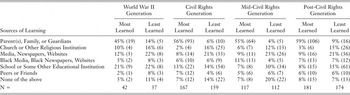
Turning to Table 3, we see that across all generations, the family is the foremost agent for socializing Black Americans about being Black in America. The next most frequent socialization agent for both WWII (twenty-one percent) and civil rights generation Black Americans (thirteen percent) is learning about race from a “school or some other educational institution.” For mid-civil rights generation Black Americans, the second most important socialization agent (with a distant eleven percent of respondents) is “Black media, Black newspapers, and Black websites.” While post-civil rights generation Blacks also report media as their second-most agent of racial socialization (nine percent), in contrast to the mid-civil rights generation, these media are among the broader public and not necessarily race-specific media outlets targeted toward Blacks.
Sources for Learning about Being Black in America

Source: 2007 National Political and Socialization Survey.
Note: Values on the scales are in the parentheses; percentages may not sum to 100 due to rounding.
When Black respondents are asked more specifically what sources they feel least contributed to their learning about being Black in America, as we may expect based on the virtual exclusion of Blacks from the broader public in early twentieth-century media discourse and perhaps even their educational experiences, WWII generation Blacks report equally the broader “media, newspapers, and websites” (twenty-two percent; although websites would not be applicable in this era) and “school or some other educational institution” (twenty-two percent) as their least socializing agents. Similarly, civil rights, mid-civil rights, and post-civil rights generation Blacks perceive the educational context as their foremost, least socializing agent, perhaps attesting to continuing educational issues to address the diverse circumstances, culture, and history of Blacks in even contemporary school curricula (Iruka and Barbarin, Reference Iruka, Barbarin, Neville, Tynes and Utsey2009).
Socialization about Black Group Status
Learning about the status of Blacks in a racially hierarchical society is a very important aspect of socialization about being Black in America. Part of this socialization includes messages that relay the extent to which racial discrimination has affected Blacks and their group status throughout American history and contemporary American society. Table 1 shows that seventy-two percent of respondents (n = 368) report that in their learning about being Black in America, they were socialized with “much emphasis” that “Black people have dealt with racial discrimination throughout history.” In addition, fifty-two percent (n = 267) report they learned “discrimination has affected Black people's advancement in society” with “much emphasis,” compared to thirty-two percent (n = 164) who were taught this message with “some emphasis.”
In combining these two measures into an additive scale of “socialization about Blacks' status in America,” this scale ranges from “0, none” to “8, much emphasis,” with a Cronbach's alpha coefficient of .61. Table 2 indicates that an overwhelming number of respondents were socialized about Blacks' status in the United States and with “high-emphasis” (eighty-three percent; n = 423). In fact, in view of all the racial socialization messages, it appears this message receives the most emphasis in Blacks' familial racial socialization experiences.
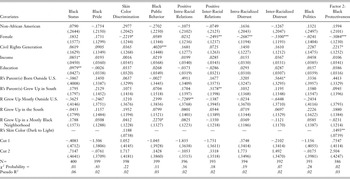
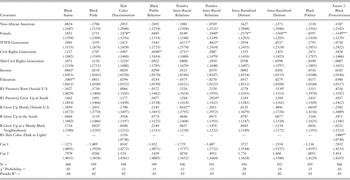
In both Tables 4 and 5, ordered probit regressions for Black status indicate that respondents with higher incomes and education levels report having received higher emphases on Black status messages. These results do not specifically say much about the socioeconomic status of the respondents' parents or family and the role they have in racial socialization messages, nor do the results offer a clear link between respondents' socioeconomic status and their parents' or family's. However, there has been some connection made between the higher socioeconomic status of parents and its influence on parenting styles, although as it must be stressed, this still does not draw a clear-cut link between parents' socioeconomic status and the eventual status of their children (Iruka and Barbarin, Reference Iruka, Barbarin, Neville, Tynes and Utsey2009). As for the influence of generational cohorts on socialization about Blacks' status in America, none of the effects are statistically significant.
Ordered Probit Models of Black Americans' Racial Socialization Messages (Comparison of Civil Rights Generation to Other Generations)

Source: 2007 National Politics and Socialization Survey
Note: Standard errors are indicated in the parentheses;
* p ≤ .10;
** p ≤ .05;
*** p ≤ .01;
**** p ≤ .001
Ordered Probit Models of Black Americans' Racial Socialization Messages (Comparison of Generations to Post-Civil Rights Generation)

Source: 2007 National Politics and Socialization Survey
Note: Standard errors are indicated in the parentheses;
* p ≤ .10;
** p ≤ .05;
*** p ≤ .01;
**** p ≤ .001;
a Just missed statistical significance at 90 percent confidence level
Socialization about Black Pride
In addition to receiving messages about the racial discrimination that Black people faced, an important component of socialization to overcome the vagaries and psychologically depressing effects of discrimination includes receiving messages about Black experiences for which one can be proud. According to Table 1, most respondents (fifty-eight percent (n = 297)) were taught with “much emphasis” that “Black people contributed to society.” Sixty percent of respondents also received heavy emphasis on the message that “Black culture and heritage are important.” Almost seventy percent state they were told “with much emphasis” that they “should be proud to be Black.”
Accounting for the results of the additive scale of Black pride, which comprises the three aforementioned measures (scaled 0 to 12; Cronbach's alpha coefficient = .81), Table 2 elucidates sixty-seven percent of the respondents received “high-level” emphasis on Black pride messages, followed by another thirty percent who received “medium-level” emphasis. Despite the high reliability of the scale, the covariates tested in the ordered probit regression models comparing civil rights generation racial socialization experiences to all the other generations (Table 4) and the post-civil rights generation experiences to all the other generations' experiences (Table 5) do not explain the model well, and none of the covariates are statistically distinguishable.
Socialization about Skin Color Discrimination
Colorism perpetrated among Blacks augments the discrimination that group members may face by non-Black people. It is a form of intraracial discrimination against Black group members (but also evident among many racial and ethnic groups) based on the complexion of one's skin, whether it is a darker or lighter hue (Hill Reference Hill2000; Russell et al., Reference Russell, Wilson and Hall1992). Much of the historical onus of colorism, however, befell Blacks with darker complexions, having greater relevance for women who were affected by colorism as a demarcation of beauty (Russell et al., Reference Russell, Wilson and Hall1992). Respondents were asked the extent of emphasis placed on the message, “Black people should treat one another differently based on whether or not they are light-skinned,” the sole indicator for the “Black discrimination/colorism” scale (scaled “0 to 4”).
Table 1 indicates almost half the respondents did not receive any emphasis on this racial socialization message. Moreover, a little over one-fifth of the respondents report that this message was “neither emphasized nor de-emphasized.” This message is the least emphasized racial socialization message, with Table 2 showing fifty-nine percent of respondents reporting conveyance of this message with “low-level emphasis.”
Comparing the racial socialization of civil rights generation Blacks to other generations, Table 4 shows there are no statistically different distinctions in what this generation learned about colorism versus the others. Women learn this message with distinctively less emphasis than men. Table 5, which shows the comparison of racial socialization messages of the various generations in comparison to post-civil rights generation Blacks indicates a modest difference in mid-civil rights generation Blacks learning less emphasis on colorism than post-civil rights/hip-hop generation Blacks.
Socialization about Black Behavior in Public
Historically, Black people also countered negative racial stereotypes attributed to Blacks. One way in which they opposed such negativized constructions was by displaying “appropriate” behavior in public (Gaines Reference Gaines1996; Higginbotham Reference Higginbotham1993). Two combined measures incorporate the “Black Behavior in Public” racial socialization scale (scaled 0–8; Cronbach's α = .74) concerning Black people's role in appropriating their behavior in public to avoid negative stereotyping: (1) “Black people should try to avoid behaviors that are characteristic of Black stereotypes,” and (2) “Black people should be sure to act properly when they are in public.”
According to the results in Table 1, forty-five percent (n = 227) of respondents received socialization about avoiding Black stereotypical behavior with “much emphasis,” compared to seventeen percent (n = 87) who state this message was “neither emphasized nor de-emphasized.” A majority of Black Americans (fifty-two percent; n = 264) received “much emphasis” on the message about Black people acting properly in public. In fact, Table 2 elucidates that seventy-one percent of Blacks report “high-emphasis” on the overall Black public behavior message.
Compared to other Black generational cohorts, civil rights generation Blacks received higher emphases on the Black public behavior socialization messages (Table 4). In fact, a member of the civil rights generation, with mean education and income, who has parents from the South, and personally grew up in a Black neighborhood is .11 more likely than other generations to have “high-level” socialization about Black public behavior. Modestly, those who grew up in predominately Black neighborhoods also received greater emphasis on this message (Table 4), although these effects disappear when we compare the experiences of the various generational cohorts to post-civil rights/hip-hop generation Blacks (Table 5). Notably, in comparing the civil rights generation to the post-civil rights generation, the effect of being in the civil rights generation remains, increasing the likelihood that one received greater emphasis on Black public behavior compared to post-civil rights generation Blacks.
Socialization about Positive, Black Intraracial Relations
Blacks in the United States comprise different ethnicities and have diverse cultural backgrounds. These experiences can unite or disunite members of the Black Diaspora in America (Assensoh Reference Assensoh, Alex-Assensoh and Hanks2000; Rogers Reference Rogers2006; Waters Reference Waters1999). Table 1 indicates Blacks' more variant experiences in socialization about Black intraracial relations, in particular, Blacks “having different ethnicities and they should work together.” While a greater number of respondents have received this message with “much” or “some” emphasis, still almost a quarter of respondents received messages that were “neither emphasized nor de-emphasized.” As far as socialization that “Black people should get along with one another” and that “Black men and women should treat one another well,” most Blacks received “much emphasis” or “some emphasis” on these messages. According to Table 2, most Blacks received “high-emphasis” (fifty-two percent; n = 262) on the additive scale for the Black intraracial relations message, compared to forty-four percent (n = 222) who reported “medium-emphasis.”
In the model comparing civil rights generation socialization experiences to the other generational cohorts (Table 4), only the factor of a Black person growing up outside the United States reduces emphasis on Black intraracial relations. Perhaps this is because race relations outside the United States are structured differently (especially in majority-Black societies) such that building intraracial relations does not prove useful as a political resource. Turning to Table 5, however, which compares the generational cohorts' experiences with post-civil rights/hip-hop generation Blacks, we see, in addition to outside-U.S. contextual influences decreasing the likelihood that one was socialized about positive intraracial relations, being a member of either the WWII or civil rights generation increased one's likelihood of having been socialized with greater emphasis on building positive, intraracial relations. In fact, a WWII generation Black person with mean income and education, who grew up in a Black neighborhood, with parents who were from the South has .23 more probability of having received “high emphasis” on this message compared to a post-civil rights generation Black person with the same characteristics. This generational difference seems commensurate with some of the Black political discourse exchanged among Black political leaders about pan-ethnicity and building cross-cultural and political ties with other Blacks around the world during these groups' formative developments (Abdul-Raheem Reference Abdul-Raheem and Abdul-Raheem1996; Von Eschen Reference Von Eschen1997).
Socialization about Positive, Interracial Relations
In addition to Black people being socialized about getting along with their own racial group members, being Black in America involves exposure to messages about getting along with other racial groups. The institutions of slavery and Jim Crow intimately, yet sordidly, interconnect the histories of Blacks and Whites in America. These historical references also heavily influence Blacks' sociopolitical orientations even today (Dawson Reference Dawson1994). They also play a crucial role in parents preparing children to defend themselves against discrimination in contemporary society, perhaps in some instances leading to messages that stress getting along with other racial groups or selectively distrusting them. However, all messages about Whites do not necessarily have to connote preparedness for discrimination only. Dually, parents can inculcate their children with messages about getting along with Whites as a means of balancing preparation for the uncertainties of racial discrimination with getting to know people with an open mind. Messages about race can include those that prepare children for positive interactions with Whites but also with other racial groups that have shared historical circumstances based on their racial minority status (Harris Reference Harris1995). Such messages might, thusly, emphasize that “Black people should get along with Whites;” that “Black people should get along with other racial minorities;” and that “Blacks should build positive relationships with other minorities.”
As noted in Table 1, most of the respondents, or thirty-two percent (n = 161) report they received “much emphasis” on getting along with Whites. Yet, almost a quarter of respondents (n = 120) report this message was “neither emphasized nor de-emphasized.” Only five percent (n = 26) of respondents report not having received any emphasis at all about this message. Thirty percent of Blacks (n = 153) report receiving “much emphasis” on “getting along with other racial minorities.” Meanwhile, a little over one-quarter of the sample (twenty-seven percent; n = 136) claim this message was “neither emphasized nor de-emphasized” in their racial socialization. An equal percentage of respondents were taught “Blacks should build positive relationships with other minorities,” with “much emphasis” as they were taught with “neither emphasis nor de-emphasis” about this message. In the display in Table 2 of the three-level results of the additive scale of positive interracial relations (scaled “0 to 12”), it is evident that most Blacks received “medium-level” emphasis on messages about interracial relations (sixty-one percent; n = 306), with a third (n = 165) receiving “high emphasis.”
According to Table 4, only two covariates statistically predict Blacks' racial socialization about positive, interracial relations—gender and respondents having parents who grew up in the South. More specifically, Black women received less emphasis than Black men on building interracial relations, whereas Blacks with Southern-rooted parents also seemed to emphasize more racial harmony. Being a post-civil rights generation Black woman, for example, with mean income and education, who grew up in a Black neighborhood, with parents who were from the South, reduces the probability she received “high emphasis” on this message by .08 probability. She is most likely to receive “medium-level” emphasis on positive, interracial relations—a sixty-six percent probability. Both relationships seem to suggest parental concerns about how their children may navigate race based on gender and perhaps how context might influence parents' values about race relations. Although Southern-rooted parents might intuitively socialize their children more in preparation for bias or discrimination because of the historical nature of discrimination in the South and perhaps maybe even their own personal experiences with discrimination in this context, it appears parents still reserve hope for positive race relations to be stressed for their children's interracial interactions. In the ordered probit regression model of Black intergroup relations featured in Table 5, the comparison of the generations to the post-civil rights generation indicates a modest difference between WWII generation Blacks learning more emphasis about positive interracial relations than the post-civil rights generation.
Socialization about Intraracial Distrust
Despite Blacks feeling a linkage with other Blacks based on race, group members still may feel less inclined to trust fellow group members. However, as noted in Table 1, most Blacks received “no emphasis at all” on racial socialization messages that conveyed “not trusting other Blacks”—thirty-six percent (n = 181). Another thirty percent (n = 152) report this message was “neither emphasized nor de-emphasized.” Yet, seventeen percent (n = 85) of respondents state that they, in fact, received “some emphasis” on this message. Most Blacks did not receive emphasis at all about “being suspicious [of] working with Caribbeans and Africans” (forty-two percent; n = 211), and twenty-eight percent (n = 141) report this message was “neither emphasized nor de-emphasized.” Table 2 elucidates intraracial distrust is mostly a “low-level” emphasized racial socialization message, and the only statistically distinguishable covariate is gender, with women learning the message with less emphasis than men for both comparisons of the generations to the civil rights generation and to the post-civil rights generation.
Socialization about Interracial Distrust
In comparison to messages about trust in Blacks, as we see in Table 1, most respondents were not told messages emphasizing distrust in Asian Americans (forty percent; n = 204) and Latinos (forty-seven percent; n = 241). However, most of the interracial distrust messages appear to refer more specifically to Whites, although moderately. As far as messages emphasizing “keep(ing) their guard up when they are among Whites,” more Blacks received this message with “some emphasis” (thirty-four percent; n = 171).
The additive measure combining messages about Whites, Asians, and Latinos into a scale of interracial distrust (0–16, featured in Table 2) reveals that most respondents (fifty-seven percent; n = 283) received only “medium-level” emphasis about interracial distrust, followed by twenty-eight percent (n = 139) who received “low-level” emphasis on this message. Only fifteen percent of the respondents (n = 75) report having received “high-emphasis” on interracial distrust. As for the ordered probit models of the interracial distrust scale, Black women received this message with less emphasis than Black men in both the models comparing the civil rights generation and the post-civil rights generation with other generations. For both models, having a parent who was born outside the United States increased emphasis on messages advocating distrust of non-Black racial groups. For instance, being a Black woman in the post-civil rights generation, with mean income and education, who grew up in a non-Black neighborhood, with parents who are from outside the United States reduces the probability that she received “high emphasis” on this message by .11 probability.
Socialization about Black Politics
According to Dawson (Reference Dawson1994), racial socialization informs Black-linked fate, or the linkage of the political interests of individual Black Americans to the political interests of the larger Black racial group. In this analysis, racial socialization messages that focus on Black politics include emphasis on (1) fighting discrimination; (2) thinking about how politics affect Black people as a group; (3) considering ways to advance Blacks in society; and (4) starting Black businesses to advance Black people's lives.
As noted in Table 1, the most highly emphasized message about Black politics is that “Black people should fight against racial discrimination.” Almost four-fifths of respondents report having received “much emphasis” on this message. In Table 2, across the several messages that are combined into a “socialization about Black politics” scale (scaled 0–16), a large percentage of respondents (seventy-four percent; n = 368) report “high emphasis” on racial socialization about Black group politics. In the ordered probit regression of Black group politics in Table 4, unfortunately, none of the variables in the model predict receiving emphases on this racial socialization. However, in Table 5, modest effects of growing up outside the United States reduce the likelihood a Black person was socialized about Black politics.
Socialization about Racelessness
While racial socialization implies that one learns specifically about the ways that race affects one's livelihood, it can also take the form of emphasizing the extent to which race and perceptions of racism should not be central in one's life. For one, in learning that “Blacks should not care about what other racial groups think about them,” this suggests that in not thinking about what other racial groups think, one is able to live comfortably without considering the effect that race, racial distinction, or racial disparagement may have on one's life. Second, in one learning that “Blacks should think less about race and racism,” this implies that Blacks focus too much on race. It also can imply that in thinking less about race, Blacks may fare better because focusing too much on racial limitations can become an impediment to individual and Black group progress. Lastly, with historic hierarchical relationships between Blacks and Whites and continuing effects of White supremacy and White privilege, all White group members may be perceived as culpable in Blacks' historic and contemporary racial discrimination (Bonilla-Silva Reference Bonilla-Silva2001), In other words, without discretion, Blacks may attribute all Whites to be racists. A racial socialization message that counters this attribution would teach that “all Whites are not racist.” In sum, Black Americans also can be socialized that (1) they should not care about what other racial groups think about them; (2) that they should think less about race and racism; and (3) that they should not think that all Whites are racist—messages that emphasize “racelessness.”
Most Blacks' socialization about “not caring about what other racial groups think about them” and “thinking less about race and racism” was “neither emphasized nor de-emphasized.” As far as “thinking less about racism,” just over one-fifth of Blacks did not receive any emphasis at all on this message. Two-thirds of Blacks, however, received emphasis on the message that “not all Whites are racist” (see Table 1). In the additive scale combining all the measures of racelessness (from 0 to 12; featured in Table 2) most respondents, or seventy-three percent (n = 365), report “medium-level” emphasis on messages about racelessness. Yet, respondents almost equally received “low-level” emphasis (twelve percent; n = 58) and “high-level” emphasis (fifteen percent; n = 77) on messages about racelessness. Unfortunately, the Cronbach's alpha coefficient for the “racelessness” scale (α = .46) does not meet conventional standards.
Overall Racial Socialization: An Anomalous Post-Civil Rights Generation?
In learning about race and being Black in America, ten racial socialization scales were developed—Black status, Black pride, colorism, Black public behavior, positive intra-racial relations, positive inter-racial relations, intra-racialized distrust, inter-racialized distrust, Black politics, and racelessness. The least constitutive and reliable scale is racelessness. However, when nine of the racial socialization measures (excluding “racelessness”) are combined into a larger scale of “Black racial socialization (4 “low” to 96 “high;” Mean = 63; Std dev. = 14),” the Cronbach's alpha coefficient is .76. Factor analysis of the scale reveals two resultant factors: Factor 1/Black Consciousness (Black status, Black pride, Black public behavior, intraracial relations, interracial relations, and Black politics; Eigenvalue = 3.73) and Factor 2/Black Protectiveness (colorism/Black discrimination, intraracial distrust, interracial distrust; Eigenvalue = 2.15).
The ordered probit regression for Factor 1/Black Consciousness (Chi-square probability = .27) has a poorer fit than the Factor 2/Black Protectiveness models (Tables 4 and 5). Nevertheless, in this Factor 1/Black Consciousness model, the civil rights generation received socialization about Black consciousness more than both the post-civil rights generation and the other generations combined (results are not shown). Post-civil rights generation Blacks still have approximately a .82 probability of receiving “high-level” emphasis on Black consciousness, with civil rights generation Blacks' socialization having a .07 greater probability.
Tables 4 and 5 feature results for Factor2/Black Protectiveness. While there are no generational differences between the post-civil rights generation and the other generations in Black protectiveness socialization in Table 5, there is a modest generational difference between the civil rights generation and other generations combined in Table 4. Black women also received “Black protectiveness” messages with less emphasis than Black men. Interestingly, persons with “lighter” skin hues were socialized about this message more emphatically than those with “darker” skin hues. For example, a non-civil rights generation Black woman, with mean income and education, who has parents from the South, who grew up in a Black neighborhood, who has a “brown-skin” tone, has a fifty percent probability of receiving “medium-level” emphasis on this message, compared with a forty-five percent probability of receiving “low-level” emphasis on this message. Moving from the non-civil rights generation to the civil rights generation increases this probability of receiving “medium-level” emphasis by .05 probability. Moving from a very dark skin tone to a very light skin tone increases learning this message with “medium-level” emphasis by .17 probability, but it also reduces learning this message with “low-emphasis” by .23 probability.
These results suggest that the post-civil rights generation received lower emphasis on Black consciousness racial socialization compared to the civil rights generation. The Black consciousness message transmission, however, is not distinct from Black people representing other generations. As for Black protectiveness racial socialization, the post-civil rights generation does not have distinct racial socialization experiences from each of the other generations. But, uniquely, the civil rights generation received more emphasis on protectiveness messages than other generations. Thus, the post-civil rights generation does not generally have more anomalous emphases on certain racial socialization than other generations. Rather, contrary to popular debates that focus on “difference” among the post-civil rights generation, the civil rights generation is more anomalous.
CONCLUSION
A Black Generational Divide: Is There Reason for Debate?
Black political elites have entertained whether Black youth harbor a commitment to Black sociopolitical advancement. Couched in this discourse is an underlying assumption that somehow Black youth do not know or understand race in ways that are beneficial to the Black racial group. Moreover, a broader understanding appears to be that younger Black Americans do not have a commitment to Black group advancement similar to the one of civil rights generation Black Americans, or older Blacks, in general. Rather, there appears to be a belief that younger Black Americans exhibit behavior that is deleterious to the Black racial group.
While the data analysis in this paper does not examine the behavior of younger Black Americans and their individualized commitment to racial group politics, it does offer a glimpse of the sources of younger Blacks' racial knowledge through analyzing a major antecedent of Black political consciousness—racial socialization. This paper assesses the sources of learning about being Black and compares the emphases several generations of Blacks received on ten scales of racial socialization messages about being Black in America. In particular, this paper analyzed how younger, post-civil rights generation/hip-hop generation Black Americans (ages 19–42) received socialization about race and to what extent this socialization was different from older generations of Black Americans—WWII (ages 67 and up), civil rights (ages 54–66), and mid-civil rights (ages 43–53) generation Blacks. The paper also compared racial socialization experiences of civil rights generation Blacks in comparison to other generations combined to assess whether this generation learned socialization differently.
The results, overall, suggest that certain generations were taught specific messages distinctly and more or less emphatically than the post-civil rights generation—(1) colorism (mid-civil rights generation, less); (2) Black public behavior (civil rights generation, more); (3) positive, intraracial relations (WWII and civil rights generations, more); (4) positive interracial relations (WWII generation, more); and (5) Black consciousness racial socialization (civil rights generation, more). Most generational differences are between the civil rights generation and the post-civil rights generation. According to the results in this analysis, generational difference occurs in four of the ten proposed socialization scales, with additional distinction in socialization about factors emerging from the factor analysis of a composite racial socialization scale.
In several instances, the models for the scales of racial socialization, however, have less reliable fits for the data, and some models do not predict any statistically significant predictors, whatsoever. Some of the results, therefore, must be interpreted cautiously. Nonetheless, this exploratory analysis reveals results that indicate generational differences in racial socialization experiences that encapsulate some of the basic controversies over generational differences mentioned in popular Black political discourse. For example, many of the arguments about Black sociopolitical advancement discuss whether certain behaviors displayed by Black Americans detract from the racial group's progress. While these arguments often center on the behavior of working class and poor Black Americans, discourse about negative Black imagery in hip-hop complicates the class question with the behavior of young Black Americans. This analysis finds evidence supporting generational differences in how post-civil rights/hip-hop generation Blacks were socialized about Black public behavior, or “behaving properly” in public as a Black person. Post-civil rights generation Blacks received less emphasis on Black public behavior than civil rights generation Blacks.
This result fits neatly into the research of Gaines (Reference Gaines1996), who submits that discourse about Black public behavior historically divided Black Americans along class lines (herein, along generational lines), as Blacks disparaged the Black poor based on a “racial uplift” ideology, which emphasized a vision of Black politics that would counter negative stereotypes about Blacks in the American mainstream by focusing on the display of “proper Black behavior” to support Blacks receiving full citizenship rights during the early twentieth century. Racial uplift ideology, then, occurred during political times that civil rights generation Blacks would have been a part, as such negative imagery would have been prevalent almost as a default imagery of Blackness during the coming of age of civil rights generation Blacks. Surprisingly, however, such messages do not resonate more with WWII generation Blacks, who should have learned such messages more emphatically to counteract democratic discrepancies during the WWII era. While this negative imagery was depicted during an era of inequality, still these images exist (Bogle Reference Bogle2004). However, how the parents of one generation felt about the depiction of these images and relaying caution about not behaving stereotypically appears to have been less emphatic for one generation of Black Americans (civil rights generation) versus another (post-civil rights generation), as younger Black Americans received less emphasis on this message.
Second, WWII and civil rights generation Blacks received more emphatic messages about positive intraracial relations than post-civil rights generation Black Americans. Such racial socialization messages entailed working together with American, African, and Caribbean Black people, Black men and women treating one another well, and Black people getting along with one another, in general. In all, these messages focus on maintaining positive relations in the community based on ethnicity, gender, and race, and they can be critical for retaining Black communal resources necessary for politics. Although these resources would be important in any moment in Black Americans' political mobilization experiences, especially, we would think that such resources would have been essential to the structure of the Black public sphere (Dawson Reference Dawson2001) and a philosophy about a mass movement such as the Civil Rights Movement. That younger Black Americans received emphasis on intraracial relations messages less than the WWII and civil rights generation Black Americans might suggest that Black parents of the post-civil rights generation had less interest in conveying this message about the Black experience in America. What effect this difference in racial socialization experiences may have on younger versus older Black Americans' communal outlook, however, remains untested in this analysis.
Third, there is limited evidence for the civil rights generation having received more emphasis on various racial socialization messages than other generations. The civil rights generation only received more emphatic racial socialization about Black public behavior and Black consciousness compared to other Black generations. Ideally, numerous differences in racial socialization between the civil rights generation and other generations might suggest a unique cohort experience in their racial socialization compared to other generations, perhaps contributing to knowledge networks that undergirded some of the unique political consciousness and activism among a generation of Blacks who transformed American politics by protesting against de jure and de facto inequality and contributing to social movements that molded modern equality for oppressed groups. Support for unique parental influences on this group's consciousness and activism, however, seems less distinctive comparative to other generations, although distinctions still exist.
In another sense, perhaps the informational, contextual, and relational influences of Blacks who came of age during this era uniquely influenced their historic contribution to American society, attesting to the applicability of “period effects” and historic events (major judicial cases challenging inequities and racial discourse about contradictions in democratic theory and practice, ills of colonialism, and liberation) on civil rights generation Blacks' racial socialization. Civil rights generation Blacks also contributed to these intellectual and discursive enterprises, making them perhaps more tangible than previous generations and more accessible to later generations.
Fourth, in assessing factors underlying composite racial socialization messages, two factors emerge: Black Consciousness and Black Protectiveness. These factors seem to serve two purposes: (1) educating Blacks about the influence of race on their groups' social, political, and economic experiences, and (2) preparing Blacks for uncertain, negative interactions with fellow Blacks and non-Blacks. While there is modest support for generational differences between post-civil rights and civil rights generation Blacks in socialization about Black consciousness, the better fitted model of Black protectiveness indicates no such generational differences. Moreover, as far as Black protectiveness socialization, civil rights generation Blacks only modestly received more emphasis on these messages than other generations.
The modest distinction between post-civil rights generation and civil rights generation Blacks notwithstanding, relates to one of the core arguments about younger Black Americans—that they do not understand being Black in America similarly to previous generations. This result does not offer evidence for how much post-civil rights generation Black Americans psychologically process race in America. It does offer, nonetheless, greater detail as far as how much Black American families emphasize racial socialization among younger Blacks. For political scientists and even Black political leaders, this modest generational divide makes salient the need to assess how parental messages about race and emphases on them influence future generations' Black identity, political consciousness, and political resources for mobilization.
Ergo, contrary to the popular discussion that implies that young Black Americans also have learned different messages about race in America, this paper finds that in many instances, the racial socialization experiences of post-civil rights generation Black Americans appear to be similar to other Black generations. Most generational cohorts share in receiving socialization the most about race from their parents, family, or guardians. However, more generational distinctions evince as far as the secondary sources of learning about being Black in America, with younger generations of Black Americans pinpointing media outlets more than educational institutions as their secondary socialization agents. This perhaps speaks to the growing influence of different kinds of media on younger Black Americans' racial learning. Moreover, while similar messages are learned across these generations, differences emerge, however, with regard to the level of emphasis that these messages were stressed during these racial socialization experiences.
Several generations of Black Americans received racial socialization messages that helped them navigate their Blackness in America. What is important to note is that the civil rights generation is the generation that came of age during an era where their political contributions made large institutional changes unlike other generations. Perhaps factors other than their racial socialization experiences explain these advancements. Then too, maybe post-civil rights generation Black Americans are coming of age during an age of politics that requires different emphatic racial socialization messages from civil rights and mid-civil rights generation Black Americans but with a more basic appreciation of “Black community.” The point remains; younger Black Americans are still receiving the messages, but they are just emphasized less by their families than they were among older Black Americans' families. Again, the eras of politics differed as far as the importance of Black communality.
Increasingly, cross-sectional issues (i.e. class, gender, sexuality) within the Black community test the “boundaries of Blackness” in modern Black politics (Cohen Reference Cohen1999; Price Reference Price2009). If the political times dictate racial socialization, then maybe young Black Americans, particularly post-civil rights/hip hop generation Black Americans, are receiving messages about race in ways that are congruent with the way race was functioning during the political era in which they came of age, again attesting to the effect that period effects have on the socialization of children but also the racial socialization practices of their parents.
What also is critical for interpreting these results and assessing their implications is the fact that older generation Blacks and post-civil rights generation Blacks do not live in a vacuum. Not only do they interact with one another in Black sociopolitical spaces, but most notably, civil rights generation and mid-civil rights Black Americans more than likely are the direct progenitors of the post-civil rights generation as either parents or grandparents who would have influenced the kinds of racial socialization that post-civil rights generation Black Americans (including both mid-civil rights generation and post-civil rights/hip-hop generation) received.
With this said, arguments that point to the seemingly deleterious conditions of younger Black Americans should inadvertently point to the influence that civil rights generation Black Americans and mid-civil rights generation Black Americans had (have) on the transmission of messages that structure younger Black Americans' political orientations. Simply put, the finger-pointing about post-civil rights/hip-hop generation Black Americans can not occur without reflection upon the role that prior generations of Black Americans had in socializing them about being Black in America and the politics related to being Black in America. In turn, these parent-child racial socialization messages can influence their political world views as Black Americans. Still, post-civil rights generation Black Americans have the will to incorporate and value differently racial socialization messages into their own Black psyche. Emphasis added, maybe this is where the generational difference lies—the value placed on fulfilling these cultural prophecies.
The research, herein, contributes some results to the Black politics and political socialization literature that can offer interesting segues into the study of Black political psychology among different age cohorts of Black Americans. Future research should examine how Black parents and families decide to emphasize some racial socialization messages over others. In other words, how do Black parents and families assess the “value” of racial socialization messages, especially in their racial socialization transmission with girls versus boys? Do different eras of politics usher in different approaches to Black parents' and families' considerations of racial socialization messages and their emphases? How much do respondents agree with the messages they were taught about race and to what extent would they incorporate these messages into the socialization of their own children? Moreover, how do Black children sort through these racial socialization messages, and similarly, sort through their own, personal racial socialization experiences that they learn through interacting with different racial groups and through experiencing race and racism? Even greater, in an era post-election of the first African American president in the United States, how does this influence or even change prior socialization messages about racial discrimination and group advancement in America? In other words, will racial socialization messages transmitted to children in a generational cohort including the election of President Barack Obama produce distinct historic period effects and generational differences among “Obama generation” Black Americans?Footnote 1
While this paper opens the door for these several inquiries, there are still limitations of this research. For one, data from web-based surveys present a host of issues that may bias samples, especially as far as skewed socioeconomic status and the confounding effect it has on limiting potential respondents' accessibility to participate in a survey that requires having a computer and access to the Internet (Couper Reference Couper2000). Moreover, while the sample in the NPSS offers statistical matching based on gender and age characteristics for each group and offers a diverse Black sample, the sample still does not reflect a representative sample, thus, limiting the generalizability of the results to the U.S. Black population. Respondents also are asked to recall their racial socialization experiences. Thus, the responses may reflect how much and how well respondents remember their racial socialization experiences. Respondents also may selectively remember emphases on certain racial socialization messages. In hand, the questions in this analysis do not tap into a different kind of racial socialization—racial etiquette—that WWII and civil rights generation Black Americans may have learned in order to navigate discrimination experiences during Jim Crow (Ritterhouse Reference Ritterhouse2006). Some of these messages may still be important for younger Black Americans to navigate being Black in America, although the consequences of defying racial etiquette may not be as severe as those of times past. Even the models for racial socialization still can be improved for better fit and inclusion of better explanatory factors.
Racial socialization studies such as this one, however, offer important implications for examining influences on Black identity and Black political consciousness. Most importantly, as even popular discourse about generational differences among Black Americans suggests, more studies should investigate generational cohorts and change and continuity in socialization and social and political behavior among Black Americans.
APPENDIX
NPSS Descriptive Statistics of Survey Sample

Source: 2007 National Politics and Socialization Survey.
Note: Raw numbers are included in parentheses.
a While respondents were informed about the survey being one on Black American social and political attitudes, the survey was open to respondents who self-identified as such. The diversity of Black ethnicity in the survey reflects those who identify as being of African descent, including those who identify as “African American,” “West Indian/Caribbean,” “African,” “Black.”